INTRODUCTION
Microalgae are photosynthetic microorganisms that have the ability to convert sunlight and carbon dioxide (CO2) to highly valuable biomass. Algal biomass production has advantages such as use of water that is unsuitable for humans and minimum competition for land with crops. Due to their contents of essential amino acids, fatty acids and other health-promoting nutrients, microalgae are attractive feeds or feed supplements for livestock (Janczyk et al. Reference Janczyk, Langhammer, Renne, Guiard and Souffrant2006).
Chlorella vulgaris is a single-celled freshwater microalgae and contains the highest amount of chlorophyll of any common plant, with protein content of about 600 g/kg dry matter (DM) and 18 amino acids as well as vitamins and minerals (Radhakrishnan et al. Reference Radhakrishnan, Bhavan, Seenivasan, Shanthi and Muralisankar2014; Kholif et al. Reference Kholif, Elghandour, Salem, Barbabosa, Márquez and Odongoin press). Moreover, it contains some other important dietary components such as unsaturated fatty acids (UFA), glycoproteins and carotenoids (Janczyk et al. Reference Janczyk, Langhammer, Renne, Guiard and Souffrant2006). Chlorella vulgaris contains a phyto-nutrient called Chlorella Growth Factor (CGF), comprised mainly of nucleic acids and other essential substances, with detoxification and antioxidant properties (Han et al. Reference Han, Kang, Kim and Kim2002). Two recent studies (Anele et al. Reference Anele, Yang, McGinn, Tibbetts and McAllister2016; Tsiplakou et al. Reference Tsiplakou, Abdullah, Skliros, Chatzikonstantinou, Flemetakis, Labrou and Zervas2016) reported that C. vulgaris improved bacterial growth and a shift in the ruminal biohydrogenation pathway by stimulating production of trans C18:1, trans-11 C18:1 fatty acids, monounsaturated (MUFA) and polyunsaturated fatty acids (PUFA).
It was hypothesized that inclusion of C. vulgaris microalgae in the diet of goats would improve feed utilization and milk production. The objective of the present study was to compare the effect of feeding two levels of C. vulgaris on feed utilization, milk production, rumen fermentation and blood chemistry of Damascus goats.
MATERIALS AND METHODS
Goats were cared for and handled in accordance with the Guide for the Care and Use of Agricultural Animals in Research and Teaching (FASS 2010). The trial was conducted at the experimental farm of Animal Production Research Institute (Egypt) and at the laboratory of dairy animal production, National Research Centre (Egypt). This area has an average annual rainfall of 22 mm and mean annual temperature between 14 and 28 °C.
Chlorella vulgaris microalgae
Lyophilized C. vulgaris biomass was obtained from the algal biotechnology unit, National Research Centre (Egypt). Inoculum was prepared as described by El-Sayed et al. (Reference El-Sayed, Abdalla and Abdel-Maguid2001) using BG-II growth medium (Stainer et al. Reference Stainer, Kunisawa, Mandel and Cohen-Bazire1971). Continuous light illumination was provided from daylight lamps (10 × 40 w). Aeration was achieved using an oil-free air compressor (HIBLOW AIR PUMP, type SPP-100GJ-H, Japan) through a 3-mm polyethylene tube. Room temperature was adjusted to 27 ± 2 °C during the whole incubation period. Incubation was carried out using fully transparent polyethylene bags (75 × 5 cm2 and 100 µm thickness) containing 2·5 litres of algal broth. Mass production of C. vulgaris was performed within a 1000-litre Zigzag photobioreactor (El-Sayed et al. Reference El-Sayed, Battah and Wehedy2015). For harvesting and cleaning of the obtained biomass, a series of precipitation and washing was performed using tap water and a cooling centrifuge (RUNNE, HIDEBERG, RSV-20, Germany).
Chlorella vulgaris was analysed for fatty acids using fatty acid methyl esters prepared by base-catalysed methanolysis of the glycerides (potassium hydroxide [KOH] in methanol). A Perkin-Elmer chromatograph (model 8420, Beaconsfield, Perkin Elmer, Beaconsfield, UK) equipped with a flame ionization detector was used. Helium was the carrier gas at 30 cm/sec, column temperature was initially 150 °C for 1 min, and then increased by 4 °C/min to 200 °C, and was then held at 200 °C for 10 min. Peaks in chromatographs were identified and quantified using pure methyl ester standards (Sigma-Aldrich Inc., Bellefonte, PA, USA). The fatty acid profile was (/kg DM): 18·5 g C14:0, 525·6 g C16:0, 158·8 g C17:1, 88·3 g C18:0, 54·2 g C18:1, 65·6 g C18:2, 88·7 g C18:3, 632·4 g total saturated fatty acids (SFA) and 367·3 g total UFA.
The amino acid profile of C. vulgaris was determined as described by Spackman et al. (Reference Spackman, Stein and Moor1958). Analysis was performed using an LC 3000 amino acid analyser (Eppendorf-Biotronik, Maintal, Germany) at the Central Service Unit, National Research Centre, Egypt. The analysis was based on the separation of amino acids using strong cation exchange chromatography followed by the ninhydrin colour reaction and photometric detection at 570 nm. The amino acids content was (/kg DM): 105 g aspartic acid, 52·4 g threonine, 50·8 g serine, 107 g glutamic acid, 51·0 g glycine, 84·4 g alanine, 64·4 g valine, 15·0 g methionine, 50·1 g isoleucine, 68·4 g leucine, 52·0 g tyrosine, 42·0 g phenylalanine, 50·2 g histidine, 56·0 g lysine, 82·0 g arginine and 64·0 g proline.
Goats, feeding and experimental design
One week after parturition, 15 multiparous lactating Damascus goats (44 ± 0·8 kg body weight) were assigned randomly to three experimental groups (five goats per treatment) for 12 weeks. The experimental design was a completely randomized design. Goats were housed individually in soil-surfaced pens (1·5 m2/goat), with unrestricted access to water and experimental diets to meet their energy and nutrient requirements according to NRC (2007) recommendations. Adjustments were made to the diets to ensure collection of orts.
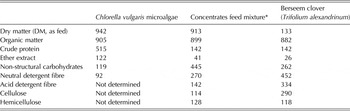
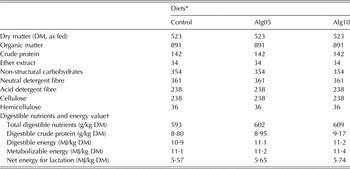
The basal diet fed to the goats contained (/kg DM) 500 g of Egyptian berseem clover (Trifolium alexandrinum) and 500 g of concentrates feed mixture (containing per kg DM: 250 g un-decorticated cotton seed meal, 350 g wheat bran, 300 g maize, 30 g rice bran, 30 g molasses, 20 g limestone, 10 g urea and 10 g salt). Chemical composition (g/kg DM) of ingredients fed to the Damascus goats is shown in Table 1. Chemical composition (g/kg DM) and nutritive value of experimental diets fed to the Damascus goats are shown in Table 2.
Chemical composition of ingredients fed to lactating Damascus goats (g/kg DM)

* Consisted of (/kg DM): 250 g cotton seed meal, 350 g wheat bran, 300 g maize, 30 g rice bran, 30 g molasses, 20 g limestone, 10 g urea and 10 g salt.
Chemical composition and nutritive value of experimental diets fed to the lactating Damascus goats (g/kg DM)

* The basal diet based on 500 g/kg DM of concentrates feed mixture and 500 g/kg DM berseem clover (Trifolium alexandrinum) without addition of Chlorella vulgaris microalgae (Control) or with addition of Chlorella vulgaris microalgae at 5 (Alg05) and 10 (Alg10) g/goat/day.
† Calculated according to (NRC 2001) using the obtained nutrients digestibility coefficients.
Goats were supplemented with C. vulgaris at 0 (Control), 5 (Alg05) and 10 g/goat/day (Alg10). Diets were offered to each goat individually at 08.00 and 16.00 h in two equal portions. Daily allocation of C. vulgaris for each goat was mixed with the diet individually and fed at 08.00 h. Samples of the berseem clover and concentrate mixtures were taken daily, composited weekly and dried at 60 °C in a forced-air oven for 48 h. Samples were ground to pass a 1-mm screen using a Wiley mill and then stored for chemical analysis.
Digestibility and chemical analysis
Three digestibility trials were conducted at the 4th, 8th and 12th week (7 days for each collection period) of the experiment. During these periods, DM intake was recorded daily by weighing feeds offered and orts. Faecal grab samples were collected twice daily at 07.00 and 15.00 h, dried at 60 °C in a forced-air oven for 72 h (AOAC 1997, method 930·15) and pooled by goat within period. An acid-insoluble ash was used as the internal indigestibility marker (Sales & Janssens Reference Sales and Janssens2003). Acid-insoluble ash contents of feeds and faeces were determined gravimetrically after drying, ashing, boiling of ash in hydrochloric acid (HCl), filtering and washing of the hot hydrolysate, and re-ashing. Coefficients of digestion were calculated according to Ferret et al. (Reference Ferret, Plaixats, Caja, Gasa and Prio1999). Digestible nutrients and energy value of diets were calculated according to NRC (2001).
Feed, orts and faecal samples were ground through a 1 mm screen using a Wiley mill (Arthur H. Thomas, Philadelphia, PA, USA) and analysed for DM (method 930·15), ash (method 942·05), nitrogen (N; method 954·01) and ether extract (EE; method 920·39), according to AOAC (1997) official methods. Neutral detergent fibre (NDF) was determined by the procedure of Van Soest et al. (Reference Van Soest, Robertson and Lewis1991) without the use of alpha amylase but with sodium sulphite. Acid detergent fibre (ADF) was analysed according to AOAC (1997; method 973·18). Acid detergent lignin (ADL) was analysed by solubilization of cellulose with sulphuric acid in the ADF residue according to Van Soest et al. (Reference Van Soest, Robertson and Lewis1991). Non-structural carbohydrates (NSC; [NSC (g/kg DM) = 1000 − ((NDF (g/kg DM) + crude protein (CP; g/kg DM) + EE (g/kg DM) + ash (g/kg DM))], cellulose [cellulose (g/kg DM) = NDF (g/kg DM) − ADL (g/kg DM)], hemicelluloses [hemicellulose (g/kg DM) = NDF (g/kg DM) − ADF (g/kg DM)] and organic matter (OM; [OM (g/kg DM) = 1000 − ash (g/kg DM))] were calculated.
Sampling and analysis of rumen fluid
On day 7 of the 8th and 12th week of the experiment, ruminal contents were sampled at 3 h post-morning feeding to determine pH and concentration of fermentation end-products. Rumen contents (~100 ml) were collected once from the ventral sac by using a stomach tube and hand pump, and then composite samples taken from each goat were strained through four layers of cheesecloth. The pH of ruminal fluid was measured immediately using a pH meter (HI98127 pHep®4 pH/Temperature Tester, Hanna® instrument, Italy).
A sub-sample of 5 ml was preserved in 5 ml of 0·2 M HCl for ammonia-N analysis and 0·8 ml of rumen liquor was mixed with 0·2 ml of a solution containing 250 g of metaphosphoric acid/l for total volatile fatty acid (VFA) analysis. Samples were stored at −20 °C until laboratory analysis. The concentration of ruminal ammonia-N was determined according to AOAC (1997; method 954·01). Total VFA concentration in samples was determined by titration, after steam distillation of a 4 ml sample according to Annison (Reference Annison1954). The molar proportions of the individual VFA were measured by gas-liquid chromatography (Varian 3700; Varian Specialties Ltd, Brockville, Ontario, Canada). Separation was carried out with a capillary column (30 m × 0·25 mm internal diameter, 1 m film thickness, Supelco Nukol; Sigma–Aldrich, Mississauga, ON, Canada) and flame ionization detection. The column temperature was adjusted to 100 °C for 1 min, then increased by 20 °C/min to 140 °C, then by 8 °C/min to 200 °C and held at this temperature for 5 min. The injector temperature was 200 °C while the detector temperature was 250 °C. Helium was used as the carrier gas.
Sampling and analysis of blood serum
On day 7 of the 8th and 12th week, blood samples (10 ml) were taken 4 h after feeding from the jugular vein of each goat into a clean dry tube, without anti-coagulants. Blood samples were centrifuged at 4000 g at 4 °C for 20 min. Serum was separated into 2-ml clean dried Eppendorf tubes and frozen at −20 °C until analysis.
Blood serum samples were analysed for concentrations of total protein, albumin, urea-N, glutamate-oxaloacetate transaminase (GOT), glutamate-pyruvate transaminase (GPT), glucose and cholesterol using specific kits (Stanbio Laboratory, Boerne, Texas, USA) following manufacturer's instructions. Globulin concentration was calculated by subtracting albumin values from their corresponding total protein values.
Milk sampling, milk composition and fatty acid analysis
Goats were milked by hand twice daily at 09.00 and 21.00 h in the 4th, 8th and 12th week (7 days per week), and samples (100 g/kg of recorded milk yield) were collected at each milking. A mixed sample of milk (proportional to amounts produced in the morning and evening) was taken daily. Milk samples were analysed for total solids, fat, protein and lactose using infrared spectrophotometry (Foss 120 Milko-Scan, Foss Electric, Hillerød, Denmark). The ash content of milk was determined by heating samples in a muffle furnace at 550 °C for 8 h. Fatty acids in milk were determined as described previously in Kholif et al. (Reference Kholif, Khattab, El-Shewy, Salem, Kholif, El-Sayed, Gado and Mariezcurrena2014) using methyl esters prepared by base-catalysed methanolysis of the glycerides (KOH in methanol) according to International Standards (ISO-IDF 2002) on a Perkin-Elmer chromatograph (model 8420, Beaconsfield, Perkin Elmer, Beaconsfield, UK) equipped with a flame ionization detector. Athrogenicity index (AI) was calculated according to Ulbricht & Southgate (Reference Ulbricht and Southgate1991) as:
 $$AI\, = \,(C12:0\, + \,4\, \times \,C14:0\, + \,C16:0)/\sum {\rm of \;UFA}.$$
Average yield (g/d) of each milk component was calculated by multiplying milk yield by the component content (g/kg). Gross energy content in milk was calculated according to Tyrell & Reid (Reference Tyrell and Reid1965) as: Milk energy content (MJ/kg) = 4·184 × 2·204 × [(41·63 × fat (g/100 g) + 24·13 × protein (g/100 g) + 21·60 × lactose (g/100 g) − 11·72)/1000]. Milk energy output (MJ/d) was calculated as milk energy (MJ/kg) × milk yield (kg/d).
Energy corrected milk (ECM) was calculated according to Sjaunja et al. (Reference Sjaunja, Baevre, Junkkarinen, Pedersen, Setala, Crettenand, Moll, Mosconi and Wegmann1991) as: ECM (kg/d) = milk (kg/d) × [38·3 × fat (g/kg) + 24·2 × protein (g/kg) + 16·54 × lactose (g/kg) + 20·7]/3140.
Statistical analysis
Data on intake, apparent diet digestibility, ruminal fermentation, blood chemistry parameters, milk yield and composition (including fatty acid profile) were analysed using a completely randomized design with repeated measurements in time, where each goat was an experimental unit using PROC MIXED of SAS (2006) with the following model:
 $$Y_{ijk{\rm l}} = m + T_i + A_j(T_i) + W_k + (T\times W)_{ik} + {\rm} E_{ijk{\rm l}}$$
where Y ijkl expressed each observation of the jth goat in the kth sampling time given ith treatment, T i expressed the treatments effect, A(T) ji expressed the goat within treatments, W k expressed the sampling week effect, (T × W) ik expressed the interaction between the treatments and sampling week, and E ijkl expressed the experimental error. Treatments × sampling week interactions were insignificant for most of the measured parameters and therefore are not reported; only the main effects of diets are reported. The Tukey test was used for multiple comparisons of means, and polynomial (linear and quadratic) contrasts were used to examine dose responses to increasing levels of C. vulgaris in the diet. Significance was declared at a level of P < 0·05.
RESULTS
Feed intake and digestibility
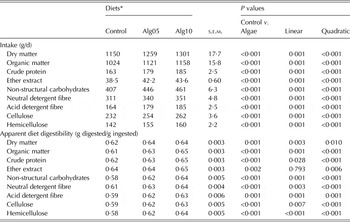
Addition of C. vulgaris in the diets increased (P < 0·001) intake compared with the control diet (Table 3). Level of inclusion (Alg05 v. Alg10) did not affect feed intake.
Feed intake and digestibility of a basal diet with increasing levels of Chlorella vulgaris microalgae (g/kg DM of the basal diet) and fed to lactating Damascus goats (n = 5 goats per treatment) determined at the 4th, 8th and 12th week (7 days for each week)

* The basal diet based on 500 g/kg DM of concentrates feed mixture and 500 g/kg DM berseem clover (Trifolium alexandrinum) without addition of Chlorella vulgaris microalgae (Control) or with addition of Chlorella vulgaris microalgae at 5 (Alg05) and 10 (Alg10) g/goat/day.
Apparent digestibility increased when goats were fed Alg05 and Alg10 diets (P < 0·01) with higher OM (linear effect, P = 0·001; quadratic effect, P < 0·001), CP (linear effect, P = 0·028; quadratic effect, P < 0·001), EE (quadratic effect, P = 0·006), NDF (linear effect, P = 0·003; quadratic effect, P < 0·001) and cellulose (linear effect, P = 0·007; quadratic effect, P < 0·001) digestibilities noted in the Alg10 treatment (Table 3).
Ruminal fermentation kinetics and blood parameters
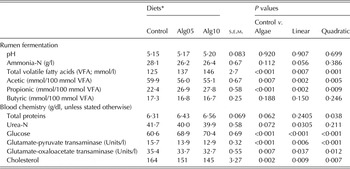
Chlorella vulgaris had no effect on ruminal pH, ammonia-N concentrations and proportion of butyric acid (Table 4). Increased (P < 0·05) concentration of total VFA and propionic acid were observed in goats supplemented with Alg05 and Alg10 compared with the control.
Rumen fermentation and blood chemistry of lactating Damascus goats fed on a basal diet with increasing levels of Chlorella vulgaris microalgae (g/kg DM of the basal diet) (n = 5 goats per treatment) determined at the last day of the 8th and 12th week of the experiment

* The basal diet based on 500 g/kg dry matter (DM) of concentrates feed mixture and 500 g/kg DM berseem clover (Trifolium alexandrinum) without addition of Chlorella vulgaris microalgae (Control) or with addition of Chlorella vulgaris microalgae at 5 (Alg05) and 10 (Alg10) g/goat/day.
Compared with the control diet, goats supplemented with C. vulgaris had lower (P < 0·01) GPT, GOT and cholesterol concentrations. Chlorella vulgaris had no effect on serum albumin and globulin concentrations (data not shown). Increased total protein (quadratic effect, P = 0·038) concentration was observed in goats fed Alg10 treatment compared with the control (Table 4).
Milk yield and composition
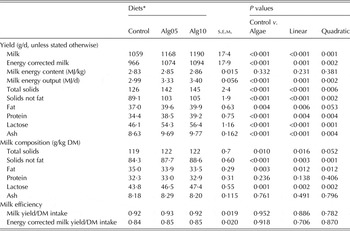
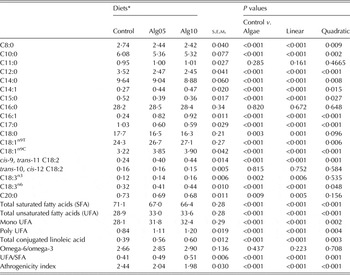
Goats fed with C. vulgaris produced more (P < 0·001) milk and ECM with increased milk energy output (P < 0·001) compared with the control diet (Table 5). Similarly, milk contents from total solids (P = 0·010), solids not fat (P < 0·001) and lactose (P = 0·001) were higher in Alg05 and Alg10-fed goats. Milk efficiency as milk yield/DM intake (DMI) or ECM yield/DMI was similar for all the diets. Feeding Alg05 and Alg10 diets to goats decreased (P < 0·001) total SFA and AI and resulted in increased (P < 0·001) total conjugated linoleic acid (CLA) concentrations and UFA/SFA ratios (Table 6).
Milk yields and composition of Damascus goats fed on a basal diet with increasing levels of Chlorella vulgaris microalgae (g/kg DM of the basal diet) (n = 5 goats per treatment) determined at the 4th, 8th and 12th week (7 days for each week)

* The basal diet based on 500 g/kg dry matter (DM) of concentrates feed mixture and 500 g/kg DM berseem clover (Trifolium alexandrinum) without addition of Chlorella vulgaris microalgae (Control) or with addition of Chlorella vulgaris microalgae at 5 (Alg05) and 10 (Alg10) g/goat/day.
Fatty acid profiles (g/100 g total FA) in milk of Damascus goats fed on a basal diet with increasing levels of Chlorella vulgaris microalgae (g/kg DM of the basal diet) (n = 5 goats per treatment) determined at the 4th, 8th and 12th week (7 days for each week)

* The basal diet based on 500 g/kg dry matter (DM) of concentrates feed mixture and 500 g/kg DM berseem clover (Trifolium alexandrinum) without addition of Chlorella vulgaris microalgae (Control) or with addition of Chlorella vulgaris microalgae at 5 (Alg05) and 10 (Alg10) g/goat/day.
DISCUSSION
Feed intake and apparent diet digestibility
Supplementation with C. vulgaris increased feed intake by about 9·5 and 12% for Alg05 and Alg10 treatments, respectively. Similarly, Van Emon et al. (Reference Van Emon, Loy and Hansen2015) reported a linear increase in DMI when steers were supplemented with 150, 300 or 450 g heterotrophic microalgae meal/kg feed in a growing study. Enhanced digestibility noted in C. vulgaris-supplemented goats may have resulted from improved ruminal fermentation kinetics. Chlorella vulgaris microalgae CGF contains growth promoting substances such as S-nucleotide adenosyl peptide complex, which can affect digestibility (Han et al. Reference Han, Kang, Kim and Kim2002). Inclusion of C. vulgaris in the diets caused increased concentration of some bacterial species, e.g. Butyrivibrio fibrisolvens, Ruminococcus albus and Clostridium sticklandii, over forage-based diet in in vivo studies (Tsiplakou et al. Reference Tsiplakou, Abdullah, Skliros, Chatzikonstantinou, Flemetakis, Labrou and Zervas2016), resulting in improved bacterial growth (Kotrbáček et al. Reference Kotrbáček, Doubek and Doucha2015). Moreover, it contains β-glucan, which plays a role in scavenging free radicals (Iwamoto Reference Iwamoto and Richmond2004) and thus improves fermentation. Moreover, the C. vulgaris microalgae contents of PUFA, carotenoids, phycobiliproteins, polysaccharides and phycotoxins are required for higher microbial growth (Kotrbáček et al. Reference Kotrbáček, Doubek and Doucha2015). Tibbetts et al. (Reference Tibbetts, MacPherson, McGinn and Fredeenin press) reported that the dietary effect of algal supplementation on feed digestibility in ruminants is related in part to its lipid content. Enhanced digestibility will lead to increased rate of passage, resulting in greater DMI. However, Glover et al. (Reference Glover, Budge, Rose, Rupasinghe, MacLaren, Green-Johnson and Fredeen2012) observed that supplementing diets of lactating cows with marine microalgae at 200 g/day did not affect DMI of fresh forage or silage-based total mixed ration. Inconsistency between these studies may be due to different diet composition and different algae inclusion doses (Reynolds et al. Reference Reynolds, Cannon and Loerch2006).
Ruminal fermentation
Increased total VFA production with feeding C. vulgaris microalgae can be attributed to improved digestibility. Flatt et al. (Reference Flatt, Warner and Loosli1956) reported that concentration of VFA in the rumen depends on digestibility, especially OM digestibility. Increased proportion of propionic acid is considered beneficial in ruminant nutrition and dairy production, as propionate is the primary gluconeogenic VFA that can be used for lactose biosynthesis (Vanhatalo et al. Reference Vanhatalo, Varvikko and Huhtanen2003). Ruminal ammonia-N concentration was not affected by algal supplementation ranging between 26 and 28 g/l, which is above the minimal level (5 g ammonia-N/l) reported by Satter & Slyter (Reference Satter and Slyter1974) for maximal growth of ruminal microorganisms. Increased CP intake and digestibility without significant differences in ammonia-N between treatments is evidence of efficient N utilization by ruminal microorganisms. Availability of peptides and amino acids are stimulatory factors for microbial growth and ruminal digestion (Carro & Miller Reference Carro and Miller1999), particularly in the presence of rapidly fermentable carbohydrate. Chakraborty et al. (Reference Chakraborty, McDonald, Nindo and Chen2013) reported that glucose represents the main sugar of Chlorella microalgae, with about 630–900 g/kg of total sugars as glucose.
Blood metabolites
All measured blood metabolites were within the reference ranges (Boyd Reference Boyd1984). Increased serum total protein with C. vulgaris supplementation may be due to increased CP and OM intakes and digestibilities. In addition, decreased values of serum urea-N with different C. vulgaris treatments indicate the absence of protein catabolism, and normal kidney function (Hosten Reference Hosten, Walker, Hall and Hurst1990). Increased OM intake and digestibility and higher total VFA production when feeding C. vulgaris to goats, may have resulted in elevated serum glucose in C. vulgaris treatments. Interestingly, the serum glucose of goats followed a similar trend to OM digestibility and milk yield. Reduced concentrations of GPT and GOT are important indicators of liver activity, function and hepatotoxicity, suggesting the absence of pathological lesions in the liver. In the present study, feeding C. vulgaris microalgae, at both levels, resulted in a significant decrease in GPT and GOT concentrations, indicating a probable protective role for C. vulgaris against liver dysfunction.
The mechanism by which C. vulgaris supplementation reduced plasma cholesterol has not been fully explored; however, the hypocholesterolemic actions of spirulina microalgae involving reducing plasma and liver cholesterol (Karkos et al. Reference Karkos, Leong, Karkos, Sivaji and Assimkopoulos2008), inhibition of jejunal cholesterol absorption and ileal bile acid resorption (Nagaoka et al. Reference Nagaoka, Shimizu, Kaneko, Shibayama, Morikawa, Kanamaru, Otsuka, Hirahashi and Kato2005) could be responsible for reduced plasma cholesterol. Marine microalgae have the ability to modify lipoprotein metabolism through increasing lipoprotein lipase and hepatic triglyceride lipase activities (Karkos et al. Reference Karkos, Leong, Karkos, Sivaji and Assimkopoulos2008). Furthermore, C. vulgaris contains α-glucan, which is considered an active immunostimulant with beneficial effects in scavenging free radicals and reducing blood lipids (Iwamoto Reference Iwamoto and Richmond2004).
Milk production, composition and fatty acids profile
Higher amounts of milk (10·3 and 12·4%, respectively) and ECM (11·1 and 13·2%, respectively) were noted in goats fed Alg05 and Alg10 diets. Increased intake and digestibility observed in goats fed C. vulgaris may have resulted in higher milk production. Moreover, C. vulgaris contains several nutrients, such as amino acids, essential fatty acids, vitamins and minerals that could enhance milk production (Lum et al. Reference Lum, Kim and Lei2013). In addition, propionate is the precursor for gluconeogenesis and lactose synthesis, and increasing glucogenic precursors will have a favourable effect on milk yield (Rigout et al. Reference Rigout, Hurtaud, Lemosquet, Bach and Rulquin2003). Higher propionate concentration due to C. vulgaris supplementation could have resulted in increased milk lactose (by 6·2 and 8·2% in goats fed Alg05 and Alg10 diets, respectively).
Feeding C. vulgaris decreased milk fat content by 3·1 and 4·3% and increased daily fat yield by 7·0 and 7·8% in goats fed Alg05 and Alg10 diets, respectively. This is consistent with the negative relationship between milk yield and fat contents. Increasing levels of C. vulgaris may have elevated fatty acid C18:1, which has a negative effect on milk fat content (Kadegowda et al. Reference Kadegowda, Bionaz, Piperova, Erdman and Loor2009). An inverse relationship between milk fat and C18:1 (r = −0·71) had been reported by Toral et al. (Reference Toral, Hervás, Gómez-Cortés, Frutos, Juárez and De La Fuente2010). Consistent with the current results, Glover et al. (Reference Glover, Budge, Rose, Rupasinghe, MacLaren, Green-Johnson and Fredeen2012) reported decreased milk fat content in cows supplemented with 200 g of marine microalgae/day.
The fatty acid profile of goat milk can be changed dramatically by altering the feeding regime and feed additive supplementation (Rojo et al. Reference Rojo, Kholif, Salem, Elghandour, Odongo, Montes De Oca, Rivero and Alonso2015; Kholif et al. Reference Kholif, Morsy, Gouda, Anele and Galyean2016). Supplementation with C. vulgaris resulted in a ‘healthier’ milk, with lower SFA (5·8 and 6·6%) and AI (16·4 and 18·9%) and greater UFA (14·2 and 16·2%) and total CLA (43·6 and 53·8%) contents. Increased UFA in the milk indicated that a considerable amount of algal PUFA may have escaped ruminal biohydrogenation. In human nutrition, reduction of SFA with concomitant increase in UFA is important targets for the prevention of cardiovascular diseases (Shingfield et al. Reference Shingfield, Chilliard, Toivonen, Kairenius, Givens and Bösze2008). Unsaturated fatty acids are considered important bio-regulators of many cellular processes and linked to the development and functionality of the immune system (Abedi & Sahari Reference Abedi and Sahari2014). Research on the effect of different fatty acids on human health indicates that only a few individual fatty acids such as C12:0, C14:0 and C16:0 are responsible for the negative consequences on consumer health (Simopoulos Reference Simopoulos2002). Marine microalgae are rich in PUFA – eicosapentaenoic acid and docosahexaenoic acid (Abedi & Sahari Reference Abedi and Sahari2014). In agreement with the results reported in the present study, increased PUFA and CLA and decreased SFA contents were reported by Glover et al. (Reference Glover, Budge, Rose, Rupasinghe, MacLaren, Green-Johnson and Fredeen2012) in cows supplemented with 200 g of marine microalgae/day.
Daily inclusion of C. vulgaris at 5 and 10 g in goats’ diets increased feed intake and digestibility and improved rumen fermentation, and consequently increased milk yield. Milk fatty acid profile was modified positively in goats fed C. vulgaris, as the relative proportions of UFA and CLA were increased, whereas SFA was decreased. Higher levels of C. vulgaris inclusion (i.e., 10 g/goat/day) had better results than lower levels for lactating goats in the present study. More studies are warranted to delineate the effect of feeding C. vulgaris at increasing levels on nutritive value and fermentation kinetics of the lactating goat's diet.
Authors acknowledge the help of Dr A. Abu Elella at the Animal Production Research Institute, Agriculture Research Center (Egypt) for help during the field experiment.