INTRODUCTION
For those who seek an understanding of the ‘end’ of Roman Britain the identification of sites of early fifth-century date remains the greatest difficulty.Footnote 1 Any work on Roman Britain or its aftermath will contain at least a few lines on why this is so.Footnote 2 This phenomenon is often attributed to a lack of new coins after c. a.d. 388–402, typological ‘fossilization’ in finds assemblages, poor standards of excavation, destruction by later activity, and genuine archaeological absence. However, amongst some finds specialists there is a sense of optimism that new ways of interpreting the latest assemblages of ‘Roman’ material culture will offer significant insights into the early fifth century.
The work of Hilary Cool on assemblages of small finds has demonstrated that rather than looking for new types of object, the fifth century may be revealed by changes in the composition of artefactual assemblages.Footnote 3 A similar approach, developed independently of Cool’s work, has shown that groups of fifth-century ‘calcite-gritted’ pottery from York can be distinguished from their fourth-century precursors by variations in the range and type of inclusions present in a vessel’s fabric.Footnote 4 Other recent work on the latest Roman pottery assemblages has followed more traditional lines. ‘Very late’ vessel forms have been identified for some late Roman pottery producers in southern BritainFootnote 5 and important research on the chronology of pottery supply to Essex during the fifth century has also been undertaken, but remains unpublished.Footnote 6 The purpose of this paper is to add to this growing corpus of early fifth-century material culture by presenting the dating evidence associated with an unusual pottery fabric produced in the same tradition as BB1 by kilns in south-east Dorset.Footnote 7
The distribution of this unusual pottery is localised. However, this does not detract from its wider significance. The fifth century remains largely invisible to archaeologists in Britain and diagnostic artefacts dating to this period are extremely rare.Footnote 8 Any new material is thus important. This type of pottery is also a record of one of the most important processes that operated during the fourth and fifth centuries: regionalisation. As the over-arching economic structures of the Western Empire first faltered, and then failed, they were replaced by smaller, local economic systems.Footnote 9 This pottery from one corner of Dorset may, for the first time, allow us to investigate how that process impacted on one of Roman Britain’s most successful centres of pottery production.
SOUTH-EAST DORSET ORANGE WIPED WARE
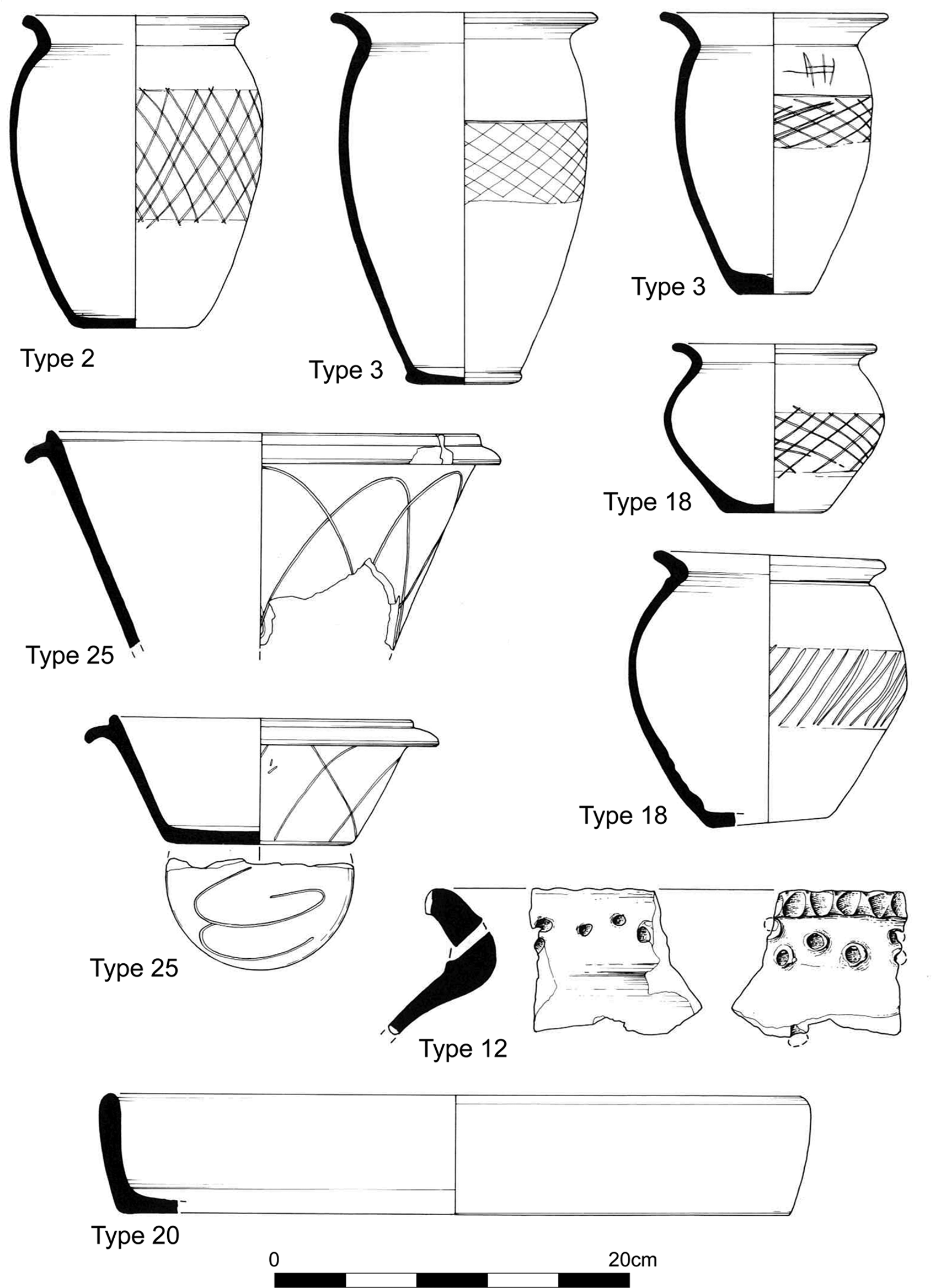
South-east Dorset — the margins of Poole Harbour and the Isle of Purbeck — is well known for the production of Dorset Black Burnished Ware (BB1). The chronology, distribution and significance of this type of pottery has been charted in some detail and does not need to be reiterated here.Footnote 10 Suffice to say that BB1 was a development of Iron Age ‘Durotrigian’ potting traditions and achieved a province-wide distribution during the Roman period. By the late fourth century that distribution had contracted somewhat towards a core area of Somerset and Dorset. This contraction has often been seen as symptomatic of the industry’s decline as the BB1 potters lost ‘market share’ to other producers.Footnote 11 However, there is a growing body of evidence that points to the innovation of new forms and fabrics in the BB1 repertoire during the fourth century and their continued production into the early fifth century (fig. 1).
Common late Roman BB1 vessel forms as classified by the Wessex Archaeology / Greyhound Yard typology (Seager Smith and Davies Reference Seager Smith, Davies and Woodward1993).

This paper is concerned with the production of a variant BB1 fabric and its relationship to an unusual vessel form of unknown function. A combination of stratigraphic evidence and associated finds suggests that this fabric — here named South-East Dorset Orange Wiped Ware (SEDOWW) — is of late fourth- and early fifth-century date.Footnote 12
SEDOWW was first identified by Seager Smith in the Dorchester By-pass excavations where it was labelled with the alphanumeric code Q107 or E107.Footnote 13 The fabric’s restricted distribution, the close typological connections between the SEDOWW vessels and BB1 potting traditions, and the range of inclusions visible at x20 magnification strongly suggest that this fabric was produced somewhere in south-east Dorset. The fill of a kiln at Bestwall Quarry (Wareham) produced 150 probable waster sherds (weighing c. 3.5 kg) of SEDOWW associated with definite BB1 wasters.Footnote 14 This makes it likely that production of this fabric occurred alongside BB1 at Bestwall. However, it may also have been produced at other late Roman kilns in south-east Dorset.
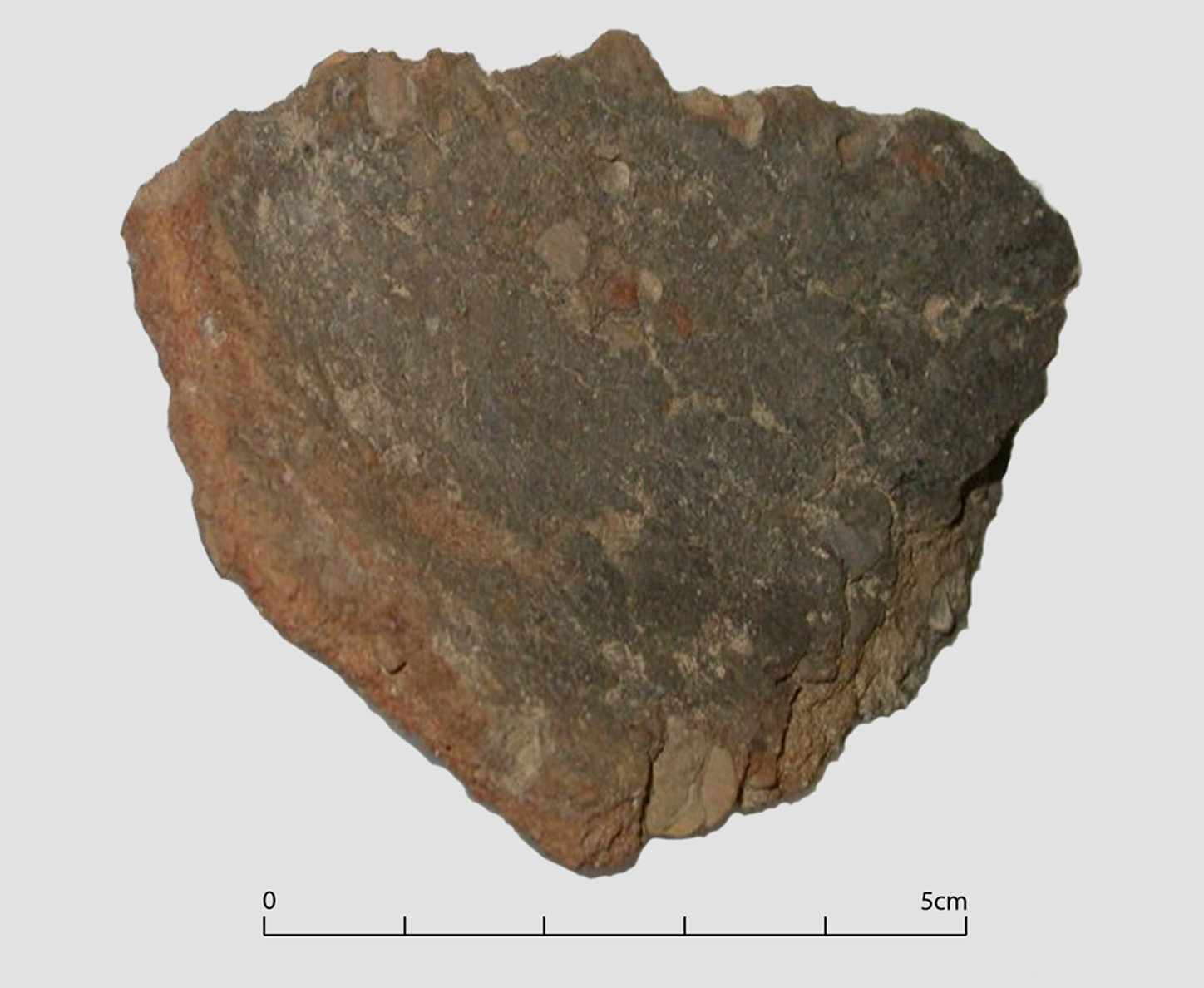
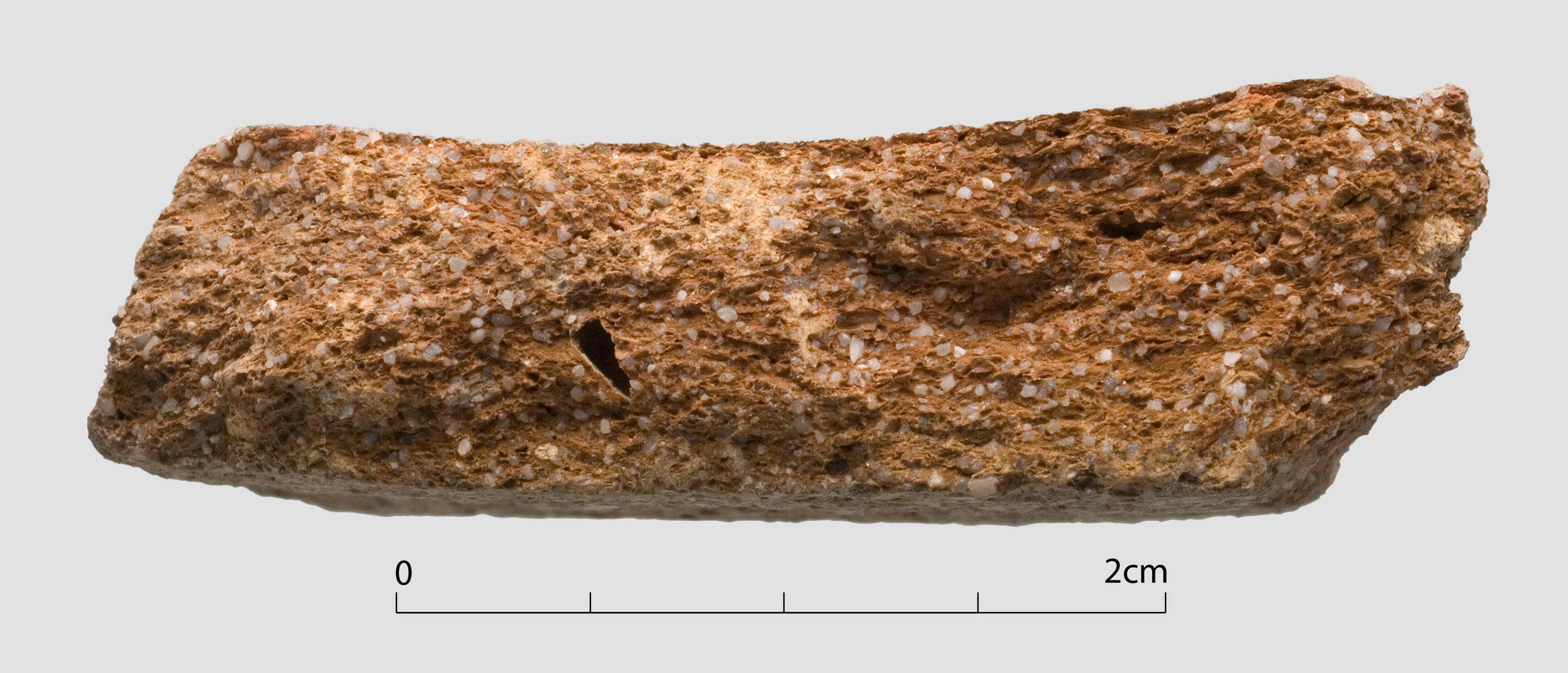
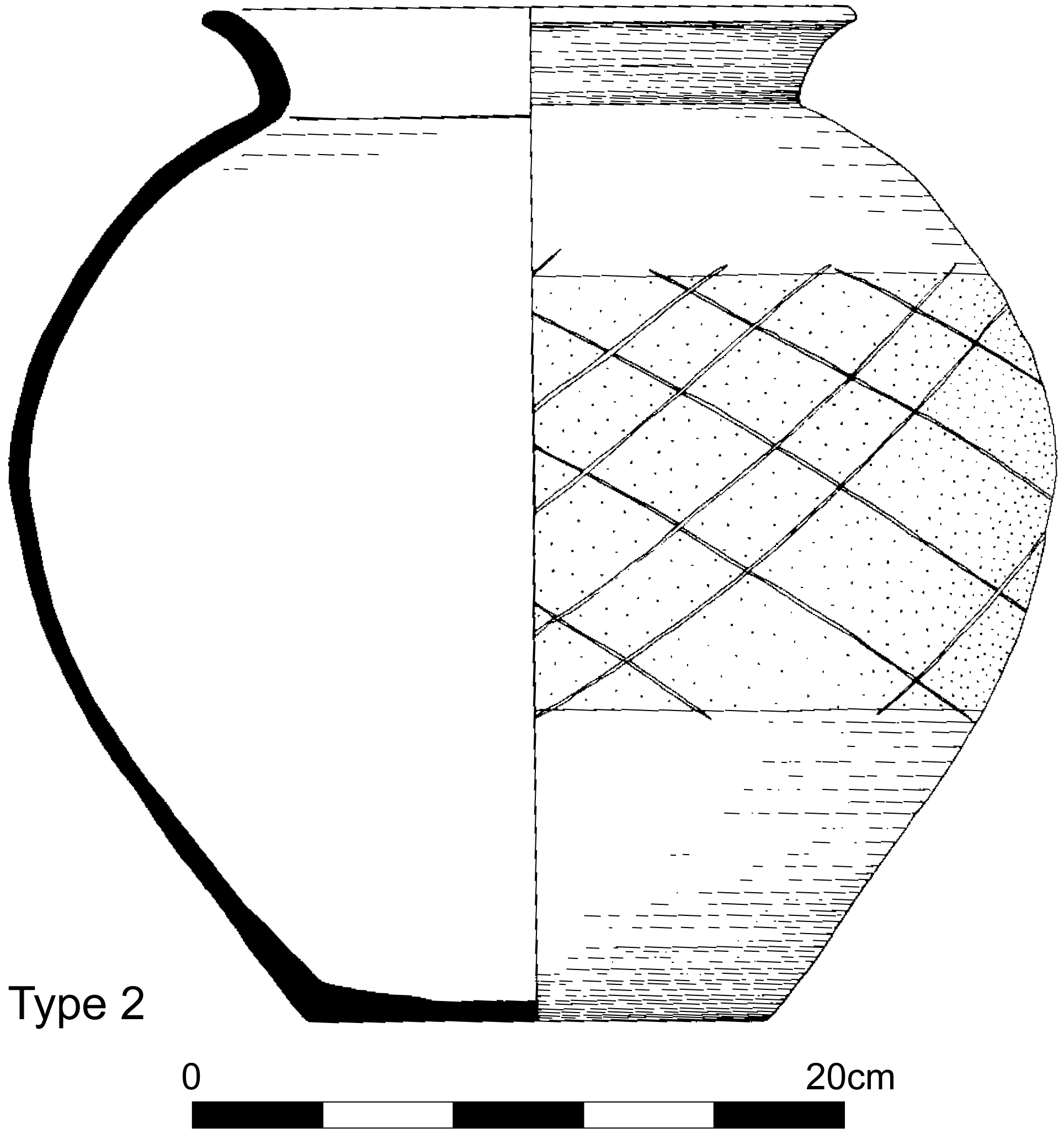
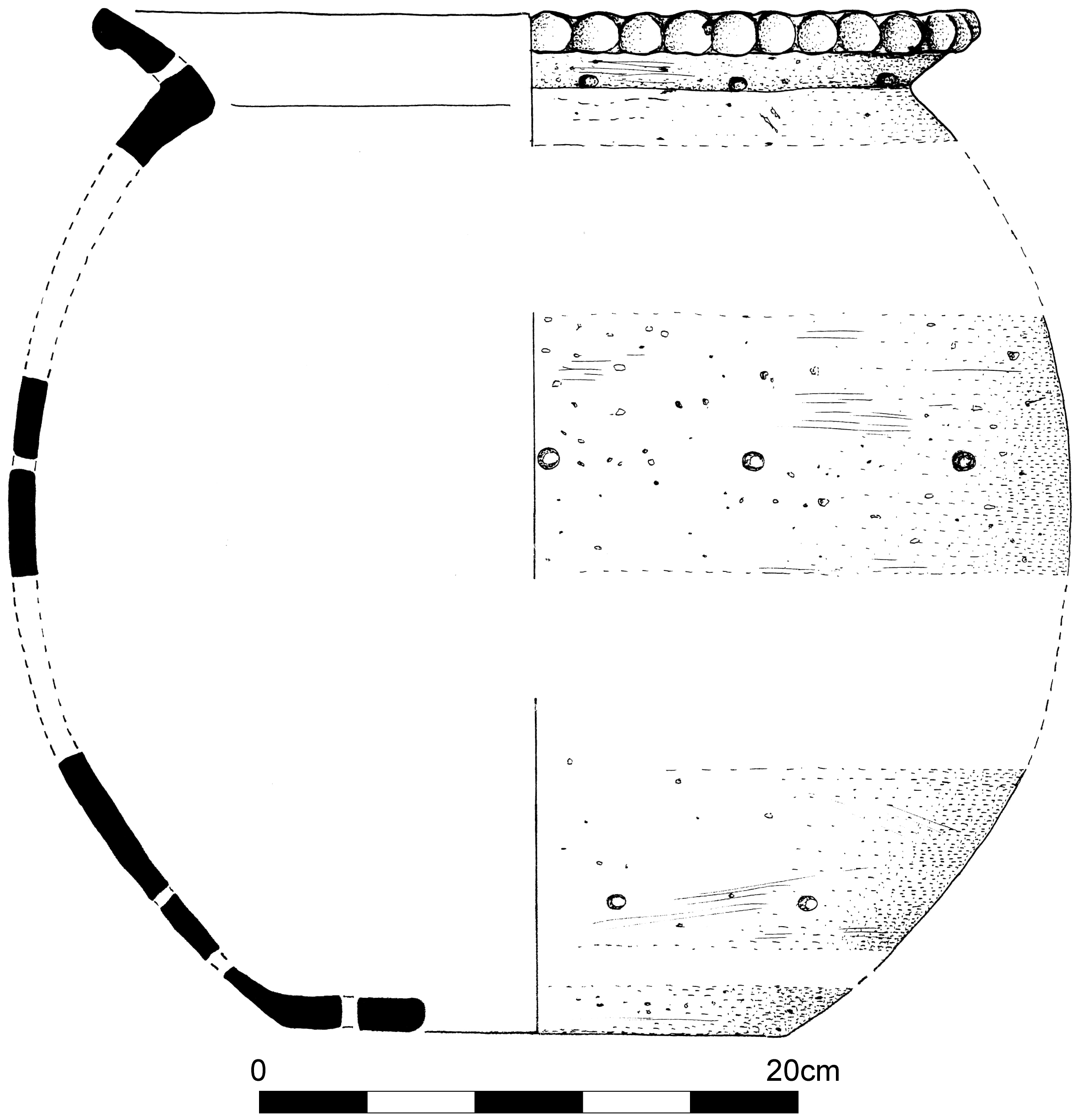
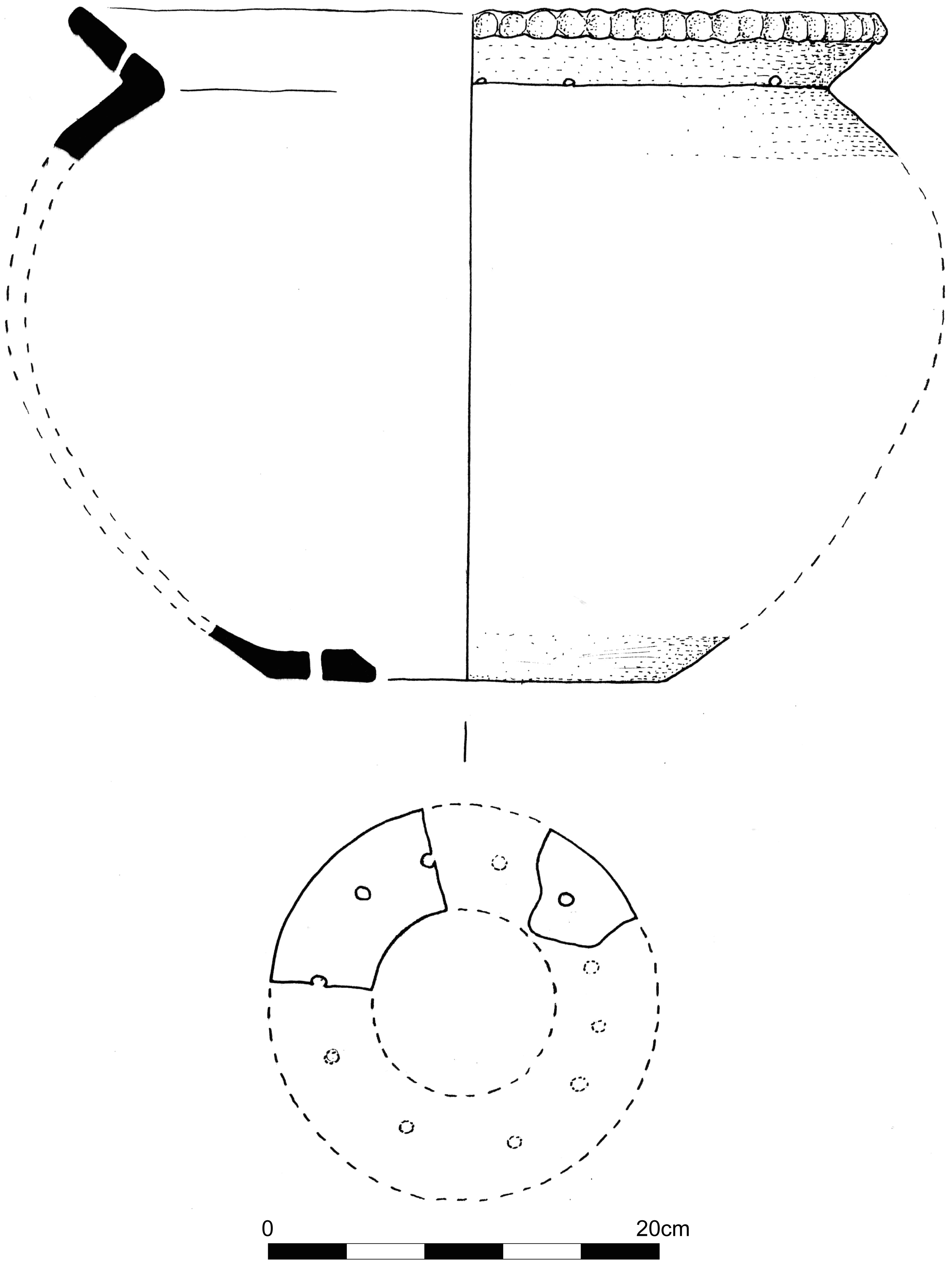
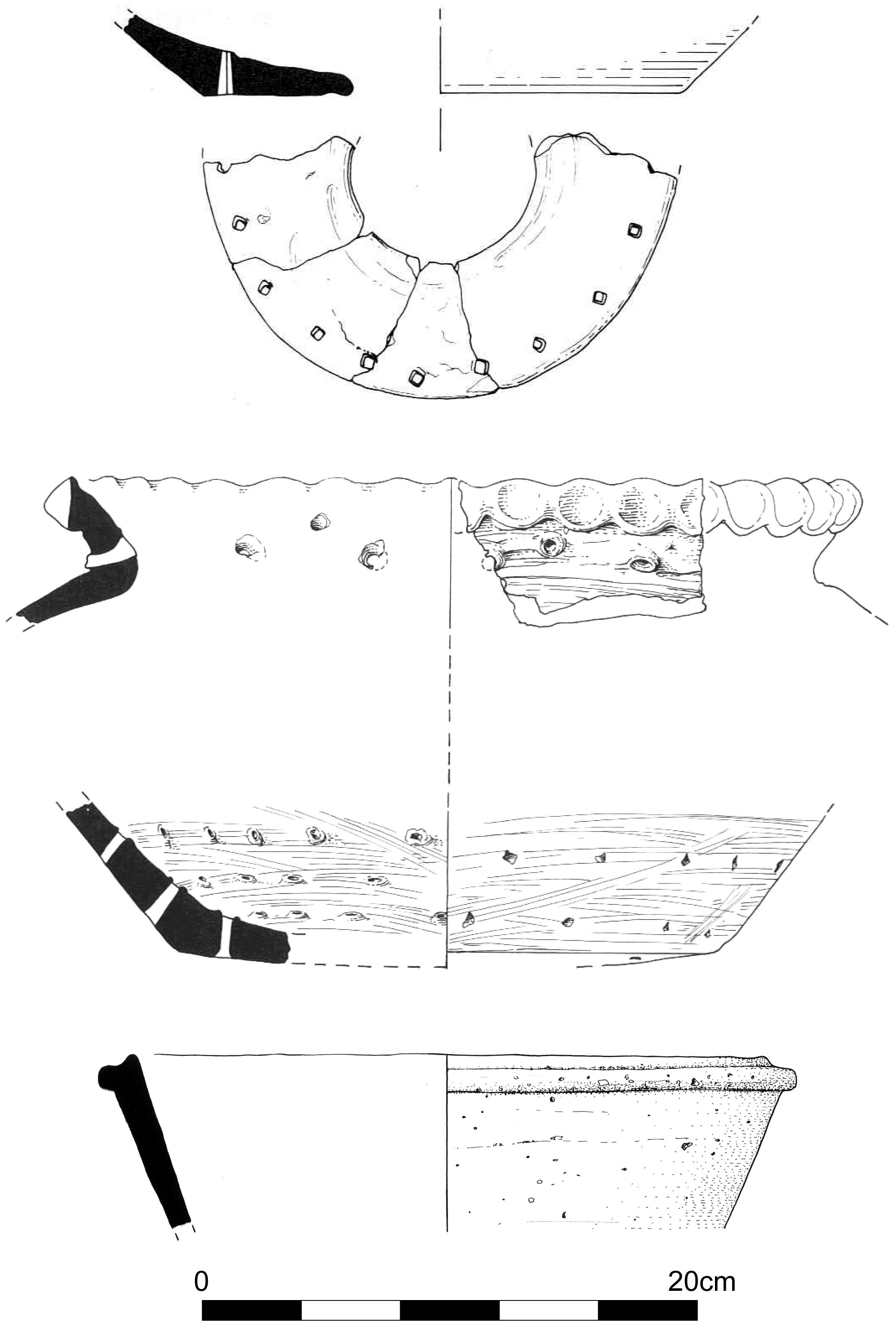
The fabric of SEDOWW can be described as a relatively soft to hard, orange fabric with wiped external surfaces which are decorated occasionally with the standard (but poorly executed) late Roman techniques. These techniques include wiping and burnishing combined with unburnished zones that are decorated with a variety of designs created using burnished lines; the typical design is an obtuse lattice. Inclusions are largely restricted to abundant white and colourless sub-angular quartz <1 mm, with occasional fragments of angular and sub-rounded shale <3 mm and limestone <1 mm (fig. 3). Other inclusions can be present in very small quantities and moderate to large quantities of shale inclusions can sometimes be found concentrated in base sherds (fig. 2). In contrast to the standard BB1 fabric, SEDOWW occurs in a very restricted range of forms, which are described using the Greyhound Yard / Wessex Archaeology type series.Footnote 15 These forms include large everted rim jars (Type 2) (fig. 4), large, ‘pie-crust’ or ‘cable’ rim jars with multiple pre-firing perforations (Type 12) (figs. 5–6), and very occasionally dropped-flange bowls (Type 25).
Photograph of the internal surface of the base of a SEDOWW jar. Note the presence of large fragments of shale. (Photo: J. Gerrard)

Photograph of a fresh break through a SEDOWW sherd. The break is 9 mm wide by 36 mm long.

SEDOWW Type 2 jar from Maiden Castle Road (from Smith et al. 1997, fig. 72).

SEDOWW Type 12 ‘pie-crust’ rim jar from Bestwall Quarry with pre-firing perforations (from Lyne forthcoming).

SEDOWW Type 12 ‘pie-crust’ rim jar from Bestwall Quarry with pre-firing perforations. Note the large central hole in the base (from Lyne forthcoming).

SEDOWW: DATE AND DISTRIBUTION
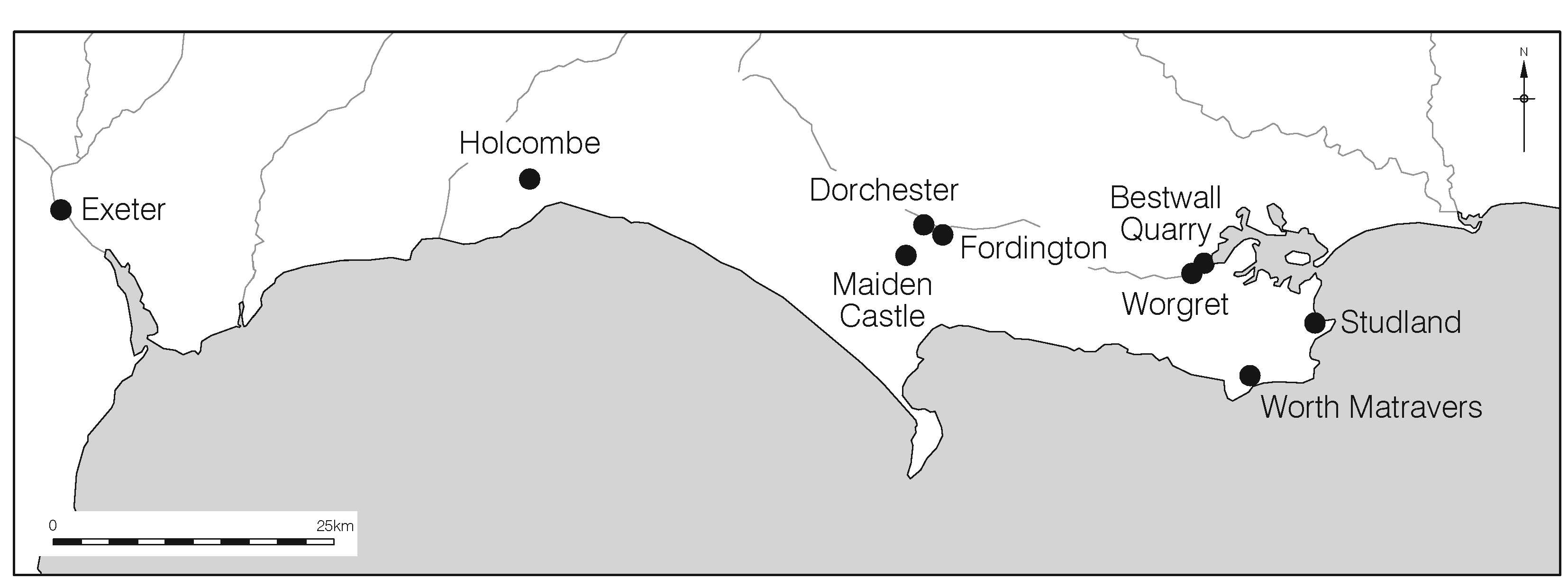
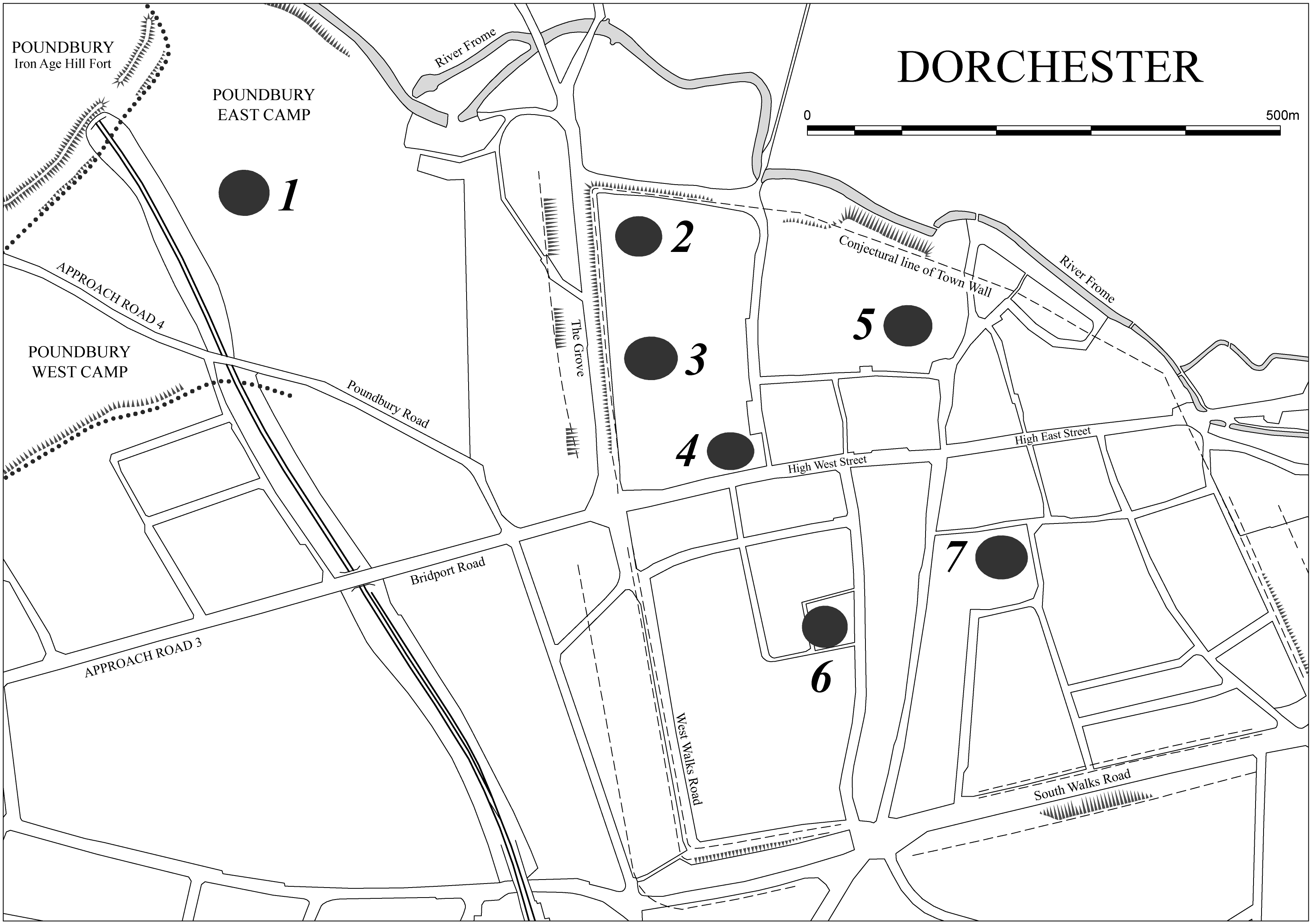
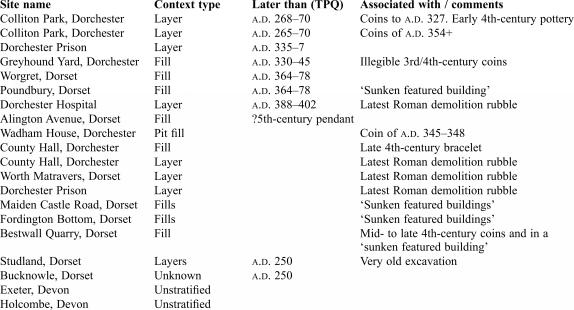
The present state of knowledge would seem to indicate that SEDOWW’s distribution is restricted to the urban centre of Durnovaria, its immediate environs and south-east DorsetFootnote 16 (Figs. 7–8). Unsurprisingly, it is the urban and extramural sites that have produced the best dated assemblages of this material and what follows is an attempt to present this dating evidence in a manner that will withstand rigorous examination (Table 1).
Location of sites mentioned in the text.

The distribution of SEDOWW within the walls of Dorchester. 1. Poundbury; 2. Colliton Park; 3. County Hall; 4. Wadham House; 5. Dorchester Prison; 6. Dorchester Hospital; 7. Greyhound Yard (base map from RCHM 1970).

DATING AND CONTEXT EVIDENCE FOR THE OCCURRENCE OF SEDOWW

Within Durnovaria’s walls the earliest potential dates for the presence of vessels that can be ascribed to SEDOWW come from the 1960s excavations at Colliton Park.Footnote 17 Here Type 12 vessels were recovered from deposits containing early fourth-century pottery and coins to a.d. 327. These layers overlay limestone paving laid after a.d. 268–270.Footnote 18 Elsewhere on the same site sherds were recorded as coming from on the ‘chalk floor of Building 5’; Building 5 was constructed after a.d. 265–270 and the layers overlying its floor contained coins of post-a.d. 354 date.Footnote 19
Similarly-dated finds occur at Wadham House, where Type 12 SEDOWW sherds were recovered from a pit containing a coin of a.d. 345–348.Footnote 20 Elsewhere, other finds occur at Dorchester Prison from disturbed deposits associated with the construction of a building.Footnote 21 One wall of this structure was found to contain a coin of a.d. 335–357 mortared into its fabric.Footnote 22 Further sherds were recovered from the demolition deposits marking the end of the Roman sequence.Footnote 23 Excavations at County Hall recovered sherds of SEDOWW from the fill of a beamslot and demolition deposits overlying a fourth-century structure.Footnote 24 The beamslot contained a bracelet of late fourth-century date.Footnote 25 The extensive excavations at Greyhound Yard also produced a small quantity of this fabric. Most seems to come from the fill of a pit containing illegible third- or fourth-century coins.Footnote 26 However, the pit was dug in the angle between a wall that had been constructed after a.d. 330–345 and a building that had been added to the wall at right angles,Footnote 27 leading the excavators to phase the pit to a.d. 350–450. In contrast to Greyhound Yard, SEDOWW seems to be absent from the late groups associated with the nearby bath-house.Footnote 28 This, however, may be related to the latter site’s function.
The latest finds of SEDOWW come from excavations on the site of the former Dorchester County Hospital. A campaign of excavations during the late 1960sFootnote 29 uncovered the remains of a late Roman structure associated with several ovens, a dispersed hoard of Theodosian bronze coins (a.d. 388–402), belt fittings of well-known late and early post-Roman type,Footnote 30 and BB1 bowls of a late type (Type 18).Footnote 31 However, no mention was made in the published report of any Type 12 rims or a pottery fabric that could be equated with SEDOWW. More recent excavations by Wessex Archaeology on an adjacent site to the north have revealed a further late Roman building.Footnote 32 This structure, on the basis of a coin of the House of Theodosius (a.d. 388–402) found in a beamslot, appears to have been in use and undergoing modification at some date after a.d. 388.Footnote 33 When the structure collapsed or was demolished another Theodosian hoard, probably hidden in the structure’s rafters, was dispersed in the demolition rubble. Features associated with this structure and the demolition rubble contained quantities of SEDOWW, alongside Type 18 bowls and, intriguingly, seemingly wheel-thrown BB1.Footnote 34 This is a strong indicator that SEDOWW was still being used in Dorchester during the currency of Theodosian coins (a.d. 388–410/30?).
Sites in Dorchester’s immediate hinterland have also produced assemblages of SEDOWW. The closest and best known of these is the late and post-Roman settlement and cemetery at Poundbury. At Site G the earliest features of relevance were three burials, one of which contained coins of a.d. 321 and a.d. 364–378. These graves were cut by a ditch that bounded a cobbled area, which sealed another coin of a.d. 364–378. A number of post-holes associated with this cobbled surface (including one containing fragments of a Type 18 bowl) have been interpreted as a timber structure (labelled by the excavator R20a). This structure and the yard appear to have preceded the creation of a small sunken building (R20b) of a type that characterises the fifth- and sixth-century phases at Poundbury.Footnote 35 The fill of R20b and other (undated) features at Site G produced sherds of SEDOWW, including Type 12 rims; this vessel form was also present at the nearby Site C.Footnote 36 This suggests that during the second phase of post-Valentinianic activity at Site G SEDOWW was being deposited in the fill of structures that were to be the architectural norm in the sub-Roman settlement.Footnote 37
On Dorchester’s southern fringes SEDOWW was recovered from another extramural settlement that has evidence for late and post-Roman activity. Alington Avenue was found to contain a number of late Roman buildings laid out within enclosure ditches.Footnote 38 These were cut by a series of timber structures and fence lines that were essentially undated, but it is argued, given the site’s proximity to a nearby ‘Anglo-Saxon cemetery’, that they are of seventh-century date.Footnote 39 The SEDOWW was recovered from the fill of a large and shallow irregular pit dug into the top of a backfilled well.Footnote 40 The function of this pit is uncertain, but it seems possible that it is another sunken building of Poundbury type.Footnote 41
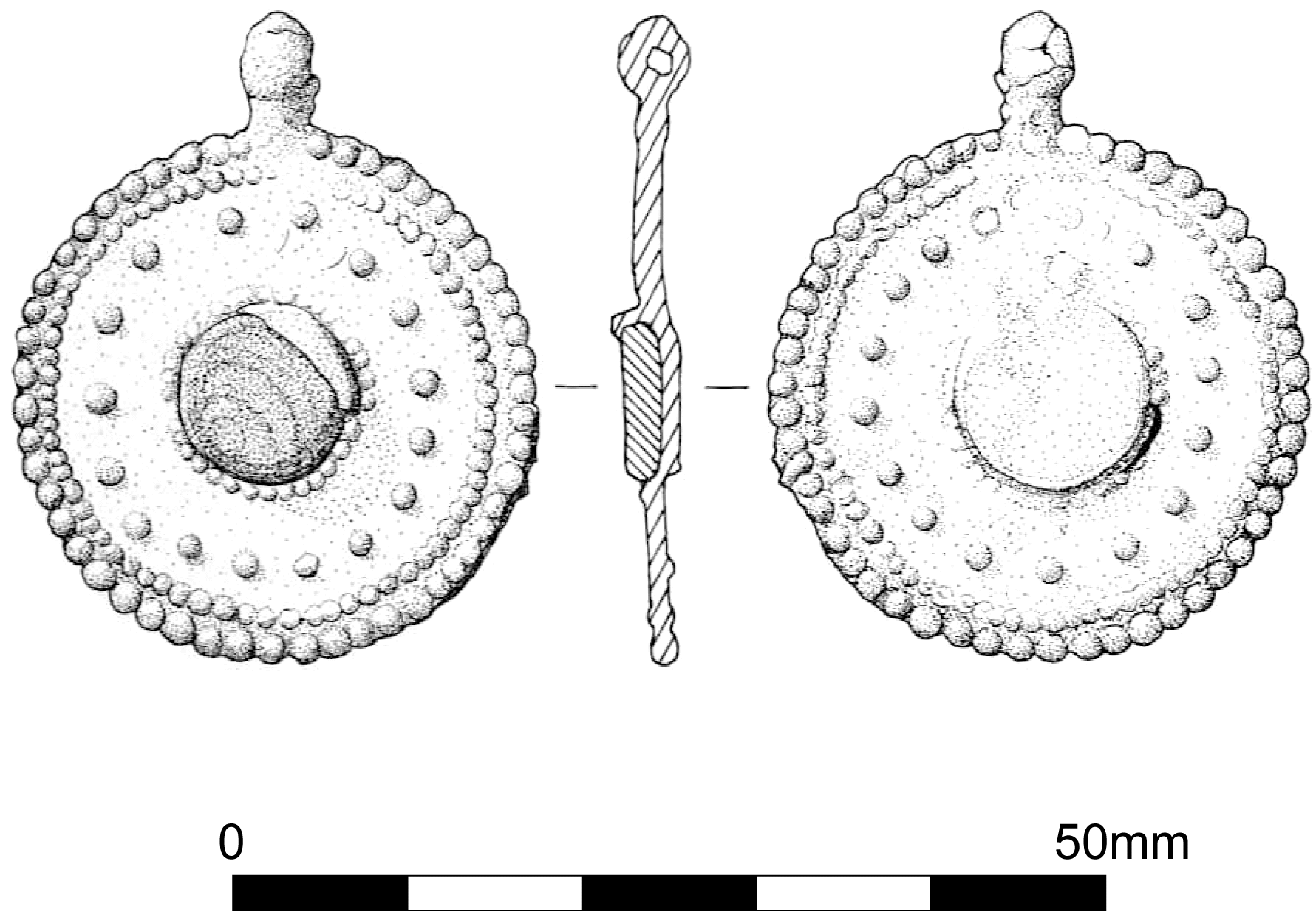
The ‘pit’ is clearly later than the Roman period well and this is of some importance because the quantity of SEDOWW from the ‘pit’ is large. In excess of 48 kg of this fabric were retained, including Type 12 vessels (fig. 9), and more was discarded unquantified during the excavation.Footnote 42 What is striking about this quantity of SEDOWW is that it can conclusively be shown to have been deposited after a.d. 400. From the upper fill of the well came a small lead-alloy pendant (fig. 10) described by Henig and Morris as follows:
A flat disc with a central mounting of opaque red glass, bordered by a circle of raised dots within a further three concentric circles of raised dots, one forming the edge, it seems to be a base metal version of the type of pendant found with female burials of the 7th century a.d. The use of lead alloy at this time would be exceptional in a true Anglo-Saxon context, although 10th-century pewter brooches are reminiscent… The closest parallels are from an important late Roman site at Ickham, Kent, and are tentatively dated to the 5th century. They are regarded as ancestral to later Kentish jewellery.Footnote 43
Top: Pierced SEDOWW jar base from Fordington Bottom (from Smith et al. 1997, fig. 108). Centre: SEDOWW Type 12 jar and pierced base from Alington Avenue (from Seager Smith 2002, fig. 48.55). Bottom: Type 25 SEDOWW bowl from Bestwall Quarry (from Lyne forthcoming).

Post-Roman lead-alloy pendant of ?fifth- to seventh-century date (from Davies et al. 2002, fig. 84).

There is some debate over the exact date of this object. A similar pendant recovered by a metal-detector user in Berkshire was associated with Anglo-Saxon metalwork of sixth- and seventh-century date.Footnote 44 However, what seems certain is that the Alington Avenue object is of post-Roman date. No parallels are known from fourth-century contexts and it seems reasonable to date the object to between a.d. 400 and 700.
At Maiden Castle Road and Fordington Bottom, two other sites located in the environs of Dorchester, small sunken buildings of Poundbury type associated with assemblages of SEDOWW have been excavated.Footnote 45 At Maiden Castle Road SEDOWW accounted for almost 40 per cent of the pottery by sherd count from three such structures.Footnote 46 This material included Type 12 rims and also a reconstructable profile of a Type 2 jar with obtuse lattice decoration. At Fordington Bottom the small sunken structures were terraced into a valley side, served by a hollow way and associated with a cobbled surface, grain-drier and cistern in the valley bottom. This latter area was protected from hillwash by a substantial revetment. SEDOWW was recovered from the cistern, the grain-drier and also the fills of the structures. Significantly, two of these structures had SEDOWW in primary contexts. A hearth in Structure 5198 was found to contain large SEDOWW sherds derived from a pierced jar baseFootnote 47 (fig. 9). This unusual vessel form had a large central perforation surrounded by smaller square perforations, all of which were cut prior to the vessel being fired. Overlying the hearth was a loam and chalk floor ‘strewn with artefacts’ which contained sherds that joined with the SEDOWW base.Footnote 48 The nearby Structure 5197 also contained a hearth and this was again associated with most of a burnt jar in SEDOWW and the remains of seven sheepFootnote 49 (fig. 4).
The Maiden Castle Road and Fordington Bottom sites are unusual in that they have both yielded assemblages of SEDOWW from architecturally similar structures. These are small sunken buildings associated with drystone walls and post-holes. The dating evidence from both sites is poor. Only 18 coins were recovered from Fordington Bottom, a small list that terminates with issues of Valentinian, and none were usefully stratified.Footnote 50 At Maiden Castle Road the situation is worse with only five coins recovered, all fourth-century issues to Valentinian.Footnote 51 Other finds, including Oxfordshire and New Forest colour-coated pottery, and associated structures (such as the grain-drier and cistern) place the settlements clearly within a late Roman or fourth-century cultural milieu. However, it is noticeable that rectangular stone-built buildings (which seem to typify the late Roman countryside elsewhere in Dorset and Somerset) are absent at Maiden Castle Road and Fordington Bottom.Footnote 52 Given the architectural similarities with the early post-Roman structures at Poundbury, it seems reasonable to suggest that these sites may also be of very late fourth- and possibly fifth-century date.
Further afield finds of SEDOWW have been made around Poole Harbour in the areas where BB1 was manufactured. At Bestwall Quarry (east of Wareham) extensive excavations revealed a multi-period landscape that included an extremely important complex of Romano-British enclosures and field boundaries associated with a number of BB1 kilns.Footnote 53 The most important group of SEDOWW came from a sunken structure whose primary occupation deposits contained fragments of a SEDOWW vessel used as the base for a hearth.Footnote 54 SEDOWW forms represented in the assemblage included ‘pie-crust’ rim vessels (Type 12) and ‘beaded-and-flanged’ bowls (Type 25). Other pottery included Oxfordshire vessels dated a.d. 350–400+. The sunken structure appears to have been deliberately infilled with a large assemblage of rubbish and more than 147 kg of pottery.Footnote 55 This fill contained a number of corroded coins of mid- to late fourth-century dateFootnote 56 and Oxfordshire pottery dated a.d. 350–400+. SEDOWW vessels formed perhaps 15 to 20 per cent of this assemblage by weightFootnote 57 and included ‘pie-crust’ rim jars (Type 12) and flanged bowls (Type 25) (Figs. 5 and 6). Several of the jars had pre-firing perforations similar to those exhibited on vessels from Alington Avenue and Fordington Bottom. Further sherds of SEDOWW were recovered from the fill of a very late Roman kiln dug into the fill of the sunken structure.Footnote 58
Elsewhere in the Poole Harbour region and the Isle of Purbeck SEDOWW and ‘pie-crust’ rim vessels have been identified on a number of sites. At Worgret, just west of Wareham, a handful of sherds was associated with the disuse of late Roman BB1 kilns and quarry pitsFootnote 59 and at Bucknowle, Studland and Worth Matravers sherds were found associated with poorly dated late Roman structures.Footnote 60 Unstratified finds of Type 12 vessels have also been identified in Exeter and at Holcombe in Devon.Footnote 61
A number of important points can be distilled from this mass of data. First, it seems apparent that SEDOWW’s earliest occurrences in Durnovaria can be dated to c. a.d. 330–360. It is important to note that there are no sustainable associations between SEDOWW and the abundant irregular radiate coinage of the late third century. If SEDOWW had been in use between a.d. 270 and 290, then one might expect it to occur associated with coins of this date in closed groups. It does not and this reinforces the implication of the evidence presented so far that this fabric did not enter production until the middle third of the fourth century.Footnote 62 Secondly, SEDOWW is associated with coins of the House of Valentinian and Theodosius, which suggests continued production and use until the end of the fourth century at least. Thirdly, SEDOWW is associated with a type of structure that seems to sit clearly within the architectural tradition of fifth-century Poundbury.Footnote 63 These sunken structures are distinct from the Anglo-Saxon Grubenhäus,Footnote 64 but appear to be potential candidates for a late Roman and early post-Roman architectural form. Fourthly, large quantities of SEDOWW were deposited at Alington Avenue above an object of post-Roman date. Fifthly, at Bestwall Quarry a large assemblage of SEDOWW was deposited in a mid- to late fourth-century structure earlier than the use of a pottery kiln. This would indicate that pottery production continued in south-east Dorset at a very late date indeed. Finally, SEDOWW represents an innovation at a time traditionally seen as typified by stagnation and decline.
The distribution of SEDOWW may also be of significance (fig. 7). It is noticeable that findspots are clustered around Dorchester and the hypothesised production area, with hints of a possible coastal distribution westwards towards Exeter. It was not possible to undertake a comprehensive search of published literature and museum collections in Dorset and Somerset for this study. However, the fabric and Type 12 ‘pie-crust’ rim jar is absent from a swathe of sites in southern Somerset and around Ilchester.Footnote 65 This contrasts sharply with what is sometimes termed BB1’s core area: a zone that encompasses the ‘Durotrigian civitas’ and most of the modern counties of Somerset and Dorset.Footnote 66 Quite what this distribution means is a matter for speculation. It might indicate that this material was being distributed at a point in time when the distribution of pottery beyond Dorchester had largely ceased. Alternatively, it could simply be a product of practicality — perhaps the inhabitants of late Roman Somerset had no need for these unusual vessels.
SEDOWW: INNOVATION DURING THE LATE FOURTH AND EARLY FIFTH CENTURY
The late fourth century and early fifth century are traditionally seen as a period of economic decline. It is often asserted that late Roman pottery industries were ‘typologically stagnant’ and reduced to producing an ever-decreasing range of vessels.Footnote 67 In its broad outline this is undoubtedly true. However, as with any generalisation one must be cautious about its complete applicability to all situations and SEDOWW would seem to offer a cautionary tale.
The most obvious innovative aspect of SEDOWW production concerns the manufacture of the unusual Type 12 vessel. This type of vessel is a large jar form with a ‘pie-crust’ or ‘cable’ rim. The neck is usually pierced by a series of pre-firing perforations and similar perforations often occur sparsely around the lower half of the vessel. The base of such vessels is also frequently pierced with numerous pre-firing holes and occasionally there is a large central hole in the base. No fully reconstructable profiles have yet been identified, but it is assumed that the vessel shape is essentially similar to that of a late Roman jar (Type 2/3).
Large storage jars with ‘pie-crust’ rims are not an uncommon form. Coarseware producers located to the east of Dorset in the New Forest,Footnote 68 the Alice Holt / Farnham regionFootnote 69 and at Rowlands CastleFootnote 70 have all manufactured such vessels, often with pre-firing holes in the neck, and similar vessels are known from sites in northern Somerset.Footnote 71 However, this particular form is seemingly unknown in the BB1 repertoire prior to its introduction in the mid-fourth century. Furthermore, the perforation of bases and the occurrence of large central perforations in conjunction with this form would appear to be otherwise unattested in Romano-British pottery production.Footnote 72 Clearly, the form is a development of a vessel in widespread use but innovatively modified to fit a specific function.
Quite what function the Type 12 vessel performed must remain something of a mystery. Vessels rarely occur in primary contexts but where they do, at Fordington Bottom and Bestwall Quarry, they would appear to be associated with hearths. This could be taken to indicate a role in the preparation of food. However, it may equally be owing to the reuse of large, thick sherds as hearth bases. Alternatively, it should be noted that similar ‘pie-crust’ rim vessels produced in the Alice Holt / Farnham region have been interpreted as pottery beehives with the ‘vessels being placed on blocks in an inverted position with the bees entering from beneath and the perforations being for ventilation’.Footnote 73 This explanation does seem a little fanciful since beehives are much more easily made from organic materials.Footnote 74 Identifying the function of this vessel, in the absence of a modern programme of residue analysis,Footnote 75 must remain a matter for conjecture.
The other aspect of SEDOWW that represents technological innovation concerns the manufacturing and firing of these vessels. One of the most obvious characteristics of the fabric is its colour: orange, which stands in sharp contrast to the preceding and contemporary production of black burnished forms.Footnote 76 The colouration of these vessels would indicate that they had been fired in an oxidizing atmosphereFootnote 77 and the size of the Type 12 jars may also indicate a change in kiln technology. In terms of manufacturing the vessels seem to sit comfortably with the handmade BB1 tradition. However, some vessels do seem to have an abnormally large number of shale fragments concentrated in their bases.Footnote 78 This is unparalleled in BB1 potting and may have been thought by the potter to have performed some beneficial function.
SEDOWW: PRODUCTION AND USE IN THE FIFTH CENTURY?
It is remarkably difficult to demonstrate beyond reasonable doubt that SEDOWW (or any other type of ‘Romano-British’ pottery) was produced in the fifth century. To establish this conclusively one would need to excavate a kiln which was loaded with SEDOWW wasters and was securely stratified above a definitively fifth-century object or objects.Footnote 79 Such an object would have to be either a coin or a piece of early Anglo-Saxon material culture.Footnote 80 Both types of object are exceptionally rare in Dorset. Therefore, any suggestion that SEDOWW was being made (rather than just used) in the fifth century must rest on circumstantial evidence. It is to be hoped that the weight of the circumstantial evidence marshalled in this paper is enough to convince that SEDOWW was certainly being used in Dorset between a.d. 400 and 450. It is also hoped that the possibility (if not probability) of its production during the fifth century is accepted and that other researchers will explore this possibility.
The date of SEDOWW has been largely established by association with coins. The date at which a coin was struck can be established with some precision and most fourth-century coins can be dated (providing they are legible) to a span of just a few years.Footnote 81 As archaeologists we take the earliest date at which a coin could have been struck and use this as a terminus post quem. Clearly this is a methodologically rigorous approach, yet the striking date is not the date of loss. Unfortunately, establishing the date of loss is virtually impossible.Footnote 82 However, it is generally accepted that the role of base metal coins as money ceased in Britain between a.d. 410 and 430.Footnote 83 It is logical to assume that the majority of the coins used during Roman Britain’s last years were lost between a.d. 410 and a.d. 430 when people realised that this money was now worthless. The vast bulk of the bronze currency represented in the latest Roman hoards, and used at the exclusively late fourth-century signal stations on the Yorkshire coast, is made up of bronze issues of the Houses of Valentinian (a.d. 364–378) and Theodosius (a.d. 388–402).Footnote 84 If this argument is accepted, then it may be that many groups of pottery and other objects dated to c. a.d. 364 and c. a.d. 388 should actually be dated to c. a.d. 420. This would have a significant impact on our interpretation of many such groups, including those containing SEDOWW discussed above.
The clearest evidence for SEDOWW’s potential use in the fifth century comes from Alington Avenue. Here a very large assemblage (more than 48 kg) of fresh and unabraded SEDOWW sherds was recovered securely stratified above a unique pendant of arguably fifth-century date (see above). This deposit combined with SEDOWW’s close association with the latest Roman ‘demolition’ layers at a number of sites in Dorchester would seem to indicate that SEDOWW was current at the very end of those structures’ occupation. This phenomenon, when it is combined with the presence of SEDOWW in and around ‘sunken featured buildings’ of Poundbury type, suggests that this pottery was being used and deposited at a time when long-established sites (the civitas capital of Durnovaria) were failing and new sites with new architectural styles were emerging. The last decades of the fourth and first decades of the fifth century seem appropriate for these events.
The last point which can be made and may be of chronological significance concerns SEDOWW’s distribution. During the fourth century BB1 was being distributed and used across much of Somerset and Dorset.Footnote 85 When SEDOOW was being produced and used it achieved an extremely restricted distribution. This may, of course, be the product of some functional characteristic. That said, SEDOWW was not so specialised that it did not find a variety of users in both urban and rural contexts. This may imply that SEDOWW was being produced at a time when the economic and trade networks that were used to distribute BB1 in the West Country had failed.
This evidence can be termed ‘circumstantial’. It does not necessarily prove conclusively that SEDOWW was being produced during the fifth century. However, it is clear that this material was being produced in the late fourth century and the weight of the circumstantial evidence indicates that it was being used and deposited during the early fifth century. The quantities of pottery involved are, in some cases, large and the possibility that SEDOWW continued to be produced in the decades after a.d. 400 seems a reasonable interpretation.
CONCLUSIONS
The primary aim of this paper was to challenge the notion that late Roman pottery has nothing or very little to contribute to the study of life during the fifth century. The accumulated body of evidence would seem to indicate that SEDOWW entered production during the middle third of the fourth century. It appears to have continued to be used and possibly manufactured until the middle third of the fifth century. As such it represents a significant contribution to our ability to identify sites, phases and features of this date in Dorset. SEDOWW is only one of a number of regional wares which appeared in the late Roman period. It seems reasonable to suggest that further studies of these wares would also yield some evidence of early fifth-century production and use. This in turn has led to an appreciation that the fabric and unusual Type 12 ‘pie-crust’ rim form represent a technological and social innovation. New types of manufacturing were being introduced alongside a new vessel form whose function still eludes identification.
It is to be hoped that SEDOWW will become established as a diagnostic artefact of the late fourth and early fifth century in Dorset and that further work will shed new light on its date, distribution and function.Footnote 86 Once this has been achieved the next step will be to build upon this material’s association with other classes of evidence — artefactual, ecofactual and structural — to develop a greater understanding of the latest Roman and earliest post-Roman societies in Dorset. This in turn will shed light on some of the darkest years of the ‘Dark Ages’.
ACKNOWLEDGEMENTS
This paper is based on doctoral research funded by the Arts and Humanities Research Board and undertaken at the University of York between 2001 and 2005. In the course of that research I accumulated many debts to individuals and institutions. However, I would particularly like to thank my PhD supervisor, Steve Roskams, and my thesis examiners, Drs Richard Reece and Tania Dickinson, for their help and constructive criticisms. I am also indebted to Rachael Seager Smith of Wessex Archaeology and Dr Malcolm Lyne and Lilian Ladle of the Bestwall Quarry Archaeology Project for their help and access to unpublished data. Peter Woodward and the staff of the Dorset County Museum were always approachable and made various excavation archives available for study. Mark Roughley and Strephon Duckering prepared the illustrations and photographs. Any errors and misconceptions remain my own.