Disruptions in autobiographical memory, our memory for our personal past, play a key role in the development and maintenance of psychopathology (e.g., Dalgleish & Werner-Seidler, Reference Dalgleish and Werner-Seidler2014; Salmon & O'Kearney, Reference Salmon, O'Kearney, Bauer and Fivush2014). One such disruption is overgeneral memory (OGM), which is the tendency to recall general memories when asked to retrieve a specific autobiographical episode (Williams et al., Reference Williams, Barnhofer, Crane, Herman, Raes, Watkins and Dalgleish2007). For example, in response to the cue word “angry,” a specific autobiographical memory would be “last Monday when I fought with my sister.” In contrast, “when I fight with my sister,” summarizing a category of experiences, is an overgeneral memory. In youth and adults, recalling greater numbers of overgeneral memories has been found to predict increased symptoms and future episodes of psychopathology, particularly depression (for reviews, see Hitchcock, Nixon, & Weber, Reference Hitchcock, Nixon and Weber2014a; Sumner, Griffith, & Mineka, Reference Sumner, Griffith and Mineka2010; Williams et al., Reference Williams, Barnhofer, Crane, Herman, Raes, Watkins and Dalgleish2007). Further, in combination with heightened rumination, OGM predicts increases in adolescent anxiety over time (Gutenbrunner, Salmon, & Jose, Reference Gutenbrunner, Salmon and Jose2018). One way in which reduced specificity may contribute to the development of psychopathology is through interfering with effective problem-solving (Jing, Madore, & Schacter, Reference Jing, Madore and Schacter2016). Understanding the factors that contribute to the development and maintenance of OGM in youth can therefore shed light on the development of psychopathology.
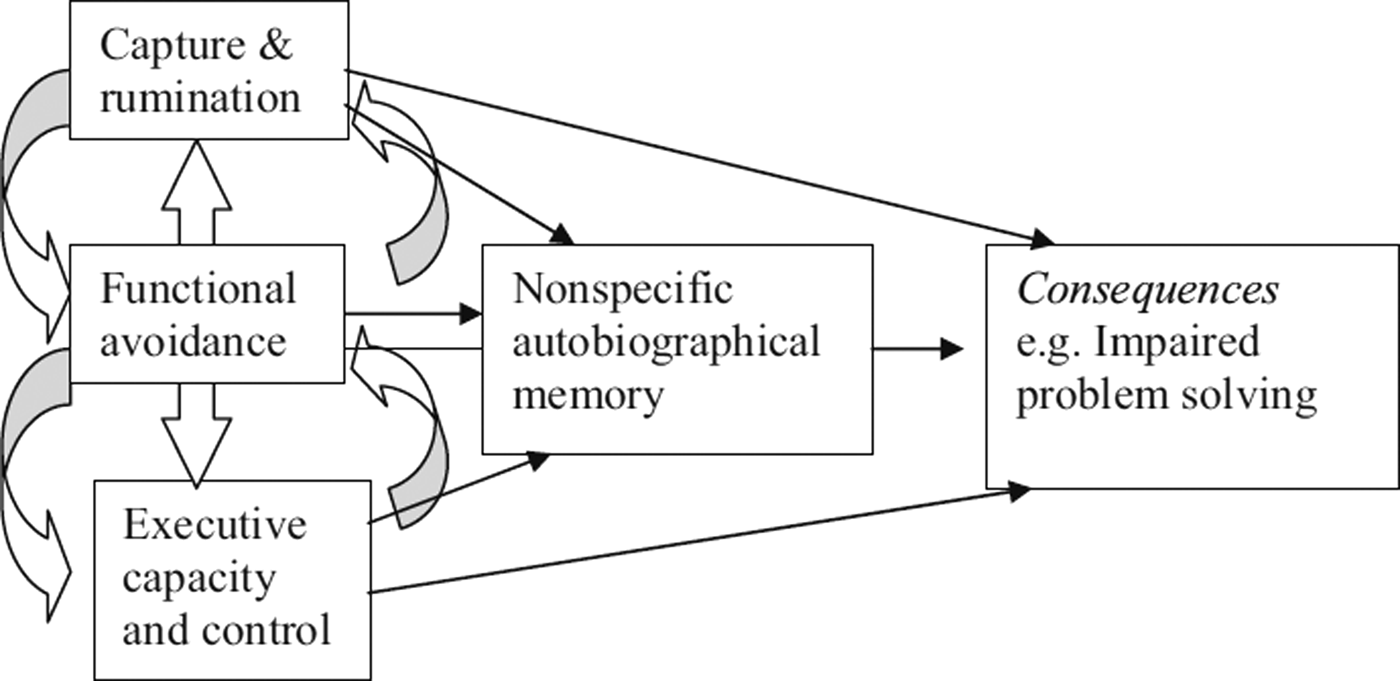
The dominant model of OGM, the CaR-FA-X model (Williams et al., Reference Williams, Barnhofer, Crane, Herman, Raes, Watkins and Dalgleish2007; see Figure 1), proposes that three mechanisms, either separately or in interaction, cause and maintain OGM, and thereby lead to and maintain psychological difficulties: Capture and Rumination (CaR), Functional Avoidance (FA), and Executive Control (X). To date, no research has tested this model in its entirety, adopting a longitudinal design incorporating all three factors and including interaction effects in a sample of adolescent youth. Longitudinal investigation of OGM in adolescence is particularly important given the dramatic increase in onset of both anxiety and depression during this period (Cicchetti & Toth, Reference Cicchetti and Toth1998; Costello, Foley, & Angold, Reference Costello, Foley and Angold2006). In light of research that highlights OGM as a vulnerability marker of psychopathology, it is crucial to investigate mechanisms underlying this risk factor before the onset of significant psychopathology. Adolescence is a time when psychopathology such as depression typically first emerges (Kessler et al., Reference Kessler, Amminger, Aguilar-Gaxiola, Alonso, Lee and Ustun2007); clarification of OGM's underpinnings during this time will inform theoretical accounts of OGM and aid identification of clinical intervention targets. The primary aim of the current article, therefore, was to test the CaR-FA-X model in a community adolescent sample across four annual assessment points. Moreover, in light of research with adults that found differential associations between the CaR-FA-X mechanisms and OGM as a function of depressive mood (Sumner et al., Reference Sumner, Mineka, Adam, Craske, Vrshek-Schallhorn, Wolitzky-Taylor and Zinbarg2014), we further investigated the effect of early depression levels on the model's applicability to understanding OGM in youth.
The CaR-FA-X Model. Three mechanisms (capture and rumination, functional avoidance and executive capacity and control) impact psychological functioning (e.g. problem solving ability) either directly, or through their independent or joint effects on autobiographical memory specificity (permission for reproduction of image granted by J. M. G. Williams; Williams et al., Reference Williams, Barnhofer, Crane, Herman, Raes, Watkins and Dalgleish2007, p. 141).

The CaR-FA-X model of OGM (Williams et al., Reference Williams, Barnhofer, Crane, Herman, Raes, Watkins and Dalgleish2007) elaborates on Conway and Pleydell-Pearce's (Reference Conway and Pleydell-Pearce2000) Self Memory System (SMS) model of autobiographical memory. According to the SMS, autobiographical memory is organized hierarchically, such that when asked to retrieve a specific memory, an individual must carry out a generative retrieval search, navigating from general representations at the top to event-specific representations at lower levels. The three CaR-FA-X model mechanisms are proposed to interfere with the generative retrieval search in different ways (Williams et al., Reference Williams, Barnhofer, Crane, Herman, Raes, Watkins and Dalgleish2007). First, CaR occurs when cue word presentation activates abstract self-relevant information, such as self-beliefs (e.g., brave = “I am not a brave person”), which captures the individual's attention. Rather than moving down the SMS hierarchy and generating a specific memory, the individual engages in rumination, resulting in premature termination of the generative retrieval search at a general level. Second, the FA mechanism refers to termination of the memory search at a general level to avoid potential event-related negative affect (e.g., avoiding thinking about the details and emotions related to a negative social encounter). Avoiding negative emotions negatively reinforces overgeneral retrieval, which, although initially adaptive, may develop over time into a passive and inflexible affect regulation strategy. Last, reduced X, in the form of poor inhibition of irrelevant information during the memory search and/or working memory deficits, may also cause premature termination of the generative retrieval search at a general level.
A key aspect of the CaR-FA-X model is that OGM may initially be part of an adaptive emotion regulation strategy repertoire when used flexibly in response to negative experiences (Hermans, Defranc, Raes, Williams, & Eelen, Reference Hermans, Raes, Williams and Eelen2005). For some people, however, OGM may turn into an inflexible and habitual style of memory retrieval that has adverse consequences for cognitive functioning (Williams et al., Reference Williams, Barnhofer, Crane, Herman, Raes, Watkins and Dalgleish2007). One implication is that OGM relates to the CaR-FA-X model mechanisms differently across populations with different psychopathological profiles (Sumner et al., Reference Sumner, Mineka, Adam, Craske, Vrshek-Schallhorn, Wolitzky-Taylor and Zinbarg2014; Williams et al., Reference Williams, Barnhofer, Crane, Herman, Raes, Watkins and Dalgleish2007). For example, at chronic levels of depressed mood, when emotion regulation is low, avoidance of negative emotional material by means of truncating the retrieval search at a general level may have a stronger reinforcing effect. For individuals from nonclinical samples manifesting low distress, however, OGM may be driven by other processes. For example, adults report that retrieval of recurrent event memories can serve adaptive social functions by highlighting the value of specific social relationships (Waters, Bauer, & Fivush, Reference Waters, Bauer and Fivush2014).
Research on OGM in adults with elevated depression symptoms provides robust support for the capture and rumination and executive function mechanisms of the Car-FA-X model (see Sumner, Reference Sumner2012, for a review). A significant limitation of past research, however, is that most studies have focused on single mechanisms only. Adopting a cross-sectional design, Sumner et al. (Reference Sumner, Mineka, Adam, Craske, Vrshek-Schallhorn, Wolitzky-Taylor and Zinbarg2014) were the first researchers to assess all three components of the model concurrently. They reported that for people with major depression, increased rumination predicted higher concurrent levels of OGM at low levels of executive control. In contrast, for a nondepressed control group, increased rumination predicted OGM at high levels of executive control. Avoidance was not associated with OGM in either group. Consistent with Williams et al.’s (Reference Williams, Barnhofer, Crane, Herman, Raes, Watkins and Dalgleish2007) proposal, these findings highlight that mechanisms can exert effects in interaction. They suggest also that the mechanisms may function differently across groups of people with varying levels of depression symptoms, as has been reported by other research (e.g., Ganly, Salmon, & McDowall, Reference Ganly, Salmon and McDowall2017; Smets, Griffith, Wessel, Walschaerts, & Raes, Reference Smets, Griffith, Wessel, Walschaerts and Raes2013).
Findings with youth provide some support, albeit nuanced, for the relationship between OGM and each of the CaR-FA-X factors. For example, Park, Goodyer, and Teasdale (Reference Park, Goodyer and Teasdale2004) found a cross-sectional positive association between rumination and numbers of OGMs, but this relationship was limited to adolescents with first episode major depression (ages 12–17 years) and to memories provided in response to negative but not positive cues. In contrast, they found a nonsignificant relationship between rumination and the numbers of OGMs reported for individuals in the nondepressed control condition. Similarly, focusing on hospitalized children who had experienced an accidental injury (ages 7–17 years), Hitchcock, Nixon, and Weber (Reference Hitchcock, Nixon and Weber2014b) reported that the association between rumination and OGM was nonsignificant. In terms of executive function, findings are also mixed. One study reported an association between lower inhibitory control (as a measure of executive function) and greater OGM in a community sample of youth ages 9–13 years (Raes, Verstraeten, Bijttebier, Vasey, & Dalgleish, Reference Raes, Verstraeten, Bijttebier, Vasey and Dalgleish2010). Another study (Valentino, Bridgett, Hayden, & Nuttall, Reference Valentino, Bridgett, Hayden and Nuttall2012) did not replicate this finding in a group of young people in inpatient psychiatric care (ages 7–17 years) who were experiencing a range of psychological difficulties (e.g., mood disorders, posttraumatic stress disorder, behavioral problems), and instead reported a negative association between working memory capacity and frequencies of OGM. Research investigating the functional avoidance mechanism has predominantly focused on youth who have experienced trauma (e.g., Brennen et al., Reference Brennen, Hasanović, Zotović, Blix, Skar, Prelić and Gavrilov-Jerković2010), and only two studies have investigated the relationship between self-reported avoidance tendencies and OGM (Kuyken, Howell, & Dalgleish, Reference Kuyken, Howell and Dalgleish2006; Stokes, Dritschel, & Bekerian, Reference Stokes, Dritschel and Bekerian2004). As findings were mixed, strong conclusions about the role of self-reported avoidance cannot be drawn.
Two studies have investigated whether the model mechanisms predict OGM longitudinally (Hitchcock et al., Reference Hitchcock, Nixon and Weber2014b; Rawal & Rice, Reference Rawal and Rice2012). Consistent with the CaR-FA-X model, these studies also investigated possible interactions between mechanisms. In a longitudinal study of adolescents (ages 10–18 years) at familial risk of depression, Rawal and Rice (Reference Rawal and Rice2012) found that higher levels of rumination and lower levels of executive control interacted to predict OGM at a 6-month follow-up. Although Hitchcock et al. (Reference Hitchcock, Nixon and Weber2014b) did not find this relationship in community adolescents (ages 7–17 years) at a 12-month follow-up, greater working memory capacity was associated with lower proportions of OGM in older, but not younger, adolescents.
In summary, the mechanisms of rumination and executive function have received some support, but more research is needed, and very little work has focused on the role of the avoidance mechanism. The conclusions that can be drawn from current research are also limited by variability in the samples, particularly with respect to the age of participants and the nature and severity of their psychological symptomatology. Several factors seem to moderate the findings of significant associations. In particular, it appears that the model better accounts for OGM in clinical than nonclinical youth populations. One possible explanation may be that in clinical samples, existing psychological vulnerabilities moderate the degree to which the CaR-FA-X processes precipitate OGM (Crane et al., 2015; Rawal & Rice, Reference Rawal and Rice2012; Smets et al., Reference Smets, Griffith, Wessel, Walschaerts and Raes2013). At times of low mood or distress, when emotion regulation is impaired and inhibitory control compromised (Joormann & Gotlib, Reference Joormann and Gotlib2010), a person may ruminate more and thus be more susceptible to CaR errors (Raes, Schoofs, Griffith, & Hermans, Reference Raes, Schoofs, Griffith and Hermans2012; Williams et al., Reference Williams, Barnhofer, Crane, Herman, Raes, Watkins and Dalgleish2007). With increasing distress, avoidant cognitions and behaviors also increase (Ottenbreit & Dobson, Reference Ottenbreit and Dobson2004). In contrast, at low levels of distress, individual differences in OGM may be better accounted for by other factors, such as reduced motivation to engage in the task (Crane et al., Reference Crane, Heron, Gunnell, Lewis, Evans and Williams2016).
Cue valence may also moderate the relationship between the model's mechanisms and OGM, with some research reporting associations for memories generated in response to negative cue words only (Park et al., Reference Park, Goodyer and Teasdale2004). This result may suggest that OGM as an affect regulation strategy is at first limited to negative cue words, but generalizes to positive cues as psychopathology increases over time. Initially, OGM may emerge when young people attempt to minimize the emotional impact of remembering negative past events. Over time, as OGM retrieval becomes more inflexible, and distress increases, recall of a wider range of memories, regardless of emotional valence, becomes disrupted (Kuyken & Dalgleish, Reference Kuyken and Dalgleish2011).
In conducting a test of the full CaR-FA-X model, the current study addressed several important gaps in the literature. In particular, our four annual waves of data for adolescents who averaged 13 years of age at Time 1 spanned the period of significant increases in psychopathology (Costello, Mustillo, Erkanli, Keeler, & Angold, Reference Costello, Mustillo, Erkanli, Keeler and Angold2003) and associated cognitive processes such as rumination (Jose & Brown, Reference Jose and Brown2008) and executive functioning (Anderson, Anderson, Northam, Jacobs, & Catroppa, Reference Anderson, Anderson, Northam, Jacobs and Catroppa2001). At each time point, participants completed measures of the three CaR-FA-X factors and depression. This method allowed us to not only test the CaR-FA-X model in its entirety, but also to investigate possible differences in the model's applicability to groups of young people who report different patterns of early depressive symptomatology. We operationalized depression severity as trajectory of depression symptom growth across the four time points and compared two group of participants: one group with low, yet increasing, depression levels across the 4 years, and one group with higher and increasing levels. We chose this approach because depression levels tend to fluctuate across adolescence, and in light of the theoretical notion that flexibility of OGM use may reduce as a function of prolonged adversity (Hermans et al., Reference Hermans, de Decker, De Peuter, Raes, Eelen and Williams2008), we wanted to identify youth with elevated depression levels across time. We aimed to test, therefore, whether the CaR-FA-X processes, individually and in interaction, would function differentially across groups of young people with varying levels of depression symptoms.
We hypothesized that higher levels of rumination and avoidance, and reduced executive control (operationalized as inhibitory control) would predict higher OGM (operationalized as higher proportions of overgeneral memories and lower proportions of specific memories) over time, either individually or in interaction, in the context of higher depression symptoms. Due to a lack of research testing multiple mechanisms concurrently, we did not make specific predictions about interaction effects. To strengthen any conclusions drawn from our subgroup findings and to explore whether patterns of findings across high and low subgroups are characteristic of only these groups or more widely evident in community youth, we also tested the model across the entire sample.
Methods
Participants
Participants were recruited from 14 schools in New Zealand. Initial recruitment at Time 1 involved communication with schools in the immediate Wellington urban area. We then systematically recruited further afield until a sufficient number of students agreed to participate. For follow-up, additional schools needed to be recruited as students transitioned to intermediate and secondary schools. Of the 323 (171 males, 152 females) adolescents who participated at Time 1, 288 participated at Time 2 (89.2%), 269 at Time 3 (83%), and 239 at Time 4 (74%). The mean age was 12.83 years (SD = 1.18) at Time 1, 13.87 years (SD = 1.16) at Time 2, 14.74 (SD = 1.05) at Time 3, and 15.87 (SD = 1.00) at Time 4. Boys were significantly older at Time 1 (M = 13.10, SD = 1.25) than girls (M = 12.54, SD = 1.01), t (318.27) = 4.46, p < .001, bootstrapped (2,000 samples) 95% bias-corrected accelerated (BCa) confidence interval (CI) [3.67, 9.84]. Parental consent and student assent was obtained separately for each wave, allowing for the option of withdrawal at each follow-up point. The majority of participants identified as New Zealander or European New Zealander (80.1%). The remaining participants identified as Mãori (5.3%), Asian (7.9%), Pacific Islander (3.4%), or Other (3.4%). Although, across schools, low to high socioeconomic backgrounds were represented, the majority of the children were of middle socioeconomic background. We would like to acknowledge that the dataset analyzed in the present study includes data used in a previous study (see Gutenbrunner et al., Reference Gutenbrunner, Salmon and Jose2018), which addressed different research questions. This research was approved by the School of Psychology Human Ethics Committee, under delegated authority to the Victoria University of Wellington's Ethics Committee.
Measures
Depression
Participants completed the 12-item Children's Depression Inventory-2 (CDI-2) Self-Report Short Version (Kovacs, Reference Kovacs1985, Reference Kovacs1992). For each item, participants are presented with three sentences per item (e.g., “I hate myself,” “I do not like myself,” “I like myself”), and asked to select the one response option that best corresponds to how they had been feeling over the past two weeks. Items are then scored on a 3-point scale (0 = no symptoms, 1 = mild symptoms, 2 = severe symptoms) and a total score computed. Internal consistency was good across the four waves (all Cronbach's αs =.73 to .81).
Effortful control
An index of effortful control was calculated by computing a mean score across three subscales of the Revised Early Adolescent Temperament Questionnaire Short Form (Capaldi & Rothbart, Reference Capaldi and Rothbart1992; Ellis & Rothbart, Reference Ellis and Rothbart2001): inhibitory control (five items; e.g., “I can stick with my plans and goals”), activation control (five items; e.g., “I finish my homework before the due date”), and attention (six items; e.g., “I am good at keeping track of several different things that are happening around me”). Responses are made on a 5-point scale (1 = almost always untrue to 5 = almost always true). Higher scores indicate greater effortful control, that is, greater “ability to inhibit a dominant response to perform a subdominant response” (Rothbart & Bates, Reference Rothbart, Bates, Damon and Eisenberg1998; p. 137). Effortful control and executive functioning are regarded as conceptually and empirically overlapping constructs (e.g., Bridgett, Oddi, Laake, Murdock, & Bachmann, Reference Bridgett, Oddi, Laake, Murdock and Bachmann2013). We used a subjective measure of self-regulation on the basis of previous research on OGM with youth (Raes et al., Reference Raes, Verstraeten, Bijttebier, Vasey and Dalgleish2010). Across the four data collection waves, superscale Cronbach's alphas ranged from .80 to .85.
Rumination
Participants completed an abbreviated 6-item version of the 13-item rumination subscale of the Children's Response Styles Questionnaire (Abela et al., Reference Abela, Rochon and Vanderbilt2000, Reference Abela, Brozina and Haigh2002). Each item consists of a statement related to ruminative cognitive processes (e.g., “When I am sad, I think why can't I handle things better”), and participants report how often they engage in these thinking styles on a 4-point scale (1 = almost never; 2 = sometimes; 3 = often; 4 = almost always). Average scale scores range from 1 to 4, with higher values representing greater rumination levels. Across the four waves of data collection, Cronbach's alphas ranged from .77 to .85.
Avoidance
The Affect Regulation Scale was devised for the current study based on Jose and Huntsinger's (Reference Jose and Huntsinger2005) coping measure. Three domains were measured; emotional (e.g., “when I am sad, I avoid thinking about how I feel”) and behavioral (e.g., “when I am sad, I stay away from the person or situation that is causing the problem”) avoidance, as well as denial of unfavorable circumstances (e.g., “when I am sad, I try to pretend there isn't a problem”). Participants indicated how often they engage in such response styles on a 4-point scale (1 = almost never; 2 = sometimes; 3 = often; 4 = almost always). In light of high correlations between subscales, the three subscales were collapsed into a 10-item avoidance measure at Times 1 and 2, and a 12-item (2 items added) measure at Times 3 and 4. Higher scores indicate greater engagement in avoidant affect regulation. Cronbach's alphas ranged from .77 to .86 across the four years.
As the Affect Regulation Scale was developed specifically for the current study, additional psychometric analyses were carried out. The measure exhibited good convergent validity, with scores across the four time points correlating significantly in expected directions with other conceptually relevant measures. For example, correlations between the avoidance and rumination scores were significant at all time points (rs = .22–.32, ps < .001), which is consistent with research that investigated relationships between these constructs (e.g., Moulds, Kandris, Star, & Wong, Reference Moulds, Kandris, Starr and Wong2007). Moreover, longitudinal measurement invariance was demonstrated across the four time points when a Longitudinal Invariance Confirmatory Factor Analysis was carried out (additional information about this analysis can be requested from the first author).
Autobiographical memory
The written version of the Minimal Instructions Autobiographical Memory Test (Mi-AMT; Debeer, Hermans, & Raes, Reference Debeer, Hermans and Raes2009) assessed memory retrieval style. The Mi-AMT has been found to be more sensitive to overgenerality in nonclinical populations than the original AMT (Debeer et al., Reference Debeer, Hermans and Raes2009). Participants were presented with 10 cue words in fixed order, alternating between positive and negative valence. The cues (happy, sad, lucky, angry, proud, lonely, excited, guilty, relaxed, scared) were obtained from previous research with youth (Hipwell, Sapotichne, Klostermann, Battista, & Keenan, Reference Hipwell, Sapotichne, Klostermann, Battista and Keenan2011; Raes et al., Reference Raes, Verstraeten, Bijttebier, Vasey and Dalgleish2010). Following piloting, minor alterations were made to the test instructions. Participants were instructed that they are completing a memory test, and that, for each cue, they are requested to think of and write down a specific event of which the cue reminds them. As an example, they were provided with a correct and incorrect response to a cue word not included in the Mi-AMT, but they were not asked to complete practice items. Participants were told not to use the same memory more than once. For each cue, participants had one minute to respond. Participants provided memories in writing; our previous research suggests that, in children, mode of memory reporting (written vs. spoken) does not predict number of overgeneral and specific memories reported (Glynn, Salmon, & Jose, Reference Glynn, Salmon and Jose2016).
Memory coding and reliability
Responses on the AMT were coded for temporal specificity using preestablished criteria (e.g., Crane et al., Reference Crane, Heron, Gunnell, Lewis, Evans and Williams2016; Griffith et al., Reference Griffith, Sumner, Raes, Barnhofer, Debeer and Hermans2012). Memories referring to single events that did not last longer than one day were coded as specific (e.g., “when I went to the cinema on Saturday”); memories referring to a category of similar events were coded as categoric (e.g., “when we go to the park”); memories referring to events that took longer than 24 hours were coded as extended (e.g., “going to Australia last year”). Several additional types of responses were errors and not analyzed further: semantic associates (verbal associations, such as “bed” in response to cue word happy); future-oriented responses (reports of events that had not yet happened, such as, “going on camp next week”); repetitions of previous responses; incomplete responses; omission (failure to provide a response). Mean inter-rater reliability across three trained raters was good overall (κ = .75). Six indices of memory specificity, or overgenerality, were calculated. Following Griffith et al. (Reference Griffith, Sumner, Raes, Barnhofer, Debeer and Hermans2012), indices of overgenerality (categoric and extended memories) and specificity (specific memories) were computed as proportions of nonmissing responses. In line with findings of cue valence effects in young people (e.g., Park et al., Reference Park, Goodyer and Teasdale2004), we also calculated separate indices of overgenerality and specificity for positive and negative cue words.
Procedure
Participants were assessed during school time in groups of approximately 10 students. Before data collection commenced, students were informed that responses were confidential and would only be traced back to individuals if responses gave concerns about their well-being. In that case, the school would be contacted (for individuals younger than age 16 years) or the individual themselves (for individuals age 16 years and older). Following informed assent, the Mi-AMT was administered. For the second part of the session, students completed self-report questionnaires. Participants were then debriefed about the purpose of the study, and invited to ask questions. Each session was of approximately 45 minutes' duration, and trained postgraduate students and research fellows carried out data collection and coding.
Data analysis
Across the four data collection points, the total percentage of missing scores across the measures was 14.2%. Little's Missing Completely At Random (MCAR) test was statistically significant, indicating that data were not missing completely at random. To maximize power, we used the expectation-maximization (EM) algorithm to impute missing values in SPSS, version 23. The software package Mplus 7 (Muthén & Muthén, Reference Muthén and Muthén1998–Reference Muthén and Muthén2015) was used for growth modeling analysis, and AMOS 23 (Arbuckle, Reference Arbuckle2014) for structural equation modeling. Because some measures were nonnormally distributed, we used the MLR estimator for analyses in Mplus and bootstrapping in AMOS. To test hypotheses, we bootstrapped (2,000 samples) 99% BC CIs. Because of the number of multiple comparisons made, parameter estimates and bootstrapped CIs are only reported for findings significant at the p < .01 level.
Next, to identify subgroups of participants with different depression growth trajectories across the four time points, latent class growth analyses were carried out. Unlike conventional growth modeling analyses, this approach identifies subgroups with distinct growth curves, rather than treating the sample as coming from a single population with a single growth trajectory (Jung & Wickrama, Reference Jung and Wickrama2008). Models with different numbers of subgroups are compared to identify the best-fitting model with the smallest Bayesian Information Criterion (BIC), and significant Lo, Mendell, and Rubin (Reference Lo, Mendell and Rubin2001) likelihood ratio (LMR-LRT) test statistic (Jung & Wickrama, Reference Jung and Wickrama2008).
Prospective associations between CaR-FA-X mechanisms and OGM were tested using autoregressive cross-lagged structural equation models. This approach is suited to the current research questions because it allows simultaneous inclusion of multiple factors across multiple time points. To test whether the CaR-FA-X factors are related to OGM in youth who experience higher, but not lower, depression over time, multigroup analyses were carried out using one of the six memory indices at a time. Computational constraints were imposed by our inclusion of main effects and interactions and also because we considered it important to allow stability coefficients to vary across groups; therefore, separate analyses were carried out for each time lag. First we assessed main effects and then included interaction terms (three in total, each representing the product of two model mechanisms) to test whether interactions between the CaR-FA-X mechanisms predicted OGM above and beyond the main effects. Variables were allowed to covary with one another, as was age and gender. If a coefficient was found to be statistically significant in either trajectory group, follow-up χ2 difference tests were carried out: that is, a group difference was considered significant only if the χ2 value significantly increased as a function of constraining the pathway of interest to equality across trajectory subgroups (indicating worse model fit).
For tests of prospective associations across the entire sample, single models including all four waves of data were fit for each one of the six computed memory indices outlined earlier (indices for proportions of overgeneral and specific memories; and separate indices for proportions of overgeneral and specific memories reported to positive and negative cue words). To identify the most parsimonious models, models with freely varying autoregressive pathways (associations between scores on the same measure across the three time lags) were compared with models where autoregressive pathways were constrained to be equal. To allow for estimation of time-specific prospective effects, cross-lagged pathways were allowed to vary freely (e.g., associations between rumination and OGM from Time 1 to Time 2, Time 2 to Time 3, and Time 3 to Time 4 were not constrained to be equal).
Results
Descriptive statistics
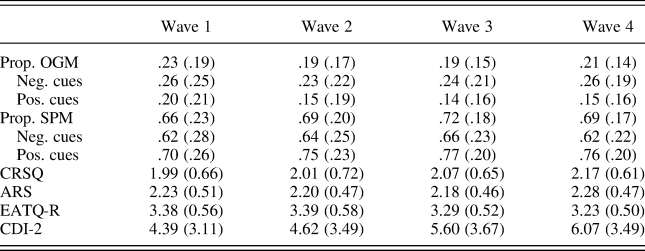
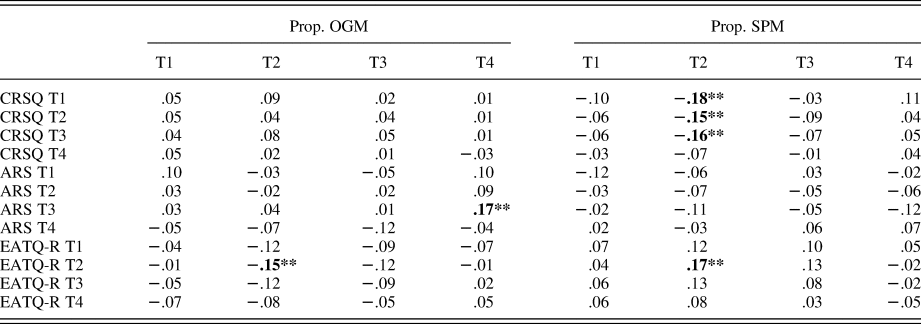
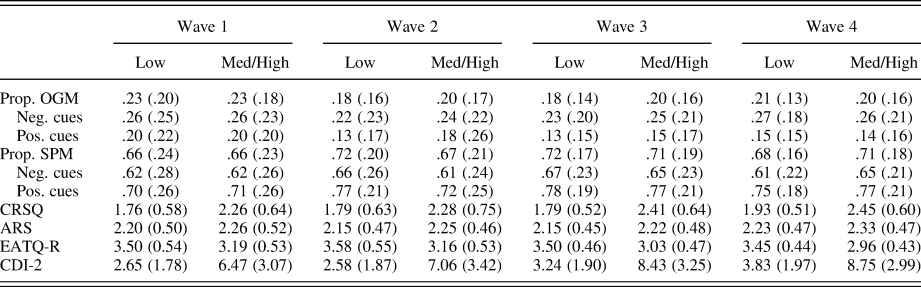
The study variables’ M and SD are presented in Table 1 for the entire sample and in Table 3 for the depression trajectory groups. Correlation analyses (Table 2) show that the three CaR-FA-X model factors were not consistently associated with proportions of overgeneral or specific memories across the four waves of data collection. Because of the large number of comparisons made, we adopted a more stringent criterion of statistical significance. At the p < .01 level, six correlations were statistically significant. Higher levels of rumination at Times 1, 2, and 3 were associated with lower proportions of specific memories at Time 2, and higher levels of avoidance at Time 3 were associated with higher proportions of overgeneral memories at Time 4. Lower levels of effortful control at Time 2 were associated with higher proportions of overgeneral memories and lower proportions of specific memories at Time 2.
Descriptive statistics of the study variables (N = 323)

Note: ARS = Affect Regulation Scale; CDI-2 = Children's Depression Inventory 2; CRSQ = Children's Response Styles Questionnaire; EATQ-R = Early Adolescent Temperament Questionnaire; prop. OGM = proportion of overgeneral autobiographical memories (sum of categoric and extended memories); prop. SPM = proportion of specific autobiographical memories.
Pearson's correlations between CaR-FA-X model factors and primary memory indices (findings significant at the .01 level in bold)
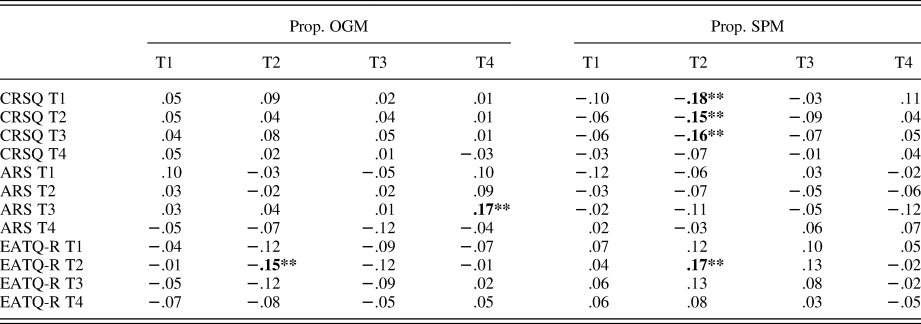
Note: Prop. OGM = Proportion of overgeneral autobiographical memories (sum of categoric and extended memories); Prop. SPM = Proportion of specific autobiographical memories; CRSQ = Children's Response Styles Questionnaire; ARS = Affect Regulation Scale; EATQ-R = Early Adolescent Temperament Questionnaire.
**p < .01.
Descriptive statistics of the study variables for low (N = 176) and medium/high (N = 147) depression growth subgroups

Note: ARS = Affect Regulation Scale; CDI-2 = Children's Depression Inventory 2; CRSQ = Children's Response Styles Questionnaire; EATQ-R = Early Adolescent Temperament Questionnaire; prop. OGM = proportion of overgeneral autobiographical memories (sum of categoric and extended memories); prop. SPM = proportion of specific autobiographical memories.
A repeated measures analysis of variance was carried out to investigate change in mean scores over the four time points. Mauchly's tests indicated that the assumption of sphericity had been violated for each measure, χ2(5) = 12.04 to 121.98, ps < .001 to .030. Degrees of freedom were thus corrected using the Greenhouse-Geisser estimates of sphericity (ε = .85 to .98). The main effect of time was significant for depression, F (2.92, 943.01) = 44.23, p < .001, ηp2 = .121, with mean depression scores increasing over time (Time 3 and Time 4 significantly greater than Time 1 and Time 2). Similarly, rumination scores increased over time, F (2.81, 903.25) = 11.08, p < .001, ηp2 = .033. Only Time 4 differed significantly from the other time points, however, and no other significant time point differences were found. For the avoidance measure, scores were relatively stable across the first three waves before increasing significantly at Time 4 (relative to Times 2 and 3), F (2.91, 936.31) = 4.32, p = .005, ηp2 = .013. Effortful control scores were relatively stable across the first two time points, then decreased at Times 3 and 4, with scores at Time 4 being significantly lower than scores at the other time points, F (2.53, 816.09) = 16.13, p < .001, ηp2 = .048. Proportion of overgeneral memories significantly decreased at Time 2 and 3, then increased again slightly at Time 4, although not significantly, F (2.73, 878.69) = 6.05, p = .001, ηp2 = .018. Proportions of specific memories remained relatively stable, with significant differences only between Time 1 and Time 3 scores, F (2.79, 897.62) = 5.76, p = .001, ηp2 = .018.
Do depression growth classes moderate the CaR-FA-X model's prediction of OGM?
To determine the number of distinct subgroups of students with varying trajectories of change on the depression measure across the four time points, latent class growth models with different numbers of classes were compared in terms of model fit. First, we carried out latent class growth analyses to identify two distinct depression trajectory classes. Specification of a three-class model demonstrated superior model fit relative to a two-class model, as evidenced by lower BIC and significant LMR-LRT fit statistics. Specification of a four-class model resulted in a nonsignificant LMR-LRT and only a marginal reduction in BIC, rendering the three-class solution as optimal. The three subgroups (where I = intercept; S = slope) were: a low-increasing group (N = 176, I = 2.53, S = .40, ps < .001); a medium-increasing group (N = 121, I = 5.43, S = .40, ps < .001); and a higher-stable group (N = 26, I = 10.60, S = .64, p < .001 and p = .05, respectively). Considering that the higher-stable group represented less than 10% of the sample (N = 26), we collapsed the small higher-stable group with the medium-increasing group to form a single medium-higher group (N = 147); this group was compared with the low-increasing group (N = 176) in subsequent analyses.
Table 3 presents descriptive statistics for the depression trajectory subgroups. It should be noted that depression trajectory group labels (low and medium/high) are relative. According to the CDI-2 scoring guide, the medium/high subgroup mean depression levels, although increasing over time, would be considered average at Times 1 and 2, and higher average/elevated at Times 3 and 4. The low depression subgroup would be considered average or lower at all time points.
A repeated measures ANOVA was run to test for differences in proportions of overgeneral and specific memories reported across the two trajectory subgroups, including covariates of age and gender. Levene's tests of equality of variances were nonsignificant for each measure across all four time points. Tests of main effects for depression growth group membership were nonsignificant for both proportions of overgeneral memories and specific memories, respectively, Fs (1, 319) = 0.34 and 0.33, ps = .560 and .569.
To test hypotheses, main effect models were tested first and then models including interaction terms. Across the 18 cross-lags examined, four main effect differences were found using χ2 difference tests. As can be seen in Table 4, increased avoidance at Time 3 predicted higher proportions of overgeneral memories at Time 4 in the medium/high depression growth group (β = .28, p = .001, BC 99% CI [.109, .445]) but not the lower growth group (β = .05, p = .576, BC 99% CI [−.187, .274]). Follow-up valence effect tests suggested that increased avoidance predicted higher proportions of overgeneral memories to negative cue words in the medium/high depression growth group (β = .32, p = .001, BC 99% CI [.129, .502]) but not the low depression growth group (β = −.12, p = .205, BC 99% CI [−.322, .121]). No significant group difference was found for prospective associations between avoidance and proportions of overgeneral memories to positive cue words. Increased avoidance at Time 3 also predicted lower proportions of specific memories at Time 4 in the medium/high depression growth group (β = −.25, p < .001, BC 99% CI [−.397, −.074]) but not in the lower growth group (β = .01, p = .947, BC 99% CI [−.215, .225]). Follow-up valence effect tests suggested that increased avoidance predicted lower proportions of specific memories to negative cue words in the medium/high depression growth group (β = −.25, p = .001, BC 99% CI [−.411, −.075]), but not the low depression growth group (β = .13, p = .115, BC 99% CI [−.084, .356]). No significant associations were found for specific memories to positive cue words. When including interaction terms as predictors of OGM indices, no significant interaction effect differences were found across depression trajectory groups using the χ2 difference test.
Standardized regression weights and corresponding confidence intervals for avoidance (T3) predicting OGM proportions (T4) across entire sample and depression growth subgroups (findings significant at the .01 level in bold)

Note: CI = confidence interval; neg = negative cues; pos = positive cues; prop. OGM = proportion of overgeneral autobiographical memories (sum of categoric and extended memories); prop. SPM = proportion of specific autobiographical memories.
In summary, our first hypothesis that the CaR-FA-X mechanisms would predict OGM in youth with elevated depressive symptoms was partially supported. Specifically, the medium/high trajectory group showed that increased avoidance at Time 3 predicted higher proportions of overgeneral memories, and also lower proportions of specific memories, at Time 4, in particular to negative cue words. No significant associations between the model mechanisms and OGM were found for the low depressive symptoms subgroup.
Does the CaR-FA-X model predict OGM across the entire sample?
Before testing associations among the three CaR-FA-X model components and OGM, we identified best-fitting models for each of the six memory indices. Step-wise relaxation of autoregressive parameters only improved model fit when associations between scores of effortful control were allowed to vary freely across the four waves. Consequently, the most parsimonious models entailed constrained autoregressive pathways across the three time lags for all measures with the exception of effortful control (final models fits: χ2(81, N = 323) = 241.92 to 266.00, ps < .001, Confirmatory Fit Index = .91 to .92, and all Root Mean Square Error of Approximation = .08).
To test associations between the CaR-FA-X mechanisms and OGM across the entire sample, we first examined models’ main effects. Of the 54 main effect tests (three cross-lags for each of the three time lags, tested separately using one of the six memory indices at a time), only two significant findings emerged at p < .01. As can be seen in Table 4, increased avoidance at Time 3 predicted higher proportions of overgeneral memories at Time 4 (β = .18, p = .001, BC 99% CI [.045, .315]). This finding was qualified by cue valence, with increased avoidance at Time 3 predicting higher proportions overgeneral memories to positive cue words at Time 4 (β = .16, p = .003, BC 99% CI [.023, .297]), but not negative cue words (β = .11, p = .052, BC 99% CI [−.040, .260]). No significant interaction effects were found. In summary, higher avoidance symptoms predicted increases in OGM to positive cue words across the entire sample, but only from Time 3 to Time 4.
Discussion
This study is the first to test Williams et al.’s (Reference Williams, Barnhofer, Crane, Herman, Raes, Watkins and Dalgleish2007) CaR-FA-X model of OGM in its entirety across four time points in a sample of nonclinical youth. We hypothesized that differences in associations between model mechanisms and OGM would emerge across groups reporting lower or higher psychological vulnerability, operationalized as low or medium/high trajectories of depression growth. Specifically, we predicted that the three model mechanisms (increased rumination and avoidance and reduced executive control) would predict OGM recall independently, or in interaction, across four annual time points, but only for youth with higher depression levels. This prediction was partially supported; increased avoidance predicted higher proportions of overgeneral and lower proportions of specific memories to negative cue words only in the medium/high depression trajectory group, but these findings were limited to the third time lag. The CaR-FA-X model mechanisms did not consistently predict OGM in the low depression group or across the entire sample. Collectively, findings highlight that the CaR-FA-X model mechanisms, either independently or in interaction, do not explain significant variability in OGM in community youth. Although the avoidance mechanism may precipitate OGM to some degree, findings were only noted for a single period and as a function of higher depression levels.
Our finding that avoidance predicted OGM only for people in the high depression group is consistent with the notion that symptom severity or clinical status moderates associations between the CaR-FA-X mechanisms and OGM (Sumner et al., Reference Sumner, Mineka, Adam, Craske, Vrshek-Schallhorn, Wolitzky-Taylor and Zinbarg2014; Williams et al., Reference Williams, Barnhofer, Crane, Herman, Raes, Watkins and Dalgleish2007). Specifically, in youth with consistently higher depressive symptom levels across time, increased avoidance at Time 3 predicted increased overgenerality and reduced specificity at Time 4. Although most research on the functional avoidance mechanism in youth has focused on associations between OGM and past trauma, our findings are consistent with one cross-sectional report of associations between self-reported avoidant tendencies and higher OGM for depressed youth (Stokes et al., Reference Stokes, Dritschel and Bekerian2004). We extend this research, however, in demonstrating longitudinal increases in OGM as a function of increased avoidance in youth with elevated depression levels while controlling for established covariates. Thus, although our findings are restricted to one period only, they suggest that youth with a tendency to engage in avoidant coping may also use overgeneral remembering as a means of reducing the likelihood of experiencing distressing memories and associated affect (Hermans et al., Reference Hermans, Raes, Williams and Eelen2005; Moore & Zoellner, Reference Moore and Zoellner2007; Williams, 1996; Williams et al., Reference Williams, Barnhofer, Crane, Herman, Raes, Watkins and Dalgleish2007).
Associations between increased avoidance and higher proportions of overgeneral memories were stronger for memories to negative cues than to memories to positive cues. In contrast, studies with adults with clinical-level difficulties often find OGM in response to negative and positive cue words. The current finding may suggest that in youth with enduring elevated depressive symptoms, OGM initially serves to regulate affect associated with information elicited by negatively valenced cue words. At early stages of the development of this coping mechanism, therefore, young people with elevated depression levels may selectively avoid retrieval of negative memories to regulate their emotional experience (Kuyken & Dalgleish, Reference Kuyken and Dalgleish2011). With increasing levels of psychopathology, however, OGM, as a learned affect regulation strategy, may generalize to positive cue words also (Williams et al., Reference Williams, Barnhofer, Crane, Herman, Raes, Watkins and Dalgleish2007).
Particularly interesting was that the longitudinal relationship between avoidance and OGM emerged despite levels of reported avoidance and OGM not differing significantly across depression subgroups. That is, young people in the medium/high depression growth group were not more avoidant, nor more overgeneral, than adolescents with lower depression trajectories. These findings suggest that avoidance and retrieval of overgeneral memories have a different relationship with each other and may serve different functions, for individuals with higher vs. lower levels of depression. Other research, also, suggests this possibility (e.g., Ganly et al., Reference Ganly, Salmon and McDowall2017). For young people with lower depression, using OGM flexibly might help to avoid negative feelings in the short term. Indeed, some findings suggest that in nonclinical populations, higher OGM can even serve a protective function and be associated with reductions in negative affect (e.g., Raes, Hermans, de Decker, Eelen, & Williams, Reference Raes, Hermans, de Decker, Eelen and Williams2003). At increasing and chronic levels of distress, however, overgeneral remembering may become inflexible and be a product of, and further exacerbate, psychological difficulties. If OGM represents one facet of a broader avoidant coping style, clinical interventions with depressed youth may benefit from addressing biases in autobiographical remembering alongside other vulnerabilities (Hitchcock, Werner-Seidler, Blackwell, & Dalgleish, Reference Hitchcock, Werner-Seidler, Blackwell and Dalgleish2017).
Increased rumination and reduced executive control did not predict higher OGM in either subgroup or the entire sample. This is inconsistent with the CaR-FA-X model and other theories that focus specifically on diminished cognitive regulation resources and increased ruminative self-processing as causes of OGM (Dalgleish et al., Reference Dalgleish, Williams, Golden, Perkins, Barrett, Barnard and Watkins2007; Watkins & Teasdale, Reference Watkins and Teasdale2004). The reasons for this finding are unclear, but we can speculate on potential factors. In Rawal and Rice's (Reference Rawal and Rice2012) one-year longitudinal study demonstrating predictive relationships between memory specificity and both rumination and executive control, avoidance was not measured. A particular strength of the current study, however, is that our findings enabled conclusions about the role of avoidance while controlling for rumination and executive control (and vice versa), permitting greater clarity of the relative influence of each. Our self-report measure for the executive control mechanism further differed from the measure adopted by Rawal and Rice, which was the Block Design test of the Wechsler Intelligence Test for Children (Wechsler, Reference Wechsler2004). Given the complexity of the executive control construct (Duckworth & Steinberg, Reference Duckworth and Steinberg2015), differences in conceptualization and measurement likely contribute to inconsistencies in findings in this research area. Finally, with regard to the rumination mechanism, although we refer to trajectory groups as low or medium/high, our overall levels of depressive symptoms in the sample were relatively low, particularly at early time points. Perhaps negative self-beliefs in the current sample were still less well established than in other research samples with greater depression, thereby reducing likelihood of capture and rumination errors.
The finding that the three CaR-FA-X mechanisms did not consistently predict OGM across the entire sample mirrors other research with nonclinical youth populations (e.g., Kuyken et al., Reference Kuyken, Howell and Dalgleish2006; Smets et al., Reference Smets, Griffith, Wessel, Walschaerts and Raes2013). The current study's findings extend past, predominantly cross-sectional, research by highlighting that the three CaR-FA-X mechanisms do not account for significant variability in OGM across four annual assessment points in this group of community adolescents. Two significant associations were found across the entire sample. First, increased avoidance at Time 3 predicted higher OGM at Time 4, but this finding was likely driven by the association found in the medium/high depression growth subgroup. In contrast, the finding that higher avoidance at Time 3 predicted higher OGM to positive cue words at Time 4 across the entire sample was not moderated by depression growth. This result should be interpreted with caution, however; relative to the other findings, the effect size was small and the confidence interval's lower bound included values close to zero.
If not the CaR-FA-X mechanisms, what then underlies or drives OGM in nonclinical youth? At least three explanations are possible. First, although research on alternative underlying mechanisms is lacking, lack of motivation when responding to the AMT may play a role in youth populations (Crane et al., Reference Crane, Heron, Gunnell, Lewis, Evans and Williams2016). Further, research investigating the development of autobiographical memory also suggests that retrieval of some general memories when asked to retrieve a specific memory is normative in young people (Peterson, Baker-Ward, & Grovenstein, Reference Peterson, Baker-Ward and Grovenstein2016), perhaps as a result of early memory socialization practices between mother and child, which can shape style of recalling past events (Valentino et al., Reference Valentino, Nuttall, Comas, McDonnell, Piper, Thomas and Fanuele2014). Third, it is also possible that OGM serves adaptive functions in children as has been reported with adults (e.g., Waters et al., Reference Waters, Bauer and Fivush2014); for example, memories with a social component (e.g., “family holidays”) can support the development of a healthy relational sense of self (Wang, Reference Wang2004). For a more comprehensive understanding of OGM's etiology in youth, future research needs to (a) test CaR-FA-X model in its entirety longitudinally in samples with different forms and levels of psychopathology and (b) investigate a broader range of mechanisms, at various ecological levels (Valentino, Reference Valentino2011).
Other findings from this same sample (Gutenbrunner et al., Reference Gutenbrunner, Salmon and Jose2018) and other work (see Hamlat et al., Reference Hamlat, Connolly, Hamilton, Stange, Abramson and Alloy2015) demonstrate that rumination interacts with OGM to predict anxiety and depression in youth. Together with the current results, these findings paint a complex picture of the longitudinal interrelationships among OGM, avoidance, rumination, and psychopathology in the context of increasing risk. Beyond the current study's time points, avoidant coping, over time, may foster retrieval inflexibility in youth with elevated low mood. Future research could investigate whether inflexible use of OGM as a form of avoidance, over time, predicts greater OGM and low mood as a function of reduced executive control and increases in capture and rumination errors. Indeed, research with adolescents has found avoidance to predict increases in rumination over a short delay, which, in turn, mediated associations between avoidance and subsequent increases in low mood and anxiety (Dickson, Ciesla, & Reilly, Reference Dickson, Ciesla and Reilly2012).
The current research has several limitations. First, the large number of analyses performed here may have inflated Type 1 error rate. To compensate for this strategy, we adopted a more stringent significance threshold, thus reducing the risk of falsely rejecting the null hypothesis. Second, although we could have investigated possible gender effects, this issue was not a primary research question for this article, and group difference testing would have increased computational burden significantly. We did include gender and age as covariates in all analyses, however. Third, our analyses did not account for young peoples’ language skills or IQ, which may have affected retrieval of memories on the AMT (e.g., Hipwell et al., Reference Hipwell, Sapotichne, Klostermann, Battista and Keenan2011). Fourth, measurement limitations must be acknowledged. That is, inconsistencies in how past research conceptualized and operationalized the three mechanisms make it difficult to compare studies’ findings directly and thus limit their generalizability. For a more comprehensive understanding of associations between the three CaR-FA-X mechanisms and OGM in youth, future research should test the model using a range of construct measures (e.g., assess both capture and rumination, include measures of both trauma and functional avoidance, and adopt measures of executive function that tap into a range of executive control capacities). Finally, participants in the current study were predominantly of New Zealand European ethnicity and of middle-class socioeconomic origin, which, in the context of research demonstrating consistent cultural influences on autobiographical memory (Wang, Reference Wang2004), limits the generalizability of our findings.
In conclusion, the current findings suggest that the CaR-FA-X model exhibits limited efficacy in nonclinical adolescents. Although a few supportive findings were identified, relationships were transient and qualified by levels and growth of depressive symptoms. In youth reporting higher trajectories of depression across the four time points, increased avoidance predicted increases in OGM, but only from Time 3 to Time 4. These findings suggest that the CaR-FA-X functional avoidance mechanism may, to some degree, explain OGM in youth at higher risk for future adversity, but only under certain conditions, such as when depression levels have persisted over an extended period and reach a critical threshold. In youth with lower depression trajectories, individual variability in OGM may be better accounted for by processes other than the CaR-FA-X mechanisms.