Surgical-site infections (SSIs) complicating spine surgery result in increased morbidity, mortality, and costs. While investigating spine SSI at our institution, we noted that many patients had received intraoperative methylprednisolone injections in situ (ie, either in the wound bed or as an epidural injection). In situ steroids have been associated with better control of postoperative pain, decreased analgesia, and decreased length of stay after laminectomy procedures. Reference Waqas, Shallwani, Shamim and Ahmad1,Reference Wilson-Smith, Chang and Lu2 However, the theoretical risk of impaired wound healing and associated infection risk have led some to question the safety of in situ steroids. Reference Wicke, Halliday and Allen3–Reference Aszodi and Ponsky5
The clinical evidence that in situ steroids might be harmful is largely extrapolated from studies reporting an increased risk of spine SSI following preoperative epidural steroid injections, which is more pronounced for instrumented fusion procedures than noninstrumented laminectomy procedures. Reference Patel, Cheppalli, Bhandarkar, Patel and Singla6 Additional factors associated with SSI risk have been extensively studied in the infection prevention literature and include the type of spinal surgery (ie, noninstrumented laminectomy versus instrumented fusion), level of spinal surgery (ie, cervical, thoracic, lumbar, or sacral), number of levels involved, procedural approach (ie, anterior versus posterior), procedure duration, obesity, diabetes, and the surgical indication (eg, emergency versus elective, trauma, malignancy). Reference Gu, Tu and Liang7–Reference Walsh, Querry and McCool13 However, previous studies have not examined the association between in situ steroids administered intraoperatively and spine surgery SSI while testing spinal instrumentation as an effect modifier and adjusting for confounding variables. Thus, we estimated the association between in situ methylprednisolone and spine surgery SSI at our institution, and we sought to determine whether spinal instrumentation modifies this effect while adjusting for confounders. Because in situ steroid administration is still a relatively common practice in spine surgeries, the results of this study would help inform the specific scenarios in which withholding local steroids could best reduce the risk of infection.
Methods
Study setting and design
We identified 1,468 unique patients undergoing fusion and laminectomy procedures at a 422-bed rural academic medical center between January 2020 and December 2021 using current procedural terminology codes and the International Classification of Disease, Tenth Revision procedure coding system as specified by the National Healthcare Safety Network (NHSN). 14 We manually reviewed the operative report of the index procedure for every patient during the study period and excluded 30 patients with infection present at the time of surgery, 358 patients with procedures using an anterior approach, and 2 patients with miscoded procedures. We also excluded patients aged <18 years. The remaining 1,058 patients comprised the cohort from which cases and controls were ascertained for this case–control study. This study was deemed exempt by the Institutional Review Board of the Dartmouth-Hitchcock Office of Research Operations.
Cases, controls, exposure, and covariates
We performed a manual chart review of these 1,058 patients to ascertain a clinical diagnosis of SSI documented in an infectious diseases consultation note within 6 months of the index procedure. We identified 26 cases with an SSI. Clinical information from at least 6 months following the index procedure was available for all 1,058 patients. For each case, 4 controls were randomly selected from the remaining cohort without an SSI to give 104 controls. The primary exposure was in situ steroids, as documented in the operative note by the administration of intraoperative methylprednisolone either directly in the wound bed or as a local injection. Patient-specific covariates at the time of index surgery included age, sex, body mass index, diabetes, smoking within the previous 6 months, active cancer, Charlson comorbidity index, current fracture, and history of spine surgery. Procedure-specific covariates included spinal instrumentation, level of surgery (C-, T-, L-, and/or S-spine), number of levels, surgical duration, durotomy, in situ antibiotics, perioperative intravenous dexamethasone, and drain placement. A complete data dictionary is provided in Supplementary Table 1 (online).
Statistical analysis
We compared the distribution of covariates among cases and controls, using medians for continuous variables and proportions for categorical variables. Reference Hayes-Larson, Kezios, Mooney and Lovasi15 We used logistic regression to assess the crude association between the exposure and outcome, expressed as an odds ratio. We selected the following potential confounders a priori based on a causal diagram (ie, covariates with the strongest potential association with both the exposure and outcome, but neither caused by the exposure nor a cause of the outcome): Charlson comorbidity index, active cancer, BMI, and smoking (Supplementary Fig. 1 online). We then assessed each potential confounder individually using the change-in-estimate approach (ie, for a covariate to be a confounder, the adjusted OR and crude OR had to differ by >10%). We assessed whether instrumentation modified the effect of in situ steroids on SSI on the odds ratio scale by inspecting the odds ratios with and without instrumentation in the presence of a product term. We used Stata version 15.1 software (StataCorp, College Station, TX) for all statistical analyses.
Results
Patient and surgical characteristics of cases and controls
Patient and surgical characteristics of cases and controls are given in Table 1. Cases were more likely to be diabetic than controls (31% vs 12%). Cases were also more likely to have cancer than controls (15% vs 4%). Cases were more likely to have a worse Charlson comorbidity index (38% vs 16%, with a 10-year survival rate of <22%), and cases were more likely to present with a fracture than controls (15% vs 8%). Other factors, such as age, sex, obesity, recent smoking, and history of spine surgery with or without instrumentation, were similar between cases and controls.
Characteristics of Patients and Procedures by Case and Control

Note. SSI, surgical site infection; BMI, body mass index; IQR, interquartile range.
a Dexamethasone.
b Methylprednisolone.
Cases were more likely than controls to involve more levels (54% vs 19% with >2 levels), to be longer in duration (69% vs 37% lasting >180 minutes), and to be complicated by a durotomy (23% vs 10%). The use of in situ antibiotics was less common in cases than in controls (42% vs 55%). Other factors, such as the level of surgery, the use of intravenous dexamethasone, and the presence of a surgical drain, were similar between cases and controls.
Additional characteristics of the cases are given in Supplementary Table 2 (online). The distribution of the 26 cases among 6 surgeons over 24 months and 6 operating rooms was sporadic. Overall, 15 cases (58%) were incisional SSIs, whereas the remainder involved the spine or vertebrae. Among them, 14 phenotypically distinct microbes were isolated. In total, 19 cases (73%) met the NHSN definition of SSI.
Association between in situ steroids and spine SSI
The final statistical model of the association between in situ steroids and spine SSI is given in equation 1. Regression coefficients are provided in Supplementary Table 3 (online).
 $$\eqalign{{\rm{log}}\left( {{\rm{odds}}\ {\rm{SSI}}} \right) =\ & {{\rm{\unicode{x03B2} }}_{\rm{0}}} + {{\rm{\unicode{x03B2} }}_{\rm{1}}} \times {\rm{steroids}} + {{\rm{\unicode{x03B2} }}_{\rm{2}}} \times {\rm{Charlson}} \cr&\hskip -2pt+ {{\rm{\unicode{x03B2} }}_{\rm{3}}} \times {\rm{cancer}} + {{\rm{\unicode{x03B2} }}_{\rm{4}}} \times {\rm{instrumentation}} \cr&\hskip -2pt+ {{\rm{\unicode{x03B2} }}_{\rm{5}}} \times {\rm{steroids}} \times {\rm{instrumentation}}}$$
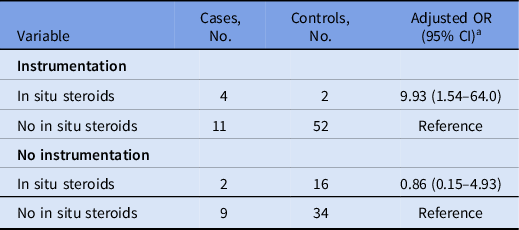
Charlson comorbidity index and active cancer were the only significant confounders using the change-in-estimate approach. We included Charlson comorbidity index as an ordinal variable with 5 levels because the log odds of spine SSI as a function of Charlson comorbidity index was approximately linear. Notably, adjustment for any given surgeon did not alter the point estimates. Instrumentation modified the effect of the association between in situ steroids and spine SSI: in situ steroids were strongly associated with a 9.93-fold odds of spine SSI relative to no in situ steroids for instrumented procedures, adjusting for Charlson comorbidity index and malignancy. Instrumentation was weakly associated with a 0.86-fold odds of spine SSI among noninstrumented procedures (Table 2).
Instrumentation Modifies the Effect of In Situ Steroids on the Likelihood of Having a Spine SSI

Note. SSI, surgical site infection; OR, odds ratio; CI, confidence interval.
a Adjusted for Charlson comorbidity index and cancer.
Discussion
We have shown that the administration of in situ steroids is significantly associated with spine SSI in patients undergoing spinal instrumentation, though not in patients undergoing noninstrumented spinal surgery. This finding is consistent not only with the biological plausibility of the association between steroids and infection but also with the fact that the presence of hardware increases the risk of biofilm formation, which is difficult to eradicate, and the risk of infection, which is difficult to treat.
This study addresses the gap in the literature regarding the relationship between in situ steroids, spinal instrumentation, and spine SSI. Epidural steroid injections within 30 days prior to surgery have been associated with increased SSI, though the effect was more pronounced for instrumented fusion procedures than noninstrumented laminectomy procedures. Reference Patel, Cheppalli, Bhandarkar, Patel and Singla6 Intraoperative epidural steroid injections appear to be more weakly associated with SSI for laminectomies. Reference Akinduro, Miller, Haussen, Pradilla and Ahmad16 The association between intraoperative epidural steroid injections and SSI during fusion procedures has not been well studied, Reference Bednar, Wong, Farrokhyar and Paul17–Reference Haws, Khechen and Patel19 and multiple studies examining the effect of intraoperative epidural steroid injections have not separated infections from other adverse events. Reference Waqas, Shallwani, Shamim and Ahmad1,Reference Wilson-Smith, Chang and Lu2,Reference Elsamadicy, Wang and Back20 Notably, a single dose of intravenous steroids appears not to influence infection risk among neurosurgical and other procedures, which was also confirmed by this study. Reference Polderman, Farhang-Razi and Van Dieren21
The major strength of this study is the quality of the data. The primary exposure of in situ methylprednisolone was ascertained by manual review of operative notes, and the primary outcome of spine SSI was ascertained by manual review of all documentation by infectious diseases providers. This manual review was superior to our routine SSI surveillance procedure because it captured both SSI meeting NHSN surveillance definitions and clinical diagnoses of SSI not meeting surveillance definitions (eg, infection occurring outside of the 30-day surveillance period following laminectomy). Moreover, the cases and controls were selected from a relatively large cohort of >1,000 patients, and the eligibility of each patient was also manually validated.
This study had several limitations. The number of cases was small, particularly in the exposed group. The study was retrospective in nature, and it was conducted at a single center. Minor superficial infections that did not require an infectious disease consultation (eg, incisional cellulitis resolving after a short course of oral antibiotics) were not captured in this study, though we reasoned that the more severe infections (eg, superficial abscess requiring a washout) would be of greater interest. We attempted to adjust for the most important confounders, though our estimates might still be biased by residual confounding. The adjustment for all possible confounders was limited by the number of cases. Although all surgeon-specific practices may not all have been captured in this data set, our causal diagram justified the adjustment of key covariates that best reflected the patient selection of specific surgeons. Moreover, the adjustment for any surgeon did not alter any of the point estimates of this study. We were unable to assess infection control practices (eg, skin preparation prior to incision), though we do not suspect that this biased our study given the apparent lack of a point source for these spine SSIs. We do not suspect that the COVID-19 pandemic significantly affected infection control practices during the study period because the only significant surge at this rural academic medical center coincided with the SARS-CoV-2 o (omicron) variant in the final month of the study, during which no cases occurred.
The use of in situ steroids for pain control is a relatively common practice, albeit controversial for postoperative infection prevention purposes. Although larger, multicenter studies would bolster our conclusion, this study provides preliminary evidence that the use of in situ steroids is a potentially modifiable risk factor for spine SSI, especially in instrumented procedures, and should be reconsidered.
Supplementary material
To view supplementary material for this article, please visit https://doi.org/10.1017/ice.2023.28
Acknowledgments
Financial support
No financial support was provided relevant to this article.
Conflicts of interest
All authors report no conflicts of interest relevant to this article.