Introduction
Tail biting in pigs is a behaviour that is a serious animal welfare problem. Tail biting affects the welfare of the pigs being bitten directly, also the procedure of tail docking as a common means of preventing tail biting is an animal welfare issue as it causes acute trauma and pain. Currently, the cause of tail-biting outbreaks among pigs is unknown, but the cause appears to be multi-factorial. The onset of tail-biting behaviour has been associated with many factors including physical (i.e. floor type), environmental, nutritional and feeding management, over-crowding, gender, genetics, length of tail and lack of substrates (Fraser, Reference Fraser1987; Fraser and Rushen, Reference Fraser and Rushen1987; McGlone et al., 1990; McGlone and Nicholson, 1992; Guy et al., Reference Guy, Rowlinson, Chadwick and Ellis2002; Jankevicius and Widowski, Reference Jankevicius and Widowski2003 and Reference Jankevicius and Widowski2004; Walker and Bilkei, Reference Walker and Bilkei2006). Currently, tail docking is routinely used on farms in the USA as a solution to this problem.
Commonly used tail-docking techniques include surgical tail docking (the tail is cut off using a sharp knife), heated docking iron (the tail is severed using a cautery iron (CAUT)) and rubber ring tail docking (a constrictive rubber ring is applied to the tail). Physiological and behavioural indices of stress have been used to measure the acute stress response to tail docking in pigs (Noonan et al., Reference Noonan, Rand, Priest, Ainscow and Blackshaw1994; Prunier et al., Reference Prunier, Mounier and Hay2005), lambs (Mellor and Holmes, Reference Mellor and Holmes1988; Graham et al., Reference Graham, Kent and Molony1997 and Reference Graham, Kent and Molony2002; Kent et al., Reference Kent, Molony and Graham1998) and dairy cows (Petrie et al., Reference Petrie, Mellor, Stafford, Bruce and Ward1996; Eicher et al., Reference Eicher, Morrow-Tesch, Albright, Dailey, Young and Stanker2000; Schreiner and Ruegg, Reference Schreiner and Ruegg2002). Physiological indices of stress shown to increase in response to tail docking include cortisol concentrations (Mellor and Holmes, Reference Mellor and Holmes1988; Petrie et al., Reference Petrie, Mellor, Stafford, Bruce and Ward1996; Graham et al., Reference Graham, Kent and Molony1997; Kent et al., Reference Kent, Molony and Graham1998), haematological values (Schreiner and Ruegg, Reference Schreiner and Ruegg2002) and haptoglobin concentrations (Eicher et al., Reference Eicher, Morrow-Tesch, Albright, Dailey, Young and Stanker2000). Behaviours shown to change in response to tail docking include eating (Eicher et al., Reference Eicher, Morrow-Tesch, Albright, Dailey, Young and Stanker2000), restlessness (Graham et al., Reference Graham, Kent and Molony1997; Kent et al., Reference Kent, Molony and Graham1998), foot stamping (Graham et al., Reference Graham, Kent and Molony1997; Kent et al., Reference Kent, Molony and Graham1998), head turning (Graham et al., Reference Graham, Kent and Molony1997; Kent et al., Reference Kent, Molony and Graham1998), total active behaviour (Graham et al., Reference Graham, Kent and Molony1997 and Reference Graham, Kent and Molony2002; Kent et al., Reference Kent, Molony and Graham1998), time spent in abnormal postures (Graham et al., Reference Graham, Kent and Molony1997 and Reference Graham, Kent and Molony2002; Kent et al., Reference Kent, Molony and Graham1998), vocalisation (Noonan et al., Reference Noonan, Rand, Priest, Ainscow and Blackshaw1994), tail wagging (Noonan et al., Reference Noonan, Rand, Priest, Ainscow and Blackshaw1994) and tail jamming (Noonan et al., Reference Noonan, Rand, Priest, Ainscow and Blackshaw1994).
There is limited literature on the acute stress response of pigs to tail docking. Prunier et al. (Reference Prunier, Mounier and Hay2005) showed that adrenocorticotropin hormone (ACTH), cortisol and lactate did not differ between pigs tail docked using a CAUT- and control-handled pigs, at 1 day of age. However, tail jamming (clamping of tail stump between the hind limbs without side-to-side movement) and wagging, and grunting were shown to be greater in tail-docked pigs compared with control-handled pigs for up to 1 min after tail docking (Noonan et al., Reference Noonan, Rand, Priest, Ainscow and Blackshaw1994). Currently, there is limited literature comparing the stress response caused by different methods of tail docking in pigs, but the acute stress response caused by different methods of tail docking in lambs has been thoroughly evaluated in the literature (Graham et al., Reference Graham, Kent and Molony1997; Kent et al., Reference Kent, Molony and Graham1998). Graham et al. (Reference Graham, Kent and Molony1997) compared the stress response to different methods of tail docking in lambs and found that tail docking using the rubber ring method resulted in a marked increase in cortisol concentrations and active behaviours, whereas tail docking using a heated docking iron produced levels of behaviour and cortisol similar to that of control-handled lambs.
Analgesics and anaesthetics are not routinely used to relieve the pain associated with tail docking on commercial pig farms in the USA or at research or teaching institutions (FASS, 1999). Therefore, it would be beneficial to assess different methods of tail docking to determine methods that may reduce the stress caused by this routine procedure. Pain and distress can be assessed in animals using a range of physiological and behavioural indices and the assessment of pain or distress is improved by using several indices (Molony and Kent, Reference Molony and Kent1997). Therefore, the objective of this study was to determine whether different methods of tail docking (conventional blunt trauma cutting (BT) v. CAUT) would have an effect on the stress caused by tail docking as measured by behaviour and physiological measures of stress that have previously been shown to change in response to tail docking.
Material and methods
Pigs used in this study were PIC USA genetics using the Camborough-22 sow line. All animals were fed a diet to meet or exceed National Research Council nutrient requirements. Water was provided ad libitum. All animal procedures were approved by the Texas Tech University Animal Care and Use Committee.
Experiment 1: physiological response to tail docking
Eight weight-matched and healthy piglets from 10 sows were allocated to one of two treatment groups: docked (n = 40) and non-docked (CON, n = 40). Within each litter, two gilts and two barrows were allocated to the CON treatment group. Of the four pigs (two gilts and two barrows) allocated to the tail-docking treatment, one gilt and one barrow were allocated to one of two docking treatments: BT or CAUT. The same number of gilts and barrows were allocated to each treatment.
Within the first 3 days after farrowing, piglets were routinely castrated, ear notched (for pig ID) and given an iron shot (100 mg). Piglets were given 3 days to recover from this initial processing experience. At 6 days of age (±2 days), piglets were tail docked or left intact, depending on which treatment group the pig was in. Piglets were removed from the sow individually and taken to an adjoining room separated by a closed door, so as not to disturb the remaining sows and piglets in the farrowing room. Piglets were held by one handler with the tail facing outward. The second handler marked a length of 2 cm on the pigs’ tail starting at the base on the pigs’ tail and then either sham cut the pigs’ tail or cut the tail using BT or CAUT. Sham cutting involved placing two fingers, one on either side of the tail, and making a cutting motion on the tail. Tail docking was performed using one of two methods: (1) conventional BT cutting with disinfected stainless-steel cutting pliers or (2) cutting with a commercial cutting CAUT (Meador TNSC; Meador Swine Health Developers, Gretna, NE, USA). Regardless of the tail-docking method (BT or CAUT), tails were docked to a tail length of 2 cm. Once all the piglets from one litter were tail docked or sham handled, they were returned to their home pen all together. The tail-docking treatment was randomised over time.
Prior to (baseline), and 30, 60 and 90 min after tail docking, pigs were held in a supine position and 5 ml blood was obtained by anterior vena cava puncture (catching and blood sampling took ∼1 min). Blood was collected into vacutainers containing sodium heparin. Whole blood was analysed to determine white cell counts, differential leucocyte counts and platelet counts using a cell counter (Cell-Dyn® 3700, Abbott laboratories, Abbott Park, IL, USA) and the neutrophil-to-lymphocyte (N : L) ratio was calculated by dividing the percentage of neutrophils by the percentage of lymphocytes. Blood samples were centrifuged and plasma collected for analysis of cortisol using an enzyme immunoassay kit (Assay designs, Ann Arbor, MI, USA). Intra- and inter-assay CV were 4.7% and 6.0%, respectively.
Experiment 2: behavioural response to tail docking
Eight weight-matched and healthy piglets from 10 sows were allocated to one of two treatment groups: docked (n = 40) and non-docked (CON, n = 40). Within each litter, two gilts and two barrows were allocated to the CON treatment groups. Of the four pigs (two gilts and two barrows) allocated to the tail-docking treatment, one gilt and one barrow were allocated to one of two docking treatments: BT or CAUT. The same number of gilts and barrows were allocated to each treatment.
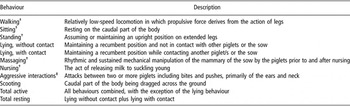
Within the first 3 days after farrowing, piglets were routinely castrated, ear notched (for pig ID) and given an iron shot (100 mg). Piglets were given 3 days to recover from this initial processing experience. At 6 days of age (±2 days), piglets were tail docked or left intact, depending on which treatment group the pig was in. One and a half hours prior to tail docking, experimental piglets were individually marked with a heavy-duty marking pen (Super Mark Pen, Fearing International Ltd, Northampton, UK) using a series of lines in the cross sectional plan to differentiate among individual pigs for easy identification during the live observations. After 60 min of recording piglet behaviour, all piglets from one sow were removed and taken to an adjoining room separated by a closed door, so as not to disturb the remaining sows and piglets in the farrowing room. Piglets were held by one handler with the tail facing outward. The second handler marked a length of 2 cm on the pigs’ tail starting at the base on the pigs’ tail and then either sham cut the pigs’ tail or cut the tail using BT or CAUT. After tail docking, all piglets were retuned to their home pen at the same time and the behaviour of each individual pig was recorded using 1-min scan-samples (live observations) for 90 min. The observer sat directly behind the sow to prevent disturbing her as much as possible but still giving the observer a complete view of all piglets in the farrowing crate. Behaviour was recorded in the same way prior to and after tail docking. Behaviours measured included lying alone, lying touching the sow or other piglets, massaging, nursing, scooting, aggressive encounters, standing, sitting and walking (Table 1). All behaviours were mutually exclusive.
Description of behaviours

†Hurnik et al. (Reference Hurnik, Webster and Siegel1995).
‡McGlone (Reference McGlone1985).
Statistical analysis
All data were tested for constant variance and departures from normal distribution. Data lacking normality were transformed logarithmically using log10. Data were subjected to analysis of variance using the mixed-model procedure of Statistical Analysis Systems Institute (SAS, 2004). All analyses were performed as two-tail tests. The piglet was the experimental unit. Litter was the block. The study was a random complete block design with three treatments (BT, CAUT and CON). For physiological measures, the main fixed effects were gender (two levels), treatment (three levels) and time (four levels). The random effects were litter (10 levels) and piglet (80 levels). The interactions between treatment and time (d.f. = 6), and treatment and litter (d.f. = 18), were included in the model. The model had a repeated structure on time allowing, incorporation of heterogeneity of variances across time. A total of 10 litters and 80 piglets (CON, n = 40; BT, n = 20; CAUT, n = 20) were examined. Behaviour data were recorded as the percentage of observations of a given behaviour over the entire sampling period and analysed using analysis of variance using the mixed-model procedure of SAS. The 150 min behaviour observation period was divided into 10- and 15-min periods. For behavioural measures, the main fixed effects were gender (two levels), treatment (three levels) and period (10 levels). The random effects were litter (10 levels) and piglet (80 levels). The interactions between treatment and period (d.f. = 18), and treatment and litter (d.f. = 18) were included in the model. The model had a repeated structure on time, allowing incorporation of heterogeneity of variances across time. A total of 10 litters and 80 piglets (CON, n = 40; BT, n = 20; CAUT, n = 20) were examined.
Results
Experiment 1: physiology
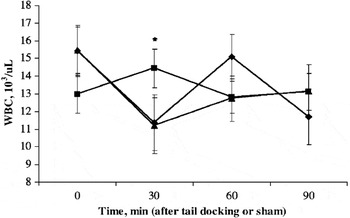
Total white blood cell (WBC) counts differed among treatments over time (Figure 1). Total WBCs were lower (P < 0.05) among BT and CAUT piglets compared with CON piglets 30 min after tail docking. Total WBCs counts were lower (P < 0.01) among BT and CAUT piglets at 30 min compared with baseline (0 min) counts but returned to baseline values by 60 min after tail docking. Total WBC counts of CON piglets did not change (P > 0.05) over time. No litter-by-treatment interactions were found.
Total white blood cell (WBC) counts (103/μl) of piglets tail docked using cautery (CAUT; ♦), blunt trauma cutting (BT; ▴) or sham-docked controls (CON; ▪) at 0, 30, 60 and 90 min after tail docking or control handling. At each time, least-square means accompanied by an * are different at P < 0.05.

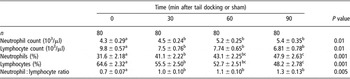
WBC measures differed over time (P > 0.01) regardless of treatment (Table 2). The number and percentage of neutrophils increased (P > 0.01) over time. Conversely, the number and percentage of lymphocytes decreased (P > 0.01) over time. The neutrophil-to-lymphocyte ratio increased (P > 0.005) over time. No treatment or litter-by-treatment interactions were found.
Comparison of white blood cell values over time of piglets tail-docked using cautery (CAUT), blunt trauma cutting (BT) or sham-docked controls (CON)

a,b,c,dLeast-square means with different superscripts within a row are different (P < 0.05).
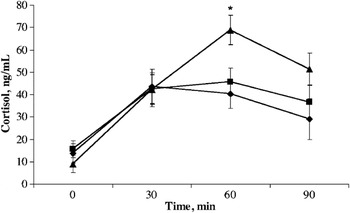
Cortisol concentrations differed among treatments over time (Figure 2). Cortisol concentrations were higher (P < 0.05) among BT-docked piglets compared with CON and CAUT piglets 60 min after tail docking. Cortisol concentrations did not differ (P > 0.05) between CAUT and CON piglets at this time. No other differences (P > 0.05) in cortisol concentrations were observed among treatments at 0, 30 or 90 min. No litter-by-treatment interactions were found.
Cortisol concentrations (ng/ml) of piglets tail docked using cautery (CAUT; ♦), blunt trauma cutting (BT; ▴), or sham-docked controls (CON; ▪) at 0, 30, 60 and 90 min after tail docking or control handling. At each time, least-square means accompanied by an * are different at P < 0.05.

Experiment 2: behaviour
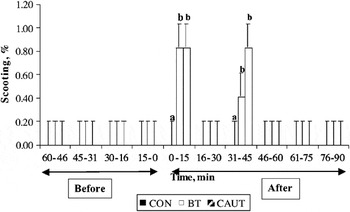
Cautery and BT piglets spent more (P < 0.001) time scooting compared with CON piglets between 0 and 15 min post tail docking (Figure 3). Piglets docked using CAUT and BT spent more time (P < 0.05) scooting compared with CON piglets between 31 and 45 min post tail docking.
The percentage of time spent performing scooting behaviour by piglets tail docked using cautery (CAUT), blunt trauma cutting (BT) or sham-docked controls (CON) over a 150-min period. At each time, least-square means accompanied by subscripts are different at P < 0.07.

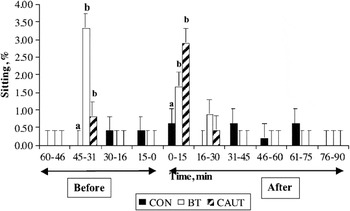
Prior to tail docking, BT spent more (P < 0.01) time sitting and CAUT tended (P < 0.07) to spend more time sitting compared with CON piglets. Piglets tail docked using CAUT spent more (P < 0.01) time sitting and BT-docked piglets tended (P < 0.08) to spend more time sitting than CON piglets between 0 and 15 min post tail docking (Figure 4).
The percentage of time spent performing sitting behaviour by piglets tail docked using cautery (CAUT), blunt trauma cutting (BT), or sham-docked controls (CON) over a 150-min period. At each time, least-square means accompanied by subscripts are different at P < 0.08.

No other treatment, period-by-treatment or litter-by-treatment interactions were found for the other behaviours measured in this study.
Discussion
This study was designed to assess the acute physiological and behavioural response of piglets to tail docking. Furthermore, we wanted to compare two methods of tail docking to determine whether one method would cause less stress compared with the other. Tail docking by the conventional BT method was shown to cause an acute cortisol and behavioural response in piglets. However, tail docking using a CAUT reduced the cortisol response to tail docking compared with the conventional method using BT.
Total WBC counts declined in piglets tail docked using BT or CAUT 30 min post tail docking. Reduction in the total WBC numbers in piglets experiencing tail-docking stress may be the result of leucocyte trafficking. Dhabhar and McEwen (Reference Dhabhar and McEwen1997) hypothesised that during stress leucocytes move out of the peripheral blood and into the skin, lymph nodes and bone marrow to prepare the animal for a potential assault. The number of lymphocytes decreased immediately after a 2 h restraint test, and after 30 s of handling in mice (Bowers et al., Reference Bowers, Bilbo, Dhabhar and Nelson2007), suggesting that leucocyte trafficking can occur quickly in response to an acute stress. Leucocyte trafficking in response to tail docking in pigs may potentially benefit the piglet by preparing its body for possible future stressors.
Cortisol concentrations were influenced by tail docking over time. At 60 min after tail docking, cortisol concentrations were higher in BT piglets compared with CON and CAUT piglets. The cortisol response to tail docking was similar between CON and CAUT piglets. Prunier et al. (Reference Prunier, Mounier and Hay2005) also showed that cortisol concentrations did not differ between piglets tail docked using a heated docking iron and control-handled piglets for up to 180 min after tail docking. ACTH was also similar between piglets tail-docked using a heated docking iron and non-docked control piglets (Prunier et al., Reference Prunier, Mounier and Hay2005). The stress response to different tail-docking methods has been compared in lambs and lambs tail-docked using a heated docking iron produced similar cortisol and behaviour (total active behaviours) levels as control-handled lambs (Graham et al., Reference Graham, Kent and Molony1997). Intense heat associated with the CAUT may cause third-degree burns and thereby destroy the nociceptors in the immediate area, thereby reducing the perception of pain experienced by these animals. It would be interesting to determine whether these CAUT piglets experience more distress later on when the nociceptors regenerate compared with piglets docked using the BT method. Neuromas were found to be present in the tail stump of docked pigs (Simonsen et al., Reference Simonsen, Klinken and Bindseil1991) and tail-docked heifers showed increased sensitivity to heat and cold (Eicher et al., Reference Eicher, Cheng, Sorrells and Schutz2006), suggesting that these animals may experience increased sensitivity to pain and chronic discomfort due to tail docking. However, the present study was designed to determine the acute physiological and behavioural effects of tail docking, not the long-term consequences. It has been suggested that cautery may delay wound healing, which could possibly lead to chronic infections (Graham et al., Reference Graham, Kent and Molony1997). However, in an unpublished study carried out in this laboratory, wound healing was assessed daily in piglets tail docked using CAUT or BT up to the time they were moved into the nursery. Wound healing did not differ between these two methods over time. Therefore, if tail docking using CAUT reduces the acute stress response to tail docking and has no long-term detrimental effects on the health or pain and/or discomfort experienced by the piglets, this may be a practical alternative to reduce the stress caused by this procedure.
Behaviour of individual piglets was recorded prior to and after tail docking. Tail-docked piglets spent more time scooting than CON piglets. It appeared as though piglets performed this behaviour to relieve themselves of the discomfort caused by having their tails removed as scooting behaviour is not a natural behaviour performed by piglets and was not recorded prior to tail docking or by CON piglets. Tail-docked piglets performed scooting behaviour for up to 45 min after tail docking, but no scooting behaviour was recorded after 45 min among tail-docked piglets (regardless of the tail-docking method). Ninety minutes after tail docking, cortisol concentrations were similar among CON, CAUT and BT pigs. The absence of scooting behaviour in combination with CON level cortisol concentrations in tail-docked pigs 90 min after tail docking suggests that these animals experienced transient stress due to tail docking, which was minimal 90 min after tail docking. However, these animals may experience chronic pain or stress due to increased sensitivity in the tail stump owing to neuroma formation (Simonsen et al., Reference Simonsen, Klinken and Bindseil1991; Eicher et al., Reference Eicher, Cheng, Sorrells and Schutz2006). Further studies are needed to determine whether tail docking of piglets results in chronic pain or stress due to this procedure.
Piglets tail-docked using CAUT spent more time sitting than CON and BT pigs, up to 15 min after tail docking. Sitting is a natural behaviour performed by pigs, but in the situation of tail-docked piglets, sitting may have been carried out as a means to relieve the sensation caused by the wound of tail docking or to protect the wounded site. Sitting behaviour was also performed by CAUT and BT piglets prior to tail docking; therefore, it is difficult to determine whether sitting behaviour performed after tail docking by CAUT and BT pigs was in response to having been tail docked or was simply a natural behaviour. The major behavioural changes (tail wagging, tail jamming and vocalisation) in response to tail docking in piglets occurred in the first minute after tail docking (Noonan et al., Reference Noonan, Rand, Priest, Ainscow and Blackshaw1994). In the present study, behavioural observations started when the piglets were returned to the home pen and piglets were only returned to the home pen once all the piglets from that litter had been tail docked; for this reason, the initial behavioural response to tail docking was not recorded. It appears as though the optimum behavioural indices of tail docking stress in piglets are tail wagging, tail jamming, posterior scooting and vocalisation, which occur more frequently within the first few minutes after tail docking.
Tail docking is a routine management practice carried out on pig farms to control tail biting. Analgesics and anaesthetics are not routinely used for pain relief for tail docking on commercial pig farms in the US. Therefore, it would be beneficial to the welfare of piglets to determine other methods of tail docking that may reduce the acute stress caused by this procedure. Behaviour appeared to be similar between piglets tail docked using CAUT and BT cutting after tail docking; however, cortisol concentrations were lower in CAUT piglets (in fact similar to CON piglets) than in piglets docked using BT cutting at 60 min post tail docking. Tail docking using a heated CAUT may reduce the acute physiological stress response caused by tail docking as compared with conventional tail docking using BT cutting. Behaviour did not differ between piglets tail docked using the conventional BT or CAUT docking method. Further studies are needed to confirm these findings and to determine the possible chronic stress caused by tail docking in piglets.
Acknowledgements
This research was supported by the National Pork Board, Des Moines, IA, USA. The authors thank Lindsey Hulbert, Matt Massey and Mila Billette for their assistance with this project.