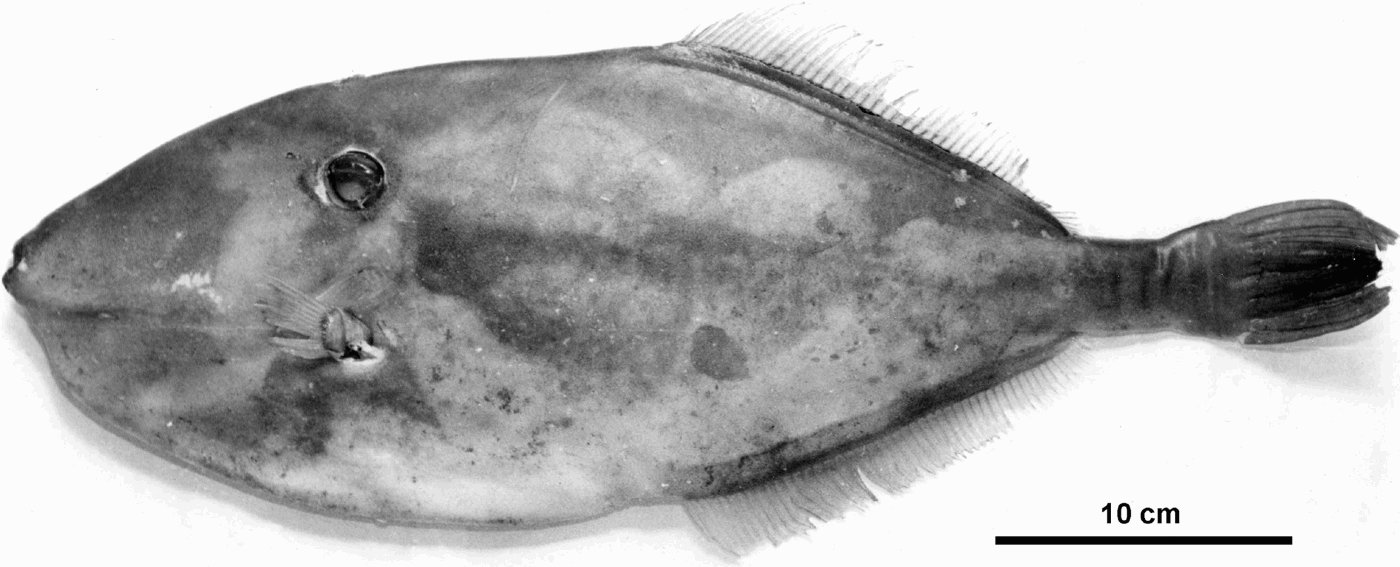
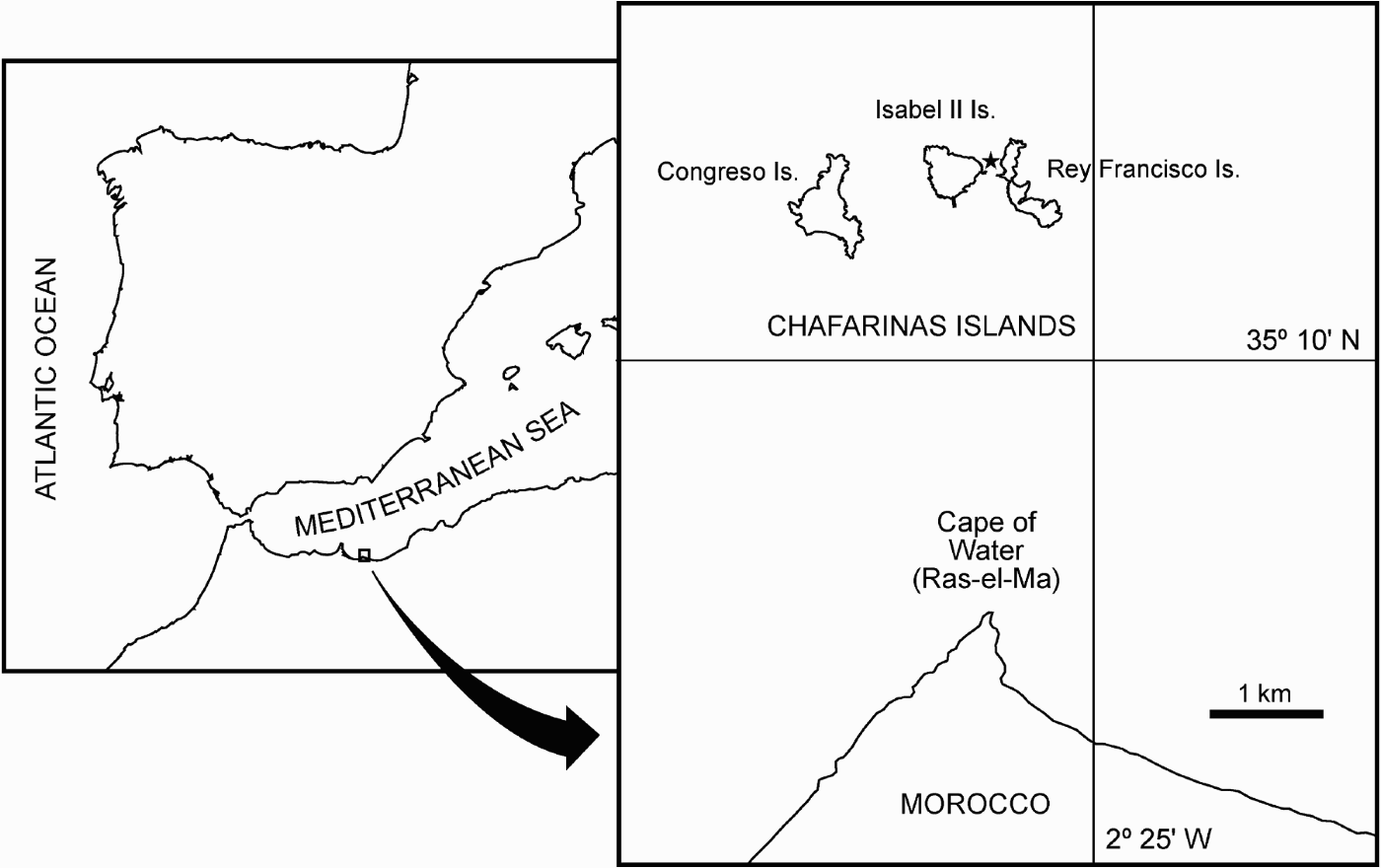
Aluterus monocerus (Linnaeus, 1758) is a littoral filefish, living on the continental shelf to 50 m depth, with a circumglobal distribution mainly in tropical and sub-tropical waters (Harmelin-Vivien & Quéro, Reference Harmelin-Vivien, Quéro, Quero, Hureau, Karrer, Post and Saldanha1990), occurring in the Atlantic, western Indian Ocean and eastern Pacific. It is widely distributed in the western Atlantic Ocean, occurring from Massachusetts to Argentina (Figueiredo & Menezes, Reference Figueiredo and Menezes2000), whereas in the eastern Atlantic it has been considered a rather rare species, restricted to tropical waters off the coast of Africa (Harmelin-Vivien & Quéro, 1990). Two recent records of specimens of A. monoceros from the north-eastern Atlantic, one from off Arcachon (Bay of Biscay) (Quéro & Laborde, Reference Quéro and Laborde1996) and another from the Gulf of Cadiz (Galeote et al., Reference Galeote, Oter and Arias1996), expanded several hundreds of kilometres the northern limit of its geographical distribution in the area, as this species was not previously reported from the CLOFNAM area (north-eastern Atlantic, from 30° to 80°N, including the Mediterranean Sea) (Tortonese, Reference Tortonese, Hureau and Monod1973, Reference Tortonese, Whitehead, Bauchot, Hureau, Nielsen and Tortonese1986). The presence of this species in the Bay of Biscay, together with seventeen other tropical fish species recorded in the area since 1950, has been related to increased sea temperatures and climatic change (Quéro et al., Reference Quéro, Du Buit and Vayne1997, Reference Quéro, Du Buit and Vayne1998; Quéro, Reference Quéro1998). On 28 March 2000, one adult male A. monoceros of 384 mm standard length (SL) (Figure 1) was captured in the Chafarinas Islands (south-western Mediterranean), a small archipelago located about two miles off the northern African coast (Figure 2). The capture of this specimen represents the first documented report of the species in the Mediterranean Sea. The specimen was captured with a harpoon gun at a depth of 4 m, and was over a gravel substrate in a rocky area. The specimen was frozen and subsequently preserved in formalin. The specimen was deposited in the collection of the Museo Nacional de Ciencias Naturales in Madrid (Catalogue number: MNCN 243.210).
Aluterus monoceros, male 384 mm SL, Chafarinas Islands, MNCN 243.210.

Chafarinas Islands and location of capture of the specimen of Aluterus monoceros (★).

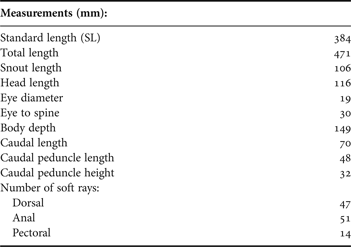
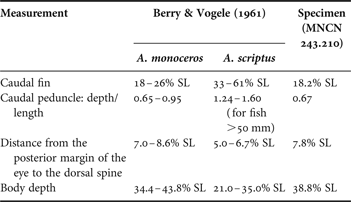
Morphometric data of the specimen (Table 1) agree with the diagnostic features proposed by Berry & Vogele (Reference Berry and Vogele1961) to discriminate among Atlantic species of the genus. According to these authors, the number of soft rays in the dorsal (>43) and anal fins (>46) discriminates A. monocerus and the scrawled filefish Aluterus scriptus from other filefish (Monacanthidae) in the area. There are several morphometric differences that separate A. monoceros and A. scriptus (Table 2).
Morphometric data of the specimen of Aluterus monoceros from Chafarinas Islands (MNCN 243.210). Biometrics based on Berry & Vogele (Reference Berry and Vogele1961).

Morphometric differences between Aluterus monoceros and A. scriptus, according Berry & Vogele (Reference Berry and Vogele1961), and morphometrics of the specimen caught off the Chafarinas Islands.

During recent years, an increasing number of fish species have been recorded for the first time in the Mediterranean Sea. Although some of these are probably resident species in the area that have remained undetected due to its rarity or difficulty of access to its habitat (e.g. deep sea), some others can be considered as ‘exotic’ species that have arrived from other areas. Golani et al. (Reference Golani, Orsi-Relini, Massutti and Quignard2002) presented a first comprehensive review of these latter species, a list which has been progressively updated during recent years (Golani et al., Reference Golani, Orsi-Relini, Massutí and Quignard2004, Reference Golani, Orsi-Relini, Massutí, Quignard and Dulčić2007) (see www.ciesm.org/atlas/). The most recent updated list (Golani et al., Reference Golani, Orsi-Relini, Massutí, Quignard and Dulčić2007) includes 108 species, of which 65 species are considered to have arrived from the Red Sea through the Suez Canal (lessepsian migration), 35 are of Atlantic origin, having reached the Mediterranean Sea through the Strait of Gibraltar, and 8 are thought to have arrived due to human activities (e.g. ship mediated transport and mariculture) or to unknown causes. Whereas the arrival of species from the Red Sea responds to the construction of the Suez Channel, a quite recent connection (open in 1869, less than 150 years ago) of two previously isolated seas, the reasons behind increased entries through the Strait of Gibraltar is less clear. Most of these Atlantic species have tropical or subtropical affinities and, in some cases, they have now established populations in the area (e.g. Ragonese et al., Reference Ragonese, Rivas and Jereb1992, Reference Ragonese, Jereb and Morara1997). The presence of these species together with other changes in the demography of several other species (i.e. increase of populations of species with warm waters affinities; Quignard & Raibaut, Reference Quignard and Raibaut1993) has been described as a phenomenon of ‘tropicalization’ or ‘meridionalization’ of the Mediterranean Sea (Andarolo & Rinaldi, Reference Andarolo, Rinaldi, Enne, d'Angelo and Zanolla1998; Grau & Riera, Reference Grau and Riera2001), that might have its origin in the increase of water temperature of this sea due to global climate change (Francour et al., Reference Francour, Boudoresque, Harmelin, Harmelin-Vivien and Quignard1994; Andarolo & Rinaldi, Reference Andarolo, Rinaldi, Enne, d'Angelo and Zanolla1998; Grau & Riera, Reference Grau and Riera2001).
Although adult specimens of A. monoceros are demersal, juveniles are pelagic and are often associated with floating objects (Sommer et al., Reference Sommer, Schneider and Poutiers1996) which may facilitate, under favourable conditions, the dispersal of isolated individuals from the main distribution area. The relative proximity of the Chafarinas Islands to the Strait of Gibraltar supports the probable Atlantic origin of the reported specimen. Whereas the present report might correspond to the arrival of an individual vagrant to the area, it is also possible that this species is spreading northwards. That would be in accordance with the suggested idea of an increasing northward distribution for this species in the north-eastern Atlantic due to increased water temperature (Quéro et al., Reference Quéro, Du Buit and Vayne1997, Reference Quéro, Du Buit and Vayne1998; Quéro, Reference Quéro1998). Further records of A. monoceros in the Mediterranean would be more indicative of colonization of the area.
ACKNOWLEDGEMENTS
Thanks to David Castillo, who captured the specimen and provided it for study. The specimen was obtained and studied during the programme ‘Seguimiento y control de los Ecosistemas del R.N.C. de las Islas Chafarinas’ carried out by GENA S.L. for the Organismo Autónomo de Parques Nacionales (Ministerio de Medio Ambiente). Thanks to Jim Ellis (CEFAS) for commenting on the manuscript.