Introduction
The gastropod family Turritellidae is widely regarded as a monophyletic group within basal caenogastropods commonly known as “cerithioids” (Cerithioidea, sensu Strong et al., Reference Strong, Colgan, Healy, Lydeard, Ponder and Glaubrecht2011; Cerithimorpha, sensu Golikov and Starobogatov, Reference Golikov and Starobogatov1975; also see Lydeard et al., Reference Lydeard, Holznagel, Glaubrecht and Ponder2002; Ponder et al., Reference Ponder, Colgan, Healy, Nützel, Simone and Strong2008). Turritellids can be extremely abundant in assemblages in which they occur, from Lower Cretaceous to Recent (Allmon, Reference Allmon2007), including several fossil assemblages in India (Malarkodi et al., Reference Malarkodi, Fayazudeen and Mallikarjuna2009; Mallick et al., Reference Mallick, Bardhan, Paul, Mukherjee and Das2013; Bardhan et al., Reference Bardhan, Mallick and Das2014). The group has also been the subject of numerous studies of predation intensity in the fossil and Recent records (e.g., Allmon et al., Reference Allmon, Nieh and Norris1990; Mallick et al., Reference Mallick, Bardhan, Paul, Mukherjee and Das2013, Reference Mallick, Bardhan, Das, Paul and Goswami2014; Paul et al., Reference Paul, Das, Bardhan and Mondal2013).
The recent consensus has been that the oldest definite representatives of the subfamily Turritellinae (and perhaps the family Turritellidae, as well) are from the Lower Cretaceous (Valanginian Stage) of Poland (Turritella polonica Schröder, Reference Schröder1995; see Bandel, Reference Bandel1993; Tracey et al., Reference Tracey, Todd and Erwin1993; Schröder, Reference Schröder1995; Kaim, Reference Kaim2004; Allmon, Reference Allmon2011) (ca. 133.9–139.4 Myr; Gradstein et al., Reference Gradstein, Ogg, Schmitz and Ogg2012), and the group is moderately diverse and abundant by later in the Early Cretaceous (Ellisor, Reference Ellisor1918; Abbass, Reference Abbass1962; Allmon and Cohen, Reference Allmon and Cohen2008). Turritellidae was, however, long reported to have originated in the late Paleozoic (e.g., Knight et al., Reference Knight, Batten, Yochelson and Cox1960, p. I316; Sepkoski, Reference Sepkoski1982, p. 28), and the genus Turritella sensu lato has occasionally been cited (although never with much detailed analysis) from the Jurassic and even Triassic (e.g., Hudleston, Reference Hudleston1892, p. 227–235; Dacque, Reference Dacque1905; Edwards, Reference Edwards1980; Fürsich, Reference Fürsich1984; Meier and Meiers, Reference Meier and Meiers1988; Tekin, Reference Tekin1999; Bandel, Reference Bandel2006). Many 19th and early-20th century workers considered any high-spired gastropod lacking a selenizone and with a U-shaped apertural sinus as “Turritella,” but many of the early Mesozoic examples so assigned have since been placed in other groups, especially Mathildoidea (Bandel, Reference Bandel1991, Reference Bandel1995; Hikuroda and Kaim, Reference Hikuroda and Kaim2007; Gründel and Nützel, Reference Gründel and Nützel2013).
Within Turritellidae, details of shell form, including apical angle, whorl profile, and especially spiral sculpture, usually allow relatively unambiguous recognition of species in fossils, and the group has long provided important guide fossils in Cretaceous and Cenozoic biostratigraphy (e.g., Woodring, Reference Woodring1930, Reference Woodring1931; Gardner, Reference Gardner1935; Stenzel, Reference Stenzel1940; Wheeler, Reference Wheeler1958; Kauffman, Reference Kauffman1977; Sohl, Reference Sohl1977; Saul, Reference Saul1983; Squires, Reference Squires1988). These characters, however, are also clearly homeomorphic across the family (Merriam, Reference Merriam1941; Marwick, Reference Marwick1957; Kotaka, Reference Kotaka1978; MacNeil and Dockery, Reference MacNeil and Dockery1984; Allmon, Reference Allmon1994, Reference Allmon1996). Thus, while detailed morphological examination (e.g., with SEM of protoconch and early apical ontogeny) allows for testing of phylogenetic hypotheses on a limited geographic scale, broader phylogenetic analysis—and reliable assignment to supraspecific taxa—based solely on shell characters remains problematic (Allmon, Reference Allmon1996, Reference Allmon2011; Beu, Reference Beu2010, p. 89).
In this paper, we report four species assignable to the genus Turritella sensu lato, from the Late Jurassic (Oxfordian) Chari Formation of Kutch, western India, and argue that these represent the oldest turritellid species known. The age of the Turritella-bearing horizons is well constrained by the coeval ammonites and belemnites. Two of these species of Turritella were previously described from these deposits (Mitra and Ghosh, Reference Mitra and Ghosh1979). Unfortunately, however, they went unnoticed by the paleontological community, and the specimens were lost. We therefore here re-describe them, based on new data obtained from numerous additional specimens and SEM analysis, and describe two more species as new. We compare the Indian species with diverse species across many geological periods and continents to show the extent of homeomorphism, but we explicitly note that nothing phylogenetic is intended by these comparisons.
Turritellidae versus Mathildoidea
Within gastropods, mathildoids are phylogenetically distant from turritellids. They are sometimes referred to as “lower heterogastropods,” more closely related to pulmonates and opisthobranchs than to cerithioids. Yet the shells of many mathildoids are superficially similar to turritellids in being high-spired, with relatively small apertures. The group was also apparently more diverse in the Mesozoic, especially the Jurassic, than it is today (see Bandel, Reference Bieler1995; Bieler, Reference Bandel1995; Gründel and Nützel, Reference Gründel and Nützel2013), posing an additional potential difficulty in distinguishing its species from early representatives of Turritellidae.
The family Turritellidae is characterized by an elongate, high-spired shell of many whorls, ending in an aperture that is relatively small, simple, and entire, lacking any elaboration of its margin (Marwick, Reference Marwick1957). The subfamily Turritellinae is characterized by external teleoconch sculpture of spiral threads, sometimes beaded, and curved growth lines; the aperture is rounded or quadrate and not large; the inner wall of the aperture is smooth and concave (Marwick, Reference Marwick1957; Bandel, Reference Bandel2006).
Mathildoid species superficially resemble turritellids in shell shape and spiral ornamentation, but the former are usually more slender (Bandel, Reference Bandel1995). Many species of mathildoids have strong carination similar to one of the species discussed here. Strong carination is also found in turritellids, such as Zaria angulata (Sowerby, Reference Sowerby1840) from the Miocene of the Indian sub-continent (see Harzhauser et al., Reference Harzhauser, Reuter, Piller, Berning, Kroh and Mandic2009, fig. 3a–d), and “Turritella” mortoni from the Paleocene of the U.S. Gulf and Atlantic coastal plains (Allmon, Reference Allmon1994, Reference Allmon1996).
Shells of mathildoids, however, show a number of clear differences compared to turritellids, most conspicuously their heterostrophic (sinistral) protoconch, which shows an abrupt boundary with the dextral teleoconch. High-spired mathildoids are also smaller than most turritellids; their aperture frequently bears a short anterior canal; and their earliest teleoconch whorls almost always bear axial (vertical) ribs in addition to spiral sculpture.
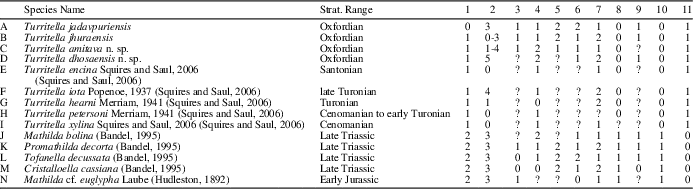
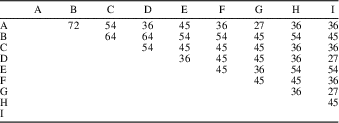
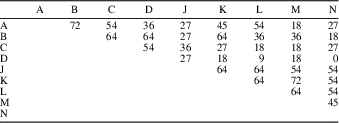
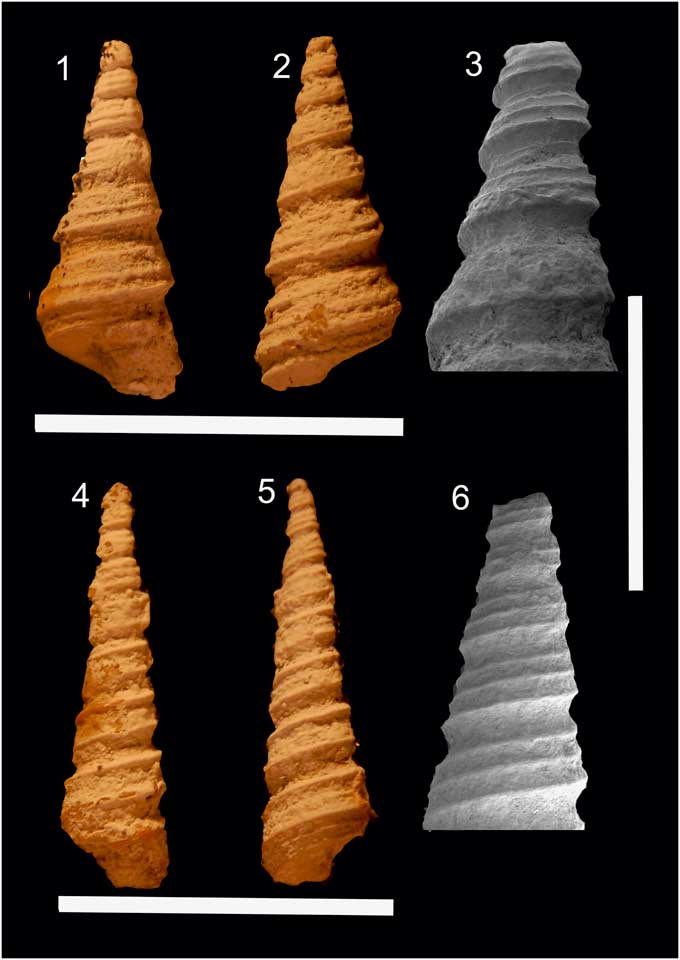
None of our specimens has preserved protoconchs; our identification of them as turritellids is therefore based on other characters. For example, all our studied specimens lack axial sculpture and an apertural anterior canal, and all of our four species are relatively large (> 2 cm) compared to known Jurassic mathildoids. A broader analysis of shell characters of our Jurassic species, compared to a number of Cretaceous turritellines and Mesozoic mathildioid species originally identified as Turritella (Tables 1–3), further supports our assignment by demonstrating that our species are more similar to Cretaceous turritellids than to Mesozoic mathildoids. Growth-line data are poorly known from fossil mathildoids, but extant species show mostly irregular and opysthocyrt growth lines (Bieler, Reference Bieler1995). The species considered here, however, have prosocline growth lines. Ecologically, the modern family Mathildidae is a mostly deep-water group (Bieler, Reference Bieler1995), with many Recent species inhabiting 550–600 m depths within coral bank communities (Smriglio et al., Reference Smriglio, Prkiæ, Di Giulio and Mariottini2007). The depositional environment of the Dhosa Oolite Member, from which the present species were obtained, in contrast, was an offshore setting below the fair-weather wave base (Singh, Reference Singh1989; Fürsich et al., Reference Fürsich, Oschmann, Singh and Jaitly1992), and no corals have been described from the Dhosa Oolite Member.
Coded morphology of turritelline species described in this text (A–D), Cretaceous turritellines (E–I) and some mathildidoid species (J–N). The coded characters and their different states are given in Appendix 1.

Similarity matrix showing clusters of the Jurassic species discussed in this paper and selected Cretaceous turritelline species (based on data from Table 1). Methods based on Raup and Stanley (Reference Raup and Stanley1978, p. 144–145).

Similarity matrix showing clusters of the Jurassic species discussed in this paper and selected Mesozoic mathildidoid species (based on data from Table 1).

Geologic setting
Geologic time units
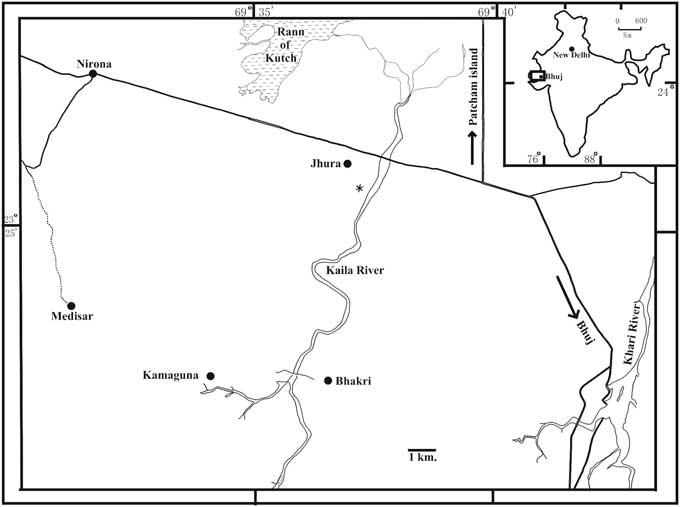
During the Middle Jurassic (Bajocian–Bathonian), the Kutch Basin developed due to the fragmentation of Gondwana (Biswas, Reference Biswas1982, Reference Biswas1991). Mesozoic strata in Kutch are divided into several formations (Mitra et al., Reference Mitra, Bardhan and Bhattacharya1979). The major fossil-bearing units are the Patcham (Bathonian) and Chari (Callovian to Oxfordian) formations of the mainland of Kutch (Biswas, Reference Biswas1977). The fossils discussed here were collected from the Dhosa Oolite Member (Oxfordian) of the Chari Formation (23°24’47.57”N, 69°36’09.26”E) (Fig. 1).
Geographic locations (solid circles) of the Dhosa Oolite Member. Present fossil collection has been made from a pond section near Jhura (*). Modified after Bardhan et al. (Reference Bardhan, Chattopadhyay, Mondal, Das, Mallick, Roy and Chanda2012).

Stratigraphic information
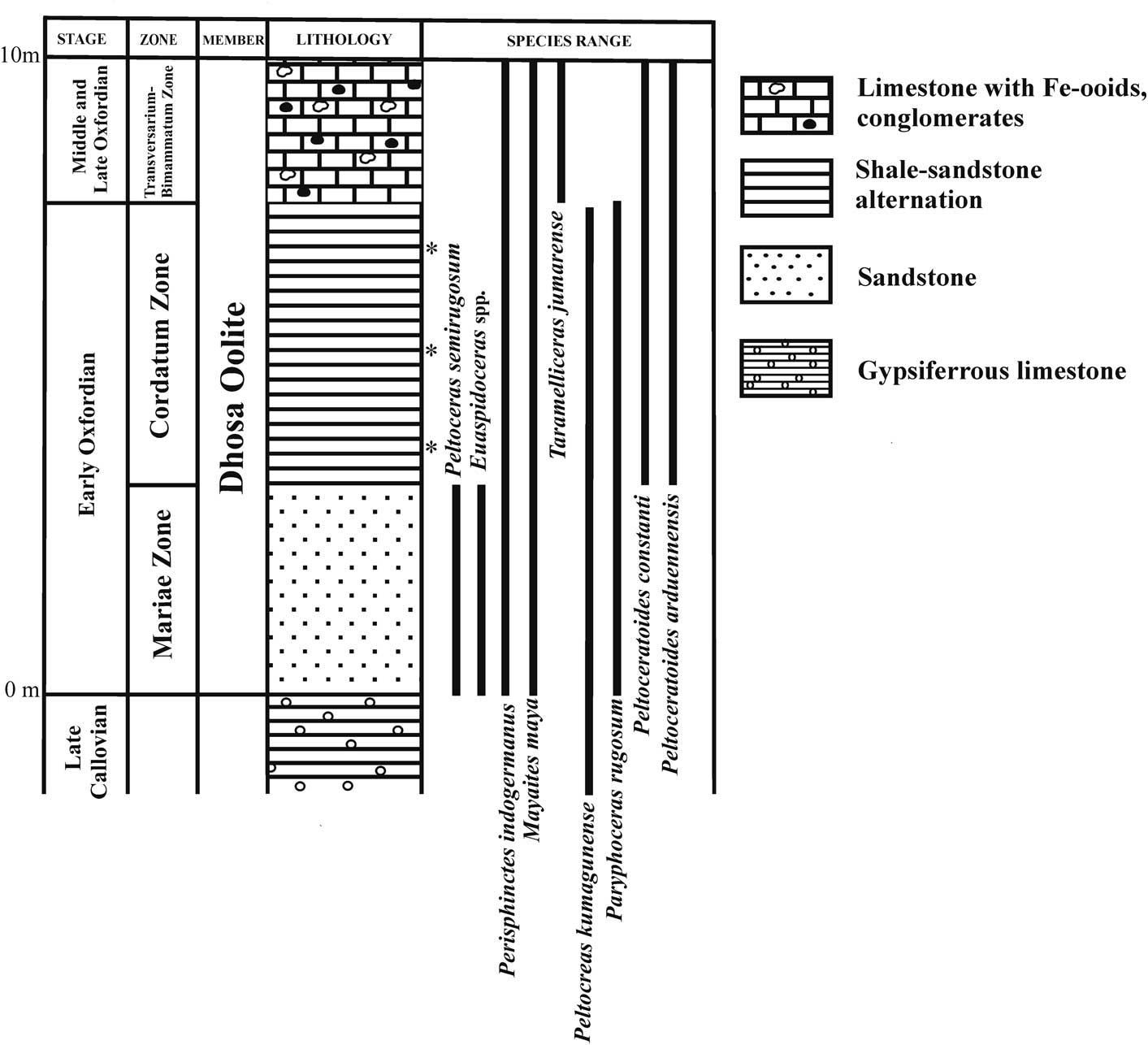
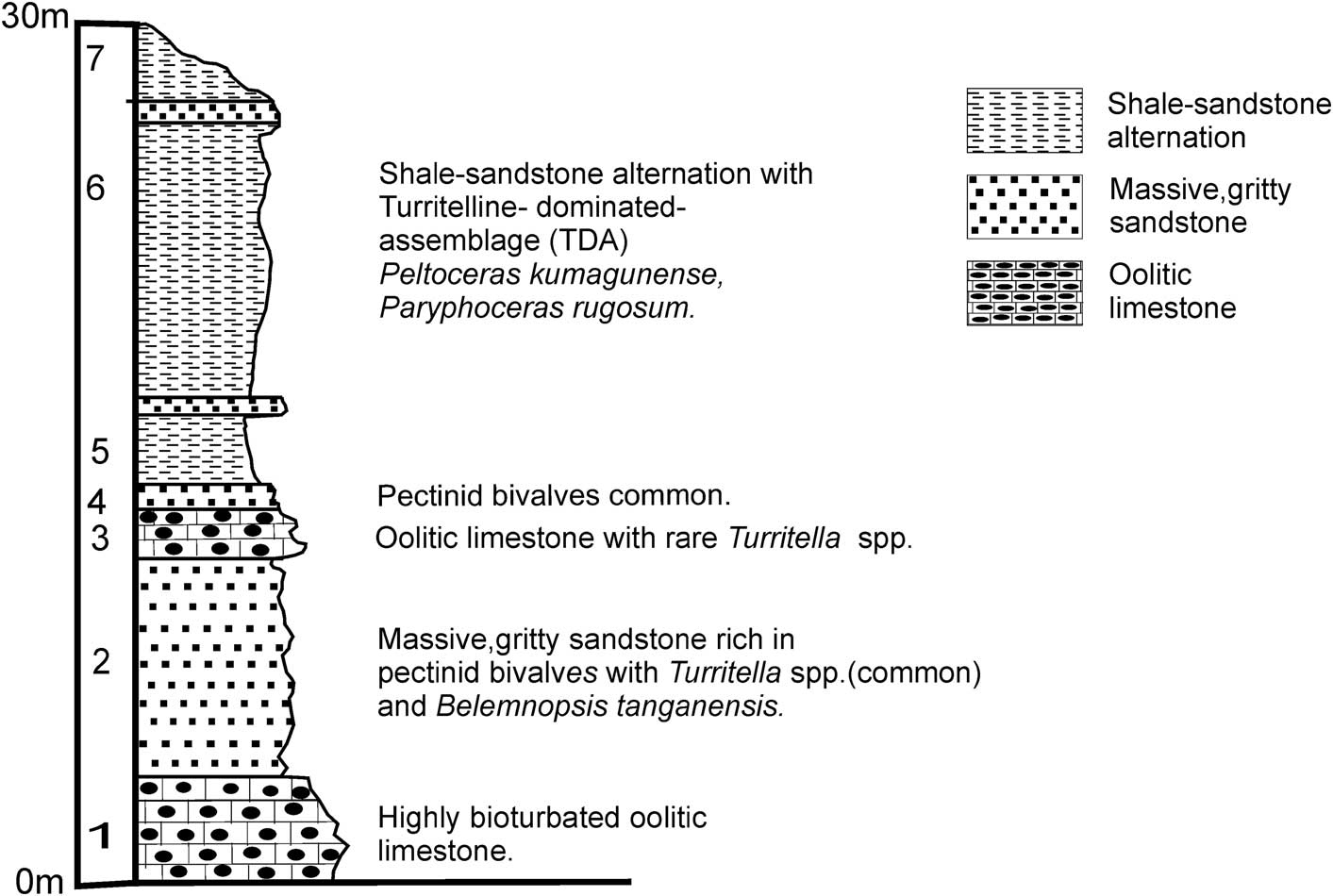
Rocks of both the Patcham and Chari formations were the products of continental shelf margin sedimentation (Datta, Reference Datta1992; Fürsich et al., Reference Fürsich, Pandey, Collomon, Jaitly and Singh2001). The Dhosa Oolite Member is a condensed, time-averaged unit (Singh, Reference Singh1989; Fürsich et al., Reference Fürsich, Oschmann, Singh and Jaitly1992; Pandey et al., Reference Pandey, Fürsich and Sha2009; Roy et al., Reference Roy, Bardhan, Das, Mondal and Mallick2012). In sequence stratigraphic terms, it represents a Transgressive System Tract (TST; Fürsich et al., Reference Fürsich, Pandey, Collomon, Jaitly and Singh2001) and Maximum Flooding Zone (MFZ; Fürsich and Pandey, Reference Fürsich and Pandey2003). The top part of the Dhosa Oolite is hard, conglomeratic, highly fossiliferous, and contains ferruginous oolite. The lower part contains shale and sandstone with sparse oolite (Fürsich et al., Reference Fürsich, Pandey, Collomon, Jaitly and Singh2001; Roy et al., Reference Roy, Bardhan, Das, Mondal and Mallick2012) (Fig. 2). The present turritelline species were found in the lower part of the unit, mostly in shale, or occurring loosely, free of matrix.
Stratigraphic distribution of a few time-diagnostic ammonite species from the Dhosa Oolite of mainland of Kutch. Asterisk (*) marks the sampling points. Modified after Roy et al. (Reference Roy, Bardhan, Das, Mondal and Mallick2012), based on Waagen (Reference Waagen1875); Spath (Reference Spath1928, Reference Spath1931); Fürsich and Heinze (Reference Fürsich and Heinze1998); Fürsich et al. (Reference Fürsich, Pandey, Collomon, Jaitly and Singh2001); Roy et al. (Reference Roy, Bardhan, Das, Mondal and Mallick2012); and Alberti et al. (Reference Alberti, Pandey, Hethke and Fürsich2015).

Mitra and Ghosh (Reference Mitra and Ghosh1979) reported two ammonite species, Peltoceras kumagunense Spath, Reference Spath1931 and Paryphoceras rugosum Spath, Reference Spath1928, in association with the Turritella specimens they described. According to them, these two species belonged to the Oxfordian and were found only in the Dhosa Oolite Member, which was overlain by layers of Kimmeridgian age. We also collected a single belemnite specimen tentatively assigned to Belemnopsis tanganensis (Futterer, Reference Futterer1894) (see Spath, Reference Spath1927, p. 9, pl. 1, figs. 3a, b, 4) from one Turritella-bearing horizon.
Despite the previous discovery of these cephalopod fossils, determination of the precise age of the Turritella-bearing horizons remained unclear. Recently, however, Roy et al. (Reference Roy, Bardhan, Das, Mondal and Mallick2012) demonstrated that the Dhosa Oolite Member spans the entire Oxfordian. Peltoceras kumagunense ranges from upper Callovian to lower Oxfordian (Spath, Reference Spath1931; A. Roy, personal communication, 2016). Spath, on the other hand, described all species of Paryphoceras from the Dhosa Oolite Member without specifying from which part of the unit the species came. Alberti et al. (Reference Alberti, Pandey, Hethke and Fürsich2015) revised the species of Paryphoceras of Kutch, and concluded that the majority of the species are found in the middle Oxfordian (Cardioceras cordatum to Gregoryceras transversarium zones; ca. 159.4–161.4 Myr; Gradstein et al., Reference Gradstein, Ogg, Schmitz and Ogg2012). The only species described by Alberti et al. (Reference Alberti, Pandey, Hethke and Fürsich2015) come from the lower Oxfordian part of the Dhosa Oolite. From these faunal occurrences, it appears that the Turritella-bearing horizons are either early Oxfordian or middle Oxfordian in age. From the lithological point of view, Turritella-yielding horizons are mostly shale and sandstone, occasionally within limestone with sparse ooids (Fig. 3). This facies association is typical of the upper part of the lower Oxfordian part of the Dhosa Oolite Member.
Schematic stratigraphic section of the pond section from where Turritella spp. were collected. Associated cephalopod taxa indicate the late early Callovian age.

Locality information
The Dhosa Oolite Member is widely distributed in the mainland of Kutch as well as in the Jhura dome. The Turritella-bearing assemblages, however, are restricted to a pond section (23°24’47.57”N, 69°36’09.26”E) near the village of Jhura, which is 45 km northwest of Bhuj, the district town of Kutch (Fig. 1).
Materials and methods
The samples were collected following both bulk sampling (see Kowalewski, Reference Kowalewski2002) and random surface-sampling protocols (see Mallick et al., Reference Mallick, Bardhan, Paul, Mukherjee and Das2013). Eleven bulk samples were collected in four separate field trips (2012, 2013, 2014, and 2016). The turritelline gastropods were separated in the laboratory. At several stratigraphic horizons, we collected all specimens encountered, including those small and large, broken, and intact. Turritelline specimens were identified at supraspecific levels following criteria and morphological terms used in the previous literature (e.g., Allison, Reference Allison1965; Allmon, Reference Allmon1996; DeVries, Reference DeVries2007; Allmon and Harris, Reference Allmon and Harris2008). Turritellines comprise 85% of the total macrofossil assemblage, which satisfies the criteria of “turritelline-dominated assemblage” (TDA) (Allmon, Reference Allmon2007). Our collections included a total of 13,705 turritelline specimens, of which 2686 specimens are nearly complete. We assigned the turritellines to four species: Turritella jadavpuriensis (about 74.8% of all specimens), Turritella jhuraensis (about 9.2%), Turritella amitava new species (about 15.6%), and Turritella dhosaensis new species (about 0.003%).
In spite of good preservation of many specimens, no protoconchs were preserved, and early teleoconch whorls were preserved in only three specimens of T. jadavpuriensis and one specimen of T. amitava n sp. All measurements were made by digital caliper to the nearest 0.1 mm.
Repositories and institutional abbreviations
All specimens, including the types, are archived in the museum of Geological Studies Unit, Indian Statistical Institute, Kolkata, India. Specimens are numbered following the institutional abbreviation ISI/g/Jur/T.
Systematic paleontology
Class Gastropoda Cuvier, Reference Cuvier1797
Subclass Caenogastropoda Cox, Reference Cox1960
Order Sorbeoconcha Ponder and Lindberg, Reference Ponder and Lindberg1997
Superfamily Cerithioidea Fleming, Reference Fleming1822
Family Turritellidae Lovén, Reference Lovén1847
Genus Turritella Lamarck, Reference Lamarck1799
Type species
Turbo terebra Linnaeus, Reference Linnaeus1758 (original designation), Recent, Indo-Pacific.
Turritella jadavpuriensis Mitra and Ghosh, Reference Mitra and Ghosh1979
Figures 4.1–4.4, 5.1, 5.2, 6, 7.1–7.6, 8.1–8.4
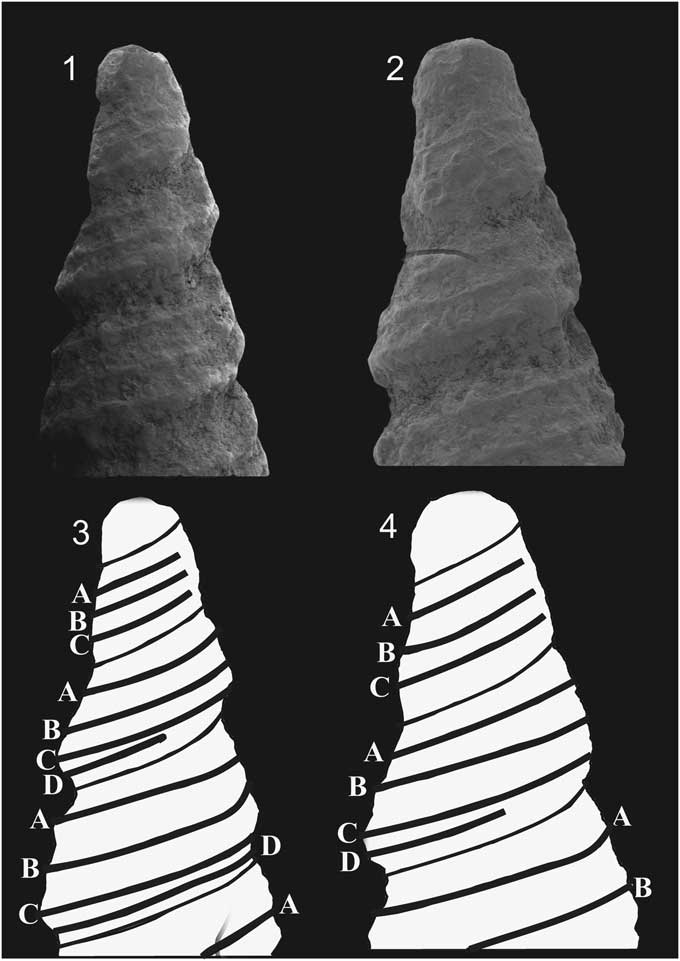
Scanning electron micrographs of apices of two specimens of Turritella jadavpuriensis Mitra and Ghosh, Reference Mitra and Ghosh1979. (1) Paraneotype (no. ISI/g/Jur/T 1) showing early teleoconch part and well-developed apical sculpture (×105); (2) paraneotype (no. ISI/g/Jur/T 2) with completely preserved early teleoconch (×105); (3) sketch of 1, showing primary spiral ribs (notation after Allmon, Reference Allmon1996); note A, B, C spirals appear simultaneously and apical sculpture formula is therefore, A1B1C1d2; (4) sketch made from 2, showing similar appearance of primary spiral ribs.

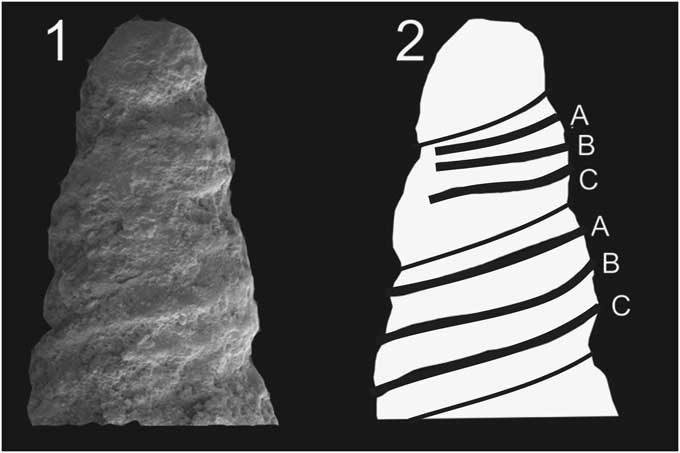
Scanning electron micrograph of apex of one specimen of Turritella jadavpuriensis Mitra and Ghosh, Reference Mitra and Ghosh1979. (1) Paraneotype (no. ISI/g/Jur/T 101) showing completely preserved early teleoconch (×105); (2) sketch of 1, showing primary spiral ribs.

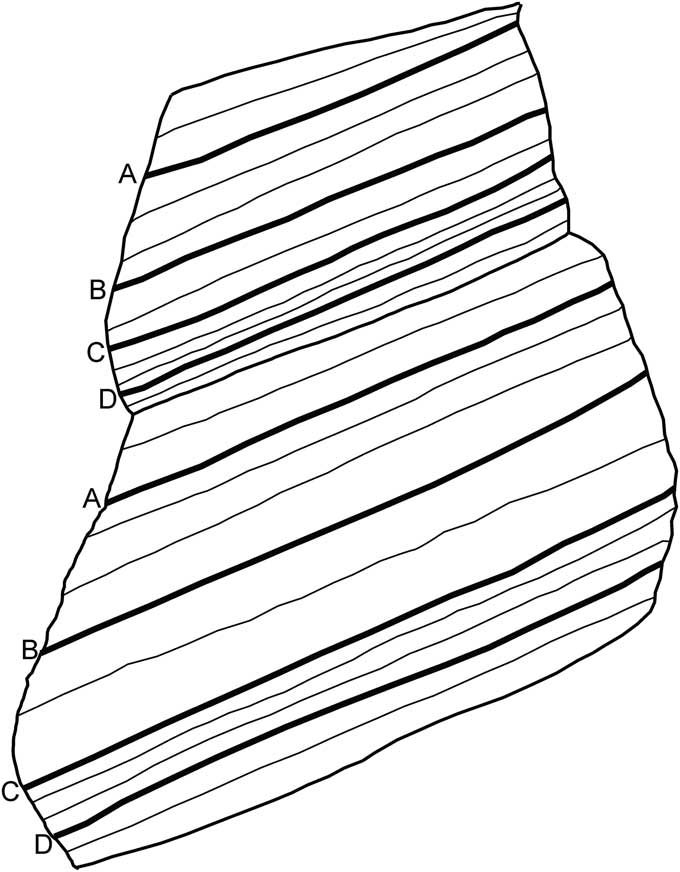
Sketch of the adult whorls of a paraneotype (no. ISI/g/Jur/T 9) of Turritella jadavpuriensis Mitra and Ghosh, Reference Mitra and Ghosh1979, showing all secondary spiral ribs within the primary spirals (maximum diameter 18.3 mm).

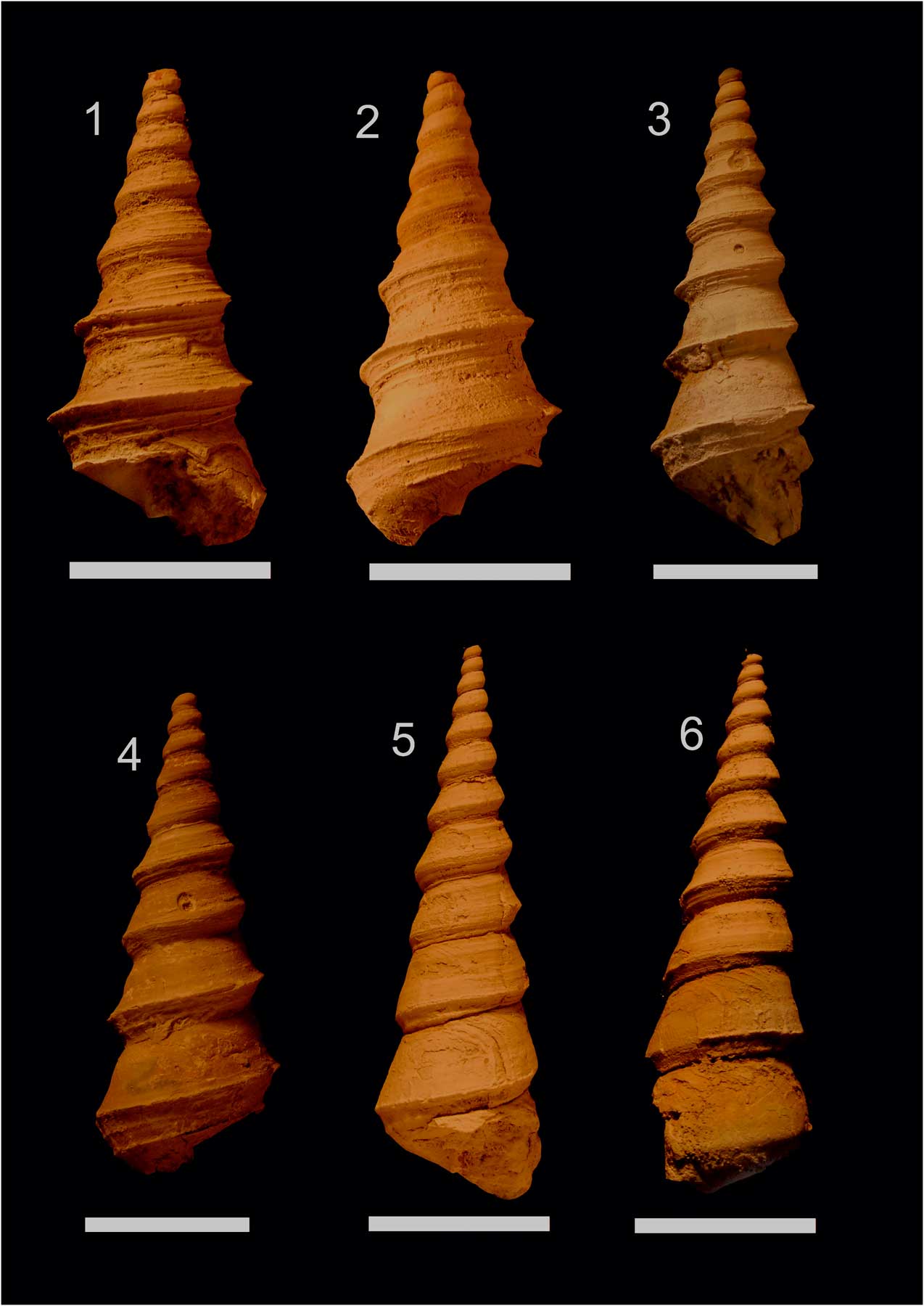
Turritella jadavpuriensis Mitra and Ghosh, Reference Mitra and Ghosh1979. (1, 2) Apertural and abapertural views of robust variant (paraneotype no. ISI/g/Jur/T 5); (3, 4) apertural and abapertural views of intermediate variant (paraneotype no. ISI/g/Jur/T 7); (5, 6) apertural and abpertural views of slender variant (paraneotype no. ISI/g/Jur/T 6). All specimens are coated with magnesium oxide. Scale bars = 1 cm.

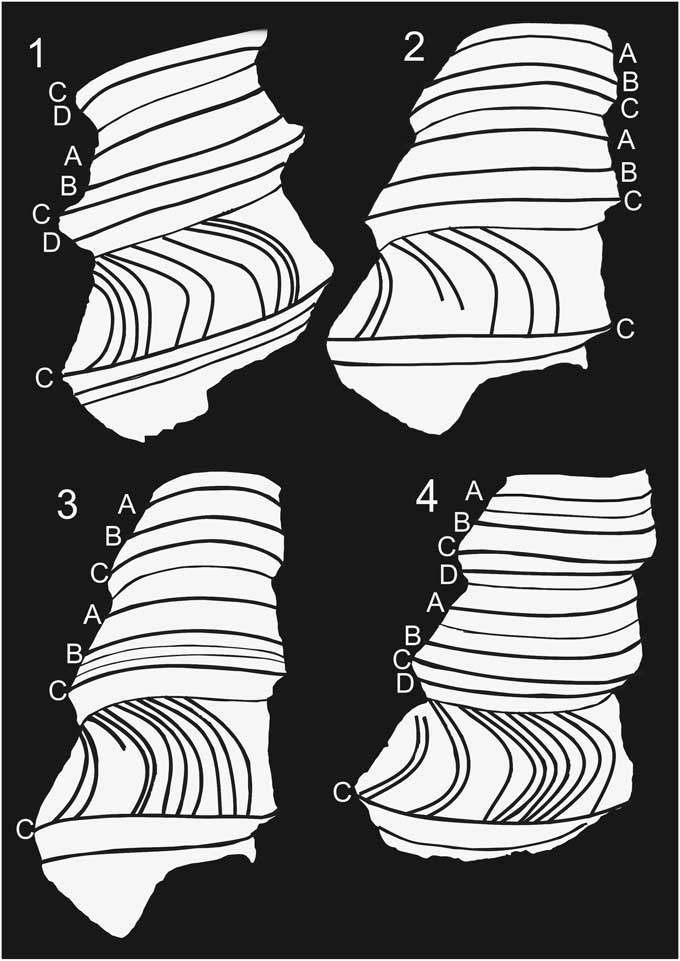
Sketch of growth line patterns in Turritella jadavpuriensis Mitra and Ghosh, Reference Mitra and Ghosh1979. Note wide intraspecific variability of growth line traces. For full description of the patterns see text. (1–4) Abapertural views (maximum diameters: (1) 16.1 mm, (2) 14.5 mm, (3) 15.1 mm, (4) 15.3 mm) with broken aperture.

Type
Neotype: specimen no. ISI/g/Jur/T 1.
Occurrence
This species is known only from the Oxfordian horizons near a pond ~1 km southeast of the village of Jhura, Kutch (23°24’47.57”N, 69°36’09.26”E).
Description
Shell medium to large in size with 15–16 whorls. Maximum observed whorl diameter 23.5 mm and maximum observed height 64.5 mm. Apical angle 19–29°; apical angle and pleural angles not equal, pleural angle slightly less than apical angle. Suture moderately to deeply incised; incision increasing with ontogeny. Protoconch unknown (Figs. 4, 5). Apical sculpture formula A1B1C1d2. Primary spirals A, B, and C develop simultaneously; spiral A appears in the upper 1/3 of the first teleoconch whorl, spiral B in the middle of the whorl and spiral C in the lower 1/3 of the whorl. Spiral C quickly becoming prominent in the later whorls and forming an angulation near the anterior part of whorls. In inflated variant, spiral C changes during ontogeny from having a rounded edge to a well-marked, blade-like angulation. Spiral A becomes prominent in later whorls, but less strong with respect to C and B spirals. In second teleoconch whorl, a prominent D spiral appears between spiral C and suture. Strength of all spirals (A, B, C, and D) increases during ontogeny. Order of relative strength is C, D, B, and A, which remains unchanged on adult whorls. Secondary spirals appear between all primary spirals. Spiral A and spiral B separated by one or two secondary spirals. Spiral C and spiral D also separated by two fine secondary spirals. One secondary spiral developed between spiral A and posterior suture, between spiral B and spiral C, and between spiral D and anterior suture (Fig. 6). Shell basally bicarinate, with carinae thinner toward its peripheral (outer) part. Shape ranges from forms with high apical angle ~29° (i.e., “inflated” variants) to elongated forms with apical angle ~19° (i.e., “slender” variants). These two extreme variants are connected by intermediate forms forming overlapping morphotypes (Fig. 7.3, 7.4). All of them occur side-by-side in the same horizons. Shape of whorls in slender variants is imbricate and campanulate in robust variants. Spiral ornament in inflated variant forms a prominent keel-like angulation at whorl periphery. Both variants with convex early teleoconch whorls. Lateral aspect of growth line trace prosocline; lateral sinus is moderately deep (Fig. 8). Sinus with apex below mid-whorl is common while rarely occurring above mid-whorl. Single inflection point on top developed in some variants. Basal sinus mostly not discernible; in some cases, it appears to be shallow. Growth line formula 3-3-M-A/C-P. Aperture subquadrate, higher than wide. Columellar lip distinct, outer lip very thin and fragile, in most specimens not preserved.
Materials
Four syntypes originally selected by Mitra and Ghosh (Reference Mitra and Ghosh1979) were declared lost by the Repository Section, Geological Survey of India (G.S.I), Kolkata. Neotype specimen no. ISI/g/Jur/T 1; 41 paraneotype specimens, nos. ISI/g/Jur/T 2-30 and 101-112.
Remarks
Turritella jadavpuriensis Mitra and Ghosh, Reference Mitra and Ghosh1979 is the most abundant species in the studied assemblages. The angular whorl profile and large size of T. jadavpuriensis distinguish it from the other two species described from the same Oxfordian horizons of Kutch.
Turritella jadavpuriensis and Mathilda cf. euglypha Laube, Reference Laube1867 from the Lower Jurassic of England (see Hudleston, Reference Hudleston1892, p. 235, pl. 17, fig. 10) have a similar angular teleoconch whorl profile, but they differ in many respects. Turritella jadavpuriensis has exclusively spiral sculpture and a holostomatous aperture. On the other hand, M. cf. euglypha has dominantly axial sculpture and a siphonastomatous aperture. Moreover, T. jadavpuriensis has a larger size (maximum observed height 64.5 mm) compared to M. cf. euglypha (height ~3 mm).
An angular whorl profile like that of T. jadavpuriensis is also present in Mathilda bollina (Münster, Reference Münster1841) from Late Triassic St. Cassian Formation (see Bandel, Reference Bandel1995, p. 6, pl. 2, figs. 1–4, 6), but the latter’s very small size, axial sculpture, and siphonotomatous aperture clearly differentiate it from T. jadavpuriensis.
Turritella jadavpuriensis might be compared with Turritella woodsi Lisson, Reference Lisson1925 from the Oligocene to Miocene of southern Peru (DeVries, Reference DeVries2007, p. 341, fig. 6.8–6.14) in having keeled ornamentation. However, the position of the keel differs in these two species. In T. jadavpuriensis, the keel is anteriorly (abapically) placed while in T. woodsi the keel is located posteriorly (adapically). Moreover, the Peruvian species attains very large size (up to 110 mm) and has more whorls. Turritella jadavpuriensis is also distinguished from T. woodsi in growth line pattern: growth line formula 3-3-M-A/C-P in T. jadavpuriensis versus 5/4-1/2-D-B-P/OR in the Peruvian species.
Eames (Reference Eames1952) identified Turritella imbricataria Lamarck, Reference Lamarck1804 from the Eocene of Pakistan, based on a single fragmentary specimen whose apical part was, however, well preserved, and he placed it within the genus (or subgenus) Haustator. This species resembles T. jadavpuriensis in being basally (abapically) carinate. Eames (Reference Eames1952) provided a detailed description of the apical ornamentation (which was very rare in those days). According to him, the Pakistani T. imbricataria is characterized by a smooth, rounded protoconch with one convex whorl. Apical ornamentation, he said, is characterized by “unicarinate” spiral ornamentation, but he did not specify the primary spirals (i.e., the apical ontogenetic formula). In T. jadavpuriensis, however, all three primary spirals appear simultaneously (formula A1B1C1d2).
Zaria angulata (Sowerby, Reference Sowerby1840) from the Miocene sediments of Kutch (Vredenburg, Reference Vredenburg1928; Harzhauser et al., Reference Harzhauser, Reuter, Piller, Berning, Kroh and Mandic2009, p. 343, fig. 3A–D; Kulkarni et al., Reference Kulkarni, Kapoor and Borkar2010, p. 314, fig. 2g) is similar to the slender variant of T. jadavpuriensis. Both have a similar imbricate whorl profile, basally bicarinate shell and relatively less-strong keel in comparison with the inflated variant of the present species. Growth line patterns, however, differ in these two species: Z. angulata is characterized by opisthocline growth lines, while T. jadavpuriensis has prosocline growth lines. Moreover, T. jadavpuriensis is larger than Z. angulata and has a more acute apical angle compared to Z. angulata. Unfortunately, the nature of apical ornamentation is not known for Z. angulata.
Turritella jhuraensis Mitra and Ghosh, Reference Mitra and Ghosh1979
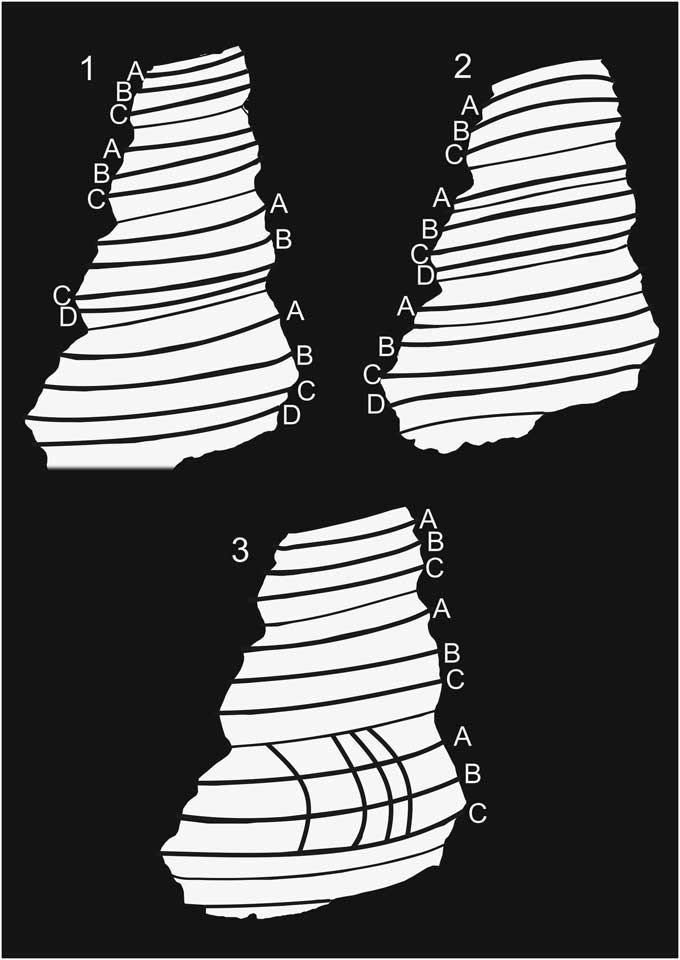
Sketch of Turritella jhuraiensis Mitra and Ghosh, Reference Mitra and Ghosh1979. (1) Diagram showing all the primary spirals present in the adult whorls (maximum diameter 9.3 mm); (2) diagram showing all the primary spirals and one secondary spiral present within the A and B spiral (maximum diameter 6.2 mm); (3) diagram showing the growth line patterns of the species, i.e., straight and faint prosocline (maximum diameter 3.9 mm).

(1–3) Turritella jhuraensis Mitra and Ghosh, Reference Mitra and Ghosh1979. (1, 2) Apertural and abapertural views (paraneotype no. ISI/g/Jur/T 32). Specimens are coated with magnesium oxide; (3) SEM image of early teleoconch whorls of the same species (paraneotype no. ISI/g/Jur/T 33) showing three primary spirals of varying strength (see systematic description for details). Scale bars = 1 cm; (4–6) Turritella amitava new species. (4, 5) Apertural and abapertural views (paratype no. ISI/g/Jur/T 45). Specimen is coated with magnesium oxide; (6) SEM image of early teleoconch whorls of the same species (paratype no. ISI/g/Jur/T 46) showing three spirals of equal strength (see systematic description for details). Scale bars = 1 cm.

Type
Neotype: specimen no. ISI/g/Jur/T 31.
Occurrence
This species is known only from the Oxfordian horizons ~1 km south-east of the village of Jhura near a pond, Kutch (23°24’47.57”N, 69°36’09.26”E).
Description
Shell small to medium in size with five to eight whorls. Maximum observed whorl diameter 8.5 mm; maximum observed height 28.2 mm. Apical angle 22–26°; apical angle and pleural angle not equal; pleural angle slightly smaller. Suture moderately to deeply incised. Protoconch and early teleoconch whorls unknown. Earliest known whorl ~0.6 mm in diameter; A, B, and C spirals prominent, but C spiral stronger and B spiral weak. Space between A and B spirals wider than space between B and C. In later whorls (~4.3 mm diameter), D spiral developed between C spiral and suture, its strength remaining much weaker than other three spirals (Fig. 9). Primary spiral C remains strong throughout ontogeny. Spiral C rounded in profile on early whorls, but becomes sharp, keel-like in adult whorls. One secondary spiral between A and B spirals in later whorls (whorl diameter = 6.4 mm) (Fig. 9). Shell basally carinate; carina thin and sharp at peripheral (outer) margin. Between inner carina and outer carina, a feeble thread developed. Whorl profile convex to frustrate. Lateral growth lines not well preserved, but probably straight and slightly prosocline (Fig. 9). Aperture subrounded, higher than wide. Columellar lip distinct and outer lip very thin.
Materials
Four syntypes originally selected by Mitra and Ghosh (Reference Mitra and Ghosh1979) and deposited in the Repository Section, Geological Survey of India (G.S.I), Kolkata were lost. One neotype (specimen no. ISI/g/Jur/T 31) and nine paraneotypes (specimen nos. ISI/g/Jur/T 32-40) have been assigned here.
Remarks
Turritella jhuraensis lacks the highly angulated C spiral, which forms a very sharp, blade-like ridge in T. jadavpuriensis. In T. jadavpuriensis, the distances between primary spirals are equal, but in T. jhuraensis, spirals B and C are closer than spirals B and A. Moreover, number of secondary spirals is greater in T. jadavpuriensis, while in T. jhuraensis only a single faint secondary spiral is present. These two species also differ in their growth lines. Turritella jadavpuriensis is characterized by a curved, prosocline lateral growth line (growth line formula is 3-3-M-A/C-P), while it is straight (albeit faint) in T. jhuraensis. Turritella jadavpuriensis is basally bicarinate, while T. jhuraensis has three basal cords; the middle one is weakly developed. The aperture in T. jadavpuriensis is subquadrate, while in T. jhuraensis it is subrounded.
Turritella jhuraensis resembles T. pelusae, described by Von derOsten (Reference Von Der Osten1957, p. 586, pl. 65, fig. 15) from the Lower Cretaceous of Venezuela, in having similar shell size and whorl profile. Turritella jhuraensis, however, differs from the South American species in having a higher apical angle (22–26° versus 13° in T. pelusae). Von der Osten mentioned the presence of five ribs on early whorls and one additional rib on later whorls, but he did not specify which spiral he was referring to. In contrast, T. jhuraensis has three primary spirals and two secondaries up to the last whorls, and these and spiral elements have varying strength, whereas in Venezuelan species they are of equal strength.
Turritella jhuraensis is also comparable to “Turritella” toulmini described by Allmon (Reference Allmon1996, p. 90, pl. 12, figs. 6, 7) from the lower Paleocene Clayton Formation of Alabama in having a similarly convex whorl profile. Turritella jhuraensis, however, differs from the American species in having a smaller and less slender shell (apical angle in T. toulmini 10° versus 22–26° in T. jhuraensis). Although both species have same number of spiral threads, the strength of spirals in T. toulmini is about equal. In T. jhuraensis they are of varying strength.
Turritella jhuraensis is very similar to T. narica, described from the Miocene Khari Nadi Formation of Kutch (Vredenburg, Reference Vredenburg1928, p. 375, pl. 18, figs. 13–17, 21, pl. 19, figs. 2, 6; Kulkarni et al., Reference Kulkarni, Kapoor and Borkar2010, p. 312, fig. 2d, e) in having a similar apical angle and whorl profile. But T. narica is larger (maximum observed height 37.0 mm compared to 28.2 mm in T. jhuraensis). Moreover, sculpture in T. jhuraensis consists of five spiral threads of unequal strength while T. narica has six spirals, of which five are of equal strength and the basal thread is stronger.
Another Miocene species from Kutch, Turritella assimilis Sowerby, Reference Sowerby1840 (see Harzhauser et al., Reference Harzhauser, Reuter, Piller, Berning, Kroh and Mandic2009, p. 341, fig. 3j–n), strongly resembles T. jhuraensis in many characters, including shell size, shell outline, whorl profile (flat to convex), and moderately impressed suture. Harzhauser et al. (Reference Harzhauser, Reuter, Piller, Berning, Kroh and Mandic2009) provide a detailed account of the ontogeny of spiral sculpture in T. assimilis. In both species, the early teleoconch whorls possess three primary spirals, but in T. assimilis many secondaries develop later. One of them, located near the anterior suture, becomes equal in strength with the primaries. Two additional secondaries occur between the anterior-most primary spiral and the anterior suture, and the posterior-most primary spiral and the posterior suture. Such development of secondaries is not observed in T. jhuraensis, where the total number of spiral elements including secondaries remains the same (five) all through the later part of the teleoconch.
Turritella amitava new species
Figures 10.4–10.6, 11.1, 11.2, 12.1, 12.2
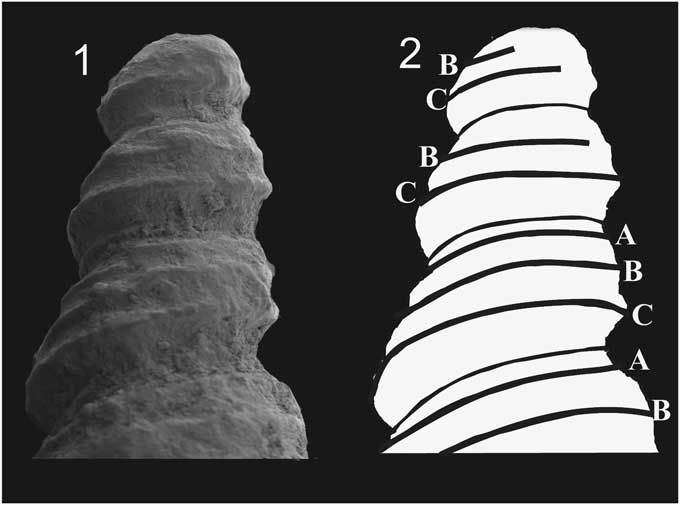
SEM image of apex of Turritella amitava n. sp. (1) Paratype (no. ISI/g/Jur/T 42) showing development of early teleoconch stage and well-developed apical sculpture (×105); (2) sketch of 1, showing primary spiral ribs (notation after Allmon, Reference Allmon1996). Note order of appearance of spiral ribs in ontogeny: C spiral rib appears first, quickly followed by spiral rib B, with A coming later. Therefore, apical sculpture formula is C1B2A3.

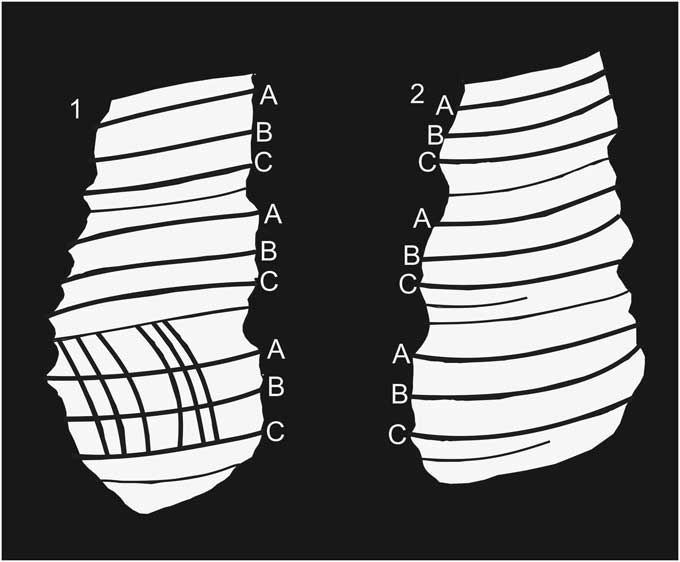
Sketches of late teleoconch of Turritella amitava n. sp. (1) Showing the growth line pattern, slightly prosocline and straight (maximum diameter 6.1 mm); (2) showing the spiral ornamentation, which illustrated three primary spiral ribs (A, B, C) and one secondary spiral present between spiral C and the anterior suture (maximum diameter 5.28 mm).

Holotype
Holotype: specimen no. ISI/g/Jur/T 41.
Diagnosis
Shell small, with subquadrate whorls; primary teleoconch spirals equidistant; spiral B weak to obsolete; secondary spirals faint and discontinuous; growth line formula 4-4-S-P.
Occurrence
This species is known only from the Oxfordian horizons near a pond ∼1 km south-east of the village of Jhura, Kutch (23°24’47.57”N, 69°36’09.26”E).
Description
Shells small to medium in size with nine to ten whorls. Maximum observed whorl diameter 13.5 mm; maximum observed height 28.0 mm. Apical angle 20–24°; apical and pleural angles equal. Sutures weakly to moderately incised. Protoconch unknown. Apical sculpture formula C1B2A3. C spiral in earliest teleoconch in lower 1/3 of whorl; B spiral in middle of that whorl. A spiral within upper 1/3 of third teleoconch whorl. A and C spirals in later whorls become more conspicuous, but B spiral remains relatively weak. Three primary spirals equidistant. Spiral A and spiral B separated by one secondary spiral that is weaker in strength compared to primary spiral. Spiral C and anterior suture also separated by one secondary spiral, which is very faint, discontinuous, and only preserved in two consecutive whorls at whorl diameter 6.13 mm (Fig. 12). Shell basally bicarinate and carinae restricted in peripheral outer part of the base. Upper carina stronger than lower carina. Whorl profiles subquadrate to slightly concave. Lateral aspect of growth line traces slightly prosocline, straight (Fig. 12). Basal sinus shallow. Growth line formula 4-4-S-P (Allmon, Reference Allmon1996, text-fig. 10). Aperture axially ovate. Columellar lip distinct, outer lip very thin and fragile, in most specimens not preserved.
Etymology
The species is named in honor of the late Amitava Koyal, Geologist, Oil and Natural Gas Corporation Limited (ONGC), India.
Materials
Holotype (ISI/g/Jur/T 41) and 10 paratypes specimens ISI/g/Jur/T 42-51.
Remarks
Turritella amitava n. sp. is comparable to the American upper Eocene species Haustator perdita (Conrad, Reference Conrad1865), as described by Allmon (Reference Allmon1996, p. 74, pl. 8, figs. 1–9). Both species are small to medium size, with moderately incised sutures, and similar maximum observed whorl diameter and whorl profile. The American species, however, is more slender and has more whorls. Apical ontogeny is similar in both species, but strength and relative position of primary spirals differ. Turritella amitava n. sp. is characterized by the presence of faint and discontinuous secondary spirals, whereas H. perdita has many fine secondaries developed in different growth stages. The two species also differ in the nature of growth line patterns. Growth line formula is 4-4-S-P for T. amitava n. sp., compared to 4-2-M-B/C-P/OR for H. perdita.
Turritella dhosaensis new species
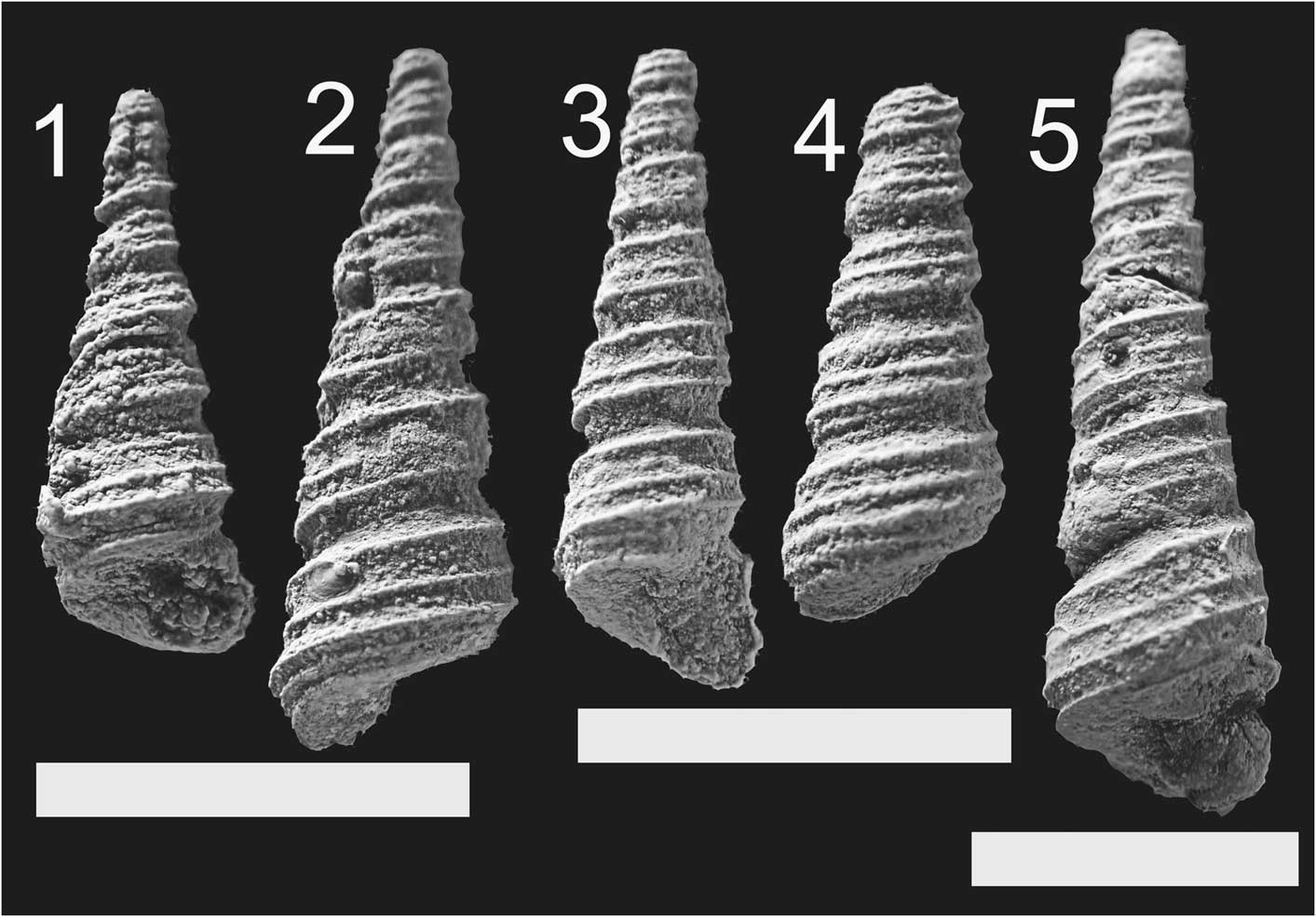
Figures 13.1, 13.2, 14.1–14.5
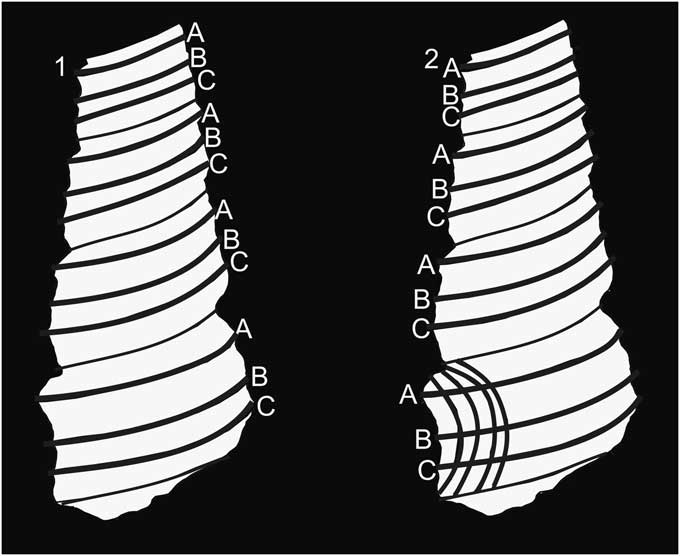
Sketches of adult whorl of Turritella dhosaensis n. sp. (1) Showing the spiral ornamentation that demonstrates three primary spiral ribs (A, B, C) throughout the late growth stage (maximum diameter 7.5 mm). Note the absence of secondary spiral within the primaries; (2) growth line patterns, slightly prosocline, convex with inflection point at or above the mid-whorl (maximum diameter 7.5 mm).

Turritella dhosaensis n. sp. (1) Apertural view (specimen no. ISI/g/Jur/T 54); (2) abapertural view (specimen no. ISI/g/Jur/T 58); (3) apertural view (specimen no. ISI/g/Jur/T 60); (4) abapertural view (specimen no. ISI/g/Jur/T 61); (5) apertural view (specimen no. ISI/g/Jur/T 52). Specimens are coated with magnesium oxide. Scale bars = 1 cm.

Holotype
Specimen no. ISI/g/Jur/T 52.
Occurrence
This species is known only from the Oxfordian horizons ~1 km south-east of the village of Jhura near a pond, Kutch (23°24’47.57”N, 69°36’09.26”E).
Description
Shell small to medium in size with eight to nine preserved whorls. Maximum observed whorl diameter 7.5 mm; maximum observed height 23.2 mm. Pleural angle 22°. Suture deeply grooved. Protoconch and early teleoconch whorls unknown. Earliest known whorl ~2.0 mm in diameter. A, B, and C spirals prominent; strength of spirals decreases from posterior suture to anterior suture. Primary spiral A remains strong throughout ontogeny. Space between A and B spirals wider than space between B and C. No secondary spirals between primary spirals (Fig. 13). Shell basally bicarinate, carina thin and sharp at its peripheral (outer) margin. Whorl profiles telescoped. Lateral aspect of growth line traces indistinct, slightly prosocline, convex with inflection point at or above mid-whorl. Basal aspect of growth line traces not discernible (Fig. 13). Aperture axially ovate. Columellar lip distinct, outer lip thin.
Etymology
The species is named after the Dhosa Oolite Member of the Chari Formation in which it is found.
Materials
Holotype (ISI/g/Jur/T 52) and 13 paratype specimens ISI/g/Jur/T 53-65.
Remarks
Turritella dhosaensis n. sp. has a telescoped whorl profile, whereas whorl profiles are subquadrate to slightly concave in T. amitava n. sp., described above. In T. amitava n. sp., the distances among primary spirals are equal, but in T. dhosaensis n. sp., spirals B and C are closer than spirals A and B. Moreover, T. dhosaensis n. sp. lacks secondary spirals, while in T. amitava n. sp., a number of secondary spirals are present. Turritella dhosaensis n. sp. is characterized by indistinct, slightly prosocline, convex lateral growth lines with the inflection point at or above the mid-whorl, while it is slightly prosocline or straight in T. amitava n. sp.
Turritella dhosaensis n. sp. resembles Haustator tennesseensis (Gabb, Reference Gabb1860) of the lower Paleocene of the Gulf and Atlantic coastal plains, USA (Allmon, Reference Allmon1996, p. 79, pl. 7, figs. 6–9) in having a similar shell size, number of primary spirals (three), growth line pattern (both have slightly prosocline growth line traces), and absence of secondary spirals. However, the American species has more whorls. Both species also differ in their whorl profiles: H. tennesseensis is characterized by trapezoidal to concave whorl profiles, while it is telescoped in T. dhosaensis n. sp.
Turritella dhosaensis n. sp. is similar to another American species, Haustator rina (Palmer, Reference Palmer1937), described by Allmon (Reference Allmon1996, p. 76, pl. 10, figs. 1, 4, 5) from the middle Eocene Lisbon Formation. Both species have similar number of primary spirals, suture (deeply incised), and growth line patterns (slightly prosocline growth line traces and inflection points above the mid-whorl). Haustator rina, however, is characterized by medium to large shell, straight-sided whorl profile, and presence of faint secondaries while T. dhosaensis is characterized by small- to medium-sized shell, telescoped whorl profiles and lack of secondaries.
Another American upper Eocene species, Haustator perdita (Conrad, Reference Conrad1865), described by Allmon (Reference Allmon1996, p. 74, pl. 8, figs. 1–9), is also similar to the new species. Both species have similar shell size and similar number of primary spirals. The American species, however, has more whorls. Secondary spirals are present between primaries in H. perdita, while it is absent in T. dhosaensis n sp. Whorl profile and growth line patterns, however, also differ. In H. perdita, the whorl profile is subquadrate, while it is telescoped in T. dhosaensis n. sp. Lateral growth line traces is orthocline to slightly prosocline in H. perdita, whereas it is slightly prosocline in T. dhosaensis n. sp.
Turritella dhosaensis n. sp. can be compared with Incatella cingulatiformis Möricke in Möricke and Steinmann, Reference Möricke and Steinmann1896 from the Oligocene to Miocene of southern Peru (DeVries, Reference DeVries2007, p. 334, fig. 3.4–3.7, 3.20) in having similar number of primary spirals (three). Incatella cingulatiformis, however, has a number of secondary spirals, while they are absent in T. dhosaensis n. sp. Moreover, the Peruvian species attains a very large size (up to 70 mm) and has more whorls and a more acute pleural angle. These two species also differ in their whorl profiles and growth line traces. Incatella cingulatiformis is characterized by strongly subquadrate whorls and the growth line formula is 1/2-1-M-A-OR/OP, while T. dhosaensis n. sp. is characterized by telescoped whorl profiles and an indistinct, convex and slightly prosocline lateral growth line.
Another Cenozoic species from western Pacific Islands (Pliocene and Pleistocene), Turritella (Kurosioia) fileola Yokoyama, Reference Yokoyama1928 (see Ladd, Reference Ladd1972, p. 16, pl. 1, figs. 8–14), strongly resembles T. dhosaensis n. sp. in shell size and number of primary spirals present. Ladd (Reference Ladd1972) provided a brief description of the species. In both species, the early teleoconch whorls possess three primary spirals, but in Turritella (Kurosioia) fileola primaries are equidistant and have secondary spirals between them. Such development is not found in the new species. Moreover, T. (Kurosioia) fileola is characterized by flattened whorl profiles, while they are telescoped in T. dhosaensis n. sp. The aperture in T. (Kurosioia) fileola is subquadrate, while in T. dhosaensis n. sp. it is ovate.
Discussion
Even though the Permian-Triassic mass extinction severely affected caenogastropods, it is generally agreed that at least some cerithioids (or stem group cerithioids) were present in the late Palaeozoic (e.g., Nützel, Reference Nützel1998, Reference Nützel2002; Nützel and Bandel, Reference Nützel and Bandel2000; Bandel et al., Reference Bandel, Nützel and Yancey2002; Nützel and Pan, Reference Nützel and Pan2005; Frýda et al., Reference Frýda, Nützel and Wagner2008; Ponder et al., Reference Ponder, Colgan, Healy, Nützel, Simone and Strong2008). The phylogenetic relationships and timing of appearance of various cerithioids in the Mesozoic, however, remain unclear. In the Triassic and Jurassic, at least some cerithioids appear to have been widely distributed and diverse (Nützel, Reference Nützel2002; Nützel and Erwin, Reference Nützel and Erwin2002; Kaim, Reference Kaim2004; Bandel, Reference Bandel2006; Ferrari, Reference Ferrari2012). Although numerous, previous reports of pre-Cretaceous Turritella sensu lato have remained poorly documented (see Allmon, Reference Allmon2011). The present report, therefore, appears to represent the oldest well-documented occurrence of at least this branch of the family Turritellidae, and thereby provides additional documentation of the timing of the radiation of post-Paleozoic cerithioids (e.g., Bandel, Reference Bandel1993, Reference Bandel2006; Bandel and Kowalke, Reference Bandel and Kowalke1997; Nützel, Reference Nützel2002; Nützel and Erwin, Reference Nützel and Erwin2002).
It is noteworthy that the turritelline species described here are not markedly “primitive” compared to Lower Cretaceous species that were previously the oldest known representatives of the group, and these Cretaceous forms, furthermore, lack primitive characters that are not found in the Tertiary (see, e.g., Allmon, Reference Allmon1996). In other words, turritellines appear to have occupied approximately the same shell morphospace since the beginning of the group. It remains to be seen, however, whether this is a result of lineages continuously occupying an area of morphospace once it was attained, or extinction of forms followed by repeated (convergent) reoccupation of those areas of morphospace.
Acknowledgments
S.S.D. acknowledges the Indian Statistical Institute, Kolkata, for financial support. S.S. acknowledges DST (SERB) for providing funds to pursue the fieldwork. S.B. acknowledges DST (SERB), DST-PURSE, and CAS of Jadavpur University for providing partial funds. S.M. also acknowledges the grant funded by the University Grants Commission, India for the fieldwork. For valuable comments and suggestions on previous drafts of the manuscript, we are very grateful to T. DeVries, P. Wagner, and an anonymous reviewer. P.P. Halder and T. Basu from RPU of ISI helped with photography and line drawing.
Accessibility of supplemental data
Data available from the Dryad Digital Repository: http://dx.doi.org/10.5061/dryad.mb14c