

I am honored to present the 2026 APSA Executive Director’s Report. This report provides a comprehensive overview of the association’s governance, operations, programs, activities, and key accomplishments during the 2025 fiscal year. It also serves as an important opportunity to highlight the numerous ways in which APSA staff work diligently to deliver meaningful initiatives, programs, resources and support to the APSA membership and the broader political science community throughout the year. I would like to express my gratitude and appreciation for the staff for their hard work and their contributions to this report, as well as to the APSA Council and Governance bodies for their leadership and service.

This year marked a number of milestones and accomplishments for the association: a successful Annual Meeting in Vancouver, British Columbia, Canada, where we welcomed more than 5,600 attendees, highlighting the depth of research engagement across the field and the second annual Virtual Research Meeting, convening more than 200 political science scholars in an accessible and dynamic online format. Beyond our meetings and conferences, APSA continued to expand its digital and international reach. In 2025, the APSA Educate platform, an online teaching library and resource hub, attracted more than 56,000 visitors, with our most accessed resource receiving nearly 5,000 unique engagements. The APSA Mentor Program matched 125 mentees to mentors in the profession. The Centennial Center awarded a total of $184,030 to support political science research. Internationally, we strengthened partnerships with organizations in Japan, Southeast Asia, and the MENA region to support early-career scholars and deepen global collaboration across the discipline. Across our wide range of programs, we continued to provide essential support to scholars, educators, and students. Together these accomplishments and the programmatic achievement described below underscore APSA’s enduring commitment to cultivating an engaged and globally connected political science community. I look forward to building on this momentum by advancing innovative programming, supporting research and scholarship, and expanding resources for students, teachers, scholars, and practitioners across the profession.
EXECUTIVE OFFICE AND GOVERNANCE
In 2025, APSA’s Council and Executive Committee were actively engaged in advancing the association’s mission and ensuring organizational oversight. The Executive Committee and Council each convened four times, providing strategic guidance and fiduciary stewardship. Additionally, the then President-Elect Susan Stokes finalized committee appointments for over 65 membership, policy, advisory, and award committees, supporting the broad range of programs and initiatives that sustain APSA’s work.
The 2025 Council elections took place over the summer and reflected continued member participation in association governance. The Rules and Elections Committee reviewed and certified the results. Members elected Beth Simmons, University of Pennsylvania as President-Elect; Cristina Beltrán, New York University; James Mahoney, Northwestern University, and Sherri Wallace, University of Louisville as Vice Presidents; and Barry Burden, University of Wisconsin; Nicholas Carnes, Duke University; Paul Carrese, Arizona State University; Thomas Dolan, University of Central Florida; Colin Elman, Syracuse University; Jane Gingrich, University of Oxford; Betina Wilkinson, Wake Forest University, and Deborah Yashar, Princeton University, as Council Members. An orientation and onboarding session was held in the fall to support newly elected leaders as they began their service.
The Executive Director and President represented the association at several regional and international meetings, including the 2025 IPSA World Congress in Seoul, South Korea in July, representing the association and engaging in scholarly presentations and discussions with their counterparts.
During the 2025 Annual Meeting in September, APSA leadership welcomed representatives from 17 regional and international political science associations, reinforcing the association’s commitment to global collaboration and disciplinary partnership. Governance operations this year also emphasized strengthened transparency, improved member outreach, and enhanced communications to ensure broader engagement and clearer pathways for participation in APSA leadership and decision-making.
To close out the year, in December, President Susan Stokes and President Elect Beth Simmons visited the APSA Headquarters in Washington, DC to meet with the Executive Director and the Staff who provided updates on APSA programs and operations.
APSA OPERATIONS
In 2025 all tenant space at APSA’s headquarters and its adjacent property were fully leased. APSA’s tenant rental income helps provide a diversified income and investment portfolio that through careful fiscal management, helps to maintain APSA’s strong financial position and supports various programmatic activities. Since July 2024, APSA’s mortgage was paid in full.
During 2025, APSA’s annual external audit was completed by Han Group LLC which issued an Unqualified Opinion on our December 31, 2024 financial statements, which is the highest level of assurance that an external auditor can provide upon conclusion of the audit fieldwork. Similarly, APSA’s federal and state tax returns were filed on time with both the IRS and DC governments. APSA remains in a sound financial position with ample resources for current and future operations. The combined Fair Market Value of APSA’s Investments as of December 31, 2025, was $65 million, up from $57.2 million on December 31, 2024, due to favorable equity conditions that prevailed in 2025. APSA continues to seek more effective operations, which have resulted in savings across a variety of operational areas.
ANNUAL MEETING AND CONFERENCES
2025 APSA Annual Meeting
The 2025 APSA Annual Meeting & Exhibition took place in Vancouver, British Columbia, Canada from Thursday, September 11, through Sunday, September 14. Featuring over 5,600 attendees, the 121st Annual Meeting provided a forum for political science students, professors, researchers, and practitioners to share innovative research, engage with relevant issues, and network with colleagues.
The meeting featured 21 pre-conference short courses, 1,400 panel sessions, 85 business meetings, and 59 receptions. This year, there were also a limited number of panels with virtual participation to help accommodate those with concerns regarding international travel. Program co-chairs Tatishe Nteta (University of Massachusetts Amherst) and Christian Dyogi Phillips (University of Southern California), created a program focused on the conference theme of “Reimagining Politics, Power, and Peoplehood in Crisis Times” The program addressed a range of significant and timely issues including those highlighted in the plenary and breaking news panel discussions: “Democracy in a Reparative Key,” “Toward a More Responsible Two-Party System?,” and “Contesting the University.”
APSA President Taeku Lee, of Harvard University, gave the Presidential Address “Epistemic Institutions and the Populism Dilemma: Reimagining Political Science as a Vocation during Democratic Breakdown.” Reaffirming our strong commitment to students and early-career scholars, we hosted on-site Interview Services, the Career Open House, and the sixth annual Emerging Scholars Symposium, providing undergraduate and graduate students with the opportunity to present their research in a panel format. Additional notable events included the annual APSA Awards Ceremony, which recognized 41 award recipients’ scholarly contributions to the discipline, and the eighth annual TLC at APSA. Around 150 attendees joined TLC at APSA on Saturday to discuss the theme: “Teaching Politics, Power, and Peoplehood in Crisis Times.” I want to extend my sincere appreciation to the conference program co-chairs, division and related group chairs, and staff for their hard work in bringing this program to fruition.
Looking ahead, this year, we are pleased to welcome the 2026 Program Co-Chairs, Ellen Lust, Cornell University, Laura Gamboa, University of Notre Dame, and Jamila Michener, Cornell University. I look forward to welcoming political scientists from across the world to Boston, MA on September 3-6, 2026. The conference theme, “Democracy under Threat: How to Understand, Protect, and Rebuild,” will guide our shared conversation and scholarship as we come together to engage, collaborate and innovate.
APSA Teaching and Learning Conference
The biennial Teaching and Learning Conference, held February 7–9, 2025, in Alexandria, VA brought together over 260 political science teacher-scholars under the theme “Teaching Political Science Matters.” The conference followed a track-based format, featuring seven distinct tracks that fostered in-depth discussions and collaboration around pedagogy, the use of AI in the classroom, curriculum, and student engagement. Michelle D. Deardorff of the University of Tennessee at Chattanooga, gave an engaging and inspirational keynote address entitled “Finding Joy in Teaching during Dark Times.”
I am grateful to the members of the committee for their hard work in shaping this year’s program: Co-Chairs Terry Gilmour of Midland College and Stephen Meinhold of the University of North Carolina, Wilmington, along with committee members Natasha Duncan of Purdue University, Josh Franco of Cuyamaca College, John Ishiyama of the University of North Texas, and A. Lanethea Mathews-Schultz of Muhlenberg College. Their efforts were instrumental in making the conference a success. We look forward to gathering again for the next Teaching and Learning Conference in 2027.
Virtual Research Meeting
APSA’s second annual Virtual Research Meeting took place April 10-11, 2025. The two-day event provided a forum for scholars to share their research, provide constructive feedback for others, and create partnerships and networks for future collaboration. Utilizing a working group format, the meeting welcomed over 200 political science scholars from across all subfields and various career stages of the discipline. This 100% digital event featured opportunities to learn from research workshops, general panels, and a virtual keynote panel on the theme of “Political Science Research in a Virtual World.” Sanjana Hattotuwa, University of Otago, New Zealand, presented the keynote address on the panel “But What is Virtual? The Perils and Potential of Platforms in Politics.” I would like to extend my thanks to the Virtual Research Meeting Program Committee: Bobbi Gentry, City University of New York, Eric D. Loepp, University of Pittsburgh, Amanda M. Rosen, The Ohio State University, and Sarah Wilson Sokhey, The Ohio State University. We are looking forward to another successful Virtual Research Meeting taking place April 15-16, 2026.
TEACHING AND LEARNING AND PROFESSIONAL DEVELOPMENT PROGRAMMING
Promoting and developing teaching and learning in the political science discipline, providing political scientists with professional development opportunities, and supporting political science departments are central goals in APSA’s strategic plan. The Teaching & Learning and Professional Development department offers critical programming and resources to advance these strategic goals.
TEACHING AND LEARNING
The 8th Annual TLC at APSA, a full-day mini-conference held in conjunction with the APSA Annual Meeting in Vancouver, brought together nearly 150 political science educators in a highly interactive forum to share innovative tools and techniques for political science education, present research on the scholarship of teaching and learning, and reflect upon the mini-conference theme of “Teaching Politics, Power, and Peoplehood in Crisis Times.” The 2025 TLC at APSA program committee, led by co-chairs Alison Rios Millett McCartney, Towson University and Erin Richards, Cascadia College included Tavishi Bhasin, Kennesaw State University, Patrick McKinlay, Morningside University, Rolfe Peterson, Susquehanna University, and Tamelyn Tucker-Worgs, Morgan State University. TLC at APSA will be held again at the 2026 APSA Annual Meeting in Boston. The next biennial, stand-alone Teaching and Learning Conference will be held in 2027.
In 2025, APSA held two teaching and learning symposia, with each event bringing together 15-20 teacher-scholars to produce concrete teaching resources in emerging substantive and pedagogical areas. An in-person symposium brought scholars together to workshop teaching resources for teaching Human Rights while a virtual symposium focused on Teaching American Politics in Times of Uncertainty.
Since APSA Educate’s launch in April 2020, the political science education teaching resource library has published over 450 teaching resources and 380 teaching focused blogs, with teaching materials for undergraduate and graduate courses across all subfields of the discipline. In 2025, APSA Educate had over 56,000 total visitors, with our top resource receiving close to 5,000 unique engagements. All materials are free and allow users to easily search, upload, and “favorite” materials.
PROFESSIONAL DEVELOPMENT
In recent years, APSA has increased the number of professional development resources and events for political scientists at all career levels and in both academic and non-academic careers. The 2025 APSA Annual Meeting featured professional development panels and events, including dissertation workshops, roundtables on the job market and getting grants, and events for scholars interested in non-academic careers. APSA also collaborates with status committees to support the professional development of graduate students, community college faculty, and contingent faculty. In 2025, this included virtual professional development webinars and workshops, such as the graduate student professional development virtual workshop series and the community college professional development workshop series. Additionally, the APSA Committee on the Status of Contingent Faculty in the Profession launched an award to recognize the contributions of contingent faculty to the discipline through teaching, research, and service. Working with the Careers Diversity Committee, APSA develops resources and programming to support political scientists considering careers outside of academia.
APSA’s Departmental Services Program supports political science departments by providing resources for department chairs, data and reports on the profession, forums for departments to address common issues, and services for chairs, faculty, and students. 48 department chairs gathered for the inaugural Department Chair’s Mini-Conference at the 2025 Annual Meeting for two panels, a luncheon keynote, and networking opportunities. Topics discussed during the 2025 event included a roundtable on increasing American civics course mandates, dealing with new budget realities, and a keynote on resources to protect academic freedom of speech. We look forward to welcoming Department Chairs to the second-annual Department Chair’s Mini-Conference at the 2026 Annual Meeting.
RESEARCH
APSA’s Research Department conducts research on the political science profession, focusing on degrees earned, job placement, access, opportunities, and representation within the discipline and across higher education. The department produces analytical reports based on APSA surveys and other data sources, publishes findings for the discipline, and maintains interactive data dashboards that support research and professional insight.
For the 2025-2026 academic year, the Research Department expanded its data collection efforts to ensure that the information gathered more fully reflects the experiences and perspectives of APSA members. In addition to its three primary instruments of data collection: (1) the Graduate Placement Survey, which gathers data on political science job candidates from PhD-granting institutions in the United States; (2) the Departmental Survey, which collects information from department chairs on political science curricula, enrollments, and faculty composition; and (3) the Project on Women and Minorities (P-WAM) Survey, which documents demographic trends across all levels of the profession, the department has added two additional surveys. These new surveys include the Survey of Graduate Students, which collects data from APSA members enrolled in a political science PhD program, and the Perspectives in Practice Survey, which gathers APSA member insights on the current policy environment.
In addition to these core surveys, the Research Department conducts specialized surveys for the association and collaborates with APSA members who are undertaking research on the profession in their capacity as scholars.
GOVERNMENT RELATIONS AND PUBLIC ENGAGEMENT
APSA advances the interests of the association and the discipline of political science through its government relations efforts and Advocacy Program. APSA pursues the nonpartisan development of relationships with Members of Congress, federal agencies, and other key stakeholders in efforts to educate policymakers about the value of political science scholarship and to defend the discipline of political science. APSA will also periodically author public statements and letters on relevant issues to the political science discipline, including the rights and freedoms of our members to teach, research, and learn. In 2025, APSA launched the Advocacy Corner newsletter to provide important updates and action alerts to APSA members.
APSA is committed to fostering dialogue between scholars, students, researchers, and practitioners, the public and policy makers in order to help develop a better understanding of the value of political science and to share practical insights from the discipline. APSA’s Public Engagement programming supports, develops, and encourages members’ engagement with their communities, policymakers, the media, and other audiences within the broader public.
PUBLIC ENGAGEMENT PROGRAMMING
APSA is proud to offer public engagement programs and opportunities for our members. Throughout 2025, APSA published 12 issues of a “Reflections on the 2024 US Election” blog series, which showcased a variety of academic perspectives on the 2024 US election through a public engagement lens. Each of the blog submissions was authored by APSA members and reviewed, edited, and circulated by the APSA staff.
APSA coordinated a Media Training short course at the 2025 APSA Annual Meeting in Vancouver, BC in partnership with the American Association for the Advancement of Science (AAAS) SciLine project. The full-day short course, titled “Sharing Your Science with the Media” took place on Wednesday, September 10, 2025, and guided participants through engaging more effectively with the media and how to make scientific messaging more accessible to non-academic audiences.
On October 23, 2025, APSA organized a teaching webinar titled “Guiding Principles for Advocating for Political Science.” The webinar, which featured a presentation from Executive Director of the Consortium of Social Science Associations’ (COSSA) Wendy Naus, centered upon teaching strategies for how APSA’s members can be effective advocates for research and education in support of the discipline of political science, dispelling common misconceptions about advocacy, and demystifying the process of communicating with legislators and other decision-makers. A full recording of the webinar is available on the APSA Advocacy Program website.
ADVOCACY PROGRAMMING
Through its Advocacy Program, APSA staff may offer guidance for members to engage more deeply with policymakers through the sharing of updates and analyses on policy, alerts to enable outreach to Members of Congress, training on how to advocate for political science, and preparatory support to hold meetings on Capitol Hill.
In 2025, APSA began publishing a new method for members to receive information about federal policy and advocacy, the APSA Advocacy Updates newsletter. Recipients of the Advocacy Updates will receive information about upcoming opportunities, events, and deadlines related to federal advocacy in Washington, DC. In addition, analyses and updates regarding major policy changes with impacts on APSA’s membership may be shared through the Advocacy Updates mailing list. APSA staff aim to grow this mailing list in an effort to strengthen the visibility of APSA’s Advocacy and Public Engagement programming.
APSA executive director and staff serve as active participants in several non-partisan advocacy-focused and informational coalitions to coordinate efforts with partner organizations in the higher education space, including the Consortium of Social Science Associations, National Humanities Alliance, Coalition for National Science Funding, Coalition for International Education, Coalition for National Security Research, and the CivXNow Coalition. APSA provides support for the annual advocacy fly-in days for several of these organizations, including personnel support for leading advocates around Capitol Hill and financial support for member attendance through administering the Advocacy Travel Grant Program.
INTERNATIONAL PROGRAMS
APSA continues to collaborate on a variety of initiatives that extend our global network and provide research and professional development support to scholars across the world.
Last year, the International Committee awarded two travel grants to support APSA members presenting at conferences held by our various partner associations. One for a panel on “Populism and Democracy: The Citizens’ Perspective” at the European Consortium for Political Research’s August 2025 General Conference in Greece, and one for a panel on “Impacts of Climate Crisis on Knowledge Production” at the Central European Political Science Association’s September 2025 Conference in Poland. We also supported 10 scholars from outside the US to attend the APSA Annual Meeting and join one of two research development groups: one held by the Southeast Asia Politics Research Group (SEAPRG), and one held by the MENA Politics organized section.
With support from the Japan Foundation, APSA and the Japanese Political Science Association (JPSA) are undertaking a multi-year program of scholarly exchange, professional development, and community engagement. The second JPSA-APSA Working Group on “Civically Engaged Research for Critical Issues in Society” was held alongside the October 2025 JPSA Annual Meeting in Tokyo. The four-day program focused on Political Transitions in Aging Societies and featured research from 16 junior scholars (seven from Japan and nine from USA).
With support from Carnegie Corporation of New York, APSA extended its engagement with early-career scholars from the Arab MENA region. We supported six scholars to attend the IQMR and ICPSR summer methods training programs in June/July 2025. We matched nine junior scholars with advanced-career mentors through the MENA mentoring program. In August, we held a four-day Methods Training Workshop on “Addressing Decolonization and Extractivism in Academic Research” in Amman, attended by 35 early-career scholars. And in January 2026, we held a four-day Methods Training Workshop on “Engaged and Participatory Research” hosted by the Doha Institute for Graduate Studies and attended by 19 early-career scholars.
DIVERSITY AND INCLUSION PROGRAMMING
The APSA strategic plan states that one of APSA’s overarching goals is to promote and encourage diversity and inclusion in the profession. The APSA Diversity and Inclusion Department supports longstanding programs to increase diversity, inclusion, and access within the discipline of political science, across all levels and at APSA meetings and events. Participation in APSA Diversity and Inclusion Programs is open to all interested individuals without regard to any characteristic protected by applicable law. Applicants must satisfy any relevant program-specific criteria. APSA Diversity and Inclusion Fellowship and Grant programs (such as the Diversity Fellowship Program and the Fund for Latino Scholarship, among others) awarded a total of $102,800 for FY25. An additional $72,000 was awarded to the Advancing Research Grants for Early Career Scholars and Indigenous Politics.
APSA Mentoring Program
Created in 2003, the APSA Mentoring Program connects undergraduate, graduate students, and junior faculty from all backgrounds to experienced and senior members of the profession for professional development support on a wide range of academic and career topics. Mentorship is vital to the success of all scholars. Mentor matches are made twice a year, once at the beginning of the fall semester and once at the beginning of the spring semester. Matches can be short-term (one semester) or long-term (one academic year). In spring 2025, APSA staff matched 68 mentors and mentees. In fall 2025, APSA staff made an additional 57 matches. During the 2025 APSA Annual Meeting, the Mentoring Program held the “Mentoring in Political Science: Strategies for Success” roundtable, which featured advice and guidance from mentors and mentees who previously participated in the Program.
Ralph Bunch Summer Institute
One of the most prominent of APSA’s programs is the Ralph Bunche Summer Institute (RBSI), which is celebrating its 40th year in 2026. In 2025, 14 undergraduate students participated in the annual, intensive five-week program hosted by Duke University on May 25–June 26, 2025, under the direction of Dr. Paula D. McClain. The program provides education and courses such as research methods, race, and American politics, as well as professional development opportunities. The 2026 institute will be held May 24-June 25, 2026. The program is funded in part by the National Science Foundation, Duke University, and APSA, with generous sponsorship from Cambridge University Press.
RESPECT Campaign
A key component of APSA’s efforts to create a diverse, inclusive, and respectful environment at APSA meetings and events is the RESPECT Campaign, which encourages “professional respect” by and towards all APSA annual meeting attendees and participants at all times. The RESPECT Campaign was featured at the 2025 Annual Meeting through email messaging, signage, and buttons. RESPECT stands for Respectful, Equitable, Safe, Professional, and Ethical Conduct Towards All. The goal is to promote a respectful climate throughout the profession. The presence of APSA resources like the APSA Meetings Ombuds and the onsite Inclusion Training and Bystander Intervention Training, which were available during the 2025 meeting onsite and virtually, also embody the RESPECT message.
APSA Professional Ethics Program
To uphold the ethical standards in the political science discipline and to protect the human rights of scholars within the profession, APSA maintains a Professional Ethics Program that provides guidance on ethical conduct in the profession and a formal outlet for members to submit individual grievances and complaints that pertain to an APSA related meeting, conference or entity. The program is grounded in the APSA Guide to Professional Ethics, which outlines principles for responsible professional behavior. The Committee on Professional Ethics, Rights, and Freedoms, handles grievances, develops ethical guidelines, and supports the human rights of political scientists in the US and abroad. Members may submit concerns through APSA’s reporting system, EthicsPoint, or via email at ethics@apsanet.org.
History of the Profession: APSA Oral History Project
During the 2025 National Conference of Black Political Scientists (NCOBPS) Annual Meeting held in New Orleans, Louisiana, the APSA Diversity and Inclusion Department conducted a third set of oral history interviews. Then, during the 2025 Western Political Science Association (WPSA) Annual Meeting held in Seattle, Washington, the APSA Diversity and Inclusion Department conducted a fourth set of oral history interviews. This video series, “Contributions by Scholars of Color,” contributes to a continuous project that seeks to amplify the scholarship and contributions of scholars in the profession and to examine the history of race and racism in the political science profession. It further builds upon the APSA-Pi Sigma African American Alpha Oral History Project (1988-1994) and is motivated by the McClain Task Force on Systemic Inequality in the Discipline (2022). The videos premiered at the 2025 Annual Meeting in Vancouver, British Columbia.
CONGRESSIONAL FELLOWSHIP PROGRAM
Established in 1953, the Congressional Fellowship Program (CFP), serves the mission of APSA by enhancing public understanding of policymaking and improving the quality of scholarship, teaching and reporting on American national politics. The current 2025-2026 cohort is composed of 33 accomplished professionals from diverse fields, including political science, journalism, healthcare, and US government domestic and foreign policy specialists. Six political science fellows are directly sponsored by the CFP endowment. One fellow was also awarded the William A. Steiger Fellowship to support two months of research prior to the start of the fellowship year. Fellows are currently serving in various congressional offices, with placements in the House of Representatives, Senate, committees, and other executive and legislative offices.
Over the past year, the CFP program focused on strengthening its alumni community, revitalizing its advisory committee, and finalizing updates to the original endowment grant agreement. Looking ahead in 2026, the CFP is focused on promoting diversity in its applicant pool by increasing outreach to a broader population of political scientists, journalists, and telecommunications scholars.
CENTENNIAL CENTER FOR POLITICAL SCIENCE AND PUBLIC AFFAIRS
The Centennial Center advanced APSA’s strategic priorities in 2025 through robust grantmaking, expanded training initiatives, and strengthened institutional partnerships. Across its programs, the Center continued to support high-impact research, foster civic engagement, and serve as a hub for scholarly collaboration within the discipline.
Supporting Research and Engagement Through Grants
Grant funding remained central to the Center’s work. In 2025, the Centennial Center awarded a total of $184,030 to support political science research including: 20 Spring grants totaling $40,000 and 59 Summer grants totaling $144,030. These awards provided essential support to scholars conducting innovative research and advancing work addressing pressing societal challenges.
Strengthening the Visiting Scholars Program
The Visiting Scholars Program hosted Margaret A. T. Kenney (University of California, Berkeley) in spring 2025, providing a Washington, DC–based research home for scholars seeking to advance their work and expand professional networks. Interest in the program continues to grow, reflecting strong demand for space and community within APSA’s headquarters. The Center looks forward to hosting Tiago Tasca (University of California, Santa Cruz) in spring 2026.
Institute for Civically Engaged Research (ICER)
A major milestone in 2025 was the launch of a new collaborative partnership with the John Randolph Haynes and Dora Haynes Foundation, the UCLA Center for Community Engagement, and the UCLA College of Arts and Sciences. The institute was held in Los Angeles, marking a significant geographic and institutional expansion of the program.
In 2025, ICER welcomed 21 new fellows, bringing the program’s alumni network to 113 scholars since its inception in 2018. The four-day residential institute provided advanced training in civically engaged research methodologies, equipping participants at all career stages with practical tools for rigorous, ethical, and community-centered scholarship. The success of the 2025 institute led to renewed support from the Haynes Foundation, enabling APSA to return to UCLA in summer 2026. ICER has also received generous contributions and pledges from members; I greatly appreciate these partnerships and the support.
DOCTORAL DISSERTATION RESEARCH IMPROVEMENT GRANT
The APSA DDRIG program seeks to award between 20 and 25 grants annually of $10,000 to $15,000 to support doctoral dissertation research that advances knowledge and understanding of citizenship, government, and politics. In 2025, the APSA DDRIG program made awards to 22 outstanding dissertation projects from doctoral candidates at 18 institutions. Since 2020, the APSA DDRIG has awarded $1.875 million in grants to support 139 doctoral candidates in completing their political science dissertation research.
APSA submitted a grant application to the National Science Foundation in December 2025 to continue administering the APSA DDRIG program from 2026 through 2028. APSA requested increased funding of $350,000 per year to be able to support awards of up to $20,000 due to inflation and rising research costs.
PUBLICATIONS
In 2025 APSA publications focused on promoting cutting-edge research in the association’s journals, managing editor reappointments, conducting a journal RFP, and promoting newer ventures including APSA Preprints and the association magazine, Political Science Today. Review committees were formed to assess the editorial teams for Perspective on Politics, PS: Political Science & Politics, and Journal of Political Science Education in response to the editors’ requests to extend their term to six years. Each committee worked closely to evaluate the performance of the respective teams and journals, and all three unanimously voted to extend the terms. APSA Council approved the extensions (2026-2029 for Perspectives, and 2026-2028 for PS and JPSE) at the Fall Council Meeting.
Another major project in 2025 was to conduct a request for proposals (RFP) for APSA’s three all-member journals and six section titles published by Cambridge University Press, each of which were on contracts due to expire at the end of 2026. An RFP Working Group was formed consisting of Council members, staff, a former editor, and a section representative. The team worked with consultants at Clarke & Esposito to develop the RFP and solicit interest from publishers.
The Working Group met throughout the year to evaluate the best way forward for our nine discipline-leading publications and the association, and the decision was made to renew APSA’s partnership with Cambridge University Press. The renewed agreement, signed early in 2026, will help to ensure the financial stability of the association and the six section journals for years to come. It provides the resources necessary to support editorial teams and APSA programs, while also providing flexibility to adapt to new business models and changes in the publishing industry. Cambridge has been a trusted partner of APSA for over 20 years, and we look forward to their continued collaboration as APSA’s publisher.
Politics and Religion, a publication of an APSA Organized Section, transitioned to a fully Open Access (OA) journal in 2025. Due to Cambridge University Press’ “transformative agreements” with institutions, an increasing percentage of articles in our flagship journals are also being published Open Access, providing the association the opportunity to better serve members across the discipline in that format. Under the new publishing agreement there is increased flexibility for titles to “flip” to OA.
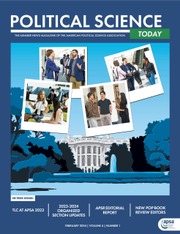
Other APSA publication initiatives continued growing in 2025. The association magazine, Political Science Today, completed its fifth volume. The quarterly magazine, which is available to all members in print and online, includes news about our discipline, member spotlights, public scholar summaries and association updates. APSA Preprints continues to serve as an important resource for scholars to share research. The site now has over 1,100 original articles, 1.3 million abstract views, 700,000 article downloads, and has been cited over 600 times.
The Public Scholarship Program, now in its sixth year, provides an opportunity for graduate students in political science to come to APSA as fellows where they learn how to write and summarize journal articles for a general audience, similar to what one might find in a Good Authority post. In 2025 Public Scholarship Fellows authored 20 APSR article summaries, plus multiple writeups of APSA’s various informative and educational teaching and learning webinars.
COMMUNICATIONS & MARKETING
Communications & Marketing
APSA strives to connect with members and the general public through monthly email newsletters, social media, numerous events, and various websites developed by APSA to encourage communication between scholars, students, and researchers. By spreading awareness of APSA’s program initiatives, the association aims to encourage a better understanding of political science, provide members with ample learning opportunities, and enhance the capacity of political scientists today.
APSA uses a multichannel approach to promote and increase awareness around all APSA programs, including but not limited to diversity, equity and inclusion programming, the Congressional Fellows, the Centennial Center, research in the discipline, international programs, teaching and learning resources, individual membership and departmental membership, awards and recognition in the profession, eJobs, grants and funding opportunities, advocacy, development, and much more.
APSA Connect
APSA provides support and resources for APSA Connect, an online community for APSA members to share, connect and network with one another. APSA Organized Section microsite administrators and officers make up more than 50% of APSA Connect users on the platform. Currently, APSA hosts and supports a total of 83 microsites managed by APSA staff, committees, and organized section officers. We recently completed a code review and refactoring of the code around SSO and database syncing to streamline the process. We also continue making front-end usability improvements to enhance members’ experience.
Political Science Now
Political Science Now continues to grow and evolve as the storytelling arm and content hub of the American Political Science Association, which is designed to highlight all aspects of the association and political science community. PSNow offers daily association announcements, recent research articles, APSA programs and calls to action–featuring the latest political science research from APSA’s leading journals, teaching and learning opportunities that explore topics and trends in the profession, current grant and program opportunities and support for political scientists, insightful interviews with scholars, grant and award recognition, professional development resources, association meetings and events, and much more.
MEMBERSHIP SERVICES
In 2025, APSA Membership averaged 10,665 individual members, on track with the annual average from the previous year. APSA Organized Section membership remained stable as well. Overall, organized sections averaged 27,757 total memberships, a four percent increase from 2024. Organized sections recognized and supported members through over 300 awards, travel, and research grants. Over $141,000 was disbursed by sections in award and grants to their members. 62 percent of APSA members belong to at least one organized section and 20% of section members serve in leadership positions, as a section officer or an award committee member.
Through the APSA Awards, the association recognized 41 recipients for outstanding dissertations, books, articles, and posters, as well as for significant career achievements reflecting sustained scholarly impact and professional leadership. This year also marked the inaugural presentation of the Sage/CQ Press Award which honors research-based projects and those that may involve activism that focuses on advancing social justice, and addressing inequality and inequity in society. By recognizing exceptional scholarship, leadership, and service, the APSA Awards play a vital role in celebrating the contributions of our colleagues and reaffirming the values that strengthen and advance the discipline.
DEVELOPMENT
In 2025, APSA members and friends contributed to support the mission. The APSA Annual Fund received the greatest number of donations, with 80 unique contributions. The yearly total of $88,026.92 represented a $20,000 increase from the 2024 total. There were 307 unique donors, 22% of which were first time donors. There were 567 unique donations, with the majority of the contributions ranging from $1 to $25. Thank you to all who contributed to support the mission, work and programs of the association.
CONCLUSION
Over the past year, APSA has reaffirmed its steadfast commitment to strengthening the political science profession and supporting scholars, students, and practitioners, as well as service, research, teaching, and public engagement. Through expanded professional development programs, innovative initiatives, and international partnerships, the association has continued to broaden access to meaningful resources and opportunities for members at every stage of their careers. These achievements are made possible by the extraordinary dedication of our members, whose time, expertise, and generosity help sustain our wide-ranging programming, fellowships, grants, the annual meeting, and our publications portfolio.
As we look ahead, I am excited to collaborate with our community to further advance research excellence, innovative pedagogy, career development, and public engagement. I extend my sincere appreciation to the APSA Council, the governance, standing and membership committees, and the many volunteers, members, staff, and partners whose leadership and service drive our mission forward. I look forward to continuing to lead the association in advancing and achieving our shared mission and goals for the political science profession.■


