Introduction
The neotropical genus Hiraea Jacq., comprising more than 70 species, is characterised by epipetiolar stipules, axillary umbellate inflorescences with yellow flowers, and butterfly-shaped samaras. In about three-quarters of the genus, the umbels are 4(–6)-flowered, single or in ternate cymes, one to several groupings per leaf axil. The remaining species bear large, multiflowered, globose clusters borne on a single axis. The most widespread species with multiflowered umbels in Mexico and Central America is Hiraea smilacina Standl., but traditionally it had been included within H. quapara (Aubl.) Sprague, a species primarily of French Guiana (e.g. Cuatrecasas, Reference Cuatrecasas1958; Cuatrecasas & Croat, Reference Cuatrecasas, Croat and Woodson1981). Study of the collections assigned to Hiraea smilacina uncovered the novelties here described, H. costaricensis and H. polyantha.
Taxonomic History
Aublet (Reference Aublet1775) described Banisteria quapara in Histoire de Plantes de la Guiane Françoise, based on flowering branchlets and loose samaras, the latter resembling those of “Banisteria L.” (= Banisteriopsis C.B.Rob.). Jussieu (Reference Jussieu1840) transferred this species to Hiraea and proposed the name H. multiradiata, thereby creating a superfluous name according to modern rules of nomenclature. He used a new epithet in the newly assigned genus, as was common practice in his day.
Jussieu studied Aublet’s collection, and in his monograph of the Malpighiaceae (Reference Jussieu1843) he pointed out that the samaras, which Aublet described and illustrated in the protologue, belong to Sapindaceae and not Hiraea, an aspect overlooked by Cavanilles (Reference Cavanilles1790). In a review of Hiraea, Niedenzu (Reference Niedenzu1906) adopted Jussieu’s name H. multiradiata and surmised, from Jussieu’s description alone, that H. cephalotes Triana & Planch., based on a Triana collection from Colombia, was a synonym.
Sprague (Reference Sprague1924) assumed that Jussieu chose the epithet multiradiata “doubtless on the ground that quapara was a barbarous name”, and to agree with then current rules of nomenclature, he proposed the combination Hiraea quapara. He cited Aublet’s type collection at BM as well as a specimen from Honduras (Peck 828, dated 1907, K), and remarked on the gap in distribution. He recognised two additional varieties, both based on collections from French Guiana. Sprague considered Hiraea cephalotes an older name for H. spruceana Nied., which Niedenzu described from a Spruce collection from Ecuador (Niedenzu, Reference Niedenzu1912).
Niedenzu (Reference Niedenzu and Engler1928) was unaware of Sprague’s article when he published his monograph of the Malpighiaceae for Das Pflanzenreich. He retained Hiraea multiradiata and listed H. cephalotes as a synonym. He followed Jussieu in rejecting the fruits of the Aublet collection, but in his description he quoted the nature of the samara from the protologue for Hiraea cephalotes (Triana & Planchon, Reference Triana and Planchon1862). He listed a duplicate of the Triana type, along with specimens from French Guiana. Later authors (Cuatrecasas, Reference Cuatrecasas1958; C. Anderson, Reference Anderson2013) agreed with Sprague that Hiraea cephalotes is a distinct species.
Standley (Reference Standley1933) based Hiraea smilacina on a flowering collection and a single fruiting specimen from Barro Colorado Island in Panama, the latter the holotype. He noted the similarity to Hiraea multiradiata “but differing in several details from Niedenzu’s description”, but without elaboration of the differences. At the time, Hiraea quapara had been collected in fruit only once, by Mélinon in 1877 (P), and neither Standley nor Niedenzu realised that H. quapara has highly unusual fruits. As is typical for the genus, Hiraea smilacina produces schizocarps that break into three butterfly-shaped samaras (Fig. 4J). In Hiraea quapara, a species of riparian habitats, the fruit is roughly spherical (Fig. 3J) and the mericarps bear a network of greatly reduced winglets, presumably an adaptation for dispersal by water. The two species have discrete ranges. Hiraea smilacina occurs in southern Mexico and much of Central America, with records also from Colombia and Ecuador. Hiraea quapara is known from French Guiana as well as adjacent Suriname and Brazil (Amapá).
Morton (Reference Morton1936), in an account of Malpighiaceae of the Yucatan Peninsula, dismissed Standley’s “differences” as well as Niedenzu’s qualms about the mixed type collection and rejection of Aublet’s epithet. Like Niedenzu, Morton was unacquainted with Mélinon’s fruiting collection as well as Sprague’s review of 1924, and he too proposed the combination Hiraea quapara. Later authors (e.g. Standley & Steyermark, Reference Standley and Steyermark1946; Cuatrecasas, Reference Cuatrecasas1958; Croat, Reference Croat1978; Cuatrecasas & Croat, Reference Cuatrecasas, Croat and Woodson1981), who also had not seen fruiting specimens of Hiraea quapara, agreed with Morton and considered H. smilacina and H. quapara conspecific. Collections of Hiraea smilacina were routinely identified as H. quapara or H. multiradiata until W. R. Anderson (Reference Anderson1993) noted that H. smilacina and H. quapara are indeed separate species with greatly dissimilar fruits.
The novelties here described, Hiraea costaricensis and H. polyantha, had been sorted in the herbarium with H. smilacina, presumably because they have the flowers arranged in multiflowered umbels and the laminas are abaxially covered with stalked hairs. Hiraea costaricensis is readily distinguished by the spreading basifixed hairs found on the stems and leaves. Such basifixed hairs are highly unusual in the family, which is characterised by vesture composed of medifixed single-celled hairs. These hairs may be appressed or spreading, the latter V-, T-, or Y-shaped, or rarely stellate. In a few species, one arm of a V- or Y-shaped hair is reduced to a rudiment or completely suppressed, and the resulting hair appears basifixed. Hiraea polyantha, known from one collection of Colombia, immediately stands out by the size of its inflorescence, which comprises c.100 flowers. In other species of Hiraea with multiflowered umbels, the flowers number from about 10 to 60.
Taxonomy
Measurements of flowers are taken from herbarium material revived with Pohl’s solution (Pohl, Reference Pohl1965). An asterisk marks specimens seen only as online images as well as duplicates listed in the online database at CAY.
Hiraea costaricensis C.E.Anderson, sp. nov.
Hiraea costaricensis differs from H. smilacina Standl. by the presence of basifixed hairs on the stems and leaves as well as bearing only a few digitate-glandular fimbriae at the apex of the posterior petal. – Type: Costa Rica, Golfito, P.N. Corcovado, valle de Coto Colorado, Quebrada Arenas, sección Esquinas, 08°46′N, 83°15′W, 100 m, 15 v 1994 (fl), Quesada 906 (INB587056). Fig. 1.
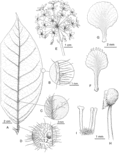
Hiraea costaricensis C.E.Anderson. A, Large leaf, adaxial view; B, detail showing basifixed hairs on margin of lamina; C, detail showing basifixed hairs on costa; D, detail showing gland on petiole; E, umbel; F, posterior petal; G, lateral petal; H, stamen; I, gynoecium, anterior stamen at left. Based on Quesada 906. Drawn by John Megahan.

Woody vine; stems densely covered with a mixture of basifixed hairs and some spreading T- and Y-shaped hairs when young, eventually glabrous. Leaves opposite; laminas of the larger leaves 19–28(–37) × 9.5–14.5(–18.5) cm, elliptical, apex acuminate, acumen to 1 cm long (the tip sometimes broken off and the apex appearing apiculate), base slightly cordate, adaxially when young densely covered with basifixed hairs (0.5–)1–2.5 mm long and some T- and/or Y-shaped hairs, the arms often unequal, stalk 0.1–0.2 mm long, trabecula of T-shaped hairs and total of arms of Y-shaped hairs 0.9–1.5 mm long, glabrescent, abaxially mostly with T-shaped and fewer Y-shaped hairs, stalk 0.2–0.6 mm long, trabecula of T-shaped hairs and total of arms of Y-shaped hairs 0.6–1(–1.5) mm long, basifixed hairs mostly on veins (a few scattered on surface), 1.2–2 mm long, the vesture thinning with age; margin with a fringe of basifixed hairs mixed with some T- and Y-shaped hairs, abaxially with scattered glands in the proximal 1/4 to 3/4, glands 0.3–0.4 mm in diameter, prominent or raised to 0.2 mm; costa and secondary veins prominent abaxially, tertiary veins prominulous; petioles 14–25 mm long, densely covered by a mixture of basifixed hairs and some spreading T- and Y-shaped hairs, with a pair of glands in the distal 1/5, hidden by the dense vesture, each gland 0.4–0.5 mm in diameter; stipules c.3 mm long, borne on the petiole at the proximal 1/4. Inflorescence a solitary umbel of c.25 flowers, borne on an axis 3.5 cm long, at the distal 1/4 below the umbel with a node bearing a pair of inflorescence bracts to 3 mm long; floriferous bracts 0.5–1 mm long, bracteoles like floriferous bracts or slightly shorter and/or narrower; pedicels 16–19 × c.1 mm; axes, abaxial surface of bracts and bracteoles, and pedicels densely sericeous. Sepals 2–2.5 mm in diameter, triangular, adaxially glabrous, abaxially sericeous; anterior sepal eglandular, the lateral four biglandular, glands 1.3–1.5 mm long, prominent. Petals glabrous, yellow; lateral petals with the claw c.2.5 mm long, limb orbicular, margin subentire or to irregularly denticulate, teeth to 0.1 mm long, limb of anterior-lateral petals c.4.5 mm in diameter, of posterior-lateral petals c.4 mm in diameter; posterior petal with the claw c.3 mm long and thicker than that of lateral petals, limb c.3.5 × 3.5–3.7 mm, orbicular, margin near base subentire, distally denticulate, the teeth to 0.2 mm long, only those at the apex drawn out into glandular fimbriae to 0.4 mm long. Stamens glabrous, basally connate, that opposing the anterior sepal the largest (filament 3–3.5 mm long, anther 1.5–1.6 mm long), that opposing posterior petal the smallest (filament c.2 mm long, anther 1 mm long); filaments of lateral stamens 2.3–2.7 mm long, anthers 1.2–1.3 mm long. Styles glabrous; anterior style c.2.5 × c.0.3 mm, apex extended into a spur 0.1 mm long, erect; posterior styles c.2.8 × c.0.2 mm, apex dorsally blunt, incurved. Ovary c.1 mm long, densely villous. Samaras: mature samaras not seen; immature samaras butterfly-shaped, dorsal wing present.
Phenology. Collected in flower in April and May, in young fruit in June.
Distribution and habitat. Costa Rica (Pacific watershed: Puntarenas); forest and roadside; 20–1300 m.
Additional specimens examined. Costa Rica. Puntarenas: Monte Verde, lower community, 10°18′N, 84°48′W, 23 viii 1990 (sterile), Anderson 13813 p.p. (MICH); Reserva Forestal Golfo Dulce, Osa Peninsula, Rancho Quemado, c.15 km W of Rincón, along Río Riyito and Quebrada Quebradón, 08°40′N, 83°34′W, 200 m, 3 vi 1988 (y fr), Hamme1 7001 (MICH, MO); within 0.5 km of 08°40′48′′N, 83°30′25′′W, 18 vii 2001 (sterile), Mayfield 213-891-1530 (MO); Osa, Cuenca Térraba-Sierpe, Sierpe, camino hacia Rancho Quemado, 08°41′10′′N, 83°40′30′′W, 20 m, 28 iv 1999 (fl), Rodríguez 4811 (MO).
The striking basifixed hairs of the stems and laminas immediately separate Hiraea costaricensis from H. smilacina, which lacks basifixed hairs. The posterior petal of Hiraea costaricensis differs in having only a few marginal teeth at the very apex drawn out into digitate-glandular fimbriae; in H. smilacina, digitate-glandular fimbriae occur along the margin of the distal 2/3 to 3/4 of the posterior petal.
Hiraea polyantha C.E.Anderson, sp. nov.
Hiraea polyantha differs from all other species of Hiraea by its inflorescences with c.100 flowers. – Type: Colombia, Caldas, La Selva, Pueblo Rico, 1600–1900 m, 25 i 1946 (fl), von Sneidern 5541 (holo US, iso F). Fig. 2
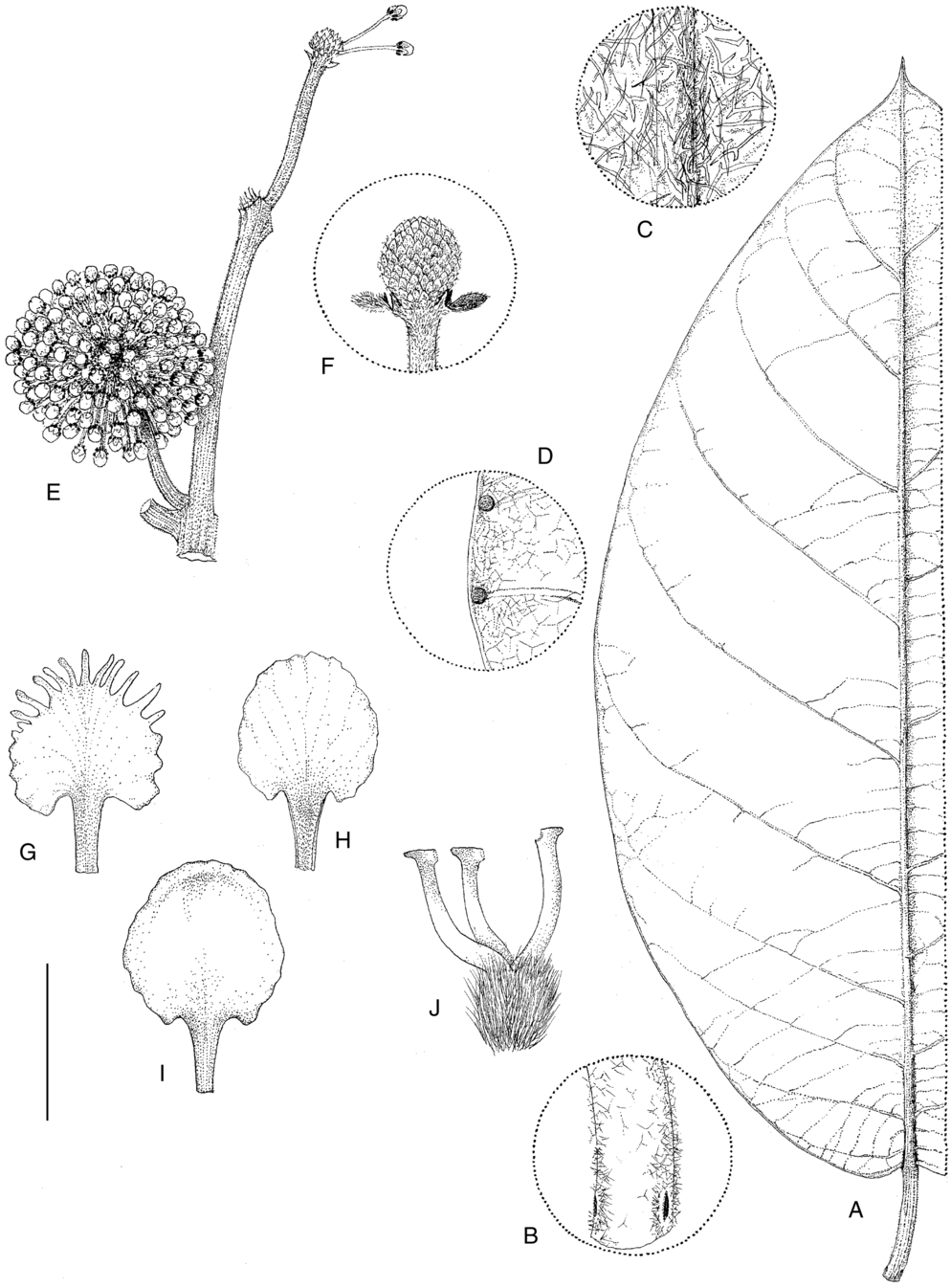
Hiraea polyantha C.E.Anderson. A, Large leaf, adaxial view; B, basal portion of petiole, showing stipule scars; C, detail showing dense abaxial vesture of lamina; D, detail showing two marginal glands on abaxial surface of lamina; E, inflorescence in bud; F, detail showing spherical receptacle of inflorescence, all pedicels abscised; G, posterior petal; H, posterior-lateral petal; I, anterior-lateral petal; J, gynoecium, anterior style at right. Scale bar equivalents: A, 4 cm; B, 1 cm; C, 2 mm; D, 4 mm; E, 4 cm; F, 1.3 cm; G–I, 4 mm; J, 2.7 mm. Based on von Sneidern 5541 (US). Drawn by Karin Douthit.

Habit unknown but probably a woody vine; stems velutinous. Leaves presumably opposite (only three detached large leaves seen); laminas 24–27 × 15–19.5 cm, ovate, apex apiculate to briefly acuminate, base cordate, adaxially glabrous or the costa proximally velutinous, abaxially densely beset with T-shaped hairs, stalk 0.1–0.2 mm long, trabecula 0.2–0.6 mm long, wavy; with a pair of glands at the base adjacent to the costa, each gland c.0.4 mm in diameter; margin with scattered glands 0.3–0.4 mm in diameter; costa and secondary veins prominent abaxially, tertiary veins prominulous; petioles 25–30 mm long, densely velutinous; stipules not seen, stipule scars at the basal 1/4 of petiole. Inflorescence a solitary c.100-flowered umbel borne on an axis 4–4.5 cm long, below the umbel with a node bearing a pair of leafy bracts to c.4 mm long; floriferous bracts c.0.8 mm long, bracteoles like floriferous bracts or slightly shorter and/or narrower, all abaxially densely sericeous; pedicels 18–22 × 0.5 mm; axes and pedicels densely velutinous. Sepals 2.2–2.5 × c.2 mm, triangular, adaxially glabrous, abaxially sericeous; anterior sepal eglandular, the lateral four biglandular, glands c.2 mm long, prominent. Petals yellow, glabrous; lateral petals with the claw c.2 mm long, limb 4–4.5 mm in diameter, orbicular, margin subentire; posterior petal with the claw c.2.5 mm long and thicker than that of lateral petals, limb 4–4.5 mm in diameter, orbicular, margin glandular-digitate-fimbriate in the distal 1/3, fimbriae to 0.8(–1) mm long, the proximal 2/3 subentire or shallowly erose. Stamens glabrous, filaments basally connate; that opposing the anterior sepal the largest (filament c.3 mm long, anther c.1.2 mm long), that opposing posterior petal the smallest (filament c.2 mm long, anther c.0.8 mm long); filaments of anterior-lateral stamens c.2.5 mm long, filaments of posterior-lateral stamens 2–2.2 mm long, anthers c.1 mm long. Styles glabrous, c.3 × 0.3 mm; anterior style slightly incurved, apex extended into a spur c.0.1 mm long; posterior styles incurved, apex extended into a spur c.0.2 mm long. Ovary c.1.5 mm long. Samara not seen.
Hiraea polyantha is known from only two fragmentary specimens of three large unattached leaves and portions of inflorescence branches bearing umbels with c.100 flowers. Unlike the other species discussed here, the stems and petioles are velutinous, and the abaxial vesture of the laminas consists of only T-shaped hairs. The adaxial surface is glabrous, but the retained velutinous vesture found on the costa indicates that young laminas most likely are adaxially velutinous. The pair of leaf glands is borne at the base of the lamina adjacent to the costa instead of at or near the petiole apex. The posterior petal has digitate-glandular fimbriae only in the distal 1/3 rather than in the distal 2/3 to 3/4, longest at the apex and gradually decreasing towards the base.
Hiraea quapara (Aubl.) Sprague, J. Bot. 62: 22 (1924). [Combination also proposed by C. V. Morton, Reference Morton1936.] Banisteria quapara Aubl., Hist. Pl. Guiane 1: 464, pl. 186 (1775). Hiraea multiradiata A. Juss., nom. superfl., Ann. Sci. Nat. Bot., Sér. 2, 13: 257 (1840). – Type: French Guiana, Aublet s.n. (lecto BM000796288, “the three pieces with leaves and flowers but excluding the fruits”; designated by W. R. Anderson, Reference Anderson1993; isolecto LINN-HS824.3*; probable isolecto C!, photo F!). Fig. 3.
Hiraea quapara var. acuminata Sprague, J. Bot. 62: 22 (1924). – Type: French Guiana, Martin s.n. (holo K-Herb. Hook.; iso BM, MO).
Hiraea quapara var. glabrata Sprague, J. Bot. 62: 22 (1924). – Type: French Guiana, Karouany, 1857, Sagot 94 (holo K-Herb. Hook.; iso B†-photo F, BM, BR0000009869578, GOET007588, K-Herb. Benth., P00594629, U).
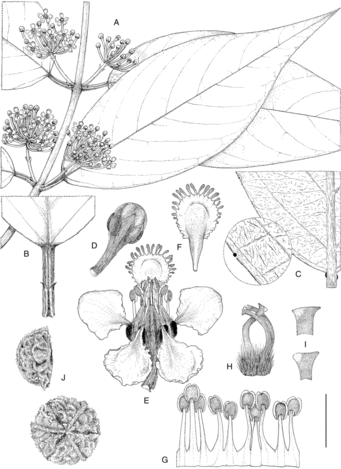
Hiraea quapara. A, Flowering branch; B, petiole with stipules and base of lamina, adaxial view; C, base of lamina, abaxial view, with enlargement of margin to show small marginal gland; D, flower bud, with eglandular sepal in centre; E, flower, posterior petal uppermost; F, posterior petal, abaxial view; G, androecium, fourth stamen from right opposite posterior petal; H, gynoecium, anterior style at left; I, distal portions of styles, anterior style above, posterior style below; J, intact fruit seen from above and lateral view of one mericarp. Scale bar equivalents: A, 4 cm; B, 1.3 cm; C, 8 mm (4 mm); D, 5.7 mm; E and F, 4 mm; G and H, 2.7 mm; I, 1 mm; J, 1 cm. Based on: A, B and D–I, Martin s.n. (MICH); C, Wachenheim s.n. (P); J, Sastre 4692 (MICH). Drawn by Karin Douthit.

Woody vine; stems densely sericeous when young, eventually glabrous. Leaves opposite; laminas of the larger leaves 8.5–23 × 6.2–11.3 cm, elliptical to broadly so to slightly obovate, apex apiculate in smaller leaves to acuminate in larger, acumen to 1.5 cm long, base acute or briefly truncate, adaxially with T-shaped hairs when young, stalk 0.05–0.2 mm long, trabecula (0.8–)1–1.6 mm long, soon glabrous, abaxially primarily with a mixture of T- and Y-shaped hairs, subsessile or with a stalk to 0.1 mm long, trabecula 0.2–0.5 mm long, arms of Y-shaped hairs often unequal, 0.1–0.5 mm long, intermixed with scattered tiny V-shaped hairs, arms to 0.1 mm long, in addition with scattered stouter T-shaped hairs, stalk 0.1-0.3 mm long, trabecula (0.3–)1–1.5 mm long, eventually glabrescent and oldest leaves appearing glabrous to the naked eye; margin abaxially with scattered glands or only in the in the proximal 1/2 to 3/4, often very few, glands 0.3–0.4 mm in diameter, sessile; costa and secondary veins prominent abaxially, tertiary veins prominulous; petioles 11–23 mm long, densely sericeous, with a pair of glands at apex to slightly (–3 mm) below apex, each gland 0.8–1.6 mm in diameter; stipules 1–1.2 mm long, borne on the petiole at the proximal 1/4 to 1/2. Inflorescence a solitary umbel of (15–)28–40 flowers, borne on an axis 1–5.5 cm long, often on leafless branches, at the 1/2 to distal 1/3 to 1/5 below umbel with a node bearing a pair of inflorescence bracts to 3–4 mm long or with a pair of reduced leaves, the petiole 2.5–4 mm long, the lamina (0.6–)1–4 × 0.5–2 cm; floriferous bracts 1–1.5 mm long, bracteoles like floriferous bracts or slightly shorter and/or narrower; pedicels 17–22 × c.1 mm; axes, abaxial surface of bracts and bracteoles, and pedicels densely sericeous. Sepals 2.2–2.5 × 1.8–2.2 mm, triangular, adaxially glabrous, abaxially sericeous; anterior sepal eglandular, the lateral four biglandular, glands (1.2–)1.5–1.7 mm long, prominent. Petals glabrous, yellow; lateral petals with the claw c.2 mm long, limb orbicular, margin subentire to slightly erose to finely irregularly denticulate, teeth to 0.01 mm long, limb of anterior-lateral petals 5.5–5.8 mm in diameter, of posterior-lateral petals 4.5–5 mm in diameter; posterior petal with the claw c.3 mm long and thicker than that of lateral petals, limb c.3.5 mm in diameter, orbicular, margin glandular-digitate-fimbriate in the distal 2/3 to 3/4, fimbriae to 1 mm long, longest at apex, the proximal 1/4 to 1/3 mostly irregularly denticulate or also with a few fimbriae. Stamens glabrous, basally connate, that opposing the anterior sepal the largest (filament c.3 mm long, anther 1.2–1.4 mm long), that opposing posterior petal the smallest (filament 2–2.3 mm long, anther 0.8–0.9 mm long); filaments of lateral stamens 2.2–2.8 mm long, anthers 0.9–1.2 mm long. Styles 2.5–2.8 × 0.2–0.3 mm, glabrous; anterior style nearly erect to incurved, apex extended into a spur to (0.05–)0.1 mm long, erect; posterior styles incurved, apex extended into a spur 0.1–0.2 mm long. Ovary c.1.5 mm long, densely villous. Fruit roughly spherical, c.1.5 cm in diameter, composed of three finely velutinous mericarps, each orbicular in face view, the lateral wings greatly reduced, c.5 mm wide, each with c.6 strong ribs radiating from the nut, dorsal wing extending the length of the nut, c.3 mm wide, with a network of thick interconnected winglets between the lateral and dorsal wings; nut c.4 mm in diameter, areole c.2.5 mm in diameter, ovate to suborbicular.
Phenology. Collected in flower from September to January, in fruit in January, and March to May.
Distribution and habitat. Primarily known from French Guiana, one collection from adjacent Suriname, two collections from Brazil (Amapá); along riverbanks and in riparian forest; sea level to 100 m.
Additional specimens examined. Brazil. Amapá: arredores da Agua Fria e Igarapé Agua Fria, 13 x 1979 (fl), Austin et al. 7175 (IAN*, INPA, MICH, MO, NY, US*); beira do Rio Oiapoque, 6 x 1949 (fl), Black 49-8431 (IAN*).
French Guiana. Crique Gabaret, commune St. Georges, 03°55′N, 51°48′W, 7 xii 2005 (fl), Delnatte 321 (CAY*, COL*, MICH); Fleuve Approuague, aux abords de la Crique Matarony, 4 xii 1985 (fl), Granville 8292 (CAY*, MICH, P*); Crique Gabaret, 27 ii 2000 (fr), Grenand & Guillaumet 3226 (CAY*, MICH, P*); Saut Takari-Tanté, Bassin de Sinnamary, 04°37′N, 52°56′W, 34 m, 19 xi 1989 (fl), Hoff 5939 (CAY*, MO, P); Trois Sauts, without date (fl), Lescure 468 (CAY); Maroni, 1876 (fl), Mélinon 310 (K, P, US); Maroni, 1877 (fl), Mélinon 383 (F, P); Maroni, 1877 (fr), Mélinon 384 (P); without locality, 1804 (fl), Mélinon s.n. (P); Arataye River, between Camp Aratai (03°59′N, 52°34′W) and the Petit Japigny rapids, below 100 m, 10 xi 2003 (fl), Mori et al. 25685 (CAY*, MICH, NY*); Orapu, village Fourgassié, 18 x 1966 (fl), Oldeman B-585 (CAY*, P*); Rivière des Cascades, Crique St. Pierre, 9 i 1967 (fl), Oldeman B-833 (CAY*, NY*, P*); Fleuve Approuague, 3 km en amont du village Takoudou, Saut Athanase, 26 i 1967 (fr), Oldeman B-906 (CAY*, NY*, P*, US*); Canal de Kaw, rive gauche de l’embouchure de l’Approuague, 25 iii 1967 (fl), Oldeman B-1030 (CAY*, P*); Fleuve Kourou, degrade Saramacca, 16 ix 1967 (fl), Oldeman B-1299 (CAY*, MICH, P*); basse Crique Courouaïe (affluent basse Approuague) á environ 5.5 km en amont des Deux Fourches, 15 i 1970 (fr), Oldeman B-2767 (CAY*, NY*, P*); rive droit du Yaroupi, environ 4.5 km en amont du Saut Coueki, 28 iv 1970 (fr), Oldeman B-3101 (CAY*, P*); fleuve Approuague, entre le Saut Couata et le confluent de la Crique Sapokyae, 18 x 1968 (fl), Oldeman T-230 (CAY*, MICH, P); Ile Portal, (fl), Sagot s.n. (NY, P); Haut Oyapock, Trois Sauts, 6 iv 1976 (fr), Sastre 4692 (CAY*, MICH, P); Crique Jacques, (fl), Wachenheim 54 (NY); Godebert, (fl), Wachenheim 481 (NY, P*); Crique Jacques, 20 ix 1924 (fl), Wachenheim s.n. (P).
Suriname. Marowijne, Albina, 05°52′22′′N, 54°08′12′′W, 9 iii 2006 (fr), Andel et al. 4997 (MO, U*).
Hiraea quapara occurs in wet habitats near watercourses. Its greatly modified fruit, a sphere composed of mericarps covered with small winglets, is likely an adaptation to dispersal by water and separates it from all other species of Hiraea. The abaxial vesture of the lamina includes numerous tiny V-shaped hairs not found in Hiraea smilacina nor the other species discussed here. Hiraea quapara has very small stipules, only 1–1.2 mm long.
Aublet’s type collection includes leaves and flowers of Hiraea as well as unattached samaras that belong to Toulicia Aubl., Sapindaceae (P. Acevedo, Smithsonian Institution, personal communication). In Aublet’s day, all species of Malpighiaceae with samaras having the dorsal wing dominant were assigned to the inclusive Banisteria (= Banisteriopsis and segregates). Aublet was misled by the superficial resemblance of the samaras of his collection to those of “Banisteria”. W. R. Anderson (Reference Anderson1993) lectotypified Banisteria quapara with the leaves and flowers but excluded the fruits.
After Aublet’s death, his herbarium was sold in parts, with the main portion bought by Banks for his herbarium (now at BM). The specimen at C that is probably an isolectotype was part of the Vahl Herbarium. The label, in what appears to be Vahl’s hand, reads, “Banisteria quapara Cavan. Tab. 250 dedit D. Banks”; Vahl’s reference is to Cavanilles’s (Reference Cavanilles1790) account of this species. Vahl’s specimen includes leaves, an unattached inflorescence, and five samaras of Toulicia (two mounted, three in the packet). Given the provenance, it is most likely that this material was part of the type collection. A specimen at P (P0067367), presumably part of the Aublet gathering, consists of several samaras only and therefore is not considered an isolectotype.
Candolle’s (Reference Candolle1824) variety, Banisteria quapara β mucronulata DC., is a synonym for Heteropterys berteroana A. Juss.
Hiraea smilacina Standl., Contr. Arnold Arbor. 5: 87, pl. 13 (1933). – Type: Panama, Panamá, Barro Colorado Island, 27 vi 1931 (fr), Bailey & Bailey 403 (holo F). Fig. 4.
Hiraea pittieri Cuatrec., Webbia 13: 396 (1958). – Type: Colombia, Cauca, Gargantilla Ridge, Tomínio Valley, 2100 m, i 1906 (fl), Pittier 1011 (holo US).
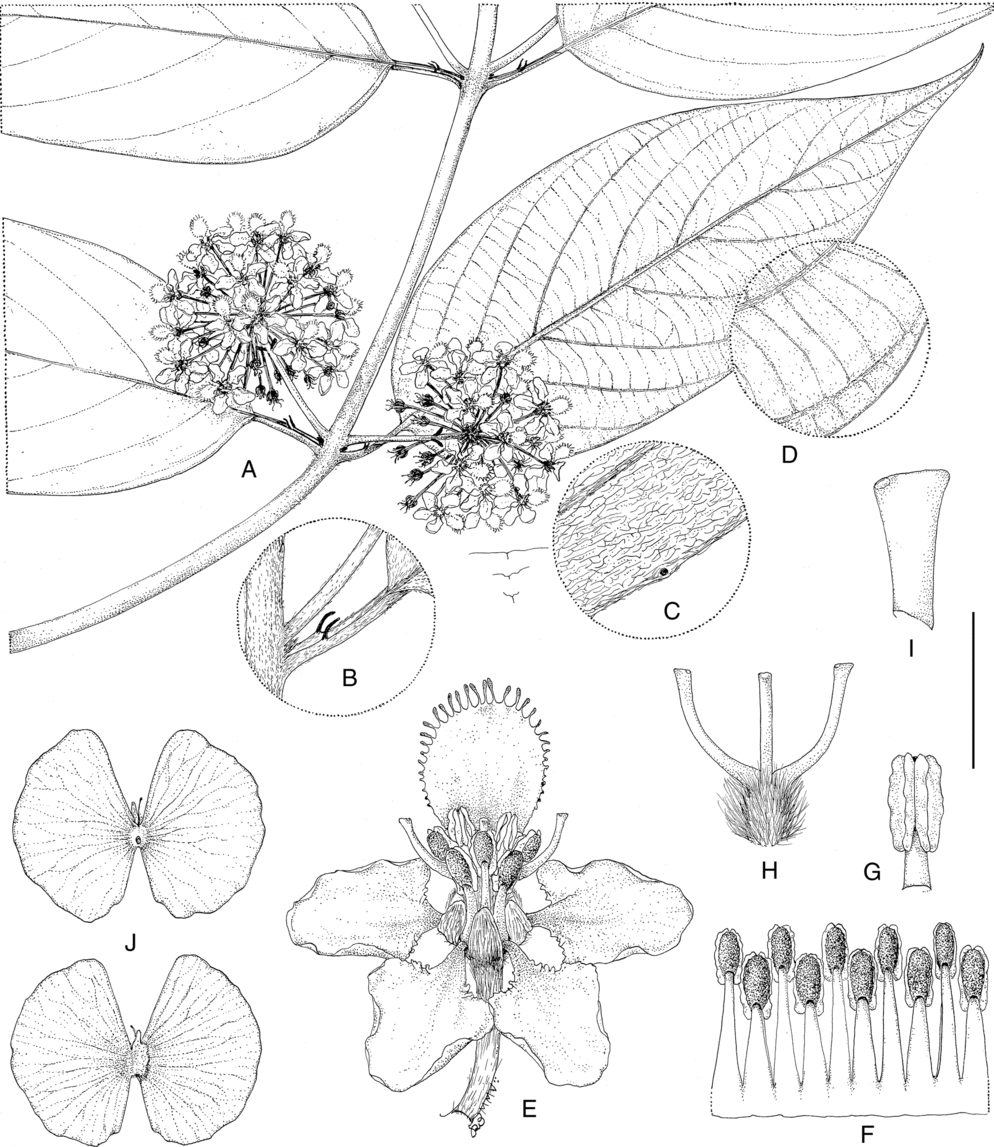
Hiraea smilacina. A, Flowering branch; B, petiole with stipules; C, abaxial margin of lamina, showing hairs and marginal gland; D, parallel tertiary veins, abaxial view of lamina; E, flower, posterior petal at top; F, androecium, fifth stamen from right opposite posterior petal; G, anther, adaxial view; H, gynoecium, anterior style in centre; I, distal portion of style; J, samaras, adaxial view (above) and abaxial view (below). Scale bar equivalents: A, 4 cm; B, 2 cm; C, 4 mm; D, 1.3 cm; E, 5.7 mm; F, 4 mm; G, 2 mm; H, 4 mm; I, 1 mm; J, 2.7 cm. Based on: A–I, Foster 2365 (MICH); J, Foster 2372 (DUKE). Drawn by Karin Douthit.

Woody vine; stems densely covered with a mixture of sessile and T-shaped hairs when young, soon glabrous. Leaves opposite; laminas of the larger leaves 10–22(–32) × 5–16 cm, elliptical to ovate or obovate, apex acuminate, acumen to 1.5 mm long, or apiculate, base briefly truncate or slightly cordate, adaxially with Y- and T-shaped hairs when young, stalk 0.05–0.2 mm long, trabecula 0.5–1.5(–1.8) mm long, wavy, arms of Y-shaped hairs to 0.1 mm long, soon glabrous or the vesture retained on the costa, especially in the proximal half, abaxially with Y- or T-shaped hairs, stalk 0.1–0.4 mm long, trabecula 0.5–1.4 mm long, straight to wavy, arms of Y-shaped to 0.15 mm long, mixed with scattered more robust T-shaped hairs, stalk 0.3–0.5 mm long, trabecula 1–2 mm long, straight, the vesture thinning with age; margin with scattered glands 0.3–0.5 mm in diameter or only in the proximal 1/4 to 1/2; costa and secondary veins prominent abaxially, tertiary veins prominulous; petioles 10–25 mm long, densely sericeous or appressed-tomentose, with a pair of glands sometimes at or to 3 mm below apex of petiole, each gland (0.3–)0.5–1(–1.5) mm long; stipules (1.5–)2–3 mm long, borne at just above base of petiole to proximal 1/4 (to 1/3) or rarely at middle. Inflorescence a solitary (16–)20–38(–60)-flowered umbel borne on an axis 1–3.5(–4.5) cm long, often at leafless nodes, at the distal 1/4 (rarely 1/2) to 1 mm or less below the umbel with a node bearing a pair of deciduous inflorescence bracts to 3 mm long or a pair of reduced leaves, the petiole to 5 mm long, the lamina 4.5 × 4 to 29.5 × 15.5 mm; floriferous bracts 0.8–1.5 mm long, bracteoles like floriferous bracts or slightly shorter and/or narrower, all abaxially densely sericeous; pedicels (9–)11–23 × 0.7–1 mm, axes, abaxial surface of bracts and bracteoles, and pedicels densely sericeous. Sepals (1.5–)2–3 × (1.2–)1.6–2.5 mm, triangular, adaxially glabrous, abaxially sericeous; anterior sepal eglandular or rarely biglandular, the lateral four biglandular, glands 1.5–2 mm long, prominent, or all eglandular. Petals glabrous; lateral petals with the claw 2–2.5 mm long, limb (3.5–)5–6 mm in diameter, suborbicular or broadly ovate, yellow, margin subentire to irregularly denticulate, teeth to 0.1 mm long; posterior petal with the claw (2–)2.5–3 mm long and thicker than that of lateral petals, limb 4.5–5 mm in diameter, broadly ovate to orbicular, yellow, the centre orange or orange-red, margin glandular-digitate-fimbriate in distal 2/3 to 3/4, proximally subentire or finely denticulate, fimbriae to 0.8(–1) mm long. Stamens glabrous, basally connate, that opposing the anterior sepal the largest [filament 3–4 mm long, anther 1.2–1.5(–2) mm long], that opposing posterior petal the smallest [filament 2–2.5 mm long, anther 0.8–1.2(1.5) mm long], filaments of lateral stamens 2.5–3.2 mm long, anthers 1–1.3 mm long. Styles glabrous, apex blunt or extended into a spur up to 0.15(–0.2) mm long; anterior style (2–)2.3–3.3 × 0.4–0.5 mm, erect to slightly incurved; posterior styles 2.8–3.8 × 0.3–0.4 mm, incurved. Ovary 1–1.3 mm long. Samaras butterfly-shaped, only immature to nearly mature samaras seen, the latter with lateral wings 2.5–3.5 × 1.7–2.2 cm, margin sinuous, sericeous; dorsal wing 3–4 × 1–3.5 mm.
Phenology. Collected in flower all year, in fruit in March through August and in October through December.
Distribution and habitat. Southern Mexico to Panama, except El Salvador and Nicaragua, Colombia (Caquetá, Putumayo), Ecuador (Napo, Pastaza, Zamora-Chinchipe); in wet evergreen forest and forest remnants; 30–2000 m.
Additional specimens examined. Belize. El Cayo: vicinity of Doyle’s Delight, southern Maya Mountains, 16°30′N, 89°03′W, 1000 m, 6 xii 1993 (fl), Allen 15184 (MICH, MO); La Flor hunting camp on Río La Flor, 6 mi S of Grano de Oro, 1700–2000 ft, 3 vi, 1973 (y fr), Gentry 7812 (MICH, MO, US). Stann Creek: beyond Middlesex, 26 iv 1939 (y fr), Gentle 2760 (A, F, MEXU, MICH, NY, US); Stann Creek Valley, Mountain Cow Ridge, 31 iii 1940 (y fr), Gentle 3300 (A, MICH). Toledo: 8 iv 1907 (fl), Peck 828 (GH, K, NY); Rio Grande, 250 ft, 18 iii 1933 (fl), Schipp 1138 (A, F, GH, K, MICH, MO, NY, UC).
Colombia. Caquetá: Km 61–63, rd from Neiva to Florencia, 1000 m, 9 i 1974 (fl), Gentry et al. 9064 (COL, MICH, MO). Putumayo: Río San Miguel, en el affluente izquierda Quebrada de la Hormiga, 290 m, 16 xii 1940 (fl, fr), Cuatrecasas 11120 (COL, F, US).
Costa Rica. Alajuela: Upala, P.N. Guanacaste, Est. San Ramón, Sendero El Níspero, 10°52′50′′N, 85°24′05′′W, 550 m, 4 v 1995 (fl), Cano 199 (CR, INB, MICH); Guatuso, P.N. Volcán Tenorio, cuenca del Río Frío, Alto Masís, 10°40′17′′N, 84°59′25′′W, 1200 m, 17 v 2002 (y fr), Chaves 1489 (MICH); P. Nac. Rincón de la Vieja, Sendero La Siembra, falda SE del volcán Santa María, 10°48′00′′N, 85°18′12′′W, 1400 m, 3 vi 1991 (fr), Rivera 1323 (CR, INB, MICH); San Carlos, Sucre, 1025 m, 2 iii 1939 (fl), Smith H1684 (F, NY, US). Cartago: Platanillo, Turrialba, 650 m, 25 v 1952, Córdoba 145 (fl), 146 (fr) (CR). Guanacaste: Liberia, P.N. Guanacaste, Nueva Zelandia, Est. San Ramón, 10°52′50′′N, 85°24′05′′W, 550 m, 23 iii 1994 (fr), García 89 (INB, MO); Liberia, P.N. Rincón de la Vieja, Sector Santa María, Sendero La Plantación, cabeceras Quebrada Zopilote, 10°46′50′′N, 85°17′55′′W, 950–1100 m, 14 viii 1996, Morales 5661 (INB, MO); Z. P. Tenorio Tilarán, Tierras Morenas, Río San Lorenzo, 10°36′40′′N, 84°59′45′′W, 1050 m, 29 iv 1993 (fl), Rodríguez 254 (CR, INB, MO). Heredia: Finca La Selva, trail, E River road, 1300 m E, 100 m, 27 vii 1980 (fl), Hammel 9340 (DUKE); Finca La Selva, Central Trail, 100 m, 27 ix 1980 (fl), Hammel 9903 (DUKE); Finca La Selva, Puerto Viejo, Sarapiquí, 10°26′N, 84°01′W, 12 ii 1976 (sterile), Hartshorn 1816 (F); Finca La Selva, 10°26′N, 84°01′W, vii 1976 (fr), Hartshorn 1848 (CR, F, MO); Finca La Selva, Southwest Trail, 6 vii 1979 (fr), Sperry 812 (DUKE). Limón: Hacienda Tapezco–Hda. La Suerte, 29 air km W of Tortuguero, 10°30′N, 83°47′W, 40 m, 14 iii 1978 (fl), Davidson 6947 (MICH); Talamanca, Finca La Culebra, carr. a Bribri desvio por camino rural 1.5 km c.Río Sandbox, 09°38′05′′N, 82°50′W, 200 m, 12 ii 1992 (fl), Gómez-Laurito 12162 (CR, F); Talamanca, cuenca del Sixaola, San Miguel, siguiendo trocha de madereo San Miguel–Gandoca, 09°34′30′′N, 82°40′W, 100 m, 18 i 1997 (fl), González 1648 (INB); Cordillera de Talamanca, along Quebrada Cañabral, from Río Barbilla to c.1.5 km upstream, 10°02′N, 83°24.5′W, 100–200 m, 8 ix 1988 (fl), Grayum 8880 (MICH, MO). Puntarenas: Cantón de Buenas Aires, P. N. La Amistad, Cuenca Terraba-Sierpe, 09°01′52′′N, 82°59′30′′W, 7 iv 1999 (fl), Alfaro & Alfaro 2186 (MO); Cantón de Osa, R. F. Golfo Dulce, Cuenca Térraba-Sierpe, Bahia Chal, entrada a Chocuaco, 08°43′50′′N, 83°27′17′′W, 150 m, 20 viii 1997 (fr), Aguilar 5242 (CR, INB, MICH, NY); Golfito, P.N. Corcovado, Estación Cerro de Oro, 1 km de la estac., camino a La Palma, 08°32′20′′N, 83°30′10′′W, 300 m, 11 iv 1996 (fr), Angulo 575 (CR, INB, MO); Monteverde, cliff edge above Quebrada Máquina, forest along Fonseca, Hotel de Montaña, and Savage Farms, 10°18′N, 84°48′W, 1100–1300 m, 3 vi 1990 (fl), Haber 9898 (INB, MICH); Golfito, P.N. Esquinas, Sendero Fila near the Esquinas-Rainforest-Lodge, 08°41′N, 83°13′W, 130 m, 6 vii 1998 (fr), Huber & Weissenhofer 1155 (CR); Osa, Cuenca Térraba–Sierpe, camino a Rancho Quemado, del cruce 1 km, 08°40′40′′N, 83°41′00′′W, 70 m, 18 iv 1999 (fl), Hurtado 118 (MO). San José: Carara National Park, Río Carara near Carara Guard Post, 09°46′N, 84°32′W, 140–150 m, 6 iv 1993 (sterile), Gentry 79508 (CR, INB, MO); Cantón de Turrubares, Z. P. Turrubares, cuenca del Río Grande de Tárcoles, NW flank of Cerro Turrubares, near and along Quebrada La Plata, 09°49′30′′N, 84°29′30′′W, 580 m, 4 iv 1993 (fl), Grayum & Hammel 10490 (CR, INB, MICH, MO); Puriscal, Z.P. La Cangreja, San Martín de Puriscal, sector este de la Fila Vara Blanca, 09°44′10′′N, 84°23′30′′W, 800 m, 20 xi 1993 (fl), Morales 2009 (CR, INB).
Ecuador. Napo: Reserva Biológica Jatun Sacha, Río Napo, 8 km al E de Misahuallí, 01°04′S, 77°36′W, 450 m, 22 x 1988 (fl), Cerón & Iguago 5395 (MICH), 24 xi 1987 (fl), Neill & Manning 8012 (MICH). Pastaza: Cantón Arajuno, Campamentos temporalis 11 y 12, Km 32 NE del pozo villano 2, 01°25′S, 77°39′W, 785 m, 15–20 ix 1998 (y fr), Freire et al. 3403 (MICH); Canelos, 6 xi 1974 (fl), Lugo 4483 (GB, MICH); Parayacu, c.10 km E of Canelos, 8 xi 1974 (fl), Lugo 4536 (GB, MICH); Pastaza Cantón, Pozo Villano 2 de arco, 2 km del pueblo de Villano, 01°25′S, 77°20′W, 400 m, 3 xii 1991 (fl), Tipaz et al. 454 (MICH). Zamora-Chinchipe: Nangaritza Cantón Shaimi, SE de Campamento Militar, 04°18′S, 78°43′W, 930 m, 27 x 1991 (fl), Palacios et al. 8785, 8796 (MICH).
Guatemala. Alta Verapaz: Sebol, 22 iv 1964 (fl), Contreras 4468 (LL). Izabal: between Virginia and Lago Izabal, Montaña del Mico, 50–500 m, 5 v 1940 (fr), Steyermark 38870 (F).
Honduras. Atlántida: Valle de Lancetilla, 35 m, 29 iv 1990 (fl), Cruz 564 (TEFH); S bank of Quebrada Grande above confluence with Río Bonito, base of N slope of Pico Bonito, 10 km SW of La Ceiba, Parque Nacional Pico Bonito, 15°42′N, 86°51′W, 140 m, 10 v 1993 (fl), Evans 1603 (MO); Campamento Quebrada Grande, c.10 km SW of La Ceiba, base of N slope of Pico Bonito, from camp to 2 km E of camp, 15°42′N, 86°51′W, 80–180 m, 10 v 1993 (fl), Liesner 26131 (MO), 16 v 1993 (fl), Liesner 26385 (MICH, MO).
Mexico. Chiapas: Mpio. Palenque, near side rd to Agua Azul 60 km S of Palenque, 520 m, 13 iv 1981 (fl, y fr), Breedlove 50850 (CAS, LL, MICH, MO). Oaxaca: Mpio. Santa María Chimalapa, Arroyo Sardina, c.6 km al S de Sta. María por la vereda al Paso La Ciruela, 16°52′N, 94°41′W, 230 m, 3 iv 1985 (fl), Hernández G. 1065 (CHAPA, MICH, MO); 1 km del Río Chichihua, hacia Sta. María Chimalapa, 300 m, 26 v 1984 (y fr), Torres C. 5185 (MEXU, MICH). Tabasco: Mpio. Teapa, a 2 km al W de Puyacatengo, 17 v 1981 (fr), Ramos E. et al. 757 (ENCB, XAL); Mpio. Macuspana, Agua Blanca, 30 iv 1983 (fl), Zamudio R. 860 (IEB). Veracruz: Mpio. Mecayapan, Ejido La Valentina, al NE del camino para Río Pilapillo, 5 v 1985 (fl), Calzada 11078 (XAL); Mpio. Hidalgotitlán, Km 0–2 del camino Plan de Arroyos–Alvaro Obregón, 17°15′N, 94°41′W, 130–150 m, 14 iv 1974 (y fr), Dorantes 2793 (F, GUADA, MEXU, MO, XAL); Mpio. Hidalgotitlán, 0–2 km S del campamento Hnos. Cedillo, rumbo a Río Alegre, por la desv. al E, 17°15′N, 94°40′W, 140 m, 22 iv 1974 (y fr), Dorantes 2926 (C, F, MEXU, MO, XAL); Mpio. San Andrés Tuxtla, Estación de Biología Tropical Los Tuxtlas, Cerro Lázaro Cárdenas, 18°34–36′N, 95°04–09′W, 600 m, 25 vi 1986 (fl), Ibarra M. 2954 (ENCB, MEXU, XAL); Mpio. San Andrés Tuxtla, Est. Biol. Trop. Los Tuxtlas, 18°34–36′N, 95°04–09′W, 550 m, 22 v 1990 (fr), Ibarra M. 3488 (XAL); Mpio. San Andrés Tuxtla, Estación de Biología Tropical Los Tuxtlas, 18°34–36′N, 95°04–09′W, 350 m, 10 vi 1986 (fl), Sinaca C. 787 (CHAPA, ENCB, MEXU); Mpio. Hidalgotitlán, Brecha Hermanos Cedillo–La Escuadra, 17°16′N, 94°37′W, 152 m, 2 v 1974 (fr), Vázquez 527 (XAL); Mpio. Hidalgotitlán, SE de Agustín Melgar, 17°13′N, 94°35′W, 153 m, 3 v 1974 (fr), Vázquez 534 (XAL); Mpio. Hidalgotitlán, lomitas al SE de Poblado 6, Zona Uxpanapa, 17°15′45′′N, 94°29′30′′W, 140 m, 30 iv 1981 (fr), Wendt et al. 3262 (CHAPA, ENCB, LL, MEXU, MICH); Mpio. Jesús Carranza, 1–3 km al NNW de Poblado 2, 17°16′N, 94°40′W, 100 m, 12 iii 1982 (fl), Wendt et al. 3660 (CHAPA, ENCB, MEXU, MICH, MO, NY).
Panama. Chiriquí: Finca Ojo de Agua, E of Río Chevo, 08°52′N, 82°44′W, 1550 m, 12 x 1981 (fl), Knapp 1539 (MICH); Burica Peninsula, 8 mi W of Puerto Armuelles, 200 m, 2 iii 1973 (sterile), Liesner 360A (MO). Colón: Pipeline Rd 6 mi N of Gamboa, 3 xii 1971 (sterile), Gentry 2839 (MO); Achiote, 12 vii 1966 (fl), Tyson et al. 4518 (MICH, MO, US). Darién: Río Balsa, between Manene and Tusijuanda, 26 vii 1967 (fr), Duke 13553 (MO). Panamá: El Llano–Cartí hwy, c.8 km N of El Llano, 10 iii 1973 (fl), Dressler 4297 (MO); Cerro Campana area, above Su Lin Motel, 3000 ft, 11 viii 1967 (fl), Dwyer & Kirkbride 7830 (MO, US); El Llano–Carti rd, 8–11 km from InterAmerican Hwy, 300–400 m, 14 viii 1975 (fl), Mori 7754 (MICH, MO, US). Cerro Campana, N slope, 850 m, 15 ix 1974 (fl), Mori & Kallunki 1932 (MICH, MO). — Barro Colorado Island: shore of broad cove NE of Drayton House, 28 viii 1970 (y fr), Croat 11931 (F, MO, NY); Drayton House clearing, 23 xi 1970 (fr), Croat 12690 (MO); shoreline of large cove leading to Fuertes House, 10 x 1968 (fr), Croat 6842 (MO); Fuertes Cove, 29 vi 1969 (fl), Foster 1061 (DUKE, MO); Fuertes Cove, 20 vii 1969 (fl), Foster 1125 (DUKE, MO); W shore of Drayton cove, 18 viii 1971 (fl), Foster 2365 (DS, DUKE, F, GH, MICH, UC); near Zetek 5, 1 x 1971 (fr), Foster 2372 (DUKE); without locality, 19 vii 1983 (fl), Schmalzel X28 (MO); Standley Bay, 29 vii 1983 (fl), Schmalzel & Herre X60 (MO); Fuertes inlet, 21 vii 1934, (fl) Shattuck 1020 (F, MO, US); Drayton Pt., 4 viii 1934 (y fr), Shattuck 1136 (F, MO); Cove W of Fuertes House, 22 ii 1932 (fl), Woodworth & Vestal 661 (A, F, MO).
Hiraea smilacina differs from H. quapara, in addition to its butterfly-shaped samaras, in its larger stipules and larger petals, and the lack of tiny V-shaped hairs in the abaxial laminar vesture.
Acknowledgements
Karin Douthit and John Megahan drew the handsome illustrations. Pedro Acevedo (US) kindly identified the samaras that are part of Aublet’s type collection of Banisteria quapara. I am indebted to the late William R. Anderson for notes on Hiraea quapara. I thank Thomas F. Daniel and Rafael F. de Almeida for their reviews of the manuscript, and the latter also for calling my attention to an IAN specimen of H. quapara. The curators of the following herbaria kindly provided access to their collections: A, C, CAS, CAY, CHAPA, COL, CR, DS, DUKE, ENCB, F, GB, GH, GUADA, IEB, INB, INPA, K, LL, MEXU, MICH, MO, NY, P, TEFH, UC, US and XAL. This study was supported in part by a grant from the American Philosophical Society and from the National Science Foundation to the University of Michigan (DEB-0543909).