Background
CHD is one of the most commonly occurring congenital defects globally, accounting for over half of neonatal deaths. Reference Rohit1 Even when patients with CHDs are able to successfully achieve adulthood, they frequently have lingering haemodynamic defects. Reference Brida and Gatzoulis2 To date, the pathogenesis of CHDs has remained unclear. Previous studies have revealed that CHDs can be produced by genetic factors, environmental impacts, or gene–environment interactions, Reference Boyd, McMullen, Beqaj and Kalfa3 but only 15% of CHDs cases can be explained genetically. Reference Zaidi and Brueckner4 Therefore, there has been a surge in scientific interest in discovering the environmental origins of CHDs.
Many variables have a role in the development of CHDs during pregnancy. Environmental radiation exposure during pregnancy may induce heart and other organ malformations in offspring, as well as increase the likelihood of miscarriage. Reference Zhao, Guo and Zhang5 A prior cohort study revealed that noise exposure significantly enhanced the risk of CHDs in offspring. Reference Nie, Liu and Wang6 Similarly, chemical exposure during pregnancy may potentially be associated with cardiac abnormalities. Previous studies have linked Particulate Matter 2.5 or Particulate Matter 10 exposure to an increase in the occurrence of congenital cardiac disorders such as transposition of the major arteries, pulmonary valve stenosis, and ventricular septal defects. Reference Zhang, Liang and Zhao7 Numerous animal studies have also found that Particulate Matter 2.5 or Particulate Matter 10 exposure induces aberrant cardiac development in mice and zebrafish. Reference Li, Zhao and Shi8 Folic acid has also been proven to influence pregnancy progression, while timely and appropriate folic acid supplementation can help prevent fetal neural tube abnormalities and CHDs. Reference Qu, Lin and Bloom9 Furthermore, mental issues and poor habits throughout pregnancy may have an impact on the growth and development of the fetal heart. Reference Gu and Guan10
Since most studies use approximated questionnaire measurement or data that have not been validated in any other way, the results can be misinterpreted and underestimated. In this study, we use questionnaires to obtain epidemiological data from pregnant women. In addition, a quantitative analysis of blood and indoor air samples was performed concurrently to investigate the probable relationship between exposure to external environmental factors and the occurrence of CHDs during fetal development. The goal of this study was to examine the relationship between environmental factors and CHDs, as well as to establish a scientific foundation for better preventive measures.
Method
Study population
Mothers aged 18–45 years, carrying singleton pregnancies and admitted to either Shanghai Jiao Tong University School of Medicine or Jiaxing Maternal and Child-care Service Centre from January 2016 to January 2021, were included in this study. These participants had undergone treatment in the obstetrics departments of these hospitals and were subsequently referred to the fetal echocardiography unit due to suspected CHD following an obstetric ultrasound examination at 16–30 weeks of gestation. Both hospitals approved and supervised this survey. All participants gave informed consent for the peripheral blood draw, indoor air sampling and access to questionnaire information. Our inclusion criteria: (1) Complete fetal echocardiography at 16–30 weeks of gestation (the best timing for fetal echocardiography); (2) pregnant mothers without multiple fetuses, mental disease, or severe pregnancy complications (such as gestational diabetes mellitus, pregnancy-induced hypertension, and other pregnancy complications that can cause fetal malformations); and (3) fetus was not diagnosed with chromosomal abnormalities. Following the application of inclusion criteria, a total of 103 cases with complete medical records were enrolled in the study. At least two advanced echocardiography experts tested all pregnant women for CHDs, and 31 cases of CHDs were diagnosed.
Research methods
The study has been approved by the Human Studies Committee of Xin Hua Hospital Affiliated to Shanghai Jiao Tong University School of Medicine. Informed consent was obtained during registration. After receiving the approval documents, the basic information of all patients participating in the study was recorded and numbered in chronological order.
Immediately after enrollment, the study participants were aided by trained researchers in filling out detailed questionnaires. These questionnaires encompassed a range of topics including demographic information (such as age, residential location, and education level), reproductive history (including parity, gravidity, and any abnormal reproductive history), family history of cardiovascular and reproductive-related genetic diseases, parental medication usage, as well as maternal emotional status, smoking habits, and alcohol consumption. Additionally, self-reported questionnaires also provided information on residential environmental factors such as residential proximity to farmland/orchards, plastic greenhouses, heavy traffic, chimneys and pollutant emitters, living habits, and occupational and environmental exposures prior to or during pregnancy.
Blood samples were also taken from all participants to assess serum concentrations of folic acid, vitamin B12, and homocysteine, which have been linked to CHDs in previous studies. Reference Verkleij-Hagoort, van Driel and Lindemans11 The collection of blood samples and completion of questionnaires were conducted during the initial visit, shortly after the participants’ enrollment, falling within the 16- to 30-week pregnancy window.
Chemical substances such as formaldehyde, total volatile organic compound, benzene, toluene, xylene, Particulate Matter 2.5, Particulate Matter 10 were detected in indoor air samples. Environmental parameters such as temperature and relative humidity were also recorded. These measures were completed within two weeks after the initial visit, usually between the 18th and 32th weeks of gestation.
Samples were obtained ethically by qualified researchers and utilised strictly in accordance with the requirements of the informed consent supplied. Data were excluded if a patient was unable to complete all essential procedures, and all study participants stated that they did not have any competing interests in the study.
Analytic strategy
Numerical variables are reported as the number of instances and means (± standard deviation), whilst categorical variables are described as frequency proportion or percentage (%), and a Chi-squared test was performed to assess differences across groups. Logistic regression analyses were further used to examine associations between environmental risk factors including laboratory tests and aetiological parameters and the likelihood of CHDs in offspring, with P less than 0.05 regarded statistically significant.
To examine the mediation effect of formaldehyde on air pollutants–CHD relationships, we adopted a causal mediation approach. We used SPSS to calculate the direct and indirect impacts (95% confidence interval) of air pollutants on CHDs, with formaldehyde as the response. When the 95% confidence interval did not include “0”, indirect effects parameters were judged statistically significant.
Statistical differences across data groups were examined by using SPSS software (IBM-SPSS Statistics v24.0, Inc. Chicago, IL).
Results
Participant characteristics
This study enlisted the participation of 103 people, including 31 cases and 72 controls. The 31 qualifying instances included 8 induced labours, 7 stillbirths, and 16 live births. Within one-month of delivery, all live neonates were checked using routine cardiac auscultation, and definitive diagnoses were made using neonatal echocardiography. After consulting with three or more cardiologists, the diagnosis of cases resulting in stillbirth or abortion was verified. Table S1 in supplement files lists all of the case group’s birth outcomes and CHDs categories.
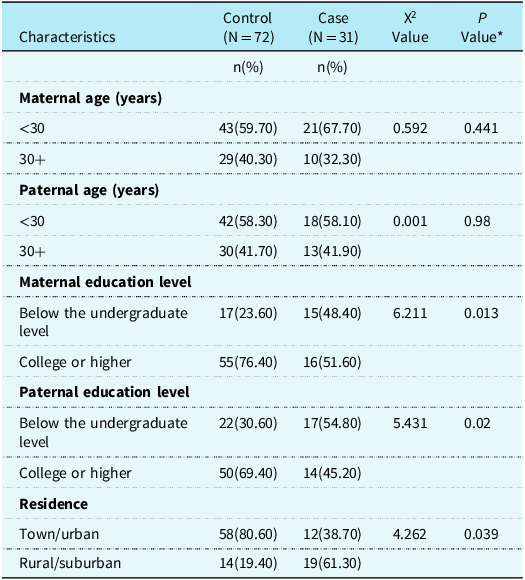
No statistical differences between case and control groups were observed in terms of parents’ childbearing age, but there was a significant difference in parents’ education level (P = 0.013, P = 0.02) and type of residence (town/urban or rural/suburban) (P = 0.039), with the proportion of lower education (54.80% vs 30.60% in paternal, 48.40% vs 23.60% in maternal), and rural/suburban (61.30% vs 19.40%) were higher in the case group. As a result, we would control the impact of these factors in the subsequent analysis (Table 1).
Basic characteristics of case and control groups in the study

* P value was calculated with chi-square or Fisher exact tests.
Daily diet and nutrients intake during pregnancy that affect CHDs risk
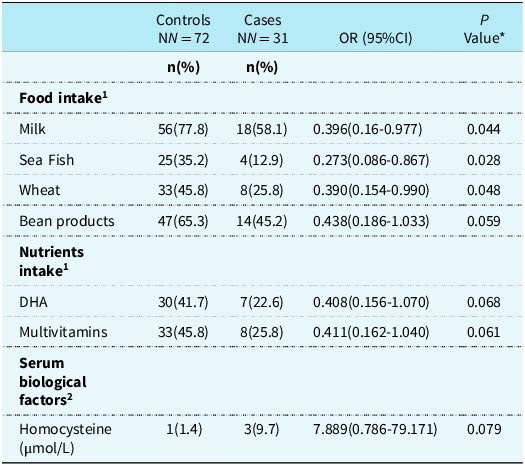
We collected questionnaires and performed univariate binary regression analysis to assess the effect of dietary intake during pregnancy on CHD. After controlling for demographic parameters dietary factors during pregnancy that may be related with CHDs (P < 0.05) were identified. (Table 2/Figure 1, and all data details in Table S2)
Forest plot of association between daily habits/nutrients intake with CHD risk.

Association between daily habits or nutrients intake with infant CHD risk

* P value was calculated with univariate binary logistic regression analysis.
1 According to the questionnaire design, we defined food/nutrients/drinks intake as eating regularly/often/usually, while no/occasionally eating is considered no intake.
2 Serum biological factors, we only calculated the impact of abnormal values. (The normal value: folic acid: 11-54 nmol/L; vitamin B12: 200-900 pmol/L; homocysteine: 5-15μmol/L.)
Univariate regression analysis showed that there are statistical significance between the two groups in milk (P = 0.044, odds ratio = 0.396 [0.16–0.977]), sea fish (P = 0.028 odds ratio = 0.273 [0.086–0.867]), and wheat (P = 0.048, odds ratio = 0.390 [0.154–0.990]), while bean products (P = 0.059, odds ratio = 0.438 [0.186–1.033]), docosahexaenoic acid (P = 0.068, odds ratio = 0.408 [0.156–1.070]), and multivitamins (P = 0.061, odds ratio = 0.411 [0.162–1.040]) have marginal effect. And these were all protective factors for the development of CHD.
Maternal disease, reproductive history, and psychological conditions that affect CHDs risk
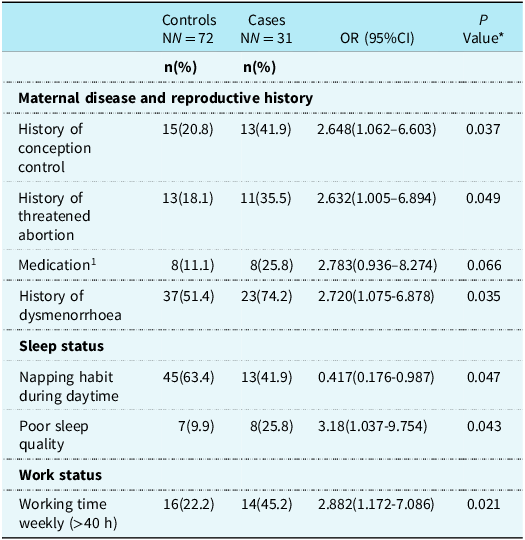
We collected questionnaires on their reproductive history, sleep status, work status, and other characteristics to evaluate the effect of maternal physiological and psychological factors on fetal CHD, and serum samples were tested. After eliminating the effect of demographic parameters, factors associated with CHDs were identified using univariate logistic regression analysis (P < 0.05) (Table 3/Figure 2, and all data details in Table S3).
Forest plot of association between maternal disease, reproductive history and psychological conditions with CHD risk.

Association between maternal disease, reproductive history and psychological conditions with infant CHD risk

* P value was calculated with univariate binary logistic regression analysis.
1 Medication means taking prescription drugs during pregnancy including Euthyrox or some anti-abortion drugs.
According to univariate logistic analysis, there are differences or marginal effects between the two groups in maternal disease and reproductive history (history of conception control, P = 0.037, odds ratio = 2.648 [1.062–6.603]; history of threatened abortion, P = 0.049, odds ratio = 2.632 [1.005–6.894]; history of dysmenorrhoea, P = 0.035, ods ratio = 2.720 [1.075–6.878]), sleep status (napping habit during daytime, P = 0.047, odds ratio = 0.417 [0.176–0.987]; poor sleep quality, P = 0.043, odds ratio = 3.18 [1.037–9.754]) and work status (working time > 40 h weekly, P = 0.021, odds ratio = 2.882 [1.172–7.086]).
Environmental factors that affect CHDs risk
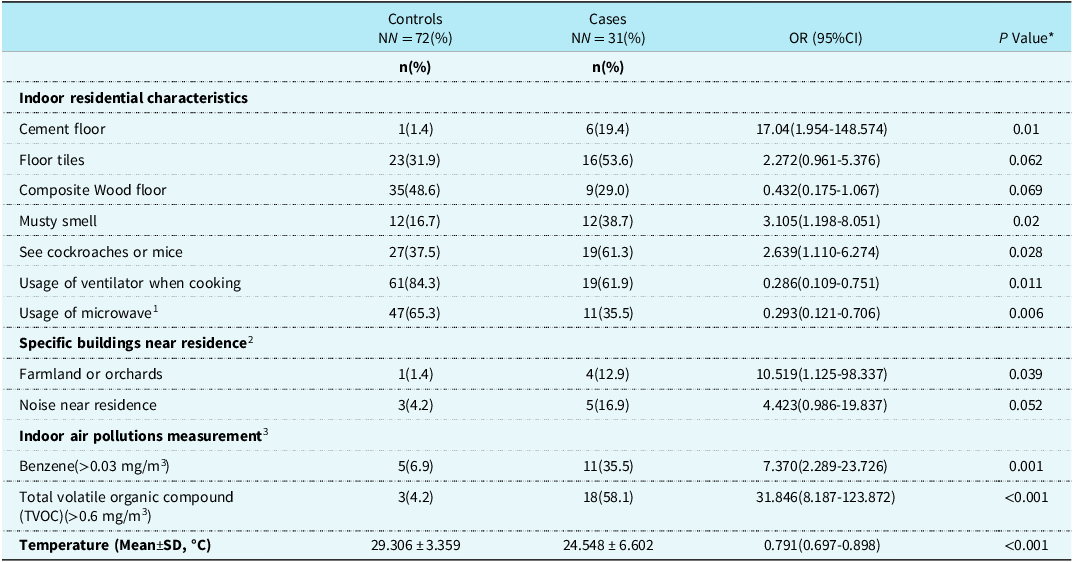
Dozens of risk factors were analysed using questionnaires and site air samples to investigate the connection between environmental risk factors and CHDs. After ruling out the influence of demographic characteristics, factors likely associated with CHDs (P < 0.05) were determined using univariate logistic regression analysis (Table 4/Figure 3, and all data details in Table S4).
Forest plot of association between residential characteristics with CHD risk.

Association between residential characteristics with infant CHD risk

* P value was calculated with univariate binary logistic regression analysis.
1 We defined the usage of electronics, microwave or TV as used at least once weekly.
2 We defined near residence as less than five minutes’ walk from residence.
3 Indoor chemical substances exposure limits were referenced from Chinese national GB/T 18,883-2022.
Univariate regression analysis revealed a statistically significant difference between the two groups in indoor residential characteristics (cement flooring, P = 0.01, odds ratio = 17.04 [1.954–148.574]; musty smell, P = 0.02, odds ratio = 3.105 [1.198–8.051]; see cockroaches or mice, P = 0.028, odds ratio = 2.639 [1.110–6.274]; usage of ventilator when cooking, P = 0.011, odds ratio = 0.286 [0.109–0.751]; microwave usage, P = 0.006, odds ratio = 0.293 [0.121–0.706]), specific buildings near dwelling (Farmland or orchards, P = 0.039, odds ratio = 10.519 [1.125–98.337], and noisy environment (P = 0.052, odds ratio = 4.423 [0.986–19.837]). Similar findings were also made for chemical compounds in the air (benzene, P = 0.001, odds ratio = 7.370 [2.289–23.726]; total volatile organic compound, P < 0.001, odds ratio = 31.846 [8.187–123.872]) and the temperature (P < 0.001, odds ratio = 0.791 [0.697–0.898]).
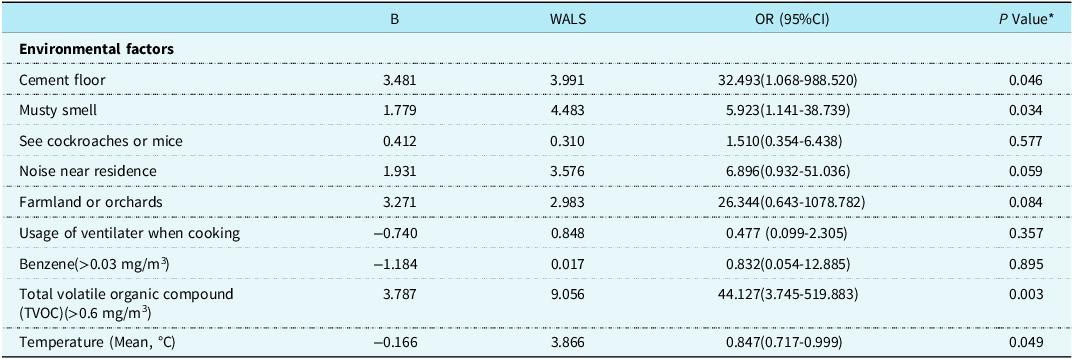
The components with substantial influence above were examined using multivariate logistic regression analysis to identify independent environmental risk factors of CHDs. The findings found that the cement floor use, musty smell, room temperature and total volatile organic compound were all independent risk factors for CHDs. The usage of cement floor (P = 0.046, odds ratio = 32.493 [1.068–988.520]), musty smell (P = 0.034, odds ratio = 5.923 [1.141–38.739]) and total volatile organic compound exposure (P = 0.003, odds ratio = 44.127 [3.745–519.883]) positively correlated with the fetal CHDs, while the increase of indoor air temperature (P = 0.049, odds ratio = 0.847 [0.717–0.999]) was negatively correlated with CHDs. Table 5/Figure 4 summarises the findings of these analyses.
Forest plot of factors affecting CHD via multivariate logistic regression analysis.

Factors affecting congenital heart disease via multivariate logistic regression analysis

* P value was calculated with multivariate logistic regression analysis.
The relationship between folic acid with indoor air pollution
Table 6 shows the findings of the hypothesised mediation analysis. Folic acid significantly mediated the relationships between total volatile organic compound (indirect effect = −0.072, 95% CI: −0.138, −0.033) and formaldehyde (indirect effect = −0.109, 95% CI: −0.381, −0.006) with CHDs in offspring, as indicated in the Table 6.
Mediation effect of maternal folic acid level on the associations between maternal air pollutants with CHDs in offspring

* P<0.05
** P<0.01.
1 F-FA-CHDs, formaldehyde-folic acid-the incidence of CHDs;.
2 TVOC-FA-CHDs, TVOC-folic acid-the incidence of CHDs;.
3 PM2.5-FA-CHDs, PM2.5-folic acid-the incidence of CHDs;.
4 B-FA-CHDs, benzene- folic acid-the incidence of CHDs.
Discussions
Effects of a balanced diet and nutrition intake on risk of CHDs in offspring
As is known to all, maternal diet and nutrient consumption during pregnancy are critical for fetal development. According to Table 2, pregnant women who often/usually drinking milk (P = 0.044, odds ratio = 0.396), sea fish (P = 0.028, odds ratio = 0.273),wheat (P = 0.048,odds ratio = 0.390), bean products (P = 0.059, odds ratio = 0.438), docosahexaenoic acid (P = 0.068, odds ratio = 0.408), and multivitamins(P = 0.061, odds ratio = 0.411) are likely to have a lower incidence of CHDs, which is consistent with previous studies. Reference Yang, Kang and Cheng12
We also examined the effects of folic acid, vitamin B12 and homocysteine levels in pregnant women’’s serum, but only the homocysteine abnormality (P = 0.079, odds ratio = 7.889) has marginal effects between two groups. After reviewing the questionnaire information, we discovered that this finding may be due to pregnant women’’s recent increased awareness of nutritional needs, which ensured adequate folic acid and vitamin supplementation, indicating that the popularisation of science education for pregnant women in wealthier parts of the country is providing beneficial effects.
In our study, no statistical differences between two groups were found for other risk factors such as smoking or passive smoking or drinking status. It may be because awareness of the negative effects of these unhealthy habits has been promoted among families.
Effects of female reproductive history and psychological conditions on risk of CHDs in offspring
Based on an analysis of information provided in questionnaires, we observed that pregnant women’’s female reproductive medical history and psychological disorders were also likely to influence offspring fetal growth and development, as shown in Table 3. Pregnant women with a history of conception control (P = 0.037, odds ratio = 2.648), threatened abortion (P = 0.049, odds ratio = 2.632) or previous dysmenorrhoea (P = 0.035, odds ratio = 2.72) were more likely to have children with CHDs. Previous studies have demonstrated that certain disorders and medicines directly cause embryonic heart malformations. Reference Picot, Berard and Grenet13 However, we did not find that taking medicine during pregnancy has a significant effect in our study. In addition to the questionnaire content, pregnant women received Euthyrox or other fetal protection drugs, which do not cause deformities or have any toxic effect on the fetus. Pregnant women prefer to avoid using other prescription drugs during pregnancy.
Furthermore, we discovered that mothers with poor sleep quality (P = 0.043, odds ratio = 3.18) and excessive working time (> 40h per week) (P = 0.021, odds ratio = 2.882) had an increased risk of developing CHD in their fetuses, while napping during the day (P = 0.047, odds ratio = 0.417) played a protective effect on CHD. Paying too much attention to a child’’s health may cause pregnant women to develop negative feelings, anxiety and tension, which can trigger the unfolded protein response and harm the fetal heart’’s early development. Reference Gu and Guan10 This may explain why threatening abortion and psychological disorders lead to CHD.
Effects of residential characteristics on risk of CHDs in offspring
Recently, a study confirmed that air pollution is closely associated with early pregnancy abortion and some birth defects. Reference Inoue, Yan and Arah14 We also determined that both indoor and outdoor environmental conditions can have an effect on embryonic growth. The data gathered in this investigation demonstrated that pollution plays a role in the genesis of CHDs (Table 4). If a woman’s home environment during pregnancy is near farmland/orchards (P = 0.039, odds ratio = 10.519), a noisy place (P = 0.052, odds ratio = 4.423), use cement floor (P = 0.01, odds ratio = 17.04) or use floor tiles (P = 0.062, odds ratio = 2.272), the fetus is more likely to have CHDs. The questionnaires provided to patients also inquired whether pregnant women smelt musty (P = 0.02, odds ratio = 3.105) or saw cockroaches/mice (P = 0.028, odds ratio = 2.639) in house during pregnancy, and a statistical difference was observed between case and the control groups. We believe that living near farmland/orchards may increase exposure to chemicals (such as pesticides), whereas the musty smell indicates that the room is moist or inadequately aired. However, there is no proof about using cement flooring is hazardous to human health. As for the results of our study, perhaps it is due to the fact that the majority of families who use cement flooring live in rural or suburban areas with more complex environments.
Using a ventilator when cooking (P = 0.011, odds ratio = 0.286) or microwave ovens (P = 0.006, odds ratio = 0.293) may lessen the negative impact of indoor cooking oil fume pollution, reducing the risk of CHDs. Radiation is known to be carcinogenic, especially during the first trimester. Reference Yasuda, Okazaki and Nakano15 In this study, however, using radiating household appliances such as microwave ovens, televisions and electronics during pregnancy did not significantly increase fetal morbidity. Because radiation has a cumulative impact and electromagnetic radiation is not as powerful as the ionising radiation used in X-ray or CT machines, it may indicate that daily use of electronic devices will not be sufficient to reach the threshold values needed to induce teratogenicity.
Effects of indoor air pollution on risk of CHDs in offspring
Previous studies have linked high amounts of contaminants in the environment to CHDs. Pregnant women spend more time indoors than the average adult, according to surveys of their time-activity patterns. Reference Elizabeth, Michael and Patti16 It is reported that indoor air level is the main element that leads to personal exposure of housewives, and its influence is greater than outdoor air level. Reference Elizabeth, Michael and Patti16 Although many studies have been conducted to analyse the effects of outdoor air pollution on fetal health, few have assessed the impact of indoor air pollution. In this study, indoor air samples were collected during a period relatively close to early gestation, therefore the indoor environment was unlikely to change much. Formaldehyde, total volatile organic compound, benzene series, Particulate Matter 2.5, Particulate Matter 10 and other chemicals were discovered and detected in the air. Results in Table 4 showed that the abnormal levels of formaldehyde, toluene, xylene and Particulate Matter 2.5/Particulate Matter 10 in the case group were not substantially different from those in the control group. Because the majority of the results were normal for both groups, this could indicate that there is an improved awareness of the risks of formaldehyde and benzene series exposure during fetal development.
However, the number of patients exposed to excessive indoor total volatile organic compound levels in the case group was 18(58.1%), whereas 3 were in the control group (4.2%), indicating a substantial difference between the two groups. The results for benzene exposure are similar (35.5% versus 6.9%, P = 0.001, odds ratio = 7.370). In addition, we identified total volatile organic compound (P = 0.003, odds ratio = 44.127) as an independent risk factor for increased risk of fetal CHDs by using multivariate binary regression analysis (Table 5). When concentrations of the chemicals within the air are high, volatile organic compounds, a lesser-known pollutant, frequently have a strong and immediately detectable chemical smell, including aromatic hydrocarbons, aldehydes, ketones, amines and other organic compounds, which have been proven to be powerful carcinogens. Reference Pei, Yin, Liu and Dai17 The numerous volatile organic compounds measured are referred collectively as total volatile organic compound, primarily come from outside sources such as fuel combustion and transportation. Reference Liu, Yin and Ma18 While burning products such as coal and natural gas are the primary causes of indoor pollution, other sources include heating, cooking smoke, furniture, household appliances, cleaning agents, human body emissions, and building or decorative materials such as glue, paint, wallpaper, etc. Reference Cheng, Li and Yu19 Previous research has shown that TVOC mainly affect the human respiratory system, neurological systems and cardiovascular health. Reference Manisalidis, Stavropoulou, Stavropoulos and Bezirtzoglou20 According to epidemiological and experimental evidence, exposure to total volatile organic compound may affect birth outcomes, impede fetal immunologic and neurologic functional development, and even impair postnatal growth. Reference Maroziene and Grazuleviciene21 One possible mechanism of total volatile organic compound toxicity is the production of oxidative stress, Reference Moro, Brucker and Charão22 which might lead to endothelium damage.
Folic acid supplementation protects zebrafish against embryonic cardiotoxicity caused by Particulate Matter 2.5 or other organic compounds in animal experiments, which is accomplished via changing DNA methylation or antioxidative stress to activate the Wnt/β-catenin signalling pathway. Reference Jiang, Li and Ren23 Through epigenetic action, DNA damage, oxidative stress and apoptosis, formaldehyde, and total volatile organic compounds can also alter the genes and signalling pathways involved to fetal cardiovascular lineage, resulting in the formation of fetal CHDs. Reference Duong, Steinmaus, McHale, Vaughan and Zhang24 Through mediating effect analysis, our study proved that folic acid can be used as a mediating factor to cause the cloaking effect and neutralise the influence of excessive concentrations of formaldehyde and total volatile organic compound on abnormal fetal heart development when combined with the results of environmental tests and blood samples. However, due to the small number of samples, the Particulate Matter 2.5 level in the living environment of both the case and control group was lower than the standard value, so the analysis results of folic acid’’s mediating influence on Particulate Matter 2.5 did not find statistical significance.
Since the underlying mechanism by which total volatile organic compound levels affect CHDs remains unknown, enhanced preventive actions to protect pregnant women and fetuses from the adverse effects of air pollution are urgently needed.
Strengths and limitations of the study
This study was a cross-sectional analysis utilising prospective cohort data, encompassing a broad spectrum of potential risk factors for CHDs during pregnancy. To mitigate recall bias, we employed a tripartite assessment methodology: questionnaires, blood samples, and air quality measurements. A primary limitation was the study’s relatively small sample size, which constrained our statistical power, as evidenced by the wide confidence intervals for rarer exposures. Additionally, the collection of blood and air samples occurred post the crucial cardiac developmental stage in the first trimester, which may have introduced a degree of nondifferential misclassification and reduced the precision of our exposure assessments. Nonetheless, a distinctive strength of this study lies in the naturalistic data collection from participants in their usual environments and daily routines, offering a more authentic reflection of exposure levels during pregnancy, well-suited to our case–control study design. It is also significant to note the earlier data collection period in this study, relative to prior research in this field. Earlier studies typically focused on personal exposure assessments during the latter stages of pregnancy Reference Slama, Thiebaugeorges and Goua25,Reference Chang, Park and Ha26 or postpartum, Reference Madureira, Slezakova, Costa, Pereira and Teixeira27 potentially overlooking earlier prenatal influences on CHDs. Therefore, our study’s advanced timeline of data collection may shed new light on prenatal factors affecting CHD development. As this is a pilot study, further research across diverse populations is essential to corroborate and extend our findings.
Conclusions
To reduce the risk of CHDs, it is necessary to minimise fetal exposure to multiple risk factors in utero during early pregnancy. In this study, three types of measurements were used (questionnaires, maternal serum nutrient levels, and air quality) to obtain clinical data needed to evaluate environmental risk factors for CHDs in eastern China. We determined that dietary intake, pregnant women’’s psychological health, and residential air quality are all factors that may influence CHD incidence. Furthermore, our findings suggest that total volatile organic compounds levels may have a considerable impact on the risk of developing fetal CHDs, and folic acid may act as a masking factor, reducing the harmful effects of these air pollutants. More research, particularly investigations on total volatile organic compounds metabolic pathways, are needed to confirm whether the relationships discovered here are causative.
Supplementary material
The supplementary material for this article can be found at https://doi.org/10.1017/S104795112500188X.
Acknowledgements
The authors acknowledge all of the partners in this study for their help and support. Thanks to the Environmental Science and Engineering of Shanghai Jiao Tong University for their work and advice.
Financial support
This study was supported by funding from a Multi-center Clinical Research Project of Shanghai Jiao Tong University School of Medicine (Grant No. DLY201609).
Competing interests
The authors declare that they have no conflicts of interest to report regarding the present study.
Ethical standard
The authors assert that all procedures contributing to this work comply with the ethical standards of the relevant national guidelines on human experimentation and with the Helsinki Declaration of 1975, as revised in 2008, and has been approved by the institutional committees (Ethics Commettee of Xinhua Hostipal, No. XHEC-D-2016-401-2).