Background
Supraventricular tachycardia is the most common tachyarrhythmia in children. Radiofrequency catheter ablation is an effective method of treatment for this condition, which utilises radiofrequency energy to modify tissue.Reference Hafez, Abu-Elkheir, Al-Marsafawy, Abo-Haded and Abo El-Maaty 1 Vagus nerve stimulation is one of the more recent methods of treatment being used for the treatment of refractory epilepsy. This treatment requires surgical implantation of a stimulation device. The Cyberonics vagus nerve stimulator generator (Houston, Texas, United States of America) is implanted in the upper left chest, directly below the clavicle, and the leads are attached to the left vagus nerve. Impulses are delivered from the generator to the nerve itself. Although the precise mechanism of how this treatment helps in reducing seizure frequency is currently unknown, it is believed that it directly affects the nucleus tractus solitarius and its further contacts throughout the brain.Reference Jayalaksmi, Panigrahi, Kumar Nanda and Vadapalli 2 The most likely course of action is a rearrangement of the electrical activity in the brain. Other proposed mechanisms of action include changes in neurotransmitter concentrations and alterations of blood flow.
To date, there is no published data on the potential interaction of cardiac ablation performed using radiofrequency energy in patients with a vagus nerve stimulator implanted. The two methods of treatment utilise electrical energy sources as their method of action in close proximity to one another. There is literature in existence concerning the interactions of radiofrequency ablation and similar implantable device systems such as cardiac pacemakers and implantable cardioverter defibrillators. We report the case of a young girl with supraventricular tachycardia and vagus nerve stimulation who underwent successful radiofrequency ablation without known adverse impact on her vagus nerve stimulator.
Case report
The patient was an 8-year-old girl diagnosed with several co-morbid medical conditions including primary generalised epilepsy, supraventricular tachycardia, Lennox–Gastaut-like syndrome, and attention deficit disorder.
In September of 2010, the patient had a vagus nerve stimulator implanted to improve control of her epilepsy. According to her mother, after the vagus nerve stimulator was implanted, she experienced marked improvement in her seizure control.
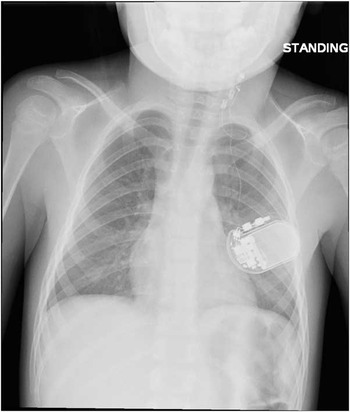
She also continued to have breakthrough supraventricular tachycardia. After discussion of options, the family elected to proceed with the electrophysiology study and ablation procedure, which she underwent in October of 2013. Before catheterisation, the vagus nerve stimulator was disabled. She was found to have supraventricular tachycardia secondary to a concealed left posterior accessory pathway. Ablation was performed via a trans-septal approach using a St. Jude Safire Ablation catheter (St. Paul, Minnesota, United States of America) with a Medtronic Atakr II radiofrequency power generator (Minneapolis, Minnesota, United States of America) to deliver radiofrequency energy. A total of three lesions were performed lasting a total of 133 seconds with a maximum temperature of 71°C and a maximum power of 50 W with means of 60°C and 33 W, respectively. There was no evidence of recurrent accessory pathway conduction, and the procedure was considered a success. The patient’s chest x-ray (Fig 1) shows the location of the vagus nerve stimulator overlapping with the cardiac silhouette. The ablations were performed on the mitral valve annulus, in the left posterior position (~4:00), which is in close proximity to the vagus nerve stimulator. At her last follow-up in July 2014, she showed no evidence of recurrent supraventricular tachycardia. According to her mother’s report in July 2014, from time of ablation until May 2014 – that is, 7 months after the procedure – the patient experienced no change in seizure frequency or known change in vagus nerve stimulator function. She reported that at the beginning of May/June 2014, the patient began experiencing an increase in seizure frequency and was seen by neurologists. According to her mother, her increase in seizure frequency was felt to be secondary to changes in her prescription tolerance, and a new anti-epileptic drug regimen was initiated.
Chest x-ray.

Discussion
Radiofrequency energy destroys selected portions of the myocardium by converting electromagnetic energy to thermal energy, and thus administering electrical heat directly to the heart tissue. This technique utilises a resistive mode of heating; as the current passes through the resistive heart tissue, the voltage drops creating heat. As the radiofrequency energy is applied, the current radiates outwards from the source, but direct heating decreases with increasing distance. Once the temperature reaches its peak, shown to be ~50° C, the tissue undergoes irreversible damage.Reference Stephen Huang and Wood 3
Manufacturers of radiofrequency ablation technology provide published warnings when using this technology in conjunction with pacemakers or implantable cardioverter defibrillators. 4 Concerns include potential asynchronous pacing, inappropriate shock therapy, and changes in pacing thresholds among several other possible interactions. Clear instructions are published for the use of this energy in patients with implantable cardiac devices, including directing the radiofrequency energy away from the implantable device. Even with precautionary measures, interaction does still occur in some cases. In a study with 25 patients with 13 different pacemakers, during radiofrequency ablation, current delivery sensing failure was observed in eight patients and pacing failure in four patients due to electromagnetic interference on the pacemaker.Reference Erdogen 5 The vagus nerve stimulator does not utilise sensing as pacemakers and implantable cardioverter defibrillators do, but there is no data regarding other possible interactions unrelated to sensing.
Conclusion
To date, no known literature exists pertaining to the use of radiofrequency ablation in patients with an implanted vagus nerve stimulator. We report the case of a patient who underwent successful radiofrequency ablation for supraventricular tachycardia; with the vagus nerve stimulator disabled, there were no observed effects on vagus nerve stimulator function. Further investigation is reasonable to ensure that there are no interactions between these two procedures in a larger population sample.
Acknowledgements
None.
Financial Support
This research received no specific grant from any funding agency, commercial, or not-for-profit sectors.
Conflicts of Interest
None.
Ethical Standards
The authors assert that all procedures contributing to this work comply with the ethical standards of the relevant national guidelines on human experimentation and with the Helsinki Declaration of 1975, as revised in 2008, and has been approved by the institutional committees at the Children’s Hospital of Pittsburgh of UPMC.