INTRODUCTION
Interdisciplinarity is a central tenet of palliative care. Cooperation and collaboration are quintessential, and they require effective communication between all individuals involved. Communication can be greatly facilitated if stakeholders share a common understanding of fundamental concepts. In view of the fact that volunteers represent an increasingly important group of actors in this field of care and that, as such, they must be integrated effectively into the palliative care team, it is necessary to explore their point of view.
The concepts of health and illness are building blocks upon which the actions of individuals taking part in palliative care are founded, and from which palliative care systems have been constructed (Canadian Hospice Palliative Care Association, 2002). However, not all individuals or groups of individuals view health and illness in the same manner. Patients, family members, doctors, the young, and the old do not necessarily share the same outlook on what defines being healthy or on what constitutes being ill. Research has in fact shown the variable and evolving nature of these notions (Billings, Reference Billings1998; Bircher, Reference Bircher2005; Davies, Reference Davies2007; Lynn et al., Reference Lynn, Schuster and Wilkinson2007; Pastrana et al., Reference Pastrana, Jünger and Ostgathe2008).
Furthermore, researchers have found that the meaning given to concepts derives from a combination of personal experience and knowledge (Boström, Reference Boström2004), as well as values, beliefs, and needs (Lipowski, Reference Lipowski1983). It also arises from and within interaction with others through social exchange. The medical anthropologist and psychiatrist Arthur Kleinman (Reference Kleinman1988) has shown that understandings of illness are also culture-specific. Meaning then becomes an individual, social, and cultural construct. Words carry more than the letters they are composed of. Their meaning varies through time and place, for societies as well as individuals. Meaning goes beyond definition by allowing human beings to make sense of life and the events they experience (Lipowski, Reference Lipowski1983; Fjelland et al., Reference Fjelland and Barron2008), and has long been recognized as having a great impact on patients' coping strategies (Lipowski, Reference Lipowski1970).
Meaning also drives action (Boström, Reference Boström2004). In this respect, the specific meaning individuals give to key concepts plays a critical role in how they act and interact with each other. A person's view of health and illness will impact both the way this person chooses to provide care, more specifically palliative care, as well as the way patients receive that care. Because concepts can be interpreted in various ways by different individuals working within the same team, interdisciplinarity – which refers to “a team whose members work together closely and communicate frequently to optimize care” (Hall & Weaver, Reference Hall and Weaver2001) — is that much harder to attain. Communication and delivery of care can consequently benefit from the development of congruent definitions and meanings.
A literature review allowed the identification of studies exploring palliative care patients' views of their own experience of illness and health (Lipowski, Reference Lipowski1970, Reference Lipowski1983; Collie & Long, Reference Collie and Long2005; Ando et al., Reference Ando, Morita and Lee2008), as well as that of professionals or family caregivers (Lobchuk & Vorauer, Reference Lobchuk and Vorauer2003; Melin-Johansson et al., Reference Melin-Johansson, Axelsson and Danielson2007; Bingley et al., Reference Bingley, Thomas and Brown2008). However, the perspective of volunteers — whose contribution to the palliative care movement is constantly expanding (Gottlieb, Reference Gottlieb2002; Zimmerman et al., Reference Zimmerman, Sloane and Hanson2003) — has been scarcely investigated. Volunteers working in patients' homes have received even less attention. In addition, most of these palliative care studies adopt a quantitative approach and center their attention on functionality or effectiveness of the volunteer working rendered (Cassarett et al., Reference Cassarett, Hirsman and Henry2001; Zimmerman et al, Reference Zimmerman, Sloane and Hanson2003). It has been shown that volunteering in palliative care changes over time and is contingent upon legislation, organizational models of service, and cultural differences (Sévigny et al., Reference Sévigny, Dumont and Cohen2009). The number of volunteers as well as the type and level of involvement has been shown to vary depending on the government's involvement in public healthcare, as well as on the social perception of volunteering in this sector, elements that fluctuate through time (Hackl et al., Reference Hackl, Halla and Pruckner2009; Sévigny et al., Reference Sévigny, Dumont and Cohen2009).
Considering the current institutional will to help palliative care patients stay in their homes for the longest possible time (Carstairs, Reference Carstairs2005), the point of view of home care volunteers is becoming increasingly valuable. How do these volunteers view health and illness, and, in light of these understandings, how do they describe palliative care? Because interdisciplinarity is an intrinsic part of palliative care, do their views coincide with those of the Canadian Hospice Palliative Care Association (CHPCA), whose actions contribute to a consensus-building process (Canadian Hospice Palliative Care Association, 2002, p. v)?
HEALTH, ILLNESS,Footnote 1 PALLIATIVE CARE, AND THE CHPCA
How individuals construe health and illness influences how they care for one another (Pastrana et al., Reference Pastrana, Jünger and Ostgathe2008). Common knowledge assumes that these concepts are diametrically opposed to one another: a person is either ill or healthy, and cannot be both. Health is most often described as the combined soundness of a person's physical, mental, and social state. Some add that health also depends upon the capacity to cope with the demands of life to reach one's potential, to benefit from a favorable psychosocial development and to have meaningful interpersonal relationships (Bircher, Reference Bircher2005). Illness, on the other hand, refers to “a disordered, weakened, or unsound condition,” to “ill health” (Merriam-Webster's Online Dictionary, 2009), to disease of body or mind, or to sickness. Illness is sometimes also associated with, and can derive from, a lack of favorable social or psychological contexts.
Palliative care organizations around the world generally entertain a holistic view of health that includes all aspects of a person's life (Palliative Care Australia, 2005; Worldwide Palliative Care Alliance, 2006; Doyle & Woodruff, Reference Doyle and Woodruff2008). As do most of their international counterparts, the CHPCA considers health as a state of complete well-being and describes the state of health as “a perception on the part of each individual. In the presence of health, people live their lives in ways that bring them meaning and value.” In the CHPCA's view, health is also linked to the “quality of life” — defined as a very subjective experience “that refers both to experiences that make life meaningful and conditions that allow people to have such experiences.” In its view, health and quality of life are “closely tied to autonomy, and the capacity and right to determine our own future” (Canadian Hospice Palliative Care Association, 2002, p. 12).
Although illness is not expressly defined by the CHPCA, it is generally portrayed as a life-changing experience, not only as it manifests itself in the body, but as it leads to an upheaval of individuals' roles and relationships. The CHPCA's Model to Guide Hospice Palliative Care (Canadian Hospice Palliative Care Association, 2002) underlines the fact that illness and bereavement experiences affect and are affected by multiple domains (e.g., physical, psychological, social, spiritual, practical, etc.). The model stresses that illness is a social phenomenon and is not limited to an individual's experience (Canadian Hospice Palliative Care Association, 2002, p. 13). Consequently, palliative care organizations must endeavor to care for all those living with life-threatening illnesses; patients as well as their families.
In this article, we report on a study that aimed to explore volunteers' viewpoints and compare them with the interpretations offered by the CHPCA. If the palliative care movement wishes to provide a cohesive approach to care for those living at home with life-threatening illnesses and their families, it must consider the way each group of care providers understands and makes sense of the concepts at play. This knowledge can contribute to the improvement of interdisciplinary communication and collaboration.
METHOD
Design
The qualitative methodology of this interpretive description study was built on Bowers' (Reference Bowers1987, Reference Bowers1988) approach to caregiving, which considers, as does Poupart's (Reference Poupart, Poupart, Deslauriers and Groux1997), that social actors are not only capable of ascribing meaning to their experiences, but also of reflecting upon them. This framework enables comprehension of the experience from the individual's point of view and exploration of stakeholders' aims (Bowers, Reference Bowers1987, Reference Bowers1988). The main objective was to draft an outline of volunteers' understandings, as they are an important group of actors. The research protocol was submitted to and accepted by the Université Laval research ethics committee.
Settings
Participants in this research are all members of community action organizations (CAOs) that offer home or ambulatory palliative care services. CAOs are defined as non-profit organizations that entertain strong community ties, are democratically run as an association, and are free to define their own mission, direction, approaches, and practices (Deslauriers, Reference Deslauriers1991). Data were gathered from five CAOs in three provinces offering a variety of socio-cultural settings (Alberta, British Columbia, and Quebec) within the larger Canadian geopolitical setting. They operated in large and small cities in both French and English Canada. This allowed the collection of a wide scope of perspectives. Comparison among sites, volunteers, or volunteers and coordinators was not at issue, as the main objective was to examine the nature of the ties between the meanings ascribed by social actors and the CHPCA's vision of health, illness, and palliative care. We purposely sampled CAOs involved in volunteer palliative home care for >10 years. This time frame allowed the CAOs the opportunity to develop a model of practice on which volunteers and their coordinators could reflect.
Participant Selection and Recruitment
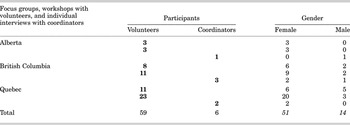
A purposive sampling resulted in the selection of 59 volunteers chosen because they had been active in a palliative care CAO for at least 3 months and offered their services in the homes of patients. Six paid coordinators of these CAOs were also interviewed. The principal investigator personally contacted coordinators of each participating organization. Each coordinator agreed to take part in individual semi-structured interviews as well as to recruit volunteers for focus groups. Recruitment ended when researchers found that additional interviews could not yield any new relevant information (saturation point) (Pires, Reference Pires, Poupart, Deslauriers and Groux1997). Table 1 shows the number and gender of participantsFootnote 2 in each province. All volunteers received training from their CAOs before they were paired with patients. Even though the experience of volunteering with palliative care patients has the potential to modify a person's perception of health and illness, this study aimed to outline the meanings ascribed by the group of participants and therefore did not analyze the potential evolution between short-term and long-term volunteers and coordinators. These aspects could, however, constitute the basis for further research.
Sample sizes and data collection method

Data Collection
Focus groups were organized with the volunteers. Coordinators participated in individual semi-structured interviews. The use of this dual data-gathering technique helped to ensure the volunteer focus groups' internal homogeneity as well as to avoid any bias the coordinator's presence could have prompted. The group setting has the combined advantage of lowering participants' possible performance anxiety and of eliciting more normative information than individual interviews would (McQuarrie & McIntyre, Reference McQuarrie and McIntyre1988, Reference McQuarrie, McIntyre and Hirshman1990; Krueger, Reference Krueger2000). Furthermore, because meaning is not only an individual but also a social and cultural construct, the dynamics of interactions between participants have the potential to uncover elements of the social actors' reality that would not necessarily have been revealed otherwise. During the group discussion, volunteers had the opportunity to exchange views on the subject and, in doing so, contributed to the construction of meaning.
Both types of interviews were conducted using open-ended questions that encouraged the free flow of ideas (Mayer & Ouellet, Reference Mayer and Ouellet1991; Poupart et al., Reference Poupart, Poupart, Deslauriers and Groux1997). Probes covered all important themes linked to the study's aim: representations of health and illness; representation of palliative care; values and principles linked to palliative care; and personal significance of volunteering in this sector.Footnote 3 Interviews and focus group discussions were audio-taped and transcribed verbatim by the principal investigator. However, for convenience, data collection for one of the Quebec groups was conducted in a workshop setting. The 23 attendees were divided into three groups and discussions were facilitated in much the same way as in the other focus groups. Data from the workshops consisted of notes taken by the participants who conducted the workshops as well as those taken by the principal investigator. The principal investigator also conducted the individual interviews and focus groups that were conducted in French areas, and trained the bilingual interviewers who led the focus groups in English areas. She attended and took notes for all of them. Individual interviews ranged from 60 to 90 minutes, whereas the focus groups lasted an average of 110 minutes, ranging from 90 to 120 minutes.
Data Analysis
A thematic analysis approach was adopted for initial classification using a mixed categorization model (Mayer & Ouellet, Reference Mayer and Ouellet1991); i.e., initial themes, emanating directly from the study's objectives (exploration of the meaning of health, illness, and palliative care), constituted initial analysis categories. Further categories and subcategories emerged from the data collected (Bardin, Reference Bardin1986; Paillé & Mucchielli, Reference Paillé and Mucchielli2003). The principal investigator read and coded the transcripts. The software NVivo 7 was used to help manage the data (Welsh, Reference Welsh2002). Coding ended when no new categories of meaning emerged. During this process, attention was given to isolated or unusual views in order to gain a better understanding of the complexities of the analyzed data. Furthermore, analysis categories, results, and result interpretation were frequently discussed with another researcher who followed the complete course of the project.
RESULTS
In general, volunteers and coordinators both describe health as a general state of well-being, whereas illness is seen as an impediment to personal equilibrium, a state of discomfort and unease. In their view, the mission of palliative care is to help patients regain balance and find comfort in a situation fraught with instability and pain.
Health and Illness
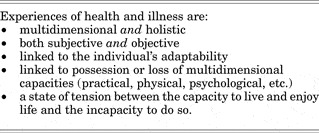
Volunteers and coordinators alike view health and illness as opposite ends of a graduated scale; even though extremes exist, most people find themselves somewhere in between. This parallels Antonovsky's model of “health ease/dis-ease continuum” (Antonovsky, Reference Antonovsky1996, p. 14) that positions every human being, at any given time, somewhere at one point between the two concepts. For participants in this study, health and illness are (1) multidimensional (body, mind, spirit; social, psychological, physical), (2) subjective, and (3) dynamic realities (Table 2). Participants simultaneously emphasized the multidimensional and global aspects of both health and illness. These were characterized as both objective and subjective realities. When a person is ill, the physical self is affected by pain, incapacities, or other measurable difficulties; but every individual reacts and adapts to this new physical reality and its foreseeable conclusion differently. Some participants consider that health is a gift, and that wellness depends upon how a person reacts and adapts to it. At the onset of illness, lives are changed, but it is the individual's capacity to adapt to his or her new reality that qualifies health. In their opinion, human beings are composed of various dimensions that interact with each other to different extents at different times. This means that the physical body can become ill, even terminally ill, without necessarily rendering the person “sick.”
Understanding “health” and “illness”

Even though a person can be conceptualized as having different layers, participants value the global nature of health and illness. In their opinion, all dimensions of a person's life must be taken into consideration when caring for them.
As long as there isn't death, there's life,” [but] “being too incapacitated to lead a meaningful life […that's] the saddest part about illnesses […] the mind is willing but the body can't react (6G).
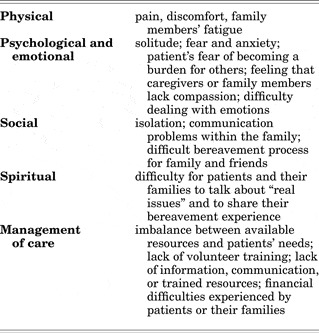
When one dimension is compromised, the others must adapt. Health can therefore be equated to a global state of well-being involving multilevel wellness, whereas illness stems from the loss or decline of one dimension and the instability this brings to other dimensions of the individual. Volunteers and coordinators mentioned numerous difficulties brought on by these losses for patients and their families (Table 3).
Multileveled difficulties

Believing we are “healthy,” in these dire circumstances, is not seen as the denial of illness, but rather as the affirmation that people are much more than what ails them. A coordinator explained how health could be understood as a person's courage when faced with illness
In other words, I'm not well now; I have an illness that's going to kill me. Do I feel healthy? Well, a part of me is not well but a bigger part of me feels healthy. I'm living my life; I'm making my choices; I'm dealing with the challenges. I could still feel healthy even though I don't have what anyone normally would call well-being. I think that's how it works (3C).
Health then becomes a state of mind and a capacity to be “well,” even though the body is in pain.
Despite the realities of physical illness and the inevitability of death, participants also associated health and well-being with retaining cognitive, social, emotional, and spiritual equilibrium. More than a physical reality, participants viewed health as the capacity to “feel good” about oneself and to adjust psychologically to physical pain or incapacities. For some participants, “health is life itself” (2C), “it is the love of living” and “being able to enjoy life” (2G). A person is deemed healthy when he or she loves life and still has the capacity to enjoy it.
This global definition of health extends itself to include relationships patients entertain with their close ones as well as with other stakeholders (professionals, volunteers, etc.). Being healthy, in this context, involves being at peace not only with oneself but with others. Participants found that when individuals face loss and grieving, “you realize that human beings are infinitely small and that we all have a profound need for each other” (2G). Living with illness and knowing how it will end highlights the importance of social interactions and psychological equilibrium.
Volunteers and coordinators also linked health to a person's capacity to do things that he or she is accustomed to doing. Beyond breathing or feeding oneself, being healthy is sometimes linked to physical autonomy and control over one's life (decision-making). Illness then represents “losing some control… Control over what you had before and the sickness is taking that over not the whole part of it but a big part of it” (4G). This loss of control can be offset through adaptation. Health can then by gauged by an individual's capacity to adapt, to maintain what he or she considers having a good quality of life.Footnote 4 “I think you lose things when you are sick and […] the difference is how you respond to that. […] it's whether or not you can go with it” (3G). It depends on each person's perspective and capacity to recreate balance and meaning in his or her life.
Underlying these definitions of health and illness is the fact that volunteers and coordinators believe that each person's comprehension of their own health depends not only on objective conditions such as diagnosis, symptoms, and incapacities, but on how they perceive this condition in relation to other aspects of their lives. One respondent explained
You may be dying of cancer […] you may say: “I'm not sick because this is me, essentially. I'm still here and nothing has compromised me. It's the body that I'm living in that's being compromised, it isn't ‘Me’” (3C).
This compartmentalization of the different aspects of one's life allows for the possibility that patients feel “intact,” “whole,” “healthy and well” even though the physical self is battling with a fatal illness. Even more than the physical reality, it is the sense of self that qualifies health.
Palliative Care: Global Care for a Multidimensional Situation
From this understanding of health and illness as experiences affecting all dimensions of a person's life, it naturally follows that participants view palliative care as a global and multidisciplinary service aimed at providing comfort and alleviating end-of-life patients' and families' multidimensional suffering. “My definition of palliative care is a team of people who live together, [… who] deal with different aspects of the dying person” (3G). In so doing, participants find they help patients cope with their situation and regain some form of balance, thereby contributing to the recovery of patients' global health, even though their body remains ill. They also help families cope by offering comfort and respite, and by lending them a sympathetic ear. Volunteers aim to
not just support […] the person who has the illness but their loved ones too, […] because the illness isn't just impacting the person who is dying; it's all their loved ones that are needy as well. Sometimes more so the family members than the person who is dying (4G).
The idea [is] whole person care. We are concerned to be with you in your situation as you are and to offer whatever we can find that would be important to you (3C).
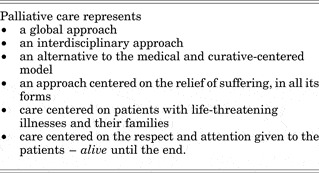
The essence of volunteering in palliative care also resides in the “little things,” the everyday things: baking cookies, talking, playing cards, and simply being there. Participants consider that the global comfort they wish for the people they care for depends greatly on the expression of emotion and the respect of patients' wills and desires. It also involves social interactions that contribute to maintaining a sense of identity and self-worth for all involved (Table 4).
Understanding “palliative care”

Several participants viewed palliative care as offering an alternative to the curative model of medical care. “There aren't a lot of medical people that are specialized yet in care of the dying. [And,] maybe [the medical field] needs more of the natural touch too” (4G). Because recovery is not an option, the goal of palliative care is to improve the final days of patients' lives. To do so, volunteers and coordinators feel that patients must maintain control over their care and their lives for as long as possible. Care must be adapted to each person's values and needs. “It's caring for the person on the level they want you to (…). Finding out what it is that they really want” (3G).
Volunteers and coordinators view themselves as countering loneliness and isolation, offering solace and helping patients accomplish meaningful activities. “Life is changing but you are not alone, you are being supported and helped along this journey” (4G). Most importantly, patients are their guides to care. Volunteers journey alongside the patient throughout their end-of-life passage, helping them enjoy life for as long as possible.
DISCUSSION
Overall, volunteers and coordinators shared a cohesive comprehension of health and illness that closely parallels that of the CHPCA (2002). Participants' and the CHPCA's holistic understandings of health and illness coincide (Moulin, Reference Moulin2000; Canadian Hospice Palliative Care Association, 2002), contrasting with the individualistic view still present in the biomedical field today (Moulin, Reference Moulin2000; Street & Blackford, Reference Street and Blackford2001). The participants and CHPCA also share a common view of the person as a complex and multifaceted being. As well, both value health-generating events that aim to increase well-being. These events, or activities, can take any form as long as they contribute to the patients' comfort and capacity to cope with their reality, and reinforce their sense of self by valuing interaction. These elements are consistent with the salutogenic model of health which argues that “all human distress is always that of an integrated organism, always has a psychic (and a social, I might add) and a somatic aspect” (Antonovsky, Reference Antonovsky1996, p. 11; Street & Blackford, Reference Street and Blackford2001). Sometimes, all dimensions are affected simultaneously, creating a sense of profound instability. However, adapting to new circumstances often means that the focus of life will change, enabling people to feel healthy despite their physical condition. Participants wish to focus on the patients' lives, without negating their impending deaths. They hope to improve the quality of living and dying of the people they accompany. In so doing, Dolan (Reference Dolan1994) asserts that volunteers' actions breathe new life into patients' last days and may help the passage towards death.
Other studies have shown that patients' views of health and quality of life are in line with the main findings of this study (Lindqvist et al., Reference Lindqvist, Widmark and Rasmussen2006; Gourdji et al., Reference Gourdji, McVey and Purden2009). Some find that the concept of healing involves meaning-based adaptation to illness, and the will to achieve a sense of wholeness (Mount et al., Reference Mount, Boston and Cohen2007). They describe health (Kagawa-Singer, Reference Kagawa-Singer1993) and quality of life (Cohen & Mount, Reference Cohen and Mount2000; Cohen & Leis, Reference Cohen and Leis2002) as multi-dimensional and subjective realities that are often defined by the extent to which individuals can adapt. As patients' companions, volunteers position themselves as active members of a palliative care team, and concentrate their efforts on offering whole-person care to the individuals they interact with. Their views of health, illness, and the objectives of palliative care allow them to deal with most common issues identified by the CHPCA model: depression, isolation, search for meaning, grief, and mourning, to name a few (Canadian Hospice Palliative Care Association, 2002, p. 99). Volunteers accompany patients and families from assessment to care delivery by addressing a part of their psychological, social, spiritual, and practical needs.
Participants also feel that patients should benefit from the highest quality of life possible. They see this as the main mission of palliative care. For this purpose, they consider that patients should maintain control over their own future. They see this control as closely linked to an individual's identity and general well-being. This concept of control can be linked to the autonomy valued by the CHPCA model, as it has been in other research on perceptions of quality of life (Mystakidou et al., Reference Mystakidou, Tsilika and Kouloulias2004). In fact, the CHPCA model lists “the intrinsic value of each person as an autonomous and unique individual” (Canadian Hospice Palliative Care Association, 2002, p. 19) as one of the main values guiding all hospice palliative care activities. Since they value patients' autonomy, volunteers primarily rely on the patients to guide their actions. This aspect can be linked to a Western culture that emphasizes and values individualism and independence. This aspect of palliative care would most probably be different in other cultures. Consequently, these values may bring conflict. A volunteer could find it difficult to accompany a patient who does not view dying the same way he or she does. Even though volunteers wish to respect patients' wishes and center on patient care, might they not be tempted to encourage the realization of what, to them, represents a “good death” (Castra, Reference Castra2003) — even though this concept has been shown to vary greatly by culture, profession, role in end of life, and individuality (Steinhauser et al., Reference Steinhauser, Christakis and Clipp2000; Ando et al, Reference Ando, Morita and Lee2008)?
Bowers' approach (1987, 1988) to caregiving, which focuses on meaning, enabled us to go beyond the instrumental mission of palliative care and establish a link between the understandings of health and illness and volunteers' conceptualizations of palliative care. Bowers' approach has allowed us to understand that in palliative care, it is not primarily functionality that motivates action (keeping clean, giving respite) but rather its relevance and meaning for social actors (sense of self, autonomy, value of life). The key elements of participants' understandings of the palliative care mission confirm this. By linking illness to instability and loss, it follows that the primary mission of palliative care is to accompany and facilitate the re-establishment of a certain form of balance for the person living with an ailing body. It also entails establishing open communication between caregivers (whether professionals, family members, or volunteers) and patients, in order to work towards what the patient sees as being “a good death,” a concept that cannot be limited to normative expectations since it is highly variable (Goldsteen et al., Reference Goldsteen, Houtepenb and Prootc2006).
One could argue that the shared understandings of participants and the CHPCA are evidence that the “Model to Guide Palliative Care” has reached its audience, and that volunteers have integrated its teachings and philosophy. These results could also be interpreted as a testimony to the model's social relevance and acceptance within the healthcare environment. A third interpretation could be that because subjectivity plays an important role in conceptualization of illness and health, the basis of these similarities is that people who volunteer in palliative care share, even before their involvement, the movements' values, ideals, and aims, or even its general culture.
The results of this research suggest that the CHPCA and volunteers who are active in palliative care agree on the meanings of the major concepts involved in this healthcare sector. They also underline the importance of promoting patients' well-being by emphasizing living over dying: helping them “live, until they die” (Sévigny et al., Reference Sévigny, Dumont and Cohen2009). After the uneasiness and confusion brought on by a fatal illness, volunteers aim to bring back a renewed sense of wholeness and comfort. Based on an understanding of individuals as multilayered and complex beings, participants understand that each individual holds a unique view of health; every person, whether healthy or not, aims to give his or her life meaning. Volunteers understand this and wish to contribute to the appeasement of patients. Interdisciplinary by nature, palliative care represents a place of convergence for an ensemble cast of caregivers (family members, doctors, volunteers, nurses, etc.). Understanding volunteers' perceptions may help CAOs and other stakeholders better understand the function of volunteers in palliative care and therefore facilitate their integration into the interdisciplinary team.
ACKNOWLEDGMENTS
We thank the CIHR Strategic Training Program in Palliative Care Research that funded Andrée Sévigny, the Équipe de Recherche de la Maison Michel-Sarrazin, and the Chaire de Soins Palliatifs (Université Laval), who funded the collection of data for this study. This study was also funded by the Canadian Cancer Society through its support of the Centre for Behavioural Research and Program Evaluation (CBRPE) and the Sociobehavioural Cancer Research Network (SCRN). We also thank Drs. Michèle Aubin (Université Laval) and Janine Pierret (Centre de Recherche Médecine, Sciences, Santé, et Société, CERMES) for their valuable comments and suggestions concerning both the research and analysis processes.