Introduction
Choice is a key concept in welfare reform, particularly in England but also elsewhere in Europe (Lundsgaard, Reference Lundsgaard2005; Greve, Reference Greve2009). It has been the subject of much academic debate, including a themed section on ‘Choice or Voice?’ concentrating on the UK in this journal (Social Policy and Society, 2008), and a special issue of Social Policy and Administration (2009) which extended the debate Europe-wide and to diverse sectors such as education, care and pensions. However, few papers have considered how people experience the practical implications of choice policies, and, in particular, how emotions and choices are related; this article goes some way to redressing this balance by exploring the emotions that disabled and older people experience in making choices about welfare-related services in England.
Choice policies are underpinned by the empowerment discourse of the disability movement (see Morris, Reference Morris, Glendinning and Kemp2006; Ellis, Reference Ellis2007) and by discourses of consumerism and quasi-markets (see Glendinning, Reference Glendinning2008). It is not the role of this article to rehearse the arguments for and against choice policies or give detailed accounts of how these policies have been implemented. It is sufficient to note that there has been a general policy shift towards enabling people to exercise choice and have more responsibility for and control over the care and support they receive across a range of services. The Labour government from the late 1990s promoted activation, empowerment and ‘responsibilities as well as rights’ (Clarke, Reference Clarke2005); the current Coalition Government is continuing with this policy direction.
Thus, recent welfare reforms in England have resulted in the transfer of responsibility for managing choices about welfare services from third party, trained professionals to service users and patients. This transfer is placing new emotional demands on recipients of services. Clarke et al. (Reference Clarke, Smith and Vidler2006) have referred to this as the devolution of stress. So what are the emotional consequences of this shift in responsibility? How does managing these emotions impact on the process of making a choice and overall welfare gains? Do individuals need to expend more time and energy managing not just the choices that have been devolved to them but also the associated emotions?
Appleby et al. (Reference Appleby, Harrison and Devlin2003) claim it is difficult to argue against the desirability of allowing people more say in decisions that affect them. However, there are concerns over the uncritical acceptance of ‘individualization, responsibilization and the transfer of risk from the state to the individual’ (Ferguson, Reference Ferguson2007: 387). Although too much choice can be confusing (Schwartz, Reference Schwartz2004), and being responsible for making choices can be stressful (Barnett et al., Reference Barnett, Ogden and Daniells2008), in general the role of emotions and choices in analyses of welfare state reforms across Europe has been neglected (Greve, Reference Greve2009). Thus, as policies result in increasing numbers of people becoming actively involved in choices relating, amongst other things, to their health and social well-being, it is timely to explore the relationship between emotions and choice-making.
This article explores these issues for disabled working age and older people making choices about health, social care, housing and employment. It does so by using well-developed theories of decision-making, from experimental psychology and behavioural economics, as a framework to explore the types and causes of emotions experienced during choice-making. Although other frameworks could have been chosen, the focus of these robust but nuanced theories was felt to offer the greatest potential for insights into the processes of decision-making in relation specifically to both the causes and impacts of emotions. Choices are defined broadly to reflect the special circumstances and relational nature of choices in public services (Clarke et al., Reference Clarke, Newman and Westmarland2008). Therefore, we include not only experiences of choices between two or more available options but also deciding for or against an action, and emotional experiences when waiting for opinions from professionals about eligibility for or the availability of desired options.
Theories of emotions and choice-making
This section draws on a review of the dynamics of decision-making undertaken in preparation for the study on which this article is based (see Beresford and Sloper, Reference Beresford and Sloper2008).
Emotions can limit people's ability to make choices; negative emotions such as stress or fear, in particular, can affect people's usual abilities through limiting their cognitive capacity (Lemerise and Arsenio, Reference Lemerise and Arsenio2000). This limitation, ‘bounded rationality’ (Simon, Reference Simon1955), occurs if people are unable to cope with all the information at their disposal. In effect, they reach the bounds of their ability to think rationally. These boundaries are different for different people, but for each individual they can also differ over time and by circumstance.
Emotions can also result in people avoiding making choices. Theories of emotion-focused coping argue that individuals cope with negative emotions by minimising the emotional aspect of choices, that is, by avoiding the unwanted emotions (Folkman and Lazarus, Reference Folkman and Lazarus1988). This can be achieved by reducing the amount of thought devoted to the choice – avoiding it altogether, delaying it or showing a preference for the status quo. In some cases, people might prefer someone else to make the decision for them. Alternatively, the specific emotional aspects of the choice might be singled out and avoided by concentrating on other important but less emotional factors (Beresford and Sloper, Reference Beresford and Sloper2008).
The anticipation of emotions (especially regret) can also lead to avoidance or delays in making choices. Anticipated regret may be over the outcome of a choice as well as the process used to make a decision (Connolly and Reb, Reference Connolly and Reb2005). Delays can seem appropriate in the short term but be outweighed by longer term costs (Beattie et al., Reference Beattie, Baron, Hershey and Spranca1994). Aversion to regret can lead to excessive gathering of information if that information is expected to reduce the potential for uncertainty. However, excessive information-gathering may lead to an inability to process all the information and thus incur problems associated with bounded rationality.
People may also avoid choices because they fear potential negative outcomes more than they value potential gains. This is known as being ‘risk averse to losses’, and means people make more effort to avoid a loss than to make an equivalent gain (Kahneman and Tversky, Reference Kahneman and Tversky1984). People also prefer the status quo, the certainty of their current situation, rather than the risk of a loss. Importantly, an individual's attitude to risk depends on their relative wealth (Allingham, Reference Allingham2002). It follows that an individual's emotional response to choice-related risk will depend on the size of the potential loss relative to their current status. This might be pertinent particularly when loss is measured in health status or quality of life.
Other theories and evidence paint a more positive picture. The theory of problem-focused coping (Folkman and Lazarus, Reference Folkman and Lazarus1988) argues that people use negative emotions to indicate the importance of a choice. Generally, people make more effort to resolve decisions they consider important than ones they consider less important; Tiedens and Linton (Reference Tiedens and Linton2001) argue similarly that negative emotions can result in more systematic processing of choices. Furthermore, emotions may result in people simplifying complex, multifaceted decisions by using heuristics (rules of thumb); cognitive effort is saved by processing only the most important information. One type of heuristic is the ‘lexicographic’ rule in which only the most important attributes of each option are considered (Bettman, Reference Bettman1979). In essence, these theories argue that negative emotions can have positive effects on choice-making.
This overview raises a number of specific research questions for exploration. Is people's cognitive functioning impaired by their emotional state and does this lead to the use of heuristics? Do people avoid negative emotional aspects of choice-making or do they embrace their feelings and try harder to reach the best solution? How do people respond to making choices where they risk suffering losses or feeling regret? And what are the wider implications for policies that prioritise choice by welfare service users?
Methods and sample
This article draws on the accounts of fifty-two disabled people (working age and older) who took part in a qualitative, longitudinal study exploring choice-making in the context of changing circumstances. Multi-centre research ethics approval was obtained.
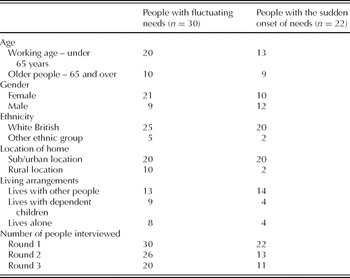
Participants were recruited from a wide range of organisations in England, including: condition-specific voluntary organisations, hospitals, local authority social service departments, community groups, an independent recruitment agency and ‘snowballing’ from other study participants. Participants were selected purposively to include people with support needs that were progressive but fluctuating, meaning that additional services might be needed on a temporary basis; and those with the sudden onset of support needs resulting from an accident or sudden deterioration in health. The aim was to include people accustomed to making welfare-related choices and those making them for the first time. Although a pre-defined sampling quota aimed to ensure diversity in age, gender, ethnicity and living arrangements, the majority of participants were working age white British females (see Table 1). One participant with limited speech was interviewed using ‘Talking Mats’ (Murphy et al., Reference Murphy, Tester, Hubbard, Downs and MacDonald2005), a visual framework using symbols; two were interviewed through interpreters.
Characteristics of study sample

Each participant was interviewed up to three times in 2007–10. In the first two interviews, participants discussed in detail a recent important choice they had made about services or support, including the options and information available, the roles of other people in making the choice and the outcomes of the choice. In the second and third interviews, participants discussed ongoing or new choices, but also reflected back on choices discussed in earlier interviews. This article is based on data from all three interviews. A wide range of choices was discussed, including choices about health care treatments; social care, such as help at home and direct payments (cash budgets to pay for care); minor and major housing adaptations; and support for employment.
Interviews were recorded and transcribed in full. The research team focused initial analysis around the main topics discussed in the interviews (such as information, relationships, options and outcomes), but also read subsamples of transcripts to identify other emergent themes and agree a framework for analysis (Miles and Huberman, Reference Miles and Huberman1994). All transcripts were read and coded using the computer-assisted qualitative data analysis software MAXQDA. Coded data were then summarised in a series of charts, following the Framework approach (Ritchie and Spencer, Reference Ritchie, Spencer, Bryman and Burgess1994), addressing issues relevant to individual rounds of interviews and themes across different rounds. This method of displaying the data aided identification of more/less common issues, within and across themes and participants. Many issues were explored in different strands of the study; here we report just those findings relating to the emotional dimensions of choice.
Findings
Emotions and their causes
All participants experienced emotions in the course of making choices. Most of the emotions discussed were negative, such as fear, worry, stress, isolation and anger. To a lesser extent, participants reported positive emotions, for example excitement or hope. However, not only were the majority of emotions negative, but negative emotions were expressed more strongly than positive ones.
One cause of negative emotions was decreased mental and physical well-being. People reported a downward spiral whereby their perceived difficulty in making decisions led to anxiety and further deteriorations in health. Feelings were complex and intense:
Stressed and worried. I mean, I described myself as desperate at that time, and I think that was very much influenced by my, what was probably six weeks of being ill every day by that time, it has an impact on the way you see things. (Woman with fluctuating needs, ID105)
I am noticeably physically . . . weaker and that's affecting me, and stresses in the house and that sort of thing, and I just . . . I just, I can't, I just can't deal with it. (Man with fluctuating needs, ID111)
I had some bad nightmares and I had, you know, and of course this is complicated by pain, loss of function, fears about the future, fears about my career . . . So there were a lot of layers of feelings. (Woman with sudden onset of needs, ID125)
Uncertainty, or as one woman put it, ‘fear of the unknown’, played a major role in creating negative and especially stress-related emotions:
I would have been relieved if they'd said . . . you can't have it or you can have it, because the not knowing, the sort of hanging in limbo was, it was an awful [experience]. (Woman with fluctuating needs, ID131)
It were a bit scary because I didn't know what, and up to the, seeing me, the main bloke and telling me what were wrong, nobody had actually telled me . . . there were no information. (Older woman with fluctuating needs, ID203)
That six week period, direct payments, with all these women coming in and that booklet sat in there, thinking oh my God, I hated that period because it was stressful because I didn't understand it. (Woman with fluctuating needs, ID107)
Fear of losing control, for example over daily routines when considering applying for home care or returning home after an extended hospital stay, preyed heavily on people's minds. People also feared losing positive features from their lives, such as current support or periods of stable health; this is consistent with the theory that people are risk averse to losses. For example, a former art teacher, unable to work due to fluctuating mobility problems, was too scared to approach the job centre for advice as she feared they would force her to take an inappropriate job which would have adverse effects on both her health and finances.
Sudden changes in health or social circumstances that were outside people's control but necessitated quick responses were especially stressful. External factors could also generate unexpected choices within tight deadlines, as illustrated by a man with complex care needs who was forced into a difficult and unwanted choice about a different drug regime when manufacturers suddenly ended production of his regular medication. Stress was also experienced when people's health deteriorated slowly but they delayed asking for help for as long as possible, until the need for support became urgent. One reason for such delays was people's reluctance to accept their increased support needs, in some cases resulting in anger:
It was stressful . . . making that choice. I think . . . knowing that you have to, you do need support. I think it's owning up to yourself that, you know, you need help, because I try to be as independent as possible. (Woman with fluctuating needs, ID113)
Nobody helps, nobody explains, nobody helps you cope with the fact you're a different person now, and you're angry because you've been made into a different person. (Woman with sudden onset of needs, ID125)
I was so angry with myself, so angry with everything at the time, you know, I was really flippant about the choices I had really, you know. I think the, the stage I was at, it's not just a, it's not just anger, it's, I was ashamed as well, it wasn't even a, you know, a proper accident. (Man with sudden onset of needs, ID126)
These examples show how sudden or urgent changes in circumstances, not just the sudden onset of illness, can cause negative emotions.
Equally, the absence of deadlines for making choices caused stress, particularly for people with fluctuating/progressive conditions when responsibility for the timing of decisions fell on them. Acting too soon could mean jeopardising current, relatively good health, or, if a treatment had a limited lifespan, experiencing poorer quality of life in the future; acting too late could risk unnecessary loss of independence. This again illustrates concern about the risk of losses.
Lack of support made people feel isolated during choice-making processes. Feelings of isolation were caused also by conflicting advice from different sources, or receiving advice with which participants disagreed, particularly from professionals.
It's just that I feel very anxious . . . because there's no . . . real, there's nobody just mentoring or watching, just, well, you know, apart from myself now I suppose watching to see what happens. (Woman with fluctuating needs, ID107)
If things got worse I think there'd be more support available but when you're in between, between like being really healthy, middle of the road and then sick, there's no support in, in the middle there from, from anywhere. (Man with sudden onset of needs, ID121)
But, you know, I got no, no support, no advice from . . . occupational therapy and . . . I actually sort of like partly got the feeling that . . . the individual occupational therapist was not (pause) not in agreement with me having the adaptations done at all. That she, for whatever reason, I don't know, had made a personal judgement that she didn't think I was worthy. (Man with fluctuating needs, ID111)
In addition, people worried about failing to identify all acceptable options when making a choice, that is they anticipated regret.
Anxious I would say, that springs to mind . . . Am I doing the right thing? (Pause) Is there any, always thinking in the back of my mind, is there something I've missed . . . before I've elected to do this? (Woman with fluctuating needs, ID112)
Stressed and worried . . . Well you think, well it was, I'd decided I wanted it doing but I still was worried about it, was I doing the right thing? (Older woman with fluctuating needs, ID205)
Anticipated regret was evident especially among people who felt they had ‘stumbled upon’ information about choices, or those who found available information more limited than they would have liked. The importance and permanence of potential outcomes also aroused anxiety, for instance sensing that a choice was irreversible or that its impact would be long lasting.
Positive emotions were less commonly reported and were expressed less strongly than negative ones. However, even positive emotions were frequently mixed with negative ones, so people would describe their feelings as: ‘anxious and frustrated . . . and fearful, positive, excited . . . hopeful, they're all there’. Only a handful of participants felt entirely positive about a particular choice. For them, being positive was associated with feeling in control of the choice and expecting a better future as a result of the choice made. People who had experienced a downturn in health as a result of a previous stressful decision-making process consciously forced themselves to be positive in order to avoid further deteriorations, suggesting a reaction to their earlier experiences of loss.
The impacts of emotions on choice-making
Our findings support the theory that cognitive processing can be impaired by negative emotions. People reported feeling drained by the experience of having to make a choice at a time when they felt ‘overwhelmed with stress’. Although there was no evidence of the use of heuristics, there was some reliance on instincts and some self-confessed irrational behaviour.
I wasn't really thinking straight at the time, I don't know what I was thinking in fact. Was I thinking, was I able to think? It was just instinctive. (Man with sudden onset of needs, ID130)
Anger, as well as a mix of other emotions, left people unable to think or express themselves logically:
[It] would be useful to have somebody else to bang on the table for you, because when you're feeling that ill you just don't have the strength and the energy and the willpower to, to maybe put over a reasoned argument and of course when it's happening to you yourself or, your emotions are involved so it's difficult to not be emotional about it as well . . . [I] felt too emotional about it to be able to [act] rationally. (Woman with fluctuating needs, ID105)
These quotes suggest that impaired thinking resulted not only from stress intrinsic to the choice being made, but also more general negative emotions associated with feeling ill and tired. It is notable in the quotes above that the participant with the sudden onset of needs talked about feelings specific to the choice in hand, whereas the woman with fluctuating needs talked about more general tiredness, not necessarily related to the choice.
The theoretical literature also suggests that people may cope with strong negative emotions by avoiding making a choice and thus avoiding the negative emotions associated with it. The empirical evidence from this study supports this. Negative emotions resulted in people feeling hesitant about making a decision, reflecting uncertainty and anticipated regret at an unsatisfactory process or outcome. In situations where people feared a loss, for example where they felt that their current health or level of support might be compromised, they avoided or delayed making choices. Delaying choices also helped people to cope with the stress associated with uncertainty about the timing of a decision; in effect, they justified avoiding a decision by emphasising the benefits of the current situation.
I feel OK and I don't want to rock the boat. (Woman with fluctuating needs, ID118)
[S]ometimes the status quo, although it may not be ideal, it's a case of you know what you're living with, you know what you're dealing with. (Woman with fluctuating needs, ID105)
The point at which people stopped avoiding a choice was when the current situation became untenable and anticipated regret lessened. This was evidenced by an older man considering a lung transplant. For many years he had assessed the risks associated with the operation to be too great to take. Eventually, his quality of life reduced to such a degree that he was willing to accept these risks.
Some people were tired and stressed by their changing health conditions and could not face making another choice. This suggests a cumulative negative effect of emotions on subsequent decision-making for people with long-term, fluctuating conditions. These people reacted by, as one respondent said, ‘backing off’ from the choice. This in effect delayed decisions until the prospect of making a choice became more manageable. For example, when she first opted to receive care at home, a mother of three rejected using direct payments. She believed that her mental struggle to cope with her loss of mobility and her decision to ask for external help left her unable to deal with a further choice about how support should be delivered. Two years later her emotions were more settled:
I've got my head round everything else. It's all dealt, it's all slotted into its own place, and now direct payments is a doddle. It just does not seem like a problem now. But then it did, and I wouldn't touch [it] with a bargepole because it just seemed so much work and so much time and effort. (Woman with fluctuating needs, ID110)
In contrast, anger could result in quick decision-making, thus avoiding having to deal with emotions for any period of time. With anger, choices were made in an offhand and inattentive manner. A working age man explained how the ‘fog was in front of my face’ when he had to make an important career decision a few days after a serious accident:
I can't say it was an easy choice but I made it easy by just being flippant with it. ‘OK, not a problem, yeah, I'll just go, I'll just stay here’, you know, ‘Go away, leave me alone’. (Man with sudden onset of needs, ID126)
An alternative to avoiding negative emotions is to embrace them as an indicator of the importance of a choice and thus heighten the choice-making process. The result is more systematic processing than usual. This response was not widely evident in this study. One example was an older woman who made a choice about extensive housing adaptations; she spoke specifically about how she was encouraged to be particularly conscientious in making the decision through a combination of fear that she might make poor choices and her belief that she would never have to make the same choice again.
Discussion
This article has explored, for disabled working age and older people, the role of emotions in making choices about health and social care, housing and employment. It has examined both the impact of making choices on emotions and the subsequent impact of those emotions on choice-making.
One of the strengths of this research is that it has used experimental theories from psychology and behavioural economics to understand empirical evidence on welfare service-related choices. Using these theories as an analytic framework facilitated exploration of the impact of emotions on decision-making. The choices discussed were those considered most important by the participants themselves. Whilst this created a wide range of choices, including routine as well as major choices in health, social care, housing and employment support, it also left some gaps, such as decisions about moving into sheltered accommodation or residential care, which did not arise in the course of the study. However, the common causes and impacts of emotions across this diverse range of choices suggest the findings are robust.
This article has some limitations. It has not addressed how emotions associated with the process of making choices affect satisfaction with the outcome of choice; outcomes have been explored in other articles from this study (Maddison and Beresford, Reference Maddison and Beresford2012; Rabiee, Reference Rabiee2012). However, even if people are satisfied with the outcomes of their choices, they are likely to have experienced emotional highs and lows in order to get to that point. Thus, although the end result might be positive, if the decision-making process comprised fewer negative emotions, the overall experience may be improved. Furthermore, despite efforts to recruit a diverse study sample, there were insufficient older people or people from ethnic minority groups to be able to make robust statements about differences in the experiences of these groups. However, the findings do suggest that the decision to include in the study people who have experienced the sudden onset of an illness and are thus relatively new to making choices and those with longer-term fluctuating conditions who have been making choices for many years, was justified. Among the latter there appeared to be a distinctive cumulative effect of general tiredness as well as fatigue with making choices, combined with concerns about loss of health and support, which resulted in a marked reluctance to make choices.
The findings provide no evidence that people used heuristics to aid decision-making, although there was evidence of impaired cognitive functioning. There was little evidence of a relationship between health status and attitude to risk. Fear of loss or regret at the outcome of a choice, and uncertainty associated with the timing of choices, however, did result in hesitation and avoidance of choice-making; this is consistent with the literature. This finding is strengthened by a lack of evidence that people treated negative emotions as an indicator of the importance of a choice, as the alternative theory of problem-focused coping would suggest. The implication, that people who feel negative whilst making welfare-related decisions tend towards avoiding rather than embracing these decisions, is important, especially within the context of policies that assume choice is beneficial per se and that opportunities for choice should be maximised.
The findings illustrate the extent to which welfare state reforms can cause significant emotional costs in people's personal lives. That is not to say that the costs outweigh the benefits of greater choice, control and engagement in the process of making choices, rather that the emotional costs involved in making choices should not be overlooked.
It is interesting that there were instances where people felt uncomfortable with the choices they were making but where time helped them to adjust to their new situations and thus re-engage with choices. However, there were also examples of people who felt overwhelmed by the choices they had to make, which resulted in disengagement. What this suggests is that the trajectory of people's physical and mental health, including any fluctuations, can affect their ability to deal with the emotions associated with making choices. These fluctuating emotions are not solely related directly to the choice being undertaken, but to well-being more generally. It follows that in some cases, and at some times, people might prefer to enjoy the outcomes of their choices without being wholly responsible for producing those choices; as Hochschild (Reference Hochschild2005: 84) says, ‘the meaning or fun is not in the growing of a vegetable garden but in the eating from it’.
The findings also suggest that people perceived themselves at times to have poor decision-making ability, that is bounded rationality. This arose both from negative emotions related specifically to making decisions about (and for) themselves and from negative emotions related more generally to life's ‘ups and downs’. The fact that people felt, in some circumstances, that they were not good at making choices may reflect beliefs about how they think they are expected to make choices – in a rational and emotionless manner. While psychological research, in particular, refutes theories of simplistic rational decision-making, and although people are acting in line with more nuanced models, it may be that they would benefit from reassurance that making choices is complex and emotional.
One important policy implication is that disabled and older people making choices about a range of welfare services would, in the main, benefit from continued or greater support from professionals. This is not an argument against devolving responsibilities, but for empowering people by offering appropriate support in all aspects of making choices. This support may come from social workers (Hudson, Reference Hudson2009), other professionals or expert peers (Department of Health, 2001; Coulter et al., Reference Coulter, Le Maistre and Henderson2005; Squire and Hill, Reference Squire and Hill2006) or from personal networks (Baxter and Glendinning, Reference Baxter and Glendinning2011). The nature of professional support is changing, but that support is still vital, especially in helping people deal with emotions and time pressures that can result in making quick but rash decisions or in delaying decisions, both of which might later be regretted.
In returning to the broader policy goals of increasing opportunities for welfare-related choices, while there are undoubtedly benefits from devolving greater responsibilities to individuals, this research has drawn attention to the associated emotional costs. These costs arise both directly from the negative emotions experienced during the choice-making process, and indirectly from the effects of these emotions on decisions, such as avoidance of or delays in making choices. The findings further our understanding of the relationships between the potential benefits and costs of choice, particularly the emotional costs to individuals of the process of choice-making.
Acknowledgements
The research on which this article is based was funded by the Department of Health. The views expressed here are the authors’ own and not necessarily those of the funding body. We are grateful to the study participants who made this research possible. We would like to thank members of the Choice and Change project team for their contributions: Hilary Arksey, Bryony Beresford, Janet Heaton, Jane Maddison, Wendy Mitchell, Parvaneh Rabiee and Tricia Sloper.