Introduction
The genus Ochrolechia A Massal. comprises 60 species worldwide (Verseghy Reference Verseghy1962; Howard Reference Howard1970; Brodo Reference Brodo1991; Messuti & Lumbsch Reference Messuti and Lumbsch2000; Kukwa 2009 Reference Kukwaa , Reference Kukwab , Reference Kukwa2011). There are 29 known taxa from China, but this figure is in need of revision as the studies on which it is based were primarily on morphology and are no longer current (Wei Reference Wei1991; Zhao & Jia Reference Zhao and Jia2002; Aptroot & Sparrius Reference Aptroot and Sparrius2003; Jia & Zhao Reference Jia and Zhao2003, Reference Jia and Zhao2005; Jia et al. 2008 Reference Jia, Ren and Zhaoa , Reference Jia, Ren, Sun and Zhaob ; Zhang et al. Reference Zhang, Yang, Ren and Zhao2008; Gao & Ren Reference Gao and Ren2012).
Species in the genus Ochrolechia are characterized by having a white to ashy grey thallus, sometimes with soredia or isidia; large lecanorine apothecia with broad pinkish to pale orange discs that are sometimes pruinose or scabrose; a strongly amyloid hymenium; branched and anastomosing paraphyses; (3–)4–8-spored asci with simple, hyaline, thin-walled ascospores>20 μm long; and usually the presence of orcinol depsides that react C+ pink or red (Brodo Reference Brodo1988, Reference Brodo1991; Schmitz et al. Reference Schmitz, Lumbsch and Feige1994; Schmitt & Lumbsch Reference Schmitt and Lumbsch2004; Kukwa Reference Kukwa2011).
The objective of this work is to describe the accepted Ochrolechia species from China and to provide an identification key.
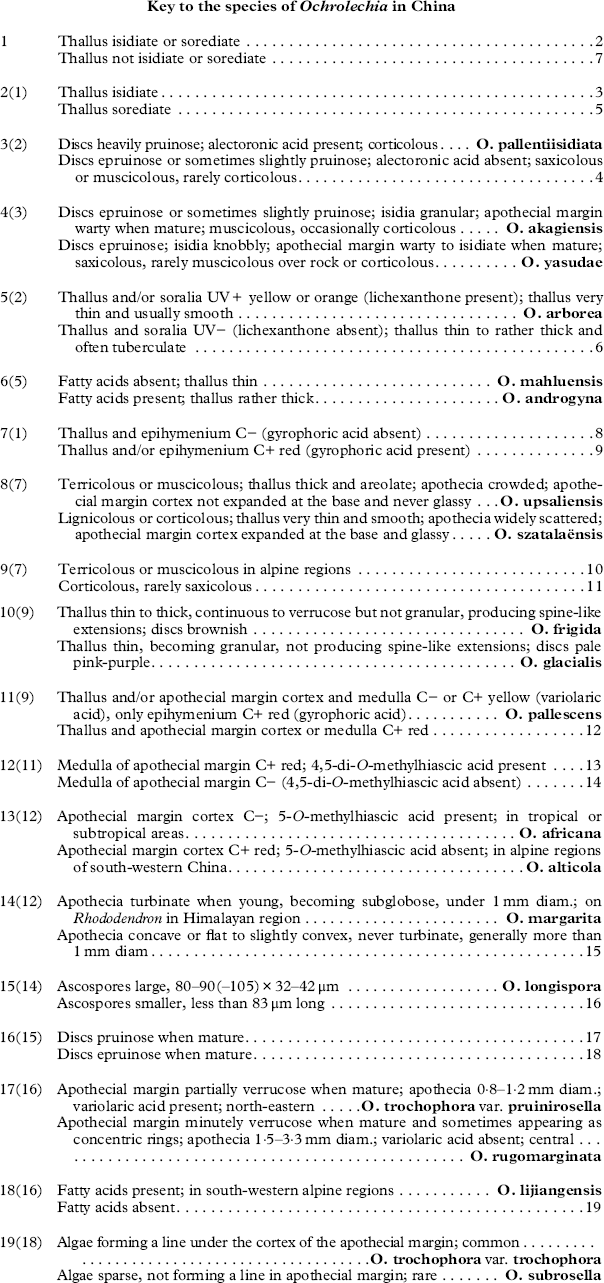
Material and Methods
Approximately 1300 specimens (1120 of them collected from China) from CANL, F, HMAS-L, KUN-L, LCU (Herbarium of Liaocheng University), M and SDNU were examined for this study. Morphological examinations were carried out using an Olympus SZ51 stereomicroscope, and anatomical details were examined with an Olympus CX21 compound microscope. All measurements were made on hand-cut sections mounted in distilled water. Lichen substances were identified by spot tests and thin-layer chromatography (TLC) using solvents A, B and C (Orange et al. Reference Orange, James and White2001). Photographs were taken with a DP 72 camera attached to an Olympus SZX 16 stereomicroscope and an Olympus BX61 compound microscope. Nomenclature is mostly based on Kukwa (Reference Kukwa2011). Type specimens are deposited at SDNU. All the species descriptions are based on Chinese material.
The Species
Ochrolechia africana Vain.
Ann. Univ., Fenn. Aboënsis, Ser. A 2(3): 3 (1926); type: South Africa, Durban, 1921, van der Bijl 136 (TUR-V—holotype).
Description. See Brodo (Reference Brodo1991).
Chemistry. Thallus and apothecial margin cortex K−, C−, KC−; medulla K−, C+ red, KC+ red; epihymenium K+ yellow, C+ red, KC+ red; thallus UV−. Gyrophoric acid, 4,5-di-O-methylhiascic acid, 5-O-methylhiascic acid, and a trace of lecanoric acid.
Substratum and distribution. Ochrolechia africana grows on bark in subtropical and tropical areas. The species has been reported from the south-eastern coastal plain in North America (Brodo Reference Brodo1991; Brodo et al. Reference Brodo, Sharnoff and Sharnoff2001), the West Indies, South America and South Africa (Brodo Reference Brodo1991), Australia (Allen et al. Reference Allen, Lumbsch, Madden and Sipman2001), and China (Aptroot & Sparrius Reference Aptroot and Sparrius2003).
Comments. Ochrolechia africana differs from other Chinese species of Ochrolechia in having thick, smooth, even apothecial margins, 5-O-methylhiascic acid in the medulla, and a subtropical distribution. In comparison with specimens examined from America, the Chinese specimen examined for this study lacks pruina and lichexanthone, both of which were regarded as variable characters by Brodo (Reference Brodo1991). The Chinese material corresponds to chemotype 5 of Brodo (Reference Brodo1991). Chemotype 5 is the most common chemotype of the species and is represented by the type of O. africana Zahlbr., which is conspecific with O. africana Vain. (Brodo Reference Brodo1991). Ochrolechia africana was erroneously reported from China in previous studies (Aptroot & Sparrius Reference Aptroot and Sparrius2003; Gao & Ren Reference Gao and Ren2012), as the specimens cited therein lack 5-O-methylhiascic acid and the medulla reacts C−.
Specimens examined (out of 3). China: Fujian: Wuyishan City, Tongmu Town, San’gang, on bark, 1200 m, 2010, Wang 20105094 (SDNU).—Mexico: Baja California Sur: 50 km NNW of Ejido Insurgenes, 25°32'N, 111°56'W, on Fouqueria diguetii, c. 40 m, 1979, Nash 17,072 (CANL).—USA: North Carolina: Pender Co., 34°33'07''N, 77°48'41''W, on Vaccinium, 2003, Brodo 21126 (CANL).
Ochrolechia akagiensis Yasuda & Vain.
Bot. Mag., Tokyo 35: 54 (1921); type: Japan, Kozuke, Mt. Akagi, Yasuda 156a (TUR-V—holotype; TUR-V—isotype).
Description. See Yoshimura (Reference Yoshimura1974).
Chemistry. Thallus and apothecial margin cortex K−, C+ red, KC+ red; medulla K−, C−, KC−; epihymenium K−, C+ red, KC+ red; thallus UV−. Gyrophoric acid and trace of lecanoric acid.
Substrata and distribution. Ochrolechia akagiensis grows mostly on mosses, and occasionally on bark. It is known from China (Wu Reference Wu1987; Jia & Zhao Reference Jia and Zhao2003) and Japan (Yoshimura Reference Yoshimura1974).
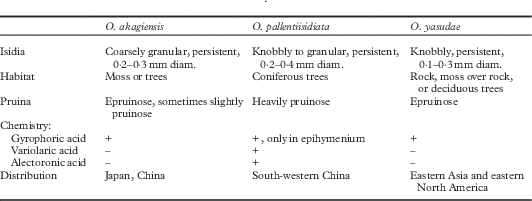
Comments. Ochrolechia akagiensis is similar to O. yasudae Vain., which usually grows directly on rock or moss-covered rock and has cylindrical isidia 0·1–0·3 mm diam., whereas O. akagiensis usually grows on mosses over bark and has granular isidia 0·2–0·3 mm diam. When growing on bark, O. akagiensis resembles O. trochophora (Vain.) Oshio, but the latter species lacks isidia and has larger apothecia (1–3 mm diam.) with smooth to sometimes rosulate discs, the margins of which have large and scattered verrucae (see Table 1).
A comparison of the characters of isidiate species of Ochrolechia in China
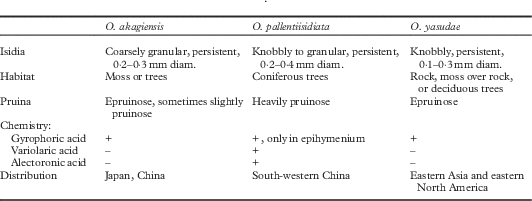
+indicates presence, –indicates absence.
Selected specimens examined (out of 47). China: Anhui: Yuexi Co., Yaoluoping Town, on moss, 1450 m, 2001, Liu 460 (HMAS-L). Fujian: Wuyishan City, Mt. Huanggangshan, on moss, 1840 m, 2004, Zhang wy216 (HMAS-L). Guizhou: Jiangkou Co., Mt. Fanjing, 27°54'N, 108°41'E, on moss, 2120 m, 2012, Ren 2184 (SDNU). Hubei: Shennongjia Forest Area, Houzishi, on moss, 2620 m, 1984, Chen 10421 (HMAS-L); ibid., 2660 m, Chen 10442 (HMAS-L). Hunan: Sangzhi Co., Mt. Tianping, on bark, 1500 m, 1997, Chen et al. 9432 (HMAS-L); Mt. Bagong, on moss, 1400 m, 1997, Chen et al. 9676 (HMAS-L). Jilin: Wangqing Co., Tianqiaoling Town, on moss, 1100 m, 2012, Du 20128106 (SDNU). Liaoning: Kuandian Co., Baishilazi Nature Reserve, 40°53'N, 124°45'E, on moss, 710 m, 1988, Chen 7054-(1) (CANL). Zhejiang: Mt. Tianmu, on roadside between Chanyuan Temple and Laodian, on moss over rock, 1000 m, 1962, Zhao & Xu 6063 (HMAS-L).—Japan: Kushiro: Shiriba Cape, Kushiro-cho, Kushiro-gun, on Quercus crispula, 145 m, 2004, Kashiwadani 47431 [KASHIWADANI, Lich. Munus Cogn. Exs. 313] (CANL).
Ochrolechia alticola Q. Ren sp. nov.
MycoBank No.: MB 815448
Differs from Ochrolechia mexicana by the larger ascospores (63–71×32–43 μm vs 38–60×19–28 μm in O. mexicana) and the absence of lichexanthone. Differs from O. africana by the C+ red reaction of the apothecial margin cortex, the absence of 5-O-methylhiascic acid, and its habitat in the alpine regions of south-western China.
Type: China, Yunnan, Dali City, Mt. Cangshan, 3400 m, on Rhododendron, 2011, Q. Ren 1459 (SDNU—holotype).
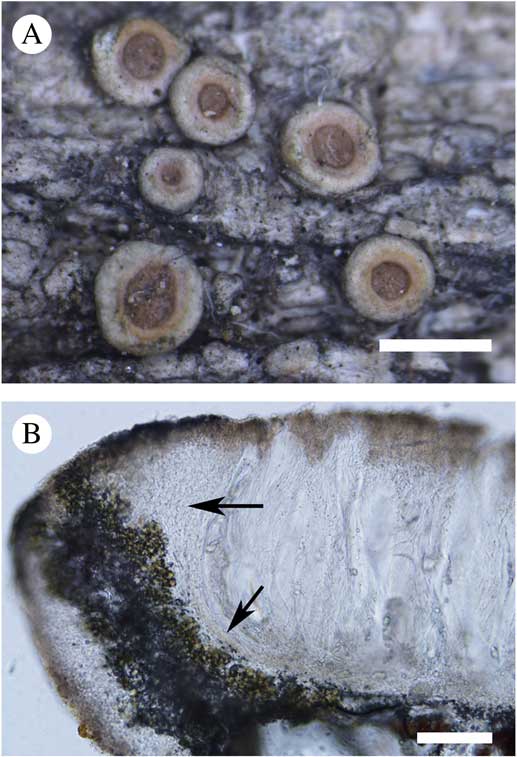
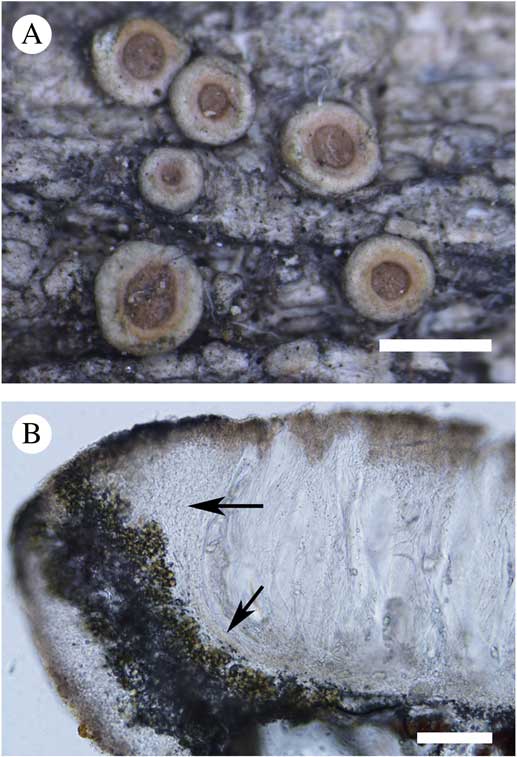
(Fig. 1)
Ochrolechia alticola (holotype). A, thallus with apothecia; B, vertical section through apothecium (arrows pointing to the exciple). Scales: A=1 mm; B=100 μm. In colour online.
Thallus grey, thin, verrucose, shiny or dull; verrucae scattered, irregular, 0·4–0·5 mm diam.; prothallus indistinct; isidia and soredia absent.
Apothecia frequent, scattered, sessile, round, 0·8–1·0 mm diam.; disc light orange-yellow or brownish yellow, epruinose, plane, 0·3–0·5 mm diam.; margins thick, smooth; epihymenium pale brownish, 25–35 μm high; hymenium 260–290 µm high; hypothecium yellowish, 30–33 μm high; exciple c. 20 μm thick below hypothecium, expanding laterally (Fig. 1B), forming a distinct excipular ring around the disc; algae forming a continuous layer in the margin and below the hypothecium; asci narrowly clavate, 8-spored; ascospores simple, hyaline, ellipsoidal, 63–71×32–43 μm.
Etymology. From the Latin altus (high) and cola (dweller), a reference to the high altitudes at which the specimens were collected.
Chemistry. Cortex of thallus and apothecial margin K−, C+ red, KC−; medulla of thallus K−, C−, KC−, medulla of apothecial margin C+ red; epihymenium K−, C+ red, KC+ red; thallus UV−. Gyrophoric acid, 4,5-di-O-methylhiascic acid and trace of lecanoric acid.
Substratum and distribution. Ochrolechia alticola grows on bark at high altitudes between 3400 m and 3600 m in south-western China.
Comments. Ochrolechia alticola is similar in morphology and chemistry to O. mexicana Vain., a North American species, but the latter has smaller ascospores (38–60×19–28 μm) and has a UV+ yellow thallus due to lichexanthone (Brodo Reference Brodo1991). Another similar species, O. africana, has an apothecial margin cortex that reacts C−, contains 5-O-methylhiascic acid, and has a tropical to subtropical habitat (Brodo Reference Brodo1991).
Selected specimens examined (out of 16). China: Yunnan: Luquan Co., Jiaozi Snow Mountain, 3600 m, on bark, 2012, Jiang 20129430 (SDNU); Dali City, Mt. Cangshan, 3450 m, on Rhododendron, 2011, Ren 1471 (SDNU).
Ochrolechia androgyna (Hoffm.) Arnold
Flora 68: 236 (1885); type: Germania (H-ACH—epitype).
Description. See Kukwa (Reference Kukwa2011).
Chemistry. Thallus cortex K−, C+ red, KC+ red; medulla K−, C−, KC−; soralia K−, C+ red, KC+ red; thallus UV−. Gyrophoric acid, lecanoric acid and unidentified fatty acids (androgyna B unknowns).
Substrata and distribution. Ochrolechia androgyna occurs on bark and occasionally on mosses or rock in boreal to arctic regions (Brodo Reference Brodo1991, Reference Brodo2016). In China this species has been previously reported from Shaanxi (Wei Reference Wei1991) and Yunnan (Wei Reference Wei1991; Jia & Zhao Reference Jia and Zhao2003). It also occurs in North America (Brodo Reference Brodo1991; Brodo et al. Reference Brodo, Sharnoff and Sharnoff2001), South America (Messuti & Lumbsch Reference Messuti and Lumbsch2000), Europe (Kukwa Reference Kukwa2011) and India (Awasthi & Tewari Reference Awasthi and Tewari1987).
Comments. Ochrolechia androgyna might be confused with the sorediate species O. arborea (Kreyer) Almb. and O. mahluensis Räs., but they have a different morphology and different lichen substances. Ochrolechia arborea has a thin thallus and contains lichexanthone (UV+ orange) (Kukwa Reference Kukwa2011); O. mahluensis contains no fatty acids. Ochrolechia androgyna is chemically identical to O. tartarea (L.) A. Massal. and both species have thick, verrucose thalli and large apothecia, but O. tartarea is mostly saxicolous and lacks soralia (Brodo Reference Brodo1991; Kukwa Reference Kukwa2011), and it is almost always richly fertile.
Selected specimens examined (out of 27). Canada: British Columbia: Queen Charlotte Islands, 52°37'N, 131°48'W, 1968, Brodo 14238A (CANL).—China: Yunnan: Lijiang City, Mt. Yulong, Yufeng Temple, on bark, 2600 m, 1987, Ahti et al. 46311 (HMAS-L).—Finland: Uusimaa: Kirkkonummi, 30–45 m, on Picea abies, 1992, Brodo 28445 (CANL).—USA: Maine: Washington Co., Great Wass Island, on Picea, 2010, Lendemer 22654 (CANL).
Ochrolechia arborea (Kreyer) Almb.
Bot. Not. 3: 254 (1949); type: Belarus, Gomel’skaya oblast’, 1912, V. P. Savicz (LE—lectotype).
Description. See Brodo (Reference Brodo1991), Brodo & Lendemer (Reference Brodo and Lendemer2012) and Kukwa (Reference Kukwa2011).
Chemistry. Thallus cortex and soralia K−, C+ red, KC+ red, UV+ yellow-orange. Lichexanthone, gyrophoric acid, and trace of lecanoric acid.
Substratum and distribution. Ochrolechia arborea grows on Rhododendron in China. It is known from North America (Brodo Reference Brodo1991; Brodo & Lendemer Reference Brodo and Lendemer2012), Europe (Fletcher et al. Reference Fletcher, James and Purvis2009; Kukwa Reference Kukwa2011), Mongolia (Hauck & Javkhlan Reference Hauck and Javkhlan2006) and Turkey (John & Nimis Reference John and Nimis1998). This is a new record for China.
Comments. Ochrolechia arborea might be confused with O. androgyna, O. mahluensis, or O. turneri (Sm.) Hasselrot but none of these species contain lichexanthone (UV+ orange) (Brodo Reference Brodo1991; Kukwa Reference Kukwa2011).
Selected specimens examined (out of 45). Canada: Ontario: Bruce Co., Bruce Peninsula Park, 45°13'20''N, 81°28'16''W, 180 m, on Thuja, 2008, Brodo 32284 (CANL).—China: Sichuan: Litang Co., Mt. Kazila, 4700 m, on Rhododendron, 2008, Sun 20080365 (SDNU). Yunnan: Lijiang City, Mt. Tiejiashan, 2600 m, on Rhododendron, 2011, Ren 1677 (SDNU); Dali City, Mt. Cangshan, on Rhododendron, 3000 m, 2011, Ren 1376 (SDNU).—USA: Maine: Hancock Co., 44°30'54''N, 68°11'12''W, on Populus grandidentata, Brodo 31821 (CANL).
Ochrolechia frigida (Sw.) Lynge
Sci. Results Norw. Exped. Novaya Zemlya 43: 182 (1928); type: Finland, Lapponia enontekiënsis (S—epitype).
Description. See Fletcher et al. (Reference Fletcher, James and Purvis2009) and Kukwa (Reference Kukwa2011).
Chemistry. Thallus, apothecial margin cortex and epihymenium K−, C+ red, KC+ red; thallus UV−. Gyrophoric acid, trace of lecanoric acid and sometimes unidentified fatty acids.
Substrata and distribution. Ochrolechia frigida grows on detritus, soil or bryophytes in open areas, and it is a bipolar lichen (Kukwa Reference Kukwa2011). In China this species has been previously reported from Sichuan (Jia & Zhao Reference Jia and Zhao2003).
Comments. Ochrolechia frigida is easily distinguished by the pale, distinctive, spine-like extensions of the thallus granules (Fletcher et al. Reference Fletcher, James and Purvis2009). Chinese material is fertile and as such might be confused with O. grimmiae Lynge, but the latter species is endosubstratal (Kukwa Reference Kukwa2011).
Selected specimens examined (out of 21). Canada: British Columbia: Liard River basin, Fairy Lake, 57°20'N, 123°56'16''W, 180 m, on peat, 1977, Brodo 21718 (CANL). Newfoundland and Labrador: Avalon Peninsula, 47°18'55''N, 53°07'40''W, on alpine heath, 2007, Brodo 32080 (CANL).—China: Sichuan: Jiuzhaigou Co., Long Lake, on moss, 3100 m, Zhao et al. S-25-1 (HMAS-L); Songpan Co., Huanglong, on moss, 3325 m, Zhao & Jiang S209 (HMAS-L).
Ochrolechia glacialis Poelt
Khumbu Himal. 1: 255 (1966); type: Nepal, Khumbu, Poelt L417 (M—holotype!).
Thallus white, thin, rough, verrucose; verrucae numerous, crowded, granular, 0·2–0·4 mm diam., gradually giving rise to apothecia; prothallus absent; isidia and soredia absent.
Apothecia abundant, crowded, contiguous, sessile, round, covered with white pruina, 0·8–1·5 mm diam.; disc pale pink-purple, plane or slightly concave; margins thick, concolorous with thallus, smooth; epihymenium hyaline, 33–44 μm high; hymenium hyaline, 250–275 μm high; hypothecium hyaline, 44–55 μm high; exciple well developed, 44–55 μm thick; algal cells forming a continuous layer or in scattered clumps in the margin, absent below the hypothecium; asci well developed, narrowly clavate, 8-spored; ascospores simple, hyaline, ellipsoidal, 72–82×32–40 μm.
Chemistry. Thallus and apothecial margin cortex K−, C+ red, KC+ pink; medulla K−, C−, KC−; epihymenium K+ yellow, C+ red, KC+ red; pruina C−; thallus UV−. Gyrophoric acid and trace of lecanoric acid.
Substrata and distribution. Ochrolechia glacialis grows on mosses, rotting plant debris or soil in alpine regions. In China this species has been previously reported from Xizang (Obermayer Reference Obermayer2004).
Comments. Ochrolechia glacialis is characterized by its habitat; white and thin, granular thallus with abundant apothecia; pale, pink-purple discs; and the production of gyrophoric and lecanoric acids. Chinese specimens examined for this study are identical to the type collected in Nepal, with the exception of slightly larger ascospores (60–70×27–33 μm fide Poelt (Reference Poelt1966)).
Selected specimens examined (out of 21). China: Yunnan: Luquan Co., Jiaozi Snow Mountain, on plant debris, 4300 m, 2008, Wang 20083802 (SDNU); Xianggelila Co., Tiansheng Bridge, on soil, 3500 m, 2008, Ren 20081263 (SDNU); Shika Snow Mountain, on moss, 4300 m, 2008, Wang 20080966 (SDNU).
Ochrolechia lijiangensis Q. Ren sp. nov.
MycoBank No.: MB 815450
Differs from Ochrolechia longispora by the larger apothecia ((1–)2–4(–5) mm vs 0·8–1·7 mm in O. longispora), the smaller ascospores (52–60×22–30 μm vs 80–90(–105)×32–42 μm in O. longispora), and the presence of an additional, undetermined fatty acid.
Type: China, Yunnan, Yulong Co., Lijiang Alpine Botanical Garden, 3450 m, on Pinus densata, 2011, Q. Ren 1626 (SDNU—holotype).
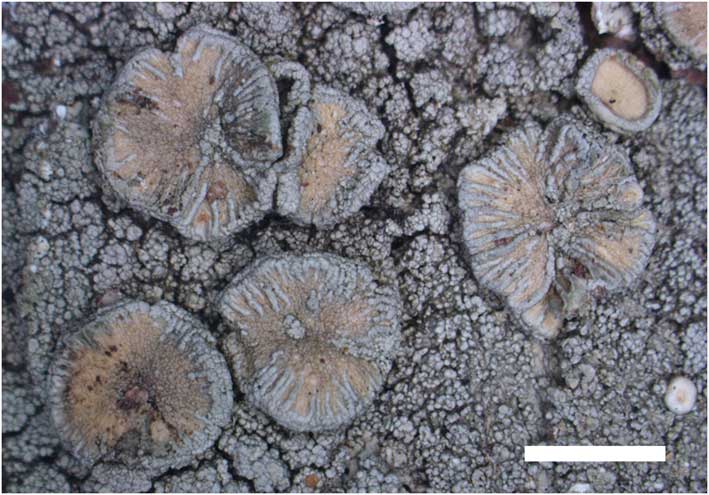
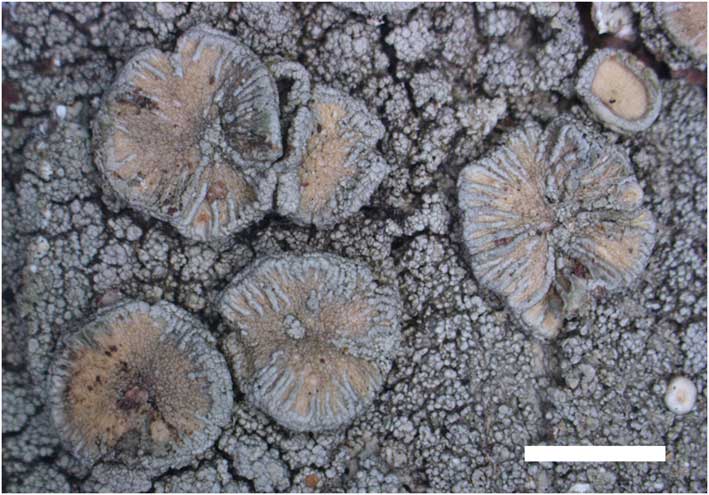
(Fig. 2)
Ochrolechia lijiangensis (holotype), thallus with apothecia. Scale=4 mm. In colour online.
Thallus grey, thin to thick, dull, granulose to verrucolose; prothallus distinct, shiny; isidia and soredia absent.
Apothecia frequent, scattered to crowded, sessile, round, (1–)2–4(–5) mm diam.; disc pale yellowish, epruinose, smooth or rough to rugose, usually with radiating sterile ridges of tissues; margins thick and smooth when young, becoming thin and verruculose when older, concolorous with the thallus; epihymenium hyaline, 20–30 μm high; hymenium 230–260 μm high; hypothecium 50–70 μm high; algae forming a continuous layer in the margin, absent below the hypothecium; asci narrowly clavate, 6–8-spored; ascospores simple, hyaline, narrowly ellipsoidal, 52–60×22–30 μm.
Etymology. Referring to Lijiang, the name of the botanical garden where the type was collected.
Chemistry. Thallus and apothecial margin cortex K−, C+ red, KC+ red; thallus and apothecial margin medulla K−, C−, KC−; epihymenium C+ red; thallus UV−. Gyrophoric acid, trace of lecanoric acid, lichesterinic acid, protolichesterinic acid, and one undetermined fatty acid (A=2, B=1, C=1). This undetermined fatty acid is present in every specimen of O. lijiangensis and therefore can be considered a diagnostic character of the species.
Substrata and distribution. Ochrolechia lijiangensis grows on the bark of Pinus and Rhododendron in alpine regions of south-western China.
Comments. Ochrolechia lijiangensis is similar to O. longispora Brodo & Q. Ren, but the latter species has a thin thallus with much smaller apothecia (0·8–1·7 mm diam.) and larger ascospores (80–90(–105) μm long), and lacks an undetermined fatty acid (A=2, B=1, C=1). Ochrolechia lijiangensis is morphologically similar to O. tartarea and O. trochophora var. trochophora; however, O. tartarea contains fatty acids called ‘androgyna B unknowns’ and usually grows on rocks, while O. trochophora var. trochophora differs by the absence of lichesterinic and protolichesterinic acids (Kukwa Reference Kukwa2011).
Selected specimens examined (out of 21). China: Sichuan: west slope of Mt. Gongga, 3900 m, on Rhododendron, 1982, Wang et al. 9396 (HMAS-L). Yunnan: Dali City, Mt. Cangshan, on Rhododendron, 3100 m, 2011, Ren 1408 (SDNU); Yulong Co., Lijiang Alpine Botanical Garden, on Pinus densata, 3210 m, 2011, Ren 1551 (SDNU).
Ochrolechia longispora Brodo & Q. Ren sp. nov.
MycoBank No.: MB 815451
Differs from O. trochophora in having larger ascospores (80–90(–105)×32–42 μm vs 47–72(–83)×22–30(–36) μm in O. trochophora) and two fatty acids.
Type: China, Shaanxi, Mt. Taibai, Wengong Temple, on Abies, 3600 m, 2005, Q. Ren 1081 (SDNU—holotype).
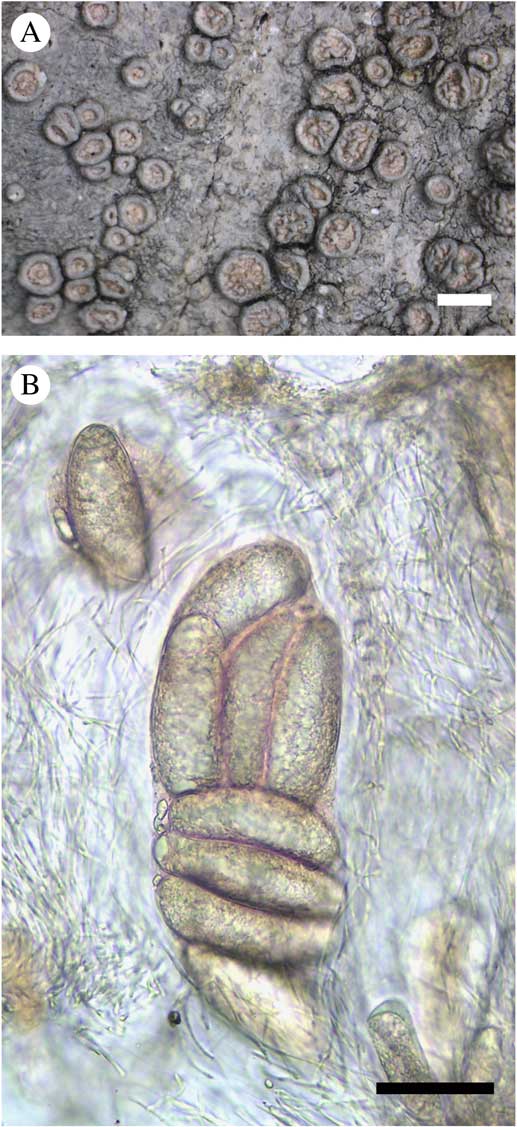
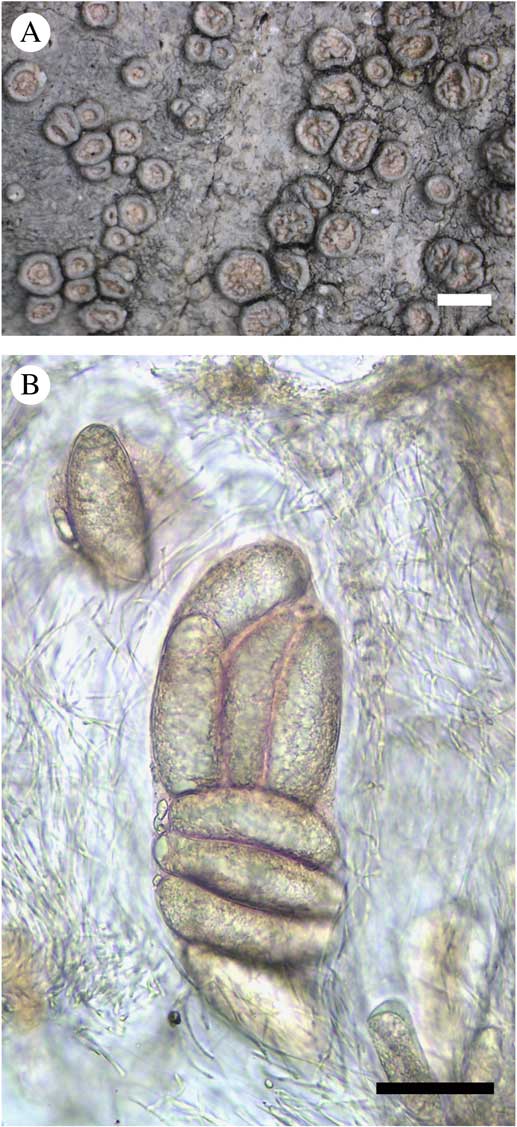
(Fig. 3)
Ochrolechia longispora (holotype). A, thallus with apothecia; B, section of apothecium (showing ascus with ascospores). Scales: A=2 mm; B=50 μm. In colour online.
Thallus dark yellowish grey or greenish grey, thin, rugose to verruculose; prothallus indistinct; isidia and soredia absent.
Apothecia abundant, scattered, often crowded, sessile, round or irregular, 0·8–1·7 mm diam.; disc pinkish, epruinose to lightly pruinose or scabrid, usually somewhat rosulate or umbonate; margins thick, smooth or with a few verrucae; hymenium c. 400 μm high; hypothecium c. 45 μm high; exciple well developed, but not reaching the disc surface; algae continuous in margin, sparse or absent below the hypothecium; asci narrowly clavate, 8-spored; ascospores mostly aborted, simple, hyaline, narrowly ellipsoidal, 80–90(–105)×32–42 μm.
Etymology. From the Latin longispora, longi- (long) and spora (spore), in reference to the long spores.
Chemistry. Thallus and apothecial margin cortex K−, C+ red, KC+ red, UV−; medulla of thallus and margins K−, C−, KC−; epihymenium C+ red. Gyrophoric acid, protolichesterinic acid, lichesterinic acid, and trace of lecanoric acid.
Substrata and distribution. Ochrolechia longispora grows on bark of various kinds in southern and south-western China.
Comments. Ochrolechia longispora generally resembles O. trochophora, but the latter has a thick thallus without fatty acids and has much smaller ascospores (47–72(–83)×22–30(–36) μm). It should be noted that the spores of O. longispora are among the longest in the genus. Another similar species, O. lijiangensis, has a thin to thick thallus with much larger apothecia ((1–)2–4(–5) mm) and smaller ascospores (52–60×22–30 μm), and always contains an undetermined additional fatty acid.
Selected specimens examined (out of 238). China: Anhui: Yuexi Co., Yaoluoping, on bark, 1300 m, 2001, Huang 671 (CANL). Chongqing: Nanchuan Co., Mt. Jinfo, on Salix wallichiana, 2180 m, 2001, Zhao & Jia C-193 (HMAS-L). Fujian: Wuyishan City, Tongmu Village, on bark, 1200 m, 2010, Kou 20104859 (SDNU). Guangdong: Xinyi Co., Datianding, on bark, 1700 m, 2010, Wang 20107218 (SDNU). Guangxi: Tianlin Co., Mt. Cenwanglaoshan, on bark, 1800 m, 2011, Li 20110613 (SDNU). Guizhou: Jiangkou Co., Mt. Fanjing, on bark, 2000 m, 2012, Ren 2207 (SDNU). Hunan: Sangzhi Co., Mt. Bagong, on Castanea mollissima, 1380 m, 1997, Chen et al. 9968 (HMAS-L). Jiangxi: Ji’an City, Xianmo Village, on bark, 2010, Jiang 20106564 (SDNU). Shaanxi: Mt. Taibai, on bark, 2800 m, 2005, Ren 1097 (SDNU). Sichuan: Mt. Emei, on Abies, 3160 m, 1963, Zhao & Xu 7911 (HMAS-L). Xizang: Nielamu Co., Zhangmu Town, on Acer, 2950 m, 1966, Wei et al. 660 (HMAS-L). Yunnan: Yulong Co., Lijiang Alpine Botanical Garden, on Rhododendron, 3590 m, 2011, Ren 1643 (SDNU). Zhejiang: north slope of Qingliang Mountain, on bark, 600 m, 2010, Jiang 20104064 (SDNU).
Ochrolechia mahluensis Räsänen
Ann. Bot. Soc. Zool.-Bot. Fenn. ‘Vanamo’ 21: 1 (1947); type: Finland, Tb [Tavastia borealis], Saarijärvi (H, BP, UPS—isolectotypes).
Description. See Kukwa (Reference Kukwa2011).
Chemistry. Thallus cortex and soralia K−, C+ red, KC+ red, UV−; medulla K−, C− or +red, KC− or +red. Gyrophoric acid and trace of lecanoric acid.
Substrata and distribution. Ochrolechia mahluensis grows on the bark of coniferous trees and Rhododendron in China. The species is known from boreal to arctic areas in Europe (Kukwa Reference Kukwa2011), as well as in North America (Brodo & Lendemer Reference Brodo and Lendemer2012; Brodo Reference Brodo2016). This is a new record for China.
Comments. Ochrolechia mahluensis is characterized by its often shiny, verrucose, sorediate thallus; gyrophoric acid alone as the major secondary metabolite; round soralia; a corticolous habitat; and a distribution in boreal to arctic areas. Ochrolechia mahluensis is similar to O. androgyna, but that species always contains fatty acids (‘androgyna B unknowns’) (Kukwa Reference Kukwa2011). Ochrolechia mahluensis might also be confused with O. arborea, but O. arborea produces lichexanthone (UV+ orange) (Kukwa Reference Kukwa2011).
Selected specimens examined (out of 103). China: Gansu: Zhouqu Co., Huacaopo, 3400 m, on Abies, 2006, Yang 062109 (SDNU). Shaanxi: Mt. Taibai, Mingxing Temple, on bark, 2900 m, 2005, Ren 05-151 (SDNU). Sichuan: Jiuzhaigou Co., Jiuzhai Valley, on bark, 2300 m, Jiang & Zhao S89 (HMAS-L); Songpan Co., Huanglong, on bark, 3300 m, 2001, Jiang & Zhao S164 (HMAS-L). Xizang: Nielamu Co., Zhangmu Town, 2680 m, 1966, Wei et al. 731 (HMAS-L); Linzhi Co., east slope of Mt. Sejila, 4400 m, on Rhododendron, 2007, Han 20073340 (SDNU). Yunnan: Lijiang Co., Yulong Snow Mountain, 2700 m, on Pinus, 2002, Ren 474 (SDNU); Yulong Co., Lijiang Alpine Botanical Garden, 3590 m, on Rhododendron, 2011, Ren 1657 (SDNU).
Ochrolechia margarita Poelt
Khumbu Himal. 1: 257 (1966); type: Nepal, Khumbu, Poelt L-419 (M—holotype!).
Thallus pale yellowish, very thin, mostly endosubstratal; upper surface sometimes with small granular verrucae; isidia and soredia absent.
Apothecia frequent, scattered to crowded, sessile, more or less turbinate when young, becoming subglobose, lower part concolorous with thallus, upper part covered with white pruina, under 1 mm diam.; disc slightly concave; margins thick, smooth or fissured, whitish pruinose; epihymenium pale brown, c. 55 μm high; hymenium hyaline, c. 300 μm high; hypothecium yellowish, c. 50 μm high; algae abundant in the margin and forming a continuous layer below the hypothecium; asci narrowly clavate, 5–6-spored; ascospores mostly aborted, at the most three mature ascospores per ascus, simple, hyaline, ellipsoidal, 72–82×39·0–49·5 μm.
Chemistry. Thallus and apothecial margin cortex K+ yellowish, C+ red, KC+ pink; medulla K−, C−, KC−; epihymenium K+ yellow, C+ red, KC+ red; pruina C−; thallus UV−. Gyrophoric acid and trace of lecanoric acid.
Substrata and distribution. Ochrolechia margarita grows on Rhododendron bark in alpine regions (Poelt Reference Poelt1966). Aptroot & Sparrius (Reference Aptroot and Sparrius2003) reported this species from Taiwan on conifer bark.
Comments. Ochrolechia margarita differs from other Ochrolechia species by its turbinate to subglobose apothecia, the upper part of which are covered with white pruina, and by having at the most three mature ascospores per ascus. The specimens cited by Aptroot & Sparrius (Reference Aptroot and Sparrius2003) can be assigned to O. trochophora var. trochophora and other Ochrolechia spp.
Selected specimens examined (out of 17). China: Sichuan: Litang Co., Mt. Kazila, on Rhododendron, 4700 m, 2008, Du 20080079 (SDNU), Sun 20080364a (SDNU).
Ochrolechia pallentiisidiata Z. F. Jia & Q. Ren
Mycotaxon 106: 234 (2008); type: China, Yunnan, Su 0214 (HMAS-L—holotype!).
Description. See Jia et al. (2008 Reference Jia, Ren and Zhaoa ).
Chemistry. Thallus and apothecial margin cortex K−, C− or + yellowish, KC−; medulla of apothecial margin K−, C−, KC+ pink, UV+ white; epihymenium K−, C+ red, KC+ red; pruina C+ yellowish; thallus UV−. Gyrophoric acid and trace of lecanoric acid only in epihymenium, variolaric acid in cortex and pruina, and alectoronic acid in medulla of apothecial margin.
Substratum and distribution. This species is known from Weixi County in Yunnan Province where it grows above 2400 m on coniferous trees.
Comments. Ochrolechia pallentiisidiata is characterized by the knobbly to granular isidia, disc covered with white pruina, 6–8-spored asci with large ascospores (70–85×37·5–45·0 μm) and the chemistry. This species resembles O. pallescens (L.) A. Massal. and O. yasudae Vain. but O. pallescens has no isidia and mostly grows on the bark of deciduous trees at altitudes up to 1500 m (Kukwa Reference Kukwa2011) while O. yasudae lacks alectoronic acid and pruina on the discs and mostly grows on rocks, moss over rock or bark (see Table 1). The presence of variolaric acid and alectoronic acid is not mentioned in the original description of O. pallentiisidiata by Jia et al. (2008 Reference Jia, Ren and Zhaoa ) and this information is included here as a diagnostic character of the species.
Specimens examined (out of 2). China: Yunnan: Weixi Co., Weideng Town, 3200 m, on bark of coniferous tree, 1982, Su 0805 (LCU); Weixi Co., Yezhi Town, 2400 m, on Abies fabri, 1982, Su 0241 (HMAS-L).
Ochrolechia pallescens (L.) A. Massal.
Nuov. Annal. Sci. Nat. Bologna 7: 212 (1853); type: Sweden, Härjedalen, R. Santesson 24384 (UPS—conserved type).
Description. See Kukwa (Reference Kukwa2011).
Chemistry. Thallus and apothecial margin cortex K−, C− or +yellowish or yellow, KC−; medulla K−, C−, KC−; epihymenium K−, C+ red, KC+ red; pruina C−; thallus UV−. Gyrophoric acid, variolaric acid, trace of lecanoric acid and usually alectoronic acid (alectoronic acid was not detected by TLC in two of the specimens examined (Ren 1020, Guo & Shi QL288)).
Substrata and distribution. Elsewhere, O. pallescens grows mostly on the bark of deciduous trees and rarely on conifers at altitudes up to c. 1500 m, very rarely above 2000 m (Kukwa Reference Kukwa2011). However, in China this species grows at altitudes above 2100 m. The Chinese material may represent an undescribed species, and further study is recommended. In China this species has been previously reported from Sichuan (Wei Reference Wei1991; Jia & Zhao Reference Jia and Zhao2003), Yunnan (Zahlbruckner Reference Zahlbruckner1930; Wei Reference Wei1991), Hunan (Zahlbruckner Reference Zahlbruckner1930), Anhui (Wu & Qian Reference Wu and Qian1989), and Taiwan (Aptroot & Sparrius Reference Aptroot and Sparrius2003). It is known from Europe, the Canary Islands, Cyprus, Georgia, Syria and Turkey (Kukwa Reference Kukwa2011).
Comments. Ochrolechia pallescens is characterized by often having pruinose discs and the production of variolaric acid in the cortex and gyrophoric acid only in the epihymenium. It closely resembles O. parella (L.) A. Massal., inasmuch as both species have thick thalli, abundant apothecia, the same secondary metabolites and usually pruinose discs; O. parella, however, is saxicolous (Brodo Reference Brodo1991; Kukwa Reference Kukwa2011).
Selected specimens examined (out of 127). Austria: Niederösterreich: 8 km SSE of Lilienfeld, 47°56'50''N, 15°39'E, on Fraxinus excelsior, 1995, Türk 20558 [OBERMAYER, Lichenotheca Graecensis, Fasc. 7 & 8 (no. 143)] (CANL).—China: Gansu: Wenxian Co., Qiujiaba, on bark, 2630 m, 2006, Shi 062168 (SDNU). Hubei: Shennongjia Forest Area, Jinhouling, on bark, 2190 m, 2008, Zhao & Han 20101610 (SDNU). Shaanxi: Ningshan Co., Pingheliang, on bark, 2300 m, 2005, Zhao 509 (CANL & SDNU); ibid., on Pinus, Ren 1020 (SDNU); Mt. Taibai, on roadside between Dadian and Doumu Temples, on bark, 2820 m, 2005, Guo & Shi QL288 (SDNU); Fangyang Temple, on Picea, 3200 m, 2005, Ren 1076 (SDNU). Taiwan: Hualian Co., Taroko National Park, Hehuan Shan, on Tsuga formosana, 3000 m, 2001, Aptroot 52765 (F).
Ochrolechia rugomarginata Q. Ren sp. nov.
MycoBank No.: MB 815812
Differs from O. pallescens by the minutely verruculose margins of the mature apothecia, sometimes in concentric rings, the lack of variolaric acid and the C+ red thalline cortex. Differs from O. trochophora var. trochophora by the presence of alectoronic acid in the apothecial medulla, the coarsely pruinose disc and a preference for bark of coniferous trees.
Type: China, Shaanxi, Meixian Co., Mt. Taibai, on Pinus, 2800 m, 2005, Q. Ren 1098 (SDNU—holotype; CANL—isotype).
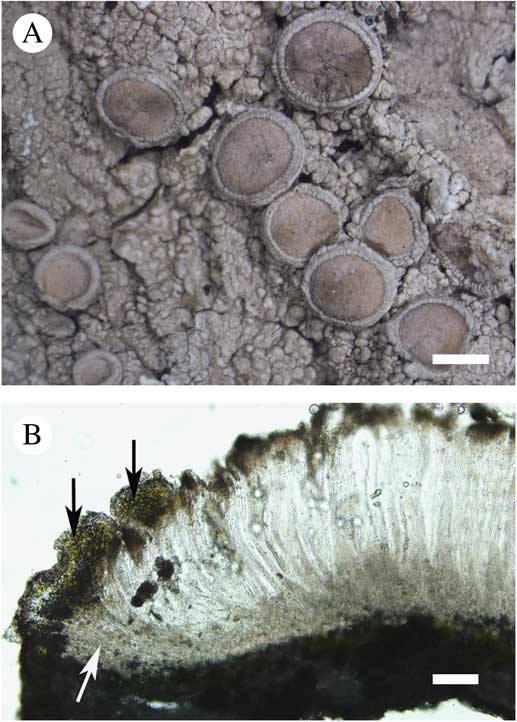
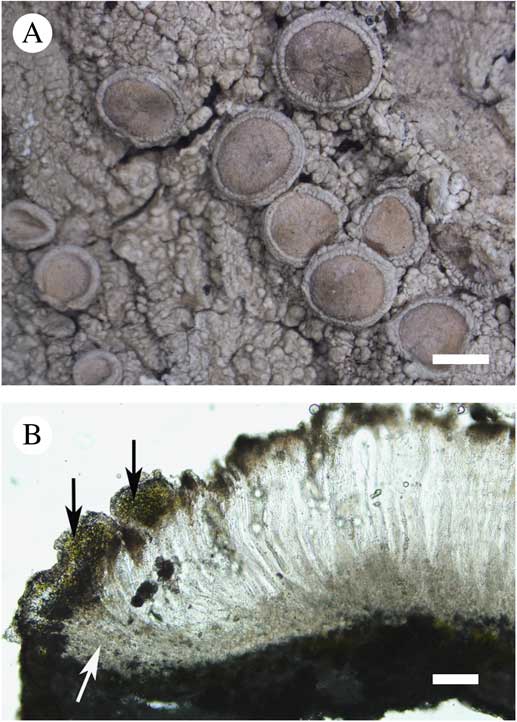
(Fig. 4)
Ochrolechia rugomarginata (holotype). A, thallus with apothecia; B, section of apothecium (black arrows pointing to the expanded thalline tissue, white arrow pointing to the parathecium). Scales: A=2 mm; B=200 μm. In colour online.
Thallus grey or yellowish grey, thin to thick, dull, verrucose; verrucae hemispheric, scattered to crowded, 0·1–0·2 mm diam.; prothallus usually distinct, shiny, whitish; isidia and soredia absent.
Apothecia abundant, scattered, sometimes contiguous, sessile, round, 1·5–3·3 mm diam.; disc plane or slightly concave, coarsely pruinose; margins single and smooth when young, becoming verruculose on the inner part when mature and sometimes appearing as concentric rings; apothecial cortex well developed, 30–50 μm thick; hymenium hyaline, 300–325 μm high; hypothecium 35–50 μm high; algae forming a continuous layer or in scattered clumps in the margin and below the hypothecium; asci narrowly clavate, 8-spored; ascospores simple, hyaline, narrowly ellipsoidal, 65–80×28–37 μm.
Etymology. From the Latin rugosus (wrinkled, rough) and marginata (margin), in reference to the ‘wrinkled’, verruculose margins of the mature apothecia.
Chemistry. Thallus and apothecial margin cortex K−, C+ red, KC+ red, UV−; medulla of apothecial margin K−, C−, KC+ pink, UV+ white; disc K−, C+ red, KC+ red. Gyrophoric acid, alectoronic acid and lecanoric acid (trace).
Substratum and distribution. Ochrolechia rugomarginata grows on conifer bark at altitudes of between 2600 m and 3200 m in central China.
Comments. This species is characterized by coarsely pruinose discs, apothecial margins that are always rough when mature, a preference for bark of coniferous trees and the production of gyrophoric and alectoronic acids as major lichen substances, gyrophoric acid in the thallus cortex as well as the apothecial disc and alectoronic acid in the apothecial medulla. Ochrolechia rugomarginata resembles O. pallescens in overall appearance and in containing alectoronic acid. However, O. pallescens contains variolaric acid in the apothecial margin cortex and gyrophoric acid only in the epihymenium, so that the thallus and apothecial cortex are C− or C+ yellow (Kukwa Reference Kukwa2011). The rough apothecial margin develops in mature apothecia by expanding over the outer edge of the disc with thalline, warty tissue, and covering the expanded parathecium (Fig. 4B). This appears to be a unique feature of this species, not known to occur in other Chinese species of Ochrolechia. Ochrolechia rugomarginata is also similar to O. trochophora var. trochophora in morphology but the latter species always lacks alectoronic acid in the thallus and pruina on the disc, and grows on various kinds of trees and rarely on rocks.
Selected specimens examined (out of 26). China: Shaanxi: Meixian Co., on Pinus, 2600–3200 m, 2011, Dong 20114295 (SDNU), Cheng 20113964, 20114902 (SDNU), Huang 20114827, 20114977 (SDNU).
Ochrolechia subrosella Z. F. Jia & Z. T. Zhao
Mycosystema 24 (2): 162 (2005); type: China, Yunnan, Dali, Wei WY014-1 (HMAS-L—holotype!).
Description. See Jia & Zhao (Reference Jia and Zhao2005).
Chemistry. Thallus and apothecial margin cortex, and epihymenium K−, C+ red, KC+ red; medulla K−, C−, KC−; thallus UV−. Gyrophoric acid and lecanoric acid (trace).
Substrata and distribution. Ochrolechia subrosella grows mainly on coniferous bark such as Picea. The species is known only from south-western China (Jia & Zhao Reference Jia and Zhao2005).
Comments. Ochrolechia subrosella resembles O. subpallescens Verseghy morphologically, but differs in chemistry and anatomy: O. subpallescens contains gyrophoric, lecanoric and 4-O-demethylmicrophyllinic acids (as well as olivetoric acid in most specimens), and it has a continuous algal layer below the hypothecium (Brodo Reference Brodo1991). Other similar species are O. trochophora, which differs by having abundant algae in an often verrucose apothecial margin, and O. brodoi Kukwa, which contains lichesterinic acid (Kukwa Reference Kukwa2011).
Selected specimens examined (out of 89). China: Xizang: Linzhi Co., east slope of Mt. Sejila, 4400 m, on Rhododendron, 2007, Han 20127973 (SDNU). Yunnan: Dali City, Mt. Cangshan, on Picea, 3850 m, 2002, Wei WY014-1 (HMAS-L), WY014 (HMAS-L & CANL); Lijiang City, Mt. Laojun, on Picea, 3800 m, 2002, Ren 442 (SDNU); Luquan Co., Jiaozi Snow Mountain, on Picea, 3800 m, 2008, Du 20083804 (SDNU).
Ochrolechia szatalaënsis Verseghy
Ann. Hist.-Nat. Mus. Natl. Hung. 50: 80 (1958); type: Bulgaria, 1929, Szatala (BH—holotype; BP—lectotype; BP—isolectotype).
Description. See Brodo (Reference Brodo1991) and Kukwa (Reference Kukwa2011).
Chemistry. Thallus and apothecial margin cortex, and epihymenium K−, C+ yellow, KC−; medulla K−, C−, KC−; thallus UV−. Variolaric acid and murolic acid complex (murolic and hydromurolic acids).
Substrata and distribution. Ochrolechia szatalaënsis grows on bark or wood of different kinds in open habitats (Brodo Reference Brodo1991; Kukwa Reference Kukwa2011). It has previously been reported from Europe and North America (Brodo Reference Brodo1991; Fletcher et al. Reference Fletcher, James and Purvis2009; Kukwa Reference Kukwa2011); Africa, Turkey, and South America (Kukwa Reference Kukwa2011); and Kazakhstan (Hauck et al. Reference Hauck, Tønsberg, Mayrhofer and Breuss2013). This is the first report of this species from China.
Comments. Ochrolechia szatalaënsis is characterized by a very thin and smooth thallus, the presence of variolaric acid and the murolic acid complex, heavily pruinose apothecial discs, an expanded and glassy cortex at the base of the apothecial margin, and a corticolous habitat. Chemically, O. szatalaënsis is identical to O. upsaliensis (L.) A. Massal.; however, O. upsaliensis is an arctic-alpine species that grows on soil, moss and plant remains, it has a thick thallus with crowded apothecia, and the apothecial margin cortex is not expanded at the base and never glassy (Kukwa Reference Kukwa2011).
Selected specimens examined (out of 12). Canada: British Columbia: 13·9 miles S of Squamish on Rt. No. 99, 49°29'N, 123°13'W, on Alnus, 1966, Brodo 8156 (CANL).—China: Xinjiang: Buerjin Co., Kanas National Nature Reserve, 48°40'N, 87°01'E, 1340 m, on bark, 2013, Ren 3227 (SDNU).—USA: Idaho: Idaho Co., above Walton Lake, 35°49'N, 82°08'W, on Thuja plicata, 1981, McCune 11691 (CANL).
Ochrolechia trochophora (Vain.) Oshio var. trochophora
J. Sci. Hiroshima Univ., Ser. B, Div. 2, 12: 145 (1968); type: Japan, Yasuda 53 (TUR-V—lectotype).
=Ochrolechia chondriocarpa Zahlbr., in Handel-Mazzetti, Symb. Sin. 3: 176 (1930); type: China, Fujian, Chung F-281 (HMAS-L—lectotype!).
Description. See Brodo (Reference Brodo1991) and Kukwa (Reference Kukwa2011).
Chemistry. Thallus and apothecial margin cortex K−, C+ red, KC−; medulla K−, KC−, C−; epihymenium K+ yellow, C+ red, KC+ red; thallus UV−. Gyrophoric acid and trace of lecanoric acid.
Substrata and distribution. Ochrolechia trochophora usually grows on bark of various kinds and is rarely found on rocks. In China this species has been previously reported from Fujian (Zahlbruckner Reference Zahlbruckner1930, as O. chondriocarpa; Kukwa Reference Kukwa2011), Anhui and Zhejiang (Wu & Qian Reference Wu and Qian1989), Taiwan (Wei Reference Wei1991; Aptroot & Sparrius Reference Aptroot and Sparrius2003, as O. rosella), Yunnan (Wei Reference Wei1991, as O. rosella), Guizhou (Jia & Zhao Reference Jia and Zhao2003; Zhang et al. Reference Zhang, Li and Wei2006) and Jiangxi and Guangxi (Jia & Zhao Reference Jia and Zhao2003). This species also occurs in Central Europe (Kukwa Reference Kukwa2011) and eastern North America (Brodo Reference Brodo1991; Brodo et al. Reference Brodo, Sharnoff and Sharnoff2001).
Comments. Ochrolechia trochophora var. trochophora is characterized by coarsely-granular, white-tipped verrucae on the thallus and apothecial margins; epruinose, rugose to rosulate discs; and the presence of gyrophoric acid in the epihymenium, apothecial margins and thalline cortex. Ochrolechia trochophora var. trochophora is similar to O. akagiensis, O. subrosella and O. longispora in having a C+ red cortex and C− medulla. However, O. akagiensis has coarsely granular isidia, O. subrosella has sparsely distributed algal cells in the apothecial margin, which is smooth and becomes thin with age, and O. longispora has larger spores and contains lichesterinic and protolichesterinic acids. Ochrolechia trochophora varies greatly in appearance and probably as a consequence, it has been reported from China as the following similar species: Ochrolechia montana Brodo, O. oregonensis H. Magn., O. isidiata and O. subisidiata Brodo. Also, O. rosella, a synonym of O. trochophora (Oshio Reference Oshio1971; Brodo Reference Brodo1991), has been reported as a separate species for China. For details, see the section on excluded and doubtful taxa below. Other synonyms of O. trochophora include O. harmandii f. granulosa Verseghy, and O. harmandii f. pustulata Verseghy, the types of which were collected from China (Kukwa 2009 Reference Kukwaa , Reference Kukwa2011).
Selected specimens examined (out of 336). Canada: Ontario: Algonquin Provincial Park, 46°04'24''N, 78°22'29''W, on Fagus, 2007, Brodo 32019 (CANL).—China: Gansu: Wenxian Co., Qiujiaba, on dead wood, 2350 m, 2006, Yang & Shi 061517-1, 061571 (SDNU). Guizhou: Jiangkou Co., Mt. Fanjing, near Cheng’en Temple, 27°54'N, 108°41'E, on Acer davidii, 2120 m, 2012, Ren 2161 (SDNU). Heilongjiang: Tieli City, Taoshan National Forest Garden, on bark, 750 m, 2011, Cheng 20119926 (SDNU). Hubei: Shennongjia Forest Area, on bark, 2600 m, 2008, Zhao 20101633 (SDNU). Hunan: Sangzhi Co., Mt. Bagong, on bark, 1380 m, 1997, Chen et al. 9784-1 (HMAS-L). Jiangxi: Lushan Botanical Garden, on rock, 1963, Zhao 346 (HMAS-L). Jilin: Helong Co., Mt. Zengfengshan, on Pinus, 1100 m, 2011, Cheng 20119918 (SDNU). Shaanxi: Mt. Taibai, Luotuo Temple, on Quercus, 2100 m, 2005, Ren 1058 (SDNU). Sichuan: Dujiangyan, Longchi, on bark, 1800 m, 1997, Chen 97523 (HMAS-L). Xizang: Linzhi Co., Mt. Sejila, on Betula, 3300 m, 2007, Han 20073022 (SDNU). Yunnan: Jianchuan Co., Mt. Shibaoshan, on Quercus acutissima, 2600 m, 2011, Ren 1707 (SDNU); Lijiang Co., Yulong Snow Mountain, on Pinus yunnanensis, 2700 m, 2002, Ren 0269 (SDNU). Zhejiang: Mt. Tianmu, on the roadside between Kaishan Laodian and the Weather Forecast Station, on bark, 1200 m, 1960, Zhao & Xu 6200 (HMAS-L). Taiwan: Hualian Co., 43 km WNW of Hualian, Meifeng, on bark, 2100 m, 2001, Aptroot 52439 (F).—USA: North Carolina: Haywood Co., Blue Ridge Parkway, 35°49'N, 82°08'W, 1994, Sharnoff & Sharnoff 1536.05 (CANL).
Ochrolechia trochophora (Vain.) Oshio var. pruinirosella Brodo
Can. J. Bot. 69 (4): 763 (1991); type: USA, Wisconsin, J. W. Thomson 11330 (WIS—holotype).
Description. See Brodo (Reference Brodo1991).
Chemistry. Thallus and apothecial margin cortex, and epihymenium K−, C+ red, KC+ red; medulla C−, KC−, K−. Gyrophoric acid, variolaric acid and lecanoric acid (trace).
Substratum and distribution. Ochrolechia trochophora var. pruinirosella grows on the bark of various trees. This variety was previously known from North America, mainly in the north-east (Brodo Reference Brodo1991); it is the first report from China.
Comments. Ochrolechia trochophora var. pruinirosella differs from O. trochophora var. trochophora by its smaller apothecia and pruinose discs, and by usually containing variolaric acid (Brodo Reference Brodo1991). Although Brodo (Reference Brodo1991) did not find consistency in pruina and chemistry in O. trochophora var. pruinirosella, this was not the case with the Chinese specimens examined for this study (pruina always occurred in specimens with variolaric acid) and with genetic analysis it may well prove to be a separate species. In this regard, it should be noted that almost all the Chinese specimens are found on coniferous bark and all are confined to a relatively small area in north-eastern China.
Selected specimens examined (out of 29) (* Paratypes). *Canada: New Brunswick: Albert Co., Fundy National Park, 45°39'N, 65°07'W, on Betula alleghaniensis, 1980, Gowan 3129 (CANL). Quebec: Gatineau Co., Kirk’s Ferry, near Meech Lake, 45°34'N, 75°54'W, on Betula alleghaniensis, 1967, Brodo 9630 (CANL); Papineau Co., Lac Clair, on Acer saccharum, 45°44'N, 75°48'W, 290 m, Brodo 25290 (CANL).—China: Heilongjiang: Tieli City, Taoshan National Forest Garden, on Pinus, 700 m, 2011, Cheng 20125855 (SDNU); ibid., 750 m, Cheng 20119932 (SDNU); ibid., 800 m, Cheng 20125853 (SDNU). Jilin: Antu Co., Baishan Forest Farm, on fallen wood, 1690 m, 1960, Yang et al. 15 (HMAS-L); south slope of Mt. Changbai, on Abies, 1700 m, 1994, Wei et al. 94244 (HMAS-L); Helong Co., Mt. Zengfengshan, on Pinus, 1500 m, 2011, Cheng 20119700 (SDNU); ibid., 1600 m, Jiang 20119921 (SDNU).
Ochrolechia upsaliensis (L.) A. Massal.
Ric. Auton. Lich. Crost.: 31 (1852); type: ‘Upsalia’ (LINN-HL—lectotype; E—syntype).
Description. See Kukwa (Reference Kukwa2011).
Chemistry. Thallus, apothecial margin cortex, and epihymenium C− or C+ yellow, K−, KC−; medulla C−, K−, KC−; thallus UV−. Variolaric acid and murolic acid complex.
Substrata and distribution. Ochrolechia upsaliensis grows on plant debris or moss on arctic and alpine tundra from Europe, Mongolia, Russia (Kukwa Reference Kukwa2011) and North America (Brodo et al. Reference Brodo, Sharnoff and Sharnoff2001; Kukwa Reference Kukwa2011). In China this species has been previously reported from Xijiang (Mamut et al. Reference Mamut, Tursun and Abbas2014).
Comments. Ochrolechia upsaliensis is terricolous or muscicolous, has crowded, round, coarsely pruinose apothecia and contains variolaric and murolic acids. Ochrolechia szatalaënsis has similar chemistry but is corticolous, has scattered apothecia and, compared to O. upsaliensis, has an apothecial margin that is expanded at the base and glassy (Kukwa Reference Kukwa2011).
Selected specimens examined (out of 16). Canada: British Columbia: Lillooet, c. 10 miles E, 50°53'N, 121°50'W, 1988, Brodo 27325B (CANL). Saskatchewan: Grasslands National Park, 49°03·866'N, 106°31·699'W, on Selaginella densa, 2009, Freebury 853A (CANL).—China: Xinjiang: Hejing Co., Mt. Bayinbuluke, 2639 m, 2013, Abbas & Mamut 20131690 (SDNU).—Mongolia: Changj, 2200m, 1973, Golubkova & Zogt 958 (CANL).
Ochrolechia yasudae Vain.
Bot. Mag. (Tokyo) 32: 155 (1918); type: Japan, Yasuda 52 (TUR-V—holotype & isotype).
Description. See Brodo (Reference Brodo1991).
Chemistry. Thallus and apothecial margin cortex K+ yellowish, C+ red, KC−; medulla K−, C−, KC−; epihymenium K+ yellowish, C+ red, KC−; thallus UV−. Gyrophoric acid, trace of lecanoric acid, and an unidentified fatty acid (A=2, B=1, C=1).
Substrata and distribution. Ochrolechia yasudae grows on rocks (often sandstones), sometimes also extending onto saxicolous moss, and on deciduous tree bark. In China, this species has been previously reported from Hunan (Wu Reference Wu1987), Anhui, Jiangxi, Zhejiang (Wu & Qian Reference Wu and Qian1989) and Taiwan (Aptroot & Sparrius Reference Aptroot and Sparrius2003). It is an eastern Asian and eastern North American species from temperate regions (Howard Reference Howard1970; Brodo Reference Brodo1991; Brodo et al. Reference Brodo, Sharnoff and Sharnoff2001).
Comments. Ochrolechia yasudae could be confused with O. akagiensis, especially when poorly developed, but O. yasudae has cylindrical isidia whereas the isidia on O. akagiensis are granular. Other isidiate species, such as O. antillarum, O. isidiata and O. subisidiata, have a C+ red medulla and occur in the tropical and subtropical regions of America (Brodo Reference Brodo1991). Other Chinese species of Ochrolechia with isidia differ in the characters outlined in Table 1.
Selected specimens examined (out of 78). China: Anhui: Yuexi Co., Yaoluoping Town, on rock, 1450 m, 2001, Huang 624 (HMAS-L); Mt. Huangshan, Ciguang Temple, on moss over bark, 1956, Chen 6109 (HMAS-L). Fujian: Wuyishan City, Guadun, 1100 m, on moss over rock, 1980, Qian 02124 (HMAS-L). Jilin: Mt. Changbai, Hancong Gou, on rock, 750 m, 1994, Wei et al. 94010 (HMAS-L). Hebei: Xinglong Co., Mt. Wuling, on moss, 1390 m, 1931, Liou L.97 (HMAS-L). Hubei: Shennongjia, Qianjiaping, on moss over rock, 1850 m, 1984, Chen 11645-2 (HMAS-L). Shaanxi: Ningshan Co., Pingheliang, on moss, 2100 m, 2005, Ren 1012 (SDNU). Yunnan: Deqin Co., Meili Snow Mountain, 3500 m, on Quercus, 1994, Wang 94-15429 (KUN-L). Zhejiang: Jiulongshan, 630 m, on rock, 1987, Chen Z0180 (HMAS-L).—Japan: Nemuro: N Shore of Furenko Lake, on deciduous tree, 5–10 m, 1995, Thor 14427 [KASHIWADANI, Lich. Munus Cogn. Exs. 71] (CANL).—USA: North Carolina: Haywood Co., Big Creek, 35°44'N, 83°07'W, 600–700 m, 1977, Brodo 22552 (CANL).
Excluded and doubtful taxa
Ochrolechia alboflavescens (Wulfen) Zahlbr.
Verhandl. Zool. Bot. Ges. Wien 76: 94 (1927).
This species was reported from China by Jia et al. (2008 Reference Jia, Ren, Sun and Zhaob ) and Zhang et al. (Reference Zhang, Yang, Ren and Zhao2008) but, on re-examination, the material can be assigned to O. trochophora var. trochophora. One specimen, Wang & Xiao 11469, contains only atranorin and is not, therefore, an Ochrolechia species.
Ochrolechia antillarum Brodo
Can. J. Bot. 69: 743 (1991).
Specimens from Hubei cited by Zhao & Jia (Reference Zhao and Jia2002) and Jia & Zhao (Reference Jia and Zhao2003) are assigned to O. akagiensis. A single specimen from Gansu cited by Zhang et al. (Reference Zhang, Yang, Ren and Zhao2008) is assigned to O. trochophora var. trochophora.
Ochrolechia balcanica Verseghy
Beih. Nova Hedwigia 1: 85 (1962).
This species was recorded from China by Jia et al. (2008 Reference Jia, Ren, Sun and Zhaob ) but the specimens upon which the report was based contain lichesterinic and protolichesterinic acids which are not found in O. balcanica. The material is assigned to O. longispora.
Ochrolechia isidiata (Malme) Verseghy
Beih. Nova Hedwigia 1: 96 (1962).
On re-examination, material reported by Jia & Zhao (Reference Jia and Zhao2003) can be assigned to O. longispora while the specimens reported by Zhang et al. (Reference Zhang, Yang, Ren and Zhao2008) are assigned to O. trochophora var. trochophora.
Ochrolechia laevigata (Räsänen) Verseghy ex D. Hawksw.
Index of Fungi Suppl. 44 (1972).
This species is known only from the west coast of North America and contains olivetoric acid (Brodo Reference Brodo1991) which the Chinese specimen cited by Gao & Ren (Reference Gao and Ren2012) does not. It can be assigned to O. longispora.
Ochrolechia mexicana Vain.
Dansk Bot. Arkiv, 4(11): 9 (1926).
This species was reported from China by Zhang et al. (Reference Zhang, Yang, Ren and Zhao2008) based on a single specimen which, on re-examination, can be assigned to O. trochophora var. trochophora.
Ochrolechia microstictoides Räsänen
Lich. Fenn. Exs. no. 226 (1936).
The Chinese material cited by Jia & Zhao (Reference Jia and Zhao2003) does not belong to the genus Ochrolechia.
Ochrolechia montana Brodo
Can. J. Bot. 69: 753 (1991).
This species was reported from China by Zhao & Jia (Reference Zhao and Jia2002), Jia & Zhao (Reference Jia and Zhao2003), Zhao et al. (Reference Zhao, Guo and Zhao2006) and Zhang et al. (Reference Zhang, Yang, Ren and Zhao2008). The material on which these reports are based can be assigned to O. trochophora var. trochophora. Ochrolechia montana is endemic to western North America (Brodo Reference Brodo1991).
Ochrolechia oregonensis H. Magn.
Meddel. Göteb. Bot. Trädg. 13: 251 (1939).
Chinese specimens reported by Zhang et al. (Reference Zhang, Yang, Ren and Zhao2008) do not have a pink or discoloured excipular ring on the apothecial discs, unlike O. oregonensis, and they are therefore assigned to O. trochophora var. trochophora. Ochrolechia oregonensis is endemic to western North America (Brodo Reference Brodo1991; Brodo et al. Reference Brodo, Sharnoff and Sharnoff2001).
Ochrolechia parella (L.) A. Massal.
Ric. Auton. Lich. Crost.: 32 (1852).
Material reported from China by Zhao et al. (Reference Zhao, Guo and Zhao2006) is corticolous and is assigned to O. pallescens. Ochrolechia parella is a saxicolous species (Kukwa Reference Kukwa2011).
Ochrolechia pseudopallescens Brodo
Can. J. Bot. 69: 755 (1991).
The Chinese material cited by Zhao et al. (Reference Zhao, Guo and Zhao2006) does not contain fatty acids and can be referred to O. pallescens. Ochrolechia pseudopallescens is endemic to eastern North America (Brodo Reference Brodo1991).
Ochrolechia rosella (Tuck.) Verseghy
Beih. Nova Hedwigia 1: 110 (1962).
This species as reported for China by Wei (Reference Wei1991), Aptroot & Sparrius (Reference Aptroot and Sparrius2003) and Jia & Zhao (Reference Jia and Zhao2003) is synonymous with O. trochophora (Oshio Reference Oshio1971; Brodo Reference Brodo1991).
Ochrolechia subisidiata Brodo
Can. J. Bot. 69: 759 (1991).
Although reported from China by Jia & Zhao (Reference Jia and Zhao2003), this species is not accepted here. The single specimen cited therein contains only gyrophoric and lecanoric acids and is assigned to O. trochophora var. trochophora. Ochrolechia subisidiata contains variolaric acid and is known from the south-western USA (Brodo Reference Brodo1991).
Ochrolechia subpallescens Verseghy
Beih. Nova Hedwigia 1: 118 (1962).
The Chinese material cited by Jia & Zhao (Reference Jia and Zhao2003) and Zhang et al. (Reference Zhang, Yang, Ren and Zhao2008) contains only gyrophoric and lecanoric acids and can be referred to O. trochophora var. trochophora. The specimens cited by Aptroot & Sparrius (Reference Aptroot and Sparrius2003) contain gyrophoric and protolichesterinic acids and lack olivetoric acid; furthermore algal cells are sparse in the apothecial margin and do not form a layer below the hypothecium, a reliable characteristic of O. subpallescens. It comes closest to O. longispora but it has shorter spores (62–70×22·5–27·5 µm). Although I have been unable to examine the specimens cited by Verseghy (Reference Verseghy1962), I am doubtful that O. subpallescens occurs in China and prefer to exclude it from the Chinese flora pending further research.
Ochrolechia subviridis (Høeg) Erichsen
Verh. Bot. Ver. Brandenb. 72: 3 (1930).
This species was reported from China by Zhao & Jia (Reference Zhao and Jia2002) and Jia et al. (2008 Reference Jia, Ren, Sun and Zhaob ). Two of the specimens on which these reports are based (Chen Z0180, Qian 02124) are assigned to Ochrolechia yasudae while two others (Qian 02912, 01498(c)) belong to the genus Pertusaria.
Ochrolechia tartarea (L.) A. Massal.
Ric. Auton. Lich. Crost. (Verona): 30 (1852).
This species was reported from China by Verseghy (Reference Verseghy1962), Chen et al. (Reference Chen, Wu and Wei1989), Jia & Zhao (Reference Jia and Zhao2003), Zhao et al. (Reference Zhao, Guo and Zhao2006) and Zhang et al. (Reference Zhang, Yang, Ren and Zhao2008). The supporting specimens, cited by Jia & Zhao (Reference Jia and Zhao2003), Zhao et al. (Reference Zhao, Guo and Zhao2006) and Zhang et al. (Reference Zhang, Yang, Ren and Zhao2008), mostly grow on bark and do not contain fatty acids; they are assigned to O. trochophora var. trochophora. None of the other Chinese specimens I have examined correspond to the description of O. tartarea. Ochrolechia tartarea has also been reported from Hong Kong (Aptroot & Seaward Reference Aptroot and Seaward1999) but material from this region has not been examined for this study.
Many thanks to CANL, F, HMAS-L, KUN-L, LCU, M, and SDNU for access to or loan of specimens, and to the Canadian Museum of Nature for the use of its lichen laboratory. I am greatly indebted to Irwin M. Brodo for his many helpful suggestions during the course of this research. Thanks to Colin Freebury for his assistance in editing the manuscript. Ms X. J. Hou (Shandong Normal University) is thanked for providing the photograph used in Fig. 4B. Financial support was provided by the National Natural Science Foundation of China (Grant No. 31370066), and the Excellent Young Scholars Research Fund of Shandong Normal University.