It is well established that in early lactation, the available metabolizsable energy (ME) from dry matter intake (DMI) is not sufficient to satisfy the energy requirements of the dairy cow. The required energy for milk (E L) and maintenance (E M) cannot be covered by feed intake alone (Bauman & Currie, Reference Bauman and Currie1980). Owing to early lactation energy balance, the dairy cow mobilises energy from body mass (mainly fat reserves), resulting in increased lipolysis. Differences of 8–56 kg of body fat mobilisation were observed in Dutch and Holstein Frisian cows during the first 8 weeks after calving (Tamminga et al. Reference Tamminga, Luteijn and Meijer1997). Such a strong fat mobilisation induces an imbalance of fat- and carbohydrate metabolism with a typical increase of ketone bodies and the possibility of its manifestation as subclinical or clinical ketosis. According to the literature, studies using β-hydroxybutyrate (BHB) to define a subclinical ketosis, report ranges of values of 1·0–1·4 mmol/l as the threshold (Duffield, Reference Duffield2000). Dirksen et al. (Reference Dirksen, Gründer and Stöber2012) summarised the literature and defined a level of <1·2 mmol BHB in blood serum as physiological, characterised by a balanced energy supply. So ketogenesis during early lactation, producing in the range of <1·2 mmol/l BHB is a considerable metabolic pathway to compensate the insufficient intake of glucose precursors, while increasing concentrations up to 3 mmol/l are defined as subclinical ketosis (Duffield, Reference Duffield2000; Dirksen et al. Reference Dirksen, Gründer and Stöber2012). Recently, an average incidence of subclinical ketosis of 43% was reported, with a peak incidence 5 d after calving (McArt et al. Reference McArt, Nydam and Oetzel2012).
In addition, ketosis is associated with hepatic lipidosis. The extent of the negative energy balance (NEB) and the body condition during dry period determine the potential development of fatty liver, which results as an increased hepatic uptake of non-esterified fatty acids (NEFA) from blood. NEFAs are mobilised from adipose tissue, in an amount greater than needed, so that the excess is transported to the liver (Bobe et al. Reference Bobe, Young and Beitz2004), inducing a fatty liver with an impairment of general condition in dairy cattle. In particular the body condition score (BCS) is still an object of research for the prevention of excessive negative metabolic changes in dairy cows, as it is a parameter which shows good correlation with increased risk of fatty liver or ketosis (Bernabucci et al. Reference Bernabucci, Ronchi, Lacetera and Nardone2005; Bewley & Schutz, Reference Bewley and Schutz2008; Roche et al. Reference Roche, Kay, Friggens, Loor and Berry2013).
Current publications describe the changes in blood profile in regard to ketosis and hepatic lipidosis over a defined period around calving (Asl et al. Reference Asl, Nazifi, Ghasrodashti and Olyaee2011; Gonzalez et al. Reference Gonzalez, Muino, Pereira, Campos and Benedito2011; Stengarde et al. Reference Stengarde, Holtenius, Emanuelson, Hultgren, Niskanen and Traven2011). Next to this, in Europe, a monensin slow-release bolus was recently permitted as a ketosis prophylactic measure which hints at the practical relevance of this disease (Day, Reference Day2013). The current literature and the continuing interest in metabolic changes during early lactation, underline the usefulness of the present work.
The object of the present study was to create an animal model which induces BHB values indicative of subclinical ketosis (BHB in blood >1·2 mmol/l) due to a heightened lipomobilisation, and to monitor how this physiological condition affects bovine metabolism. We hypothesised that the combination of overfeeding in the dry period and a reduced feed intake post partum would result in a NEB that will cause ketosis. With the model the relationship between blood profile and metabolic diseases can be elucidated, with the possibility of showing pharmacological effects to medicate subclinical ketosis and the fatty liver syndrome. The continued productivity of high-yielding dairy cows and the still existing clinical picture of ketosis, especially with regard to pluriparous cows during transition period, account for the importance of prophylaxis and therapy.
Materials and methods
Experimental design
The experiment was carried out at the experimental station of the Institute of Animal Nutrition, Friedrich-Loeffler-Institute (FLI) in Braunschweig, Germany. In the study 18 pregnant and healthy German Holstein cows, 10 pluriparous and 8 primiparous, were selected according to BCS (Edmonson et al. Reference Edmonson, Lean, Weaver, Farver and Webster1989), using a 5-point scale. Nine cows (5 pluriparous, 4 primiparous) with a BCS of 2·61±0·09 were selected as a normal condition group (NC), acting as a control group, and 9 cows (5 pluriparous, 4 primiparous) with a BCS of 3·19±0·09 were selected as the experimental group, called the higher condition group (HC). To enhance the contrast between the control and the experimental group, the cows with the highest BCS were allocated to the experimental group. The BCS at the time of classification between these two groups was statistically different (P<0·01) and was then established weekly. The experimental period started 6 weeks before expected parturition and continued until the 56 d after calving.
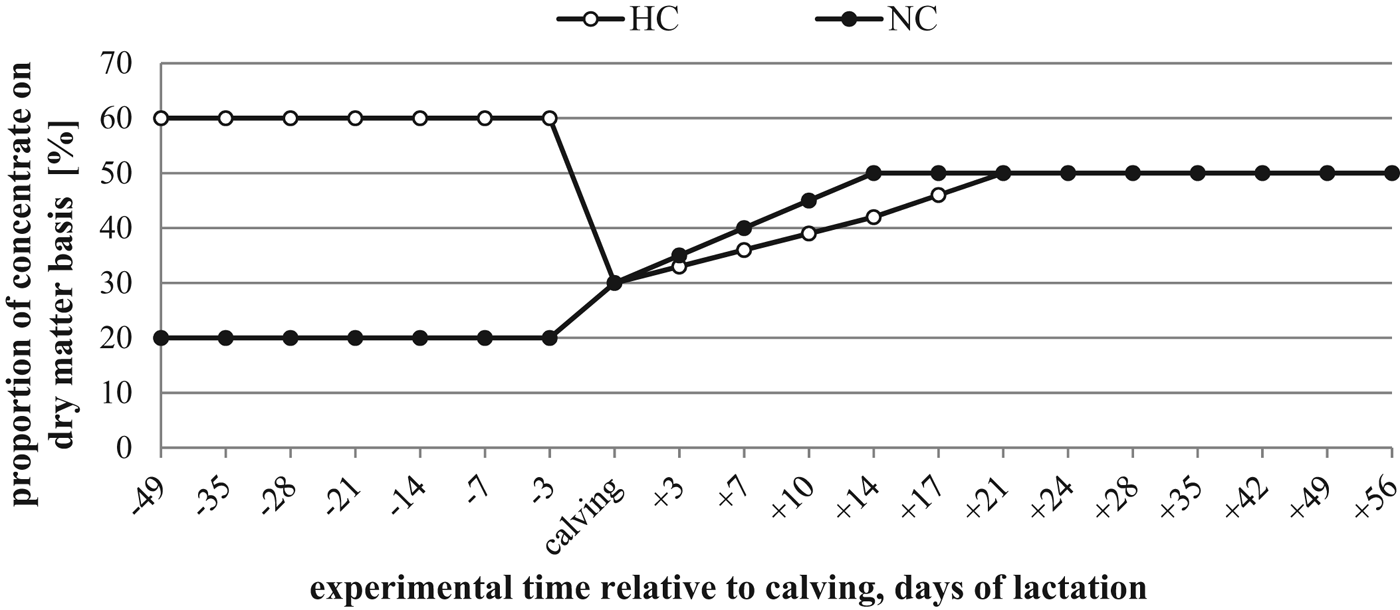
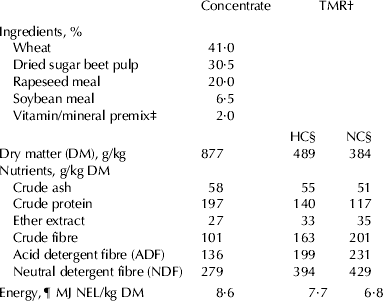
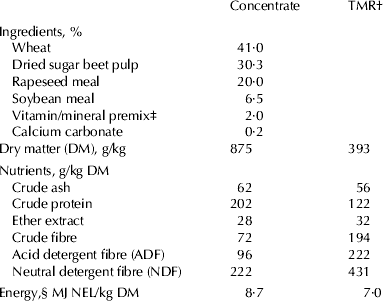
Prepartum, the cows of NC group were fed with an energetically adequate ration, based on the recommendations of the German Society of Nutrition Physiology (GfE, 2001), of 80% roughage (75% corn silage and 25% grass silage based on DM content) and 20% concentrate, whereas the cows of HC group where fed a ration, consisting of 40% roughage and 60% concentrate which led to an energetic oversupply (Table 1). After calving, all animals were initially fed with a standardised total mixed ration (TMR) for lactation, consisting of 30% concentrate. The ingredients and chemical composition of the lactation TMR are given in Table 2. Immediately after calving, the concentrate proportion was raised stepwise, applied by a computerised feeding station (Insentec, B.V., 1274 Marknesse, The Netherlands), from 30 to 50% within the first 2 or 3 weeks for the NC or HC groups, respectively. The initialised increase occurred more slowly in the HC group (Fig. 1), with the additional aim of stimulating postpartal lipolysis. Cows were fed ad libitum and had free access to water.
Concentrate proportion of the diet (%) of high (HC) and normal (NC) condition groups during the experiment.

Ingredients and chemical composition of concentrate and total mixed ration (TMR) of the pre-partum diet
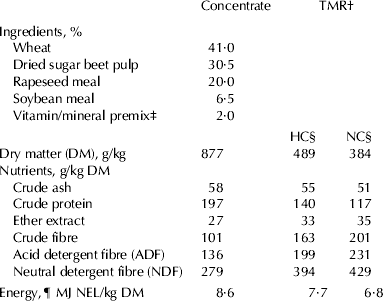
† Total mixed ration on DM basis (75% corn silage, 25% grass silage on DM basis)
‡ Per kg of mineral feed: 10 g Ca, 60 g P, 120 g Na, 60 g Mg, 800 000 IU vitamin A, 100 000 IU vitamin D3, 2500 mg vitamin E, 4000 mg Mn, 6000 mg Zn, 1250 mg Cu, 100 mg I, 35 mg Co, 50 mg Se
§ High condition (HC) cows were fed a concentrate proportion of 60% in the diet; Normal condition (NC) cows were fed a concentrate proportion of 20% in the diet
Ingredients and chemical composition of concentrate and total mixed ration during the lactation period
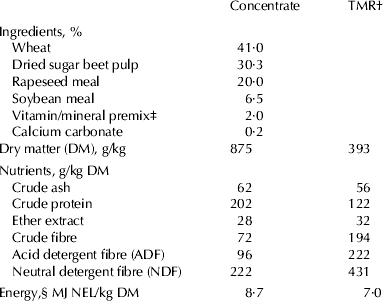
† Total mixed ration on DM basis [70% roughage (75% corn silage, 25% grass silage) +30% concentrate]
‡ Per kg of mineral feed: 170 g Ca, 50 g P, 120 g Na, 45 g Mg, 800 000 IU vitamin A, 100 000 IU vitamin D3, 4000 mg vitamin E, 4000 mg Mn, 6000 mg Zn, 1300 mg Cu, 120 mg I, 35 mg Co, 40 mg Se
The classification of a cow as healthy, subclinical ketotic or clinic ketotic was based on the concentration of BHB in blood serum. Therefore, BHB values of 1·2–2·5 mmol/l were characterised as a subclinical metabolic status, lower values meant a healthy animal, whereas higher values indicated clinical ketosis.
Sample preparation and measurement
The daily individual feed intake was recorded for the whole experimental time (computerised feeding station: Type RIC, Insentec, B.V., 1274 Marknesse, The Netherlands). Representative concentrate samples were taken once, grass and maize silage twice a week, while TMR samples were collected daily and pooled monthly. Feedstuffs were analysed for DM, crude protein (CP), crude ash (CA), ether extract (EE), crude fibre (CF), neutral detergent fibre (NDF) and acid detergent fibre (ADF), according to the guidelines of the Association of German Agricultural Analytic and Research Institute (VDLUFA, 1993).
Milking took place twice a day at 5·30 and 15·30. Milk yield was recorded using automatic milk counters (Lemmer Fullwood GmbH, 53797 Lohmar, Germany) and body weight was always determined when leaving the milking parlour. Milk samples were taken twice a week and stored at 4 °C for analysing fat, protein, lactose and urea concentrations, using an infrared milk analyser (Milkoscan FT 6000 in combination with a Fossomatic 5000; Foss Electric, 3400 Hillerød, Denmark).
At day −48 (control sample; 48±7·19 days antepartum), −14, −7, −3, 1, 3, 7, 10, 14, 17, 21, 24, 28, 35, 42 and 56 (relative to calving) blood samples for clinical-chemical parameters were taken from the vena jugularis. Immediately after centrifugation (Heraeus Varifuge® 3.0R, 2000 g, 15 °C; 15 min) serum concentrations of BHB, NEFA, glucose and triglycerides (TG) were measured using an automatic analysing system, based on a photometric measurement (Eurolyser, Type VET CCA, 5020 Salzburg, Austria). Serum concentrations of total protein, albumin, cholesterol, urea, aspartate-aminotransferase (AST), γ-glutamyl transferase (γ-GT) and glutamate dehydrogenase (GLDH) were measured the same way. The concentration of insulin was analysed by the endocrinology laboratory of the Cattle Clinic (University of Veterinary Medicine, 30173 Hanover, Germany) using radioimmunoassay (RIA). Samples were stored at −80 °C interim.
Liver samples were taken on days −14, 7, 21, 35 and 56 (relative to calving). Therefore approximately 200 mg of tissue were removed from the bovine liver by a minimally invasive, transcutaneous cutting biopsy needle technique under local anaesthesia. The acquired liver tissue was analysed for the content of total lipid (TL) using a gravimetrical method based on that of Starke et al. (Reference Starke, Haudum, Busche, Beyerbach, Danicke and Rehage2010). For the determination in mg/g of fresh liver weight, the TL was extracted from homogenised tissue samples with hexane:isopropanol (mixing ratio 3 : 2, continual agitation for 24 h at 20 °C).
Calculations
The net energy for lactation (NEL) of concentrates was calculated by using the nutrient digestibility from studies with wethers according to GfE (1991), whereas the data for corn- and grass silage are based on feed tables (DLG, 1997). According to formulae published by GfE (2001), the requirement for maintenance (E M), milk production (E L) and the energy balance were calculated as follows:
Maintenance requirement:
 $$E_{\rm M} {\rm [MJ}\,{\rm NEL/d] = 0} {\cdot} {\rm 293 \times body}\,{\rm weight}\,{\rm [kg]}^{{\rm 0} \cdot {\rm 75}} $$
Energy content of milk:
 $$\eqalign{{\rm [MJ/kg]}\!=\! {\rm 0} {\cdot} {\rm 95 + 0} {\cdot} {\rm 38 \! \times\! Milk}\,{\rm fat}\,{\rm [\% ] \! +\! 0} {\cdot} {\rm 21}{\rm \times Milk}\,{\rm protein}\,{\rm [\% ]}} $$
Requirement for milk production:
 $$\eqalign{E_{\rm L} {\rm [MJ}\,{\rm NEL/d]}\! =\, & {\rm Energy}\,{\rm content}\,{\rm of}\,{\rm milk}\,{\rm [MJ}\,{\rm NEL/kg]} \cr & {\rm + 0} {\cdot} {\rm 07 \times Milk}\,{\rm yield}\,{\rm [kg/d]}} $$
4% Fat-corrected milk (FCM) was calculated based on the equation of Gaines (Reference Gaines1928):
 $$\eqalign{{\rm FCM}\,{\rm [kg/d]}\! =\!{\rm ((milk}\,{\rm fat}\,{\rm [\% ] \times 0} {\cdot} {\rm 15) + 0} {\cdot} {\rm 4)} {\rm \times milk}\,{\rm yield}\,{\rm [kg/d]}} $$
Calculation of the energy balance as follows:
 $$\eqalign{ &{\rm Energy}\,{\rm balance}\,{\rm [MJ}\,{\rm NEL/d]} {\rm = energy}\,{\rm intake}\,{\rm [MJ}\,{\rm NEL/d]} \cr &\quad {\rm -} {\rm (E}_{\rm M} \,{\rm [MJ}\,{\rm NEL/d] + E}_{\rm L} \,{\rm [MJ}\,{\rm NEL/d])}\;} $$
Before calving, the energy balance was calculated by subtracting the requirement of maintenance and for pregnancy (GfE 2001) from daily net energy intake. During the last 6 weeks of gestation 13 MJ NEL/d are required in addition, with an increase to 18 MJ NEL/d for the last 3 weeks.
In particular to the insulin sensitivity, the Revised Quantitative Insulin Sensitivity Check Index (RQUICKI) was calculated according to Holtenius & Holtenius (Reference Holtenius and Holtenius2007):
 $${\rm RQUICKI} = & \displaystyle{1 \over{\log {\rm Insulin}\ [ {{\rm \mu U}/{\rm ml}}] + {\rm log}\ {\rm Glucose}\ [ {{\rm mg}/{\rm dl}} ] \atop+ \log {\rm NEFA}\ [ {{\rm mmol}/l} ]}}}$$
Statistical analysis
For the statistical analysis, the whole trial period was classified into three time periods. Period 1 describes the time prepartum and summarised the days −48, −14, −7 and −3. Period 2 centralises the first 2 weeks post partum (including days 1, 3, 7, 10 and 14), while in Period 3 the time points from the lactation week 3 (days 17, 21, 24, 28, 35, 42 and 56) are summarised. According to this classification all parameters of the performance and the clinical chemistry were evaluated.
All statistics were performed by using the MIXED procedure of SAS (Software package, Version 9.1, SAS Institute, 2004). Effects were declared significant when P-values were ⩽0·05 after Tukey test. Each parameter was analysed by a compound symmetry covariance structure. For clinical-chemical parameters the model contained feeding group and period, including the interaction between the factors. The performance was evaluated similarly, but in consideration of the parity as additional fixed factor. All results are represented at least square means (LSmeans) and sem.
Results
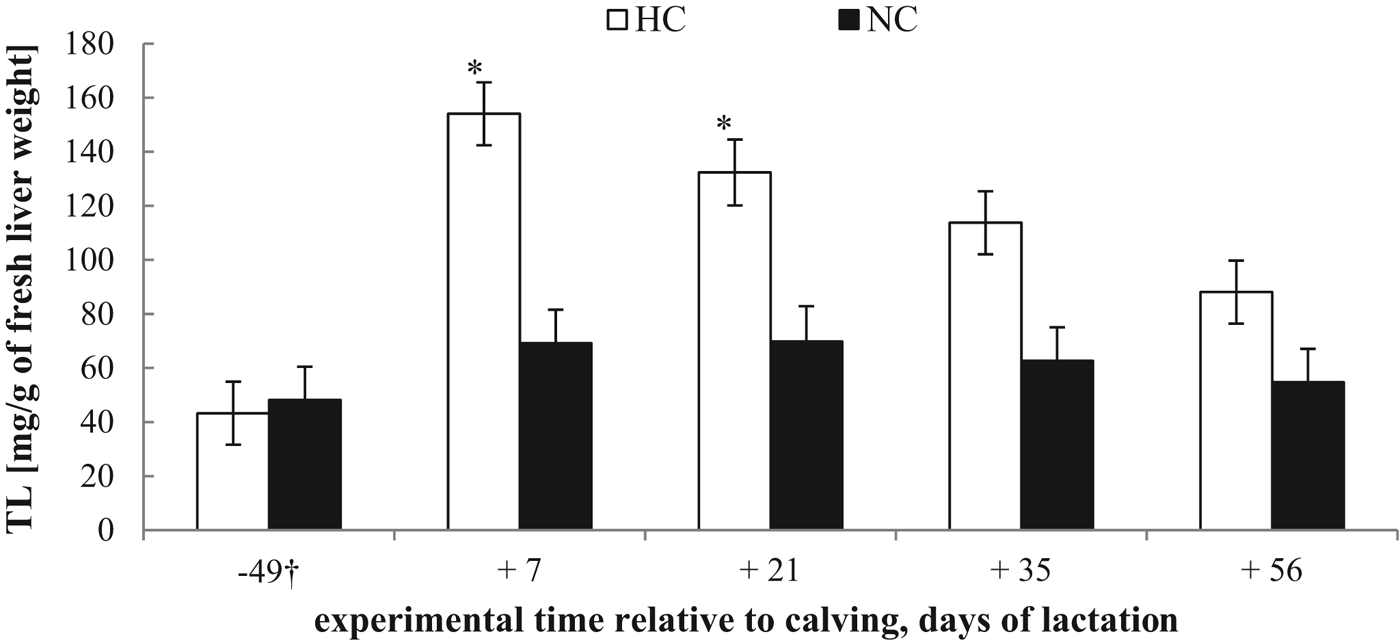
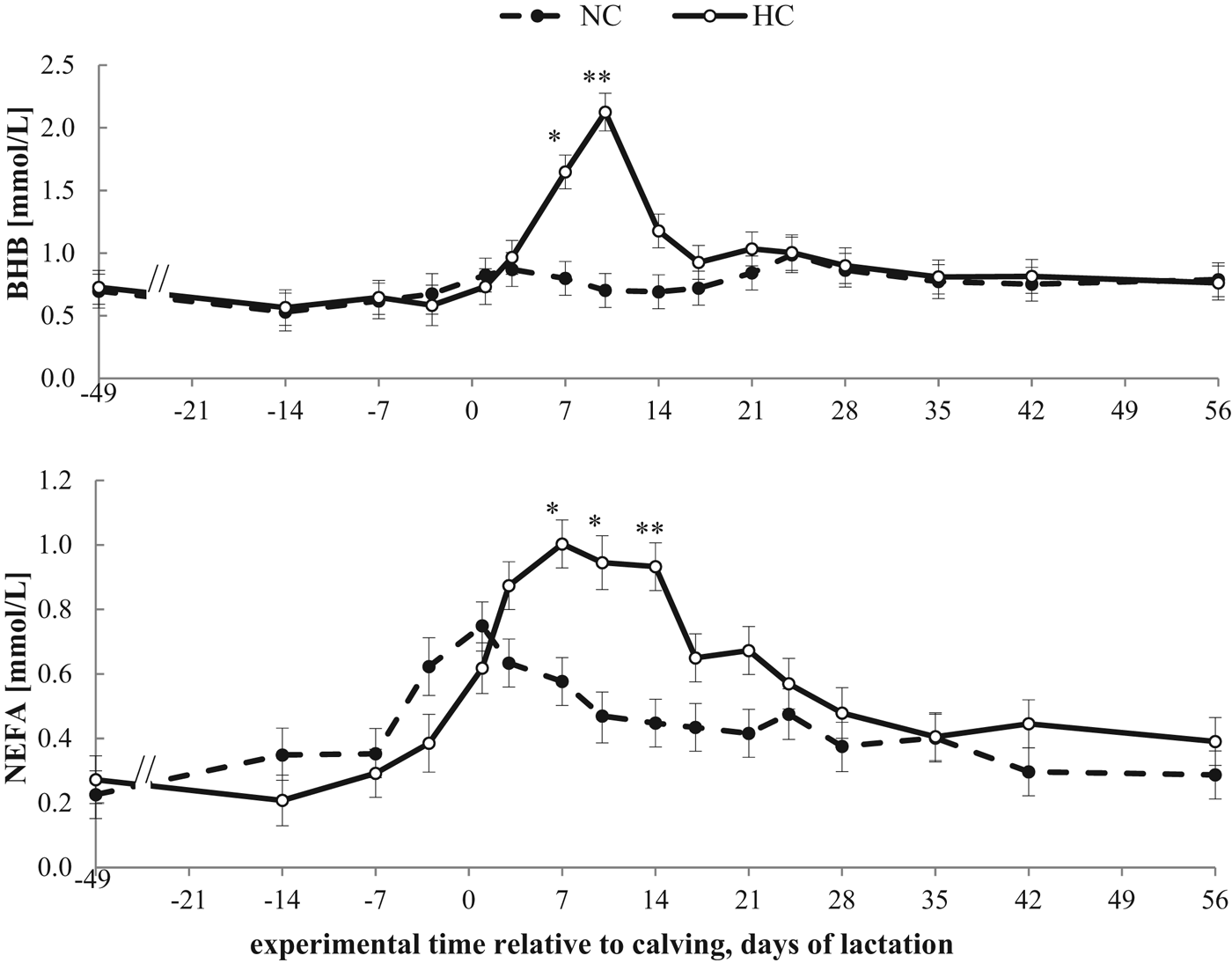
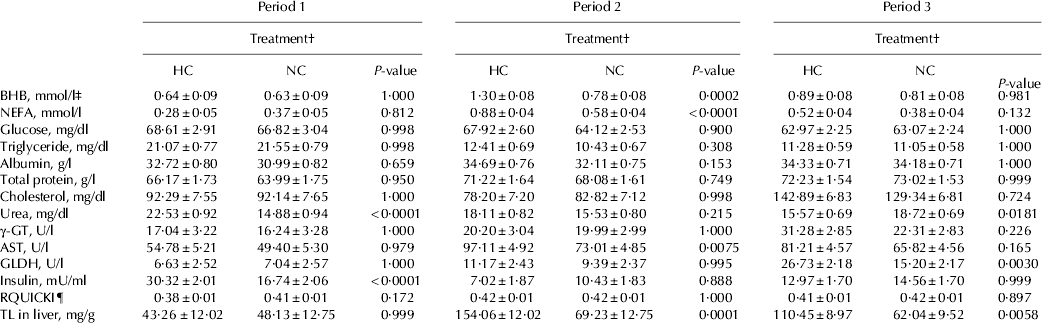
Over the entire trial, 6 out of 9 cows of the HC group developed a subclinical form of ketosis (BHB in blood serum >1·2 mmol/l), 2 cows had BHB values indicative for clinical ketosis (BHB>2·5 mmol/l) and 1 cow remained healthy. The 2 cows with clinical ketosis had the highest BHB values with 4·39 and 2·92 mmol/l on days 7 and 10 after calving, respectively. In the NC group 8 out of 9 animals stayed healthy. The diseased cow had the same indicative serum concentrations as the subclinically ketotic cows in HC group. All 13 parameters of the clinical chemistry, including RQUICKI, are shown for both feeding groups in Table 3. Insulin and urea levels were significantly higher in HC group in Period 1 (P<0·0001). Serum concentrations of BHB and NEFA differed significantly among the groups in Period 2, as did AST. In Period 3, the urea level was significantly higher and the GLDH level significantly lower in NC than in HC cows. The TL content of the liver is also shown in Table 3, with highly significant intergroup differences in both periods post partum (P<0·01). A graphical presentation for the evaluated days of the experiment is given in Fig. 2. There was a significant difference between both groups on day +7 (154·06 mg/g in HC vs. 69·23 mg/g in NC) and day +21 (132·33 mg/g in HC vs. 69·83 mg/g in NC). Detailed evaluations of BHB and NEFA for the single time points are shown in Fig. 3, with a significant difference after calving.
Total lipid (TL) content of the liver of high (HC) and normal (NC) condition group at sampling points during the experiment (†6 weeks before expected parturition). Values are LSMeans±sem; *P⩽0·01.
Values of beta-hydroxy butyrate (BHB) and non-esterified fatty acids (NEFA) in blood serum of high (HC) and normal (NC) condition groups at sampling points during the experiment. Values are LSMeans±sem; *P<0·05; **P<0·01.
Blood serum parameters of the clinical chemistry and the total lipid content of the liver of high (HC) and normal (NC) condition group within Period 1 (6 weeks before expected parturition till calving), Period 2 (first 2 weeks post partum) and Period 3 (2nd week – 8th week post partum) (LSMeans±sem)
† Treatments: High condition (HC) cows were fed a concentrate proportion of 60% during Period 1, after calving the proportion was raised from 30 to 42% (Period 2) till 50% (Period 3). Normal condition (NC) cows were fed a concentrate proportion of 20% during Period 1, which was raised from 30 to 50% in Period 2 and stayed at 50% during Period 3.
‡ BHB, β-hydroxybutyrate; NEFA, non-esterified fatty acids; γ-GT, γ –glutamyltransferase; AST, aspartate aminotransferase; GLDH, glutamate dehydrogenase; TL, total lipid
¶ Revised quick insulin sensitivity index, calculated by Holtenius & Holtenius (Reference Holtenius and Holtenius2007)
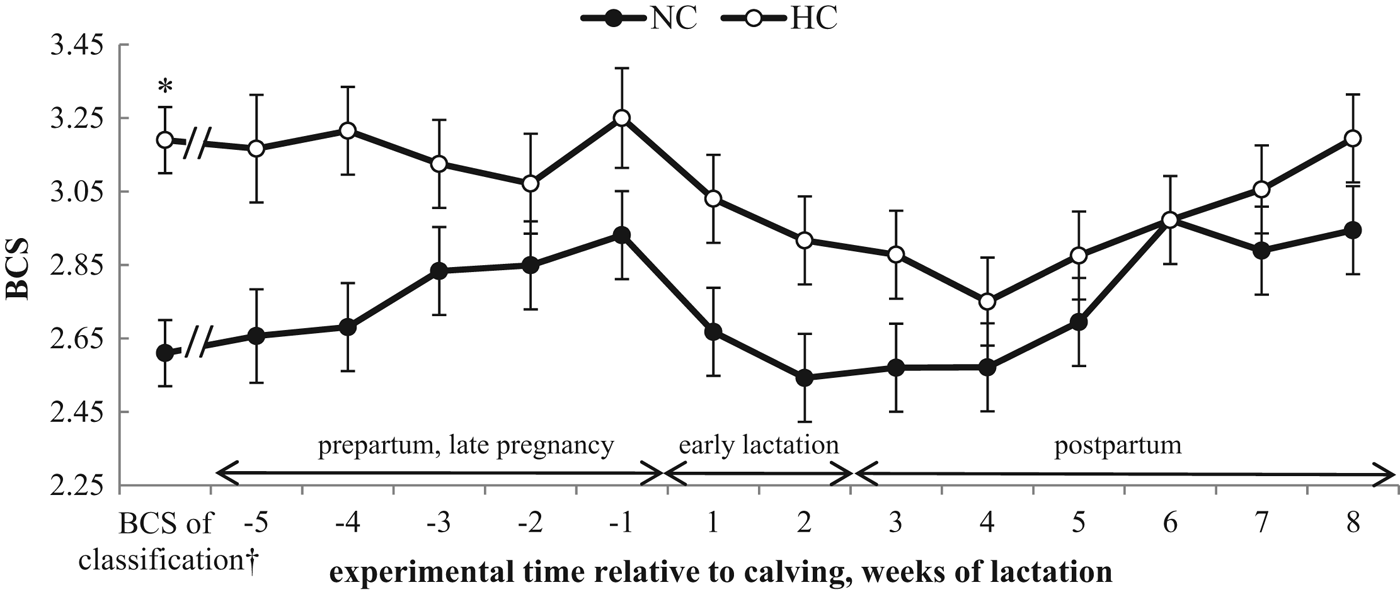
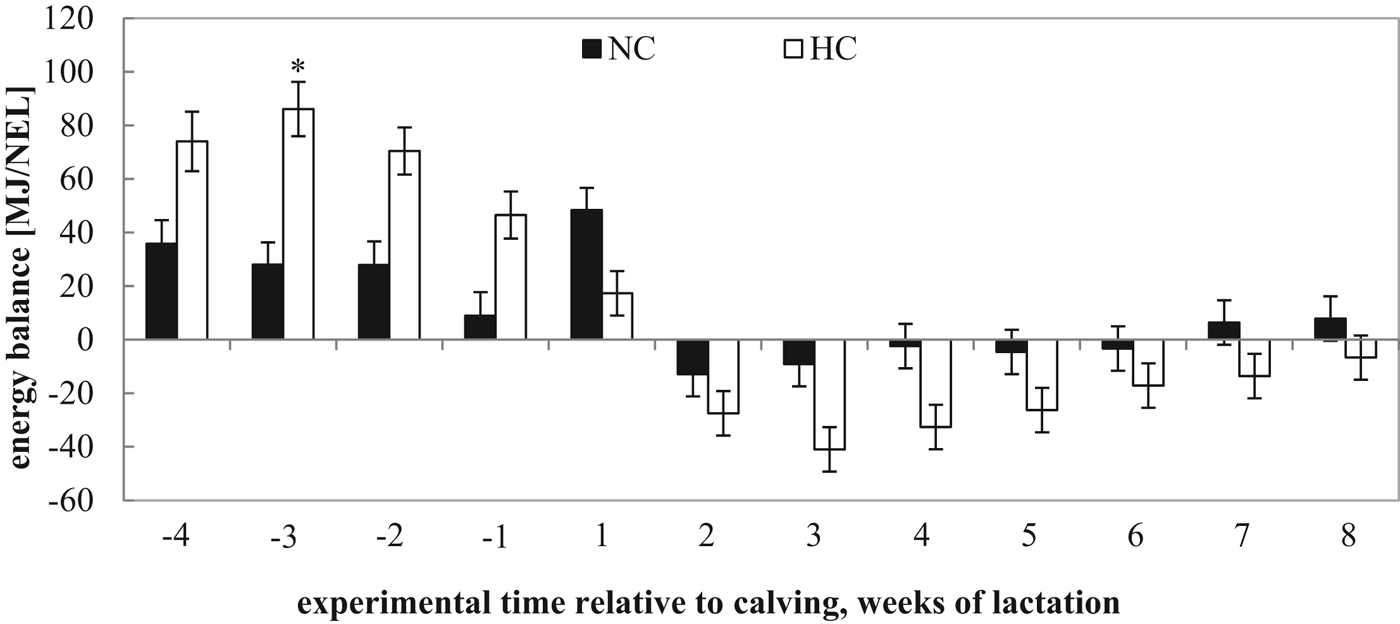
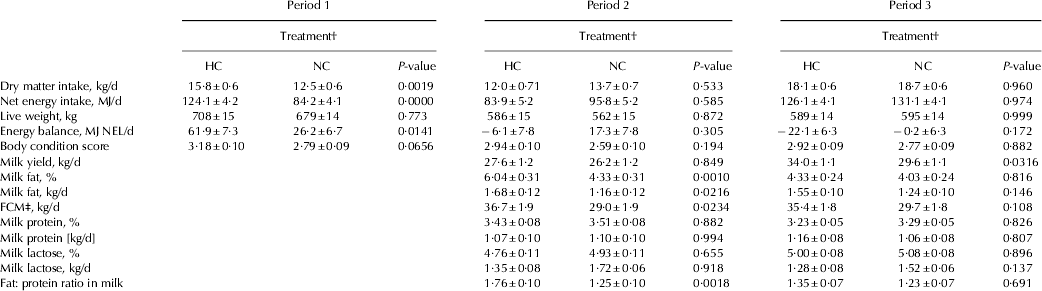
Changes of BCS in the two groups are shown in Fig. 4. At the time of classification (6 weeks before expected parturition), the difference in BCS between HC and NC was significant (P<0·01). During the further course of the experiment, BCS showed significant differences with regard to group (P<0·0001) and the lactation week (P=0·0052), even though the interaction of group and lactation week was not significantly affected (P=0·820; data not shown). The first marked increase (although the increase was found to be not significant) took place 4 weeks post partum for both groups (Fig. 4). The results for the performance parameters are given in Table 4. Based on the individual feed intake prepartum, there was a highly significant difference (P<0·01) between groups for DMI, net energy intake and energy balance in Period 1. Figure 5 shows the energy balance for every single week of the experiment with a significant difference between HC and NC 3 weeks before calving (P=0·0046). In addition, the NC cows overcame their negative energy balance post partum faster than the HC animals, namely in week 7 of lactation.
Comparison of the body condition score (BCS) of high (HC) and normal (NC) condition groups during the experiment (†6 weeks before expected parturition). Values are LSMeans±sem; *P<0·01.
Energy balance of high (HC) and normal (NC) condition groups during the experiment. Values are LSMeans±sem.
Performance, milk composition and energetic variables of high (HC) and normal (NC) condition groups within Period 1 (6 weeks before expected parturition till calving), Period 2 (first 2 weeks postpartum) and Period 3 (2nd week – 8th week postpartum) (LSMeans±sem)
† Treatments: High condition (HC) cows were fed a concentrate proportion of 60% during Period 1, after calving the proportion was raised from 30 to 42% (Period 2) till 50% (Period 3). Normal condition (NC) cows were fed a concentrate proportion of 20% during Period 1, which was raised from 30 to 50% in Period 2 and stayed at 50% during Period 3
‡ 4% fat-corrected milk
A high statistical relevance is also shown in Period 2 in regard to milk fat, absolute as well as relative (Table 4). Owing to the higher milk fat content in HC group, also the parameters fat-corrected milk (FCM) and fat:protein ratio of the milk (FPR) showed a significantly higher level compared with the NC feeding group. In Period 3 the milk yield differed significantly between the two groups. Thereby the average milk production of the HC group was 4·35 kg/d higher than that of the NC group. There were no more differences observed in Period 3.
Discussion
Our animal model to investigate subclinical ketosis was based on a factorial design with three important factors: BSC 6 weeks before expected parturition and the subsequent classification into high and normal condition; the group-individual DM and energy intake prepartum; and the initialised increase in energy input till the week 3 after calving. Bobe et al. (Reference Bobe, Young and Beitz2004) concluded that studies that investigate the effects of BCS, prepartal and postpartal diet in a factorial design are warranted. The model allowed the changed physiological situation of HC cows to be compared with that of the healthy NC cows.
Bewley & Schutz (Reference Bewley and Schutz2008) concluded from a review of available literature that fat cows tend to lose more body condition during early lactation than thin cows. As the present study was based on a group-specific feeding management, these data are difficult to compare. Owing to the accelerated proportion of concentrate for the NC cows during the first 2 weeks after calving, the differences in BCS post partum between NC and HC became less pronounced. Nevertheless, BCS at calving represents an important risk factor for subsequent development of subclinical ketosis during lactation (Duffield, Reference Duffield2000). In the present study 6 out of 9 cows of the HC group developed subclinical ketosis. These 6 cows had an average BCS of 3·50 1 week before calving. In the NC group 8 out of 9 cows stayed healthy and had an average BCS of 2·90 1 week before calving, which was significantly different from the BCS of HC cows with subclinical ketosis at that time (P=0·016; data not shown). This difference in BCS endorsed the success of our animal model, as the artificially provoked subclinical ketosis is a result of a higher BCS combined with experimental feeding management ante- and post partum.
Owing to the feeding management in the animal model, DMI was higher in the HC group prepartum and higher in the NC group post partum. It was not clear whether or not the energy balance for the time prepartum could be calculated according to the formulae published by GfE (2001). The high proportion of concentrate in HC group during the dry period came along with 41% wheat, which is highly degradable in the rumen, and a low crude fibre content (16·3%). So the authors cannot exclude the possible development of an at least mild acidosis. In this situation a reduced digestion of the ingredients is possible (Owens et al. Reference Owens, Secrist, Hill and Gill1998). Despite this, the energy balance was significantly higher in HC cows within the experimental dry period. Additionally, NC cows were able to compensate their NEB faster (Fig. 5). This was partly due to the faster increase of energy for NC cows post partum and partly to the lower milk yield in Period 3 (Table 4). These results are comparable to other studies (Holcomb et al. Reference Holcomb, Van Horn, Head, Hall and Wilcox2001; Vickers et al. Reference Vickers, Weary, Veira and von Keyserlingk2013). In addition, the various nutrient and energy intake prepartum was also reflected in the significantly different serum blood concentrations of urea and insulin in Period 1 (Table 3), caused by the higher concentration of crude protein and energy in HC feedingstuffs.
Regarding the milk parameters, significant differences in our results were typical for subclinical ketosis and confirm other findings (Miettinen & Setälä, Reference Miettinen and Setälä1993; Duffield, Reference Duffield2000; LeBlanc, Reference LeBlanc2010). According to the literature, milk yield is significantly decreased in almost every case of ketosis, even subclinical ketosis (Duffield, Reference Duffield2000). For the present study this did not apply. In the HC group, where 89% had BHB values indicative of clinical or subclinical ketosis, the milk yield was significantly higher during Period 3 (Δ=4·35 kg/d). Milk yield was also higher in Period 2 (Δ=1·4 kg/d), even though this difference was not statistically relevant. A few studies with similar results were found. The comparison of healthy and subclinically ketotic cows show continuously higher milk yields until week 6 of lactation in the group of subclinical cows (Asl et al. Reference Asl, Nazifi, Ghasrodashti and Olyaee2011). In comparison of cows with lower (⩽3·25) and higher BCS (>3·25), the average milk yield was numerically higher for the fatter ones (Busato et al. Reference Busato, Faissle, Kupfer and Blum2002). Quite in line with this, Domecq et al. (Reference Domecq, Skidmore, Lloyd and Kaneene1997) found, in a study with 779 cows, that a one-point increase (Edmonson-scale) between dry-off and parturition was associated with 546 kg more milk in the first 120 d of lactation. Based on our data and consistent with these findings, cows with a higher BCS at calving tended to yield more milk. We suggest that our HC cows, which underwent a slower energy adaptation during the first 3 weeks post partum, used the mobilised body mass as an energy source for milk production, even if the same cows had BHB values indicative of clinical or subclinical ketosis. That a fat body condition is related to a higher milk yield is also described by Heuer et al. (Reference Heuer, Schukken and Dobbelaar1999). They equated the higher milk production with a FPR >1·5, which coincides with high lipolysis and an elevated risk of ketosis (Heuer et al. Reference Heuer, Schukken and Dobbelaar1999; Buttchereit et al. Reference Buttchereit, Stamer, Junge and Thaller2010). Consistent with those studies, we found a FPR of 1·76 in HC group during Period 2 which was significantly different from the FPR of NC cows during Period 2 (Table 4).
According to the serum parameters, bovine subclinical ketosis in combination with high lipomobilisation can be diagnosed if the following values are on par: BHB >1·2 mmol/l, glucose <2·5 mmol/l, TG <0·08 mmol/l and NEFA >0·4 mmol/l (Oetzel, Reference Oetzel2004; Gonzalez et al. Reference Gonzalez, Muino, Pereira, Campos and Benedito2011; Dirksen et al. Reference Dirksen, Gründer and Stöber2012). This combination applied to 8 out of 9 cows from the HC group, in which all 8 cows had BHB values indicative of clinical or subclinical ketosis during the ongoing trial.
Our results show that the ketotic metabolic status strongly affected liver metabolism, reflected by the difference of the TL content pre- and post partum (Table 3 & Fig. 2). Normally the TL content of the liver alone allows no adequate inference to classify a fatty liver. Nevertheless a TL content of 3–6% is considered as physiological and should be in this range for the time prepartum and from the week 8 after calving (Fürll, Reference Fürll1989). Ametaj et al. (Reference Ametaj, Bradford, Bobe, Nafikov, Lu, Young and Beitz2005) established cows with a TL content more than 10% as cows with fatty liver. In the present paper, within the HC group, contents of 15·4 and 11% TL were measured during Periods 2 and 3. Depending on the available literature, such a concentration of TL can be classified as mild fatty infiltration, which is almost physiological (Đokovic´ et al. Reference Đokovic´, Šamanc, Petrovic´, Ilic´ and Kurc´ubic´2012). Due to the infiltration of fat, lesions in hepatic tissues appear and cause increased blood levels of specific enzymes (Bobe et al. Reference Bobe, Young and Beitz2004). Gonzalez et al. (Reference Gonzalez, Muino, Pereira, Campos and Benedito2011) describe an AST level of >100 U/l as indicative for hepatic lesions. In our case, 7 out of 9 cows from the HC group (77·8%) showed AST concentrations >100 U/l during early lactation. These 7 cows also included the two clinically ketotic animals (BHB >2·5 mmol/l; AST maximum of 219·44 U/l) and not the 1 cow which stayed healthy (AST maximum of 81·83 U/l). The 7 cows together offered an average TL content of 17 and 15% for days 7 and 21, relative to calving (data not shown). Next to AST, GLDH is useful for analysing longer-acting influences, so that a variation of the activity occurs about 3–5 weeks after the impacts. This fact is verified by the high level of GLDH, exceeding the physiological level of 10 U/l (Dirksen et al. Reference Dirksen, Gründer and Stöber2012) and the significant difference between the feeding groups in Period 3 (Table 3). In summary, even a liver lipid content of about 15% can be classified as mild to moderate fatty liver if further parameters like AST show increased levels far beyond their physiological range. However, it has to be supposed that the fatty degeneration was reversible, because the TL values and serum concentrations of AST, BHB and NEFA decreased and normalised towards the end of the trial.
An insulin resistance is present when higher than normal insulin concentrations are needed to achieve normal metabolic responses and has already been demonstrated in the case of hepatic lipidosis of dairy cattle (Oikawa & Oetzel, Reference Oikawa and Oetzel2006). Holtenius & Holtenius (Reference Holtenius and Holtenius2007) consider that different kinds of glucose tolerance tests for clinical investigations are too time-consuming and not suitable for cows. They assess insulin sensitivity on the basis of RQUICKI, and found that this calculated parameter might be useful to identify a disturbed insulin function in cows. In our study, postpartum RQUICKI was lowest on day +1 (data not shown) for both groups. However, there was no significant difference between groups any time point (Table 3) and consequently no relationship between RQUICKI and subclinical ketosis. These results are contrary to those of Stengarde et al. (Reference Stengarde, Holtenius, Emanuelson, Hultgren, Niskanen and Traven2011) who describe RQUICKI as a more sensitive parameter for metabolic imbalances than separate evaluation of glucose, insulin and NEFA. However, the respective serum values in the present study were substantially higher. For example, the serum NEFA and BHB levels in HC group during Period 2 are nearly twice as high compared with those of Stengarde et al. (Reference Stengarde, Holtenius, Emanuelson, Hultgren, Niskanen and Traven2011). This induced a pathological metabolic situation and confirms the statement, that RQUICKI has a low discrimination power in diagnosing decreased insulin sensitivity in cows affected by a metabolic disease (Kerestes et al. Reference Kerestes, Faigl, Kulcsar, Balogh, Foldi, Febel, Chilliard and Huszenicza2009).
In conclusion, we give an example of how the physiological situation of subclinical ketosis affects the whole bovine metabolism. Therefore, the prerequisite was the development of an animal model that induces exactly such a metabolic situation. The described animal model is based on a combination of three different influencing factors: first, overfeeding in the dry period; second, the decelerated energy supply with concentrate in the first 3 weeks of lactation; and third, the grouping of cows with a higher BCS 6 weeks before expected parturition to the experimental group to enhance the contrast compared with the animals of the control group. We confirm that the combination of the named factors caused the success of our investigation. We summarise that the cows of experimental group developed a subclinical ketosis in the time of early lactation and provide the opportunity to investigate metabolic interrelations of subclinical ketosis, as well as an appropriate model for testing medical effectiveness of treating ketosis and fatty liver syndrome.
The authors would like to thank the co-workers of the Institute of Animal Nutrition of the Friedrich-Loeffler-Institute (FLI) in Braunschweig Germany in performing the experiment and analyses. Furthermore we gratefully acknowledge Boehringer Ingelheim for its cooperation and the financial support (Boehringer Ingelheim Vetmedica, D-55216 Ingelheim am Rhein, Germany).