Introduction
Australia has approximately 2,700 nursing home facilities (AIHW, 2014a), with just over 50% of nursing home residents diagnosed with a dementia-related condition (AIHW, 2014b). Behavioral and psychological symptoms, such as wandering, calling out, confusion, restlessness, depression, and apathy, are predominantly experienced by nursing home residents with dementia (Zuidema et al., Reference Zuidema, de Jonghe, Verhey and Koopmans2009; Fauth and Gibbons, Reference Fauth and Gibbons2014). Up to 90% of people with dementia will experience these symptoms during the course of their illness (Cerejeira et al., Reference Cerejeira, Lagarto and Mukaetova-Ladinska2012). Residents without a diagnosis of dementia may also experience some of these symptoms, with verbal symptoms reported as particularly prevalent in nursing home residents without dementia (Cohen-Mansfield et al., Reference Cohen-Mansfield, Marx and Werner1992). Negative consequences of behavioral and psychological symptoms are apparent for both the caregiver and the individual experiencing them. They can result in increased distress, reduced resident and caregiver safety, and increased caregiver burden (Lowery and Warner, Reference Lowery and Warner2009). This can lead to inappropriate prescribing of psychotropic medication and increased healthcare costs (Cerejeira et al., Reference Cerejeira, Lagarto and Mukaetova-Ladinska2012). Thus, it is imperative to learn more about the factors that impact on this heterogeneous set of symptoms. This study focuses on an under-researched influential factor, sleep, as it has been implicated in the development of behavioral agitation symptoms (Cohen-Mansfield et al., Reference Cohen-Mansfield, Marx and Werner1992), but rarely examined.
Agitated behaviors in nursing home residents
Agitation is one of the most prevalent and most impairing symptoms expressed by nursing home residents, with estimates ranging from 24% in mild dementia (Lyketsos et al., Reference Lyketsos, Steinberg, Tschanz, Norton, Steffens and Breitner2000) up to 90% in later stages (Srikanth et al., Reference Srikanth, Nagaraja and Ratnavalli2005). Three categories of agitated symptoms are often reported – verbal agitation e.g. swearing, constant requests for help; verbal aggression; physical non-aggressive behaviors e.g. pacing, aimless wandering, general restlessness; and physically aggressive behaviors e.g. hitting, pushing, grabbing onto people (Cohen-Mansfield et al., Reference Cohen-Mansfield, Marx and Rosenthal1989).
The presentation of these symptoms varies widely, and certain people become more physically aggressive while others are more verbally agitated. Not only is there significant interpersonal variation, but also intrapersonal variation each day. Factors such as time of day, resident mood, staff attitude, number of co-residents, and level of cognitive decline, impact on the extent to which these symptoms are expressed by nursing home residents (Whall et al., Reference Whall2008; Khachiyants et al., Reference Khachiyants, Trinkle, Son and Kim2011; Cerejeira et al., Reference Cerejeira, Lagarto and Mukaetova-Ladinska2012). Evidence that sleep may have an impact has been reported (Cohen-Mansfield and Marx, Reference Cohen-Mansfield and Marx1990; Whall et al., Reference Whall2008) however this has not been thoroughly assessed.
Sleep disturbance and agitation
Sleep disturbance is an important factor likely to contribute to the expression of agitated behaviors (Cohen-Mansfield et al., Reference Cohen-Mansfield, Marx and Werner1992). Poor sleep is known to lead to poor mood, increased irritation, and lower threshold to pain in the general population (Hirst and Sloan, Reference Hirst and Sloan2001). Thus, it is suspected that these general consequences of poor sleep could be even more detrimental in those with multiple comorbidities and dementia, enhancing the expression of agitation. Despite this, limited research has described the association between amount of sleep obtained, and the expression of agitated behaviors in nursing home residents.
One of the earlier efforts, conducted using a sample of 408 nursing home residents, identified increased symptoms of agitation present in residents with either less night time sleep or more disruptions to sleep (Cohen-Mansfield and Marx, Reference Cohen-Mansfield and Marx1990). However, the outcomes were limited due to a reliance upon the subjective observations of nursing staff to record behavioral and sleep data. A later study of 107 nursing home residents aimed to identify factors that contribute to the expression of aggressive behaviors (Whall et al., Reference Whall2008). In this study, a greater accuracy of sleep data was obtained through the use of actigraphy, which provided the researchers with an objective measure (Martin and Hakim, Reference Martin and Hakim2011). Inconsistent findings on the relationship between amount of sleep and agitation were found in these studies. Limitations of methodology for sleep data collection in the first, and generalizability in the second were noted. The current study aims to address these limitations.
Sleep of nursing home residents
Sleep disturbance is more common and more severe in older adults living in nursing homes than in the community (Haesler, Reference Haesler2004; Cooke and Ancoli-Israel, Reference Cooke and Ancoli-Israel2011). It has been estimated that over two-thirds of nursing home residents have disruptions to their sleep patterns (Ersser et al., Reference Ersser, Wiles, Taylor, Wade, Walsh and Bentlet1999). Other research has found the incidence of fragmented sleep may be even higher, with one study reporting that in 200 residents there was rarely a period of an hour in which residents sustained sleep or awakeness was maintained (Ancoli-Israel et al., Reference Ancoli-Israel, Parker, Sinaee, Fell and Kripke1989). Sleep disturbance is likely due to the high incidence of disease, pain, medication use, medication side effects, environmental factors, and psychogeriatric factors that are often associated with nursing home placement (Cooke and Ancoli-Israel, Reference Cooke and Ancoli-Israel2011).
In addition to the link with agitation, sleep disturbance can lead to a range of serious and detrimental outcomes, including problems such as an increased risk of falls and injuries, stroke, coronary heart disease, and cancer, as well as intensifying symptoms of chronic diseases, mood disorders, and increased caregiver burden (Simpson et al., Reference Simpson, Culpepper Richards, Enderlin, O’Sullivan and Koehn2006). Sleep variables have explained significant variance associated with cognitive and functional decline in people with Alzheimer's disease (Moe et al., Reference Moe, Vitiello, Larsen and Prinz1995; Whall et al., Reference Whall2008).
Pharmacological management of sleep disturbances in nursing homes
Although non-pharmaceutical options are increasingly being promoted, sedating medications, specifically benzodiazepines and non-benzodiazepine hypnotics, are primarily used in the aged care setting (Simpson et al., Reference Simpson, Culpepper Richards, Enderlin, O’Sullivan and Koehn2006). Antipsychotics, antihistamines, and sedating antidepressants are also used off-license to alleviate sleeplessness among other symptoms (Conn and Madan, Reference Conn and Madan2012).
It is well established that benzodiazepines often increase the amount of sleep obtained with short-term use, and can increase sedation during both the night-time and day-time (Hirst and Sloan, Reference Hirst and Sloan2001). However, when administered for extended periods, research suggests no significant advantage to sleep time is evident, and increased dissatisfaction in self-reported sleep quality in high care residents has been reported (Koch et al., Reference Koch, Haesler, Tiziani and Wilson2006; Bourgeois et al., Reference Bourgeois, Elseviers, Van Bortel, Petrovic and Vander Stichele2013). Benzodiazepines are associated with significant adverse side effects, such as confusion, memory impairment, daytime drowsiness, and impaired balance, leading to falls (Hirst and Sloan, Reference Hirst and Sloan2001; Chang and Chan, Reference Chang and Chan2010). Elderly patients, especially those with dementia who often already have cognitive impairment, are at increased risk of these adverse effects, meaning psychotropic medication should be used sparingly (Zaudig, Reference Zaudig2000).
Objectives of the present study
The aim of this study was firstly to determine the prevalence of sleep disturbance in Australian nursing home residents. Second, we aimed to determine the relationship between sleep and agitation. Furthermore, it was suspected that this relationship would change when considering dementia. We were interested in assessing the nature of the relationship between sleep and agitation for those with and without dementia, as well as whether the same types of agitation were significantly linked to sleep. Finally, we aimed to evaluate if residents taking benzodiazepines obtained more sleep than other residents.
Methods
Participants and procedure
Letters of invitation were sent out to nursing homes in the Hobart region of Tasmania. Four nursing homes agreed to participate. Participants were selected based on a minimum age of 75 years as this reflects the majority (87%) of residents in Australian nursing homes (AIHW, 2012). Residents in temporary respite care and those who had recent hospitalization were excluded as they were likely to be readjusting to the nursing home setting and this may affect their sleep patterns. Residents with involuntary wrist movements were also excluded due to the sleep data collection device being worn on the residents’ wrist.
The director of nursing from each facility compiled a list of eligible residents based on the criteria. Information on capacity to give informed consent was also provided during this process. Residents with capacity to give consent were approached by a researcher in the nursing home. For other residents without the capacity to provide informed consent, their “Person Responsible” was sent an invitation letter by the nursing home.
Once consent was obtained, the CMAI (Cohen-Mansfield et al., Reference Cohen-Mansfield, Marx and Rosenthal1989) and the NPI-NH (Wood et al., Reference Wood2000) were conducted with a staff member who knew the participant well. Demographic details were collected from both the participant and staff members. Psychotropic medication information was obtained from resident medication charts. Participants were asked to wear a sleep-monitoring actigraph device on their non-dominant wrist for three days (72 h).
An Aged Care Funding Instrument (ACFI) dementia diagnosis was obtained from resident records. The diagnosis section of this form is completed by a trained nursing staff member with evidence provided by the resident's general practitioner, medical specialist, and/or by an Aged Care Assessment Team (ACAT) assessment (DHA, 2013). This process usually occurs within two months of entering the home and may be repeated as needed (AIHW, 2014c).
Instruments
Sleep
Sleep-wake activity was recorded using an ActiGraph ActiSleep monitor (ActiGraph LLC, 2013). Validation studies testing the accuracy of sleep/wake activity have found correlations of above 0.8 for polysomnography–actigraphy comparisons, suggesting that the actigraph is a valid and accurate indicator of sleep time (Ancoli-Israel et al., Reference Ancoli-Israel, Clopton, Klauber, Fell and Mason1997; Sadeh and Acebo, Reference Sadeh and Acebo2002). Actigraphy has also been validated in the aged care setting for use with individuals with dementia (Ancoli-Israel et al., Reference Ancoli-Israel, Clopton, Klauber, Fell and Mason1997).
Actigraphy is arguably more reliable than self-report measures such as sleep diaries or questionnaires in a nursing home setting, as this relies on an individual's ability to recall information, such as amount of time it takes to fall asleep, number of times they woke during the night, and other observations (Ancoli-Israel et al., Reference Ancoli-Israel, Cole, Alessi, Chambers, Moorcroft and Pollak2003). This is particularly problematic for individuals with cognitive impairment or dementia. Alternatively, if completed by staff, reliability can be affected by limited available time.
The ActiGraph ActiSleep monitors were 19 grams in weight, had dimensions of 4.6 cm × 3.3 cm × 1.5 cm and were worn on the non-dominant wrist with a nylon strap like a watch. The device measures movement in orientation (vertical, horizontal, and perpendicular), intensity, frequency, and duration. The Cole–Kripe algorithm for adults (Cole et al., Reference Cole, Kripke, Gruen, Mullaney and Gillin1992) in the ActiLife data analysis software (ActiGraph LLC, 2014) was then used to determine total time in bed, total sleep time, sleep efficiency, and number of awakenings after sleep onset.
Night-time sleep was recorded as sleep time between 10 pm and 6 am, consistent with previous investigations using actigraph devices for residents with dementia (Ancoli-Israel et al., Reference Ancoli-Israel, Clopton, Klauber, Fell and Mason1997). The Low Frequency Extension (ActiGraph LLC, 2014) was used for 60% of participants, as their activity level was very low. Reports of usual bed time and waking time were obtained from the resident to cross reference with the actigraph data.
Behavioral and psychological factors
The NPI-NH (Wood et al., Reference Wood2000) was used to collect information from care staff about common behavioral and psychological symptoms experienced by nursing home residents. The NPI-NH is an interview-based measure consisting of twelve subscales assessing different neuropsychiatric symptoms. Each present symptom is rated on a three-point severity and four-point frequency, creating a composite score ranging from 0 to 12 for each symptom. Total scores range from 0 to 144, with higher scores indicating higher burden. Four factors of the NPI-NH are reported; affective symptoms, agitated symptoms, psychotic symptoms, and apathy/eating symptoms (Selbæk and Engedal, Reference Selbæk and Engedal2012). The NPI-NH has been validated for use with residents with and without dementia (Lange et al., Reference Lange, Hopp and Kang2004; Selbæk and Engedal, Reference Selbæk and Engedal2012), as well as different stages and types of dementia (Zuidema et al., Reference Zuidema, de Jonghe, Verhey and Koopmans2009; Bjørke-Bertheussen et al., Reference Bjørke-Bertheussen, Ehrt, Rongve, Ballard and Årsland2012).
Behaviors associated with agitation were assessed using the CMAI (Cohen–Mansfield et al., Reference Cohen-Mansfield, Marx and Rosenthal1989). The short form of this questionnaire was used (Werner et al., Reference Werner, Cohen-Mansfield, Koroknay and Braun1994). This consists of 14 items covering 29 behaviors to which an informant is asked to rate the frequency of each that have occurred in the last fortnight, ranging from 1 = “Never” to 5 = “Several times an hour.” These items were collated to compute three factors; physically aggressive behavior, physically non-aggressive behavior, and verbally agitated behavior, as well as a total score (Whall et al., Reference Whall2008). The CMAI has been widely used in geriatric research, and reliability and validity for use of this measure with nursing home residents are well established (Cohen-Mansfield et al., Reference Cohen-Mansfield, Marx and Rosenthal1989; Zuidema et al., Reference Zuidema2011).
Design and analysis
This study was a cross-sectional observation study, designed to determine strengths of associations of sleep on symptoms of agitation. All analyses were computed using IBM SPSS Version 22 (IBM Corp, 2013). Descriptive information was reported as means and standard deviations of sleep parameters. Non-parametric Mann–Whitney U tests were used to determine if there were any differences in amount of sleep for those with and without dementia, as well as benzodiazepine users and non-users. Bivariate correlations were computed to determine direction and strength of the relationship between night-time sleep and symptoms of agitation including aggressive, non-aggressive, and verbal symptoms. A moderation analysis was then conducted to determine if presence of dementia had an impact on the relationship between night-time sleep and symptoms of agitation. These analyses were conducted using PROCESS (Hayes, Reference Hayes2013). Alpha levels were set at p ≤ 0.05.
Results
Demographics
Out of a total of 233 eligible older adults, 55 consented to participate in the study (response rate 24%). Six participants exited from the study, due to death (four) and removing the device (two). One resident removed the device during the recording period, however sleep data were still obtained. Therefore, data were obtained for 49 participants. The average age was 85.6 years (SD = 5.9), with a range from 75 to 100 years. The majority were female (73%), with just under half (45%) with a documented diagnosis of dementia.
Behavioral and psychological symptoms
Behavioral and psychological symptoms were assessed for prevalence in both individuals with and without dementia. Symptoms were considered clinically relevant with a Frequency x Severity score above 3 (Wood et al., Reference Wood2000). Agitation in the CMAI was considered clinically relevant if symptoms were present once per week or more (Zuidema et al., Reference Zuidema2011).
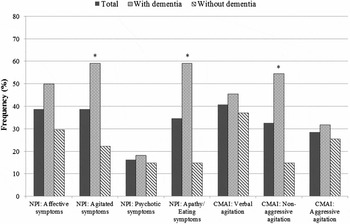
The most frequently reported symptoms in the general sample were affective and agitated symptoms (Figure 1). Verbal agitation was the most prevalent type of agitation rated on the CMAI. Psychotic symptoms were reported considerably less frequently than other types of symptoms.
Frequencies of behavioral and psychological symptoms in residents with (n = 22) and without (n = 27) dementia. NPI = Neuropsychiatric Inventory; CMAI = Cohen-Mansfield Agitation Inventory. *p < 0.05 for χ 2 tests between residents with and without dementia.

Neuropsychiatric factors were assessed for differences in frequencies between those with and without dementia using χ 2 analyses. Yates’ Correction for Continuity was applied to all analyses. General agitation measured by the NPI-NH was significantly different between the groups (χ 2 = 5.48, p = 0.019), with residents with dementia more likely to express these symptoms than those without dementia. Symptoms of apathy were also significantly more likely to be expressed by individuals with dementia, than those without (χ 2 = 8.63, p = 0.003). There was no significant difference for factors of affective or psychotic symptoms. When considering specific types of agitation, participants with dementia were significantly more likely to express physical non-aggressive behaviors than those without dementia (χ 2 = 6.99, p = 0.008). There was no significant difference in the frequency of verbal and physically aggressive agitation when assessed by presence of dementia.
Sleep
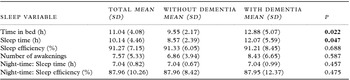
On average, residents were in bed for eleven hours and two minutes (SD = 4 h 5 minutes) and asleep for ten hours and eight minutes (SD = 4 h 28 minutes). The range of sleep times was large, with one resident sleeping 5 h and 2 minutes per 24 h period, and another sleeping 22 h 26 minutes. Participants woke an average of 8 (SD = 5) times per night, staying awake for an average of 7 (SD = 6) minutes with each awakening. Sleep efficiency is defined as the amount of time asleep divided by the amount of time in bed and is considered to be within the normal range if above 85% (Lacks and Morin, Reference Lacks and Morin1992). Participants had a sleep efficiency of 91.27% when rating their whole sleep. When considering only night-time hours (between 10 pm and 6 am) their sleep efficiency was lower (87.96%), but still within “normal” parameters. Of the eight night-time hours, participants achieved 7 h and 2 minutes of sleep (SD = 49 minutes). Specific figures can be seen in Table 1.
Sleep demographics for participants with (n = 22) and without (n = 27) dementia

Non-parametric Mann–Whitney U tests were calculated to compare the sleep characteristics of those with and without a diagnosis of dementia (Table 1). Residents with dementia spent significantly longer in bed (U = 183.00, z = −2.29, p = 0.022) and obtained significantly more sleep (U = 198.00, z = −1.99, p = 0.049), than those without dementia. Both resident subgroups achieved approximately 7 h of sleep over the 8 h night-time period. On average, all residents were awake for an hour per night.
Relationship between sleep, agitation, and dementia
To determine the relationship between night-time sleep and symptoms of agitation, Pearson correlations were calculated. In the total sample there were significant negative correlations, in which less sleep correlated with more agitation, between amount of night-time sleep and both verbal agitation (r = −0.35, p = 0.013) and non-aggressive behavioral agitation (r = −0.29, p = 0.041), but not for aggressive behaviors. Stratified by diagnosis of dementia, verbal agitation alone was negatively associated with night-time sleep for those without dementia (r = −0.51, p = 0.007), and non-aggressive behavioral agitation alone had a significant negative correlation with night-time sleep for those with dementia (r = −0.48, p = 0.037). Physically aggressive behaviors did not appear to be significantly related to amount of night-time sleep obtained.
Dementia moderates the relationship between sleep and agitation
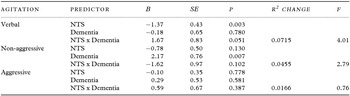
Moderation analyses were then conducted to determine if a significant difference in the relationship between sleep and agitation was present based on whether or not a resident had dementia (Table 2). Night-time sleep was a significant predictor for verbal agitation, but not for physical forms of agitation. Dementia had significant main effects on non-aggressive behaviors, but not on verbal and physical agitation.
Dementia moderates the relationship between night-time sleep and verbal agitation, but not behavioral forms of agitation

Note: NTS = Night-time sleep.
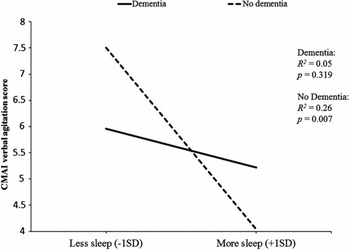
A moderating effect of dementia diagnosis was found on night-time sleep and verbal agitation (Figure 2). In individuals without dementia, a significant negative relationship was present (B = −2.12). This significant interaction explained 25.5% of variance (p = 0.007). Individuals with dementia did not appear to have a significant difference in level of verbal agitation with relation to amount of night-time sleep obtained (B = −0.45; p = 0.319). Physical forms of agitation did not appear to have significant effects of a sleep-dementia interaction.
Dementia moderates the relationship between night-time sleep and verbal agitation. Plot represents verbal agitation scores for those with less sleep (sleep time less than the mean – 1 standard deviation) and more sleep (sleep time greater than the mean +1 standard deviation) for individuals with (n = 22) and without (n = 27) dementia.

Medication rates
Benzodiazepine medications were prescribed to 35% of the sample, with the majority being administered in the evening or night-time. Of these, 8 participants were prescribed benzodiazepines regularly, and 9 residents prescribed benzodiazepines “as required”. Most residents were administered short to intermediate acting forms of this drug, with 2 residents prescribed a long acting benzodiazepine. Of the 8 participants prescribed a regular benzodiazepine, 3 of them were also using another type of sedative medication (antipsychotic or sedating antidepressant). Of the 33 participants not using a benzodiazepine medication, 9 were prescribed a sedating medication (antipsychotic or sedating antidepressant). Non-benzodiazepine hypnotics (or z-drugs) were also considered. Notably, only 1 participant was prescribed a z-drug. Three residents were prescribed “as required” benzodiazepines, however did not use them during the four week period, thus were not included in the benzodiazepine category.
Benzodiazepine use and sleep
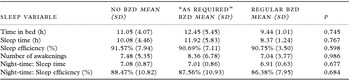
Benzodiazepine use was then considered to determine if using this medication had any impact on the amount of sleep residents were achieving. All regular benzodiazepine users had been taking the medication for longer than four weeks. Non-parametric Kruskal–Wallis tests were conducted to assess for differences in amount of sleep between residents prescribed benzodiazepines regularly, prescribed benzodiazepines occasionally, or as required, and not prescribed benzodiazepines (Table 3). No significant differences were found between groups for any sleep variable.
Sleep demographics, grouped by benzodiazepine use

Note: BZD = Benzodiazepine; No BZD: n = 32; “As required” BZD: n = 9; Regular BZD: n = 8.
Discussion
The present study aimed to explore the interrelations between sleep, agitation, and dementia in nursing home residents. Our first aim exploring the prevalence of night-time sleep disturbance suggested a low prevalence. Over a typical 24-h period, residents slept for a total of 10 h, and slept for 7 of the 8 night-time h. Sleep efficiency was above the normal cut-off value. Our second research aim examining the relationship between symptoms of agitation and night-time sleep suggested a significant relationship for verbal and non-behavioral forms of agitation but not for physically aggressive agitation. Less sleep was associated with increases in both verbal and non-aggressive symptoms of agitation. Our third aim to examine the moderating role of a diagnosis of dementia on the impact of sleep on symptoms of agitation, found that for verbal agitation alone, residents without dementia showed a negative relationship between sleep and agitation that was not present in residents with dementia. Our fourth research aim examining the role of benzodiazepines for sleep in nursing home residents showed no significant differences between benzodiazepine users and non-users for a range of sleep variables.
Disturbances in night-time sleep
Sleep disturbance is well reported in the aged care cohort (Ancoli-Israel et al., Reference Ancoli-Israel, Clopton, Klauber, Fell and Mason1997; Ersser et al., Reference Ersser, Wiles, Taylor, Wade, Walsh and Bentlet1999; Haesler, Reference Haesler2004). However, the current data did not provide clear evidence in support of this. Of the night-time hours (10 pm–6 am), residents slept for 7 h. This finding has also been reported elsewhere. A review conducted by Ancoli-Israel (Reference Ancoli-Israel2009) found that most older adults sleep for about 7 h per night, within the recommended guidelines for adults of 7– 8 h (Youngstedt and Kripke, Reference Youngstedt and Kripke2004).
Sleep disturbance in older adults is not only defined by the lack of total sleep time, but also by a reduced quality of sleep obtained. It is reported that the quality of sleep, often measured by sleep efficiency, reduces as adults age (Ancoli-Israel, Reference Ancoli-Israel2009; Cooke and Ancoli-Israel, Reference Cooke and Ancoli-Israel2011). Despite this, residents’ sleep efficiency in the current study was above the 85% cut-off value (Lacks and Morin, Reference Lacks and Morin1992), indicating they were asleep for most of the time they spent in bed.
The present study suggests that in Tasmanian nursing homes at least, residents are achieving a sufficient amount of sleep and, in some cases, an excessive amount. Previous research has provided support for excessive sleep in residents, with residents of a Norwegian nursing home found to be in bed for an average of thirteen hours and asleep for an average of ten hours (Fetveit and Bjorvatn, Reference Fetveit and Bjorvatn2002). The results of the present investigation support this finding. Residents were in bed for 11 h and slept an average of 10 h per day, well above the recommended 7–8 h per day (Youngstedt and Kripke, Reference Youngstedt and Kripke2004). This finding is at odds with the high rates of hypnotic medication prescribed to many Australian nursing home residents (Westbury and Peterson, Reference Westbury and Peterson2013). When examining possible group differences, our data implicated dementia in modulating the residents’ sleep behaviors. Here, residents who had received a diagnosis of dementia slept for approximately 50% of the 24-h period and significantly longer than residents without a diagnosis of dementia, a finding replicated in other research (Ancoli-Israel et al., Reference Ancoli-Israel, Clopton, Klauber, Fell and Mason1997; Fetveit and Bjorvatn, Reference Fetveit and Bjorvatn2002).
Behavioral and psychological symptoms
Frequency of behavioral and psychological symptoms reported here are reflective of previous research (Zuidema et al., Reference Zuidema, de Jonghe, Verhey and Koopmans2009; Fauth and Gibbons, Reference Fauth and Gibbons2014). Affective, agitated and apathetic symptoms were the most prevalent symptoms, expressed regularly by 30–40% of the total sample. Rates of these symptoms were particularly high for participants with dementia. In terms of agitation, verbal agitation was most prevalent, with about 40% of residents regularly expressing themselves in this way. Consistent with other research (Cohen-Mansfield et al., Reference Cohen-Mansfield, Marx and Werner1992), a higher percentage of residents without dementia, than with dementia, expressed this type of agitation. The incidence of non-aggressive behaviors was relatively low in individuals without dementia at about 15%, but above 50% in those with dementia. This trend has been reported elsewhere, with cognitive impairment significantly correlated with non-aggressive behavioral agitation (Cohen-Mansfield et al., Reference Cohen-Mansfield, Marx and Werner1992). Aggressive behaviors were the least prevalent type of agitation.
There is a dearth of studies assessing agitated behaviors in residents without dementia. In this regard, our data suggest that nursing home residents without dementia are expressing agitated behaviors, typically verbal, but not physical, in nature. While it is not useful to pathologize normal behavior, it is important to recognize the presence of these behaviors to assist in determining possible causes or unmet needs in both people with and without dementia. Non-aggressive behaviors, common in residents with dementia, are associated with younger age, increased cognitive impairment, and may be driven by reduced ability to perform activities of daily living, such as dressing and undressing oneself. Whereas verbally agitated behaviors, typical of residents with high cognitive functioning, have been correlated with depression, anxiety, pain, disease, boredom or poor sleep, and the behavior may be a call for help to deal with these symptoms (Cohen-Mansfield et al., Reference Cohen-Mansfield, Marx and Werner1992). The current research demonstrated that residents without dementia have a different profile of agitation, likely driven by a different set of needs, compared to those with dementia.
Sleep and agitation
Limited information on the relationship between sleep and agitation in residents of nursing homes is available. While a considerable number of studies address sleep in older adults, the impact of poor sleep on the behavior of nursing home residents has not yet been well established. An earlier investigation assessed associations between symptoms of agitation and resident sleep patterns as reported by staff (Cohen-Mansfield and Marx, Reference Cohen-Mansfield and Marx1990). The authors found a significant negative correlation between amount of residents’ night-time sleep and both verbal and non-aggressive symptoms of agitation. Residents with higher cognitive function were more likely to express themselves with verbal forms of agitation, whereas residents with impaired cognition were likely to exhibit non-aggressive behavioral forms of agitation (Cohen-Mansfield et al., Reference Cohen-Mansfield, Marx and Werner1992). These findings were replicated in the current study using quantitative measures of sleep variables. We found that residents without dementia were more likely to express verbal agitation when achieving less night-time sleep. No relationship between verbal agitation and sleep was found for those with dementia – indicative of a moderation effect. Similarly, a significant negative relationship existed between non-aggressive behaviors and night-time sleep in the dementia group, whereas this was not present in the group without dementia. Although the overarching moderation effect was not significant, it is possible a lack of statistical power influenced our ability to detect significance on this test.
Sleep and benzodiazepines
In the current study, no difference in sleep-time between users and non-users of benzodiazepines was found. Other researchers have found similar results for residents administered benzodiazepines for long-term use (Simpson et al., Reference Simpson, Culpepper Richards, Enderlin, O’Sullivan and Koehn2006). It is widely accepted that after four weeks of administration, the sedating effects of benzodiazepines are reduced (Hirst and Sloan, Reference Hirst and Sloan2001). All regular benzodiazepine users in the current study had been using their medication for longer than this period, thus it is likely that the therapeutic effect was minimized. It is also possible that sedating properties in other psychotropic medications administered to users and nonusers of benzodiazepines diluted between-group differences.
Limitations
This study comes with three main limitations that might impact on the interpretation of results. First, presence of dementia was defined by the ACFI reports in resident charts. As it is the responsibility of the nursing home to keep these records up to date, this means that it is possible that the diagnostic criteria may not have been applied to some individuals who have developed dementia in the nursing home. It is more accurate for the researchers themselves to establish whether a diagnosis relating to dementia is present, using diagnostic criteria. This should be considered when interpreting current findings.
A second limitation is that, although actigraphy is a useful and validated tool to obtain measurements of sleep for nursing home residents, there is evidence that it is less reliable on the measurement of certain variables, including sleep onset latency and day-time sleep. This may result in an overestimation of total sleep time and sleep efficiency, particularly in a population who have little movement (Martin and Hakim, Reference Martin and Hakim2011). The current study attempted to reduce the overestimation of sleep by asking staff and residents for the usual sleep and awakening time of each participant. This method has been applied in other research (Fetveit and Bjorvatn, Reference Fetveit and Bjorvatn2002; Sadeh and Acebo, Reference Sadeh and Acebo2002). Furthermore, the Low Frequency Extension data filter was applied to residents with very low levels of movement (ActiGraph LLC, 2014). This filter reduces the threshold of movement amplitude detected by the actigraph device so that it becomes more sensitive to smaller movements. This reduces the likelihood of overestimation of sleep in individuals who move considerably less than others.
Finally, this study was restricted by the participant sample size. This was driven by the lower than expected response rate. Power is likely to be below the accepted level of 0.80, thus individual results should be interpreted with this in mind. While this interim research is an important step in considering the impact of poor night-time sleep in nursing home residents, further investigation should be conducted in this field.
Conclusions
The results of this study demonstrate a significant relationship, in which less night-time sleep correlated with more symptoms of agitation. In residents without dementia, this was in the form of verbal agitation. In residents with dementia, this may be linked to non-aggressive behavioral agitation. Benzodiazepines did not appear to have an impact on sleep in this study. Further studies should consider investigating sleep in relation to quality of life variables, as well as further examine the relationship between sleep and benzodiazepines in nursing home residents.
Conflict of interest
None.
Description of authors’ roles
DB: Study design, data collection, data analysis, manuscript preparation
JW: Study design, manuscript preparation
BS: Data analysis, manuscript preparation.