1. Introduction
This paper examines two responses to the global constitutional crises in the twentieth century, with a focus on a comparison between Carl Schmitt, a notorious German political theorist and a critic of liberal constitutionalism and Zhang Junmai (張君勱), a constitutionalist in Republican China. After the First World War, both Germany and China experienced constitutional crises, which prompted critical reflections among intellectuals. My research shows that Zhang’s 1930 article, “Hugo Preuss (Author of the New German Constitution), His Concept of the State and His Position in the History of German Political Theory” (德國新憲起草者柏呂斯之國家觀念及其在德國政治學說史上之地位) (Zhang Reference Zhang1930, 69–76),Footnote 1 published in his name, is his Chinese translation of Carl Schmitt’s article, “Hugo Preuss: His Concept of the State and His Position in German State Theory” (“Hugo Preuss: Sein Staatsbegriff und seine Stellung in der deutschen Staatslehre”) (Schmitt Reference Schmitt1930, 1–34), printed earlier that year. My research is the first to discover the latent element of Carl Schmitt in Zhang Junmai’s political thought.Footnote 2
It is fundamentally valuable to have a thorough study of Zhang Junmai’s 1930 article, “Hugo Preuss (Author of the New German Constitution), His Concept of the State and His Position in the History of German Political Theory” (德國新憲起草者柏呂斯之國家觀念及其在德國政治學說史上之地位), because it was one significant text part of Zhang’s constitutional practices. Previous scholarship has touched on the importance of this text as it relates to the relationship between the Weimar Constitution, Zhang Junmai’s writing of his own version of the Chinese constitution, and the development of constitutionalism in twentieth-century China, but no one has noticed that this text was, in fact, a translation of Carl Schmitt’s article. Hence, this text not only shows how Zhang Junmai was attracted to Hugo Preuss and the Weimar Constitution but also shows how Zhang simultaneously introduced a kind of critique of the Weimar Constitution. Thus, my article sheds new light on the history of Chinese constitutionalism and constitutional practice. Moreover, by comparing this text with the Guoshi Constitution he drafted in 1922, we can see how Zhang shifted from a constitutionalist supporting the Federalist Movement (Liansheng zizhi yundong 聯省自治運動) and provincial autonomy to a constitutionalist who emphasised the decisive power of the state and introduced a critique of the Weimar Constitution. Considering Zhang Junmai’s introduction of Carl Schmitt’s criticism of liberal constitutionalism, my research challenges previous scholarship that claims Zhang accepted the liberal aspect of the Weimar Constitution. Zhang’s treatment of the relationship between the state and professional associations in his translation of Schmitt’s text also revealed the internal tension of Zhang’s political and constitutional thought, which made him hesitate at different times between the state (which he gradually considered a kind of “Gemeinschaft” [political and ethical community] and professional associations [understood more as “Gesellschaft”]). Zhang Junmai’s hesitation between “Gemeinschaft” and “Gesellschaft” inherited the intellectual legacy of Max Weber, which was not mentioned by previous scholarship.
My comparison of Schmitt’s original ideas and Zhang’s translation of them into the Chinese context is not a translation study or technical discussion on translation, because what Zhang Junmai did had several levels and all of them constitute crucial parts of constitutional and legal adventures and practices in modern China: First, as I will discuss later, Zhang’s constitutional practices led him to reflect on the limits of pure law and paper constitution and led him to differentiate “theory of politics” and “theory of law” and to decide to practice true law instead of paper constitution. Second, based on his reflections on the constitutional crises in early republican China, Zhang decided to learn more from the latest discussions on related theories of constitutionalism, constitutional state, and neutral state in Germany, thus updating his own understanding of what a constitutional state should be. As I will point out in the following sections, Zhang simultaneously accepted Schmitt’s criticism of liberal constitutionalism and the ideas of liberal constitutionalists, which shows the internal tension of his constitutional thought. Such an examination is very important for us to deepen our understanding of the development of constitutionalism in modern China. Thus, my discussion is not just a technical discussion of translation, but a deep exploration of the hidden constitutional landscape in the context of the global twentieth century. What Zhang did was to learn from the German lessons and transplant certain constitutional ideas from Germany to China, and such transplantation of ideas is a crucial part of the constitutional and legal adventures and practices in modern China.
Instead of simply regarding Zhang’s writing as plagiarism, my paper interrogates the gaps between Carl Schmitt’s original text and Zhang’s translation. Based on my close analysis of Carl Schmitt’s political ideas shown in his text, as well as Zhang’s translation of these ideas, I explore how and why Zhang accepted Carl Schmitt’s notions of the political and of decision-making. By investigating how Zhang and Schmitt simultaneously called on the determining power of politics and how Zhang readily accepted Schmitt’s emphasis on politics against the so-called pure law, I examine how German and Chinese intellectuals endeavoured to resolve the constitutional crises in Germany and China from the 1910s to the 1930s through their reflections on the concept of the political and the state, as well as the relationship between politics and law.
My research is also the first to deeply explore the hidden intellectual impact of Max Weber and Carl Schmitt on Zhang Junmai, especially on several key issues related to the politics of the nineteenth and twentieth centuries, such as the sovereign and sovereignty, the depoliticising bourgeois intellectuals, the rise of economic interests and the decline of politics and state theory, and so on.Footnote 3 As mentioned above, Zhang Junmai’s hesitation between “Gemeinschaft” and “Gesellschaft” inherited the intellectual legacy of Max Weber, which was not discussed by previous scholarship. Here I would like to add Carl Schmitt to the genealogy of state versus society. In Carl Schmitt’s original text, Schmitt closely discusses the relationship between the state and society in detail. Schmitt argues that “the most important problem in nineteenth-century state theory—that of the relationship between the state and society—was both clearly understood and openly discussed by the educated bourgeoisie. This generation, who were undeterred by their defeat in 1848, maintained that the state is to be understood as a sphere of the intellect (Geist) and ethical life (Sittlichkeit). Society, by contrast, is the realm of impulses, emotions and egoism or, as Gneist once put it, of zoon, the animalistic nature of the human, who only becomes a zoon politikōn once existing in the state” (Schmitt, Loughlin, and Foley Reference Schmitt, Loughlin and Foley2017, 357–358).Footnote 4 Interestingly, in his Chinese translation of Schmitt’s text, Zhang Junmai adds another sentence after this one: “This era considers the position of the state to be above society (Staat über der Gesellschaft)”(Zhang Reference Zhang2006, 347). Here we can see that Zhang Junmai adds a phrase specifically in German—“Staat über der Gesellschaft” and in this phrase, he self-consciously uses “Gesellschaft” to refer to the word “society” in Chinese. From here, we see how the concept of “Gesellschaft” haunts Zhang Junmai’s political thought.
In the same paragraph of Schmitt’s text, Schmitt indicates that in the context of Germany, if the state “becomes the ‘self-organization’ of society” (Schmitt, Loughlin, and Foley Reference Schmitt, Loughlin and Foley2017, 366), there would be a possible danger to a constitutional state. Schmitt says, “under the Weimar Constitution, it is now left to the powers of society to organize themselves into a state” (Schmitt, Loughlin, and Foley Reference Schmitt, Loughlin and Foley2017, 366). However, if the state is “only the ‘self-organization’ of the societal body” (Schmitt, Loughlin, and Foley Reference Schmitt, Loughlin and Foley2017, 366), the state could end up “in the hands of the parties” (Schmitt, Loughlin, and Foley Reference Schmitt, Loughlin and Foley2017, 366). Schmitt points out that Preuss hopes to include “authentic public opinion” and “a national purpose of the German people” “in the state depicted in the Weimar Constitution” (Schmitt, Loughlin, and Foley Reference Schmitt, Loughlin and Foley2017, 367) in order to prevent party politics from destroying a constitutional state. And “the question itself is as long-standing as that of the concept of the bourgeois constitutional state” (Schmitt, Loughlin, and Foley Reference Schmitt, Loughlin and Foley2017, 368). To Schmitt, the only solution is a call to the “political education and intelligence” (Schmitt, Loughlin, and Foley Reference Schmitt, Loughlin and Foley2017, 368). Schmitt points out that “the state theory of the young Lorenz Stein was based on Hegel. …It also provides evidence of the astonishing intellectual power of the increasingly politically-conscious German bourgeoisie” (Schmitt, Loughlin, and Foley Reference Schmitt, Loughlin and Foley2017, 357). Here, we see how Schmitt emphasises the significance of the political consciousness of the bourgeoisie. Schmitt believes that a national spirit is necessary to achieve authentic public opinion. All of Schmitt’s points here can be found in Zhang Junmai’s political and constitutional activities and related writings. In Zhang’s 1923 lecture “The Internal and External Politics” (Nei de zhengzhi yu wai de zhengzhi 内的政治与外的政治) (Zhang Reference Zhang2006, 314–318), he emphasises the importance of “public opinion.” In his later writings on state philosophy, Zhang also appreciates the German state theories, especially those of Hegel’s. Therefore, my research shows that there is a hidden existence of Carl Schmitt in Zhang’s acceptance of Hegel’s ideas, which has not been noticed by existing scholarship, while the intellectual connections between Hegel and Zhang Junmai have been recognised by Zhang himself and previous scholarship. In addition, Zhang’s activities in connection with the Federalist Movement also showed how he dealt with social forces. In founding Guoli Zizhi xueyuan 国立自治学院 (National Institute of Self-Government) in 1923, Zhang emphasised the improvement of people’s political interests and political education.
Like Max Weber, Carl Schmitt criticised the German bourgeoisie’s loss of political interest and called on the political education of the bourgeoisie, while Zhang Junmai practised political education in China. Carl Schmitt’s description of true politics as being able to solve difficult problems prompted Zhang to emphasise the government’s ability to solve political difficulties. Carl Schmitt’s emphasis on state theory echoes in Zhang Junmai’s calling for a state philosophy in China’s time of emergency under the shadow of war in the 1930s.
Carl Schmitt’s arguments on the Rechtsstaat also influenced how Zhang Junmai understood the rule of law. As mentioned above, both Schmitt and Zhang emphasise the determining power of the political, questioned pure law and the non-political nature of a Rechtsstaat. Schmitt believes that the Rechtsstaat should go beyond the Gesetzesstaat (legislative state) or Justizstaat (judiciary state). However, although “being a neutral state” is a characteristic of the Rechtsstaat, it also shows the limits of a Rechtsstaat, because a neutral state means “a non-intervening, non-interfering, passive, agnostic state.” Such neutrality of the Rechtsstaat reduced the latter to a “passive state.” Here we see Schmitt’s criticism of liberal constitutionalism because it is liberals who consciously sought to minimise the functions of the state and to leave problems of the state to the competition of various social forces. Schmitt differentiates two types of non-interference (one between the state and society; and the other between the state and economic institutions of the state). Schmitt also distinguishes two types of neutrality. While criticising neutrality as in the concept of a neutral state, a “passive, agnostic state,” Schmitt proposes a kind of neutrality that “facilitates an impartial and fair decision” (Schmitt, Loughlin, and Foley Reference Schmitt, Loughlin and Foley2017, 369). Schmitt argues that “from a sociological perspective, this requires an entity that is not linked to any particular party. Without this, any bourgeois constitutional state would today be unthinkable. This state encompasses civic education and the belief in a national spirit (Geist der Nation)” (Schmitt, Loughlin, and Foley Reference Schmitt, Loughlin and Foley2017, 369).
Borrowing Schmitt’s definitions of two types of neutrality of a state, Zhang Junmai also explores the role of law in compromising social forces, the dichotomies between state and society and between state and economic institutions. It seems that Zhang simultaneously accepted the two levels of neutrality that Schmitt distinguished. In many of his writings, Zhang emphasises the importance of social organisations. Zhang Junmai’s practice of creating mature and neutral political subjects outside the control of specific parties also echoes Schmitt’s emphasis on the second level of neutrality, which severed its relation to parties. In addition, we also see the hidden influence of Carl Schmitt on Zhang Junmai in Zhang’s emphasis on the substance of the state and a national spirit, since Schmitt himself linked the substance of the state to a national spirit.
While Zhang seems to have simultaneously read and accepted parts of the ideas of Carl Schmitt and Schmitt’s liberal rivals, a hidden side in Zhang Junmai’s thought is his acceptance of Schmitt’s critique of liberal understandings of the state and Rechtsstaat. Carl Schmitt’s question, “Who is the guardian of the constitution?” was also a question for Zhang Junmai. For Schmitt, the judiciary should not act as the guardian of the constitution. It is necessary to avoid the judicial solution of political difficulties (in the broad sense of politics) and the politicisation of the judiciary (in the narrow sense of politics). When Zhang Junmai discussed the rule of law in the context of twentieth-century China, he hesitated between the Rechtsstaat (constitutional state) and the Gesetzesstaat (legislative state). Later, as China became increasingly caught up in the shadow of the war, Zhang also began to emphasise more strongly the need to avoid the administrativisation of legislation.
By examining the intertextual relation between Carl Schmitt and Zhang Junmai, this paper reveals a latent aspect of the spectrum of Constitutionalism in the twentieth century and shows a special dialogue between a German critic of constitutionalism and a Chinese constitutionalist.
2. Historical contexts and intellectual backgrounds
2.1. Historical contexts: Germany and China after the First World War
In 1912, the last imperial dynasty of China, the Qing dynasty was replaced by the Republic of China. Although the new regime claimed to be a republic, it was not really a substantial political body. Several constitutions were drafted before and after 1912. However, in the absence of a mature and widely accepted constitution, the constitutional practices only led to chaos and political struggles among different parties. For a state, a constitution is its foundation; for politicians, to draft a constitution is to gain discursive and substantial power in domestic politics. In addition to the top-bottom action of constitutional drafting, the Federalist Movement (Liansheng zizhi yundong 聯省自治運動) brought about constitutional practices at the provincial level. At the same time, the rise of the social fields or social forces since the late Qing brought about the rise of civil or professional associations (Xiao-Planes Reference Xiao-Planes, Balme and Dowdle2009, 45), which also played their own role in constitutional practices at the provincial level. Thus, the provincial and the professional forces interacted with each other in China’s constitutional practices in the early twentieth century (Xiao-Planes Reference Xiao-Planes, Balme and Dowdle2009, 46). China’s chaotic situation at that time also hastened many intellectuals to reconsider the possibility of a new, true constitution. In addition to the government-sponsored constitutional drafts, various intellectuals provided their own versions of China’s constitution, including Kang Youwei 康有為, Zhang Taiyan 章太炎, and Zhang Junmai. A former student of politics, Zhang Junmai began his intellectual and political journey as a politician and pioneer constitutionalist in the 1910s and 1920s. First, he was involved in various political activities in the 1910s and 1920s, including criticising the Yuan Shikai government and later participating in anti-Yuan Shikai activities, working for various levels of the government (first in his hometown, Baoshan county, then for the Zhejiang provincial government), being involved in politics in the Beiyang government, and so on. Second, his political activities were also intertwined with his observation of politics in Europe with other intellectuals including Liang Qichao. Third, after examining the political and economic models of Britain, Germany, and the Soviet Union, in 1922, Zhang Junmai drafted one version (甲種) of the Guoshi huiyi xianfa caoan 國是會議憲法草案 and also published a book called Guoxian yi 國憲議, providing further explanations of the Guoshi Constitution. Another version of the Guoshi huiyi xianfa caoan (乙種) was attributed to Zhang Taiyan (Cen Reference Cen1933). According to Zhang Junmai’s own account, Zhang Taiyan’s version of the Guoshi Constitution was also drafted by Zhang Junmai himself at Zhang Taiyan’s request (Zhang Reference Zhang2006, 6). So, it shows Zhang Taiyan’s blueprint for a Chinese constitution. Interestingly, the Guoshi huiyi was organised by the joint Council of National Confederation of Commercial Associations 全國商會聯合會 and the National Confederation of Educational Associations 全國教育會聯合會. The representatives were from civic (professional) associations in various provinces, including commerce, trade, education, agriculture, industrial, press, and lawyer’s associations (Cen Reference Cen1933; Zhang Reference Zhang2006, 6; Xiao-Planes Reference Xiao-Planes, Balme and Dowdle2009, 46). Although we cannot conclude that the two versions of the Guoshi constitutions absolutely represented the voices of the professional associations, since the professional associations themselves were different and both Zhang Junmai and Zhang Taiyan had their own political visions, at least the articles in the constitutions were not against the interests of the professional associations. In fact, in both versions of the Guoshi Constitution, representatives from the professional associations can be candidates for the Senate. Moreover, as Fupeng Li argues, Zhang Junmai’s version of the Guoshi Constitution “translated” the social rights in the Weimar Constitution into articles on shengji 生计 (economy) (Li Reference Li2020, 134). Such a legal transport also shows that Zhang not only emphasised the social forces as represented by the professional associations but also had his focus among the social forces on the economic. The drafting of constitutions also became a battleground for various groups to fight for, or at least claim, their interests. Zhang Junmai’s emphasis on the social and the economic can also be linked to Zhang’s later treatment of the relationship between the state and professional associations, which was reflected in his translation of Carl Schmitt’s article.
The political vacuum created by the lack of a mature constitution hastened Zhang Junmai’s rethinking of what is true constitution, what is true law, and what is true politics. At this point, Germany became the focus of Zhang’s attention. In fact, in the development of Zhang Junmai’s political thought, there was a shift from the British model to the German model. Why was Germany so attractive to Zhang Junmai? There are three reasons. First of all, Germany and China at that time shared similar historical and political circumstances. Second, because of his own emphasis on ethics, Zhang Junmai appreciated the ethical dimension in the German theory of the state. Third, Zhang Junmai’s insistence on true politics and state sovereignty inclined him to readily accept Carl Schmitt’s theory of the political, and his emphasis on a state’s ability to solve difficult problems in times of emergency.
From 1918 to 1919, Germany was trapped in a chaotic situation. After being defeated in the First World War, the Second German Empire collapsed. During this period, both the sovereignty of the state and its legitimacy existed in a vacuum. Political theorist Hugo Preuss was then asked to draft a new constitution, which was later called the “Weimar Constitution.” As a compromise, the Weimar Constitution was far from perfect and caused many problems.
The situation in China was similar in many ways. The constitution had become a tool used by politicians to carry out their own plans. This constitutional crisis in modern China pushed Zhang to reflect on the determining power of the constitution or the law. In his search for resources to inform his deliberations, the Weimar Constitution became an important precedent for him.
From 1919 to 1921, Zhang Junmai stayed in Europe for three years. In August 1919, the Weimar Constitution came into force. In his book, On Political Phenomena of Social Democracy in New Germany (Xin deguo shehui minzhu zhengxiang ji 新德國社會民主政象記), Zhang Junmai encloses Hugo Preuss’s photo with Preuss’s signature and written greetings to him, dated 23 December 1919, as well as Preuss’s subsequent letter to him. Thus, the previous scholarship has concluded that Zhang visited Hugo Preuss on 23 December 1919 (Weng Reference Weng2010, 84; Liu Reference Liu2003a, 56; Li Reference Li2020, 136). In April 2020, Zhang Junmai published his Chinese translation of the Weimar Constitution (Zhang Reference Zhang1920, 39–84), with the hope that Chinese intellectuals could read it “ten thousand times” (Jeans Reference Jeans1997, 33; Liu Reference Liu2003a, 56). As mentioned above, we also see the influence of the Weimar Constitution in Zhang Junmai’s version of the Guoshi Constitution.
2.2. Intellectual background: Zhang Junmai’s reflection on politics
However, is a written constitution enough to establish a new politics? Zhang’s answer is “No.” Zhang realised the limits of constitutions and began to reexamine the meaning of politics. By emphasising the substantial content of politics, Zhang hoped to transcend the formal level of politics and call on the truth of politics. In 1923, in a lecture entitled “The Internal and External Politics” (Nei de zhengzhi yu wai de zhengzhi内的政治与外的政治), Zhang Junmai says:
What I want to talk about today is not concerned with the constitutions of the provinces, but with politics among the provinces—and not only on the politics among the provinces, but on the truth of politics. What is politics? Let me try to answer this question… (Zhang Reference Zhang2006, 315)Footnote 5
What is politics? What is the truth of politics? This is the most fundamental issue pointed out by Zhang Junmai. After a reflection on political practices since the establishment of the Republic of China, Zhang gives his conclusion:
The problem of Chinese politics is that we only talk about external politics rather than internal politics, superficial politics rather than inner politics. In other words, we only work on paper or on the formal level, but never work on the spirit or the heart-and-mind.Footnote 6 (Zhang Reference Zhang2006, 315–316)
In Zhang’s opinion, political practices so far have only produced “paper constitutions,” “formal systems or institutions,” and “stagnant rules and laws without progress”—all of which are not politics. Zhang says, “Even if we name them politics, they are only external politics or superficial politics” (Zhang Reference Zhang2006, 316).
Thus, “the so-called law procedures or systems,” are mostly “only paperwork, not the crystallization of the public opinion.” He continues: “Those so-called political institutions or associations are mostly bodies without souls, not organic systems” (Zhang Reference Zhang2006, 316–317).
Based on the idea of an “organic system,” which was quite popular at that time, Zhang calls for a kind of true politics, which he names “internal politics”:
Internal politics simply means breaking the old politics which emphasized rules, institutions, and forms, replacing the old politics with a new politics through substantial effort. (Zhang Reference Zhang2006, 318)
When Zhang uses “internal”/“inner” and “external”/“superficial” to describe two political poles, and describes the former as “working on heart-and-mind or spirit” and the latter as “only working on paper or the formal level,” we see that his approach is similar to that of traditional Chinese philosophy. However, Zhang’s political consciousness as shown here is quite modern. The politics he applauds does not comprise hollow constitutional items, but, rather, actual political actions.
Connected to his concept of “internal politics,” Zhang also calls for a “true law.” In his opinion, there are two conditions for law:
First: “Law is the principle of the common life of a society.”
Second: “The more progressive a society, the more people can express their own opinions. Hence, whether or not law is good depends on whether it is suitable for the community of free-willed people.” (Zhang Reference Zhang2006, 337–338)
Based on these two conditions, Zhang argues that “law should aim at allowing all people in a society to be able to freely express their will. This is true law” (Zhang Reference Zhang2006, 338).
As in his definition of politics, Zhang argues that true law is not what is written in paper documents, because once it is put into writing it becomes formal. To Zhang, the fundamental basis of law is the human mind or the will of the people. Moreover, because the human mind and the will of the people always change with time, law also changes with time. The unchangeable nature of law is that it is always based on the people’s free will. If Zhang’s emphasis on heart-and-mind is more or less rooted in the tradition of Chinese philosophy, then his advocacy of “people’s will” and “free will” is more from the tradition of Western political philosophy. Thus, his definition of law reveals a combination of the Chinese and Western traditions. All of his reflections on politics and law made him readily accept Carl Schmitt’s ideas of politics and the constitution.
3. The latent Carl Schmitt in Zhang Junmai’s political thought
3.1. New discovery
Zhang’s insistence on true politics and internal politics influenced his acceptance of Carl Schmitt’s concept of the political, although Zhang never acknowledged that he was influenced by Schmitt. On 25 December 1930, Zhang Junmai published an article entitled “Hugo Preuss (Author of the New German Constitution), His Concept of the State and His Position in the History of German Political Theory” (Deguo xinxian qicaozhe Bo Lüsi zhi guojia guannian jiqi zai deguo zhengzhi xueshuoshi shang zhi diwei 德國新憲起草者柏呂斯之國家觀念及其在德國政治學說史上之地位) (Zhang Reference Zhang1930, 69–76). This article deserves new interpretations based on my new discoveries because there are many striking similarities between this text and Carl Schmitt’s ideas on the state and the political. In the early phase of my study, I found the ideas expressed in this work very similar to those of Carl Schmitt’s book The Concept of the Political. My first guess was that Zhang had read Carl Schmitt’s work and borrowed his ideas. However, Zhang’s article was published in Dongfang zazhi 東方雜誌, in December 1930. Although the first two editions of Schmitt’s article “Der Begriff des Politischen” (“The Concept of the Political”) were printed in 1927 and 1928 in two German journals (Schmitt Reference Schmitt1927, 1–33; Schmitt Reference Schmitt1928, 1–34), the passages that are similar to those in Zhang Junmai’s article appear only in the book edition of The Concept of the Political, which was published in 1932. Such evidence shows that Zhang’s article was not derived from Schmitt’s book The Concept of the Political. Thus, I had to conclude that the striking similarity between Zhang Junmai and Carl Schmitt was due to the similar historical situations of Germany and China. In similar historical situations during the same period, Zhang Junmai, a Chinese constitutionalist and Carl Schmitt, a German political theorist, shared a similar historical sense. Both of them provided their own critical responses to constitutional crises in China and Germany.
However, a deeper study of Carl Schmitt’s works allowed me to discover one of his articles, entitled “Hugo Preuss: Sein Staatsbegriff und seine Stellung in der deutschen Staatslehre” (“Hugo Preuss: His Concept of the State and His Position in German State Theory”). It was published in the 72nd issue of Recht und Staat in Geschichte und Gegenwart in 1930. According to the author’s preliminary remarks, written in April 1930, the article is based on a speech he delivered on 18 January 1930. In this speech, he provided a brief overview of the historical development of three generations of German constitutional law.
The titles of Zhang Junmai’s article, “Hugo Preuss (Author of the New German Constitution), His Concept of the State and His Position in the History of German Political Theory,” and Carl Schmitt’s article, “Hugo Preuss: His Concept of the State and His Position in German State Theory,” are almost the same. There are only two differences. First, Zhang adds a short introduction stating that Hugo Preuss is the author of the new German Constitution, which is helpful to the Chinese reader. Second, Zhang replaces the “state theory” (staatslehre) in Carl Schmitt’s title with “political theory” in his title. The similarities between the titles prompted me to do a comparative study of the two articles. After a close comparison, my conclusion is that Zhang’s article was a Chinese translation of Carl Schmitt’s article. This conclusion suggests that Zhang Junmai must have read Carl Schmitt’s works, although Zhang Junmai never mentioned having read Schmitt in any of his own writings, lectures or interviews. Because of this, the latent Carl Schmitt in his thought has never been discovered by previous scholarship. Thus, my discovery of the textual relation between Carl Schmitt and Zhang Junmai sheds new light on the scope of Zhang Junmai’s intellectual world, as understood from existing scholarship.
In his article, “An Episode of Constitutionalism in Republican China” (“Minguo xianzheng de yiduan wangshi 民国宪政的一段往事”), Liu Xiaofeng laments that Zhang Junmai did not pay attention to the major reflections on the constitution at that time by German theorists such as Carl Schmitt (Liu Reference Liu2003b). However, my discovery shows the intertextual relation between Zhang Junmai and Carl Schmitt. Carl Schmitt gave his speech in January 1930 and revised it into an article the following April, while Zhang Junmai translated this article with its original title into Chinese and published it in his own name on 25 December 1930. The fact that Zhang introduced Carl Schmitt’s article into China so soon after its initial publication, shows that Zhang Junmai was actively following the latest works concerning the German Constitution and state.
It is not productive to simply regard Zhang’s article as plagiarism. Due to the long tradition of quoting others’ works without any footnotes in works of literature and scholarship in ancient China, intellectuals since the late Qing had not established a mature, modern attitude towards copyright. Many famous scholars, including Yan Fu and Liang Qichao, published their translations of foreign works in their own names, without mentioning the original authors. Thus, having established the textual relation between Zhang Junmai’s and Carl Schmitt’s articles, I will focus on the following questions: What does Carl Schmitt discuss in his article? What is Schmitt’s attitude toward Hugo Preuss’s idea of the state, which also reflects his own idea of the state? How does Schmitt evaluate the situation of Germany after the publication of the Weimar Constitution? Why did Zhang Junmai, after translating and introducing the Weimar Constitution drafted by Hugo Preuss, choose to also introduce Carl Schmitt’s article to the Chinese people? What points in Carl Schmitt’s article “Hugo Preuss” attracted Zhang Junmai?
3.2. Carl Schmitt’s major arguments in “Hugo Preuss: His concept of the state and his position in German state theory”
In “Hugo Preuss: His Concept of the State and His Position in German State Theory,” Carl Schmitt makes several major arguments:
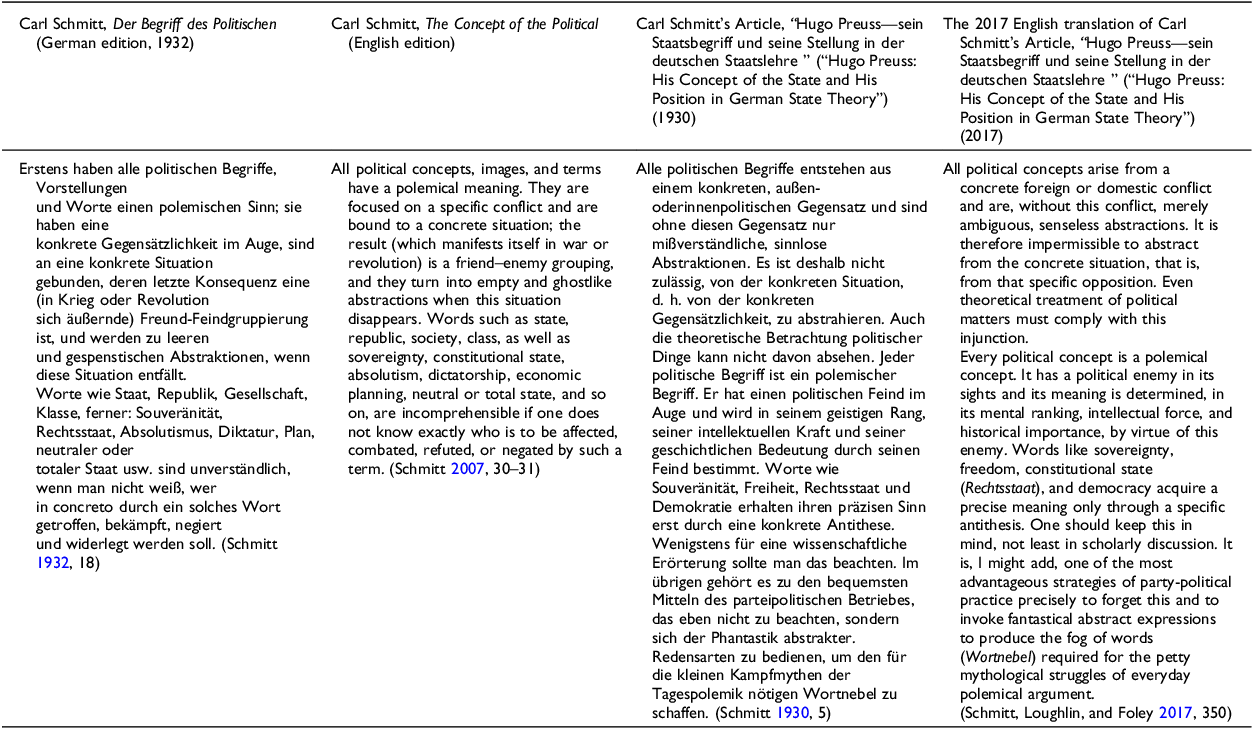
First, Schmitt addresses his ideas on political concepts and the friend–enemy dichotomy, which are later readdressed in the 1932 book Der Begriff des Politischen (The Concept of the Political). (Table 1: Comparison between the first paragraph of Carl Schmitt’s article and an important paragraph in his book Der Begriff des Politischen.)
Concept of the political

From Table 1, we see that in the two texts—Carl Schmitt’s 1930 article “Hugo Preuss—sein Staatsbegriff und seine Stellung in der deutschen Staatslehre” (“Hugo Preuss: His Concept of the State and His Position in German State Theory”) and his 1932 book Der Begriff des Politischen (The Concept of the Political), Schmitt emphasises four points: first, there is no political concept that is free from a concrete situation. Second, political concepts cannot be abstractly understood. Third, a concrete situation is often a friend–enemy situation. Fourth, political notions such as sovereignty, the constitutional state, dictatorship, and economic planning are not neutral; they should always be placed in concrete, friend–enemy situations.
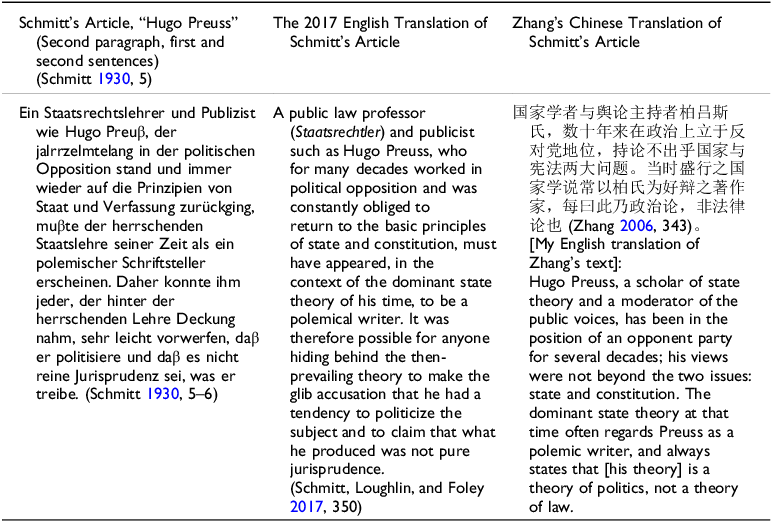
Second, Carl Schmitt criticises the so-called pure theory of law or “pure jurisprudence” for avoiding political difficulties and the most fundamental issues in politics. At the beginning of the second paragraph of his article “Hugo Preuss—sein Staatsbegriff und seine Stellung in der deutschen Staatslehre” (“Hugo Preuss: His Concept of the State and His Position in German State Theory”), he quotes a popular critique of Hugo Preuss at that time:
Ein Staatsrechtslehrer und Publizist wie Hugo Preuβ, der jahrzehntelang in der politischen Opposition stand und immer wieder auf die Prinzipien von Staat und Verfassung zurückging, muβte der herrschenden Staatslehre seiner Zeit als ein polemischer Schriftsteller erscheinen. Daher konnte ihm jeder, der hinter der herrschenden Lehre Deckung nahm, sehr leicht vorwerfen, daβ er politisiere und daβ es nicht reine Jurisprudenz sei, was er treibe. Heute durchschauen wir diese Art juristischer Reinheit. Wir wissen, daβ es ein spezifisch politischer Kunstgriff ist, sich selbst als unpolitisch und den Gegner als politisch hinzustellen. (Schmitt Reference Schmitt1930, 5–6)
A public law professor (Staatsrechtler) and publicist such as Hugo Preuss, who for many decades worked in political opposition and was constantly obliged to return to the basic principles of state and constitution, must have appeared, in the context of the dominant state theory of his time, to be a polemical writer. It was therefore possible for anyone hiding behind the then-prevailing theory to make the glib accusation that he had a tendency to politicize the subject and to claim that what he produced was not pure jurisprudence. Today, we see through this kind of juristic purity. We know that to declare oneself apolitical and one’s enemy to be political is a specific political manoeuvre. (Schmitt, Loughlin, and Foley Reference Schmitt, Loughlin and Foley2017, 350)
Schmitt argues that there is no field that is not penetrated by politics; all problems are political problems. The concept of “the political” used here is “the political” in the broad sense. This means that it concerns important issues such as the state, sovereignty, and so on. People who claim to be “non-political” are nonetheless trapped in politics, though not politics in the broad sense, but in the narrow sense—politics that wrestles at the superficial level and far from the most fundamental issues: bureaucratic politics, judicial politics, and so on. Regarding those who insist on the so-called “pure law,” Schmitt argues that their emphasis is solely on judicial and administrative issues and that they never pay attention to difficult political problems. The goal of “a jurisprudence” is to legitimise the status quo. The notion of pure law works only on a superficial level—rules, institutions, procedures—and in turn, neglects the most fundamental questions of politics (Schmitt Reference Schmitt1930, 6). Schmitt’s criticism of the pure theory of law was linked to his reflections on the limits of the constitution.
Third, Schmitt emphasises the importance of decision-making. He criticises the tendency of decision suspension which is evident in the insistence of pure law:
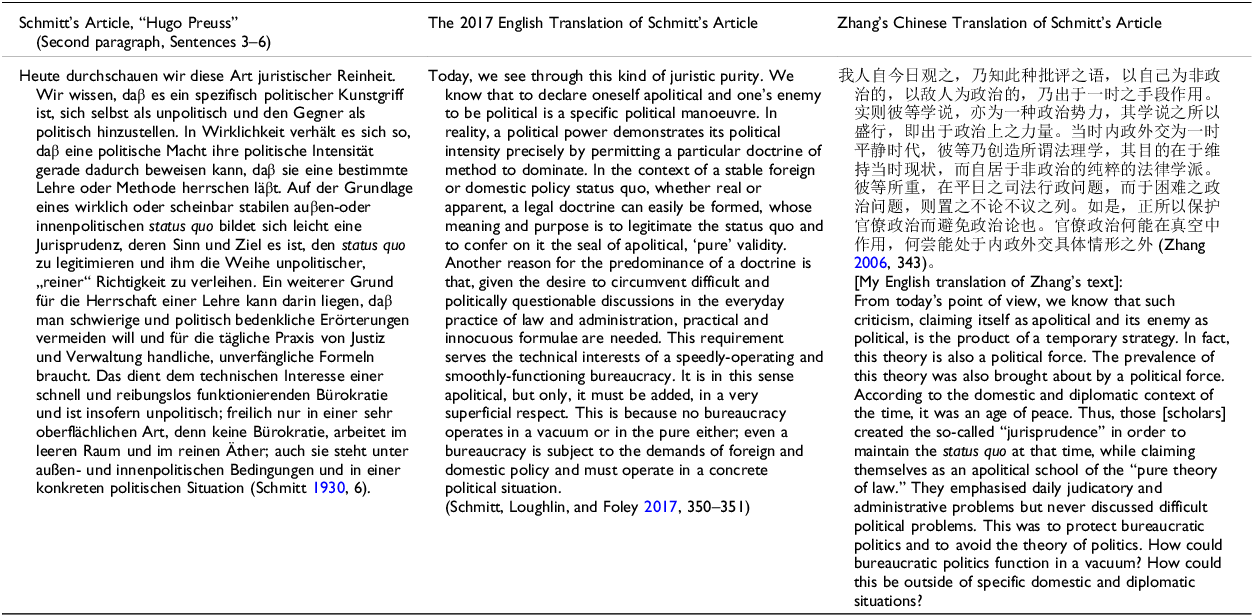
Auf der Grundlage eines wirklich oder scheinbar stabilen auβen- oder innenpolitischen status quo bildet sich leicht eine Jurisprudenz, deren Sinn und Ziel es ist, den status quo zu legitimieren und ihm die Weihe unpolitischer, „reiner“ Richtigkeit zu verleihen. Ein weiterer Grund für die Herrschaft einer Lehre kann darin liegen, daβ man schwierige und politisch bedenkliche Erörterungen vermeiden will und für die tägliche Praxis von Justiz und Verwaltung handliche, unverfängliche Formeln braucht. Das dient dem technischen Interesse einer schnell und reibungslos funktionierenden Bürokratie und ist insofern unpolitisch; freilich nur in einer sehr oberflächlichen Art, denn keine Bürokratie arbeitet im leeren Raum und im reinen Äther; auch sie steht unter außen- und innenpolitischen Bedingungen und in einer konkreten politischen Situation. (Schmitt Reference Schmitt1930, 6)
In the context of a stable foreign or domestic policy status quo, whether real or apparent, a legal doctrine can easily be formed, whose meaning and purpose is to legitimate the status quo and to confer on it the seal of apolitical, ‘pure’ validity. Another reason for the predominance of a doctrine is that, given the desire to circumvent difficult and politically questionable discussions in the everyday practice of law and administration, practical and innocuous formulae are needed. This requirement serves the technical interests of a speedily-operating and smoothly functioning bureaucracy. It is in this sense apolitical, but only, it must be added, in a very superficial respect. This is because no bureaucracy operates in a vacuum or in the pure ether; even a bureaucracy is subject to the demands of foreign and domestic policy and must operate in a concrete political situation. (Schmitt, Loughlin, Foley Reference Schmitt, Loughlin and Foley2017, 351)
Schmitt traces it back to the pre-war period:
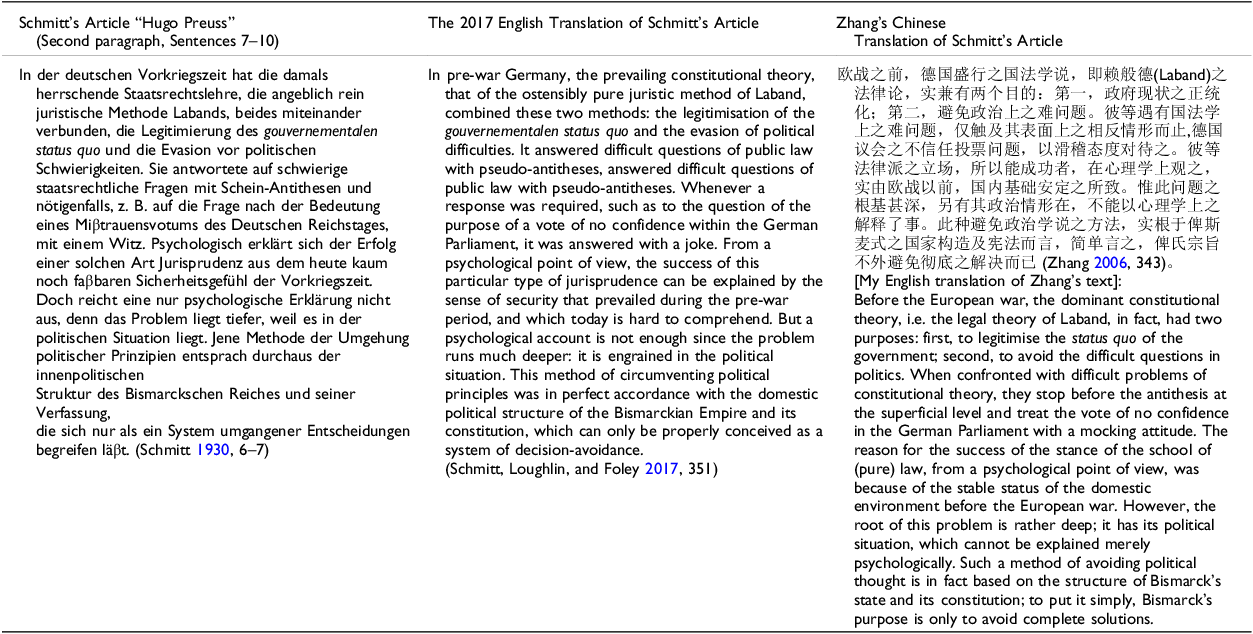
In der deutschen Vorkriegszeit hat die damals herrschende Staatsrechtslehre, die angeblich rein juristische Methode Labands, beides miteinander verbunden, die Legitimierung des gouvernementalen status quo und die Evasion vor politischen Schwierigkeiten. Sie antwortete auf schwierige staatsrechtliche Fragen mit Schein-Antithesen……Jene Methode der Umgehung politischer Prinzipien entsprach durchaus der innenpolitischen Struktur des Bismarckschen Reiches und seiner Verfassung, die sich nur als ein System umgangener Entscheidungen begreifen läβt. (Schmitt Reference Schmitt1930, 6–7)
In pre-war Germany, the prevailing constitutional theory, that of the ostensibly pure juristic method of Laband, combined these two methods: the legitimization of the gouvernementalen status quo and the evasion of political difficulties. It answered difficult questions of public law with pseudo-antitheses….This method of circumventing political principles was in perfect accordance with the domestic political structure of the Bismarckian Empire and its constitution, which can only be properly conceived as a system of decision-avoidance (Schmitt, Loughlin, and Foley, Reference Schmitt, Loughlin and Foley2017, 351).
To Schmitt, the “evasion of political difficulties” and “circumventing political principles” are compromises and thus construct a system of decision-avoidance and end up with “suspension of difficult political decisions.” Behind this, we can see the “political purpose” of the “apolitical and ostensibly pure legal method” (Schmitt, Loughlin, and Foley Reference Schmitt, Loughlin and Foley2017, 351).
3.3. Theory of law versus Theory of politics: Zhang Junmai’s acceptance of Carl Schmitt’s article
By a close comparison between Schmitt’s original article “Hugo Preuss: His Concept of the State and His Position in German State Theory” and Zhang’s translation, I find a few points that deserve attention in Zhang Junmai’s acceptance of Carl Schmitt’s ideas addressed in this article.
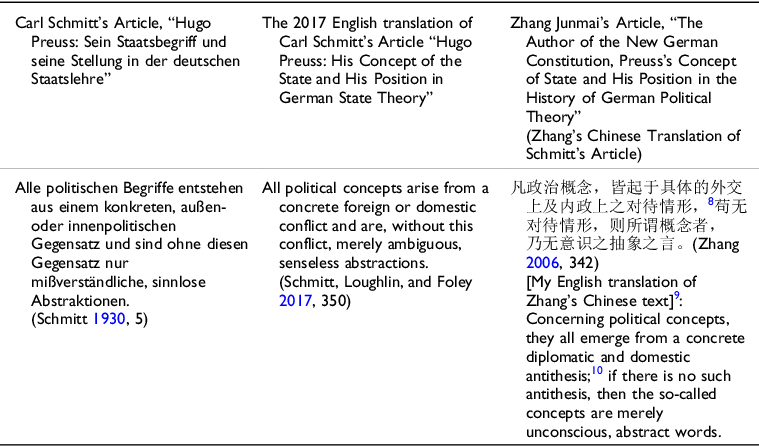
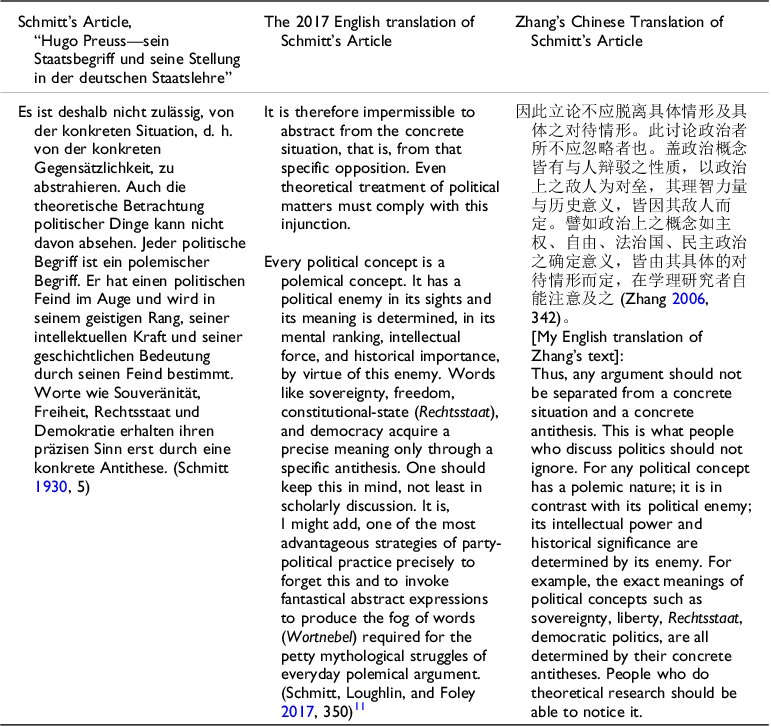
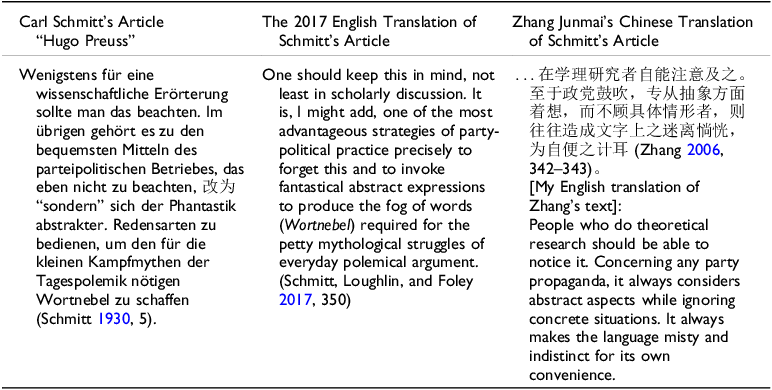
First, Zhang’s commitment to the search for true politics made him readily accept Schmitt’s concept of the political while overlooking Schmitt’s distinction between enemy and friend.Footnote 7 We can see this point by comparing Schmitt’s original text and Zhang’s (Tables 2–4).
Concept in concrete conflict

Political concept as polemical concept

Strategies of Party-Political practice

From the three tables, we see that Schmitt emphasises that all political concepts are not abstract concepts; they all come from concrete oppositions. Zhang Junmai’s translation of the German words Gegensatz, Gegensätzlichkeit, and Antithese as “duidai qingxing” (antithesis) captures the basic meaning of Schmitt’s original text. However, although Zhang’s translation retains Schmitt’s friend–enemy dichotomy, it does not draw full attention to it. Zhang’s own reflection on the truth of politics made him readily accept Schmitt’s concept of the political, although he focuses very little on Schmitt’s concept of the friend–enemy dichotomy.
Second, Zhang Junmai incorporates Schmitt’s criticism of pure jurisprudence into his elaboration on the theory of politics as opposed to the theory of law (falü lun 法律论). From Table 5, we see that in his translation, Zhang Junmai deletes the word “pure” before “jurisprudence” and translates “pure jurisprudence” as falü lun 法律论 (theory of law), which negates the specific connotation of the concept of “pure jurisprudence.” He also changes “politicising” into the “theory of politics.” Such changes do not violate the basic meanings of Schmitt’s words. Rather, through re-narrating Schmitt’s theory in his own language, Zhang Junmai provides his creative interpretation of Carl Schmitt’s emphasis on the political and turns it into his own distinction between the theory of politics and the theory of law.
Theory of Politics vs. Theory of law

Table 6 provides a close comparison between Schmitt’s original text and Zhang Junmai’s translation:
The So-called “Apolitical”

From Table 6, we see that Zhang’s translation captures the basic meaning of Schmitt’s argument and makes a clear differentiation between the theory of law and the theory of politics: the former claims to be pure “legal theory,” but cannot avoid being trapped in polities, while the latter embodies the following ideas: politics exist in concrete situations; politics penetrates all fields; true politics should be able to solve difficult political problems (Zhang Reference Zhang2006, 343).
Third, Zhang Junmai turned Carl Schmitt’s emphasis on decision-making against decision suspension into his own emphasis on the “solution of difficult political problems.” If we compare Carl Schmitt’s original text with Zhang Junmai’s translation, we find two differences (see Table 7):
Decision-Avoidance

Zhang Junmai’s translation changes two sentences. First, Zhang translates “circumventing political principles” into “avoiding the method of political thought.” Second, while the original text describes Bismarck’s approach as “a system of circumventing decisions,” Zhang Junmai’s translation emphasises that “Bismarck’s purpose” is “only to avoid complete solutions.” In Carl Schmitt’s article “Hugo Preuss,” Schmitt calls attention to political situations; he emphasises that political principles are more fundamental than psychological approaches. Zhang Junmai’s translation keeps the basic meaning of Schmitt’s original text while presenting it in his own language. By changing “political principles” into “method of political thought,” Zhang Junmai emphasises a theory of politics at the level of methodology. By using “complete solutions” to interpret “decisions,” he omits Carl Schmitt’s notion of “political decision;” however, his interpretation as “complete solutions” still captures the inner spirit of Schmitt’s idea of making decisions in the face of political difficulties.
3.4. Translation and reinterpretations of notions
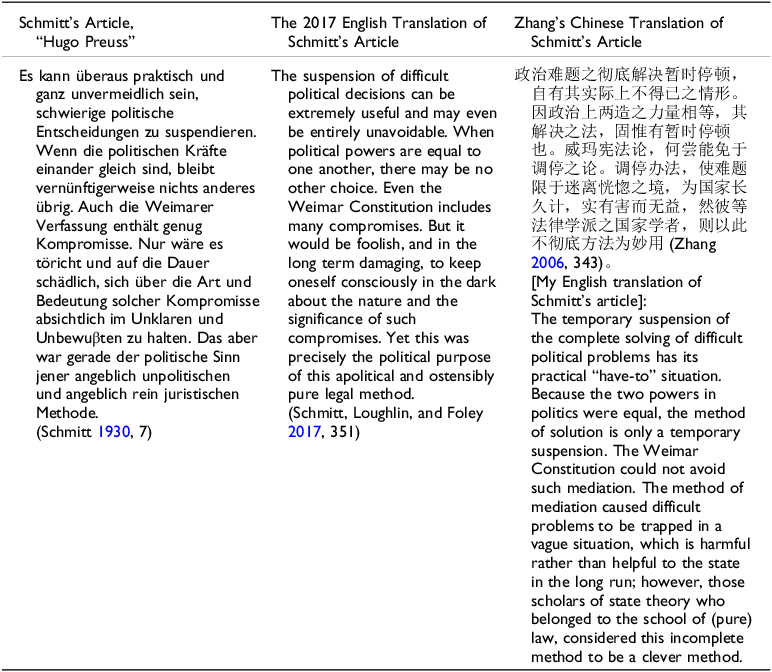
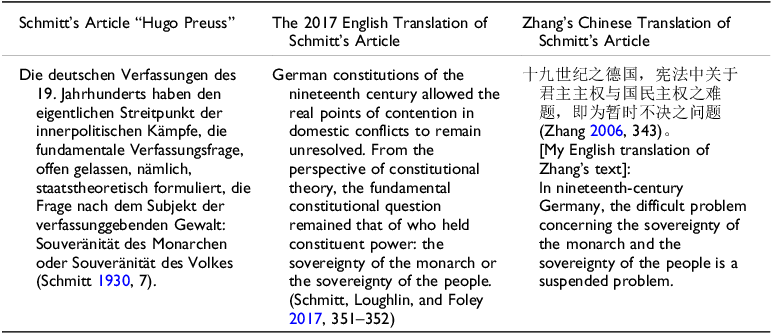
In the third paragraph of Carl Schmitt’s original text, Schmitt deepens his analysis on the suspension of difficult political decisions; Zhang Junmai’s translation captures the basic meaning of Carl Schmitt’s article “Hugo Preuss” despite some revisions at the level of expression (see Table 8):
Suspension of difficult political decisions

From Table 9, we see that Zhang Junmai continues to translate “decisions” into “complete solutions.” In Schmitt’s text, he admits that it is difficult to completely avoid the suspension of difficult political decisions. However, in severe situations, if politicians cannot make decisions, then difficult problems cannot be completely solved and may end up in a standstill. Where there are opposing political sides, if their strengths are equal, the likely outcome is a stalemate between them. The Weimar Constitution was such a negotiation. Schmitt believes that this method of negotiating would turn difficult political problems into a deadlock, and so would not be useful, but harmful, to the future of the state. By defining this type of negotiation or compromise as a political application of the so-called “apolitical” and “purely legal methods,” Schmitt uncovers the political face of those scholars who claimed to be apolitical. If we compare Schmitt’s original sentence with Zhang Junmai’s translation, we see that Zhang leaves out Schmitt’s emphasis on the political face of the so-called apolitical method. Rather, Zhang interprets it as a position of those scholars who insisted on a theory of law to approach the issues of the state. While Schmitt highlights those legal scholars’ political strategy behind their apolitical gesture, Zhang Junmai emphasises the method of negotiation and the nature of the Weimar Constitution as a compromise (See Table 9):
The unsolved constitutional question

From Table 9, we see that Zhang Junmai’s translation captures the main meaning of Schmitt’s sentence, though omitting one important point. In Schmitt’s text, “German constitutions of the nineteenth century allowed the real points of contention in domestic conflicts to remain unresolved;” “the real points of contention in domestic conflicts” are linked to “the fundamental constitutional question:” “that of who held constituent power.” Although the 2017 English translation translates “staatstheoretisch formuliert” as “from the perspective of constitutional theory,” it can also be translated as “in terms of state theory.” In fact, in the genealogy of German state theory or constitutional theory, a group of terms including Staatsrechtswissenschaft, Staatsrechtslehre, Staatsrecht, or those labelled as “staatstheoretisch” are often translated in the following ways: state theory, constitutional law, or public law. For example, the 2017 English translation translates “Staatsrechtler” as “public law professor.” From Schmitt’s text, we see the emphasis on “state theory” and the sovereignty of the state. For Schmitt, these are among the most fundamental issues of politics. Zhang Junmai’s translation does not reveal this point in Table 9, but Table 8 shows that he draws attention to “those scholars of state theory who belonged to the school of (pure) law.” Moreover, Zhang Junmai’s advocacy, in 1937, for the establishment of a Chinese state philosophy, still shows the influence of German state theory, from Hegel to Schmitt.
Why was the Weimar Constitution a compromise? Carl Schmitt argues that,
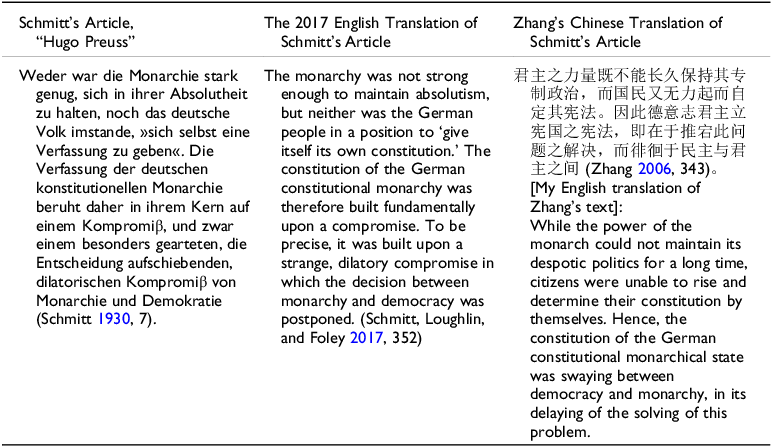
Weder war die Monarchie stark genug, sich in ihrer Absolutheit zu halten, noch das deutsche Volk imstande, »sich selbst eine Verfassung zu geben «. Die Verfassung der deutschen konstitutionellen Monarchie beruht daher in ihrem Kern auf einem Kompromiβ, und zwar einem besonders gearteten, die Entscheidung aufschiebenden, dilatorischen Kompromiβ von Monarchie und Demokratie. (Schmitt Reference Schmitt1930, 7)
The monarchy was not strong enough to maintain absolutism, but neither was the German people in a position to ‘give itself its own constitution’. The constitution of the German constitutional monarchy was therefore built fundamentally upon a compromise. To be precise, it was built upon a strange, dilatory compromise in which the decision between monarchy and democracy was postponed. (Schmitt, Loughlin, and Foley Reference Schmitt, Loughlin and Foley2017, 352)
Table 10 provides a close comparison between Schmitt’s original text and Zhang’s translation.
Decision postponed

From Table 10, we see again Zhang Junmai’s translation changes Schmitt’s notion of “decision-making” into a “complete solution of problems.” While Schmitt criticises the German Constitution as a particular kind of compromise, a decision-suspending, dilatory compromise between monarchy and democracy, Zhang Junmai translates “decision-suspending” as “delaying of the solving of” the problem of sovereignty. From this instance and similar examples above, we can conclude that Zhang Junmai understands Schmitt’s arguments on “decision,” “decision-making,” and “decision-suspending” in terms of solutions to difficult political problems.
After pointing out the historical reasons why the German Constitution was a compromise, Carl Schmitt criticises that the so-called purely legal approach is hollow:
In der Sache sind sie Ausweichungen und Umgehungen, Versuche einer Harmonisierung und Versöhnung widersprechender politischer Staatsformprinzipien und werden um so mehr zu inhaltlosen Reflexen des innerpolitischen status quo, je mehr sie rein juristisch zu sein und alles Politische streng zu vermeiden vorgeben. (Schmitt Reference Schmitt1930, 8)
They are, in reality, evasions and avoidances; they are attempts to harmonize and reconcile contradictory political principles concerning the form of government; and the more they purport to be purely legal and to strictly avoid anything political, the more they become pointless reflections of the domestic status quo. (Schmitt, Loughlin, and Foley Reference Schmitt, Loughlin and Foley2017, 352)
Zhang Junmai’s translation of this sentence is as follows:
简单言之,则两种冲突之国体论之迁就与调和而已。即以纯粹法律为立场,而避免一切政治论,则所谓定义与解释云云,不过为维持内政上之现状,固并无真正之内容也。(Zhang Reference Zhang2006, 344)
Simply put, it is the harmonization and reconciliation of the two opposing forms of the state. If [scholars] stick to the stance of the “pure law” and try to avoid any theory of politics, then the so-called “definitions” and “interpretations” are only to maintain the status quo. They do not have real contents. (My translation)
In Schmitt’s opinion, the evasion of making political decisions or avoidance of political difficulties would defeat all political attempts at harmonisation and reconciliation of conflicting political principles and would result in a failure to solve political problems. Zhang Junmai also correctly highlights Schmitt’s criticism of pure legal theory as lacking real content. In addition, while criticising the theory of law, Zhang recommends the theory of politics. In other words, by correctly introducing Schmitt’s main points in his article, Zhang’s translation also embodies a creative reinterpretation of Schmitt’s arguments and constitutes a dialogue with Schmitt’s original text.
4. Theory of politics versus theory of law in the Chinese and German contexts
Why did Zhang Junmai choose to translate this article and introduce it to China? There must have been some points in Schmitt’s article that attracted him. First of all, Zhang’s reflections on true politics, true law, and the relationship between politics and law, are in accord with Carl Schmitt’s thinking. Thus, Zhang readily accepted Schmitt’s concept of the political as the fundamental category that permeates all other spheres of activities. As discussed in previous paragraphs, Zhang Junmai argues that, what is most important is not what specific politics or constitution China decides to adopt, but what is the truth of politics. In his 1923 lecture entitled “The Internal and External Politics,” Zhang had criticised the laws of China as being nothing but paperwork. What he would promote is true law, or the truth of law. His constant disdain for the so-called purely legal details made him inclined to support Carl Schmitt’s theory of politics against the theory of law.
In fact, since the late Qing, the scholarly understanding of the theory of law has been quite developed. As early as 1902, in “A Brief Introduction to Karl Rathgen’s Politics 那特硜政治學小引 (集錄)” (Xuan bao, no.17, 1902, 6–10),Footnote 12 the school of jurisprudence 法理学派 and its advantages and disadvantages are discussed. The methods of the jurisprudence school are considered deduction and logic. It is also criticised for using judicial explanation to interpret a state’s legal relations. Because it does not focus on the key issues of a state’s economy and how a state governs and benefits people, it often ends up as a formal theory of the state, which in turn hinders the development of a state in its substantiality (Xuan bao, no.17, 1902, 8–9).
If we consider that in 1906, another important intellectual Liang Qichao, in his article entitled “The History of Development of Chinese Jurisprudence 中国法理学发达史论” (Liang Reference Liang, Wu, Lu, Wang and Duan2001, 340–375), also distinguished between the rule of law (law) and a state’s governance strategies and techniques (politics), we see that at the beginning of the twentieth century, Chinese intellectuals had a primary sense of the differences between the theory of law and the theory of politics, which, constituted a special dialogue with similar German ideas at that time.
In the 1928 edition of The Concept of the Political, Carl Schmitt also mentions the antithesis of law and politics:
Man wird selten eine klare Definition des Politischen finden. Oft wird das Wort nur negative als Gegensatz gegen verschiedene andere Begriffe gebraucht, in Antithesen wie Politik und Wirtschaft, Politik und Moral, Politik und Recht, innerhalb des Rechts dann wieder Politik und Zivilrecht. (Schmitt, Reference Schmitt1928, 1)
One seldom finds a clear definition of the political. The word is most frequently used negatively, in contrast to various other ideas, for example in such antitheses as politics and economy, politics and morality, politics and law; and within law there is again politics and civil law, and so forth. (Schmitt Reference Schmitt2007, 20)
In a note attached to this passage, Carl Schmitt goes further to emphasise the difference between the antithesis of law and politics and that of civil and public law. Moreover, in the 1932 edition of The Concept of the Political, we find that Schmitt’s argument on the clash between the political and the non-political is similar to his point in the article “Hugo Preuss: His Concept of the State and His Position in German State Theory.” Schmitt says,
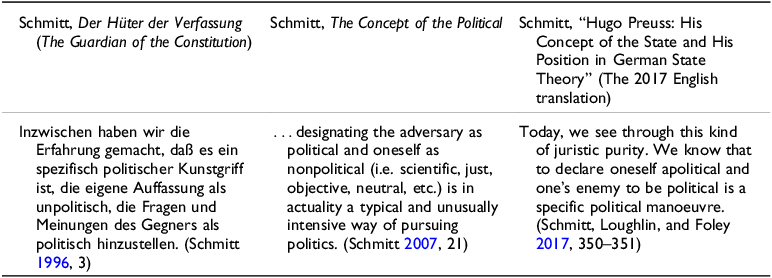
Triepel then justly criticizes the ostensibly nonpolitical, purely juristic approach of the Gerber-Laband school and the attempt at its continuation in the postwar period (Kelsen). Nevertheless, Triepel had not yet recognized the pure political meaning of this pretense of an apolitical purity, because he subscribes to the equation of politics =state. As will still be seen below, designating the adversary as political and oneself as nonpolitical (i.e., scientific, just, objective, neutral, etc.) is in actuality a typical and unusually intensive way of pursuing politics. (Schmitt Reference Schmitt2007, 21)
Let us make a comparison among three passages from Carl Schmitt’s different texts (See Table 11):
The So-called juristic purity

From the table above, we see the intertextual relation among these three texts of Carl Schmitt. In the article “Hugo Preuss: His Concept of the State and His Position in German State Theory,” after criticising Laband’s juristic method (Zhang Junmai translates it as “theory of law”), Carl Schmitt also indicates that Hugo Preuss is not only influenced by Gneist and Laband, but also “constantly aligns himself most firmly with Gierke’s organic state and social theory” (Schmitt, Loughlin, and Foley Reference Schmitt, Loughlin and Foley2017, 354). Schmitt emphasises that Preuss deeply believes in the ideas of freedom and a constitutional regime, which could place limits on the powers of both the monarchy and the people. Then the following question would be: what is a constitutional state?
5. Rechtsstaat and the neutral state
The constitutional state, or Rechtsstaat, is a complex concept with different implications for different contexts. To Carl Schmitt, a constitutional state is a transcendence of Gesetzestaat or Justizstaat.Footnote 13 In his book, Der Hüter der Verfassung (The Guardian of the Constitution), which was published in 1931, Schmitt addresses the question of who indeed is the “guardian” of the constitution. In Schmitt’s opinion, the judiciary cannot provide the source of preservation of the constitution. Regarding the tendency to look for the guardian in the judicial sphere, Schmitt indicates that this is due to certain misunderstandings:
Zunächst aus einer mißverstandenen und abstrakten Vorstellung vom Rechtsstaat. Es liegt nahe, die justizförmige Erledigung aller politischen Fragen als rechtstaatliches Ideal aufzufassen und dabei zu übersehen, daß mit einer Expansion der Justiz auf eine vielleicht nicht mehr justiziable Materie die Justiz nur geschädigt werden kann. (Schmitt Reference Schmitt1996, 22)
Schmitt argues that it is a misunderstanding of the concept of the constitutional state if one considers the judicial treatment of all political questions as an ideal of the constitutional state and ignores the fact that an expansion of the judiciary into a matter that should no longer be treated judicially, cannot be good to a constitutional state.
Equating the judiciary solution with the idea of a constitutional state would bring about not only a juridification of the political but also a politicisation of the judiciary. To Schmitt, such an approach reveals a purely formalised way of thinking. Although Schmitt claims that he is against the politicisation of the judiciary, we should notice that the “political” that Schmitt mentions here refers to politics in the narrow sense, rather than politics as the fundamental nature that defines other spheres. Later in the same paragraph, Schmitt continues to criticise the tendency of formalising the constitutional into the judiciary. Schmitt argues that the abstract use of the term Rechtsstaat is meaningless because it cannot lead to any concrete systems. Moreover, such an abstract concept implies too many different mechanisms with various forms which cannot coexist. Thus, Schmitt emphasises that people should focus on concepts and differentiations of specific constitutional theories, rather than quoting the term Rechtsstaat abstractly (Schmitt Reference Schmitt1996, 22–23).
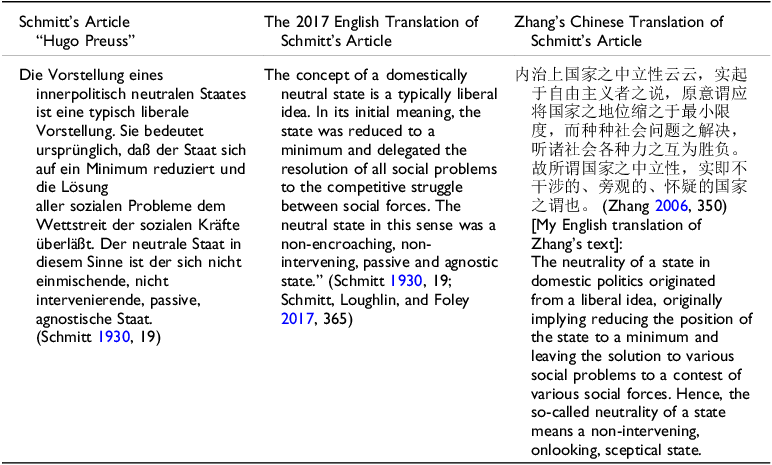
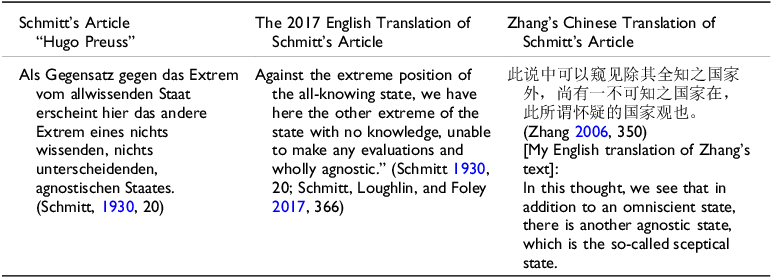
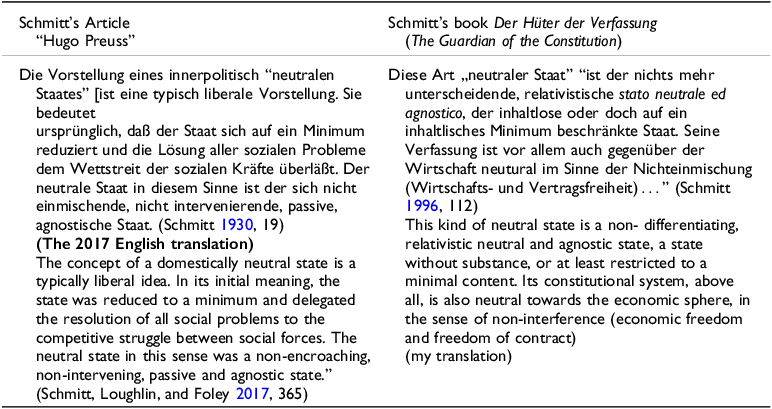
In his article “Hugo Preuss: His Concept of the State and His Position in German State Theory,” after defining the concept of the state in the Weimar Constitution as the “neutralen Staat”(neutral state) (Schmitt Reference Schmitt1930, 18), Carl Schmitt argues that the neutral state was born of the conciliation between the bourgeoisie and the working class, as they sought mutual accord in constructing the Weimar Constitution (Schmitt Reference Schmitt1930, 18). Schmitt believes that “the procedures of the bourgeois constitutional state” “are the most neutral possible for a state confronted with domestic conflicts” (Schmitt Reference Schmitt1930, 18–19; Schmitt, Loughlin & Foley, Reference Schmitt, Loughlin and Foley2017, 363). Schmitt argues that “the concept of a domestically neutral state is a typically liberal idea. In its initial meaning, the state was reduced to a minimum and delegated the resolution of all social problems to the competitive struggle between social forces. The neutral state in this sense was a non-encroaching, non-intervening, passive and agnostic state” (Schmitt Reference Schmitt1930, 19; Schmitt, Loughlin, and Foley Reference Schmitt, Loughlin and Foley2017, 365). In quoting Hugo Preuss’s explanation of why there is still inequality that cannot be measured by the laws of the state, despite the claims of equality within the law, Schmitt argues that this shows that “against the extreme position of the all-knowing state, we have here the other extreme of the state with no knowledge, unable to make any evaluations and wholly agnostic” (Schmitt Reference Schmitt1930, 20; Schmitt, Loughlin, and Foley Reference Schmitt, Loughlin and Foley2017, 366).
Zhang Junmai’s translation of Carl Schmitt’s points on the neutral state in Weimar Germany also shows his own understanding of the neutral state. The following is a close comparison between Carl Schmitt’s argument and Zhang’s translation (see Tables 12 and 13):
Neutral State

Agnostic State

Zhang’s translation captures the basic meaning of Carl Schmitt’s sentences, though he changes “a neutral state” into the “neutrality of a state.” At the same time, he also revises Schmitt’s definition of a “neutral state” into his own notion of the “neutrality of a state” by translating “non-encroaching, non-intervening, passive, and agnostic state” into a “non-intervening, onlooking, sceptical state.” Here, Zhang replaces the notion of “agnostic state” with his own interpretation: “sceptical state.”
Table 13 shows that Zhang Junmai insists on using the “sceptical state” to explain the “agnostic state,” although he does not delete this notion in his translation.
If we compare Schmitt’s discussion of the neutral state in the article “Hugo Preuss: His Concept of the State and His Position in German State Theory”Footnote 14 with that in Der Hüter der Verfassung, we find there are several interesting similarities (see Table 14):
“Neutral State” as liberal idea

Carl Schmitt’s argument, in the second part of Der Hüter der Verfassung, divides the notion of the neutral into several types, the first of which is named “Neutrality in the sense of non-intervention” (Neutralistät im Sinne der Nicht-Intervention). Because the article “Hugo Preuss: His Concept of the State and His Position in German State Theory” was published before Der Hüter der Verfassung, we see the genealogy of Carl Schmitt’s reflections on the notion of the neutral state defined by the Weimar Constitution. Schmitt’s points can be summarised in the following aspects regarding the implication of the neutrality regulated by the Weimar Constitution: (1) reducing the function of a state to minimum; (2) a state of non-intervention: (3) an agnostic state. However, the emphases of these two texts are slightly different. First, in Der Hüter der Verfassung, Schmitt describes two types of neutrality: (1) the neutrality of the state as a kind of neutrality which allows the state, as a counterpart of religious groups, to be independent from the church (“Neutralistät des Staates gegenüber den Religionen und Konfessionen” (Schmitt Reference Schmitt1996, 111). (2) the neutrality of the state and its constitutional system towards the economic sphere. Here we see the dichotomy between the state and society and the state and the economy. Schmitt describes “Neutralistät des Staates gegenüber den Religionen und Konfessionen” as “the internal political neutrality” that first appears in “historical consciousness” (“die innerpolitische Neutralität des Staates zuerst in das geschichtliche Bewußtsein”) (Schmitt Reference Schmitt1996, 111), meaning that this neutrality was rooted in the historical and cultural-political contexts of Europe throughout its history, and that state and church constitute a dichotomy of power relations. However, in the article “Hugo Preuss: His Concept of the State and His Position in German State Theory,” Schmitt places the state in a dichotomy with society. The neutrality Schmitt emphasises in this article is the neutrality of the state as a counterpart of society. From here we see another reason why Zhang Junmai accepted this article, because he also insists on the separation between state and society and places the state in a higher position. Second, in Der Hüter der Verfassung, when Schmitt defines “non-intervention” as one of the characteristics of a neutral state, such “non-intervention” can also be understood in the relationship between the state and economics—in other words, it refers to the mutual “non-intervention” between the state and its economic institutions. However, in the article “Hugo Preuss: His Concept of the State and His Position in German State Theory,” Schmitt understands the mutually non-intervening relationship in the dichotomy between state and society and thus turns the mutual “non-intervention” between the state and its economic institutions into a mutual “non-intervention” between state and society.
Ryan Martinez Mitchell’s article (Mitchell Reference Mitchell2020) correctly captures two similarities between Zhang Junmai and Carl Schmitt—emphasis on “social structures” and “understanding the state as an organic social unity,” but this is only one side of the coin of Schmitt and Zhang’s positions on the state. Mitchell also mentions that Zhang Junmai quotes a definition of “national Rechtsstaat” from “Schmitt’s (at the time) ‘liberal nationalist’ rival Otto Koellreutter,” but this is also only one side of Zhang Junmai’s acceptance of German theories of the state and Rechtsstaat at that time. As mentioned above, another hidden side is Zhang Junmai’s acceptance of Schmitt’s critique of liberal understandings of the state and Rechtsstaat. Linking Zhang Junmai to another Chinse legal theorist, Xu Daolin 徐道邻, Mitchell argues that both Xu and Zhang “shared some criticisms of Schmitt’s Executive-focused state.” However, on the one hand, it may be one-dimensional to label Schmitt’s theory of the state as “executive-focused;” on the other, we should note that Zhang Junmai seems to have simultaneously read and accepted parts of the ideas of Carl Schmitt and Schmitt’s liberal rivals.
6. State theory and political consciousness of the bourgeoisie: Max Weber, Carl Schmitt, and Zhang Junmai
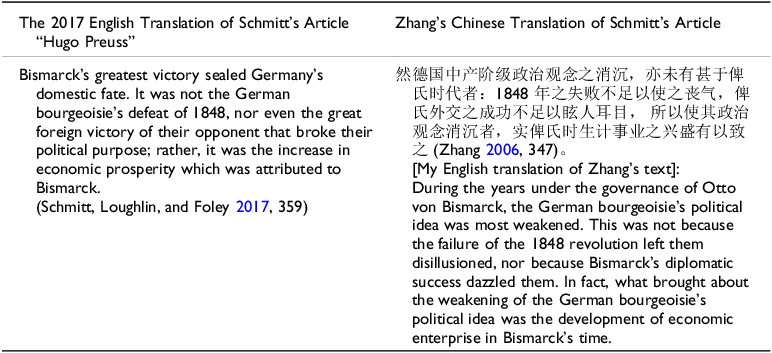
Before highlighting the notion of the neutral state in the context of Weimar Germany as a non-intervening, agnostic state at the first level, Carl Schmitt has addressed his own emphasis on the political nature of state theory, which is based on the political consciousness of the bourgeoisie. In the article “Hugo Preuss: His Concept of the State and His Position in German State Theory,” Schmitt argues that the biggest problem of the bourgeoisie in nineteenth-century Germany was their lack of political consciousness. Schmitt bemoans that the change of the government’s focus from politics to economics under Bismarck’s reign depressed the bourgeoisie’s interest in discussing political issues:
Bismarcks großer Erfolg hat das innerpolitische Schicksal, Deutschlands bestimmt. Nicht der eigene Mißerfolg von 1848, nicht einmal der ungeheure außenpolitische Erfolg des Gegenspielers, sondern erst die ihm verdankte wirtschaftliche Prosperität brach den politischen Sinn des deutsehen Bürgertums. (Schmitt Reference Schmitt1930, 14)
Bismarck’s greatest victory sealed Germany’s domestic fate. It was not the German bourgeoisie’s defeat of 1848, nor even the great foreign victory of their opponent that broke their political purpose; rather, it was the increase in economic prosperity which was attributed to Bismarck. (Schmitt, Loughlin, and Foley Reference Schmitt, Loughlin and Foley2017, 359)
“Politischen Sinn” can also be translated as “political sense.” Carl Schmitt’s criticism of the decline of political interests and political consciousness in the German bourgeoisie was greatly influenced by Max Weber.Footnote 15 In his article “The Nation State and Economic Policy,” Max Weber also criticises Otto von Bismarck for not being able to address political reforms needed to accommodate changes in the economic structure. Weber believes that Bismarck did not bring about the “inner unification of the nation” instead of the merely external one (Lassman and Speirs Reference Lassman and Speirs1994, 22). The genealogy from Max Weber to Carl Schmitt is echoed by the intertextual relationship between Schmitt and Zhang Junmai. Let us do a close comparison between Schmitt’s original argument and Zhang Junmai’s translation (see Table 15):
The weakening of the German Bourgeoisie’s political ideas

Zhang’s translation captures the main points of Schmitt’s argument: the decline of the bourgeoisie’s political interests.
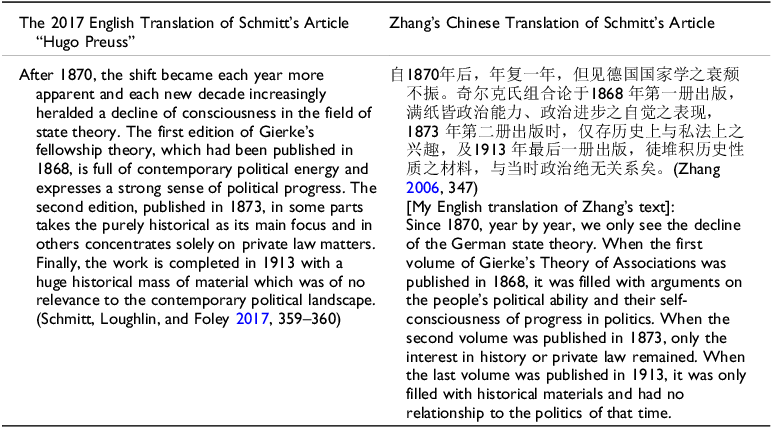
The following description from Schmitt’s article explains the development of Gierke’s theory and also embodies a critique of the non-political nature of the theory:
Nach 1870 wird die Wendung von Jahr zu Jahr deutlicher, und in wachsendem Maße bedeutet jedes Jahrzehnt einen Abstieg des staatstheoretischen Bewußtseins. Der erste Band von Gierkes Genossenschaftslehre, der 1868 erschienen war, ist ganz von aktuellen politischen Energien und einem kühnen politischen Fortschrittsbewußtsein erfüllt. Mit dem zweiten, 1873 erschienenen Band beginnt schon teils das rein Geschichtliche, teils das rein Privatrechtliche zum Hauptinteresse zu werden, und schließlich endet das Werk 1913 in ungeheuren historischen Materialhaufen, die keine Beziehung zur politischen Gegenwart haben. (Schmitt Reference Schmitt1930. 14–15)
After 1870, the shiftFootnote 16 became each year more apparent and each new decade increasingly heralded a decline of consciousness in the field of state theory. The first edition of Gierke’s fellowship theory,Footnote 17 which had been published in 1868, is full of contemporary political energy and expresses a strong sense of political progress. The second edition, published in 1873, in some parts takes the purely historical as its main focus and in others concentrates solely on private law matters. Finally, the work is completed in 1913 with a huge historical mass of material which was of no relevance to the contemporary political landscape. (Schmitt, Loughlin, and Foley Reference Schmitt, Loughlin and Foley2017, 359–360)
Table 16 shows a close comparison between Schmitt’s original argument and Zhang Junmai’s translation:
The decline of the German State theory

Carl Schmitt believes that the German bourgeoisie’s political consciousness is closely related to state theory. Behind the weakening of the bourgeoisie’s political consciousness, there was also a decline of state theory and people’s consciousness of the state theory in Germany. In Schmitt’s opinion, the bourgeoisie’s political consciousness should be cultivated in a kind of political education, focusing on state theory. According to Schmitt, while the first volume of Gierke’s work is still able to reveal the political life of the German bourgeoisie, their political energies and political consciousness, the second and third volumes of his work only record the retreat of the German bourgeoisie from the political sphere. In this sense, as Gierke shifted his interest from politics to historical materials and materials related only to private law, his work also lost its political nature and its ability to reveal the substantiality of the political life of his age. Zhang’s translation mainly captures Schmitt’s criticism of the German bourgeoisie’s loss of political consciousness and political vision. Schmitt indicates that organic state theory still treats the relationship between the state and society, and considers the state one of the “fellowship-groups” instead of marking it as the highest. Thus, the state is understood “as a social entity equal to other social entities” (Schmitt, Loughlin, and Foley Reference Schmitt, Loughlin and Foley2017, 360).
To Carl Schmitt, a theory of politics should contain a theory of the state and a theory of sovereignty. However, the specialisation of disciplines in modern times has moved scholars’ interest away from the issue of the state as a whole. Schmitt says,
…die große Gelehrsamkeit Georg Jellineks trennte sich in Jurisprudenz auf der einen, Soziologie oder Geschichte auf der andern Seite, und diese Trennung wurde schließlich—mit viel Methodologie und wenig Methode—zu einem mehr taktisch als wissenschaftlich interessanten Werkzeug eines leerlaufenden Formalismus. Das theoretische Interesse am Staat wanderte ab, zu den Nationalökonomen und den Sozialpolitikern, zu Historikern oder den damals wenig beachteten Soziologen. (Schmitt Reference Schmitt1930, 16)
…the great scholarly work of Georg Jellinek was broken up into jurisprudence, on the one hand, and sociology or history on the other. With much methodology but little method, this division, rather than being an academically interesting device, ultimately became a tactical tool of empty formalism.
Theoretical interest in the idea of the state migrated elsewhere, towards the national-economists, the socio-political theorists, the historians, or the largely overlooked sociologists. (Schmitt, Loughlin, and Foley Reference Schmitt, Loughlin and Foley2017, 361)
Zhang Junmai’s translation of this passage is as follows,
…耶林纳克氏之国家学,分为二部,一方为法律,一方社会学、历史学,因此划分之结果,国家学上产生一种羌无内容之形式主义而已。世人之兴趣,不集于国家方面,转而入于生计学、社会政策、历史与尚未发展之社会学 (Zhang Reference Zhang2006, 348)。
Georg Jellinek’s theory of the state was divided into two parts—law on the one hand, and sociology and history on the other. The result of such division is that the theory of state became a kind of formalism without any substance. Hence, people’s interest was no longer in the issues of the state, but was turned to economics, social policy, history, and undeveloped sociology. (My translation)
Schmitt argues that “the educated German bourgeoisie neither promoted nor persisted with state theory” (Schmitt, Loughlin, and Foley Reference Schmitt, Loughlin and Foley2017, 361). People’s interests turned to other fields: economics, history, and sociology, or they tended to use different ways of thinking from the perspectives of other disciplines. Zhang Junmai’s translation captures Schmitt’s main points. Later, in Zhang Junmai’s calling for a state philosophy in China’s time of emergency in the 1930s, we also see the echo of Carl Schmitt’s emphasis on state theory (Chen Reference Chen2015).
7. Conclusion: Calling for political education of the bourgeoisie
In his article “The Nation State and Economic Policy,” Max Weber points out that,
In every sphere we find that the economic way of looking at things is on the advance. Social policy has superseded politics at the forefront of thinking, just as economic power-relations have replaced legal relations, and cultural and economic history have ousted political history. (Lassman and Speirs Reference Lassman and Speirs1994, 17)
Weber criticises the abuse of such an economic perspective without any limit. In contrast, he calls for a political perspective, with a primary concern on the issue of sovereignty: what kind of person or group can function as the leader of the state? Weber’s political criterion points to the sovereign’s political maturity. After indicating that “economic power and the vocation for political leadership of the nation do not always coincide” (Lassman and Speirs Reference Lassman and Speirs1994, 20), Weber continues,
This brings us to some concluding reflections of a more practical-political nature. We economic nationalists measure the classes who lead the nation or aspire to do so with the one political criterion we regard as sovereign. What concerns us is their political maturity, which is to say their grasp of the nation’s enduring economic and political power interests and their ability, in any given situation, to place these interests above all other considerations. (Lassman and Speirs Reference Lassman and Speirs1994, 20–21)
Similarly, Carl Schmitt calls attention to the political consciousness of the German bourgeoisie as a possible leading class for Germany. After describing the non-political tendency of German society, a society experiencing an inevitable social differentiation and stratification, Schmitt claims that the intelligentsia among the German bourgeoisie in the 1890s failed to construct a new theory of the state to accommodate changes taking place in their society. Based on Max Weber’s description of the two types of intellectuals in German society—the bureaucrats and the literati—Carl Schmitt goes further to criticise education in Germany. He points out that “by 1914 the education of the German bourgeoisie scarcely covered any state theory. It was, on the one hand, an apolitical, technical bureaucratic education and, on the other, an equally apolitical, obscure literary education mainly provided for private, aesthetic consumption” (Schmitt Reference Schmitt1930, 16; Schmitt, Loughlin, and Foley Reference Schmitt, Loughlin and Foley2017, 361). Unsatisfied with the non-political nature of such an education, Schmitt emphasises the importance of political education as a crucial part of improving civil education. What is the purpose of this education? Schmitt indicates that it would lead to the cultivation of a kind of “political intellect” independent of all parties.
In the article “Hugo Preuss: His Concept of the State and His Position in German State Theory,” Carl Schmitt laments that the neutrality of the state at the first level, the “neutrality of the passive, agnostic state can no longer survive in the current social and economic state” (Schmitt Reference Schmitt1930, 24; Schmitt, Loughlin, and Foley Reference Schmitt, Loughlin and Foley2017, 369). Accordingly, Carl Schmitt points to a second level of neutrality, which refers to “neutral forces” (neutrale Kräfte) (Schmitt Reference Schmitt1930, 24) in politics. Schmitt argues that without such neutral forces, which can mediate among different parties competing for the control of the regime, a constitutional state under democracy cannot be maintained. Who can function as this neutral power? Carl Schmitt argues that the subject or the agent of such neutral powers should be the bourgeoisie. They should not be limited by any parties and their contributions should be respected by the entire country, making them the intellectual “backbone” of society. They should not limit themselves to narrow spheres controlled by particular organisations, but rather, they should base their positions on their free, open, objective spiritual power; they should have the ability to call on the entire country, to function as the intellectual core, and thus, they should develop a discursive environment for expression of public opinions. This kind of “neutrality that facilitates an impartial and fair decision” “requires an entity that is not linked to any particular party;” “without this, any bourgeois constitutional state would today be unthinkable” (Schmitt Reference Schmitt1930, 23–24; Schmitt, Loughlin, and Foley Reference Schmitt, Loughlin and Foley2017, 369).
Here, we find another reason for Zhang Junmai’s interest in Carl Schmitt’s article, in which Schmitt calls for the improvement of the political education of the bourgeoisie, which emphasises the development of spiritual elements rather than a strict observance of the law. Schmitt’s critique of the nineteenth-century German intelligentsia seems very attractive to Zhang Junmai, whose interest in the improvement of the people’s political consciousness and political skills made it easy for him to accept Schmitt’s stress on the education of the bourgeoisie, particularly “political education.” This should also be connected to Zhang’s practice of education in reality. As early as 1920, Zhang Junmai and Liang Qichao discussed the importance of the university as a means of introducing civilisation (Ding and Zhao Reference Ding and Zhao1983, 896–897).Footnote 18 In 1922, when the governor of the Jiangsu province asked Zhang Junmai about the method of renovating the politics of Jiangsu, Zhang addressed the proposal of establishing an Institute of Self-Government (自治学院). In 1923, Zhang started to work as the president of Guoli zizhi xueyuan 国立自治学院 (National Institute of Self-Government). Zhang’s purpose in establishing such a school was to develop people’s political character and administrative knowledge. Zhang also believed that the enlightenment of the people should be led by the bourgeois intellectuals.
The translation of Carl Schmitt’s article provides access to Zhang’s understanding of the Rechtsstaat in the context of Republican China in the 1930s when Zhang reflected on “democracy versus dictatorship.” In his lecture entitled, “The Rule of Law and Dictatorship” (Fazhi yu ducai 法治与独裁) in 1934, Zhang argues that the highest purpose of a state is to maintain its legal life (Zhang Reference Zhang2006, 375), and that the most fundamental condition for China to become a modern state is the law. To become a modern state, the first step is to become a constitutional state 法治国 (Rechtsstaat). For Zhang, a constitutional state means government by law, not by man. Zhang goes on to assert that a constitutional state not only means governing by law but also requires respecting the people’s rights. These points reveal Zhang Junmai’s eager acceptance of the most common opinions about constitutionalism. At the same time, Zhang had translated Carl Schmitt’s article on Hugo Preuss, which embodies many reflections and criticisms on the common understanding of liberal constitutionalism. Zhang criticised the lack of subjectivity of political groups in China, which echoed his concept of cultivating people into political subjects through political education. In “The Rule of Law and Dictatorship,” Zhang understands that a constitutional state should be a routine for a modern state, while a dictatorship can function for a short time as an emergency response in times of crisis. Such points continue Zhang’s dual understanding of constitutionalism: on the one hand, maintaining a belief in the principles of a constitutional state, and on the other, considering dictatorship as a solution when the routine rule of law is trapped in a crisis. Zhang’s acceptance of Carl Schmitt’s reflections and criticisms on the common understanding of liberal constitutionalism, as reflected in Schmitt’s article on Hugo Preuss, enabled him to maintain his unique position and views on “democracy versus dictatorship” in 1930s China. Although Zhang accepted many of Schmitt’s points, Zhang still maintained a strong belief in constitutionalism, even after he had questioned the constitutional movement in Republican China. Zhang’s more optimistic attitude can be read together with Carl Schmitt’s worry about the function and future of liberal constitutionalism. Such complicated responses to the constitutional crises from the 1910s to the 1930s have shown us the uneven topology of constitutional development on the global stage in the twentieth century.