I. INTRODUCTION
Bulk metallic glasses have demonstrated significant potential for use in advanced engineering applications due to their extraordinary properties including high strength, moderate toughness, good wear resistance, and high strength-to-weight ratio.Reference Inoue1–Reference Hofmann, Suh, Wiest, Duan, Lind, Demetriou and Johnson3 However, integration of these materials into engineering structures has been limited by challenges in adhesion and joining. Conventional welding techniques lead to recrystallization of the amorphous glass local to the weld spot, whereas bolted joint techniques introduce stress concentration sites which drive shear localization, fatigue, and related fracture processes. Standard epoxy bonding techniques have been used to limited success; however, recent developments in compositionally graded hybrid materials may be capable of achieving the robust and reliable bonds required for high-performance structural applications.
Hybrid organic–inorganic thin films processed via sol–gel chemistry have demonstrated novel properties and functionalitiesReference Mammeri, Le Bourhis, Rozes and Sanchez4–Reference Sanchez, Julián, Belleville and Popall6 that lend themselves to use in a wide variety of applications including adhesive coupling layers for structural joints and laminates.Reference Liu, Chaudhury, Berry, Seebergh, Osborne and Blohowiak7–Reference Oliver and Dauskardt11 By fine tuning synthesis and processing parameters, hybrid thin films can be developed to exhibit high-performance adhesion capable of withstanding in-service stresses and degradation from environmental stresses.
In the present study, we synthesized and deposited a compositionally and functionally graded hybrid coupling film from a metal alkoxide and an epoxy-functionalized silane, which serves as an adhesion promotion layer between the metallic glass substrate and epoxy resin. Using the well-established double cantilever beam (DCB) testing method, we investigated the effects of Zr:Si precursor ratios on the debond energy of the metallic glass–hybrid–epoxy interface and correlated these measurements with changes in failure pathways, confirmed using x-ray photoelectron spectroscopy (XPS). The influence of temperature and humidity on debond growth acceleration was also investigated to understand the role of the hybrid coupling layer in mitigating environmentally assisted debond processes. An activation energy for debonding of the metallic glass–hybrid–epoxy interface is presented.
II. EXPERIMENTAL
A. Hybrid coupling film synthesis and deposition
Hybrid organic–inorganic films were processed via sol–gel chemistry from an epoxy-functionalized silane, 3-glycidoxypropyltrimethoxysilane (GPTMS), and a zirconium alkoxide, tetra-n-propoxyzirconium (TPOZ). GPTMS/TPOZ aqueous sols were prepared with a volume concentration of (GPTMS + TPOZ) of 3.75% with Zr:Si molar ratios ranging from 0 to 1.0. GPTMS was first prehydrolyzed by stirring in deionized water at room temperature. In a separate vial, TPOZ was prereacted with glacial acetic acid (GAA) using a GAA/TPOZ volume ratio of 0.45 to prevent rapid precipitation of zirconium-oxo-hydroxo species upon addition to the aqueous silane solution.Reference Yi and Sayer12 The silane solution was then mixed with the GAA/TPOZ solution and aged 90 min at ambient temperature prior to film deposition by dip coating.
Metallic glass beams with a composition of Zr35Ti30Co6Be29 were polished and conditioned using M-Prep Conditioner 5 and M-Prep Neutralizer 5A (Vishay, Shelton, CT), then subsequently exposed to UV-ozone for 180 s. The activated substrates were then submerged in the aged sol at a rate of 10 mm/s and immediately withdrawn at a constant rate of 0.2 mm/s, resulting in approximately 20-nm-thick films as confirmed by profilometry. The films were cured in air for 30 min at 60 °C.
B. DCB test metrology and fracture specimen preparation
Fracture energy measurements of the metallic glass–hybrid–epoxy interface were made using the DCB fracture test geometry (Fig. 1), which is a well-established method for measuring adhesive and cohesive fracture energy of thin film structures and interfaces.Reference Kanninen13–Reference Sharratt, Wang and Dauskardt15 DCB specimens were fabricated by bonding two hybrid coupling film coated metallic glass substrates with a 5-µm thick bond line of one of two epoxy adhesives: (i) a model brittle epoxy (Epo-tek 353 ND, Epoxy Technology Inc., Billerica, MA) to preclude contributions from deformation processes in fracture energy measurements or (ii) a single-phase Bis-A toughened epoxy (MSR-355, Applied Poleramic, Benicia, CA) commonly used in structural composites and laminates. The epoxy bonded DCB specimens were cured in air for 120 min at 120 and 175 °C, respectively. Test specimens were also prepared on cleaned and conditioned substrates without hybrid coupling films to provide a baseline for comparison. Precracks were introduced into the epoxy-hybrid bond line using a prenotch, and specimens were loaded until fracture was initiated. Adhesion/cohesion testing was performed on the DCB specimens using an adhesion testing system (DTS Delaminator) under ambient environmental conditions of ∼23 °C and ∼45% relative humidity (RH) to measure the critical strain energy release rate, G C.
Schematic of the metallic glass/hybrid coupling layer/epoxy test structure in the DCB test configuration.

C. Environmentally assisted subcritical debonding experiments
Unlike critical debonding, environmentally assisted fracture is a time-dependent mode of fracture that involves a chemical reaction between highly strained bonds at the crack tip and reactive environmental species. Under these conditions, subcritical debonding mechanisms can lead to debond advance at driving forces well below the critical fracture energy of an interface, making this phenomenon particularly critical to the long-term reliability of bonded structures.
The roles of moisture and temperature on bond reliability were investigated by measuring crack growth velocities, da/dt, resulting from subcritical monotonic loading of DCB specimens. These studies were conducted in an environmental chamber with well-controlled temperature (±1 °C) and humidity (±1%) in widely varying humid air environments to determine their influence on the fracture characteristics of the metallic glass–hybrid–epoxy interface. To measure the crack growth velocity, DCB specimens were loaded at a constant loading rate (1 µm/s) to a predetermined load, at which the displacement was fixed. The rate of load relaxation that results from crack extension was measured to calculate the crack growth velocity. Subcritical crack growth velocities were characterized as a function of the applied strain energy release rate, G, over the range of ∼10−5 to 10−9 m/s to produce a characteristic da/dt-G curve. These measurements were conducted at temperatures of 23, 60, and 80 °C with relative humidity ranging from 20% to 80% and aqueous environments.
D. Fracture path characterization
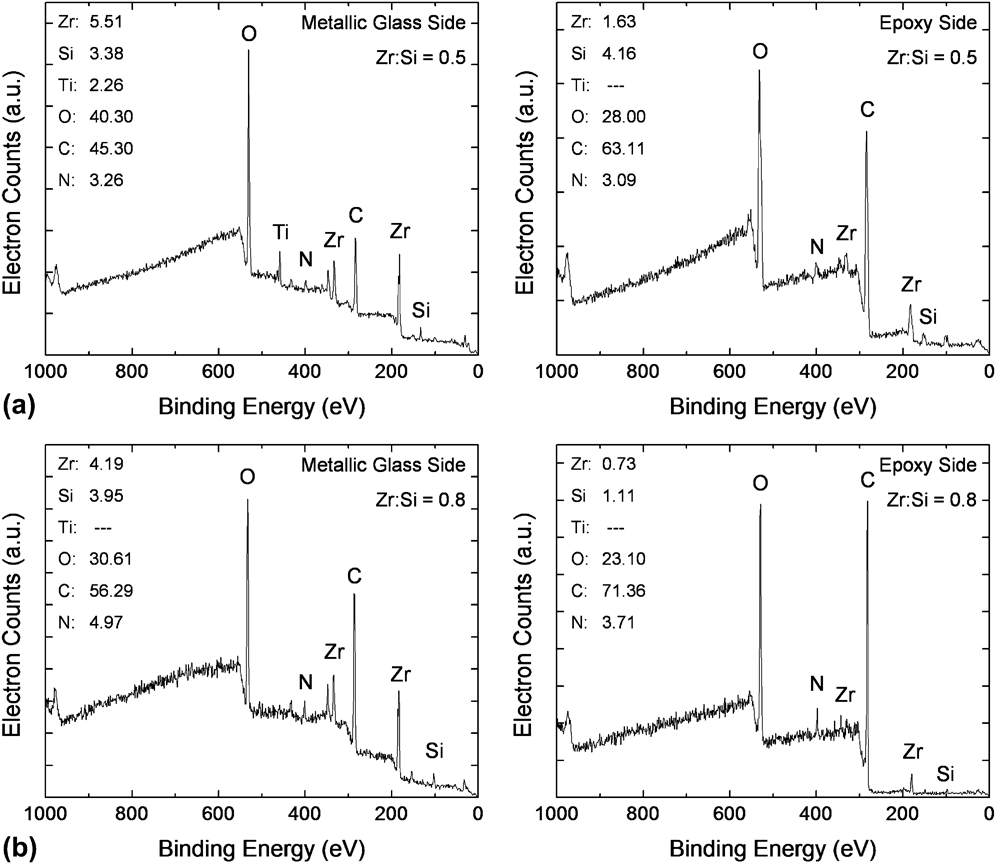
XPS was used to characterize the chemical composition of the fracture surfaces to determine the debond pathway in the thin film structures. The surfaces were characterized using a Surface Science XPS unit with monochromatized Al Kα x-ray radiation with an electron escape depth of ∼20 Å. A spot size of 250 × 1000 μm was used to perform survey scans over a binding energy range of 0–1000 eV.
III. RESULTS AND DISCUSSION
A. Adhesion with hybrid coupling layers
The critical fracture energy, G C, measured for a brittle epoxy bonded interface without the hybrid coupling layer was 8.1 ± 0.8 J/m2. With the addition of the hybrid organic–inorganic thin film (Zr:Si ratio of 0.5), measured G C values increased to 25.4 ± 2.4 J/m2. XPS characterization of the fracture surfaces confirmed a change in the failure path with increasing G C, moving from adhesive debonding at the metallic glass–epoxy interface to cohesive failure within the hybrid coupling layer.
The measured 3-fold increase in fracture energy can be attributed to the compositionally and functionally graded hybrid coupling film structure, which was confirmed through XPS depth profiling using C60 sputtering. During the synthesis process, GPTMS and TPOZ react via condensation reactions to form Si–O–Si, Zr–O–Zr, and Si–O–Zr bonds that create an inorganic zirconia–silica network. Simultaneously, an organic network is formed through self-polymerization of GPTMS epoxy groups or Zr–O–C and Si–O–C bond formation through reaction of an opened epoxy ring with a Si–OH or Zr–OH group. The result is a graded structure with a dense inorganic network at the metallic glass–hybrid interface and an organic-rich region on the opposite surface with epoxide groups capable of forming strong covalent crosslinks with amine groups in the adjacent epoxy resin (Fig. 2), allowing the coupling layer to effectively bond to both inorganic and organic surfaces.
Schematic of the hybrid coupling layer network structure processed from GPTMS and TPOZ precursors.
B. Critical fracture energy dependence on hybrid coupling film composition
The dependence of G C on the sol Zr:Si ratio measured between 0 and 1.0 is shown in Fig. 3. As the Zr:Si ratio is increased from 0 to 0.5, measured fracture energies increase more than 2-fold from 11.5 ± 2.0 J/m2 to a maximum of 25.4 ± 2.4 J/m2. Within this region, crack propagation occurs adhesively at the metallic glass–hybrid interface and becomes increasingly cohesive with increased zirconium content, as confirmed by XPS (Fig. 4). Increasing the Zr:Si ratio beyond 0.5 results in a decrease in measured fracture energies to an average value of 16.7 J/m2. Above this critical ratio, the fracture path switches from adhesive or near-adhesive failure to cohesive failure in the hybrid coupling film near the hybrid–epoxy interface as shown in Fig. 4.
Fracture energy of metallic glass/hybrid coupling layer/brittle epoxy interfaces, represented in terms of the critical strain energy release rate, G C, as a function of the sol Zr:Si ratio. Schematics illustrate the change in failure path from adhesive in the vicinity of the metal oxide to primarily cohesive near the brittle epoxy with increasing Zr content in the sol.
XPS spectra of fracture surfaces for (a) hybrid coupling films synthesized with Zr:Si = 0.5, revealing adhesive/cohesive failure in the hybrid near the metallic glass–hybrid interface and (b) Zr:Si = 0.8 showing cohesive failure in the hybrid near the hybrid–epoxy interface.
The influence of sol composition on measured fracture energies and failure path can be attributed to the development of the organic and inorganic network regions of the hybrid structure. The observed increase in fracture energy with increased Zr:Si ratio between 0 and 0.5 suggests that the Zr acts to toughen the metallic glass–hybrid interface through increased bond strength and bond densities. In a related study on silicon substrates by Oliver et al.,Reference Oliver, Blohowiak and Dauskardt10 increased fracture energies and higher Zr content were correlated with increased densities of residual hybrid layer islands observed at the silicon–hybrid interface using atomic force microscopy. It is suggested that the addition of Zr content in the sol increased bond densities at the interface since Zr species are capable of tighter packing than their silane counterparts and could inhibit the formation of (SiO)2n ring structures in favor of a more networked structure.
Above a Zr:Si ratio of 0.5, toughening effects of the ZrO2 network become limited as the failure path moves toward the epoxy film. Although a dense zirconia network may have formed, it is suggested that the decreased silane content reduces the number of epoxide rings available to crosslink with amine groups in the adjacent epoxy resin, thus degrading the bond density between the hybrid coupling film and the adjacent resin, resulting in a weak interface in the vicinity of the epoxy interface.
The impact of precursor concentration is emphasized when DCB test specimens are bonded using the brittle epoxy, showing a peak in fracture energy at a Zr:Si ratio of approximately 0.5. Plasticity contributions dominate when using a toughened epoxy, resulting in adhesion measurements that are relatively insensitive to varying sol composition.
C. Sensitivity to moisture-assisted cracking
The influences of humidity and temperature on bond degradation were independently investigated for DCB specimens bonded with the toughened epoxy. Subcritical debond growth rates were measured for specimens bonded with and without the hybrid coupling film (optimized at a Zr:Si ratio of 0.5) at 23 °C and 35% relative humidity. As shown in Fig. 5(a), both specimens exhibited time-dependent crack growth; however, crack growth rates were decelerated by over two orders of magnitude for specimens prepared with the hybrid coupling film. Additionally, the conventionally bonded structure reached a crack growth threshold, G th, of ∼125 J/m2, below which the crack growth is presumed to be dormant, compared to a threshold of ∼165 J/m2 for the hybrid bonded structure. In the absence of the hybrid coupling film, adhesive failure was observed at the metallic glass–epoxy interface. The addition of the hybrid coupling film resulted in a change in the failure path, switching from adhesive debonding to cohesive cracking within the toughened epoxy layer.
Crack growth rates, da/dt, measured as a function of applied strain energy release rate, G, for toughened epoxy DCB specimens prepared (a) with and without hybrid adhesion films at 23 °C and 35% RH and (b) with hybrid coupling layers loaded under varying humidity conditions.
Crack growth rates were also measured for hybrid coupling film bonded structures at 23 °C under varying humidity levels and normalized to highlight their sensitivity to moisture-assisted debonding [Fig. 5(b)]. Increasing the humidity from 20% to 35% RH resulted in a slight depression of G th. However, in higher moisture content environments, the presence of such a threshold is lost altogether. The measured crack growth rates indicate a relative insensitivity to moisture content in the environment at fast crack growth velocities above ∼100 nm/s, characterized by approximately constant log-linear slopes. However, at growth rates below this threshold, accelerated crack growth is observed under increasingly humid conditions with no apparent threshold observed for specimens tested in an aqueous environment. Characterization of the fracture surfaces revealed cohesive epoxy failure at 20% and 35%RH, and mixed adhesive/cohesive failure at elevated humidity. A similar anomalous debond growth behavior has been previously reported and modeled for bis-F polymer/Si interfaces, where it was suggested that water molecules were diffusing through the polymer layer causing defects ahead of the debond tip.Reference Sharratt, Wang and Dauskardt15
D. Sensitivity to temperature
Crack growth sensitivity to temperature was also measured for metallic glass substrates bonded using hybrid coupling layers and a toughened epoxy. Crack growth rates were measured as a function of G at 23, 60, and 80 °C with humidity held constant at 35% RH [Fig. 6(a)]. Adhesive bonding of the metallic glass–hybrid and hybrid–toughened epoxy interfaces was sufficiently strong such that failure was confined to be cohesive through the toughened epoxy layer. With increasing temperature, crack growth velocity curves shift toward lower strain energy release rates, indicating a significant decrease in resistance to debonding at elevated temperatures. The acceleration of debond growth rate with temperature can be attributed to an increase in the kinetics of the stress-enabled chemical reaction at the crack tip. In the reaction-controlled growth regime, the activation energy for crack advancement can be calculated by analyzing the increase in debond velocity as a function of temperature. The natural log of the debond growth rate, measured at G = 130 J/m2, is plotted in Fig. 6(b) as a function of the inverse of the product of the ideal gas constant and temperature. A linear fit of this data yields a slope of −462 kJ/mol, corresponding to an activation energy of E A = 4.79 eV, more than three times greater than that for brittle glass fracture where E A = 1.39 eV.
(a) Crack growth rates, da/dt, measured as a function of applied strain energy release rate, G, for toughened epoxy DCB specimens with hybrid coupling films loaded at 23, 60, and 80 °C. (b) The natural log of the debond growth rate for the metallic glass/hybrid coupling layer/epoxy bond lines, measured at G = 130 J/m2, as a function of inverse RT. The measured slope corresponds to an activation energy for kink advancement of 4.79 eV.
IV. CONCLUSIONS
Hybrid coupling films have been synthesized and deposited to create an adhesion promoting interphase region, improving the strength of metallic glass–epoxy bond lines by more than 3-fold when properly optimized. The Zr:Si ratio in the sol was measured to have a significant impact on not only the failure path through the junction but also the strength of the bond line, with the highest G C values correlating with cohesive cracking through the hybrid coupling film. The hybrid coupling film was also shown to have a significant impact on the moisture sensitivity of the bonded structure, reducing crack growth rates by over two orders of magnitude compared to conventional metallic glass–epoxy bonds, and significantly increasing measured G threshold values under moderate humidity environments. Environmentally assisted degradation was shown to increase with increasing relative humidity, with plateaus developing in measured crack growth rates for studies conducted above 60% RH. These results show that hybrid coupling films can effectively strengthen bond lines between metallic glass substrates and organic adhesive resins, creating new alternatives for joining of these advanced materials.
ACKNOWLEDGMENTS
This research was supported by The Boeing Company and the Air Force Office of Scientific Research (AFOSR Grant No. FA9550-08-1-0015).