


Introduction
Envy has been described throughout history as a potent cause of human unhappiness and is associated with a range of negative mental health outcomes such as low self-esteem, decreased life satisfaction (Krasnova et al., Reference Krasnova, Wenninger, Widjaja and Buxmann2013) and a greater tendency to depression (Smith et al., Reference Smith, Parrott, Diener, Hoyle and Kim1999). This uniquely unpleasant emotional experience is thought to be provoked when a person perceives that they lack another’s superior quality, achievement or possession and either desires it or wishes the other lacked it (Parrott and Smith, Reference Parrott and Smith1993).
Historically, empirical evidence has suggested that there are two principle affective components integral to the experience of envy: hostility and depressive feelings (Taciano et al., Reference Taciano, Milfont, Valdiney and Gouveia2009). When a person feels envious, they are likely to believe that the envied other benefits from an underserved advantage in an area important to their own goals (Smith and Kim, Reference Smith and Kim2007; Van de Ven et al., Reference Van de Ven, Zeelenberg and Pieters2012). The inequality of the situation is perceived as unjust, motivating feelings of ill will and hostility in the reaction of the envier (Smith et al., Reference Smith, Parrott, Ozer and Moniz1994). Depressive feelings in contrast have been linked to an unfavourable social comparison which culminates in thoughts of failure and inferiority (Smith et al., Reference Smith, Parrott, Ozer and Moniz1994). Empirical studies have conceptualized the emotional experience of shame as stemming from similar negative self-appraisals. Dryden (Reference Dryden1994) suggests that shame often serves as a meta emotion which occurs when a person supposes that an emotional experience constitutes a weakness and then feels ashamed of it. Multiple studies have identified that people are often reluctant to admit to feeling envy and try to conceal it (Silver and Sabini, Reference Silver and Sabini1978). The experience of feeling ashamed of feeling envious may offer some explanation for this and indicate that shame is frequently experienced alongside envy.
Contemporary research has identified a further affective component to this emotion: an increase in motivation to move up to gain the desired attribute. Several studies have found that this distinct dimension of envy is associated with heightened performance (Lange and Crusius, Reference Lange and Crusius2015) and an increase in personal effort to obtain the desired object (Crusius and Mussweiler, Reference Crusius and Mussweiler2012; Crusius et al., Reference Crusius, Lange and Corcoran2015; Schaubroeck and Lam, Reference Schaubroeck and Lam2004; Van de Ven et al., Reference Van de Ven, Zeelenberg and Pieters2012).
These varying dimensions of envy are clearly connected to distinct cognitive and behavioural responses that can be broadly categorized into either malicious or benign versions of this emotion. Many recent research studies support this distinction with malicious envy being characterized by thoughts and behaviour aimed at dragging the envied other down, whilst in contrast benign envy promotes motivation to move up to gain the envied attribute (Van de Ven et al., Reference Van de Ven, Zeelenberg and Pieters2012). The nature of malicious envy shows some similarity to unhealthy anger in that both emotions are associated with thoughts of injustice and aggressive behaviour. It seems logical that the experience of malicious envy may lead to unhealthy anger as the individual recognizes that they do not have that which they desire and attributes this to an unfair distribution of advantage or privilege.
Most scales that have been introduced to measure envy have focused on historical conceptualizations of malicious envy and have been designed to assess an individual’s predisposition to experiencing it (Gold, Reference Gold1996; Lange and Crusius, Reference Lange and Crusius2015; Smith et al., Reference Smith, Parrott, Diener, Hoyle and Kim1999). For example, the disposition envy scale (DES) is an 8-item self-report measure that focuses on thoughts about inadequacy, unfairness and the success of others (Smith et al., Reference Smith, Parrott, Diener, Hoyle and Kim1999). It correlates with negative psychological outcomes such as low self-esteem, depression, neuroticism and resentment. The York enviousness scale focuses on the emotional facets of resentment and ill will and is linked to higher levels of anger and hostility (Gold, Reference Gold1996). In contrast, the recently developed benign malicious envy scale (BeMaS) contains items relating to the appraisals and emotional aspects of both types of envy. The five items that are indicative of benign envy are centred on thoughts of increasing personal effort to obtain the envied object or attribute and show an association with increased inspiration and hopefulness for the future. The five items suggestive of malicious envy concentrate on feelings of ill will towards the envied person and a wish to see them fail, and is linked to an increased fear of personal failure (Lange and Crusius, Reference Lange and Crusius2015).
In order to measure malicious envy, each of these scales has focused on a differing and narrow range of cognitions and emotions indicative of this emotional experience. There is a notable absence of items relating to the anti-social motivations and behaviours empirically linked to and often included in theoretical definitions of this emotion (Delpriore et al., Reference DelPriore, Hill and Buss2012). Within the workplace several studies have observed behaviours which include employees spreading malicious rumours, providing misinformation and verbally disparaging their rival to colleagues, all with the sole intention of harming their envied colleague’s reputation or performance (Cohen-Charash, Reference Cohen-Charash2009; Vecchio, Reference Vecchio2000).
While aggressive envy-related behaviour is frequently identified in the empirical literature, two studies have also identified a tendency for malicious envy to demotivate behaviour. One study found avoidance or withdrawal from the envy-provoking situation to be a commonly reported behavioural response (Jordan and Chalder, Reference Jordan and Chalder2013), whilst the other noted a decrease in goal-directed behaviour (Lange and Crusius, Reference Lange and Crusius2015).
The absence of items relating to these core behavioural tendencies of malicious envy on contemporary measures may have important implications for effective measurement and understanding of this emotion. Over the last 200 years, researchers from Charles Darwin (Reference Darwin, Ekman and Prodger1872) to Richard Lazarus (Reference Lazarus1991) have proposed models of emotion which recognize that affective states have distinguishable and consistent motivational dynamics (Lang, Reference Lang1995). The ability to distinguish, measure and correlate the emotional experience of malicious envy may therefore be improved by a scale that contains items which capture its core cognitive and behavioural responses.
The aim of this paper was to develop a new valid and reliable measure of malicious envy (C-BRES) that included items which represented the cognitive, emotional and behavioural responses empirically associated with this emotion (Van de Ven Reference Van de Ven, Zeelenberg and Pieters2012). Our approach involved generating a set of candidate items based on the findings of a qualitative questionnaire study previously carried out by the authors (Jordan and Chalder, Reference Jordan and Chalder2013), in combination with a review of the wider literature.
The goals of this study were to assess (a) which of the items from the initial pool should be retained, (b) the factor structure of the C-BRES, and (c) the concurrent construct validity (convergent and discriminant) of the C-BRES.
We hypothesized that (1) the cognitive behavioural responses to envy scale (C-BRES) would have good reliability and internal consistency, (2) the C-BRES scores would be correlated with the dispositional envy scale scores, and (3) high C-BRES scores would be associated with high levels of depression, neuroticism, psychoticism, anger, and low levels of self-esteem and a reduced quality of life.
Method
Design of the scale
Firstly, we generated a set of candidate items based on the findings of a previous study conducted by the authors (Jordan and Chalder, Reference Jordan and Chalder2013). This study explored the lived experience of malicious envy from the enviers’ perspective and provided detailed information on the specific cognitive, emotional and behavioural components of this dimension of envy as reported by 50 participants. These included perceived unfairness, inferiority and sense of loss/failure as well as hostile thoughts, harming behaviours, verbal disparagement and avoidance.
Between one and three items were created for each category and were phrased as a behaviour or thinking a person might experience when feeling envious. For example, the category of perceived inferiority was tapped by item 17, ‘I feel inferior to others when they have something I want’. Item 10 (‘I try to mix with people who have the life I want’) was reversed to break tendencies towards a response set.
The reluctance of people to admit to feeling envy was addressed by items designed to assess solely the thoughts and behaviour which reflect envy, e.g. item 5 (‘I feel bad about myself because I don’t have the attributes or talents of others’). As such, the word ‘envy’ was avoided.
Responses for this measure rated the extent to which it accurately described the individual’s thoughts and behaviours towards the object or person. Items were rated on a 6-point Likert scale, ranging from 0 (totally disagree) to 5 (totally agree), a higher score being indicative of a greater level of envy. The initial pool of items is presented in Appendix 1 (see Supplementary Material).
Participants and procedure
A sample of 203 people participated, recruited through a circular email to the staff and students of a London-based university, a social networking site and an advertisement placed on the noticeboard of a hostel in London, UK. Concurrently with the C-BRES, the participants were asked to complete either online or in a pen-and-paper format the Dispositional Envy Scale (DES; Smith et al., Reference Smith, Parrott, Diener, Hoyle and Kim1999), the Centre for Epidemiological studies Depression scale (CES-D; Radloff, Reference Radloff1977), the Novaco Anger Scale (NAS; Novaco, Reference Novaco, Monahan and Steadman1994), the Quality of Life Activity Inventory (QoL-AI; Albert et al., Reference Albert, Del Castillo-Castaneda, Sano, Jacobs, Marder, Bell, Bylsma, Lafleche, Brandt, Albert and Stern1996), and Eysenck personality inventory (EPQ; Eysenck et al., Reference Eysenck, Eysenck and Barrett1985) and the Iowa-Netherlands Comparison Orientation Measure (Gibbons and Buunk, Reference Gibbons and Buunk1999). These measures were selected for evaluating the validity of C-BRES, as they were justified in the literature to have a theoretical or empirical link to envy. Ethical approval for this study was granted by King’s College London (reference PNM/11/12-66).
Analysis
Exploratory factor analysis for categorical data (item factor analysis) via the weighted least squares estimator (WLSMV; Muthén et al., Reference Muthén, du Toit and Spisic1997) was used. Measures of absolute and relative fit were assessed, namely the relative chi-square (relative χ2: values close to 2 indicate close fit; Hoelter, Reference Hoelter1983), the root mean square error of approximation (RMSEA, values less than 0.08 are required for adequate fit and close to 0.05 for close fit; Browne and Cudeck, Reference Browne, Cudeck, Bollen and Long1993), the Comparative Fit Index (CFI, values higher than 0.9 are required for close fit; Bentler, Reference Bentler1990) and the standardized root mean square residual (SRMR; values less than 0.08 are generally required for a good fit; Hu and Bentler, Reference Hu and Bentler1999). Parallel analysis (Horn, Reference Horn1965) with polychoric correlation matrices was also implemented. For the evaluation of the 6-point rating scale effectiveness, we followed the guidelines of Linacre (Reference Linacre, Smith and Smith2004).
The reliability (internal consistency) of the factors and the total scale was evaluated using Cronbach’s (Reference Cronbach1951) alpha. Evidence towards the concurrent construct validity (convergent and discriminant) of the C-BRES is reported in relation to other measures using non-parametric methods, namely the Spearman’s correlation coefficient and the Mann–Whitney test.
The reliability and the validity assessment were conducted using the Statistical Package for the Social Sciences (version 22; IBM 2013). The evaluation of the rating scale was carried out using Facets software (Linacre, Reference Linacre2015). EFA was conducted in Mplus (Muthén and Muthén, Reference Muthén and Muthén1998–2011) and parallel analysis was carried out using the ‘random.polychor.pa’ R package (Presaghi and Desimoni, Reference Presaghi and Desimoni2014).
Results
Descriptive characteristics
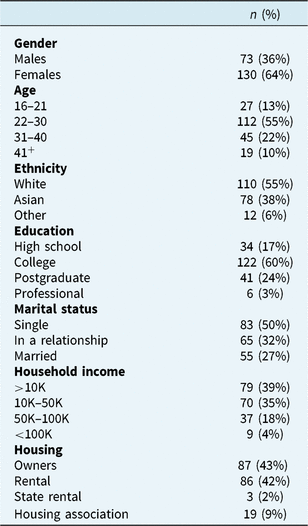
The demographic characteristics of the final sample are presented in Table 1. No significant differences emerged between genders in any of the demographic characteristics (p > 0.10 in all cases).
Demographic characteristics

Exploratory factor analysis for categorical data
The inspection of the frequencies of the items revealed that the responders tended not to choose the last category (5: ‘totally agree’). In fact, the absolute frequency of this category did not exceed 5 in any of the items. In order to have sufficient data (per cell) to proceed with item factor analysis the last two categories were merged.
EFA for categorical items was conducted and four eigenvalues above one (16.2, 2.2, 1.5, 1.2) were present. However, adequate fit was achieved when the number of factors was increased to five (relative χ2 = 1.9, CFI = 0.99, RMSEA = 0.068 and SRMR = 0.034). The results of this initial analysis were used for item selection. In particular, items that did not load (Geomin rotation) sufficiently in any of the factors (item 27) or had large loadings in more than one factor (items 5, 6, 13 and 24) were considered as problematic. The reliability within the corresponding factor along with the face validity was also taken into consideration and the five items were finally omitted from the scale. The analysis was repeated using the remaining 22 items (see Appendix 2 in Supplementary Material).
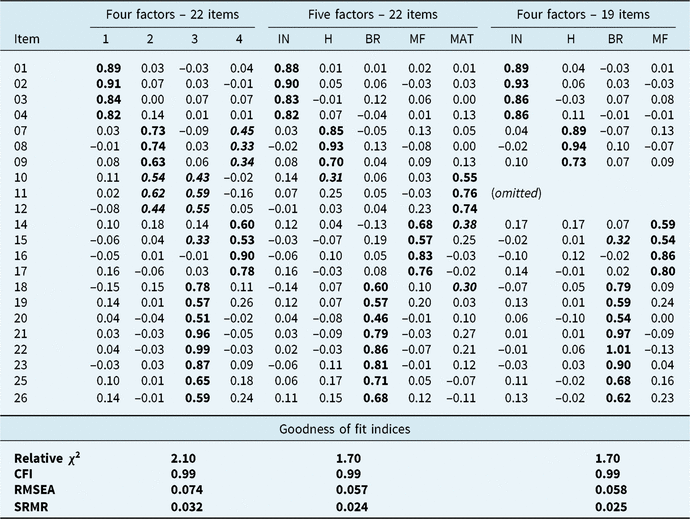
The one-factor model did not have adequate fit (relative χ2 = 5.7, CFI = 0.95, RMSEA = 0.152 and SRMR = 0.112), verifying that the scale is not unidimensional. The first model to provide adequate fit was the 4-factor solution (Table 2). Parallel analysis using polychoric correlations also indicated a four-factor solution. However, the loadings matrix reveals that this solution leads to high cross loadings (results were replicated under Promax rotation as well). In particular the items 7, 8 and 9 which describe malicious action tendencies (thoughts), loaded equally into two factors. The five factors solution resolves this issue, providing a clear structure where these three items constitute a separate factor. Based on the content of the statements, the factors were named as injustice (IN), hostility (H), behavioural responses (BR), malicious feelings (MF) and malicious actions tendencies (MAT). By omitting the three MAT items, the four other factors were replicated in the 19 items set, verifying that there are five factors pertaining the complete 22 items set (Table 2).
EFA for categorical data solutions – Geomin rotated loadings and goodness of fit indices

IN, injustice; H, hostility; BR, behavioural responses; MF, malicious feelings; MAT, malicious actions tendencies.
Rating scale evaluation
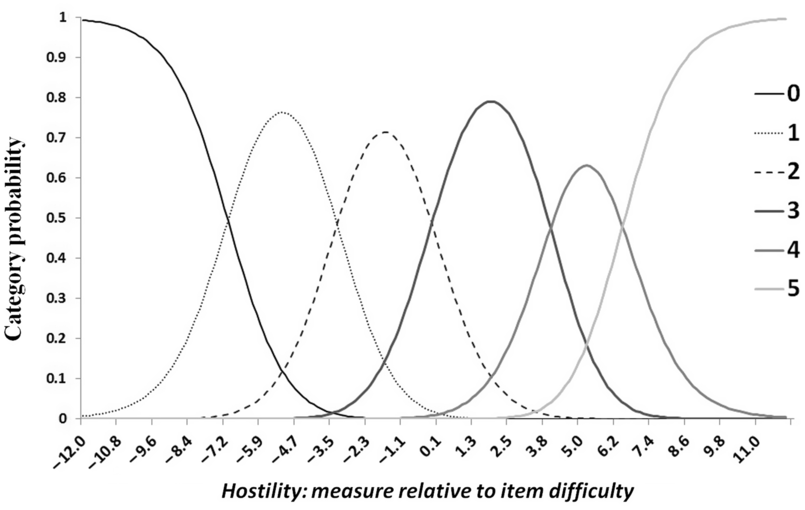
In order to evaluate the 6-point rating scale effectiveness, we followed the guidelines of Linacre (Reference Linacre, Smith and Smith2004) and we considered the necessity of combining adjacent categories. The initial scaling was found to be suitable as no distorted thresholds were present in any of the factors (for details, see Linacre, Reference Linacre, Smith and Smith2004). This is illustrated graphically in Fig. 1; the six categories smoothly follow the expected order, with lower categories (for instance responses ‘1’) being placed at lower levels of hostility (to the left) and vice versa. Each category (response option) peaks at a point where the probability of this response is higher than all other responses. Therefore, the 6-point rating scale is recommended even if for the needs of the analysis solely, low frequency categories might need to be merged in some samples.
Rating scale evaluation.

Descriptive indices and reliability
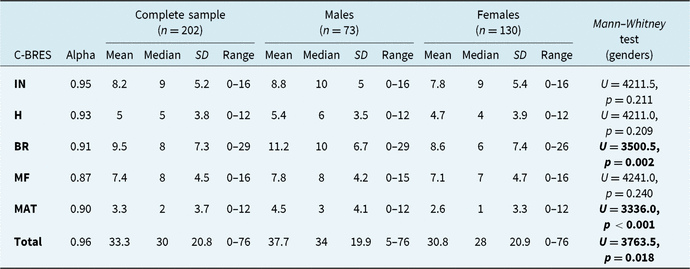
Table 3 presents the descriptive indices of the factors and the total score for the total sample and separately for each gender. All scores were skewed to the right which indicates a reluctance for participants to report the most extreme levels of envy and is congruent with previous research indicating that people are often reluctant to admit to feeling envy and try to conceal it (Silver and Sabini, Reference Silver and Sabini1978). Furthermore, envy may need to be present and in operation for the participants to be able recall their most envious thoughts or desires. The internal consistency (reliability) was satisfactory in all cases, even in factors constituted by three items such as H and MAT (Table 3). Males scored higher than females in MAT and BR factors, leading to an increased total score. Age correlated negatively and weakly with the factors and total scores (Table 4). The five factors correlated positively and highly with one another and with the total score (Table 4).
Descriptives of C-BRES scores, Cronbach’s alpha, and gender comparison

C-BRES subscales: injustice (IN), hostility (H), behavioural responses (BR), malicious feelings (MF) and malicious actions tendencies (MAT).
Spearman’s correlation coefficients among C-BRES scores and age

IN, injustice; H, hostility; BR, behavioural responses; MF, malicious feelings; MAT, malicious actions tendencies.
Evidence towards validity
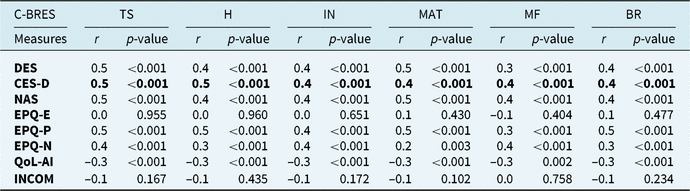
Table 5 presents the correlations of the C-BRES scores with the other scales concurrently administered to the participants. Criterion validity is evident as the C-BRES correlated moderately and positively with DES (r = 0.5 in total score level). Further convergent validity was evident via the satisfactory correlation of the C-BRES scores with the CES-D, NAS and EPQ psychoticism and neuroticism dimensions. On the contrary, C-BRES did not correlate with INCOM and EPQ-E providing evidence towards discriminant validity. There was also no correlation between the C-BRES scores and the Lie scale (p > 0.1 in all cases).
Spearman’s correlation coefficients between C-BRES scores and other measures

TS, total scale CBRES, IN, injustice; H, hostility; BR, behavioural responses; MF, malicious feelings; MAT, malicious actions tendencies; DES, Dispositional Envy Scale; CES-D, Centre for Epidemiological studies Depression scale; NAS, Novaco Anger Scale; QoL-AI, Quality of Life Activity Inventory; EPQ, Eysenck personality inventory (P, psychoticism and N, neuroticism); INCOM, Iowa-Netherlands Comparison Orientation Measure.
Discussion
We developed a 22-item cognitive behavioural response to envy scale (C-BRES) with sound reliability and validity. Our analysis showed malicious envy to be characterized by five dimensions, four illustrating key cognitive responses (thoughts of injustice, IN), hostility (H), maliciousness (MF) and malicious actions (MAT), and one highlighting primarily harming behaviours (BR) (e.g. I have caused harm to someone who has what I want). The items indicative of these factors possess clear content validity as each has been consistently empirically linked to the experiential content of malicious envy (Cohen-Charash, Reference Cohen-Charash2009; Smith et al., Reference Smith, Parrott, Diener, Hoyle and Kim1999; Vecchio, Reference Vecchio2000). The reliability of the scale was satisfactory in all cases, even in factors constituted by three items such as hostility and malicious action tendencies.
A measure of the scale’s concurrent validity was obtained through the comparison of participants’ scores on the C-BRES and DES (Smith et al., Reference Smith, Parrott, Diener, Hoyle and Kim1999). A significant relationship between all five factors of the C-BRES and the DES was identified, which suggests that the measures are tapping a common underlying factor.
The C-BRES for the most part, correlated in empirically compatible ways with psychological measures providing evidence of construct validity. Correlation coefficients point to a strong positive association with depression, anger, psychoticism and neuroticism, and a negative association with quality of life (Parrott and Smith, Reference Parrott and Smith1993; Smith et al., Reference Smith, Parrott, Diener, Hoyle and Kim1999).
Neuroticism is typified by negative affect and a tendency to interpret ordinary situations in an extreme way. It is consistently linked to a range of negative mental health outcomes. Psychoticism is associated with hostility, and being achievement orientated and dogmatic. These personality traits therefore overlap with envy in experiential content and an association between them would be predicted (Eysenck et al., Reference Eysenck, Eysenck and Barrett1985). Envy does not, however, share any features with extraversion such as being sociable or irresponsible. The absence of a relationship between this subscale on the EPQ and the C-BRES would therefore be expected, and provides some support for the discriminant validity of the C-BRES (Eysenck et al., Reference Eysenck, Eysenck and Barrett1985).
In contrast to previous studies, no relationship was found between envy as measured by C-BRES and the tendency to make social comparisons. This is unexpected but understandable on closer scrutiny of the items comprising the INCOM (Gibbons and Buunk, Reference Gibbons and Buunk1999). This measure sets out a range of social situations in which comparison might occur, for example considering how someone else might react in a similar situation. According to our results this may not be pertinent to the experience of envy. The absence of a relationship between the C-BRES and INCOM may therefore reflect the ability of the C-BRES to distinguish the specific cognitive and behavioural responses of envying from the process of general social comparison. This may be further evidence of the discriminant validity of this measure (Gibbons and Buunk, Reference Gibbons and Buunk1999).
When examining the relationship with socio-demographic variables and envy, it is apparent that males score higher than females for malicious action tendencies and behavioural responses. Although this may be a consequence of it being more socially acceptable for men than women to admit to and engage in aggressive or hostile behaviours (Burton et al., Reference Burton, Hafetz and Henninger2007), it also suggests that envy motivates a different response in men and women. Several studies have previously detected differences in the situations or attributes provoking envy for men and women. It is also possible that gender motivates different action tendencies (Delpriore et al., Reference DelPriore, Hill and Buss2012). Age also showed a weak but significant negative association with C-BRES scores, suggesting that increasing age was linked to decreasing envy. Both of these factors are worthy of further exploration, given the likely impact of malicious envy on real world outcomes, such as acting in a harmful way towards another.
Finally, participants tended not to use the last category of the 6-point rating scale for the C-BRES. We would, however, recommend this range of response options as a reduction to 5 points may be subject to the same trend. People are reluctant to admit to envy and as a result may tend to deflate their rating of it. If necessary, low frequency categories can subsequently be merged for the purposes of analysis.
Conclusion, limitations and future directions
The findings of this study support the psychometric properties of the C-BRES. As with any self-report measure designed to capture the experience of envy, the unbecoming reputation of this emotion may mean that people tend to under-report their experience of it. Here we attempted to minimize this potential by omitting the word envy from the scale and by attempting to capture the experiential content of malicious envy via the thoughts and behaviour it tends to motivate.
As the psychometric properties of the C-BRES were tested on a convenience sample, no formal norms are presented here. A second sample is currently being surveyed for that purpose. Future research plans also include the evaluation of the stability of the scale (test–retest reliability) and the confirmation of the factorial structure.
Supplementary Material
To view Supplementary Material for this article, please visit: https://doi.org/10.1017/S1352465819000614
Acknowledgements
None.
Financial support
S.V. and T.C. were funded by the National Institute for Health Research (NIHR) Biomedical Research Centre at South London and Maudsley NHS Foundation Trust and King’s College London. The views expressed in this article are those of the authors and not necessarily those of the NIHR or the NHS.
Conflicts of interest
Cheryl Jordan, Silia Vitoratou, Yee Siew and Trudie Chalder have no conflicts of interest with respect to this publication.
Ethical statements
The authors have abided by the Ethical Principles of Psychologists and Code of Conduct as set out by the APA. Ethical approval for this study was granted by King’s College London (reference PNM/11/12-66).





Comments
No Comments have been published for this article.