Introduction
Rachiplusia nu (Guenée) (Lepidoptera: Noctuidae) is a significant agricultural pest widely distributed across several countries in southern South America, including southern Brazil, Bolivia, Chile, Uruguay, Paraguay, and Argentina (Acosta-Parra et al., Reference Acosta-Parra, Barrionuevo, Beccacece, Casmuz, Chalup, Drewniak, Fichetti, Murúa, San Blas, Vera, Claps, Roig-Juñent and Morrone2023; Barbut, Reference Barbut2008; Rimoldi et al., Reference Rimoldi, Fogel, Schneider and Ronco2012). Additionally, R. nu has increased in abundance at lower latitudes, suggesting a possible adaptation of this species to warmer climates. This adaptation may be driven by climate change, the expansion of soybean-growing regions, the low genetic distances among populations, and the emergence of insect resistant to transgenic crops, which could enhance the pest’s ability to spread and thrive in new areas (Braga et al., Reference Braga, Warpechowski, Diniz, Dallanora, Reis, Farias and Bernardi2024; Horikoshi et al., Reference Horikoshi, Bernardi, Godoy, Semeão, Willse, Corazza, Ruthes, Fernandes, Sosa-Gómez, Bueno, Omoto, Berger, Correa, Martinelli, Dourado and Head2021; Nardon et al., Reference Nardon, Mathioni, Dos Santos and Rosa2021; Pasqualotto et al., Reference Pasqualotto, Alves, Pedó, de Souza Trombim, de Souza Trombim, Soares, Jun Horikoshi, Miraldo, Ovejero, Berger and Bernardi2024).
This pest is widespread throughout the soybean-growing regions of Argentina, with particular agricultural significance in the central-southern areas of the country. In the northwest of Argentina, it is most frequently found from December to mid-February affecting advanced vegetative and initial reproductive stages of soybean crops (Acosta-Parra et al., Reference Acosta-Parra, Barrionuevo, Beccacece, Casmuz, Chalup, Drewniak, Fichetti, Murúa, San Blas, Vera, Claps, Roig-Juñent and Morrone2023; Barrionuevo et al., Reference Barrionuevo, Murúa, Goane, Meagher and Navarro2012).
Conventional control methods for R. nu and other lepidopteran pests in soybeans include foliar insecticides and seed treatments. However, the use of Bacillus thuringiensis (Bt) soybean has become an established alternative management strategy, providing benefits beyond pest control, such as reduced insecticide use, conservation of natural enemies, and enhanced crop yields (Gassmann and Hutchison, Reference Gassmann and Hutchison2012). Consequently, the global rate of adoption of this technology continues to rise annually. One of the most widely used Bt soybean varieties is the stacked line developed by Monsanto, which combines the transformation events MON 87701 (expressing Cry1Ac protein) and MON 89788 (conferring glyphosate tolerance), commercially known as Intacta RR2 PRO. Argentina is a major producer and exporter of soybean, with approximately 60% of planted surface and more than 43 million tons of production (FAOSTAT, 2024; Páez-Jerez et al., Reference Páez-Jerez, Hill, Pereira, Alzogaray and Vera2023). The widespread adoption of genetically modified soybean in the country has increased sharply in the last few decades, now accounting for nearly 97% of the planted surface in the country (Sistema de Información Simplificado Agrícola (SISA), 2021; Paredes et al., Reference Paredes, Pérez, Rodriguez, Devani, Devani, Ledesma and Sánchez2022).
Bt soybean was designed to provide control for the primary lepidopteran pests of soybean such as R. nu, Chrysodeixis includens (Walker), Helicoverpa gelotopoeon (Dyar), Chloridea virescens (F.) (Noctuidae), Anticarsia gemmatalis Hübner (Erebidae), Crocidosema aporema (Walsingham) (Tortricidae), Colias lesbia (F.) (Pieridae), Spilosoma virginica (F.) (Arctiidae), and Achyra bifidalis (F.) (Crambidae) (Argenbio, 2024).
However, recently the survival of R. nu on MON 87701 × MON 89788 soybean (Cry1Ac) in the field was reported in Brazil (Horikoshi et al., Reference Horikoshi, Bernardi, Godoy, Semeão, Willse, Corazza, Ruthes, Fernandes, Sosa-Gómez, Bueno, Omoto, Berger, Correa, Martinelli, Dourado and Head2021; Nardon et al., Reference Nardon, Mathioni, Dos Santos and Rosa2021; Reis et al., Reference Reis, Steinhaus, Godoy, Warpechowski, Diniz, Dallanora, Horikoshi, Ovejero, Martinelli, Berger, Head, Dourado and Bernardi2024). Similarly, in Argentina, laboratory trials revealed reduced susceptibility of a R. nu population to Bt soybean (Vera et al., Reference Vera, Casmuz, Fadda, Fogliata, Marchi, Murúa and Gastaminza2018). More recently, unexpected injury to the MON 87701 × MON 89788 soybean caused by R. nu was observed during the 2021/22 crop season in different regions of Argentina (Almada, 2022; Asociación Argentina de Productores en Siembra Directa (AAPRESID), 2022; Asociación Argentina de Protección Profesional de Cultivos Extensivos (AAPPCE), 2022; Consorcios Regionales de Experimentación Agrícola (CREA), 2024; Vera et al., Reference Vera, Casmuz, Murúa, Suárez, Cejas Marchi, Medrano, Romero, Ale Reuter, Margagliotti, Gastaminza, Scalora, Devani, Devani, Ledesma and Sánchez2022). This was followed by confirmation of a shift in susceptibility to Cry1Ac protein during the subsequent crop season (Casuso et al., Reference Casuso, Tarragó, Pérez, Colli and Nadal2023; Suárez et al., Reference Suárez, Casmuz, Vera, Romero, Medrano, Cejas Marchi, Giménez Sardi, Álvarez Paz, Campero, Gastaminza, Scalora, Devani, Murúa, Devani, Ledesma and Sánchez2023). These studies from Argentina documented a survival rate of over 90% in strains collected from Bt cultivars, with no significant differences in performance when reared on Bt or non-Bt soybean. On the other hand, injury to the Bt soybean caused by R. nu was also observed during the 2022/23 crop season in Uruguay (Cibils et al., Reference Cibils, González, Pessio, Calistro, Rossi, Chiaravalle, Abbate and Baráibar2023). Together, these reports from Brazil, Uruguay, and Argentina would suggest that resistance of R. nu to Cry1Ac, characterised as field-evolved resistance, may be emerging as a regional issue.
The evolution of resistance in target pest populations to transgenic plants expressing Bt insecticidal proteins poses a major threat to the long-term sustainability of these technologies. Nonetheless, resistance to Bt proteins can be delayed through insect resistant management (IRM) strategies. The success of these strategies includes several assumptions which include a high dose of the Bt protein, a low initial resistant allele frequency, random mating between resistant and susceptible insects, and the presence of an abundance of non-Bt refuges. The purpose of the refuge is to reduce selection pressure by the Bt protein and to provide susceptible insects to mate with resistant insects (Tabashnik et al., Reference Tabashnik, Gassmann, Crowder and Carrière2008). The frequency of susceptible insects in the refuge depends on several factors, including pest bionomics, genetic mode, stability of resistance, and the relative performance of susceptible and resistant insects. However, in Argentina, the failure to comply with refuge requirements, as showed by the limited area of non-Bt soybean planted (Sistema de Información Simplificado Agrícola (SISA), 2021; Paredes et al., Reference Paredes, Pérez, Rodriguez, Devani, Devani, Ledesma and Sánchez2022), may be a key factor contributing to the buildup of pest resistance to Bt crops (Arends et al., Reference Arends, Reisig, Gundry, Huseth, Reay-Jones, Greene and Kennedy2021; Tabashnik and Carrière, Reference Tabashnik and Carrière2017).
Comparing the performance of susceptible and resistant insects can help understand fitness costs and improve IRM (Murúa et al., Reference Murúa, Vera, Michel, Casmuz, Fatoretto and Gastaminza2019; Wu et al., Reference Wu, Guo and Gao2002). Furthermore, understanding the biological and reproductive parameters of these populations, along with their fitness differences is essential for refining these strategies. Evaluating the performance of resistant and susceptible insects can provide insights into fitness costs, while evaluating reproductive compatibility can clarify the potential for gene flow within populations (Murúa et al., Reference Murúa, Vera, Michel, Casmuz, Fatoretto and Gastaminza2019; Wu et al., Reference Wu, Guo and Gao2002). Fitness evaluations provide critical insights into the survival, reproduction, and spread of resistant populations, enabling the prediction of resistance dynamics and the design of effective integrated pest management tactics. These include optimising refuge designs, enhancing resistance monitoring, and implementing complementary control methods to delay resistance evolution and sustain the efficacy of Bt crops (Carriere et al., Reference Carriere, Crowder and Tabashnik2010; Gassmann et al., Reference Gassmann, Carrière and Tabashnik2009). Additionally, reproductive compatibility, which includes factors such as gamete compatibility, mating success rates, synchronised mating behaviours, and functional reproductive systems, plays a key role in understanding how pest populations respond to different management strategies (Herrero et al., Reference Herrero, Fogliata, Vera, Casmuz, Gómez, Castagnaro, Gastaminza and Murúa2017; Xue et al., Reference Xue, Sun, Witters, Vandenhole, Dermauw, Bajda, Simma and Van Leeuwen2023).
Despite the recent reports about the susceptibility shift of R. nu that would suggest the development of resistance of this species to Cry1Ac, no research has examined the fitness of R. nu strains exposed to soybean expressing Cry1Ac. The objective of this study was to determine the performance of two R. nu strains, one susceptible (SS) and other exhibiting reduced susceptibility to Cry1Ac (RR), when reared on non-Bt and Bt soybean. Biological, reproductive parameters and mating compatibility were evaluated.
Materials and methods
Insect rearing
Two strains of R. nu were studied, one susceptible (SS) and the other exhibiting reduced susceptibility to Cry1Ac (RR). The colony of the SS strain was initiated from 1500 larvae sampled from non-Bt soybean fields in San Agustin County (−26.837; −6,8576) (Tucumán Province, Argentina) in 2020. This colony was documented to be highly susceptible to Cry1Ac protein because it showed 99% of mortality when the larvae were fed with fresh leaf tissue of Bt soybean (unpublished data). The RR colony of R. nu was collected during February and March of 2022 from a Bt soybean field located at Burruyacu County (−64.6792; −26.4630) (Tucumán Province, Argentina).
Each colony was maintained in the same chamber under identically controlled conditions at 27 ± 2 ºC, 70 ± 5% RH and 14:10 h L:D. Colonies were reared according to the methodology described by Barrionuevo et al. (Reference Barrionuevo, Murúa, Goane, Meagher and Navarro2012) and Murúa et al. (Reference Murúa, Vera, Abraham, Juárez, Prieto, Head and Willink2008). Twenty-five pairs of moths (both females and males) were used per cage and per strains (N = 6). Adults were maintained in cylindrical oviposition cages of plastic mesh (30 cm high and 20 cm diameter) lined with polyethylene bags as an oviposition substrate. For aeration, both ends of the cage were covered with nylon cloth.
The food was provided via a cotton plug saturated with a mixture of honey and water (1:1 v/v), which was replaced daily. Cages were checked daily for oviposition and adult mortality. Eggs were collected daily with a moistened brush and deposited in Petri dishes lined with moistened filter paper. Once emerged, neonate larvae were placed in 20 cm diameter, 800 ml containers with an artificial larval diet that included bean flour (Grandiet®, Buenos Aires, Argentina), wheat germ (Grandiet®, Buenos Aires, Argentina), brewer’s yeast (Calsa®, Tucumán, Argentina), vitamin C (Anedra®, Buenos Aires, Argentina), sorbic acid (Anedra®, Buenos Aires, Argentina), vitamin supplement amino acids (Ruminal®, Buenos Aires, Argentina), and methylparaben (Pura Química®, Córdoba, Argentina) (Murúa et al., Reference Murúa, Virla and Defagó2003). Diet was replaced every 5 days. As larvae pupated, pupae were sexed and placed in cup containers with moistened filter paper until adult emergence. Adults were used to initiate a new generation. After establishing a colony for each strain, individuals from the second generation (F2) were used for the evaluation of both strain with Cry1Ac soybean and non-Bt soybean in a laboratory.
Host plants
Soybean seeds (Brv 5622 Enlist conventional and 60i62 IPRO varieties) of maturity group 7 were used (recommended for cultivation in northwestern Argentina). Bt Cry1Ac soybean and non-Bt soybean were planted in pots (15 cm diameter, 600 ml) using sterilised soil. One seed per pot was planted. The plants were maintained under greenhouse conditions and ambient lighting at approximately 33 ± 4 ºC, 80 ± 10% RH and 14:10 h L:D. The growth stages of plants used to feed the larvae were V4 to V6 (Fehr et al., Reference Fehr, Caviness, Burmood and Pennington1971). In each experiment, fresh leaf tissues were excised from the greenhouse-grown plants to feed the larvae. The presence of the Cry1Ac protein in the Bt soybean plants used for this study was confirmed prior to the experiment using ELISA Quickstix lateral flow detection strips (Envirologix, Portland, ME, USA).
Finess of R. nu strains
Eggs of R. nu were randomly isolated from the colonies (SS: n = 230; RR: n = 190) and used to start assays under laboratory conditions (27 ± 2 ºC, 70 ± 5% RH and 14:10 h L:D). The emerging neonate larvae of each strain were placed individually inside Petri dishes with one soybean leaf and wet tissue paper to prevent leaf desiccation. A total of 230 larvae from the SS strain were evaluated, with 125 larvae fed with Bt soybean and 105 fed with non-Bt soybean. From a total of 190 RR larvae, 100 were assessed for susceptibility to Bt toxin, while the remaining 90 were fed non-Bt soybean. Each larva was checked daily until adult emergence. Soybean leaves were provided on an ad libitum regime to the larvae used in this assay. The parameters evaluated were duration of larval and pupal stage, pupal mass (obtained 24 h after pupation), sex ratio (proportion of emerged females), and adult longevity.
Reroductive compatibility between R. nu strains
Adults from each strain (SS and RR) were randomly selected for laboratory crosses. Virgin couples were transferred to cylindrical plastic oviposition cages (24 cm high × 12 cm diameter) lined with polyethylene bags as an oviposition substrate. For aeration, both ends of the cage were covered with nylon cloth. The adults were fed as was mentioned above.
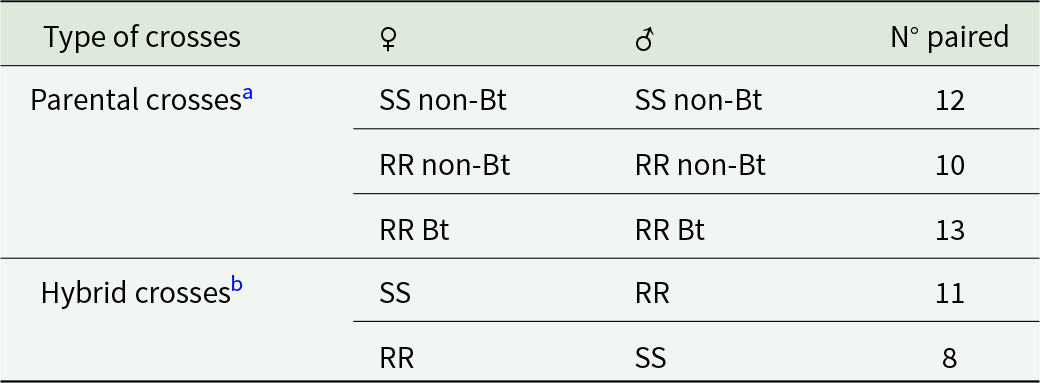
To determine the compatibility of both strains, two types of crosses were performed (Table 1): (i) parental crosses using parents from the same population, and (ii) hybrid crosses using one parent of each population according to the methods described by Barrionuevo et al. (Reference Barrionuevo, Murúa, Goane, Meagher and Navarro2012), Murúa et al. (Reference Murúa, Vera, Abraham, Juárez, Prieto, Head and Willink2008), and Fogliata et al. (Reference Fogliata, Vera, Gastaminza, Cuenya, Zucchi, Willink, Castagnaro and Murúa2016), Fogliata et al. (Reference Fogliata, Herrero, Vera, Castagnaro, Gastaminza and Murúa2019). Parental crosses were performed using adults obtained from larvae fed with non-Bt or Bt soybean, while hybrid crosses were performed using adults obtained from larvae fed with artificial diet.
Types of crosses using susceptible (SS) and reduced susceptibility (RR) strains of Rachiplusia nu collected in tucumán province in Argentina and reared at 27 ± 2 ºC, 70 ± 5% RH and 14L:10D

a Parental crosses were performed using adults obtained from larvae fed with non-Bt or Bt soybean.
b Hybrid crosses were performed using adults obtained from larvae fed with artificial diet.
The cages were checked daily to collect eggs and replace the oviposition substrates. The eggs (F3) were kept inside plastic containers until the hatching of larvae and were monitored for survival to pupation and then reared to adulthood. Moths were maintained in this cage, and daily mortality and oviposition were recorded until the moths died. Dead females were dissected to establish the number of spermatophores present in their reproductive tract to determine whether mating had occurred, a common and practical approach to quantify mating success and assessing prezygotic incompatibility (Perfectti, Reference Perfectti and Soler2002; Rhainds, Reference Rhainds2010). To evaluate postzygotic incompatibilities, parameters indicative of reproductive success and hybrid viability were recorded. These included preoviposition and oviposition period duration, total fecundity (number of eggs deposited by a female during her entire life period), egg duration, total fertility (percentage of eggs hatching), and adult longevity.
Statistical analysis
Generalised linear models (GLM) with gamma error distribution and log-link function were used to compare the duration of development stages, total life cycle duration (egg to adulthood), and pupal mass across leaf treatments. Comparisons of adult emergence and sex ratios from different plant treatments were analysed with GLM fitted with binomial error distribution and logit link function. Longevity of adults was analysed using GLM with gamma error distribution and log-link function.
Spearman’s rank correlations were conducted to assess the relationship between pupal mass and fecundity/longevity of emerged female moths. The survivorship of larvae was analysed by means of the nonparametric Kaplan–Meier survival analysis (Kaplan and Meier, Reference Kaplan and Meier1958). Log-rank tests were used to compare the survival curves of RR individuals from the different leaf treatments and the Bonferroni adjustment was used for pairwise comparisons.
Data related to mating crosses were evaluated by comparing female fecundity, fertility, and number of spermatophores between treatments using GLM with Poisson error distribution and log function. The preoviposition and oviposition periods, and the duration of egg stage were analysed with GLM fitted with gamma error distribution and log link function. Treatments from all GLMs performed were compared using likelihood ratio tests (LRT). Post hoc comparisons were carried out using the Holm test adjustment.
Statistical analyses were carried out at the 0.05 significance level using R software version 2024.04.2 (RStudio team 2024), using the R statistical packages survival, survminer, multcomp, and emmeans.
Results
Finess of R. nu strains
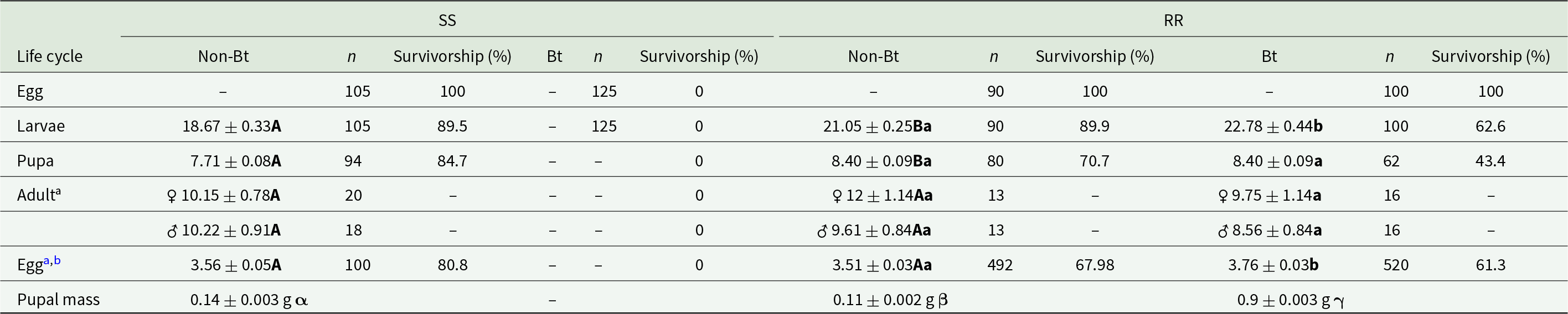
The performance of R. nu strains varied depending on the soybean plant used to feed the larva. Larvae of SS strain fed with Bt soybean did not complete their life cycle and all died, whereas the SS strain fed with non-Bt showed a significantly higher survival (89.5%). A similar percentage of RR larvae that were fed with non-Bt soybean survived (89.9%) and 62.6% of RR larvae survived when were fed on Bt soybean. Additionally, significant differences were found in the duration of the egg and larval stages of RR, which were significantly longer in the Bt treatment (eggs: GLM: χ2 = 24.69; df = 1; P < 0.05; larvae: GLM: χ2 = 13.08; df = 1; P < 0.05). Pupal stage duration (GLM: χ2 = 0.0005; df = 1; P = 0.98) and longevity of females and males were statistically similar between Bt and non-Bt treatments within the RR strain (GLM: Leaf treatment: χ2 = 2.62; df = 1; P = 0.10; sex: χ2 = 2.92; df = 1; P = 0.08) (Table 2).
Mean duration in days of development stages (mean ± SE), survivorship (%) and pupal mass of susceptible (SS) and reduced susceptibility (RR) strains of Rachiplusia nu reared on Bt and non-Bt soybean. Different uppercase letters indicate significant differences between strains fed with non-Bt soybean (P < 0.05). different lowercase letters indicate significant differences between plant treatments within the RR strain (P < 0.05). Different Greek letters denote significant differences between all plant treatments (P < 0.05)

a Duration of adult and egg stages were estimated using data from the fecundity assays.
b Data obtained from third generation individuals (F3).
When comparing the biological parameters of SS and RR individuals fed with non-Bt leaves, only the larval and pupal stages where significantly longer in the RR strain (eggs: GLM: χ2 = 0.36; df = 1; P = 0.54; larvae: GLM: χ2 = 9.56; df = 1; P < 0.05; pupa: GLM: χ2 = 28.92; df = 1; P < 0.001). There were no statistically significant differences in adult longevity, regardless of sex (females: χ2 = 1.87; df = 1; P = 0.17; males: χ2 = 0.20; df = 1; P = 0.68). The sex ratio (proportion of females) of emerged adults was similar in all treatments (GLM: χ2 = 1.80; df = 2; P = 0.40; non-Bt RR: 0.44; Bt RR: 0.55; non-Bt SS: 0.42).
The pupal mass was significantly affected by the soybean variety consumed by the larvae (GLM: χ2 = 57.84; df = 1; P < 0.001). Larvae from the RR strain, when fed with Bt soybean, exhibited a lower pupal mass (0.09 ± 0.003 g) compared to those fed non-Bt soybean (0.11 ± 0.002 g), as well as SS larvae fed non-Bt soybean (0.14 ± 0.003 g). Nonetheless, correlations showed that fecundity and longevity of females was not affected by the soybean variety (Bt = Fecundity: ρ = 74, P = 0.49; longevity: ρ = 51.92, P = 0.87; non-Bt = Fecundity: ρ = 52, P = 0.90; Longevity: ρ = 29.01, P = 0.27).
A summary of the biological parameters of the SS and RR strains of R. nu maintained on Bt and non-Bt soybean is shown in Table 2. Developmental time from egg to adult emergence was significantly shorter for the SS strain fed with non-Bt leaves (29.60 ± 0.33 days) compared to the RR strain fed with non-Bt soybean (31.59 ± 0.27 days) and Bt soybean (33.17 ± 0.60 days) (GLM: χ2 = 42.63; df = 2; P < 0.001). The longevity of adults was similar in all treatments (GLM: χ2 = 2.75; df = 2; P = 0.25; Table 2).
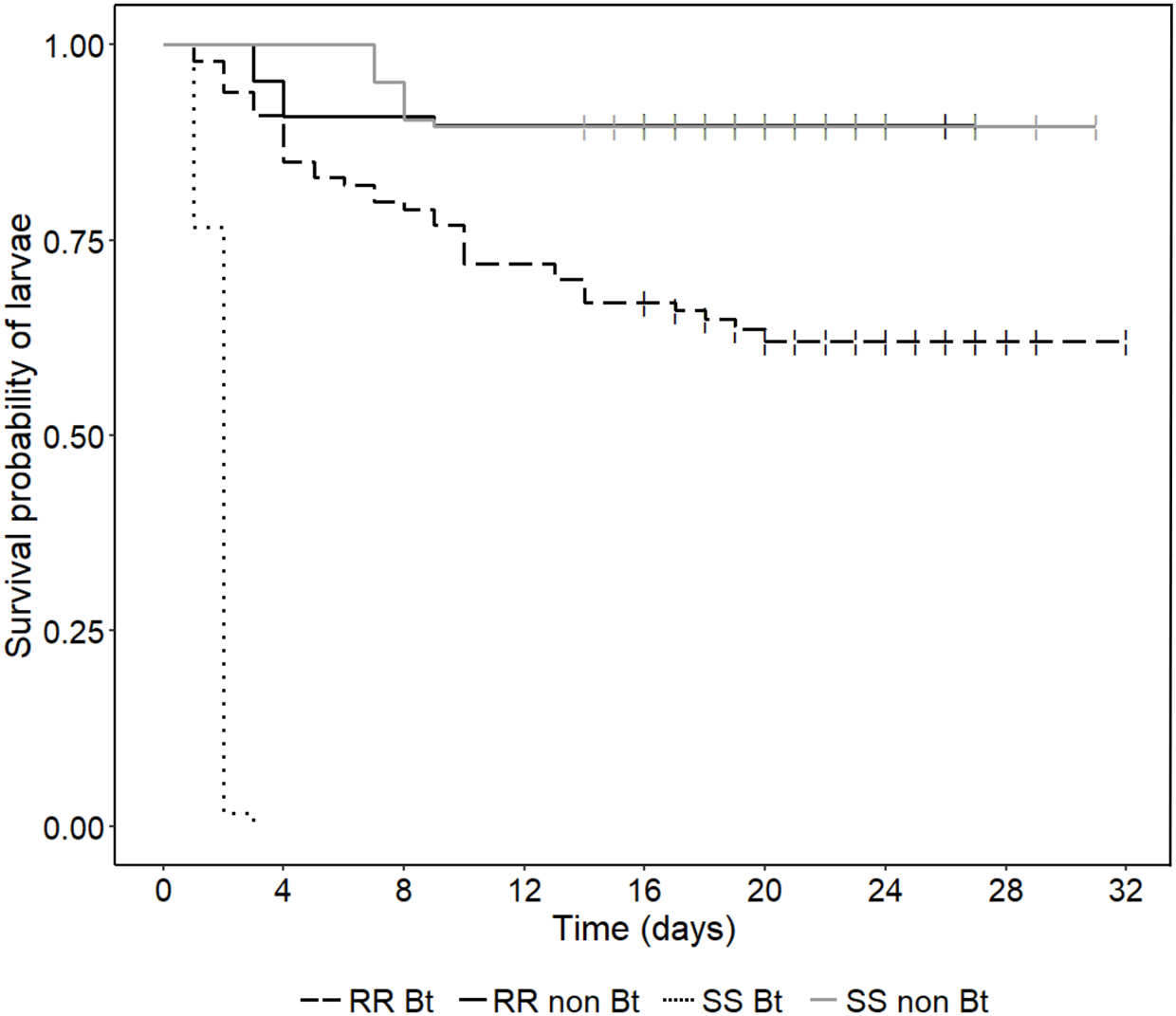
Kaplan–Meier test showed that SS and RR larvae reared with Bt leaves had a lower survival probability than those fed with non-Bt leaves, confirmed by the log-rank test (χ2 = 420; df = 3; P < 0.0001; Fig. 1). Only Bt-fed SS individuals revealed 100% mortality before molting to pupae.
Kaplan–Meier survival probability curves of Rachiplusia nu larvae. the susceptible strain (SS) is represented by solid (non-Bt fed) and dotted lines (Bt fed), whereas the strain with reduced susceptibility (RR) is illustrated by dot-dashed (non-Bt fed) and dashed lines (Bt fed). Day ‘0’ indicates emergence of neonate larvae. Vertical bars intersecting with curves show time intervals during which larvae molted to pupae. Each decline within a curve represents the death of larvae. survival curves of RR and SS larvae fed with Bt and non-Bt soybean are significantly different (P < 0.05).

Reroductive compatibility between R. nu strains
In total, 35 parental crosses and 19 hybrid crosses were carried out between the RR and SS strains (Table 3). The parental crosses with RR strain fed with Bt showed the lowest number of mated females when compared with other parental crosses (Table 3). Parental crosses (SS × SS and RR × RR) obtained from larvae fed with non-Bt soybean showed differences in both fecundity (GLM: χ2 = 154.5; df = 1; P < 0.001), and fertility (GLM: χ2 = 391.2; df = 1; P < 0.001) (Table 3). Although fecundity was significantly higher in RR × RR crosses, fertility decreased in this treatment. Similarly, when comparing the parental crosses of RR from Bt and non-Bt soybean, a significant decrease in fecundity and fertility is observed in the Bt treatment (GLM: χ2 = 154.5; df = 1; P < 0.001, GLM: χ2 = 391.2; df = 1; P < 0.001; Table 3).
Fecundity (nº number of eggs laid by a female during her entire life period), fertility (percentage of hatching eggs), and preoviposition/oviposition periods of parental and hybrid crosses of Rachiplusia nu adults obtained from larvae reared with non-Bt, Bt soybean or artificial diet. Different letters denote significant differences (P < 0.05) among strains subject to different diet treatments

SS: Susceptible strain; RR: reduced susceptibility strain.
According to the analysis of hybrid crosses, evidence of prezygotic and postzygotic incompatibility was detected (Table 3). Hybrid crosses showed that 9 of 19 females did not carry spermatophores in their reproductive tract.
Considering successful crosses (10), the mated females carried one or two spermatophores. The fecundity average of hybrid crosses was 315.3 ± 93.14 eggs/female (range 8-996) and the fertility ranged from 50% to 100%. However, only 54.5% of RR females mating SS males laid eggs, with a fertility of 71.2%, while 87.5% of SS females mating RR males laid eggs with a 77.5% of hatching.
The SS females of the hybrid cross were significantly more fecund than RR females of hybrid cross (GLM: χ2 = 1664.9; df = 1; P < 0.001) (Table 3); however, there were no statistical differences in egg fertility of the two hybrid crosses (Table 3).
The number of spermatophores transferred by males was not statistically different between the Bt and non-Bt treatments of parental crosses or for hybrid crosses (GLM: χ2 = 2.44; df = 4; P = 0.65). No statistical differences were found between all crosses regarding the preoviposition and oviposition period of females (GLM: χ2 = 4.03; df = 1; P = 0.40; χ2 = 5.63; df = 1; P = 0.22; Table 3).
Discussion
The development of resistance by R. nu to MON 87701 × MON 89788 soybean poses a significant challenge, particularly in regions where this species is considered a key pest. Moreover, this technology also targets other pest species in soybean, such as C. includens, A. gemmatalis, and H. gelotopoeon. Therefore, implementing effective IRM strategies to preserve the efficacy and durability of Bt crops should be a priority.
The present study investigated the impact of Bt soybean on the biological and reproductive parameters, and mating compatibility of two strains, one susceptible (SS) and one displaying a shift in the susceptibility to Cry1Ac (RR) of R. nu. Significant differences in the performance of the two strains were found. As expected, data from the survival analysis showed that individuals from the SS strain were completely susceptible to Cry1Ac protein, while the RR strain revealed a shift in susceptibility. These results of experiments conducted under laboratory conditions corroborated field observations reported by Vera et al. (Reference Vera, Casmuz, Murúa, Suárez, Cejas Marchi, Medrano, Romero, Ale Reuter, Margagliotti, Gastaminza, Scalora, Devani, Devani, Ledesma and Sánchez2022), Almada (2022), Casuso et al. (Reference Casuso, Tarragó, Pérez, Colli and Nadal2023), and Suárez et al. (Reference Suárez, Casmuz, Vera, Romero, Medrano, Cejas Marchi, Giménez Sardi, Álvarez Paz, Campero, Gastaminza, Scalora, Devani, Murúa, Devani, Ledesma and Sánchez2023) of larvae of R. nu damaging transgenic Bt soybean, demonstrating a shift in susceptibility of this species to Bt soybean in Argentina.
Aside from the higher survival rates of RR larvae, significant differences were found regarding the duration of the egg and larval stages and pupal mass, compared to SS individuals. Larval longevity was perhaps the most affected trait, with larvae from the RR strain taking over four days longer to pupate compared to the SS strain. Developmental time from egg to adult emergence of the SS strain fed with non-Bt leaves was in average 29.94 days, while the RR strain fed with non-Bt and Bt soybean were 32.96 and 34.94 days, respectively. These results align with previous findings in other Lepidoptera species that also report longer development times in resistant genotypes (Adamczyk et al., Reference Adamczyk, Adams and Hardee2001; Bourguet et al., Reference Bourguet, Bethenod, Pasteur and Viard2000; Jakka et al., Reference Jakka, Knight and Jurat-Fuentes2014; Liu et al., Reference Liu, Tabashnik, Dennehy, Patin, Sims, Meyer and Carrière2001; Murúa et al., Reference Murúa, Vera, Michel, Casmuz, Fatoretto and Gastaminza2019; van Rensburg, Reference van Rensburg2007). Nonetheless, Reis et al. (Reference Reis, Steinhaus, Godoy, Warpechowski, Diniz, Dallanora, Horikoshi, Ovejero, Martinelli, Berger, Head, Dourado and Bernardi2024) found no significant difference in the survival and development time of larvae between a resistant and a susceptible strain of R. nu from Brazil. Longer larval stages translate not only into higher feeding damage to crops, but if asynchronous emergence of resistant and susceptible adults took place, it would result in fewer crosses producing heterozygote progeny, thereby contributing to the progression of resistance (Gryspeirt and Grégoire, Reference Gryspeirt and Grégoire2012; Murúa et al., Reference Murúa, Vera, Michel, Casmuz, Fatoretto and Gastaminza2019). Hence, if such a scenario were to occur in natural field conditions, susceptible adults would probably not encounter or mate with emerging adults from resistant strains. This behaviour could disrupt the random mating between moths emerging from Bt crop areas and refuge zones (Gryspeirt and Grégoire, Reference Gryspeirt and Grégoire2012; Jakka et al., Reference Jakka, Knight and Jurat-Fuentes2014).
In many insect species, pupal mass is thought to be related to fitness, since it is associated with the level of reserves acquired during the larval period, which might influence the reproductive input (Ongaratto et al., Reference Ongaratto, Silveira, Santos, Gorri, Sartori, Hunt, Lourenção and Baldin2021). In this study, R. nu RR strain fed with Bt soybean displayed reduced pupal mass in comparison to the non-Bt treatment and with the SS strain, although this reduction did not translate into differences in fecundity and longevity. Similarly, resistant strains of R. nu from Brazil also presented reduced pupal mass (Reis et al., Reference Reis, Steinhaus, Godoy, Warpechowski, Diniz, Dallanora, Horikoshi, Ovejero, Martinelli, Berger, Head, Dourado and Bernardi2024). Additionally, Bilbo et al. (Reference Bilbo, Reay-Jones, Reisig, Musser and Greene2018) evaluated the pupal mass of Helicoverpa zea (Boddie) (Lepidoptera: Noctuidae) reared on several hybrids of Bt corn and found a reduction in pupal mass and no association between this trait and fecundity. While the direct relationship between pupal mass and fitness parameters like fecundity and longevity was not observed in these studies, it is possible that other fitness traits, such as moth size, mating frequency, fertility, or flight capacity, could be affected (Kruger et al., Reference Kruger, Van den Berg and Van Rensburg2012; Wu et al., Reference Wu, Wu, Wang and Guo2006). This suggests that reduced pupal mass may have subtle or delayed effects on population dynamics that are not immediately apparent in controlled conditions but may become significant under field conditions (Gassmann et al., Reference Gassmann, Carrière and Tabashnik2009; Lemoine et al., Reference Lemoine, Capdevielle and Parker2015)
Reproductive parameters and mating compatibility of parental and hybrid crosses of R. nu were also investigated. A negative effect on reproductive parameters was observed. Fecundity and fertility were both significantly lower in the RR strain fed with Bt soybean. These results are similar to those reported by Horner et al. (Reference Horner, Dively and Herbert2003), in which Bt toxin also decreased fecundity in H. zea and by Vélez et al. (Reference Vélez, Spencer, Alves, Crespo and Siegfried2014), Horikoshi et al. (Reference Horikoshi, Bernardi, Bernardi, Okuma, Farias, Miraldo, Amaral and Omoto2016), and Muraro et al. (Reference Muraro, Garlet, Godoy, Cossa, Rodrigues Junior, Stacke, Medeiros, Guedes and Bernardi2019), who reported that S. frugiperda resistant strains exposed to Cry1F were less fecund in comparison to the susceptible strain. In contrast, a resistant R. nu strain from Brazil fed with Cry1Ac display no negative effects on fecundity or fertility (Reis et al., Reference Reis, Steinhaus, Godoy, Warpechowski, Diniz, Dallanora, Horikoshi, Ovejero, Martinelli, Berger, Head, Dourado and Bernardi2024).
When comparing reproductive parameters between RR and SS strains fed with non-Bt soybean, fertility and fecundity were affected. The number of spermatophores found in the genital tract of RR females fed with Bt soybean was less than in RR females fed with non-Bt, though this was not statistically significant. The RR and SS females used in the hybrid crosses also contained a similar amount of spermatophores. As the mating status of females can be determined by the presence of spermatophores in their reproductive tract (Rhainds, Reference Rhainds2010), this result would suggest that the mating ability of moths was not negatively affected by Cry1Ac protein. In both cases, crosses produced offspring. However, as mentioned before, evidence of prezygotic and postzygotic incompatibility was detected in the analysis of hybrid crosses (Table 3), despite the fertility and fecundity levels detected. Prezygotic barriers in insects can include behavioural, ecological, and temporal differences, as well as mechanical isolation due to differences in reproductive structures. On the other hand, postzygotic barriers can be encountered as hybrid unviability or female infertility (Elzinga et al., Reference Elzinga, Mappes and Kaila2014). In almost half the hybrid crosses performed in this study, males were unable to transfer spermatophores, and about half the females that did carry spermatophores did not lay eggs. The inability of males to transfer spermatophores in hybrid crosses could stem from various factors. One potential explanation is behavioural incompatibility, where differences in mating cues or courtship behaviours between strains may prevent successful copulation (Abbas et al., Reference Abbas, Alam, Abbas, Abbas, Ali, Schilthuizen, Romano and Zhao2024; Liu et al., Reference Liu, Tallat, Wang, Li, Li, Zhao and Feng2024). Additionally, resistance to Bt crops may also play a role in shaping reproductive behaviours and compatibility. For instance, Souza Ribas et al. (Reference Souza Ribas, McNeil, Araújo, de Souza Ribas and Lima2022) demonstrated that resistance to Bt corn affected the reproductive output of S. frugiperda, highlighting potential links between resistance mechanisms and mating behaviours. Although hybrid crosses exhibit signs for some reproductive isolation mechanisms, further research is necessary to confirm this and to investigate underlying mechanisms, as they are critical for understanding the reproductive isolation that may limit gene flow between resistant and susceptible populations.
Recently, the genetic basis of Cry1Ac resistance in R. nu was reported. The inheritance pattern of Cry1Ac resistance in R. nu is autosomal recessive, monogenic, and not associated with obvious fitness costs. On the other hand, a cross-resistance between Cry1Ac and Cry1A.105 was found in R. nu (Reis et al., Reference Reis, Steinhaus, Godoy, Warpechowski, Diniz, Dallanora, Horikoshi, Ovejero, Martinelli, Berger, Head, Dourado and Bernardi2024). Horikoshi et al. (Reference Horikoshi, Bernardi, Godoy, Semeão, Willse, Corazza, Ruthes, Fernandes, Sosa-Gómez, Bueno, Omoto, Berger, Correa, Martinelli, Dourado and Head2021) mentioned that the development of resistance of R. nu to MON 87701 × MON 89788 soybean may have been influenced not only by the cropping systems in Brazil but also by biological characteristics and prior adaptation of R. nu populations to warmer climates.
On the other hand, Decker-Franco et al. (Reference Decker-Franco, Blas, Balbi, Fichetti, Puebla, Toledo and Arneodo2023) detected that R. nu populations in central Argentina are genetically diverse, suggesting a high level of gene flow between populations from different hosts and regions. This could favour the spread of genes conferring adaptive advantages to R. nu (such as resistance to transgenic cultivars, chemical insecticides, or pathogens). Braga et al. (Reference Braga, Warpechowski, Diniz, Dallanora, Reis, Farias and Bernardi2024) evaluated the insecticide susceptibility of R. nu and C. includens co-occurring on soybean in Brazil. They found that most of the tested insecticides exhibited comparable or higher lethality against R. nu than against C. includens. With the demographic expansion of R. nu into other soybean production regions of Brazil and the ongoing selection pressure from insecticide use, they would expect that this species will also develop resistance to insecticides, if resistance management practices are not adopted.
Despite the characteristics of R. nu that may have favoured resistance development, as noted by Horikoshi et al. (Reference Horikoshi, Bernardi, Godoy, Semeão, Willse, Corazza, Ruthes, Fernandes, Sosa-Gómez, Bueno, Omoto, Berger, Correa, Martinelli, Dourado and Head2021), the question persists as to why Cry1Ac resistance evolved in MON 87701 × MON 89788 soybeans for this species, while it did not occur in C. includens, the most abundant lepidopteran soybean pest in Brazil and Argentina, despite similar refuge adoption and management practices. Currently, MON 87701 × MON 89788 soybean remains effective against A. gemmatalis, C. includens, Helicoverpa spp. and C. virescens in Argentina, Uruguay and Brazil. However, the increasing adoption of Bt soybean technology and the decrease in structured refuge compliance, along with these first and still localised cases of Cry1Ac resistance documented in secondary lepidopteran pests, highlights the importance of IRM practices. To maintain the benefits of MON 87701 × MON 89788 soybean against primary target pests such as C. includens and A. gemmatalis, it is crucial to follow the refuge recommendations (Horikoshi et al., Reference Horikoshi, Bernardi, Godoy, Semeão, Willse, Corazza, Ruthes, Fernandes, Sosa-Gómez, Bueno, Omoto, Berger, Correa, Martinelli, Dourado and Head2021). Pest monitoring and chemical control (foliar insecticides and seed treatments), combined with the correct IRM strategies could also be key to delaying resistance emergence and improve crop productivity (Head and Greenplate, Reference Head and Greenplate2012). Examples from other lepidopteran pests demonstrate the importance of refuge strategies in delaying resistance and sustaining the efficacy of Bt crops. In the United States, high compliance with refuge planting requirements has effectively suppressed Pectinophora gossypiella populations in Arizona for over a decade. In contrast, minimal refuge compliance in India and Argentina has led to the rapid emergence of field-evolved resistance to Bt cotton and Bt corn in P. gossypiella and S. frugiperda populations, respectively (Chandrasena et al., Reference Chandrasena, Signorini, Abratti, Storer, Lopez Olaciregui, Alves and Pilcher2018; Tabashnik et al., Reference Tabashnik, Brévault and Carrière2013).
The present generation of Bt soybean continues to use the Cry1Ac protein, now pyramided with Cry1F. The first stacked event combining these proteins (DAS-81419-2) was approved in 2016 and began commercialisation in 2022 (Argenbio, 2024). However, given the variability in the susceptibility to Cry1Ac protein observed in field populations of R. nu, implementing resistance management strategies will be essential for the sustainability of Bt soybean technology. These strategies should consider the variations in developmental parameters and reproductive characteristics that are affected by the development of resistance in this species, as well as potential reproductive barriers between populations. Rachiplusia nu populations must continue under surveillance and frequent monitoring to prevent population outbreaks that could cause significant economic damage.
Acknowledgements
This study was supported by Consejo Nacional de Investigaciones Científicas y Técnicas (CONICET), Estación Experimental Agroindustrial Obispo Colombres (EEAOC), and the grants PIP no. 206 and PICT 2020-02986 to MGM.
Competing interests
The authors have no relevant financial or non-financial interests to disclose.