Introduction
Crop rotations composed of corn planted for silage and alfalfa are common in dairy cropping systems due to the complementary agronomic attributes and animal performance that occurs when these crops are fed to dairy cattle. However, alfalfa acreage in the northern United States has declined in recent decades (USDA-NASS 2020). A likely contributing factor to this decline is low alfalfa productivity in the year of stand establishment. Spring-seeded alfalfa stands are 50% as productive as established alfalfa stands that are harvested in subsequent years (Stanger et al. Reference Stanger, Lauer and Chavas2008). It has also been demonstrated that alfalfa production generates positive soil and water conservation outcomes (Randall et al. Reference Randall, Huggins, Russelle, Fuchs, Nelson and Anderson1997; Toth and Fox Reference Toth and Fox1998); thus, reduced use of alfalfa in cropping systems can have significant negative impacts on the environment. Therefore, it is important to consider and investigate alternative alfalfa establishment techniques that have the potential to enhance crop productivity and encourage retention of alfalfa in forage-based crop rotation systems.
Interseeding alfalfa with silage corn is an innovative method for establishing alfalfa that has been shown to provide agronomic, economic, and environmental benefits compared to conventional solo-seeded corn-alfalfa rotations. For example, alfalfa yield in the first year after interseeding has been reported to be two times greater than conventional spring-seeded alfalfa (Grabber Reference Grabber2016; Osterholz et al. Reference Osterholz, Renz, Lauer and Grabber2018a). Although slight decreases in silage corn yield have been observed in the interseeded system, the combined 2-yr forage yield (corn silage + first year alfalfa) was 12% greater than the corn yield that occurred in the spring-seeded alfalfa production system (Osterholz et al. Reference Osterholz, Renz, Lauer and Grabber2018a). The second-year alfalfa forage yield increases provided by interseeding were predicted to increase the profitability of silage corn-alfalfa rotations, despite slight increases in input costs (WR Osterholz, MJ Renz, and JH Grabber, personal communication). Additionally, interseeded alfalfa reduces soil erosion and nitrogen and phosphorus losses relative to conventional solo-seeded corn-alfalfa rotations (Kleinman et al. Reference Kleinman, Salon, Sharpley and Saporito2005; Osterholz et al. Reference Osterholz, Renz, Jokela and Grabber2019). Despite the potential benefits of interseeding, weed management during the seeding year presents a challenge to successful implementation because only a few herbicides are labeled for use with both crops.
Glyphosate applied after weed emergence is an effective and selective option because glyphosate-resistant corn hybrids and alfalfa varieties are commercially available for use in an interseeding system. Research has demonstrated that glyphosate used in glyphosate-resistant alfalfa provided improved weed control during alfalfa establishment compared to many conventional herbicides applied PRE and POST (Bradley et al. Reference Bradley, Kallenbach and Roberts2010; Dillehay and Curran Reference Dillehay and Curran2010; Glaspie et al. Reference Glaspie, McCordick, Dietz, Kells, Leep and Everman2011; McCordick et al. Reference McCordick, Hilger, Leep and Kells2008; Wilson and Burgener Reference Wilson and Burgener2009). However, there is a need to investigate alternative herbicides options and strategies apart from POST applications of glyphosate for weed management in interseeded silage corn-alfalfa systems. Overreliance on a single herbicide or on a single site of action as the sole weed control method has been cited as the most important factor leading to the evolution and spread of herbicide resistance (Norsworthy et al. Reference Norsworthy, Ward, Shaw, Llewellyn, Nichols, Webster, Bradley, Frisvold, Powles, Burgos, Witt and Barrett2012). Because glyphosate resistance is a major obstacle in current crop production systems worldwide (Heap Reference Heap2020), other weed management options need to be considered. Separate from the issue of herbicide resistance, previous research has observed greater establishment performance in interseeded systems when conventional non-glyphosate-resistant alfalfa cultivars were used (JH Grabber and MJ Renz, unpublished observations). Several herbicide options for use PRE and POST are currently labeled and available for use with both corn and alfalfa, but their effectiveness and selectivity alone or in combination have yet to be tested in an interseeded system.
The primary objective of this research was to evaluate the weed control and crop selectivity of various herbicides when applied PRE and POST to interseeded alfalfa relative to a glyphosate-based herbicide program. We tested the hypothesis that other herbicides could provide similar weed control and crop selectivity when applied PRE or POST, as compared to a glyphosate-based system across six sites and 2 yr in southern Wisconsin.
Material and Methods
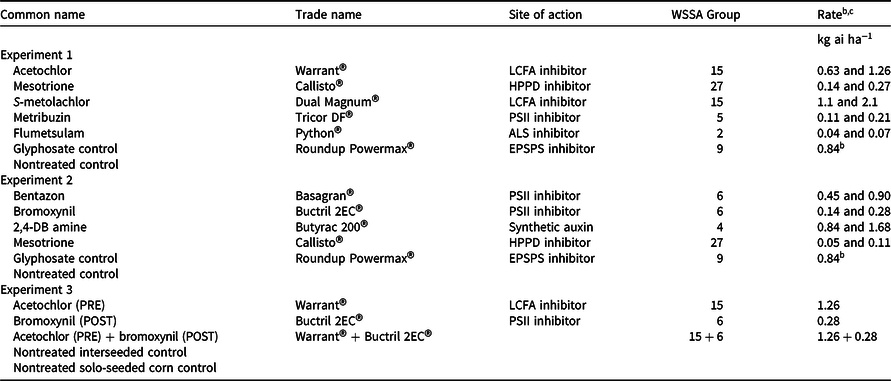
Three experiments were conducted over a period of 2 yr in southern Wisconsin. The objective of Experiment 1 was to determine the efficacy and selectivity relative to glyphosate of five herbicides applied PRE at full or reduced labeled rates. The full rate was considered the maximum rate recommended by the label for both corn and alfalfa (Table 1). Experiment 2 compared the performance, also relative to glyphosate, of four herbicides applied POST at two times (early vs. late) at full or reduced labeled rates (Table 1). In Experiment 3, we selected one top-performing herbicide from Experiments 1 and 2 and compared their performance when applied alone or in combination (Table 1). Experiment 3 also assessed the inherent weed suppression potential of interseeded alfalfa by inclusion of a solo-seeded corn control treatment, which did not receive any herbicide application.
Details of herbicide treatments and controls examined in Experiment 1, Experiment 2, and Experiment 3. a

a Abbreviations: ALS, acetolactate; EPSPS, 5-enolpyruvylshikimate-3-phosphate synthase; HPPD, 4-hydroxyphenylpyruvate dioxygenase; LCFA, long-chain fatty acid; PSII, photosystem II; WSSA, Weed Science Society of America.
b Glyphosate rate is on an acid equivalent basis and acetochlor formulation was microencapsulated.
c Full and reduced labeled rates of each product were compared in Experiments 1 and 2, except for the glyphosate control, which was a full labeled rate.
Research Sites
Each experiment was conducted at two locations. Experiments 1 and 2 were both established in 2015 at the University of Wisconsin’s Arlington Agricultural Research Station (AARS; 43.18°N, 89.20°W) on a Plano silt loam soil (pH 6.5, 3.5% soil organic matter) and the U.S. Dairy Forage Research Center research farm in Prairie du Sac (PDS; 43.21°N, 89.45°W) on a Richwood silt loam soil (pH 6.8, 3.5% soil organic matter). Experiment 3 was established in 2016 at AARS on a Plano silt loam soil (pH 6.8, 3.4% soil organic matter) and the Lancaster Agricultural Research Station (LARS; 42.49°N, 90.54°W) on a Fayette silt loam soil (pH 7.1, 2.2% soil organic matter). The weed communities in these experiments were generally composed of species common to midwestern annual cropping systems. At AARS the primary weed species were common lambsquarters (Chenopodium album L.), common ragweed (Ambrosia artemisiifolia L.), dandelion (Taraxacum officinale L.), pigweeds (a mix of redroot pigweed [Amaranthus retroflexus L.] and smooth pigweed [Amaranthus hybridus L.]), large crabgrass [Digitaria sanguinalis (L.) Scop.], and foxtails (a mix of yellow foxtail [Setaria pumila (Poir.) Roem. & Schult.] and Japanese bristlegrass [Setaria faberi Herrm.]). At PDS common lambsquarters and large crabgrass were the most common species. Finally, at LARS the community was primarily composed of seedling dandelions, common lambsquarters, pigweeds (a mix of redroot pigweed and waterhemp [Amaranthus tuberculatus (Moq.) J. D. Sauer]), prostrate knotweed (Polygonum aviculare L.), and yellow foxtail. At all sites there were no perennial weeds, and broadleaves were more abundant than grasses.
Corn and Alfalfa Agronomic Management Practices
For all experiments a 105-d maturity glyphosate-resistant dual-purpose corn hybrid (HiDF-3105RA, Dairyland Seed Inc., West Bend, WI) was planted with a no-till planter (John Deere 1750 MaxEmerge® Plus, Moline, IL) at 86,500 seeds ha−1, at a depth of 4.4 cm, and row spacing of 76 cm with rows oriented in a North-South direction. Planting for Experiments 1 and 2 occurred on May 4 and May 20, 2015, at PDS and AARS, respectively; and planting for Experiment 3 occurred on May 8 and May 19, 2016, at AARS and LARS, respectively. On the same day as corn planting, four rows of alfalfa spaced 16.5 cm apart were planted into corn interrow areas using a no-till drill (TYE Pasture Pleaser), at a seeding rate of 18 kg live seed ha−1, and a planting depth of 1.3 cm. Experiments 1 and 2 used the glyphosate-resistant alfalfa variety WL359LH.RR (Forage Genetics, Nampa, ID) while Experiment 3 used a conventional alfalfa variety Pioneer 55H94 (Pioneer, Johnston, IA) previously found to achieve good establishment in the interseeded system (Grabber Reference Grabber2016). Nitrogen fertilizer (180 kg N ha−1 in Experiments 1 and 2, 224 kg N ha−1 in Experiment 3) was split-applied, with 40% applied as urea ammonium nitrate at planting and 60% side-dressed as a band of urea along the corn row at the V5 corn growth stage. Applications of phosphorus and potassium fertilizer were made prior to planting, with rates determined by autumn soil tests and University of Wisconsin-Extension recommendations for corn silage production and alfalfa establishment (36, 134, 139, and 180 kg P2O5 ha−1 and 290, 569, 401, and 530 kgK2O ha−1 at PDS 2015, AARS 2015, AARS 2016, and LARS 2016, respectively; Laboski and Peters Reference Laboski and Peters2012). Glyphosate was broadcasted at 1.12 kg ae ha−1 on the entire field either the previous autumn or spring prior to planting to control perennial and winter annual weeds, primarily dandelion. Applications eliminated winter annuals and existing perennial weeds species from the plant community from each site during the first year of interseeding.
The plant growth regulator prohexadione (calcium salt of 3,5-dioxo-4 propionylcyclohexanecarboxylic acid) was applied to interseeded alfalfa at a rate of 0.5 kg ai ha−1 when alfalfa reached ~20 cm in height, which occurred 4.6 to 6.9 wk after planting, and included the adjuvants ammonium sulfate (10 g L−1), crop oil concentrate (12.5 mL L−1), and citric acid (5 g L−1; Osterholz et al. Reference Osterholz, Renz and Grabber2018b). Prohexadione is a gibberellin inhibitor that suppresses stem elongation and has been shown to improve interseeded alfalfa establishment when applied to 10- to 30-cm-tall alfalfa seedlings (Grabber Reference Grabber2016; Osterholz et al. Reference Osterholz, Renz, Lauer and Grabber2018a). Prohexadione rate and application timing were chosen based on previous studies conducted in Wisconsin (Grabber Reference Grabber2016; Osterholz et al. Reference Osterholz, Renz, Lauer and Grabber2018a). Applications were made on June 21, 2015, at AARS and PDS in Experiments 1 and 2, and on June 12 and 16, 2016, at AARS and LARS, respectively, in Experiment 3. A CO2-pressurized backpack sprayer calibrated to deliver 187 L ha−1 and equipped with drop nozzles was used in order to minimize contact of the plant growth regulator with corn plants. Corn silage was harvested by plot harvester in mid-September at all sites when whole plant moisture content reached 60% to 65%, with no wheel traffic applied to the experimental interrow area. In Experiment 1, second-year alfalfa was harvested four times in 2016 at the late bud to early bloom stages.
Treatment and Application Information
The selected PRE and POST herbicides had a current, pending, or previous registration for both corn production and alfalfa establishment. Experiment 1 treatments consisted of five PRE herbicides (acetochlor [encapsulated formulation], mesotrione, S-metolachlor, metribuzin, and flumetsulam) applied at full and reduced labeled rates, which were compared to POST-applied glyphosate applied at a rate of 0.84 kg ae ha−1 (Table 1). Experiment 2 treatments included four POST herbicides (bentazon, bromoxynil, 2,4-DB, and mesotrione) applied at two timings (early vs. late) at full and reduced labeled rates, which were also compared to a glyphosate treatment applied either early or late (Table 1). Experiment 3 treatments consisted of PRE-applied acetochlor at 1.26 kg ha−1, POST-applied bromoxynil at 0.28 kg ha−1, and a split application of acetochlor at 1.26 kg ha−1 PRE followed by bromoxynil at 0.28 kg ha−1 POST (Table 1). Nontreated (i.e., no herbicide) interseeded controls were also included in all experiments for treatment comparison. Additionally, a nontreated corn control without interseeded alfalfa was included in Experiment 3 to assess the weed suppression potential of adding interseeded alfalfa to corn (Table 1). PRE herbicides were applied within a week after corn and alfalfa planting (Experiments 1 and 3). In Experiment 2, early POST herbicides were applied approximately 4 wk after planting when weeds were 2 to 7 cm tall. Late POST applications were performed 8 to 12 wk after planting when weeds were 10 to 15 cm tall. Herbicide application timings in Experiment 3 were performed as described for Experiment 1 (PRE treatments) and Experiment 2 (late POST treatments). The POST application of glyphosate (glyphosate control treatment) in Experiment 1 was performed at the early POST timing similar to Experiment 2, approximately 4 wk after planting. A CO2-pressurized backpack boom sprayer equipped with eight Teejet-11002 flat-fan nozzles (Teejet, Glendale Heights, IL) on a 3.0-m boom calibrated to deliver 187 L ha−1 at 4.8 km h−1 was used to apply all herbicide treatments.
Experimental Design and Response Variables
Experiments were arranged as randomized complete block designs at all sites, with four replications in Experiments 1 and 3, and six replications in Experiment 2. Plot length was 7.6 m in all experiments, plot width was four corn rows (3.0 m) in Experiments 1 and 3, and two corn rows (1.5 m) in Experiment 2. Assessments of treatment effects were performed within the middle corn interrow of each plot with the exception of crop yield in Experiment 1. Weed control and crop tolerance were evaluated qualitatively in all experiments by visually estimating weed ground cover and alfalfa injury. A healthy alfalfa stand was assigned 0 injury, and the percent of leaves and stems exhibiting herbicide damage was estimated. For assessments 2 WAT the damage included chlorosis, stunting, and leaf curling, whereas damage assessments at 4 and 8 WAT was necrosis. The percent of living weed cover was classified as either broadleaf or grass and was also visually estimated on a scale of 0 (no weeds) to 100. In Experiment 1, alfalfa injury and weed cover were assessed 4 and 8 WAT. In Experiment 2, alfalfa injury was assessed 2 and 4 WAT, although weed cover was evaluated at 4 WAT only. In addition, alfalfa ground cover (%) was recorded in the spring of following year, approximately 1 yr after treatment. In Experiment 3, alfalfa and weed ground cover (%) were evaluated at 2 and 4 WAT (after herbicide applications made POST). Treatment effects on corn and alfalfa yield were also evaluated in Experiment 1. Corn silage yield was measured at harvest by chopping and weighing the interior two corn rows of each plot with a plot-scale forage harvester (Hege model 212 equipped with Kemper chopper head). Alfalfa yield in the year following interseeding was measured from the center 1.5-m-wide swath of each plot with a plot-scale forage harvester (Hege model 212 equipped with forage head) set to a cutting height of 5 cm. Moisture content of the harvested material was assessed by drying a subsample at 60°C for at least 2 wk, and all yields are reported on a dry matter basis. Alfalfa stand density (crowns per square meter) was estimated in Experiment 1 in September of the second year following the fourth alfalfa harvest (18 mo after treatment [MAT]). Alfalfa plants in an area of 0.3 × 0.8 m were undercut with a U-bar to sever roots at a depth of ~15 cm. Plants were then removed, and crowns were manually counted.
Statistical Analysis
Data were subjected to mixed-model analyses by running PROC GLIMMIX in SAS 9.3 (SAS Institute, Cary NC). In Experiments 1 and 3 the herbicide treatment was considered a fixed effect, and location and block within location were considered random effects. In Experiment 2 the herbicide treatment, application timing, and their interaction was considered fixed effects, whereas location and block within location were considered random effects. Weed cover data were analyzed after natural log transformation; however, nontransformed means were presented for ease of interpretation. All other data were analyzed assuming normal distributions. Residuals were examined to ensure acceptable distributions and homogeneity of variance. Treatments and their interactions were considered different when F-test values were P < 0.05. Individual treatment least squares means were separated at the 5% level of significance using the Tukey-Kramer test.
Results and Discussion
Growing season temperatures and precipitation were generally favorable for crop establishment and production at all sites in the three experiments. In 2015, total precipitation from April to October was 737 mm at AARS and 452 mm at PDS, which corresponds to 14% above and 32% below the 30-yr average for the same period at each location, respectively (data not shown). Dry conditions were present in early summer at AARS and late summer at PDS, but cooler than average temperatures likely limited effects of moisture stress on crop growth. In 2016, precipitation was abundant and frequent during the growing season (April through October) at both AARS (713 mm total) and LARS (862 mm total), which corresponds to 11% and 24% above the 30-yr average for the same period at each location, respectively.
Weed Control
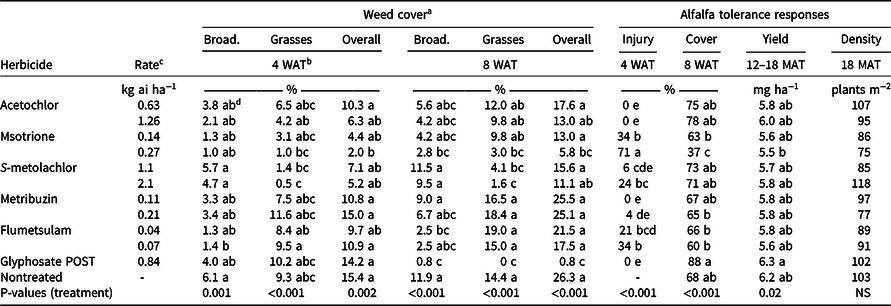
Weed cover ranged between 1% and 26% among herbicide treatments in Experiment 1 at 4 and 8 WAT (Table 2). At 4 WAT, prior to the glyphosate application POST, only the full rate of mesotrione (2% cover) resulted in lower overall weed cover compared with that in the nontreated control (15% cover). At 8 WAT, only glyphosate (1% cover) and mesotrione at 0.27 kg ha−1 (6% cover) resulted in lower overall weed cover compared with that in the nontreated plots (26% cover). Broadleaf weed cover was similar in all treatments 4 WAT with the exception of flumetsulam, but by 8 WAT metribuzin (0.21 kg ha−1), flumetsulam, mesotrione, and acetochlor all provided similar results to those of glyphosate (Table 2). Grass weed cover among treatments did not differ from that of the nontreated control 4 WAT, but by 8 WAT only the full label rates of S-metolachlor and mesotrione provided similar control to glyphosate POST.
Visual injury to interseeded alfalfa, weed, and alfalfa cover in Experiment 1 with herbicides applied PRE, and effects on crop yields and alfalfa stand density following a year of alfalfa harvests. a,b

a Field experiments were initiated in 2015 at Arlington Agricultural Research Station and Prairie Du Sac, WI.aWeed cover data were found to be non-normal and were log-transformed prior to analysis; original untransformed treatment means are shown.
b Abbreviations: Broad, broadleaf weeds; WAT, weeks after treatment; MAT, months after treatment.
c Acetochlor formulation was microencapsulated, and glyphosate rate is on an acid equivalent basis.
d Different lowercase letters within a column indicate differences in treatment least squares means (P < 0.05, Tukey-Kramer method for multiple comparison).
Although residual herbicide efficacy and selectivity is driven by a variety of factors (Prata et al. Reference Prata, Tornisielo, Cardinali and Regitano2003), our results are in agreement with those reported in several other published studies on corn or alfalfa production. For example, Soltani et al. (Reference Soltani, Brown and Sikkema2019) found that when used with corn, S-metolachlor at 1.05 kg ha−1 provided excellent control (>90%) of redroot pigweed and green foxtail, intermediate control (65%) of common lambsquarters, and poor control (12%) of common ragweed. Likewise, metribuzin at 0.21, 0.31, or 0.42 kg ha−1 was reported to provide at least 80% control of Amaranthus spp. when there was sufficient rainfall for herbicide activation (Smith et al. Reference Smith, Soltani, Kaastra, Hooker, Robinson and Sikkema2019). When used with alfalfa, flumetsulam at 0.03 kg ha−1 provided effective control of annual broadleaf weeds (burning nettle [Urtica urens L.], spiny cocklebur [Xanthium spinosum L.], and common lambsquarters; Arregui et al. Reference Arregui, Sanchez and Scotta2001) while metribuzin at 0.56 or 0.84 kg ha−1 provided at least 95% control of shepherd’s purse (Capsella bursa-pastoris L. Medik.; Wilson and Orloff Reference Wilson and Orloff2008). Although weed cover was moderate to low in our studies, these results suggest that flumetsulam, mesotrione, and acetochlor applied PRE have the potential to provide similar efficacy as glyphosate POST in corn-alfalfa interseeded systems.
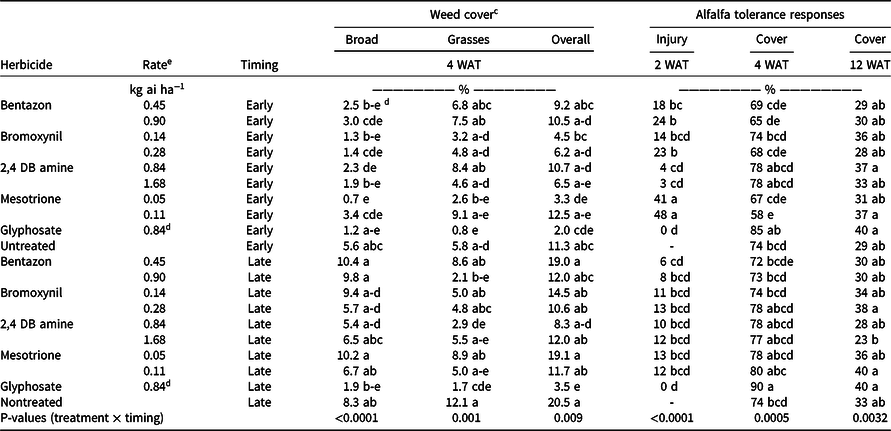
In Experiment 2 we compared the efficacy and alfalfa tolerance of four POST herbicides applied at two different timings (early [4 wk after planting] vs. late [ 8–12 wk after planting]). An application timing by herbicide treatment interaction was detected for all weed cover classes 4 WAT, thus, results from the interaction are compared (Table 3). Even though the lowest overall weed cover for early POST treatments occurred with glyphosate (2% cover), it was not statistically lower than that of other herbicide treatments or the nontreated control 4 WAT (3% to 13% cover). Similarly, all early treatments reduced broadleaf weed cover to the same extent as glyphosate 4 WAT; however, only mesotrione (both rates) provided the equivalent degree of grass weed cover reduction as glyphosate did. For the late POST treatments, many treatments were less effective than those applied earlier, but the response was specific to broadleaf (bentazon, mesotrione) and grass weeds (2,4-DB reduced rate). None of the herbicides applied at the late timing were as effective at reducing total weed cover as glyphosate (4%). However, several treatments applied at this timing exhibited similar broadleaf and grass weed cover to that of glyphosate. These results are congruent with those of previous studies in which POST applications of several nonglyphosate herbicides provided similar weed control as glyphosate when applied to new alfalfa seedings (Bradley et al. Reference Bradley, Kallenbach and Roberts2010; Dillehay and Curran Reference Dillehay and Curran2010).
Results from Experiment 2 examining effects of two rates and two application times of post-emergence herbicides on alfalfa injury, weed cover, and alfalfa cover. a,b

a Field experiments were initiated in 2015 at Arlington Agricultural Research Station and Prairie Du Sac, WI.
b Abbreviations; Broad, broadleaf weeds; WAT, weeks after treatment; MAT, months after treatment.
c Weed cover data were found to be non-normal and were log-transformed prior to analysis; original untransformed treatment means are shown.
d Different lowercase letters within application timings and columns indicate differences in treatment least squares means (P < 0.05, Tukey-Kramer method for multiple comparison).
e Glyphosate rate is on an acid equivalent basis.
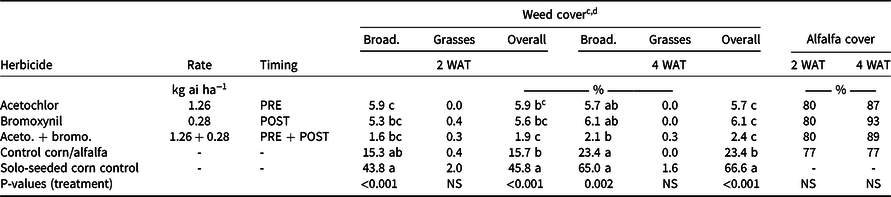
In Experiment 3, acetochlor applied as a PRE treatment and bromoxynil applied as an early POST treatment were selected for further assessments alone and in combination based on their performances in Experiments 1 and 2. Only the combination of acetochlor and bromoxynil reduced weed cover 2 wk after the POST application compared with weed cover in the nontreated control (Table 4). However, by 4 wk after POST, all herbicide treatments resulted in an overall weed cover that was nearly four times lower than those of the nontreated controls. Although the sequential application of acetochlor followed by bromoxynil did not result in lower weed cover beyond either herbicide treatment applied alone, the multiple sites of action and application timings may provide more consistent control under diverse and variable weed populations and challenging weather conditions. Diversification of weed management practices and the use of multiple sites of action are two key strategies to decrease selection pressure and delay potential issues with herbicide-resistant weeds (Norsworthy et al. Reference Norsworthy, Ward, Shaw, Llewellyn, Nichols, Webster, Bradley, Frisvold, Powles, Burgos, Witt and Barrett2012). Previous research on newly seeded alfalfa agree with this approach because a combination of multiple herbicides such as imazamox or imazethapyr plus bromoxynil or 2,4-DB applied POST consistently achieved similar levels of weed control as glyphosate (Wilson and Burgener Reference Wilson and Burgener2009).
Weed and alfalfa cover in alfalfa interseeded into corn from Experiment 3 that examined the effects of acetochlor pre-emergence, bromoxynil post-emergence, or a combination of the two herbicides. a,b

a Abbreviations; Broad, broadleaf weeds; WAT, weeks after the post-emergence application of bromoxynil; Aceto., acetochlor; Bromo., bromoxynil.
b Field experiments were conducted in 2016 at Arlington and Lancaster Agricultural Research Stations, WI.
c Different lowercase letters within a column indicate differences in treatment least squares means (P<0.05, Tukey-Kramer method for multiple comparison).
d Weed cover data were found to be non-normal and were log-transformed prior to analysis; original untransformed treatment means are shown.
Crop Tolerance
Visual symptoms of injury on alfalfa varied among herbicide treatments at 4 and 8 WAT (Table 2). The predominant symptoms observed were reduced growth (stunting), malformed new leaves, necrosis, and chlorosis. Mesotrione was the most injurious treatment because alfalfa injury 4 WAT was between 34% and 74% depending on the rate applied. Additionally, both rates of flumetsulam and the full rate of S-metalochlor also resulted in significant alfalfa injury (21% to 34%). All other treatments had injury levels equivalent to that of glyphosate applied POST. Compared to glyphosate applied POST (88%), reductions in alfalfa cover 8 WAT were observed with all treatments except acetochlor, S-metolachlor, and the low rate of metribuzin.
Herbicide selectivity has been previously investigated in monoculture alfalfa cropping systems and in other interseeded systems, with results similar to those reported here. Established alfalfa fields displayed visual symptoms of injury after PRE application of flumetsulam at 0.03 kg ha−1 (Arregi et al. Reference Arregui, Sanchez and Scotta2001). Similarly, flumetsulam at 0.12 kg ha−1 and S-metolachlor (rates above 1.92 kg ha−1) applied PRE caused phytotoxicity to alfalfa 12 WAT (Silva et al. Reference Silva, Vilela, Ferreira, Pereira and Cobucci2002). Metribuzin applied in late fall or winter did not result in alfalfa injury in the Western United States (Wilson et al. Reference Wilson1997), but this research was conducted on established alfalfa fields and it is unclear whether the same tolerance would exist in newly seeded alfalfa. Similarly, S-metalochlor has been labeled for use on established alfalfa grown for seed in select areas in the United States (e.g., Idaho); however, the label emphasizes the possibility of crop injury if environmental conditions are unfavorable (Idaho Department of Agriculture 2020). Encapsulated acetochlor is labeled for use on seedling alfalfa in the United States (Anonymous 2020a), although not until alfalfa emerges. This suggests that alfalfa phytotoxicity may occur in some years, even though we did not observe any symptoms. Although we found no previous studies on alfalfa tolerance to mesotrione, research on its use on red clover showed reduced biomass (80%) compared to the nontreated control (Wallace et al. Reference Wallace, Curran, Mirsky and Ryan2017).
In Experiment 2, significant herbicide treatment by application timing interactions were detected for alfalfa injury and alfalfa cover (Table 3). Alfalfa injury symptoms 2 WAT included chlorosis and necrosis. When herbicides were applied early POST, alfalfa injury was greatest (>40%) when mesotrione was used, with lower levels of injury observed when both rates of bentazon (18% and 24%) and bromoxynil (14% and 23%) were used, but 2,4-DB application did not result in any visible injury. Injury from the late-POST applications was highly variable (0% to 13%) and did not result in significant differences among herbicide treatments. Although most herbicides applied early POST resulted in lower alfalfa cover (58% to 69%) compared to that when glyphosate was used (85%) 4 WAT, no differences existed 12 mo after treatment application (MAT). Late POST applications of mesotrione (78% to 80%) and 2,4-DB amine (77% to 78%), and the full rate of bromoxynil (78%) resulted in reduced alfalfa cover 4 WAT compared to that (90%) when glyphosate was used. By 12 MAT similar alfalfa cover was observed after all treatments except the full rate of 2,4-DB. Although established alfalfa stands are considered tolerant to POST applications of 2,4-DB, the higher rate used in a competitive environment (interseeded with corn) in combination with the late timing may have caused the observed reduction in alfalfa cover. The recommended time at which 2,4-DB should be applied to establishing alfalfa is at the one- to four-trifoliate leaf stage (Anonymous 2020b), and in this study it was applied well beyond the fourth trifoliate leaf stage (8 to 12 wk after planting). Negative impacts on alfalfa due to the combined effects of stress of a companion crop plus 2,4-DB applications have been previously reported (Moyer et al. Reference Moyer, Cole, Maurice and Darwent1995).
In Experiment 3, acetochlor applied PRE or bromoxynil applied POST alone or sequentially resulted in similar alfalfa cover 2 and 4 WAT compared with alfalfa cover in the nontreated control (Table 4). This lack of reduction in alfalfa cover was similar to that in Experiments 1 and 2 for these herbicide treatments and provides further evidence for the level of crop safety in this interseeded system.
Despite the differences in alfalfa injury and cover, most herbicide treatments in Experiment 1 provided similar alfalfa yield the year following seeding compared to the yield after glyphosate treatment (6.3 mg ha−1; Table 2). The only exception occurred when the full rate of mesotrione was used, which resulted in a 13% reduction in alfalfa yield. This suggests that alfalfa can tolerate substantial injury because treatments with 30% to 35% injury 4 WAT resulted in no differences in yield the following year. Furthermore, the difference in yield would not be expected to persist into the following years because alfalfa plant density 18 MAT did not differ among treatments (P > 0.05; Table 2) and was above acceptable thresholds for productive alfalfa stands (Kephart et al. Reference Kephart, Twidwell, Bortnem and Boe1992). Results from Experiment 1 also suggest that weed control does not influence second-year alfalfa yield or stand persistence in an alfalfa-silage corn interseeded system. Other authors have found similar results in solo-seeded alfalfa in which weed control did not result in alfalfa stand density or yield benefits in subsequent years of alfalfa stands (Glaspie et al. Reference Glaspie, McCordick, Dietz, Kells, Leep and Everman2011; Moyer Reference Moyer1992). Results might have differed, however, if weed populations had been greater, because both locations had low to moderate weed cover (maximum of 26%) and moderately competitive annual weed species. Alternatively, the application of prohexadione-calcium to interseeded alfalfa may have reduced weed shoot growth and, consequentially, competitiveness. This hypothesis was not evaluated in this research because all alfalfa was treated with prohexadione-calcium to ensure its success as an interseeded alfalfa (Grabber Reference Grabber2016; Osterholz et al. Reference Osterholz, Renz, Lauer and Grabber2018a), but future studies to understand the effects of prohexadione-calcium on weed competitiveness is warranted.
Although corn silage yield was measured only in Experiment 1, no significant effects of herbicide treatments were detected among treatments (averaged 20.8 mg ha−1 across all treatments; data not shown). The lack of corn yield response to herbicide treatments may have been due to suppression of weeds by the interseeded alfalfa. Interseeded cover crops have been shown to enhance weed suppression, however, they can reduce yields of the main crop (Schipanski et al. Reference Schipanski, Barbercheck, Douglas, Finney, Haider, Kaye, Kemanian, Mortensen, Ryan, Tooker and White2014). Grabber (Reference Grabber2016) and Osterholz et al. (Reference Osterholz, Renz, Lauer and Grabber2018a) reported that silage corn yields declined up to 10% when alfalfa was interseeded compared to yields when corn was grown without alfalfa. The reasons for the lack of corn yield reduction in this research are not known but may be related to available nitrogen and/or ample precipitation the year the experiments were conducted.
Interseeded Alfalfa Weed Suppression
Weed suppression by interseeded alfalfa was observed in Experiment 3 as the nontreated, interseeded control contained 65% and 70% less weed cover than the nontreated solo-seeded corn control 2 and 4 WAT, respectively (Table 4). Thus, alfalfa interseeded with corn provided valuable weed control benefits, and may be the reason for the low to moderate weed populations we observed in Experiments 1 and 2. Other researchers (Abdin et al. Reference Abdin, Zhou, Cloutier, Coulman, Faris and Smith2000) have attributed significant weed control benefits from interseeding cover crops into corn. Youngerman et al. (Reference Youngerman, DiTommaso, Curran, Mirsky and Ryan2018) reported that weed biomass was on average 31% lower in corn grown with interseeded cover crops compared to solo-seeded corn. Several other studies have also highlighted a positive correlation between weed suppression and cover crop biomass production (Bybee-Finley et al. Reference Bybee-Finley, Mirsky and Ryan2017; De Haan et al. Reference De Haan, Wyse, Ehlke, Maxwell and Putnam1993; Finney et al. Reference Finney, White and Kaye2016). The impacts of interseeded species on crop yield also needs to be considered because interseeded cover crops have been shown to reduce yields of the main crop (Schipanski et al. Reference Schipanski, Barbercheck, Douglas, Finney, Haider, Kaye, Kemanian, Mortensen, Ryan, Tooker and White2014). This has been observed in that silage corn yield declines of up to 10% have been documented (Grabber Reference Grabber2016; Osterholz et al. Reference Osterholz, Renz, Lauer and Grabber2018a). Further research under different management, weed communities, weed infestations, and environments is warranted to better understand the potential weed suppression benefits of interseeded alfalfa with silage corn production and how it affects corn yield.
In summary, this study provided insight into weed management options for the corn-alfalfa interseeded system with emphasis on alternatives to glyphosate applied POST. Results from this research identified multiple herbicides when used PRE and POST that exhibited good crop safety and provided effective control of common annual weed species. Herbicides that provided total weed cover similar to that of a POST glyphosate treatment and also resulted in limited crop injury included early applications of bromoxynil (0.14 or 0.42 kg ha−1) and 2,4-DB (0.84 or 0.68 kg ka−1). None of the herbicides applied PRE provided equivalent control and crop selectivity compared to that of glyphosate, but acetochlor (0.63 or 1.26 kg ha−1) demonstrated good crop selectivity and high alfalfa cover 8 MAT. One deficiency with these treatments may be annual grasses, because their cover at 4 WAT (Experiment 2) and 8 WAT (Experiment 1) was higher than when glyphosate was applied early POST. Although these results indicate promise for weed control in this novel system, additional research is needed to document the robustness of these herbicides in different environments and weed communities.
Acknowledgments
Funding for this research was in part provided through USDA–Agricultural Research Service agreements 58-3655-1-754 and 58-5090-6-060. Mention of trade names or commercial products does not imply recommendation or endorsement by the USDA. USDA is an equal opportunity provider and employer. We thank Christopher Bloomingdale, Stacy Marion, and Matt Volenec for their technical support, as well as a large team of undergraduate students who assisted in data collection. No conflicts of interest have been declared.