REPRESENTATIONAL HANGOVERS AND SEMIOTIC COLLAPSE IN THE SIERRA MAZATECA
My first day in Mexico's Sierra Mazateca, in the spring of 2000, I visited a shaman.Footnote 1 It happened by accident. I wanted to steer clear of shamans to avoid positioning myself as yet another “mushroom-seeker,” the most recognizable yet ambivalent category of outsiders visiting the Sierra. In Mexico and beyond, the region is best known as the “land of the magic mushrooms” and the home of shamans who use them in curing rituals, like the internationally renowned María Sabina. An ethnographic and popular literature spanning nearly a century has depicted the region through its hallucinogenic plants. Since the 1960s, these texts have circulated alongside and crucially shaped international consumer interest in the psychedelic mushrooms that grow there. More recently, this interest has expanded to include a variety of mint found there and nowhere else: Salvia divinorum, widely known outside the region as “salvia” and in Mazatec as xka4 pastora (“leaves of the shepherdess”).
Thus on my first day in the Sierra, when people asked me ¿No quiere hongos? (“Want some mushrooms?”), I self-righteously declined. I insisted I was not there for the mushrooms to everyone who asked: the bus driver who delivered me, the young men loafing outside the bus station, the old woman in the street carrying a basket of mushrooms on her arm, the hotel's desk clerk. I asserted that I was there looking to interview authors writing in Mazatec, the indigenous language of the area. My search took me to Chilchotla, a small town known regionally for its songwriters, and soon after arriving I met one of the most prominent, Heriberto Prado Pereda.
That first day, Prado and I sat in the blazing sun on a rock wall by his store, talking about the possibilities and challenges posed by writing songs in tonal languages like Mazatec. Later his wife invited me to stay with them, but it was too late in the day to find a ride back to my hotel in Huautla. An hour away by pickup truck, Huautla is the Sierra's one big town and also the center of “the mushroom trade.” So I wound up accompanying the family on a mandado (“errand”), which turned out to involve visiting a sabio—a “wise person” or shaman (in Mazatec, cho4ta4chji4ne4, “person of knowledge”).Footnote 2 Construction on the family's house had stalled, and they had contracted a shaman to help them make amends to the resident chi3kon3— “earth spirit” or “spirit lord”—whom they believed they had somehow offended.
During the ceremony, the chota chjine said numerous prayers in Mazatec; he blessed some cacao seeds, macaw feathers, and copal incense, and inserted them into bundles of amate (bark paper) that the family later buried outside their house's four corners. The ritual lasted a couple of hours, but one revealing moment came at its close. The sabio performed a limpia (ritual cleaning) on each of us—Prado and his wife, their two boys, and finally me. Once finished, he turned to me and, shifting into Spanish, said he would be happy to do a velada or mushroom ceremony with me if I wanted to come back for the cositas (“little things”), a literal translation of the Mazatec expression ndi1 tso3jmi2, which is widely used to denote hallucinogenic mushrooms.
This episode crystallizes and refracts momentous transformations taking place in the Sierra over recent decades, changes about which local people often disagree, and that inform the work of Mazatec authors. The chota chjine's manner of addressing me—openly, as a potential client—is now common when interacting with outsiders, and I regularly receive similar invitations, especially from people I do not know. But while the region's hallucinogenic plants and shamanistic services are now routinely enmeshed in cash exchanges, some sharply condemn their commodification, making it a subject of ongoing debate.
After we left the shaman's house, Prado told me I should not go back because that shaman would charge me lots of money. “Real sabios don't act like that,” he said. “If you have a treasure, do you put it right in your doorway so everyone can see it?” Several months later, when I was living in Chilchotla, others expressed similar views. I once mentioned to a friend that on my trips to Huautla people tried to sell me mushrooms. “You mean, they just walk around selling them in the street?” she asked. ¡Ska-le! [That's crazy!]. Treating sacred things like they were plastic buckets!”
Such encounters were not always so prevalent. They stem from mid-twentieth-century historical events during which two very different groups of outsiders “discovered” the mushrooms. Both groups became novel loci of global connection, and their writings made them powerful sources of representations about the region. One group was mushroom-seeking outsiders: at first anthropologists and ethnobotanists and later crowds of hippies. Otherwise disparate, they were united in seeking the mushrooms and the ceremonies they were used in. These outsiders' interest kicked off the commodification of both the mushrooms and veladas, inserting them for the first time into cash exchanges detached from local relations. To quote the title of a Mazatec author's nostalgic book about the era, that “age of the hippies” has passed (Estrada Reference Estrada1996), but the resulting literature continues to affect Sierra residents, most tangibly through the ongoing influx of mushroom tourists, or what I call “mycotourists” (from myco, “mushroom”). Hailing from urban Mexico, the United States, and Europe, their interest in the mushrooms and “authentic” Mazatec rituals is sparked by outsiders' writings, including the foundational texts I will discuss.
The second group of outsiders was smaller and less publicized: Protestant missionary-linguists whose interest in the mushrooms and veladas was oppositional. They aimed to replace the mushrooms and the rituals with Mazatec-language Bibles and the literacy skills to read them. Though the impact of their textual representations is less visible today, they also made distinct contributions to the history of depictions of the region, which likewise turned on linking local people to the region's hallucinogenic plants.
Combined, these interpretations of the region have created what I call a “representational hangover.” The continuing circulation of a vast body of texts about the region written by outsiders poses distinct challenges for locals. I will explicate those challenges by examining how people of the Mazatec region are affected not only by global markets in the Sierra's hallucinogens, but also by the representational histories that accompany those markets. I claim that theorizing global connection—particularly by studying global markets—requires attention to the circulatory paths not only of commodities but also of semiotic representations about them. This includes representations that circulate as texts and whose attendant ideologies shape both semiotic and material circulation. My discussion will examine competing textual representations of the region, then trace their present legacies for Mazatec authors, like Prado, who offer their own depictions of the region and its people.
My analysis also stresses conceptual questions raised by this case. A critical focus is the role that semiotic ideologies, including textual ideologies, play in theories of global connection. I argue that understanding global relations, particularly those structured by transnational markets, requires attending not only to histories of trade but also to histories of semiotic representation that accompany and structure the circulation of goods and services. Semiotic mediation is necessary for things to become valuable: to become objects, in Keane's terms (Reference Keane2003). Moreover, semiotic representations can themselves become material, circulating through networks of exchange much like commodities. At the center of this case is a specific form of semiotic materiality: textuality, wherein linguistic and other signs become solidified into enduring, decontextualizable objects. Analyzing the dynamics of global connection requires addressing not only how objects circulate alongside the texts that give them meaning, but also how textual ideologies are implicated in the circulation of both texts and objects. These processes, in turn, are implicated in how social groups like “Mazatecs” are delimited, because “the processes by which things become objects … are the same processes that configure the borders and the possibilities of subjects” (ibid.: 423).
Understanding the nature of the region's “representational hangover,” and how its residents have crafted their own representations in response, requires examining how both are animated by distinctive textual ideologies. A key site where differences between these textual ideologies become visible concerns how different authors engage with veladas and the sacred local plants at their center. I will discuss veladas presently, but for now highlight how their connections to local textual ideologies have contributed to “friction” (Tsing Reference Tsing2005) between competing representations of the Mazatec region and its people.
In this region, veladas are key venues for ethnic socialization. Echoing Kroskrity's (Reference Kroskrity and Duranti2009) discussion of the socializing role of Tewa kiva speech, veladas are events where ethnically inflected practices and ideologies are transmitted through ritual speech. This process hinges on the circulation of sacred texts imparted when participants ritually contact unseen deities. By “texts” I mean relatively stable, structured, decontextualizable complexes of signs (Silverstein and Urban Reference Silverstein and Urban1996); they are relatively object-like even when not inscribed in material objects like books. Indeed, many shamans represent the oral knowledge imparted in veladas through the trope of “the book,” referring to their xo4n kjua4chji4ne4 (“book of wisdom”) or xo4n kjua4ki4xi4 (“book of truth”). During veladas, chota chjine voice the words of divine sources to which hallucinogens provide access. Sometimes the plants themselves are that source, as one woman said to me the day after a velada (about a carpenter she considered hiring): “The mushrooms told me I can't trust him.” Furthermore, many Mazatec authors and composers link veladas to creativity and textuality, claiming the mushrooms have bestowed not just texts for particular songs but the more profound gift of creativity itself. These local textual ideologies bundle mushrooms, veladas, and ethnic identification in ways that are sometimes at odds with outsiders' views. Further, due to the ongoing mycotourist market and emerging salvia trade, the plants and veladas are key sites where these representational differences, and the textual ideologies that activate them, become manifest, and hence where contestations about moral norms become particularly salient.
In the next section, I briefly elaborate on my theoretical framework. I then discuss three distinct representational histories surrounding the Sierra's hallucinogens and people, and show how differences among them stem from divergent textual ideologies, each with distinct implications for “Mazatec subjects,” including Mazatec authors. I begin with the history of the region's “discovery” by mushroom-seeking researchers. I then consider how the subsequent commodification of the mushrooms and veladas complicated their status as paradigmatic signifiers of Mazatec “tradition.” My analysis then turns to a roughly co-occurring history during which Protestant missionaries introduced literacy in Mazatec and accidentally elicited unexpected linkages between Bible reading and shamanic practice.
These historical events and the texts about them have had an enduring impact on people from the region, pressuring them to perform particular representations of indigeneity through reference to the plants. In this “semiotic collapse,” or what Irvine and Gal call “iconization” (Reference Irvine, Gal and Duranti2009), the mushrooms became icons of local people. In Keane's terms (Reference Keane2003), the different semiotic ideologies animating these diverse representations simultaneously create the mushrooms as particular objects and Mazatecs as particular subjects. My final section discusses legacies of this particular coupling of objects and subjects by considering how Mazatec authors have responded to these representational histories. My conclusion returns to this case's wider implications as but one of many in which formerly local “things” have become commodities traded across national and ethnic boundaries, while the people attached to them have been inserted into new regimes of value.
ON THEORIES OF GLOBAL CONNECTION: TEXTUAL IDEOLOGIES AND COMMODITY FETISHISM
Building on Appadurai's seminal volume on materiality (Reference Appadurai1988) and Marcus' call to “follow the thing” (Reference Marcus1995), ethnographic studies of commodity chains have been a leading vehicle for theorizing global connection, producing a vibrant literature on the social life of transnational commodities (e.g., Foster Reference Foster2008; Soto Laveaga Reference Soto Laveaga2009), including related work on the commodification of ethnicity (e.g., Comaroff and Comaroff Reference Comaroff and Comaroff2009). Such research examines not only networks through which things travel but also “zones of awkward engagement” where “global flows” are interrupted by contestation (Tsing Reference Tsing2005). This approach makes “friction” a useful analogy for conceptualizing the multiple meanings attached to the “things” that anchor global connections. In the present case, for example, differences between the textual ideologies of Protestant missionaries and Sierra natives can be read as friction limiting the uptake of literacy. Competing textual ideologies that animate the work of different Mazatec authors can invoke the productive dimensions of friction whereby conflict generates novel representational possibilities.
Yet much of this scholarship is hampered by its failure to take semiotic representation as seriously as it does political economies. The focus on social scale and power relations undergirding global markets often means attending less fully to the relatively intangible stuff circulating through far-flung networks: words, discourses, and other semiotic representations, including texts. Tsing's influential work is a case in point: the semantic associations of the term “friction” import, if unwittingly, the tendency to see global relations in physical terms, as a collision of forces. This risks privileging an agonistic view of such encounters, conceptualizing them as previously constituted forces coming into a new (contentious) relationship. This analytic strategy also implicitly marginalizes the role that semiotic representations play in such encounters. It becomes harder to see global connections as complex, shifting engagements conditioned by dense, historically specific entanglements among material objects, their semiotic representations, and the joint but independent circulation of the two. Finally, the “commodity chain” approach tends to sideline the materiality of discourse itself: its durability and circulatory capacities, its “thingyness.”
The materiality of semiotic representation is especially salient with texts, wherein representations become stabilized, decontextualizable, and available for exchange. Their circulation depends, in turn, on textual ideologies: metapragmatic ideas about texts that encode meanings about them. These include interpretations about what they are, how they are categorized, what purpose they serve, who can and cannot create and use them, and under what circumstances. In this case, Mazatec authors are engaging with the material ramifications of the mushroom and salvia trades; but they are contending also with the history of representations about those markets. This “representational hangover” consists of a range of texts animated by divergent textual ideologies.
My focus on textual ideologies builds on research into the intersection of semiosis and materiality, especially Keane's work on semiotic ideologies. Keane aims to move beyond the divide between words and things, material objects and semiotic representations. He argues that this legacy of entrenched Cartesian dualism is reinscribed in contemporary social theory that draws upon Saussurian semiotics. As antidote, Keane advocates careful attention to the processes by which things become objects, a process mediated by semiotic ideologies “that interpret and rationalize representational economies” (Reference Keane2003: 411).
I build on his work in two ways. First, I focus on textual ideologies as a unique but important subset of semiotic ideologies. Through the ideologies that “interpret and rationalize them,” texts are key sites where language is packaged into durable units, thereby effacing the word/thing boundary. Much linguistic anthropological research explores the socially situated creation of texts, often drawing on Bakhtinian concepts stressing the internal variability, or fundamental heteroglossia, of language as a political and expressive resource (e.g., Bauman Reference Bauman2004; Silverstein Reference Silverstein2005). By viewing the social reality of language as inherently unstable, emergent, and polyvocalic, the construction of stable linguistic units—texts—becomes visible as the product of effort. Texts are created when people draw strategically on linguistic resources, as when they create intertextual connections among texts and the diverse semiotic events of their use. This is related to Bakhtin's “chronotope,” a specific temporal and spatial envelope that, when deployed in texts like those discussed here, positions them alongside others while foregrounding particular connections across space and time. Stressing intertextuality and chronotopic framings exposes how the social effects of texts depend upon their durability, circulatory trajectories, and historical and political interconnections.
When used alongside examination of textual ideologies, these concepts help explain why the foundational “discovery” texts of the region's “magic plants” have had such enduring materiality. Their powerful “thingyness” is reflected in the high economic value often assigned to original versions of these foundational texts (e.g., in rare book markets), and how they are serially reproduced across various media, where mycotourists and others continue to consume them. Their vibrant materiality is also reflected in the exuberance with which living Mazatec authors treat them as sites for critique.
I also expand on Keane's work by building on his insight that understanding semiotic ideologies, and hence textual ideologies, has implications for understanding subjectivity. I show how specific texts and textual ideologies have constructed “Mazatecs” as particular subjects, tying local subjectivity so fundamentally to the region's hallucinogens that they become iconic of a bounded “Mazatec people.” In other words, through these key texts the region's plants have become fetishes, and doubly so. This fetishization proceeds first through the generic magical witchery of capitalist exchange that these texts made possible: once the plants became commodities, they became detachable from the distinct contexts and particular labor relations that made them valuable in the Mazatec region. This process also involved detachments from specific social relations, including the observance of ritual taboos. But the plants are doubly fetishes because they have also become signifiers for an entire group of people—“the Mazatecs.” These dimensions distinguish this case from those traced by the Comaroffs (Reference Comaroff and Comaroff2009), which are marked by neoliberal commodifications of identity. In this case, “ethnicity-as-commodity” was forced upon serranos (Sierra residents), largely through outsiders' accounts of the region.
Of the vast body of research on the fetishization of commodities, I draw primarily on Coronil's work (Reference Coronil1995). He examines Cuban author Fernando Ortíz's work Cuban Counterpoint, involving a “playful masquerade” where tobacco and sugar are treated as people. For Coronil, this accomplishes a “counterfetishism” that “resocializes” the commodities, thereby “illuminating the society that has given rise to them. The relationships concealed through the real appearance of commodities as independent forces become visible once commodities are treated as what they are, social things impersonating autonomous actors” (Reference Coronil1995: xxvi–xxviii). The perspective against which Ortiz's work is positioned is similar to that perpetuated by key historical texts about the Sierra. Namely, fetishistic misrecognition locates the region's attractiveness primarily in its hallucinogenic plants—alternatively casting the region as scientific laboratory, capitalist market, pilgrimage site, or spiritual battlefield—and only secondarily in terms of the people who use them. Furthermore, the impulse animating the view that Ortiz embraces also informs strategies taken by Mazatec authors in countering those representational histories. Like Ortiz, these authors attempt a “counterfetishization” that can “re-socialize” the plants by reframing serranos' relations with them.
My analysis of these competing histories offers a new perspective on the politics of representation. It also suggests how historically specific circulatory formations shape “semiotic economies,” structuring the political economies surrounding material objects like hallucinogenic plants. Material “things” at the heart of that global trade are serially bundled to circulating texts and textual ideologies that make them meaningful, a process with substantial implications for the people who are the targets of those discourses.
MARÍA SABINA, THE PSYCHEDELIC REVOLUTION, AND THE BIRTH OF “MYCOTOURISM”
The historical events discussed here have a singular place in the region's history, but they did not occur in isolation. Like other indigenous Mexicans, serranos experienced the arrival, especially after the Mexican Revolution, of various nationalization programs that included land reform, infrastructural development, and educational expansion (e.g., Joseph and Nugent Reference Joseph and Nugent1994). But the most unusual vector of outside influence stemmed from the arrival of “mushroom seekers”: academic researchers, then hippies and their ideological heirs. These outsiders had diverse motives, but all were drawn by the region's “magic mushrooms” and “authentic” velada rituals. One consequence of their incursions was that both became commodities; and like other customers, mushroom researchers and tourists significantly shaped the goods and services they consumed. Key to that process was the dissemination of narratives about the region's hallucinogens, whose animating textual ideologies were often at odds with those circulating locally.
A key event in these textual chains began in 1953 when Gordon Wasson, a vice-president at J. P. Morgan bank and amateur mycologist, arrived in the Sierra “on the trail of strange and hitherto unstudied mushrooms with vision-giving powers” (Reference Wasson1957: 101). His self-financed research on the role that hallucinogenic mushrooms played in the evolutionary development of religion produced several books, most famously Soma: Divine Mushroom of Immortality (Wasson Reference Wasson and O'Flaherty1968), which claimed that the sacred substance at the heart of Vedic scriptures was the mushroom Amanita muscaria. No less a figure than Lévi-Strauss celebrated its “revolutionary hypothesis … the implications of which go so far that ethnologists … [must] make it public” (Reference Lévi-Strauss1976: 223). Wasson's studies led him to Mexico, ultimately to Huautla de Jiménez, in the Mazatec Sierra. Wasson initially failed to achieve his holy grail of ingesting the mushrooms, but in 1955, with photographer Allan Richardson, he finally did so during two veladas held by the chota chjine María Sabina.
Before discussing his depictions of those events, let me offer a brief ethnographic account of veladas.Footnote 3 These rituals vary widely by region, historical period, and practitioner, but in general their primary purpose is to access divine spirits who impart knowledge capable of creating changes in the world, especially healing the sick. The medicinal efficacy of the texts is located not only in the referential information they convey but also in the performative power of their process of reception, involving hours of chanting and singing. Musico-linguistic performances are the central practices making up veladas, and are the medium through which participants commune with unseen spirits. They are made possible by ingesting hallucinogenic plants, generally mushrooms or salvia; María Sabina apparently preferred mushrooms but used both, as do many sabios. Ingesting the plants produces hallucinations whose intensity is magnified by the setting: veladas take place at night before an altar, its candles the only light source. These associations inform how people talk about the ceremonies, using the Spanish term velada (“vigil”; cf. desvelarse, “to stay awake”; vela, “candle”) or, in Mazatec, indirect phrases emphasizing their liminal, nocturnal context, as in ni4tje4n xi3 va3ca3so1n (“the night one stays awake”). Similar forms of verbal taboo (“euphemisms”) are used for the mushrooms themselves, including ndi1xi3tjo3 (usually translated as pequeños que brotan, “little ones that spring forth”), ndi1xti3santo (“saint children”), and ndi1tso3jmi2 (“little things”). Grounded in referential instability, these linguistic practices preserve the sacredness marking the plants and rituals by distancing them from the taint of straightforward everyday speech.
Wasson (Reference Wasson1957) wrote about his velada experiences in the sensationalistic article, “Seeking the Magic Mushroom: A New York Banker goes to Mexico's Mountains to Participate in the Age-Old Rituals of Indians who Chew Strange Growths that Produce Visions”; published in Life, it reached tens of millions of readers. In a book coauthored with his wife the same year, Wasson claimed he and Richardson were the first outsiders to participate in such rituals:
There is no record that any white man had ever attended a session of the kind that we are going to describe, nor that any white men had ever partaken on the sacred mushrooms under any circumstances. For reasons deeply rooted in the mortal conflict of Spaniards and Indians, it is unlikely that any recorded event of the kind had ever taken place…. We were attending as participants a mushroomic Supper … which was being held pursuant to a tradition of unfathomed age, possibly going back to a time when the remote ancestors of our hosts were living in Asia, back perhaps to the very dawn of man's cultural history, when he was discovering the idea of God (Wasson and Wasson Reference Wasson and Wasson1957: 290).
As others have commented, Wasson had a flair for self-promotion (e.g., Duke Reference Duke1996: 96). For example, he wrote that he and his wife—a pediatrician who was also an amateur mycologist—“were solely responsible for the present development of what we were the first to call ethnomycology” (Reference Wasson1980: xvi). Such grandiosity led him to make false claims and obscure important contributions of other researchers. Contrary to the Life article's claims, the mushrooms were not “unstudied”; nor was it true that “no anthropologists … [had] ever described” such rituals (Reference Wasson1957: 101). Anthropologists had earlier witnessed a velada in the Sierra and published the first modern studies of Mazatec mushroom use (e.g., Johnson Reference Johnson1939a; Reference Johnson1939b; Weitlaner and Weitlaner Reference Weitlaner and Weitlaner1946). One author, the prominent Mexican anthropologist Robert Weitlaner, accompanied Wasson on his initial visit to Huautla (Abse Reference Abse2007: 431–33; Feinberg Reference Feinberg2003: 128; Wasson and Wasson Reference Wasson and Wasson1957: 242–45). The renowned “father of ethnobotany” Richard Schultes wrote about the mushrooms in American Anthropologist (Reference Schultes1940), an article amounting to the “rediscovery and botanical identification … of the legendary teonanácatl” at the heart of the “so-called mushroom cult” (Abse Reference Abse2007: 428–29), which figured in colonial descriptions of idolatry by Motolinía, Sahagún, and others. Until these publications, it was assumed that mushroom veneration was a “dead tradition” throughout Mesoamerica.Footnote 4 Indeed, Wasson learned of the Sierra's mushroom rituals through those very texts, after the poet Robert Graves, with whom Wasson periodically corresponded, mentioned them in a letter.
Although Wasson exaggerated the singularity of his scholarly contributions, his influence on the region's representational history is unparalleled. His narrative of “discovering” the region and its mushrooms is ubiquitous in both popular and scholarly venues.Footnote 5 While he hardly “rediscovered … the importance and role … of hallucinogenic mushrooms … among the Indians of Mexico,” as Lévi-Strauss claimed (Reference Lévi-Strauss1976: 223), he did construct the most widely circulating account of the region's mushroom use. The history of interest in the region's mushrooms prior to Wasson, beginning in the colonial era, became visible only through the monumental influence of Wasson's writings. They stimulated a cottage industry producing both popular and scholarly narratives about the region that include books, articles, literary and visual art works, musical recordings, films, and websites. Many endlessly reproduce Wasson's account and even corrective versions use it as a foil.Footnote 6 Wasson's work also made the history of interest in the region visible to serranos themselves; like myself, other researchers (e.g., Abse Reference Abse2007; Duke Reference Duke1996; Faudree Reference Faudree2013; Feinberg Reference Feinberg2003) have found that local people know this history from Wasson's writings or those his work inspired. A few locals had direct experiences with earlier researchers, but while those accounts surely circulated as oral history, their impact was apparently limited. And few serranos, even the small minority who were literate in earlier decades, could access the earlier texts; their circulation was limited and few spoke the languages they appeared in (English and Spanish).
Wasson's writings made a wide range of people suddenly aware of the region and its “exotic” rituals, and transformed Huautla's and the entire region's “place in the symbolic economy of Mexico, Europe, and the United States” (Feinberg Reference Feinberg2003: 51). The Life article concealed the veladas' setting and the sabia's identity, using the pseudonym “Eva Mendez,” from the mythical ethnic group “Mixeteco.” Yet the article's large color photographs conveyed information the pseudonyms obscured. María Sabina initially refused the outsiders' request to photograph the rituals, but later relented provided they not show the photos widely. Wasson published them anyway, in the Life article and the book co-authored with his wife:
We were welcome to the pictures, she said, but would we please refrain from showing … [them] to any but our most trusted friends, for if we showed them to all and sundry … it would be a betrayal. We are doing as the Señora (María Sabina) asked us, showing these photographs only in those circles where we feel sure that she would be pleased to have them shown. In order that she not be disturbed by the importunities of commercially minded strangers, we have withheld the name of the village where she lives, and we have changed the names of the characters in our narrative (Wasson and Wasson Reference Wasson and Wasson1957: 304).
Wasson is prominent in the photographs, an epitome of the worldly traveler; his narrative stresses the “nearly 30 years” of work that went into his “discoveries.” María Sabina is centrally positioned as well. Kneeling in her huipil (traditional indigenous tunic) and “Indian woman's braids,” her hands press skyward as she converses with the spirits populating the visions Wasson described. Her exotic otherness symbolizes Wasson's reward for the physical and intellectual distances he traveled to partake of the mushrooms himself. Within three months of publication, a hippy learned that María Sabina's huipil marked her as a native of Huautla, a secret that quickly spread among others then converging on Oaxaca (Feinberg Reference Feinberg2003: 130; Duke Reference Duke1996: 106). But then, those seeking the true identity of “Eva Mendez”—María Sabina Magdalena García, thereafter simply María Sabina—and her home merely had to look in the Wassons' 1957 book, where both are identified by name, alongside a detailed description of the arduous journey into the Sierra.
After that the number of mushroom-seeking outsiders arriving in Huautla skyrocketed. Timothy Leary, drawn to the mushrooms by Wasson's article, traveled to Mexico to try them; the experience transformed his life and work. With his colleague Richard Alpert (later Ram Dass) he founded the Harvard Psilocybin Project, launching experiments with psilocybin and LSD. After both were dismissed from the university amid a highly publicized scandal, Leary published The Psychedelic Experience, a canonical text of the psychedelic revolution and counterculture movement. Meanwhile, María Sabina quickly became an icon of indigenous culture and emblem of the earthy “Neolithic” (Munn Reference Munn and Harner1973) wisdom of indigenous peoples. As the Noble Savage trope aligned with sixties-era anti-establishment sentiment, the “High Priestess of the Magic Mushrooms” and her mystical veladas came to represent an antidote to the ills of Western civilization. Hippies flocked to Huautla throughout the 1960s, and by the end of the decade had constructed a permanent camp outside town (Feinberg Reference Feinberg2003: 52). Most were unknown, but a few were famous, including the Beatles and other rock luminaries. Today, the regional cultural magazine La Faena regularly features articles on that era: interviews with people who met the Rolling Stones, photos of half-naked hippies bathing in a waterfall outside town, and so forth.
The effects of the hippie incursion were dramatic. Not only were they outsiders who rarely spoke Spanish let alone Mazatec—they flagrantly disregarded the ritual taboos surrounding mushroom use in the Sierra. People I have interviewed and observed insist that failure to observe the taboos can cause illness, insanity, or even death. These taboos include dietary, social, and calendrical restrictions but the most important concern sexual relations, which must be avoided for four days before and after veladas. Otherwise, one is not tsje43 (clean) when contacting divine sources. The region-wide emphasis on ritual purity has implications for shamans, who cannot know in advance when their services will be needed. Because they risk harming clients if they are ritually “unclean,” sabios are “culturally marked as celibate” (Duke Reference Duke, Sobo and Bell2001: 129). They live in a state of extended, public sexual purity, inhabiting social roles suggesting they habitually abstain from sex. Many shamans are unmarried or widowed, and María Sabina worked as a shaman only when she was unmarried (Estrada Reference Estrada1989 [1977]: 40, 46, 62).
Hippies flagrantly violated these taboos. They streaked through town naked, took mushrooms in the daytime, had sex in cornfields, and smoked “dangerous drugs” like marijuana. Though marijuana and hallucinogenic mushrooms are often grouped together as psychotropics, in the Sierra they belong to distinct categories: ndi xitjo are medicinal, not “recreational drugs.” I routinely heard Zapotec-speakers in Oaxaca's Sierra Norte similarly place marijuana in a separate category from local medicinal plants. As Campos (Reference Campos2012) suggests, such views may reflect specific historical discourses circulating across Mexico that link marijuana to foreignness and rural degeneracy. But in the Mazatec region, and possibly the Sierra Norte as well, I think other associations are at work. In both regions marijuana is an underground cash crop and often the subject of vehement public critique. In the Sierra Mazateca, marijuana's status as both non-local and commercial distances it from local plants like salvia, mushrooms, corn, and cacao while aligning it with cash crops like coffee, vanilla, and sugar cane that are not subject to the same taboos as local, sacred plants. For example, Neiburg (Reference Neiburg1988) claims that taboos for agricultural rituals pertain only to local subsistence crops, not coffee, and some serranos have told me velada taboos include refraining from drinking coffee, suggesting its use would compromise ritual purity. Combined, these practices suggest a local botanic taxonomy where certain plants, like mushrooms and salvia, are sacred; they are fundamentally dependent upon and nourished by local social relations. Other plants are profane, particularly those attached to cash economies. These beliefs help explain why the hippies' behavior, as well as the commodification of the mushrooms they ushered in, were so scandalous, constituting brazen invitations for divine retribution and acts of extreme social violence. Such tears in the social fabric were great enough that in 1968 Huautla's municipal president asked the government to intervene; the Mexican Army set up military roadblocks that until 1976 barred the entire region to outsiders (Feinberg Reference Feinberg2003: 131).
But from the perspective of many serranos the damage was done. Through Wasson's writings made her famous, María Sabina herself was one of the most vocal critics of the changes they wrought. By the late 1960s she was “under near-constant harassment by the authorities, who were convinced she had been selling marijuana to foreigners” (Duke Reference Duke1996: 108–9). Envious neighbors even burned her house down (Estrada Reference Estrada1989: 74–75). She later talked about the profound transformations in her spiritual life: “[F]rom the moment the foreigners arrived to search for God, the niños santos lost their purity…. Before Wasson, I felt that the niños santos elevated me. I don't feel that way anymore. The force has diminished … [and they lost] their power” (ibid.: 85–86).Footnote 7 She mourns not just the desacralization of the mushrooms and veladas but also the accompanying linguistic shift. Another sabio from Huautla echoes her sentiment: “What is terrible, listen, is that the divine mushroom doesn't belong to us anymore. Its sacred Language has been defiled. The Language has been spoiled and it is indecipherable for us…. Now the mushrooms speak nqui3le2 [English]! Yes, the language the foreigners speak…. The mushrooms have a divine spirit; they always had it for us, but the foreigner arrived and frightened it away” (ibid.: 87).
I read these laments as animated by themes raised earlier. Such comments are grounded in particular textual ideologies that intersect with Coronil's discussion of fetishization. For these chota chjine, the mushrooms no longer function as conduits for locally meaningful sacred texts. These sabios may not view the loss of sacred language—its conversion from Mazatec to English, making the texts that instantiate it semantically opaque—as directly tied to commodification. But they do point to social dislocation and ruptures in social ties surrounding the mushrooms. No longer embedded in and supported by local social relations, the mushrooms can no longer be ritually performative—they cannot impart sacred texts.
This textual ideology is quite different from the one animating Wasson's response:
Here was a religious office … that had to be presented to the world in a worthy manner, not sensationalized, not cheapened and coarsened, but soberly and truthfully.
We alone could do justice to it, my wife Valentina Pavlovna and I, in the book that we were writing and in responsible magazines. But given the nether reaches of vulgarity in the journalism of our time, inevitably there would follow all kinds of debased accounts erupting into print around the world….
[María Sabina's] words make me wince: I, Gordon Wasson, am held responsible for the end of a religious practice in Mesoamerica that goes back far, for a millennia [sic].… [At] my first velada … I had to make a choice: suppress my experience or resolve to present it worthily to the world. There was never a doubt in my mind. The sacred mushrooms and the religious feeling concentrated in them … had to be known to the world … at whatever cost to me personally.Footnote 8 If I did not do this, “consulting the mushroom” would go on for a few years longer, but its extinction was and is inevitable. The world would know vaguely that such a thing had existed but not the importance of its role. On the other hand, worthily presented, its prestige, María Sabina's prestige, would endure (Reference Wasson and Estrada1981: 13–14, 20).
For the shamans quoted above, the sacred texts at the heart of veladas are made meaningful—become objects—through particular textual ideologies. For them, veladas are valuable because they reveal divine texts conveying information necessary for treating illnesses. But the mushrooms can only serve as “text delivery devices” when embedded in certain social relations. Those social bonds are disrupted when, for example, shamans take on foreign clients, work in Spanish, or accept cash payment. Such practices turn the mushrooms back into mere things, opaque and ineffective signifiers incapable of serving as conduits for divine messages.
Wasson's account, on the other hand, is buttressed by a contrasting textual ideology, one in which the primary value of texts derives from the referential information they convey and their ability to transmit knowledge, rather than, for instance, to become a precursor to action. This value grounds the entire scientific enterprise. Wasson's work is replete with hallmarks of his investment in that intellectual project, found here in his appeals to truth and knowledge that “had to be known to the world.”
Wasson was right that María Sabina's prestige did endure, though not in the form he intended, as we will see in the work of living Mazatec authors. There we find that like María Sabina's reputation, Wasson's own has met with an ambivalent fate, as the divergent textual ideologies animating the “friction” between his accounts and those of locals become subject to creative revaluation. Similar dynamics attend the historical events I discuss next, in which another group of outsiders portrayed the region through their own textual ideologies. Those, too, were at odds with local textual ideologies, and likewise became a site where the meanings of social change were processed.
MISSIONARY LINGUISTS, LITERACY, AND COMPETING TEXTUAL IDEOLOGIES
Mushroom seekers were not the only outsiders whose complicated relationships to serranos were mediated through texts. The first Protestant missionaries encountered another form of “friction” involving the mushrooms. When Eunice Pike and other Protestant missionary-linguists first introduced literacy in Mazatec, serranos made sense of it in surprising, culturally specific ways. While the lasting impact of these historical events has been less recognized, the misunderstandings at their core reveal distinct, local textual ideologies.
These events also underscore the importance of historicizing global connection, particularly the role played by histories of textual circulation. The missionaries had an instrumental, if sometimes indirect role in stimulating indigenous literacy, laying the groundwork for living indigenous authors. Yet this legacy is largely unrecognized by Mazatec authors, many of whom, like Prado, have ties to the Catholic Church and oppose Protestant evangelization. In addition, although the missionaries arrived before Wasson, they only came to understand local resistance to Mazatec literacy after his writings made visible the centrality of veladas to local textual ideologies.
In Mexico, many indigenous languages have long literate traditions, sometimes extending back to the pre-Columbian era. However, while Catholic evangelization and secular colonial administration both relied on employing “majority” languages like Nahuatl and Yucatec Maya, “minority” languages like Mazatec were never used seriously for such activities. That changed somewhat following the Mexican Revolution when the new state began incorporating indigenous people into the nation as never before, through “everyday forms of state formation” (Joseph and Nugent Reference Joseph and Nugent1994). In 1936, the Cárdenas administration invited the Protestant organization Summer Institute of Linguistics (SIL) to help expand the educational system by administering it in the regions the state found hardest to reach, especially rural and indigenous areas (Hartch Reference Hartch2006; Stoll Reference Stoll1982). SIL personnel also served secular ends, becoming, as the title of Hartch's book has it, “missionaries of the state” (Reference Hartch2006). Many factors motivated this partnership, including the post-revolutionary state's desire to curb the power of the Catholic Church by expropriating its vast land holdings and turning them over to peasant farmers. The SIL's work also seemed to offer a solution to the challenge that Mexico's enormous linguistic diversity posed to universal assimilation. SIL staff members are not just missionaries but trained field linguists equipped to understand little-understood languages, a category to which most Mexican indigenous languages, including Mazatec, then belonged. For many indigenous languages worldwide, Protestant missionaries, especially SIL staff, were the first to introduce vernacular literacy, as part of a larger program to provide first-language access to the Bible. Though a Bible translation organization, the SIL is also a leading global force in pursuing basic research on minority languages.Footnote 9
The SIL's animating mission derives from a distinctive textual ideology that sets it apart from contemporary (i.e., pre-Vatican II) Catholic practice. Its anchoring imperative requires translating the Bible into all living languages so their speakers can apprehend the Gospel directly, in their first language. This mission is clear in Eunice Pike's accounts of her work: “My purpose for studying both the language and the customs of the Mazatec Indians was to translate the New Testament for them. The tribe is one of about fifty in Mexico that are still speaking the language they used before the arrival of the Spanish.… The struggle [to understand the language] … had taken us years. But it had been worth it…. We would use those Scriptures as we witnessed, and the people could read them for themselves and to each other” (Reference Pike1958: 5, 159).
As would be expected, the SIL's agendas are reflected throughout the writings of the missionaries stationed in the Sierra. The SIL established a base in Huautla in 1936, the year the organization began work in Mexico. Its core researchers were members of the SIL-Wycliffe Bible Translators inner circle: George Cowan, later Wycliffe's president, his wife Florence Cowan, and Kenneth Pike's sister Eunice. Kenneth Pike, a student of Edward Sapir and himself a renowned linguist, was a professor of linguistics at the University of Michigan, the SIL's first president (1942–1979), and its foremost intellectual figure.
The SIL's partnership with the Mexican government lasted until 1979. The increasingly leftist Mexican academy, catalyzed by the 1968 student movement and subsequent massacre in Tlatelolco, launched critiques against the SIL that persist today. They accused SIL personnel not only of active evangelization but also of espionage, promoting U.S. imperialism and capitalism, and fostering community divisions. However, for much of the twentieth century the SIL was heavily involved in providing education throughout indigenous Mexico. During this period most indigenous people who became literate did so, directly or indirectly, through government-supported SIL programs.
The SIL considered their goals to be aligned with, and subservient to, modernizing state policies that promoted assimilation. As founder William Cameron Townsend told his followers: “Obey the government, for God is the one who has put it there” (in Stoll Reference Stoll1982: 4).Footnote 10 The SIL's interventions were ostensibly aimed at teaching indigenous people Spanish, a goal that served the state's purposes but also made SIL literacy programs attractive to indigenous people. As Pike wrote, “Most people … had a great desire to learn Spanish. Perhaps they thought they could acquire money faster if they knew some—it was true that some of the town's wealthiest citizens were either bilingual or had a smattering of Spanish. Perhaps the people wanted to be more one with the rest of Mexico—they knew that they would have to speak Spanish if they were going to get along outside the Mazatec area. Whatever the reason, the more ambitious ones used every opportunity to learn a word or two” (Reference Pike1958: 23). Another SIL researcher, discussing why some early SIL reading programs were unpopular, observed that people were more interested in bilingual texts than monolingual Mazatec ones (Gudschinsky Reference Gudschinsky1951).
When SIL researchers arrived in Huautla, long before the road into town was completed, 90 percent of serranos were monolingual Mazatec speakers and less than 10 percent were literate. Although the missionaries' ultimate aim was teaching people to read the Bible in their language, producing the translation first required basic work on the language. During that process they prepared two kinds of inexpensive, easily disseminated booklets. Some were Bible excerpts, initial installments of what would become the Mazatec New Testament, while others were non-scriptural. Though not explicitly religious, the latter espoused strong Christian morals and often overtly nationalistic themes, as in a booklet recounting the arrival of the Spanish conquistadors and the death of “the last Aztec king” (ILV 1961). The introductory text to many of the booklets exemplifies this nationalistic, assimilationist orientation. For example, the “Goals of the Sixth Mazatec Primer” state, “In order for Mexico to be united, it is indispensable to speak a common language, Spanish. The progress and advancement of the country requires every citizen to be able to read and write. Especially among the indigenous tribes, castellanización [learning to speak Spanish; “hispanification”] and alfabetización [becoming literate] are necessary…. This primer aims to allow Mazatecs to participate in this important program.”Footnote 11 In promoting literacy, state assimilation policies intersected with the SIL's goal of teaching serranos to read Mazatec so they could read the Bible in their language.
When SIL missionaries began working in the Sierra, even the Catholic Church had a nominal presence. While large towns had churches, few had resident priests. Then, as now, most people lived in dispersed settlements, hours or days by foot from established Catholic centers. In fact, the region's “underevangelization” and the dearth of research on the language were part of what attracted the SIL. When the missionaries began teaching people to read the Bible, few locals had interacted substantively with written texts, let alone sacred ones. For most people, veladas offered the closest analogous experience, as events where sacred texts are conveyed by unseen spirits. In my interviews with serranos about their velada experiences, dialogue and the transmission of messages are central. One recalled, “The mushrooms told me to stop drinking.” Another said, “The mushrooms let us speak to God.” Many sabios use the trope of “the book” to symbolize the knowledge imparted during veladas (Abse Reference Abse2007: 159–79, 193–94; Munn Reference Munn and Harner1973), and María Sabina spoke of her knowledge to cure with mushrooms as “my book.”Footnote 12 This “book of wisdom,” the “book of language,” was sacred wisdom she received during veladas and used to heal the sick.
Not surprisingly, then, people placed reading the Bible in the same category as veladas. Yet SIL missionaries seemed oblivious to this conflation. Only when Wasson began writing about María Sabina and asked the missionaries to translate her speech into English did they ponder their difficulties in convincing people to read the Mazatec Bible. They began considering how ideas about mushrooms, including local textual ideologies, might condition serranos' responses to literacy. In writings that followed Wasson's first publications, Pike and Cowan stated, “We tend to call the Scriptures ‘God's Word.’ The Mazatecos have considered the mushrooms a means of getting a message from God, and hence the two things tend to get grouped together in the same category” (Reference Pike and Cowan1959: 148).
Here the differences between Mazatec linguistic and textual ideologies and those of the missionary-linguists come sharply into focus. Habitual, culturally specific associations with sacred texts in the Sierra illuminate why missionaries encountered unforeseen problems in enticing people to read the Bible. As the missionaries recount in convincing detail, using examples from over twenty years of fieldwork, they encountered much more resistance to their Bible excerpts than to non-biblical texts (ibid.). People who otherwise seemed “good converts” balked at reading the scriptures. The missionaries concluded that this resistance arose from how taboos associated with mushroom use had been transferred to the act of reading the Bible, later confirming this in practice. Thus married people, who were publicly presumed to be sexually active, would not read the scriptures despite otherwise demonstrating strong interest in Protestant Christianity. As Pike wrote:
I have gradually become aware of the fact that Mazatecs consider sexual relations to be offensive to “God” and in fact to any spirit. If they have not had intercourse for some time, they are said to be “clean,” otherwise they are “sinful.” For fear of being punished by the spirits, the Mazatecs try to be ceremonially clean whenever they come in contact with them…. When I tried to interest Mazatecs in reading the Bible, I told them that it is the Word of God. When they did not respond, I thought they were not convinced. Now I suspect that sometimes they do not respond because they are convinced and have applied to the Scriptures the same restrictions that they apply to the mushroom, witchcraft, or a book of magic. Specifically, they are afraid to read Scripture unless they are “clean” (Reference Pike1960: 49–50).
The SIL missionaries spent twenty-five years trying to interest Mazatecs in reading the Bible, all the while missing how the sacred texts they promoted were filtered through local textual ideologies. Yet although they eventually accepted the “interference” from veladas as an unfortunate reality, the ideologies motivating them, and their deep social embedding, eluded them. Their solutions for “surpassing the mushroom” perpetuated their overall strategy of harnessing evangelization to modernization, as when they urged would-be Bible-readers to “reject the mushroom” and “save face by answering ‘I'm using [Western] medicine instead’” (Pike and Cowan Reference Pike and Cowan1959: 149). This resistance to engaging local textual ideologies continues today. Neither early nor recent Mazatec SIL publications make any mention of mushrooms, veladas, or other things obviously classifiable as “pagan.” The only exception I found was an entry in a small vocabulary book published years ago: xi3tjo3 (Pike Reference Pike1952). Glossed simply as “a certain type of mushroom,” this is the diminutive-free variant of ndi xitjo, a common but indirect referent for psychedelic mushrooms.
When Protestants or Catholics read the Bible today they no longer transfer mushroom taboos to the act. Yet this encounter reveals local textual ideologies that endure; Wasson's skepticism notwithstanding, “consulting the mushroom” remains vibrant. Furthermore, the living Mazatec writers I will discuss presently suffer less exotic varieties of the problems the SIL encountered. They are keenly aware of the social context in which their texts are received: even today, few in their audience habitually read texts in Mazatec. Most Mazatec authors promote literacy in the language alongside writing texts in it. Yet they, too, encounter resistance to their literacy projects. The struggles they face differ in substance from those the SIL encountered, but they likewise emerge from the ways that local textual ideologies condition how serranos interact with written texts. Contrasting these dynamics against those encountered by the SIL clarifies the particulars of the current situation.
Pike and Cowan wrote, “How can one effectively present the message of divine revelation to a people who already have, according to their belief, a means whereby anyone who so desires may get messages directly from the supernatural world in a more spectacular and immediately satisfying way than Christianity has to offer?” (Reference Pike and Cowan1959: 145). As further testament of the difficulty they faced they offer a telling quotation from a woman they criticized for continuing to use the mushrooms: “But what else could I do?” she asked. “I needed to know God's will and I don't know how to read” (ibid.: 147). Here and elsewhere, the missionaries come face to face with their evangelical project's inability to offer a viable alternative to entrenched local communicative practices and the textual ideologies surrounding them.
Mazatec writers face a version of this problem, and they must regularly contend with some of the same dimensions of local context that lurk behind the missionaries' accounts. These concern the culturally salient links between veladas, ideologies about creativity, and singing. When local women overheard one missionary singing a hymn, they commented how lovely the song was, “just like the mushroom.” When the missionary objected, the women insisted, “We mean, wasn't it gracious of the mushroom to teach you that song!” (ibid.). The missionaries then reflected upon the recordings of hymns they had been selling in the region. “We now suspect that some of the hymns may have been sung to the mushroom by the shaman,” they wrote, and people to whom they voiced this suspicion confirmed that the practice was widespread (ibid.: 147–48). For Mazatec authors, the bundling of mushrooms, ideologies about creativity, and singing pose a different set of challenges. They animate the choices authors make in representing the region and its people, including how they counter the “representational hangover” from the two histories I have discussed.
LOCAL TEXTUAL IDEOLOGIES AND THE LEGACIES OF “MARÍA SABINA STUDIES” FOR MAZATEC AUTHORS
In my ethnographic interviews, Mazatec songwriters and authors often claim links between hallucinogenic plants and song composition. They emphasize the textual ideology discussed earlier wherein the sacred plants are vehicles through which divine texts are imparted. Yet they also link the plants to local ideologies of creativity: the inspiration for creative works like songs, and even the more profound gift of the creative capacity itself, are bestowed when receiving such texts. Thus veladas are central venues for not only ethnic socialization but also the inculcation of engagement with the musical properties of the Mazatec language, through the singing, chanting, and whistling that form the bulk of velada activities. This bundling of the plants and veladas to local textual ideologies and the creative use of singing draws upon Mazatec's tonal structure, and robust language ideologies through which speakers view their language as fundamentally musical, a “singing language.” This ideology is supported by several widespread local practices that couple music and language. These include whistle speech, a daily speech register allowing speakers to have entirely whistled conversations (Cowan Reference Cowan1948), and a vibrant tradition of musical performances centered on annual Day of the Dead festivities (Faudree Reference Faudree2013; Reference Faudree2014; Reference Faudree2015).
These musical resonances complicate and condition how Mazatec authors conceptualize their own textual representations of the region and its people. Their depictions are also in intimate dialogue with the “representational hangover” linked to the historical events discussed above. Of these, the influence of SIL interventions is less visible today but may ultimately have been more profound. The people I will profile here, leading Mazatec authors now in their fifties, belong to the first generation of native speakers to publish in Mazatec. They passed through the educational system after the government's collaboration with the SIL had come to a politically charged end. Like most Mexicans, and most indigenous authors, they seem largely unaware of the SIL's central role in constructing the foundations of the national educational system, and hence in establishing, if indirectly, dominant frameworks for indigenous self-representation. The SIL played a critical role in providing templates for indigenous education, including the ongoing use of bilingual pedagogical materials. As with many other languages, the first modern, mass-produced texts in Mazatec were generated by the SIL, which helped normalize a bilingual format for indigenous language publications featuring Spanish and indigenous language versions on facing pages. Today, most indigenous literary texts are published in this form, and Mazatec authors must work within the confines of such conventions. They must also work within the prior commitment, which the SIL was instrumental in naturalizing, of engaging with indigenous languages through written texts rather than, for example, sung performance. At the same time, Mazatec authors sometimes find novel ways to exploit pockets of freedom within these constraints.
By contrast, the influence of Wasson's representations remains overt and pervasive, for two related reasons. The first stems from the ongoing mushroom trade in the Sierra, recently augmented by interest in salvia. Tourists visit the Sierra from around the world to ingest the plants and participate in “authentic” veladas. Their interest is stimulated by word of mouth but also by texts they have read, including Wasson's writings and others in the “María Sabina canon.” Ranging from the academic to the “gonzo journalistic,” these books, films, plays, poems, websites, works of arts, music recordings, and so on circulate around the world, reinscribing María Sabina and her magic plants as symbols of “Mazatec culture” and generic “indigenous wisdom.” Many years after her own experiences in the region had drawn to a close, Eunice Pike wrote of a young man who claimed the mushrooms were a gift God made to the Mazatecs because they are poor (Reference Pike1994). I have heard similar sentiments expressed by people I have interviewed, as when a man told me: “Here, there is no work, the mountains are steep, farming is hard, the roads are bad, we have mudslides, the phone always goes out. But at least we have the ndi tsojmi, that's the blessing [kjuanda] God gave us.” An irony of life in the Sierra today is that this local “spiritual wealth,” the sacred plants, have become cash crops offered to (relatively) rich “refugees” from the alienated West.
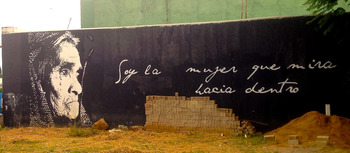
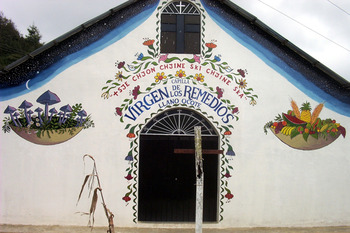
The second reason Wasson's depiction of the region endures is that these commercial transactions occur alongside, and are mobilized by, the widespread use of María Sabina and the mushrooms as symbols. Both are utterly ubiquitous in Huautla, and appear frequently in Oaxaca and beyond. Not all uses are tied directly to commercial interest, as with the chapel in Huautla dedicated to María Sabina (see image 1), a large mural of her appearing in Oaxaca City (see image 2), and the Mazatec display in Mexico City's National Museum of Anthropology, a veritable shrine to Mexican nationalism, where Wasson's recordings of María Sabina chanting play on a continuous loop. In many other cases, though, the symbols are deployed for clear commercial ends, as reflected in the following examples of businesses and organizations drawing upon them:
María Sabina and the mushrooms also appear on items sold in tourist shops throughout Mexico, such as coffee cups, bags, coasters, and even beer holders. One of her most commonly reproduced images, in which she is smoking a cigarette, appears on T-shirts sold on the Oaxaca and Mexico City zócalos alongside such figures as Che Guevara, Emiliano Zapata, Subcomandante Marcos, and the Virgin of Guadalupe.
A mural of María Sabina alongside the Fuente de los Ocho Regiones, a Oaxaca city landmark. The line Soy la mujer que mira hacia dentro (I am the woman who faces inward) is from the Spanish translation of one of her velada chants, and has circulated widely in print and online (author's photo, 2014).

The Capilla a la Virgen de los Remedios (Chapel to the Virgin of Cures) in the Llano Ocote barrio of Huautla. The words tsje chjota chjine ski chjine ṡka (of the woman wise in medicine, wise in plants) dedicate the chapel to María Sabina, and are among many widely circulating phrases attributed to her veladas chants (photo courtesy Ben Feinberg, Reference Feinberg2003).

The ethnographic and journalistic record, including interviews with María Sabina and other sabios, indicates that many serranos felt profound ambivalence about the commodification of the mushrooms, Mazatec shamanism, and images of María Sabina. Some people look back “with nostalgia for the moment when Huautla entered world history,” as reflected in a sign outside the market whose image bears the caption, “This was Huautla de Jiménez, Oaxaca in 1968” (Feinberg Reference Feinberg2003: 148). Yet, as this article's opening vignette illustrates, others take an opposing view. “Magic plants,” and chota chjine like María Sabina, have now become key if contested symbols in serranos' self-representations of “Mazatec identity” (see ibid.). Even those who reject identification with such symbols, or distance themselves from the tarnish of commodification, do so because it is difficult to remain indifferent. This is especially so for cultural intermediaries like Mazatec authors, who are more likely than other locals to interact with people from outside the region. For them, taking a stand on matters surrounding shamanism and the ritual use of hallucinogens is even more mandatory. In their work and discussions about it they are heavily in dialogue with symbols like mushrooms, veladas, María Sabina, and chota chjine.
The work of two Mazatec authors, Heriberto Prado and Juan Gregorio, gives a sense for how some people from the region respond to the “representational hangover.” Their divergent choices in representing serranos and “Mazatec culture” suggest the challenges they face in squaring local textual ideologies with competing, more broadly circulating ones. These ideologies include those grounding the practices of Mexican indigenous authorship, which were partly shaped by the SIL.
Juan Gregorio Regino is the best-known and most widely respected Mazatec author, and enjoys a national and even international reputation. His high-ranking job in the national arts and culture institute means that he lives in Mexico City rather than Oaxaca city or his small hometown in the Mazatec region. A prominent member of the national literary scene, Gregorio has limited latitude in escaping explicit engagement with María Sabina, so thoroughly do national and international readers of indigenous literature associate her with Mazatec identity. Biographical statements introducing indigenous authors usually identify their ethnic group. In Gregorio's case, this almost always involves a further explanation invoking María Sabina, perhaps because the label “Mazateco” is not well known even in Mexico. One typical identification of him, by a prominent Native American scholar and writer, runs as follows: “He is from the same people as the famous (late) Mazatec Wise Woman, María Sabina, who healed in trance using the sacred mushrooms of their region” (Hernández-Avila Reference Hernández-Avila2004: 121). In a recent anthology of indigenous literature, the editorial introduction begins by naming Juan Gregorio and Heriberto Prado and their shared ethnic group. María Sabina appears in the very next sentence, followed by quotes from her chants (Montemayor and Frischmann Reference Montemayor and Frischmann2004: 23).
Gregorio's poem (Reference Gregorio Regino1992: 18–19) to María Sabina originally appeared in his first volume of poetry. Frequently reprinted, it is one of his best known:
The poem's popularity stems from its orientation toward the same kind of audience the Mazatec author Juan García Carrera targets with the magazine he edits, La Faena, and with his books, one of which (Reference García Carrera1986) exposes María Sabina's anger at both outsiders and fellow serranos who exploited her name and image for profit. While both he and Gregorio envision their audiences as partially local, they are also oriented toward outsiders. La Faena prints articles in (flawed) English more often than in Mazatec, especially during the rainy season when mycotourists come to Huautla by the busload. This is a marked departure from national Mexican indigenous literary magazines, since even primarily Spanish-language publications feature token items in indigenous languages, usually a poem or two. Like the aforementioned book about the hippie era by huauteco Álvaro Estrado (Reference Estrada1996), La Faena “explicitly invokes a nostalgia for the past, including the 1960s” (Feinberg Reference Feinberg2003: 151, see 148–52). Every issue has at least one article about María Sabina, generally mentioned on the cover. Rainy season editions are almost entirely filled with articles featuring her and the symbols she helped make central to Huautla's mythic allure. García thus conforms to a host of specific conventions and expectations in writing about María Sabina. His work calls forth a specific chronotope drawing on particular voicings of the past and specific intertextual linkages to many other texts by local and outside authors that depict María Sabina.
In some ways Gregorio is doing similar work in his poem. He draws on María Sabina to elicit the same chronotope that La Faena conjures, positioning his work in the reader's received knowledge of indigenous Mexico and the particular role Mazatec shamanism has played in that mythology. Yet he subtly manages the terms of that engagement. In the Mazatec version of the poem, for example, María Sabina's name never appears. Instead, she is referenced using a construction from daily greeting conventions wherein the respectful term for addressing a woman (na) is paired with a shortened version of her given name (Sabi). This form infuses the relation with intimacy and affection while also alluding to her status as “wise woman” or shaman through her name's overlap with the term sabia. The association with María Sabina is made explicit only in the author's own Spanish version of the poem. This disparity between the two versions illustrates a point I have made elsewhere (Faudree Reference Faudree2013, Reference Faudree2015), that despite explicit discourses characterizing indigenous language literatures in terms of an indigenous language “original” and a Spanish language “translation,” the processes by which such texts are produced and read by indigenous language speakers is in practice thoroughly bilingual.
The use of these two languages also speaks to the complicated decisions indigenous authors face when addressing two (or more) audiences. One audience speaks Mazatec well enough to read the indigenous version; for its members, María Sabina is not a casual figure. The other reads the poem entirely in Spanish, has fewer associations with María Sabina, and may find they help position the author in both ethnic and literary lineages. The publication history of the book where the above poem debuted accomplishes similar work, particularly regarding its cover. Gregorio's first collection of poems, the book made him a national literary figure. The first edition featured a portrait of María Sabina, while the second and third, issued after his career was established, did not. Similarly to the differences between the Spanish and Mazatec versions of the above poem, this shift involves strategic positioning toward different audiences, alternately drawing on María Sabina as an important frame of reference or using distance to contain the ambivalent history surrounding her. This publication history is suggestive in other ways. It indicates the inevitability of invoking María Sabina for Mazatec authors aspiring to national prominence, with the attendant risk of importing ambivalent symbolic baggage. And it illustrates the relative degrees of freedom available to indigenous authors when producing intertextual linkages to prior representations of the Mazatec region and its people.
The other Mazatec author appearing in the aforementioned anthology, Heriberto Prado Pereda, has taken a different approach to being a writer from “the land of the magic mushrooms.” Formerly a Catholic priest, Prado now lives in the Sierra town of Chilchotla, where he was born. He founded two important songwriting traditions in the region, and then a schismatic nativist Catholic organization called the Mazatec Indigenous Church. He has a nominal profile outside the region despite being incredibly prolific and influential locally. To my knowledge, he has never written a poem or song about María Sabina, and of the hundreds he has written, the following song-poem (Reference Prado Pereda1997) appears to be the only one where he writes about the mushrooms:Footnote 13
That Prado wrote this poem, and that it is among the few of his works to reach national and international audiences, speaks to how he, like Gregorio, cannot escape the magnetic pull of symbols like María Sabina and the mushrooms. The poem was reprinted in the only anthology of indigenous Amerindian writing to feature his work, the second in the three-volume series Words of the True Peoples: Anthology of Contemporary Mexican Indigenous-Language Writers (Montemayor and Frischmann Reference Montemayor and Frischmann2004).Footnote 14 While hardly the sort of luxurious, limited-edition book Wasson tended to publish, it is a “coffee table” book with large, professionally taken portraits of each author. In his photo Prado wears a style of dress I never otherwise saw him wear: a shirt made of white cotton manta cloth and embroidered with mushrooms. Such shirts are among the wide range of tourist commodities sold in places like Oaxaca and Huautla that trade on the “semiotic collapse” between the region, its people, and its hallucinogenic plants.
From another perspective, though, the poem represents an attempt to subvert or at least unsettle such constraints. It first appeared in the volume Cantos en Torno al Tiempo Santificador Indio (Chants about Indian sanctifying time; Prado Pereda, Reference Prado Pereda1997). While to my knowledge it was never published, it circulated in the Sierra in manuscript form. The collection was quite different from Prado's other work. Most of his publications were financed by the Catholic Church's Huautla Prelature and featured songs he wrote for Catholic Mass and other church services. The edition featuring this poem was funded by a grant from the National Fund for Culture and the Arts (FONCA) and constituted a self-conscious representation of “Mazatec culture” for outsiders. The bulk of the book is a section entitled “About Mazatec Culture,” featuring songs about such emblems of ethnicity as the twenty-day months of the Mazatec calendar and the thirteen sacred tables of Mazatec cosmology.
However, while this volume is clearly more geared toward outsiders, it maintains a local orientation and has had a primarily local audience. Most of the song-poems fit into the genre of commentaries on or representations of Mazatec culture so prevalent in indigenous language literature that targets outsiders, and yet their content is aimed at educating local people about ethnic practices presently falling into disuse. The poem does not describe or narrativize the mushrooms, conveying referential information about them as one would for outsiders who know little about them. Doing so would amount to adopting the textual ideologies that animate Wasson's description of his veladas with María Sabina. Instead, the mushrooms are addressed and invoked as interlocutors, as conveyors of divine texts and bearers of sacred knowledge. The author is not describing what mushrooms do, but rather instantiating the appropriate way to address them. He is assuming the reader has enough insider knowledge about the mushrooms to supply key contextual information: knowledge of veladas and how mushrooms are addressed in such rituals. He is also furthering as normative the mushrooms' cultural link to local ideas about divine texts—the very textual ideologies that lay beneath the Protestant missionaries' hapless attempts to promote Mazatec literacy.
To put the matter in the terms raised in my introduction while spotlighting Prado's attempt to embrace local textual ideologies, the author is trying to use this song-poem to undo the power of the fetish. In Coronil's terms, he is working to effect a “counterfetishization.” He wants to reverse the process by which Wasson, Pike, and countless others have, through their texts, doubly fetishized the region's hallucinogenic plants: turning them into fetishized proxies for the region's people while simultaneously detaching them, through commodification, from local social relations. Prado wants to re-socialize the mushrooms, to embed them once again in local relationships of reciprocity, ritual respect, and mutual sustenance. His choice to call this poem (like all those in the volume) a canto or song (chant) is part of this overall strategy. Doing so positions this text alongside the singing practices at the heart of veladas. In Gregorio's 1992 collection he makes a similar move, titling the final section of the book cantares (songs, hymns). It is no accident, I think, that his poem to María Sabina does not appear in this section. Yet in his own way he, too, attempts to orient his work towards local textual ideologies, even as, like Prado, he remains constrained by the written-text paradigm governing indigenous authorship in Mexico.
CONCLUSION: ON NEW MARKETS AND ENDURING CHALLENGES
The different approaches these Mazatec authors take suggest the tension between constraint and creative license they encounter when navigating legacies of the region's “representational hangover” while accommodating local textual norms. These dynamics may find parallels in how minority authors elsewhere navigate similar tensions. They also illuminate future challenges and opportunities as Mazatec authors respond to ongoing representations by outsiders concerning the mushrooms as well as emerging commodities like salvia. While it is too early to draw conclusions about the social effects of salvia's commodification, my interviews suggest this new trade may also become a locus of contention: many cast burgeoning interest in the plant through explicit reference to the legacy of the mushrooms' commodification. Their concerns echo solidified complaints about that trade, including anxieties about how the plant will become detached from local sociality. As one person said, referencing the pattern that while serranos drink infusions of the plant outsiders generally smoke it, “They just take our xka pastora away and treat it like marijuana, like a drug.” Though couched in different language, such comments suggest that salvia may emerge as not only a new ethnic fetish and locus of “semiotic collapse,” but also a site for critique about the dislocation of cultural goods from local social relations.
An ongoing paradox of life in the Sierra Mazateca is that its people have been discursively constructed as “authentic Indians” who resisted development and nationalization through the very narratives that drew and continue to draw ethnobotanists, mycotourists, missionaries, and other outsiders. Their depictions of the region have had an enduring impact on it people, whose own representations are conditioned by complex positioning in light of that representational history. Attempts to redress it sometimes struggle with stubborn paradoxes: as in so many places in the world, local versions of ethnic belonging may look modern to visitors from outside, while representations of indigeneity marketed to outsiders as authentic may be little more than mirrors reflecting their desire for exotic otherness.
Indigenous authors and other cultural intermediaries feel special pressure to inhabit positions engendering such contradictions. Yet they are also among the most likely to find creative ways to reconcile them. As the authors discussed here have shown, such reconciliation requires not only strategic use of texts but also reflexive engagement with the specific textual ideologies that give those texts meaning. These authors' representational strategies emerge as artifacts of contentious dialogue with complex histories of global connection. These have been enabled by the exchange of objects like hallucinogenic plants but also by the circulation of textual representations giving those objects value while making subjects of the people to whom they are attached.
This case exhibits how calculated management of textuality and textual ideologies can be a valuable resource as people navigate the tensions accompanying global interconnection. It also suggests that our theoretical frameworks for conceptualizing translocal relations require greater attention to the texts that travel alongside things, and to the materiality of discourse as well: its capacity for solidity and circulation as alternately enabled or forestalled by particular textual ideologies. Here we have also seen how local textual ideologies became visible and perhaps even activated over time through the confluence of multiple histories of textual representation, demonstrating the importance of historical dimensions of text production and circulation.
But in the end, whatever the theoretical payoff, this case is also a story, a narrative about how people from the Sierra make sense of outsiders' interest in their sacred plants. And perhaps the central lesson this case offers is to remind us that things always circulate with stories attached. We cannot understand how things connect people, across distances great and small, if we fail to listen to those stories and consider how their persistence and movement is ultimately anchored in the socially embedded subjects who created them.