George Eliot's Daniel Deronda (1876), a novel that spurred Zionism in Palestine, opens with a scene of watching and thus moves from a male gaze on a woman's body to a project of envisioning a new nation in a distant land.Footnote 1 The national drama of the novel turns on the ideological meaning of gazing at landscape, as Daniel Deronda replaces one political perspective with another. Indeed, Mordecai's political dream of a Jewish national future involves “Looking towards a land” (454; bk. 6, ch. 42): his nationalist vision transpires as a gaze upon a far-off place. Colonial ambition itself can be understood as an ideological view of landscape as open to possession, a gaze on the territory of others that insists often violently on itself, to the exclusion of other political perspectives. Motivated not by sex but by moral and political domination, this colonial gaze nationalizes viewership, and makes the landscape it imagines real.Footnote 2 For Deronda himself, nationality itself is a kind of viewership. He wants to study abroad, because, he says, “I want to be an Englishman, but I want to understand other points of view” (155; bk. 2, ch. 16). Being an Englishman is a “point of view,” a perspective to claim, to the possible exclusion of other nationalized ways of seeing landscapes both domestic and distant.
The nationalist politics in British views of distant landscapes received a most consequential expression in the context of Israel-Palestine when, on November 2, 1917, British Foreign Secretary Arthur James Balfour sent the following statement on behalf of Parliament to the Zionist leader Baron Rothschild:
His Majesty's Government view with favour the establishment in Palestine of a national home for the Jewish people, and will use their best endeavours to facilitate the achievement of this object, it being clearly understood that nothing shall be done which may prejudice the civil and religious rights of existing non-Jewish communities in Palestine, or the rights and political status enjoyed by Jews in any other country (Krämer 149).Footnote 3
The statement, called by Balfour a “declaration of sympathy with Jewish Zionist aspirations” (Gilbert 34), informed Britain's settlement with post-Ottoman Turkey after WW1, and its administration of Palestine until the formation of the state of Israel in 1948.Footnote 4
Weaknesses in Balfour's rhetoric bear some responsibility for the appalling political situation that endures in Israel-Palestine today.Footnote 5 As Gudrun Krämer explains, the danger of the declaration partly lies in its reference to “Arab Muslims, Christians, and Druze in Palestine as “non-Jewish communities,” a mere residual group formed on the basis of this difference” (150). Balfour's expression of policy as a “view” can be read as another rhetorical turn with unfortunate political ramifications. Balfour's “view” refers to an opinion as a perspective, a figuratively visual thought. Yet this wording can also be read literally, as an expression of a colonial vision, a gaze enacting knowledge and power over the landscape of Palestine.Footnote 6 Writing of another statement by Balfour regarding the Middle East, Edward Said explains that “[k]nowledge to Balfour means surveying a civilization from its origins to its prime to its decline – and of course, it means being able to do that. Knowledge means rising above immediacy, beyond the self, into the foreign and distant” (Orientalism 32). Even as it helped open Palestinian landscape to the nationalist movement of Zionism, Balfour's “view” operates within a colonial discourse by inviting Britain to imagine it could control a landscape that its citizens neither occupied, nor viewed themselves on a regular basis.
In this paper, I argue that the British willingness to legislate Palestine in 1917 represents a view of the reality of a distant region and its inhabitants that has a history in the perspectives represented in George Eliot's Daniel Deronda and in nineteenth-century British books illustrated with pictures of Palestine.Footnote 7 The uses of vision and visual media in these works contribute to the establishment of Balfour's political view, since they present Palestinian reality as the product of British perspective. In these works, the actual Palestinian landscape under Victorian eyes becomes a site of elusive reality that is visible only from the right point of view, a distant and spectral history that lives most vividly in printed images, visible, imagined, or literary. Viewing Palestine from a distance, these books regard the region as a spectre, something that is real in its visibility and as a harbinger of the past, but not as a material locale in the present. In making this argument, I begin with a reading of spectrality, vision, and print in Eliot's novel and then move to a consideration of the images in several illustrated travel books about Palestine that were printed in London during the nineteenth century, and that are now housed in Toronto's Thomas Fisher Rare Book Library. While in Eliot's novel Deronda's own contested visibility consolidates Mordecai's ideological goals in viewing the east from a distance, the frames and captions of the illustrated books make political perspectives visibly explicit. These books ask their viewers and readers to imagine knowing the Middle East by experiencing looking at a book as an act of gazing through a window, resulting in a spectral concept of Palestine.Footnote 8
Palestine was a crucial inspiration and common topic for many Victorian authors and artists, from bestselling travel writers Alexander Kinglake and Eliot Warburton, to early photographers J. M. Diness and Francis Frith, to Pre-Raphaelite Holman Hunt.Footnote 9 Eitan Bar-Yosef explains that ever since Bunyan's Pilgrim's Progress (1678) located Zion in English landscapes and hearts, the Holy Land seemed local for the many British travellers who wrote about their visits there (19–23). Their often-expensive books proliferated at the rate of dozens per year through the late nineteenth century (103, 95). Women were increasingly frequent witnesses to Palestine, and John Theakstone's list of Victorian and Edwardian women travel writers documents thirty-four who published accounts of visiting the Holy Land. Among the most famous was Gertrude Bell, an explorer and diplomat whose copiously illustrated account, The Desert and the Sown (1907), proved immensely popular (Wallach 79). Daniel Deronda was not published with images, but hundreds of illustrated books about Palestine were printed in London between the time of Wynkyn de Worde and the Balfour Declaration of 1917.Footnote 10 They gave inspiration to pilgrims, topographical knowledge to geographers, and settings to childhood readers of Bible stories. By inspiring travel and instructing ideology, they share an important history with colonialism, religion, and tourism.Footnote 11
As the breadth of this field of publication may indicate, the illustrated books I address here are not perfectly representative of the vast range of publications about and visualizations of the Holy Land that captivated Victorian audiences. Rather, since all the travel books I examine belong to the Thomas Fisher Rare Book Library, my selection reflects the inclusions and exclusions of a particular archive. The Fisher Library dates to the founding of the Department of Rare Books and Special Collections at the University of Toronto in 1955, which began developing research holdings through acquisitions and donations, as well as by retrieving notable books from the general stacks (Landon). In 1973, the growing collection was moved into the newly built Thomas Fisher Rare Book Library, an extension of the University of Toronto's largest research facility, Robarts Library (Landon). The library has multiple concentrations: its strengths include print history, the history of science, and Canadiana, while numerous niche collections are named for the donors who first assembled them (Thomas Fisher). No single collector is responsible for amassing the works I discuss here, however, nor did the library systematically gather Victorian materials about Palestine. Rather, the collection I have drawn from its holdings is accidental. As a result, I do not propose that this sampling of Victorian illustrated books about Palestine is comprehensive or fully illustrative of the genre, but that it is rather suggestive of traits in a broader historical print culture.
Limiting my study to its holdings makes the Fisher Library into one of the bookish landscapes this paper gazes upon. As a Canadian institution, the library sits on land once governed by aboriginal peoples: just as its holdings preserve artifacts of British colonial ambition, its very setting is rooted in colonial history. Though the British books I discuss depict scenes foreign to London, England, this Canadian collection of books is itself local for me. Using this accidental archive of British works about Palestine, rather than a more comprehensive collection, thus offers a way for me to acknowledge what Linda Hutcheon calls the “crypto-ethnicity” of the Englishness of English studies in Canada and the uneasy relation multiethnic Canadian critics have to the universalism of the British canon (31). In this instance, by limiting my study to the Fisher collection, I highlight the Canadian frame of my own work on Victorian culture, my inevitably national perspective in addressing the nationally vexed topic of Israel-Palestine. In my own act of gazing backwards onto these books that themselves look at Palestine, the collection I use foregrounds the national tint of my lenses, the landscape I stand on as a Canadian scholar, and the one I see.
While many nineteenth-century Britons might have had a religious feeling for Palestine, most would never have visited the region, so Eliot's novel and illustrated books offered a moderately available landscape of perspectives on the region to Victorian readers and the electorate behind the parliament of 1917. In so framing the social power of print, I am indebted to scholarship on the history of reading that looks to literate audiences for traces of democratic culture, political participation, and citizenship.Footnote 12 I contend, by extension, that the viewers of images in books must also be seen as political agents in the social history of print culture, alongside readers of text. Individually, illustrated travel books may have been less popular than now-canonical works like Daniel Deronda, but, over time, the entire spectrum of British printed images of Palestine may also have accumulated as great an influence on generations of readers and viewers as any one bestselling literary work. Increasing the immediacy of what British readers thought of as the Holy Land, as well as its accessibility to verbally illiterate people, illustrated books should be incorporated into critical understandings of the British colonial impulse in the Middle East, as well as the British Zionist movement. The landscapes created in these books and in Eliot's novel represent a kind of alternative constituency, the Palestine with which British citizens might have felt somewhat acquainted. In their views lies one explanation for a British thread of Middle Eastern history.
Perspectives Made Real in Daniel Deronda
Like Balfour's view and the illustrated travel books I discuss below, Daniel Deronda maintains Palestine as a spectre, an immaterial image, rather than a reality. By contrasting the potency of Mordecai's ways of viewing the world with the failures and mutability of other perspectives and appearances, the novel interrogates the spectrality of colonialist vision, and how it is enabled by letting perspective stand in for reality. In the following section I first account for critical impressions of spectrality and Daniel Deronda and then offer a reading of how Eliot links optical and ideological perspective in the visibility and sight of individual characters. While Deronda incarnates the visions of other characters, Eliot compares the failures of Gwendolen's vision to the political success of Mordecai's: part of Gwendolen's error is that she is always thinking of those watching her, rather than, like Mordecai, of those whose futures she could watch over. I close this reading of Eliot's novel by addressing how print materializes the characters’ visions of a spectral eastern destination. By exploring the spectrality of letting perspective constitute reality, the novel focalizes the political power of Victorian views of Middle Eastern landscape.
While I stress that this novel examines the spectrality of conflicts between vision and the real, spectrality has also attended its reception history. Ever since Daniel Deronda was first published, the realism of the novel has been interrogated through questions about how and to what end it makes Jews and their “parts” visible: critics have debated the accuracy of its rendition of Jewish lives, the sincerity of its sympathy with Jewish experience, and its utility as a symbol for Zionism. Eliot's Jewish characters have been decried as “cold” (James 313) and inaccurate (Goody 467), and though many Jewish communities did embrace the novel enthusiastically, some have been as bent on eliding the “Christian part” of the text, as F. R. Leavis was on taking out its Jewish “part.”Footnote 13 This reception history of textual dissection and suture between Gwendolen's plotline and Deronda's reveals that the novel and its politics have often been seen as incoherent. Like Derrida's definition of a spectre, readers have imagined Daniel Deronda as a “Thing that is not a thing, [a] thing that is invisible between its apparitions, when it reappears” (6). The text itself has been seen as a kind of spectre.
Spectrality as an idea of competing blindness and visibility has also acted as a catalyst for critical concepts of Jewish ethnicity in the novel. Jules Law argues for the “spectrality” of the Jew as being both the summation of critical reflections on Eliot's representation of Jewishness and the philo- or anti-Semitic interventions the novel makes in questions of Zionism and Jewish rights (251–54). For Daniel Novak, “the Jewish body in Deronda can only be seen as a not-yet-visible Jewish national body – a specter of a past inheritance and an inheritance to come” (84). Jewish spectrality also figures in Cynthia Chase's suggestion that Eliot's realism in Deronda depends on the fantastical notion that Deronda himself had never “looked down” to see his own circumcision (222). According to this reading, his physical spectrality to himself – the question of his real or unreal circumcision – provides the foundation of the plot about his Jewish self-discovery.Footnote 14 The spectrality of Jewishness in Daniel Deronda is linked to what Audrey Jaffe describes as an impossibility for Victorian minds, “the Jew who does not look like one” (123); she suggests that “[f]or Eliot and her hypothetical spectators, the Jew's gaze is focused elsewhere: on his nation but not on theirs” (124). Like a spectral moment of double vision that keeps two realities visible at once, here a divergence of gaze serves as a metaphor for incommensurate political perspectives.
While these interpretations suggest that conflicting views result in spectral bodies in Daniel Deronda, its characters themselves risk becoming spectres as the narrative displays a regulated and regulating scene that leaves some subjects out of its frame and escorts others away. Susan Meyer claims that since the novel “purges away resistant female selves and it purges away Jews,” it is not actually invested in Jewish nationalism, but in “guarding the boundaries of the English nation” (753, 754). This reading suggests that there is hostility in the conclusion of the novel, which promises to make the Jews of the story invisible by pushing them out of the frame of the narrative – Mordecai dies, and Deronda and Mirah are set to depart. As Edward Said famously argues, the novel also treats Arab subjects to this banishing action.Footnote 15 Though sympathy seems to have motivated Eliot's writing, Said's critique demonstrates that her omission of Arab Palestinians shows a lack of sympathy that might aptly be cast as racism.Footnote 16 In a response to Said, Christopher Hitchens suggests that Eliot would have included sympathetic portrayals of Palestinians had she ever visited the Middle East (12). By positing her as a failed tourist, Hitchens overemphasizes the accuracy of touristic vision, since, given the dominance of Biblical visions of Palestine in Victorian England, had Eliot visited, or had she peered through contemporary illustrated books about the region, she might not have achieved a more accurate perspective on Arab life there.Footnote 17 Rather than representing a lapse in Eliot's empirical information-gathering, the absence and disappearing of Arabs as well as Jews in her narrative represents the participation of her work in a Victorian gaze on Palestine and nationalized others whose boundaries were themselves difficult to elude. The spectral visibility and invisibility of marginalized subjects in this novel, whether women, Jews, or Arabs, define the political perspective through which Eliot frames her fictional world.
In Daniel Deronda itself this spectrality stems from the instabilities of relying on visibility for access to the real, a mode of perception that recurs throughout the work. Experiencing reality as its visibility, Eliot's characters perceive the real as what they can see. The work elaborates a kind of visual metaphysics, so that the realities of both space and time are framed through visual perspective. Towards the end of the novel, Eliot writes, “all things are bound together in that Omnipresence which is the place and habitation of the world, and events are as a glass wherethrough our eyes see some of the pathways” (641; bk. 8, ch. 63). Events become a transparent window on the “pathways” of the world, which are themselves visible. Eliot's construction of this visibility of the world, however, “our eyes see,” underscores the specificity of all perspective: she is addressing a particular first-person plural audience, the implication being that while “our eyes see,” “their” eyes might see something else. The narrator's discovery of a visible “world” (a synonym for the plenum of reality), therefore, enables a visual statement of ideological perspective, since places that seem to lack importance need not appear in the world, while the eyes of “others” might be blind to some facets of “reality.” Further elaborating this visual constitution of reality, Eliot writes that when the world intrudes on the ignorant, “[t]hen it is as if the Invisible Power that has been the object of lip-worship and lip-resignation became visible” (689; bk. 8, ch. 69). In becoming visible, the “Invisible Power” is insisting on its reality over the falseness of “lip-worship and lip-resignation,” insincere tributes that, importantly, Eliot figures as verbal. Visible appearances are more real in this realist novel than verbal statements, even as the metaphysical “Power” underpinning events is available to vision.
Reality is so dependent on visibility in this novel, that images also describe the passage of time and help characters orient themselves chronologically. Characters frequently apprehend the past and the future in moving images in an anticipation of the motion pictures of cinema. The “rushing images of future difficulty” (600; bk. 7, ch. 52) accompany “hurrying images of what might come” (607; bk. 8, ch. 53) and “images which have a foreshadowing power” (404; bk. 5, ch. 38). While, as Pamela Thurschwell suggests, these moving images mirror the recurring thread of uncanny and prophetic insight or “second sight” in the novel (93), they also participate in a broader spectrum of visibilities through which characters apprehend reality. Mental processes also tend to use such swift images: while “Deronda's thinking went on in rapid images” (176; bk. 3, ch. 19), Gwendolen “lived back in the scenes of her courtship” (515; bk. 6, ch. 48), and her memories of Grandcourt return “like pictures in a book beaten open with a sense of hurry” (247; bk. 3, ch. 26). “Pictures in a book” becomes a way of naming the spectral return of the past, the reproduction of experience as visualized memory.
While the structures of real experience are visible in this novel, so too is character, and Eliot links subjectivity to visibility throughout the book. Deronda observes that “there are some natures one could see growing or degenerating every day, if one watched them” (345; bk. 5, ch. 35). Here the use of the word “nature” both signifies personality, and underscores Eliot's almost botanical description of the growth and decay of characters, as though they were plants in a garden that could be watched over. Character here is something that can be seen and seen changing. In describing the visibility of character, Eliot makes an indirect reference to the photographic development of images, writing that “[n]o chemical process shows a more wonderful activity than the transforming influence of the thoughts we imagine to be going on in another” (362; bk. 5, ch. 35). The displays of “chemical process” here offer Eliot a metaphor for intersubjective perspective. Identity and watching are further linked in one of Eliot's chapter epigraphs, in which she writes that “[m]en, like planets, have both a visible and an invisible history” (139; bk. 2, ch. 16). This visibility or invisibility of the past refers to the relative availability of the experience of others to outside perspectives. Visibility thus offers Eliot a way of describing the accessibility of characters’ subjectivities.
While real character can be seen in this novel, of all Eliot's cast members, Gwendolen's personality and perception is most defined by visibility and errors in vision. During her engagement, she wonders, “Was not all her hurrying life of the last three months a show, in which her consciousness was a wondering spectator?” (301–02; bk. 4, ch. 31). This description of her life positions it as a spectacle, a representation rather than a reality, and constructs her own subjectivity as dependent on watching. In being “apt to think rather of those who saw her than of those whom she could not see” (59; bk. 1, ch. 7), Gwendolen's concern for the reality of others also depends on her own visibility. While other people are only real insofar as she is visibly real to them, she feels Grandcourt is an unsuitable romantic partner because he “could hardly have been more unlike all her imaginary portraits” (91; bk. 2, ch. 11). The narrator writes despairingly of “girls and their blind visions” (103; bk. 2, ch. 11), and it seems Gwendolen's sight is most perturbed of all. “In Gwendolen's consciousness,” Eliot writes, “Temptation and Dread met and stared like two pale phantoms, each seeing itself in the other – each obstructed by its own image” (577; bk. 7, ch. 54). Eliot illustrates Gwendolen's psychological complex as a layering of images and gazes that block each other and present multiplying barriers to vision.
Marking a contrast to Gwendolyn's troubled vision and visibility, Deronda affects and often clarifies her sight. She thinks of Deronda as having “first risen on her vision as a corrective presence” (682; bk. 8, ch. 69), while his “presence and touch seemed to dispel a horrible vision” (690; bk. 8, ch. 69). Even by his presence alone, he points out and helps to mitigate the faults and pathologies in her vision. Her perspective remains damaged in the domain of their own relationship, however, as “her supreme need of him blind[s] her to the separateness of his life” (682; bk. 8, ch. 69). As though in response to Gwendolen's visualizations of her relation to him, Deronda in turn takes up visual metaphors in his effort to come to some moral resolution to his involvement with her. Even as Deronda listens to her plight with sympathy, “imminent consequences were visible to him” (658; bk. 8, ch. 65). He advises her that she has had “a vision of possible degradation,” and attempts to turn her onto a course of redemption, though “looking at your life as a debt may seem the dreariest view of things at a distance” (658; bk. 8, ch. 65). Deronda instructs Gwendolen's vision by using visual metaphors, so that changing her attitude requires a new way of viewing. He serves as an interpreter of and doctor to Gwendolen's visions, and a corrective to and dispeller of her blindnesses, a visual force that defines his character as well as their interaction.
The very reality of Deronda's body both to himself and to others is determined by its relative visibility, distance, and placement within the space of individual perspective and this visual potency of his character is evident in his “looks.” He objects to the notion that his appearance draws notice (158; bk. 2, ch. 17), even as he accustoms himself “to the habit of seeing things as they probably appeared to others” (307; bk. 4, ch. 32). He is at once a spectacle, aware of his own perspective, concerned with the perspectives of others, and willing to acquiesce to his appearance in their eyes. Enjoined to “[l]ook at his hands” readers find that “they are long, flexible, firmly-grasping hands, such as Titian has painted in a picture” (157–58; bk. 2, ch. 17). This form of description begins by making Deronda's body into a spectacle to be looked at, while, as Hugh Witemeyer discusses at length, he is frequently thus likened to paintings: “He puts me in mind of Italian paintings. One would guess, without being told, that there was foreign blood in his veins” (281; bk. 4, ch. 29).Footnote 18 Suggesting that Deronda looks like “Italian paintings,” indicates a Victorian idea of his aesthetic “type,” while this way of linking his appearance and his nationality indicates that being foreign means looking like a distant picture.
Indeed, the spectacle of difference Deronda makes to others is often encoded with distance, as though his body were a far-off scene. Gwendolen, for example, thinks that invisible or remote images make up Deronda's aspect. She notes that “[h]ardly any face could be less like Deronda's than that represented as Sir Hugo's in a crayon portrait at Diplow,” and at the same time “[a]n image which had immediately arisen in Gwendolen's mind was that of the unknown mother – no doubt a dark-eyed woman – probably sad” (281; bk. 4, ch. 29). While the difference between Deronda and his representation in the portrait inserts distance between himself and his image, Gwendolen's idea that he must be like an “unknown mother” presents another remote image for him to resemble. Deronda too imagines his relative in his likeness to an invisible portrait. “His own face in the glass,” Eliot writes, “had during many years been associated for him with thoughts of some one whom he must be like – one about whose character and lot he continually wondered, and never dared to ask” (158; bk. 2, ch. 17). While his appearance provokes the idea of distant pictures in others, he sees absence in his own reflection, “thoughts of some one whom he must be like.” Even to himself, Deronda's image presents an invisible picture.
Eliot often expresses this visual distance in Deronda's appearance through the language of perspective. While Gwendolen “did not imagine him otherwise than always within her reach” (682; bk. 8, ch. 69), Mirah is pained by an “image of Mrs Grandcourt by Deronda's side drawing him farther and farther into the distance” (627–28; bk. 8, ch. 61). In this scene that relies on perspective, which makes distant objects smaller, and more difficult to see, the threat of Deronda's acquiescence to Gwendolen is figured as his encroaching invisibility. Here again we see Eliot describing Deronda as a receding scene, as an image that is becoming more distant, and less available to sight. In a moment that contrasts with this scene of recession, Eliot also uses perspective to describe Mordecai's strengthening vision of Deronda. “Thus it happened,” she writes, “that the figure representative of Mordecai's longing was mentally seen darkened by the excess of light in the aerial background. But in the inevitable progress of his imagination towards further detail, he ceased to see the figure with its back towards him. It began to advance, and a face became discernible” (406–07; bk. 5, ch. 38). Eliot produces Mordecai's perception of Deronda through the obstructions to vision of distance, depth, and shadow that constitute perspective. This combination of invisibility and visibility contributes to the spectrality of Deronda's presence as a real body in the world of this book.
While Deronda is frequently a distant image, Mordecai is an active and powerful looker. Eliot writes that he “had, both abroad and in England, looked at pictures as well as men, and in a vacant hour he had sometimes lingered in the National Gallery in search of paintings which might feed his hopefulness with grave and noble types of the human form, such as might well belong to men of his own race” (405; bk. 5, ch. 38). His spectatorship of pictures and people helps him both to articulate and find the embodiment of his ideals. As Jaffe writes, “Mordecai seeks the image of his protégé throughout the world and, specifically, in the museum,” a relation that constructs Deronda as “a space to be filled with images” (121, 122). When Mordecai gazes at Deronda, “the words youth, beauty, refinement, Jewish birth, noble gravity, turned into hardly individual but typical form and colour: gathered from his memory of faces seen among the Jews of Holland and Bohemia, and from the paintings which revived that memory” (407; bk. 5, ch. 38). Mordecai draws his perspective on the figure of his dreams from faces and paintings – reproducing these visible histories in his own mind to reissue them in a projection upon the right figure.
So intense is Mordecai's visual awareness that, more than any of the other characters, he is able to materialize his visions, a trait that is essential to his goals. Eliot deploys a relation between romance, vision, and imagination in the description of Mordecai's projections onto Deronda: “[r]everently let it be said of this mature spiritual need that it was akin to the boy's and girl's picturing of the future beloved; but the stirrings of such young desire are feeble compared with the passionate current of an ideal life straining to embody itself, made intense by resistance to imminent dissolution” (407; bk. 5, ch. 38). Whereas Gwendolen has imaginary portraits of future love objects, Mordecai looks at paintings and Deronda to see his own visions represented. Under Mordecai's eyes Deronda is a collage of pictures from other settings that enables the realization of a political vision. In the light of his ideological desire, Mordecai sees in Deronda the body and embodied perspective for which he has been looking, but his insistence on the reality of his visions and on fitting Deronda into the future landscape he sees does not proceed entirely without tension. Deronda reminds him that “[y]ou have your own way of looking at things” (455; bk. 6, ch. 42), and, protecting Mordecai from strangers, he also takes care to hide “everything that might feed the ready repugnance in minds unblessed with that ‘precious seeing’” (494; bk. 6, ch. 47). Deronda casts Mordecai's difference and the source of his prejudice against others as a matter of perspective. Mordecai's visionary creation of Deronda himself does not go without Deronda's notice: “Mordecai, on his side, had his visions of a disciple, and he saw me by their light; I corresponded well enough with the image his longing had created” (439; bk. 6, ch. 41). Mordecai's visions are not only images, but they cast light by which to see, while Deronda himself is aware of the triumph of Mordecai's perspective in the elaboration of his own identity and destiny. Mordecai's perspective determines Deronda's reality, and so overcomes other visions for his future.
In Mordecai's eyes, Deronda becomes a physical origin point for a political perspective, a person able to take up Mordecai's view and so make his vision for eastern landscape real by fulfilling his colonial enterprise. As in the illustrated travel books of the period, Mordecai's political vision creates a reality by latching an ideological position to a perspective on a landscape. In expressing his desire to give his people a “national centre,” a geographic as much as political goal, Mordecai frequently states his proto-Zionism in visual terms. “Looking towards a land and a polity,” he vows, “our dispersed people in all the ends of the earth may share the dignity of a national life which has a voice among the peoples of the East and the West – which will plant the wisdom and skill of our race” (454; bk. 6, ch. 42). The project of thinking this dream involves “looking” to a landscape. Mordecai's passionate vision results in his “living an intense life in an invisible past and future” (455; bk. 6, ch. 42), realities that only he can see. Eliot suggests that the political future he imagines is made present for him just as a parent's gaze on a child's future makes it real (455; bk. 6, ch. 42). While Mordecai is himself a “portrait” (425; bk. 5, ch. 40), he describes himself as sustained by visions: “They said, ‘He feeds himself on visions,’ and I denied not; for visions are the creators and feeders of the world” (426; bk. 5, ch. 40).Footnote 19 This emphasis on visions as the substrate of reality helps to affirm the importance of his political views. In a reference to Moses’ vision of Israel from Mount Pisgah, Mordecai tells Deronda, “You see it all – you are by my side on the mount of vision, and behold the paths of fulfilment which others deny” (461; bk. 6, ch. 43).Footnote 20 For Mordecai, sight is the currency of political agreement and his convictions about the rightful future of “his people” transpire as visions. Coral Ann Howels argues that Deronda inherits Mordecai's vision, and his journey with which the novel ends has the effect of “transforming Mordecai's visionary nationalism into action” (179). Vision is thus a prompt to ideological action and a spur to bringing political projections into reality. Mordecai is able to bequeath his political visions to Deronda by teaching him to share his perspective, a transference of an ideological “view” on a foreign destination that constructs a potential reality for the landscape it purports to “see.”
While his political obsession transpires as a creative gaze towards a distant landscape, Mordecai also uses vision to articulate his political demands to Deronda. In what becomes a repeated slogan in Deronda's mind, Mordecai calls, “You must believe my beliefs – be moved by my reasons – hope my hopes – see the vision I point to – behold a glory where I behold it!” (436; bk. 6, ch. 41, repeated on 455; bk. 6, ch. 42). In addition to sharing his ideology, Mordecai insists that Deronda employ his sight. “Seeing” Mordecai's vision implies taking up his perspective, both literally, as a view of a future landscape for the Jewish people, and figuratively, as an adoption of a “vision,” a speculative or imaginary ideological dream. Deronda describes the mission he inherits from Mordecai as follows: “[t]he idea that I am possessed with is that of restoring a political existence to my people, making them a nation again, giving them a national centre, such as the English have, though they too are scattered over the face of the globe” (688; bk. 8, ch. 69). In describing his vision as an “idea,” Deronda chooses a word that shares an etymological history with “image” (“idea”). As W. J. T. Mitchell writes in Iconology, “the very idea of an ‘idea’ is bound up with the notion of imagery. ‘Idea’ comes from the Greek verb ‘to see’” (5). This idea, the ideological perspective on Palestinian landscape and its availability as a setting for Jewish futures is itself a kind of image, a political fantasy for a distant and spectral scene that creates the reality it seems simply to view.
In the transmission of Mordecai's political perspective, print serves as an important symbol. Mordecai has Jacob repeat the words of his poem about “a blended past and future” because “[t]he boy will get them engraved within him. . . it is a way of printing” (408; bk. 5, ch. 38). In addition to representing a way to preserve knowledge, engraving here offers an emblem of visibility, and an archive of present, past, and future that can be shared among many people. Eliot repeats this formulation in referring to Mordecai's pedagogy as “strange printing” (408; bk. 5, ch. 38), while the observation that Mordecai's “figure had bitten itself into Deronda's mind” (404; bk. 5, ch. 38) also references the print technique of etching. Eliot's use of print metaphors to describe connection among people persists in Deronda's sense of “the strong stamp of race on [Pash's] features” (448; bk. 6, ch. 42), in Mordecai's idea that he “engraves his thought” (426; bk. 5, ch. 40), and in Deronda's unlikeness to his grandfather in sentiment though he is “a young copy of him in [his] face” (540; bk. 7, ch. 51). These invocations of print contribute to the rhetoric of transmission in Daniel Deronda that numerous critics have noted.Footnote 21 Of this interest in print, Mikhal Dekel writes, “Mordecai, with all his pathos and intensity, calls his instruction to Deronda “a way of printing”: a printing on the body that remains free of the printing industry, a hostile audience, and anti-Zionist sentiments” (795). As with any effort to create a new nation, the fulfilment of Mordecai's ambition depends on the possibility of aligning the thoughts and sentiments of a large group of people. The political significance that Mordecai associates with this concept of printing beyond the mainstream, therefore, recalls Benedict Anderson's description of the importance of print to the “imagined communities” of nations (44), a model that Jaffe also points out is germane to nationalism in this book (138, 136). As a means by which to spread and represent his ideals, print is thus essential to Mordecai's project and so becomes a symbol of the hope of a new Jewish nation.
Event as print offers a metaphor for the transmission of political vision in this novel, it also materializes ways of “looking” eastward. So crucial is print to Eliot's construction of Mordecai's vision that he first meets Deronda, his political inheritor, in a bookshop (424; bk. 5, ch. 40). The relationship that will send Deronda on Mordecai's mission to the east and so extend his nationalist vision for the region has as its original locale a space teeming with the fecundity and visibilities of print culture. While in the bookshop Mordecai and Deronda experience “an instinctive feeling that they wished to see each other fully” (424; bk. 5, ch. 40). This desire for sight of each other corresponds to Mordecai's emphasis on vision as the substrate of his nationalism. Eliot pushes towards a kind of light-box rendering of the scene both for the characters in their effort to “see each other fully” and for her audience of readers, on whose behalf the narrator laments her inability to offer a painted representation: “I wish I could perpetuate those two faces, as Titian's ‘Tribute Money’ has perpetuated two types presenting another sort of contrast” (424; bk. 5, ch. 40).Footnote 22 Here “perpetuation” stands in for “reproduction”: being able to visualize a scene whether in paint or in prose contributes to its semblance of reality. As “lookers” among the displays of the bookshop, a literary marketplace, the two men confirm their role as spectator consumers, while their bodies, items to be looked at in this store, take on something of the commodity and spectacle of reproducible book objects. An origin point for Deronda's journey to the east, the scene links his collaboration with Mordecai's proto-Zionist nationalist vision to the sites and sights of print culture.
In contrast to this scene of bookstore visibility, the hypothetical eastern destination – perhaps Palestine itself – towards which this origin sends Deronda is a vanishing point in this book. All the characters’ distant images of Deronda coalesce in the scene of this far-off destination towards which they gaze. Acquiescing to the recession of visibility at the end of the novel, Deronda, Mirah, and Mordecai are about to begin their journey and so fade into the distance: either Mordecai's death or their departure will come first (695; bk. 8, ch. 70). The departure itself could close the narrative by sending its titular character into what is offstage but implicated space for this novel, the nationless east, but the novel ends instead with Mordecai's death (695; bk. 8, ch. 70). Since the plan for their voyage was always his vision, Eliot leaves open the possibility that Deronda will abandon the dream once Mordecai is dead. Both Mordecai and the reader of this novel “die” without ever learning whether his vision of Deronda's journey becomes reality. Palestine remains a spectre perceived through an ever-receding chronological and geographic distance, a place that is only as real as the views pictured in or left out of books will allow.
While Deronda's own appearance and perspective inherit the visions of others, as the novel ends he is about to leave its scene by going out to meet an equally spectral landscape, an imaginary geography that has been, like his body, constituted in bookstore meetings and reproduced images. The real world in this novel exists so long as characters can see it, while the “East” remains invisible, and so represents a thing that is not a thing, a spectre. Obsessed with vision, its representations, and its obstructions, ironically, by failing to achieve a “realistic” vision of Deronda's destination, the novel is guilty of the visionary blindness of incomplete perspective it so often describes.Footnote 23
Palestine as Illustration: Clear, Connected, and Accurate Views
Eliot's emphasis on vision in the establishment of proto-Zionist desire in her characters prompts a curiosity about what images of Palestine might have been available in that bookshop where Deronda and Mordecai meet. While it provides the origin point for Deronda's condensation of Mordecai's perspective, the bookshop reflects the political power of the book itself within Victorian print culture. As readers interpreting that scene of print, politics, and visibility, we might do well to hypothesize about the books surrounding Mordecai and Deronda, and the books in other London bookstores through the century leading to the Balfour Declaration. Had the characters picked up one or two books in the store and flipped through a few pages, not even reading the titles, what images might have, in a glance, encouraged or discouraged an eastern mission? What arguments, opinions, and views of Palestine might a “common reader” have seen pictured between the pages of such books? What perspectives on the region might these illustrations have shared with Mordecai? To begin to answer these questions, I turn now to a discussion of the Thomas Fisher Rare Book Library's holdings of books printed in London and illustrated with images of Palestine in the decades leading up to the Balfour Declaration. This accidental archive of Victorian perspectives on the Middle East reveals one face of the visual print culture that swelled bookstores like the one Eliot imagines.
While sight permits characters to perceive reality in Daniel Deronda, the “real” Palestine reproduced in these books is subject to British perspective and represents a spectre from the past that is both real and unreal. A spectral Palestine offers an appropriately mystical atmosphere for a destination of utmost religious and historical importance to British readers. Yet precisely because of its great cultural meaning, these works place a strong emphasis on the authenticity and authority of their views, and on the possibility of accessing real Palestinian landscape through vision and visual media. Alongside what Nancy Armstrong identifies as the increasing reliance of realism, due to the advent of photography, on visual detail as a measure of the real (7), these books imply that sight and visual representations can offer viewers access to reality. They evince their makers’ faith in the ability of visual representation to give, in the words of one illustrator, a “clear, connected, and accurate view” of Palestinian space (Bartlett, Walks iii). These books were made to present would-be tourists with a cheaper commodity: the illustrations are substitutes for the “real thing,” the actual and original Palestine that they represent. “The here and now of the original,” writes Benjamin, “underlies the concept of its authenticity” (“Work of Art” 21). For eager tourists and pilgrims, the semblance of the “here and now” is the greatest commodity a destination can offer in exchange for the expense of a visit, a function that these illustrated perspectives replace by opening up views that might persuade regular people that they have some knowledge of Palestine. In creating their perspectives, these illustrated books combine claims of empirical authenticity – the clear, connected and accurate view – and authority, the sense that, for example, Biblical authors could offer correct accounts of the contemporary region.
In the following section I examine three habits of viewing Palestinian space that recur in these books as they work to frame their images as authoritative and authentic. First, they use geographic landmarks, particularly the Mount of Olives, to muster authority for their illustrated perspectives. Second, they abbreviate Palestinian space by representing it with a kind of visual shorthand that turns it into a system of icons rather than a richly featured landscape, thereby inviting perspectives that, like Mordecai's, fill in gaps in knowledge with fantasy. Third, the images in these books view Palestine as a visible religious history: reproducing Palestine as a past moment in a religion rather than as a place, these illustrations echo what the region itself seems to offer pilgrims – a visual gloss on scripture, or an illustration of the Bible. I close my discussion of these illustrated books by examining two works from 1900–01 that display the uneasy cooperation between Victorian religious perspectives on Palestine and the technologies of photography and colonialism. One of these works deploys photography in the effort to represent a perspective as a reality, and the other uses images of Palestine to realize a view of colonial entitlement towards another country. These books illustrate the political and religious ideologies and Victorian perspectives that conspired to reproduce “real” Palestine as an historical spectre.
Seeing and knowing reality is a matter of perspective, which, exemplifying their first common viewing habit, the illustrators and authors gathered here frequently connect to geographical position. British illustrators often work to heighten the authority of their illustrations by labelling their views with the physical origin points of their perspectives. For example, in Edward Daniel Clarke's 1810 work Travels in Various Countries of Europe, Asia and Africa, the scene of Nazareth is subtitled, “in the approach from Sephoury” (462), while the view on the Sea of Galilee is specified as the “Lake of Gennesareth, or the Sea of Galilee, with the town of Tiberius and the baths of Emmaus, taken from the Western side, looking towards the country of the Gadarenes” (426). Likewise the fold-out frontispiece in Henry Light's Travels in Egypt, Nubia, Holy Land, Mount Lebanon, and Cyprus, in the Year 1814 (1818) makes a curious announcement of the location from which the image was taken: “Jerusalem from the Terrace of the Convent of the Latin Monks, looking on the Mount of Olives.” Here as in many other illustrated books about Palestine, the relative holiness of the place from which the perspective begins contributes authority to the image and is as important as the scene displayed.
In these works, the Mount of Olives itself often serves as a crucial origin of perspective. Frederick Henniker's Notes, During a Visit to Egypt, Nubia, the Oasis, Mount Sinai and Jerusalem (1823) opens with an aquatint fold-out view of Jerusalem that depicts the city with map-like precision. The injunction noted to the binder that the fold-out view ought “to face the Title Page” gives a point of origin for viewing the illustration, and invites the interpretation of the book itself as a map and maze to be journeyed through, deciphered and created as an urbane place for dwelling and wandering. As with many such views, the caption announces a point of origin: “from the cave of the Apostles on the Mount of Olives.” This disclosure increases the informational value of the image, since it purports to give viewers an experience of two places at once: the seen, and the seen-from. The holiness of the origin point, however, also enhances the import and seeming authority of the view itself. Describing a perspective as being taken from the Mount of Olives represents a pose of authority, both then and now. The interest of this viewpoint for British travellers might be linked to its status as the final resting place for some one hundred and fifty thousand individuals whose graves date back three thousand years (Friedman). While viewing a scene from the Mount of Olives might have titillated a quintessentially Victorian and touristic curiosity about what the dead see, today the site represents a panopticon in Jerusalem that has been among the most contested of sites in the region's ongoing conflict.Footnote 24 Just as treading on its soil has both spiritual and political ramifications, describing a perspective on or from the Mount of Olives indicates a particular orientation to or invocation of power and authority.
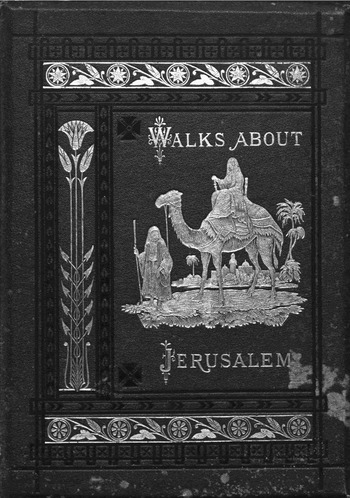
Viewing a scene from a particular vantage point excludes other possible perspectives. This framing has a counterpart in the second viewing habit of these Victorian illustrators, that of abbreviating a depiction of the region by using a visual shorthand, most frequently, an image of a camel and palm trees. As early as 1850, this iconography had become distinctly common in British visual representations of Palestine. As with any logo, this one helps to suggest that its topic is visible and so knowable. This icon often appears as a silhouette, the detail of its hypothetical scene shrouded through distance and a too-powerful light-source. For example, we see the icon of the gold camel and palms, here with the addition of a few other animals and a human figure in Arab-identified clothing in Samuel Manning's Religious Tract Society publication Those Holy Fields: Palestine, published two years before Daniel Deronda began its serialization. This iconography also appears in the gold camel embossed on the cover of John Kitto's The Land of Promise: or, a Topographical Description of the Principal Places in Palestine, and of the Country Eastward of Jordan (c.1850). W. H. Bartlett's Walks about the City and Environs of Jerusalem (1845) is also embossed in gold with the classic British icon of Palestine, a camel, and palms (Figure 8). This reliance on a visually simplistic iconography contrasts with the detail available in photographic representation, a visual alternative to hand-drawn media that was gaining cultural visibility in this period. Icons offer telegraphic communication, a visual shorthand to replace the more abundant information associated with realistic representation. Stripped of detail, an icon allows fantasy to fill in the blanks of what its image leaves out. Inviting perspectives on a place whose representation is narrowed to a suggestion rather than a scene, these icons imply that there is more to be seen, and that the viewer can have a role in imagining the view.
Cover of W. H. Bartlett's Walks about the City and Environs of Jerusalem (1845). 23 cm × 17 cm. Courtesy of the Thomas Fisher Rare Book Library, Toronto.

Such room for fantasy is germane to the third viewing habit of these British spectators of Palestine, their common feeling that the scenes available to them somehow illustrate the Bible, or that modern readers ought to be most interested in the contemporary appearance of the region so as to better understand Christian religious history. Palestine in the present becomes an illustration of its spiritual past self. An example of this trend comes in Kitto's The Land of Promise. Its excellent fold-out map of Palestine contributes to the book's qualities of positivist display, though it was published by the Religious Tract Society. Simultaneously discounting purely impressionistic or spiritual encounters with the region through religious history, as well as admitting the inevitably subjective nature of seeing land, the author announces in the preface that “[i]t is the object of the present work to describe every place or site of interest or importance in the Land of Promise as it now appears” (vii). Choosing “every place or site of interest or importance” relies on the tacit conclusion to Kitto's sentence: his real topic is Palestine “as it now appears to a British subject.” The apparitional quality that Kitto ascribes to these sights makes their visible aspect seem highly dependent on perspective, changeable as a spectre, and not bound by “reality.” Similarly, for an 1810 map of Jerusalem, Edward Daniel Clarke notes, “some attempt is made to reconcile Historical Documents with existing phenomena” (552). Present Palestine becomes a “phenomenon,” a perceived display to be reconciled with the equally real evidence of “Historical Documents.” Here writing, “documents,” and visible landscape vie for reality even as they collaborate in its production. These illustrators and authors invite a gaze on Palestine that imagines seeing both the Biblical landscape and the modern together at once, a view that represents a kind of spectral double vision that is blind to the actuality or contemporary reality of the region.
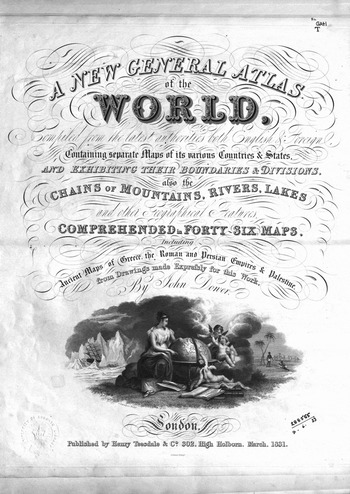
Even a geographic work such as John Doner's A New General Atlas of the WORLD (1831), a prose-less collection of maps, reveals Palestine's double life as both a contemporary place and a Biblical scene. The frontispiece (Figure 9) announces with exuberant flourishes and swoops in the only sentence of this book that it has been “Compiled by the latest authorities both English and Foreign” of maps “Exhibiting th[e] Boundaries and Divisions” of contemporary nations, as well as “Ancient Maps of Greece, the Roman and Persian Empires, & Palestine,” all created “from Drawings made Expressly for this Work.” This sentence emphasizes the reliance of Doner's images on “authorities” and the freshness of the views exhibited in its drawings, so as to shore up the semblance of authenticity of his images. As a work that sets out to display the “world” visually, Doner's atlas participates in what Heidegger thought of as the modern phenomenon of the world picture.Footnote 25 Visualizing the world depends on the idea that the world is knowable and open to being categorized. The inclusions and exclusions of world pictures like this one become ideological statements that imply political hierarchy. Physical geography, empire, and history here compete for organizational primacy: the maps of the “Roman and Persian Empires” give imperial history a primary place in the construction of the visible world, whereas in the maps of Ancient Greece and Palestine, classical pasts that have gained eminence in Western culture appear in maps of their own. The book represents Palestine twice, in the nationally vexed map of the Ottoman Empire entitled, “Turkey in Asia,” and in the map of “Ancient Palestine.” While Palestine was not thought of as a nationalized region in this period, its double placement in the present Ottoman Empire and in ancient history displays the competing classifications that defined its precarious knowability and visibility in the Victorian era.Footnote 26 Its importance as a “still-visible” Biblical past lets the region appear twice in the book: like a ghost, it is visible both in the present and as an history, an emblem of the past. As was so frequently the case in Victorian illustrations, Palestine as a contemporary place occupied by Palestinians does not exist in the visible “world” this book perceives. At once a nameless place in the present and the apparition of a Biblical past, Palestine in this book is a spectre.
Frontispiece of John Doner's A New General Atlas of the WORLD (1831). 52 cm × 28 cm. Courtesy of the Thomas Fisher Rare Book Library, Toronto.

Perhaps the most startling articulation of the insistence on seeing the past in Palestine comes in W. H. Bartlett's Walks about the City and Environs of Jerusalem (1845). In a book that addresses itself to the armchair traveller, Bartlett valorises walking through a city as the prime method of possessing or knowing it. The book thus participates in the cult of the flâneur that Baudelaire was brewing in the same period and a modernizing tourism culture that privileges the spectacle of travel.Footnote 27 A frontispiece offers a slanted bird's-eye view of Jerusalem.Footnote 28 Bartlett tries to enforce to a sense of his own modernity by claiming that earlier illustrated books on Jerusalem represented a “desultory” load, all of which lacked “correct and well-chosen Views” (Preface, n.p.). As a result, he formed
the idea of attempting to give a clear, connected, and accurate view of the City, by gradually tracing its progress from the earliest period of authentic history, [r]estoring its past appearance by a careful study of existing data, and exhibiting its present condition in a series of Views chosen with express reference to historical illustration, and in which the local character should be the only object, and where, at every step, the past and present should be compared. (iii–iv)
This passage demonstrates Bartlett's assumption that a perspective on the present can be derived from a history that is visible and a past that can be illustrated: the “present condition” of Jerusalem, can be “exhibited” through “a series of Views” that will offer “historical illustration.”
Both the visual and explanatory meanings of “illustration” are at work in this passage, in which Bartlett demonstrates his emphasis on the possibility of deriving knowledge from images of Palestine. Jerusalem itself is a series here, a collection of perspectives that, when gathered together by the right (British) illustrator-curator, can “trac[e] its progress” and present a coherent, authoritative, “clear, connected, and accurate view of the City.” Bartlett's hope for this view, which acts as both an exhibit and a perspective, denotes his faith in a British empirical vision of Palestine, a fantasy of knowing the region through sight that opens it to possession and creation while anticipating the colonial ambitions of Balfour's view.
Since Bartlett aims to depict both current conditions in Jerusalem and scenes from the city's past, it seems that for him the past and the present visibly coexist in Jerusalem. Bartlett's representation of the benefits of “restoring its past appearance” overlooks the possibility that the “restoration” could be a fictionalization. In the same passage, he continues, “[i]f the student who reads the history of Jerusalem in the Scriptures, or in Josephus, or the pages of later historians, can find in this little work any assistance in bringing before him a picture of what they describe the principle object of this writer is attained” (iv). Bartlett's explicitly male reader is enjoined to use these exhibits of “present” Jerusalem when reading scripture so that they may contribute to “bringing before him a picture” of the ancient history being narrated. In a very curious illustration of the purposes of illustration, Bartlett claims to be using images to retrieve past appearances while representing present states with accuracy, so that readers may use these contemporary images to imagine a religious past. This layered reproduction of visible Jerusalems, past and present, results in a spectral city whose visual representations hover between reality, imagination, and history.
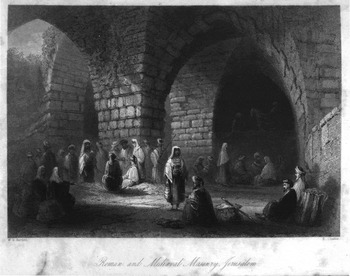
Because of this common representation of Palestine as a shifting and spectral landscape from the past, the authenticity of the images in these books is most starkly belied when they attempt to represent people in the present. The bodies of residents appear in Bartlett's images almost as part of the topography of the city, and their captions reveal the uneven admissions to visibility of human subjects. While the image captioned “Jewish family on Mount Zion” seems to be torn from the pages of a contemporary fashion manual, the one called “Roman and Medieval Masonry” (Figure 10) is ostensibly of a crowd of Arab men. This disjunction between the caption and what the scene seems to portray is an instance of unequal identification. While the Jewish family is made visible both in the label and the image, the caption of “Roman and Medieval Masonry” implies that Arab bodies are to be read as part of the antique architecture of Palestine. In an instance of what, in Fabian's terms, might be called a denial of coevality, Palestinians are cast as elements of an ancient landscape, rather than as people with a history that brings them into the present.Footnote 29 This captioning makes these bodies “invisible” in their own image, and exemplifies what Said describes as the disappearing of Palestinian experience in Western representation.Footnote 30 The caption is complicit in establishing the perspective viewers are meant to take in relation to this illustration. While the illustration is intended to be read for its authentic rendering of a scene, by representing a contrast between the title and the image, the caption itself belies the depiction of the illustration. The quest for visual authenticity in these images of present Jerusalem contends with the desire to see Palestinian space as a return of the past.
“Roman and Medieval Masonry,” in W. H. Bartlett's Walks about the City and Environs of Jerusalem (1845). Courtesy of the Thomas Fisher Rare Book Library, Toronto.

As book illustrators continued to represent Palestine through the nineteenth century, the invention of photography brought some of them a new source of “authentic” visual details. Though only one of the books I include here contains photographs, their presence in illustrated travel books rose sharply through the last period of this study, when late nineteenth-century halftone processes allowed photographic images to be mass-produced.Footnote 31 Curiously, although halftone photoreproduction processes were available at the time of its publication, Margaret Oliphant's account of her 1890 excursion to Palestine, Jerusalem the Holy City: Its History and Hope (1892), includes “wood engravings from drawings and photographs.”Footnote 32 This reproduction of both photographic and drawn images using wood engraving allows all the images in this book to appear under the visual system of one medium. The design choice also combines the seeming “here-and-now” authenticity of photography and on-site drawing with the preference for older printmaking methods in the visual fashion of the day: in the 1890s older image reproduction processes like wood engraving carried a particular charm and semblance of authority.Footnote 33 Though electrotyped or halftone reproductions of original photographs of Oliphant's travels might have brought their own authenticity as more immediate documents of the region, the wood engravings offer the sort of visual linkage of past with present that British illustrators of Palestine often attempted to depict. Oliphant's layering of visual reproductions actively deploys particular media to argue for the authenticity and authority of their views of Palestine, belying Benjamin's suggestion that “the technology of reproduction detaches the reproduced object from the sphere of tradition” (“Work of Art” 22). Photography brought a new visual mode of referencing real Palestine, but it did not offer an immediate replacement for the veridicality of older techniques of visual representation.
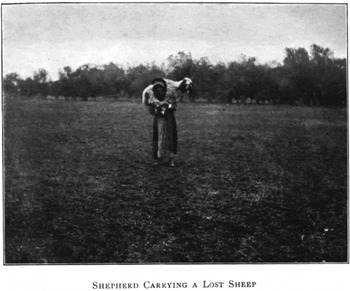
Ten years after Oliphant's voyage, adventure writer H. Rider Haggard attempts to use photographs directly to render authentic views of Palestinian reality in A Winter Pilgrimage: Being an Account of Travels Through Palestine, Italy and the Island of Cyprus, Accomplished in the Year 1900 (1901). Opening a century of “documentary” realism in visual media, this is the only Victorian book containing photographs of Palestine that I found in the Fisher collection.Footnote 34 The photographs throughout are referred to as “illustrations.” As with Bartlett's depiction of Arabs as architecture, Haggard's captions sometimes enact spurious vanishings of what his images ostensibly portray. For example, an image of four Arab men in a boat is labelled as “Boat on the Sea of Galilee,” rather than “boaters.” These photographic “illustrations” pretend to the realism modern viewers frequently expect of photographs, but they also often operate like hand-drawn images in their imaginative enactment of scenes in the text. For example, a photograph captioned “Shepherd Carrying a Lost Sheep” (Figure 11) depicts both an actual experience of the author and a vision of Palestine as inscribed with Jesus’ famous acts and symbolism. Though it is clearly staged, this image does ask to be interpreted as a spontaneous and therefore more authentic representation. The sheep is a “lost” sheep, as though this shepherd had just happened upon the photographer as he supposedly happened on Jesus, and Haggard himself. This particular sheep, however, has evidently been found. Describing it as “lost” in the caption allows the scene to mirror Jesus’ parable of salvation, in which the repentance and retrieval of one human sinner, a “lost sheep,” is worth more to heaven than the virtue of the rest of the flock.Footnote 35 This image thus uses photography to communicate that Jesus’ historical promise of salvation is visibly real in modern Palestine.
“Shepherd Carrying a Lost Sheep,” from H. Rider Haggard's A Winter Pilgrimage (1901). 14 cm × 11 cm. Courtesy of the Thomas Fisher Rare Book Library, Toronto.

Haggard's use of photography here makes this scene seem more authentic and truthful – Palestine as it now appears. Yet this image also relies on the assumptions of illustration, which presumes that an informative image may be staged if it is meant to reflect a text. In a culture accustomed to drawn illustration as the primary mode of mass-produced visual representation (whether printed in steel or wood engraving, halftone, or lithography), and familiar with photographs of still people because of long exposures, images in books at this time were still meant to be “set up.” Whereas we expect drawn illustrations to reflect texts, photographs are now supposed to be more happenstance, caught in a real moment, not staged to suit an author's purposes. This different standard of visual interpretation derives in part from the year this book was written, 1900, when Eastman introduced the Brownie, the first portable, affordable, and “fast” camera that allowed regular folk to take what we now call “snapshots” (Brayer 204). Such photographs created the value of spontaneity as a measure of photographic meaning. Before the snapshot, photographs were not expected to depict spontaneous moments such as this image pretends to represent. Spontaneous photography was not yet widely available to travellers, but this image, like others in Haggard's book, declares its own authenticity by implying that it reflects the contemporary landscape (viewed as the Biblical past) as well as the text at hand, as though the author had had a Polaroid camera in his pocket while travelling.
Though the photograph was clearly set up, Haggard writes of the scene actually occurring during his travels. On his way back to Haifa he
met a shepherd clothed in a robe of many colours, doubtless such as Jacob gave to Joseph and bearing upon his shoulders a lost sheep. This illustration of the saying recorded in St. Luke was really remarkable. “What man of you, having an hundred sheep, if he lose one of them, doth not leave the ninety and nine in the wilderness, and go after that which is lost until he find it? And when he hath found it, he layeth it on his shoulders rejoicing.”
It shows once more how closely the Saviour clung to the use of natural examples around Him as a groundwork of His parables, and how little those examples have changed in the course of nineteen centuries. (246–47)
In his willingness to imagine Palestine as unchanged since ancient times, Haggard evinces the Victorian feeling that things mostly “look different” in the modern world, a region that, for him, does not yet exist in Palestine.Footnote 36 There, people (“natural examples”) exist like plants or rock formations whose rate of change over time is imperceptible, who represent the Christian past to British visitors but are without lived history of their own. This passage displays Haggard's eager insistence on seeing the Biblical parable illustrated in Palestinian land and life. Its accompanying image is a picture of landscape seen as a repetition of the Bible, rather than a “realistic” depiction of contemporary Palestine. This photographic illustration is thus an illustration of an illustration, an echoing chamber of representations of representations. An artifact of a shifting visual culture, it is steeped in traditions of realism, static photography and illustration, even as it anticipates emergent modes of making and interpreting photographs. Even seen through the more “authentic” lens of photography, Palestine remains a spectral illustration of the Bible, the visible reproduction of a religious past mapped onto a landscape.
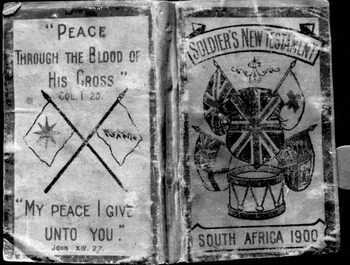
Whereas Haggard's work uses the new technology of photography to make real Palestine feel more immediate for Victorian book viewers, another illustrated work of the same year, H. A. Harper and J. Clark's tiny and well-worn The New Testament of Our Lord and Saviour Jesus Christ: Illustrated from Original Drawings Made in the Holy Land (1900), marshals images of Palestine to affect the reality of another country. Hugh Anson-Cartwright, an antiquarian book dealer from Toronto, donated this book to the Fisher library in 2005, likely because it formed excess stock (Carefoote). The book is filled with landscape illustrations of Palestine (Figure 12), while its cover is painted with nationalist signifiers (Figure 13). The Palestine portrayed in this edition is meant to be seen from South Africa, since the book was printed in London to be taken by soldiers to the Boer War, one of the last to be fought by Britain for purely and admittedly imperial goals (Saunders and Smith 618). The date and location of the war at hand are noted on the binding of the book as though in a kind of notch-marking of conquests. For the soldiers who were given this book, images of an ancient promised land may have reflected a viable perspective on the present contested land of South Africa.
“Jerusalem,” from H. A. Harper and J. Clark's The New Testament (1900). 11.5 cm × 7.5 cm. Courtesy of the Thomas Fisher Rare Book Library, Toronto.

Cover of H. A. Harper and J. Clark's The New Testament (1900). 24.5 cm × 7.5 cm. Courtesy of the Thomas Fisher Rare Book Library, Toronto.

Small, nationalized Bibles like this one offered many Victorian soldiers in many wars moral comfort to fuel their motivation in battle. Writing of the activities of the influential British and Foreign Bible Society (BFBS), Leslie Howsam explains that the Crimean War of the 1850s “initiated a resolution to provide a New Testament to each soldier going on service,” an undertaking that some society members seem to have read as a direct contribution to the imperial project (181). The Harper and Clark New Testament thus supports the odd notion that images of Palestine were used to muster the conquest of South Africa. Howsam observes that in its circulation of masses of such small cheap Bibles through the nineteenth century, the BFBS tended not to publish illustrated editions (99), making this particular Bible all the more noteworthy. While it may seem inappropriate to align works that appeal to a touristic, or “realist” interest in a landscape with works that, like this one, attempt to illustrate the scenes of a religion, in the visual culture of the era and the Victorian gaze on Palestine these purposes overlapped. Bar-Yosef cautions against so direct an interpretation of the imperialism in British attitudes towards Palestine in this period, arguing that their origins in religious history contradicts Said's description of a purely colonialist Victorian Orientalism (4–7). Nevertheless, this particular work demonstrates that images in religious books could indeed contribute to colonialist discourse frequently thought to be more evident in books devoted to tourism or geography.
While the Harper and Clark New Testament does not direct active colonialism towards Palestine itself, it demonstrates that such a proprietary view of the region could further Victorian colonialism, and that, just as Mordecai bestows his perspective on Deronda, Victorian perspectives on Palestine were transferable to colonial projects in other countries. The imagined visibility of the Palestinian past offered Victorian spectators an entitled view of another present-day landscape. This hypothesis casts a strange light on the “view” of Palestine taken by Balfour seventeen years later, as well as on the visions Eliot gave Mordecai twenty-four years earlier. The illustrations in this book and their intended use both demonstrate and are complicit in the seepage of the idea of “Promised Land” into British colonial epistemology.Footnote 37 The inheritance of the concept may have spurred colonial feelings of entitlement towards other landscapes, while thinking of Palestine as “promised” and therefore already possessed may have seemed natural to those immersed in the imperial project. This vision of a Biblical Promised Land seems to have offered enduring inspiration to colonial imagination, itself a visual practice and a possessive way of regarding the landscapes of others. The image as well as the idea of the Promised Land encouraged imperial attitudes both towards Palestine – a spirit evident in the Balfour Declaration – and towards other countries where Britain was at war. Acting like shades printed with fantastical images and covering Victorian thoughts of Palestine, these perspectives are as much blind spots as scenes of reality.
Like the other books I discuss here, the Harper and Clark New Testament displays the political and religious fantasies that combined to transform “real” Palestinian landscape through the windows of Victorian print culture. The views in these illustrated books rely on captions to privilege the authenticity of some geographies and bodies over others and represent suppressions and fabrications of reality as much as transcriptions. In these works, Victorian perspectives on Palestine that are born from contests of authorities, quests for authenticity, and elisions and creations of detail, reproduce a spectral landscape from the past that is difficult to dissociate from a “visible” religious history.
Conclusion: Viewing Palestine through a Book
The illustrations in these books must be regarded not as they present themselves, as transparent windows on Palestine, but as visible British visions of the region that are by times as fantastical as Mordecai's. Each of the illustrations in these books amounts to a printed gaze on Palestine, a portal onto Victorian perspectives working in tandem with the sights in Daniel Deronda, and prefiguring Balfour's “view.”
Both Daniel Deronda and these illustrated books offer insight into Victorian culture's construction of an imaginary Palestine. In Eliot's work, reality can be accessed through vision, characters are real insofar as they are visible, the visibility of printed images offers a mode of accessing the real, and the “East” remains an invisible landscape that is nevertheless open to Mordecai's visions and gaze. The illustrated books that make claims for their “clear, connected, and accurate” views rely on a similar faith in the accuracy of vision and visual representation. The visual statements about Palestine in these books, like Mordecai's convinced visions, sweep past the risks of unverified verbal claims. They make arguments that seem to present knowledge about reality in a single glance, and invite perspectives that are easy to adopt in an instant, thus opening up new but not necessarily accurate points of view. Though there is reason to have more faith in Eliot's perspicuity than Haggard's, had she visited Palestine she too might have seen only “illustrations” of the Old Testament, scriptural real-estate deeds seeming to prove a British entitlement to and favourable “view” of establishing a Jewish state in the region. Mordecai's visible future and the visible history that nineteenth-century illustrators saw in Palestine create the region as a reproducible spectre, opening it up to Victorian perspectives and fantasies of possession.
Bar-Yosef opens his account of Victorian attitudes towards Palestine with “an image that encapsulates the English fascination with the Holy Land: an image of a reader and a book” (18). While for most Victorians the book implied in this imaginary scene of reading would have been the Bible, other books could also have found their way onto that hypothetical reader's lap – Daniel Deronda and numerous illustrated travel books among them. In Bar-Yosef's reader we must also see a viewer of texts and their scenes, a person gazing at Palestine from a distance, through a book and from an inevitably ideological perspective. Isobel Armstrong suggests that the Victorian icon of an “isolated figure at the window” who “gazes from a hidden interior” displays a viewing subject who “claims ownership” of the spaces she occupies and gazes upon (7). The “hiatus of the window,” Armstrong writes, “dramatizes the uneven relation of subject and object” and is “the disputed space of the century” (7). The printed page, with its semblance of transparency, is another space in dispute, a hiatus posed, in this instance, between the present and the past, between Victorian Britain and the Middle East. Similarly, the picture-viewing reader, shaded by the pages of books while gazing through their windows onto distant landscapes, must be counted as another powerful Victorian subject exerting control on the scene outside.