Assessing the early career of Aaron Copland, a man best known for works that are “virtual signifiers of American culture,” Carol Oja has argued that the composer, grasping the importance of having “both an international purview and a national one,” developed a “transatlantic gaze” in the 1920s.Footnote 1 Elizabeth Crist's book-length study of Copland's next decade, by contrast, depicts a composer turning increasingly toward domestic political concerns. She contends that Copland's music from the 1930s, with its folk music quotation and narratives of small-town life, shows his attraction to progressive politics, the Popular Front, and “communism as a social movement and political philosophy.”Footnote 2 Crist's excellent analysis of Copland's music from the 1930s in this context has brought significant attention to his domestic activities, but the “international purview” Oja diagnosed has not received the same level of attention. In this study I reexamine Copland's internationalist philosophies, demonstrating their relevance far beyond the 1920s for our understanding of both his politics and his music.
My assessment of Copland's internationalism arises from an investigation of a neglected aspect of his career: his four-decade commitment to government-funded cultural diplomacy. Beginning during the Second World War, when Copland helped the State Department establish an exchange program with South American countries, his work with government departments and agencies reached a peak during the Cold War, when he toured overseas repeatedly as a cultural ambassador. Between the 1940s and the 1980s Copland became one of the State Department's most dedicated composer-ambassadors, even serving unofficially in this capacity when he traveled abroad without government funds. During this same period he worked closely with the U.S. Information Agency (USIA), a government agency that promoted State Department–funded tours of cultural diplomats, organized events for musicians on privately funded international tours, and provided information to foreign citizens about the United States and its culture.
Crist has argued that Copland's work to create cultural diplomacy programs with the U.S.S.R. during World War II reveals that he was still attracted to the Soviet Union and all its political system had to offer in the early 1940s.Footnote 3 This claim implies there may have been some validity to Senator McCarthy's suspicions about Copland's affiliations, which were voiced in 1953 when the composer appeared before the Senate Committee on Permanent Investigations as part of an investigation into possible communist infiltration of State Department programs. McCarthy also interrogated Copland about the political implications of his attendance at the Conference for World Peace in 1949. In fact, an analysis of Copland's work with the federal government demonstrates that his profound investment in internationalism played a greater role in his decision to participate than any other political commitment. From the 1940s onward, Copland was far more concerned with helping his country build peaceful relationships with other nations than with encouraging radical political change within the United States.
Copland's attitude to world affairs shows all the markers of a multilateral, universalist approach to internationalism. As historian Akira Iriye asserts, internationalism is a form of global consciousness, “the idea that nations and peoples should cooperate instead of preoccupying themselves with their respective national interests or pursuing uncoordinated approaches to promote them.”Footnote 4 Artistic and cultural leaders had always played a central role in internationalist activity: In the years following World War I, for example, many European intellectuals believed that “‘a league of human intellects,’ not just an association of nations, was needed to establish a peaceful world.”Footnote 5 Although internationalism had historically attracted supporters from across the political spectrum, divisions grew during and after World War II. As the Cold War began, internationalists were split over whether to take a unilateralist stance, with the U.S. leading the free world against totalitarian communism, or a multilateral, universalist approach, in which the United States would lead a group of nations that would work together to ensure global peace.Footnote 6 For a brief period in the late 1940s both paths were considered viable, but by the early 1950s the former had become pervasive and the latter deemed a signifier of radical leftism. Against this background Copland's cultural diplomacy work and his speech to the Conference for World Peace are revealed as attempts to encourage universalist internationalism, evidence of his interest in building peaceful relations with all nations rather than a continued commitment to communism. Inevitably both his internationalist and communist interests grew out of the same fundamentally left-wing political philosophy. Communism, however, was a relatively short-term interest when compared to his enduring passion for internationalism.
Copland remained an active servant of government and an enthusiastic promoter of the possibilities of cultural diplomacy even after his traumatic hearing before McCarthy and his subcommittee. This finding raises questions about the merits of limiting discussions of Copland's politics primarily to the 1930s and 1940s. Crist has argued that “in the years after his encounter with Senator McCarthy, Copland increasingly concerned himself more with abstract musical concerns than with social or political issues.”Footnote 7 Yet why would a man devoted only to “abstract musical concerns” choose to serve his country overseas in his government's battle against global communism? Given that so many former communists became cynical and withdrew from political engagement during and after the Red Scare, we can only assume a more encompassing agenda underlying his commitment to cultural diplomacy. Indeed, McCarthy's anticommunist attack would only briefly interrupt Copland's internationalist efforts.
Copland's work with the federal government also brings new evidence to the scholarly debate about Copland's stylistic change of direction during the 1950s. Jennifer DeLapp, whose dissertation was the first to explore Copland's McCarthy hearing and its impact, argues that Copland's music changed in style in response to the anticommunist movement, becoming less overtly political. Nevertheless her analysis of the 1950 Quartet for Piano and Strings shows that she believes Copland remained invested in making a political statement of sorts in his music. DeLapp sees this piece as a musical representation of Copland's desire to reconcile Cold War political oppositions, represented musically by tonality and serialism. At the same time, she argues, the work marks a musical about-face in which Copland distanced himself from his previous approachable, tonal music, which some, by that time, associated with communism.Footnote 8 Thus, according to DeLapp, Copland was moving away from accessible musical messages even before the confrontation with McCarthy; and yet a political message of sorts remained just beneath the surface. Howard Pollack, meanwhile, has usefully observed in much of Copland's music an engagement with broader issues that he describes as a “powerful moral presence.”Footnote 9 Pollack associates this attitude with an understanding of prophecy most commonly associated with Judaism and the Hebrew Bible. He finds far fewer prophetic statements in Copland's late works than in the earlier ones, although he does argue that Copland remained a “deeply engaged citizen from the beginning of his career to the very end.”Footnote 10
Crist, DeLapp, and Pollack all agree, therefore, that the anticommunist movement brought about a change in Copland and his music. Pollack and Crist see less political engagement in Copland's later works, whereas DeLapp sees a political message in the Quartet but one that deals with communism and capitalism. Copland's work with the government adds support for their assertion that Copland grew increasingly pragmatic about his self-presentation and political actions after his encounter with McCarthy. Indeed, Copland's recognition that he needed to adapt to the political climate of the 1950s initiated a rebranding exercise, which he undertook with the help of government agencies that also benefited from a depoliticized Copland. Yet despite Copland's increasing awareness of the need to neutralize his actions and his music, his ongoing governmental work shows he remained committed to affecting political change—an attitude that is also reflected in his music. The seemingly abstract orchestral work Connotations, for example, shows that Copland continued, as he always had, to confront contemporary political challenges in his music, even as this engagement became—as in his other activities—less overt. Indeed, most of the music in Copland's oeuvre that appears abstract in fact spoke in some way to contemporary issues relevant to all humanity.
Creating U.S. Musical Diplomacy, 1941–1949
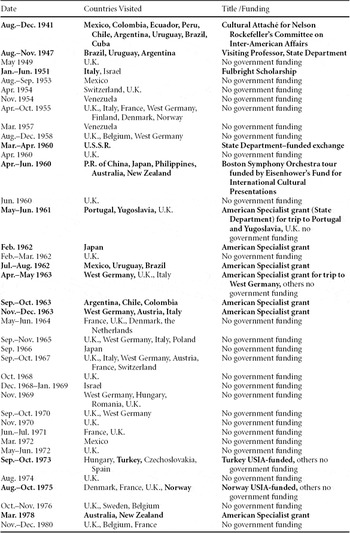
Copland had always been interested in travel, living in Paris during the 1920s and visiting Mexico during the 1930s, but World War II brought a new focus to his international interests. The year 1941 marked the first of a series of foreign tours Copland undertook regularly until his late seventies. As Table 1 demonstrates, fourteen of his thirty-nine international trips (many of which were multicountry tours) were organized and paid for in part or in full by the State Department, the USIA, or another government body. On the trips Copland undertook as a paid cultural diplomat, he visited twenty-four countries in South America, Europe, Asia, and Australasia, many of them two or three times. Considering each country and each visit individually, Copland's travel and living expenses between 1941 and his death were covered by the U.S. taxpayer 36 percent of the time that he traveled on work-related trips overseas. (Some trips also brought an additional stipend of some kind.)
Aaron Copland's Trips to Countries outside North America after 19241

1This table is based on my analysis of papers pertaining to Copland's engagements and travel in the Copland Collection at the Library of Congress. Bold font indicates that Copland was fully reimbursed for travel and living expenses by a governmental body while visiting this country. In many such cases, he also received an additional stipend.
Even before Copland began touring for his government, however, he was involved in helping to shape the program that would make such tours possible. From November 1940 to September 1941 he advised the Music Committee of Nelson Rockefeller's Office for Coordination of Commercial and Cultural Relations between the American Republics, later the Office of Inter-American Affairs (OIAA), which created programs to reduce the appeal of fascism in the Americas by strengthening interhemispheric relations in line with Franklin Roosevelt's “Good Neighbor” policy.Footnote 11 In June 1941 the OIAA committee was moved into the State Department, and Copland served on the new Advisory Committee on Music until June 1943.Footnote 12
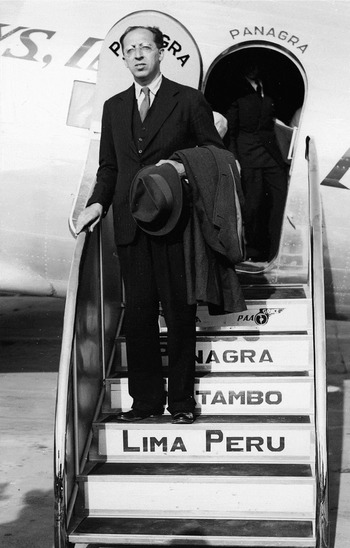
From the outset Copland used the inter-American exchange program to help nurture hemispheric understanding through cultural exposure. He apparently recognized and shared his government's concern about international perceptions of high culture in the United States, writing in notes for a speech given in Brazil in 1947: “The usual idea: America pays for its commercial development by lack of cultural development. Our fear = ideas of America will be derived solely from Hollywood movies, Time magazine, jazz records or even: Hemingway.”Footnote 13 His primary response to this challenge was to encourage a range of programs to promote U.S. music overseas, particularly concert music—a project to which Copland had long been dedicated.Footnote 14 At the February 1941 meeting, for example, Copland suggested that the committee offer grants to record U.S. works that at the time were unavailable on LP for distribution across South America, along with existing commercial recordings.Footnote 15 After his first tour as a State Department–funded cultural ambassador (August to December 1941; see Figure 1) Copland became even more ambitious, calling for the establishment of U.S.–funded cultural centers in South American cities. He recommended that each center be stocked with a selection of representative recordings (presumably those previously suggested), accompanying scores, and leaflets about U.S. composers in the local language. The same materials could be distributed to local radio stations, Copland proposed, and he appended a list of stations in the countries he had visited that had expressed a willingness to cooperate with such a plan.Footnote 16
Aaron Copland deplanes in Lima, Peru [1941]. (Aaron Copland Collection, Box 483, Folder 18, Library of Congress, Washington, D.C. Provided by courtesy of the Aaron Copland Collection at the Library of Congress.)

Copland's vision of international understanding through culture also required increased U.S. exposure to its neighbors' music. In 1941 he proposed that the United States pay for “the printing and distribution of Latin American composers’ works” to help “creat[e] good-will . . ., since practically none of them have ever seen their orchestral or longer chamber music scores in print.”Footnote 17 He also encouraged the publication of a magazine in English, Spanish, and Portuguese containing articles written by “musicians of both sides of our hemisphere” to “set up a continuous sense of solidarity in musical endeavor.”Footnote 18 Copland's language in these suggestions underscores his faith in the potential for foreign relations to build international kinship among artists.
An acknowledgment of the internationalist attitudes motivating Copland's inter-American cultural efforts becomes more significant when we come to evaluate his concurrent participation on U.S.–Soviet committees, an aspect of his advisory work that has drawn more attention and controversy. These committees include the Sub-Committee on Musical Interchange with the U.S.S.R. (which answered to the State Department's Music Advisory Committee), on which Copland served from February to May 1944, and the Music Committee of the National Council of American Soviet Friendship, a nongovernmental organization to which he contributed from August 1943 until it broke away from the National Council to become the American-Soviet Music Society in February 1946. In 1953 McCarthy and his committee saw these memberships as indicative of Copland's attraction to the politics of the Soviet Union.Footnote 19 DeLapp, however, argues that they indicate only his “friendly interests in Russian musical life” and do not represent “political expressions of sympathy with international communism.”Footnote 20 By contrast, Crist has claimed that this work demonstrates Copland's dedication to “a Popular Front blend of American cultural nationalism and pro-Soviet sentiment” that continued beyond the 1930s into the 1940s.Footnote 21 Crist's principal evidence for this claim is the influence on Copland of Serge Koussevitzky, who also sat on these committees and who, she maintains, strongly supported both the Popular Front and the Soviet Union. This evidence seems problematic, given that DeLapp, at least, has argued that Koussevitzky “opposed the Soviet government.”Footnote 22 Furthermore, whatever the nature of Koussevitzky's politics, they can hardly serve to delineate conclusively Copland's own reasons for serving on these committees.
In fact, Copland's efforts to encourage U.S.–Soviet exchange appear little different from his contributions to inter-American cultural diplomacy. Minutes and other documentation from these committees show he hoped to use culture to better international relations and nurture peace—goals that were central to universalist internationalism during this period, which placed high priority on promoting good relations between the United States and the Soviet Union.Footnote 23
Both of the U.S.–Soviet committees on which Copland served asserted cultural exchange as their primary goal. The State Department's Sub-Committee on Musical Exchange with the U.S.S.R. charged itself with providing advice regarding “enterprises which the State Department could appropriately undertake” to facilitate U.S.–Soviet exchange of music and musicians.Footnote 24 The nongovernmental Music Committee of the National Council of American Soviet Friendship stated the benefits of such activities more clearly, showing the same belief in the power of cultural exchange that we saw in interhemispheric efforts: “Through increased knowledge and use of Soviet music in this country [and] likewise the introduction of American music and information about American musicians in the Soviet Union, the Music Committee can develop friendship and understanding between the two countries.”Footnote 25 Copland's own contributions to the National Council of American Soviet Friendship consistently emphasized such cultural dialogue. As the minutes record, “Aaron Copland said that the activities of the Music Committee should be in the nature of an exchange of information material between the American and Soviet musicians.”Footnote 26 He also agreed to chair a Concert Music Committee that would seek “to promote closer relations between American and Soviet composers, conductors, critics and performing concert musicians; to establish a direct interchange of musical materials and ideas; and to further the distribution and performance of American music in the Soviet Union and of Soviet music in this country.”Footnote 27
Copland's agenda remained consistent beyond the end of the war. In 1946 the Music Committee decided to break away from the National Council of American-Soviet Friendship to form an autonomous body, affiliated with the council. Copland was involved in founding this new organization, the American-Soviet Music Society, and he chaired its first meeting.Footnote 28 In his address at this first meeting Copland spoke of the importance of building “a two-way street,” thereby emphasizing his desire to bring Soviet representatives to the United States as well as sending U.S. cultural products to that country, just as he had in regard to South America. He also said he would prefer the State Department to take the lead on these exchanges: Its Sub-Committee on Musical Exchange with the U.S.S.R. had by now ceased to exist, presumably in response to growing U.S.–Soviet tensions. Nevertheless, Copland said, it had been made clear to him that State Department staff would “support—but not organize,” which is significant given McCarthy's later assertions that this organization supported communists.Footnote 29
Universalist Internationalism and Anticommunism, 1949–1954
Copland's idealistic vision for postwar peace, very much in evidence in his inter-American and U.S.–Soviet committee work, was far from unusual during this period. As Andrew Falk has argued, many artists “sought ways to use their positions as purveyors of national culture to influence U.S. post-war character and foreign policy.”Footnote 30 As they had since much earlier in the century, these individuals believed that the kind of world community they envisioned could only come about through education, exchange, outreach, and cultural dialogue.Footnote 31 In 1948 such attitudes resulted in the creation of the Fulbright Program and UNESCO—both key institutions for those who believed in the power of culture to bring nations together.Footnote 32 Many people felt that additional steps needed to be taken, however, to destroy any chance of another world war.
In 1949 Copland gave a speech at the New York World Peace Conference that provides perhaps the best evidence of his commitment to internationalist ideals. Unfortunately many Americans, including Senator McCarthy, interpreted his words as a gesture of appeasement that was both pro-Soviet and even pro-communist. The event itself, moreover, now marks an historical turning point in the United States’ rejection of the far left, especially after Sidney Hook and others alleged it had received funding from Moscow (although scholars today continue to debate the accuracy of this assertion).Footnote 33 Certainly U.S. communists organized and attended the event, and participants such as Clifford Odets and Norman Mailer used their speeches to advocate not only for peaceful relations with the U.S.S.R. but also for an end to capitalism. Others proclaimed socialism the best hope for Europe.Footnote 34 Had Copland been interested in promoting an alternative political system for the United States or Europe at this occasion, he would certainly have found a sympathetic audience.
Copland, however, did not speak of the merits of communism or any other political system—indeed, he asserted he was “not at all interested in doctrinaire communism”—nor did he offer his support for the Soviet Union.Footnote 35 Although he began his speech with an objection to his government's “determinedly unfriendly” attitude toward the U.S.S.R. and its attempts to brand peace a “dirty word,” he balanced this criticism with an attack on the Soviets for “condemn[ing] in advance” all Western music.Footnote 36 The central topic of Copland's speech was in fact the detrimental effect of the Cold War on artists—a war that “permeates the atmosphere with fear and anxiety.”Footnote 37 As he had so many times previously, Copland argued that cultural diplomacy was the solution to current international tensions:
All of us are aware of how powerful an agent art can be in giving all humanity a sense of togetherness. How unfortunate it is that our lawmakers have so little conception of the way in which the work of our composers, painters, and writers might be used in order to draw closer bonds between our own people and those of other nations.Footnote 38
By using this political event to offer his opinions about the power of culture, Copland's speech had more in common with those given by noncommunist scientist delegates who attended to urge the abolition of atomic weapons than it did with the communist calls-to-arms of Mailer and Odets.Footnote 39
In his speech Copland described the challenges he had faced on his two U.S.–Soviet committees in initiating cultural exchange with the U.S.S.R. Particularly upsetting to him was a U.S. tour by two Ukrainian singers arranged through the State Department Subcommittee on Musical Exchange with the U.S.S.R. This small-scale effort to initiate artistic dialogue was, Copland said, quickly thwarted. The Justice Department judged the Ukrainians’ visit “political in nature” and determined that they would have to register in the United States as “agents of a foreign power,” thereby essentially branding the singers as Soviet spies and necessitating their immediate departure. The incident, Copland reported, “naturally threw cold water on future projects for musical interchange.”Footnote 40 It is important to emphasize that although the U.S. government was not operating many cultural diplomatic programs in 1949, five years later the State Department put into effect its first global effort in this domain and finally, in 1958, signed an agreement with the Soviets that made possible the “exchange of persons” between the two superpowers. Copland's speech to the Conference for World Peace thus demonstrates that he was committed to encouraging cultural exchange with both enemies and friends of the United States even when the idea was out of favor in Washington. Unfortunately his decision to speak out for U.S.–Soviet cultural exchange soon raised the suspicions of the growing number of fervent anticommunists in the federal government.
Four years later, summoned before McCarthy's committee, Copland was asked to explain why he had attended the World Peace Conference. In his response he again voiced support for cultural exchange as a mechanism to promote music by U.S. composers, encourage international artistic conversation, and build more peaceful political relations:
I sponsored [the Peace Conference] and attended it because I was very anxious to give the impression that by sitting down with Russian composers one could encourage the thought that since cultural relations were possible that perhaps diplomatic relations were possible. I did not go there to advance the Communist line or in any way encourage their operations.Footnote 41
Copland emphasized that he had no “anti-American” or pro-communist motivations in undertaking cultural exchange, as McCarthy claimed. In a particularly powerful handwritten document from his papers entitled “My Record,” Copland lists his many contributions to his nation. Clearly he thought these contributions ought to be sufficient to prove his patriotism:
As an advisor to the State Department's Cultural Program.
As a participant in that program.
As a composer who has given America increased cultural standing abroad.
As a composer of works known for their Americanism.
As a practicing musician with no interest in politics as such.
As a liberal and humane artist.
As a composer who is a civic-minded person.
As a musical “ambassador”: my belief in the value of musical interchange as a means of relieving tensions and cementing friendship.
As a worker in that field in Latin America and Europe.Footnote 42
It was essential, of course, that Copland downplay non-mainstream political interests during a hearing that threatened his career and that he emphasize features of his cultural diplomatic work that demonstrated his patriotism. This reality, however, does not diminish the value of this document and his responses to the McCarthy committee, which are entirely consistent with his earlier statements and actions. At least since the early 1940s Copland's political focus had been consistently international and almost entirely focused on “relieving tensions and cementing friendship.” Furthermore, he had repeatedly shown himself to be a “civic-minded person” who believed in cultural exchange as a means to give “America increased standing abroad” by bettering foreign appreciation of its musical life, thereby decreasing the chances of international conflict.
In 1954, just one year after his McCarthy hearing, Copland attended an event that has been little mentioned by those who study his politics and that raises yet more questions about the strength of his commitment to communism: a festival in Rome entitled “Music in the XXth Century” hosted by the Congress for Cultural Freedom (CCF). The CCF was ostensibly a private organization but in fact was funded by the CIA, as journalists revealed in 1967. Significantly, the CCF was not only overtly anticommunist but was also created in response to the Waldorf Peace Conference. The Congress's founders, including Dwight Macdonald, Sidney Hook, and Nicolas Nabokov, made no secret of the fact that their goal was to lead influential left-leaning European intellectuals and artists away from Marxism and toward a pro-U.S. stance.Footnote 43 This particular CCF festival concentrated heavily on atonal and dodecaphonic music in order to make plain the differences between Soviet and Western culture. As Frances Stonor Saunders has written, “For Nabokov, there was a clear political message to be imparted by promoting music which announced itself as doing away with natural hierarchies, as a liberation from previous laws about music's inner logic.”Footnote 44 No information survives regarding Copland's own attitude toward the conference nor his reasons for attending, but had he supported the communist voices at the Waldorf Conference he likely would have declined to attend the CCF's festival. Instead, the event represented for Copland yet another opportunity to build positive relationships with European composers and increase the profile of U.S. composers. A pragmatic recognition that attendance at an anticommunist event would help his image with the anticommunist mainstream may also have played a role. Nevertheless he would have had to be very cynical to accept both engagements if a commitment to communism had been his reason for attending the Conference for World Peace.
This covertly CIA-funded appearance was not mirrored by a return to favor for Copland in the State Department. Apparently its staff were disinclined to employ him so soon after McCarthy had used him to draw attention to the deployment of suspected communists as U.S. representatives. A note in Copland's McCarthy hearing papers indicates he was bitter about their sudden lack of interest:
If the State Dept, though they gave me Security Clearance [for a Fulbright Scholarship to Italy in 1951] as recently as two years ago, now fears to use me because of congressional allegations as to my political affiliations, I sincerely feel it leaves a greater gap in our cultural exchange program than it does in my own life. For as a creative artist [word(s) illegible] better to stay quietly at home.Footnote 45
Cold War Cultural Diplomacy
It is ironic, given that Copland appeared before McCarthy as part of an investigation of communist infiltration in the State Department, that his return to the position of state-sponsored ambassador in the late 1950s took the form of a trip to the U.S.S.R. In the meantime, attitudes toward both McCarthy and the leftist artists he had attacked had changed. Andrew Falk has argued that Eisenhower began to realize, after McCarthy's censure in December 1954, that the overseas promotion of progressive artists as cultural diplomats could usefully supplement U.S. Cold War efforts. This sea change was influenced by surveys of Europeans who consumed American cultural diplomacy; many of these consumers emphasized that they preferred to view a politically diverse array of U.S. attractions.Footnote 46 Nevertheless, this reorientation of the program needed to be pursued with care and without overtly reminding Europeans of an artist's leftist inclinations. Copland himself must also have had a change of heart, perhaps feeling more enthusiastic about collaborating with the State Department after the death in 1959 of Secretary of State John Foster Dulles, who was known for his aggressive anticommunist stance. Dulles's successor was Christian Herter, who had been opposed to permanent subcommittees investigating un-American activities and was invested in building peaceful relations with the Soviet Union. The year 1958 also saw the end of the passport denials for suspected communists that had affected Copland for much of the decade.Footnote 47
Furthermore, whereas Copland's vocal support for exchange with Soviet musicians was seen as almost treasonous in the late 1940s, a decade later the climate was entirely different. Following Nikita Khrushchev's call for more peaceful cooperation with the West at a 1956 Communist Party conference, the United States and the U.S.S.R. signed an “Agreement . . . on Exchanges in the Cultural, Technical, and Educational Fields” in 1958. Copland agreed to participate in the inaugural exchange of composers under the new agreement, facilitated on the U.S. side by the State Department. The first leg saw Roy Harris, Ulysses Kay, Peter Mennin, and Roger Sessions visit the Soviet Union in 1958. Copland was not involved in this tour, but he did play an important part in hosting the return delegation of Soviet composers, who toured the United States in 1959. During their visit Copland interviewed musicologist Boris Yarustovsky and composers Fikret Amirov, Kostyantyn Dankevych, Dmitry Kabalevsky, Tikhon Khrennikov, and Dmitry Shostakovich in a program produced by the Boston public television station WGBH entitled Aaron Copland Meets the Soviet Composers. Footnote 48 Because the Soviets had returned six delegates for the Americans’ four, the United States was permitted to send another two to the U.S.S.R. Thus Copland and Lukas Foss were invited to visit Moscow, Leningrad, and Riga in March and April 1960.Footnote 49
Copland's travel diary from his Soviet tour illustrates that he was profoundly affected by both the social and the musical situation in the Soviet Union, and he felt moved to help effect positive change. He wrote of the “spiritual starvation and inner resentments”Footnote 50 of the people he met and the “cold reception” of Soviet concert audiences.Footnote 51 After dinner at Shostakovich's home, he wrote with sympathy about his colleague's experiences under the Soviet regime: “He loves music with a kind of innocent joy I have rarely seen in a famous composer. Music must have been a great solace to him in the tough days.”Footnote 52 Copland sought, as usual, to make a difference within his own sphere of influence. After a concert in Riga he expressed disillusionment about the audience's response but hopefulness about his personal and musical contribution to the exchange: “No comment of any kind from anyone about our music; instead one gets a sort of over-all cordiality which tells nothing. Nevertheless ‘cultural relations’ were definitely established that night.”Footnote 53 In another diplomatic undertaking, Copland distributed jazz records he had brought with him to strangers on the street. He was also delighted to discover a fifteen-piece jazz orchestra in rehearsal in a Riga concert hall, recognizing the power of jazz as “a powerful agent for the stimulation of friendly feelings toward America.”Footnote 54 Although Copland was passionate about promoting concert music, he recognized that jazz could and should be exploited as well for its political impact.
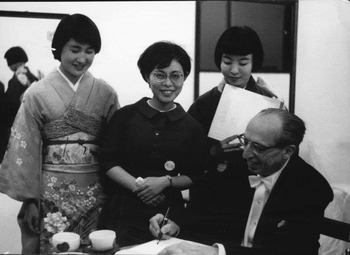
Copland's Soviet tour inaugurated a new dedication to the State Department on his part and to cultural diplomacy on behalf of his country, as Table 1 illustrates. Collectively, Copland's government-funded tours during the Cold War evince the strength of his commitment to cultural diplomacy and the values that motivated it. Indeed, the sheer number of countries that he visited on the State Department's behalf deserves comment; it exceeds that of his composer colleagues. (According to State Department documents, Lukas Foss made four tours with government funding in 1960, 1965, 1967, and 1968. Leonard Bernstein completed three State Department–funded tours as conductor of the New York Philharmonic in 1958, 1959, and 1968 but was never sent alone as an American Specialist. Virgil Thomson and Gunther Schuller also each toured three times with government funding. Various other composers were funded once or twice only.)Footnote 55 To help introduce foreigners to the music of the United States, Copland spent many hours playing his works on the piano for fellow musicians. Increasingly his central activity on tour was to conduct a local or U.S. orchestra in a performance of his symphonic works, alongside music by other American (or sometimes European) composers for foreign audiences. Copland usually insisted on conducting U.S. repertoire, unless there were extenuating circumstances that made it impossible.Footnote 56 He also lectured on music in the United States and spoke for hours with composers, music critics, musicologists, and performers.Footnote 57 During such meetings, Copland distributed scores and examined works by local composers, always encouraging conversation and the exchange of ideas (see Figure 2).Footnote 58 In the evenings he attended events and dinners, often at U.S. embassies, where he met important local dignitaries. After 1960 Copland did less lecturing and more conducting.Footnote 59 Television appearances featured in almost all of his tours during the sixties and seventies, as did press conferences, and interviews for radio and the print media.Footnote 60 A U.S. Embassy official's description of Copland's visit to Vienna in 1963 shows what he could achieve in just three days: “His program included auditioning recorded tapes of works by contemporary Austrian composers; a round-table discussion with Austrian composers and musicians; three lectures given at various Vienna Music Centers; and an informal meeting with the Secretary General of the International Music Center.”Footnote 61
Aaron Copland in Japan, 1960. (Aaron Copland Collection, Box 483, Folder 13, Library of Congress, Washington, D.C. Provided by courtesy of the Aaron Copland Collection at the Library of Congress.)

Although financial considerations may have motivated some U.S. musicians to participate in cultural diplomacy, money does not seem to have been a major factor in Copland's involvement, as we might expect given the evidence of his philosophical commitment to the mission. In the 1950s payment for a tour included all expenses, a per diem, and either a small stipend or payment for each concert conducted. By the 1960s, the decade of Copland's greatest commitment to the program, however, budget cuts had made government-funded tours far from lucrative, with the State Department sometimes reducing or cutting entirely Copland's performance fees—a generous concession on his part, given the honoraria he could typically command. Sympathetic to the program's financial hardships, Copland found opportunities to contribute while saving his government money, regularly contacting State Department staff after he had received one of his frequent invitations to the United Kingdom to conduct the London Symphony Orchestra.Footnote 62 Because the orchestra paid his transatlantic fare, he could travel for a month or two on behalf of the State Department if the government covered his European flights. On these tours he repeatedly conducted for a reduced fee.
Copland's dedication to cultural interchange is also apparent in his attitude toward the numerous overseas tours for which he did not receive government funding. On a self-funded 1969 visit to Budapest, for example, he asked the American Embassy to arrange a meeting with Hungarian composers in order that he might get to know “the present-day musical situation in Hungary.”Footnote 63 It is not surprising that Copland was interested in meeting his colleagues, but in most such cases these composers were students who would have benefited more from the exchange than would Copland himself. Phillip Ramey, who accompanied Copland to Hungary on this trip, emphasizes Copland's sense of national duty. Ramey mischievously told an American Embassy attaché in Budapest that he wished he had participated in the anti–U.S. marches held in the city shortly before their arrival. The attaché was obviously shocked by this unpatriotic statement. Later Ramey recounted this conversation to Copland, who, according to Ramey, “said he wished I'd keep my political opinions to myself because it might seem to reflect on him.”Footnote 64 Copland was keen to fulfill a useful, noncontroversial, and nonpartisan diplomatic service for his country—particularly after his experience with McCarthy—in every part of the world he visited, whoever was paying his expenses.
State Department and U.S. embassy staff were well aware of the unusual level of commitment Copland brought to his tours and his potency as a musical ambassador. The Bureau for Educational and Cultural Affairs (the office responsible for arranging tours by musicians after 1961) maintained a file of embassy reports about Copland's tours that demonstrate his remarkable success. Here is a characteristic example from the American Embassy in Bogotá in 1962:
Mr. Copland's indefatigable spirit and unpretentious manner lent much to his very successful tour which, in the opinion of the Post, was singularly effective in fostering understanding and appreciation of American culture. . . .
Copland's visit as an American Specialist is an excellent example of the very favorable and far-reaching impact which a leading American cultural personality can achieve. Furthermore, Mr. Copland's outstanding professional reputation is matched by his dynamic personality, a combination which ensures public recognition and clearly fulfills the objectives of the Cultural Presentations Program.Footnote 65
Indeed, Copland became so popular with embassy staff that he had to be democratically shared among them. The following internal State Department memo refers to a trip arranged for Copland to West Germany, Austria, and Italy in 1963: “Although he has served as a Specialist on a number of occasions, his reputation is so great that we continue to receive urgent requests from our embassies. The three posts requesting him this time have not previously had his services.”Footnote 66
Yet despite his profound commitment to cultural diplomacy, Copland may have had some reservations about touring in certain circumstances, for example, under Republican presidents: 77 percent of his government-funded tours took place during Democratic administrations. Of the remaining 23 percent, most were during the administration of Dwight Eisenhower, a president with whom Copland shared an enthusiasm for cultural diplomacy. Copland's period of most intense cultural diplomatic work was between 1960 and 1963: During these three years he spent a total of nine months on the road touring nineteen countries with State Department funding. It may be significant that after realizing a long-held dream of bringing Soviet and U.S. composers together in 1959 and 1960 under Eisenhower, the numerous tours of 1961–63 supported the outreach agenda of John Kennedy—a leader whom Copland strongly admired, not least for his advocacy of the arts.Footnote 67 Kennedy's assassination occurred while Copland was in Munich on a State Department American Specialist Grant. He was devastated by it, writing in his diary that night, “At such a moment one wants to have a fellow countryman nearby to help abort such news. It was sad to be alone . . . and hard to believe.”Footnote 68 The tour seemed to go downhill from there, and Copland wrote shortly before returning home: “It's a sad thought, but the fact is I have made no new friends—professional or otherwise, since coming here. Most surprising, practically no contact with local composers. Makes one want to stay at home.”Footnote 69
Copland's disappointment with this tour and his growing antipathy toward the Vietnam War may have been factors in his second significant break in government-funded touring, between 1964 and 1973, despite the fact that a new Democratic president (Lyndon Johnson) was in charge for much of that period. After all, the U.S. presence in Vietnam epitomized everything to which universalist internationalism was opposed.Footnote 70 Later, in 1973 and 1975 under the administration of Gerald Ford, Copland visited two countries with funding from the taxpayer, but these excursions were short ones arranged by the USIA as part of longer tours subsidized by European orchestras. His final trip with full State Department funding took place in 1978 under a Democratic president, Jimmy Carter. Copland may not have had a domestic political agenda for his diplomatic tours, but he was certainly more likely to become involved under a leader with whom he shared political values. Republican politicians had been responsible, of course, for the two most damaging incidents in Copland's career: his McCarthy hearing and the cancellation of a planned performance of Lincoln Portrait at Eisenhower's 1953 inauguration, spearheaded by Congressman Fred E. Busbey (R-Illinois). Copland showed his antipathy toward the political right wing in a statement released to the press in response to the Busbey matter: “My ‘politics’—tainted or untainted—are certain to die with me, but my music, I am foolish enough to imagine, might just possibly outlive the Republican Party.”Footnote 71
The Need for Rebranding
Although Copland's work for government was inspired by personal values and the level of his participation was affected by the values of the national administration, there were also many pragmatic benefits to participation. Although Copland was not deterred from cultural diplomatic missions by his altercation with McCarthy, the senator from Wisconsin nevertheless left him with a significant image problem. In the Cold War climate, Copland's alleged affiliations with the Far Left had the potential to damage his reputation permanently. Yet he somehow succeeded in removing the taint of leftism from his image during the final decades of his life and in establishing himself as the quintessential “American everyman”: a down-to-earth, hardworking, nonpolitical yet pro-American citizen who could be relied upon to serve as an example of the best of his nation. Elizabeth Crist has argued that Cold War anticommunist historiography was responsible for transforming Copland's image and removing the leftist associations that were initially evident in his populist works of the thirties and forties.Footnote 72 In fact, both Copland himself and the U.S. government helped effect this change.
The most significant contributor to this rebranding was the USIA. Like the State Department, its staff apparently recognized that Copland, internationally renowned by the 1960s and 1970s, could help enhance the country's reputation, but they needed to work around his more controversial features, particularly his alleged communist affiliations and his homosexuality. Like the State Department, USIA staff were willing to work with someone who had been associated with the far left by the now discredited McCarthy (by whom they had also been victimized), given that they had evidence to suggest that foreigners were interested in seeing a politically diverse array of cultural representatives. Nevertheless, emphasizing such characteristics would not have been expedient. For the USIA to succeed in presenting Copland as an exemplary American—a depiction from which Copland himself would also benefit—the agency needed to find a neutral way to tell his story. The USIA promoted Copland on a vast scale: through recordings, scores, pamphlets, and displays in U.S. embassies; through documentaries and radio shows; and by advertising his many tours.Footnote 73 What these sources share is an avoidance of the less mainstream and controversial elements of Copland's biography. Instead they consistently focused on two central themes: Copland's decision to write music “that expressed the American scene and temperament”Footnote 74 and his personal realization of the American Dream.
These features are particularly evident in the USIA film Copland Portrait, made for the U.S. bicentennial in 1976. Footnote 75 Filmmakers Terry Sanders and Frieda Lee Mock wrote, produced, and directed this half-hour description of Copland's life and works through their production company, the American Film Foundation; the film was one of several they made under contract to the USIA. Sanders informed me that the USIA commissioned the documentary because the composer was “such an icon of American music,” although the content was left entirely to the two filmmakers. Sanders claims that, unlike some other films he had made for the agency, Copland Portrait was entirely apolitical: “The great thing about films on artists is they're not political at all, so even though the USIA has a mission to . . . present the U.S. in a favorable light to other nations . . ., there's no political agenda with artists.”Footnote 76
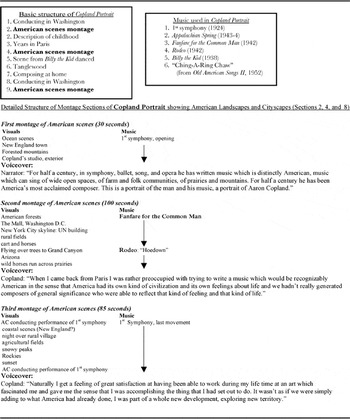
Whether or not Sanders and Mock intended it, this documentary is nevertheless highly politicized. Indeed, much of the film is devoted to associating Copland and his music with positive aspects of the United States. These linkages are particularly explicit in three sections of American landscape montages, presented to the accompaniment of Copland's music, which together constitute three-and-a-half minutes of material (8 percent of the film's total running time). Sanders filmed these aerial vistas before beginning the film and believed they would enhance it.Footnote 77Table 2 outlines the structure of these montage segments.
Structure of USIA film, Copland Portrait

In the first section of montage the aerial view takes us from the ocean, to scenes of New England towns and forested mountains, to the exterior of Copland's studio and home in Peekskill, New York, thereby positioning Copland geographically for the foreign viewer for whom this film was intended. In the second and third montage sequences the images proceed (to the extent that it is possible to locate them) roughly from east to west, including the skylines of Washington, D.C., and New York City, the coasts and towns of New England, the prairies and farmland of the Midwest, and the drama of Arizona's Grand Canyon. The first and last montage sequences are preceded by footage of Copland conducting the National Symphony Orchestra. While his first symphony plays on, images of U.S. landscapes replace our view of Copland at the podium, ensuring that the viewer constructs a mental link between Copland, his music, and the United States.
Once Copland's music and person have been inseparably linked to an idealized image of the United States, it becomes possible to present his life as an American Dream narrative. In his voiceovers Copland himself is an active agent in this presentation, with the filmmakers adding weight to his words through their choice of images. In his description of his childhood, Copland emphasizes the incongruity of his upbringing given his ultimate career choice:
I was born in Brooklyn in November of 1900. My family was not terribly musical. I don't think we would show any musicians, or painters, or writers. [Image: family photographs] My father had what was considered to be the large department store of that area, sort of a small version of Macy's. [Image: small department store front] I get surprised when I recall that a composer was born on that street because I wouldn't have picked it as a likely place for a composer to come into the world. [Image: rundown shop front] And I remember when I talked to my father about wanting to become a composer he said “where did you get such a strange idea!” and I really don't know where I got it from. [Image: Brooklyn brownstone] I just found myself naturally drawn towards the piano after school hours and fiddling around with some notes.Footnote 78
The filmmakers’ decision to show particularly shabby storefronts while Copland utters these words contrasts with the achievements and success that follows, illustrated visually through photos of Copland's life in Paris, a pan of published scores in his studio, and footage of the composer conducting his music in Washington's Kennedy Center. However, Copland's upbringing as the son of a department store owner in fact meant he was far from deprived. By presenting the Brooklyn brownstones in which he grew up as the urban equivalent of Lincoln's log cabin, the filmmakers show the world that even those Americans who grow up without wealth and access to the arts are able to realize their ambitions through hard work and persistence.Footnote 79
Unsurprisingly, the less conventional elements of Copland's life and politics are entirely ignored by the filmmakers, including his Jewishness, his homosexuality, and his left-wing political views. The last omission is striking given that it is Copland's music from the 1930s and 1940s that forms the majority of the soundtrack—the period when, according to Crist, Copland was most committed to an alternative vision of U.S. society (see Table 2 for a list of the works featured). His more dissonant music from the 1920s and the serial works he composed after World War II are neither mentioned nor heard, aside from his First Symphony, which, according to Terry Sanders, was only featured because Copland happened to be conducting a performance of it when the film was shot. Sanders said Appalachian Spring would have been much better suited to the mood he wished to create.Footnote 80 Notably, the one occasion in which the filmmakers chose to use Appalachian Spring in Copland Portrait was during a scene in which Copland describes the difficult reception of his “modernist” works in the 1920s. This reference to modernism serves to remind the viewer about the freedom of expression Copland enjoyed in the United States. At the same time, by accompanying Copland's description of past criticism with perhaps his most accessible and well-loved piece, the viewer struggles to understand the logic of those early audiences and is thus yet more favorably disposed toward this U.S. icon.
Copland's recognition that he needed to rebrand himself is not only evident in his voiceover contributions to this whitewashed, nationalistic presentation of his life. His response to the film is also highly revelatory. According to Terry Sanders, Copland said to him after seeing the finished tape, “If this doesn't get nominated for an Oscar then there's no justice!” This hyperbole was not merely an example of Copland's famous affability. That same year he was asked to participate in a BBC documentary in celebration of his seventy-fifth birthday. He encouraged the filmmakers to incorporate material from Copland Portrait, which he describes as a “remarkable film” with “especially fine shots of me conducting my FIRST SYMPHONY with the National Symphony in Washington, and beautiful scenes of the American landscape in the far west.”Footnote 81 This enthusiasm is echoed in his autobiography, where Copland describes how he liked to watch Copland Portrait from time to time in his later years, obviously enjoying seeing himself in action at the podium but also thereby embracing the constructed linkages between his music and his homeland. As he said, “I particularly enjoy the conducting segments and the American scenes.”Footnote 82 Copland was apparently quite willing to be explicitly associated with an idealized vision of his country of birth in products designed to serve as anticommunist propaganda.Footnote 83
Copland Portrait makes it clear that it was not only U.S. government departments and agencies that participated in altering Copland's global reception during the Cold War, but also Copland himself. After the McCarthy episode Copland knew how essential it was for his music and persona to avoid any hint of controversy. So while his nationalistic image was helping the State Department and USIA to demonstrate the uniqueness and sophistication of U.S. culture during the Cold War, their efforts simultaneously helped him to disassociate himself with everything that marked him as an outsider so he could retain his leading position in American musical life.
Musical Reflections
Because Copland's contributions to cultural exchange were primarily inspired by his internationalist attitude, he did not become disillusioned about the possibility of affecting change, as did many passionate communists of his generation. Instead he retained his faith in the power of the arts to create new opportunities for peace and understanding, continuing to contribute to cultural diplomacy for as long as he was able. In this context, Copland's attitudes toward music and politics appear far more consistent and unchanging than has previously been recognized, even as he was forced to make them less overt to survive in the newly polarized climate. So what might this new assessment of the composer mean for our understanding of his music?
Copland's output during the Cold War, in fact, mirrors his work with the federal government during this period, reflecting the same complex interaction between his desire to create international artistic dialogue to encourage peace and his need to reorient the perceptions of others regarding his political interests. Other Copland scholars have observed this combination of features. Elizabeth Crist, for example, has analyzed political references to McCarthyism in The Tender Land (1954) and Canticles of Freedom (1955) but has also claimed that Copland increasingly turned away from political discussion in his music after his McCarthy hearing.Footnote 84 She cites Connotations (1962) and Inscape (1967), in contrast to The Tender Land and Canticles, as works in which “musical purity seemed a refuge from ideology,” citing Copland's assurances to the State Department in the immediate aftermath of the McCarthy hearing that he had, since the Peace Conference, “rigorously confined myself to purely musical matters.”Footnote 85 I believe, however, that just as Copland remained an active participant in world political affairs during the 1960s, he actually addressed contemporary issues in all of his late works, even as he altered his approach to a new political climate.
The titles of Copland's pieces from the 1960s immediately suggest a nonexplicit meaning, but one that nevertheless seeks to engage with the times. Titles such as Connotations, Emblems (1964), and Inscape are, in fact, unusually suggestive when contrasted with the many compositions of this decade—particularly serial works—with titles that are simply musically descriptive: “sonata,” “piano piece,” or “composition for piano.”
Furthermore, Copland's written descriptions of these pieces gesture more overtly toward extramusical meanings. Regarding the orchestral Connotations Copland explained in his memoirs that the dictionary definition of “connote” was “‘to imply,’ to signify meanings ‘in addition to the primary meaning.’” In this piece, he explained, the twelve-tone row was the “primary meaning,” and its subsequent treatment represented “connotations” of this meaning; yet, he continued, “the listener . . . is free to discover his or her own connotative meanings, including perhaps some not suspected by the author,” thereby implying the legitimacy of a programmatic reading.Footnote 86 His description of the wind piece Emblems similarly encourages extramusical interpretation but leaves this interpretation largely to the audience: “An emblem stands for something—it is a symbol. I called this work Emblems because it seemed to me to suggest musical states of being: noble or aspirational feelings, playful or spirited feelings. The exact nature of these emblematic sounds must be determined for himself by each listener.”Footnote 87 Finally, regarding the orchestral work Inscape of 1967, he explained that the meaning of the title word came from its use by poet Gerard Manley Hopkins: “To the uninitiated, the word ‘inscape’ may suggest a kind of shorthand for ‘inner landscape.’ Hopkins, however, meant to signify a more universal experience.”Footnote 88 Here, too, Copland implies that although the piece explores subjective emotions, these are emotions that he shares with others. Copland was consistently committed to writing music that spoke to the community at large. Indeed, this idea is a recurring theme in Crist's analysis of Copland's music from the Depression and war years: Her assessment of Billy the Kid and Rodeo as works that depict “a contemporary drama of community as told from the perspective of the individual,” for example, resonates with Copland's description of Inscape.Footnote 89Emblems also contains a quotation of the hymn “Amazing Grace”—a reference that Copland always claimed was subconscious and accidental, but that indicates nevertheless that as late as 1967 he was still drawn to musical source material that denoted communal values.Footnote 90
Although all three of these works can thus be said to reference shared experiences and challenges, Connotations is the only one for which Copland gave more specific clues to the nature of his “connoted” meaning. A provocative political message was probably especially attractive to Copland given the circumstances of this work's first performance at a gala New York Philharmonic concert to open Lincoln Center. After linking the title to the musical structure in his program notes, he went on to state explicitly that the “connotative meanings” that he had left the listener “free to discover” might have spoken directly to political and social challenges: “I decided to compose a work that would bring to the opening exercises a contemporary note, expressing something of the tensions, aspirations, and drama inherent in the world of today.”Footnote 91 What were these “tensions” and “aspirations”? A few critics understood Copland's words as a reference to the contemporary crisis in serialist language, but in the context of his lifelong engagement in international social and political concerns, is it not equally (or even more) likely that he was in fact referring to the political climate of the day?Footnote 92 Robert J. Landry, writing in Variety following the work's premiere, certainly thought so: “It is strictly accurate to declare that an audience paying $100 a seat and in a mood for self-congratulation and schmaltz hated Copland's reminder of the ugly realities of industrialization, inflation and Cold War—which his music seemed to be talking about.”Footnote 93 Indeed, the work's alternation of dissonant, loud, dramatic sections with more lyrical, reflective, occasionally quasi-romantic music seems to attempt simultaneously both to stir up the listener and to encourage contemplation.
Copland provided further insight into his intentions for Connotations during an interview before the televised broadcast of its premiere on 23 September 1962. Echoing his program notes, he suggested that some listeners might wonder why he chose “to create a work that reflects drama and tension and even desperation on so gala an occasion as this.”Footnote 94 His addition of the word “desperation” adds further weight to the argument that this work reflects a critical reading of contemporary political problems. One might speculate that he could be referring to the Cuban Missile Crisis, a particularly desperate and potentially catastrophic Cold War event that occurred while Copland was in the last stages of composing Connotations. It is also worth noting that the work's composition and premiere occurred in the middle of Copland's most intense period of participation in cultural diplomacy, as he tried to use his own musical resources to bridge the intractable Cold War divide.
In fact, it was not only during the Cold War that Copland wrote nonprogrammatic works that explored profound extramusical ideas and issues. As he explained in a letter to a friend in 1931, even the seemingly abstract Piano Variations (1930) and Symphonic Ode (1927–29) sought to present a message of sorts about the modern world:
Let me see if I can make more clear what I mean in relation to the Ode and the Variations. To affirm the world is meaningless, unless one also affirms the tragic reality which is at the core of existence. To live on—to develop means, as I see it, to enter always more and more deeply into the very essence of tragic reality. The Ode is an affirmation, of course, with tragic implications. The Variations also affirm, but the reality they affirm is more particularized, it is the reality of our own age and time. . . . I feel sure that there is a certain essence of contemporary reality which is expressed in the Variations which I was too young to grasp at the writing of the Ode.Footnote 95
This 1931 description of the Variations as an “affirmation” of the “reality of our own age and time” bears comparison with Connotations. Intriguingly, the music of the Variations is also echoed in the later work, both literally in its quotation (as both Leonard Bernstein and Howard Pollack have observed)Footnote 96 and more generally in the demanding dramatic intensity that the two works share.Footnote 97 Both, furthermore, relate in complex ways to serialist methods.Footnote 98 Thus Connotations, Emblems, and Inscape were not the first seemingly abstract works in which Copland implied a desire to communicate a broadly relevant message, whether in his program notes, his writings, or his choice of evocative titles. To what or whom is the Symphonic Ode an “ode,” for example? What “statement” is Copland making in Statements (1935)? According to Larry Starr, the Piano Sonata (1941) also conveys an oblique political message: He claims that it represents Copland's musical response to the horrors of war.Footnote 99
* * *
Christopher Norris has described Copland's contemporary Dmitri Shostakovich as a “citizen composer,” working out his “personal destiny” under certain “conditions or self-imposed choices of social role.”Footnote 100 Copland's music similarly shows a man intent on creating art that fulfills a function in society—indeed, as Norris says of Shostakovich's music, Copland's creations can actually be said to depict, in part, this search. For both composers, the quest to find ways to be useful to their nations and to the world at large did not die when politicians challenged their moral or artistic integrity; it was merely moved to channels that gave a superficial impression of abstraction. For both, however—as perhaps for many of their colleagues—such channels had always been useful for exploring contemporary problems that could not easily be encapsulated in words. In this way Copland's output seems to answer Lydia Goehr's assertion that, “ideally, music's function is to help bring about a better world, by presenting the world as it is and by manifesting an alternative vision of that world.” Taking a leaf out of Adorno's book, she continues: “By denying involvement with the political, musicians might be playing out in the music their most effective political role—in silence, in abstraction, in transcendence.”Footnote 101
Present-day audiences tend to associate Copland primarily with music that tells a story or represents suggestive ideas—pieces that engage with society in an overt way such as Appalachian Spring, Rodeo, Fanfare for the Common Man—but as both the early Piano Variations and the much later Connotations demonstrate, Copland's social engagement was not expressed only in works with obvious extramusical meaning. Copland was interested in confronting “contemporary reality,” particularly the thorny question of the United States’ place in the world, from the beginning to the end of his career, both in his actions and in every type of musical work, whether tonal or serial, programmatic or abstract, “populist” or “serious.” Although he frequently turned to the serial method when he wished to make a more demanding musical statement (as he said about Connotations: “The method seemed appropriate for my purpose”),Footnote 102 his serialist music lies far from a Webernian level of abstraction. Copland wanted these works to provoke his audiences and to send a message, albeit one that may sometimes have been untranslatable into words: Describing the Piano Variations, he wrote, “our language is woefully inadequate to the task of describing musical experiences.”Footnote 103
As one British journalist aptly wrote in 1958: “If there was a Master of the President's Music, Copland would probably be it.”Footnote 104 Copland spent the better part of his career working with his government to promote the music of his nation, with the expressed aim of helping to spread American democratic values. Although he helped reshape his image for a new Cold War world, he never lost his desire to write socially engaged music that served his universalist goals, consistently resisting the ivory tower. Instead, both his musical works and his career as a cultural diplomat reflect a man deeply invested in promoting and reflecting in sound the nation he held so dear, while simultaneously imagining new visions of a better global future.