1 Introduction
Recent research on adjectival modifiers has shown that certain adjectives are strongly connected with either the definite or indefinite article in language use. Generally, these studies have focused on the so-called post-deictic function of the adjective (Halliday Reference Halliday1994: 183), where the adjective helps the reader/hearer identify the referent or retrieve it from discourse. For example, Breban (Reference Breban2010: 257–8) notes that adjectives, such as next, usual, only, same and main, combine with the definite article to form a complex determiner (e.g. the next, the same), while words like certain, further and specific are used with the indefinite article in their identifying function: a certain, a specific. The close bond between the article and the secondary determiner can also be observed in the syntactic position of the adjectives: as part of a complex determinative element, these adjectives can only occur prenominally and cannot be used as predicatives. They also lack other features typical of central adjectives: they do not denote a property of the referent and cannot be coordinated with a descriptive adjective. In other words, they can be regarded as ‘peripheral adjectives’ (Breban Reference Breban2010: 250). The boundary between primary and secondary determiners has been studied by, among others, Denison (Reference Denison, van Kemenade and Los2006), Davidse et al. (Reference Davidse, Breban and Van linden2008), Breban (Reference Breban2010) and Breban et al. (Reference Breban, Davidse and Ghesquière2011).
The above studies have all focused on the way adjectives acquire a secondary determiner function and become closely linked with the primary determiner. However, systematic studies on the connection between more descriptive adjectives and articles have, to my knowledge, been thus far a relatively neglected area of linguistic research. We do find some isolated observations of certain trends, but they are not followed up by detailed analyses. For example, Thompson (Reference Thompson and Hawkins1988: 174–7) notes that her (rather small) data set of English conversations included only one prenominal adjective in a definite NP, while there were altogether 32 prenominal adjectives in indefinite NPs. Paradis (Reference Paradis, Bermúdez-Otero, Denison, Hogg and McCully2000: 252; Reference Paradis2001: 60), on the other hand, notes that reinforcing adjectives, such as those in an absolute bliss or a total mess, typically occur in indefinite NPs. She comments on this briefly, saying that ‘[reinforcing adjectives] have a descriptive rather than an identifying function’ (Paradis Reference Paradis, Bermúdez-Otero, Denison, Hogg and McCully2000: 252).
In this article it will be argued that we can arrive at an even more accurate explanation than the one offered by Paradis when the relative subjectivity/objectivity of the adjective is taken into account. I will argue that the connection between the descriptive function of the adjective and the indefiniteness of the NP observed by Paradis holds not only for reinforcing adjectives but also for a much larger class of adjectives that express the speaker's subjective evaluation of the referent (‘subjective adjectives’ for short). Importantly, the issue is not about the descriptive or characterising function as such: when more objective adjectives are used to describe the referent, there is no systematic correlation with indefiniteness.
As the focus of this article is on actual language use instead of potential syntactic realisations of articles and adjectives, the arguments formulated here are supported by case studies that draw their data from large corpora of Present-Day English: the 100-million-word British National Corpus (henceforth, the BNC) and the 450-million-word Corpus of Contemporary American English (COCA). The data for the diachronic studies are taken from the Corpus of Historical American English (COHA), a 400-million-word corpus of American English from 1810 to 2009.
The article is organised as follows. Section 2 will begin by providing a brief overview of the relevant theoretical issues. Section 3 introduces the main research question in more detail and offers some preliminary corpus findings regarding article usage with subjective and objective adjectives. Section 4 focuses on two constructions that are used to modify an adjective from a subjective standpoint (very ADJ and much ADJ-comp). Section 5 brings further support to the argumentation by introducing corpus studies of polysemous adjectives, where one sense of the word is clearly subjective (e.g. moving, ‘emotionally touching’) and the other more objective (e.g. moving, ‘in motion’). Section 6 extends the topic to diachronic case studies of Participle > A (outstanding) and N > A category change (key), and the case studies are followed by conclusions and suggestions for further research in section 7.
2 Theoretical background
Subjectivity has been an increasingly important topic of linguistic research in recent decades (see e.g. Traugott Reference Traugott, Lehmann and Malkiel1982, Reference Traugott1989; Langacker Reference Langacker1990; Stein & Wright Reference Stein and Wright1995; Athanasiadou et al. Reference Athanasiadou, Canakis and Cornillie2006; De Smet & Verstraete Reference De Smet and Verstraete2006; Davidse et al. Reference Davidse, Vandelanotte and Cuyckens2010), but the term itself has been understood and used in various ways (De Smet & Verstraete Reference De Smet and Verstraete2006). First, subjectivity can be defined as ‘speaker-relatedness’ in very general terms, and in this sense it is an all-pervasive feature of language. Indeed, in his seminal paper Benveniste remarks that ‘[l]anguage is marked so deeply with the expression of subjectivity that one might ask if it could still function and be called language if it were constructed otherwise’ (Reference Benveniste and Meek1971 [1958]: 225). According to this view, everything we say is in some way subjective, from the construction of discourse participants as you and I to describing objects as nice or red.
However, subjectivity can also be used in a narrower sense. Somewhat problematically (or at least inconveniently), the most prominent theoreticians of subjectivity, Traugott and Langacker, both define the term differently. For Langacker, subjectivity has to do with the speaker's role in the construal. If the speaker figures implicitly as an ‘offstage locus’ of an expression, as in this person, the construal is considered subjective (Langacker Reference Langacker2008: 77; De Smet & Verstraete Reference De Smet and Verstraete2006: 366). In an objective construal, on the other hand, the speaker's role is less prominent, and the focus is on the described entity (as in the person sitting opposite Mike).
Traugott, by contrast, defines subjective expressions as those ‘the prime semantic or pragmatic meaning of which is to index speaker attitude or viewpoint’ (Reference Traugott2010: 32). In this article subjectivity is understood and used in Traugott's sense. The main distinction is made between semantically subjective adjectives (e.g. interesting, pleasant) and semantically more objective adjectives (e.g. urban, empty). In other words, the focus is specifically on form–meaning pairs that encode subjectivity (see e.g. Cuyckens et al. Reference Cuyckens, Davidse and Vandelanotte2010: 4–5) instead of the more general kind of subjectivity discussed by Benveniste (see above). Importantly, subjectivity, as defined by Traugott, can also be applied to diachronic research. Many studies have convincingly shown that, especially in grammaticalisation, the direction of semantic change tends to proceed from more objective to more subjective meanings, i.e. expressions undergo subjectification (see e.g. Traugott Reference Traugott, Lehmann and Malkiel1982, Reference Traugott1989, Reference Traugott2010; Cuyckens et al. Reference Cuyckens, Davidse and Vandelanotte2010, and the references therein).
The main finding of this article is the strong connection between the subjectivity of the adjectival modifier and indefiniteness, which will be discussed in terms of Accessibility theory (see e.g. Ariel Reference Ariel1990, Reference Ariel, Sanders, Schilperoord and Spooren2001, Reference Ariel, Hedberg and Zacharsky2007). According to Accessibility theory, the form of the NP chosen by the speaker correlates with the accessibility of its referent in discourse. For example, a highly accessible discourse topic or a close antecedent is usually referred to by a pronoun or even a zero, while referents that are harder to retrieve are referred to by a full definite NP (Ariel Reference Ariel1990: 73–4; see also Epstein Reference Epstein2002a: 345, Reference Epstein and Brisard2002b: 49). Basically, the less accessible the referent is, the more explicit information the NP needs to encode for felicitous use (i.e. the more premodifiers and/or postmodifiers it must have; see Ariel Reference Ariel1990: 73, Reference Ariel, Hedberg and Zacharsky2007: 285).Footnote 2 The data discussed in this article suggest that when it comes to subjective and objective adjectival modifiers, the accessibility of the information encoded by them is also relevant for the structure of the NP. Objective modifiers often encode information that is either typical of their referent or else inferable from the discourse context or through world knowledge. By contrast, subjective modifiers encode new information that is part of the speaker's mental world to which other discourse participants have no access. As a result, subjective premodifiers show a significant preference for indefinite marking, while objective premodifiers exhibit a more even article distribution. Moreover, when subjective premodifiers are used in a definite NP, the phrase is typically postmodified: the postmodifier limits the set of referents to a uniquely identifiable entity and allows for definite marking regardless of the accessibility of the referent and/or the information expressed by the modifier.
3 Descriptive adjectives and article usage: a preliminary investigation
In principle, there is nothing in English grammar that would prevent speakers of English from using different kinds of descriptive adjectives in both definite and indefinite noun phrases (Newmeyer Reference Newmeyer1998: 41–2). Let us therefore, just for the sake of discussion, play the devil's advocate and formulate a null hypothesis:
The definiteness/indefiniteness of the article in a noun phrase is independent of the semantics of the descriptive adjectival premodifier or the point of view expressed by the phrase.
This hypothesis would lead us to expect that the frequency of phrases like a nice man and the nice man would, by and large, follow the average distribution of the definite and indefinite articles in the ART+ ADJ + N-Sg pattern, i.e. a singular noun phrase with an adjectival premodifier.Footnote 3 Alternatively, we might see word-specific preferences, where certain adjectives occur more often with either the definite or the indefinite article without forming a more general, linguistically motivated class. In other words, the differences in article profiles would be more or less random.
Considering the topic of this article, the null hypothesis could specifically state that there is no significant difference in article distribution regardless of the relative subjectivity of the modifier: adjectives expressing the speaker's evaluation and attitude (say, awful, marvellous or beautiful) would be expected to pattern similarly to more objective adjectives (say, extant, semantic or global) or, at the very least, there would be no reason to assume that either one of the groups would show systematic skewing with regard to article distribution.
As a first step, let us take a look at some corpus data from the BNC. The data in table 1 reveal that, overall, definite and indefinite articles occur with roughly even frequency in the ART + ADJ + N-Sg pattern, although the indefinite article is slightly more frequent of the two. The numbers in table 1 include all instances of a pattern where an article is followed by an adjective in the positive form and a singular noun.Footnote 4
ART + ADJ + N-Sg in the BNC

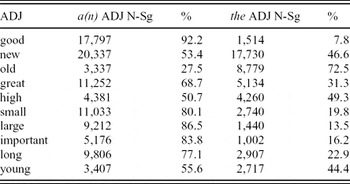
Now, our null hypothesis predicts that we should see a somewhat similar distribution of articles regardless of the semantics of the adjectival modifier. In order to put this hypothesis to the test, let us first see how some of the most frequent adjectives in the BNC are used prenominally. All adjectives in table 2 are included in the fourteen most frequent adjectives by lemma in the BNC (Leech et al. Reference Leech, Rayson and Wilson2001).
The distribution of definite and indefinite articles with some high-frequency adjectives (BNC)

Although the data in table 2 are unsorted and unanalysed, the numbers suggest that our null hypothesis, according to which the distribution of the definite and the indefinite articles follows the overall distribution of articles in the corpus (table 1), is not correct. Of the ten adjectives studied, only three show any indication of even distribution: new, high and young. In all the other cases, the distribution is heavily skewed. With old, the definite article is the clear winner: 72.5 per cent of all NPs with prenominal old occur with the definite article. However, the opposite trend seems to be much more common: in the case of good, great, small, large, important and long, it is the indefinite article that wins out by a large margin.
On closer inspection, however, it seems that the variation is not entirely random either. First, some of the adjectives that favour the indefinite article are often used in quantifying expressions. For example, a great deal (of) occurs 3,971 times in the corpus, while the great deal (of) does not occur at all. Moreover, a large number/amount (of) (1,535) is partly responsible for tipping the scales in favour of the indefinite article in the case of large: the large number/amount (of) only yields 255 hits. It is clear that only adjectives of dimension (see e.g. Dixon Reference Dixon2005: 84) are semantically well suited to modify quantities (compare *a new/young amount of), and consequently, other kinds of adjectives, such as new and young, show a more even distribution of articles (see also Brems Reference Brems2011, especially section 4.5, for a discussion of premodification in measure noun constructions).
Second, in the case of old, which is the only adjective in the data that occurs markedly more often with the definite article, the definite article is strongly linked to (implied) contrastive usage. Although there are some frequent collocates, such as the old man (1,174 hits), that partly explain the prevalence of the definite article, a more likely explanation for the distribution may be found in one of the functions of the adjective where old means ‘past’ or ‘former’ (as opposed to ‘present’ or ‘current’; see Davidse et al. Reference Davidse, Breban and Van linden2008), as in examples (1) and (2) below:
(1) The problem with the old board was that it did not innovate and did not concern itself with exporting English hops. (A14 640)
(2) Yet as of 1922 the political reliability of the teachers was notoriously low: large numbers of them were remnants from the old regime. (A64 387)
Turning back to the adjectives that favour the indefinite article (esp. good, great, important), we may explain the skewed distribution by studying the meaning of the adjectives; these adjectives are more clearly used to express the speaker's internal evaluation of, and subjective stance towards, the modified referent than the adjectives with a more equal article distribution (new, high, young) or the lone adjective favouring the definite article (old). In other words, speakers are much more likely to agree that a certain referent is new or young, for instance, than that it is good or important (see also Paradis Reference Paradis2008: 324). Even if properties like new or young are certainly not entirely objective, they are much more so than good or important. This subjective viewpoint is also evident in the quantifying expressions mentioned above. Phrases like a large amount (of) or a great deal (of) provide the speaker with a means of expressing a subjective evaluation of a certain quantity.
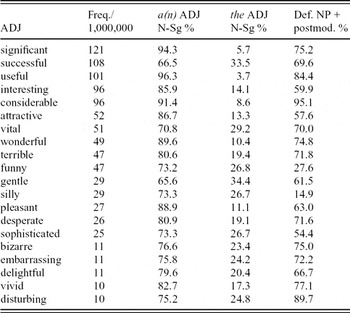
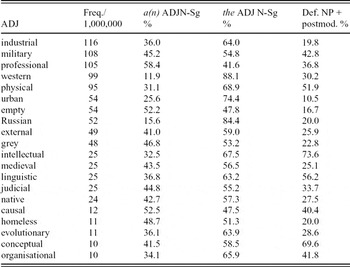
It is clear, however, that by studying ten adjectives we can only draw preliminary conclusions about the way articles are connected with certain descriptive premodifiers. Moreover, the adjectives in table 2 are among the most frequent adjectives in English, which raises suspicion that a simple frequency effect might somehow explain the results better than the relative subjectivity of the adjectival modifiers. However, when we study both subjective and objective adjectives of different frequencies, we see that the data strongly support our initial conclusions. The adjectives in tables 3 and 4 are handpicked from a frequency list of the BNC (Leech et al. Reference Leech, Rayson and Wilson2001) based on an a priori evaluation of their relative subjectivity/objectivity.Footnote 5
Article distribution in subjective adjectival premodifiers of different frequencies (BNC)

Article distribution in objective adjectival premodifiers of different frequencies (BNC)

The data in tables 3 and 4 indicate that there is indeed a correlation between the subjectivity of the adjectival modifier and the use of the indefinite article. However, it is evident that handpicked and intuitively selected adjectives do not provide for a methodologically sound way of studying the connection between subjectivity and article usage. Therefore, to put the hypothesis to a more robust test, let us focus on constructions where subjectivity is overtly expressed. At this point we can also conclude that our null hypothesis is not supported by the data and replace it with an alternative hypothesis: subjective adjectives favour indefinite constructions.
4 The effect of subjective expressions of degree on article usage
Whether or not something is considered to be good, important, interesting or significant is not only a matter of the subjective opinion of the speaker; the property expressed by the adjective is also a matter of degree. For example, we may evaluate something to be very good or more interesting than something else. Studying how adjectives are used in degree constructions provides us with a way to see whether the putative connection between speaker subjectivity and indefinite constructions is valid or not.
Based on our hypothesis, we may predict that if an expression includes a clear marker of (subjective) degree, this should have an effect on article usage. We already saw an indication of this in examples (1) and (2), where old was used in the sense of ‘past’ or ‘former’. These uses typically occur with the definite article, and they cannot appear in degree constructions: *the very old board, *the older regime. However, the focus of the following discussion will be on indefinite NPs, and the precise hypothesis is this: overt indicators of degree should result in a higher proportion of indefinite articles compared to the simple ART + ADJ + N-Sg pattern. Specifically, I will study two syntactic manifestations of degree: the ART + very + ADJ + N-Sg pattern and the prenominal comparative construction intensified with the degree adverb much (e.g. a/the much older/better/larger N-Sg).
4.1 ART + very + ADJ + N-Sg
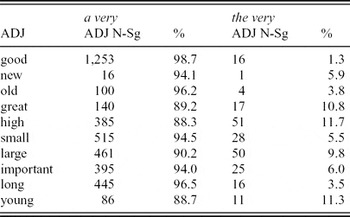
If our hypothesis is correct, we should see an increase in the use of the indefinite article when the degree modifier very, which is here considered to be an overt expression of subjectivity, is used to intensify the adjectival premodifier. Indeed, data on the high-frequency adjectives in table 5 strongly support this idea.
ART + very + ADJ + N-Sg (BNC)

The data in table 5 show that, regardless of the distribution of articles in the simple ART + ADJ + N-Sg construction (table 2), the proportion of indefinite articles rises up to ~90 per cent in the ART + very + ADJ + N-Sg pattern. The lowest proportion of indefinite articles is found with high (88.3%), and the highest with good (98.7%).
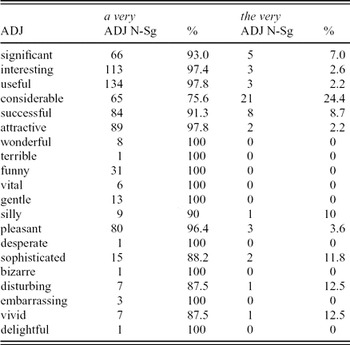
The 20 subjective adjectives that were studied in table 3 show a similar trend to the one seen in table 5 when they are intensified with very. However, as many adjectives appear very rarely in the ART + very + ADJ + N-Sg construction, it might be better to regard the following data simply as not disproving the hypothesis instead of providing strong support for it. In any case, of the 20 subjective adjectives, 17 show an increase in the proportion of indefinite articles with the introduction of very (table 6).Footnote 6
The proportion of definite and indefinite articles in the ART + very + ADJ + N-Sg pattern (BNC)

4.2 ART + much + ADJ-comp + N-Sg
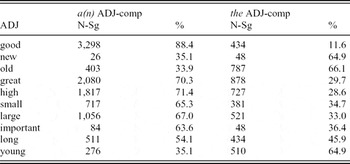
The starting point with the comparative construction is rather similar to the basic ART + ADJ + N-Sg construction, where we found a certain amount of variation in article distribution (table 7).
Article distribution in the ART + ADJ-comp + N-Sg construction with ten frequent adjectival modifiers (BNC)

Again we see that some adjectives favour the indefinite article, while others occur more often with the definite article; the distribution is not even, and there is no apparent trend to be found. The adjectives that favour the definite article are new and young, i.e. the same words that did not show any preference for either article in the basic (positive) ART + ADJ + N-Sg construction, and old, which was used more often with the definite article in the positive construction.Footnote 7
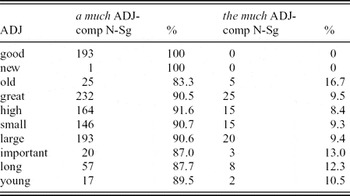
We already saw that the introduction of very significantly increased the proportion of indefinite articles with high-frequency adjectives (table 5). Let us now take a look at the comparative construction to see if it behaves similarly when an overt indicator of degree and subjectivity, in this case much, intensifies the adjective (table 8).
ART much ADJ-comp N-Sg (BNC)

The results are strikingly similar to what we saw earlier with very: the data are heavily skewed in favour of the indefinite article.
Unfortunately, the ART + much + ADJ-comp + N-Sg construction is relatively infrequent, and it is therefore not possible to make a valid comparison of the subjective and objective adjectives of different frequencies that were studied in tables 3 and 4. It can be pointed out, however, that 13 of these 40 adjectives do occur in the ART + much + ADJ-comp + N-Sg construction in the BNC. Pooled together, there are altogether 30 tokens, and in each case the adjective is semantically subjective and the article indefinite.
5 Subjective and objective polysemies
Knowledge of the correlation between indefiniteness and subjectivity can also be applied to the study of polysemous words. In particular, the correlation may be useful in corpus annotation, where words are automatically assigned a word class label. In this section I will take a look at two -ing participles, moving and glowing, which both have a relatively objective sense that corresponds to the basic (physical) sense of the verbs to move and to glow, respectively. As these -ing forms do not behave syntactically like adjectives (apart from their potential to be used prenominally), they could be analysed (and annotated) as verbs, not adjectives. The subjective senses, by contrast, behave like central adjectives. For example, they can be modified by degree modifiers (e.g. very moving) and appear as predicatives (e.g. the review was glowing).
In this section I will also discuss the underlying reasons for the correlation between subjectivity and indefiniteness. I will argue that objective modifiers can express meanings that are accessible in connection with the referent they modify; they may describe properties that are either typical of their referents or otherwise accessible through contextual factors or shared world knowledge. This allows for their frequent use in short definite NPs. By contrast, subjective modifiers are used to make a comment on the referent by imposing on it a property that is less accessible. As a result, subjective modifiers favour indefinite NPs. Furthermore, when they are used in definite NPs, the phrase is typically postmodified, which suggests that definite marking is a consequence of the reference-limiting function of the postmodifier.
5.1 Moving
Let us begin by studying two senses of moving that are maximally apart in terms of subjectivity. The objective sense studied is ‘[something] that moves or passes from one place, position, or posture to another. . . not fixed or stationary, in motion’ (OED, 2nd edn, s.v. moving, 1a), while the subjective sense is ‘[something] producing strong emotion, esp. sadness or sympathy; touching, affecting’ (OED, s.v. moving, 4).
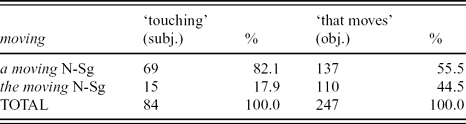
Data from the BNC (see table 9) indicate that the more objective sense (‘that moves’) does not show a clear preference for either article (55.5% indefinites vs 45.5% definites), whereas the subjective sense (‘emotionally touching’) occurs much more often with the indefinite article (82.1% vs 17.9%).
Article distribution with subjective and objective senses of moving (BNC)
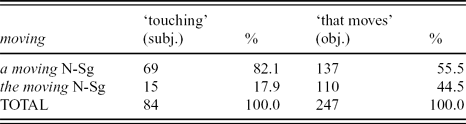
When it comes to indefinite NPs, the objective sense of moving usually expresses information that is accessible either because it can be considered a typical property of the referent, as in (3), or because the information expressed by the modifier has been established in prior discourse, as in (4). In both examples, the modifier functions both to describe a discourse referent and to introduce it to the discourse.
(3) He was shown a blurred photograph, taken from a moving car, of a thief, an enemy of the state. (CLD 2177)
(4) A good example of a simple problem made complex is movement discrimination. To understand the problem we need to look at a moving object from the point of view of a single cell in the visual cortex. (CMH 1430)
Examples (3) and (4) illustrate that even if the information encoded by the modifier is accessible information, the fact that the discourse referent itself is new information triggers indefinite marking. In other words, there are competing motivations for definite and indefinite marking, and in these cases it is the information status of the referent that is more relevant.
The significant difference between subjective and objective modifiers in indefinite NPs is that while the more objective modifiers often express accessible information, subjective modifiers express new information. Typically, the subjective adjective is used to make a personal comment about another discourse referent, as in (5), where leaving the Harrow is described as a moving experience. In (6), on the other hand, the modified NP does not point to another NP: the letter has not been mentioned before, and the modifier is used both to evaluate the referent and to introduce it to the discourse.
(5) Leaving the Harrow was a moving experience in many ways for John and Maureen. (A14 813)
(6) A moving letter, written in May 1944, may help to explain the welcome which the National Health Service received four years later. (CMG 1025)
The difference in the accessibility of the information encoded by subjective and objective modifiers is perhaps even more evident when we consider how the modifiers are used with the definite article. Following Epstein (Reference Epstein2002a: 333, Reference Epstein and Brisard2002b: 49), I take the basic meaning of the definite article to signal the accessibility of a discourse referent (Epstein Reference Epstein2002a: 348). Indeed, when the definite article is used with the objective sense of moving (‘that moves’), we find that both the objective premodifier and the head of the NP signal accessible information, as in (7)–(9). Again, movement is something that is either considered to be typical of the referent, well established in previous discourse or available through world knowledge:
(7) The footsteps halted, and she could see the beam of the lantern swing from side to side. [. . .] Not even hearing the rolling crackle above, she was conscious only of the moving light. . . (HGV 467)
(8) Ell screamed. A huge snake was unravelling from a tree, sliding along the forest floor. His left foot was trapped beneath the moving snake. (HTY 1320)
(9) We step backwards towards the car. [. . .] He seems eager to talk right up until we finally bid him goodbye through the moving car window. (HH0 2580)
In (7), the moving light is highly accessible because the writer has already mentioned a lantern swinging from side to side. Therefore, both the movement (swing) and the light (lantern) are accessible. The same is true for (8), where the snake and its movement (sliding) have been established in prior discourse, while in (9), the car window is accessible through the prior mention of the car. The movement of the car window is accessible through world knowledge: we know that car windows can be opened and closed, and this is why a modifier like moving can readily be used as a modifier to car window in a short definite NP.
By contrast, when a subjective premodifier is used in a definite NP, the phrase usually expresses discourse-new information. In examples (10)–(13) the author expresses a personal evaluation of the referent, and this opinion is not accessible to the reader before reading the phrase.
(10) Serious negotiations for James's return began only after the deaths of Albany and of Henry V of England, and after he had married the Duke of Somerset's daughter, Joan Beaufort, for whom he wrote the moving love poem King's Quair. (EF2 679)
(11) MANY people have contacted our office since the showing of the moving film ‘Wide-Eyed and Legless’ (on BBC on Sunday last), saying that their friends and relatives received an insight into the illness Myalgic Encephalomyelitis (ME) which they had not appreciated before. (K2Y 411)
(12) The Franco-Prussian war was at this time still a recent memory, and German mathematicians quickly suspected that nationalistic sentiment lay behind the accusations directed at their adopted son. There is an echo of their reaction in the moving tribute to Minkowski delivered after his premature death in 1909 by the greatest mathematician of the age. (B7N 1345)
(13) Helen Attwell tells the moving story of how she discovered what happened to her brother and his crew on their last heroic flight in September 1940. (CLU 1660)
In each example the premodifying adjective serves the dual function of describing and introducing a new discourse referent. However, the property denoted by the subjective adjective is not typical of the referent, nor is it accessible through prior discourse or world knowledge. For example, as new discourse referents, both (10) and (11) would be quite incomprehensible without the appositive noun phrases King's Quair and Wide-Eyed and Legless, respectively. Similarly, constructing the referent just as the moving tribute in (12) would suggest that the phrase signals accessible information, while in fact it does not; it is also a new discourse referent with low accessibility. The long postmodifier limits the reference to the extent that the definite article can be used, but without the postmodifier the phrase would probably be indefinite. The same is true for (13), where the prepositional phrase contains information that is essential for making the NP definite. Otherwise we would probably find an indefinite description: Helen Attwell tells a moving story. Moreover, in each example the definite article is more or less interchangeable with the indefinite article. For instance, (13) is perfectly well formed as Helen Attwell tells a moving story of how she discovered what happened to her brother and his crew. In other words, the use of the definite article with subjective premodifiers is largely due to the postmodifier that serves to limit the set of potential referents and overrides the unmarked choice of expressing new information with the indefinite article. These data are also in line with the larger data sets in tables 3 and 4, where the proportion of postmodified definite NPs was consistently larger for subjective adjectives than for objective adjectives with only few exceptions.
Table 10 shows the different postmodification tendencies for the two senses of moving in definite NPs.
Postmodified definite NPs with moving (BNC)

5.2 Glowing
Glowing is another example of a word that has several senses, one of which is clearly more subjective than the others. The basic sense of the word is related to the glow caused by a physical burning process; it describes something ‘that is in a glow from the action of heat; burning, incandescent’ (OED, s.v. glowing, 1).
(14) A glowing ember landed on the wizard. (HA3 1576)
(15) He took the cigarette out of his mouth and blew on the glowing tip. (ALL 2082)
The second sense of glowing given in the OED is ‘brilliantly luminous; brilliant, rich, and warm in colouring; also, having the glow or exuberant colouring of excitement or health’ (OED, s.v. glowing, 2). However, when considering the different meanings of glowing in terms of subjectivity, it seems that this definition conflates two senses, one of which is relatively objective (examples (16) and (17)), and another one which is more subjective (examples (18) and (19)):
(16) Then he laid her on the bed and feasted his eyes on her, slender and seductive, totally naked except for the glowing ruby that flashed fire whenever she moved her hand. (JY2 4023)
(17) Bernice, on the Doctor's heels, saw the glowing blue curve of a planet set against the darkness of space. (F9X 2290)
(18) Merrill smiled at the glowing face and said, ‘Yes, I'd love to see it . . . ’ (HA7 4090)
(19) She turned to them with a glowing smile. (AEB 1428)
In (16) and (17), the glow of the ruby/curve of the planet is not produced by something burning physically. However, the luminosity of the entities is still a physically observable and objective fact, something that is either typical of the referent (ruby) or accessible through general knowledge (curve of a planet). By contrast, the glow of a face or a smile represents a metaphorical and more subjectively construed use of glowing. Nevertheless, even this metaphorical use of glowing is more objective than the most subjective sense of the word: ‘ardent, impassioned, fervid’ (OED, s.v. glowing, 3), as in (20) and (21):
(20) It would not have been difficult to fill this page with a glowing report based entirely on first impressions. (AMW 493)
(21) A glowing profile by a local journalist of the time said: ‘There's nothing of the ruthless businessman in him.’ (AHN 463)
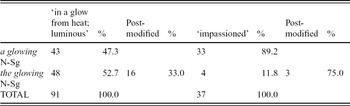
The differences in article profiles are most evident when we compare the most objective senses of glowing (‘in a glow from the action of heat’; ‘brilliantly luminous’) with the most subjective sense (‘ardent, impassioned’). The data in table 11 show that while indefinite and definite NPs are quite evenly distributed with the objective sense, the subjective sense, ‘impassioned’, shows a massive preference for indefiniteness: in this sense, glowing occurs in indefinite NPs 89.2 per cent of the time. Moreover, the postmodification patterns are similar to moving. Only 25 per cent of the objective senses occur with a postmodifier, while the corresponding figure for the subjective sense is 75 per cent (the data are admittedly scarce, however).
Definite and indefinite articles with different senses of glowing (BNC)

To sum up this section, we may conclude that in both case studies the correlation between the subjective sense of the modifier and indefiniteness is a useful tool for semantic disambiguation: subjective premodifiers occur very rarely in definite NPs, and therefore it is probable that in phrases like the moving N-Sg or the glowing N-Sg we are dealing with the objective sense of the word, especially if the phrase is not postmodified. This observation is interesting for the purposes of corpus annotation: as the objective senses of moving and glowing are regular -ing participles of the verbs to move and to glow, respectively, there are good grounds for categorising them as verbs, not adjectives. By contrast, the subjective senses behave syntactically like central adjectives and should also be categorised as such. This would make corpus annotation more accurate and allow for more reliable data retrieval.
6 Diachronic studies
So far we have studied the connection between subjectivity and indefiniteness from a synchronic perspective. In this section I will introduce two case studies which show that the skewed article distribution has uses in diachronic research as well. The idea is simple: if a relatively objective word gains a more subjective sense in the course of its history, then we should be able to see signs of this development in article distribution. More specifically, we would expect to see a rise in the frequency of the indefinite article. This, in turn, helps us estimate when the new meaning developed and allows us to study the semantic change in detail.
6.1 Outstanding
Outstanding is a good candidate for a diachronic case study as the OED gives it two relatively frequent, objective senses, which are still in use, and a very frequent subjective sense. These are:
1. That stands or juts out; projecting, prominent.
2. That continues in existence or remains to be dealt with; esp. (of a sum of money) unsettled, unpaid.
3. That stands out from the rest; noteworthy. Also: remarkable, exceptionally good.
Now, the first two meanings are clearly more objective than the third one. However, the third sense is somewhat problematic: it is evident that the sense of being ‘remarkable’ or ‘exceptionally good’ is more subjective than just ‘standing out’ in a neutral way. Moreover, it seems to me that ‘exceptionally good’ is a stronger expression of subjectivity than ‘remarkable’ as it unambiguously places the property denoted by the adjective to the extreme (positive) end of the scale of evaluation.
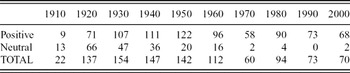
Corpus data suggest that the most subjective sense (‘exceptionally good’) is the prevailing sense of outstanding in Present-Day English. For example, there are 68 instances of prenominal outstanding from 2000–9 in the COHA, and only two of these can be understood in a neutral way; all the rest are unambiguously positive. Examples (22)–(24) illustrate the predominant present-day usage:
(22) He was the best tennis player in the community and an outstanding baseballplayer. (2002)
(23) We've talked to people, Mr. Cole. You've an outstanding reputation for diligence, and your integrity is above reproach. (2005)
(24) It will be an outstanding conference this fall. (2006)
However, the situation was very different less than a century ago. Examples (25)–(27) illustrate that outstanding was also commonly used in neutral context in the early 1900s.
(25) It is possible to say that excessive individualism is an outstanding curse of American civilization, and that absence of individualism is our marked deficiency. (1922)
(26) An outstanding weakness of this approach in its simple form consists in the lack of explanation of how and why these responses are what they are. (1929)
(27) The affair of the Italian bombers was easily the outstanding event of a bloody and nerve-wracking week. It not only meant that Spain's Civil War had now passed beyond the Pyrenees, but that for the first time, Fascism, like Communism, had become an international force. (1936)
Indeed, it is not until the 1930s that we see a clear preference for outstanding to be used in positive contexts, and the present-day situation, where neutral uses are extremely rare, is only established in the 1970s, as shown in table 12.
Positive and neutral readings of outstanding in singular NPs, 1910–2009, COHA

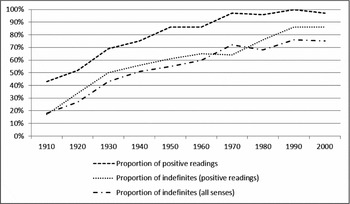
While careful data analysis is always crucial, we can still use the knowledge about the connection between indefiniteness and subjectivity as a quick-and-easy diagnostic of semantic change. Table 12 shows that the proportion of positive (i.e. the most subjective) readings of outstanding grows significantly in the 1930s. Interestingly, this is also the decade that marks an increase in the proportion of indefinite NPs with prenominal outstanding, as shown in table 13.
Outstanding as ‘standing out in a positive way’ or ‘exceptionally good’ in singular NPs (COHA)

Even raw corpus data yield similar results: counting the proportion of indefinite NPs in all the different senses of outstanding reveals that the correlation between subjectivity and indefiniteness can be used as a diagnostic of semantic subjectification even without conducting a semantic analysis of the data. Figure 1 illustrates this.
Prenominal outstanding: the proportion of positive readings and the proportion of indefinite NPs of the positive readings and all senses (COHA)

6.2 Key
Let us conclude our investigation by studying the semantic change of key, a word that has previously been studied by Denison from the perspective of category change (see also Aarts Reference Aarts2007: 132–3). Denison notes that key has gradually lost some of its ‘nouniness’ and gained adjectival uses (see e.g. Denison Reference Denison and Brinton2001, Reference Denison, Meurman-Solin and Nurmi2007, in prep.). He distinguishes two senses of key that are relevant for the category change of key and also for our discussion: ‘[t]hat which serves to open up, disclose, or explain what is unknown, mysterious, or obscure; a solution or explanation’ (OED s.v. key n., 6a), as in the key to his success, and a more recent sense of ‘dominant, controlling, chief, essential; esp. designating some person or thing that is of crucial importance to others’ (OED s.v. key, 17b).
The historically prior explanatory sense (OED, 6a) points to a unique factor that can explain a certain phenomenon, and it is therefore predominantly used with the definite article. The ‘crucial’ sense (OED, 17b), by contrast, may point to one explanatory factor out of many, and the sense is close to ‘extremely important’. Hence, it can readily be used in indefinite NPs as well, as in (28) and (29):
(28) But, looking back at coverage of two decades ago, one finds that the press played a key part in promulgating the view that Indochina was an area of vital interest to the United States. (COHA, 1971)
(29) Bashir was a key figure behind the extensive sightseeing tours for Henry Kissinger during his Middle East peace shuttles. . . (COHA, 1975)
Denison (in prep.) notes that key starts to appear with adjectival syntax with increasing frequency from the 1970s onwards. For example, the earliest predicative use of key without an article comes from 1970:
(30) Two ideas were key in the discovery of the kinoform. (OED, 1970)
This roughly coincides with the first corpus example of a prenominal use of key with a degree modifier (31). However, it must be pointed out that both degree modifiers and comparatives/superlatives used with key are rare, although some isolated instances can be found in the COCA (examples (32)–(34)):
(31) I think the role of the ambassador in the Soviet Union is a very key one. (COHA, 1964)
(32) So therefore that was more key to you than Mark Fuhrman or the race issue. . . (COCA, 1995)
(33) But there's another piece of equipment even more key to his independence. (COCA, 2003)
(34) General Lute was one of the most key resistors of this idea. (COCA, 2007)
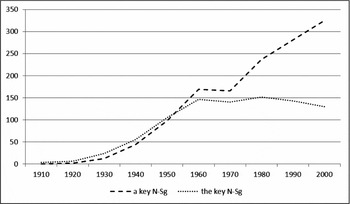
Detailed semantic analysis of key is problematic, as Denison (in prep.) also observes, because the two relevant senses of key are closely connected. However, corpus data reveal that there has been an increase in the proportion of indefinite NPs since the 1970s, which suggests that it is the ‘crucial’ or the ‘extremely important’ sense that has become more common. Significantly, this development corresponds well to the time when we start seeing the first signs of the word's functional expansion (examples (30) and (31)).
To sum up, the data presented in figure 2 complement Denison's distributional analysis. The article profiles show that the semantic change of key (from its ‘explanatory’ sense to the ‘crucial’ sense) started to pick up speed in the 1970s, but the change has been ongoing up to the present day. Therefore, observing the changes in the article profiles provides us with a method for studying the semantic side of the adjectivisation process.
The frequency of the definite and indefinite articles with key as a premodifier (1910–2009, COHA)

7 Conclusions
In this article I have discussed the correlation between semantically subjective premodifiers and NP indefiniteness. As this correlation has not been discussed in previous literature, much of this study has concentrated on providing evidence for the existence of the phenomenon, while also discussing its underlying reasons. I have suggested that the connection between subjective premodifiers and indefinite NPs can be explained in terms of information structure. Objective modifiers are often used to express accessible information: they denote properties that are typical of the referent, or accessible from context or through world knowledge. This makes them well suited for both indefinite and definite descriptions, and article choice is governed by both the accessibility of the modified discourse referent and the information encoded by the adjective. By contrast, subjective modifiers provide the speaker with a way of expressing a personal evaluation of the referent. This is typically new information, which is why subjective modifiers tend to be used in indefinite NPs. When they occur in definite NPs, the phrase is usually postmodified. The postmodifier serves to narrow down the set of possible referents and allows for the definite marking of the NP, even when the referent is new in discourse. I have suggested that in addition to its theoretical interest, this phenomenon can be used as a tool in the semantic disambiguation of polysemous senses, word-class annotation, as well as in studies of semantic change, where a significant increase in the proportion of indefinite NPs is indicative of the development of a new, more subjective meaning.
In the diachronic studies of outstanding and key the introduction of the subjective sense was accompanied by a gradual increase in the proportion of indefinite NPs. In the case of outstanding, this gradualness can be regarded as a natural consequence of pragmatic strengthening (Traugott Reference Traugott1989; Traugott & König Reference Traugott, König, Traugott and Heine1991; Hopper & Traugott Reference Hopper and Traugott1993). First, ‘standing out’ has a more neutral meaning, but the increased frequency of the positive environments in which the participle is used provides a basis for further semanticisation into ‘exceptionally good’. For key, on the other hand, the semantic change is rather subtle, which may explain why the increase in the proportion of indefinite NPs is gradual. The increased frequency of indefinite NPs also goes hand in hand with the observed increase in adjectival syntax (e.g. comparative forms, the use of degree modifiers) in recent decades, which reveals an interesting link between semantic change (subjectification), category change (adjectival syntax) and a syntactic tendency (increased proportion of indefinite NPs).
The results of this study may also be useful for more technically minded linguists. For example, parts-of-speech taggers and syntactic parsers operate on probabilistic information, and syntactic tendencies, such as the correlation observed in this article, may be valuable for automatic corpus annotation. As it stands, many corpora provide a rather simplified analysis of word classes. For example, in the BNC-web the word class of moving is tagged as an adjective in both the moving train and a moving experience. In this particular case, we could achieve 91 per cent precision in the annotation by simply telling the tagger that all instances of a prenominal moving with a definite article are verbs (i.e. they denote physical motion). Ultimately, of course, the precision of such an approach is dependent on the relative frequency of different senses, but nevertheless, the idea would certainly merit further consideration.