INTRODUCTION
Emerging economy multinational enterprises (EMNEs) have recently triggered extensive scholarly debates calling for new theoretical insights or extensions to the boundaries of existing theories of MNEs (Clougherty, Jin, Skousen, & Szücs, Reference Clougherty, Jin, Skousen and Szücs2017; Luo & Tung, Reference Luo and Tung2018; Xu & Meyer, Reference Xu and Meyer2013). Studies suggest that the strategic objectives as well as external and internal strategic contexts for EMNEs’ internationalization differ substantially from their advanced economy counterparts (Cui, Meyer, & Hu, Reference Cui, Meyer and Hu2014; Estrin, Meyer, & Pelletier, Reference Estrin, Meyer and Pelletier2018; Hoskisson, Wright, Filatotchev, & Peng, Reference Hoskisson, Wright, Filatotchev and Peng2013). In particular, it is unclear whether the conventional wisdom that focuses on the path-dependent process of cultivating networks and knowledge for international success equally applies to EMNEs’ internationalization. For instance, evidence of EMNEs’ risk tolerance and strategic aggressiveness, despite their relative lack of ownership advantages, seems to contradict mainstream theories of the MNE (Luo & Tung, Reference Luo and Tung2018; Rugman & Nguyen, Reference Rugman, Nguyen, Cuervo-Cazurra and Ramamurti2014).
In particular, recent studies identify multiple patterns of EMNEs’ international strategies that appear to deviate from classic typologies such as Dunning's (Reference Dunning and Oxelheim1993) classification of market, resource, efficiency, and strategic asset seeking. For example, by linking business ownership and international diversification, Luo and Tung (Reference Luo and Tung2007) classify EMNEs' strategies in four types: world stage aspirant, transnational agent, niche entrepreneur, and commissioned specialist. Focusing on competitive dynamics, Cui, Fan, Liu, and Li (Reference Cui, Fan, Liu and Li2017) differentiate EMNEs' strategic asset seeking investments in four types (casual updating, specialty developing, proactive experimenting, and aggressive overtaking). These studies highlight the heterogeneity of EMNEs' strategies. Yet, the appropriate classification of strategies and their performance implications remain poorly understood. Thus, a pressing question is how can EMNEs achieve high international performance using a variety of different internationalization patterns?
To address this research question, we further develop the strategic configuration view as an overarching theoretical framework to analyze EMNEs, especially the performance of their international operations. Building on configurational theory developed by organization theorists (e.g., Fiss, Reference Fiss2007; Kor & Mesko, Reference Kor and Mesko2013; Miller, Reference Miller1987, Reference Miller2018; Misangyi, Greckhamer, Furnari, Fiss, Crilly, & Aguilera, Reference Misangyi, Greckhamer, Furnari, Fiss, Crilly and Aguilera2017) and recent applications in management research (Fainshmidt, Wenger, Pezeshkan, & Mallon, Reference Fainshmidt, Wenger, Pezeshkan and Mallon2019; Haxhi & Aguilera, Reference Haxhi and Aguilera2017; Judge et al., Reference Judge, Hu, Gabrielsson, Talaulicar, Witt, Zattoni, López-Iturriaga, Chen, Shukla, Quttainah, Adegbite, Rivas and Kibler2015; Verbeke, Ciravegna, Lopez, & Kundu, Reference Verbeke, Ciravegna, Lopez and Kundu2019), we further crystalize the strategic configuration view by highlighting the interdependence and interaction among three key elements of firm operation, namely environment, leadership, and strategy, to study international performance.
Our objectives differ from those of prior studies of EMNEs' foreign direct investment (FDI) performance in three aspects. First, our unit of analysis is the entire portfolio of an EMNE's FDI projects, while prior studies on EMNEs’ FDI performance tend to investigate individual FDI projects (e.g., survival and financial performance of individual foreign subsidiaries). Second, following the call by Richard, Devinney, Yip, and Johnson (Reference Richard, Devinney, Yip and Johnson2009), we dissect the dimensions of corporate performance by separating growth and profitability. This allows us to examine strategies and conditions associated with different performance objectives. Third, instead of assuming a singular performance-maximizing solution for all firms, we apply configuration theory to allow for the existence of multiple equifinal strategic solutions (Fiss, Reference Fiss2007, Reference Fiss2011; Short, Payne, & Ketchen, Reference Short, Payne and Ketchen2008). In other words, instead of a universal formula for international success, multiple strategic configurations may coexist and be equally effective in delivering desirable performance outcomes.
This question is semi-exploratory in nature. Instead of hypothesizing potential configurations ex ante, we follow the strategic configuration view to reveal patterns of association as the basis for taxonomy development (Fiss, Reference Fiss2011; Short et al., Reference Short, Payne and Ketchen2008). We apply the fuzzy-set qualitative comparative analysis (fsQCA) technique in the context of Chinese manufacturing firms’ internationalization, using multi-sourced (combining survey and archival) data for a sample of publicly listed Chinese manufacturing firms that conducted FDI during 2007–2012. Our fsQCA procedure reveals seven strategic configurations associated with three performance groups of EMNEs’ FDI.
This study contributes new insights on EMNEs’ performance. Prior studies have highlighted the unconventional strategic focus of EMNEs (Cuervo-Cazurra & Genc, Reference Cuervo-Cazurra and Genc2011; Luo & Tung, Reference Luo and Tung2018; Ramamurti & Hillemann, Reference Ramamurti and Hillemann2018). However, whether EMNEs’ aggressive and exploratory strategies can deliver the desired performance outcomes remains an open question (Aybar & Ficici, Reference Aybar and Ficici2009; Guo, Clougherty, & Duso, Reference Guo, Clougherty and Duso2016), especially given the resource bottlenecks that these latecomer firms often face (Meyer & Xin, Reference Meyer and Xin2018). We develop a taxonomy that identifies three strategic configurations that deliver simultaneously high performance in international growth and profitability, which we name ‘global producer’, ‘local producer’, and ‘global seller’. In addition, we identify one configuration, ‘transnational manufacturer’ that results in profitable low growth, and three configurations with poor performance outcomes on both dimensions.
Two insights stand from our rich empirical findings. First, we distinguish growth and profitability dimensions of FDI performance, which are both conceptually and empirically distinct. Our findings, as summarized in our taxonomy, suggest that instead of trading off between these two objectives, EMNEs’ adopt strategic configurations that, with one exemption, either achieve or fail both performance objectives simultaneously. Second, with the equifinal configurations associated with the performance groups, our findings suggest that firms face multiple ways to succeed or fail, and thus challenge the ‘singular optimal solution’ assumption underlying the popular regression-based approach to theory testing (Cui et al., Reference Cui, Fan, Liu and Li2017; Fiss, Reference Fiss2007). We thus answer Van de Ven, Ganco, and Hinings's (Reference Van de Ven, Ganco and Hinings2013) call for more research and theorizing on equifinality of business performance.
STRATEGIC CONFIGURATION OF EMNES
The Strategic Configuration View
The notion of configuration refers to ‘any multidimensional constellation of conceptually distinct characteristics that commonly occur together’ (Meyer, Tsui, & Hinings, Reference Meyer, Tsui and Hinings1993: 1175). The development of the notion can be traced back to the early stage of organization studies, such as in Max Weber's work (Reference Weber1922), but it has remained ‘one of the field's least understood aspects’ (Fiss, Marx, & Cambré, Reference Fiss, Marx, Cambré, Fiss, Cambré and Marx2013). The contemporary ‘strategic configuration view’ extends the notion of configuration to strategy formation, implementation, and performance at different levels of an organization (Short et al., Reference Short, Payne and Ketchen2008). It emerged in the 1970s (Fiss, Reference Fiss2007) and has since integrated various theoretical arguments, such as combining entrepreneurial, adoptive, and planning modes (Mintzberg, Reference Mintzberg1973), archetypes of strategy formulation (Miller & Friesen, Reference Miller and Friesen1978), generic strategies and strategic groups (Porter, Reference Porter1985), organizational gestalts (Miller, Reference Miller1981), typologies of organizational forms (Miles & Snow, Reference Miles and Snow1978), strategic alignment (Luo & Park, Reference Luo and Park2001), and strategic orchestration (Sull & Ruelas-Gossi, Reference Sull and Ruelas-Gossi2010). Miller (Reference Miller1996) argues that configurations are central orchestrating themes that organize and connect an organization's elements; therefore, the strategic configuration view, as an umbrella term, adopts a holistic view of an organization and embraces causal complexities of achieving organizational outcomes (cf., Miller, Reference Miller1987; Misangyi et al., Reference Misangyi, Greckhamer, Furnari, Fiss, Crilly and Aguilera2017).
In this study, we adopt strategic configuration to study international performance. Ghoshal and Nohria (Reference Ghoshal and Nohria1993) argue that MNEs' international performance is driven by strategic configurations that align internal operations with uncertain and complex environmental components. Compared with other perspectives in management research, the strategic configuration view offers two distinct theoretical properties. First, multi-element alignment recognizes that all elements relevant to a firm's strategy are mutually interdependent, and therefore cannot be assessed in pairs. For example, while resources are essential to strategy formulation, aligning strategy with internal resources without considering the external environment is not sufficient nor feasible as the competitive environment influences the supply and value of resources (Makadok & Barney, Reference Makadok and Barney2001; Yamakawa, Yang, & Lin, Reference Yamakawa, Yang and Lin2011), and the firm is constrained by its resource-dependency on external actors (Burton, Lauridsen, & Obel, Reference Burton, Lauridsen and Obel2002). Embracing causal complexities, the strategic configuration view takes a holistic understanding of organizations, where constellation patterns of conceptually distinct strategy elements, rather than individual factors, are associated with strategic outcomes (Delery & Doty, Reference Delery and Doty1996; Fiss, Reference Fiss2007, Reference Fiss2011). This multi-element alignment reflects the essence of strategy, which concerns how firms can simultaneously align their structures, activities, and environments (Miller, Reference Miller1996).
The second distinct theoretical property of the strategic configuration view is equifinality, which refers to the possibility of multiple configurations of strategy elements leading to the same (desired) level of strategic outcome (Payne, Reference Payne2006; Short et al., Reference Short, Payne and Ketchen2008). Equifinality defies the assumption of a singular optimal configuration of causal conditions for a given outcome. Rather, multiple configurations of strategy elements can be equally effective in achieving high performance (Fiss et al., Reference Fiss, Marx, Cambré, Fiss, Cambré and Marx2013; Short et al., Reference Short, Payne and Ketchen2008). An important implication of this theoretical property is that competitive advantage (reflected in superior performance) is not tied to a singular success formula. Firms that lack certain favorable conditions may still achieve success by exploring alternative configurations of resource, strategy, and environment alignment.
Strategic Configuration as an Analytical Lens for EMNEs’ FDI
During their phenomenal growth in recent years, EMNEs have demonstrated considerable strategic diversity in comparison with the conventional strategies of more established multinational firms (Clougherty et al., Reference Clougherty, Jin, Skousen and Szücs2017; Cuervo-Cazurra & Genc, Reference Cuervo-Cazurra and Genc2011; Cui et al., Reference Cui, Fan, Liu and Li2017). In particular, they vary considerably in terms of their strategic goals and the competitive pressures they face (Hoskisson et al., Reference Hoskisson, Wright, Filatotchev and Peng2013; Luo & Rui, Reference Luo and Rui2009; Luo & Tung, Reference Luo and Tung2018). Such strategic diversity offers an ideal context to develop and test the notion of strategic configuration, which allows us to contribute novel empirical insights into the performance of EMNEs’ FDI which is currently inconclusive (Aybar & Ficici, Reference Aybar and Ficici2009; Buckley, Elia, & Kafouros, Reference Buckley, Elia and Kafouros2014; Guo et al., Reference Guo, Clougherty and Duso2016; McCarthy, Dolfsma, & Weitzel, Reference McCarthy, Dolfsma and Weitzel2016).
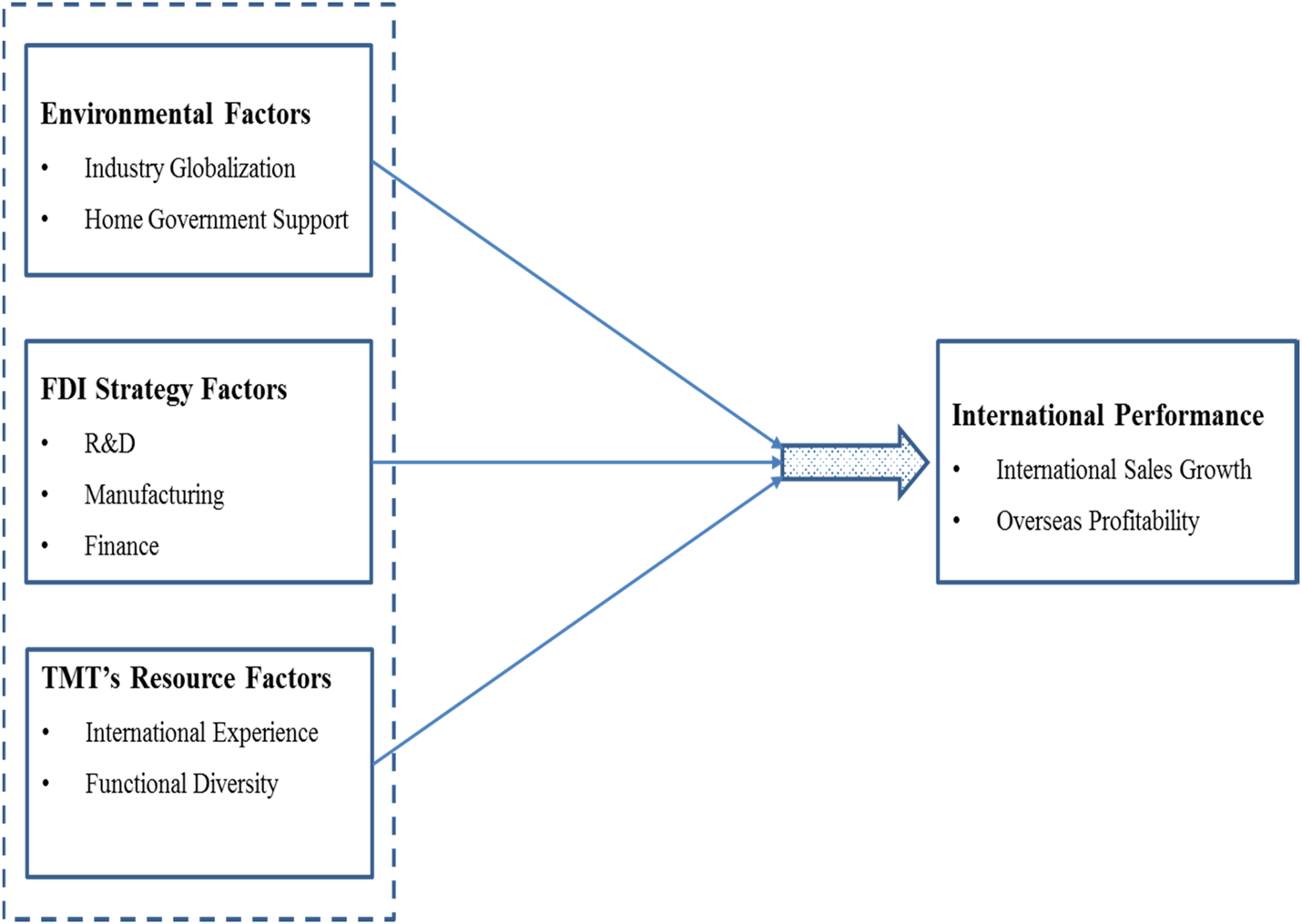
To explore the theoretical properties of strategic configuration of EMNEs’ FDI, we construct an analytical framework to guide our data exploration through fsQCA (see Figure 1). The framework enables us to identify and group critical strategy elements potentially influencing the international performance of EMNEs in an interactive manner. Our review of the strategic configuration literature suggests the salience of resource, strategy, and environmental factors for strategic outcomes. Accordingly, drawing on the recent literature of EMNEs (e.g., Buckley, Clegg, Cross, Liu, Voss, & Zheng, Reference Buckley, Clegg, Cross, Liu, Voss and Zheng2018; Chitoor, Sarkar, Ray, & Aulakh, Reference Chitoor, Sarkar, Ray and Aulakh2009; Luo & Tung, Reference Luo and Tung2018; Ramamurti, Reference Ramamurti2012), our analytical framework identifies specific factors under three dimensions that are most likely to influence the performance of EMNEs. Specifically, we focus on factors at the corporate level because this study concerns the performance of EMNEs’ overall FDI activities (i.e., the entire portfolio of an EMNE's FDI projects) rather than the performance of specific subsidiaries, and on the factors explaining the diversity, rather than common features, of EMNEs.
Theoretical framework of strategic configuration of EMNEs’ FDI

Environmental factors
The external environment has long been recognized by both industrial economics and institutional theory as presenting opportunities and constraints for business strategies (Aldrich, Reference Aldrich1979; Kimberly & Rottman, Reference Kimberly and Rottman1987; Scherer, Reference Scherer1980). At the corporate level, global trends in a firm's core industry and its home institutional framework constitute key environmental factors driving firm FDI strategies. For EMNEs in particular, recent studies highlight (1) the trend of industry globalization that increases competitive exposure to foreign competition and thus motivates firms to respond proactively through FDI (Chitoor et al., Reference Chitoor, Sarkar, Ray and Aulakh2009; Pangarkar & Wu, Reference Pangarkar and Wu2012) and (2) the significance of home government support for EMNEs’ strategic decisions and objectives regarding FDI (Buckley et al., Reference Buckley, Clegg, Cross, Liu, Voss and Zheng2018; Li, Meyer, Zhang, & Ding, Reference Li, Meyer, Zhang and Ding2017; Yamakawa, Peng, & Deeds, Reference Yamakawa, Peng and Deeds2008).
Industry globalization can be broadly defined as a process of intensifying linkages among national markets in terms of customers, value chains, and the extent of the relevant market in which firms compete (Ghemawat, Reference Ghemawat2007; Guillén, Reference Guillén2001). A central tenet of international business research is that globalization varies across industries because of underlying industry structure or conditions (Chang & Rosenzweig, Reference Chang and Rosenzweig1998). Firms competing in globalized industries can exploit similarities across international locations to accomplish global economies of scale and globally integrated, efficient supply networks and value chains (Kobrin, Reference Kobrin1991; Wiersema & Bowen, Reference Wiersema and Bowen2008; Yang, Lu, & Jiang, Reference Yang, Lu and Jiang2016). As industry globalization rises, firms can gain competitive advantages on a global level by adopting strategies that exploit location differences in national resource endowments and/or strategic resources (Bartlett & Ghoshal, Reference Bartlett and Ghoshal1989; Tsai, Huang, & Ma, Reference Tsai, Huang and Ma2009; Wiersema & Bowen, Reference Wiersema and Bowen2008).
While globalization increases global interdependence, the ability of EMNEs to compete on the global stage depends to some degree on their home environment (Buckley et al., Reference Buckley, Clegg, Cross, Liu, Voss and Zheng2018). In particular, home government support is important to many firms from countries that are relative latecomers to global competition (Hoskisson et al., Reference Hoskisson, Wright, Filatotchev and Peng2013). Such support can create value for domestic firms through, for example, preferential treatment for government-owned enterprises (such as banks or raw material producers), lighter taxation, relaxed regulatory oversight, or stiffer regulatory oversight of a firm's rivals (Buckley, Clegg, Cross, Liu, Voss, & Zheng, Reference Buckley, Clegg, Cross, Liu, Voss and Zheng2007; Luo & Tung, Reference Luo and Tung2007; Yan, Zhu, Fan, & Kalfadellis, Reference Yan, Zhu, Fan and Kalfadellis2018).
Moreover, governments control critical resources in many emerging economies, which they may employ to selectively encourage their favored businesses to go global (Hoskisson et al., Reference Hoskisson, Wright, Filatotchev and Peng2013; Xu & Meyer, Reference Xu and Meyer2013). For example, access to bank loans, preferential incentives, administrative assistance, and implicit guarantees help firms not only invest overseas, but do so profitably (Luo & Tung, Reference Luo and Tung2007, Reference Luo and Tung2018). Although home government may support all firms from a country, they often show preferences in terms of industries or types of firms they wish to support (Yan et al., Reference Yan, Zhu, Fan and Kalfadellis2018). EMNEs can then leverage such support to enhance their FDI performance by matching it with appropriate FDI strategies.
Strategy factors
Strategy concerns the allocation of resources to different activities in pursuit of competitive advantages. The strategy literature has developed various typologies regarding overall business posture (e.g., Miles & Snow, Reference Miles and Snow1978) and generic competition strategy (e.g., Porter, Reference Porter1985), among others, that can be applied to EMNEs (Buckley et al., Reference Buckley, Clegg, Cross, Liu, Voss and Zheng2007; Wright, Filatotchev, Hoskisson, & Peng, Reference Wright, Filatotchev, Hoskisson and Peng2005). Instead of picking a particular strategy taxonomy to evaluate EMNEs, we focus on the specific value-adding activities EMNEs perform in their FDIs, which vary in intensity across firms, reflecting their heterogeneous strategic intents, competitive positioning, and learning orientations (Barkema & Drogendijk, Reference Barkema and Drogendijk2007).
Firms can perform four main value-adding activities in FDI operations: sales, research and development (R&D), manufacturing, and finance (Kim, Park, & Prescott, Reference Kim, Park and Prescott2003; Takeuchi & Porter, Reference Takeuchi, Porter and Porter1986). Through FDI, firms establish subsidiaries in other countries that trade in local and international markets. These subsidiaries normally have their own sales activities, though the relative importance of sales varies across FDIs as the investing firm engages in other value-adding activities. R&D involves activities aiming to enhance products and processes of the firm through experiments, design, prototype development and testing, and technical support. Manufacturing involves activities related to converting material inputs into the final products, which include fabrication, assembly, quality control, testing, machining, and equipment maintenance. Some EMNEs use FDI mainly for finance purposes (Buckley, Sutherland, Voss, & El-Gohari, Reference Buckley, Sutherland, Voss and El-Gohari2015; Luo & Tung, Reference Luo and Tung2007), such as corporate holdings and tax arbitrage, including reverse investment aimed at obtaining foreign investors status in the home country or tax saving through tax-heaven investment. Overall, by evaluating the intensity and therefore importance of R&D, manufacturing, and finance activities across their FDI units, we can differentiate EMNEs in terms of the strategic posture of their FDI operations.
Managerial resource factors
The FDI literature suggests that a firm's international success is supported by its firm-specific advantages (FSAs), particularly in the forms of technology, brand, and managerial resources (Rugman & Nguyen, Reference Rugman, Nguyen, Cuervo-Cazurra and Ramamurti2014; Verbeke & Kano, Reference Verbeke and Kano2016). Scholars have also argued that experiential knowledge is an important resource for firm internationalization (Eriksson, Johanson, Majkgard, & Sharma, Reference Eriksson, Johanson, Majkgard and Sharma1997; Tan, Su, Mahoney, & Kor, Reference Tan, Su, Mahoney and Kor2020), which is embedded in the firm's top management team (TMT) (Carpenter & Fredrickson, Reference Carpenter and Fredrickson2001; Sambharya, Reference Sambharya1996). For EMNEs, while their FDI projects are not necessarily driven by the exploitation of their ownership advantages (i.e., FSAs) in technology or brand assets (Buckley et al., Reference Buckley, Clegg, Cross, Liu, Voss and Zheng2007; Luo & Tung, Reference Luo and Tung2007), they do need to overcome managerial challenges and cognitive barriers in overseas operations (Cui, Li, Meyer, & Li, Reference Cui, Li, Meyer and Li2015; Li & Cui, Reference Li and Cui2018). Recent studies of EMNEs have pointed to gaps in managerial human resources as a critical obstacle to strategy implementation in many internationalizing EMNEs (Meyer & Xin, Reference Meyer and Xin2018). Accordingly, we highlight two managerial resource factors, TMT international experience and TMT functional diversity, as crucial conditions for successful FDIs by EMNEs.
A firm's TMT international experience represents important managerial resource for its internationalization decision-making and corresponding performance (e.g., Carpenter & Fredrickson, Reference Carpenter and Fredrickson2001; Lee & Park, Reference Lee and Park2008). Knowledge on how to do business internationally enhances the understanding of opportunities and constraints, and thereby enhances the design and implementation of strategies (Bird & Mendenhall, Reference Bird and Mendenhall2016) and their ability to cross boundaries between business units in different countries and companies (Birkinshaw, Ambos, & Bouquet, Reference Birkinshaw, Ambos and Bouquet2017; Schotter, Mudambi, Doz, & Gaur, Reference Schotter, Mudambi, Doz and Gaur2017). However, such knowledge is often tacit and hard to transfer across organizational boundaries but may best be acquired through personal experience (Brewster, Bonache, Cerdin, & Suutari, Reference Brewster, Bonache, Cerdin and Suutari2014). Therefore, it is available to some firms but not to others and can become a critical differentiator for firms aiming to internationalize.
Specifically EMNEs face considerable obstacles in their overseas operations when their TMTs struggle to appreciate institutions that they counter (Meyer & Xin, Reference Meyer and Xin2018; Meyer, Ding, Li, & Zhang, Reference Meyer, Ding, Li and Zhang2014). As ‘latecomers’ in global markets, EMNEs typically do not yet have built international management capabilities through conventional experiential learning. With know-how from international work experience, TMTs in EMNEs can enhance their general managerial capabilities, while building specific capabilities to support international activities (Cui et al., Reference Cui, Li, Meyer and Li2015; Filatotchev, Liu, Buck, & Wright, Reference Filatotchev, Liu, Buck and Wright2009). Managers with international work experience are thus particularly sought by EMNEs that aim to catch up with global leaders. Thus, as an organizational resource, TMT international experience plays an important role for EMNEs’ strategies.
While TMT international experience helps EMNEs making international strategic decisions, functional knowledge of TMT members is critical for flexible and effective strategy implementation (Li & Cui, Reference Li and Cui2018). Managers are likely to encounter new challenges in foreign operations that they have not experienced in domestic operations. When dealing with new challenges, a group of collaborators (e.g., TMT members in MNE) can achieve knowledge transformation through proposing and applying their diverse knowledge in a new way, which is essential to explore alternative problem formations and unearth new solutions (Tippmann, Scott, & Parker, Reference Tippmann, Scott and Parker2017). Through members with various knowledge structures, functionally diverse teams are better at resolving such challenges by stimulating task-related constructive debate and criticism among TMT members (Simons, Pelled, & Smith, Reference Simons, Pelled and Smith1999). TMT functional diversity thus enables the generation of a wide range of solutions and strategic options, and thus design novel solutions to unfamiliar operational issues, which in turn is an important dynamic capability (Buyl, Boone, Hendriks, & Matthyssens, Reference Buyl, Boone, Hendriks and Matthyssens2011; Helfat & Martin, Reference Helfat and Martin2014; Wiersema & Bantel, Reference Wiersema and Bantel1992). Specifically, task-related debate is stimulated when group members disagree about the content of the tasks, including differences in viewpoints and ideas (Chen, Liu, & Tjosvold, Reference Chen, Liu and Tjosvold2010; Lovelace, Shapiro, & Weingart, Reference Lovelace, Shapiro and Weingart2001). Through task-related debate, functionally diverse TMTs can thus combine a variety of perspectives, knowledge, and skill-sets to enable sound decisions when faced with unfamiliar circumstances (Alexiev, Jansen, Bosch, & Volberda, Reference Alexiev, Jansen, Bosch and Volberda2010; Wei & Wu, Reference Wei and Wu2013). Therefore, TMT functional diversity is highly relevant for EMNEs to achieve desired strategic objectives of FDI.
METHODOLOGY
Research Design
As China is the largest emerging economy and an important source of outward FDI (UNCTAD, 2015), our sampling frame consists of all Chinese listed manufacturing firms during 2007 and 2012, on which we applied two sampling criteria. First, following the practice of prior studies (e.g., Hitt, Hoskisson, & Kim, Reference Hitt, Hoskisson and Kim1997), we used a size criterion of 50 million US dollars in market capitalization (based on 2012 financial reports). We did so to ensure that sample firms (1) have an adequate size to potentially achieve the strategic objectives through FDI and (2) have more complete and accurate data that are publicly available. Second, to examine EMNEs’ strategic configuration through FDI, a sample firm is required to have FDI operation between 2007 and 2011. A total of 426 firms with full contact details were identified to fulfill these criteria.
To obtain data for our outcome variable, we then designed and targeted our questionnaire to the top decision-makers in Chinese outward-investing firms. We required the respondent to be a senior executive who was directly in charge of their firm's outward investment activities. In the questionnaire, we asked the respondents to reflect on home government support of their firms’ FDI strategy in 2007–2011 and on the performance of the firm in 2012. The survey was conducted from April to December 2012. Our survey finally yielded 162 usable responses, which achieved an effective survey response rate of 38.0%. For strategic-fit factors except home government support, we averaged their values between 2007 and 2011. Firms’ FDI data were collected from the Orbis and Wind databases, two commercially available databases that have been used in prior studies in the Chinese context (e.g., Zou & Adams, Reference Zou and Adams2008), supplemented by firms’ annual reports. We identified TMT members of a firm, and following prior studies (e.g., Boeker & Wiltbank, Reference Boeker and Wiltbank2005; Nielsen & Nielsen, Reference Nielsen and Nielsen2013), collected their demographic data from annual reports. Environmental indicators were sourced from our questionnaire and the United Nations Industrial Development Organization (UNIDO) database. After taking one-year lag and deleting cases with missing data, we obtained a dataset of 128 firms in 27 manufacturing industries (for our sample distribution by industry and ownership type, refer to Supplementary Appendix I). As shown in Li (Reference Li2021), the data and testing results of this study are available at https://osf.io/u7mfe/.
Analytical Approach
We explore our research question following a set-theoretic approach utilizing fsQCA. fsQCA techniques identify patterns between set memberships and outcomes (such as international growth and FDI profitability), and allow for equifinality, a situation where ‘a system can reach the same final state from different initial conditions and by a variety of different paths’ (Fiss, Reference Fiss2007: 1181; Schneider, Schulze-Bentrop, & Paunescu, Reference Schneider, Schulze-Bentrop and Paunescu2010).
To perform a fuzzy-set analysis, the first step is calibrating set membership. Prior studies applying fuzzy-set analysis usually use three-level or four-level scales (e.g., Crilly, Reference Crilly2011; Fiss, Reference Fiss2011; Judge, Fainshmidt, & Brown, Reference Judge, Fainshmidt and Brown2014; Kim, Reference Kim2013). For causal conditions’ calibration, the underlying choice of the number of levels is that different levels of membership should reflect agreed upon standards (Crilly, Reference Crilly2011; Ragin, Reference Ragin2008). Correspondingly, our calibration is informed by prior literature and the qualitative analysis, as detailed below.
The second step involves the construction of a truth table with frequency cutoff to identify combinations of causal conditions associated with the outcome. Ragin suggests that when establishing a frequency cutoff, ‘the issue is not which combinations have instances, but which combinations have enough instances to warrant conducting as assessment of the subset relationship’ (Reference Ragin2008: 133). According to the literature, the selected cases associated with the frequency cutoff would have captured no less than 80% of the cases in the sample (e.g., Bell, Filatotchev, & Aguilera, Reference Bell, Filatotchev and Aguilera2014; Dwivedi, Joshi, & Misangyi, Reference Dwivedi, Joshi and Misangyi2018; Haxhi & Aguilera, Reference Haxhi and Aguilera2017; Ragin, Reference Ragin2008). We employ two as the frequency cutoff to include 85% of the cases in all of the analyses. This means that a causal combination is considered ‘relevant’ only when it is exhibited across two or more cases.
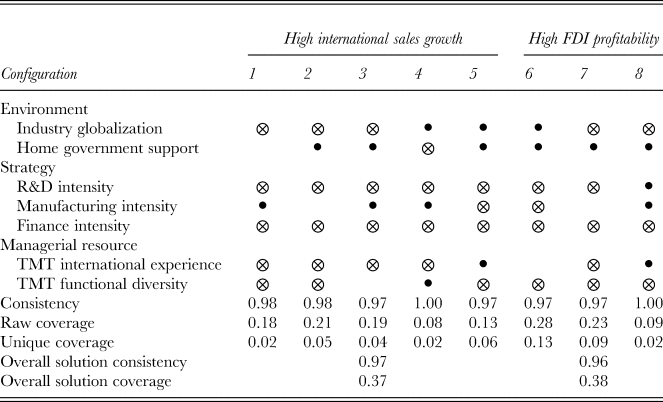
The third step involves the specification of the consistency threshold. Following earlier studies (Judge et al., Reference Judge, Fainshmidt and Brown2014; Pajunen, Reference Pajunen2008; Ragin, Reference Ragin2008), we examine gaps in the upper range of consistency to determine the thresholds. In our case, 0.97 for high international sales growth, 0.96 for high FDI profitability, 0.88 for low international sales growth, and 0.95 for low FDI profitability are employed because the truth tables exhibited substantial gaps at those consistency levels, and to be consistent with prior studies (Pajunen, Reference Pajunen2008).
Outcomes
Critical recent reviews of strategy literature have highlighted that organizations typically pursue multiple objectives (Hamann, Schiemann, Bellora, & Guenther, Reference Hamann, Schiemann, Bellora and Guenther2013; Hennart, Reference Hennart2011; Richard et al., Reference Richard, Devinney, Yip and Johnson2009), yet empirical strategy research normally focuses on singular dimensions of performance. To overcome this limitation and to enhance the external validity of our study, we analyze two distinct outcome variables relevant to firm internationalization. Especially for EMNEs, prior research suggests that in internationalization, they primarily pursue growth (Zhou, Barnes, & Lu, Reference Zhou, Barnes and Lu2010) and profitability (Luo & Rui, Reference Luo and Rui2009), though few achieve both objectives simultaneously (Park, Zhou, & Ungson, Reference Park, Zhou and Ungson2013). Accordingly, we run our analyses for both the growth and profit dimensions of firm performance, before integrating them in our interpretation of the findings.
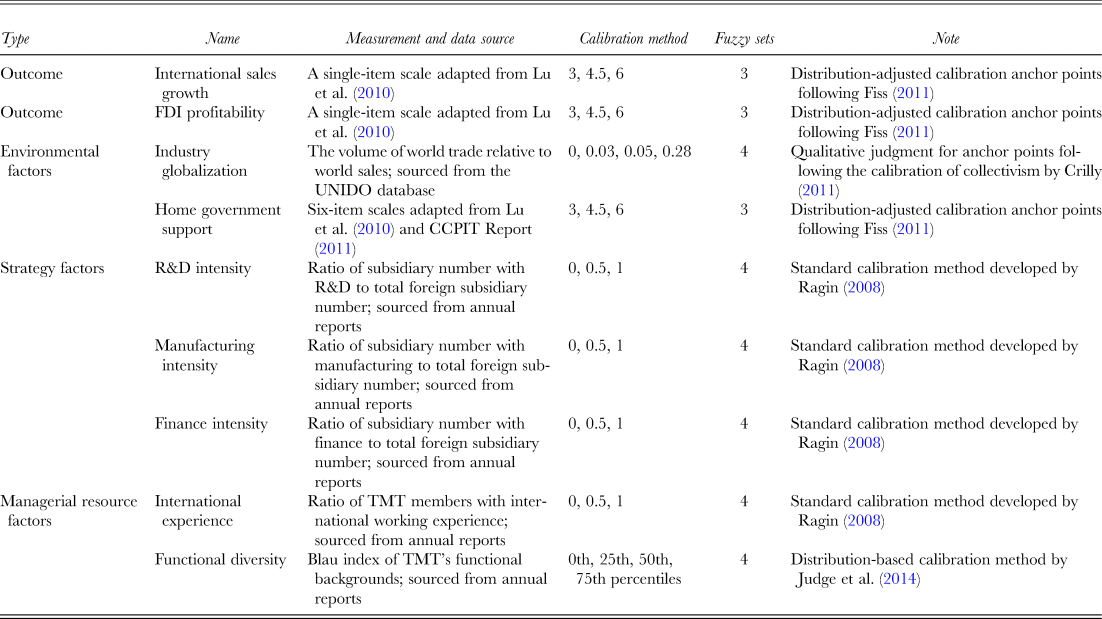
Specifically, we use international sales growth and FDI profitability as outcome variables associated with the two performance dimensions (Birkinshaw & Morrison, Reference Birkinshaw and Morrison1995; Johansson & Yip, Reference Johansson and Yip1994; Roth & Morrison, Reference Roth and Morrison1990). Adapted from Lu, Zhou, Bruton, and Li (Reference Lu, Zhou, Bruton and Li2010), our measurements of international performance were operationalized through two corresponding questions from the survey using a 7-point Likert scale (see Supplementary Appendix II). Our fuzzy-set measurements of high international performance were based on this scale and coded as ‘fully in’ with the set of the values of 6 and 7. Because the minimum observed value was 3 for both indicators, we coded this value as ‘fully out’ of the set of high international performance and used the observed scale midpoint of 4.5 as the crossover point, which follows Fiss's (Reference Fiss2011) calibration rules.
As mentioned earlier, fuzzy-set analysis further allows for the determination of asymmetric causality, which entails examining the causal connections in the opposite direction, or separately analyzing what leads to the negation of the outcome of interest (Campbell, Sirmon, & Schijven, Reference Campbell, Sirmon and Schijven2016). Thus, when analyzing low international performance of international sales growth and FDI profitability, we treat them as negation of high-performance indicators and use an inverse of the measure described above (i.e., reverse ‘fully in’ and ‘fully out’ thresholds).
Configurational Factors
As described above, we identify seven environmental, strategic, and managerial resource factors in EMNEs’ FDI strategic configuration. Following the rule of limited diversity, seven factors are appropriate for a sample of 128 observations (Ragin, Reference Ragin2006, Reference Ragin2008). Table 1 summarizes measurements and calibration of outcomes and configurational factors.
Measurement and calibration of outcomes and configurational factors

Industry globalization
We capture the extent of an industry's globalization by the volume of world trade relative to world sales, which we adapted from Wiersema and Bowen (Reference Wiersema and Bowen2008). The data about world trade and world sales in each industry are from the UNIDO database. With external industry knowledge and information of sample distribution, we calibrate industries with ratios above 0.28, such as communications equipment manufacturing and semiconductor manufacturing, as full members (i.e., a score of 1) in the set of industry globalization. Ratios between 0.05 and 0.28, including synthetic fibers manufacturing and motor vehicle body manufacturing, are considered to have a high degree of membership at the 0.67 level. Ratios between 0.03 and 0.05 receive a low degree of membership at the 0.33 level, which includes industries like beverage manufacturing, food manufacturing, textile, paper, and allied products. Industries with rates below 0.03, such as furs and leather products manufacturing and furniture manufacturing, are coded as full non-membership (i.e., a score of 0) of the set.
Home government support
We operationalize home government support through multi-item survey scales adapted from Lu, Liu, Wright, and Filatotchev (Reference Lu, Liu, Wright and Filatotchev2014) and CCPIT (2011). Executives were asked to describe their views on home government support for their firms’ FDI on six items with a 7-point Likert scale. We created an index by averaging the values, which has a Cronbach's alpha of 0.75 (see Supplementary Appendix II). We then applied distribution-adjusted anchor points of 3, 4.5, and 6 to calibrate the fuzzy-set membership of this factor.
EMNEs’ FDI strategies are captured by distinguishing four value-adding activities of foreign subsidiaries: R&D, manufacturing, and finance, with sales as a base activity for every foreign subsidiary. Thus, we treat subsidiaries without any of the three other activities as firms with sales focus. For R&D, manufacturing, or finance, we used intensity of this activity overseas, respectively, to capture EMNEs’ strategic focus on it. To operationalize this intensity measure, we used the formula ${\rm I} = N_i/N_t\;$ , where N i is the number of foreign subsidiaries with ith type of strategic activity (such as R&D) and N t is the total number of foreign subsidiaries of this EMNE. Activities have been coded based on the descriptions in annual reports of the firms. For the calibration of each of the activities (R&D, manufacturing, and finance), we consider firms with a ratio of 0 as fully out of the set. Those between 0 and 0.5 were coded as 0.33, and ratios between 0.5 and 1 were scored as 0.67. EMNEs with the ratio of 1 are fully in the set. Through this operation process, we obtained three calibrated strategy factors to represent EMNEs’ FDI strategies: R&D intensity, manufacturing intensity, and finance intensity.
TMT international experience
Following Sambharya (Reference Sambharya1996) and Cui et al. (Reference Cui, Li, Meyer and Li2015), we used the ratio of TMT members with international working experience to measure this factor. The information on working experience of TMT members was collected from companies’ annual reports. For the calibration of this factor, EMNEs with ratio of 0 are fully out of the set. Those between 0 and 0.5 were coded as 0.33, and ratios between 0.5 and 1 were scored as 0.67. Firms with ratio of 1 are fully in the set.
TMT functional diversity
Following previous studies (e.g., Qian, Cao, & Takeuchi, Reference Qian, Cao and Takeuchi2013), we calculated TMT functional diversity with a Blau index using the formula ${\rm B} = \left[{1-\sum {( p_i) }^2} \right]$ , where p is the percentage of TMT members in the ith functional expertise group. To calibrate TMT functional diversity, we assign the score of 0 to firms with the Blau index in the 25th percentile, which means they are out of the set. Meanwhile, firms in the 75th percentile are fully in the set, which are assigned the score of 1 for the membership. As a crossover point, we chose the 50th percentile of EMNEs’ TMT functional diversity, which is consistent with prior studies’ calibration approach (Fiss, Reference Fiss2011; Judge et al., Reference Judge, Fainshmidt and Brown2014).
RESULTS
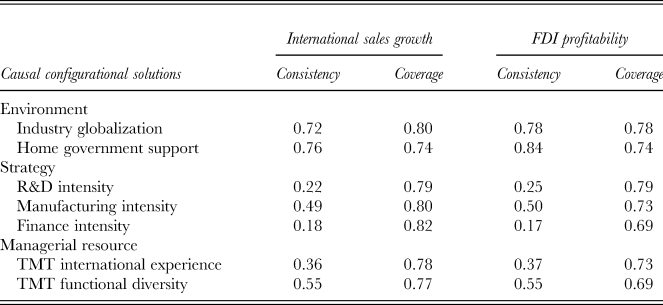
We tested whether any of the configurational factors could be considered as a necessary condition for the outcomes. In line with recommendations (Ragin, Reference Ragin2006; Rihoux & Ragin, Reference Rihoux and Ragin2009), the minimum consistency threshold is set at 0.90. As shown in Table 2, none of the individual factors exceeded the consistency threshold of 0.90. Descriptive statistics and correlation matrix for the outcomes and configurational factors are reported in Supplementary Appendix III. International sales growth and FDI profitability are related at medium level (correlation ratio: 0.51), confirming that they ought to be treated as distinct dimensions of EMNEs' international performance.
Necessary conditionsa

Note:
a Necessary conditions are calculated with the fsQCA 3.0 software.
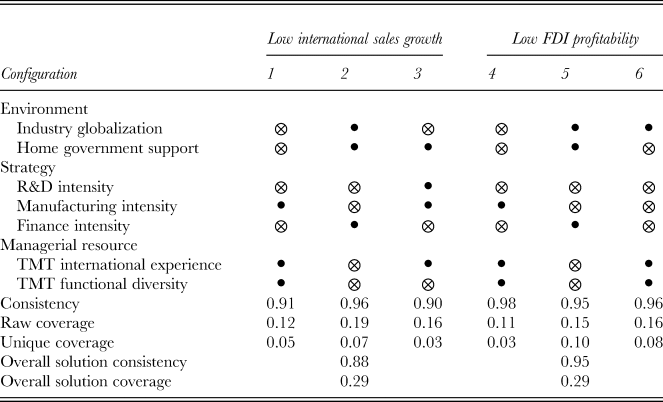
Table 3 presents the outcomes of the fuzzy-set analysis of EMNEs’ strategic configuration leading to high levels of sales growth and profitability, while Table 4 shows the configurations leading to low levels of sales growth and profitability. The results are presented following the widely adopted fsQCA presentation style introduced by Ragin and Fiss (Reference Ragin, Fiss and Ragin2008; also see Crilly, Reference Crilly2011; Fiss, Reference Fiss2011). The columns represent the configurations of factors that are associated with EMNEs’ high or low international performance, and that exceed the consistency threshold of 0.96 for high performance and of 0.88 for low performance. These configurations consistently display high correspondence with the outcomes. Under the notation, black circles (•) indicate the presence of a factor, and circles with ‘X’ (⊗) indicate its absence. Blank spaces indicate ‘don't care’ situations in which the configurational factor may be either present or absent. Following Ragin's (Reference Ragin2008) suggestion, we focus on intermediate solutions to generate our findings.
Configurations for high international performancea

Notes:
a Black circles indicate the presence of a condition, and circles with ‘X’ indicate its absence. Blank spaces indicate ‘don't care’.
Configurations for low international performance

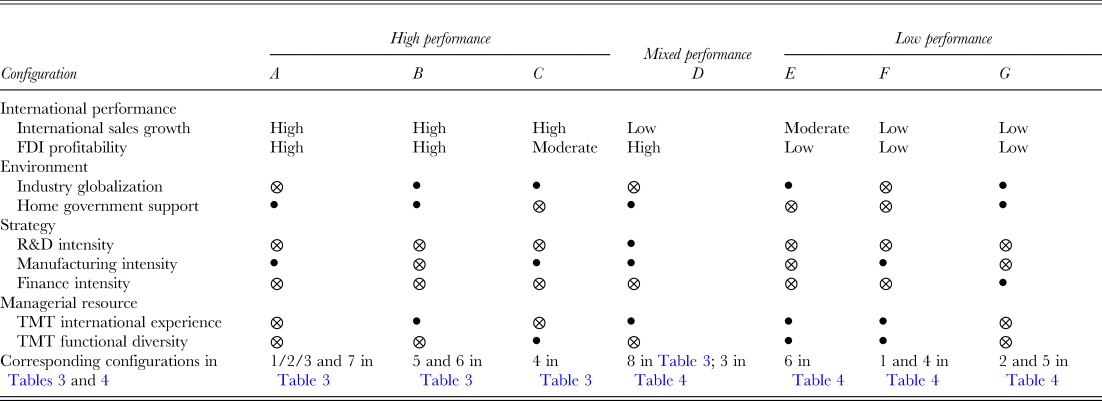
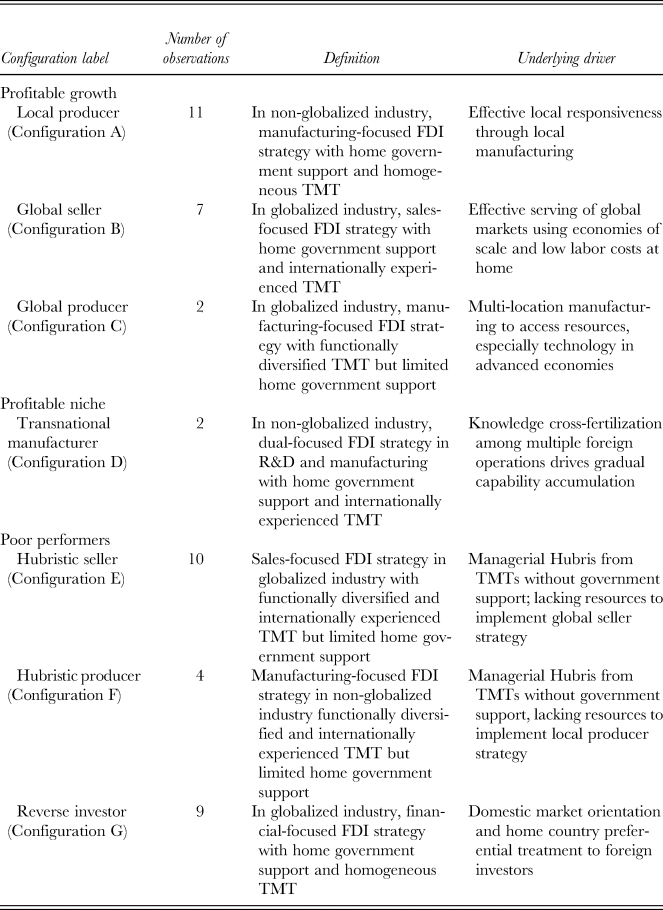
We reorganize the results based on both performance outcomes by aggregating the findings of Tables 3 and 4, which leads us to a taxonomy of seven strategic configurations (Table 5). Specifically, Strategic Configurations A–C lead to high or moderate performance in both international sales growth and FDI profitability; Strategic Configuration D leads to mixed performance with high FDI profitability but low international sales growth; and Strategic Configurations E–G lead to low performance in both indicators. These results demonstrate configurational equifinality for multiple pathways leading to the same level of desired outcome and asymmetric causality for high- and low-performance configurations.
EMNEs’ strategic configuration and dual-performance implicationsa

Note:
a Number of observations in each configuration is calculated by its unique coverage in the sample.
Robustness Tests
We conducted a number of robustness checks to understand the stability of the solutions. In particular, following the suggestions of Epstein, Duerr, Kenworthy, and Ragin (Reference Epstein, Duerr, Kenworthy, Ragin, Kenworth and Hicks2008) and Crilly (Reference Crilly2011), we replicated the analyses with reduced consistency thresholds. The configurations are similar to those presented in Tables 3 and 4, but they are less precise, as might be expected when applying a lower consistency threshold (Crilly, Reference Crilly2011; Schneider & Wagemann, Reference Schneider and Wagemann2006). Following Fiss (Reference Fiss2011), we further conducted sensitivity analyses to test the robustness of our findings through alternative specifications of our causal conditions. Specifically, we varied the crossover point between ±25% for our measures during calibration. Minor changes are observed regarding the number and configuration of solutions, but the interpretation of our results remains substantively unchanged. Detailed results of robustness tests are available from the authors upon request.
DISCUSSION
Based on the configurational approach, this study pioneers the study of strategic configurations that shape EMNEs’ performance. Exploiting methodological opportunities enabled by the fuzzy-set analytical technique, it reveals ‘the realities of strategizing’ (Fiss, Reference Fiss2007: 1194), which involve dynamic interactions of the three pillars of strategic configuration and equifinal pathways toward desired strategic outcomes. Meanwhile, we also find evidence for asymmetric causality (Ragin, Reference Ragin2008), indicating the nonlinear impact of configurational elements on the outcomes.
Our findings suggest that international strategic configurations have dual-performance implications as some configurations differ in their impact on, respectively, international growth and profitability. These findings not only contribute to our understanding of the performance of EMNEs but demonstrate the efficacy of the strategic configuration concept for international business research more generally. Methodologically, we contribute to the configurational approach and fuzzy-set analysis by generating dual outcomes of each configuration through cross-table comparison.
Putting the Pieces Together
In this section, we interpret the different strategic configurations and their performance outcomes. We supplement the fsQCA findings with case examples drawn from our sample for further qualitative analysis.
Profitable growth
Our results reveal two strategic configurations with potential to achieve high performance in both international sales growth and FDI profitability, thus realizing ‘profitable growth’. Configuration A reflects the strategic configuration of a Local Producer, which entails foreign production in localized (as opposed to globalized) industries. This configuration resembles a localization strategy which is designed to fulfill customers’ preferences in non-globalized industries. As latecomers in international markets, many EMNEs lack world-leading technologies and brands (e.g., Ramamurti, Reference Ramamurti2012), which makes exploitation of ownership advantage through standardization unattainable. To compensate EMNEs’ latecomer disadvantage, home government support plays an important role to access information on target countries and to generate financial resources to establish manufacturing sites abroad (Buckley et al., Reference Buckley, Clegg, Cross, Liu, Voss and Zheng2007; Morck, Yeung, & Zhao, Reference Morck, Yeung and Zhao2008).
Localization strategies can best be implemented when managers in foreign subsidiaries have sufficient autonomy to enhance their local responsiveness in the host market (Birkinshaw, Reference Birkinshaw1997). In non-globalized industry, less interference from TMTs of the headquarters would be preferred by foreign subsidiaries when pursuing local production strategy. For Chinese MNEs, recent studies also suggest that localization strategy works best with high levels of autonomy for foreign subsidiaries (Meyer & Xin, Reference Meyer and Xin2018; Wang, Luo, Lu, Sun, & Maksimov, Reference Wang, Luo, Lu, Sun and Maksimov2014). Meanwhile, compared with functionally diversified TMTs with international experiences, internationally inexperienced and functionally homogeneous TMTs are more likely to delegate their decision to foreign subsidiary managers, which compensates for the TMT's limited ability to evaluate the risks and opportunities in unfamiliar foreign environments (Li, Reference Li2018; Tihanyi & Thomas, Reference Tihanyi and Thomas2005). With sufficient autonomy, subsidiary managers can provide managerial resources for information search, interpretation, and verification, which help TMTs to overcome the constraints of accessing and interpreting complex information associated with foreign markets (Birkinshaw, Reference Birkinshaw1997; Wang et al., Reference Wang, Luo, Lu, Sun and Maksimov2014). Thus, a localization strategy can be led by autonomously acting subsidiary managers and thus is feasible for internationally inexperienced and functionally homogeneous TMTs.
An example of the Local Producer configuration is Hangyang Co. Ltd. in Germany. As top manufacturer of air separation unit and industrial gases in China, Hangyang realizes the importance of localization in its foreign operation. Since the requirements of industrial gases and air separation units varied country by country, Hangyang relied heavily on its local manufacturing subsidiary to cover product needs in Germany. With financial support and information access from home government, Hangyang built the factory with a German partner (Messer Group) in Frankfurt and hired local subsidiary managers to supervise its German operation. With power delegation from the TMT, the subsidiary managers from Germany helped Hangyang design and manufacture industrial gas products in its Frankfurt factory, which fit well with the needs of German industrial customers. Through this localized manufacturing strategy, Hangyang became an important player in the German market with satisfactory profits reported in its 2012 annual report.
Configuration B represents a second equifinal path of dual high performance, the configuration of a Global Seller. In globalized industries, pressure for local adaptation is lower (Bartlett & Ghoshal, Reference Bartlett and Ghoshal1989). EMNEs with standardized products can thus integrate most value-added activities in their home country to exploit economies of scale in production and lower labor costs. They then use FDI to access foreign markets for their standardized and price-competitive products. Meanwhile, home government support can help EMNEs to leverage domestic financial resources for FDI activities and to mitigate entry barriers in foreign countries friendly to the home government, which enhance EMNEs’ foreign market expansion and improve their FDI profitability. The implementation of this strategy benefits from internationally experienced managers who can better coordinate sales activities worldwide and transfer successful business operations from headquarters to foreign subsidiaries in globalized industries.
An example of Configuration B in our sample is Xiamen Comfort Science and Technology (XCST), the largest massage appliance manufacturer in emerging economies and the only listed company in this industry. Because production standards and customer requirements are largely the same across national markets, XCST integrated its R&D, production, and administrative departments in its headquarters in Xiamen with preferential treatment by local Chinese government (e.g., R&D subsidies, tax return on exporting, and land-leasing discount for factories). This helped the company to maintain high product quality with industry-leading low costs. Through sales subsidiaries in the US, Japan, and Hong Kong, XCST became the market leader for massage appliances in the Americas and in Asia. Meanwhile, as shown in XCST's 2012 annual report, the internationally experienced TMT was planning to extend its profitable business operations to other regions, such as Oceania and Europe.
Configuration C achieves high sales growth in globalized industries, which we label as Global Producer. In globalized industries with extensive cross-border exchanges of goods and services, MNEs can pursue standardized production and exploit location advantages overseas to enhance the efficiency of their global value chain (Kogut, Reference Kogut1985). Instead of basing production activities solely in the home country (as in Configuration B), a Global Producer optimizes production locations by following resource availabilities and costs globally, that is, locating each activity in a foreign location well suited for that activity. This optimization requires managerial expertise in evaluating locations for a diverse range of value-adding activities of the firm. As such, this strategy is enabled by functionally diversified TMTs and can deliver growth without support of the home government. Thus, Global Producers can grow international market rapidly, presumably due to the opportunities created for mobilizing resources from the global operational network. However, this configuration delivers only a moderate level of profitability, which is likely a result of lack of government support, and of internationally experienced TMT who can effectively manage globally integrated operations.
An example of Configuration C is Hikvision Co. Ltd. As a latecomer to global competition, Hikvision had grown into one of the world's largest suppliers of video surveillance. The company specialized in innovative video surveillance technology, as well as the design and manufacturing of a full line of innovative closed-circuit television (CCTV) and video surveillance products. In this globalized industry, a potential obstacle to entering advanced markets was the sensitivity within local communities regarding the extent to which their privacy would be protected by surveillance products and technology from a Chinese producer. To overcome this negative country of origin effect, Hikvision, the specialized surveillance provider, collaborated with local business partners in the US that each focused on different stages of the manufacturing process. Led by a functionally diversified TMT, Hikvision successfully integrated innovative technology from its Chinese R&D unit into locally manufactured surveillance products in its US joint ventures.
Profitable niche
Configuration D achieves high FDI profitability but only low international sales growth, thus capturing a ‘profitable niche’. We label this configuration Transnational Manufacturer as R&D units in multiple foreign countries support global knowledge creation and sharing as promoted by Bartlett and Ghoshal (Reference Bartlett and Ghoshal1989). Specifically, overseas R&D units help EMNEs to cross-fertilize product improvements across countries to increase FDI profitability for the whole company. Our results suggest that a transnational strategy can generate high FDI profitability if it is implemented by an internationally experienced TMT with home government support. However, a transnational organization is very complex to create and requires a collaborative organizational culture along with a carefully designed internal incentive scheme (e.g., Meyer & Estrin, Reference Meyer and Estrin2014). The creation of such an organization takes time. Although Bartlett and Ghoshal (Reference Bartlett and Ghoshal1989) advocate their transnational strategy as the ultimate international strategy for MNEs, our results in Configuration D suggest that with gradual development, this strategy may be profitable from a relative latecomer country. However, we only have a small number of firms showing this configuration, such that we recommend further research into the feasibility of global niche strategies for EMNEs.
An example of Configuration D is Foton Motor, the largest Chinese truck and bus manufacturer in terms of units sold. Since local demand varied and business environments were highly competitive, Foton needed to customize its commercial vehicles to meet local requirements. With home government support for financial resources and a TMT with working experience in Germany and Japan, Foton built an R&D center in Germany for premium commercial vehicle development and another in India for low-cost platform development. By integrating knowledge from these R&D centers, Foton successfully designed a more flexible manufacturing platform, which was deployed to its factories in 20 countries in Europe and Asia. This integrated flexible platform helped Foton to operate profitably in two continents, yet its international sales growth remained slow.[Footnote 1]
Poor performers
Our analysis uncovers three configurations (summarized on the right-hand side of Table 5) that fail to achieve high performance in either international growth or FDI profitability. We identify two different reasons for poor performance. Configurations E and F both point to managerial hubris leading to overambitious expansion. Both types have TMTs that are strong in terms of diversity and international experience, and their strategies appear theoretically appropriate for advanced MNEs. In a globalized industry, the optimal strategy should concentrate each value chain activity in the most suitable location while selling products worldwide (Configuration E, Hubristic Seller), while in a non-globalized industry, local manufacturing close to customers would make more sense (Configuration F, Hubristic Producer). However, both configurations lack support from the home government. These diversified and internationally experienced TMTs appear to underestimate their resource needs or overestimate their ability to access resources without government support. Therefore, even with resourceful TMTs, EMNEs without home government support achieve only moderate-to-low sales growth and low profitability. This finding provides important insights and empirical evidence to the big debate regarding how and why government support matters for EMNEs (Buckley et al., Reference Buckley, Clegg, Cross, Liu, Voss and Zheng2018; Luo & Tung, Reference Luo and Tung2018; Meyer et al., Reference Meyer, Ding, Li and Zhang2014; Morck et al., Reference Morck, Yeung and Zhao2008).
An example of Hubristic Seller in our data is the internationalization of SZZT Electronics, a manufacturer of secure payment products. In this globalized industry, SZZT had a well-diversified TMT and integrated most of its value chain activities in Shenzhen, China. However, when expanding overseas, SZZT did not enjoy much home government support. Thus, SZZT chose South Africa as its first overseas operation in consideration of relatively low expenses for its foreign expansion. However, as an emerging country, South Africa lacked strong market demand for secure payment products, while neighboring countries faced a similar situation. SZZT failed to generate desirable international growth and profit, which we attribute to managerial hubris. As example of Hubristic Producer, Jingwei Textile Machinery Co. Ltd. invested in truck manufacturing in the Netherlands, which led to low performance both in sales growth and profitability. Without home government support and lacking automobile manufacturing experience, Jingwei lost its way in R&D and new channel building for this new product line and thus suffered from poor international performance.
Our study offers some general insights from these poor performance types. Both ‘hubristic’ strategies (Configurations E and F) include well functionally diversified and internationally experienced TMTs but lack home government support. Although their strategic focus resembles successful strategies in many ways, their managerial hubris may lead the company to invest in inappropriate markets or unrelated diversification. These high-risk investments then yield negative influences for EMNEs’ international performance.
Finally, Configuration G points to a poor alignment path that we label Reverse Investor. In globalized industries, these firms have home government support but choose finance-focused FDI. Reverse investment represents the creation of a financial subsidiary in a foreign country (especially in tax-heaven countries) and then uses this subunit as the ‘foreign’ entity to invest back home to receive privileges (such as tax break and cheaper land-leasing fees) offered by home government (Buckley et al., Reference Buckley, Sutherland, Voss and El-Gohari2015; Luo & Tung, Reference Luo and Tung2007). Because attracting foreign investments is a national policy for many emerging economy governments, this type of strategy may be a convenient means to take advantage of these preferential treatments. With functionally homogeneous and internationally inexperienced TMTs, these firms focus on domestic operations, while their FDIs are largely used to benefit from home government privileges and subsidies for ‘internationalization’. Since most of their foreign operations do not focus on foreign markets, it is not surprising that their international performance is poor – the benefits of this strategy should be reaped in domestic accounts.
An example of this configuration G in our sample is a battery and electric vehicle manufacturer BYD, which established most of its foreign subsidiaries in tax-haven areas, including the Virgin Islands, Cayman Islands, and Hong Kong. In 2012, less than 1% of its product sales were in overseas markets, which demonstrates BYD as a typical reverse investor with limited interest in international markets at that stage. Configuration G suggests that finance-focused FDI strategy may be utilized as a method for reverse investment back to home country. In a globalized industry, even with home government support, EMNEs with functionally homogeneous and internationally inexperienced TMTs may largely focus on the domestic market and only use financial FDI to optimize their tax and subsidy structure.
Summary of strategic configurations
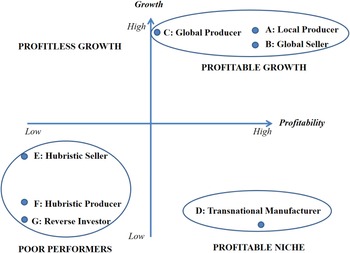
Based on the seven configurations discussed above, we propose a taxonomy of strategic configurations of EMNEs’ FDI, which are illustrated in Table 6 and Figure 2. Table 6 summarizes our taxonomy, outlining the strategic configuration types along with definitions and underlying drivers. Figure 2 provides an overview by mapping the seven configurations on the two dimensions of performance, namely profitability (FDI profitability) and growth (international sales growth).
Dual-performance implications of seven strategic configurations.

Taxonomy of strategic configuration of EMNEs’ FDI

Theoretical Contributions
In this study, we endeavor to make three theoretical contributions. First, we crystalize a strategic configuration view as an overarching theoretical lens to study the international performance of EMNEs. A central debate in EMNEs’ internationalization research concerns whether existing theoretical frameworks and models are able to explain the unconventional internationalization behaviors of EMNEs (Buckley et al., Reference Buckley, Clegg, Cross, Liu, Voss and Zheng2018; Chitoor et al., Reference Chitoor, Sarkar, Ray and Aulakh2009; Luo & Tung, Reference Luo and Tung2018; Ramamurti, Reference Ramamurti2012), and what new theoretical insights this phenomenon can contribute to the existing theories. Our study demonstrates that the context of EMNEs’ internationalization does not fundamentally reject existing theoretical work but requires further development of existing theory to accommodate greater complexities and varieties.
The contextualization of strategic configurations is particularly important for explaining EMNEs’ internationalization performance, because these firms are relatively inexperienced (Xu & Meyer, Reference Xu and Meyer2013; Zhou & Guillén, Reference Zhou and Guillén2015), originate from a variety of institutional settings, and have diverse strategic intents (Cui et al., Reference Cui, Meyer and Hu2014; Luo & Rui, Reference Luo and Rui2009). By integrating these contextual constraints, we identify equifinal ways for EMNEs to succeed or fail in international markets, thus responding to the call of Van de Ven et al. (Reference Van de Ven, Ganco and Hinings2013) for more research on equifinality of business performance.
Second, we enrich our understanding on an important knowledge gap of the performance of EMNEs’ internationalization, which has been remarkably under-investigated in the literature (Buckley et al., Reference Buckley, Elia and Kafouros2014, Reference Buckley, Clegg, Cross, Liu, Voss and Zheng2018; McCarthy et al., Reference McCarthy, Dolfsma and Weitzel2016). Our configurational analyses support the development of a taxonomy of EMNEs, where the patterns of the association among the firms’ multi-conditional alignments and their international performance in profitability and sales growth represent strategically distinct types of internationalizing EMNEs. Interestingly, most EMNEs in our sample (except firms in Configuration D) adopt strategic configurations either to achieve or fail the two international performance objectives simultaneously. While growth and profitability are distinct objectives (at least in the short to medium run), Chinese MNEs appear to either attain both objectives to at least a moderate degree or fail on both dimensions. Contrary to case evidence, such as presented by Park et al. (Reference Park, Zhou and Ungson2013) and by Rugman, Nguyen, and Wei (Reference Rugman, Nguyen and Wei2016), we do not find evidence of strategies that pursue growth at the expense of profitability, which would be in the top left quadrant of Figure 2.
Our poor performance configurations suggest that even well-diversified and experienced TMTs cannot secure desired outcomes without home governmental support, which appears to differentiate Chinese MNEs from MNEs from advanced economies. The taxonomy developed in this study thus helps explaining how performance outcomes are rooted in Chinese MNEs’ context, thus partially answering the question, ‘what is Chinese about Chinese MNEs'? (Ramamurti & Hillemann, Reference Ramamurti and Hillemann2018). For future research, these findings suggest that no single condition or strategic choice has a definitive impact on EMNEs’ international performance. Rather, our taxonomy suggests that future research should look into the diverse success pathways to examine the heterogeneities among EMNEs.
Third, we also contribute to the literature on strategic configuration by integrating external and internal configuration elements. In particular, we model the relationship between the environment and the organization influenced by TMT characteristics. Prior empirical studies examine external environment-strategy alignment and internal strategy-resource alignment separately, without considering the simultaneous alignment of these elements shaping strategic decisions and outcomes interactively rather than independently. In other words, separating external and internal alignments does not reflect the reality of strategizing, as the environmental and organizational conditions may present tensions between the separate goals of achieving external and internal trade-offs (Zajac, Kraatz, & Bresser, Reference Zajac, Kraatz and Bresser2000). Our study thus extends the concept of strategic configuration and highlights the importance of multiple alignments in international strategy.
Managerial Implications
Our findings offer practical implications, especially for internationalizing EMNEs. Firstly, EMNEs need to consider environmental, strategic, and managerial resource factors simultaneously when pursuing high international performance through FDI. Since FDI is a high resource-commitment and high-risk strategy, EMNEs should care about its performance implications rather than strategic motivations only. When actively engaging with environmental, strategic, and managerial resource factors, EMNEs may pursue multidimensional alignment for international growth or FDI profitability, or even both. Secondly, while environment, strategy, and managerial resource play important roles in firms' alignment, multiple pathways can lead to high performance.
Thus, managers need to identify a strategic configuration that is feasible to implement given their existing situation; in doing so they can choose between different strategy alternatives that enable high performance; there is no need to follow any particular strategy recipe. Thus, they should analyze their existing configuration and aim to move it toward one of the configurations identified as a high-performance configuration.
Limitations and Future Research Directions
Empirical limitations of this study suggest several future research directions. Scholars need to be cautious when assessing the efficacy of our empirically derived configurations in explaining the varieties of internationalization patterns of EMNEs. As with prior fsQCA studies, our goal is to reveal causal combinations of salient cases (Ragin, Reference Ragin2008) that are reliably identifiable (i.e., passing certain consistency threshold) from the sample data, but not to produce inferences that are generalizable to the population level. Our analysis results suggest that 60% of our sample firms, which were not covered in our results, may not have salient and/or consistent configurations leading to high/low international performances. This is reflected in the coverage levels of our configurational findings. While our overall and unique coverage levels are comparable to recent fsQCA studies with similar sample sizes (e.g., Bell et al., Reference Bell, Filatotchev and Aguilera2014; Dwivedi et al., Reference Dwivedi, Joshi and Misangyi2018; Misangyi & Acharya, Reference Misangyi and Acharya2014), the fact remains that our analysis result does not represent the full information in the data. To address this limitation, future research can supplement fsQCA with other analytical techniques that produce results based on the full information in the sample data. For example, researchers can use cluster analysis to explore potential inconsistency in non-salient firms of a sample and to even investigate the source of the inconsistent causal combinations in these non-salient observations.
Regarding the measurements of empirical analyses in this study, our measures of managerial resources are based on the analysis of TMT biographical records. This provides a fine-grained measure at the level of each TMT member. Future research may further improve on this by triangulating such data with surveys directly addressed to these individuals.
The nature of our sample, mid-sized (n = 128) and non-random, creates limitations to the generalizability of the taxonomy we developed. Following Tsang and Williams's (Reference Tsang and Williams2012) classification of generalization, we acknowledge several limitations. In terms of temporal generalization, the strategic configurations may change over time, especially due to the on-going institutional transition in emerging economies that influence not only resource availability but also the impact of resources. Future studies may incorporate institutional dynamics into their theoretical framework and apply longitudinal empirical designs to examine the dynamic multi-element alignment for EMNEs’ international performance with consideration of multiple outcomes.
In relation to contextual generalization, industry and country contexts may limit the generalizability of our findings. Regarding industry context, our focus is on manufacturing firms. The competitive dynamics and associate international investment barriers of this industry can differ substantially from those faced by firms in service and natural resource industries. As a result, our findings may not apply to other industries where firms’ internationalization may be driven by different environmental factors that fit with different FDI strategies supported by different resources. In other words, the strategic configurations are likely to be industry specific.
In terms of country context, our analyses were based on internationalizing firms from Mainland China. While China is an important emerging economy (by the sheer size of the economy and its global influence), it is not a representative one. The state capitalism system in China differs substantially from those found in other major emerging economies (Witt, Reference Witt2019). Specifically, home government support for firm internationalization, a key environmental driver in our theoretical framework, is more prevalent in China than in other emerging economies (e.g., Brazil, India, and Russia). Future research can conduct cross-country analysis to identify the role of country institutional system in general and the salience of specific institutional factors in firms’ internationalization.
CONCLUSION
Research on the performance of FDI is dominated by unifinal theoretical models and regression-based empirical methodologies. We argue that a configurational approach is more suitable to study strategy–performance relationships in EMNEs because of the existence of multiple equifinal strategies. We have thus applied an inductive approach based on set-theoretic methodology that, we assert, neatly fits the underlying mechanisms through EMNEs’ actual processes of international strategic configuration.
By applying this methodology, we have identified multiple equifinal configurations that enable profitable growth, even in a given environment or with given managerial resources. These three strategy configurations we have named as global producer, local producer, and global seller. This suggests that firms pursuing simultaneous alignment can choose between several configurations of strategy elements. Yet not all strategy configurations are successful; we have also identified three strategy types that perform poorly on both dimensions, while transnational manufacturers perform well on profitability but not on growth.
Supplementary Material
The supplementary material for this article can be found at https://doi.org/10.1017/mor.2021.53.