Introduction
In recent years, numerous new species of Gesneriaceae have been described from Vietnam (e.g. Middleton, Reference Middleton2009; Phuong et al., Reference Phuong, Xuyen, Wen and Wei2012; Middleton et al., Reference Middleton, Atkins, Luu, Nishii and Möller2014a,Reference Middleton, Leong-Škorničková and Nguyễnb; Luu et al., Reference Luu, Pham, Tran, Ngo, Dinh and Ton2015; Middleton, Reference Middleton2015; Vũ et al., Reference Vũ, Phạm, Nguyễn and Luu2015; Hong et al., Reference Hong, Li, Maciejewski, Wen and Do2018), including several of Oreocharis Benth. (Chen et al., Reference Chen, Middleton, Nguyen, Nguyen, Averyanov, Chen, Nguyen, Möller and Shui2017; Do et al., Reference Do, Wei and Wen2017; Chen et al., Reference Chen, Nguyen, Chen, Nguyen, Nguyen, Nguyen, Möller, Middleton and Shui2018). Since its redefinition in 2011 and the addition of several new species, Oreocharis now comprises about 115 species (Möller et al., Reference Möller, Middleton, Nishii, Wei, Sontag and Weber2011, Reference Möller, Wei, Wen, Clark and Weber2016; Chen et al., Reference Chen, Middleton, Nguyen, Nguyen, Averyanov, Chen, Nguyen, Möller and Shui2017; Do et al., Reference Do, Wei and Wen2017; Chen et al., Reference Chen, Nguyen, Chen, Nguyen, Nguyen, Nguyen, Möller, Middleton and Shui2018). Until recently, only one species, Oreocharis aurea Dunn, was recorded from Vietnam (Pellegrin, Reference Pellegrin and Lecomte1930; Wang et al., Reference Wang, Pan, Li and Wang1990, Reference Wang, Pan, Li, Weitzman, Skog, Wu and Raven1998; Ho, Reference Ho and Ho2000). Five additional new species have so far been described in 2017 and 2018: Oreocharis caobangensis T.V.Do, Y.G.Wei & F.Wen from Cao Bang Province in Northeast Vietnam (Do et al., Reference Do, Wei and Wen2017); O. argyrophylla W.H.Chen, H.Q.Nguyen & Y.M.Shui and O. blepharophylla W.H.Chen, H.Q.Nguyen & Y.M.Shui from Son La Province in Northwest Vietnam (Chen et al., Reference Chen, Middleton, Nguyen, Nguyen, Averyanov, Chen, Nguyen, Möller and Shui2017); and O. grandiflora W.H.Chen, Q.H.Nguyen & Y.M.Shui and O. longituba W.H.Chen, Q.H.Nguyen & Y.M.Shui from the Fan Si Pan mountains in Lao Cai Province in Northern Vietnam (Chen et al., Reference Chen, Nguyen, Chen, Nguyen, Nguyen, Nguyen, Möller, Middleton and Shui2018).
In 2014, a joint expedition from the Royal Botanic Garden Edinburgh (Logan Botanic Garden), the Royal Botanic Gardens, Kew, Longwood Gardens, the University of British Columbia and the Institute of Ecology and Biological Resources (IEBR) to Northern Vietnam yielded collections of fruiting specimens and seeds of an unidentified member of the Gesneriaceae. Plants raised in cultivation in Edinburgh and Kew from these seeds flowered in 2016. On the basis of its habit (leaves in basal rosette), flower shape (infundibuliform corolla), number of fertile stamens (four), filament shape (thick, more or less straight) and capsule dehiscence (loculicidal), it was identified as belonging to Oreocharis (Wang et al., Reference Wang, Pan, Li and Wang1990, Reference Wang, Pan, Li, Weitzman, Skog, Wu and Raven1998; Möller et al., Reference Möller, Middleton, Nishii, Wei, Sontag and Weber2011). Following comparison with existing species in the genus from Vietnam and elsewhere, it was concluded that it was a new species, which is described and illustrated here as Oreocharis tribracteata Bramley, H.J.Atkins & Mich.Möller. It was also discovered that this new species is similar to, but not conspecific with, unnamed collections from the Muséum national d'Histoire naturelle in Paris. These collections have mature fruits but only one mature flower between them. They do have sufficient diagnostic features, however, to be described as another new species, Oreocharis rufescens D.J.Middleton. Both these species are distinct from other species in the genus in their calyx lobes that are partially fused into a tube in contrast to nearly free basally fused calyx lobes in all other species.
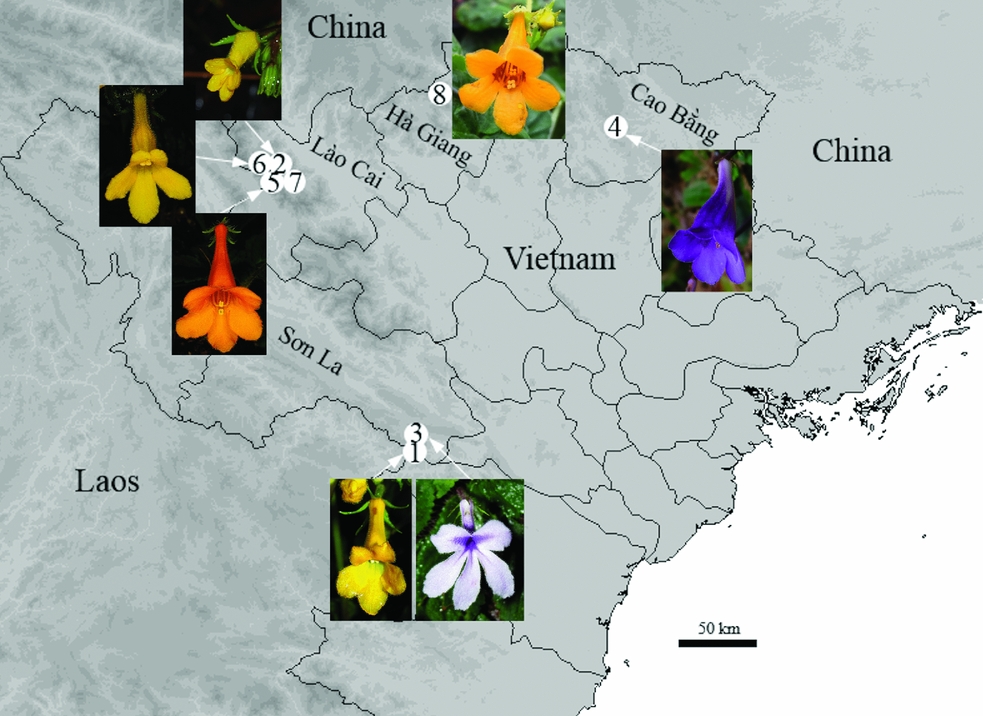
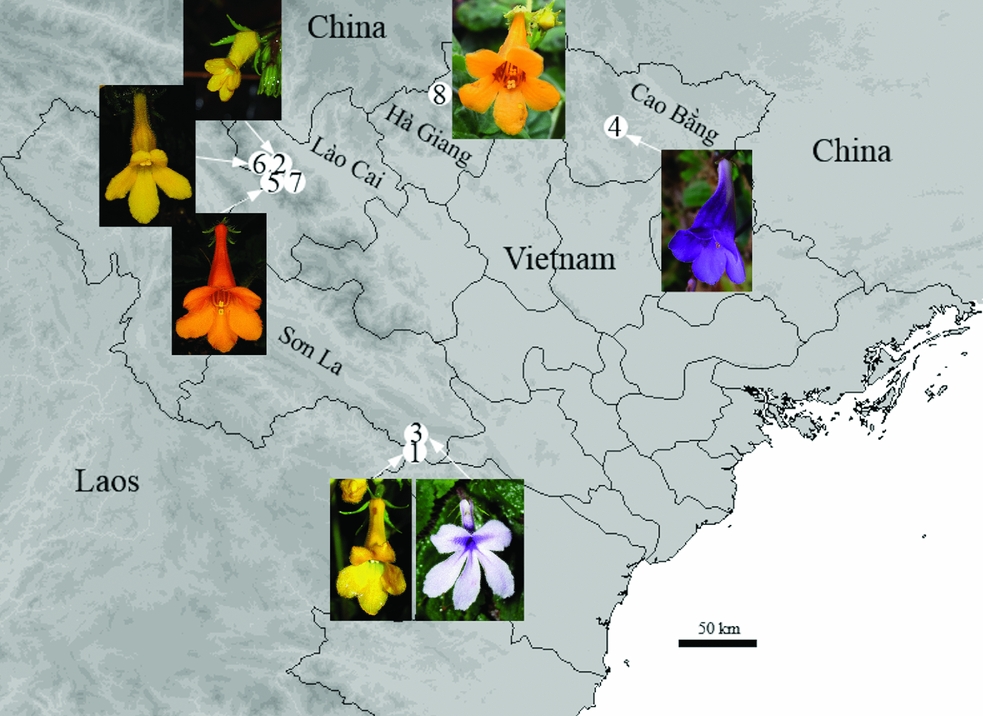
With the publication of these new species, the total number of Oreocharis species in Vietnam now stands at eight, occurring in four different provinces in the north of the country (Fig. 1). The species differ greatly in their combination of floral shape and colouring, and in leaf shape, particularly where they coexist on the same mountains (see Fig. 1). Such high diversity collected over a very short period of time in a relatively small region of suitable mountain ranges suggests that more diversity is present and that additional species will be discovered in the country. Several species appear to occur in close proximity or sympatry (Chen et al., Reference Chen, Middleton, Nguyen, Nguyen, Averyanov, Chen, Nguyen, Möller and Shui2017, Reference Chen, Nguyen, Chen, Nguyen, Nguyen, Nguyen, Möller, Middleton and Shui2018), which might indicate that they have similar ecological niches although have perhaps adapted to different pollinators. This is supported by differences in their floral morphology. In Fan Si Pan, Lao Cai Province, for example, four species occur: Oreocharis aurea, possessing small, short-tubed, yellow flowers (and broadly cuneate leaf bases); O. rufescens, with small, short-tubed flowers of unknown colour (and cordate leaf bases); O. longituba, with a long-tubed, yellow corolla (and cordate leaf bases); and O. grandiflora, with a large, deep-orange corolla (and narrow cuneate leaf bases). Oreocharis rufescens is found at higher altitudes than the other species. In A Lay village, Van Ho District, Son La Province, Oreocharis argyrophylla, with a yellow, open-tubed corolla, occurs alongside O. blepharophylla, with a purple, narrow and constricted corolla tube suggestive of butterfly or moth pollination (Chen et al., Reference Chen, Middleton, Nguyen, Nguyen, Averyanov, Chen, Nguyen, Möller and Shui2017). Such sympatric distributions have been observed elsewhere in Oreocharis, for example in Dayao Shan, Guangxi, China (Puglisi et al., Reference Puglisi, Wei, Nishii and Möller2011). In this case, however, the molecular data of Chen et al. (Reference Chen, Shui, Yang, Wang, Nishii, Wen, Zhang and Möller2014) suggested that this was not likely to be the result of sympatric speciation but due to allopatric speciation followed by later range overlap. It must also be noted, however, that there are many parts of the high mountains of Northern Vietnam from which specimens have not yet been collected or for which the collecting density is very low, so our understanding of the diversity and distribution of Oreocharis species in the region, including of overlapping species distributions, remains rudimentary.
Distribution of the eight recorded species of Oreocharis in Vietnam. 1, O. argyrophylla W.H.Chen, H.Q.Nguyen & Y.M.Shui; 2, O. aurea Dunn; 3, O. blepharophylla W.H.Chen, H.Q.Nguyen & Y.M.Shui; 4, O. caobangensis T.V.Do, Y.G.Wei & F.Wen; 5, O. grandiflora W.H.Chen, Q.H.Nguyen & Y.M.Shui; 6, O. longituba W.H.Chen, Q.H.Nguyen & Y.M.Shui; 7, O. rufescens D.J.Middleton sp. nov.; 8, O. tribracteata Bramley, H.J.Atkins & Mich.Möller sp. nov. No flower photograph is available of Oreocharis rufescens. (Photographs: 1 and 3, S. K. Nguyen; 2, B. Liu; 4, F. Wen; 5 and 6, Y. M. Shui.)
Key to Oreocharis species in Vietnam
1a. Calyx lobes fused into a tube for at least the lower third of their length______2
1b. Calyx lobes free to base or almost so_______________________3
2a. Petioles 8–12.5 cm long; bracts 3; corolla 40–50 mm long; filaments c.22–24 mm long____________________________O. tribracteata
2b. Petioles 2.5–7 cm long; bracts 2; corolla c.20 mm long; filaments c.3.2–4 mm long O. rufescens
3a. Leaf margins ciliate; corolla purple with white lobes_______O. blepharophylla
3b. Leaf margins not ciliate; corolla orange, yellow or purple including the lobes_4
4a. Leaf bases cordate__________________________________5
4b. Leaf bases cuneate to nearly rounded____________________6
5a. Petiole 6–7 cm; corolla 1.2–2.2 cm long; anthers free___________________O. aurea
5b. Petiole up to 12 cm; corolla 3.2–3.5 cm long; anthers coherent in pairs O. longituba
6a. Corolla purple; staminode 10–12 mm______________________O. caobangensis
6b. Corolla orange or yellow; staminode 6 mm or less______________________7
7a. Corolla less than 2.5 cm long; anthers free_________________O. aurea
7b. Corolla more than 2.5 cm long; anthers coherent in pairs_________________8
8a. Petiole less than 3 cm; leaf margin crenate; corolla deep orange; staminode 5–6 mm long____________________________O. grandiflora
8b. Petiole 4–9 cm; leaf margin serrulate towards apex; corolla yellow; staminode 1.4–1.5 mm long____________________________O. argyrophylla
Taxonomic Treatment
Oreocharis tribracteata Bramley, H.J.Atkins & Mich.Möller, sp. nov.
Oreocharis tribracteata is morphologically similar to Oreocharis grandiflora W.H.Chen, Q.H.Nguyen & Y.M.Shui but differs from it mainly by having longer petioles (8–12.5 cm versus 2.2–2.6 cm), a cordate leaf base (versus narrowly cuneate) with serrate margin (versus crenate), three bracts (versus two), calyx lobes divided to half its length (versus free to base) and an orange corolla with reddish markings (versus deep orange without markings). – Type: Vietnam, Ha Giang Province, Vi Xuyen, Tay Con Linh mountain, Xan Xa Ho Village, Lao Commune, 2174 m, 22°48′31.74″N, 104°48′17.34″E, 10 xi 2014, Hanoi, UBC, Logan Botanic Garden, Longwood & Kew. Exped to Vietnam (2014) (HNE) 341, grown on at RBGE as accession 20150643, vouchered and selected as type as M. Möller MMOG 400 (holo E, iso HN). Figs 2, 3.
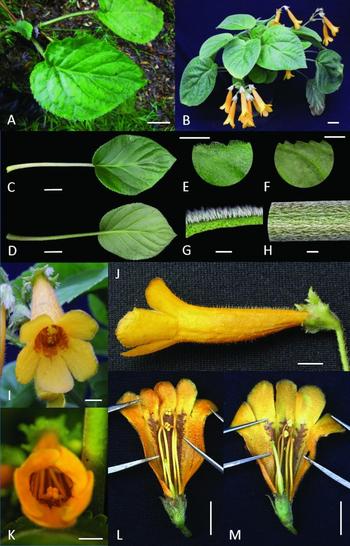
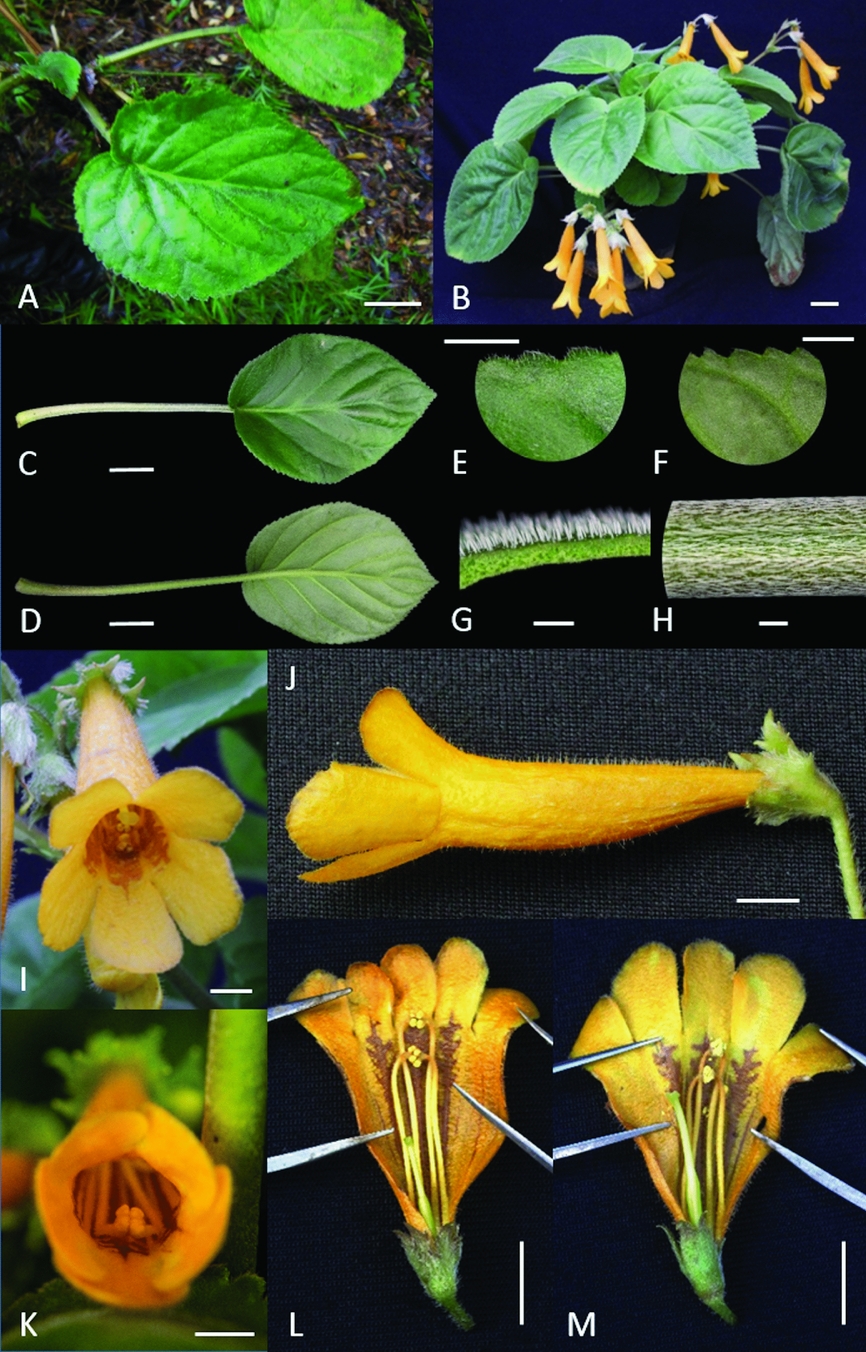
Oreocharis tribracteata Bramley, H.J.Atkins & Mich.Möller, sp. nov. A, Habit in the field; B, habit in cultivation; C, adaxial petiole and leaf surface; D, abaxial petiole and leaf surface; E, leaf margin, adaxial view; F, leaf margin, abaxial view; G, leaf cross-section; H, petiole close-up; I, flower front view; J, flower side view; K, flower in anthesis at male stage; L, flower at male stage, cut open; M, flower at female stage, cut open. Scale bars: A–D, 2 cm; E and F, 5 mm; G and H, 1 mm; I–K, 5 mm; L and M, 1 cm.
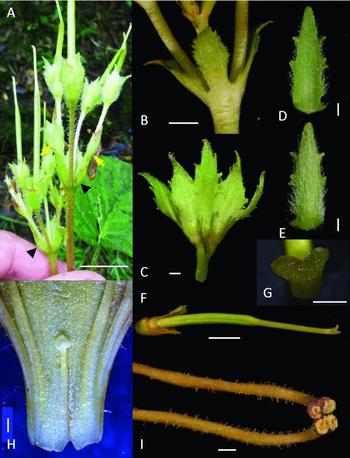
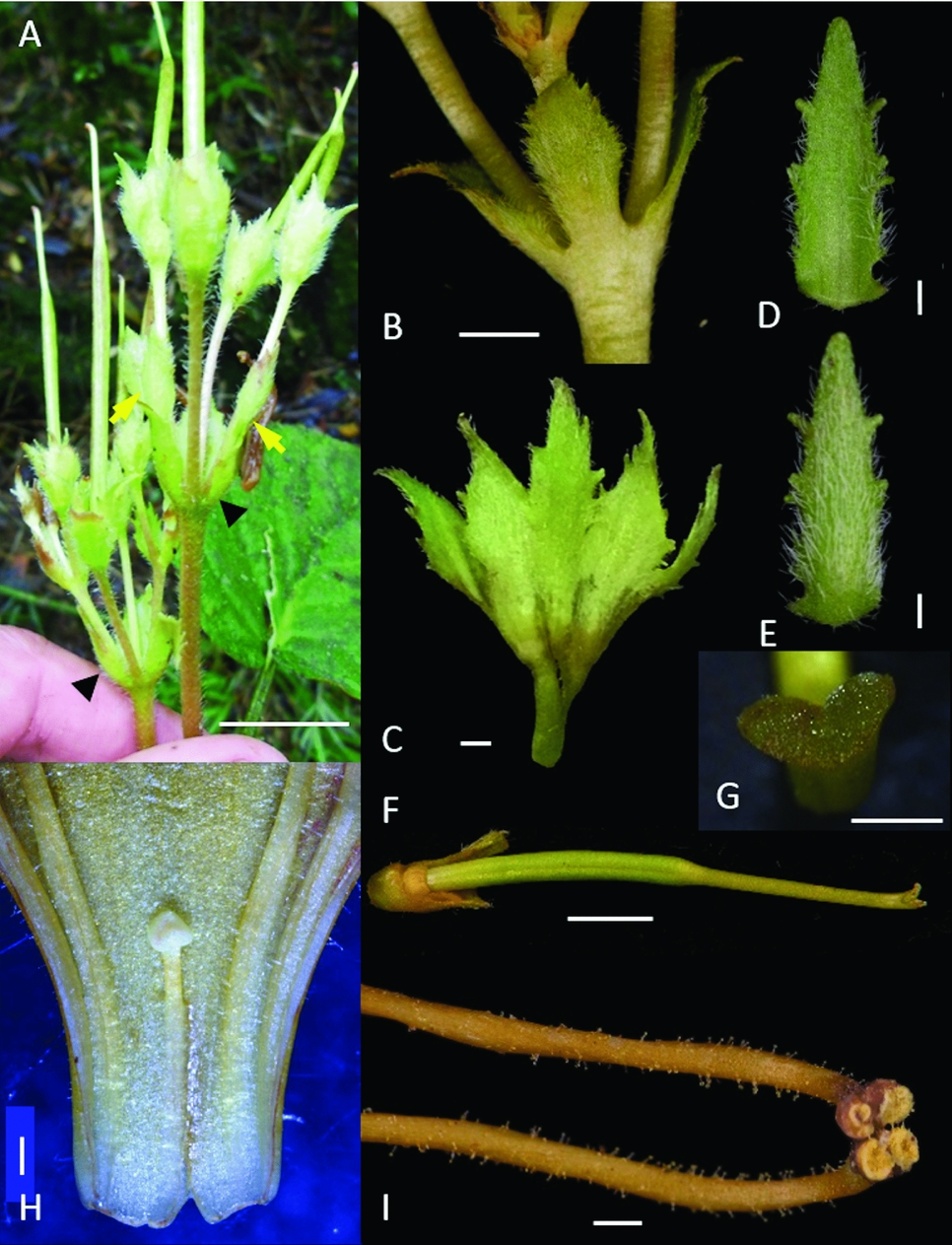
Oreocharis tribracteata Bramley, H.J.Atkins & Mich.Möller, sp. nov. A, Inflorescence with immature fruits, showing three bracts subtending cymes (black arrowheads) and occasional single or pairs of bracts subtending a single flower (yellow arrows); B, three bracts; C, abaxial view of open calyx tube; D, adaxial side of calyx lobe; E, abaxial side of calyx lobe; F, pistil with calyx partly removed, showing disc; G, bilobed stigma; H, flower cut open, showing staminode; I, one of the two stamen pairs. Scale bars: A, 2 cm; B, 5 mm; C–E, 1 mm; F, 5 mm; G–I, 1 mm.
Perennial herb. Leaves in a basal rosette. Petiole 8–12.5 cm long, with dense appressed hairs. Leaf blade narrowly ovate to ovate, 9–10 × 5.5–8 cm, base cordate, apex acute, margin serrate; adaxially with dense, even covering of semi-erect hairs, abaxially paler with appressed hairs on the lamina, veins densely covered; lateral veins 5 on each side of midrib. Inflorescences axillary pair-flowered cymes, (3–)6(–9)-flowered; peduncles longest in flower, 12 cm long, 12–15 cm long in fruit, with appressed, pale hairs; bracts 3, elliptic, 10–13 × 4–6 mm, abaxially with pale hairs, adaxially ± glabrous, margin serrate; pedicel 7–8 mm in flower, 22–25 mm long in fruit; additional bracts at each branching point 3, at first 8–10 × 3–4 mm, decreasing in size towards inflorescence apex, indumentum and margins as largest bracts; further single or pairs of bracts occasionally subtending single flowers. Calyx 12–15 mm long, light green, evenly 5-lobed, divided to about 2/3 of its length, lobes 9–10 × 3–4 mm, acuminate with margin bearing sporadic long teeth, adaxially glandular and with long, erect hairs near tip, abaxially with dense covering of long appressed, white hairs. Corolla orange with three darker reddish markings centrally at base of ventral and lateral corolla lobes continuing inside tube to base of corolla, slightly bilabiate, 40–50 mm long, internally with a scattering of glandular hairs, especially at base of corolla, externally with short, white glandular hairs throughout, tube narrowly funnel-shaped, 28–32 mm long, 3–4 mm in diameter at base and 9–10 mm in diameter at throat; upper lip 2-lobed, lobes suborbicular, 9–10 × 7–8 mm, lower lip 3-lobed, lobes suborbicular to oblong, 10–12 × 8–9 mm. Stamens 4, anthers coherent in two pairs, filaments thick, ± straight, with white, glandular hairs, slightly bent upwards near tips, adnate to base of corolla tube, upper pair c.24 mm long, lower pair c.22 mm long; anthers reniform, basifixed, glabrous; staminode 1, inserted at 5–5.5 mm from base, 2–2.3 mm long, clavate. Pistil 28–32 mm long when mature; ovary 1.5–1.8 cm long, glabrous; style 12–14 mm long, with a scattering of glandular hairs; stigma bilobed, lobes 1 × 1.5 mm; disc 1.5 mm, glabrous, in a ring with undulate margin and slightly cleft on one side, yellow. Capsule straight, loculicidally deshiscent predominantly on one side, glabrous, 4.7–5 × 0.3 cm. Seeds 0.2–0.25 × 0.6–0.67 mm, testa verruculose.
Additional specimens examined. Vietnam. Ha Giang Province: Vi Xuyen, Tay Con Linh mountain, Xan Xa Ho Village, Lao Commune, 2174 m, 22°48′31.74″N, 104°48′17.34″E, 10 xi 2014, A. Luke, R. Baines, M. Taylor, A. Hill, J. Harbage, N. V. Du, B. H. Quang, V. T. Chinh 341 (K); Vi Xuyen, Tay Con Linh mountain, Xan Xa Ho Village, Lao Commune, 2174 m, 22°48′31.74″N, 104°48′17.34″E, 10 xi 2014, Hanoi, UBC, Logan Botanic Garden, Longwood & Kew. Exped to Vietnam (2014) (HNE) 341, grown on at RBGE as accession 20150643, vouchered as H. Atkins 78 (E).
Distribution and ecology
In temperate evergreen rain forest commonly covered in clouds, in thin soil with high humus content, in dappled shade and high humidity. The surrounding vegetation is characterized by Schefflera J.R.Forst. & G.Forst., Acer L., Trevesia Vis., Rhododendron L. and Woodwardia Sm.
Phenology
The plants were collected in November with immature and mature fruits only. Flowering material is known only from cultivated collections.
Etymology
The species is named for the presence of three bracts, which is rare in the genus and absent from all other Oreocharis species currently known in Vietnam.
Proposed IUCN conservation status. Least Concern (LC) (IUCN, 2012)
Although known only from one small population, there is no immediate threat to the population from human activities because it is growing in an inaccessible site. However, the expedition report entry for the collection of that day states that there is evidence of destruction as a result of landslides in the area. More field studies are needed to see whether there are any identifiable threats to this species.
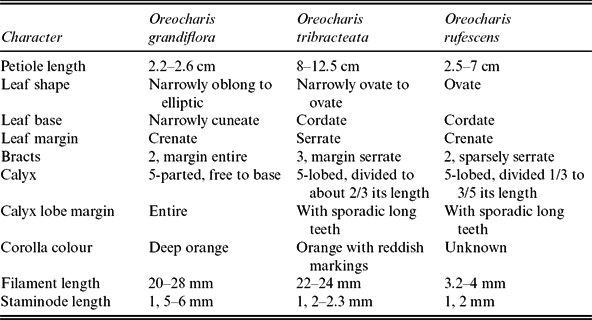
The new species Oreocharis tribracteata is morphologically similar to O. grandiflora (Table 1), which occurs in a different mountain range in a different province in Northern Vietnam (see Fig. 1). The colour and shape of the corolla of Oreocharis grandiflora are very similar to those found in O. tribracteata. However, the distinct dark reddish markings and the cordate leaf base clearly distinguish it from Oreocharis grandiflora, which lacks the markings and has a narrowly cuneate leaf base. It is also similar to Oreocharis rufescens, described below, because of the partially fused calyx lobes forming a tube, but differs in pubescence, the length of the petioles and filaments, and the size of the flowers. The presence of three bracts in Oreocharis tribracteata is also unique in Vietnamese Oreocharis.
Comparison of Oreocharis grandiflora, Oreocharis tribracteata and Oreocharis rufescens

The presence of three bracts is rather unusual in the cymes, because typically only two bracts are present in the cymes of dicotyledons. The reason lies in the special nature of the cyme in Gesneriaceae: each cyme unit comprises a flower pair instead of a single terminal flower. The additional flower is placed in front of the terminal flower. It usually lacks a subtending bract, but there are cases in which this bract is either facultatively or regularly well developed (Weber, Reference Weber1973, Reference Weber2013). Oreocharis tribracteata apparently represents one of the rare cases within Gesneriaceae in which the subtending bract of the front flower is consistently present throughout the inflorescence.
Oreocharis rufescens D.J.Middleton, sp. nov.
Oreocharis rufescens is morphologically most similar to Oreocharis tribracteata Bramley, H.J.Atkins & Mich.Möller but differs from it by having shorter petioles (2.5–7 cm versus 8–12.5 cm), two bracts (versus three), a smaller flower (corolla c.20 mm long versus 40–50 mm long) and shorter filaments (3.2–4 mm long versus 22–24 mm long). – Type: Vietnam, Lao Cai Province, Sa Pa District, ‘Massif du Fan Tsi Pan’ [Fansipan], 2200 m, vii 1940, P.A. Pételot s.n. (holo P [P04079332]).
Perennial herb. Leaves in a basal rosette. Petiole 2.5–7 cm long, with dense, patent hairs. Leaf blade ovate, 3.5–7.2 × 2.8–5.4 cm, base cordate, apex obtuse to almost rounded, margin crenate, adaxially and abaxially with a dense covering of reddish brown hairs, denser on venation and somewhat denser abaxially; lateral veins 4–6 on each side of midrib. Inflorescences axillary pair-flowered cymes, 5- to 8-flowered (but no full inflorescences intact on specimens); peduncles 5–8.5 cm long, with patent reddish brown hairs; bracts 2, elliptic, c.4 mm long, abaxially with reddish brown hairs, adaxially ± glabrous, margin sparsely serrate; pedicels 9–15 mm long, additional bracts at branching points few, similar in size and morphology. Calyx 6–9 mm long, fused into a tube at base for 1/3 to 3/5 of calyx length and then irregularly 5-lobed, lobes triangular, 3.7–4.5 × 1.3–2, apex acute, margin with sporadic long teeth, adaxially with long gland-tipped and eglandular hairs near tip, abaxially with dense covering of long gland-tipped and eglandular hairs. Corolla colour unknown, slightly bilabiate, c.20 mm long, internally glabrous, externally with short, glandular hairs sparsely throughout, tube cylindrical, c.11 mm long, c.5 mm wide; upper lip 2-lobed, lobes suborbicular, c.3.3 × 4 mm, lower lip 3-lobed, lobes elliptic, lateral lobes 6.2 × 5 mm, middle lobe c.7 × 5 mm. Stamens 4, anthers coherent in two pairs, filaments thin, glabrous, adnate at c.2 mm from base of corolla tube, upper pair c.4 mm long, lower pair c.3.2 mm long; anthers reniform, basifixed, glabrous; staminode 2 mm long. Pistil c.4 mm long; ovary c.2.5 mm long, glabrous; style c.1.5 mm long; stigma bilobed; disc c.1.9 mm long, in a ring but slightly cleft on one side. Capsule straight, 1.3–1.9 × c.0.3 cm. Seeds c.0.7 × 0.3 mm, testa verruculose.
Additional specimen examined. Vietnam. Lao Cai Province: Sa Pa District, ‘Massif du Fan Tsi Pan’ [Fansipan], 2900 m, viii 1942, P.A. Pételot s.n. (P [P04079343]).
Distribution and ecology
On rocks in very humid ravines.
Phenology
Only two collections are known, one collected in July with very few flowers and mostly fruit, and one in August with only fruit.
Etymology
The species is named after the distinctive reddish brown indumentum covering the plant.
Proposed IUCN conservation status. Data Deficient (DD) (IUCN, 2012), because it has been collected only twice, the last time in 1942.
Although the material on which this description is based had not already been described as a new species, the type specimen designated here had previously been partially annotated by the late B. L. Burtt along with notes by Olive Hilliard, drawing attention to it perhaps being an undescribed species. Burtt and Hilliard may have refrained from describing it, pending the collection of better material, which unfortunately is still not available. Table 1 shows a comparison of this species with Oreocharis grandiflora and O. tribracteata.
Acknowledgements
We thank A. Weber and J. L. Clark for their critical comments on the manuscript. We are grateful to D. Purvis and L. Wilson for the excellent photographic images of Oreocharis tribracteata, and extend our thanks to Drs S. K Nguyen, Y. M. Shui, F. Wen and Bing Liu for permitting the use of their photographs in Figure 1. The Royal Botanic Garden Edinburgh is supported by the Scottish Government's Rural and Environmental Science and Analytical Services Division. R.B. and V.D.N. would like to thank the IEBR, the University of British Columbia, Logan Botanic Garden, Longwood Gardens and the Royal Botanic Gardens, Kew, for support to the international expedition in Northern Vietnam in 2014 for collecting plant materials. The expedition was funded by the Vietnam National Foundation for Science and Technology Development under grant no. 106.03-2017.300 (B.H.Q). D.J.M. would like to thank the Muséum national d'Histoire naturelle in Paris for their hospitality and funding.