Introduction
Anaemia is one of the important public health problems that persists worldwide, particularly among women of reproductive age and children of developing countries, with major consequences for health, survival and economic development. However, the population group with the greatest number of individuals affected is non-pregnant women (468.4 million, 95% Confidence Interval (CI): 446.2, 490.6) (World Health Organization (WHO), 2008). Although the primary cause of anaemia is iron deficiency, it co-exists with a number of other causes, such as malaria, parasitic infection, nutritional deficiencies and haemoglobinopathies. According to regional estimates of WHO (2008) generated for pre-school age children, and pregnant and non-pregnant women, the greatest number of affected individuals of these groups belong to South-East Asian countries (315 million, 95% CI: 291, 340) (WHO, 2008). Severe anaemia among women is an important contributor to maternal mortality and morbidity, lowered physical activity and lowered productivity (Allen, Reference Allen1997, Reference Allen2000; Ramanakumar, Reference Ramanakumar2004), low birth weight and perinatal and neonatal mortality (McCormick, Reference McCormick1985; Seshadri, Reference Seshadri and Gillespie1997, Reference Seshadri1998; Steer, Reference Steer2000; International Institute for Population Sciences (IIPS) & ORC Macro, 2000). New analyses have shown that even mild and moderate anaemia have serious consequences for women and children (Stolzfus et al., Reference Stoltzfus, Mullany and Black2003); women with even mild anaemia may experience fatigue and have reduced work ability (Gillespie, Reference Gillespie1998).
The third round of the National Family Health Survey (NFHS) conducted during 2005–6 in India reported a disturbingly high burden of anaemia and undernutrition. More than 55% of women of reproductive age are anaemic while 36% have a body mass index (BMI) <18.5 kg/m2, indicating a high prevalence of chronic energy deficiency (IIPS & Macro International, 2007). About 39% of these anaemic women are classified as mildly anaemic (Hb 10.0–11.9 g/dl), 15% as moderately anaemic (Hb 7.0–9.9 g/dl) and 1.8% as severely anaemic (Hb <7.0 g/dl). Moreover, the proportion of anaemic women has increased more than 3 percentage points between 1998–99 and 2005–6 (IIPS & Macro International, 2007).
Various micro-level studies conducted in India reported high prevalence of anaemia among pregnant, non-pregnant and adolescent girls (Verma et al., Reference Verma, Chhatwal and Kaur1998; Rajaratnam et al., Reference Rajaratnam, Abel, Asokan and Jonathan2000; Chakma et al., Reference Chakma, Rao and Tiwary2000; Kanani & Poojara, Reference Kanani and Poojara2000; Malhotra et al., Reference Malhotra, Kumari, Kumar and Verma2004; Das & Biswas, Reference Das and Biswas2005). However, these studies were basically focused on determining level of anaemia among population sub-groups. In their study of socioeconomic determinants of anaemia in Andhra Pradesh, a southern state of India, Bentley & Griffiths (Reference Bentley and Griffiths2003) using NFHS-2 data for 1998–99 found, that place of residence, standard of living of the households, educational attainment, nutritional status and dietary habits and health practices are influential factors in determining anaemia status of women. Studies conducted in other developing and least-developed countries have shown that the underlying determinants of anaemia include diet (low in home-iron and bioavailability), infectious and parasitic diseases such as malaria, hookworm etc., and repeated reproductive cycles that deplete iron stores (Allen, Reference Allen1997; Stoltzfus, Reference Stoltzfus1997; Stoltzfus et al., Reference Stoltzfus, Dreyfuss, Chwaya and Albonico1997; Gillespie, Reference Gillespie1998; Tatala et al., Reference Tatala, Svanberg and Mduma1998; Hwalla et al., Reference Hwalla, Adra and Jackson2004; Brooker et al., Reference Brooker, Hotez and Bundy2008).
Although the high prevalence of anaemia among women in India cuts across states and regional boundaries, the prevalence is the highest among women belonging to the eastern Indian states of Assam, West Bengal, Orissa, Jharkhand and Bihar – ranging from nearly 70% in Assam and Jharkhand to 61% in Orissa, with an average of 65% (IIPS & Macro International, 2007). Also, percentages of women having moderate and severe anaemia are also very high in these states.
Against this backdrop, the present research investigates the determinants of anaemia among women of reproductive age in eastern India, where anaemia prevalence is particularly high. It is expected to find differences in levels of anaemia related to social class, rural/urban location, and age and marital status, even after controlling other potential confounding variables. It is hypothesized that prevalence of anaemia would be higher among rural women compared with urban women, particularly among the lowest social stratum. It is also hypothesized that women who married at an early age, started cohabiting and were exposed to the risk of childbearing or experienced childbearing are at elevated odds of being anaemic compared with their unmarried counterparts.
Demographic, social and economic profile of the study area
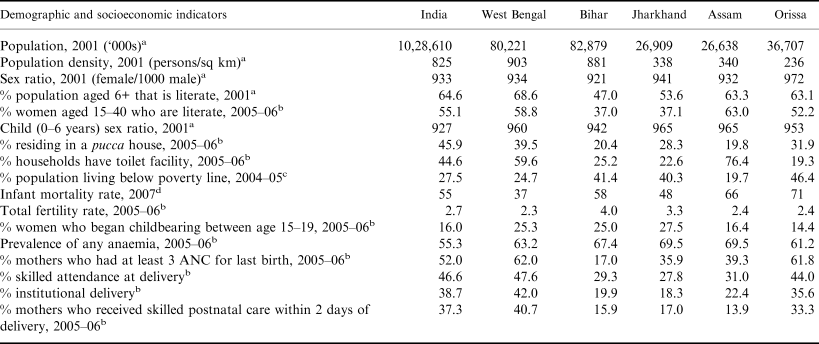
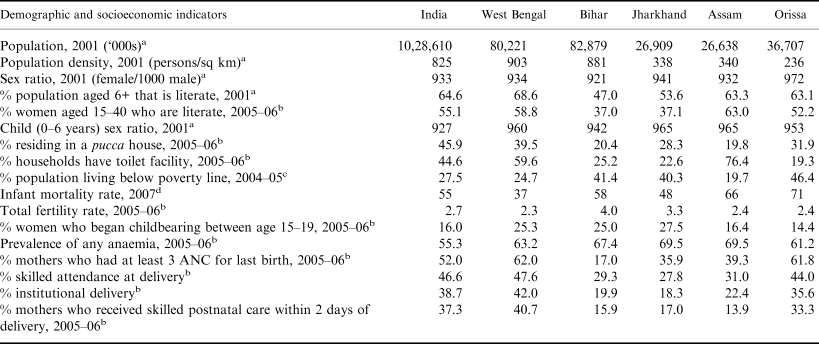
The states of Jharkhand, Bihar, West Bengal, Orissa and Assam constitute the eastern area of India. Approximately 25% of the Indian population resides in these states. Two of the states, namely West Bengal and Bihar, are very densely populated, while the remaining three are sparsely populated. Table 1 shows the demographic, socioeconomic and health indicators of these states, indicating that they are not among the developed states of India; they are characterized by a large rural population, high dependence on agriculture in the absence of heavy industry and widespread poverty with significant proportions living below the poverty line (National Sample Survey Organization, 2007). It may be noted that the indicators presented in Table 1 reflect the uniqueness of each state in terms demographic and socioeconomic characteristics. It seems that of these states, West Bengal is the best in terms of literacy rate and maternal and child health indicators, except the high fertility rate among adolescents. Assam is characterized by the least percentage of population living below the poverty line, the highest percentage of literate women and relatively low fertility among adolescents but a high rate of infant mortality. On the other hand, more than two-fifths of the population in Bihar, Jharkhand and Orissa live below the poverty line. Availability of toilet facility is also substantially lower in these states compared with West Bengal and Assam. While the maternal health indicators in Orissa are better than those of Bihar, Jharkhand and Assam, infant mortality rate is the highest in Orissa compared with all other states in this region. Nonetheless, except West Bengal to some extent, these states lag behind average India in many respects, including, in many instances, with regard to the situation of women of reproductive age.
Methods
Data
Data for this study were drawn from India's third National Family Health Survey (NHFS-3), as part of the Demographic and Health Survey (DHS) programme, coordinated by the International Institute for Population Sciences, Mumbai, under the aegis of the Government of India. The survey was carried out during 2005–6. It covered a nationally representative stratified random sample of 124,385 women (ever-married and never-married) in the age group 15–49 years and 74,369 men in the age group 15–54 years, residing in 109,041 households in order to provide estimates of a wide range of demographic, socioeconomic and nutritional health indicators. A total of 21,975 eligible women were interviewed in the five eastern Indian states and of these 20,826 respondents were not pregnant on the survey date according to their own reporting and were selected for the present study. The remaining 1149 pregnant women (5% of the sample) were excluded from the data set since by definition the level of anaemia is different for them compared with non-pregnant women. Finally, 19,695 (weighted 183,575) women, constituting 90% of the total sample for whom information on anaemia was available, were retained in the analysis.
The main strata used in the sampling procedure were rural and urban areas. The primary sampling units (PSUs) (villages in the rural areas and census enumeration blocks in urban areas) were selected with probability proportional to size sampling and the households were selected from within the PSUs. The non-response was not different by background characteristics for women and had not caused any bias in the data.
Measures
Measurement of haemoglobin levels was conducted by using a HemoCue Hb 201+ analyser. The HemoCue analyser has been used extensively for estimating the haemoglobin concentration in capillary blood in field situations. It has been found to give accurate results, comparable to estimates from more refined laboratory instruments (Gehring et al., Reference Gehring, Hornberger, Dibbelt, Rothisigkeit, Gerlach, Schumacher and Schmucker2002; Medina et al., Reference Medina, Mundy, Kandulu, Chisuwo and Bates2005; Gupta et al., Reference Gupta, Arnold, Kishor and Parasuraman2007). The analyser that was used in the NFHS-3 was validated with all tested systems (IIPS & Macro International, 2007). This system uses a single drop of blood from a finger prick (after removing first two drops to ensure that the sample is based on fresh capillary blood), which is drawn into a cuvette and then inserted into a portable, battery-operated instrument, and within one minute the haemoglobin concentration is indicated on a digital read-out. Based upon haemoglobin status and following international references (WHO, 1992), three levels of anaemia were distinguished: mild anaemia (10.0–11.9 g/dl), moderate anaemia (7.0–9.9 g/dl) and severe anaemia (less than 7.0 g/dl). Appropriate adjustments to these cut-off points were made for respondents living at altitude above 1000 m (3300 feet) and for respondents who smoke (Centres for Disease Control and Prevention (CDC), 1998). It may be mentioned here that about 4% of the total population in Assam live in the hilly areas (Registrar General of India, 2001). The adjustment of anaemia level for altitude was made with the following formulae: (1) adjust=−0.032×alt+0.022×alt 2; and (2) adjHg=Hg−adjust (for adjust > 0), where adjust is the amount of the adjustment, alt is altitude in feet (convert from metres by multiplying 3.3), adjHg is the adjusted haemoglobin level, and Hg is the measured haemoglobin level in g/dl. Similarly, an adjustment was also made for women who smoke as follows: for less than ten cigarettes smoked per day no adjustment was required; 10–19 cigarettes smoked per day required an adjustment of −0.3 g/dl in Hb concentration; 20–39 cigarettes smoked per day required an adjustment of −0.5 g/dl in Hb concentration; 40 or more cigarettes smoked per day required an adjustment of −0.7 g/dl in Hb concentration; unknown quantity or non-cigarette smoking required an adjustment of −0.3 g/dl in Hb concentration (CDC, 1998). In addition, the survey also measured the weights and the heights of women in order to calculate BMI by dividing weight (kg) by height squared (m2).
Analytical model
To identify the socioeconomic, diet, demographic, health habit and regional determinants of anaemia status, ordered logit models were used. The primary outcome variable in the analysis was created from the haemoglobin measurement, as mentioned earlier. However, only 1.5% of women were classified as being severely anaemic. For the purpose of regression modelling (more precisely to avoid problems with zero cell counts while estimating models) severe and moderate groups were clubbed together and to create a severe/moderate category (a haemoglobin concentration of less than 10.0 g/dl). In the ordered model the response variable was coded so that women with no anaemia were given 0 value, those with mild anaemia a value of 1, and those with moderate/severe anaemia 2.
The ordered logit model simultaneously estimates multiple equations by pooling the categories of response variable although it provides only one set of coefficients for each predictor variable. The number of equations it estimates would be the number of categories in the dependent variable minus one. In the present case two equations were estimated: in the first equation the response variable was categorized as no anaemia (coded as 0) and mild/moderate/severe anaemia (coded as 1) and in the second equation the response variable was categorized as no anaemia/mild anaemia (coded as 0) and moderate/severe anaemia (coded as 1). Thus, there is an implicit assumption of parallel regression, i.e. the coefficients for the variables in the equations would not vary significantly if they were estimated separately. To verify the validity of the aforesaid assumption, the parallel regressions were also estimated accordingly. It was found that (not reported in the Tables) the coefficients of the predictor variables did not vary significantly from the ordered logit estimates.
Moreover, multiple linear regressions (MLR) were also estimated with haemoglobin level as the continuous response variable (not reported in the tables). It was observed that although the signs and the significance of the coefficients of the predictor variables remained similar, the intercept was found to be large and values of the coefficients also differed significantly. It is worth mentioning that employing MLR in this case is possibly not an appropriate technique since the effect of predictor variables on the response variable may not be linear, because, for example, after some level of an explanatory variable, there may not be any rise in the haemoglobin level since it cannot increase further.
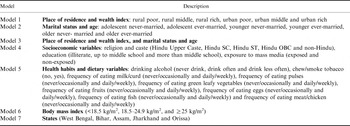
Predictor variables used in the ordered logit models in order to test their significant association with anaemia are presented in Table 2. The variables primarily fall into six main categories: place of residence and household wealth; age and marital status; other socioeconomic and demographic variables; health habits and dietary variables; BMI; and state of residence. As information on household income or expenditure is not directly available, the standard of living index (calculated by using factor analysis by NFHS-3) has been taken as the proxy for household economic status. The standard of living index consists of the following household and economic characteristics: type of house, toilet facility, source of lightning, main fuel for cooking, source of drinking water, use of separate room for cooking, ownership of house, ownership of agricultural land, ownership of irrigated land, ownership of livestock and ownership of durable goods. On the basis of the composite score related to these characteristics, the household standard of living was divided into five quintiles, viz., poorest, poorer, middle, richer and richest. After observing the variations of anaemia level among women belonging to these households, the variable was re-classified into three categories: poor, middle (pooling poorer and middle) and rich (combining richer and richest). Both household wealth and place of residence, and age and marital status, were combined to form a single categorical variable. For the age and marital status variable, age was classified into 15–19 years representing adolescent, 20–24 years representing young, and 25–49 years representing older.
Variables tested for significant association with anaemia in ordered logit regression Models 1–7

Also, caste and religion were pooled together to form a single categorical variable. The categories were upper (forward) caste Hindu, scheduled caste (SC) Hindu, scheduled tribe (ST) Hindu, other backward caste (OBC) Hindu, Muslim and other non-Hindu. The variable ‘mass media exposure’ was created from four variables, namely, ‘reads newspaper or magazine at least once a week’, ‘listens to the radio at least once in a week’, ‘watches television at least once a week’ and ‘visits the cinema/theatre at least one a month’. If a woman was exposed to any one of these, she was classified as ‘exposed to mass media of any sort’.
Altogether seven multivariate models were estimated. Model 1 included a variable that is a combination of household wealth and place of residence. This allowed a test of whether there were differences in the likelihood of being anaemic between economic groups both within urban and rural areas. In a similar way, Model 2 included a variable that is a combination of age and marital status to find out differences in the odds of being anaemic between age groups and marital status. Model 3 introduced the age and marital status variables in addition to household wealth and place of residence variables. Model 4 included other socioeconomic and demographic variables in addition to the variables of Model 3. Three additional models were also tested, adding to the variables already included in the earlier models. Model 5 introduced the health habits and dietary variables, Model 6 included BMI, and Model 7 incorporated state of residence.
Estimating the models in this way allows the testing of the significance of the association of place of residence and household wealth with anaemia status, and age and marital status with anaemia after controlling for a wide range of other confounding factors. Moreover, it also allows the identification of factors that reduced the significance of the variable of interest in each model, hence enabling the identification of variables that are associated with the place of residence and household wealth, age and marital status, and haemoglobin status of women.
Data were analysed using Stata Release 9 (Stata Corporation, 2005). To obtain the basic socioeconomic characteristics of samples, descriptive statistics were produced for the eastern Indian states after pooling data of the individual states using the individual state weights. Using sample weight in the analysis allows correction of disproportionate representation of women from states because of complex survey design. The results presented in the tables and used for interpretation are weight-adjusted in the sense that sample weights, which were inversely proportional to a woman's probability of selection and dependent on the number of women in the population at each level of stratification, were taken into account during analyses. The differences in the anaemia status variable in relation to household wealth and place of residence, or age and marital status variable, were examined through bivariate analysis using Pearson's chi-squared test of significance at p<0.05. The odd ratios produced by ordered logit regression were used for interpretation. The model assumes that the effect of any of the predictor variables should be the same regardless of the choice of category of the response variable. Only the significant variables with a two tailed p-value <0.05 are reported in Table 5.
Results
Sample characteristics
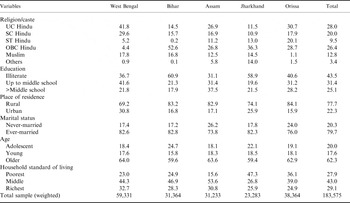
Table 3 presents the weight-adjusted sample characteristics of the respondents of each state of the eastern region of India. In general, rural predominance in the sample population was observed (78%) with the highest in Orissa (84%) and the lowest in West Bengal (69%). More than two out of five respondents were found to be non-literate in this region with the highest in Bihar (more than 60%) and the lowest in Assam (31%). More than 62% of the respondents of this region belonged to the age group 25–49 years, while around 80% were ever-married. The proportion of adolescents was higher in Bihar and Jharkhand compared with the other states. Although upper (forward) caste Hindu and other backward caste (OBC) Hindu constituted more than half of the total sample, the proportion of respondents by religion and caste varied substantially across states. Proportions of respondents belonging to the forward caste Hindu as well as to the SCs were highest in West Bengal (42% and 30% respectively) and lowest in Jharkhand (about 11% on average). The majority of the ST respondents were mainly from Orissa (20%), Jharkhand (13%) and Assam (11%). The highest proportions of OBC respondents were from Bihar (about 53%) followed by Jharkhand (36%), while the proportion was the lowest in West Bengal (4%). Respondents belonging to the Muslim and other non-Hindu communities were found to be highest in West Bengal (18%) and Jharkhand (14%), respectively, while their proportions were lowest in Orissa. Although the proportions of respondents belonging to the highest and the lowest economic strata were almost the same (29% and 28% respectively) in the sample, considerable differences may be observed among and between the states. Jharkhand (47%) and Orissa (36%) comprised the majority of the respondents belonging to the lowest economic strata while West Bengal (33%) followed by Assam (31%) had the highest proportion of respondents from affluent households.
Sample characteristics of the respondents in the eastern Indian states, NFHS-3, 2005–6 (percentages)

Prevalence of anaemia among different population sub-groups
Tables 4 and 5 present the weighted bivariate results of anaemia status by place of residence and household wealth variable, and the age and marital status variable. These are the main variables of interest, and from these the main hypothesis was constructed, i.e. that the differences in the prevalence of anaemia are related to economic well-being, rural/urban location, age and marital status. It was found that around 65% of women were classified as anaemic, about 48% as mildly anaemic, around 16% as moderately anaemic, and 1.5% as severely anaemic.
Level of anaemia (in percentages) by wealth and place of residence in the eastern Indian states, NFHS-3, 2005–6

Level of anaemia (in percentages) by age and marital status in the eastern Indian states, NFHS-3, 2005–6

The chi-squared statistics displayed in Tables 4 and 5 show the statistically significant differences in the prevalence of anaemia between groups based upon the aforesaid variables. Although rich and never-married women have statistically significant reduced risk of anaemia (p<0.01), the anaemia prevalence was high among all groups in the eastern Indian states. The prevalence of mild anaemia ranged from 42.5% among the urban poor to 50% among the rural poor. The prevalence of mild anaemia was also highest among adolescent ever-married (about 51%) and the lowest among younger never-married (about 45%). A low prevalence of moderate anaemia was found among both the rural and urban rich (just above 11%) and the highest prevalence was found among the urban poor (about 29%). Similarly, the prevalence of moderate anaemia was highest among the younger never-married (11.5%), and highest among adolescent ever-married (about 18%). In contrast, the prevalence of severe anaemia was highest among older never-married and the lowest among younger ever-married women. For severe anaemia the highest and lowest prevalences were observed among the urban poor, and both among rural and urban rich women respectively.
Econometric analysis
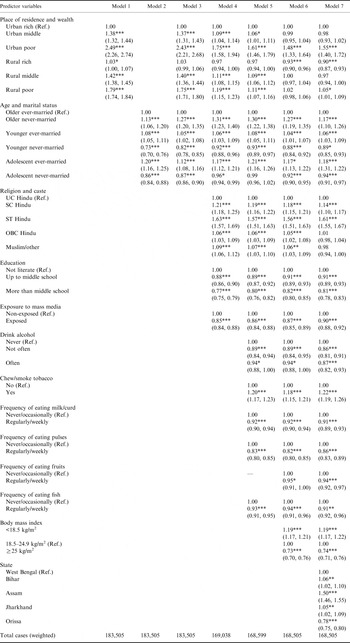
The odd ratios and 95% CI of the ordered logit regressions are presented in Table 6. Women belonging to urban poor households were observed to have the highest odds of being mildly, moderately or severely anaemic (OR=1.55, 95% CI=1.40, 1.72) compared with the urban rich women, even after controlling for a range of demographic and socioeconomic, health habit and dietary, BMI and state of residence variables in Model 7. Rural poor women were also found to have moderately higher odds of being anaemic compared with women from urban well-off households (OR=1.05, 95% CI=1.01, 1.09). It is interesting to note that women belonging to rural rich households have significantly lower odds of being anaemic (OR=0.90, 95% CI=0.87, 0.93) compared with women from urban rich households. In the unadjusted model, i.e. in Model 1, women belonging to the rural middle class (OR=1.42, 95% CI=1.38, 1.45), urban middle class (OR=1.38, 95% CI=1.32, 1.44), rural poor (OR=1.79, 95% CI=1.74, 1.84) and urban poor (OR=2.49, 95% CI=2.26, 2.74) had significantly higher odds of being anaemic compared with women belonging to urban affluent households.
Determinants of anaemia status for women in the eastern Indian states from the NFHS, 2005–6 (odd ratios and 95% CI obtained from ordered logit regression models)

Ref., reference category.
* p<0.05;
** p<0.01;
*** p<0.001.
From Model 7 it can also be ascertained that younger and adolescent unmarried women were significantly less likely to be anaemic (OR=0.94, 95% CI=0.91, 0.97 for adolescent never-married and OR=0.89, 95% CI=0.85, 0.93 for younger never-married), while younger and adolescent ever-married, and older never-married were significantly more likely to be anaemic (OR=1.18, 95% CI=1.31, 1.22 for adolescent ever-married; OR=1.06, 95% CI=1.03, 1.09 for younger ever-married; and OR=1.17, 95% CI=1.10, 1.26 for older never-married) compared with the older ever-married women after controlling for all other potentially confounding variables. The results are consistent with the unadjusted models (Models 2 and 3); only the degree of association varies.
Other socioeconomic factors such as religion and caste membership, maternal education and exposure to mass media of any sort have a significant influence on differences in anaemia status. In Model 7, women belonging to the scheduled tribes and scheduled castes were significantly more likely to be anaemic (OR=1.61, 95% CI=1.55, 1.67 for scheduled tribe and OR=1.14, 95% CI=1.10, 1.17 for scheduled caste) than upper caste Hindu women. It may be observed that although Muslim women were found to be significantly more likely to be anaemic compared with the same reference category in the unadjusted Models 4, 5 and 6, the association became insignificant and the direction of association also reversed after inclusion of the state of residence variable in Model 7.
Maternal education was found to be a protective factor for anaemia. Higher educated women were significantly less likely to be anaemic compared with non-literate women (OR=0.91, 95% CI=0.89, 0.93 for women educated up to middle school and OR=0.81, 95% CI=0.78, 0.83 for women educated more than middle school). Women who were exposed to any sort of print or audio-visual media were significantly less likely to be anaemic compared with women who did not have any media exposure (OR=0.90, 95% CI=0.88, 0.92).
In Model 7 it was observed that the respondents who reported chewing or smoking tobacco were more likely to be mildly, moderately or severely anaemic than those who did not use any tobacco-related products (OR=1.22, 95% CI=1.19, 1.26). Though alcohol consumption is associated with numerous health and social problems, surprisingly, it was observed that women who drank alcohol, either often or less often, were significantly less likely to be anaemic than their counterparts who did not drink alcohol after controlling for all other variables in the models (OR=0.86, 95% CI=0.81, 0.91 for women who drank less often and OR=0.87, 95% CI=0.82, 0.93 for women who drank often). Though the exact bio-chemical mechanism about how alcohol consumption reduces the risk of anaemia is unknown, there is plenty of literature on increased iron status and absorption related to alcohol consumption (Millman & Kirchhoff, Reference Millman and Kirchhoff1996; Hallberg & Hulthen, Reference Hallberg and Hulthen2000). This finding also supports the earlier finding of Bentley & Griffiths (Reference Bentley and Griffiths2003) regarding anaemia among women in Andhra Pradesh, India. Cautious investigation of data revealed that women who consume alcohol largely belonging to the scheduled tribe community for whom drinking is a cultural habit. In this context, it may be stated that promoting alcohol consumption among women is not an appropriate public health intervention in this setting.
Among dietary variables, women who consumed milk/curd, pulses, or ate fruits or fish frequently were significantly less likely to be anaemic than those who either did not consume or consume occasionally these aforesaid food items, even after controlling for other confounding variables (Model 7). However, it must be mentioned that frequent consumption of pulses has the strongest influence on reduced risk of anaemia compared with other food items mentioned above (OR=0.91, 95% CI=0.89, 0.93 for consumption of milk/curd; OR=0.86, 95% CI=0.83, 0.89 for consumption of pulses; OR=0.94, 95% CI=0.92, 0.97 for consumption of fruits; OR=0.91, 95% CI=0.92, 0.96 for consumption of fish).
Respondents with a BMI less than 18.5 kg/m2 were observed to be significantly more likely to be anaemic (OR=1.19, 95% CI=1.17, 1.22) that those with a normal BMI between 18.5 and 24.9 kg/m2. In contrast, overweight respondents were found to be significantly less likely to be anaemic compared with the same reference category in Model 7 (OR=0.74, 95% CI=0.71, 0.76).
Even after controlling for all other variables, state-specific effects can also be observed from Model 7. It has been observed that respondents belonging to the state of Assam were significantly more likely to be mildly, moderately or severely anaemic than respondents from West Bengal (OR=1.50, 95% CI=1.46, 1.55). In contrast, women from Orissa were significantly less likely to have anaemia of any kind compared with women from West Bengal (OR=0.78, 95% CI=0.75, 0.80). In addition, women belonging to the other two states were found to be moderately more likely to be anaemic compared with their counterparts in West Bengal (OR=1.06, 95% CI=1.02, 1.10 for Bihar and OR=1.05, 95% CI=1.02, 1.09 for Jharkhand).
Discussion
The present findings on determinants of prevalence of anaemia among women of the eastern states of India have to be interpreted in light of the demographic, socioeconomic and cultural context of India in general and of these states in particular. Although, in India, there has been an appreciable reduction in extreme hunger and poverty, a spectacular increase in life expectancy accompanied by a decline in fertility and mortality rates, particularly infant mortality rates, during the last three decades or so, improvement in nutritional status of the general population has been unimpressive (Shetty, Reference Shetty2002; Bentley & Griffiths, Reference Bentley and Griffiths2003). It is worth noting that though these observations hold for the Indian population in general, it is not the case for these states in particular as the various indicators shown in Table 1 suggest. As mentioned earlier, this region is marked by a high prevalence of absolute poverty, less significant decline in total fertility rates and infant mortality rates, low female literacy, low age at marriage, less availability of basic amenities and high rates of non-institutional deliveries etc., and these are reflected in the higher economic, social and biological vulnerability of women of this region compared with the average Indian women.
It is worth mentioning that anaemia among women in the eastern region of India (and also possibly India at large) is all pervasive and cuts across socioeconomic class, location of residence, age and marital status, and all other attributes and differences are only relative. For example, the prevalence of anaemia was about 56% among women belonging to the richest section while it was around 72% among the poorest women.
Our hypothesis regarding anaemia vulnerability, and economic status and place of residence, was established partially. It was presumed that, since most of the health indicators are worse for rural women compared with their urban counterparts, the proportion of anaemic women would be higher in rural areas compared with urban areas. However, it was found that although both rural and urban poor women were at higher risk of being anaemic, the poorest urban women were at considerably elevated risk of anaemia compared with their rural counterparts. This supports the earlier findings of Bentley & Griffiths (Reference Bentley and Griffiths2003) among women of reproductive age in Andhra Pradesh on the relationship between anaemia and poverty, and also confirms the findings of many other studies on the nature of urban poverty during the last two decades and its magnitude in India, particularly in this region (Deaton & Dreze, Reference Deaton and Dreze2002; Sen & Himanshu, Reference Sen and Himanshu2004a,Reference Sen and Himanshub; Chandrasekhar & Mukhopadhyay, Reference Chandrasekhar and Mukhopadhyay2007; Himanshu, Reference Himanshu2007; Madhiwalla, Reference Madhiwalla2007). The results of recent National Sample Surveys (NSSs) also indicate that the decline in poverty has been lower in urban compared with rural areas in India (NSSO, 2007). Lack of services such as potable drinking water and safe sanitation, drainage, solid waste collection and disposal and electricity is an indicator of urban poverty (Laquian, Reference Laquian2004). These unhygienic conditions make urban poor women more susceptible to infectious diseases such as malaria, dengue and filaria. The higher purchasing power of the rich drives up the prices of food and private health care goods, making them unaffordable for the poor and benefiting the rich (Dye, Reference Dye2008). Urban poor women may also have higher risk of poor nutritional status and anaemia due to their reduced economic power within the household and uncertain availability of casual wage employment (Banerjee, Reference Banerjee, Krishnaraj, Sudarshan and Shariff1995; Hatekar & Rode, Reference Hatekar and Rode2003; Bentley & Griffiths, Reference Bentley and Griffiths2003).
The second hypothesis regarding level of anaemia, and age and marital status, has also partially been supported. Never-married women, whether adolescent or younger, were significantly less likely to be anaemic compared with older ever-married women, while ever-married adolescent and younger women were significantly more likely to be anaemic compared with the same reference category. This supports the earlier finding that early age at marriage, which is often accompanied by repeated childbearing, decreases iron storage in women (Allen, Reference Allen1997; Gillespie, Reference Gillespie1998). To understand the relationship between repeated childbearing and the risk of anaemia, women's parity was included in the model initially but dropped later because of its high correlation with the age and marital status variable. However, it may be noted that in the case of overall India, at age 15–24, only 32% of ever-married women want no more children and more than 75% of them have already had three living children, showing the extent of repeated childbearing (IIPS & Macro International, 2007). Older never-married women were also found to be significantly more likely to be anaemic compared with their older ever-married counterparts. Careful investigation of the data reveals that the majority of these unmarried women belong to the urban rich section, and possibly they are more likely frequently to consume fast-food items, which contain less bioavailable iron and other essential micronutrients on the one hand and also interfere with bio-absorption. In this connection one could also note explicitly that a rise in income may not necessarily lead to a corresponding rise in food intake if assessed in terms of nutritional value.
Social deprivation has been observed to be an important determinant of anaemia status, even after controlling for all other potentially confounding variables: socially marginalized sections of the social strata, i.e. scheduled caste and scheduled tribe women are more likely to be anaemic compared with upper caste Hindu women. Structural discrimination against these groups takes place in the Indian social system, not only in the eastern region but also in other parts of India. They have a low literacy rate, have meager purchasing power, poor access to basic amenities, resources and entitlements and are often employed as casual labourers (Chatterjee & Sheoran, Reference Chatterjee and Sheoran2007). It has been found that health care utilization in general, and utilization of maternal health care in particular, is substantially lower among these groups compared with upper caste Hindus since they are less likely to afford and access health services when required (Govindaswamy & Ramesh, Reference Govindaswamy and Ramesh1997; IIPS & ORC Macro, 2000, 2007; Sandhyarani et al., Reference Sandhyarani, Ghosh and Shoran2007). They are also prone to infectious diseases and lag behind in the epidemiologic transition, even after controlling for economic status (Ghosh & Kulkarni, Reference Ghosh2005). All these factors potentially have a negative impact on their nutritional and health outcome resulting in a high incidence of infant and child mortality, morbidity and anaemia, among other things.
The study also found that Muslim women were insignificantly related to the risk of anaemia compared with upper caste Hindu women only after controlling for the state of residence variable, which occurs possibly due to a confounding of state of residence and minority factors. Some minorities, particularly Muslims, reside in some states such as Assam in greater proportions than in some other states (for example in Orissa and Jharkhand). Hence, without controlling for states, the observed minority effect may involve some state effect, but once state effect is controlled, the minority effect may become clearer. However, a detailed examination regarding how socio-cultural factors influence the risk of anaemia at the state level is called for, because these factors cannot be addressed with the available data and they are beyond the scope of the present study.
There is plenty of evidence establishing the significant positive influence of women's education in enhancing their health status and also that of their children through various pathways (Caldwell, Reference Caldwell1979; Cochrane et al., Reference Cochrane, O'Hara and Leslie1980; United Nations, 1985; Da Vanzo & Habicht, Reference Da Vanzo and Habicht1986; Cleland & van Ginneken, Reference Cleland, van Ginneken, Hill and Roberts1989; Bicego & Boerma, Reference Bicego and Boerma1993; Bentley & Griffiths, Reference Bentley and Griffiths2003; Ghosh, Reference Ghosh2004, Reference Ghosh2005). Our present finding also supports these studies. It is interesting to note that women who were exposed to any print or audio-visual media were significantly less likely to be anaemic even after controlling other variables. Although there is hardly any study that shows any direct relationship between mass media exposure and anaemia status, arguably, exposure to mass media can play an important role in enhancing knowledge on safe health practices and behaviour, and eating a proper diet rich in essential nutrients and iron among other things.
Most of the dietary variables such as daily or weekly eating of pulses, milk and milk products, fruits and fish are found to be protective covariates against anaemia even after controlling for other variables. Using data from the National Nutrition Monitoring Bureau (NNMB) various other studies have observed that predominantly cereal- and vegetable-based diets are being consumed by women not only in this region but also in India as a whole (Shetty, Reference Shetty2002). This type of diet provides low amounts of bioavailable iron (De Maeyer, Reference De Maeyer1989; Torre et al., Reference Torre, Rodriguez and Saura-Calixto1991) because of the high content of iron-absorption inhibitors such as phytate and polyphenols. It is worth noting that production as well as consumption of pulses and legumes, which are a rich source of iron, has been reduced dramatically during the last twenty years or so and is a matter of concern, as various other surveys conducted in India had pointed out (Shetty, Reference Shetty2002). Though India has a prominent share in the global production of fruits (Kaul, Reference Kaul1998), they are not important in the diet possibly because they are important as cash crops for sale within the country and also abroad (Shetty, Reference Shetty2002). Further, a significant proportion of the Indian population (in this region as well) practise vegetarianism and thus do not eat iron-rich fish and other animal products.
Although thin women (BMI<18.5 kg/m2) were more likely to be anaemic compared with normal or overweight women, careful investigation revealed that nearly 9% of women with BMI ≥25 kg/m2 were moderately or severely anaemic. This suggests that inadequate iron intake due to improper dietary practices or prevalence of hookworm, malaria infections, other infections such as reproductive tract infections, micronutrient deficiency, which interfere with iron metabolism, is widespread even among women who have no apparent resource constraints (Griffiths & Bentley, Reference Griffiths and Bentley2001; Bentley & Griffiths, Reference Bentley and Griffiths2003). But due to lack of data on these indicators, including morbidities, it was not possible to measure accurately the role of these variables in anaemia.
It is worth noting that even after controlling for other confounding variables state-specific factors also emerged as a significant contributor to the risk of anaemia in women. Although the prevalence of anaemia among women belonging to this region was very high, the present study observed that women from the state of Assam were at significantly higher risk and women of Bihar and Jharkhand had moderately higher risk of being anaemic compared with the women of West Bengal, while women of Orissa had a relatively lower risk of being anaemic compared with the same reference category. It may be observed that the possibility of hookworm infection and the incidence of malaria among women, which increase the risk of anaemia substantially, is higher in Assam compared with other states due to the local level agro-climatic conditions (local climate is mainly humid with heavy rainfall for most of the year). The susceptibility to infections, especially hookworm infection, rises substantially since a sizeable proportion (about 41%) of women is engaged in agriculture-based activities including plantation (WHO, 1991; RGI, 2001). In addition to ecological conditions, differential levels of socioeconomic development between states, and other state-specific factors such as access to and utilization of health care facilities, successful implementation of various disease control programmes etc. could also account for emerging anaemia status differences.
What are the policy implications of these findings? It may be mentioned that many of the protective factors of anaemia would not be changed through rapid interference, but may be amenable to long-term intervention. The risk of anaemia is minimum for the women belonging to the rich or middle classes irrespective of location of residence, unmarried women 20–24 years of age, for women who have completed at least middle school and have been exposed to any print or audio-visual media, do not use tobacco, eat pulses, milk/curd, fruits and fish frequently or are overweight.
As it was found that poor urban women have the highest risk of being anaemic, targeted interventions exclusively focusing on this groups is urgently required. It is also envisaged that the health situation among the poor is not simple, since for most of the health indicators rural poor women are not in an advantageous position compared with urban women (IIPS & Macro International, 2007). Policies and programmes should address the issue of iron fortification through a life-cycle approach so that iron deficiency during childhood and pregnancy is reduced at the outset. Appropriate breast-feeding and timely introduction of weaning foods with high amounts of bioavailable iron should be promoted. An iron-rich diet should be made available in childhood nutritional programmes such as the Integrated Child Development Programme (ICDS). It should be carefully noted that there may, however, be deleterious effects associated with high concentrations of iron and these may pose some risk of infection (Hernell & Lönnerdal, Reference Hernell and Lönnerdal2002).
Programmes for adolescent girls (for instance, Kishori Shakti Yojana, which was launched in 2000–1 as a part of the ICDS scheme aiming to break the intergenerational life-cycle of nutritional and gender disadvantage, and also to provide a supportive environment for self-development) must incorporate the provision of distributing iron tablets and an iron-rich diet in order to fortify iron during the adolescent period. Besides, vigorous distribution of iron and folic acid (IFA) tablets during pregnancy should also be strengthened and monitored so that every pregnant woman consumes an adequate IFA.
Low age at marriage for girls and early childbearing in India is really a worrisome issue in the Indian context as about 16% of women aged 15–19 have begun childbearing. Moreover, more than a quarter of these women with no education have become mothers and almost a third of them have begun childbearing (IIPS & Macro International, 2007). Thus, age at marriage among girls may be raised by providing education and vocational training for self-development and also by sensitizing the community about the importance of women's education for their own and also for the well-being of their offspring. It requires a massive campaign from the concerned agency.
Improving overall nutritional status and access to income will have the greatest impact in reducing anaemia in India (World Bank, 1993; Bentley & Griffiths, Reference Bentley and Griffiths2003). It has been observed from the present dataset that a proper intake of those dietary items such as milk/curd, pulses, fruits and fish, which can reduce the risk of anaemia, is significantly associated with household economic status. Consumption of these food items, especially pulses (which is the strongest protective factor among the dietary variables according to the present findings), could protect against anaemia since these items have a high iron content. Since these food items are not affordable for the poorer sections of the society in the era of rising prices, in the short-run, Government agencies should intervene directly by strengthening the Public Distribution System (PDS) and ensuring the availability of quality pulses and other food items to this vulnerable section of society. It must be acknowledged that detailed exploration of the relationship between dietary pattern and anaemia was not possible due to inadequate dietary variables available in the NFHS. Additionally, an increased intake of bioavailable iron should be promoted in the community. Ways to achieve this may include the consumption of low-cost fresh fruit and vegetables rich in vitamin C and the use of common household food processing methods such as soaking, germination etc., which enhance iron absorption and are effective methods in reducing phytate content in cereals thereby improving the availability of iron (Svanberg & Sandberg, Reference Svanberg, Sandberg, Alnwick, Moses and Schmidt1988; Svanberg et al., Reference Svanberg, Lorri and Sandberg1993; Tatala et al., Reference Tatala, Svanberg and Mduma1998).
Multi-pronged strategies and integrated programmes for hookworm eradication, malaria prophylaxis and micronutrient deficiencies are called for to reduce the burden of anaemia (Stoltzfus, Reference Stoltzfus1997; Bentley & Griffiths, Reference Bentley and Griffiths2003). It may be noted that about a 9% prevalence of moderate to severe anaemia among obese women is a matter of concern and this relationship needs to be explored in great detail. Moreover, information, education and counselling (IEC) activities concerning protective food habits against anaemia must be strengthened. Information about anaemia and the ways of prevention may be aired or displayed in the audio-visual media since in this study it was found that mass media exposure plays an independent protective factor for anaemia. Furthermore, health and nutrition education should be introduced vigorously by local-level institutions in rural and urban areas and made a continuous activity to help the community adapt to new behaviours and food habits that may result from these interventions.
The factors identified as significant in predicting socioeconomic vulnerability to anaemia among women suggest the direction that national health policies and programmes for the women could take. The proposed interventions may have a fundamental impact on personal and domestic health and hygiene, food habits and meal preparation, and the importance of conveying these ideas to women and in turn reducing the incidence of anaemia through a life-cycle approach in the long run.
Acknowledgments
The author would like to thank the anonymous referees for their critical and constructive comments. The author would also like to extend his gratitude to Professor P. M. Kulkarni of Jawaharlal Nehru University, New Delhi, for his comments while drafting the paper.