


INTRODUCTION
While the world is still struggling to understand and control the new coronavirus that struck in early 2020, it has already been suggested that in many different countries, governments have sought to control and manipulate information flows concerning the disease for political, economic, or public-safety reasons.Footnote 1 This follows many cases of information withholding relating to such issues as whistle-blowing, product defect, and “post-reality” and “post-fact” politics.Footnote 2 A slightly older and more thoroughly documented example is the 2011 Fukushima nuclear accident, during which the Japanese government was harshly criticized by foreign observers for withholding vital information during the first several weeks after the accident.Footnote 3 On the first day of the accident, people were informed that a bad accident had occurred at the nuclear plant. However, it took many months before they were told more precisely how bad the accident was. In these cases, and in many other crises, the following question arises: why is vital information withheld?
Facing this reality, the present study explains vague communication by what we call idiosyncratic information, defined as information on events independent of an information receiver’s state-contingent payoff function; we call this an idiosyncratic event. We extract game-theoretic features from the Fukushima accident and build a cheap-talk game (Crawford and Sobel Reference Crawford and Sobel1982) to explain not only the Fukushima accident but also various cases of vague communication by means of idiosyncratic information.
In the Fukushima accident, the possibility of losing the public’s trust appears to have been important for the government. It is reported that by setting the evacuation range within the 20-kilometer radius of the Fukushima plant, the then prime minister, Naoto Kan, expressed that it would be desirable from a safety viewpoint to set a much larger evacuation area. However, he was reportedly concerned that if the evacuation range were extended to a 50- or 100-kilometer radius, the government might not be able to carry out the evacuation, thereby losing the people’s trust in the government’s crisis management capability.Footnote 4
We describe this trust by means of the idiosyncratic events that are correlated to the nonidiosyncratic events determining the receiver’s state-contingent payoff function. If they are correlated with each other, it is reasonable to assume that an information receiver holds beliefs on not only nonidiosyncratic but also idiosyncratic events. Like the public’s trust, beliefs on idiosyncratic events are often concerned with an information receiver’s evaluation on the information sender. If so, there is no surprise that the informed agent is concerned with the uninformed agent’s belief on idiosyncratic belief. A quintessential example is what Mr. Kan referred to as the public’s trust.
Our main finding is that, due to the correlation between idiosyncratic and nonidiosyncratic events, an information sender may withhold its private information so as to influence the receiver’s idiosyncratic belief in the sender’s own favor. In short, idiosyncratic information makes communication vague.
If, more specifically, the information sender has too strong an idiosyncratic concern, communication with the receiver may become vague. If the idiosyncratic concern is not too strong and not too weak, there is a unique partially informative equilibrium. This is because if the idiosyncratic concern is too strong, the sender’s optimal choice is to maximize its idiosyncratic interest, in which case information would be completely hidden. If, in contrast, the idiosyncratic concern is sufficiently weak, the optimal choice is to maximize the public’s payoff, in which case information would be fully revealed. In between, a partially informative equilibrium exists that is a unique informative perfect Bayesian equilibrium.
The second result addresses why the most serious state is mixed with less serious states but not with the least serious one. We demonstrate that this occurs if the receiver’s prior trust in the sender is high. This is because if a sufficiently high trust is already established, the sender has relatively little to gain in terms of reputation for trustworthiness by deviating to tell that the accident is the least serious. We demonstrate that the Fukushima accident may be explained as such an equilibrium.
The third result is that the lower the public’s prior trust, the more likely the sender pools all but the most serious accident. This is because if only a very low trust is built, the sender in the most serious accident could expect little trust gain by deviating from truth telling. The 1979 Three Mile Island accident as well as a series of accidents in Japan during the latter half of the 20th century may be described by this type of equilibrium.
Different idiosyncratic concerns may motivate different information senders, which may explain vague communication in various contexts. For a manufacturer of a risky product, for example, customers’ beliefs on product safety can be nonidiosyncratic, which determines their expected payoffs. At the same time, the market’s evaluation on the company’s profit/business prospect may be idiosyncratic. Many cover-up cases on product defect may result from this type of idiosyncratic motive. Information flows relating to the current outbreak of coronavirus may be given a similar explanation by the government’s concern on public health (nonidiosyncratic) and its political concern (idiosyncratic).
A completely different type of application may be found in monetary policy. It is often said that while monetary policy was thought of as rather discretionary in the last century, independence and transparency have become important for modern central banks. Despite this, however, central banks face strong pressures from political leaders, as well as the general public, to keep the economy performing well or, at least, as though performing well. If these pressures constitute a serious idiosyncratic concern for a central bank, our model predicts that the central bank may create a noise in the market.Footnote 5 This is consistent with Lustenberger and Rossi (Reference Lustenberger and Rossi2020), who obtain empirical evidence showing that the central bank creates noises in the market.
Our research question is, as is noted above, why vital information may be withheld during an undesirable event like a nuclear accident. This question necessitates a model in which the information sender does not have any action bias ex ante; this feature is important in forming a benchmark model in which undesirable information may be hidden. We address the question by highlighting the idiosyncratic concern, which is a type of reputational concern in the literature on reputational cheap talk. In our model, a sender does not have any ex ante action bias. That is, the fully revealing messaging strategy is a unique optimal strategy for the sender if, as in Kamenica and Gentzkow (Reference Kamenica and Gentzkow2011), the sender could precommit to a messaging strategy ex ante. At the same time, the sender has a single objective function by which we may compare strategy choices between ex ante and ex post naturally. Ottaviani and Sorensen (Reference Ottaviani and Sorensen2006) and Pavesi and Scotti (Reference Pavesi and Scotti2014) work with models in which the ex ante choice of a messaging strategy is indeterminate. Sobel (Reference Sobel1985), Benabou and Laroque (Reference Benabou and Laroque1992), Trueman (Reference Trueman1994), Morris (Reference Morris2001), and Morgan and Stocken (Reference Morgan and Stocken2003) work with models in which an information sender has multiple personalities with different objective functions. Although, in our model, the sender does not have any ex ante action bias, reputational concerns prevent the sender from full revelation.
Outside of the literature on reputational cheap talk, our study is related to Levy and Razin (Reference Levy and Razin2007) in assuming that information is biased through the existence of multidimensional states of nature. It is also related to Kőszegi (Reference Kőszegi2006), who works with a model free from an ex ante bias by focusing on the case in which the ex post optimal strategy of the sender coincides with that of the receiver. In order to address the withholding of vital information, the present study works with a model that incorporates a conflict of interest between the sender and the receiver in the choice of an ex post optimal strategy.
In what follows, we will review the Fukushima accident and then build our model to capture the accident. After characterizing perfect Bayesian equilibria with different flows of information, we relate them to various types of nuclear accidents as well as to other types of real-world incidences. We then conclude.
FUKUSHIMA ACCIDENT
Around 2:45 p.m., March 11, 2011, an earthquake of magnitude 9.0 occurred off the coast of the Tohoku area of Japan. The earthquake caused a huge tsunami, which arrived in the coastal area by 3:15 p.m. The Fukushima Daiichi nuclear power plant was overwhelmed by the tsunami, which inundated the main buildings and stopped the electric power supply. The plant had six nuclear reactors, which were set in individual buildings.
In the type of nuclear reactor used at Fukushima, water is boiled by heat from nuclear fission that takes place in nuclear fuel rods. Because of the high heat, each reactor must constantly be cooled by water, which is impossible without an electric power supply. Even if the fuel rods become no longer usable for a nuclear reactor, the used rods must be cooled down in a water pool for a number of years before they can be removed safely.
At the time of the earthquake, reactors 1 through 3 of the six reactors were active. The tsunami stopped the electric power supply, which made it impossible to cool the active reactors and the pool containing used fuel rods. The overheating reactors melted down and, at the same time, produced a large volume of hydrogen gas. The accumulated hydrogen gas caused the explosions of the buildings that contained the active reactors and the used nuclear fuel rods. It was more than a month before the further deterioration of the reactors was no longer an immediate threat.
The accident is classified at level 7, the highest on the international nuclear and radiological event scale.Footnote 6 During the first month of the accident, as is discussed in the Introduction, the government provided very little information to the public.
Extreme Danger
Before beginning our analysis, it is important to explain how dangerous the situation was immediately following the Fukushima accident and in what ways vital pieces of information were withheld by the government. From the very beginning of the accident, the country was facing a catastrophic situation. After leaving the prime minister’s office, Mr. Kan (Reference Kan and Caldicott2014a, 18) writes
“[the] chairman of the Atomic Energy Commission of Japan, pointed out to me that, in the worst-case scenario, people within a radius of 155 miles would have to be evacuated, and they would not be able to return home for ten, twenty, or thirty years. The Tokyo metropolitan area, home to 50 million people and almost half of the entire population of Japan, is within this 155-mile zone.”
In the end, this worst scenario did not come to pass largely due to sheer luck, according to Mr. Kan, who attributes this to “Kami no gokago” (God’s divine protection).Footnote 7
What may have prompted this description may be explained in a program by the national broadcasting company, NHK (2014). That program reported that the Fukushima plant was in fact in a catastrophic state during the first week. The earthquake and accident occurred on March 11. It was known that, without power supply, the water that cooled the spent nuclear fuel rods would evaporate in 14 days; in addition, engineers feared the possibility that the pool in which the fuel rods were stored was damaged so that water might have leaked out within the first several days. Because they could not find a way either to add water or to restart the power supply, officials in both the Japanese and the American governments thought they were facing an imminent danger of nuclear explosions caused by overheated, spent fuel rods. If such explosions had occurred, it would have become impossible to work on the three nuclear reactors, and this could have led to massive explosions. One of the reactors used plutonium fuel, which is far more dangerous than uranium fuel. It was later discovered that the pool in which the spent fuel rods were kept continued to hold water only because of a fortuitous coincidence. A nearby pool that normally would have been empty happened to have been filled with water, and the water in this nearby pool had unexpectedly flowed into, and filled, the pool holding the spent fuel rods. If the second pool had not been filled with water, what Mr. Kan feared would have become a reality.Footnote 8
Disturbed Flows of Information
From the beginning of the accident, the government sent a clear message informing the public that an accident had occurred and was not under control. As the situation developed, however, the public was given very little information besides that initial message.
For example, people had no idea about the worst-case scenario that concerned Mr. Kan. His choice of the evacuation range discussed in the Introduction was another example.
From the beginning of the accident, moreover, both the government and the power company avoided using the term “meltdown.” On the second day of the accident, a spokesman for the Nuclear Safety Commission acknowledged the possibility that nuclear fuel was melting down. Receiving a complaint from the prime minister’s office, the commission replaced its spokesman within a few hours. After that single occasion, the term “meltdown” was avoided for a long time, although it was later discovered that all the Fukushima Daiichi reactors melted down a few hours after the accident.Footnote 9
SPEEDI data was also another type of information withheld. SPEEDI is the acronym for the System for Prediction of Environmental Emergency Dose Information. It is designed to track the spread of radioactive materials in the case of a nuclear accident. These data were not made available for the Japanese public until March 23, but the U.S. military forces were provided with data within a few days of March 11 (Onishi and Fackler Reference Onishi and Fackler2011).
Big Surprise
It appears that the tsunami and the Fukushima accident were a big surprise for the Japanese government. Although, prior to the earthquake, scientists had warned of the possibility of a tsunami, pointing out that an earthquake of a similar size occurred in 869 AD in the same region (see Shishikura et al. Reference Shishikura, Sawai, Okamura, Komatsubara, Aung, Ishiyama, Fujikawa and Fujino2007), the operator of the Fukushima plant, the Tokyo Electric Power Company (TEPCO), had completely discounted the possibility that such a tsunami might cause a nuclear accident on the scale of the Fukushima accident.
This is evidenced by the 1990 Nuclear Safety Commission guideline, the “Safety Guideline for the Plants Operating Light Water Electric Generators.” Guideline 27 in that publication states, “It is unnecessary to take into account a long-term loss of all AC power supply (blackout) because the restart of power cables and the repair of emergency alternating-current electricity generators can be expected” (translated by the authors). Emergency diesel electric generators were placed in the basement of the Fukushima facility. As soon as the tsunami hit the plant, most of the emergency generators were submerged in sea water or swept away by the tsunami; most electric facilities, pumps, fuel tanks, and emergency batteries were severely damaged. This made it impossible to cool the nuclear reactors and the spent fuel rods, which resulted in the meltdown of the reactors and the explosions of the building containing the reactors.
MODEL
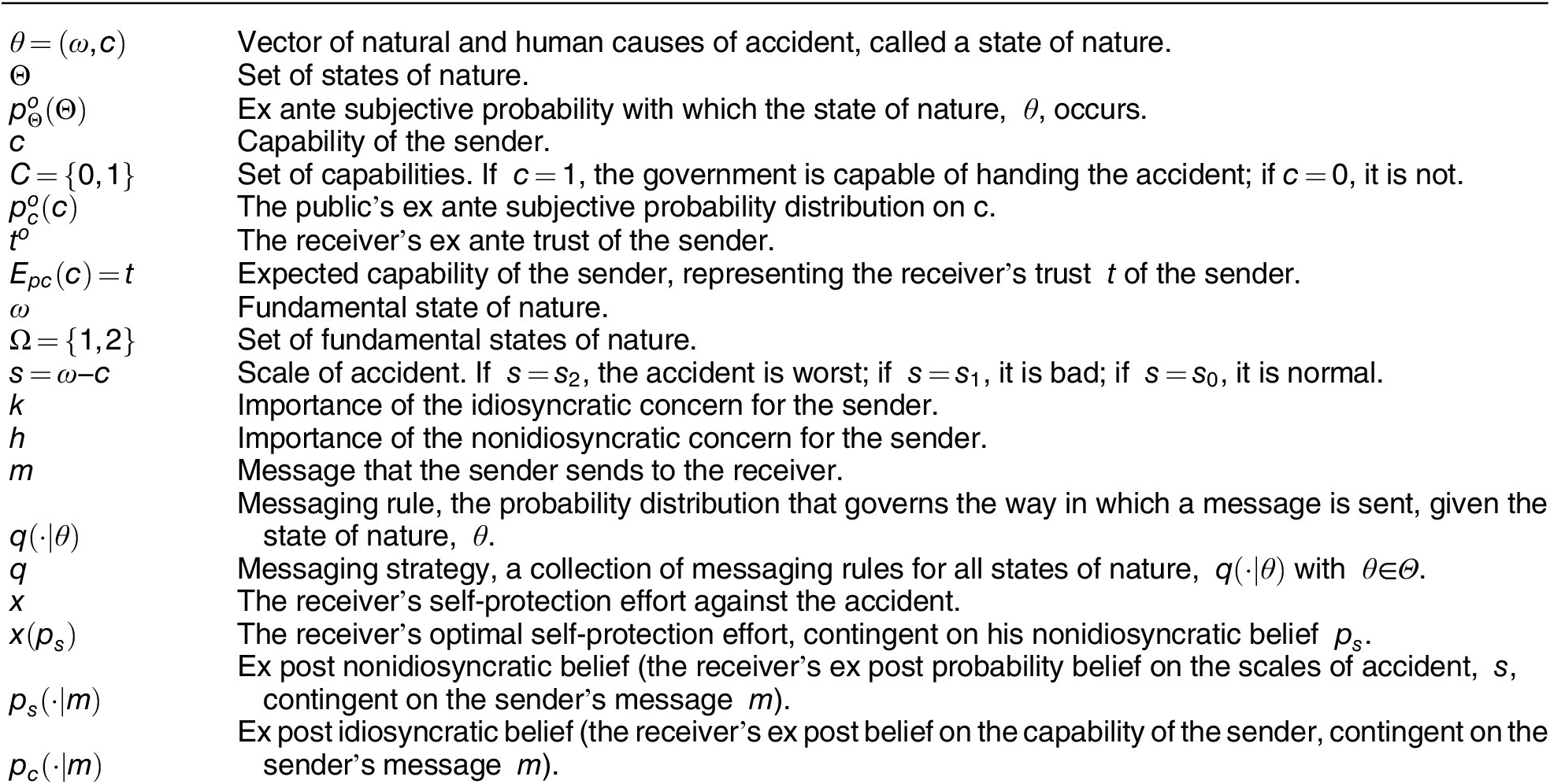
We focus on a game between an information sender and an information receiver (Ms. Sender and Mr. Receiver). As is noted at the outset, people were informed of a bad accident during an early stage of the Fukushima accident; the extremely bad state of the accident was acknowledged much later by the government. Building the simplest possible framework, this study explains such partial withholding of information by the correlation between nonidiosyncratic and idiosyncratic events. Table 1 summarizes the major variables.
Variables

As is discussed in the Introduction, we define nonidiosyncratic events,
 $ s\ \in\ S, $
as events affecting the receiver’s state-contingent payoff,
 $ u\left(s,x\right), $
which depends on the receiver’s action,
 $ x\ \ge\ 0 $
. In order to capture the partial revelation of information of nonidiosyncratic events, we need at least three nonidiosyncratic events,
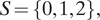 $ S=\left\{0,1,2\right\}, $
where states
 $ 0, $
 $ 1, $
and
 $ 2 $
may be thought of as normal, bad, and the worst events. Idiosyncratic events,
 $ c\ \in\ C, $
are those that do not affect the payoff function,
 $ u\left(s,x\right), $
but are correlated to the nonidiosyncratic events,
 $ s $
. Assume that there are only two idiosyncratic events,
 $ C=\left\{0,1\right\} $
.
In the context of the Fukushima accident, we may interpret
 $ s $
as the scale of the accident and
 $ c $
as the government’s capability to handle the accident. In order to characterize the correlation between
 $ s $
and
 $ c, $
it is convenient to introduce a fundamental state of nature,
 $ \upomega\ \in\ \varOmega =\left\{1,2\right\} $
that, together with the government’s capability,
 $ c, $
determines an accident scale,
 $ s=\omega - c\ \in\ S $
.
This is based on our observation that an extreme accident usually has multiple causes. In the Fukushima accident, the fundamental state of nature,
 $ \omega, $
captures beyond-human factors, including the tsunami, whereas
 $ c $
can be thought of as representing human factors, including the government’s capability. If, for example,
 $ \omega =2 $
and
 $ c=0, $
the beyond-human factor,
 $ \omega, $
is large, whereas the government’s capability,
 $ c, $
is low, in which case the accident scale is the worst,
 $ s=2. $
While this interpretation is natural in the context of nuclear accidents, the correlation between
 $ s $
and
 $ c $
may be directly assumed in order to interpret the model in different contexts. Although beyond-human and human factors may appear to be distinguished by physical features, a more economically established criterion is the Hand rule, which is cost based.Footnote
10
Denote as
 $ {\mathbf{p}}_S $
the information receiver’s belief on nonidiosyncratic events,
 $ s $
. The receiver determines his action,
 $ x, $
so as to maximize his expected payoff,
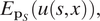 $ {E}_{{\mathbf{p}}_S}\left(u\left(s,x\right)\right), $
where
 $ {E}_{\mathbf{p}} $
denotes the operator taking an expected value with respect to probability distribution,
 $ \mathbf{p} $
. The receiver’s optimal action is
 $$ x\left({\mathbf{p}}_S\right)=\mathrm{\arg}\underset{x}{\mathrm{\max}}{E}_{{\mathbf{p}}_S}\left(u\left(s,x\right)\right).\kern1.00em $$
In the context of the Fukushima accident,
 $ x $
is the receiver’s self-protective effort. We adopt the following specific form for a payoff function.
 $$ {\displaystyle \begin{array}{ccc}u\left(s,x\right)=-\left[{\left(2s - x\right)}^2+\psi s\right] - {x}^2.& & \end{array}} $$
This implies that the larger
 $ s $
, the smaller
 $ u; $
thus, we call
 $ s=0, $
 $ 1, $
and
 $ 2 $
normal, bad, and the worst events, respectively, for the receiver. The first term,
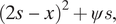 $ {\left(2s - x\right)}^2+\psi s, $
may be thought of as representing the receiver’s damage from the accident, which can be reduced by choosing
 $ 0<x<2s $
; the second term,
 $ {x}^2, $
represents the cost of self-protection effort. With no self-protection effort (
 $ x=0 $
), the damage from the accident,
 $ 4{s}^2+\psi s, $
increases in the scale of accident.Footnote
11
Denote as
 $ {\mathbf{p}}_C $
the information receiver’s belief on idiosyncratic events,
 $ c $
. This belief,
 $ {\mathbf{p}}_C, $
determines the receiver’s evaluation on the sender,
 $ t=t\left({\mathbf{p}}_C\right) $
. In the context of the Fukushima context,
 $ t=t\left({\mathbf{p}}_C\right) $
may be thought of as the public’s trust in the government. We assume that this evaluation is assumed to be equal to the expected value of idiosyncratic events,
 $$ {\displaystyle \begin{array}{ccc}t\left({\mathbf{p}}_C\right)={E}_{{\mathbf{p}}_C}(c).& & \end{array}} $$
Because
 $ c=0,1, $
Equation 3 guarantees
 $ t $
is increasing in
 $ {\mathbf{p}}_C(1) $
. In modeling the Fukushima accident, we assume a single information receiver with a state-contingent payoff function,
 $ u\left(s,x\right), $
and the evaluation of idiosyncratic belief,
 $ t\left({\mathbf{p}}_C\right) $
. As we discuss later, it is possible to think of the case in which
 $ u\left(s,x\right) $
and
 $ t\left({\mathbf{p}}_C\right) $
are held by two different individuals, each of whom knows the other receiver’s belief.
We use the term ex ante to refer to the state before the events become known and ex post to refer to the state after the events. It may be shown that the model has no ex ante bias under the following assumption. Under this assumption, it may be shown that there is no ex ante action bias. Since
 $ s=\omega -c, $
we may think of
 $ \varTheta =C\times \varOmega $
as the state space in our model. Denote as
 $ {\mathbf{p}}_{\varTheta } $
a probability distribution on
 $ \varTheta $
. The receiver initially holds a prior belief on
 $ , $
 $ {\mathbf{p}}_{\varTheta}^o $
. This gives rise to his prior beliefs on nonidiosyncratic and idiosyncratic events,
 $ {\mathbf{p}}_S^o $
and
 $ {\mathbf{p}}_C^o, $
the latter of which determines the receiver’s prior evaluation of the sender,
 $ {t}^o=t\left({\mathbf{p}}_C^o\right) $
.Footnote
12 Once nonidiosyncratic and idiosyncratic events,
 $ s $
and
 $ c, $
are realized, they are known to the sender. With this knowledge, the sender will select a message
 $ m $
to convey information on the events, by which the receiver will update his belief. Denote as
 $ {\mathbf{p}}_S\left(\cdot |m\right) $
and
 $ {\mathbf{p}}_C\left(\cdot |m\right) $
, respectively, the updated beliefs on nonidiosyncratic and idiosyncratic events when the receiver receives message
 $ m $
.
The sender’s payoff is determined by a weighted sum of the receiver’s payoff,
 $ u, $
and his evaluation of the sender,
 $ t $
. Because the sender knows the realized events,
 $ s $
and
 $ c, $
her ex post payoff when she sends message
 $ m $
is
 $$ v= hu\Big(s,x\left({\mathbf{p}}_S\left(\cdotp |m\right)\right)+ kt\left({\mathbf{p}}_C\left(\cdotp |m\right)\right). $$
In this expression, the first term on the right-hand side
 $ (hu) $
may be called a nonidiosyncratic term, which depends on the receiver’s nonidiosyncratic belief,
 $ {\mathbf{p}}_S\left(\cdot |m\right) $
. The second term
 $ (kt) $
may be called an idiosyncratic term, which depends on the receiver’s idiosyncratic belief,
 $ {\mathbf{p}}_C\left(\cdot |m\right) $
. Parameters
 $ h\ \ge\ 0 $
and
 $ k\ \ge\ 0, $
respectively, capture the strength of the sender’s nonidiosyncratic and idiosyncratic concerns.
In what follows, we will characterize an equilibrium in the above model by means of the information receiver’s prior evaluation of the sender,
 $ {t}^o, $
and the sender’s relative idiosyncratic concern,
 $ k\divslash h $
. In our game, the sender, observing state
 $ \theta, $
selects a message,
 $ m, $
with a probability
 $ \mathbf{q}\left(m|\theta \right) $
. This probability is specified by a probability measure
 $ \mathbf{q}\left(\cdot |\theta \right) $
on the space of messages,
 $ M $
(message space), and is called a messaging rule. The sender chooses her messaging rule
 $ \mathbf{q}\left(\cdot |\theta \right) $
in the following manner: (1) Without knowing the realized state of nature,
 $ \theta, $
the receiver holds a prior belief on the state of nature,
 $ {\mathbf{p}}_{\varTheta}^o $
. Once a message
 $ m $
is received, the receiver updates this belief by the Bayes rule to form a posterior belief,
 $ {\mathbf{p}}_{\varTheta}\left(\cdot |m\right) $
, which determines the receiver’s posterior beliefs on accident scale,
 $ {\mathbf{p}}_S\left(\cdot |m\right), $
and on the sender’s capability,
 $ {\mathbf{p}}_C\left(\cdot |m\right) $
. (2) The receiver will choose his action
 $ x $
based on the posterior belief on accident scale,
 $ {\mathbf{p}}_S $
,
 $ x=x\left({\mathbf{p}}_S\left(\cdot |m\right)\right) $
. (3) The sender believes that the receiver holds the posterior belief,
 $ {\mathbf{p}}_{\varTheta}\left(\cdot |m\right) $
.
In this updating process, the receiver does not know the realized state of nature,
 $ \theta, $
but knows that the collection of messaging rules from which the sender selects a message in each possible state of nature. We call this collection,
 $ \mathbf{q}=\left\{\mathbf{q}\left(\cdot |\theta \right):\theta\ \in\ \varTheta \right\}, $
a messaging strategy. Knowing a message
 $ m $
and a messaging strategy
 $ \mathbf{q} $
, the receiver updates his prior belief by the Bayes rule. To define this, let
 $$ {\displaystyle \begin{array}{ccc}\varTheta (s)=\left\{\theta\ \in\ \Theta :\theta =\left(\omega, c\right),\omega - c=s\right\}& & \end{array}} $$
and
 $$ {\displaystyle \begin{array}{ccc}{\varTheta}_c=\left\{\ \uptheta\ \in\ \varTheta :\theta =\left(\omega,\ \mathrm{c}\right),\omega\ \in\ \varOmega \right\}.& & \end{array}} $$
By the Bayes rule, the Bayes updated beliefs are given as follows:
 $$ {\displaystyle \begin{array}{ccc}{\mathbf{p}}_S^{\mathbf{q}}\left(s|m\right)=\frac{\sum_{\theta \in \varTheta (s)}\mathbf{q}\left(m|\theta \right){\mathbf{p}}_{\varTheta}^o\left(\theta \right)}{\sum_{\theta \in \varTheta}\mathbf{q}\left(m|\theta \right){\mathbf{p}}_{\varTheta}^o\left(\theta \right)}& & \end{array}} $$
and
 $$ {\displaystyle \begin{array}{ccc}{\mathbf{p}}_C^{\mathbf{q}}\left(c|m\right)=\frac{\sum_{\theta \in {\varTheta}_c}\mathbf{q}\left(m|\theta \right){\mathbf{p}}_{\varTheta}^o\left(\theta \right)}{\sum_{\theta \in \varTheta}\mathbf{q}\left(m|\theta \right){\mathbf{p}}_{\varTheta}^o\left(\theta \right)}.& & \end{array}} $$
With these updated beliefs, the sender chooses her optimal messaging rule for the realized state of nature,
 $ \theta, $
 $$ {\displaystyle \begin{array}{ccc}\mathbf{q}\left(\cdot |\theta \right)=\mathrm{\arg}\underset{{\mathbf{q}}^{\prime}\left(\cdot |\theta \right)}{\mathrm{\max}}{E}_{{\mathbf{q}}^{\prime}\left(\cdot |\theta \right)}\left({v}^{\mathbf{q}}\left({s}_i,m\right)\right),& & \end{array}} $$
where
 $$ {v}^{\mathbf{q}}\left({s}_i,m\right)= hu\Big({s}_i,x\left({{\mathbf{p}}^{\mathbf{q}}}_S\left(\cdotp |m\right)\right)+ kt\left({{\mathbf{p}}^{\mathbf{q}}}_C\left(\cdotp |m\right)\right), $$
 $ s\left(\theta \right)=\omega -c $
and
 $ \left(c,\omega \right)=\theta $
.
A perfect Bayesian equilibrium is defined as a messaging strategy
 $ \mathbf{q} $
satisfying (9) with the receiver’s state-contingent payoff,
 $ {v}^{\mathbf{q}}\left({s}_i,m\right), $
determined by the receiver’s updates beliefs,
 $ {\mathbf{p}}_S^{\mathbf{q}}\left(\cdot |m\right) $
and
 $ {\mathbf{p}}_C^{\mathbf{q}}\left(\cdot |m\right), $
 $ m\in M, $
such that if
 $ {\sum}_{\varTheta}\mathbf{q}\left(m|\theta \right){\mathbf{p}}_{\varTheta}^o\left(\theta \right) d\theta >0, $
 $ {\mathbf{p}}_S^{\mathbf{q}}\left(\cdot |m\right) $
and
 $ {\mathbf{p}}_C^{\mathbf{q}}\left(\cdot |m\right) $
are Bayes-consistent (or satisfy Equations 7 and 8). In our model, there is an equilibrium in which the space of accident scales
 $ S $
is partitioned and in which the receiver can identify for sure the element of the partition to which the realized state of nature belongs. We call such an equilibrium a pure-messaging strategy equilibrium.
Three types of pure-messaging strategies can be thought of:
Single-state-revealing Messaging Strategy: This is a messaging strategy in which the receiver either knows or does not know that a particular state of an accident,
 $ s, $
is realized. That is, a messaging strategy,
 $ \mathbf{q} $
, is
 $ s $
-revealing if the following is satisfied:
(i) There is
 $ m\in M $
such that
 $ \mathbf{q}\left(m|\theta \right)=1 $
for any
 $ \theta\ \in\ \varTheta (s) $
.
(ii) Let
 $ \left\{{s}^{\prime },{s}^{\prime \prime}\right\}=S\setminus \left\{s\right\} $
. There is
 $ m\ \in\ M $
such that
 $ \mathbf{q}\left(m|\theta \right)=1 $
for any
 $ \theta\ \in\ \varTheta \left({s}^{\prime}\right)\cup \varTheta \left({s}^{\prime \prime}\right) $
and
 $ \mathbf{q}\left(m|\theta \right)=0 $
for any
 $ \theta\ \in\ \varTheta (s) $
.
Totally Uninformative Messaging Strategy: This is a messaging strategy that conveys no information on the scale of the accident,
 $ s $
. That is, a messaging strategy,
 $ \mathbf{q}, $
is totally uninformative if the following is satisfied:
(i) There is
 $ m\ \in\ M $
such that
 $ \mathbf{q}\left(m|\theta \right)=1 $
for any
 $ \theta\ \in\ \varTheta (s) $
and
 $ s\ \in\ S $
.
Fully Revealing Messaging Strategy: This is a messaging strategy from which the receiver can identify the exact scale of an accident no matter which state is realized. That is, a messaging strategy,
 $ \mathbf{q}, $
is fully revealing if the following is satisfied:
(i) For each
 $ s\ \ \in\ \ S, $
there is
 $ m\ \ \in\ \ M $
such that
 $ \mathbf{q}\left(m|\theta \right)=1 $
for any
 $ \theta\ \ \in\ \ \varTheta (s) $
.
(ii) If
 $ \mathbf{q}\left(m|\theta \right)=1 $
and
 $ \theta\ \ \in\ \ \Theta (s), $
 $ \mathbf{q}\left(m|{\theta}^{\prime}\right)=0 $
for
 $ {\theta}^{\prime }\ \ \in\ \ \varTheta \left({s}^{\prime}\right) $
and
 $ {s}^{\prime}\ne s $
.
The basic insight that this study reveals is as follows:
Proposition 1
If an information sender’s idiosyncratic concern is too strong relative to her nonidiosyncratic concern (or if
 $ k\divslash h $
is sufficiently large), communication with the receiver becomes vague.
An intuition behind this proposition may be explained by focusing on the cases of
 $ h=0 $
. If
 $ k>h=0 $
, the sender chooses a message purely for her own benefit. Then, she chooses a message that conveys the least serious accident has occurred no matter which state is realized, thereby establishing a totally uninformative equilibrium. (If, instead,
 $ h>k=0, $
the sender’s objective function is perfectly aligned with that of the receiver, in which case the sender’s optimal choice is to fully reveal information.)
EQUILIBRIA
As is discussed in the previous section, the government sent at the beginning of the Fukushima accident a clear message that a bad accident had occurred. However, the public was not informed of how bad the accident was. This state may be captured by the
 $ {s}_0 $
-revealing messaging strategy together with
 $ {s}_2 $
being the realized event. Here, we characterize this strategy as well as other types of messaging strategies in equilibrium.
Theorem 1
An
 $ {s}_0 $
-revealing pure-messaging strategy is in a perfect Bayesian equilibrium if and only if
 $$ {\displaystyle \begin{array}{ccc}\frac{k}{h}\ \le\ \frac{3 - 2{t}^o}{\left(1-{t}^o\right)\left(2-{t}^o\right)}.& & \end{array}} $$
Proof. Only if part: Suppose that an
 $ {s}_0 $
-revealing pure-messaging strategy
 $ \mathbf{q} $
is in a perfect Bayesian equilibrium. For a realized state
 $ {s}_i, $
there is
 $ {m}_i $
such that
 $ \mathbf{q}\left({m}_i|\theta \right)=1 $
and
 $ \theta\ \in\ \varTheta \left({s}_i\right) $
. Receiving
 $ {m}_1, $
the receiver will form updated beliefs,
 $ {\mathbf{p}}_C^{\mathbf{q}}\left(1|{m}_1\right)=\frac{t^o}{2-{t}^o}, $
 $ {\mathbf{p}}_S^{\mathbf{q}}\left(1|{m}_1\right)=\frac{1}{2-{t}^o} $
and
 $ {\mathbf{p}}_S^{\mathbf{q}}\left(2|{m}_1\right)=\frac{1-{t}^o}{2-{t}^o} $
. This implies
 $ x\left({\mathbf{p}}_S^{\mathbf{q}}\left(\cdot |{m}_1\right)\right)=\frac{3-2{t}^o}{2-{t}^o} $
. Then, the sender’s payoff will be
 $$ {\displaystyle \begin{array}{ccc}& & \\ {}& {v}^{\mathbf{q}}\left({s}_1,{m}_1\right)& =-h\frac{\left(6-8{t}^o+3{\left({t}^o\right)}^2\right)}{{\left(2-{t}^o\right)}^2}+k\frac{t^o}{2-{t}^o}.& \end{array}} $$
Let
 $ {m}_0\ \in\ M $
be such that
 $ \mathbf{q}\left({m}_0|\theta \right)=1 $
and
 $ \theta\ \in\ \ \varTheta \left({s}_0\right) $
. Receiving this message,
 $ {m}_0, $
the receiver will form updated beliefs,
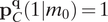 $ {\mathbf{p}}_C^{\mathbf{q}}\left(1|{m}_0\right)=1 $
and
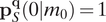 $ {\mathbf{p}}_S^{\mathbf{q}}\left(0|{m}_0\right)=1 $
. Since this implies
 $ x\ \left({p}_S^{\mathbf{q}}\ \left(\bullet |m\right)\right) $
= 1,
 $$ {\displaystyle \begin{array}{ccc}{v}^{\mathbf{q}}\left({s}_1,{m}_0\right)=-4h+k.& & \end{array}} $$
Thus,
 $ {v}^{\mathbf{q}}\left({s}_1,{m}_1\right)>{v}^{\mathbf{q}}\left({s}_1,{m}_0\right) $
if and only if Equation 11 holds.
If part: Let be an
 $ {s}_0 $
-revealing pure-messaging strategy. Then, for each
 $ {s}_i\ \in\ S, $
there is
 $ {m}_i $
such that
 $ \mathbf{q}\left({m}_i|\theta \right)=1 $
and
 $ \theta\ \in\ \varTheta \left({s}_i\right) $
. For
 $ m $
such that
 $ {\sum}_{\varTheta}\mathbf{q}\left(m|\theta \right){\mathbf{p}}_{\varTheta}^o\left(\theta \right)\mathrm{d}\uptheta =0, $
choose
 $ \left({\mathbf{p}}_S^{\mathbf{q}}\left(\cdot |m\right),{\mathbf{p}}_C^{\mathbf{q}}\left(\cdot |m\right)\right)=\left({\mathbf{p}}_S^{\mathbf{q}}\left(\cdot |{m}_1\right),{\mathbf{p}}_C^{\mathbf{q}}\left(\cdot |{m}_1\right)\right) $
. Then, by Equation 10,
 $ {v}^{\mathbf{q}}\left({s}_i,{m}_i\right)\ \ge\ {v}^{\mathbf{q}}\left({s}_i,m\right), $
which implies Equation 9.
Theorem 2
An
 $ {s}_2 $
-revealing messaging strategy is in a perfect Bayesian equilibrium if and only if
 $$ {\displaystyle \begin{array}{ccc}\frac{k}{h}\ \le\ \frac{{\left(2{t}^o+1\right)}^2}{t^o\left(1+{t}^o\right)}.& & \end{array}} $$
Theorem 3 A fully informative messaging strategy is a perfect Bayesian equilibrium if and only if
 $$ {\displaystyle \begin{array}{ccc}\frac{k}{h}\ \le\ \mathit{\min}\left\{\frac{2}{t^o},\frac{2}{1-{t}^o}\right\}{.}^{13}& & \end{array}} $$
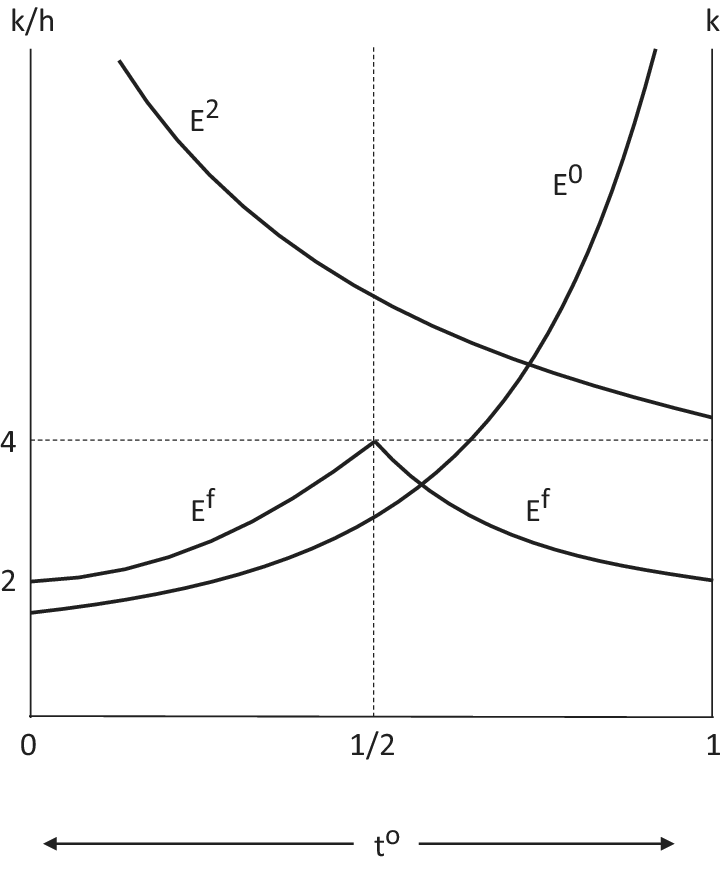
In Figure 1, we illustrate the region of parameters in which each type of equilibrium emerges. Curves
 $ {E}^0, $
 $ {E}^2, $
and
 $ {E}^f $
, respectively, illustrate the boundaries of Equations 11, 14, and 15. If the idiosyncratic concern is sufficiently strong relative to the nonidiosyncratic concern (i.e., if
 $ k\divslash h $
is sufficiently large), by the above theorems, information is withheld completely.Footnote
14 Theorems 1 and 2 show that a partially informative equilibrium, either
 $ {s}_0 $
-revealing or
 $ {s}_2 $
-revealing, is uniquely determined between above curve
 $ {E}^f $
and below (the higher of) curves
 $ {E}^0 $
and
 $ {E}^2 $
.
Perfect Bayesian Equilibria

In order to explain the role of prior trust
 $ {t}^o $
, we focus on the idiosyncratic term
 $ \left(t\left({\mathbf{p}}_C\right)\right) $
in the sender’s payoff function, given in Equation 4. For this purpose, we first calculate the conditional probabilities on the sender’s capability,
 $ C, $
 $$ {\displaystyle \begin{array}{cccc}{\mathbf{p}}_C^o\left(1|{s}_2\right)& =& 0;& \\ {}{\mathbf{p}}_C^o\left(1|{s}_1\right)& =& {\mathbf{p}}_C^o(1);& \\ {}{\mathbf{p}}_C^o\left(1|{s}_0\right)& =& 1.& \end{array}} $$
In our model, the sender’s idiosyncratic term satisfies
 $ t\left({\mathbf{p}}_C\right)={E}_{{\mathbf{p}}_C}(c)={\mathbf{p}}_C(1) $
. When
 $ {s}_2 $
is realized, by Equation 16, the sender’s idiosyncratic gain from understating the accident scale by one level is
 $$ {\displaystyle \begin{array}{cccc}{G}_2& =& t\left({\mathbf{p}}_C^o\left(\cdot |{s}_1\right)\right)-t\left({\mathbf{p}}_C^o\left(\cdot |{s}_2\right)\right)& \\ {}& =& {t}^o>0.& \end{array}} $$
When
 $ {s}_1 $
is realized, it is
 $$ {\displaystyle \begin{array}{cccc}{G}_1& =& t\left({\mathbf{p}}_C^o\left(\cdot |{s}_0\right)\right)-t\left({\mathbf{p}}_C^o\left(\cdot |{s}_1\right)\right)& \\ {}& =& 1-{t}^o>0.& \end{array}} $$
Gains
 $ {G}_2>0 $
and
 $ {G}_1>0, $
respectively, capture the sender’s “idiosyncratic gains” from telling a lie in the case in which states
 $ {s}_2 $
and
 $ {s}_1 $
are realized. In order for the fully revealing equilibrium to be supported, those idiosyncratic gains must be smaller than the “nonidiosyncratic costs” of misguiding the receiver (i.e., a reduction in u). Curve
 $ {E}^f $
shows the upper bound for
 $ k/h, $
supporting this equilibrium.
As Equation 17 shows, the larger
 $ {t}^o, $
the larger the “idiosyncratic gain” in event
 $ {s}_2 $
from understating the accident scale. This is reflected in the downward-sloping part of curve
 $ {E}^f $
—that is, the region of
 $ k\divslash h $
supporting the fully revealing equilibrium becomes narrower as
 $ {t}^o $
increases. As Equation 18 shows, the smaller
 $ {t}^o, $
the larger the “idiosyncratic gain” in state
 $ {s}_1 $
from understating the accident scale. This is reflected in the upward-sloping part of
 $ {E}^f; $
the region of
 $ k\divslash h $
supporting the fully revealing equilibrium becomes narrower as
 $ {t}^o $
decreases. This explains why curve
 $ {E}^f $
is single peaked.
The
 $ {s}_0 $
-revealing and
 $ {s}_2 $
-revealing equilibria can be explained in a similar manner. If
 $ {s}_2 $
is realized in the
 $ {s}_2 $
-revealing equilibrium, we may prove that the sender’s “idiosyncratic gain” from understating the accident scale is
 $$ {\displaystyle \begin{array}{cccc}{G}_{s_2}& =& t\left({\mathbf{p}}_C^o\left(\cdot |{s}_0\cup {s}_1\right)\right)-t\left({\mathbf{p}}_C^o\left(\cdot |{s}_2\right)\right)& \\ {}& =& \frac{2{t}^o}{1+{t}^o}-0.& \end{array}} $$
In contrast, if either
 $ {s}_1 $
or
 $ {s}_2 $
is realized in the
 $ {s}_0 $
-revealing equilibrium, the sender’s “idiosyncratic gain” is
 $$ {\displaystyle \begin{array}{cccc}{G}_{\left\{{s}_1,{s}_2\right\}}& =& t\left({\mathbf{p}}_C^o\left(\cdot |{s}_0\right)\right)-t\left({\mathbf{p}}_C^o\left(\cdot |{s}_1\cup {s}_2\right)\right)& \\ {}& =& 1-\frac{t^o}{2-{t}^o}.& \end{array}} $$
The
 $ {s}_0 $
-revealing and
 $ {s}_1 $
-revealing equilibria can be supported if the “idiosyncratic gains” are smaller than the “nonidiosyncratic costs” of misguiding the receiver. Curves
 $ {E}^2 $
and
 $ {E}^0 $
show the upper bounds for
 $ k/h $
supporting these two equilibria, respectively. Equation 19 shows that as
 $ {t}^o $
approaches 0, the “idiosyncratic gain” from understating the accident scale in event
 $ {s}_2 $
in the
 $ {s}_2 $
-revealing equilibrium approaches
 $ 0 $
. This is behind the downward-sloping curve
 $ {E}^2 $
, which shows that the region of
 $ k\divslash h $
supporting the
 $ {s}_2 $
-revealing equilibrium becomes wider and wider to infinity as
 $ {t}^o $
decreases to
 $ 0 $
. In contrast, Equation 20 shows that if
 $ {t}^o $
approaches
 $ 1, $
the “idiosyncratic gain” from the understatement in event
 $ \left\{{s}_1,{s}_2\right\} $
in the
 $ {s}_0 $
-revealing equilibrium approaches
 $ 0 $
. This is reflected in the upward-sloping part of
 $ {E}^0, $
which shows that the region of
 $ k\divslash h $
supporting the
 $ {s}_0 $
-revealing equilibrium becomes wider and wider to infinity as
 $ {t}^o $
increases to 1. This explains why curve
 $ {E}^0 $
is upward-sloping.Footnote
15
Our main result, summarized below, gives complete characterizations for unique informative and uninformative equilibria. In order to state the result, we say that an equilibrium is informative if it is not totally uninformative and that it is uninformative if it is not fully revealing.
Proposition 2 Let
 $ {t}^o\ne 1\divslash 2 $
,
 $ A=\frac{{\left(2{t}^o+1\right)}^2}{t^o\left(1+{t}^o\right)} $
,
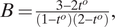 $ B=\frac{3-2{t}^o}{\left(1-{t}^o\right)\left(2-{t}^o\right)}, $
and
 $ C=\mathrm{\min}\left\{\frac{2}{t^o},\frac{2}{1-{t}^o}\right\} $
.Footnote
16
-
1. An
 $ {s}_0 $
-revealing messaging strategy is a unique informative (pure-messaging) perfect Bayesian equilibrium if and only if
(21)
$$ {\displaystyle \begin{array}{ccc}A<\frac{k}{h}\le B.& & \end{array}} $$
-
2. An
$ {s}_2 $
-revealing messaging strategy is a unique informative (pure-messaging) perfect Bayesian equilibrium if and only if (22)
$$ {\displaystyle \begin{array}{ccc}\mathrm{\max}\left\{C,B\right\}<\frac{k}{h}\le A.& & \end{array}} $$
-
a. A totally uninformative messaging strategy equilibrium is a unique uninformative equilibrium if and only if
$ \frac{k}{h}>\mathrm{\max}\left\{A,B\right\}. $
-



Proof. If
 $ {t}^o\ne 1\divslash 2, $
an
 $ {s}_1 $
-revealing equilibrium does not exist for any value of
 $ k\divslash h $
; this follows from the single crossing property. (In order to make a formal proof, let
 $ \mathbf{q} $
be an
 $ {s}_1 $
-revealing pure-messaging rule. There are
 $ m\ \in\ M $
and
 $ {m}_1\ \in\ M $
such that
 $ \mathbf{q}\left(m|\theta \right)=1 $
for any
 $ \theta\ \in\ \varTheta \left({s}_0\right) \cup \varTheta \left({s}_2\right) $
and
 $ \mathbf{q}\left({m}_1|\theta \right)=1 $
for any
 $ \theta\ \in\ \varTheta \left({s}_1\right) $
. If
 $ {t}_0\ne 1\divslash 2, $
 $ x\left({\mathbf{p}}_S^{\mathbf{q}}\left(\cdot |m\right)\right)\ne x\left({\mathbf{p}}_S^{\mathbf{q}}\left(\cdot |{m}_1\right)\right) $
. Let
 $ x\left({\mathbf{p}}_S^{\mathbf{q}}\left(\cdot |m\right)\right)>x\left({\mathbf{p}}_S^{\mathbf{q}}\left(\cdot |{m}_1\right)\right) $
. By the definition of an equilibrium,
 $$ {\displaystyle \begin{array}{l}h\left\{u\Big(s,x\left({\mathbf{p}}_S^{\mathrm{q}}\left(\cdot |m\right)\right)\ \hbox{--}\ u\Big({s}_0,x\left({\mathbf{p}}_S^{\mathrm{q}}\left(\cdot |{m}_1\right)\right)\ \right\}\\ {}\ \ge\ k\left\{t\left({\mathbf{p}}_C^{\mathrm{q}}\left(\cdot |{m}_1\right)\right)\ \hbox{--}\ t\left({\mathbf{p}}_C^{\mathrm{q}}\left(\cdot |m\right)\right)\ \right\}\end{array}} $$
for
 $ s={s}_0 $
. Since
 $ {u}_{12}>0, $
this must hold with strict inequality for all
 $ s>{s}_0 $
. This contradicts
 $$ {\displaystyle \begin{array}{l}h\left\{u\Big({s}_1,x\left({\mathbf{p}}_S^{\mathrm{q}}\left(\cdot |m\right)\right)\ \hbox{--}\ u\Big({s}_1,x\left({\mathbf{p}}_S^{\mathrm{q}}\left(\cdot |{m}_1\right)\right)\ \right\}\\ {}\ \ge\ k\left\{t\left({\mathbf{p}}_C^{\mathrm{q}}\left(\cdot |{m}_1\right)\right)\ \hbox{--}\ t\left({\mathbf{p}}_C^{\mathrm{q}}\left(\cdot |m\right)\right)\ \right\}\end{array}} $$
The case of
 $ x\left({\mathbf{p}}_S^{\mathbf{q}}\left(\cdot |m\right)\right)<x\left({\mathbf{p}}_S^{\mathbf{q}}\left(\cdot |{m}_1\right)\right) $
can be proved in much the same way.
REAL-WORLD APPLICATIONS
Our model captures two major determinants for the pattern of communication: a receiver’s prior observation on the sender’s idiosyncratic characteristic,
 $ {t}^o, $
and the relative intensity between idiosyncratic and nonidiosyncratic concerns of the sender,
 $ k\divslash h $
.
Since the middle of the last century, organizations and institutions with private information have been asked to align their decision criteria closer and closer with those of information receivers. As is explained with Equation 4, this may be thought of as a general consensus to reduce
 $ k\divslash h\ge 0 $
. This change has taken place in many parts of society; it is reflected in the tightening of disclosure requirements in the government, the increasing emphasis on corporate social responsibility in the private sector, and the tendency towards independence (from the government) of central banks. Although this change has contributed to rendering information more transparent, the information sender’s decision criterion has not yet been aligned completely to that of the receiver (that is,
 $ k\divslash h $
is still unignorable). The Fukushima accident may be explained in this context.
Various Types of Nuclear Accidents
A.
$ {\operatorname{s}}_0 $
-revealing type:

In the
 $ {s}_0 $
-revealing equilibrium, only the least damaging event
 $ \left({s}_0\right) $
is revealed. This occurs when the information receiver’s idiosyncratic evaluation of the sender
 $ \left({t}^o\right) $
is sufficiently high at the same time that the sender’s idiosyncratic concern
 $ \left(k\divslash h\right) $
is not too small and not too large. As is shown below, this theoretical prediction is consistent with the Fukushima accident.
Two important changes occurred in Japan from the last century to this century. The first is the significant increase in people’s trust in the government’s capability in handling nuclear power,
 $ \left({t}^o\right) $
. During the latter half of the 20th century, people’s trust in the government’s capability in handling nuclear energy generation
 $ \left({t}^o\right) $
was low. This reflects the country’s disastrous defeat in the WWII and the nuclear bombing of Hiroshima and Nagasaki at the end of the war.
This atmosphere changed during the 2000s. According to Iwai and Shishido (Reference Iwai and Shishido2015, 177), the percentage of people who worried about the danger of nuclear power plants decreased from 68% in 1999 to 56% in 2009. They explain, “The reasons for feeling safe . . . included 40% of people saying Japan has a satisfactory history in nuclear power generation, 36% saying Japan’s nuclear power generation is safe, 33% saying that they trust the government.” The Cabinet Bureau (2012) reports that in 2009 60% of people were in favor of increasing Japan’s reliance on nuclear energy. This shows that
 $ {t}^o $
was much higher around the time of the Fukushima accident than before.Footnote
17
Another important change is the Japanese government’s policy reversal on nuclear accidents from secrecy to transparency, or a reduction in
 $ k\divslash h $
. In 2001, Japan adopted the Information Disclosure Law. Perhaps prompted by this law, in March 2007, the government took the initiative to reveal 20 relatively minor accidents that took place between 1978 and 2006 and had been hidden completely.Footnote
18
On one hand, this change has made
 $ k\divslash h $
be too low to support the totally uninformative equilibrium after 2007. In fact, the two subsequent minor accidents before the 2011 Fukushima accident were fully revealed. One is the Kashiwazaki-Kariwa nuclear power plant accident (level-0) caused by the 6.8-magnitude earthquake on that day in the Niigata region on July 16, 2007. The other is at the Fukushima Daiichi plant on June 17, 2010. The 2007 accident was quickly reported throughout the world (Fackler Reference Fackler2007); the 2010 accident was immediately acknowledged by the operator of the plant (TEPCO 2010).
On the other hand, the reduction in
 $ k\divslash h $
was not sufficient to support the fully informative equilibrium, as is suggested by the Fukushima accident. Looking at the recent coronavirus outbreak, moreover, international observers continue to hold the view that, even today, the Japanese government is inclined to withhold vital information from the public (Dooley, Rich, and Inoue Reference Dooley, Rich and Inoue2020).
All these facts support that the Fukushima accident was in the
 $ {s}_0 $
-revealing equilibrium. Another possible
 $ {s}_0 $
-revealing equilibrium is the Chernobyl accident in 1986. Although the Soviet government initially tried to hide the accident, it was soon publicly acknowledged. This reflects President Gorbachev’s glasnost (openness) policy, which reduced
 $ k\divslash h $
significantly. At the same time, President Gorbachev was receiving rather high public trust for his perestroika (reform), which suggests that
 $ {t}^o $
was relatively high (Higginbotham Reference Higginbotham2019).
B.
$ {\operatorname{s}}_2 $
-revealing type:

In the
 $ {s}_2 $
-revealing equilibria, only the most damaging event
 $ \left({s}_2\right) $
is revealed. This occurs when the information receiver’s idiosyncratic evaluation of the sender
 $ \left({t}^o\right) $
is low. The Three Mile Island accident and the series of accidents at Japanese nuclear plants between the 1970s through the middle of the 2000s may be described by this equilibrium.
Within 30 minutes of the accident, the station manager at the Three Mile Island plant announced a general emergency. The accident was severe (level 5), which can be identified with
 $ {s}_2 $
.
In the nuclear industry at the time, a highly secretive atmosphere was surrounding less severe accidents and problems. For example, a CNN article (Cooke Reference Cooke2011) points out “[i]n most countries, the global community has few ways of knowing what really goes on inside nuclear reactors because the industry is shrouded in secrecy.” This is clearly evidenced by the halted construction of the William H. Zimmer Power Station in 1982. Since a very early stage of construction, according to a Cincinnati Magazine article (Keiger, Reference Keiger1983), the Zimmer Station had suffered from serious structural flaws, which had been ignored by early investigations. In the end, those flaws were found to be unfixable, and the construction was halted after a large sum of investments. These facts, together with the Three Mile Island accident, suggest that the information flows in the nuclear industry at that time can be described by an
 $ {s}_2 $
-revealing messaging strategy.
During the late 1970s, the American public’s trust in the government
 $ \left({t}^o\right) $
was extremely low. The accident occurred right after the anti-Vietnam War movements, as symbolized by the Kent State shooting by the Ohio National Guard in 1970, the Watergate scandal during the period 1972 through 1974, and the loss of the Vietnam War in 1975 (Dalton Reference Dalton2005).
At the same time, the government intended to align its decision criterion with that of the public—that is, to reduce
 $ k\divslash h $
. This is evidenced by the Freedom of Information Act of 1966. This law contributed to the revelation of various pieces of classified information; under this law, for example, the classified information on two major nuclear accidents in the 1950s was made public (Grober and Glasser Reference Grover and Glasser2020; Lewis Reference Lewis2019). In the 1970s, moreover, several whistle-blowers started to reveal less serious nuclear safety problems in the US, some of which had existed since the 1950s (Burnham Reference Burnham1976; New York Times 1979). Those whistle-blower cases as well as the Zimmer incidence evidence that
 $ k\divslash h $
was not low enough to support a fully informative equilibrium during the late 1970s. All of these facts are consistent with the view that the U.S. nuclear industry was in the
 $ {s}_2 $
-revealing equilibrium.
In Japan, as is noted above, 20 nuclear accidents were completely hidden between 1978 through 2006. During the same period, eight relatively serious nuclear accidents were reported immediately. The most severe was the 1999 Tokaimura accident, in which two workers died (level 4). There were one level-3 accident in 1997, four level-2 accidents, one level-1 accident in 1995, and one level-0+ accident in 2004, in which five workers died. The 20 less serious accidents were completely hidden, in addition.
This state of the Japanese nuclear industry may be described by an
 $ {s}_2 $
-revealing messaging strategy if we reinterpret
 $ {s}_0 $
as the state in which nothing occurs. The eight major accidents that were publicly acknowledged at the time of accident may be thought of as
 $ {s}_2 $
. In contrast, the 20 hidden (and less serious) accidents were
 $ {s}_1 $
. The state in which the government told nothing about these 20 accidents may be described by
 $ \left\{{s}_0,{s}_1\right\} $
.
As is noted above, people’s trust in the government’s capability in handling nuclear power
 $ \left({t}^o\right) $
was rather low at that time. It was known that the 1973 Mihama plant accident was hidden and made public in 1976 by a whistle-blower.Footnote
19 People were thus well aware that minor accidents could occur and be hidden by the government and the industry; in other words, they were aware that they were in
 $ \left\{{s}_0,{s}_1\right\} $
when no accident was reported. Until (and even after) the Fukushima accident, it had been one of the most important energy policies for the Japanese government to promote nuclear power generation.Footnote
20 Given this goal, it was highly important for the government to prove its capability in handling nuclear energy—that is, the government idiosyncratic concern on people’s trust was high (
 $ k\divslash h $
was high). At the same time, people’s scrutiny over the government’s performance was tight, and their demand for the government’s aligning with its decision criterion to the public concern was strong (
 $ k\divslash h $
was not too high). All these facts support that the Japanese nuclear industry was in the
 $ {s}_2 $
-revealing equilibrium in the latter half of the 20th century.
C. Totally Uninformative Type:
During the first half of the twentieth century, it was often thought that a government could determine what was good for the public, in particular, during an emergency. During WWI, for example, President Wilson pushed the Sedition Act that prohibited people from acting against the government’s war efforts. According to Barry (Reference Barry2017), this led public health officials to lie about the spread of Spanish flu, which worsened the outbreak. During the Cold War, a similar atmosphere prevailed in countries engaging in nuclear development, thereby suppressing information on accidents and safety issues.
One example is the Kyshtym accident. It took place in 1957 in Ural and is rated as level 6, next to Chernobyl and Fukushima. While local residents were affected, information was kept secret by the government until 1989 (Milne and Perera Reference Milne and Perera1989). In the Western world, the accident was first reported by a dissident scientist Medvedev (Reference Medvedev1976), although details of the accident are still unknown (Lewis Reference Lewis2019). This state may be described by a totally uninformative messaging rule by interpreting, again,
 $ {s}_0 $
as event in which nothing occurs.
Proposition 2 shows that this messaging strategy is the unique uninformative equilibrium if, given a level of prior trust,
 $ {t}^o, $
 $ 0<{t}^o<1, $
 $ k\divslash h $
is sufficiently high. In those days, many people exiled from the Soviet Union, which suggests that the public’s trust in the government could be rather low,
 $ {t}^o<<1 $
. At the same time, trust was not too low,
 $ {t}^o>>0, $
as is evidenced by the fact that the presidency of Nikita Khrushchev was based on the popularity of his policy on consumer and heavy industry (Breslauer Reference Breslauer1982). He was, however, ousted in 1964 due to the loss of popularity for his handling of the Cuba crisis. This suggests that for the Soviet political leaders back then, the public’s trust was a must for holding onto power—that is,
 $ k\divslash h $
was high.
A similar totally uninformative equilibrium explains the nuclear accident in 1959 at the Santa Susana Field Laboratory near Los Angeles. Grober and Glasser (Reference Grover and Glasser2020) explain that although it could be the worst nuclear accident in U.S. history, it was completely kept secret before a local TV network KNBC reported the accident in 1979. Information on the 1957 Windscale accident in England was withheld in a similar manner.Footnote 21 In the 1970s, several whistle-blowers started to reveal less serious nuclear safety problems in the U.S., some of which had existed since the 1950s. This suggests that minor problems were likely to have existed in the Soviet Union as well, if not publicly reported. This further supports the view that these early accidents can be described by the totally uninformative equilibrium.
Idiosyncratic Profit or Business Concern
A profit or business mandate is another type of idiosyncratic concern that may lead a private corporation or organization to withhold information vital for the safety or wellness of their customers, clients, and the community where the entity is located. A recent example relates to the two crashes of Boeing 737 MAX in 2018 and 2019. A major cause of the accidents was the malfunction of a flight sensor that led the computerized flight control to trigger a wrong flight path, which the pilots could not correct in time (Gates Reference Gates2019).
A recent New York Times report points out that a 2009 Boeing 737 NG crash near the Amsterdam airport may have been caused by a similar autocontrol problem (Hamby Reference Hamby2020). According to the report, if information gathered through the accident investigation had been fully revealed at that time, the 2018 and 2019 crashes might never have occurred. Although the cause of the accident was attributed to pilots’ errors by the Dutch investigators, “[d]ecisions by Boeing, including risky design choices and faulty safety assessments, also contributed to the accident . . . but the Dutch Safety Board either excluded or played down criticisms of the manufacturer in its final report after pushback from a team of Americans that included Boeing and federal safety officials.”
The report explains that during landing, in the 2009 accident, one of the two key flight sensors malfunctioned. This sensor sent data that contradicted the other sensor, which the pilots did recognize correctly. Because, however, Boeing’s pilots’ manual did not explain that these sensors were assigned to different tasks, the pilots may not have realized, until too late, that the autothrottle was controlled by the malfunctioning sensor. Although this possibility was pointed out at that time, it was not included in the report.
This state may be captured by an
 $ {s}_0 $
-revealing messaging strategy. That is, the state in which no mechanical failure exists can be identified with
 $ {s}_0 $
, that in which a mechanical failure is correctable by pilots with
 $ {s}_1 $
, and that in which a mechanical failure is not correctable by pilots with
 $ {s}_2 $
. Although the accident investigation concluded that
 $ {s}_1 $
was realized, it was mixed with
 $ {s}_2 $
to constitute
 $ \left\{{s}_1,{s}_2\right\}, $
which is pointed out by independent research.
Our model allows for the agent that holds an idiosyncratic belief to be different from one who holds a nonidiosyncratic belief. Airline companies form their nonidiosyncratic beliefs on the safety of an airplane
 $ \left({p}_S\right) $
through their own evaluation of safety designs and safety records and, when choosing an airplane, they calculate their expected safety (payoffs for airlines) by those beliefs. At the same time, the market (general public) forms an idiosyncratic belief on the company’s business or profit prospects
 $ \left({\mathbf{p}}_C\right) $
, which gives rise to an idiosyncratic concern for the company
 $ (t) $
. Our result shows that if a company has established too high a reputation as an airplane manufacturer (too high
 $ {t}^o $
) and if the business concern is too important for the manufacturer (too high
 $ k\divslash h $
), vital information on the safety of an airplane may be withheld, thereby resulting in the
 $ {s}_0 $
-revealing equilibrium.
There have been many similar incidences. For example, in 2009, leading cigarette companies were found to have lied to hide the danger of smoking” (Bartz Reference Bartz2009). Another example relates to the Minamata disease, a severe neurological disease caused by the release of methylmercury from the Chisso Corporation’s chemical factory from 1932 to 1968. It affected more than two thousand people; it is well known that the company hid its failure to take proper safety precautions (Halloran Reference Halloran1973). Information withholding in these and many similar incidences of product defects and wrong production procedures can be explained by the idiosyncratic business concern that dominated the nonidiosyncratic safety concern of a company.Footnote 22
Monetary Interventions
One application of our results is on monetary policy.Footnote 23 Until some 30 years ago, the central bank conducted its discretionary policy by “catching the market by surprise.” Since then, the independence and transparency in policy of a central bank have been emphasized more and more. Despite this, however, the discretionary aspect of monetary policy still remains.
In order to explain the process of noise creation, think of the following three possible economic states. In the worst state (
 $ {s}_2 $
), it is desirable for the central bank to intervene in the markets for long-term economic variables. In the best state (
 $ {s}_0 $
), no central bank intervention is necessary; in this case, the bank just controls the flow of short-term funds. There is a mildly bad state in which it is desirable for the central bank to intervene in the markets for middle-term economic variables (
 $ {s}_1 $
).
These states may be thought of as nonidiosyncratic events, which determine the private sector’s nonidiosyncratic payoff function,
 $ u\left(s,x\right) $
. These events may be correlated to events that are concerned with the central bank’s performance, which can be represented by a broad range of variables such as the past performance of the economy, that of monetary policy, the central bank governor’s public relations skill, and so on. These variables may be thought of as idiosyncratic events,
 $ c $
.
The private sector holds its own future outlook, or a nonidiosyncratic belief, (
 $ {\mathbf{p}}_S $
). It bases its own action on this outlook,
 $ x\left({\mathbf{p}}_S\right) $
, and obtains its payoff,
 $ u\left(s,x\left({\mathbf{p}}_S\right)\right) $
. Politicians, as well as the general public, observe the central bank’s performance and form their evaluations represented by
 $ t\left({\mathbf{p}}_C\right) $
. The central bank may be concerned with the private sector’s nonidiosyncratic payoff,
 $ u\left(s,x\left({\mathbf{p}}_S\right)\right), $
and the evaluation of politicians and the general public,
 $ t\left({\mathbf{p}}_C\right) $
.
In these circumstances, the model predicts that the larger
 $ {t}^o $
, the more likely the bank would mix
 $ {s}_1 $
and
 $ {s}_2 $
. At the same time, it would reveal
 $ {s}_0 $
. In other words, the central bank would create no noise in the market for short-term funds, whereas it would create a noise in the markets for middle- and long-term economic variables in states
 $ {s}_1 $
and
 $ {s}_2 $
.
In contrast, the smaller
 $ {t}^o, $
the more likely the bank would mix
 $ {s}_1 $
with
 $ {s}_0 $
. At the same time, it would reveal
 $ {s}_2 $
. In other words, the central bank would create no noise in state
 $ {s}_2, $
or on long-term economic variables, whereas it would create a noise in the markets for short- and middle-term economic variables, thereby mixing
 $ {s}_0 $
and
 $ {s}_1 $
.
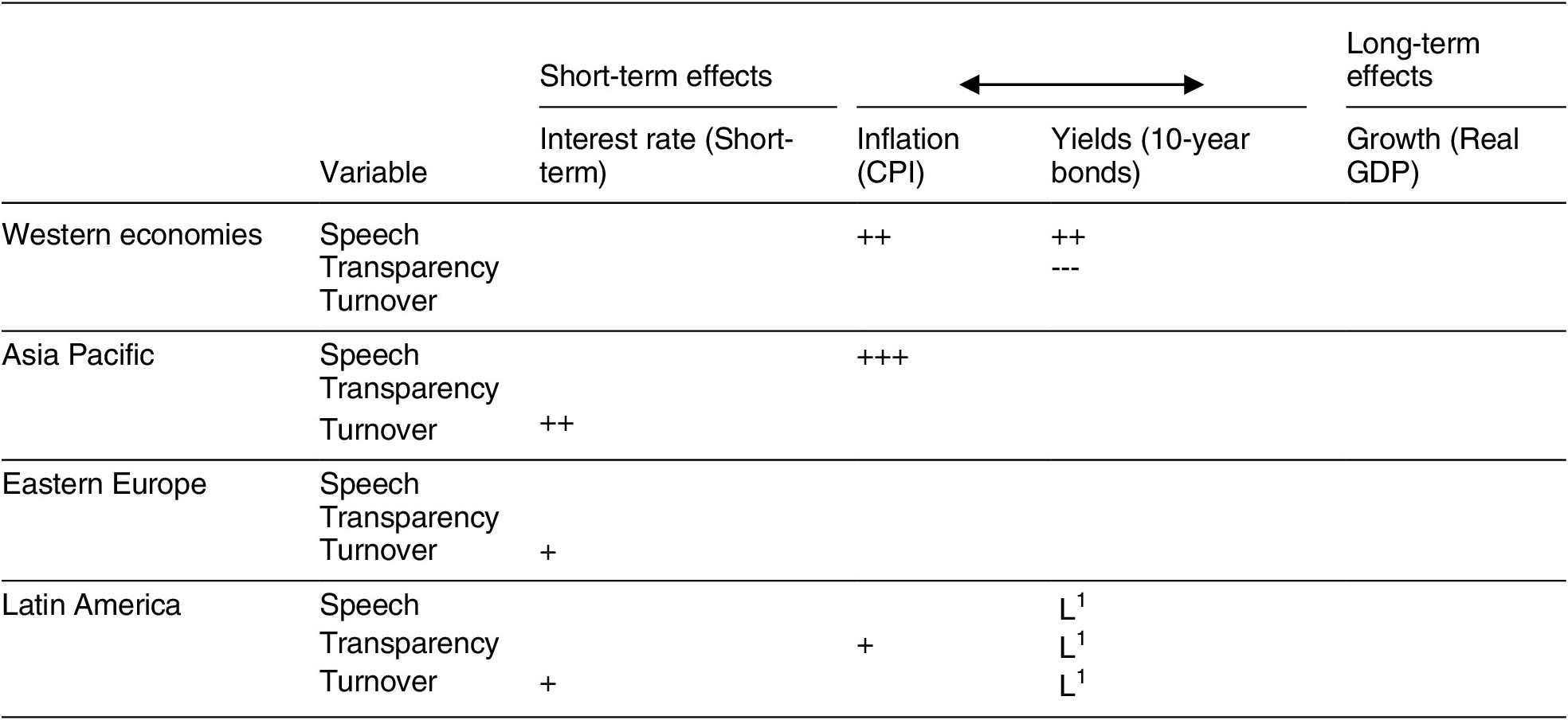
These predictions of our model are consistent with Lustenberger and Rossi (Reference Lustenberger and Rossi2020). They investigate the effects of different types of central bank messages on the accuracy of private sector economists’ forecasts on one short-term variable (short-term interest rate) and three longer-term economic variables (the yield on 10-year government bonds, the CPI inflation rate and the real GDP growth rate); as messaging devices, they adopt a number of central bank speeches, an index of central bank transparency, and the frequency of governor changes. Their estimations are based on a sample set covering 73 central banks in four major geographical regions: Western economies, Asia Pacific, Eastern Europe, and Latin America.
As is summarized in Table 2, a short-term noise (on short-term interest rate) is not created in the Western economies, but it is in each of the other three regions. In contrast, a long-term noise (on returns on 10-year bonds) is created in the Western economies but not in the other three regions. These are consistent with the predictions of our model, provided that the public’s trust in central bank is higher in the Western economies than in the rest of the regions.
Region-Wise Forecast Errors
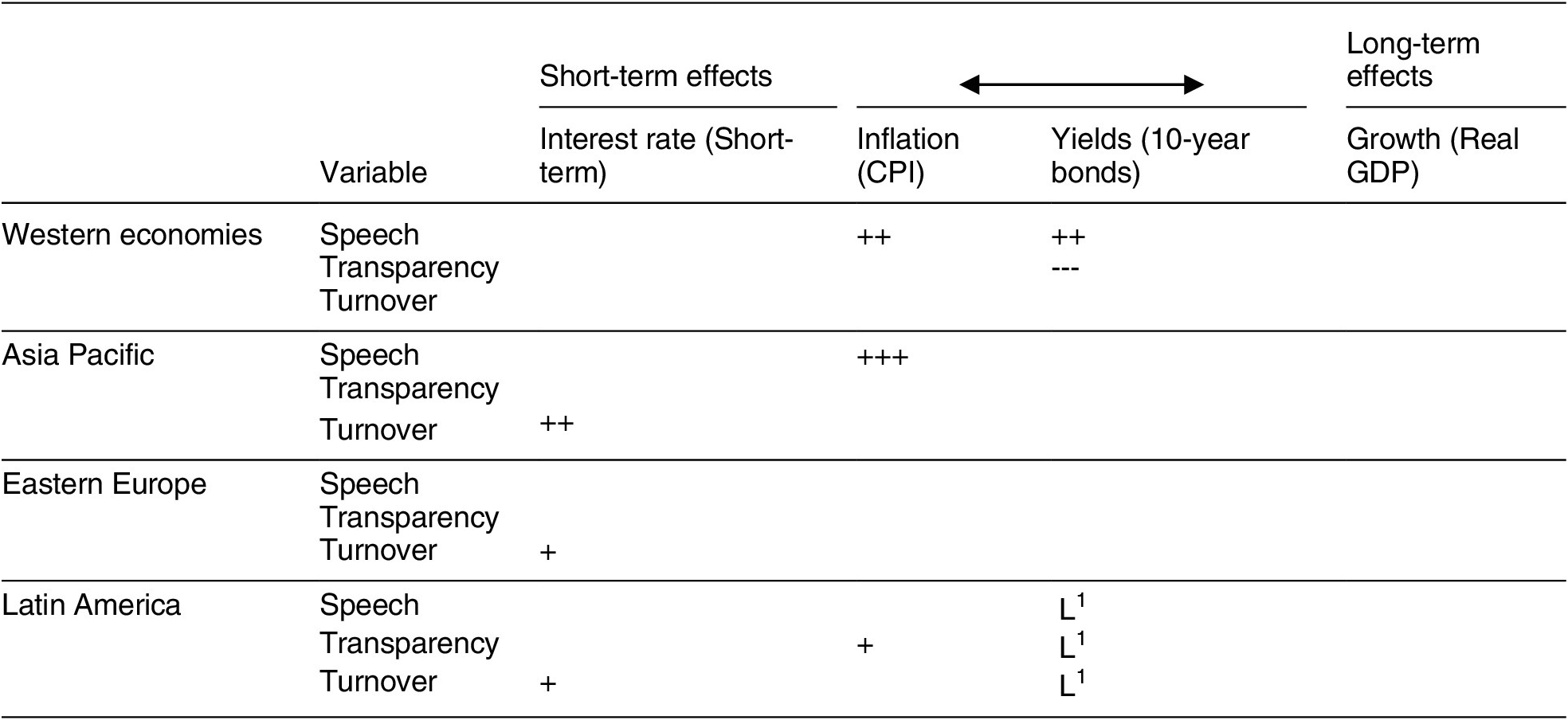
Note: Source: A Summary of Region-Wise Estimation Results (Lustenberger and Rossi Reference Lustenberger and Rossi2020, Table 3). The variables are defined as follows: Speech is made up of central bank speeches as collected by the Bank for International Settlements, compiled by Lustenberger and Rossi (Reference Lustenberger and Rossi2020). Transparency is a comprehensive measure of central bank transparency presented by Dincer and Eichengreen (Reference Dincer and Eichengreen2014) and updated by Lustenberger and Rossi (Reference Lustenberger and Rossi2020). Turnover is actual turnover of the central bank’s governor in a year, as described by Dreher, Sturm, and de Haan (Reference Dreher, Sturm and de Haan2010). The symbols are defined as follows: +++ (- - -) indicates that the coefficient is positive (negative) and significant at the 99% level, ++ (- -) indicates the coefficient is positive (negative) and significant at the 95 % level, and + ( - ) indicates the coefficient is positive (negative) and significant at the 90 % level.
1Estimates not available.
Unfortunately, Lustenberger and Rossi (Reference Lustenberger and Rossi2020) do not include an independent variable that perfectly fits the image of a middle-term economic variable. Because, however, the CPI inflation rate reflects both short-term and long-term expectations on an economy than 10-year bonds, it may be interpreted as a middle-term economic variable. Under this interpretation, the results of Lustenberger and Rossi (Reference Lustenberger and Rossi2020) fit with our model’s predictions for all the regions but Eastern Europe. That is, in the Western economies, where
 $ {t}^o $
can be assumed to be relatively high, noise is created in both
 $ {s}_1 $
and
 $ {s}_2 $
. In the Asia Pacific and Latin American regions, where
 $ {t}^o $
may be assumed to be relatively low, noise is created in both
 $ {s}_1 $
and
 $ {s}_0 $
.
CONCLUDING REMARKS
This study has shown that vague communication may be explained by the information sender’s idiosyncratic concern. This may explain various real-world incidences, including a number of nuclear accidents, cover-ups of defective products, and even noises created by central banks.
Although it is too early to make a definitive analysis, our theory is also applicable to the 2020 coronavirus outbreaks. It is reported that in many countries, information flows on coronavirus outbreaks have been disturbed by various idiosyncratic concerns. In Italy, it is reported that national political leaders were too concerned about their economies at very early stages before the virus spread in respective countries. For that reason, the messages from leaders were not serious enough to convey the seriousness of the disease, which underprepared the public (see Horowitz, Bubola, and Povoledo Reference Horowitz, Bubola and Povoled2020). A similar view is expressed on the Spanish outbreak (Ward Reference Ward2020). This may be explained by the correlation between events relating to the nonidiosyncratic public safety (seriousness of the disease) and those relating to the idiosyncratic economic performance. A similar explanation may apply to the outbreaks in the UK and U.S. The Chinese government might have been concerned with its public image (Yang, Liu, Liu, and Yu Reference Yang, Liu, Liu and Yu2020).
Post-reality politics may also be explained in our context. “Alternative facts” may appeal to a particular group of voters, whereas it may be completely idiosyncratic for other groups. If a political leader’s message is interpreted in different ways by different groups of voters, post-reality politics may work.
In the report of the Independent Investigation Commission on the Fukushima Nuclear Accident (IICFNA Reference Bricker2014), the late Professor Koichi Kitazawa, the chairman of the IICFNA, perceives the Fukushima accident as a serious communication failure.Footnote 24 He urges, “it is essential that the government learns from the Fukushima accident—during which, at times, there were debilitating communication problems” (Kitazawa Reference Kitazawa and Bricker2014).Footnote 25 He then continues, “Japan must work hard on constructing an organizational infrastructure to allow unfettered information sharing in times of crisis.”Footnote 26 Our study shows that one way to build such an organizational infrastructure is to enhance a conscious effort to align the information sender’s decision criterion with that of the receiver by reducing the sender’s idiosyncratic concern. This effort may be assisted by introducing rules and proper systems of governance.










Comments
No Comments have been published for this article.