Introduction
The dispute about the best surgical technique for dealing with hypertrophied inferior turbinates causing nasal obstruction is far from resolution.Reference Aslan1 Up to 20 per cent of the European population suffers from nasal obstruction secondary to hypertrophied inferior turbinates.Reference Kizilkaya, Ceylan, Emir, Yavanoglu, Unlu and Samim2 Being a primary cause of nasal obstruction, either due to submucosal fibrosis or dilatation of venous sinuses, hypertrophied inferior turbinates has a prominent effect on patients’ lifestyles and productivity.Reference Aslan1, Reference Seeger, Zenev, Gundlach, Stein and Müller3
The failure of long-term medical treatment in controlling nasal symptoms is the main indication for surgical intervention.Reference Kafle, Maharjan, Shrestha and Toran4 Various modalities are present that witness the balance between benefits and probable complications. Recent surgical approaches are tailored to address both bony and submucosal erectile tissue to allow for more free nasal space for airflow and arrest the submucosal engorgement through scarring, while simultaneously turbinate mucosa performs its physiological function.Reference Hytönen, Bäck, Malmivaara and Roine5
The rise of worrying symptoms following classic radical surgeries, including post-operative bleeding, atrophy, crusting, and the introduction of empty nose syndrome, directed surgeons towards less-invasive interventions.Reference Hol and Huizing6 Employing radiofrequency waves to ablate the turbinates submucosal tissues is widely used nowadays. Radiofrequency waves transmit disruptive energy at low temperatures, causing limited, deliberated damage to induce submucosal shrinkage upon bony concha.Reference Shehata, Ragab, Behiry, Erfan and Gamea7 This can be done under local anaesthesia and can be easily repeated safely as office-based sessions. Studies have shown it is physiological and preserves mucociliary function.Reference Sapçi, Sahin, Karavus and Akbulut8
Several forms for delivering radiofrequency waves are available, including coblation radiofrequency, where waves energise the ions in fluid medium between the probe and tissues, generating a plasma field providing non-thermal damage with minimal collateral heat.Reference Farmer, Quine and Eccles9 Radiofrequency volume reduction is another popular method that utilises radiofrequency waves to create ionic agitation transmitted to nearby structures, causing necrosis, followed by fibrosis and shrinkage.Reference Deenadayal, kumar, Sudhakshin and Hameed10 In this study, we compare these two popular methods in terms of efficacy, pain, crust, and long-term relief of obstruction.
Patients and methods
Study design and patients
This prospective, randomised, double-blinded clinical trial was carried out in the Otolaryngology Department, Kafr El-Sheikh University, from June 2022 until July 2024. The Institutional Research Board of our university hospital approved this study protocol (clinical trial registry number NCT06612450). We also obtained informed written consent from patients to participate and to use their data in our research. Patients who sought help at our tertiary centre outpatient clinics complaining of signs and symptoms of nasal obstruction because of hypertrophied turbinates despite long-term medications were included in our trial (Figure 1).
Methodology flowchart.

Sample size calculation
The visual analogue scale (VAS) score within the coblation group was 3.78 ± 1.15 versus 3.08 ± 0.95 within the SCT group (Islamoglu et al.).Reference Islamoglu, Kesici, Bulut, Ozer, Teleke and Babademez11 Sample size was calculated using OpenEPI software to be 36 within each group at the power of study 80 per cent and confidence level 95 per cent, with 20 per cent (18 patients) involved more than calculated sample size in case of dropout during follow-up.Reference Islamoglu, Kesici, Bulut, Ozer, Teleke and Babademez11
Inclusion criteria
All patients with the following criteria were eligible for inclusion: (1) 18–60 years old; (2) patients complaining of chronic nasal obstruction because of bilateral hypertrophied inferior turbinates refractory to medical treatment for at least three months; and (3) evident hypertrophied inferior turbinates on computed tomography with mainly soft-tissue component hypertrophy with or without minimal septal deviation, without any other cause for the obstruction. All patients underwent surgery under local anaesthesia
Exclusion criteria
All patients with the following criteria were excluded from the study: (1) marked septal deviation or concha bullosa, nasal polyps, or sinonasal tumours; (2) any previous nasal surgeries or radiotherapy; (3) chronic sinusitis or cystic fibrosis; (4) pregnancy; (5) patients with severe bleeding tendency or coagulopathy disorder; (6) and patients who refused to participate.
Randomisation and blinding
We employed the software Microsoft Excel to create random numbers to distribute our subjects to one of the two groups in a ratio of 1:1. Patients received their numbers from an independent nurse to guarantee that all patients had an equal opportunity to be allocated to any group. Patients were randomly classified into two groups, each involving 45 patients. Group (I) underwent inferior turbinate reduction via coblation radiofrequency, while Group (II) underwent the same procedure via conventional submucosal radiofrequency ablation. The study was double-blinded; neither the patient nor the assessor knew which group the patient was in. All surgeries were done by the same senior surgeon. Two separate otolaryngologists did the follow ups. All patients underwent a pre-operative diagnostic protocol, which included detailed history taking, meticulous physical examination through rhinoscopy and nasal endoscopy, pre-operative computed tomography of the nose and sinuses, and routine laboratory investigations.
Operative technique
All patients were scheduled to stop decongestants 48 hours prior to their procedure and local or systemic steroids 2 weeks before their procedures.
Anesthesia
All procedures were done under the effect of local anaesthesia using the technique where two cotton packs soaked in 3 per cent lidocaine and 1:100,000 adrenaline advanced over the entire inferior turbinate for 5 minutes. Then injecting 1 mL of 2 per cent lidocaine into the anterior (head), middle, and posterior parts of the inferior turbinate.
Coblation group
In Group I, we used the Coblation II Surgery System (Smith and Nephew, USA) and ReFlex Ultra TM 45 wand (ArthroCare) set at power level four for ablation and two for coblation. The patient lay supine with head elevated 30° on the table. First, we injected the turbinates with plain saline to enhance mechanical hydro dissection and tissue expansion and to further protect the mucosa from scarring and crust formation. Then we inserted the activated coblation wand tip into the head of inferior turbinate and proceeded submucosally while still activated until the third mark on the wand was reached to create a tunnel. Periods of activation were done at each marker depth to create another lesion, a total of 2 or 3 channels were made according to the size of the inferior turbinate.
Radiofrequency volume reduction group
In Group II under the same topical anaesthesia, we used CURIS® 4 MHz Radiofrequency Generator (Sutter – USA) turned on the radiofrequency volume reduction mode with power set at 30W with auto-stop feature turned on using turbinate bipolar two long-needle handpieces delivering energy submucosally at 3 different sites (anterior, middle, posterior) of the inferior turbinate for 2–3 seconds on average with mean energy of 350 J at each insertion. None of our patients required post-operative packs. Patients were offered post-operative painkillers, local decongestants, and local corticosteroids for two weeks. They were advised to use hypertonic saline wash for two weeks post-operative.
Patient assessment and outcomes
Nasal Obstruction Symptom Evaluation score
We used the Arabic version of the Nasal Obstruction Symptom Evaluation score as a subjective tool to evaluate the nasal obstruction before and after our intervention. We asked all patients to fill out the questionnaire to rate their nasal symptoms from 0 to 4 in ascending order (0 = no problem, 4 = severe problem) to give a total raw score of 20 to be multiplied by 5 to give a total score out of 100 where a score of 100 indicates the worst condition. The severity of nasal obstruction can be categorised as mild (5–25), moderate (30–50), severe (55–75), or extreme (80–100). Results were compared to the post-operative score after 1, 6, and 12 months.Reference Amer, Kabbash, Younes, Elzayat and Tomoum12
Pain VAS analogue scale
We used the VAS analogue score for subjective assessment of the patients’ symptoms of pain. Each patient could score from 0 to 10 where 0 = no pain and 10 = the most severe pain. We compared the VAS score post-operatively and 1 day, 1 week, and 1 month after procedure.
Inferior turbinate endoscopic grading
We used the Camacho et al. classification system of inferior turbinate size as an objective tool for post-operative evaluation based on its occupation of the total nasal airway where Grade 1 occupies 0–25 per cent of space, grade 2 occupies 26–50 per cent, grade 3 occupies 51–75 per cent, and Grade 4 occupies 76–100 per cent (Figure 2)Reference Camacho, Zaghi, Certal, Abdullatif, Means and Acevedo13 to compare the turbinate size pre-operatively and at 1 month, 6 months, and 12 months after the procedure. During post-operative visits, patients were advised to cease any topical nasal decongestants or systemic steroids 72 hours prior to their visit. All visits were scheduled during morning times under the same room conditions of temperature and humidity to reduce the variability of the nasal cycle.
Inferior turbinate size grading classification.

Post-operative crust formation
The post-operative crust was evaluated and recorded on patients’ sequential visits and was evaluated through a score from (0-3) where 0 is no crust and 3 is the most severe score. Crust was compared and evaluated at 1 week and 1 month postoperative. Simultaneously, nasal endoscopy was done through the follow-up visits. Patients were seen at regular visits 3d, 1w, 2w, 1m, 3m, 6m and 12m. Postoperative complications such as bleeding and discharge were recorded and documented.
Statistical analysis
SPSS (Statistical Package for the Social Sciences) version 26 was used for data analysis. We performed chi-square test, and Monte Carlo tests when appropriate to compare categorical variables displayed by their absolute frequencies. For ordinal data chi-square for trend test was used. Kolmogorov–Smirnov test applied for parametric tests. The mean and standard deviations were used to describe Quantitative variables. For quantitative data between two groups, an independent sample t-test was used. To analyse change in one variable over two points of time within same group, paired sample t-test (for normally distributed data) and Wilcoxon signed rank test (for categorical non-binary data) were utilised. p < 0.05 was the level of statistical significance, whereas for highly significant difference was reported if p ≤ 0.001.
Results
Patient characteristics
Our study included 90 patients with chronic nasal obstruction resistant to medical treatment recruited from outpatient clinics between June 2022 and June 2023. Five patients from Group I and 7 patients from Group II were lost during follow-up period and were removed from our study. Group I involved 40 patients: 23 of them were males (57.5 per cent), and 17 were females (42.5 per cent). Group II involved 37 patients: 20 males (54.1 per cent) and 17 females (45.9 per cent). The age group ranged between 18 and 50 years, with a mean age of 30.03 ± 9.55 years within Group I and 31.24 ± 11.63 years within Group II. There was a statistically non-significant difference between the two groups, considering age or gender.
Outcome measures
Nose score
No significant difference was observed between the two groups in Nasal Obstruction Symptom Evaluation scores at 6 and 12 months. After one month, the radiofrequency group showed significantly better improvement than the coblation group, as their Nasal Obstruction Symptom Evaluation scores were lower (p < 0.001). This means that patients in the radiofrequency group experienced faster symptom relief in the early post-operative period. At 6 and 12 months, both groups showed continued improvement compared to baseline (p < 0.001), and the difference between the two groups was no longer significant (p = 0.441 and p = 0.335, respectively). This indicates that both treatments were similarly effective in the long term.
Looking at the within-group analysis over time, the coblation group’s Nasal Obstruction Symptom Evaluation scores improved steadily from baseline to 12 months, including a slight improvement between 6 and 12 months. While in the radiofrequency group, scores improved from baseline to 6 months, but there was a slight increase in scores at 12 months, suggesting a mild degree of symptom recurrence. These changes are illustrated in Table 1 and Figure 3.
Line graph showing comparison between groups regarding NOSE score over time.

Comparison between the studied groups regarding Nasal Obstruction Symptom Evaluation (NOSE) score over follow up period

¥ p for paired sample t test t independent sample t test **p ≤ 0.001 is statistically highly significant *p < 0.05 is statistically significant; SD = Standard deviation
Pain VAS score
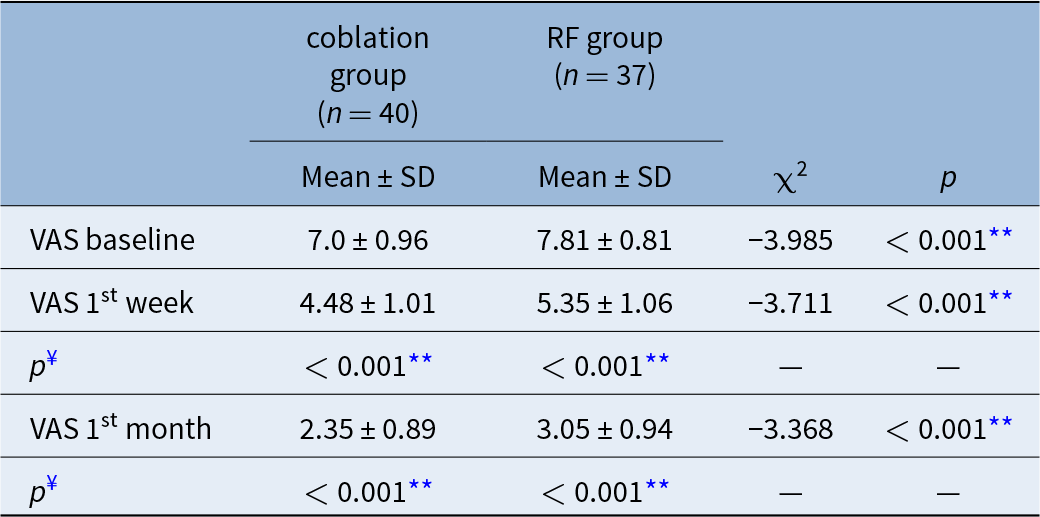
There was a statistically significant difference between the studied groups regarding VAS score baseline (1d), at the first week and the first month (significantly higher in the radiofrequency group) (p < 0.001). Within each group, there is a significant decrease in the VAS score when comparing each value with the preceding one (Table 2) (Figure 4).
Line graph showing comparison of VAS scores between coblation and radiofrequency (RF) groups over time.

Comparison between the studied groups regarding Pain VAS score

¥ p for paired sample t test t independent sample t test **p ≤ 0.001 is statistically highly significant *p < 0.05 is statistically significant
Inferior turbinate endoscopic grading
There was a statistically non-significant difference between the studied groups regarding endoscopic grading baseline, at 6 and 12 months, or overall change in endoscopic grading at 1 year as compared to baseline value. There was a statistically significant difference between the studied groups regarding endoscopic grading at the first month. (p = 0.002). Grade 1 prevailed in 7.5 per cent within the coblation group versus 40.5 per cent within the radiofrequency group (Table 3) (Figure 5).
Multiple bar chart showing comparison between groups regarding EG over time.

Comparison between the studied groups regarding endoscopic grade over time

** χ2 = Chi square for trend test p ≤ 0.001 is statistically highly significant *p < 0.05 is statistically significant p ¥ for Wilcoxon signed drank test
Post-operative crust formation
There was a statistically non-significant difference between the studied groups regarding crust score at the first week and first month or overall change in crust score at 1 month as compared to baseline value (Table 4).
Comparison between the studied groups regarding crust over time

** χ2 = Chi square for trend test p ≤ 0.001 is statistically highly significant *p < 0.05 is statistically significant
Discussion
Chronic nasal obstruction secondary to inferior turbinate hypertrophy is one of the commonest global complaints. These patients represent a major portion of patients visiting the outpatient clinic. There is sufficient unanimity about medical treatment being the first line of treatment for such cases. Topical corticosteroids, local and systemic decongestants, anti-leukotrienes, and immunotherapy are used to tackle obstructive hypertrophy.Reference Aslan1
Recalcitrant cases mandate surgical solutions for alleviating obstruction symptoms. These include mucosal-preserving and non-preserving techniques. Puterman et al.Reference Puterman, Segal and Joshua14 discussed these various modalities and reported various degrees of success, complications, and patient satisfaction.
In our study, we compare two of the most recognisable modalities of conservative surgery: coblation radiofrequency and conventional radiofrequency using radiofrequency volume reduction mode. Both techniques were done under the influence of local anaesthesia. Given the rising demand to decrease the cost of medical services, there has been a trending increase in office-based interventions if they are effective and cost-beneficial. Averting the patient from the hazards of general anaesthesia and saving time are also essential factors. Many studies have reported safe and effective turbinate reduction procedures done under local anaesthesia in the outpatient office.Reference White and Rebeiz15
Deenadayal et al.Reference Deenadayal, kumar, Sudhakshin and Hameed10 conducted a prospective study on 200 patients with hypertrophied inferior turbinates using radiofrequency ablation and reported significant improvement regarding nasal obstruction, an objective improvement in the turbinate size, and good tolerance as an office-based intervention. In another study on 220 patients, Di Rienzo Businco et al.Reference Di Rienzo Businco, Di Rienzo Businco and Lauriello16 reported significant improvement in subjective nasal symptoms (e.g. obstruction and rhinorrhea) and objective measures (e.g. nasal rhinomanometry and turbinate size) with intraturbinate coblation radiofrequency. To the best of our knowledge, only one study in the literature compared the two techniques; however, there was no post-operative assessment of pain, crust, or turbinate size.Reference Passali, Loglisci, Politi, Passali and Kern17
In our study, there was no significant difference between the two groups regarding the demographic data. We used the Nasal Obstruction Symptom Evaluation score scale for subjective assessment of obstructive symptoms (congestion, blockage, trouble sleeping, breathing difficulties during exertion) pre- and post-operatively at 1 month, 6 months, and 12 months. At 1-month follow up, there was significant improvement within the two groups compared to baseline data, with mean = (51.75 ± 12.012) within the coblation group, and mean = (40.68 ± 7.087) within the radiofrequency group (p < 0.001). Moreover, there was a significant difference between the two groups at 1 month (p < 0.001).
However, this was not the case at 6-month and 12-month follow ups; where there was a significant difference within the same group, indicating further improvement of obstruction symptoms over time at 6 months. However, a minor increase in the nasal obstruction symptom evaluation score was noticed in the radiofrequency group at 12 months compared to 6 months, reflecting the relatively faster improvement within the radiofrequency group over the short term. Still, this difference became insignificant over time, such that both techniques showed nearly identical efficacy (Table 2) (Figure 3).
This represents slightly different results from Passali et al.,Reference Passali, Loglisci, Politi, Passali and Kern17 who compared the same techniques with a follow-up period up to 3 years and concluded that the VAS value for nasal obstruction was lower in the radiofrequency group 1 year after treatment, but at 3 years follow up, the coblation radiofrequency group showed a lower VAS value than the radiofrequency group. Both techniques efficacy tends to decrease over time.
Concerning the Pain VAS score, our study showed a significant difference between the coblation radiofrequency and radiofrequency groups at baseline, 1 day after procedure, with mean = (7.0 ± 0.96) in the coblation radiofrequency group and (7.81 ± 0.81) in the radiofrequency group, where pain was significantly higher in the radiofrequency group (p < 0.001). This difference was still significant at 1 week and 1 month after the procedure, although both groups showed remarkable improvement in pain in the following visits (Table 3) (Figure 4).
Mehta et al.’sReference Mehta, Mehta and Mehta18 coblation radiofrequency patients showed lower pain scores in comparison to the group that underwent turbinoplasty using Turbinator. Several studies reported tolerable intra-operative and post-operative pain outcomes for both coblation radiofrequency and radiofrequency.Reference Bakshi, Manoharan and Gopalakrishnan19–Reference Liu, Tan, Lee, Lin and Huang21 Our conclusion that both techniques were considered tolerable by patients with lower pain scores was noticed in the coblation radiofrequency group.
For the reduction in size of the turbinate post-operatively, we used Camacho et al.’s turbinate grading as an objective assessment.Reference Camacho, Zaghi, Certal, Abdullatif, Means and Acevedo13 There was a statistically significant difference within each group at 1-month, 6-month, and 12-month periods (p < 0.001) in comparison to baseline, thus reflecting the gradual reduction in turbinate size over time. Between the two groups, there was a significant difference only at 1-month follow up showing more decrease in size in the radiofrequency group than in the coblation radiofrequency group. This difference tends to decrease over time until both techniques show similar efficacy at 6 months and 12 months.
This can be seen in coordination with the Nasal Obstruction Symptom Evaluation score, which indicates the slightly rapid effect of radiofrequency over coblation radiofrequency (Table 3) (Figure 5). Singh et al.Reference Singh, Ramli, Wan Mohammad and Abdullah22 found that there was nearly no significant difference in the turbinate grade reduction between radiofrequency and Microdebrider-assisted turbinoplasty.
In another study involving 150 patients, all patients who underwent turbinate reduction through coblation radiofrequency showed turbinate reduction to grade 1 by the end of the first year.Reference Mehta, Mehta and Mehta18 Regarding post-operative crustations at 1 week post-operative, we noticed only 1 patient (2.5 per cent) with severe crustations in the coblation radiofrequency group versus 2 patients (5.4 per cent) in the radiofrequency group, 7 patients (17.5 per cent) with moderate crustation in the coblation radiofrequency group versus 9 patients (24.3 per cent) in the radiofrequency group.
By the end of the first month, we observed only 1 patient with moderate crustations in the coblation radiofrequency group (2.5 per cent) and 3 patients (8.1 per cent) in the radiofrequency group, which all disappeared in subsequent visits. There was no significant difference between groups concerning post-operative crustations at 1-week and 1-month follow ups (p = 0.171, 0.32), respectively.
In their prospective trial, Cavaliere et al.Reference White and Rebeiz15, observed crustations by the end of the first week in the group of inferior turbinectomy (mild in 14 patients, moderate in 6 patients). In the group of radiofrequency turbinoplasty, no crustations were recorded. Other complications included a few cases of minimal epistaxis following the procedure in both groups, which were well controlled using vasoconstrictor drops and did not require packing or admission.
Our study had some limitations; it was a single-centre study, which means the generalisability may not be optimal. Also, the study lacked more objective measures such as rhinomanometry. Further studies are needed with longer follow-up periods.
• Inferior turbinate hypertrophy is one of the most common causes of nasal obstruction
• Historically, there have been many surgical approaches to tackle turbinate hypertrophy without a unanimous consensus
• Radical methods are widely avoided due to affection of the turbinate physiological functions
• Turbinate volume reduction using submucosal radiofrequency or coblation are well accepted
• Both methods are safely conducted under local anaesthesia with adequate results
Conclusion
Recent studies suggest that mucosal sparing alternatives are superior in terms of minimising complications and maintaining the physiological functions of the nasal mucosa. Both coblation radiofrequency and radiofrequency volume reduction are good options for office-based turbinate reduction in cases with mainly soft-tissue component hypertrophy. Radiofrequency seems to have a more rapid effect, but it causes more pain and crust than coblation. Both are tolerable under local anaesthesia. There is a need for more original research and meta-analysis regarding favourable approaches for hypertrophied inferior turbinates.
Ethical approval
All procedures performed in this study involving human participants were in accordance with the ethical standards of the institutional research editorial boards and with the 1964 Helsinki Declaration and its later amendments or comparable ethical standards.
Consent
Formal consent was signed by the patients to share and publish their data in this research.
Availability of data and materials
The data sets used and/or analysed during the current study are available from the corresponding author on reasonable request.
Conflicts of interest
There are no conflicts of interest.
Funding
The authors have no funding or financial relationships to disclose.
Authors’ contributions
AE: final revision, methodology; SE: methodology, idea formulation; IG: data collection, review writing and editing the final draft; IA, AS: data collection and revision.