I. INTRODUCTION
Fuel cells have become crucial because they convert chemical energy into electrical energy with a high efficiency and low emission.Reference Celik, Bozkurt and Hossein1–Reference Allcock, Hofmann, Ambler and Morford8 The significant requirement in attaining optimum performance from proton exchange membrane fuel cells (PEMFCs) is to achieve effective humidification of the ionomeric structure of the membrane. Great improvements have been made to the preparation and modification of polymer electrolyte membranes (PEMs) in the past decades.Reference Hagihara, Uchida and Watanabe9, Reference Bao, Ouyang and Yi10 Highly stable PEMs are developed by optimizing the degree of functionalization, interactions between two segments (organic–organic and organic–inorganic), controlled cross-linking, and chemical or surface modifications.
Inorganic units provide high mechanical and thermal stability as well as electrical and magnetic activity, while organic domains provide flexibility, multifunctional reactivity, and facilitate machining at low temperature. Additional novel properties can be introduced using nanocomposite materials. Even at low loadings, this interfacial area creates a significant volume fraction of interfacial polymer with properties different from the bulk polymer.Reference Balazs, Emrick and Russell11–Reference Schaefer and Justice15 The structural and physicochemical properties of organic–inorganic composites depend on their composition, the size of the inorganic particles/filler, interfacial interactions, etc.Reference Gao, Choudhury and Nalwa16 TiO2 is believed to be the most promising material at the present because of its powerful oxidation strength, high photostability, and nontoxicity.Reference Liu, Guo, Huang, Hong, Han and Gan17, Reference Chalkova, Pague, Fedkin, Wesolowski and Lvov18 Studies on Nafion/TiO2 composite membranes have attracted the attention of many research groups. Their results show that the morphological properties of the filler play a major role in the performance of the composite membranes at a high operating temperature.Reference Baglio, Aric‘o, Blasi, Antonucci, Antonucci and Licoccia19–Reference Chen, Han, Tsai, Huang and Chen23 Santiago et al.Reference Santiago, Isidoro, Dresch, Matos, Linardi and Fonseca24 incorporated TiO2into Nafion by sol–gel method to form a composite membrane that showed an improved cell performance at 130 °C.
Functional polymers based on vinylphosphonic acid and derivatives have been recognized as promising materials in energy conversion. Poly(vinylphosphonic acid) (PVPA) is the simplest polymer in which one phosphonic acid group is tethered to each repeat unit of a macromolecule. PVPA is an appropriate alternative for H3PO4because it is the polymer with the highest concentration of immobilized phosphonic acid used to prevent self-condensation of acid groups up to 150 °C.Reference Roziere and Jones25, Reference Hamlen26
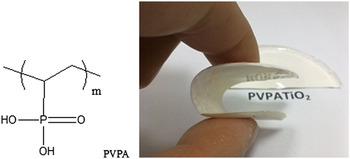
In this work, the synthesis of novel membranes based on the TiO2 nanoparticles and PVPA were discussed (Fig. 1). The PVPA(x)TiO2nanocomposite membranes were characterized via Fourier transform infrared (FTIR), thermogravimetry analysis (TGA), differential scanning calorimetry (DSC), and scanning electron microscopy (SEM). Proton conducting properties were investigated by impedance analyzer. The results are discussed in detail and compared with previously reported systems.
Structure of PVPA and picture of composite membrane.

II. EXPERIMENTAL
A. Materials and preparation
Vinylphosphonic acid (>95%, Fluka, Germany), dimethylformamide (DMF) (>99%, Fluka), TiO2nanoparticles (10–50 nm, 99.5%, Aldrich, Germany), and α,α’-azodiisobutyramidine dihydrochloride (98%, Fluka, Germany) were used as received.
PVPA was synthesized by free radical polymerization of vinylphosphonic acid according to previous work.Reference Bingöl, Meyer, Wagner and Wegner27 PVPA (see Fig. 1) and TiO2 nanoparticles were admixed at various percentage ratios to obtain PVPA(x)TiO2 composite membranes (x = 5, 10, 15, and 20) where x is the percentage (w/w) ratio of TiO2nanoparticles in PVPA matrix. Then, the mixture was further stirred under nitrogen atmosphere at 80 °C for 24 h, i.e., until getting a homogeneous milky solutions. The polymer films were cast onto polished poly(tetrafluoroethylene) (PTFE) plates and dried under vacuum at 50 °C and then stored in a glove box.
In the second approach, the composites were synthesized by in situ polymerization of vinyl phosphonic acid (VPA) with α,α’-azodiisobutyramidine dihydrochloride as the initiator in the presence of TiO2 nanoparticles. The reaction mixtures were further stirred under nitrogen atmosphere at 85 °C for 24 h, until the mixtures became homogeneous white viscous mixture. The polymers were cast onto polished PTFE plates, dried under vacuum at 50 °C, and then stored in a glove box. Hygroscopic and freestanding films were denoted as PVPA(x)TiO2(in situ). Before all measurements, polymer films were stored in a glove box.
B. Characterizations
The FTIR spectra of the samples were recorded on a Bruker Alpha-P ATR spectrometer (Germany) in the range 4000–400 cm−1, with 4 cm−1resolution.
1. Scanning electron microscopy
The surface morphology of blend membranes was investigated by SEM (Philips XL30S-FEG, Netherlands). All the samples were sputtered with gold for 150 s before SEM measurements.
2. Thermal measurements
Thermal stabilities of the complex polymer electrolytes were examined by thermogravimetry (TG) analysis with a Perkin Elmer STA 6000. The samples (∼10 mg) were heated from room temperature to 700 °C under N2atmosphere at a heating rate of 10 °C/min.
DSC data were obtained using Perkin Elmer JADE DSC instrument. The measurements were carried out at a rate of 10 °C/min under a nitrogen flow.
3. Conductivity measurements
The proton conductivity studies of the samples were performed using a Novocontrol dielectric impedance analyzer. The samples were sandwiched between platinum blocking electrodes, and the conductivities were measured in the frequency range 0.1 Hz to 3 MHz at 10 °C intervals. The temperature between −100 and 250 °C was controlled with a Novocontrol cryosystem (Germany).
III. RESULTS AND DISCUSSIONS
A. FTIR study
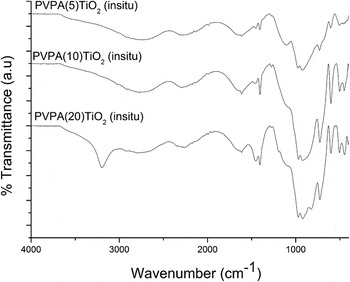
The homopolymer of PVPA was prepared by free radical polymerization of vinylphosphonic acid. Figure 3 shows the FTIR spectra of PVPA TiO2 nanocomposite membranes. The FTIR spectrum of PVPA shows strong bands between 1040 and 910 cm−1 that belong to asymmetric stretching vibrations of the P–OH group. The P–O–H vibration at 930 cm−1 decreases as the PVPA ratio increases, indicating the existence of excess acidic protons.Reference Sevil and Bozkurt28 Additionally, phosphonic acid units give rise to broad bands with medium intensity between 1700–1590 cm−1 and 2850–2750 cm−1 regions.Reference Bozkurt, Meyer, Gutmann and Wegner29, Reference Çelik, Akbey, Graf, Bozkurt and Spiess30 The intensities of these peaks increase as the concentration of TiO2 particles increases. The broad and strong peak at about 600 cm−1 is attributed to the overlapping of the combined results of the Ti–O band vibrations and/or stretching in TiO2 particles.Reference Mallakpour and Barati31 The broad band at 1100 cm−1 can be attributed to the P–O–Ti and P–O stretching vibrations, respectively. The weak band at 1400 cm−1 is due to the P–O and P–C stretching vibrations.Reference Wu, Hou, Wang, Xiaoa and Jiang32 It could be deduced from these results that PVPA had formed chemical bonds with the Ti atom at the titania surface via phosphonate groups. Both the characteristic peaks of PVPA and TiO2can be clearly seen in all these composite spectra.
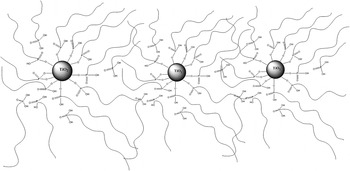
Model structure of PVPATiO2composite membranes.

FTIR spectra of the PVPATiO2composite membranes.

The broad band between 3500 and 2500 cm−1is the hydrogen bonding network, which is necessary for proton conduction.
B. Scanning electron microscopy
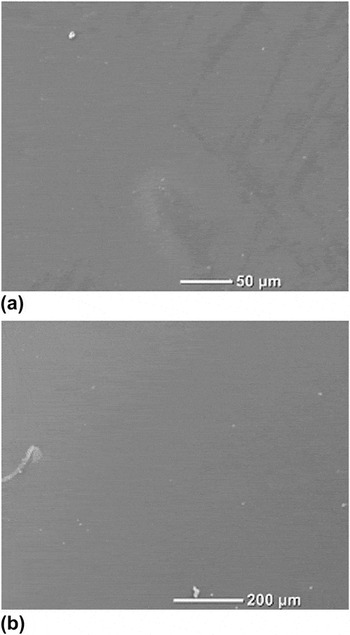
To examine the microstructures and nanofiller distribution within the nanocomposites, SEM analysis was conducted. Typical surface SEM photographs of PVPA TiO2 nanocomposite were illustrated in Figs. 4 (a) and (b). From Fig. 4, it was observed that TiO2 was homogenously dispersed in the PVPA matrix. Moreover, from these figures, it can be seen that PVPA and TiO2 being well distributed throughout the matrix. This result is also consistent with the DSC curves of blend membranes that no separate T gtransition of impregnated PVPA was observed.
SEM micrographs of the surface of PVPATiO2composite membranes: (a) 50 mm and (b) 100 mm.

C. Thermal analysis
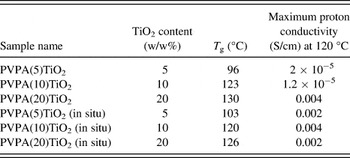
Table I lists the glass transition temperatures of the PVPA(x)TiO2 nanocomposites. The PVPA(x)TiO2 nanocomposite polymer membranes have definite glass transition temperatures between 126 and 85 °C (Table I). The results indicate that the glass transition temperatures of the samples shift to lower temperatures as the quantity of TiO2increases.
Maximum proton conductivity and T g(°C) values for the all membranes.

The PVPA(x)TiO2 (in situ) composite membranes have glass transition temperatures between 103 and 125 °C. The reason can be attributed to inhibition of intra- and interchain condensation. This increase of T g suggests improved thermal stability and hence provides potential advantages during the PEM fuel cell operation at high temperatures. The reason of such increment in T g can be expressed by the free volume theory.Reference Peighambardoust and Pourabbas33 Based on this theory, thermal expansion of free volumes, the space that is not occupied by polymer chains, occurs above glass transition temperature, and chains begin to fill the free volumes as a result of enhanced thermally motivated segmental motions of the chains. The reaction between TiO2 nanoparticles and PVPA matrice resulted in restriction of segmental relaxations, which increased the T gof the material.
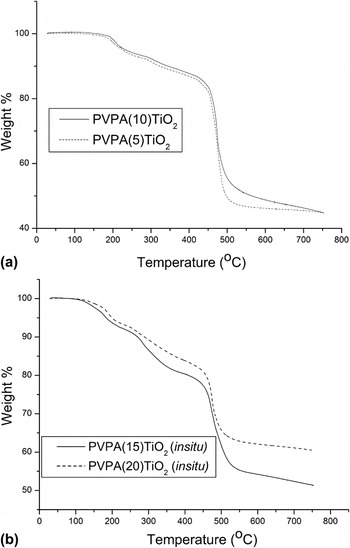
Figure 5(a) shows the TG results of the PVPA(x)TiO2. Both PVPA(10)TiO2 and PVPA(20)TiO2have no weight change up to approximately 150 °C. Then, an elusive weight loss up to 180 °C can be attributed to anhydride formation. Clearly, the dried materials are thermally stable up to 200 °C, and then, they decompose.
TG analysis of PVPATiO2 composite membranes under nitrogen atmosphere at a heating rate of 10 °C/min. (a) TG profiles of PVPATiO2 composite membranes. (b) TG profiles of PVPATiO2(in situ) composite membranes.

Figure 5(b) shows the TG results of the PVPA(x)TiO2 (in situ). Both PVPA(10)TiO2 (in situ) and PVPA(20)TiO2 (in situ) have no weight change up to approximately 150 °C. The TG graphs show an elusive weight loss up to 150 °C, which can be attributed to anhydride formation. It is clear that the dried polymers are thermally stable up to 200 °C, and then, they decompose. The TiO2nanoparticles improved the thermal stability of the PVPA nanocomposite membranes.
D. Conductivity measurement
The AC conductivities, σac (ω), of the polymers were measured at several temperatures using impedance analyzer. The frequency-dependent AC conductivities [σac (ω)] were measured using Eq. (1):
 $${\rm{\sigma \prime(\omega }}) = {\rm{\sigma }}_{{\rm{ac}}} {\rm{(\omega }}) = {\rm{\varepsilon \Prime(\omega )\omega \varepsilon }}_{\rm{0}} \quad,$$
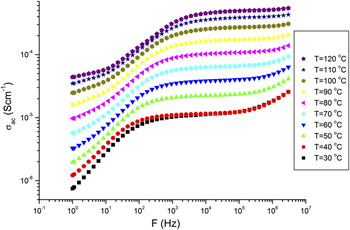
where σ′(ω) is the real part of conductivity, ω = 2πf is the angular frequency, ε0 is the vacuum permittivity (ε0 = 8.852 × 10⁻¹⁴ F/cm), and ε″ is the imaginary part of complex dielectric permittivity (ε*). The proton conductivities of PVPA(x)TiO2 anhydrous nanocomposite polymer electrolytes were measured from 20 to 120 °C. The AC conductivity of PVPA(20)TiO2 composite membrane is shown in Fig. 6.
AC conductivity of PVPA(20)TiO2composite membranes.

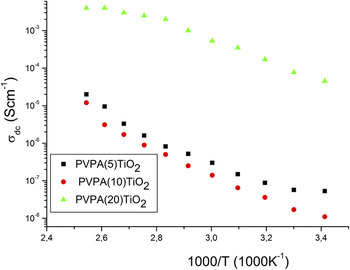
The proton conductivities of all anhydrous samples were compared in Fig. 7. The conductivity isotherm illustrates that the DC conductivity strongly depends on temperature as well as the ratio of TiO2.
DC conductivity measurements of PVPATiO2composite membranes versus reciprocal temperature.

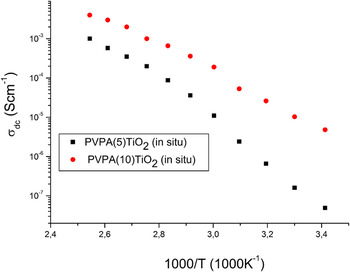
The maximum proton conductivity was measured for PVPA(10)TiO2 (in situ) and found to be 0.004 S/cm at 120 °C in the dry state in Fig. 8. The PVPA(10)TiO2 was considered to be the optimum composition as the nanocomposite polymer membrane. Conductivity results showed that the PVPA composition is highly effective on the proton conductivity of the samples in the PVPA(10)TiO2 (in situ) systems. It is expected that major part of proton transport is provided over phosphonic acid units coordinated with TiO2 as shown in Fig. 2. The increasing of the conductivity of nanocomposite polymer membrane may also explained that the interaction between titania surface and phosphonic acid units of PVPA in the membrane. Nonconducting TiO2 particles which remain embedded in the polymer matrix positively contributed to the diffusion of protons.Reference Eikerling, Kornyshev, Kuznetsov, Ulstrup and Walbran34 Moreover, the interactions between phosphonic units of PVPA and nanoparticles improve the proton transport. The decrease in conductivity for samples with higher TiO2 content can be attributed to segmental relaxation inhibited by complexation. Previous work, Wu et al.,Reference Wu, Hou, Wang, Xiaoa and Jiang32 explained that the interaction between the nanoparticle and phosphonic acid units improved the proton conductivity. Another earlier work showed that the nanoparticle content is an important factor on proton conductivity and thermal stability of nanocomposite membranes.Reference Devrim, Erkan, Bac and Eroglu35
DC conductivity measurements of PVPATiO2(in situ) composite membranes versus reciprocal temperature.

IV. CONCLUSIONS
In the present work, composite membranes of TiO2 nanoparticles and PVPA were produced by free radical polymerization. FTIR spectroscopy confirmed that the interaction existed between PVPA and TiO2. TG analysis showed that the samples are thermally stable up to approximately 200 °C. DSC results illustrated that the T g of the materials shifted to higher temperatures with increasing TiO2 content. In the anhydrous state, the proton conductivity of PVPA(10)TiO2 (in situ) was 0.004 S/cm at 120 °C. The proton conductivity of PVPA(10)TiO2was measured as 0.004 S/cm under humidified conditions this result is approached to that of humidified Nafion117 membrane at 40 °C. In this system, the proton diffusion is expected to occur by the transport of the protons through phosphonic acid units up to certain threshold composition of PVPA. The synthesized nanocomposite polymers can be suggested for application in PEMFCs.