INTRODUCTION
According to Smol & Coomans (Reference Smol, Coomans, Abebe, Andrássy and Traunspuerger2006) the suborder Oncholaimina De Ley & Blaxter, Reference De Ley, Blaxter and Lee2002 has only one superfamily Oncholaimoidea Filipjev, 1916 that has been split in two families Oncholaimidae Filipjev, 1916 (established as subfamily Oncholaimini by Filipjev 1916, raised to family by Baylis & Daubney, Reference Baylis and Daubney1926) and Enchelidiidae Filipjev, 1918 (established as subfamily Enchelidiini by Filipjev 1918, raised to family by Stekhoven, Reference Grimpe and Wagler1935). The main characters to distinguish them are the buccal cavity and pharynx shape. Enchelidiidae is characterized by a pharynx gradually enlarged posteriorly and with crenate outer walls or with many bulbs; male supplements in shape of papillae or suckers and it has 16 genera. Demanian system always is absent. Oncholaimidae is characterized by a cylindrical pharynx with outline never crenate and male supplements (if present) papilliform or setiform. Oncholaimidae has seven subfamilies, six of them with three teeth (Oncholaiminae Filipjev, 1916, Oncholaimellinae De Coninck, 1965, Krampiinae De Coninck, 1965, Pseudoncholaiminae Kreis, 1932, Adoncholaiminae Gerlach & Riemann, Reference Gerlach and Riemann1974 and Pontonematinae Gerlach & Riemann, Reference Gerlach and Riemann1974) and one Octonchinae De Coninck, 1965 with nine teeth. The family Oncholaimidae comprises 27 genera.
The subfamily Octonchinae includes one genus. It has been erected based on a juvenile specimen of Octonchus marinus (Schulz, Reference Schulz1932). The original name was Polydontus marinus Schulz Reference Schulz1932. Schulz (Reference Schulz1932) described this genus as having a buccal cavity with one big tooth plus eight small teeth (nine distinct teeth). Kreis (Reference Kreis1934), wrongly re-described Polydontus with eight teeth. Then Clark (Reference Clark1961) found that this genus name had a homonym (Polydontus Blanville, 1826, a Mollusca), and he renamed it as Octonchus, based on Kreis's re-description. So the genus etymology of Octonchus (meaning eight teeth) is not related to the teeth number in the original species described by Schulz, or to the teeth number described in this paper; it comes from a misunderstanding.
Octonchus has been described on the basis of a juvenile specimen; no data about males or females and the demanian system are available.
During 2006, under the GEF-PNUD Project ARG 02/018, A-B-55, sediment samples were taken at seven sites along the Patagonia coasts, at Río Negro and Chubut Provinces, Argentina.
During preliminary examination of the material from this survey an interesting nematode was noted in winter and summer samples. On closer investigations it appeared to belong to a new genus, belonging to the Octonchinae subfamily, with a new demanian system configuration, and sharing some characters between the Oncholaimidae and Enchelidiidae families. The relationship with Octonchus marinus is discussed.
MATERIALS AND METHODS
Description of site studied
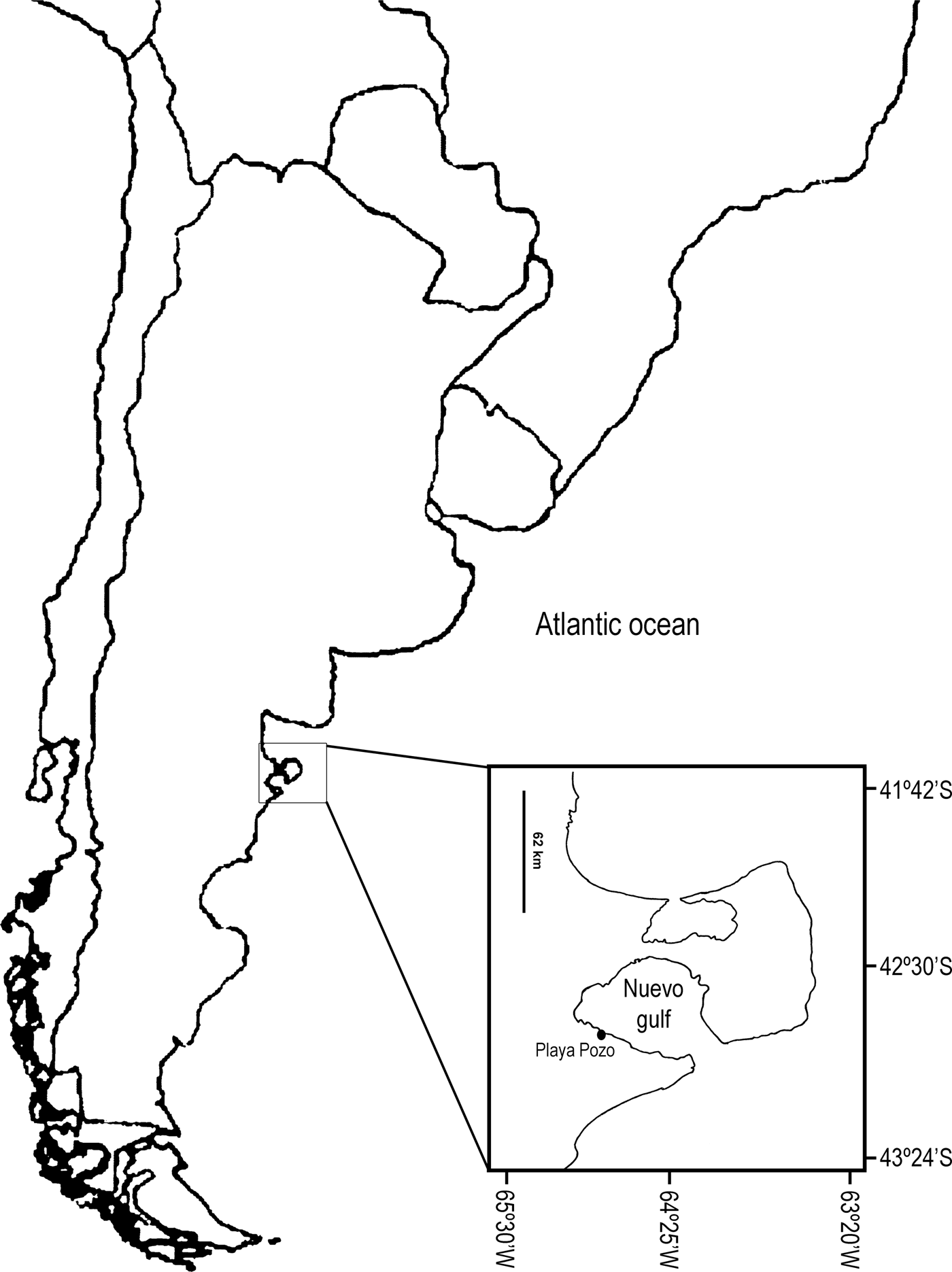
Patagonema iubatum gen. nov. sp. nov. has been found in Playa Pozo, Golfo Nuevo, Chubut province (latitude/longitude 42°49′S 64°52′W) on the Atlantic coast of South America (Figure 1). It is an enclosed bay, only 1.5 km in length, protected between the tufts restingas of Punta Loma and Cerro Avanzado. Covered by fine sand, moderately sorted with dominance of grain fraction larger than the median diameter. P. iubatum gen. nov. sp. nov. was found at low tide, on un-vegetated sand habitat. Adult specimens were found in winter, juveniles in summer.
Map showing the study site, Golfo Nuevo, Playa Pozo.

Sampling techniques and treatment
All species described below were found in samples obtained by hand, at each site and level location, with a cylindrical Plexiglas core (inner diameter 2.8 cm). They were preserved in cold 5% formaldehyde in filtered seawater stained with rose Bengal, decanted and sieved through both 500 μm and 50 μm mesh sieves. The nematodes present on the 50 μm sieve were transferred to a solution consisting of alcohol 96°:distilled water:glycerin (2:2:1) and left in it for one week in a desiccator until the nematodes were in pure glycerin. Then they were counted and mounted in pure glycerine prior to being identified to species level. Demanian system drawings were performed from nematodes stained in a solution of Blue Nile stained-glycerin for 5 minutes and then mounted in pure glycerin. Drawings were made using a Zeiss microscope incorporating a drawing device and photographs were taken using Zeiss and Olympus BX51 microscopes, both equipped with differential interference contrast (DIC). The granulometric analysis samples were oven dried at 85°C for 24 h and subsequently sieved through a series of sieves (2, 1, 0.5, 0.125 and 0.063 mm) and the grain size determined on the basis of the weight of each size fraction (Giere et al., Reference Giere, Eleftheriou, Murison, Higgins and Thiel1988).
Holotypes are deposited in the Museo Nacional de Ciencias Naturales ‘Bernardino Rivadavia’, Argentina and paratypes are part of the CENPAT-CONICET Nematode Collection.
De Man's ratios, a, b and c, used in this paper are calculated as standard. Abbreviations used in the text and table are: A%, amphid diameter as percentage of corresponding body diameter; Abd, anal body diameter; Al, amphid length; Aw, amphid width; BdA, body diameter at amphid level; Bdcs, body diameter at level of cephalic setae; Bdnr, body diameter at level of nerve ring; Bdph, body diameter at level of pharyngeal end; coll., collector; Csl, cephalic setae length; Daa/c, distance from anterior end to anus/cloacae; Danr, distance from anterior end to nerve ring; Daph, distance from anterior end to pharyngeal end; Daex, distance from anterior end to excretion pore; Dav, distance from anterior end to vulva; Dpexa, distance to excretion pore in stomatal lenghts; ED, egg diameter; EL, egg lenght; G, gubernaculum length in microns; Gcd, gubernaculum length as proportion of cloacal body diameter; L, total body length; Lcar, cardia lenght; Ldt, dorsal tooth length; Lend, endocopula length; Llsvt, subventral left tooth length; Lrsvt, subventral right tooth length; Npo, number precloacal organs; Npos, number poscloacal setae; Npc, number precloacal setae; OL, ovary length; Sl, stoma length; Sl/Gl, spicula length/gub length; Sl/Sw, stoma length/stoma width; S, spicular length in microns, along the arc; Scd, spicule chord length as proportion of cloacal body diameter; Sw, stoma width; Tl, tail length; Ta, tail in anal diameters; and V% = distance from the anterior end to the vulva opening in percentage of total length.
The classification is according to Lorenzen (Reference Lorenzen1994).
RESULTS AND DISCUSSION
SYSTEMATICS
Order ENOPLIDA Filipjev, 1929
Suborder ONCHOLAIMINA De
Coninck, 1965
Superfamily ONCHOLAIMOIDEA Filipjev,
1916
Family ONCHOLAIMIDAE Filipjev, 1916
EMENDED DIAGNOSIS
Oncholaimoidea
Buccal cavity spacious, posteriorly surrounded by pharyngeal tissue, usually with three unequal immobile teeth. One of the two ventrosublateral teeth usually the largest, sometimes the two ventrosublateral teeth are equal in size and are bigger than the dorsal tooth, rarely all three teeth are equal in size. Sometimes additional (mandibular) teeth are present in lateral and ventral position (Octonchus and Patagonema). Pharynx does not attach to the body wall. Outline of pharynx smooth. Three pharyngeal glands open through teeth. Amphids generally pouch-shaped. Delicately built dorsolateral and ventrolateral orthometanemes with pronounced caudal filament. The secretory–excretory system distinct with gland cell to the right side of the intestine. Female reproductive system variable: either didelphic–amphidelphic or monodelphic–prodelphic. The demanian system absent or present, and shows different degrees of development. Males mostly diorchic with opposite testes. Spicules of variable shape; gubernaculum present or absent. Gonads always at the right side of the intestine. The family Oncholaimidae has seven subfamilies.
Subfamily OCTONCHINAE De Coninck, 1965
EMENDED DIAGNOSIS
Oncholaimidae
Buccal cavity tapers posteriorly, posterior one-third surrounded by pharyngeal tissue; armature consists of the combination of three typical oncholaimid teeth, of which one of the ventrosublateral is the largest and three mandibular ridges with small teeth. Tail conical. Demanian system complex, related to Viscosia De Man, 1890 and Meyersia Hopper,1967 with an additional connection to the intestine. Marine.
Type genus: Octonchus Clark, Reference Clark1961.
Genus Patagonema gen. nov.
DIAGNOSIS
Stoma with a combination of three typical oncholaimid teeth: two ventrosublateral teeth with longest on right side and one small dorsal tooth and three mandibular ridges with small teeth in ventral and lateral position. Valve at the basis of the stoma present. Oesophagus end enlarged. Oesophagus cylindrical, slightly widening posterior, not crenate outer wall. Cardia conspicuous. Reproductive system is paired. Demanian system consisting of two ducts: one short tube between oviduct and osmosium which connects to the intestine (ductus entericus), one short tube connection from oviduct junction to uvette that connects to the uterus (ductus uterinus). Near vulva opening, on left side of the body, there is a second connection between the uterus and the intestine. Surrounding this connection several disc-shaped cells (glands) have been observed. This connection has a short tube that seems to have its end (on left side), on surface of the body with a similar structure to a porus terminalis. Demanian system similar to the one in the genera Viscosia and Meyersia. Spicules short, gubernaculum with dorsal apophyses and lateral curved crura. Precloacal papilliform supplements plus two subventral setae.
Presence of cylindrical pharynx with straight outline (not crenate) and papilliform male supplements places Patagonema gen. nov. inside the family Oncholaimidae according to the definition of Smol & Coomans (Reference Smol, Coomans, Abebe, Andrássy and Traunspuerger2006). The buccal cavity with more than 3 teeth places it in the subfamily Octonchinae. The well-developed demanian system shows similarities to the subfamily Adoncholaiminae Gerlach & Riemann, Reference Gerlach and Riemann1974.
RELATIONSHIPS
Patagonema gen. nov. differs from unique genus Octonchus marinus (Schulz, Reference Schulz1932) in having three oncholaimid teeth, plus three mandibular ridges with four small teeth, so a complex armature with 3 + 12 (15 teeth in total), instead nine teeth in the former. Patagonema iubatum juveniles (see Figure 6) shows the mandibular ridges teeth, in a similar position to those described by Schulz (with size differences) so probably both genera are homologous in origin. The amphids in Patagonema are positioned at the mid-level of the stoma, not at the base as in Octonchus. The cephalic setae are shorter than 0.5 of cephalic diameter, instead 1/3 in Octonchus (based on the original description of O. marinus (Schulz, Reference Schulz1932) and Belogurov & Belogurova, Reference Belogurov and Belogurova1989 re-examination of type material). The Octonchinae and Octonchus taxa had been erected on the basis of only one juvenile specimen, and it is the only one oncholaimoid genus with many teeth. We propose here to include Patagonema gen. nov. in Octonchinae subfamily.
The demanian system of Patagonema gen. nov. resembles that of the subfamily Adoncholaiminae. But it differs from the three genera currently placed in Adoncholaiminae in the following characters: from Meyersia, by having a short oviduct, a second connection between uterus and intestine and by the length of ventrosublateral teeth; from Kreisoncholaimus by the connection of demanian system on the uterus and by length of anterior sensilla; and from Adoncholaimus by having a demanian system with two osmosium, different spicules shape and gubernaculum with dorsal apophysis and lateral piece.
According to the overview of the genera of Enchelidiidae published by da Fonseca-Genevois et al. (Reference da Fonseca-Genevois, Smol, Decraemer and Venekey2009) the following characters are similar between Patagonema and the genera Thoonchus Cobb, Reference Cobb1920 and Ditlevsenella Filipjev, Reference Filipjev1927, in particular T. inermis Gerlach, Reference Gerlach1953 and D. murmanica Filipjev, Reference Filipjev1927 (sensu Blome (Reference Blome1982)): denticles in mouth (on the stoma walls); and shape of spicules, gubernaculum and precloacal papillose supplements.
Patagonema iubatum sp. nov.
(Figures
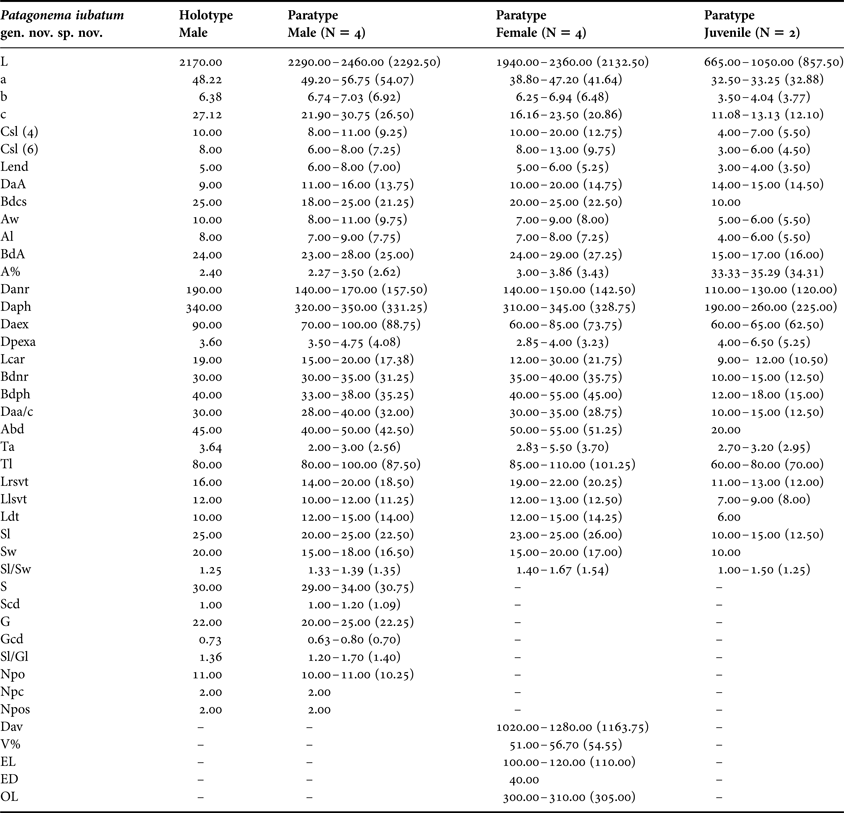
2–6; Table
1)
Type and only species
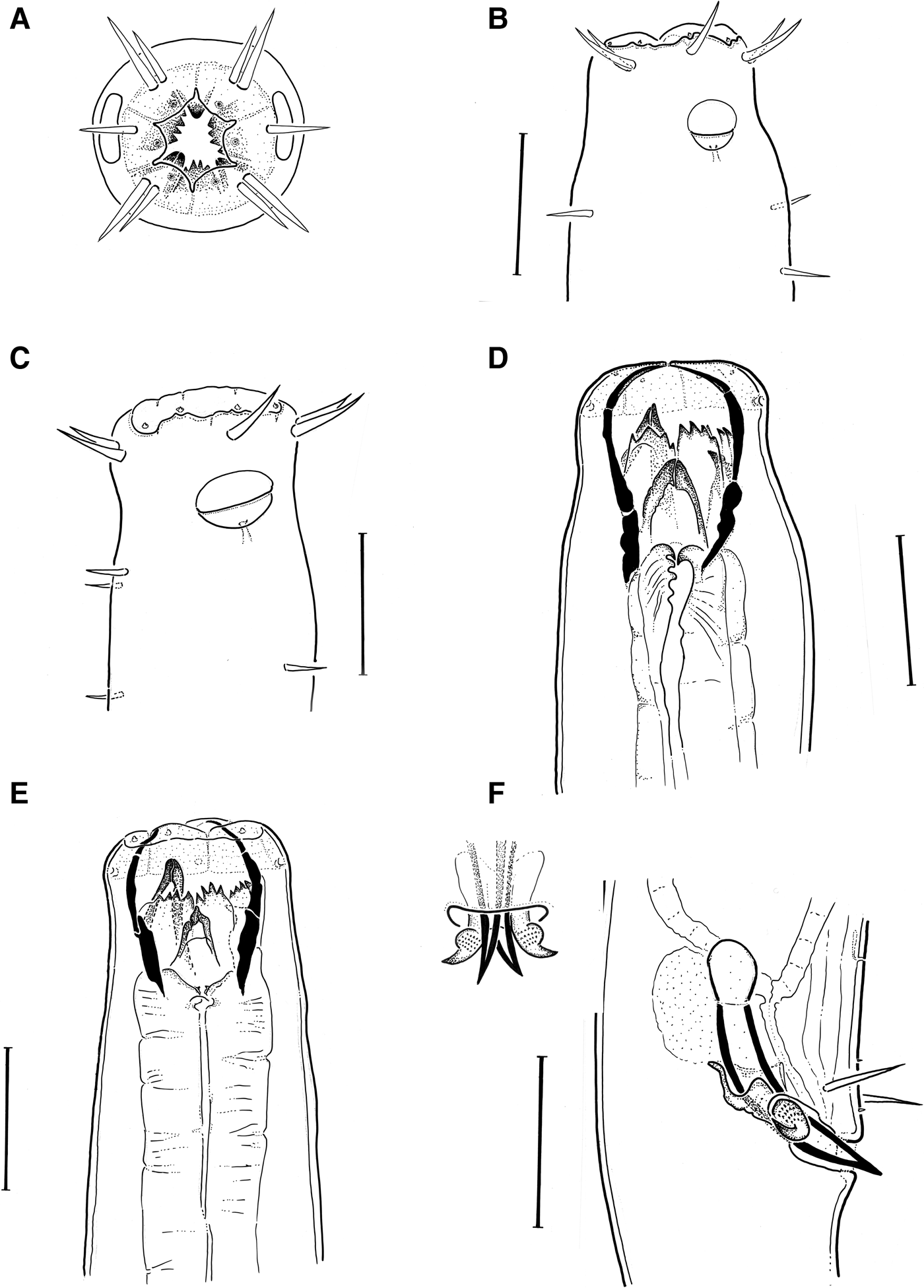
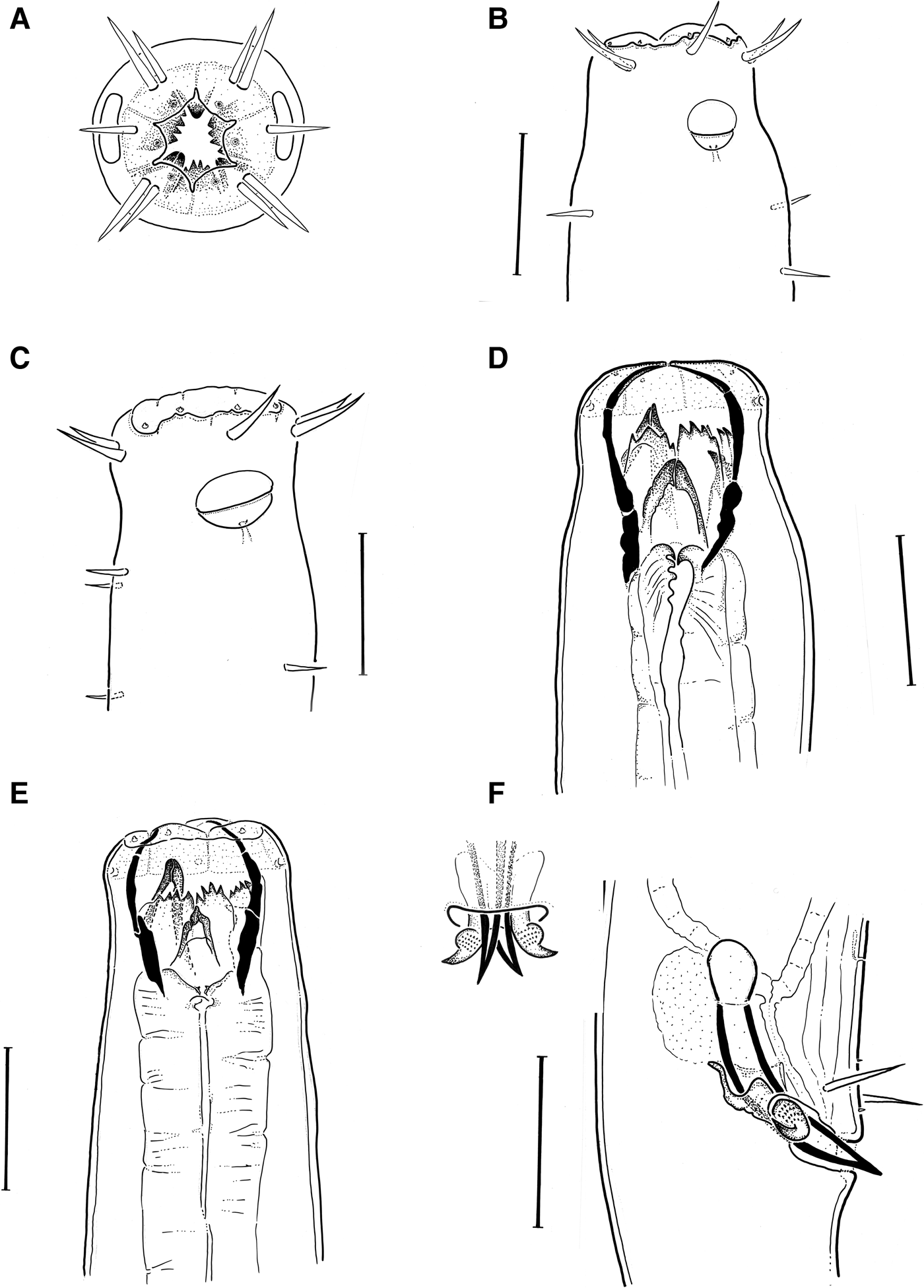
Patagonema iubatum gen. nov. sp. nov.: (A) apical view (scheme); (B) head region of paratype female (external); (C) head region of holotype male (external); (D) head region of paratype female (internal); (E) head region of holotype male (internal); (F) ventral view of cloacal aperture, paratype male; (G) posterior end of holotype male, showing copulatory apparatus. Scale bars: 20 μm.
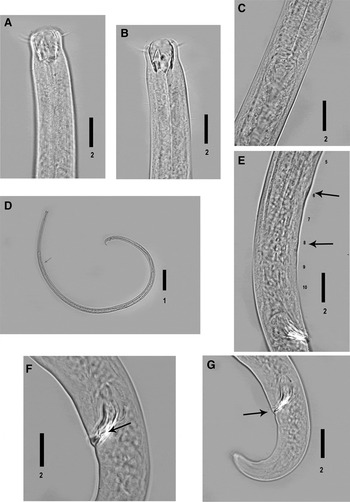
Patagonema iubatum gen. nov. sp. nov.: (A) photograph of anterior end of holotype male, detail of mandibular teeth; (B) photograph of anterior end of holotype male, subventral and dorsal teeth; (C) cardia of holotype male; (D) entire male; (E) precloacal supplement in holotype male; (F) gubernaculum holotype male; (G) gubernaculum in paratype male. Scale bars: D, 200 μm; A–C, E–G, 20 μm.

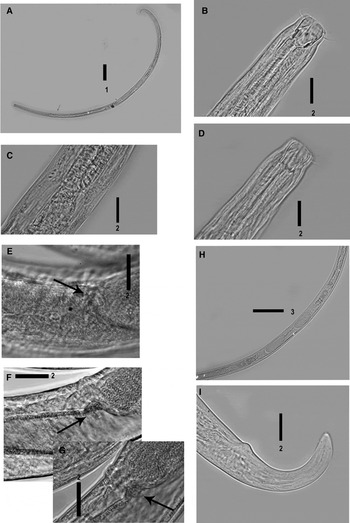
Patagonema iubatum gen. nov. sp. nov.: (A) entire female; (B) anterior end of paratype female, subventral and dorsal teeth; (C) cardia of paratype female; (D) anterior end of paratype female, detail of mandibular teeth; (E) demanian system, terminal duct and glands; (F) uterus and intestine conection; (G) another view intestine conection; (H) reproductive system of paratype female; (I) tail of paratype female. Scale bars: A, 200 μm; B–E, G–I, 20 μm; F, 100 μm.

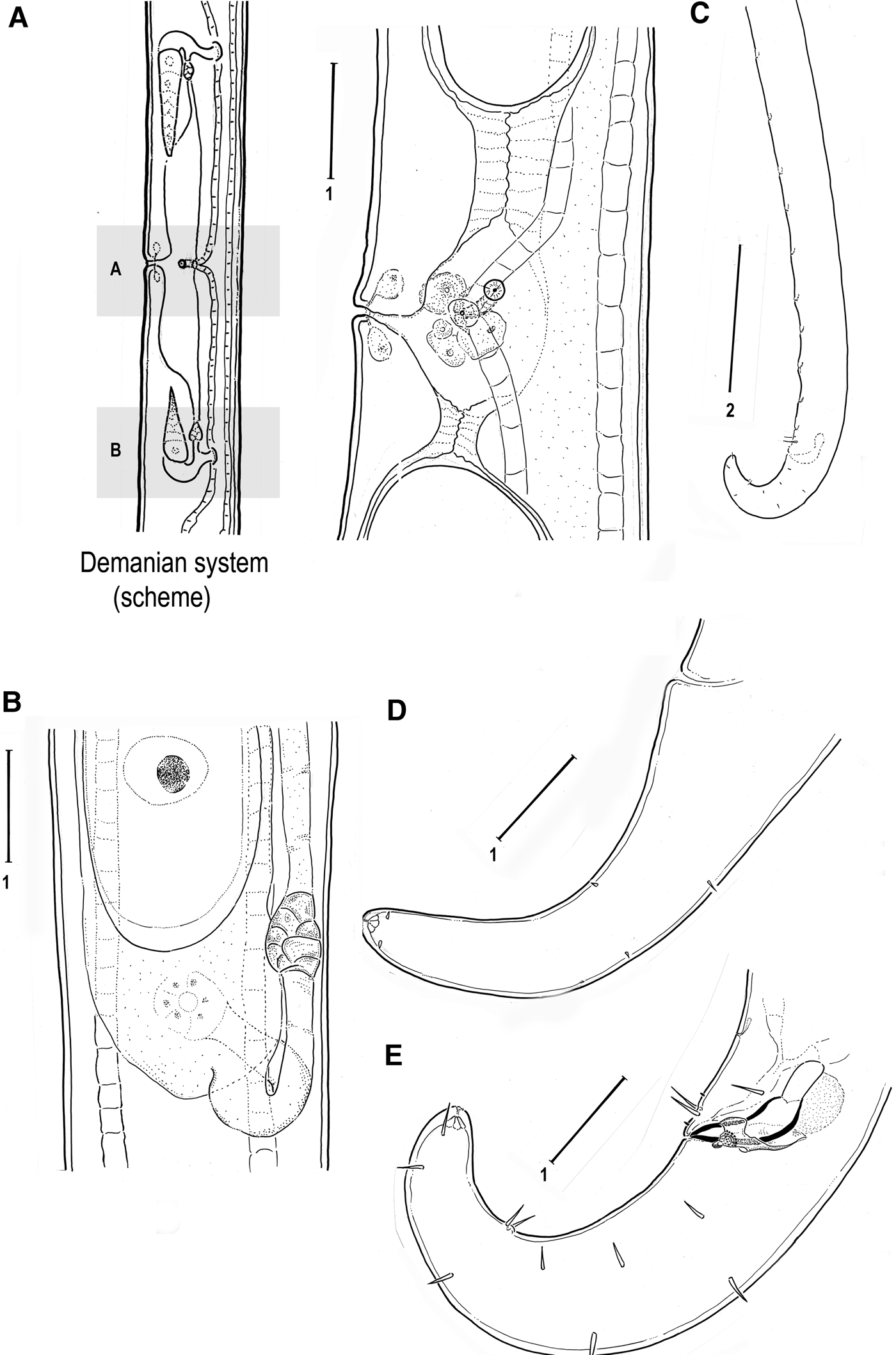
Patagonema iubatum gen. nov. sp. nov.: (A) uterus view on vagina level, with location of external porus of paratype female; (B) demanian system of paratype female (posterior ovary); (C) posterior end of holotype male, showing copulatory apparatus and precloacal supplement; (D) posterior end of paratype female; (E) posterior end of holotype male. Scale bars: A, B, D, E, 20 μm; C, 100 μm.

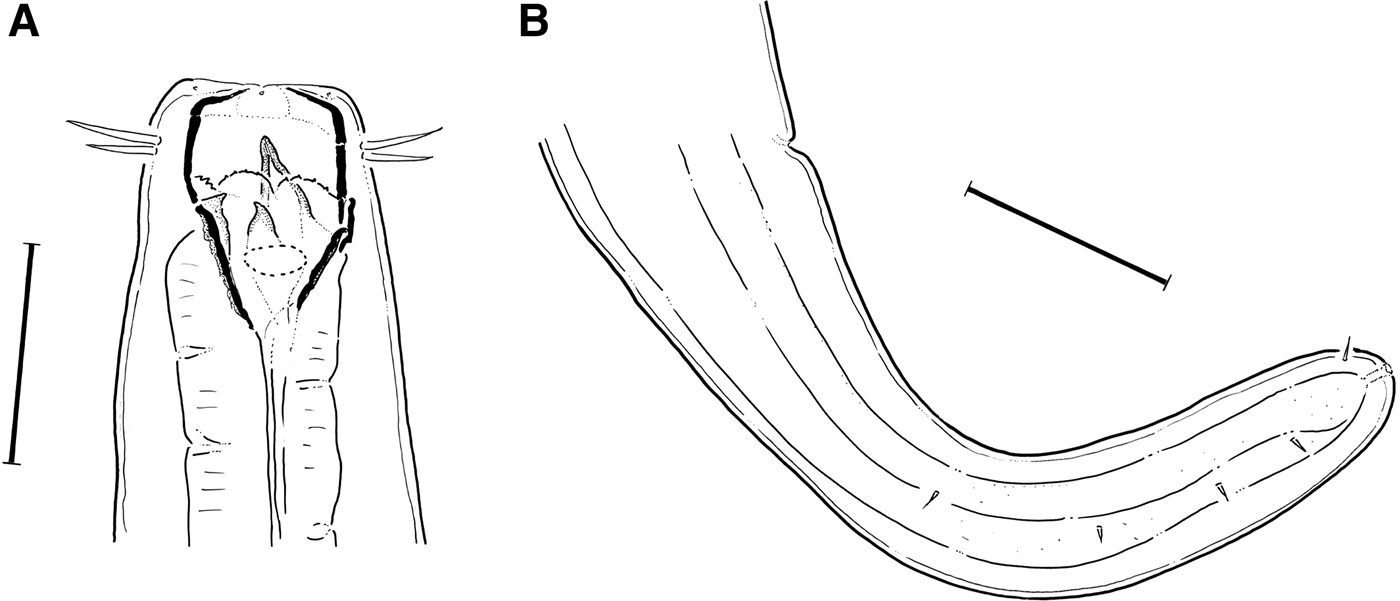
Patagonema iubatum gen. nov. sp. nov.: (A) head region of paratype juvenile; (B) posterior end of paratype juvenile. Scale bars: 20 μm.

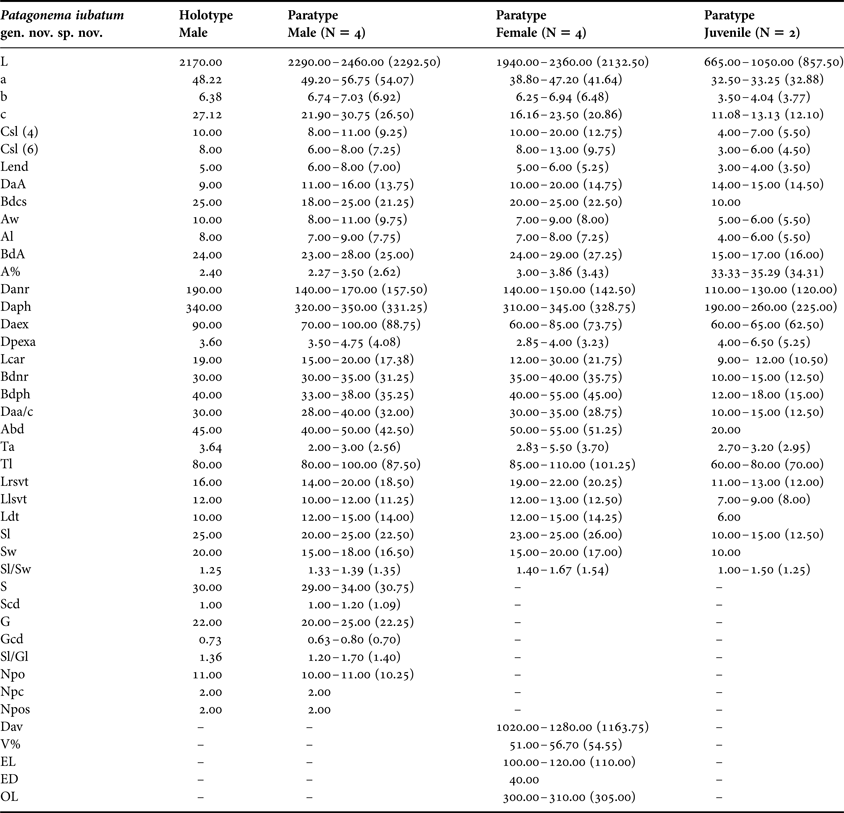
Morphometrics of Patagonema iubatum gen. nov. sp. nov. All measurements are in μm except L in mm, and in the form: mean ± standard deviation (range).
TYPE MATERIAL
Holotype: adult male. Registration number MACN-In 38929; type locality: Playa Pozo; coordinates: 42°49′308″S 64°53′157″W; low tide, 4 m depth; fine sand (median particle size 0.190–0.250 μm); coll. Catalina Pastor/Virginia Lo Russo, 13 June 2006.
Paratypes: four adult males, four adult females and two juveniles. Registration numbers MACN-In 38930 and CNP-Nem 927-935; type locality: Playa Pozo; coordinates: 42°49′308″S 64°53′157″W; low tide, 4 m depth; fine sand (median particle size 0.190–0.250 μm); coll. Catalina Pastor/Virginia Lo Russo, 13 June 2006.
ETYMOLOGY
Genus name came from Spanish word ‘Patagonia’ in reference to the area it was found and species ‘iubatum’ from Latin name meaning crested in reference to the four teeth on the mandibular plates.
MATERIAL EXAMINED
Measurements: see Table 1.
DESCRIPTION
Male (holotype): body cylindrical, tail conical. Cuticle smooth. Lip region with six lips, each one with inner small labial papillae, 6 outer labial setae, 6 + 4 cephalic setae, 6 μm and 4 μm long, arranged in a single circle. Big buccal cavity with sclerotized walls, longer than wide, 17 μm wide and 23 μm long, wider in the anterior part of the head and narrower near the pharynx. Endocopola 5–6 μm long, divided into six parts corresponding to each labium and covering 1/4 of stoma length. Three teeth present, two ventrosublateral of which right one is the longest, and one dorsal being the smallest of the three. Additionally (Figure 2A), three mandibular ridges-like structures bearing four small teeth have been observed, on sclerotized walls, two in laterodorsal and one in ventral position (Figure 2A, E), so twelve mandibular teeth in total. Pharyngeal muscles surround the posterior part of the stoma forming a valve with cuticularized surfaces at the lumen (Figure 2E). Amphideal fovea ovoid to bowl shaped (11 μm diameter, equal to 22.7% of the corresponding body diameter), located 10 μm from anterior end, apertures oval. The amphideal aperture form an angle of 25° in relation to the anterior end. Pharynx, cylindrical, enlarged posteriorly (20 μm after mouth; 28 μm at the end). Cardia is conical and conspicuous, 20 μm in length. Three glands are located to the right side of the intestine posterior to cardia level (Figures 3C, 5A). Ventral excretory gland opening through an ampulla along the pharyngeal region, 90 μm from anterior end. Scattered somatic setae present in cervical region, posterior to the amphids. Tail 50 μm long (3.6 Abd), conical in shape. There are three caudal glands with cellular bodies, 200–320 μm before cloaca, opening on tail tip. On tail one pair of postcloacal subventral setae (in some specimens they are on a small papillae), four pairs of sublateral and one pair of terminal setae 5 μm long were observed. Dorsolateral and ventrolateral orthometanemes not observed.
Reproductive system is paired, with opposed and outstretched testes, in right position relative to the intestine. Spicules present with, well-developed manubrium 8 μm, short calamus and slightly curved lamina 30 μm (0.8 Abd) long if measured along the chord. Gubernaculum composed of an expanded apophysis, one tubular corpus and two curved crura, pointed, sub-ventrally oriented and covered with denticles, 5 μm long. Two 10 μm long precloacal subventral setae at 5 μm from the cloaca opening and 9–10 small pre-cloacal supplements as weakly cuticularized papillae with thin nerve endings. In two males the 4th and 6th supplements are slightly different in size, as two small protuberances on the body wall.
Female (paratype): females are similar to males in general body shape, anterior sensilla and cuticle. Oval amphideal fovea parallel to the anterior end. Ovaries opposed, reflexed, right to the intestine. Vagina short and perpendicular to the body wall. Tail 100 μm long (3.3 Abd). On tail three pairs of small sublateral setae (2 μm) and one pair of setae on tail tip were observed. Demanian system present (Figures 5A–C). On level of the reflexing point of the ovaries, there is a short ductus entericus that connects ovary with the intestine through a simple osmosium (as first drawings given by Rachor (Reference Rachor1969) p.141, Abb.29), and one short tube connection from oviduct junction to uvette that connects to the uterus (ductus uterinus). No principal duct was observed between two uvettes (as drawing by Rachor (Reference Rachor1969), p. 140, Abb. 28 for Meyersia). At the level of the vulva opening the intestine shows a porus that connects it with the uterus. From this porus a short duct (duct terminalis) which ends (on left side), on surface of the specimen, with a similar structure to a pore terminalis (Figures 4E–G, 5A) has been observed. This external and terminal porus is very small and difficult to see and it is surrounded by four conspicuous glands (Figure 5E).
Juvenile (III stage): body cylindrical, tail conical. Cuticle smooth. Lip region with six lips, each one with inner small labial papillae, six outer labial setae (6 + 4 setae), 6 μm and 4 μm long, arranged in a single circle. Big buccal cavity with sclerotized walls, longer than wide, 14 μm wide and 17 μm in length, wide in the anterior part of the head and narrow near the pharynx. Endocopola 3 μm long. Presence of three teeth, two ventrosublateral of which right longest and one small dorsal. Three mandibular ridges structures bearing small dark areas (that will be transformed in small teeth), two in laterodorsal and one in ventral position (Figure 6A). Amphideal fovea ovoid (5 μm diameter), located 14 μm from anterior end. Pharynx cylindrical. Gonads not seen. Tail 83 μm long, conical in shape. Three pair of setae 1 μm long sublateral and one pair on the tip of the tail, (Figure 6B).
DISCUSSION
Patagonema iubatum sp. nov. is characterized by the presence of mandibular ridges armed with small teeth, 9–10 papillae like pre-cloacal supplements, short and cephalated spicula and a gubernaculum with dorsal apophysis and lateral pieces.
The demanian system is present and shows a different configuration from all known genera of the family Oncholaimidae (Rachor, Reference Rachor1969). Following Belogurov & Belogurova (Reference Belogurov and Belogurova1989), this new configuration could be in between a viscosoid and post-viscosoid type.
In P. iubatum sp. nov. juveniles, the buccal armature looks similar to the adults. Mandibular ridges are small and overlapped. The main differences we found with the adult were sizes. They differ from Octonchus marinus (Schulz, Reference Schulz1932), in having three teeth plus twelve mandibular teeth, instead of one main tooth and eigth teeth (probably 3 + 6, nine in total) in the former. The amphids are not at the base of the buccal cavity, the cephalic setae are shorter and the tail shape is different.
FINANCIAL SUPPORT
This work has been financed by GEF-PNUD Project 02/018 A-B-55.