INTRODUCTION
The pattern of seed transportation (abiotically vs. biotically) and deposition (regurgitated vs. defecated, singly vs. in clumps), and the deposition site characteristics are crucially important aspects influencing the likelihood that a dispersed seed survives germination and produces a seedling that successfully establishes and meets appropriate environmental conditions for recruitment (Schupp et al. Reference SCHUPP, JORDANO and GÓMEZ2010). When seeds are dispersed through the digestive tract of frugivores (i.e. endozoochorously), the faecal matrix in which seeds are excreted will attract both rodents and dung beetles (Andresen Reference ANDRESEN1999, Beaune et al. Reference BEAUNE, BOLLACHE, BRETAGNOLLE and FRUTH2012) that may act as predators (rodents) and/or seed dispersers (rodents and dung beetles) and hence affect the post-dispersal fate of seeds (Chambers & MacMahon Reference CHAMBERS and MACMAHON1994, Vander Wall & Longland Reference VANDER WALL and LONGLAND2004, Vander Wall et al. Reference VULINEC, LAMBERT, Garber, Estrada, Bicca-Marques, Heymann and Strier2005). In particular, the depth at which seeds are relocated underground by burrowing dung beetles (i.e. ball-rollers and tunnellers), and less frequently by scatter-hoarding rodents, is a determinant parameter as it will influence both the probability of seed detection by granivores and seedling emergence success (Shepherd & Chapman Reference SHEPHERD and CHAPMAN1998). In the specific case of dung beetles, the pattern of seed relocation, and hence the impact on post-dispersal seed and seedling fate, will partly depend on the composition of the dung beetle assemblage colonizing faeces, which in turn can be influenced by intrinsic and extrinsic attributes of the frugivore dispersing the seeds, such as the timing of faeces deposition, the spatial defecation pattern, the volume and physico-chemical properties of the faecal matter, habitat and season (Andresen Reference ANDRESEN2002, Hanski Reference HANSKI, Lieth and Werger1989, Hosaka et al. Reference HOSAKA, NIINO, MASAHIRO, OCHI, YAMADA, FLETCHER and OKUDA2014). It is therefore important to study the impact of seed deposition pattern on the burial activity of dung beetles when assessing the effectiveness of dispersal events initiated by frugivores.
This study tested the influence of seed deposition habitat on dung beetle assemblages and the resulting secondary dispersal patterns using an Afrotropical system, involving seeds most commonly dispersed by the western lowland gorilla (Gorilla gorilla gorilla) in a site in south-east Cameroon. A 3-y investigation of the gorilla in this study site demonstrated that a third of all seeds dispersed belong to the genus Uapaca (Euphorbiaceae), and, as a result of gorilla defecation pattern (Todd et al. Reference TODD, KUEHL, CIPOLLETTA and WALSH2008) and site-specific habitat preference, most of these seeds encounter either open-canopied conditions at sleeping sites (canopy gaps and young secondary forests) or shaded conditions on feeding trails (old secondary forest). As the degree of canopy openness is known to affect the composition of dung beetle assemblages (Bicknell et al. Reference BICKNELL, PHELPS, DAVIES, MANN, STRUEBIG and DAVIES2014, Hosaka et al. Reference HOSAKA, NIINO, MASAHIRO, OCHI, YAMADA, FLETCHER and OKUDA2014), we hypothesized the following: (1) The different environmental conditions at sleeping sites and old secondary forests will translate into differences in dung beetle assemblages, and subsequently into (2) differences in the proportion of seeds dispersed by dung beetles, dispersal distances and burial depths, which (3) eventually will result in differing secondary dispersal services. Furthermore, based on published findings on seed burial depths, we hypothesized that (4) most seeds will be buried at shallow depths at which seedling emergence probability will remain high, leading to an improvement in the post-dispersal fate of Uapaca seeds by dung beetles.
STUDY SITE
We conducted the study in the research site ‘La Belgique’ at the northern periphery of the Dja Biosphere Reserve, south-east Cameroon (013°07′–013°11′E, 03°23′–03°27′N) (Tagg & Willie Reference TAGG and WILLIE2013, Willie et al. Reference WILLIE, PETRE, TAGG and LENS2012). The research site covers approximately 40 km2 of mixed lowland forest (600–700 m asl), in the transition zone between evergreen and semi-deciduous forests (Letouzey Reference LETOUZEY1968). Climatic data recorded in the site between January 2010 and December 2012 correspond to a humid tropical climate with two rainy seasons (February–June and September–November) interspersed by dry seasons (monthly rainfall <100 mm; Willie et al. Reference WILLIE, TAGG, PETRE, PEREBOOM and LENS2014). Mean annual rainfall ranged between 1315–1831 mm and mean minimum and maximum daily temperatures were 19.8°C and 27.2°C, respectively. The site is dominated by old secondary forests and comprises a dense network of watercourses and swamps (Willie et al. Reference WILLIE, PETRE, TAGG and LENS2012).
STUDY SPECIES
Western lowland gorilla
The western lowland gorilla is the second largest frugivore of the Congo Basin forests, contributing to the seed dispersal of many species and in large quantities (Petre et al. Reference PETRE, TAGG, HAUREZ, BEUDELS-JAMAR, HUYNEN and DOUCET2013). The gorilla defecation pattern and hence seed deposition is bimodal with half of faeces produced at sleeping sites mostly early in the morning and the other half along the feeding trails during the day (Todd et al. Reference TODD, KUEHL, CIPOLLETTA and WALSH2008). Gorillas use an extensive home range, travelling long distances daily, and each night they construct a new sleeping site at a different location (Tutin et al. Reference TUTIN, PARNELL, WHITE and FERNANDEZ1995), resulting in a widespread seed shadow. Most gorilla nests are constructed on the ground in open-canopied environments where herbaceous terrestrial vegetation flourishes (Willie et al. Reference WILLIE, PETRE, TAGG and LENS2012) and repeated use of the same sleeping site is uncommon (but see Iwata & Ando Reference IWATA and ANDO2007). At La Belgique, however, evidence of previous use by gorillas exists for about a quarter of sleeping sites (Petre, unpubl. data).
Uapaca spp.
At La Belgique, there are five species of Uapaca (U. acuminata, U. guineensis, U. mole, U. pynaertii and U. vanhouttei). With the exception of U. pynaertii, all species exhibit similar shaped and sized seeds (slightly elongated, mean dimensions 15 × 10 × 5 mm, mean weight 0.42 g; Petre, unpubl. data), and are therefore morphologically indistinguishable in gorilla faeces. Uapaca trees occur at high density in the research site (18.2 stems ha−1; Willie, unpubl. data). The fruiting phenology is asynchronous, with fruits potentially available every month of the year (Petre, pers. obs.). Between November and March, when other fruit species are scarce, mast fruiting of Uapaca spp. may occur and intact Uapaca seeds are found in large quantities in most gorilla faeces (mast fruiting periods 2009–2012: mean ± SD = 71.5 ± 108 per faeces, mean weight of faeces ± SD = 294 ± 201 g; Petre, unpubl. data).
METHODS
Experimental design
In March 2012, we carried out dung beetle trapping in five gorilla sleeping sites and five patches of old secondary forest, followed 4–7 d later by secondary-dispersal experiments in these same experimental stations and an additional three of each type (totalling eight per habitat type). We used gorilla sleeping sites located 6–12 mo before the present study thereby ensuring that the emergence and dispersal of adult dung beetles from gorilla faeces had already occurred to avoid interference with the experiments (Hanski Reference HANSKI, Lieth and Werger1989, Scholtz et al. Reference SCHOLTZ, DAVIS and KRYGER2009). We selected patches of old secondary forest along permanent survey transects within the home range of the gorilla groups known to not have been used as sleeping sites for at least 3 y prior to this study. The distance between any two neighbouring experimental stations ranged between 111 and 688 m (thus maximizing independence; Larsen & Forsyth Reference LARSEN and FORSYTH2005). All experimental samples comprised 300 g (equating to the mean weight of natural deposits; Petre et al. unpubl. data) of fresh (<24 h old) gorilla faeces collected from the research site, installed between 08h00 and 10h00, maintained for 48 h and protected from rain by a plastic sheet positioned 1 m above.
Dung beetle assemblage
We carried out a single session of dung beetle trapping in the five sleeping sites and five old-secondary-forest patches in which we installed one faeces-baited pitfall trap, comprising the experimental faeces hung in a nylon stocking above a 5-l plastic bucket, one-third-filled with soapy water, and buried flush with the ground surface. We preserved trapped insects in 90% ethanol solution for later identification by Philippe Moretto and Jean-François Josso (Association Catharsius). Voucher specimens are available for consultation at the Royal Belgian Institute of Natural Sciences, Belgium.
Secondary seed dispersal experiments
In each station, we placed two semi-spherical experimental faecal samples 20 m apart, each mixed with 75 marked seeds of Uapaca previously collected from gorilla faeces in the site, and marked with a flag at their centre. After 48 h, we visually assessed the proportion of dung removed by dung beetles using a scale with 10% intervals. While looking for seeds remaining on the forest floor, we collected all ground litter present in a 1-m2 area around each faecal sample and weighed them. We then counted the number of experimental seeds remaining on the forest floor and measured individual distances to the flag and assigned seeds to the following categories: ‘seed not relocated’ (<5 cm from the flag, generally still covered by dung) and ‘seed relocated on the soil surface’ (≥5 cm from flag and cleaned of dung). When fewer than 75 seeds were counted, we dug up the soil, layer by layer, within a 30-cm radius around the flag (Andresen Reference ANDRESEN2001) and recovered buried seeds. If seeds were still missing we searched for surface mounds in a 1-m radius around the flag indicating the entrance of a ball-roller burrow eventually conducting to buried seeds. We recorded the burial depth and horizontal distance to the flag for each recovered seed. Once the experiments had ended, we took five soil samples with an auger (2.8 cm diameter and 12 cm long) just outside the periphery of the 30-cm-radius search area of each experimental samples, and immediately stored them in labelled zip-loc plastic bags for transport to the laboratory of Gembloux Agro-Bio Tech (University of Liège) at the Pallisco logging company sawmill at Mindourou, Cameroon, for analysis. We spread the soil samples on a metallic plate, extracted and discarded all root fragments, and placed them to dry in an oven at 105°C. We weighed soil content every 2 h until the weight stabilized, and calculated the soil bulk density (g cm−3) (ratio between dry mass and volume of the soil sample) as a proxy for the degree of soil compaction.
Seedling emergence
To determine the impact of burial depth on seedling emergence probability, we performed trials with seeds of Uapaca vanhouttei in an unfenced field nursery at the forest edge of the clearing which houses the La Belgique research camp. We extracted the seeds from ripe fruits recently fallen from a single fruiting tree to avoid genetic influence on germination performances. In March 2012, we sowed 50 depulped seeds at each of the following depths: soil surface (0 cm), 1, 3, 5 and 10 cm (Andresen & Levey Reference ANDRESEN and LEVEY2004), in perforated plastic nursery bags (one seed per bag) filled with manually compacted soil collected from the study site. Results from this germination trial revealed that seedling emergence could only occur for seeds deposited at the soil surface and buried at 1 cm. However, it did not consider the potential fertilizing effect of the faecal matter buried by dung beetles together with the seeds. Therefore, we later repeated this trial (March 2014) using depulped seeds from the same fruiting tree that we embedded in approximately 5 g of faecal matter prior to sowing. We also added a sixth depth treatment of 2 cm and sowed 75 seeds per depth treatment instead of 50. We regularly weeded and watered bags and monitored seedling emergence (above-ground appearance of hypocotyledonous stems) daily for 4 mo.
Data analysis
Except otherwise specified, we performed all statistics in Statistica 10 with α level set at 0.05. Means are given with standard deviation (mean ± 1 SD). We applied an arcsine-square-root transformation of values expressed in proportions in order to use parametric tests. We controlled for the homoscedasticity of data with the Levene test.
Dung beetle assemblage
We computed diversity estimates in EstimateS 9.1.0. We measured estimated species richness (Sest) and associated 95% confidence interval (CI), using Chao 1 estimator (Schao1) (Chao Reference CHAO1984, Reference CHAO1987), on individual-based abundance matrices from 1000 runs of randomized sampling order, and considered the smallest number of individuals caught in one habitat (309 in old secondary forest) as the reference sampling level for comparison between habitats. A significant difference (P < 0.05) is obtained when the 95% CI do not overlap. We used Chao's Abundance-based Sørensen Similarity Index, which takes into account potential undersampling bias and is therefore more conservative, to compare species assemblages. We performed Chi-squared tests of independence to test for differences in the proportion of individuals belonging to each dung-processing guild between the two habitat types. We measured body size of each individual caught, accurate to the nearest 0.5 mm, using callipers and compared the mean body size of the dung beetle assemblages of each habitat type with the Mann–Whitney test. We then performed Chi-squared tests of independence to test for differences in the proportion of individuals with respectively a higher and smaller body size than the mean length of Uapaca seeds (i.e. 15 mm) between the two habitat types.
Secondary-dispersal experiments
We investigated the effect of habitat type on seed burial with a Multivariate General Linear Model, using as the response variables proportions of: seeds buried, seeds relocated on the soil surface, seeds not relocated and seeds not recovered. We included habitat type as the categorical predictor (fixed effect) and proportion of dung removed, soil compaction index and ground litter mass as continuous predictors (covariates).
We tested differences in secondary-dispersal distances between habitat types using General Linear Models. We distinguished two categories of dispersal distance (dependent variables), according to the vertical and horizontal plane, resulting in two models. In both models, we included the same predictors as above, to which we added as a fourth continuous predictor the proportion of seeds relocated vertically or horizontally depending on the model.
Seedling emergence
We performed a Cochran's test of linear trend to look for differences in the proportion of seedlings that successfully emerged between burial depths.
RESULTS
Dung beetle assemblage
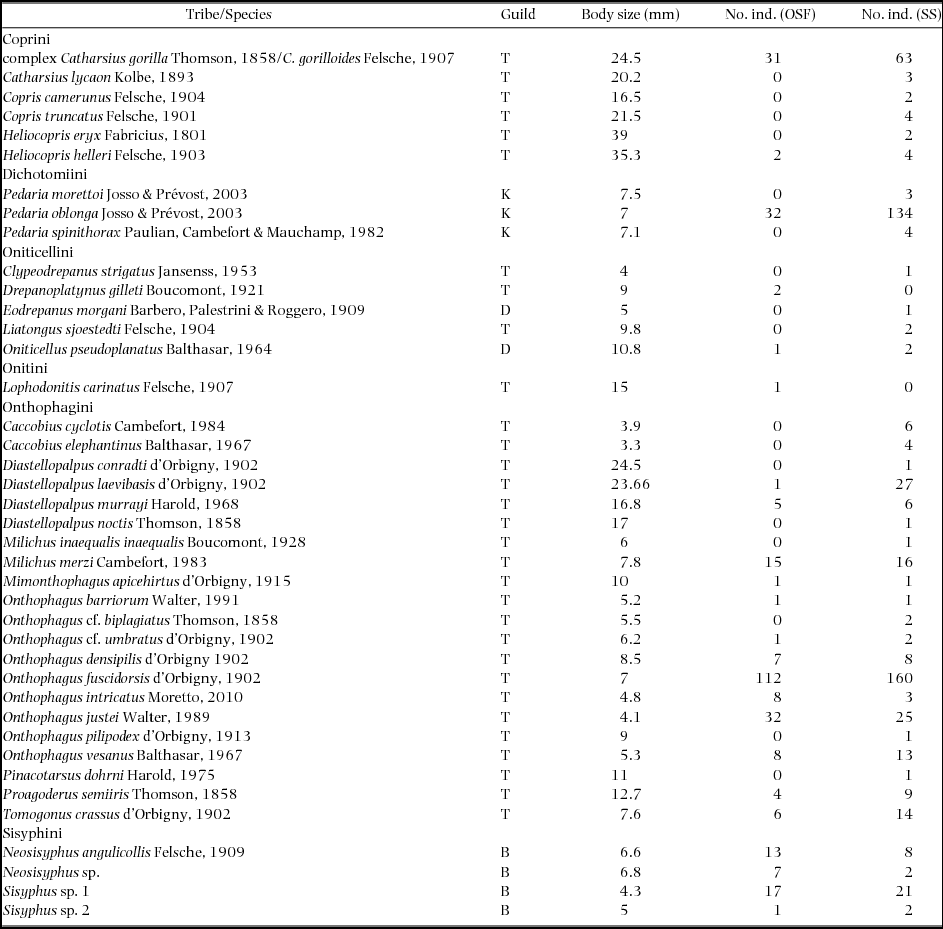
We collected a total of 870 dung beetles (family Scarabaeidae) from 41 species (22 genera, six tribes; Appendix 1) in pitfall traps. Four species (Catharsius gorilla, C. gorilloides, Onthophagus fuscidorsis, Pedaria oblonga) accounted for >60% of all individuals caught, and 27 spp. each contributed only <1%.
We found the majority of dung beetles to have been trapped at sleeping sites (N = 561; 64.5%), with an average of 112 ± 35 individuals caught per pitfall trap compared with 62 ± 23 individuals caught per pitfall trap in old secondary forests. All but two of the 41 species were represented at sleeping sites whereas only 24 species were recorded from old-secondary-forest traps. Despite this difference in observed species richness, estimated species richness at sleeping sites (Schao1 = 46.2; 95% CI = 40.6–71.3) was not significantly different to that of old secondary forest (Schao1 = 33.3; 95% CI = 25.9–68.8). For both habitats, species accumulation curves were far from reaching the asymptote, suggesting that other species would have been found with an increase in sampling effort.
The two habitat types shared 22 species in common. Because the dominant species were the same in the two habitats and the 19 species found in only one type of habitat were represented by only a few individuals (≤6), the estimated Chao's Abundance-based Sørensen Similarity Index was remarkably close to 1 (0.993), suggesting that even an increased sampling effort would have resulted in very similar assemblages.
Overall, tunnellers dominated the trap-caught dung beetle community accounting for 78.0% of individual beetles (N = 622) and 71.5% of species (N = 32) caught, respectively; whereas ball-rollers accounted for 8.2% of beetles (N = 71) and 9.8% of species (N = 4) caught. Kleptoparasites (i.e. dung beetles parasitizing faecal material previously buried by tunnellers and ball-rollers) and dwellers (i.e. dung beetles processing faecal matter within the dung pile without transporting it) accounted for the remaining 19.9% (N = 173) and 0.5% (N = 4) of individuals and 7.3% (N = 3) and 5.9% (N = 2) of species caught, respectively. There was a significant difference in the proportion of individual tunnellers vs. ball-rollers between the two habitat types (χ2 = 6.2, df = 1, P < 0.02). Ball-rollers accounted for a higher proportion of beetles caught in old secondary forests (13.9%; N = 38) compared with sleeping sites (8.0%; N = 33), and conversely tunnellers were represented by a lower proportion of beetles in old secondary forests (81.6%; N = 236) compared with sleeping sites (92.0%; N = 381).
Individual dung beetle body size varied from 3.0 mm (Caccobius elephantinus; tunneller) to 40.0 mm (Heliocopris eryx; tunneller) (mean = 10.4 ± 7.7 mm). Mean ball-roller species (N = 4) body size varied between 4.3 and 6.8 mm; and tunneller species (N = 32) between 3.2 and 39.0 mm (Appendix 1). We found the dung beetle assemblage mean body size to be significantly larger at sleeping sites than old secondary forests (11.3 mm vs. 8.9 mm; Mann–Whitney test: U = 50907, P = 0.009), and proportionally the assemblage at sleeping sites contained significantly more large-bodied beetles in comparison to that found in old secondary forests (26.6% (111 individuals) caught at sleeping sites vs. 14.1% (39) in old secondary forests: χ2 = 12.6, df = 1, P < 0.01).
Secondary dispersal experiments
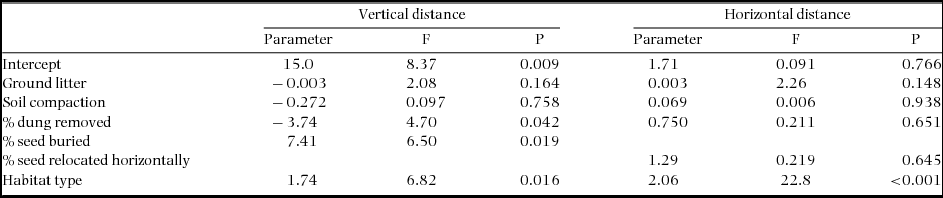
Dung beetles processed all experimental faecal samples within 48 h in sleeping sites, whereas four samples remained intact in old secondary forests. For processed samples, the proportion of dung removed was not significantly different between secondary forest (median 90%) and sleeping sites (85%) (Mann–Whitney test: U = 98, P = 0.812), and was a good overall predictor of the fate of seeds 48 h post deposition (Table 1). However, the habitat-specific pattern within each fate category was significantly different from each other (Wilk's lambda = 0.463, F = 5.79, df = 4, P = 0.003). Of the 12 processed faecal samples in old secondary forest, the percentage of seeds buried was 25.8%, seeds relocated on the soil surface 19.8%, seeds not relocated 48.7% and seeds not recovered 5.6%. The respective pattern of seed fate for the 16 faecal samples at sleeping sites was significantly different (Wilk's lambda = 0.463, F = 5.79, df = 4, P = 0.003): 9.3%, 39.0%, 46.3% and 5.3% of seeds. Univariate results indicated that old secondary forests had a significantly higher proportion of seeds buried, and sleeping sites a significantly higher proportion of seeds relocated on the soil surface (Table 1). The proportion of seeds not relocated and not recovered were similar between the two habitats; for the former, the degree of soil compaction and ground litter mass exerted significant positive influences (Table 1).
Results of the General Linear Model testing the effects of the habitat type (sleeping sites and old secondary forests) and environmental variables on the short-term fate (48 h post deposition) of Uapaca sp. seeds contained in 300 g of western lowland gorilla faecal material at La Belgique research site, south-east Cameroon, in March 2012. The model compared the proportion of seeds experiencing each of the four categories of fate: seeds buried by dung beetles, seeds relocated on the soil surface by dung beetles, seeds not relocated and seeds not recovered. The level for the categorical predictor ‘Habitat type’ is old secondary forest. Therefore a positive parameter indicates a higher proportion compared with sleeping site, and inversely a negative parameter indicates a smaller proportion.

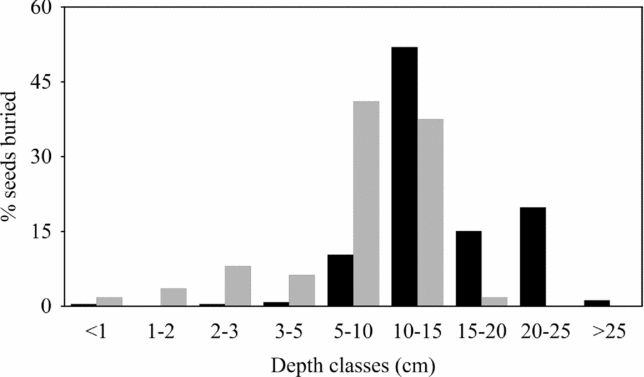
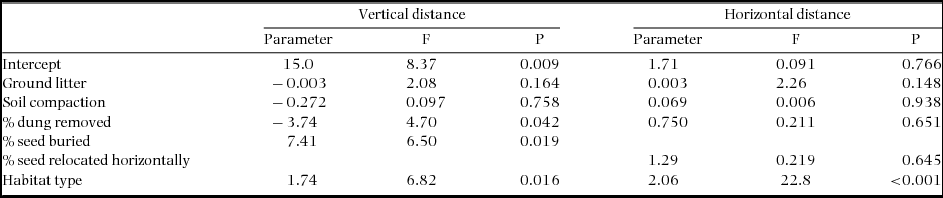
Overall, secondary-dispersal distances differed significantly between habitat types (Wilk's lambda = 0.625: F = 5.09, df = 2, P = 0.019). Seeds vertically relocated by dung beetles were buried at greater depths in old secondary forests (mean = 14.9 ± 4.9 cm; median = 13.8 cm; range = 0.5–26.5 cm) than at sleeping sites (mean = 8.7 ± 3.9 cm; median = 9.1 cm; range = 0.8–15 cm) (Figure 1), and burial depth co-varied positively and significantly with the proportion of dung removed and seeds buried (Table 2). Seeds dispersed horizontally were relocated further from the original source in old secondary forests (mean = 7.8 ± 6.8 cm; median = 6.4 cm; range = 0.1–37.7 cm) than at sleeping sites (mean = 3.7 ± 4.0 cm; median = 2.5 cm; range = 0.1–28.5 cm), but horizontal distances did not co-vary significantly with any of the predictors (Table 2).
Results of the General Linear Models testing the effects of the habitat type (sleeping sites and old secondary forests) and environmental variables on the secondary dispersal distances on the vertical and horizontal planes of Uapaca sp. seeds contained in 300 g of western lowland gorilla faecal material at La Belgique research site, south-east Cameroon, in March 2012, and subjected to dung beetle activity during 48 h. The level for the categorical predictor ‘Habitat type’ is old secondary forest. Therefore a positive parameter indicates a higher proportion compared with sleeping site, and inversely a negative parameter indicates a smaller proportion.
Percentage of Uapaca seeds contained in western lowland gorilla faeces buried by dung beetles at the different depth classes (<1, 1–2, 2–3, 3–5, 5–10, 10–15, 15–20, 20–25 and >25 cm) in old secondary forests (black columns) (12 experimental faecal samples processed by dung beetles; N = 252 seeds buried out of 900 seeds) and gorilla sleeping sites (grey columns) (16 experimental faecal samples processed by dung beetles; N = 112 seeds buried out of 1200 seeds), at La Belgique research site, south-east Cameroon (March 2012).

Emergence probability
In the 2014 trials, seeds placed on the soil surface experienced a high level of predation by rodents with 57 (76%) of the initial 75 seeds being removed. Therefore, this depth was not included in the Cochran's test of linear trend testing the effect of burial depth on emergence probability.
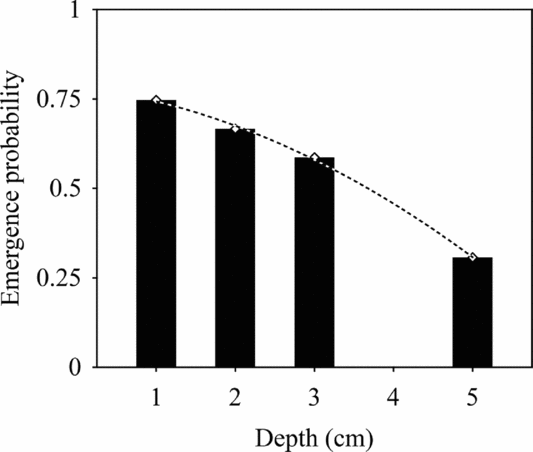
Burial depth exerted a significant influence on emergence probability (Cochran test: Q = 104, df = 4, P < 0.001), with seedling emergence probabilities 74.7%, 66.7%, 58.7%, 30.7% and 0% for depth treatments 1, 2, 3, 5 and 10 cm, respectively (Figure 2). The equation of the second-order-polynomial-adjustment regression slope fitting the emergence probability values obtained (Figure 2) suggests that an emergence probability of zero would have been found at a depth of 7 cm (at 6 cm the probability would have been 13.2%).
The impact of burial depth on the emergence probability of Uapaca vanhouttei seedlings nursed in a field nursery (March–July 2014) at La Belgique, south-east Cameroon. The depth 4 cm was not tested. Emergence probabilities are represented by black bars and the dashed line indicates the regression curve fitting the observed emergence probabilities with a second-order polynomial adjustment (y = 0.784–0.0271x–0.0136x2).
DISCUSSION
Dung beetle assemblages and secondary dispersal patterns
We did not find a significant influence of habitat type on dung beetle species richness and composition. In both habitat types, the dung beetle assemblage was characterized by a small number of abundant species and a greater number of rare ones, resulting in large, overlapping, 95% confidence intervals for the estimated species richness of the two habitats. A greater sampling effort might have reduced the effect of such unbalanced distribution of individuals among species on diversity estimates and eventually resulted in significant differences and the identification of species specialized to either habitat. However, these species, if they exist, are not likely to be abundant enough to exert a strong influence on the secondary-dispersal activities in either habitat type as all of the 19 species caught in only one habitat type (17 spp. in sleeping sites and 2 spp. in old-secondary-forest patches) each accounted for less than 1% of the total number of individuals caught in each habitat. Furthermore, only four species of these 19 exhibited a mean body size large enough to enable active dispersal of Uapaca seeds (i.e. body-size equal to or larger than seed size; Feer Reference FEER1999). Of the 22 shared species, another seven have a sufficiently large body-size to be involved in the Uapaca seed-burial events we observed in our secondary-dispersal experiments. Together, these 11 large-bodied dung beetle species, all tunnellers, represented only 17.6% of the total number of individuals caught, and this relatively low abundance is likely to be the reason for the small proportion of buried seeds we observed (15.2%). Furthermore, the fact that ball-rollers caught in the traps were less than half the size of Uapaca seeds suggests that seeds not recovered were not likely to have been transported beyond the 1-m search radius but more likely to have been removed by rodents.
The more abundant large-bodied dung beetle community observed at sleeping sites predicts more intense activity and a subsequently enhanced secondary dispersal in this habitat type. However, we observed large-bodied tunnellers to bury more seeds in old secondary forests and at greater vertical and horizontal distances. When competition is fierce, dung beetles reduce the amount of faecal matter they bury (Scholtz et al. Reference SCHOLTZ, DAVIS and KRYGER2009), resulting in a lower probability that a large seed such as Uapaca spp. would be also transported. Additionally, since we installed the experimental faeces in the morning, if the large-bodied tunnellers are nocturnal beetles as is often the case (Andresen Reference ANDRESEN2002, Slade et al. Reference SLADE, MANN, VILLANUEVA and LEWIS2007), diurnal beetles would have broken the faecal clump into pieces more actively at sleeping sites than in old secondary forests, reducing the volume of matter still containing seeds that the large-bodied tunnellers could process (Hosaka et al. Reference HOSAKA, NIINO, MASAHIRO, OCHI, YAMADA, FLETCHER and OKUDA2014). Finally, it is reasonable to suspect that with an increased competition at sleeping sites, tunnellers allocated less time to tunnel construction resulting in shallower tunnels and hence smaller secondary-dispersal distances. Dung beetle abundance, rather than composition, may explain the observed differences in seed relocation patterns.
Post-secondary dispersal seed fate
Our study provides evidence of a potentially high rate of rodent predation of Uapaca spp. seeds from the forest floor (up to 5.4% of seeds within 48 h in secondary-dispersal experiments and 76% of soil-surface seeds within 4 mo in the field nursery trials); therefore, we suggest that seed burial by dung beetles may play an important role in the short-term post-dispersal fate of Uapaca spp. seeds in this site. Furthermore, the associated burial of faecal matter during seed burial serves to improve the fertility of the available growing substrate (Nichols et al. Reference NICHOLS, SPECTOR, LOUZADA, LARSEN, AMEZQUITA and FAVILA2008, Scholtz et al. Reference SCHOLTZ, DAVIS and KRYGER2009), which may ultimately improve the vigour of the seedlings and the depth at which emergence is possible, as suggested by the discrepancy in the emergence probabilities between our 2012 and 2014 trials. However, this fertilizing effect would not facilitate emergence beyond a certain depth. In our 2014 trials, the emergence probability decreased almost linearly with burial depth to 3−4 cm and then experienced a sharper decline to a depth between 5 and 10 cm, beyond which the emergence of seedlings is completely prevented (estimated by regression to be 7 cm). As burial depths >5 cm greatly inhibit the emergence probability of Uapaca seedlings, and detection by rodents has been shown in other studies to be zero or very low for seeds buried at such depths (Andresen Reference ANDRESEN1999, Estrada & Coates-Estrada Reference ESTRADA and COATES-ESTRADA1991, Shepherd & Chapman Reference SHEPHERD and CHAPMAN1998), we suggest an optimum burial depth (Shepherd & Chapman Reference SHEPHERD and CHAPMAN1998) between 1 and 5 cm. However, we observed only a small proportion of Uapaca seeds being buried by dung beetles at depths <5 cm (7.1%), with the majority being buried at depths ≥10 cm (73.1%), at which depth the emergence of Uapaca seedlings seemed to be completely inhibited. Unless very few non-buried Uapaca seeds are escaping predation, it is likely that the influence of dung beetle activity in this case is negative. Our study demonstrates that this detrimental effect is less pronounced at sleeping sites than at secondary-forest sites, as 17.9% of buried seeds (20/112) were found at optimum depths (1−5 cm) compared with 1.2% (3/252) in old secondary forests, resulting in an estimated mean emergence probability for buried seeds of 12.8% at sleeping sites and 0.9% in old secondary forests. It seems therefore that seeds dispersed at sleeping sites that survive predation have a higher chance to produce established seedlings than seeds dispersed on trails in old secondary forests, thus leading to a higher effectiveness of Uapaca seed dispersal at sleeping sites. At the seedling stage this effectiveness might be further improved by the high irradiance levels characterizing sleeping sites as Uapaca species are (non-pioneer) light-demanding species (Hawthorne Reference HAWTHORNE1995). Furthermore, the possibility of previously buried seeds being cycled closer to the soil surface by dung beetles during soil excavation (Santos-Heredia & Andresen Reference SANTOS-HEREDIA and ANDRESEN2014) may have a higher impact at sleeping sites as species composing the soil seed bank are mostly light-demanders and therefore will encounter adequate conditions for seed germination, and seedling establishment and growth (Daïnou et al. Reference DAÏNOU, BAUDUIN, BOURLAND, GILLET, FETEKE and DOUCET2011).
Conclusion
Our study was unable to identify a habitat niche differentiation among the dung beetle community of the study site when considering gorilla sleeping sites (predominantly young secondary forest and light gaps) and old secondary forest. However, the different environmental conditions seemed to strongly influence dung beetle abundance which resulted in differing seed removal and burial patterns. In contrast to our predictions, these patterns do not support the widespread belief that seed burial by dung beetles improves the fate of seeds primarily dispersed by frugivores (but see Vulinec & Lambert Reference VULINEC, LAMBERT, Garber, Estrada, Bicca-Marques, Heymann and Strier2009). As almost all documented seed burial data pertain to the Neotropics, where burial depths may be shallower and emergence probabilities higher (Andresen Reference ANDRESEN2001, Reference ANDRESEN2002, Reference ANDRESEN2003; Andresen & Levey Reference ANDRESEN and LEVEY2004, Culot et al. Reference CULOT, HUYNEN, GERARD and HEYMANN2009, Reference CULOT, MANN, MUÑOZ LAZO, HUYNEN and HEYMANN2011; Estrada & Coates-Estrada Reference ESTRADA and COATES-ESTRADA1991, Santos-Heredia et al. Reference SANTOS-HEREDIA, ANDRESEN and ZÁRATE2010), we therefore recommend addressing the paucity of data outside the Neotropics in order to infer more generally the importance of dung beetles in the regeneration dynamics of tropical forests.
ACKNOWLEDGEMENTS
The authors thank each institution that provided financial and logistical support to Charles-Albert Petre and Marie-Hélène Zinque for conducting the field research: the Belgian Science Policy Office, Antwerp Zoo (‘Dehousse’ scholarship), the Fondation Gouverneur René Close, Fond d’Aide à la Mobilité Etudiante, and the logging companies FIPCAM and Pallisco. We are grateful to the Ministry of Forestry and Wildlife and the Ministry of Scientific Research and Innovation, Cameroon, for permission to conduct this research. We are grateful to Alain Drumont and Jérôme Constant of the Royal Belgian Institute of Natural Sciences for helping in the preparation of dung beetle voucher specimens, and to Philippe Walter of the Association Catharsius for checking the tribe and dung-processing guild of the dung beetle species. We thank Laurence Culot and two anonymous reviewers for their useful comments on the manuscript. Special thanks are given to the guides who contributed to data collection: Patrique Ondji, Pascal Bissah, Serge Mikol, Guillaume Djang Djang, Casimir Gbwabour and Anicet Mabom.
List of dung beetle species and number of individuals caught in the gorilla-dung-baited pitfall traps placed in old secondary forest (OSF) and at western lowland gorilla sleeping sites (SS) in south-east Cameroon (March 2012). Dung-processing guild encompasses ball-rollers (B), dwellers (D), kleptoparasites (K) and tunnellers (T).