Introduction
Globally over 35 million people were living with dementia in 2010, with prevalence expected to almost double every 20 years until 2050 (Prince and Jackson, Reference Prince and Jackson2009. It has been estimated that 73% of people with dementia live at home (Wimo et al., Reference Wimo, Winblad and Jönsson2007) with most receiving care from family members (Schulz and Martire, Reference Schulz and Martire2004). Behavioral and psychological symptoms of dementia (BPSD) are common for people living in the community. One population-based study found that 56% of people who had dementia experienced at least one neuropsychiatric disturbance (Lyketsos et al., Reference Lyketsos, Steinberg, Tschanz, Norton, Steffens and Breitner2000). These figures suggest that by 2030 around 27 million people with dementia will be living at home and experiencing BPSD. Given the limited therapeutic approaches for reducing cognitive and functional decline in dementia, BPSD are considered the manifestations of dementia most likely to be responsive to treatment. (Finkel et al., Reference Finkel, Costa, Silva, Cohen, Miller and Sartorius1996).
A number of frameworks have been established to try to explain BPSD, with the aim of guiding strategies to reduce these symptoms. These frameworks tend to acknowledge that BPSD are not solely a result of neurological damage or impairment but contextual, social, environmental, and psychological factors also play a role. The Progressively Lowered Stress Threshold (PLST) framework explains that dementia reduces a person's threshold to manage stressors in the environment (Hall and Buckwalter, Reference Hall and Buckwalter1987). Stressors include fatigue; changes in the environment, carer, or routine; competing multi-stimulus situations and physical illness, discomfort, and medications. The Need-driven Dementia-comprised Behavior (NDB) model argues that BPSD are the result of unmet needs such as physiological or social needs (Algase et al., Reference Algase1996). Kitwood (Reference Kitwood1997) emphasized that enriching the social and physical environment is essential for maintaining personhood and reducing signs of distress and agitation.
Psychotropic medications have some benefits for reducing some BPSD, but significant side effects are common (Zaudig, Reference Zaudig2000; Sink et al., Reference Sink, Holden and Yaffe2005) and there is mixed evidence regarding benefits. There is a general consensus that medication treatments should be used as a last resort after non-pharmacological approaches have been found ineffective and when the potential harm from the symptom is considered greater than the potential risks from the medication (Vellas et al., Reference Vellas2005; Benoit et al., Reference Benoit2006).
While BPSD may indicate an unmet need and be distressing for the person experiencing these symptoms, these symptoms can also increase carer burden (Donaldson and Burns, Reference Donaldson and Burns1999; Black and Almeida, Reference Black and Almeida2004) and the likelihood of institutionalization (Schoenmakers et al., Reference Schoenmakers, Buntinx, Devroey, Van Casteren and DeLepeleire2009).
There has been considerable work undertaken to identify effective strategies for reducing BPSD. In the community setting, psychosocial interventions for reducing BPSD usually rely on teaching carers to carry out interventions (Teri et al., Reference Teri, Logsdon and McCurry2002). Livingston and colleagues (Reference Livingston, Johnston, Katona, Paton and Lyketsos2005) concluded that the strongest evidence for reducing BPSD involved strategies that focused on the behaviors of the individual with dementia as well as psycho-education to change the carer's interaction with the person with dementia. Examining a broad range of psychosocial approaches to reduce BPSD, O'Connor and colleagues (Reference O'Connor, Ames, Gardner and King2009b) concluded that evidence supported family carer education for reducing psychological but not behavioral (2009a) symptoms of dementia. Smits and colleagues (Reference Smits, de Lange, Droes, Meiland, Vernooij-Dassen and Pot2007) found that interventions that targeted both the person with dementia and their family carer were effective for improving the carer's mental health, but the evidence was less conclusive for reducing carer burden and improving outcomes for the person with dementia, including behavioral symptoms. Focusing on psychological interventions to reduce BPSD, Logsdon et al. (Reference Logsdon, McCurry and Teri2007) identified training family carers to observe behavioral symptoms, identify triggers and modify the physical environment were features of successful interventions.
Despite the impact of BPSD and the evidence available for reducing these symptoms, little is known about how these symptoms are managed by family carers in the community. Four studies were identified that involved interviews with carers about their BSPD management strategies (Dodds, Reference Dodds1994; Harvath, Reference Harvath1994; Ward et al., Reference Ward, Opie and O'Connor2003; Colling, Reference Colling2004). Ward et al. (Reference Ward, Opie and O'Connor2003) undertook interviews with 50 Australian family carers regarding BPSD experienced by their relatives and the strategies used by them. They found that the most common response to symptoms was to not respond at all. A limitation of this study was that many carers reported a small number of symptoms and rated most symptoms as no problem or a mild problem.
Two of these studies focused on specific behaviors. Dodds (Reference Dodds1994) interviewed six carers about wandering and identified strategies, including physical and chemical restraint, ignoring behavior, verbal or physical aggression, reality orientation, avoiding the person, collusion, and diversion through activity and involving others. Colling (Reference Colling2004) interviewed 50 carers regarding passive behaviors. Carers described effective interventions for reducing passivity such as initiating tasks, providing guidance and reassurance, and using humor, music, faith, and patience. Repeating directions, and rushing and correcting the person with dementia seemed to exacerbate passivity.
Harvath (Reference Harvath1994) interviewed ten US female carers regarding the strategies they used for managing BPSD. Carers found symptoms more stressful if they felt that the person with dementia had control over their behavior. Carers could recognize triggers to symptoms, including underlying needs, emotions, and historical events. Those who used trial and error and different approaches fared better than those who repeated one or two strategies.
Given the evidence that education programs with family carers can be effective in reducing BPSD, those experiencing high levels of BPSD and known to community services, should have an understanding of effective strategies for managing BPSD. However, there is limited research on the carer's assessment of their interventions, particularly among carers reporting high levels of BPSD. This study, therefore, aimed to explore the strategies described by carers looking after someone with high levels of BPSD.
Methods
Interviews were conducted in the Australian state of Victoria with carers who were looking after a family member who was eligible for a high-level Extended Aged Care at Home Dementia (EACHD) package. Eligibility for an EACHD package is equivalent to eligibility for high-level residential care and is determined by an Aged Care Assessment Team (ACAT). In 2005, through the Making Dementia a National Health Priority initiative, the Australian government extended the EACH program to establish 2,000 new dementia specific packages (EACHD) (Doyle et al., Reference Doyle2009). EACHD packages are targeted to people with complex care needs because of behavioral symptoms, and guidelines for these packages promote the use of psychosocial strategies for managing BPSD (Australian Government Department of Health and Ageing, 2011b). As of June 2010, there were 2,300 EACHD recipients (Australian Institute of Health and Welfare, 2011). While the number of EACHD packages across Australia is small, they are the most highly subsidized community package (Australian Government Department of Health and Ageing, 2011a).
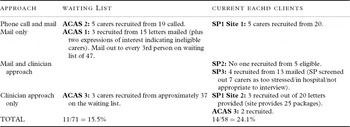
Twenty-five participants were interviewed. The recruitment process was staggered across agencies and occurred from February to December 2010. The agencies involved in recruiting participants used a variety of approaches, including mailing out an expression of interest form, telephone calls, or asking case managers/ACAT assessors to approach clients directly. Given the different approaches used, it is difficult to provide an overall response rate, particularly as agencies were not able to indicate the number of carers that clinicians approached. The approaches used are described in Table 1. For the services where the number of clients invited to participate was reported, 17 clients out of 72 agreed to participate (24%).
Response rate by recruitment method

Note: SP = EACHD service provider.
Agencies were responsible for selecting the “primary” carer. For 21 participants the person interviewed had prime responsibility for care and was co-residing with the care recipient. Another two participants were daughters who lived with their parents and described sharing the care of their father with their mother. However, given the limited English skills of their mother, they volunteered to complete the interview. Another son from a non-English speaking background, who was caring for his co-residing mother, also identified as the primary carer; however, his wife had a primary role in providing care tasks such as personal care. Another carer shared care of her mother with her siblings, each taking turn to live with their mother for rostered periods of time. The service provider chose the daughter who lived the closest to the care recipient as the primary contact for practical purposes.
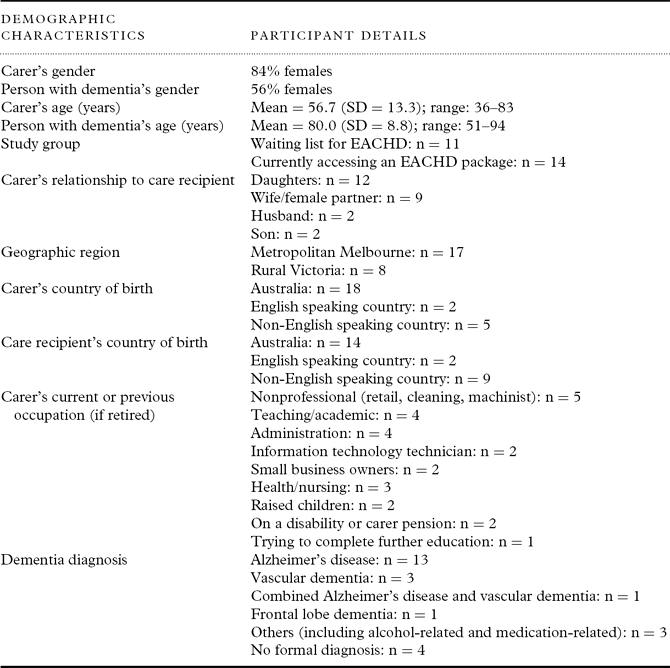
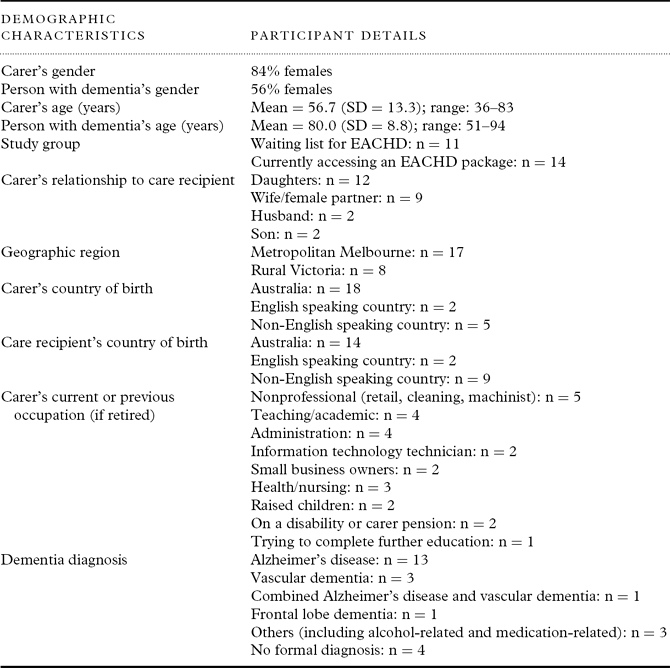
Table 2 shows the characteristics of participants and the people they cared for. Carers were not asked the duration of caring but were asked to describe the time since dementia symptoms and diagnosis were made. There was considerable diversity in the responses given and also difficulties recalling dates. Some described a diagnosis being made in the last month, while others indicated a diagnosis eight years earlier. There was also sometimes considerable time lapse between identifying symptoms and a diagnosis. For example, one described symptoms eight to nine years earlier with a diagnosis only nine months earlier.
Participant details
Interviewing people with dementia is an important element of understanding the personal experience of dementia. People eligible for an EACHD package and experiencing high levels of BPSD are generally in the advanced stage of dementia and are unlikely to be able to participate in an interview and were therefore not interviewed for this study. No formal assessment of severity of dementia was made. A previous national evaluation of the program identified that 69% of EACHD recipients had moderately severe to very severe dementia on the Global Deterioration Scale and most were in the “severe dementia, high level Resident Classification Scale” for residential aged care (Doyle et al., Reference Doyle2009). All of those being cared for by the study participants required assistance with activities of daily living, had other comorbidities, or required constant support and supervision indicating high care needs.
Interviews were conducted as part of a broader study examining carers’ experiences of EACHD packages and caring for a person with dementia and BPSD. This paper draws on the interview questions that focused on BPSD. This included completion of the structured Neuropsychiatric Inventory (NPI) (Cummings et al., Reference Cummings, Mega, Gray, Rosenbergthompson, Carusi and Gornbein1994), which was then followed by a semi-structured interview regarding the strategies carers employed for managing or coping with these symptoms. The discussion was introduced with a question, “Do you have any strategies that you feel help reduce these symptoms?” using symptoms present on the NPI as prompts for thinking about strategies, such as “You mentioned that [care recipient] had disturbed sleep, have you found anything helps to improve their sleep patterns?” Participants were also asked whether the care recipient took any medications to reduce these symptoms. A qualitative approach to examine strategies was chosen to enable carers to identify what they believed were strategies for reducing symptoms. There was also no validated questionnaire identified to provide a guided discussion. The 12-symptom version of the NPI was used which enquires about symptoms, including delusions, hallucinations, agitation/aggression, depression, anxiety, elation, apathy, disinhibition, irritability, aberrant motor behavior, sleep disturbances, and appetite/eating disorders (Cummings, Reference Cummings1997). For all symptoms present the informant is asked to rate the symptom severity (1 = mild to 3 = severe) and frequency (1 = occasionally to 4 = very frequently, once or more per day, or continuously). The severity can be multiplied by the frequency and added across the 12 symptoms to provide a possible score of 0–144 (Cummings et al., Reference Cummings, Mega, Gray, Rosenbergthompson, Carusi and Gornbein1994). The NPI-Distress (NPI-D) scale was also completed and involved the informant rating each present symptom on a scale from 0 = not at all to 5 = very severely/extremely distressing. A total NPI-D score can range from 0–60 with higher scores indicating higher distress.
All interviews were conducted by the author (KM) in the carer's home except for two interviews conducted in a café on request of the carer. Interviews were audio-recorded with recordings ranging from 42–189 min (mean = 88.8 min, SD = 32.1). Interviews were transcribed verbatim. The next stage of analysis was to synthesize the information into a summary report that was sent to carers, with a reply-paid envelope for carers to return comments. The summary report was sent prior to a three-month follow-up phone call to discuss the summary report and any changes in circumstances since the interview. The summary report was in a table format with key interview topics summarized in paragraphs. For this paper, the sections titled “Symptoms of Dementia (Including the NPI)” and “Strategies for Managing Dementia Symptoms” were analyzed. The preparation of summary reports throughout the interview process (April–December 2010) ensured that themes were continually being identified and reflected upon throughout the data collection period. Strategies were grouped into themes, loosely based on different frameworks for understanding BPSD. Strategies not considered evidence-based or positive strategies, possibly including restraint or punishment, were coded separately. As some strategies could apply to a number of frameworks, each strategy was only included in the category considered the closest fit. All data were coded and analyzed by the author (KM). As a doctoral study there was no scope for a second reviewer to code all interviews. The use of the summary report to participants, therefore, provided a key mechanism for participant checking of interpretation of the interviews. In addition, themes and findings were critically reviewed and discussed with the supervisors (EO and BD) and reviewed in relation to the existing frameworks and evidence-based strategies. In addition to describing themes and using quotes to illustrate findings, percentage of participants reporting strategies are also reported, consistent with the approach described by Luborsky (Reference Luborsky, Gubrium and Sankar1994), who argued that presenting the number or percentage of participants helps to preserve the context and richness of the data. NPI data were analyzed using descriptive statistics.
The study was approved by human research and ethics committees at The University of Melbourne, Melbourne Health and Eastern Health.
Results
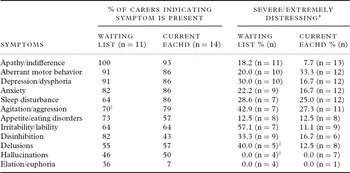
Participants experienced high levels of BPSD reporting a mean score of 8.2 for symptoms (range 2–12, SD = 2.38) and a mean NPI score of 51.4 (range 14–111, SD = 28.74). Distress was also high with a mean score of 18.5 (range 2–42, SD = 11.33). Table 3 shows the frequency and distress reported by carers for each of the 12 NPI symptoms.
Frequency and distress for NPI symptoms by carers on a waiting list or currently accessing an EACHD package

Notes: *The ratings in these columns indicate the percentage of carers who found each symptom either severely or extremely distressing as a proportion of those indicating the symptom was present. The “n” shown in brackets indicates the denominator for percentage. For example, of the 13 carers currently accessing an EACHD package and who reported apathy, only one of these 13 carers (7.7%) found it severely or extremely distressing.
†Response missing for one participant.
A comprehensive range of strategies was identified by carers to avoid or reduce BPSD. Only one carer was unable to describe or identify any strategies. After grouping specific strategies into broader themes, 19 themes were identified. These included: recreation, physical activity, and household chores (n = 15); psychotropic medication (n = 12); identifying triggers (n = 11); restraining or treating in a paternalistic manner (n = 9); meeting physiological needs (n = 9); PLST (n = 8); accepting symptoms (n = 7); validation (n = 7); adapting the social environment (n = 6); cognitive strategies (n = 5); looking after the carer (n = 5); sensory strategies, including music and massage (n = 5); adapting the physical environment (n = 4); diversion (n = 4); being flexible (n = 4); communication strategies (n = 2); maintaining personhood (n = 2); reality orientation (n = 1); and having a dog (n = 2). On average, carers reported 3.6 psychosocial strategies each (excluding medication, restraining or treating in a paternalistic manner, and accepting symptoms).
1. Recreation, physical activity and household chores: The most common strategy used was some sort of activity, such as assisting with household chores, going for walks, drives, and day trips, other physical exercises, and to a lesser extent crafts or hobbies. The later strategy was often discarded during the advanced stage of dementia, as the person with dementia no longer showed interest or capacity to undertake these activities:
She [care recipient] used to like paint, ‘cause I would try to [encourage] her to do some art or something home here and play games. . . but she doesn't. I don't know whether it's the comprehension or she just doesn't want to do it or she can't do it. (Daughter, current EACHD recipient)
2. Psychotropic medications: These were the second most commonly used strategy for managing BPSD, usually consisting of antidepressants or antipsychotics. Thirteen participants described concerns about medications relating to side effects or lack of effectiveness. Eight carers described medications that were still being taken despite questionable effectiveness or side effects, although some of these had been reduced. Seven carers had withdrawn a psychotropic medication due to side effects or lack of effectiveness. For example, one carer ceased an anti-depressant after an episode in hospital, when she explained as follows:
They forgot to give him his Effexor [venlafaxine] and I'm not aware of it, you know, there was so much that I was going through, I didn't realize that they weren't giving it to him and then on the Sunday he started to, sort of come back, you know, back to who he was, you know, this cheeky man. (Wife, current EACHD recipient)
3. Identifying triggers: Eleven carers identified strategies for trying to identify the trigger or avoid the trigger for certain behaviors, reflecting the NDB framework. No carers reported keeping a diary to identify triggers for BPSD. Some carers thought that symptoms may have reflected lifetime occupations or significant life experiences, but this was not described as very useful for establishing strategies. Some carers had identified that when they displayed their own frustrations or tried to rush, the person with dementia would usually respond with agitation or aggression:
If I'm tired and I'm a bit snappy, see if I don't take it slowly. You do have to take it, don't rush. And sometimes I'm in a hurry, yeah and then it gets his back up and it pulls me up immediately, it tells me, “Hey, slow down, you're going too fast.” (Wife, waiting list)
4. Restraining or treating in a paternalistic manner: Strategies that could be described as more limiting, punitive, or restrictive. Most often, strategies in this category were compared with or resembled childrearing, such as reprimanding the person with dementia, coaxing them to eat their vegetables, or convincing them that they needed to go to an appointment:
My own doctor says to just treat them like you would a child, because that's what they're doing, they're going backwards. (Daughter, current EACHD recipient)
5. Meeting physiological needs: Meeting physiological needs such as pain, fatigue and hunger. Many described improved diets and increasing hydration as challenging but also important for maintaining health, having a healthy weight, avoiding urinary tract infections, and avoiding some other symptoms. Often these strategies were aimed at maintaining physical health rather than preventing BPSD, but there were some exceptions.
6. Progressively lowered stress threshold: Some carers identified reducing stress and overstimulation, as supported by the PLST framework. One carer identified that her mother did not cope well with noise, activity, heat, or glare, and another found that if her husband remained calm and relaxed during the day he slept better at night. Two carers tried to maintain a strict routine to avoid stressing the person with dementia. Five carers found that when the person with dementia was getting agitated or aggressive, the best solution was to step away, and give them some space and time to calm down.
7. Accepting symptoms: Some described trying not to take symptoms personally and learning to cope. Some only applied this to particular symptoms such as elation and repetitive motor behaviors, which were perceived as less harmful. Some carers accepted most of the symptoms, only concentrating their energies on more harmful or disturbing symptoms.
8. Validation: Going along with the person's apparent reality, providing reassurance and negating self-reproaches such as if the person with dementia was saying they were useless:
He's been chopping up little bits of wood into the finest kindling you can imagine. . . and then he's tied them up into these little bundles. . . when I first saw the bundles all tied up and him there earnestly working away at this job, I felt like bursting into tears. Um, but instead I thought, well I won't do that, so I just went in, I said, “Gee you've done a lot of work today.” And he's looked up, so pleased and I said, “Do you mind if I take a photo of that ‘cause you've really worked hard’ and, you know, that was clearly the right approach.” (Wife, waiting list)
9. Adapting the social and physical environment: Adapting the social environment included using humor, increasing social contact outside the family, providing love and attention, and having conversations with the person with dementia. One described adapting the environment to address wandering away from the home:
So the front door became a non-entity, it became a cupboard, so she doesn't see it as an egress; she always goes out the back door. The bell at the door to let you know that somebody's going in or out, the bell on the gate to let me know she's going for a walk, not just weeding the garden. (Son, current EACHD recipient)
10. Cognitive strategies: These included simplifying tasks to match the care recipient's cognitive capacity, also consistent with the PLST model. Some used a memory prompt, such as a white board or calendar, to provide reminders of daily events.
11. Looking after the carer: Some carers felt burdened by the constant need to be even-tempered, patient, and keep things simple and not rushed. Some identified that the best approach for managing BPSD was to look after their own mental well-being so that they could maintain a calm exterior:
I suppose it's really more about providing outlets for myself and nurturing for myself that helps me to stay sane. . . it's probably fortunate that I work in a related field and I've seen what happens to carers at home who haven't done that, many of them don't. . . don't look after themselves. I have regular massages. . . I see my counselor and I like the phone and I talk to anyone who'll talk with me on the phone. (Wife, waiting list)
12. Diversion: Some carers found that re-approaching the person with dementia in a different way usually led to an alternative response. Some described distraction or diversion was of limited value due to its short-term effectiveness and constant need for redirection:
If she starts to get agitated or she's repeating . . . I'll try and take her mind off it and say “come on mum, let's make a cup of coffee and go sit out on the veranda and play with the dogs” . . . but it doesn't last long, she goes back to it, you know. And that's hard, ‘cause you're constantly trying to get her mind onto something else. (Daughter, waiting list)
13. Being flexible: Being creative, adaptive, and keeping a step ahead of the person being cared for. The remaining strategies (communication strategies such as using actions and touch instead of relying only on words, maintaining personhood, reality orientation, and having a dog) were reported by only one or two carers:
I think he [care recipient] suffers with a bit of depression. If he's really, really down, I put this little dog on his knee and he just cuddles him. I think people underestimate what pets can do. (Wife, waiting list)
Although many of the strategies could be considered person-centered, few were primarily about maintaining personhood. These strategies included relating activities to previous occupation and developing a memory book to help the person keep connected with their life story.
Differences between groups
Of the 25 participants in this study, 14 were currently accessing an EACHD package, and therefore could have been accessing a higher level of support and education for managing BPSD. It is therefore worth contrasting the strategies identified by those accessing a package compared with those who were not. There did appear to be a slightly larger range of psychosocial strategies as well as fewer negative strategies reported by those accessing an EACHD package. However, when drawing on carers’ reports of how they learnt about dementia and reducing BPSD, they tended to report that most learning occurred through first-hand experience, previous training and occupations, and dementia resources such as training programs, written materials, the Internet, counselors, and carer support groups. Some carers felt that by the time they were accessing an EACHD package they had already learnt what they needed to know about dementia and had already developed strategies for preventing and managing BPSD.
Discussion
While there has been a large body of research examining interventions for managing BPSD, this study is the first qualitative study of family carers of people with high levels of BPSD in Australia to examine self-identified strategies to manage these symptoms. It is one of the only studies worldwide that has examined the carer's view of strategies they use for managing BPSD and represents approximately one-fifth of the participants included in these studies. On average, carers in this study identified eight symptoms on the NPI as present and a high level of associated distress. This was expected, given the sample was selected from those assessed as eligible for an EACHD package, a program that targets those with BPSD. NPI findings indicated that this group of participants was a suitable group with whom to explore BPSD management strategies. This study is unique from previous studies as it focuses on carers experiencing high levels of distress associated with BPSD, a group at higher risk of placing their relative in residential aged care, and a group who should be prioritized for accessing BPSD education and support. The findings from this study, therefore, provide a major contribution to the literature on this topic.
This paper has outlined a broad range of strategies that carers reported using to manage BPSD, with many of the strategies reflecting previously identified response frameworks. However, most carers reported using only a small number of strategies. While this paper did not aim to explore whether carers were satisfied with their understanding and management of BPSD, review of their responses indicated that there was scope for education and support to expand and develop their repertoire of strategies.
Although a potentially useful strategy, less than half of the participants reported trying to identify triggers or antecedents to BPSD. For example, Gitlin et al. (Reference Gitlin, Winter, Dennis, Hodgson and Hauck2010) found that identifying triggers and strategies for the most problematic behavior for family carers was effective in reducing that symptom. No participant reported using a diary for identifying triggers and patterns despite the potential benefits of this strategy (Dettmore et al., Reference Dettmore, Kolanowski and Boustani2009). Only one-third of participants identified the importance of meeting physiological needs such as hunger, pain, and thirst, consistent with the NDB framework (Algase et al., Reference Algase1996). These strategies were reported as frequently as restraining or treating the care recipient in a paternalistic manner. Around one-third of participants also reported strategies for simplifying tasks and reducing stimulation, consistent with the PLST model, which has been found to be a promising approach (Logsdon et al., Reference Logsdon, McCurry and Teri2007). Some strategies previously identified as effective in reducing symptoms, such as aromatherapy and progressive muscle relaxation (O'Connor et al., Reference O'Connor, Ames, Gardner and King2009a), were not identified by any participant in this study. Many of these strategies are simple to implement, but carers may need support and education about what strategies may be effective and how to implement them.
Psychotropic medications were one of the most commonly reported strategies used by carers, despite reported negative side effects and perceived limited effectiveness. The extent to which medications were used as a final behavioral management option was not explored. Usage, however, was consistent with other studies, indicating that between 47% and 58% of community-dwelling people with dementia are prescribed psychotropic medications (Hartikainen et al., Reference Hartikainen, Rahkonen, Kautiainen and Sulkava2003; Guthrie et al., Reference Guthrie, Clark and McCowan2010). The continued use of medications that do not appear to be having the desired effects suggests a need for improved monitoring and evaluation of medication use. Medication or pharmacy reviews may help to reduce inappropriate use. Collaboration between GPs and hospital services is also important to ensure continuity of care in medication management.
No carers in this study reported contacting the Dementia Behavior Management Advisory Service (DBMAS), a telephone support line designed to provide tailored information, assessment, and mentoring in relation to behavior management techniques to staff and family carers in Australia. This group would appear to be an important target population for the DBMAS program and improving access for these carers would appear beneficial. DBMAS and other community aged care services need to promote the availability of DBMAS to carers.
There were a number of limitations to this study. Overall the response rate was low with around one in four carers invited agreeing to participate. This may indicate the high level of stress faced by this group of carers and the capacity of the staff working within the recruiting agencies to recruit participants. As a qualitative study, the results are not intending to be representative. The purpose was to explore how carers of people with high levels of BPSD were managing at home, and identify themes and gaps in carers’ strategies to guide future practice and research directions.
An important limitation concerns the extent to which carers were able to identify and recall strategies for reducing BPSD. Some strategies, such as using humor or slowing the pace of activities, may be undertaken by the carer without them being fully conscious of these adjustments. They may not have recalled all the interventions they used, or may not have wanted to admit to using strategies that could be considered unethical or controversial. The limitation of carers only reporting positive behaviors was also identified by Ward and colleagues (Reference Ward, Opie and O'Connor2003), however, they did not feel this was a major issue as carers did report using threats and punishment but had generally abandoned these strategies due to their ineffectiveness. Future research could include direct observation, using a tool such as the Dementia Care Mapping instrument. Direct observation of strategies and the interaction between carers and care recipients in the home setting however, would be difficult as the presence of an observer or a video camera may alter the carer and care recipient's behavior.
As the interview on BPSD strategies was only one element of a broader interview, there was limited capacity to explore in depth how participants had changed strategies over time to examine whether they had discarded ineffective strategies. Nor were they asked how effective they found each strategy. Coping styles can also impact on carer burden as described in Lazarus and Folkman's (Reference Lazarus and Folkman1984) cognitive model of stress, appraisal, and coping. This model explains that psychological stress occurs when the relationship between the environment and the person is appraised by the individual as exceeding their resources to cope. Vernooij-Dassen et al. (Reference Vernooij-Dassen, Persoon and Felling1996) found that carers with higher neuroticism were more likely to report higher levels of agitated behavior and mood changes of the person with dementia. Carer coping styles and personality were not examined in the current study, although they do play a role in how carers assess and manage these symptoms, and carers in the current study were experiencing considerable distress associated with these symptoms.
A structured questionnaire that asks carers about a broad range of strategies is needed to provide a more systematic evaluation of current approaches used by carers. The questionnaire could cover a range of strategies, including evidence-based strategies and ones such as those identified in this study, as well as how carers understand the causes and triggers of various behaviors. The questionnaire could be used in conjunction with a measure of BPSD, such as the NPI, to help carers identify the range of symptoms associated with dementia. This would be useful for clinical practice and future research. It would assist services in tailoring education interventions to carers based on their existing approaches and would also provide an important outcome measure for research aiming to enhance carers’ understanding of BPSD.
While a broad range of strategies across participants were identified in this study, there appeared to be room for enhancing the repertoire of strategies carers could use to manage the large number of distressing symptoms they reported. There is a clear need for programs to educate and support carers in identifying triggers, understanding symptoms, and learning to cope with these symptoms. Health professionals and service providers have a critical role in supporting carers in understanding and managing BPSD and linking them to existing services, education programs, and peer support groups that could also assist in understanding BPSD. An approach where carers are aware of a broad range of strategies applicable under different circumstances may provide a more effective means for managing BPSD, combined with efforts to identify the underlying symptom causes. Service providers can help to promote a comprehensive approach that considers the physical and social environment as well as physiological and other health-related conditions. The use of a behavior diary could provide a more systematic approach to documenting possible triggers to behavioral symptoms by helping carers to identify patterns. New technologies and devices are being developed, such as smart phone applications, where carers can look up symptoms, potential causes, and possible strategies, and also record symptoms to assist communicating with health professionals about frequency and patterns.
Despite the considerable research into strategies for carers to understand, manage, and cope with BPSD, there appears to be a gap in translating this evidence into practice. A recent evaluation of evidence-based BPSD guidelines was only able to identify five out of 15 guidelines of high quality (Azermai et al., Reference Azermai, Petrovic, Elseviers, Bourgeois, Van Bortel and Vander Stichele2012). Among the five high-quality guidelines, there were only nine consistent evidence-based recommendations for managing BPSD, of which eight related to medication management. The only other recommendation identified is trailing non-pharmacological interventions first, with most evidence for music and behavioral management for depression. This recommendation provides a limited scope for carer education and support.
Given the relentlessly increasing prevalence of dementia, family carers will be increasingly relied upon to care for people with high levels of BPSD. This qualitative study provides an insight into how carers currently manage BPSD at home and how they could be better assisted to do so in the future.
Conflict of interest
None.
Description of authors’ roles
K. Moore designed the study, undertook the interviews, analyzed the data, and wrote the paper. E. Ozanne, B. Dow, and D. Ames advised on the study design, supervised the analysis, and assisted with writing the paper.
Acknowledgments
K. Moore was financially supported by a PhD scholarship from the Dementia Collaborative Research Centre – Assessment and Better Care, University of New South Wales as part of the Australian Government's Dementia Initiative. The views expressed in this work are the views of its author/s and not necessarily those of the Australian Government.