Introduction
Flea beetles (Coleoptera: Chrysomelidae) are the most economically damaging insect pests of canola (oilseed rape) (Brassica Linnaeus, Brassicaceae) on the Canadian prairies. Direct losses to oilseed production average 8–10% of the annual crop yield (Lamb and Turnock Reference Lamb and Turnock1982), and in an outbreak year flea beetles have the potential to cause hundreds of millions of dollars in losses to the rural economy (Knodel and Olson Reference Knodel and Olson2002; Sekulic and Rempel Reference Sekulic and Rempel2016). There are two principal flea beetle species in Canadian canola fields. Crucifer flea beetle Phyllotreta cruciferae (Goeze) is most frequently found in the southern Canadian prairie regions, while striped flea beetle Phyllotreta striolata (Fabricius) was traditionally found in greatest numbers along the northern parkland of the prairies and in the Peace River Region of Alberta (Burgess Reference Burgess1977, Reference Burgess1982; Wylie Reference Wylie1979). Hop flea beetle, Psylliodes punctulata Melsheimer, occurs in low numbers in canola across the prairies, while several other Phyllotreta Chevrolat species are found in prairie canola in minor proportions (Burgess Reference Burgess1977; Wylie Reference Wylie1979).
Although both P. cruciferae and P. striolata are Eurasian in origin, P. striolata has been present in North America much longer than has P. cruciferae. Remnants of P. striolata specimens were found in Ville de Québec, Québec, Canada predating 1668 (Rousseau and LeSage Reference Rousseau and LeSage2016), and in New York City, New York, United States of America, dating to the 1770s (Bain and LeSage Reference Bain and LeSage1998). The beetle gradually spread throughout the continent, and is now found in most provinces of Canada. In contrast, the first North American record of P. cruciferae was from Agassiz, British Columbia in 1921 (Beirne Reference Beirne1971). Despite this relatively recent appearance, P. cruciferae was abundant in the Canadian prairies by the late 1930s and early 1940s. By 1956, it was the most abundant flea beetle on oilseed rape in Manitoba (Westdal and Romanow Reference Westdal and Romanow1972), and it soon became the dominant flea beetle species across the Prairie Provinces.
Although foliar insecticides are available, the primary method of flea beetle control in Canadian canola production is insecticidal seed treatment (Canola Council of Canada 2014a). When insecticides were developed for this purpose, they were tested mainly against P. cruciferae, the historic predominant species. After the deregistration of Lindane (γ-1,2,3,4,5,6-hexachlorocyclohexane) in the last decade (Pest Management Regulatory Agency 2002), neonicotinoid insecticides became the only class of seed treatment registered for flea beetle control in canola in Canada. Similarly, neonicotinoids are now the principal seed treatment for control of flea beetles on canola in the United States of America. Recent studies have shown neonicotinoids to be more efficacious against P. cruciferae than against P. striolata (Tansey et al. Reference Tansey, Dosdall, Keddie and Sarfraz2008, Reference Tansey, Dosdall and Keddie2009; Canola Council of Canada 2014b). The implications of this differential efficacy are serious, given that over 95% of the 8 000 000 ha of canola seeded annually is planted with a neonicotinoid seed treatment (Morrison et al. Reference Morrison, Harker, Blackshaw, Holzapfel and O’Donovan2016). Concomitantly, anecdotal reports appeared in the middle of the last decade of increased numbers of P. striolata in canola fields in widely separated regions across the Canadian Prairie provinces.
This study was undertaken to determine the current distribution of P. cruciferae, P. striolata, and other flea beetle species in western Canada to quantify a possible shift in flea beetle species composition relative to historical records. Such a shift could have major implications for their pest management.
Materials and methods
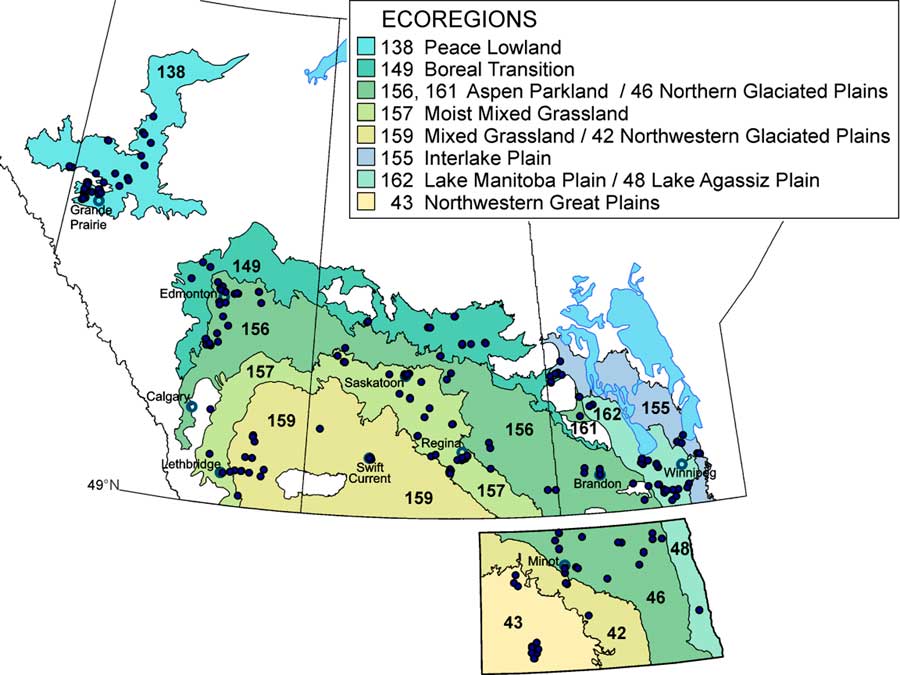
Annually from 2007 to 2011, a network of agrologists and entomologists across the Canadian prairies set out yellow sticky card traps (13.0×7.5 mm) (ConTech, Delta, British Columbia, Canada) in or near canola fields to collect flea beetles. In 2007, traps were placed at 25 sites in the Peace River region of British Columbia/Alberta and central and southern regions of Saskatchewan and Manitoba. In 2008 and thereafter, attempts were made to sample systematically the principal vegetative zones of the prairies – the Peace River Lowland, Boreal Transition, Aspen Parkland, Moist Mixed Grassland, Mixed Grassland, Interlake Plain, and Lake Manitoba Plain ecoregions of western Canada (Ecological Stratification Working Group 1995; Fig. 1). In 2010 and 2011, sites from the Northwestern Glaciated Plains, Northwestern Great Plains, Northern Glaciated Plains, and Lake Agassiz Plain ecoregions in North Dakota, United States of America (Bryce et al. Reference Bryce, Omernik, Pater, Ulmer, Schaar and Freeouf1996; Fig. 1) were added to the survey. Five, 10, or 20 traps were attached to wire or wooden stakes and placed in or adjoining newly seeded canola fields. The traps were oriented about 25–40 m apart, parallel to a convenient perimeter of a field, and at the edge of or up to 10 m into the field. They were arranged so that the short axis of each trap was parallel to the ground and the bottom edge about 5 cm above soil level, to correspond with the level of the seedlings as these grew. Traps were changed at intervals ranging from three to 30 days, but usually weekly. They were maintained for periods from one to 26 weeks, but typically for four weeks or four sampling intervals in May–June, commencing just before or at canola emergence. Traps were returned to Agriculture and Agri-Food Canada Saskatoon Research Centre (Saskatoon, Saskatchewan, Canada) or Beaverlodge Research Farm (Beaverlodge, Alberta, Canada) and examined under a magnifier or stereomicroscope in the laboratory. The number and species of flea beetles on the traps were recorded and averaged/sampling period, then standardised to reflect number caught/trap/day. Phyllotreta striolata, P. cruciferae, and P. punctulata numbers were recorded for each site using the key of Burgess (Reference Burgess1977). After 2008, when possible, all other species of flea beetles recovered on sticky cards also were quantified. These other specimens were identified from the descriptive key of Fauske (Reference Fauske2003) or by systematists at the National Identification Service, Agriculture and Agri-Food Canada (Ottawa, Ontario, Canada).
Principal ecoregions and sites sampled for flea beetles across western Canada, 2007–2011 (n=256) and North Dakota, 2010–2011 (n=44). Map modified from Ecological Stratification Working Group (1995) and Bryce et al. (Reference Bryce, Omernik, Pater, Ulmer, Schaar and Freeouf1996).

The data set included flea beetles collected from the time of initial trap placement until the end of June. Thereafter, canola is typically beyond damage and overwintering flea beetles have diminished in number. Time of first emergence from overwintering sites varies by species. Start date, end date, days between trap change, and duration of trapping period varied with trapping site and sampler. For these reasons the unit of comparison we used to determine species distribution patterns over years was the ratio of number of flea beetles/species to the total number of flea beetles occurring during periods of greatest densities of flea beetles trapped at a site in the spring. Species composition at the time of highest flea beetle populations, when economic damage is most likely to occur, should be of greatest agronomic interest.
To minimise confounding factors of sampler variability and sampling interval/location, we identified sites in close proximity sampled by the same person across years. We then compared the results from these subsamples with those of the ecoregions in which they occurred.
Statistics
Because the data were not continuous variables, a log linear regression analysis using Proc Logistic (SAS Institute 2010) was conducted to transform flea beetle counts into log odds of an event. Results of the analysis were then back-transformed and interpreted as predicted probability or odds of occurrence of that event.
Weather correlations
To examine correlation of numbers of flea beetles in particular species with weather parameters, we considered data collected by the same sampler from the same or nearby sites over sampling years as described previously. We then used flea beetle numbers at these sites from the entire spring sampling period until the end of June. Because the data were collected in the same manner as in the general survey, we incorporated flea beetle numbers averaged from 10 sites near Beaverlodge from 2004 to 2006 and two sites at Agriculture and Agri-Food Canada Saskatoon from 2004 to 2006 and 2012 to 2015 into our correlations. From Environment Canada or Agriculture and Agri-Food Canada weather station nearest to each site, we determined mean April, May, and June temperatures; total precipitation in each of April, May, and June; previous year April, May, and June mean temperatures; previous year April, May, and June precipitation amounts; previous summer precipitation (June, July, August) and previous fall precipitation (September, October). We used Proc Genmod (SAS Institute 2010) to analyse flea beetle species numbers/month modelled against weather parameters, using log linear regression analyses of count data with a negative binomial distribution.
Results
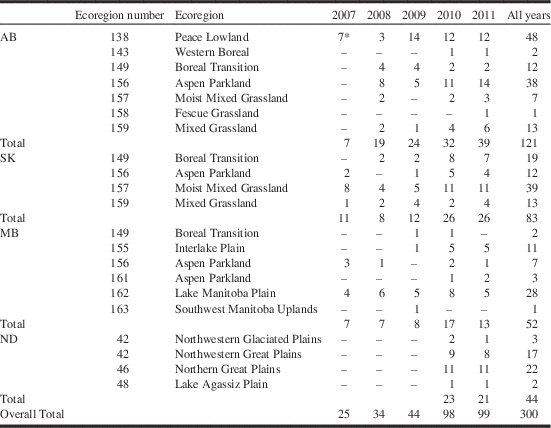
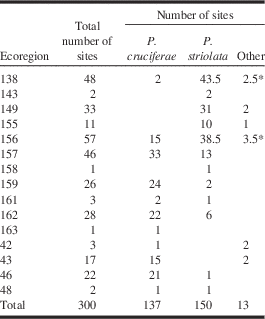
In the survey, data were collected from 300 site years in 11 Canadian and four North Dakota ecoregions (Table 1; Fig. 1). The greatest number of data points, 60 site years, were from the Aspen Parkland Ecoregions 156 and 161 (Table 1; Fig. 1), with Peace Lowland and Moist Mixed Grassland having the next highest representation, while Boreal Transition, Lake Manitoba Plain, Mixed Grassland, and Interlake Plain had decreasing numbers of data points. In North Dakota, where surveying occurred only in 2010 and 2011, 22 data points were from the Northern Glaciated Plains, a southward extension of Aspen Parkland, and 17 from the Northwestern Great Plains, an ecoregion that does not extend into Canada. Minimal representation was received from the Western Boreal Ecoregion bordering Peace Lowland, Fescue Grassland, Western Manitoba Uplands, Northwestern Glaciated Plains, which is continuous with Mixed Grassland in Canada, and Lake Agassiz Plain, equivalent to Lake Manitoba Plain (Fig. 1).
Ecoregions and number of sites surveyed with yellow sticky traps for crucifer-feeding flea beetles in Alberta (AB), Saskatchewan (SK), Manitoba (MB), and North Dakota (ND), 2007–2011.

* Including two sites from northeastern British Columbia.
Growing conditions, flea beetle numbers and population development
Although local exceptions occurred, in general, spring weather conditions in the years of the survey were not conducive to the development of high flea beetle populations, especially in 2010 and 2011, when cold and wet conditions predominated over much of the northern grain belt and most populations of flea beetles were very low. The Peace River area of northern Alberta was the only region that was consistently dry in the spring during the survey. Here seed treatments did not control flea beetle numbers, and widespread foliar insecticide application for flea beetle control was necessary, for six years in a row according to Meers (Reference Meers2010).
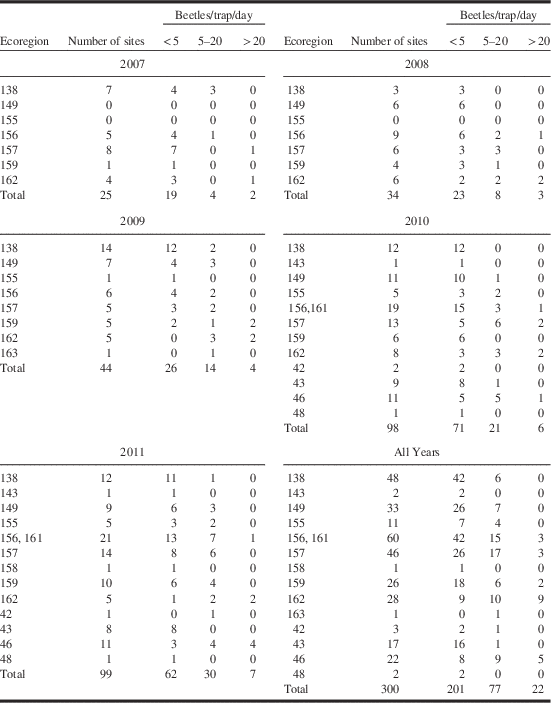
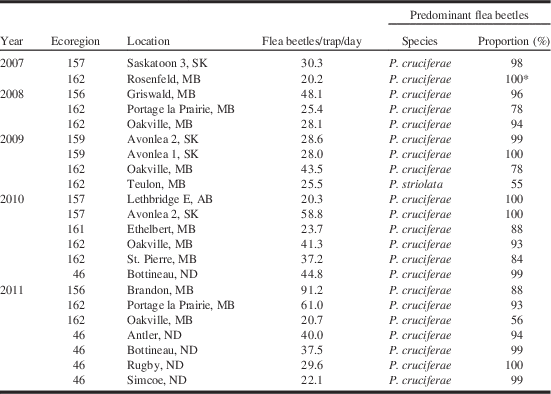
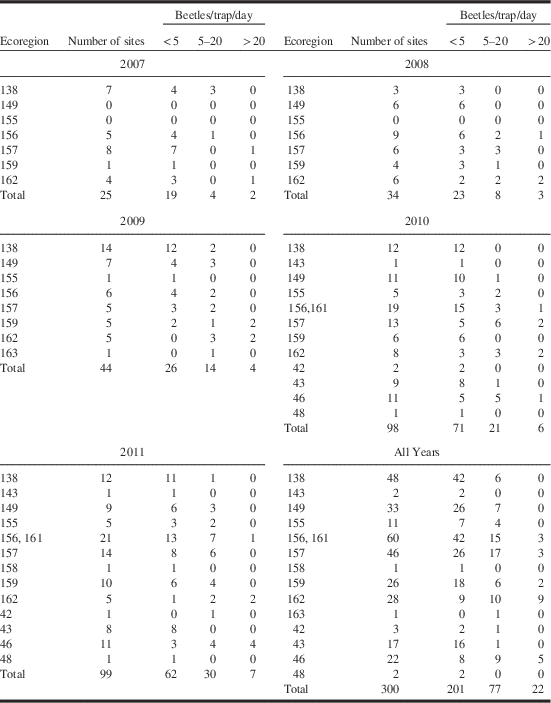
The low number of flea beetles caught on traps in the survey reflected these inclement spring weather conditions. Two-thirds of the sites surveyed in 2007–2011 had maximum flea beetle densities in spring fewer than five/trap/day (Table 2), with 86 of the 300 sites surveyed (29%) having densities of one flea beetle caught/trap/day or less. Numbers >20/trap/day were found at 22 sites in the five-year study (Table 3), typically at sites near the 49th parallel. Over all the years, the ecoregion with the greatest proportion of high flea beetle counts at nine of 22 sites (41%) was Lake Manitoba Plain, which encompasses the Red River Valley. None of the 140 sites sampled in the three most northerly regions, Peace Lowland, Boreal Transition, and Interlake Plain, had flea beetle populations >20/trap/day. Provincially, Manitoba had the greatest number of sites with high flea beetle numbers, as well as the site with the highest number of flea beetles in the entire survey (Brandon, Manitoba: 2011) (Table 3). Only one site in Alberta, in Moist Mixed Grassland near Lethbridge in 2010, had flea beetles above 20/trap/day. Despite the fact that data from North Dakota were collected for only two years, five of the sites surveyed (23%) in the Northern Glaciated Plains had flea beetle numbers >20/trap/day. These North Dakota sites were generally closest to the 49th parallel. Over all ecoregions, P. cruciferae predominated at 21 of the 22 sites with high flea beetle numbers; at two-thirds of these sites P. cruciferae comprised more than 90% of the population captured (Table 3).
Number of survey sites by ecoregion with maximum flea beetle numbers less than, equal to, or greater than 5–20/yellow sticky trap/day at spring population peak, 2007–2011.
Sites across the Canadian Prairies and North Dakota where flea beetle numbers/sticky trap at the population peak exceeded 20/day and the species that predominated.

* No site was completely free of P. striolata; thus 100% is actually 99.5<Proportion <100%.
AB, Alberta; SK, Saskatchewan; MB, Manitoba; ND, North Dakota.
Flea beetle species distribution patterns and odds of occurrence
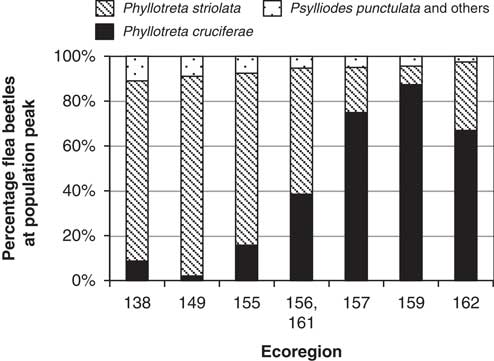
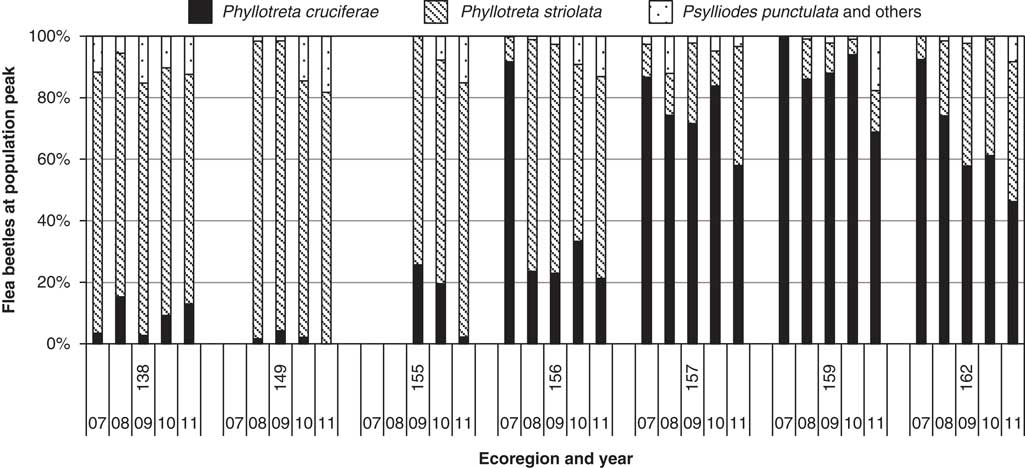
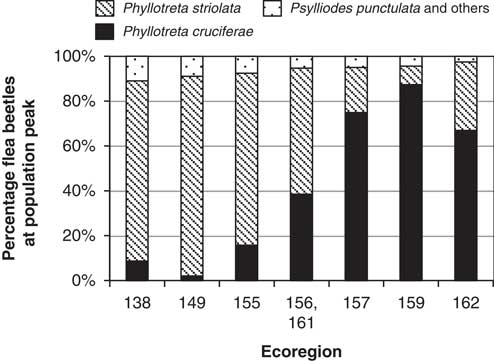
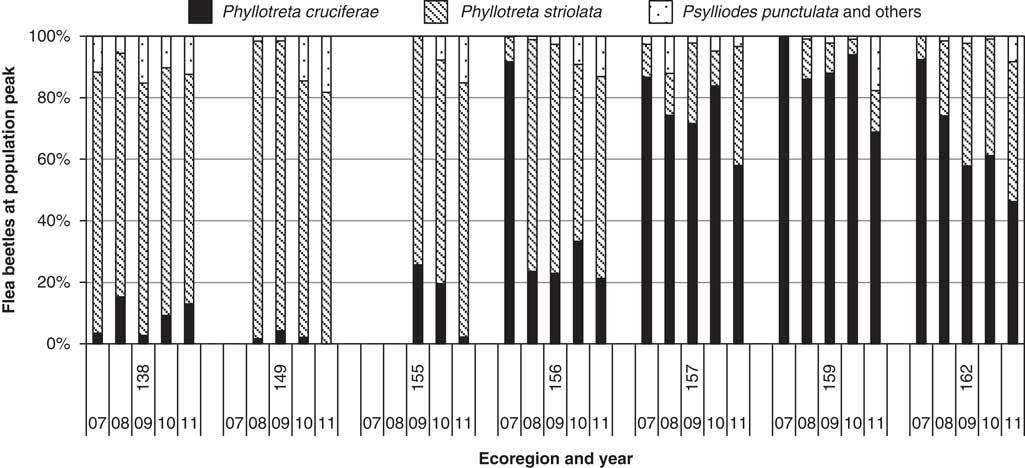
The number of sites where spring population peaks corresponded to a specific flea beetle species is summarised in Table 4. The percentage of each flea beetle species during peak population is averaged by principal Canadian ecoregion over the years 2007–2011 in Figure 2, and by individual year in Figure 3.
Percentage of Phyllotreta cruciferae, Phyllotreta striolata, and other flea beetles, including Psylliodes punctulata, found on yellow sticky traps at the time of population peak averaged over sites by principal ecoregion across western Canada over years 2007–2011 (n=252). Ecoregion: 138, Peace Upland; 149, Boreal Transition; 155, Interlake Plain; 156 and 161, Aspen Parkland; 157, Moist Mixed Grassland; 159, Mixed Grassland; 162, Lake Manitoba Plain.
Percentage of Phyllotreta cruciferae, Phyllotreta striolata, and other flea beetles, including Psylliodes punctulata, found on yellow sticky traps at the time of population peak averaged over sites by principal ecoregion across western Canada in each year 2007–2011 (n=252). Ecoregion: 138, Peace Upland; 149, Boreal Transition; 155, Interlake Plain; 156 and 161, Aspen Parkland; 157, Moist Mixed Grassland; 159, Mixed Grassland; 162, Lake Manitoba Plain.
Number of sites by ecoregion where Phyllotreta cruciferae, Phyllotreta striolata, or other flea beetles, including Psylliodes punctulata, comprised the majority of flea beetles (>50%) on yellow sticky traps near canola fields at the time of spring population peak, 2007–2011.

* 50:50 ratio between P. striolata and other species.
Over the years of the survey, P. striolata predominated in the number of sites and the proportion of flea beetle species composition at the northern edges of arable land on the Canadian prairies (Peace Lowland, Boreal Transition, and Interlake Plain) (Table 4; Figs. 1–2). Results from the reduced sampling of Western Boreal Ecoregion, which borders the Peace Lowland, and Fescue Grassland at the western edge of the grain belt, also followed this pattern. Phyllotreta cruciferae predominated in ecoregions nearer the 49th parallel, including Mixed Grassland, Moist Mixed Grassland, and Lake Manitoba Plain. The one site sampled from Southwestern Manitoba Uplands, which adjoins Lake Manitoba Plain, had a flea beetle species profile similar to the latter. Results from the two sections of Aspen Parkland, Ecoregion 156 sandwiched between Boreal Transition and Moist Mixed Grassland, and Ecoregion 161, northwest of Lake Manitoba Plain, varied with province. Phyllotreta striolata was most commonly found in Alberta sites of Aspen Parkland Ecoregion 156 (84% over study years), while P. cruciferae predominated in Manitoba sites of both Ecoregions 156 and 161 (79% over study years). Saskatchewan Aspen Parkland sites, strung along a diagonal from the Alberta sites in the northwest to Manitoba sites in the southeast (Fig. 1), revealed species proportions in between those of neighbouring provinces, with 58% of the sites having P. cruciferae as the most frequently caught flea beetle.
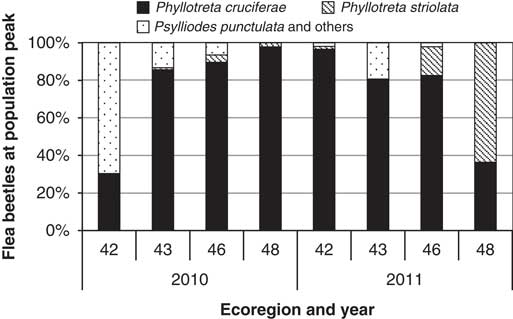
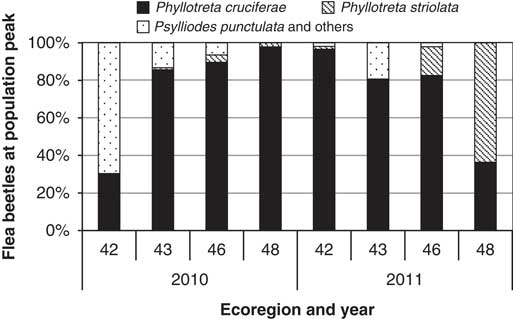
In two years of surveying multiple sites in North Dakota, P. cruciferae was the most frequently collected flea beetle at population peak in Northwestern Great Plains and Northern Glaciated Plains (Figs. 1, 4). Other species, principally Chaetocnema Stephens species, were the second most frequently collected group. However, in 2011 three of 11 sites in Northern Glaciated Plains had high numbers of P. striolata, contributing to a notable increase in proportion of that species over 2010 in the ecoregion. Species composition proportions in Northwestern Glaciated Plains and Lake Agassiz Plain varied inconsistently over the two years (Fig. 4), and the limited number of sampling sites prohibited analyses on species proportions.
Percentage of Phyllotreta cruciferae, Phyllotreta striolata, and other flea beetles, including Psylliodes punctulata, found on yellow sticky traps at the time of population peak averaged over sites by principal ecoregion across North Dakota in 2010 and 2011 (n=44). Ecoregion: 42, Northwestern Glaciated Plains (n=2, 1); 43, Northwestern Great Plains (n=9, 8); 46, Northern Glaciated Plains (n=11, 11); and 48, Lake Agassiz Plain (n=1, 1), in 2010 and 2011, respectively.
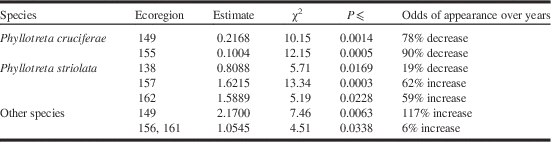
Likelihood of species occurrence paralleled species distribution patterns, with significant trends in odds of species appearance in principal ecoregions over years. During the study the likelihood of appearance of P. cruciferae decreased substantially at the northern edges of arable land on the prairies (Table 5; Figs. 1, 3). Likelihood of appearance of P. striolata decreased somewhat over years in Peace Lowland, while increasing substantially in more southerly Moist Mixed Grassland and Lake Manitoba Plain Ecoregions. Odds of appearance of P. punctulata and other flea beetle species increased greatly in Boreal Transition, and slightly in Aspen Parkland Ecoregions 156 and 161.
Significant log linear regression analyses of number of flea beetles/species in Canadian ecoregions over year at the time of spring population peak, 2007–2011.

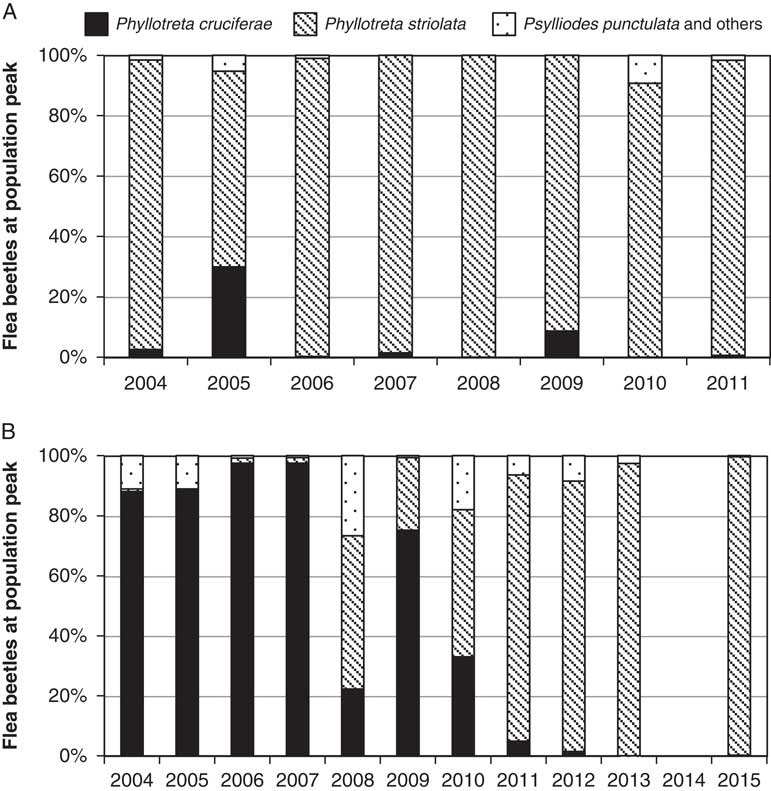
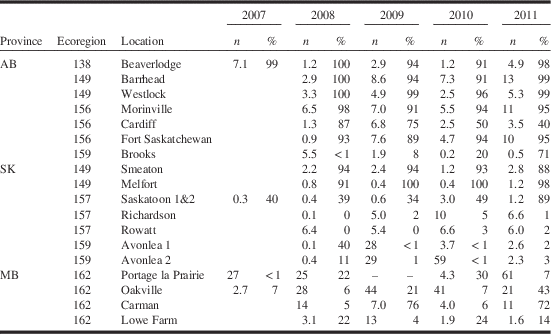
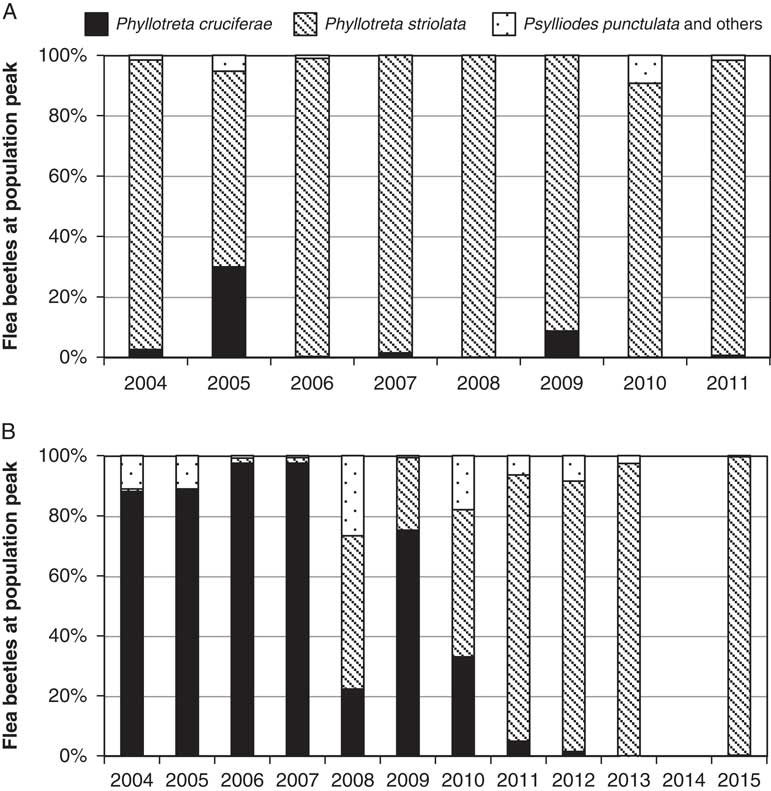
In our analyses of data from the same sampling sites over years, 18 sites over 79 site years were identified as sampling the same local flea beetle populations through time (Table 6). The results concurred with the conclusions drawn from the general survey – sites in Peace River Lowland (e.g., Beaverlodge Research Farm, Fig. 5A), Boreal Transition, and the Central Alberta portion of Aspen Parkland Ecoregion 156 had P. striolata as the principal flea beetle throughout the survey (Table 6). Saskatoon, at the northern edge of Moist Mixed Grassland, had dramatic increases in proportion of P. striolata over 11 sampling years (Table 6; Fig. 5B). Surveys of flea beetles at four sites in southern Saskatchewan, near the Moist Mixed Grassland/Mixed Grassland Ecoregion 159 interface, indicated P. striolata proportions were not increasing there. Populations of P. striolata were variable but occasionally in high proportion at four sites in Lake Manitoba Plain sites. While these generalisations held true for most sites, exceptions did occur. Unlike other sites in the Alberta Aspen Parkland, the proportion of P. striolata at Cardiff decreased through time; conversely, a site in Mixed Grassland near Brooks, Alberta saw populations of P. striolata increase (Table 6).
Percentage of flea beetle species collected on yellow sticky traps near the edge of canola plots at A, Beaverlodge Research Farm Ecoregion 138, 2004–2011 and B, Saskatoon Research Centre Farm Ecoregion 157, 2004–2015, at the time of population peak.
Total number (n) flea beetles/trap/day, and percentage Phyllotreta striolata collected on yellow sticky traps at the time of spring population peak in or near canola fields that were located within 3 km of the site from the previous year, by location 2007–2011.

AB, Alberta; SK, Saskatchewan; MB, Manitoba; ND, North Dakota.
Composition of other species
Over the course of this study, flea beetles other than P. cruciferae or P. striolata were most numerous at 13 of 300 sites, two of which had a 50:50 ratio between P. striolata and other species (Table 4). Numbers of other flea beetles were generally in low proportion whenever they were found, and only two sites in which these other flea beetles predominated had maximum numbers of all flea beetles greater than two/trap/day. Psylliodes punctulata comprised the principal flea beetle species at three site years in the survey – Worsley, Alberta, in 2009 (76% of 9.0 flea beetles/trap/day), Valhalla, Alberta, in 2010 (50% of 0.13 flea beetles/trap/day), and Swan River, Manitoba, in 2011 (64% of 0.40 flea beetles/trap/day). Eight of the remaining sites, four of which were in North Dakota, were dominated by species of Chaetocnema, including C. irregularis LeConte, C. opulenta Horn, and C. protensa LeConte. One site near Prince Albert, Saskatchewan had Crepidodera nana (Say) as the dominant flea beetle at 46% of 0.44 flea beetles/trap/day; C. nana was found occasionally throughout most ecoregions. At two sites in Alberta in 2011, Halcourt and St. Albert, the flea beetles in the “other” category comprising the majority at population peak were not identified. Other flea beetles appearing sporadically on traps throughout the survey included Phyllotreta albionica LeConte, Phyllotreta bipustulata Fabricius, Phyllotreta pusilla (Horn), Phyllotreta robusta LeConte, Chaetocnema confinis Crotch, and undetermined Longitarsus Berthold, Altica Geoffroy, and Epitrix Foudras species.
Correlations of flea beetle species and weather
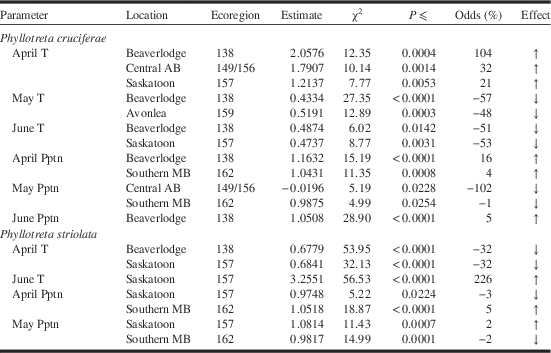
In linear regression analyses of flea beetle numbers and weather parameters, current monthly spring temperature and precipitation variables were best suited to predict flea beetle occurrence. Therefore, the weather parameters of the previous year were not incorporated into the analysis model. The two locations with the longest data sets, Beaverlodge (seven years) and Saskatoon (11 years), had the greatest number of significant flea beetle-weather correlations, while no correlations from Brooks, Alberta or Smeaton and Melfort, Saskatchewan (four years data for each site), were significant (Table 7). For P. cruciferae, analyses revealed an influence of monthly temperature and precipitation on odds of species occurrence across diverse ecoregions (Table 7), although influence direction varied by month. For every 1.0 °C rise in April temperature, there was an increase in likelihood of P. cruciferae occurrence in three ecoregions over years, while increased May and June temperatures reduced likelihood of P. cruciferae appearance (Table 7). A 1.0 mm increase in April precipitation increased occurrence of P. cruciferae at Beaverlodge and southern Manitoba, while increased rain in May decreased likelihood of P. cruciferae appearance in central Alberta and southern Manitoba. Phyllotreta striolata, conversely, was much less influenced by weather parameters than P. cruciferae and had little uniformity in response to weather across sites and ecoregions. Only April temperature predicted a decrease at both Beaverlodge and Saskatoon. Other weather parameters were associated with positive or negative odds of appearance of P. striolata, depending on site (Table 7).
Significant linear regressions of flea beetle numbers and weather parameters at specific prairie locations from 2007/2009–2011 except for Beaverlodge 2004–2011 and Saskatoon 2004–2015.

↑, ↓ – indicate odds of species occurrence increase or decrease over years.
T, temperature; AB, Alberta; Pptn, precipitation; MB, Manitoba.
Discussion
When flea beetles first became an economic problem in rapeseed production on the prairies in the 1960s and early 1970s, several surveys were conducted to determine flea beetle species composition and natural history. In a 1971–1974 survey of flea beetles in Canadian prairie rapeseed fields, Burgess (Reference Burgess1977) found that P. cruciferae was by far the most serious and abundant pest species, followed by P. punctulata and P. striolata. Geographically, Burgess (Reference Burgess1977) found P. cruciferae to be common throughout Manitoba, Saskatchewan, and central and southern Alberta, but saw few P. cruciferae in the Peace River region. He found P. striolata fairly regularly across the Prairie Provinces, usually in fewer numbers than P. cruciferae or P. punctulata, and only once as the dominant flea beetle species. He did not find P. striolata in rapeseed fields in the Lethbridge area of southern Alberta. Further, Burgess (Reference Burgess1977) found P. punctulata to be present in many rape fields across the agricultural area from southern Manitoba to northern Alberta, usually in low numbers but being the most numerous flea beetle collected in the Alberta Peace River district. From a study in Manitoba, Wylie (Reference Wylie1979) determined that P. cruciferae comprised 80–90% of the flea beetle populations on rapeseed crops in the Red River Valley, P. striolata comprised <10%, and P. punctulata comprised most of the remainder. Populations in south central Manitoba had similar compositions, while Interlake populations had P. cruciferae numbers in the 50–70% range, with P. striolata comprising most of the remainder (Wylie Reference Wylie1979). Over time, P. striolata became more abundant than in the past (Burgess Reference Burgess1981), especially in the northern portion of the Aspen Parkland (Burgess Reference Burgess1982, Reference Burgess1984; Burgess and Spurr Reference Burgess and Spurr1984; Wylie et al. Reference Wylie, Turnock and Burgess1984), although Burgess (Reference Burgess1981) observed a concomitant rise in P. cruciferae numbers across Saskatchewan by 1979, suggesting that numbers of both species were increasing in the province. More recently, Cárcamo et al. (Reference Cárcamo, Otani, Dosdall, Blackshaw, Clayton and Harker2008) collected only three P. striolata and one P. punctulata specimens along with over 65 000 P. cruciferae on sticky cards in a study near Lethbridge, Alberta, in 2003 and 2004.
Unlike the findings of Burgess (Reference Burgess1977), our study found that P. striolata was the predominant flea beetle throughout the Peace Lowland of Alberta, with P. cruciferae and P. punctulata and other flea beetles most abundant in only a few fields. Phyllotreta striolata has supplanted P. punctulata as the main flea beetle in the region, although it should be noted that levels of P. punctulata were not high originally (Burgess Reference Burgess1977). Because P. cruciferae was found infrequently in the region in both studies, it is likely that the current increase in occurrence of P. striolata is not a displacement of the niche previously occupied by P. cruciferae, but, rather, reflects a regional increase in numbers of P. striolata in the area. This increase may have occurred concomitantly with the frequency and amount of rapeseed/canola grown in the region (Hartman Reference Hartman2012; Barthet Reference Barthet2015). Similar to our results from the Peace Lowland and those of Burgess (Reference Burgess1982, Reference Burgess1984) and Burgess and Spurr (Reference Burgess and Spurr1984) from the northern boreal forest, the current study found P. striolata to be the principal flea beetle in the Boreal Transition Ecoregion. Burgess (Reference Burgess1982) predicted that P. striolata could achieve pest status if rapeseed production was extended northward into the boreal forest zone, and short rotation of crops, as is currently practiced (Harker et al. Reference Harker, O’Donovan, Turkington, Blackshaw, Lupwayi and Smith2015), would exacerbate the situation.
Although Burgess (Reference Burgess1977) found P. cruciferae to be the principal flea beetle in central Alberta, P. striolata was more numerous than P. cruciferae in some fields in central Alberta after 1979 (Wylie et al. Reference Wylie, Turnock and Burgess1984). Our data from the Alberta sites in the Aspen Parkland showed P. striolata to be the principal flea beetle there, in direct contrast to the survey of Burgess (Reference Burgess1977). General weather conditions across the prairies during the period of the current survey were relatively cool and wet, conditions not favouring P. cruciferae (Tansey et al. Reference Tansey, Dosdall, Soroka and Keddie2015; Olfert et al. Reference Olfert, Weiss, Soroka and Elliott2017b), and the dominance of P. striolata in central Alberta could be a response to these weather conditions or to changing climate over time (Olfert et al. Reference Olfert, Weiss, Soroka and Elliott2017a). However, it should be noted that in our survey the wettest conditions occurred in southeastern Saskatchewan and southwestern Manitoba, areas of the Aspen Parkland where P. cruciferae proportions were high previously and currently. If a true species shift has occurred in the Aspen Parkland of central Alberta, it likely was initiated previous to the start of our survey, and before the widespread use of neonicotinoid seed treatments that began with the registration of thiamethoxam in 2001 and clothianidin in 2004 in Canada (Pest Management Regulatory Agency 2001, 2004). The fact that sites near Cardiff, Alberta had decreasing proportions of P. striolata during the survey, while surrounding areas had high numbers of the species, suggests that flea beetle species dominance can be site-specific. Reasons for such local anomalies within regions are unknown, but may be related to differential response by the two species to variation in surrounding vegetation (Kareiva 1982a; Burgess Reference Burgess1984; Turnock et al. Reference Turnock, Lamb and Bilodeau1987), field history, and/or changing agronomic practices (Dosdall et al. Reference Dosdall, Dolinski, Cowle and Conway1999; Cárcamo et al. Reference Cárcamo, Otani, Dosdall, Blackshaw, Clayton and Harker2008).
Burgess (Reference Burgess1977) did not collect any P. striolata in irrigated rape fields near Lethbridge, Alberta and Cárcamo et al. (Reference Cárcamo, Otani, Dosdall, Blackshaw, Clayton and Harker2008) collected virtually no P. striolata near the city in 2003–2004. Conversely, in our survey the proportion of P. striolata around Lethbridge in 10 site years was 1%, and traps at most sites in the Mixed Grassland and Moist Mixed grassland Ecoregions of southern Alberta had some P. striolata, albeit in low numbers. Our results from Brooks, where P. striolata proportions increased from <1% in 2008 to 71% in 2011, are an interesting exception to the dominance of P. cruciferae in southern areas, and may represent the front of the P. cruciferae: P. striolata population mixture. This front may be influenced by latitude; thus, Chestomere and Strathmore, Alberta at latitudes of 51°3'N and 51°2'N, respectively, were in the predominantly P. striolata zone in our survey; Vauxhall, Taber, and Lethbridge at 50°4'N, 49°47'N, and 49°44'N, respectively, were in the P. cruciferae zone; and Brooks at 50°34'N, had a flea beetle species dominance that changed through the course of the survey.
Our results from northern Saskatchewan and Manitoba, where P. striolata predominated and odds of P. cruciferae occurrence declined significantly over the length of the survey, contrast with results from previous surveys (Burgess Reference Burgess1977, Reference Burgess1984; Wylie Reference Wylie1979) in which P. striolata numbers were greater in the north than south but P. cruciferae predominated in both areas. Our proportions of P. striolata from the Aspen Parkland of Saskatchewan were much greater than those of Burgess (Reference Burgess1984), who found populations of the striped flea beetle to vary from near 0–5% to 10% and only occasionally higher in the ecoregion. P. striolata is more shade tolerant than P. cruciferae (Tahvanainen Reference Tahvanainen1972), and Burgess (Reference Burgess1984) speculated that this may be a principal reason why P. striolata occurs in greater numbers in the Aspen Parkland Ecoregion than in more southerly areas with fewer trees. While this factor may have had merit before times of clearing vast areas of land in the regions, it is less pertinent today. We did not evaluate the relative attractiveness of the yellow sticky trap to each species encountered. However, this attractiveness should not have changed over the course of the survey, and changes in population proportions in the five years of the survey are likely valid.
While the predominance of P. cruciferae in southern Saskatchewan in this study was similar to previous surveys, variable but occasionally high numbers of P. striolata in Lake Manitoba Plain and increased likelihood of occurrence of P. striolata there suggests flea beetle population proportions may be changing in this region also.
Results of our survey substantiate the premise of Bradley et al. (Reference Bradley, Knodel and Lamey2006) that P. cruciferae is the principal flea beetle in North Dakota canola fields. However, since our survey, increasing numbers of striped flea beetles have been noted in North Dakota (Arnason Reference Arnason2014), the reasons for which are unknown.
Small numbers of several Phyllotreta species other than P. cruciferae and P. striolata were found to occur near crucifers both in previous studies (Burgess Reference Burgess1977, Reference Burgess1981; Wylie Reference Wylie1979) and in our survey. However, the numbers of P. albionica, P. armoraceae, P. robusta, and P. pusilla found in the current study were low and not any greater than found previously, suggesting that the population ecology of such species in western Canada is stable. Other flea beetle species such as Crepidodera nana (Parry Reference Parry1986), Epitrix tuberis Gentner, and Aphthona lacertosa Rosenhauer found in this survey have not been reported to feed on crucifers, and may have been attracted to the yellow colour of the sticky traps or feeding on nearby weeds. There may be several reasons for the notable number of Chaetocnema flea beetles caught in the survey. Higher numbers of Chaetocnema and other species may indicate a greater care in identification as the survey wore on, they may be a reflection of specific site, geographic, or weather conditions such as high moisture that are more amenable to specific flea beetle species, or they may represent a real increase in numbers of these other flea beetles.
Using bioclimatic simulation models of sites across western North America, Olfert et al. (Reference Olfert, Weiss, Soroka and Elliott2017a, Reference Olfert, Weiss, Soroka and Elliott2017b) found that increasing temperatures increased the suitability index for P. cruciferae and decreased it for P. striolata. Further, they predicted that wetter than average growing seasons would favour the geographic distribution of P. striolata more than P. cruciferae (Olfert et al. Reference Olfert, Weiss, Soroka and Elliott2017b). Our regressions followed the predictions of Olfert et al. (Reference Olfert, Weiss, Soroka and Elliott2017b) wherein April temperature was the weather parameter that had the most consistent effect over the greatest number of ecoregions, and the effects were opposite for the two species. In a similar vein, as Olfert et al. (Reference Olfert, Weiss, Soroka and Elliott2017a, Reference Olfert, Weiss, Soroka and Elliott2017b) predicted, we found May precipitation decreased the odds of occurrence of P. cruciferae at sites in central Alberta and Manitoba. However, our inconsistencies in species response to both temperature and moisture over months point out the need for greater refinement of our meteorological model, or more data, or both. The effects of short and localised precipitation events and even temperature are difficult to model when measured against monthly interception data. However, our results show that, with only one temperature parameter having consistent significant effects on P. striolata appearance, P. striolata is more plastic, or at least more variable in its response to weather conditions than its congener.
There could be several reasons for the decreased likelihood of P. cruciferae appearance and increased likelihood of P. striolata appearance in diverse ecoregions across the Canadian Prairies found in this survey. Phyllotreta striolata has a lower low temperature developmental limit and is less heat tolerant than P. cruciferae (Tahvanainen Reference Tahvanainen1972; Kinoshita et al. Reference Kinoshita, Svec, Harris and McEwan1979; Sommer Reference Sommer1981; Olfert et al. Reference Olfert, Weiss, Soroka and Elliott2017b). Less tolerance of cold may be one of the reasons why P. cruciferae emerges one to four weeks later in spring on the Canadian Prairie Provinces than P. striolata (Westdal and Romanow Reference Westdal and Romanow1972). Likewise, P. cruciferae has a lower tolerance to soil moisture than P. striolata (Olfert et al. Reference Olfert, Weiss, Soroka and Elliott2017b). These heat and drought tolerant attributes may have contributed to the very rapid expansion of the species eastward and its achievement of pest status on the Prairies in the 1930s and 1940s, so soon after its introduction to the west coast (Westdal and Romanow Reference Westdal and Romanow1972). Phyllotreta cruciferae is more mobile than P. striolata, with a higher degree of discrimination in host quality (Kareiva Reference Kareiva1982a). Several factors could reverse this dominance of P. cruciferae in areas where the species coexist. The current survey was conducted in a period of generally cool, wet springs (Morrison et al. Reference Morrison, Harker, Blackshaw, Holzapfel and O’Donovan2016), which could hamper population development of P. cruciferae more so than P. striolata. Seeding canola earlier in the spring than was previously common, as recommended by Canola Council of Canada (2013), may favour development of P. striolata populations. In addition, the use of neonicotinoid-treated canola seed over 95% of the millions of hectares in western Canada, with accompanying differences in flea beetle species efficacy (Tansey et al. Reference Tansey, Dosdall, Keddie and Sarfraz2008, Reference Tansey, Dosdall and Keddie2009; Canola Council of Canada 2014b), may favour P. striolata population development. Phyllotreta striolata can exhibit competitive release from interspecific competition with P. cruciferae unrelated to response to insecticide: Kareiva (Reference Kareiva1982b) found a significant increase in P. striolata populations upon removal of P. cruciferae from plots of collards (Brassica oleracea Linnaeus var. acephala Candolle). Tansey et al. (Reference Tansey, Dosdall, Keddie and Sarfraz2008) suggested that interspecific competition can bias distributions of organisms that occur sympatrically and use the same resources. Perhaps in this instance variable insecticide-induced mortality and competitive release from competition could synergistically result in P. striolata gaining dominance over P. cruciferae faster than if either factor acted alone.
Despite the increasing occurrence of P. striolata and other flea beetle species seen in this survey, P. cruciferae comprised the greatest proportion of flea beetles in fields with high numbers of flea beetles, similar to findings of many previous reports. In our survey, most sites with high flea beetle numbers were located in the south (or in the north, in the case of North Dakota). Current conditions at such locations may be more favourable for development of P. cruciferae populations than P. striolata (Olfert et al. Reference Olfert, Weiss, Soroka and Elliott2017a). Long-term climate changes could benefit one species over the other, as predicted by Olfert et al. (Reference Olfert, Weiss, Soroka and Elliott2017a). The current study identifies a shift in dominance from P. cruciferae to P. striolata. Given the greater resistance of the latter to neonicotinoid seed treatments, which are the main method of insecticidal control, future monitoring is warranted to assess the implications of this change on levels of flea beetle damage in canola. Whether P. striolata populations remain high if weather conditions become warmer and drier for prolonged periods and/or insecticidal seed treatments with equal efficacy against both species are developed remains to be seen.
Acknowledgements
Financial assistance from the Canola Council of Canada and its partners the Alberta Canola Producers Commission, SaskCanola and Manitoba Canola Growers Association is gratefully acknowledged, as is funding from Agriculture and Agri-Food Canada and the Tri-Provincial Monitoring Network. The authors thank the site owners, without whom this project was not possible. Our deepest appreciation to the 65 or more surveyors from the following organisations: Agriculture and Agri-Food Canada; British Columbia Ministry of Agriculture and Forestry; Alberta Agriculture, Food and Rural Development; Saskatchewan Ministry of Agriculture; Manitoba Agriculture, Food, and Rural Initiatives; University of Alberta; North Dakota State University; Canola Council of Canada; Agritrend; BASF Canada; Cargill Canada; Cavalier Agrow; Lantic (Rogers Sugar); Monsanto Canada; Viterra; and WinField Solutions, Land O’Lakes. We thank Laurent LaSage of the National Identification Service, Agriculture and Agri-Food Canada Ottawa, Ontario, who identified unknown flea beetle species. Thanks are also extended to Travis Sander and David Giffen for their patience in creating graphs and maps, and Ross Weiss for his helpful dialogue.
Supplementary material
To view supplementary material for this article, please visit https://doi.org/10.4039/tce.2017.60