


Introduction
Chronic Fatigue Syndrome (CFS), often referred to as myalgic encephalomyelitis (ME), is an illness that has a definite onset and is characterized by severe unexplained physical and mental fatigue that lasts at least 6 months. At present the two most widely accepted operational criteria for CFS are the Oxford criteria (Sharpe et al., Reference Sharpe, Archard, Banatvala, Borysiewicz, Clare and David1991) and the Centres for Disease Control (CDC) Fukuda criteria (Fukuda et al., Reference Fukuda, Straus, Hickie, Sharpe, Dobbins and Komaroff1994). The illness is associated with profound fatigue and disability. Other symptoms may be present, particularly myalgia, mood and sleep disturbance, concentration and memory problems (Sharpe et al., Reference Sharpe, Archard, Banatvala, Borysiewicz, Clare and David1991).
National Institute for Health and Clinical Excellence (NICE) (2007) recommends that either cognitive behaviour therapy (CBT) or graded exercise therapy (GET) should be offered as a treatment to patients with mild to moderate CFS, as these are the two interventions for which there is currently the clearest research evidence of benefit (NICE, 2007; Whiting, Bagnall, Snowdon, Cornell and Mulrow, Reference Whiting, Bagnall, Snowdon, Cornell and Mulrow2001; Chambers, Bagnall, Hempel and Forbes, Reference Chambers, Bagnall, Hempel and Forbes2006). A recent large randomized trial adds further support to these findings (White et al., Reference White, Goldsmith, Johnson, Potts, Walwyn and DeCesare2011). A Cochrane review has shown that CBT improves fatigue and physical functioning in about 40% of patients (Price, Mitchell, Tidy and Hunot, Reference Price, Mitchell, Tidy and Hunot2008).
Despite these encouraging results, several problems remain. It has proved impossible to keep pace with demand for treatment. The number of therapists with the necessary skills is limited and many patients are unable to travel to specialist units for treatment. To overcome these problems we piloted a telephone treatment package of CBT, consisting of 13 telephone and 2 face to face sessions, which reduced the demand on patients in terms of travel time. Nine consecutive patients with a diagnosis of CFS who were unable to attend regular out-patient appointments had a face to face assessment with MB. They were given a self-help manual and were phoned fortnightly for up to half an hour to discuss progress, problem-solve any difficulties, review diaries sent by post to the therapist, and discuss plans for the coming fortnight. Patients attended a discharge appointment. Eight patients completed treatment; one dropped out after 6 weeks as she felt too ill to continue with the programme or complete records due to the severity of her symptoms. Improvement was seen on all measures at discharge; fatigue had improved by 75%. At 6-month follow-up, levels of functioning had continued to improve although fatigue had slightly risen due to one patient having influenza at this time point. This pilot study demonstrated that telephone CBT resulted in a reduction in fatigue and improvement in disability (Burgess and Chalder, Reference Burgess and Chalder2001). The advantage of a telephone-based approach is that it is less time consuming for the therapist, therefore allowing more patients to be treated. The advantages for the patient are that it is less time consuming and less disruptive to their life.
Given the promising results of the pilot study, the next obvious step was to compare telephone CBT plus two face to face sessions with face to face CBT, which has already been shown to be efficacious in randomized controlled trials (Deale, Chalder, Marks and Wessely, Reference Deale, Chalder, Marks and Wessely1997; Prins et al., Reference Prins, Bleijenberg, Bazelmans, Elving, Boo and Severens2001; Sharpe et al., Reference Sharpe, Hawton, Simkin, Surawy, Hackmann and Klimes1996). Although telephone-based interventions are becoming more popular, a systematic review of the literature was unable to draw firm conclusions about its efficacy due to small sample sizes and a lack of randomized controlled trial methodology in many of the studies (Leach and Christensen, Reference Leach and Christensen2006).
Method
Design, objectives and randomization
We carried out a parallel-groups randomized controlled trial to compare CBT either delivered face to face or primarily by telephone. We decided to omit a “no treatment” or “placebo” group because of the potential ethical objections of leaving patients untreated and the fact that we hypothesized that one approach, face to face CBT, would be superior to telephone CBT in reducing fatigue and improving physical functioning.
Participants
The study was conducted at the Chronic Fatigue Syndrome (CFS) Research and Treatment Unit at the South London and Maudsley NHS Trust in London, which is part of the Academic Health Sciences Centre (AHSC) at King's College London. The protocol was approved by the local ethics committee. Patients aged 18–65 years were recruited from consecutive referrals to the unit. All patients were assessed by a psychiatrist and were invited to participate in the trial if they fulfilled both the CDC (Fukuda et al., Reference Fukuda, Straus, Hickie, Sharpe, Dobbins and Komaroff1994) and Oxford criteria (Sharpe et al., Reference Sharpe, Archard, Banatvala, Borysiewicz, Clare and David1991) for CFS. They also had to have had CFS for less than 10 years, as a longer duration raised concerns over the accuracy of the diagnosis and the possibility that telephone treatment would be inappropriate. Additional inclusion criteria were being able to attend the hospital or have telephone sessions fortnightly. Patients were excluded from the trial if they had any medical condition that may have accounted for their fatigue, had started or changed medication within 3 months to ensure stability of additional treatments, were pregnant, had psychosis, drug abuse, a somatoform disorder or melancholic depression, a subtype of major depression with specific features including anhedonia, severe weight loss, psychomotor agitation or retardation, insomnia with early morning waking, and guilt.
Procedure
An explanation of the trial was given to patients who fulfilled trial criteria at the end of the assessment by the psychiatrist. Some patients gave written consent to participate at the end of their assessment; other patients who wanted time to think about their decision were contacted by phone by MB within two weeks of the assessment. Informed written consent was obtained from those wishing to participate prior to randomization.
Eligible patients were randomly allocated to either face to face or telephone CBT just prior to starting treatment. A clinic administrator kept a random list of numbers. The list was prepared using a table of random numbers (Pocock, Reference Pocock1995). Randomization was started at the first number on the list. The administrator was informed by phone or in person by the assessing psychiatrist or by MB when a patient had consented for the trial. She then randomized the patient using the prepared list and wrote the treatment group to which the patient had been assigned in their medical notes as well as keeping a separate record.
Treatment procedures
Once participants had consented and had been randomized, an initial detailed face to face cognitive behavioural assessment took place with their assigned therapist. Participants in the face to face group had their assessment split into two 1½ hour appointments whereas participants in the telephone group had one long appointment of up to 3 hours.
Interventions
Cognitive behavioural models suggest that a combination of physiological, behavioural, cognitive, emotional and social factors contribute to the perpetuation of symptoms and disability associated with CFS (Wessely, David, Butler and Chalder, Reference Wessely, David, Butler and Chalder1989; Sharpe and Chalder, Reference Sharpe, Chalder and Illis1994). The essence of CBT is to help patients to change behavioural and cognitive factors, focusing specifically on changing avoidance behaviour, unhealthy sleep patterns and unhelpful beliefs in order to improve levels of fatigue and disability.
Participants were socialized to the model of treatment and a rationale for the approach was discussed collaboratively. Long term goals were negotiated. Participants allocated to telephone treatment had all subsequent sessions over the telephone, apart from the discharge session which was carried out face to face. The structure of the treatment was otherwise similar in both groups.
Early treatment sessions involved a combination of collaborative agenda setting, homework reviewing, planning of future homework, discussion about how to manage sleep problems and ways to gradually increase activity without overdoing it. Subsequent sessions involved discussion around identifying and challenging unhelpful cognitions that were standing in the way of behavioural change. Social factors, for example work, relationship or child care issues, were addressed if they were identified as being important in perpetuating the symptoms and disability associated with their CFS. Management of setbacks was discussed in the final few treatment sessions and goals agreed for participants to work towards during follow-up. Participants were offered follow-up sessions 3 months, 6 months and 12 months after the end of treatment, by phone if in the telephone group and face to face if in that group.
Face to face CBT consisted of up to 15 sessions. The number of sessions was agreed collaboratively with the participant. The first two sessions lasted up to 1½ hours in order to complete a detailed assessment. Subsequent sessions were between 50 minutes and 1 hour. Handouts containing relevant material to the session were given at the therapist's discretion; these were not standardized.
Telephone CBT consisted of one face to face session of up to 3 hours with their assigned therapist. The long session allowed adequate time for a detailed assessment and socialization to the model. In addition, participants were given a folder containing a treatment manual, activity, sleep and thought diaries to complete, and stamped addressed envelopes in which to return them. Thereafter, participants were offered 13 fortnightly phone appointments of half an hour's duration. Participants returned completed homework diaries by post, fax or e-mail for the therapist to look at before and during their phone appointment.
Some participants felt confident in using their self-help manual independently and required minimal input from the therapist who acted in a supportive role. Others required more specific help with setting a realistic programme of planned activity and rest, overcoming sleep problems and identifying and challenging unhelpful thoughts. Therapists encouraged participants to find solutions to their difficulties in order to build their confidence in using the manual. Some participants also used part of the telephone session to discuss other issues that were affecting their ability to maintain their programme; the therapist would problem-solve with them to identify the best way forward. Aside from the discharge appointment, which was carried out face to face, the follow-up appointments were carried out over the phone.
Therapists
Both treatments were delivered by eight trained cognitive behavioural nurse therapists all of whom had worked in the department for at least 6 months. The therapists had all received rigorous training involving live observation of sessions, feedback on recorded sessions, as well as close supervision of their cases. Fortnightly face to face clinical supervision was provided to ensure adherence to protocol and to problem solve clinical and protocol issues relating to trial participants.
Outcomes
Evaluations consisted of self-rated questionnaires. Participants completed questionnaires before treatment, after treatment, and 3, 6 and 12 months after completing treatment. Information was collected on demographic information, namely age, sex, marital status, social class.
Primary outcome measures
Medical Outcomes Survey: short form (physical functioning subscale) (MOS; Stewart, Hays and Ware, Reference Stewart, Hays and Ware1988). Items relating to limitation of activities caused by ill-health were assessed on a scale of 1 (limited for more than 6 months) to 3 (not limited at all). Scores from the 6 items were then summed and converted into a percentage rating; 100% = no limitation to 0% = limited for more than 6 months. This questionnaire has been shown to be reliable and valid and has been used in other CFS/ME trials, (Deale et al., Reference Deale, Chalder, Marks and Wessely1997).
Chalder Fatigue Scale (Chalder et al., Reference Chalder, Berelowitz, Hirsch, Pawilikowska, Wallace and Wessely1993). This 11-item questionnaire measures the severity of fatigue. Four response options range from “less than usual” to “much more than usual”. Bimodal scoring gives a range of 0–11 and yields a cut-off for “caseness” or excessive fatigue at 4 or over. This questionnaire has been used in previous CFS/ME intervention trials and is reliable and valid (Cella and Chalder, Reference Cella and Chalder2010).
Secondary outcome measures
Social Adjustment Scale (Mundt, Marks, Shear and Griest, Reference Mundt, Marks, Shear and Griest2002). This 5-item questionnaire measures impairment in occupational, social, private leisure, domestic activities and relationships. Impairment in each area is measured on a Likert scale from 0 indicating “not at all impaired” to 8 “very severely impaired”. The scale has been shown to be reliable (Cronbach's alpha 0.7–0.9), has good face validity, correlates with symptom severity in depression and obsessive compulsive disorder and is sensitive to change. It has recently been shown to be reliable and valid in a CFS population (Cella, Sharpe and Chalder, Reference Cella, Sharpe and Chalder2011).
Hospital Anxiety and Depression Scale (Zigmond and Snaith, Reference Zigmond and Snaith1983). This is a 14-item scale that measures anxiety and depression. It was designed specifically for the liaison setting and has good reliability and validity. Each item has 4 possible responses.
Self-rated global improvement was rated on a 6-item scale from “very much better” to “very much worse”. Scores were dichotomized for the analysis by grouping together participants who scored very much better and much better (1 or 2) with those who scored a little better to very much worse (3 to 6). Satisfaction with treatment was rated on a 7-point scale from “very satisfied” to “very dissatisfied”. Scores were dichotomized for the analysis by grouping together participants who were very satisfied or moderately satisfied (1 or 2) compared respectively with those who were slightly satisfied to very dissatisfied (3 to 7).
Sample size and statistical methods
A power-calculation based on the actual number of dropouts was calculated to ensure that an effect size between the two groups could be detected. A sample size of 50 with 80% power and a significance level of 0.05 for a two-tailed test will be able to detect an effect size of 0.35 using a two groups and three time points repeated measures of ANOVA. Allowing a maximum dropout rate of 50%, the sample size required was calculated to be 75. The power calculations were carried out using G power 3.0.8.
The baseline demographic and clinical variables namely gender, marital status, ME association, has a job to return to, age, duration of illness, number of sessions, anxiety and depression and the outcome variables fatigue, social adjustment and physical function (MOS) were summarized using descriptive statistics. Since there was an overall attrition rate of 46.25% from baseline to 12-month follow-up, the dropout mechanism was investigated. Logistic regression was used to assess whether the subject characteristics, namely gender, marital status, ME association, has a job to return to, age, duration of illness, number of sessions, anxiety and depression, were predictive of the probability of dropouts. In addition, to assess whether earlier values of an outcome variable predicted later dropouts, subjects at time ‘t’ were divided into those who supplied data (non-dropout) on the outcome variable and those who have not, at time ‘t+1’ (dropout). The emerging patterns were assessed by plotting means and 95% confidence intervals for dropout and non-dropout groups at various time points.
From logistic regression (significant coefficient value for subject characteristics in the logistic regression model) and Figure 2 (the non-overlapping confidence intervals for dropouts and non-dropouts groups at baseline and later time points), it was observed that baseline characteristics and earlier values appeared to predict absence of data and hence it was concluded that dropping out in this study was not completely at random (MCAR), but predicted by observed data. Hence, random effects models were used for the analysis of outcome variables since the inferences drawn from this model is valid under less restrictive missing at random (MAR) assumptions, provided all the variables involved are included in the model. An intention to treat analysis was carried out for the dropouts.
A random intercept model was fitted using the ‘xtmixed’ command in Stata 10 for each outcome variable. The varying intercept in this model accounted for the correlation between repeated temporal measures for the subject and the fixed part contained contrasts for the time factor, main effect of group and group by time interactions. The interaction between group and time was tested initially to assess whether any group effects differed significantly between different time points and was removed from the model if it was not statistically significant. The final model contained only the main effects of group, time points, baseline scores and the subject characteristics that were predictive of dropouts. To decide whether any of the subject characteristics such as gender, marital status, belonging to the CFS/ME organization, has a job to return to, age, duration of illness, number of sessions, anxiety and depression to be included in the final analysis model as predictors, each variable was included separately in the model and tested for its significant contribution to the post-treatment variability along with the baseline scores and effects of group and time. If any such variables explained significant variability at a liberal 10% level, then they were included in the final model.
Results
Subject flow
Four hundred and ten consecutive patients referred to the clinic were assessed for suitability for the trial; 300 of these did not meet inclusion criteria; 30 did not wish to participate and 80 did (see Figure 1). Reasons for ineligibility of the 300 patients included: not meeting Oxford and Fukuda criteria (37%), onset of over 10 years (20%), would not be able to attend regular appointments, did not have a phone (14%) or were offered group CBT in the clinic (7%). Other reasons for ineligibility included 7% being referred back to local services and 6% having started or changed medication within the previous 3 months. No reason was given or there were missing data in 9% of patients. Eighty participants were randomized to either face to face CBT (n = 35, 43.75%) or telephone CBT (n = 45, 56.25%). The participants were predominantly female (78.8%); 39.7% were married and the remaining 60.3% were single, widowed, divorced or co-habiting.
Consort statement

The average age of participants was 37.4 (SD 10.1). Only 35.5% of the participants had a job to return to. The mean depression score of participants at the start of the study was 9.1 (SD 1.7). The mean anxiety score of the participants was 11.2 (SD 3.2). Ninety percent of the participants were white. The mean duration of illness for the study group was 4.0 years (SD 2.1). Participants attended an average of 11.3 sessions (SD 5.2). The large variability of session attendance is accounted for by dropouts at different stages of treatment as well as some participants feeling better and not requiring the full amount of sessions. Twenty-eight of the 35 participants allocated to face to face CBT and 30 of the 45 participants allocated to telephone CBT received treatment. Six participants allocated to telephone treatment did not start; 2 felt better, 1 wanted face to face treatment, 1 had local treatment and 3 gave no reason. One participant allocated to face to face treatment no longer wished to participate as she felt better. Reasons for dropping out during treatment included being unable to commit to sessions due to personal circumstances, moving abroad, starting another treatment for pain, or no reason was given.
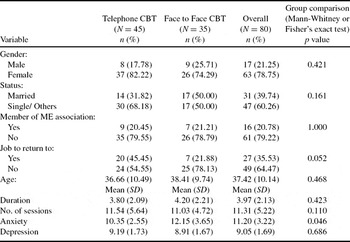
Table 1 summarizes the group-wise baseline characteristics. There was no evidence of a significant difference (p values > .05 for all the variables) between the groups with respect to sex, marital status, ME association and jobs to return to. Similarly, the mean age, duration of illness, average number of sessions attended and the depression scores did not differ between the two groups (p > .05 for all these variables). However, the two groups differed significantly (p = .046) with respect to the anxiety scores. The anxiety score was higher in the face to face therapy group compared to the telephone CBT group.
Descriptive summaries of baseline variables and tests for group differences

Outcome measures
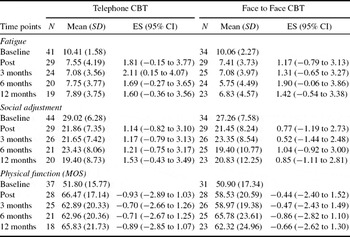
Group-wise mean and standard deviation of fatigue, social adjustment and physical function are depicted in Table 2. Fatigue scores showed a decline from baseline to post-treatment time points and maintained the score for the rest of the follow-ups for both telephone CBT and face to face groups. A similar trend was observed in social adjustment scores. The physical function (MOS) scores showed an increase from baseline to post treatment time points for both the groups. The increased score was maintained in the rest of the follow-up time points.
Mean and standard deviations (SD) of outcome variables by groups and time points

Effect sizes are calculated by subtracting the mean scores at post treatment time points from the mean scores at baseline time points and divided by the baseline standard deviation for Telephone CBT and Face to Face CBT separately.
Dropout mechanism
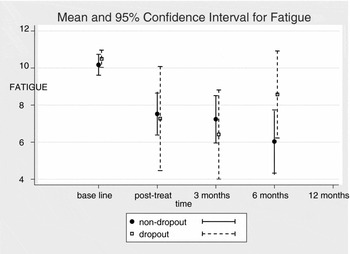
The comparison of dropout rates between groups showed no significant difference between telephone CBT and face to face CBT (p > .05) with respect to the proportion of dropouts from base line to 12-month follow-up. To find out whether the baseline variables predicted the later dropout, logistic regression analysis was carried out. The results of the logistic regression analysis showed job status as a significant (p = .003) predictor of dropouts; participants who were in employment were more likely to drop out at the post treatment and follow-up time points. The means and 95% confidence interval of the outcome measure fatigue for the two groups, namely the dropouts in the later time points and the non-dropouts, are shown in Figure 2. Although the mean values for dropout cases are slightly higher than the non-dropout cases at baseline and 6-month time points, there was no evidence to conclude that dropping out depended on previous fatigue scores since the confidence intervals for dropout and non-dropout overlap at various time points. A similar trend was noted for social adjustment scores. However, for physical functioning, participants with very low scores at baseline tended to drop out in the post treatment period; this suggests that job status and earlier values predicted the later dropout and hence in the random effects model, the analysis of which assumes only that the data are Missing At Random (MAR), these were included in the model to assess group differences.
Mean and confidence interval of fatigue scores for dropout and non-dropout groups at various time points

Group comparisons
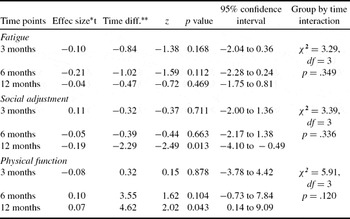
The results of the random effects model fitted to three different outcome measures, namely fatigue, social adjustment and physical functioning, are summarized in Table 3. For fatigue, the explanatory variables sex and number of sessions were included in the model as they were significantly predicting the fatigue scores at a liberal 10% level in addition to job status, which was a predictor of dropouts. The interaction between group and time was not statistically significant (chi-squared = 3.29, df = 3, p = .35) and hence it was removed from the original model and only the main effects of group and time were tested along with the baseline variables in the final model. The telephone CBT group and face to face CBT group did not differ significantly (z = –1.31, p = .19) with respect to fatigue scores. Also, there was no evidence for the predictive effect of baseline scores on later scores (p > .05). The fatigue scores at 3 months, 6 months and 12 months after treatment did not differ significantly (all p values > .05) when compared to the fatigue scores at post treatment. The predicted mean and 95% confidence intervals for the two groups at all time points are shown in Figure 3.
Comparison of post-treatment with different time points

*Effect sizes are calculated by subtracting mean scores at 3, 6 and 12 months after treatment time points from the mean score immediately after treatment (comparison group) and divided by the standard deviation of the comparison group. ** Time difference refers to the estimated difference in out come measures between post treatment and various time points (3 months, 6 months and 12 months) accordingly.
Predicted mean and 95% confidence interval of fatigue scores for telephone CBT and face to face CBT groups at various time points (graph adjusted for sex = female, job = yes and anxiety = 11.2 (mean value))

The model for social adjustment included age, sex, marital status and baseline scores as explanatory variables along with job status as predictors of dropout. Since the interaction between time and group was not significant (chi-squared = 3.39, df = 3, p = .34), this term was removed from the model and the final model contained the main effects of group, time and predictor variables. No significant difference (z = –1.57, p = .117) between telephone CBT and face to face CBT groups were observed. As expected, the baseline social adjustment scores significantly (z = –6.57, p<.001) predicted the later scores at various time points. The social adjustment scores at 3 months and 6 months after treatment did not differ significantly (all p values > .05) when compared to the scores at post treatment time point. However, the social adjustment score at 12 months after treatment significantly reduced when compared to the score post treatment (p value = .013; see Table 3).
For physical function, none of the baseline variables were significantly predictive of MOS scores at a liberal 10% level. Hence the analysis model included baseline scores and job status in addition to group and time. Since the interaction between group and time was not significant (chi-squared = 5.91, df = 3, p = .12), the interaction term was removed from the final model and only the main effects of group and time were tested along with job and baseline score. The baseline score significantly predicted (p<.001) the later physical function scores. The physical function scores did not differ significantly (z = 0.56, p = .576) between participants who received telephone CBT and face to face CBT. A significant increase (p value = .043) in physical function score was observed at 12 months after treatment when compared to the score at post treatment. However, there was no evidence for a significant increase (all p values > .05) at 3 months and 6 months after treatment compared to post treatment scores (see Table 3).
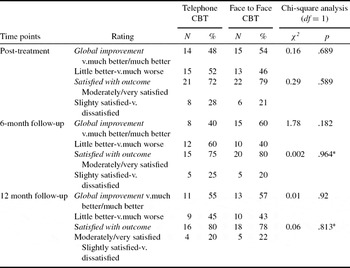
For self-rated global scores, no significant difference was found between groups on global improvement post-treatment (chi-squared = 0.16, p = .689), at 6 months (chi-squared = 1.78, p = .182) or 12 months after treatment (chi-squared = 0.1, p = .982). There was no significant difference between groups on their satisfaction with outcome of treatment post-treatment (chi-squared = 0.29, p = .589), at 6-months (chi-squared = 0.16, p = .688) or 12 months after treatment (chi-squared = 0.2, p = .889). Most participants reported being moderately satisfied or very satisfied with the outcome of treatment at each time point, with ranges between 78% to 80% in the face to face group and 72% and 80% in the telephone group (see Table 4).
Self-rated Global Improvement scores

*with yate's correction.
Discussion
Significant reductions in scores of fatigue, social adjustment and physical functioning occurred post-treatment in both the face to face CBT group and telephone CBT group and were maintained throughout the follow-up period of one year. There were no significant differences on any primary outcomes between subjects in the two groups, which indicate that our hypothesis that face to face CBT was more effective than telephone CBT for patients with CFS was not confirmed. The fact that a significant difference was not seen between treatment groups on primary outcome measures is not disappointing. Telephone treatments were shorter in length and therefore less costly. However, it is difficult to be precise about specific savings as we did not carry out an economic analysis in this study. The results from this study are in keeping with a well designed randomized controlled study by Lovell et al. (Reference Lovell, Cox, Haddock, Jones, Raines and Garvey2006), where telephone CBT was as effective as face to face CBT in patients with obsessive compulsive disorder. Both of these conditions are severely disabling and it is encouraging to note that significant improvements can be made with this mode of delivery. Another factor that cannot be ignored in terms of explaining the changes associated with telephone treatment is the face to face contact on two occasions. The initial assessment was carried out face to face and this may have helped the therapeutic alliance at the start.
The considerable number of dropouts may question the findings of this study. However, the post hoc power calculation showed a sample of 50 (25 in each group) had a mild to moderate effect size of 0.35, which confirms that the results obtained are reliable. One may have assumed that there would have been more dropouts from the face to face arm because of the increased accessibility afforded by telephone sessions. However, this was not the case; a variety of reasons were given by participants in both groups and accessibility was not one of them.
This study showed smaller changes in mean scores on our main outcomes than our previous randomized controlled trial in which we compared CBT with relaxation for patients with CFS (Deale et al., Reference Deale, Chalder, Marks and Wessely1997). Although a higher percentage of patients in the Deale et al. (Reference Deale, Chalder, Marks and Wessely1997) trial reported feeling very much better or much better, satisfaction with treatment was similar in both studies. It is important to consider why results from this trial were not as impressive as our earlier RCT. Participants in this study had a longer duration of illness and were older, factors that have been noted in other studies to have an association with symptom persistence (Joyce, Hotopf and Wessely, Reference Joyce, Hotopf and Wessely1997). There was only one therapist in the Deale et al. trial whereas eight therapists treated participants in this trial which is more indicative of real life. Therapists may have had diverse treatment outcomes. However, when using a different but much larger sample of consecutive patients receiving CBT in the same setting we did not find any evidence of therapist effects (Cella, Stahl, Reme and Chalder, Reference Cella, Stahl, Reme and Chalder2011). It is of course possible that some of the participants who did not complete questionnaires had improved and therefore decided to disengage with the service.
We also compared the results from the present study to results from routine clinic practice at this clinic (Quarmby, Rimes, Deale, Wessely and Chalder, Reference Quarmby, Rimes, Deale, Wessely and Chalder2007). Fatigue and social adjustment scores at 6 months follow-up in the face to face group in this study were slightly better than the outcomes from our study of routine clinical practice (Quarmby et al., Reference Quarmby, Rimes, Deale, Wessely and Chalder2007). The results from this study (0.35) suggest mild to moderate clinical effectiveness based on estimations by Cohen (Reference Cohen1988).
Limitations of this study include the high dropout rate and non-completion of measures. However, there were no differences in the dropout rate between the groups and this trial was more representative of normal clinical practice as seen in Quarmby et al.'s (Reference Quarmby, Rimes, Deale, Wessely and Chalder2007) examination of outcomes outside the confines of a randomized controlled trial. One could argue that it is difficult to accurately draw the conclusion that the interventions are effective as we did not find a difference between them and therefore change over time could be due to chance. However, evidence from previous trials, as already mentioned, have demonstrated the efficacy of face to face CBT for patients with CFS (Deale et al., Reference Deale, Chalder, Marks and Wessely1997; Prins et al., Reference Prins, Bleijenberg, Bazelmans, Elving, Boo and Severens2001; Sharpe et al., Reference Sharpe, Hawton, Simkin, Surawy, Hackmann and Klimes1996). Independent therapist ratings would ideally have been carried out. Methodologically, it would have been better to have randomized participants in blocks to ensure even numbers in both groups. One of our inclusion criteria was having CFS for less than 10 years as we were concerned that a longer duration raised concerns over the accuracy of the diagnosis. However, this may have meant that some patients were excluded who could have benefited. The absence of recording participants’ sessions to ensure treatment fidelity was a limitation but regular supervision, detailed discussion of the content of sessions, and observation of notes partially overcame this.
In summary, notwithstanding the several limitations to this study, the results highlight that telephone treatment can bring about meaningful change in patients with CFS. For those patients who cannot travel to the hospital because of excessive fatigue or because they live a long way from the hospital or have child care or work commitments, it is a credible alternative to face to face treatment. Both treatments were acceptable to the majority of participants who completed treatment, given that 72%–80% of participants in the telephone group and 78%–80% of participants in the face to face group reported being moderately or very satisfied with the outcome of treatment. Although there was an average of 25% dropout during treatment, no participant suggested that the reason for them dropping out was dissatisfaction with the treatment. It is interesting to note that participants who were working and did not have a job to return to were significantly more likely to drop out during treatment or follow-up than those who were not working. This issue is a complex one, potentially involving social reinforcers such as benefits (Bentall, Powell, Nye and Edwards, Reference Bentall, Powell, Nye and Edwards2002) and significant others (Schmaling, Smith and Buchwald, Reference Schmaling, Smith and Buchwald2000), making change on the patients part very difficult.
We suggest that the results of this study are generalizable to other secondary care CFS populations. The new mode of delivery comprising mainly of telephone sessions plus two face to face sessions was highly structured and manuals were adhered to by therapists, therefore making the treatment easy to replicate.
Acknowledgements
We wish to thank Brendan Thomas, Suzanne Roche, Vincent Deary, Linda Fisher, Alicia Deale, Simon Darnley, Simon Wessely and Louise Quarmby for their help with this study. Trudie Chalder is supported by NIHR Biomedical Research Centre, South London and Maudsley NHS Foundation Trust/Institute of Psychiatry King's College London. MB and TC contributed to the conception and design of the study, drafting and revising the article. MA carried out the statistical analysis. MB, TC and MA agreed final approval of the version to be published.





Comments
No Comments have been published for this article.