1. Introduction
The Enantiornithes (Walker, Reference Walker1981) are the most diverse clade of Mesozoic birds, accounting for half of all Mesozoic avian diversity, and are considered to represent the first major avian radiation, preceding that of Neornithes during the Cenozoic Era. Primarily because of the numerous discoveries of well preserved and largely complete skeletons from Lower Cretaceous volcano-lacustrine deposits in northeastern China, the anatomy and diversity of Early Cretaceous enantiornithine birds is now known in some detail (O’Connor & Chiappe, Reference O’Connor and Chiappe2011; Zhou & Zhang, Reference Zhou and Zhang2006). However, this anatomical knowledge is limited by the primarily two-dimensional preservation of most specimens, obscuring morphological details and often limiting anatomical information to a single view.
The Late Cretaceous record of enantiornithines is comparatively sparse. Although Late Cretaceous enantiornithines have been collected from nearly every continent except for Antarctica, specimens are far fewer and typically very fragmentary. Very few articulated specimens are known (only Neuquenornis, Parvavis and Elsornis) (Chiappe & Calvo, Reference Chiappe and Calvo1994; Chiappe et al. Reference Chiappe, Suzuki, Dyke, Watabe, Tsogtbaatar and Barsbold2006; Wang et al. Reference Wang, Zhou and Xu2014) and the only notable cranial material is that of Gobipteryx from Mongolia (Elzanowski, Reference Elzanowski1976; Chiappe et al. Reference Chiappe, Norell and Clark2001), Neuquenornis from Argentina (Chiappe, Reference Chiappe1996) and the recently described Falcatakely from the uppermost Cretaceous deposits of Madagascar (O’Connor et al. Reference O’Connor, Turner, Groenke, Felice, Rogers, Krause and Rahantarisoa2020). In contrast to Early Cretaceous specimens, Late Cretaceous enantiornithines are more commonly preserved in three dimensions (Chiappe & Calvo, Reference Chiappe and Calvo1994; Elzanowski, Reference Elzanowski1976; Chiappe et al. Reference Chiappe, Norell and Clark2001; Atterholt et al. Reference Atterholt, Hutchison and O’Connor2018). These preservational biases hinder comparison between Early and Late Cretaceous species and obfuscate attempts to understand evolutionary trajectories during the 65 million years of enantiornithine evolution.
The most complete Late Cretaceous skeleton to date is the holotype and only known specimen of Neuquenornis volans from the Santonian Bajo de la Carpa Formation in Argentina, which preserves only the neurocranium of the skull (Chiappe & Calvo, Reference Chiappe and Calvo1994). The only other Late Cretaceous enantiornithine from China is a partial skeleton of a young enantiornithine, the holotype of Parvavis chuxiongensis, from the lacustrine Upper Cretaceous (Turonian–Santonian) deposits in Yunnan Province, southern China (Wang et al. Reference Wang, Zhou and Xu2014). This specimen is flattened into two dimensions and, like Neuquenornis, only the neurocranium is preserved. Recently, an unusual enantiornithine skull was described from Maastrichtian deposits in Madagascar, but this specimen is incomplete, preserving only the rostrum and part of the orbit (O’Connor et al. Reference O’Connor, Turner, Groenke, Felice, Rogers, Krause and Rahantarisoa2020). Here we describe the second bird fossil from the Upper Cretaceous strata of China, which represents the most complete three-dimensionally preserved enantiornithine known to date, including a complete skull. The specimen, representing a new taxon, provides important new evidence about the osteology of Late Cretaceous enantiornithines, and reveals interesting instances of convergence with modern birds, particularly in the morphology of the skull.
2. Systematic palaeontology
Aves Linnaeus Reference Linnaeus1758
Ornithothoraces Chiappe Reference Chiappe1995
Enantiornithes Walker Reference Walker1981
Yuornis junchangi gen. et sp. nov.
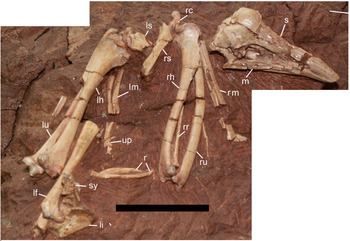
Holotype. Henan Museum of Natural History, L-08-7-3, an articulated partial skeleton with complete skull (Fig. 1).
Type specimen of Yuornis junchangi, L08-7-3, from the Upper Cretaceous Qiupa Formation of Henan, China. lf – left femur; lh – left humerus; li – left ilium; lm – left metacarpals; ls – left scapula; lu – left ulna; m – mandible; r – ribs; rc – right coracoid; rh – right humerus; rm – right metacarpals; rr – right radius; ru – right ulna; s – skull; sy – synsacrum; up – ungual phalanx. Scale bar: 50 mm.

Etymology. ‘Yu’ refers to an ancient name for Henan, the province where the specimen was found. Species name in honour of our late colleague Professor Lü Junchang (Chinese Academy of Geological Sciences), who was involved in the study but passed away on 9 October 2018.
Locality and horizon. Near Qiupa village, Luanchuan county, western Henan Province (north-central China). Continental red beds of the Qiupa Formation, Upper Cretaceous (Bureau of Geology and Mineral Resources of Henan Province, 1989; Zhou, Reference Zhou2005). The specimen was found in the course of excavations carried out by the Henan Museum of Natural History at a locality which yielded a diverse Late Cretaceous vertebrate assemblage (Xu et al. Reference Xu, Kobayashi, Lü, Lee, Liu, Tanaka, Zhang, Jia and Zhang2011) including lizards, turtles, mammals and dinosaurs.
Diagnosis. An edentulous enantiornithine (large scapular acromion; proximal margin of humerus saddle-shaped with concave cranial and convex caudal surfaces; minor metacarpal projecting distally further than major metacarpal; and femur with well developed posterior trochanter) with the following diagnostic features: both the antorbital fenestra and supratemporal fenestra completely confluent with orbit; quadratojugal with hook-like process that curves around the lateral condyle of the quadrate; acromion process with narrow pedicel with a sulcus on the lateral surface; deltopectoral crest more than one-third the length of the humerus and separated from the dorsal tubercle (continuous in most enantiornithines). Differs from Gobipteryx in having a proportionately longer and narrower rostrum that is not upturned rostrally, presence of a well developed nasal process on the maxilla (absent in Gobipteryx) and external nares that are proportionately narrower (ventral and caudal margins forming a 143° angle in Yuornis versus 118° in Gobipteryx) (see online Supplementary Materials, available at http://journals.cambridge.org/geo, for differential diagnosis).
3. Description
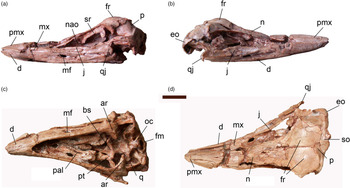
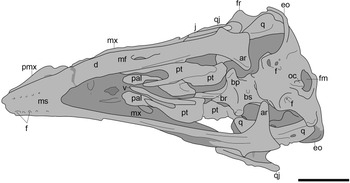
The skull, with the mandible preserved in occlusion, is well preserved despite some compression (Fig. 2). The palate (Fig. 3) has undergone some dislocation but is mostly exposed (Fig. 3). The premaxillae are roughly triangular in dorsal outline, with a slightly rounded tip. No median suture is visible between them. As in Gobipteryx (Kurochkin, Reference Kurochkin1996; Chiappe et al. Reference Chiappe, Norell and Clark2001), the premaxillary corpus is massive compared with most Early Cretaceous enantiornithines – the imperforate region of this element forms nearly half the rostral margin compared with one-third or less in older taxa (O’Connor & Chiappe, Reference O’Connor and Chiappe2011; Wang et al. Reference Wang, Hu and Li2016) – and the maxillary process of the premaxilla is short so that the maxilla contributes to the facial margin, whereas it is reduced in neornithines. The premaxillary corpus is proportionately longer than in Gobipteryx and the tip of the beak forms a smaller angle in lateral view. The dorsal surface of the premaxilla bears a pair of grooves, as in Gobipteryx, ventral to which the premaxillary corpus is perforated by faint foramina. These two features are probably related to the presence of a rhamphotheca. The tip of the rostrum is not as upturned as in Gobipteryx. In dorsal view the frontal processes appear to contact the frontals (unlike most Early Cretaceous enantiornithines).
Skull of the type specimen of Yuornis junchangi in (a) left lateral, (b) right lateral, (c) ventral and (d) dorsal views. ar – articular; bs – basisphenoid; d – dentary; eo – exoccipital; fm – foramen magnum; fr – frontal; j – jugal; mf – mandibular fenestra; mx – maxilla; n – nasal; nao – nasoantorbital fenestra; oc – occipital condyle; p – parietal; pal – palatine; pmx – premaxilla; pt – pterygoid; q – quadrate; qj – quadratojugal; so – supraoccipital; sr – sclerotic ring. Scale bar: 10 mm.

Drawing of the type specimen of Yuornis junchangi in ventral view showing details of the palate. The areas shown in dark grey are poorly visible. ar – articular; bp – basipterygoid; br – basisphenoid rostrum; bs – basisphenoid; d – dentary; eo – exoccipital; f – foramen; fm – foramen magnum; fr – frontal; j – jugal; mf – mandibular fenestra; ms – mandibular symphysis; mx – maxilla; oc – occipital condyle; pal – palatine; pmx – premaxilla; pt – pterygoid; q – quadrate; qj – quadratojugal; v – vomer. Scale bar: 10 mm.

The maxilla has a long rostral process forming the ventral margin of the external naris. The long dorsal process forms the rostral border of the antorbital fenestra, separating it from the nares, whereas in Gobipteryx that process is reduced and the rostral border of the fenestra is formed by the nasal. In lateral view the rod-like jugal becomes dorsoventrally taller and slightly triangular caudally, a feature reminiscent of the plesiomorphic condition in theropods, but also observed in Ichthyornis (Field et al. Reference Field, Hanson, Burnham, Wilson, Super, Ehret, Ebersole and Bhullar2018). The quadratojugal forms a pointed rod that laterally overlaps the jugal rostrally. More caudally, it becomes flatter and deeper. Its caudal end is hook-shaped, with a ventral process that curves around the lateral condyle of the quadrate, whereas in Early Cretaceous enantiornithines the quadratojugal is a small L-shaped bone (O’Connor & Chiappe, Reference O’Connor and Chiappe2011; Wang et al. Reference Wang, Hu and Li2016). The poorly preserved nasals apparently form part of the dorsal border of the nares. They meet the frontals along a more or less transversal suture, at the level of the eyeball (as marked by the sclerotic rings, preserved on both sides). The external nares, shaped like obtuse triangles with rounded cranial and caudal margins, are relatively short.
There is no indication of a lacrimal or preorbital. As in some neornithines, the antorbital fenestra and the orbit are completely confluent, forming an elongate opening, whereas they are completely separated by the lacrimal in all Early Cretaceous enantiornithines (O’Connor & Chiappe, Reference O’Connor and Chiappe2011). The three-pronged quadrates are partly obscured by the mandible. The small squamosal is deeply concave rostroventrally, wrapping around the caudodorsal process of the quadrate. Dorsally it forms a small rostrally directed process marking the posterolateral border of the residual supratemporal fenestra, which is open and confluent with the orbit.
The large paired frontals are narrow rostrally but rapidly expand caudally, as in other birds. Their markedly convex and bulbous dorsal surface suggests well developed cerebral hemispheres. The orbital margin forms a projecting rim with a small postorbital process at the limit between the orbit and the supratemporal fenestra, but a free postorbital is apparently absent. Caudally, the frontal ends with a transverse ridge that overhangs the parietal. The unfused parietals are quadrangular, largely face caudally, form the convex floor of the supratemporal fenestra and bear a very distinct transverse nuchal crest. The large supraoccipital faces caudally forming the concave dorsal margin of the bean-shaped foramen magnum, which is preserved facing ventrally (caudally in other enantiornithines), and may indicate rotation of the braincase paralleling the condition in modern birds; the degree to which this results from deformation is unclear.
Lateral to the foramen magnum the occiput is deeply excavated, undercutting the rim of the foramen. It is unclear whether this area is formed by the supraoccipital or by the exoccipital, as these elements are fused. The occipital condyle appears large, comparable in size to the foramen magnum, whereas it is proportionately much smaller in Neuquenornis. The occipital bones are fully fused, as in Neuquenornis (Chiappe & Calvo, Reference Chiappe and Calvo1994). They are unfused in Early Cretaceous taxa, mostly represented by subadult material (O’Connor & Chiappe, Reference O’Connor and Chiappe2011). The basioccipital plate faces ventrally. The exoccipital bears two deep concavities in which there are four round foramina, the ventralmost of which is considerably larger than the others. These are interpreted as the openings for the hypoglossus nerve XII and differ from the condition in Neuquenornis, which has only two equally sized foramina (Chiappe & Calvo, Reference Chiappe and Calvo1994). The basisphenoid lamina bears well developed basipterygoid processes, projecting laterally as in palaeognaths. The well preserved pterygoids are elongate, rostrally forked flat bones. An ectopterygoid appears absent. The median ramus apparently meets the poorly preserved rod-like vomers and the lateral ramus the palatine. The poorly preserved palatines are blade-like. The rostral portion of the palate is obscured by the mandible.
The well developed symphysis of the toothless, V-shaped mandible is formed by the rostral quarter of the dentaries, roughly as in Gobipteryx (Chiappe et al. Reference Chiappe, Norell and Clark2001), whereas there is no mandibular symphysis in Early Cretaceous taxa. The long and narrow rami have a sharp ventral margin. Caudally, the dorsal margin of the rami is markedly convex, forming a coronoid elevation as in Gobipteryx. There is a distinct fenestra just caudal to the middle of the mandible. The limits between the various bones of the mandible are unclear due to fusion. In the articular area there is a small distinct spur-like lateral process and, slightly more caudally, a strong spur-like medial process. The retroarticular process is very short and rounded in outline.
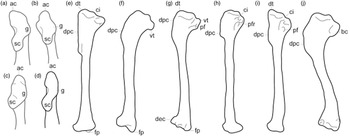
The postcranial elements comprise a synsacral fragment, two caudalmost thoracic ribs, incomplete scapulae and coracoids, well-preserved humeri and ulnae, a radius, metacarpals, the first phalanx of the major digit, an incomplete left ilium, a left femur, an incomplete tibiotarsus and two distal phalanges of the fourth pedal digit. Several of these bones show clear enantiornithine characters. In the pectoral girdle, the scapula has a large acromion and the coracoid shows the usual enantiornithine morphology of the proximal articular head, with the straight acrocoracoid proximodistally in line with the glenoid and flat scapular cotyla (Fig. 4). The weakly sigmoid humerus has a saddle-shaped proximal margin with concave cranial and convex caudal surfaces (Fig. 4); as in other Late Cretaceous enantiornithines, the epicondyles are round and bulbous (Sereno, Reference Sereno2000; Chiappe & Walker, Reference Chiappe, Walker, Chiappe and Witmer2002). The minor metacarpal projects distally farther than the major metacarpal. The first phalanx of the major digit is of the usual shape in all enantiornithines, not dorsoventrally compressed nor caudally expanded as in ornithuromorphs (Chiappe & Walker, Reference Chiappe, Walker, Chiappe and Witmer2002; O’Connor & Chiappe, Reference O’Connor and Chiappe2011). The femur bears a well developed posterior trochanter. Interestingly, the caudalmost thoracic ribs (‘floating vertebral ribs’) are unusually expanded and strongly reminiscent of the condition in the kiwi (Apteryx) (Owen, Reference Owen1841).
Comparative anatomy of select enantiornithine (a–d) proximal coracoids and (e–j) humeri, not to scale: (a, e) NSP; (b) Martinavis sp. PVL4024; (c, h) Enantiornis leali; (d, j) Lingyiornis; (f) Parvavis chuxiongensis; (g) Martinavis vincei PVL4054; (i) Elbreteornis. All taxa are Late Cretaceous with the exception of Lingyiornis, an Early Cretaceous slab specimen with exceptional three-dimensional preservation of the skeleton. The coracoids are figured in dorsal view, whereas the humeri are drawn in caudal view (for comparison with NSP) with the exception of Lingyiornis (only the cranial surface is exposed). The drawings of the humeri of Elbreteornis and Parvavis and coracoids of Martinavis and Enantiornis have been reflected for sake of comparison. Anatomical abbreviations: ci – capital incision; dec – dorsal epicondyle; dpc – deltopectoral crest; dt – dorsal tubercle; fp – flexor process; g – glenoid; pf – pneumatic fossa; pfr – pneumatic foramen; vt – ventral tubercle.

Measurements: length of skull, 62 mm; width of occipital face of skull, 26 mm; length of mandible, 50 mm; length of right humerus, 73 mm; length of right ulna, 78 mm; and length of right radius, 72 mm.
4. Discussion
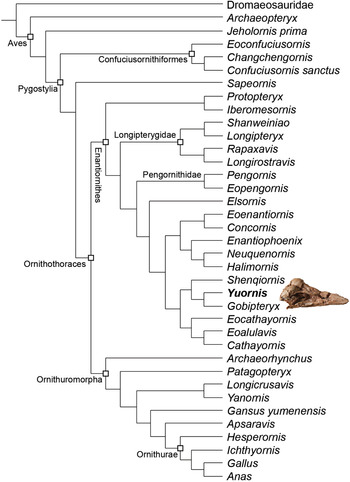
Although China has yielded most of the available information on Mesozoic birds, it mostly comes from a portion of the Early Cretaceous spanning only 11 million years (Zhou & Zhang, Reference Zhou and Zhang2006; Yang et al. Reference Yang, He, Jin, Zhang, Wu, Yu, Li, Wang, O’Connor, Deng, Zhu and Zhou2020). Yuornis junchangi represents the second known Late Cretaceous bird from China, after Parvavis chuxiongensis (Wang et al. Reference Wang, Zhou and Xu2014), a two-dimensional specimen from the Turonian–Santonian strata of Yunnan. Like Parvavis, Yuornis belongs to the Enantiornithes, the dominant clade of Cretaceous land birds, as confirmed by phylogenetic analysis (Fig. 5 and online Supplementary Material). With few exceptions (Elzanowski, Reference Elzanowski1976; Chiappe & Calvo, Reference Chiappe and Calvo1994; Chiappe et al. Reference Chiappe, Norell and Clark2001), most Late Cretaceous enantiornithines are represented by incomplete, disarticulated remains with numerous taxa erected on the basis of a single bone or less (Walker, Reference Walker1981; Chiappe, Reference Chiappe1993; Walker et al. Reference Walker, Buffetaut and Dyke2007; Panteleev, Reference Panteleev2018). L08-7-3 is arguably the most complete and well preserved specimen thus far. Phylogenetic analysis places Yuornis in a clade with Gobipteryx (see online Supplementary Material for complete results), a relationship based entirely on the complete absence of teeth, which is otherwise undescribed within Enantiornithes. Although the fragmentary nature of mature Gobipteryx specimens limits comparison, significant differences in the morphology of the maxilla and scapula suggest these two taxa are in fact not closely related. An edentulous rostrum evolved multiple times within Ornithuromorpha and the same was likely true of the Enantiornithes (O’Connor, Reference O’Connor2019). We therefore choose not to assign Yuornis to the Gobipterygidae.
Cladogram showing the position of Yuornis. See online Supplementary Material for phylogenetic methods and full results, available at http://journals.cambridge.org/geo.

The recent discovery of Falcatakely, although revealing a novel rostral shape within the Enantiornithes, indicated that numerous primitive morphologies (e.g. small, toothed premaxilla, complete postorbital bar) persisted in the enantiornithine lineage into the latest Cretaceous Period (O’Connor et al. Reference O’Connor, Turner, Groenke, Felice, Rogers, Krause and Rahantarisoa2020). The skull of Yuornis is the best preserved enantiornithine skull discovered to date being complete and preserved with minimal distortion. It reveals evolutionary trends that parallel those observed in the neornithine lineage (e.g. confluent orbit and antorbital fenestra through reduction of the lacrimal, loss of the postorbital, advanced fusion of cranial elements, possibly rotation of the braincase) as well as unusual characters indicating unique evolutionary trends within this enantiornithine lineage. The very different cranial morphologies of Falcatakely, with its numerous primitive features, and Yuornis, with its many derived characters, testify to the large amount of morphological divergence among enantiornithines during the late stages of their evolutionary history.
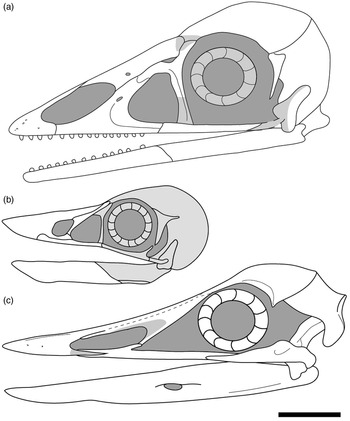
The reduction of the lacrimal and postorbital occurred independently in enantiornithines and ornithuromorphs. In Early Cretaceous enantiornithines, the Late Cretaceous enantiornithine Falcatakely (O’Connor et al. Reference O’Connor, Turner, Groenke, Felice, Rogers, Krause and Rahantarisoa2020) and Late Cretaceous ornithurines (Field et al. Reference Field, Hanson, Burnham, Wilson, Super, Ehret, Ebersole and Bhullar2018), the lacrimal is a robust free element forming the lacrimal bar that completely separates the antorbital fenestra from the orbit, as in non-avian dinosaurs. In Yuornis (and possibly in Gobipteryx) no lacrimal bar is present and the orbit and antorbital fenestra are confluent: the earliest known evidence of such a condition in Aves (Fig. 6). This morphology may also have evolved early in neornithines as the lacrimal is also not preserved in the Late Cretaceous neornithine Asteriornis and may have been absent or reduced (Field et al. Reference Field, Benito, Chen, Jagt and Ksepka2020).
Reconstructed skulls of three enantiornithines, in left lateral views. (a) Pengornis (Early Cretaceous, China); (b) Gobipteryx (Late Cretaceous, Mongolia); and (c) Yuornis (Late Cretaceous, China). Missing parts are shaded. Scale bar: 10 mm. Original drawing by Jingmai O’Connor.

During the course of avian evolution the supratemporal bar was lost through reduction of the postorbital and squamosal, which helped to free the skull for kinesis. A large free postorbital is present in Archaeopteryx, the basal pygostylians Sapeornis and Confuciusornis, and some Early Cretaceous enantiornithines, in which it articulates with the jugal to form a complete postorbital bar (Wang et al. Reference Wang, O’Connor, Zhao, Chiappe, Gao and Cheng2010, Reference Wang, O’Connor and Zhou2019; Rauhut et al. Reference Rauhut, Foth and Tischlinger2018; Hu et al. Reference Hu, O’Connor, McDonald and Wroe2020 a, b). In the enantiornithine lineage this morphology also persisted into the Late Cretaceous Period, as indicated by Falcatakely (O’Connor et al. Reference O’Connor, Turner, Groenke, Felice, Rogers, Krause and Rahantarisoa2020). However, this element appears completely absent in Yuornis and the Ornithuromorpha (including all extant taxa); instead, the frontal bears a postorbital process similar to that observed in neornithines, including Asteriornis (Field et al. Reference Field, Benito, Chen, Jagt and Ksepka2020). Postorbital reduction occurred independently in another enantiornithine lineage, the Early Cretaceous Pengornithidae (see Zelenkov, Reference Zelenkov2017 for a list of ornithurine-like characters in Pengornithidae), suggesting this element was reduced multiple times during enantiornithine evolution (Sanz et al. Reference Sanz, Chiappe, Pérez-Moreno, Moratalla, Hernández-Carrasquilla, Buscalioni, Ortega, Poyato-Ariza, Rasskin-Gutman and Martinez-Delclòs1997; Zhou et al. Reference Zhou, Clarke and Zhang2008). However, in specimens in which the postorbital is reduced it is still present as an independent ossification (Zhou et al. Reference Zhou, Clarke and Zhang2008); Yuornis is the first enantiornithine to provide compelling evidence that a free postorbital was absent and definitively demonstrates the loss of the complete postorbital bar, paralleling the condition in modern birds. The loss of these bony connections in the skull and the presence of a transverse nasofrontal contact suggests the increased potential for cranial kinesis in Yuornis relative to other enantiornithines.
Although teeth persist in various Late Cretaceous enantiornithines (O’Connor et al. Reference O’Connor, Turner, Groenke, Felice, Rogers, Krause and Rahantarisoa2020; Nava et al. Reference Nava, Alvarenga, Chiappe and Martinelli2015), the discovery of a second edentulous taxon indicates that several lineages paralleled modern birds in the evolution of a beak. As in crown birds, the premaxillary corpus is fused and enlarged relative to the maxilla in derived enantiornithines, although not to the same degree. In contrast, despite the fact the rostrum is proportionately enlarged relative to other enantiornithines, forming a morphology superficially similar to that in modern toucans (Ramphastidae), the premaxilla remains very small in Falcatakely (O’Connor et al. Reference O’Connor, Turner, Groenke, Felice, Rogers, Krause and Rahantarisoa2020). In this taxon, as in other enantiornithines and non-neornithine ornithuromorphs, rostral expansion is achieved through an enlarged maxilla (O’Connor et al. Reference O’Connor, Wang and Hu2016, Reference O’Connor, Turner, Groenke, Felice, Rogers, Krause and Rahantarisoa2020).
An autapomorphy of Yuornis relative to other known enantiornithines is the dorsoventral expansion of the jugal and quadratojugal, reminiscent of the plesiomorphic condition in non-avian theropods and Sapeornis (Hu et al. Reference Hu, O’Connor, McDonald and Wroe2020 a); interestingly, Ichthyornis also shows a deep jugal (Field et al. Reference Field, Hanson, Burnham, Wilson, Super, Ehret, Ebersole and Bhullar2018), probably indicative of convergence with Yuornis. Unlike any other known bird, the quadratojugal is broader than the jugal and bears a large ventral process that wraps around the quadrate, whereas in living birds this element is fused to the jugal forming the jugal bar, which articulates with the mandibular process of the quadrate. Although some cranial trends parallel those of neornithines, the unique morphology in Yuornis indicates that the jaw mechanics of at least one enantiornithine lineage was completely unlike that of any living bird.
5. Conclusion
The holotype of Yuornis junchangi represents the second Late Cretaceous bird known from China. The skull is complete and preserved in three dimensions, representing the best known enantiornithine skull recovered to date. The morphology reveals trends that parallel those observed in modern birds including the loss of teeth – only the second known occurrence of an edentulous rostrum in enantiornithines – as well as the loss of the lacrimal and the postorbital. All these morphologies may suggest a greater potential for cranial kinesis in this taxon relative to other known enantiornithines. Together with the recently described Falcatakely, these enantiornithines exemplify the diversity of evolutionary trajectories exploited by enantiornithines during the latest Cretaceous Period.
Acknowledgements
This study was supported by the Natural Science Foundation of China (No. 41272022); the Henan Provincial department funding for ‘Research on Luanchuan dinosaur fauna’ (2011-622-2) and ‘Exploration and Mining Right’ of Geological Research Project from Henan Land Resources Department, ‘Study on Giant Sauropods from the Cretaceous of Henan Province’ (No. 2015-1992-22). We are grateful to the reviewers, Federico Agnolin and Daniel Field, for their constructive comments. The authors declare no competing interests.
Supplementary material
To view supplementary material for this article, please visit https://doi.org/10.1017/S0016756821000807