


Introduction
Although more than half of the Palaeolithic parietal art assemblages recorded in Europe are located in the Iberian Peninsula, their distribution within this territory is markedly uneven. Regions such as Cantabria and the Basque Country in the north, and Andalusia in the south, contain a high concentration of caves with Palaeolithic imagery, whereas other areas, including Catalonia and the north-eastern Iberian Peninsula more generally, have yielded only sporadic and fragmentary evidence (Bicho et al. Reference Bicho2007; Sauvet et al. Reference Sauvet and Smith2020; Villaverde & Cantó Reference Villaverde, Cantó and Gordón Baeza2022).
Until recently, only two parietal representations attributed to the Upper Palaeolithic (43/30 000–12 000 cal BP) were known from Catalonia. One, a black-painted bovid from the Cova del Tendo (Sant Carles de la Ràpita) attributed to a pre-Magdalenian (43/40 000–19 000 cal BP) phase (González Reference González1964), was stolen shortly after its discovery and is documented today only through photographs and a tracing. The second is an incomplete figure, possibly a deer, documented in the Cova de la Taverna (Margalef de Montsant), although its anthropic origin remains uncertain (Fullola & Viñas Reference Fullola and Viñas1985; Villaverde Reference Villaverde1994a).
The scarcity of Palaeolithic graphic representations in this region is also evident in the portable record. The only figurative imagery dating between the Gravettian and the Middle Magdalenian (36/33 000–17/16 000 cal BP) is the geometric incised decorations on bone and antler tools, including spearpoints, harpoons and rods, documented at sites in northern Catalonia: Bora Gran d’en Carreras (Campeny Reference Campeny2009), Reclau Viver (Soler & Maroto Reference Soler, Maroto and Montet-White1996), Cova de l’Arbreda (Subils & Maroto Reference Subils and Maroto2009) and Cova del Parco (Mangado et al. Reference Mangado2016). Figurative and geometric representations on pebbles or plaquettes are restricted to the transition between the Late–Final Magdalenian and the Epipalaeolithic (12 000–7000 cal BP). Within this context, the site of Molí del Salt, located approximately 5km from the Cova de la Font Major, stands out for the quantity and diversity of engraved and/or painted pieces, some of which remain unpublished, distributed across three archaeological levels dated between 13 500 and 8700 cal BP (García Díez & Vaquero Reference García and Vaquero2006; Rufà et al. Reference Rufà2018).
Traditionally, the absence of Palaeolithic parietal art in certain regions has been linked to a lack of pre-Magdalenian occupations. Despite the abundance of Late Palaeolithic sites in Catalonia, knowledge of Upper Palaeolithic occupations was, until recently, limited to a small cluster of sites in the Pla de l’Estany region (Girona), near the French border. In the past decade, discoveries of Aurignacian, Gravettian and Solutrean levels (43/40 000–19 000 cal BP) at sites such as Cova Foradada (Morales et al. Reference Morales2019) or Cova del Cudó (Arjanto et al. Reference Arjanto2023), in southern Catalonia, demonstrate continuous settlement throughout the Upper Palaeolithic.
This article presents the recently identified Palaeolithic rock art assemblage from the Cova de la Font Major, providing a detailed description of the cave’s context and the circumstances of discovery, a formal and thematic analysis of the engravings and a chronological assessment. These data contribute to the evaluation of the significance of the site in relation to both its graphic manifestations and the evidence for human occupation in the Mediterranean Iberian Peninsula during the Late Pleistocene.
The Cova de la Font Major
The Cova de la Font Major (410m above sea level (asl)) is located in the modern village of Espluga de Francolí, in the erosive basin of Conca de Barberà, at the south-eastern end of the Central Catalan Depression, a landform extending between the Pre-Pyrenees and the Catalan coastal ranges, linking westwards with the Ebro Depression (Figure 1).
Location of Cova de la Font Major; base map supplied by authors (figure by authors).

The cave forms part of a karst system known as Coves de l’Espluga, developed in Oligocene limestone conglomerates at the foot of the northern slope of the Muntanyes de Prades, a mountain range reaching 1200m asl. It is a binary karst system, fed by allochthonous input from the drained reliefs of the Muntanyes de Prades, with basal karstified units forming a conglomerate aquifer. Three entrances to the system are known, from which 3590m of galleries have been explored and mapped. The Francolí River rises within the system and, after flowing 60km through the Catalan pre-littoral range and the Camp de Tarragona plain, it reaches the Mediterranean Sea near the city of Tarragona. The Francolí basin represents one of the main natural communication routes between the coast and the Central Catalan and Ebro depressions.
The karst system comprises a dry zone and a section through which the underground river flows. The dry zone includes the Cova dels Moros (now called Cova del Castell), the Cova de la Vila and the part of the Cova de la Font Major between the entrance and the Sala del Llac. This latter area encompasses the Gatoneres de Cal Palletes, which hosts the Palaeolithic rock art (Figure 2). The submerged section extends from the Sala del Llac inwards to a second sump that has not yet been traversed, and outwards along the joint of the river until the water emerges at the surface through the Font Major.
Map of Cova de la Font Major beneath Espluga de Francolí showing the nomenclature of the galleries (top) and the sectors defined within the Gatoneres de Cal Palletes for the study of the graphic assemblage (bottom) (figure by authors).

The collapse of its entrance, probably during the Roman period (second–fifth centuries CE), prevented exploration of Cova de la Font Major until 1853, when it was accessed through the Pou del Palletes, a private well located in the courtyard of a town house. Only sporadic visits are recorded until 1956, when members of the Centre Excursionista Pirinenc explored and surveyed the cave, identifying the blocked entrance (Bosch Reference Bosch2023). In January 1957, the town council cleared this entrance, removing sediment to allow pedestrian access to more than 100m of the main gallery, later named the Galeria del Pessebre. These works, carried out mechanically and without archaeological supervision, destroyed a significant part of the archaeological deposit at the cave entrance (Vilaseca Reference Vilaseca1965, Reference Vilaseca1969). The discovery of archaeological remains, including a bronze object deposit (Vilaseca Reference Vilaseca1959; Graells et al. Reference Graells2008), attracted visitors, speleologists and treasure hunters, contributing to the degradation and partial loss of the archaeological record (for a more detailed historical background, see online supplementary material).
In 1993 the cave was converted into a museum and minor archaeological interventions accompanied the musealisation works and later expansions in 1993, 1997, 1998, 1999 and 2011 (Vergès & Viñas Reference Vergès and Viñas2023). The 2011 intervention by a team from the Institut Català de Paleoecologia Humana i Evolució Social (Cebrià et al. Reference Cebrià2014) confirmed that part of the entrance deposit had survived, leading to the inclusion of the site in the 2018 research project of the Departament de Cultura of the Generalitat de Catalunya, ‘Palaeoenvironmental evolution and prehistoric settlement in the basins of the Francolí, Gaià, Siurana rivers and ramblas of the Camp de Tarragona’.
The discovery of the Palaeolithic engravings
The Palaeolithic engravings were discovered fortuitously on 30 October 2019, during the first excavation campaign planned within the project. During a visit to a sector of the cave known as the Gatoneres de Cal Palletes, one of the authors observed that, among the numerous modern engravings and graffiti covering large portions of the walls, several engravings displayed Palaeolithic characteristics.
This identification was unexpected as the cave entrance had been open since 1957 and the Gatoneres de Cal Palletes were part of the so-called Adventure Route, a tourist attraction initiated in 1993; it was assumed that any prehistoric representations would have already been discovered. Moreover, the Cova de la Font Major was theoretically considered unsuitable for yielding Palaeolithic engravings because most of its walls, formed by conglomerate, are highly irregular both in relief and colour, which are conditions generally considered unfavourable for graphic production. Yet, the area has yielded the highest concentration of Palaeolithic parietal representations currently known in Catalonia. For more than six decades, thousands of visitors passed directly in front of the engraved surfaces, and in some cases inscribed names and dates over them, without the Palaeolithic origin of the figures being recognised.
Cova de la Font Major not only fills a significant geographical gap in the distribution of Palaeolithic parietal art but also demonstrates that no cave should be dismissed a priori, regardless of the suitability of its wall and ceiling surfaces or the intensity of human visitation.
The graphic assemblage
Location, support and technique
The graphic representations in the Gatoneres de Cal Palletes are approximately 250m from the current entrance, in a completely enclosed space adjacent to the subterranean river. This section consists of small galleries currently connected to the main gallery through three narrow passages. The morphology of the walls is highly irregular, creating numerous small concave recesses and unique surfaces defined by the natural relief. Ceiling heights vary considerably, ranging from less than 1m up to 3m, while the width averages around 2m. Today, movement through these galleries is relatively easy as a trench was excavated through the lower sections after 1853. Without this intervention, the galleries would be separated into two parts, as sedimentary infill had blocked the connection between sectors 2 and 3 (Figure 2). Although the exact morphology of the galleries during the Upper Palaeolithic is unknown, data from a test excavation in sector 5 indicate that the sedimentary fill would have been approximately 0.50m thinner around 37 000 years ago. Based on this estimate, the overall volume of the space would have been slightly larger but not substantially different from today, with all galleries containing engravings connected.
The engravings are located exclusively on the marl layers intercalated among the Lower Oligocene limestone conglomerates, which are suitable for engraving due to their homogeneity and low consistency. The physical properties of these marl layers allow lines to be produced using any minimally solid implement, as evidenced by their high sensitivity to recent anthropic alterations, including direct contact with hands, finger-made graffiti and accidental impacts.
To facilitate analysis, the engraved space is divided into five main sectors (Figure 2), further subdivided into panels, following the geomorphology of the Gatoneres. All sectors, except the final stretch of sector 5, show significant wall alterations resulting from human visitation from 1957 onwards (graffiti and/or erosion through contact). This has hindered the identification and documentation of some graphic elements and suggests that the Palaeolithic corpus was originally numerically larger than that currently preserved, which to date comprises 280 graphics. These are classified into graphic units, defined as distinct graphic entities representing tangible elements (e.g. zoomorphs) and/or concepts (e.g. signs), and graphic sets, which group together elements linked without a clearly defined formal configuration (e.g. multiple strokes without an apparent pattern). Among the identified graphic units there are 55 zoomorphic representations, with a particularly high concentration in sector 5, which contains 33 figures.
The assemblage was produced using the engraving technique; characteristics of the grooves indicate that this was predominantly achieved through simple incisions and, to a lesser extent, through scraping. In some cases, both techniques were combined. Measurements derived from high-resolution 3D models of the gallery walls indicate that most grooves are 3–7mm wide and shallow. Visibility is enhanced by the chromatic contrast between the groove and the support material. Around 80 per cent of the figurative representations fall within a size range of 150–450mm in length and 80–260mm in width.
To date, no evidence for human intervention in the preparation of the support prior to the execution of the engravings has been identified. In some cases, natural relief, textural variations and fissures might have been intentionally incorporated into the composition of figures or scenes. While the intentional integration of these natural features remains interpretative and cannot be definitively demonstrated, their proposed use is supported by precise anatomical alignment with some features and the recurrent use of similar elements across the corpus. For example, the discontinuity between conglomerate and marl layers appears to have functioned as a ground line for certain figures (Figure 3) while in others horizontal fissures could represent a ground or water surface. In the latter case, the compositional use of a fissure that intersects a cervid muzzle is suggested by the fact that the figure could have been positioned higher, aligning with a more homogeneous surface and thus avoiding the discontinuity (Figure 4).
Representation of a horse (sector 5), in which the limit of the conglomerate is used as the ground line for the figure (figure by authors).

Representation of a descending cervid protome with the ears depicted (sector 3). The muzzle intersects a horizontal fissure, possibly representing a ground or water surface (figure by authors).

Thematic analysis
Within the graphic assemblage of the Cova de la Font Major, non-figurative elements constitute most of the repertoire identified to date. Among the most frequent representations are straight, parallel lines, arranged in groups of two, three or four, sometimes superimposed over zoomorphic figures. Larger groupings have also been documented, primarily composed of between 15 and 40 aligned parallel lines (Figure 5). Other, less common motifs include convergent lines, circular or semicircular forms and quadrangular shapes, as well as various compositions that are difficult to classify.
Top) representation of a series of parallel lines (sector 5); bottom) partial view of panel 2 in sector 2, characterised by hundreds of loop-shaped engravings (figure by authors).

Panel 2 of sector 2, is characterised by a particularly distinctive composition, comprising hundreds of loop-shaped engravings, either isolated or forming connected series with a predominantly horizontal development (Figure 5). The chronological attribution of these engravings remains uncertain, and no clear parallels have yet been identified within other Palaeolithic assemblages. However, radiocarbon dating of a charcoal fragment recovered from within an engraved groove indicates that some of the incisions are not later than the seventeenth century. This is further supported by the presence of a superimposed inscription bearing the date 1199, whose formal characteristics differ from those of loop-shaped motifs and which provides a terminus ante quem. Consequently, further research is required to clarify their cultural attribution (Salas-Altès et al. Reference Salas-Altès2026).
The principal taxa represented by the zoomorphic figures include equids (Figure 3), caprines, cervids (mostly identified as females) and bovids (Figure 6). A rare depiction of a bear is found in sector 5 (Figure 7). The represented taxa generally align with the common theme of Mediterranean Iberian art, where species from colder environments are absent (Villaverde Reference Villaverde1994b). However, 30 per cent of the 55 faunal representations could not be identified at a taxonomic level and an additional 15 per cent are classified between two taxa due to the difficulty of precise determination (e.g. caprine/deer). This low rate of identification is largely due to multiple anatomical deformations affecting the head, neck, trunk and/or limbs. Some figures also depict gravid abdomens. The limited depiction of internal anatomical details, such as eyes, nostrils, hooves, mane and coat, also makes taxonomic attribution difficult, often reducing the representation to a simple body outline, occasionally including elements such as ears and/or tail.
Representation of the anterior half of an auroch with horns and ears depicted in frontal perspective (sector 5) (figure by authors).

Representation of a bear with ears shown in frontal perspective and a slightly open mouth (sector 5), a singular taxon within the Palaeolithic art repertoire (figure by authors).

Chronological considerations
Dating Palaeolithic parietal art is complex. Direct dating, provided that the limitations inherent to each method are properly recognised and evaluated, generally yields more reliable results than chronological estimates based on indirect dating (Von Petzinger & Nowell Reference von Petzinger and Nowell2011; Ochoa et al. Reference Ochoa2021). The applicability of such methods in the Cova de la Font Major is currently limited, although at least one zoomorphic representation covered by calcite deposits offers the possibility of direct uranium-series dating, which will be undertaken at a later stage. Even where reliable dates are obtained, such point dates do not, on their own, establish a chronology for the entire assemblage. For this reason, it is necessary to rely on relative chronological evidence, such as archaeological context and stylistic analysis.
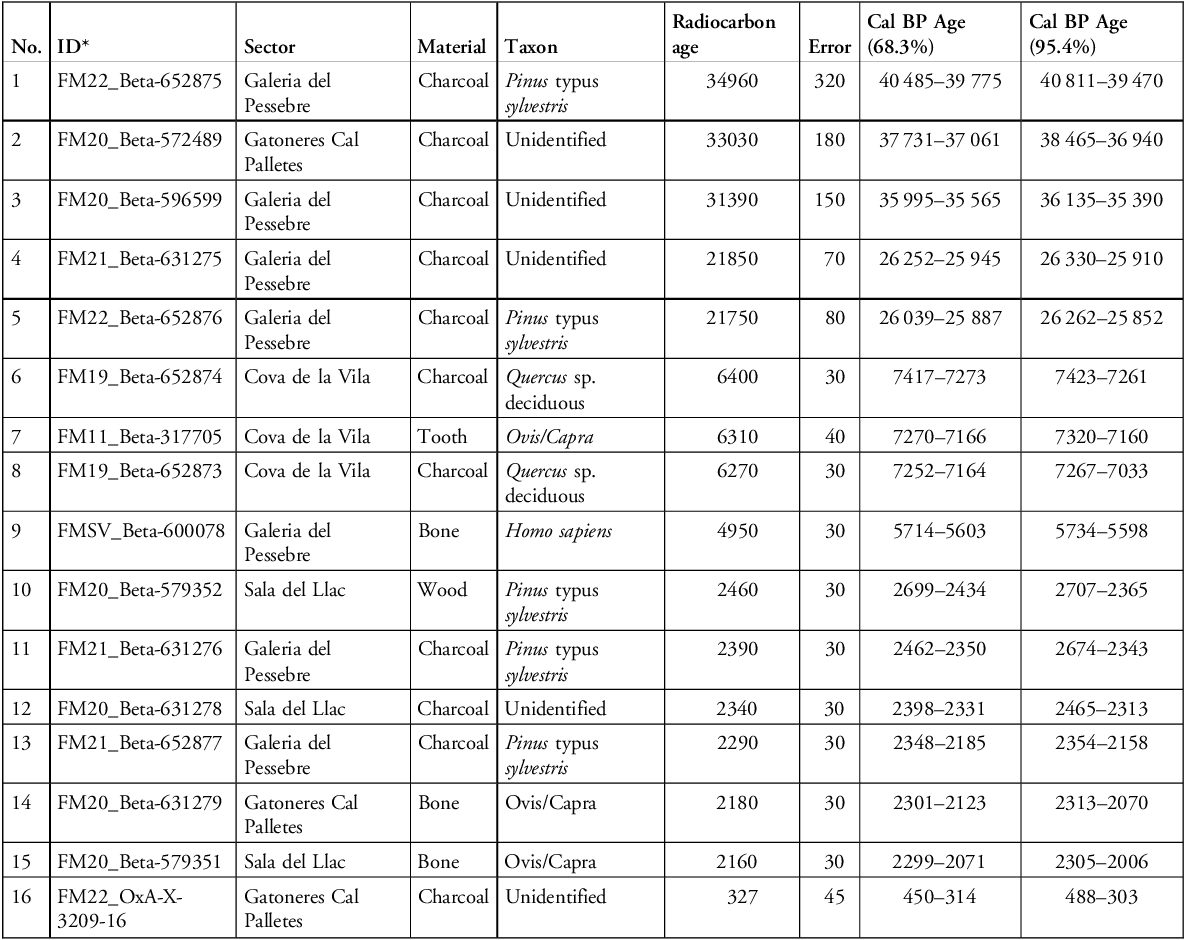
Archaeologically, the cave can be divided into two clearly differentiated sectors: the access area of the Cova de la Font Major and the western entrance of the Cova de la Vila, and the dry zone adjacent to the subterranean river, situated approximately 250m from the current entrance (Figure 8 & Table 1). In the entrance zone, occupations are documented from the Upper Palaeolithic/Epipalaeolithic to the Bronze Age (4200–2700 cal BP). Three radiocarbon dates place the earliest Neolithic phases between 7050 and 7400 cal BP. Towards the end of the Neolithic, part of the Galeria del Pessebre close to the entrance was used for burial purposes: a human femur excavated from this area in 1957 yielded a radiocarbon date of between 5700 and 5600 cal BP (FMSV_Beta-600078, see Table 1). Among the Bronze Age remains, a hoard of bronze artefacts was discovered approximately 50m from the entrance, in the area known as La Mamella, comprising two fragments of a dagger or sword, a complete dagger, a socketed axe and two disc-headed pins with solar decorations, typologically attributed to the Final Bronze Age (3200–2700 cal BP) (Vilaseca Reference Vilaseca1959; Graells et al. Reference Graells2008). Some fragments of Roman tegulae were also documented near the entrance (Vilaseca Reference Vilaseca1969), indicating the last phase in which the gallery was accessible via that route.
Cave map of Cova de la Font Major indicating the locations from which radiometric dates were obtained (top) and the chronological model of these dates generated using OxCal v.4.4.4. (bottom), distinguishing those obtained from the deep part (in purple) of the cave entrance (in yellow) (figure by authors).

Available radiocarbon dates from Cova de la Font Major. Calibrated in OxCal v.4.4 (Bronk Ramsey Reference Bronk Ramsey2021) with IntCal20 (Reimer et al. Reference Reimer2020).

Table 1 Long description
A table with 16 rows and 7 columns detailing radiocarbon dates from Cova de la Font Major. The columns are labeled No., ID, Sector, Material, Taxon, Radiocarbon age, Cal BP Age Error (68.3%), and Cal BP Age (95.4%). Each row provides specific data for different samples, including their sector, material, taxon, radiocarbon age, and calibrated age ranges. The table includes various materials like charcoal, tooth, bone, and wood, with different taxa identified. The radiocarbon ages range from 327 to 34960, and the calibrated age ranges vary accordingly.
* The year followed by the abbreviation for Font Major (FM) indicates the archaeological campaign during which the material was recovered.
In the inner zone (Gatoneres de Cal Palletes, the final stretch of the Galeria del Pessebre and the Sala del Llac), evidence of human presence clusters into two distinct periods: 40 000–26 000 cal BP and the eighth to second centuries BCE. For the interval between 26 000 cal BP and the eighth century BCE, no radiocarbon dates or archaeological remains attest to any human presence inside the cave beyond the areas immediately adjacent to the entrances.
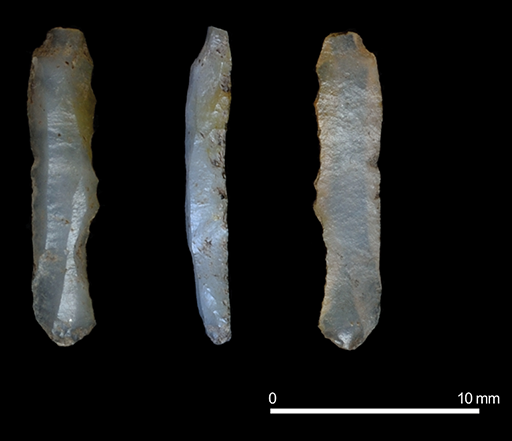
Upper Palaeolithic dates are predominantly derived from charcoal recovered from layers containing no other evidence of human activity. The only exception is a layer that returned a date of 26 000 cal BP, from which a small flint backed bladelet (Figure 9) was also recovered. The fact that the charcoals are found only in the vicinity of the Sala del Llac and downstream suggests they were generated within the cave, with a human origin.
Flint backed bladelet recovered from a level dated to 26 000 cal BP (Galeria del Pessebre) (figure by authors).

The later dates are associated with the Iron Age sanctuary in the Sala del Llac, a space used for ritual purposes between the eighth and sixth centuries BCE and again between the late third and second centuries BCE. Rituals carried out in this space included the deposition of hundreds of ceramic vessels (possibly gifts or votive offerings), metal objects (personal ornaments and weapons), ovicaprine limbs (from the metapodial down) and agricultural products, mainly naked wheat (Triticum aestivum/durum or compactum) and hulled barley (Hordeum vulgare), with occasional finds of rye (Secale cereale) and a grape pip (Vitis vinifera subsp. vinifera). Residues of wine, possibly used in libations, were identified in one of the ceramic vessels (Capella et al. Reference Capella2025).
Although the Cova de la Font Major was ‘rediscovered’ in 1853, an inscription dated 1199 and a date of 327±45 BP obtained from a firebrand left against the wall (Marcos García-Diez pers. comm. 2023), both located in the panel of signs (panel 2, sector 2) a few metres from the Pou de Cal Palletes, indicate earlier visits in the second millennium CE. A plausible hypothesis is that the system could be accessed via Cal Palletes from at least the twelfth century, either through the mentioned well, should a perforation had already been made by then, or via a fissure that was later exploited to construct the well. A fissure may also have served as the access point during the Iron Age, given that the Galeria del Pessebre was heavily infilled at that time, making the current entrance difficult to use.
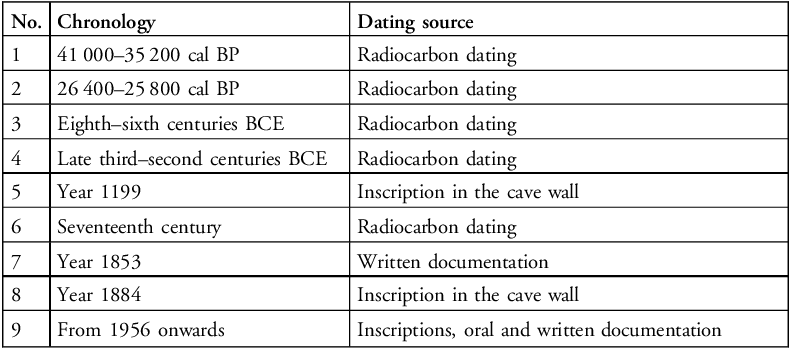
Thus, human presence documented in the deeper parts of the cave through radiocarbon dates, inscriptions or written documentation occurs as outlined in Table 2. While the absence of evidence does not necessarily imply an absence of activity in the cave, documented human activity prior to the seventh century BCE does seem to be limited to the Aurignacian and Gravettian periods.
Chronological synthesis of human presence documented in the inner galleries of the cave.

Table 2 Long description
A table with nine rows and three columns detailing the chronology of human presence in a cave. The columns are labeled No., Chronology, and Dating source. The rows list specific time periods and the corresponding dating sources. Row 1: 41 000–35 200 cal BP, Radiocarbon dating. Row 2: 26 400–25 800 cal BP, Radiocarbon dating. Row 3: Eighth–sixth centuries BCE, Radiocarbon dating. Row 4: Late third–second centuries BCE, Radiocarbon dating. Row 5: Year 1199, Inscription in the cave wall. Row 6: Seventeenth century, Radiocarbon dating. Row 7: Year 1853, Written documentation. Row 8: Year 1884, Inscription in the cave wall. Row 9: From 1956 onwards, Inscriptions, oral and written documentation.
The Palaeolithic context of the cave’s inner zones aligns with the chronological patterns of certain graphic conventions observed in the assemblage. This includes the double Y-shaped extremities and tri-lined heads of some zoomorphs (Figure 10), also recognised in multiple Mediterranean assemblages linked to pre-Magdalenian chronologies (Fortea Reference Fortea1978; Villaverde Reference Villaverde1994a & Reference Villaverdeb; Gárate & González Reference Gárate, González and Arias Cabal2012; Hernando Reference Hernando2013; Clottes et al. Reference Clottes2015; Feruglio et al. Reference Feruglio2020; Foucher et al. Reference Foucher and Angás2022; Brochard et al. Reference Brochard2022). A comprehensive study of the assemblage, currently underway, will allow further discussion of the chronology as research progresses.
Above) representations following the double-Y limb convention (hind limbs); below) figures with trilinear heads (figure by authors).

Discussion
The discovery of the abundant graphic corpus at the Cova de la Font Major substantially transforms current knowledge of Palaeolithic cave art in the Mediterranean context of the Iberian Peninsula. Until recently, the apparent geographical gap in Catalonia, where only two isolated parietal representations had been tentatively identified, stood in marked contrast to the proximity of the Franco-Cantabrian region, widely recognised for the density and richness of its Palaeolithic manifestations (Bicho et al. Reference Bicho2007: 95–96).
The exceptional nature of the Font Major assemblage becomes evident when compared with broader patterns documented along the Iberian Mediterranean façade, from the Pyrenees to Gibraltar, where approximately 75 per cent of known assemblages contain a maximum of five zoomorphic figures, and more than 90 per cent do not exceed 20. In this context, the Cova de la Font Major constitutes, in quantitative terms, the third-largest Palaeolithic parietal assemblage across the entire Iberian Mediterranean façade, with 55 zoomorphic representations, surpassed only by Ardales and La Pileta, both located at the southern extremity of the peninsula. As such, the cave represents the first and, to date, only major Palaeolithic cave art assemblage documented in the eastern peninsula, establishing it as a key reference point for the study of Mediterranean Palaeolithic graphic expression (Bicho et al. Reference Bicho2007: 140; Villaverde Reference Villaverde and Soler Díaz2018).
Beyond its quantitative significance, the site is also of particular importance for understanding the early Upper Palaeolithic in southern Catalonia, a territory traditionally considered marginal during this period. Archaeological evidence documents human presence in the inner galleries of the cave between 40 810 and 25 850 cal BP, with an apparent hiatus extending from 35 400 to 26 300 cal BP. These data, together with graphic conventions such as double Y-shaped extremities and tri-lined heads, are consistent with an attribution of the engravings to pre-Magdalenian phases. However, it is still too early to rule out the existence of engravings dating to the Magdalenian or later periods (Morales et al. Reference Morales2019).
The fact that a parietal assemblage of this magnitude remained unrecognised until very recently, despite the intense visitation of the cave over recent decades, highlights a critical methodological issue concerning the identification of rock art in heavily frequented caves. This case demonstrates that significant graphic assemblages may persist even in contexts that have been strongly anthropised in modern times. As observed in other sites, systematic re-evaluations combined with updated methodological approaches are essential, even when dealing with supports considered unfavourable, such as conglomerates, and in spaces affected by superimposed recent anthropic alterations (Medina-Alcaide et al. Reference Medina-Alcaide2018: 65–66).
Within this framework, the discovery at the Cova de la Font Major has prompted new research initiatives, including the survey of the Cova Simanya, which has likewise yielded positive results regarding the presence of Palaeolithic graphic expressions. These recent discoveries place the north-eastern Iberian Peninsula at the centre of current debates on Palaeolithic art and open new research perspectives in territories long considered devoid of such evidence (Salas-Altès et al. Reference Salas-Altès2024).
Conclusions
The identification of the engraved assemblage in the Cova de la Font Major represents a substantial advance in the understanding of Palaeolithic rock art in the eastern Iberian Peninsula. These findings contribute to redressing the long-standing imbalance in the geographical distribution of documented Palaeolithic cave art within this region and raise important methodological considerations. The recognition of graphic manifestations in caves that have been intensively visited for decades highlights the extent to which apparent gaps in the Palaeolithic record may reflect limitations in research strategies, visibility conditions or preservation factors, rather than the actual absence of rock art practices.
The scale and thematic diversity of the Font Major corpus, now among the largest documented Palaeolithic parietal assemblages along the peninsular Mediterranean façade, contributes to a reassessment of human occupation dynamics in Catalonia during the earlier Upper Palaeolithic, challenging previously proposed demographic discontinuities. In this regard, the site underscores the need for systematic rock art research in a territory that has demonstrated a clear potential for further discoveries.
Acknowledgements
We thank Ramon Viñas for his collaboration during the prospecting and recording of the engravings, and Marcos García for his support throughout the study. We are also grateful to Juan Ignacio Morales, Andreu Ollé and Marta Fontanals for their assistance during the excavation and sampling procedures. Additional thanks are due to the Tourism Office of l’Espluga de Francolí and the guides of the Cova de la Font Major for their logistical support. We further acknowledge the contribution of the staff of Drac Actiu, in particular Chantal Puig, for their assistance during the exploration of the subterranean river sector.
Funding statement
The research at Cova de la Font Major is funded by the Department of Culture of the Generalitat de Catalunya through project CLT009/22/00024, by Agència de Gestió d’Ajuts Universitaris i de Recerca (AGAUR) (SGR2021-01239 and 2021 SGR 01237), by the Universitat Rovira i Virgili (2023PFR-URV-01239) and by the City Council of l’Espluga de Francolí. The IPHES-CERCA has received financial support through the ‘María de Maeztu’ program for Units of Excellence (CEX2024-01485-M/funded by MICIU/AEI/10.13039/501100011033). MSA’s work is supported by a doctoral Formación Profesorado Universitario (FPU) fellowship from the Spanish Ministry of Universities (FPU21/02177).
Online supplementary material (OSM)
To view supplementary material for this article, please visit https://doi.org/10.15184/aqy.2026.10447 and select the supplementary materials tab.
Author contributions: CRediT categories
Josep Maria Vergès Bosch: Conceptualization-Equal, Data curation-Equal, Formal analysis-Equal, Funding acquisition-Lead, Investigation-Equal, Methodology-Equal, Project administration-Lead, Resources-Lead, Supervision-Equal, Validation-Equal, Writing - original draft-Equal, Writing - review & editing-Equal. Míriam Salas-Altès: Conceptualization-Equal, Data curation-Equal, Formal analysis-Equal, Funding acquisition-Supporting, Investigation-Equal, Methodology-Equal, Supervision-Equal, Validation-Equal, Writing - original draft-Equal, Writing - review & editing-Equal.




 Open access

