Introduction
Worm therapy is seriously considered as an alternative approach for the treatment of allergic and autoimmune diseases (Bashir et al., Reference Bashir, Andersen, Fuss, Shi and Nagler-Anderson2002; Summers et al., Reference Summers, Elliott, Qadir, Urban, Thompson and Weinstock2003, Reference Summers, Elliott and Weinstock2010; Correale & Farez, Reference Correale and Farez2009; Pritchard, Reference Pritchard2009). This clearly indicates a deficiency in conventional therapies and the existence of a significant unmet clinical need. What follows is a brief appraisal of the evidence supporting worm therapy.
Readers of the article are then invited to tender an opinion on the potential merits of iatrogenic worm infection.
The evidence
Some epidemiological studies show a negative correlation between the presence of worm infection and clinical indicators of atopy (van den Biggelaar et al., Reference van den Biggelaar, van Ree, Rodrigues, Lell, Deelder, Kremsner and Yazdanbakhsh2000; Rodrigues et al., Reference Rodrigues, Newcombe, Cunha, Alcantara-Neves, Genser, Cruz, Simoes, Fiaccone, Amorim, Cooper and Barreto2008). However, how often does a reduction in skin prick test (SPT) responsiveness to allergen challenge in the presence of worm infection equate to clinical benefit? These studies do not in general address clinical benefit.
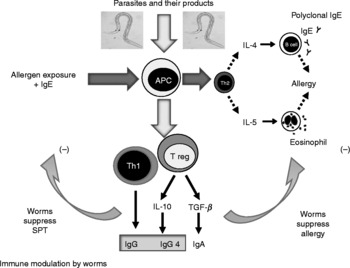
Murine models have been used repeatedly to show that worms alleviate immunological disease, and have been valuable in guiding immunologists toward the mechanisms responsible for disease modification (Wilson et al., Reference Wilson, Taylor, Balic, Finney, Lamb and Maizels2005; Smits et al., Reference Smits, Hammad, van Nimwegen, Soullie, Willart, Lievers, Kadouch, Kool, Kos-van Oosterhoud, Deelder, Lambrecht and Yazdanbakhsh2007; Dittrich et al., Reference Dittrich, Erbacher, Specht, Diesner, Krokowski, Avagyan, Stock, Ahrens, Hoffmann, Hoerauf and Hamelmann2008; Pacifico et al., Reference Pacífico, Marinho, Fonseca, Barsante, Pinho, Sales-Junior, Cardoso, Araújo, Carvalho, Cassali, Teixeira and Oliveira2009). Some of the possible mechanisms involved are considered in fig. 1.
Possible mechanisms by which helminths and their immune response modifiers (IRMs) suppress immunological disease, in this case allergy. Helminth infections can be controlled by the allergic phenotype, so it is in the interest of the parasite to be able to suppress the allergic response, possibly in a manner akin to allergen desensitization or immunotherapy. The involvement of regulatory leucocyte populations and the induction of allergen-neutralizing antibody isotypes have been proposed as mechanisms by which hypersensitivity is suppressed. APC, Antigen presenting cell; Ig, immunoglobulin; IL, interleukin; SPT, skin (prick) test; TGF, transforming growth factor; Th, T helper; T reg, regulating T cell. (Adapted from Robinson, D.S., Larche, M.L. & Durham, S.R. (Reference Robinson, Larché and Durham2004) Journal of Clinical Investigation 114, 1389–1397).

However, Mus musculus-entric researchers have a tendency to avoid using natural infection regimes, being reliant instead on high-dose, bolus infection. Naturally infected large animal systems may be preferable for the provision of interpretable immunobiological data.
Random controlled trials conducted to date and published have been small scale, and focused on safety as opposed to efficacy.
Of the trials conducted, Necator americanus has been shown to be safe, causing no change in lung function following pulmonary migration in rhinitis or asthma patients. Worms were resident in the gut for 12 weeks only, and little therapeutic benefit was expected (Mortimer et al., Reference Mortimer, Brown, Feary, Jagger, Lewis, Antoniak, Pritchard and Britton2006; Blount et al., Reference Blount, Hooi, Feary, Venn, Telford, Brown, Britton and Pritchard2009; Feary et al., Reference Feary, Venn, Brown, Hooi, Falcone, Mortimer, Pritchard and Britton2009a, Reference Feary, Venn, Mortimer, Brown, Hooi, Falcone, Pritchard and Brittonb). Similarly, the Trichuris suis ova product (TSO) was shown to be of no benefit in rhinitis, and explanations for this failure have been offered (Bager et al., Reference Bager, Arnved, Rønborg, Wohlfahrt, Poulsen, Westergaard, Petersen, Kristensen, Thamsborg, Roepstorff, Kapel and Melbye2010; Hepworth et al., Reference Hepworth, Hamelmann, Lucius and Hartmann2010). Conversly, TSO imparted benefit in inflammatory bowel disease (Summers et al., Reference Summers, Elliott, Qadir, Urban, Thompson and Weinstock2003, Reference Summers, Elliott, Urban, Thompson and Weinstock2005). However, some have expressed reservations about the use of a zoonotic infection (Kradin et al., Reference Kradin, Badizadegan, Auluck, Korzenik and Lauwers2006).
Summary
● Many immunological diseases are poorly served by existing, conventional therapy.
● Worms engage regulatory networks conducive to therapeutic benefit in immunological disease.
● Trials using worms are still very much a work in progress. Safety is paramount and seems to have been satisfied, although some reservations remain. Further therapeutic trials will follow.
● However, it is timely to ask whether worm therapy has unfulfilled potential or whether it is the product of flawed thinking.
● If worm therapy is accepted as tenable by the immuno-parasitological community, then we must address how worms can be delivered to translate the data from murine models into therapeutic benefit in patients, and/or direct research resources to the discovery and production of molecular equivalents (Pritchard, Reference Pritchard2005). Although the identity and, to a degree, the mechanisms of action of some active worm ingredients are known, none are close to clinical development at this time.
Acknowledgements
The author wishes to thank Gail Atkinson for her secretarial assistance. Our trials to date using ‘Necator americanus’ have been funded by the Wellcome Trust, Broad Foundation and MS Society.