Introduction
We've changed our service deliberately to make it a lot more personalised. We can offer much more help tailored around the individual's circumstances than ever before. (Ruth Owen, Chief Operating Officer for Jobcentre Plus, quoted by Waite, Reference Waite2009)
We will create a Work Programme which will move toward a single scheme that will offer targeted, personalised help for those who need it most, sooner rather than later. (Iain Duncan Smith, Secretary of State for Work and Pensions, Reference Duncan Smith2010)
The principle of personalisation – that services ‘should respond to the individual instead of the person having to fit with the service’ (Carr, Reference Carr2008: 3) – is widespread across the UK's public sector and is consistent with the growth and influence of ‘New Public Management’ principles in the UK over the past twenty-five years or so (Christensen and Laegreid, Reference Christensen and Laegreid2011). Although most closely associated with the New Labour government's personal budgets in adult social care, personalisation is also ‘shaping approaches to reform in the NHS, children's services, education, employment, housing and criminal justice’ (Needham, Reference Needham2011: 55) and the concept enjoys significant cross-party support. As Mansell and Beadle-Brown (Reference Mansell, Beadle-Brown, Cambridge and Carnaby2005: 21) put it: ‘There is now no serious alternative to the principle that services should be tailored to individual needs, circumstances and wants.’ But what does personalisation really mean? Considerable effort has gone into answering this question in theoretical terms. A common finding is that the concept is used, especially in policy documents, in ambiguous, elastic and sometimes contradictory ways (e.g. Borghi and van Berkel, Reference Borghi and van Berkel2007; Cribb and Owens, Reference Cribb and Owens2010; Cutler et al., Reference Cutler, Waine and Brehony2007; Ferguson, Reference Ferguson2007; Pykett, Reference Pykett2009; Valkenburg, Reference Valkenburg, Van Berkel and Valkenburg2007; and see Greener and Powell, Reference Greener and Powell2008, for a related discussion of the concept of choice). Various typologies have been proposed, with Leadbeater's (Reference Leadbeater2004) probably the best-known in the UK. These generally imply a continuum from ‘passive’ to more ‘active’ forms of participation by (potential) service users (Borghi and van Berkel, Reference Borghi and van Berkel2007). However, there has been little empirical study of how the personalisation principle is put into practice by public service providers on the frontline. This is crucial because, as Lipsky (Reference Lipsky2010) famously argued, public policy is made not only in government departments but also at ‘street level’ – ‘in the daily encounters between the public and staff in schools, hospitals, welfare-to-work programmes or the legal courts’ (McNeil, Reference McNeil2009: 9).
This paper addresses this gap in our understanding using a unique dataset: over 200 audio and video recordings of work-focused interviews (WFIs) in Jobcentre Plus offices. Jobcentre Plus is the organisation responsible, since 2002, for administering the UK's state benefits system and providing public services to support claimants into work. A central goal is to provide ‘personalised support for everyone’ (McNeil, Reference McNeil2009: 5). The main mechanism for realising this is the personal adviser, who is tasked with providing one-to-one support for claimants through work-focused interviews. Most claimants have to attend at least one such interview in order to receive benefits (Karagiannaki, Reference Karagiannaki2007). In 2009, Jobcentre Plus (JCP) advisers conducted an average of almost 950,000 work-focused interviews per month (McNeil, Reference McNeil2009). Interviews typically include discussion of a claimant's skills, work experience, aspirations and barriers to work, and vary in length, regularity and content, depending on the type of benefit being claimed. Information provision, advice-giving, helping claimants to search for jobs and making referrals to appropriate support programmes are all part of an adviser's role.
Work-focused interviews offer an ideal opportunity to study personalisation in practice for several reasons. First, welfare reform policies in the UK have, for over a decade, been underpinned by this principle. Significant supporting documents include a 1998 Green Paper (DSS, 1998), which made the case for ‘developing flexible personalised services to help people into work’ (Stafford and Kellard, Reference Stafford, Kellard, Van Berkel and Valkenburg2007: 130); subsequent Green and White papers, No One Written Off (DWP, 2008a) and Raising Expectations and Increasing Support (DWP, 2008b); the Freud (Reference Freud2007) report, which recommended more individualised support for the ‘harder to help’; and the Gregg (Reference Gregg2008) review, which laid out a ‘vision for personalised conditionality and support’. Personalisation also remains significant in the post-2010 Coalition government's plans for reform.
Second, the personal adviser role, outlined above, was created specifically to realise the principle of personalisation in practice (McNeil, Reference McNeil2009). Third, in accordance with this principle, there has been an increasing emphasis – within Jobcentre Plus and its parent organisation, the Department for Work and Pensions – on enabling ‘adviser discretion’ in dealing with claimants. For example, the ‘Jobcentre Plus offer’, introduced in April 2011, ‘aims to allow more flexibility to Jobcentre Plus managers and advisers to judge which interventions will help individual claimants most cost effectively’ (Bellis et al., Reference Bellis, Oakley, Sigala and Dewson2011: 12). Possible interventions include training and careers advice for claimants.
However, previous research indicates that it is largely the ‘interaction with a personal adviser and . . . the quality of that relationship’ which determines the degree to which claimants experience the service they receive as personal (McNeil, Reference McNeil2009: 35). Thus, regardless of the policies in place, some claimants may feel that advisers do little more than ‘process benefits’ (Bachelor, Reference Bachelor2009: 2). Participants in McNeil's (Reference McNeil2009: 38) focus groups, for example, complained specifically of ‘the lack of a personal approach from advisers’.
In addressing the matter of personalisation in practice, then, it is crucial to consider not only what advisers talk about during work-focused interviews (the substance of the interview), but how they do it (the process of the interview). An advantage of the study reported here is that the recordings allowed us to do both. Using the methodology of Conversation Analysis (CA), we show that personalisation, as it was realised in our dataset, reflects these two key dimensions: the substantive and the procedural. In the main body of this paper, we first illustrate these dimensions in practice, showing how each represents a continuum. We then propose a typology of personalisation in practice, reflecting how the two dimensions interact. We conclude with some thoughts on how our findings might have relevance for advisory practice in the future under the Coalition government's new Work Programme.
Methods
We made 243 recordings between July 2007 and June 2008, in eight Jobcentre Plus offices and two private sector Employment Zones across four regions of England (the latter are not the focus of this paper). Forty-seven advisers took part. It was not possible to calculate a participation rate for advisers, but it was high for claimants: almost 80 per cent of those approached agreed to be recorded. The sample included work-focused interviews (WFIs) with:
• lone parents claiming Income Support;
• people claiming an incapacity benefit due to ill health or disability; and
• people claiming Jobseeker's Allowance while unemployed.
Commissioned by the Department for Work and Pensions (DWP) to use Conversation Analysis (CA) to identify ‘effective practice’ in WFIs, our remit was the adviser−claimant interactions alone. This reflects the recognition by DWP policymakers that CA redresses a key limitation of more common research methods, i.e. that interviews, focus groups and questionnaires rely on respondents’ recall of past events. We know that such recollections can be incomplete, inaccurate or subject to ‘reframing’ over time (see Waitzkin, Reference Waitzkin1985). Moreover, a respondent cannot be assumed to remember the exact words used in a prior interaction. Yet we know that small changes in wording can have a significant impact on those interactions (Heritage et al., Reference Heritage, Robinson, Elliott, Beckett and Wilkes2007).
Likewise, quantitative outcome measures (e.g. job entry figures) allow only an indirect inference about the role of the WFI among multiple other factors; they cannot illuminate specifically what was effective about the adviser−claimant interaction. The question of ‘what works’ during WFIs can only be comprehensively answered through an examination of the specificities of what gets said. Yet little is known about this. It is this gap that the present study was commissioned to address.
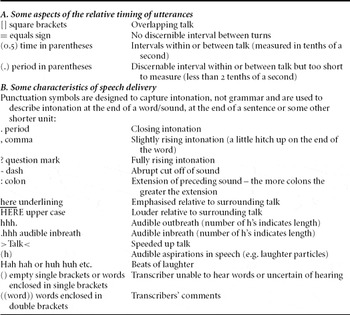
In accordance with the methodology of CA (see Drew and Heritage, Reference Drew and Heritage1992; Heritage and Clayman, Reference Heritage and Clayman2010), we worked inductively and on the understanding that talk is a means to perform some action/activity, such as making a Jobseeker's Agreement. Since the same action may be accomplished in different ways, the key question is not whether something occurred, but how it was accomplished. Analysis thus begins with transcribing recordings in detail to show how turns at talk were produced, using symbols to represent features of the timing and manner of speech (see Appendix Table A1 for a key). Next, collections are made of all instances of phenomena of analytic interest, e.g. advisers asking claimants for job goals or providing information about available support. The aim is to identify the range of ways in which the same activity was performed and the consequences – within the interaction – of these differences.
Markers of effectiveness, then, are internal to the interview, e.g. claimant responses which indicate greater understanding or engagement with the activities being undertaken, a commitment to carry out an agreed step towards work or a visible ‘turn around’ in the claimant's stance towards such a step (Drew et al., Reference Drew, Toerien, Irvine and Sainsbury2010). This analytic approach is crucial for identifying effective practices that are under the direct control of the adviser, providing an evidence base regarding what works to mobilise claimants, there and then, during the WFI.
We are aware that the presence of recording equipment might have influenced the interactions in our sample. Hence, we made particular efforts to minimise our impact: the camera was discrete and no researcher was present during the WFIs. We were reassured by participants often commenting, unprompted, that they quickly forgot they were being recorded, a finding consistent with studies that have shown ‘that the effect of video becomes negligible in most situations after a certain phase of habituation’ (Knoblauch et al., Reference Knoblauch, Schnettler, Raab and Soeffner2006).
Dimensions of personalisation in practice: ‘substantive’ and ‘procedural’
There is clear evidence in our dataset of two dimensions to personalisation in advisers’ practice. We call these substantive and procedural personalisation. In this section, we describe each, showing how it operates in Jobcentre Plus interviews. In subsequent sections, we show how each represents a continuum and how these may intersect to produce varying degrees of personalisation.
Substantive personalisation refers to the adviser's capacity to provide services that are tailored to claimants’ needs and circumstances. It refers to the substance of the support on offer, the ‘what’ of service provision. Procedural personalisation refers to the ‘how’ of service provision, to the ways in which the adviser approaches the interaction with the claimant. It refers to the process undertaken by advisers when delivering their part of the service.
The following extract illustrates both dimensions. The claimant – a lone parent receiving Income Support – is attending a mandatory annual WFI. At the time, she was not required to seek work due to her child's age. However, through her adviser, she could access support to prepare for future work. This extract is long, but well illustrates how the adviser elicits the claimant's needs as a basis for providing tailored advice. Extract 1 [003,Footnote 1 Lone Parent WFI] Some details have been omitted due to space constraints (indicated by “. . .”); boldface indicates sections of key relevance to the analysis.

In this extract the claimant is clear that she wants to work but feels ill-equipped to do so. Across the interview, she raises the possibility of a confidence class (lines 14–16), her interest in a job as a social worker or teaching assistant (lines 34–37), her enjoyment of administrative work (data not shown) and her need for training in computer and other clerical skills (lines 52–61). In response, the adviser describes several options, including voluntary work (lines 39–47), skills coaching (lines 64–74), plus the possibility of courses through Learn Direct (lines 66–68).
Substantive personalisation is evident, then, in two ways:
• The adviser is able to offer the claimant a variety of support services/training courses from which she may choose.
• The programmes themselves are flexible (e.g. at centre x, she will be able to choose from eight modules and will be given advice about other support she might receive, lines 68–77).
Thus the substance of the support on offer can be (somewhat) tailored to the individual, and that individual has a say in what kinds of support she receives.
In addition, this tailoring is facilitated by the approach the adviser takes to the interaction. Procedural personalisation is also evident, then, in several ways, including:
• The series of open questions used by the adviser to elicit the claimant's thoughts about work (line 8), her support/training needs (lines 19–20), her perceived barriers to work (lines 25–27) and her job goals (lines 31–33). These create ‘slots’ in the interaction for the claimant to describe her circumstances in her own terms.
• The claimant's responses to these questions are used by the adviser as a basis for selecting options to consider with the claimant. This is particularly evident in her exploration of what the claimant means by ‘confidence’ (lines 19–20) in order to establish what kind of course might suit her, and her insistence that the claimant start by deciding what kind of work she wants, so that the training will ‘fit’ (lines 40–51) her goals. In this way, the adviser demonstrates that any advice she offers will be rooted in the claimant's circumstances;
• She also explicitly hands the decision over to the claimant (lines 62–63, 79–81).
Extract 1 shows that advisers were, in our recordings, offering claimants some choice. Equipped with knowledge about the available options and supported by the state to make these options available, advisers were empowered to offer a (somewhat) flexible service. This extract also demonstrates a more subtle sense in which the personalisation agenda can be evident in practice – in the detail of the adviser's communication with claimants. This dimension is less dependent on what advisers do and more on how they do it. Procedural personalisation is, therefore, less directly influenced by policy since advisers can accomplish the same task with or without addressing the claimants’ specific needs, as we will show.
The dimensions as continua
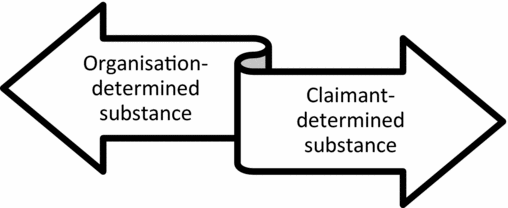
Each of these dimensions reflects a continuum, rather than a set of binary alternatives (i.e. personalised or not). With respect to the substance of the interview, this continuum ranges from more organisation-determined to more claimant-determined, as depicted in Figure 1. To illustrate, imagine a service that is entirely organisation-determined: whatever the claimants’ experience and goals, they might all be required to attend the same training programme. At the other extreme, an entirely claimant-determined service would provide whatever the claimant needed to get the job they wanted.
Substantive personalisation as a continuum

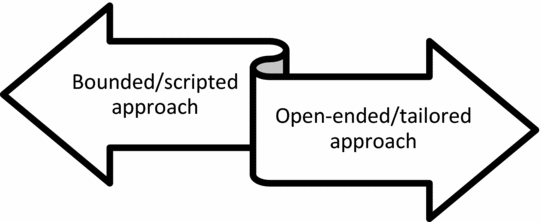
For the procedural aspects of the interview, the continuum ranges from an advisory approach that is strictly ‘bounded’, to one that is more open-ended, as depicted in Figure 2. Again, if we consider the extremes, an adviser might ask the claimant a list of questions – like in a structured survey – with pre-determined alternatives from which to choose. When delivering information, they might follow a script, providing the same information to every claimant. At the other extreme, they might take an entirely open approach – like in person-centred counselling – asking broad, open questions and providing information tailored to the claimants’ expressed needs.
Procedural personalisation as a continuum
None of the interviews in our dataset fully embodied such extremes. However, there was substantial variability – along the continua between these extremes – in how advisers addressed the interview tasks. Extracts 2 and 3 offer a striking contrast with respect to both dimensions of personalisation (for a related analysis of Extract 2, see Toerien et al., Reference Toerien, Irvine, Drew, Sainsbury and Antaki2011). The facts of the two cases are closely matched. The claimants, both under twenty-five, have recently completed degrees in graphic design and/or photography. Neither has much work experience but both want to work in their field. Both are claiming, for the first time, Jobseeker's Allowance, the main state unemployment benefit at the time of recording. They are required to complete a Jobseeker's Agreement, which includes a statement of their job goals. Both advisers record the claimants’ specialisms. Both also note that there are few suitable vacancies available in the local area (each in different parts of the UK). In Extract 2, however, the adviser insists on an additional ‘back up’ (line 7) goal that is more ‘realistic’ (lines 13–15), while in Extract 3, the adviser grants the claimant a ‘permitted period’ (lines 36–41).
The consequences are significant: the claimant in Extract 2 is required to start looking for jobs in retail immediately or risk losing benefits; the claimant in Extract 3 has thirteen weeks, on benefits, in which to seek work in his field. Moreover, the claimant in Extract 3 receives some information about support to become self-employed (see lines 18–35), an option that could allow him to pursue his goal despite the limited vacancies. By contrast, in Extract 2, the adviser introduces the (generic) possibility of training only to dismiss its relevance for this claimant without exploring the options (see lines 33–42); self-employment is not discussed. In a substantive sense, then, these cases represent opposing points on the continuum in Figure 1. The support offered in Extract 3 is fitted to the claimant's primary job goals; in Extract 2, it is not.
Extract 2 [067; New Jobseeker WFI]

Extract 3 [102; New Jobseeker WFI]

These two advisers also take very different approaches to managing the interaction with the claimant. In Extract 2, the adviser moves quickly from recording the claimant's primary job goals to insisting on a more ‘realistic’ back-up (see line 14). He assumes, then, that the primary goals are unrealistic and closes down discussion thereof. In Extract 3, by contrast, the adviser spends time questioning the claimant about his primary goal (only some of these questions are shown above due to space constraints; e.g. lines 1–2, 11–17, 20–21, 28–29), thereby opening up the discussion. The consequences are, again, significant. In Extract 3, the claimant is encouraged to consider ways in which he might make his goal a reality. In Extract 2, the adviser and claimant are at odds, with the claimant insisting on job goals in line with his qualifications and the adviser insisting on something more generally available. The claimant subsequently volunteers two pertinent facts: that he has a job interview lined up and is prepared to relocate. Both suggest that his goals might be more realistic than the adviser – having failed to elicit this information through the kind of questioning evident in 3 – assumed. Rather than taking the claimant's circumstances as his starting point, he opts to foreground his organisational mandate to ‘inject a realistic approach to the local job market’ (lines 13–15), and government policy on unemployment (lines 21–25). The result is a reluctant agreement by the claimant to record ‘retail’ as a ‘back up’ (lines 29–30) – a goal reflecting neither his training nor aspirations.
Both advisers are operating within the same, potentially conflicting, policy constraints: they can offer appropriately qualified claimants a ‘permitted period’ and should ensure that claimants have ‘realistic’ job goals. In these extracts, they each take an alternative route, providing substantively different kinds of support. In addition, our analysis shows that advisers have to navigate another choice – not just whether to offer a permitted period, but how to manage the talk about job goals. In the cases above, one adviser foregrounds his organisational mandate (to record a ‘realistic’ goal), whilst the other focuses on exploring the claimant's goals/circumstances; one provides generic information (about training), whilst the other tailors his advice to what the claimant has revealed about his needs; one considers only standard approaches to the labour market, whilst the other explores strategies for creating suitable employment. In a procedural sense, then, these cases represent opposing points on the continuum in Figure 2. The adviser in Extract 2 takes a more bounded or scripted approach – one that is primarily led by the organisation's requirements; the adviser in Extract 3 takes a more open-ended approach – one that is more tailored to what he knows about the claimant.
Connecting the substantive and procedural: a typology of personalisation in practice
If we think of substantive and procedural personalisation as two dimensions of personalisation in practice, we can construct a typology representing how they interact. This is illustrated in Table 1 above. The rows represent the extreme ends of the substantive continuum (Figure 1). The columns do the same for the procedural continuum (Figure 2). In Quadrants 1 and 4, the substance and procedure are in accord: in 1, the substance is pre-determined by the organisation (i.e. non-personalised), and advisers take a bounded and scripted approach to the procedure (i.e. non-personalised); in 4, the substance is determined by the claimant's needs/circumstances (i.e. personalised), and advisers take an open and tailored approach to the procedure (i.e. personalised). Thus, we see how the intersection between the continua can give rise both to non-personalised (Quadrant 1) and strongly personalised (Quadrant 4) welfare-to-work service provision.
The intersection between substantive and procedural personalisation

The intersection also means that partial forms of personalisation – lying anywhere along the two continua – are possible. This can, as Quadrants 2 and 3 illustrate, give rise to tensions between the modes, where the adviser may take an open-ended approach, yet have little to offer that would fit the claimant's needs (Quadrant 2), or, alternatively, the services on offer may be flexible, but the adviser's approach may be largely scripted (Quadrant 3). In our dataset, for example, some advisers took care to elicit claimants’ goals/needs and to provide appropriate tailored advice. Substantively, however, they were not in a position to provide the additional training needed. Likewise, when talking with claimants about how they might find work, some advisers explored what claimants were already doing by asking open questions. The advisers taking this (more personalised) approach, however, had no means of providing more personalised substantive support than those who took a more scripted approach. At best, the personalised approach helped claimants to think through their options more carefully; at worst, it was a form of ‘whitewash’, concealing the fact that – regardless of how they answered the adviser's questions – the same basic weekly ‘steps towards work’ would be recorded on the Jobseeker's Agreement.
Conversely, although many claimants had the right to choose from a range of support programmes (i.e. some degree of substantive personalisation was operating), these were often presented in a scripted fashion, e.g. advisers read from standard information sheets, providing no indication of the relevance to the individual's circumstances and leaving it to the claimant to decide later which programme (if any) to attend. Because this approach relies on the claimant both recognising how a programme might be of use and taking the initiative to contact the adviser for a referral, it risks working against claimants realising their right to choose. For a range of reasons claimants might never take up the support on offer. There is some evidence in our dataset that such difficulties could be overcome if advisers took a more personalised approach to talking about the available programmes. Although we do not have sufficient data to draw statistically significant conclusions, we found that lone parents only ever signed up – during the interview – to further support through the New Deal for Lone Parents if advisers issued an explicit invitation; simply providing generic information about NDLP was never enough (Drew et al., Reference Drew, Toerien, Irvine and Sainsbury2010).
Discussion
Focusing on adviser–claimant interaction in over 200 recordings, this paper has addressed the question of how advisers implement personalisation within work-focused interviews in Jobcentre Plus. In our dataset, substantive personalisation amounts to flexibility in service provision, such that claimants receive services that are (at least to some extent) determined by their needs and circumstances; procedural personalisation involves taking a personal approach to interacting with claimants, such that the WFI is shaped (to some extent) around the claimant's ‘story’. To enact personalisation in a strong sense, then, advisers need to have both the resources to provide substantively flexible services and the skills to take a personal approach to the interaction.
The rhetoric of personalisation implies the promise of strong personalisation (i.e. Quadrant 4 in Table 1). From the slogan displayed in Jobcentres at the time of recording − assuring claimants of ‘the job you want, the help you need’ − to the Coalition government's new Work Programme, which aims explicitly ‘to create a system that treats people as individuals and allows providers greater freedom to tailor the right support to the individual needs of each claimant’ (Bellis et al., Reference Bellis, Oakley, Sigala and Dewson2011: 17), the message is that substantive and procedural personalisation will be delivered. However, our analysis shows that the two dimensions need not come together in practice, resulting in partial or even non-personalised services.
In our view, there are at least two institutional barriers that make strong personalisation difficult to implement within Jobcentre Plus. First, for each interview type, there is a set of tasks (sometimes referred to as the ‘must do’ list) that advisers are expected to complete – either for every interview or in a percentage of cases. Second, advisers’ job performance is partially assessed through observation by a manager, using a checklist to record whether or not (rather than how) they perform certain activities. Moreover, most policy initiatives around personalisation have focused on the substantive dimension, leaving largely untouched the question of how to create an environment in which a personal approach to the WFI is enabled.Footnote 2 It is not surprising, then, that cases like those in Extracts 1 and 3 reflect moments of greater personalisation in what were otherwise often highly standardised interviews.Footnote 3 We would argue that they represent efforts by advisers to work around the system as it was organised at the time of recording, i.e. to create space amidst the checklists and form filling to generate something of a more ‘personal relationship’ with claimants.
The typology presented here offers a way of thinking about the trade-offs that accompany different ways of implementing the personalisation agenda. Each of the partial forms of personalisation carries risks: Quadrant 2 of Table 1 – with its tailored approach to the interview but organisation-determined substance – could be interpreted as a form of covert manipulation of the claimant;Footnote 4 Quadrant 3 – with its claimant-determined substance but scripted approach – may well result in missed opportunities to engage claimants in available support. Non-personalisation (Quadrant 1) appears to carry the greatest risk of claimant disengagement and dissatisfaction but strong personalisation (Quadrant 4) is risky too as adviser control is diminished. One implication is that, while the personalisation agenda can be seen as consistent with the principles of ‘New Public Management’, there are clearly tensions within New Public Management approaches that have yet to be reconciled in the delivery of WFIs in Jobcentre Plus, e.g. some of its methods (such as targets and checklists to improve the ‘customer experience’) may actually serve to diminish that experience.
If the policy environment in 2012 was the same as when our recordings were made we would be able to offer strong conclusions about how personalisation could be enhanced through adviser training (the study report makes a series of such recommendations – see Drew et al., Reference Drew, Toerien, Irvine and Sainsbury2010). However, since the time of recording, UK policy on welfare-to-work has changed radically. Under the Coalition government's Work Programme, services for long-term claimants have been contracted out to organisations in the private and third sectors, who employ their own staff of advisers and practitioners. This does not mean that the need for Jobcentre Plus advisers to offer personalised services is decreasing; claimants will still attend Jobcentres for up to a year before referral to a Work Programme provider. The Department for Work and Pensions therefore still has a role to play in training its staff to offer more personalised services. What the DWP has little influence over, however, is how personalisation is enacted on the frontline by Work Programme providers or their sub-contractors.
Work Programme contracts are based on payment by results (more specifically for getting people into sustained employment for six months or more). How contractors get people into work is for them to determine; they have almost complete discretion in how they organise the delivery of their back-to-work programmes:
Previous UK welfare-to-work programmes specified in varying levels of detail what interventions providers had to deliver. The Work Programme, in contrast, gives providers far greater flexibility to design programmes that will work . . . (The) government is providing freedom for providers to personalise support for the individual in a way that fits the local labour market. This is sometimes referred to as a ‘black box’ commissioning approach. (DWP, 2011)
Details of the contracts let by DWP are publicly availableFootnote 5 and show that organisations holding ‘prime’ contracts have set up networks of sub-contractors to provide specific services (e.g. help with CV writing) or specialist services (e.g. help for people with mental health conditions or drug and alcohol problems). The lists of sub-contractors imply that frontline contact with Work Programme clients will potentially be dispersed among hundreds of organisations. It is unclear, therefore, how the promises of personalisation that appear in policy documents and the announcements of senior politicians and officials (like those cited at the head of this article) can be made good in practice when the ‘black box’ approach implies that DWP and JCP will have no control over what happens on the frontline. The experiences of Work Programme clients may emerge in future but at the time of writing there is no research to draw on. Evidence from Australia offers a cautionary tale though. Considine et al. (Reference Considine, Lewis and O'Sullivan2011: 811) have shown that the privatisation of the Australian employment sector has not achieved ‘the enhanced levels of flexibility so often identified as a desirable outcome of reform’. In fact, over the ten years during which full privatisation has been accomplished (1998–2008), there has been ‘a marked increase in the level of routinisation and standardisation on the frontline’ (ibid.). What will happen in the UK is unclear. However, while personalisation remains a core principle of welfare-to-work reform there will be a need for well-grounded evidence about how this principle can be operationalised – whoever is responsible for implementation.
This paper contributes to the debate around what personalisation means. Like previous efforts to ‘unpick personalisation’ (see Cribb and Owens, Reference Cribb and Owens2010), we have shown that the concept is multi-dimensional. Unlike most work in this area (see Borghi and van Berkel, Reference Borghi and van Berkel2007: 421), however, we have focused not on formal policy-making but on the ways in which policy may be enacted on the frontline. This is crucial because, as Yeatman (Reference Yeatman, Yeatman, Dowsett, Fine and Gursansky2009: 233, emphasis in original) argues, ‘the point of service delivery is the critical level at which the democratisation and individualisation of service delivery can occur’. To study this ‘critical level’ directly, we have used Conversation Analysis to examine the detail of recorded WFIs. Like any approach, this has its limitations. Our study was not designed, for instance, to identify the possible factors underlying the different practices we observed. Further research might explore whether factors like adviser training, years of experience, financial incentives to get people into work and other policy changes might offer partial explanations. These are important empirical questions. However, they should not supplant a focus on the interactions themselves. An evidence-based understanding of how personalisation policies are enacted is necessary both for assessing whether policies are translating into the intended practice, and also for taking seriously the direct impact of policy on service users. Failure to add this interaction-based perspective to policy debates risks producing unintended consequences (cf. Antaki et al., Reference Antaki, Finlay and Walton2009), generated out of the inevitable gap between rhetoric and everyday practice.
Acknowledgements
The study was funded by the UK's Department for Work and Pensions. The authors would like to thank the advisers and claimants who made the study possible, and the DWP and JCP managers, policymakers and researchers who supported this new approach to exploring the advisory role. The authors are also very grateful to the editors and two anonymous referees for their insightful comments on an earlier draft of this paper. Please note that the views expressed in this report are not necessarily those of the Department for Work and Pensions or any other UK Government Department.
Appendix
Transcription Key (see Jefferson, Reference Jefferson and Lerner2004)