INTRODUCTION
Pigeonpea (Cajanus cajan (L.) Millsp.) is an important legume crop, grown mainly in the semi-arid tropical (SAT) regions of Asia, Africa, Latin America and the Caribbean (Saxena Reference Saxena2008). The total global area planted with pigeonpea was 4·5 million ha in 2009 (FAO 2009). India is the main producer (3·38 million ha) of pigeonpea and imports an additional 400 000 t (tonnes) from Myanmar and Africa to meet domestic needs. Although dozens of pigeonpea varieties have been released, productivity has remained stagnant at c. 700 kg/ha (FAO 2009) due to various genetic, management, biotic and abiotic constraints. Since the area of cultivation is not likely to increase, breeding efforts focusing on breaking the yield barrier through hybrid breeding (Saxena et al. Reference Saxena, Sultana, Mallikarjuna, Saxena, Kumar, Sawargaonkar and Varshney2010) and increasing sustainability of production through incorporating resistance to major biotic and abiotic stresses are needed to increase production and productivity.
In India, waterlogging during the monsoon season (June–September) is caused by erratic and prolonged rains and represents an important production constraint. Since pigeonpea is primarily grown in deep vertisols and in areas with mean annual rainfall of 600–1500 mm, waterlogging becomes a serious problem (Chaudhary et al. Reference Chaudhary, Sultana, Pratap, Nadarajan and Jha2011). It occurs when the water table attains a level at which the soil pores in the root zone of the plants are fully saturated, and restricts normal air circulation. Consequently, oxygen levels in the soil decline and carbon dioxide concentration increases, which adversely affects the growth and development of plant roots (Vartapetian & Jackson Reference Vartapetian and Jackson1997). The inability of dryland crop species, such as pigeonpea, to endure low oxygen conditions at the rhizosphere level, results in substantial yield losses. The roots of most plants are highly susceptible to anaerobic conditions, which support a unique microbial community; this severely affects the nutrient balance of the soil (Ponnamperuma Reference Ponnamperuma1972; Levitt Reference Levitt and Levitt1980; Laanbroek Reference Laanbroek1990) and plant health. Soon after the onset of short periods of excessive moisture conditions, obligate aerobic bacteria become inactive, and facultative/obligate anaerobic bacteria become active and dominate the micro-flora in the inundated soils (Sachs et al. Reference Sachs, Freeling and Okimoto1980; Jackson Reference Jackson1990). Another adverse effect of waterlogging is leaching of important minerals or essential intermediate metabolites from roots into water (Laanbroek Reference Laanbroek1990; Rathore et al. Reference Rathore, Warsi, Singh and Vasal1997). Waterlogging also induces certain changes in the physical and chemical properties of the rhizosphere. The gaseous diffusion rates in flooded soils are c. 100 times lower than normal (Kennedy et al. Reference Kennedy, Rumpho and Fox1992) and respiration of plant roots, soil micro-flora and fauna leads to rapid exhaustion of soil oxygen, thereby causing anaerobiosis.
In India, c. 8·5 million ha of arable land is prone to waterlogging. A recent comparative analysis of pigeonpea growing regions revealed that c. 1·1 million ha of the total area (3·38 million ha) under pigeonpea is affected by excess soil moisture, causing an annual loss of 25–30% in production (Chaudhary et al. Reference Chaudhary, Sultana, Pratap, Nadarajan and Jha2011).
Since waterlogging is an important yield constraint in pigeonpea, it is imperative to identify a viable economic solution for this problem. Although certain soil management options such as the use of raised sloping seed beds, ridge sowing and transplanting of seedlings help in reducing losses caused by waterlogging (Abebe et al. Reference Abebe, Mamo, Duffera, Kidam, Tanner and Mwangi1992), these options are not economically viable for the resource-poor farming community of the SAT. Hence, the use of tolerant genotypes is the most economical and simple way to minimize losses. According to Khare et al. (Reference Khare, Rao, Lakhani and Satpute2002), the initial establishment of seedlings is the most critical factor for pigeonpea in waterlogging-prone areas. Therefore, the objective of the present study was to assess the genotypic variability for waterlogging tolerance in pigeonpea and to identify genotypes capable of withstanding waterlogging stress conditions at the sowing and early seedling stages.
MATERIALS AND METHODS
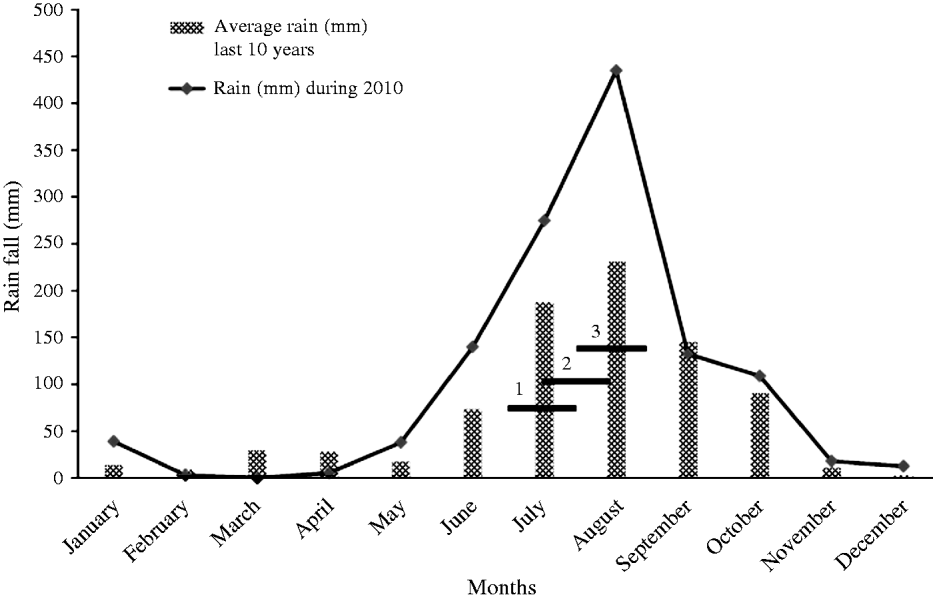
Critical evaluation of rainfall pattern during the monsoon season (June–September) at Patancheru, Andhra Pradesh, India (17°32′N, 78°16′E, 545 m asl) and its overlap with pigeonpea growing stages allowed identification of the most waterlogging-vulnerable stages as well as the time of occurrence. Pigeonpea receives maximum rain during the months of July and August (Fig. 1). Since the seed (just after sowing) and early seedling stage (15–35 days) in pigeonpea are very sensitive to waterlogging (Fig. 1), the screening methodology was optimized taking into account the crop growth stages that were most severely affected by waterlogging.
Average rainfall distribution at Patancheru, India, for the last 10 years and during the 2010 pigeonpea growing season. The horizontal lines indicate the duration of the crop growth stages potentially affected by waterlogging. Line 1: planting time window (seed stage). Line 2: 15 days old seedling window (early seedling stage). Line 3: 35 days old seedling window (seedling stage).

Laboratory screening (seed stage evaluation)
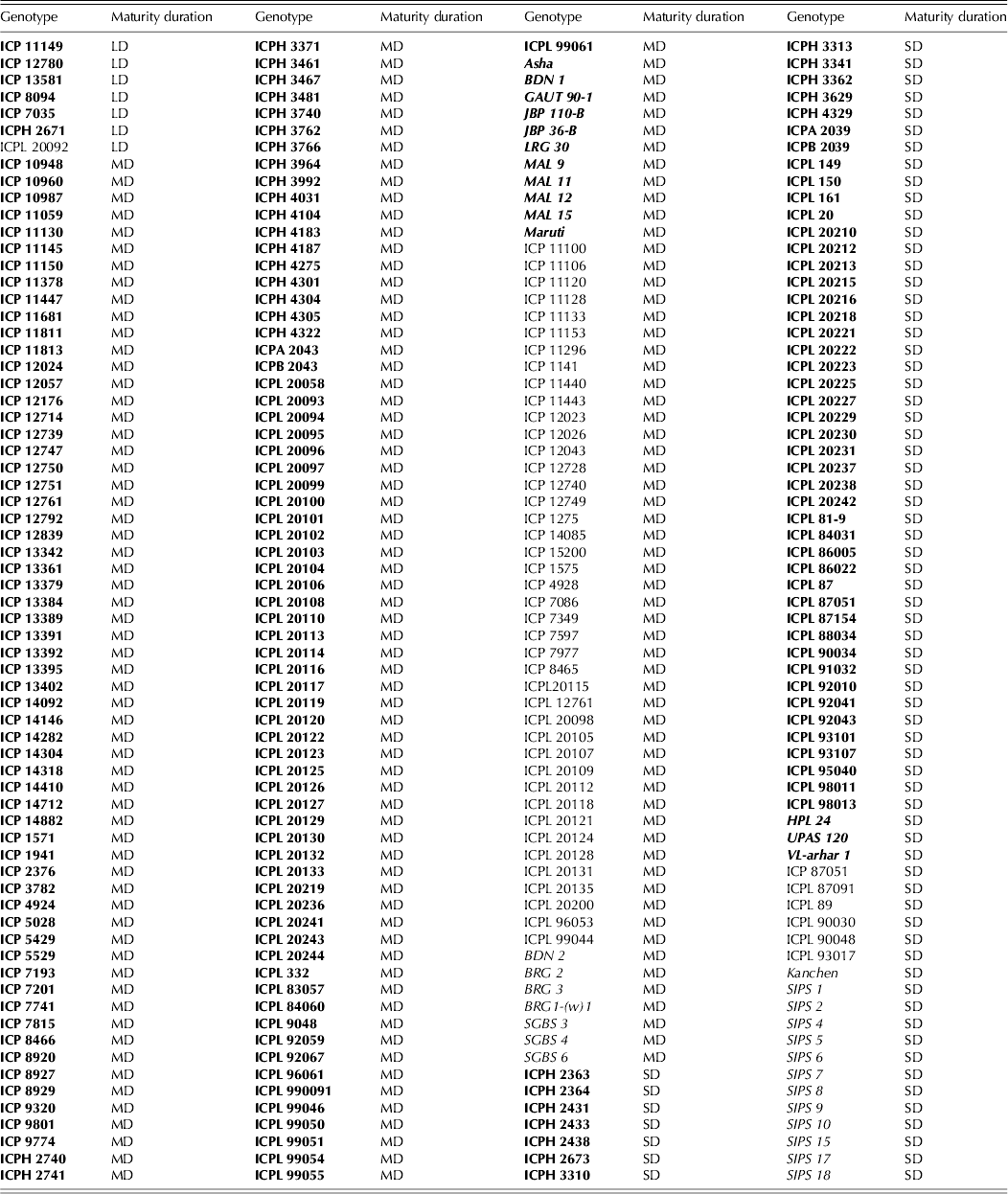
Seeds of 272 pigeonpea genotypes differing in maturity, seed colour and origin (Table 1) were evaluated for water submergence tolerance under laboratory conditions using a simple screening method that allowed evaluation of many genotypes in a short period of time. The genotypes used consisted of 114 elite breeding lines (ICPLs), 91 germplasm accessions (ICPs), 34 pure line varieties and 33 cytoplasmic male-sterility-based hybrids (ICPHs) (Table 1). Seeds of all genotypes were obtained from the global gene bank of the International Crops Research Institute for the Semi-Arid Tropics (ICRISAT) and from the ICRISAT pigeonpea breeding programme (Table 1). Seeds of all the genotypes were collected from the 2009 crop season and stored at 2–4 °C until used in the experiment. To avoid the incidence of fungal infection, the seeds were treated with Thiram (dithiocarbamate) dust (3 g/kg seeds) before imposing submergence treatments. The genotypes were classified into different groups based on maturity duration (short, medium or late) and seed coat colour (light or dark coloured). The materials included 196 medium-to-late (160–270 days) and 76 short (120–155 days to 75% maturity) maturing genotypes (Table 1). A total of 203 genotypes had dark coloured (black, purple, dark brown and brown) seeds, whereas 69 lines had light coloured (white, off-white and cream) seeds (Table 1). The experiment was conducted under laboratory conditions at ICRISAT, Patancheru, Andhra Pradesh, India in 2009.
Description of pigeonpea genotypes (n = 272) tested for waterlogging tolerance. The materials represent four genotypic groups: germplasm ‘ICP’; elite inbred lines ‘ICPL’, ‘ICPA’, ‘ICPB’; hybrids ‘ICPH’ and varieties (in italics) belonging to two maturity groups (late-to-medium and short) and of different seed coat colour intensities, bold font indicates dark (brown, black, purple) and non-bold font indicates light (cream or white) seed coat colour
The genotypes were subjected to water submergence treatments in 200 ml beakers (100 mm diameter) containing 100 ml of water at 23 ± 1 °C. The submergence treatments were established as a function of the submersion time (S120, S144, S168 and S192 for groups of seeds submerged for 120, 144, 168 and 192 h, respectively). A baseline (S0 = no submergence treatment) germination test was performed by placing 20 seeds of each genotype between two paper towels in plastic Petri dishes and maintaining humidity as necessary. The durations of S120, S144 and S168 were comparable with field observations of soil waterlogging timing at the study site, especially during rainy years. The S192 duration was specifically selected for the present experiment in order to check seed viability under extended submergence (8 days). Each test sample consisted of 20 seeds and three replications. After completing each stress period, seeds were dried on a filter paper for 4–5 h to drain excess water and then placed on a paper towel in a Petri dish and kept for germination at a constant temperature (25 ± 2 °C) in a dark room. The seeds were considered to have germinated when radicle length reached a minimum of 2 mm. The germinated seeds were counted and percent survival was calculated 5–6 days after completing stress treatment.
Analysis of variance (ANOVA) was performed using SAS software (SAS 2008) to assess the variation among genotypes, submergence durations and their interactions. The germination data (per cent) were arc-sine-transformed (Gomez & Gomez Reference Gomez and Gomez1984) to induce normality of the data set. In addition, further analysis was also performed to compare relative survival rate of the four genotype groups within submergence durations using linear contrasts. The associations of survival rates under the different water submergence treatments with seed colour and maturity duration were assessed using a t-test.
Pot screening (early seedling stage evaluation)
Ninety-six out of 272 pigeonpea genotypes representing the four genotype groups (hybrids, lines, germplasm and varieties) that showed tolerance or moderate tolerance and susceptibility to water submergence at the seed stage during laboratory screening were further evaluated for waterlogging tolerance at the seedling stage (15 days). The evaluation was conducted using plastic pots of 102 mm diameter, with three 5·0 mm diameter perforations in the base. Pots were filled with a mixture of vertisols and farmyard manure (FYM); soil : FYM ratio was 50 : 1 (V/V). Fertilizer (nitrogen, phosphorus and potassium, NPK) was also applied as basal dose; the amount was calculated on a soil weight basis and thoroughly mixed into the soil. Each pot was weighed after filling in order to maintain the same quantity of soil and maintain constant moisture in each pot. For each genotype, five pots were prepared (four pots for imposing stress treatment and one kept as a control, i.e. no treatment). Filled pots were sown on 24 February 2010, with 5 seeds/pot at 20 mm depth using a completely randomized design. All pots were kept in a glasshouse at an average temperature of 32 ± 2 °C. Before application of water stress treatment, the number of plants in each pot was counted. The stress treatment was imposed by submerging four pots in a tray filled with water in such a way that the pots surface remained at least 20 mm under water for 11 days, whereas the fifth pot was kept at normal moisture as a control. The water level in the tray was kept constant throughout the experiment and maintained for 11 days. Eight days after completion of the waterlogging stress treatment the number of plants that survived in each pot was counted and rate of survival was recorded with reference to the number of plants before treatment. ANOVA was performed using SAS software (SAS 2008) to assess the variation among genotypes for survival rates after stress imposition.
Field level evaluation (screening under natural conditions)
Forty-nine genotypes were further evaluated under natural field conditions to confirm the levels of tolerance observed under laboratory and pot screening. The field trial was conducted at ICRISAT, Patancheru, Andhra Pradesh, India (17°32′N, 78°16′E, 545 m a.s.l.) on 14 July 2010 with four replications using a 7 × 7 lattice design in deep vertisols on a flatbed rice field with no drainage. Seeds were planted in plots of four rows, 2·5 m long and 0·50 m apart, with spacing of 0·25 m within rows. Before planting, a basal dose of 46 kg N/ha in the form of diammonium phosphate was applied. A pendimethaline and atrazine mixture (both 0·75 kg/ha a.i.) was sprayed before emergence to keep the crop free from weeds. Soon after sowing, the rains commenced and continued for up to 60 days including 45 rainy days (minimum rainfall of 950 mm rain and 29 ± 1 °C average temperature). Thus, the crop was exposed to continuous natural water stress beginning 7 days after sowing with an average water depth of 20 ± 10 mm and continued for up to 53 days (Fig. 1). Plant survival counts were based on final plant stand at maturity (180 days from sowing). ANOVA was performed using SAS software (SAS 2008) to assess the variation among genotypes for survival rates before harvest.
RESULTS
Seed stage evaluation
Effect of submergence durations on seed survival
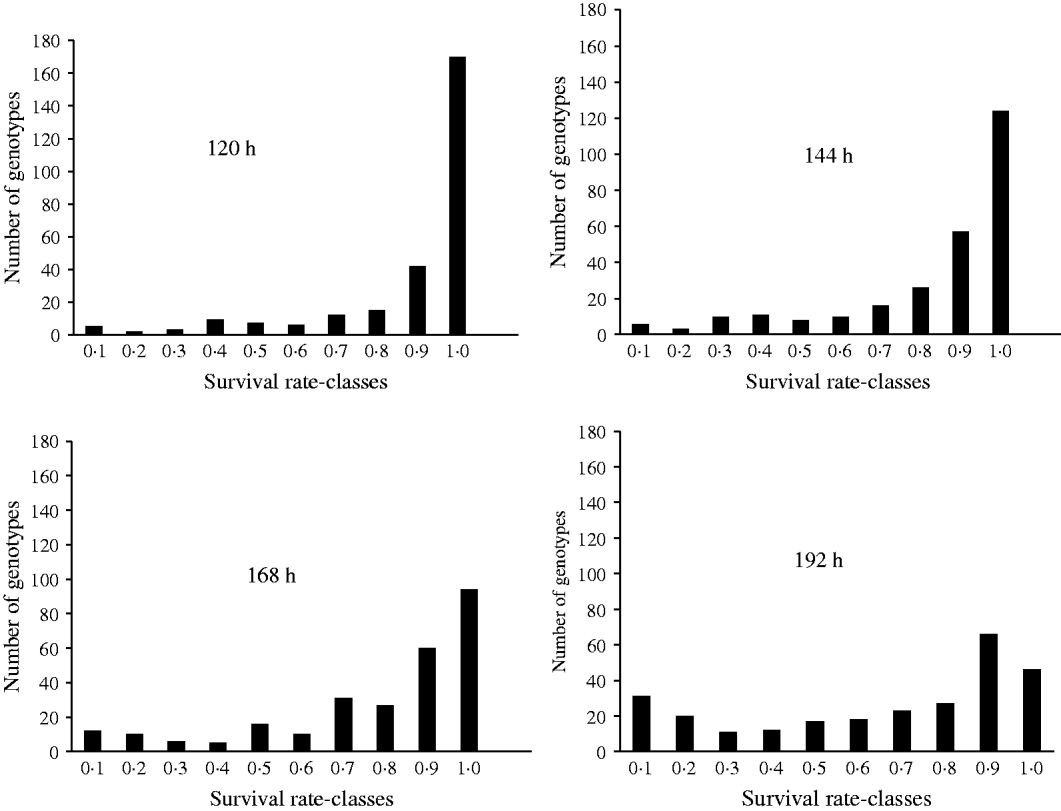
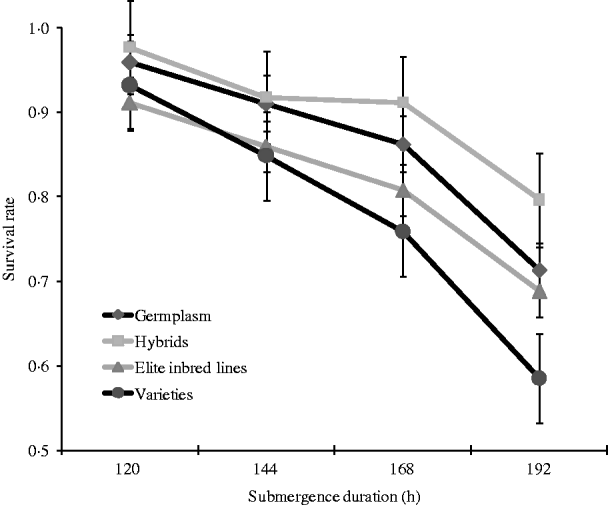
All genotypes exhibited ⩾0·90 survival irrespective of their origin when germinated under normal moisture conditions (S0, control = no submergence) (Fig. 2). The ANOVA showed highly significant differences (P < 0·01) in seed survival rates among genotypes for all submergence durations. There were also significant survival rate differences among the various submergence durations (S120, S144, S168 and S192). The interactions between genotype and submergence duration were also significant; therefore, further analysis was carried out to understand genotypic performance after each submergence. This analysis revealed that the variation among genotypes for survival rate was highly significant at all the submergence durations. To explore further, the four distinct genotype groups (hybrids, germplasm, breeding lines and varieties) were compared using linear contrasts. Significant differences in survival rates between groups were recorded for the submergence durations. However, no significant differences were found between the individual groups at S144, and at S192 significant differences between groups were seen for all except lines and germplasm. The analysis further revealed that after 120 h submergence the genotypes, irrespective of origin, had high (>0·80) mean survival rates. Even after 168 h of submergence the mean survival rate was 0·73, which suggested that most of the genotypes had the potential to tolerate severe submergence stress. A sharp decline in seed survival was observed at the 192 h submergence period (Fig. 2). After 192 h of submergence the hybrids exhibited highest survival rate (>0·79) followed by germplasm accessions (0·71), advanced breeding lines (0·68) and released varieties (>0·58) (Fig. 3).
Seed stage survival rate of 272 pigeonpea genotypes after 120, 144, 168 and 192 h of water submergence. 1 = 0–0·1, 2 = 0·1–0·2, 3 = 0·2–0·3, … ,10 = 1·0 survival rate.
Survival rates of the different groups of genotype submerged for 120, 144, 168 and 192 h under water, during seed stage screening, (G = germplasm; H = hybrids; L = lines and V = varieties); bars represent standard error (±).
Relationship of maturity, seed colour and seed weight with survival rate
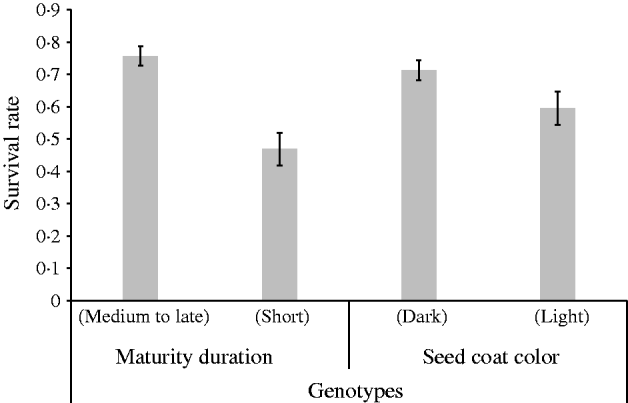
Medium-to-late maturing genotypes, irrespective of their origin, had significantly (P < 0·01) higher mean survival rate (0·70) compared with short maturity types with mean survival rate of 0·42 (Fig. 4). Further group-wise analysis revealed that, in general, the medium-to-late maturing inbred lines had higher survival rates (0·78) than short (0·45) maturing types. Similar results were recorded among germplasm and varieties. However, hybrids exhibited consistently high survival rates irrespective of their maturity groups. It was also observed that the mean survival rate was significantly higher (P < 0·01) in the genotypes with dark coloured seed coats (0·65) as compared with light coloured seed coats (0·54). In addition to maturity and seed coat colour, the seed size was found to be positively associated (P < 0·05) with survival rate of the genotypes at all the levels of submergence treatment, S120 (r=0·234), S144 (r = 0·196), S168 (r = 0·163) and S192 (r = 0·152).
Survival rate of pigeonpea genotypes (grouped based on maturity duration and seed coat colour) after 192 h of water submergence treatment under laboratory screening; bars represents standard error (±).
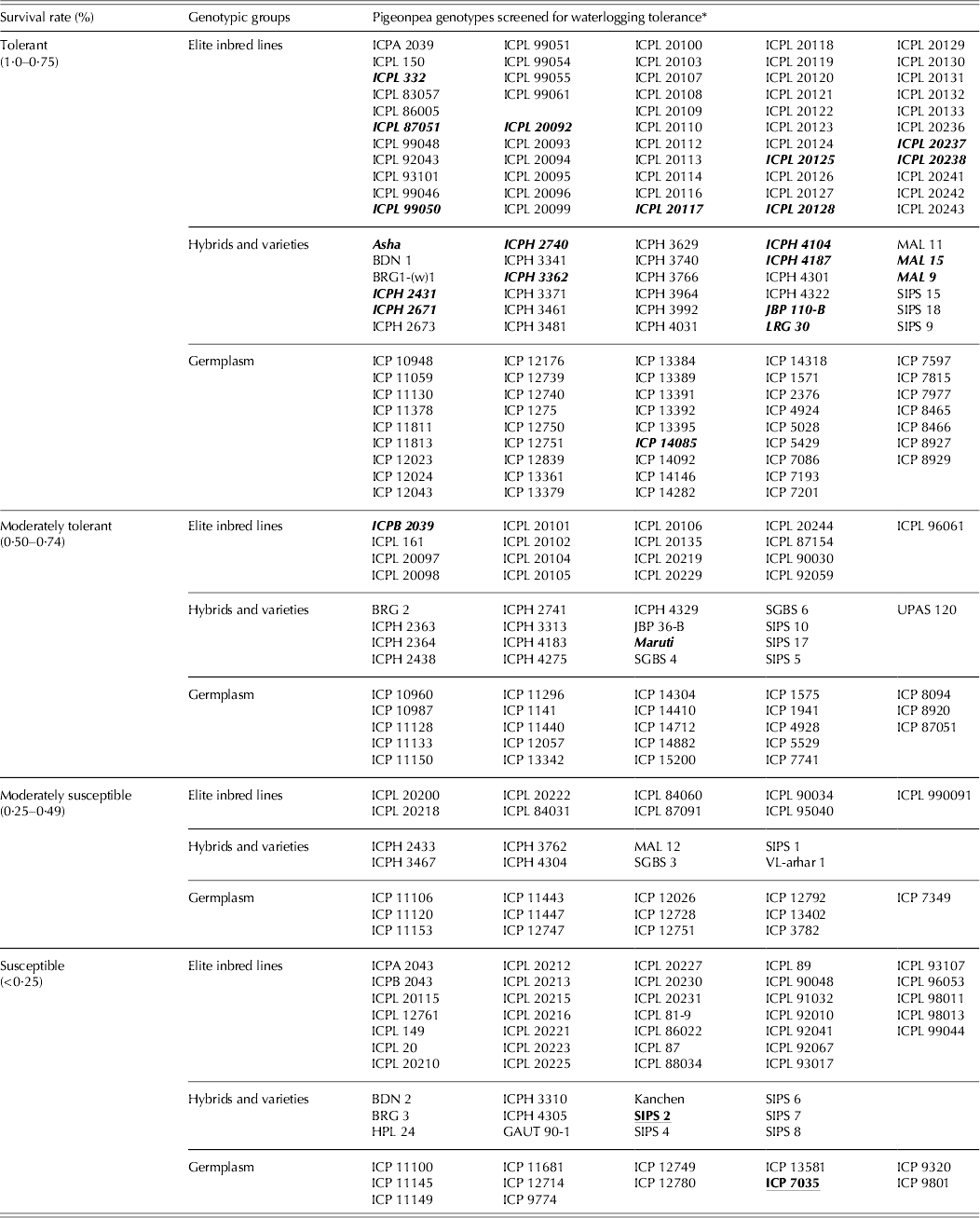
Based on the results of laboratory survival rates, the genotypes were classified into four groups (Table 2); tolerant (>0·75), moderately tolerant (0·50–0·74), moderately susceptible (0·25–0·49) and susceptible (<0·25). Survival rate at the S192 duration varied from 0·20 to 1·00, 0·02 to 1·00, 0·02 to 1·00 and 0·0 to 0·93 in hybrids, germplasm, elite inbred lines and varieties, respectively.
Pigeonpea genotypes representing tolerant (0·75–1·0), moderately tolerant (0·5–0·74), moderately susceptible (0·25–0·49) and susceptible (<0·25) on the basis of survival rate after the 192 h water submergence treatment at seed stage screening
* Genotypes in italic and bold showed consistent higher survival rate after the in vitro, pot and field evaluations, while genotypes underlined and bold showed susceptible reaction for waterlogging tolerance across screenings.
Evaluation at early seedling stage
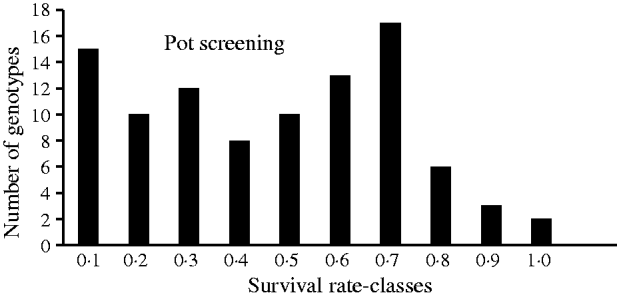
Ninety-six pigeonpea genotypes including tolerant (n = 46), moderately tolerant (n = 10) and susceptible (n = 40) were further evaluated at the seedling stage for waterlogging tolerance. ANOVA revealed highly significant differences (P < 0·01) among the genotypes for seedling survival, which ranged from 0 to 0·95 (Fig. 5). Most of the genotypes (n = 54) tested for survival rate at early seedling stage in pots were found to be sensitive to waterlogging and only a few genotypes exhibited higher (up to 1·0) survival. The dark-coloured, bold-seeded (100 seed weight ⩾10 g), medium-maturing genotypes showed higher survival rate compared with light-coloured, small-seeded (100 seed weight <10 g) short-duration genotypes.
Seedling stage (pot screening) survival rates of 96 pigeonpea genotypes after completion of submergence treatment. 1 = 0–0·1, 2 = 0·1–0·2, 3 = 0·2–0·3,…,10 = 1·0 survival rate.
Field evaluation
The 49 genotypes screened under natural field conditions showed significant variation in the survival rate. A subset of genotypes that showed waterlogging tolerance at all the three level of screenings (laboratory, pot and field screening) during 2009 and 2010 were – short: ICPH 2431 and ICPB 2039; medium: ICPH 2740, ICPH 2671, ICPH 4187, Asha, ICPL 332, LRG 30, Maruti, ICPL 20117, ICPL 20125, ICPL 20128, ICPL 20237, ICPL 20238 and ICPL 99050; and late maturity: ICPL 20092, MAL 9 and MAL 15 (Table 2). All the tolerant genotypes had dark seed colour with 100 seed weight >10 g.
DISCUSSION
The erratic rainfall patterns in India render the country highly vulnerable to drought and floods. More than 90% of pigeonpea is grown under rainfed conditions (Saxena Reference Saxena2008). Like soybean (VanToai et al. Reference Vantoai, Beuerlein, Schmitthenner and St. Martin1994), chickpea (Cowie et al. Reference Cowie, Jessop and Macleod1996) and several other legumes (Whiteman et al. Reference Whiteman, Seitlheko, Siregar, Chudasama and Javier1984), pigeonpea is highly sensitive to waterlogging (Chauhan et al. Reference Chauhan, Silim, Kumar Rao and Johansen1997; Perera et al. Reference Perera, Pooni and Saxena2001; Khare et al. Reference Khare, Rao, Lakhani and Satpute2002). Despite recognizing that waterlogging is an important production constraint in pigeonpea, very few studies have been conducted to identify germplasm tolerant to this abiotic stress and few genotypes have been tested (Perera et al. Reference Perera, Pooni and Saxena2001; Sarode et al. Reference Sarode, Singh and Singh2007) to assess the range of variation present in the overall pigeonpea gene pool.
For breeding purposes, a fast and reliable waterlogging screening method that allows evaluation of a large number of genotypes and does not require many seeds at early generation stages is necessary. The screening procedure used in the present paper is intended to be a systematic stepwise approach to filtering material through the breeding programme, starting with a large number of genotypes (n = 272) and reducing the number based on subsequent screening until the genotypes are validated and recommended to farmers. Past efforts to identify genotypic variability for waterlogging tolerance in pigeonpea were confined to in vitro and pot screenings using germplasm accessions and a few cultivated genotypes. The current study includes: (1) the most critical plant growth stages (n = 3) affected by waterlogging, (2) a large set of material that could be of direct interest or use for breeding purposes and (3) final selection of the promising genotypes based on the field evaluation. The results of screening a large set of materials (n = 272) with different genetic origins for waterlogging tolerance at seed level revealed that significant variability for waterlogging tolerance exists in cultivated pigeonpea genotypes. Chauhan et al. (Reference Chauhan, Silim, Kumar Rao and Johansen1997) tested ten genotypes and Krishnamurthy et al. (Reference Krishnamurthy, Upadhyaya, Saxena and Vadez2012) recently tested 160 accessions (146 mini core pigeonpea germplasm accessions, four control entries and ten previously tested genotypes). The present results re-confirmed the reactions of ICP 7035 previously reported by Chauhan et al. (Reference Chauhan, Silim, Kumar Rao and Johansen1997) as sensitive and those of ICPH 2671, ICPH 2740, ICPH 3762 and ICPR 2671 (Asha) as tolerant (Krishnamurthy et al. Reference Krishnamurthy, Upadhyaya, Saxena and Vadez2012). To see the genotypic variability at seed level, the seeds of all genotypes (n = 272) were submerged for different durations (S120, S144, S168 and S192). The survival rates reduced drastically with increased duration of seed soaking and some of the susceptible materials started deteriorating within 120 h of soaking (skewed variation) while after 192 h of submergence, the range of variation for survival showed a normal distribution (Fig. 2). Powell & Matthews (Reference Powell and Matthews1978) noted that in legumes, injury to the seeds is caused by excessive water accumulation due to rapid water absorption. Waterlogging during seed germination, seedling establishment and early vegetative growth result in poor plant stand (Duke & Kakefuda Reference Duke and Kakefuda1981), which leads to significant yield losses and instability in production (Reddy & Virmani Reference Reddy, Virmani and Nene1981). The genotypic differences for waterlogging tolerance at seedling level in pigeonpea have also been studied by Dubey & Asthana (Reference Dubey, Asthana, Wallis and Byth1987), Takele & McDavid (Reference Takele and McDavid1995), Chauhan et al. (Reference Chauhan, Silim, Kumar Rao and Johansen1997), Perera et al. (Reference Perera, Pooni and Saxena2001), Sarode et al. (Reference Sarode, Singh and Singh2007) and Krishnamurthy et al. (Reference Krishnamurthy, Upadhyaya, Saxena and Vadez2012). Reductions in survival rate under prolonged submergence have been attributed to anoxia/hypoxia (Orchard & Jessop Reference Orchard and Jessop1984). Respiration and electron transport under anoxic conditions are inhibited and adenosine tri-phosphate (ATP) formation is decreased (Johnson et al. Reference Johnson, Cobb and Drew1989; Tsai et al. Reference Tsai, Chu and Wang1997), which results in decreased seed viability and poor germination. In the present paper, the hybrids exhibited greater survival rates (0·79) compared with germplasm accessions (0·71), elite inbred lines (0·68) or varieties (0·58). Differences in survival rates between four contrasting genotypic groups could be related to the origin of genotypes. It could also be related to the differences in the imbibition rates and the amounts of reserved materials present in the seeds and also to the fact that hybrid seeds may have experienced less oxygen deprivation during submergence, as compared with pure lines, due to greater biomass. Significant varietal differences in response to flooding tolerance have also been reported in maize (Zea mays L.) and it was found that hybrids performed better than inbred lines under excess soil moisture conditions (Sultana et al. Reference Sultana, Singh, Singh, Singh, Jat, Dass, Zaidi and Singh2009).
Evaluations of waterlogging tolerance in the laboratory, pot and field levels for medium-to-late maturing genotypes showed higher survival rates compared with short-duration types. Similar results were observed by Matsunaga et al. (Reference Matsunaga, Ito, Tobita, Rao and Johansen1994). This indicates that medium-to-late maturing cultivars have enough time to recover from any sub-lethal waterlogging stress. Apart from maturity duration, Hou & Thseng (Reference Hou and Thseng1991) also correlated flooding tolerance in soybean with seed coat colour: seeds with black coats germinated well even after 10 days of soaking. This was also observed for pigeonpea in the present work. Khare et al. (Reference Khare, Rao, Lakhani and Satpute2002) found that the high levels of phenolic and tannin compounds found in dark seed coats slow down the rate of water uptake, which in turn increases the survival rate under extended periods of submergence. Besides origin, maturity and seed coat colour, seed size of each genotype played a significant role in survival after different water submergence treatments. However, in general a decrease in survival rate was recorded after S192 treatment in small-seeded elite inbred lines (<10 g/100 seed weight). The marked differences in rates of survival may be related to different rates of imbibition in different seed sizes. The small seeds have large surface areas, which may facilitate fast water movement through micropyles as compared with larger seeds as suggested by de Jabrun et al. (Reference De Jabrun, Byth, Wallis and Nene1980).
The waterlogging-tolerant genotypes identified through natural field screening included hybrids (ICPH 2431, ICPH 2671, ICPH 2740 and ICPH 4187), varieties (Asha, LRG 30, Maruti, MAL 9, MAL 15 and ICPL 332) and advanced breeding lines (ICPL 20092, ICPL 20117, ICPL 20125, ICPL 20128, ICPL 20237, ICPL 20238 and ICPL 99050). It can be concluded that there is large extent of variation available in the cultivated groups of genotype for waterlogging tolerance, which contradicts the results obtained by Krishnamurthy et al. (Reference Krishnamurthy, Upadhyaya, Saxena and Vadez2012). This may be due to the inclusion of only a few cultivated genotypes (n = 21) in Krishnamurthy et al. (Reference Krishnamurthy, Upadhyaya, Saxena and Vadez2012). Very few waterlogging-tolerant varieties and hybrids (ICPH 2431 and ICPB 2039) are available for the short-duration group, whereas several are available for medium-to-late maturity group. Some of the accessions identified as tolerant to waterlogging could be promoted directly as cultivars after confirmation on farmer's field. Highly tolerant genotypes can also be used as donors of waterlogging-tolerant genes in breeding programmes; this is especially needed to incorporate waterlogging tolerance to the short-duration pigeonpea pool. This will eventually lead to reduction in overall losses caused by waterlogging in pigeonpea. However, more work is needed to understand the underlying mechanisms of tolerance to waterlogging and the post-waterlogging recovery.
The authors thank Dr C. L. L. Gowda, Director, Grain Legumes Research Programme, ICRISAT for providing valuable inputs and suggestions to strengthen this manuscript. The authors are highly thankful to the National Food Security Mission, New Delhi, India for providing funds to carry out this study.