Introduction
As democratic backsliding (Waldner and Lust, Reference Waldner and Lust2018) and substantial increases in authoritarian attitudes among the citizenry of democracies throughout most parts of the globe (Inglehart and Norris, Reference Inglehart and Norris2017; Norris and Inglehart, Reference Norris and Inglehart2019) become a more and more central phenomenon, research on public preferences for democracy and its authoritarian alternatives has gained traction (e.g., Ariely and Davidov, Reference Ariely and Davidov2011; Magalhães, Reference Magalhães2014). While previous research has extensively dealt with economic prerequisites of democracy (e.g., Lipset, Reference Lipset1959b; Bratton and Mattes, Reference Bratton and Mattes2001; Kotzian, Reference Kotzian2011; Andersen, Reference Andersen2012; Teixeira et al., Reference Teixeira, Tsatsanis and Belchior2014), little research has to date scrutinized cultural accounts of regime support and, most profoundly, the role of national identity therein. This is quite startling, since national identity has moved from being a bit player to center stage in contemporary political science (Schmidt and Quandt, Reference Schmidt and Quandt2018). Considering the long-standing debate whether a strong and shared national identity should be valued as a prerequisite of a well-functioning democratic system (e.g., Miller, Reference Miller1995; Smith, Reference Smith1998) or rather as a road to authoritarian rule (e.g., Adorno et al., Reference Adorno, Frenkel-Brunswik, Levinson and Sanford1950), it is time to examine systematically to what extent national identity relates to support for democratic or authoritarian regime types.Footnote 1
Viewing national identity as a multidimensional set of attitudes (Davidov, Reference Davidov2009), we differentiate between ethnic and civic conceptions of nationhood as one major aspect of national identity (Kohn, Reference Kohn1939; Brubaker, Reference Brubaker1992; Kunovich, Reference Kunovich2009). We argue that civic national identity, defining belongingness to a nation by adherence to the national political culture and respect for political institutions, is inherently linked to democracy and its promise of equal rights and an inclusive society. In contrast, ethnic national identity, which conceptualizes nationhood by ascriptive criteria such as place of birth or ancestry, is linked to more authoritarian regime types that promise protection of the in-group by means of strong leadership. Given the prevalence of economic variables in previous research, and also seeing as current research increasingly tends to view economic factors and identity or values as interrelated (e.g., Serricchio, Tsakatika and Quaglia, Reference Serricchio, Tsakatika and Quaglia2013; Gidron and Hall, Reference Gidron and Hall2017, Reference Gidron and Hall2019), we go one step further and analyze a moderating effect of economic hardship on our hypothesized relationship between national identity and diffuse support.
Comparing 24 European countries with data from the most recent European Values Survey from 2017 to 18, the results support our main argument: an ethnic national identity is indeed associated with a lower support for democracy and higher support for a strong leadership and army rule, whereas the reverse holds true for a civic national identity. In addition, we find substantial support for one of our hypothesized moderation effects: economic hardship substantially increases the negative effect of an ethnic national identity on the preference for democracy as opposed to authoritarian alternatives. For individuals with a civic national identity, the results indicate a slight increase in this group’s support for democracy under economic hardship.
Our study contributes to the existing research in several respects. First, while most research in this field tends to focus on satisfaction with democracy or institutional trust (e.g., Armingeon and Guthmann, Reference Armingeon and Guthmann2014; Armingeon, Guthmann and Weisstanner, Reference Armingeon, Guthmann and Weisstanner2016; Cordero and Simón, Reference Cordero and Simón2016), which relates to the side of specific support as established by Easton (Reference Easton1965, Reference Easton1975), only a few exceptions address the diffuse Footnote 2 side of system support, that is, the preferences for democracy and authoritarian alternatives (Ariely and Davidov, Reference Ariely and Davidov2011; Magalhães, Reference Magalhães2014).Footnote 3 Indeed, the notion that ‘satisfaction with democratic performance and support for democracy have different etiologies’ is supported by previous studies (Magalhães, Reference Magalhães2014, but also Dalton, Reference Dalton2004; Bratton, Mattes and Gyimah-Boadi, Reference Bratton, Mattes and Gyimah-Boadi2005; Chu et al., Reference Chu, Bratton, Lagos Cruz-Coke, Shastri and Tessler2008). Second, we introduce cultural and identity-based explanations to the study of regime preferences. Third, analyzing a moderating effect of economic variables on our hypothesized relationship between national identity and diffuse regime support, our study is linked to the ongoing debate of a ‘cultural backlash’ against democratic rule stemming from a (perceived) declining material security (Inglehart and Norris, Reference Inglehart and Norris2017; Ausserladscheider, Reference Ausserladscheider2019).
The remainder of our paper is structured as follows: first, we conceptualize our understanding of national identity and its likely relevance for our dependent variable in more detail. Next, we deduce a total of five hypotheses on both direct and moderated relationships between national identity and support for democracy and authoritarian regime types from this theoretical reasoning. Subsequently, we introduce the European Values Study (EVS) data set and elaborate on our empirical approach before moving to the results of our analysis. Lastly, we discuss the implications and validity of these results and conclude with a look ahead.
National identity and support for democracy and autocracy
National identity as such describes a ‘deeply felt affective attachment to the nation’ (Conover and Feldman, 1987 cited in Rapp, Reference Rapp2018, p. 3). Recent scholarly literature mostly agrees that individual-level national identity as such is a multifaceted and multidimensional construct (Blank and Schmidt, Reference Blank and Schmidt2003; de Figueiredo and Elkins, Reference De Figueiredo and Elkins2003; Helbling et al., Reference Helbling, Reeskens and Wright2016; Schmidt and Quandt, Reference Schmidt and Quandt2018). Beyond the strength of individual-level identity and its importance in everyday life, it is especially the content of such an identity that allows for distinguishing subconcepts like (ethnic or civic) nationalism or various forms of patriotism, such as conventional, constitutional, or constructive patriotism (Schatz et al., Reference Schatz, Staub and Lavine1999; Blank and Schmidt, Reference Blank and Schmidt2003; Davidov, Reference Davidov2009; Kunovich, Reference Kunovich2009). However, since the meaning and understanding of such terms vary greatly across different contexts (Reeskens and Hooghe, Reference Reeskens and Hooghe2010; Latcheva, Reference Latcheva2011), an individual’s conception of what it takes to be a ‘true’ member of her nation has emerged as the major aspect of analyzing national identity across countries and cultures (Brubaker, Reference Brubaker1992; Shulman, Reference Shulman2002; Kunovich, Reference Kunovich2009; Berg and Hjerm, Reference Berg and Hjerm2010; Reeskens and Hooghe, Reference Reeskens and Hooghe2010; Bonikowski, Reference Bonikowski2016; Lenard and Miller, Reference Lenard, Miller and Uslaner2018), as ‘the importance of this distinction cannot be overstated’ (Helbling et al., Reference Helbling, Reeskens and Wright2016, p. 746). Following the seminal work of Kohn (Reference Kohn1939), research tends to distinguish between either civic or ethnic conceptions of nationhood based on the criteria that define belongingness to the respective nation.
A civic conception of national membership mostly revolves around a common (national) language and a shared political culture (Ignatieff, Reference Ignatieff1993; Lenard and Miller, Reference Lenard, Miller and Uslaner2018). These so-called voluntarist criteria for belongingness to a nation originate from the ideals of the French Revolution and stress the element of choice in national membership (cf. Brubaker, Reference Brubaker1992; Habermas, Reference Habermas and Gutman1994; Miller, Reference Miller1995; Luong, Reference Luong, Verdugo and Milne2016). An ethnic view of nationhood, however, puts a strong emphasis on ancestry and birth for defining belongingness by objectivist criteria (Lenard and Miller, Reference Lenard, Miller and Uslaner2018).Footnote 4 Importantly, these presumably biological criteria do not necessarily require actual kinship but are considered to be proxies for the belief in a common culture that includes history, myths, and values (Brubaker, Reference Brubaker, Kriesi, Armingeon, Siegrist and Wimmer1999; Kymlicka, Reference Kymlicka2000; Larsen, Reference Larsen2017). This is what Berg and Hjerm (Reference Berg and Hjerm2010) refer to as a ‘thick’ national identity as opposed to a ‘thin’, civic one.
In research, these two conceptions of nationhood hardly occur as ideal types or mutually exclusive. Thus, scholars have proposed to conceptualize criteria for national membership as one continuum with civic and ethnic identities as the respective extreme points (Smith, Reference Smith1991; Brubaker, Reference Brubaker, Kriesi, Armingeon, Siegrist and Wimmer1999; Kuzio, Reference Kuzio2002; Brubaker, Reference Brubaker2004; Lenard and Miller, Reference Lenard, Miller and Uslaner2018). Looking deeper into the issue of mutual exclusiveness, previous research has concluded further that whereas adherence to ethnic view on nationhood does not necessarily preclude agreement with indicators like language or political norms (Reeskens and Hooghe, Reference Reeskens and Hooghe2010; Wright et al., Reference Wright, Citrin and Wand2012), the reverse may be the case of civic conceptions of nationhood (Habermas, Reference Habermas1991; Markell, Reference Markell2000; Müller, Reference Müller2010). Eventually, most individuals combine elements of both civic and ethnic criteria for national membership (Wright et al., Reference Wright, Citrin and Wand2012; Lenard and Miller, Reference Lenard, Miller and Uslaner2018). Given that these arguments also touch upon methodological issues, we return to this in the empirical section. Despite these discussions on how to conceptualize views on nationhood appropriately, the civic–ethnic framework remains widespread and is used frequently in cross-national research (Reeskens and Hooghe, Reference Reeskens and Hooghe2010; Helbling et al., Reference Helbling, Reeskens and Wright2016; Larsen, Reference Larsen2017).
The theoretical argument that civic conceptions of nationhood are linked to support for democracy has a long history. Early scholars like Giuseppe Mazzini, John Stuart Mill, or Ernest Renan have established the notion that liberal forms of nationalism as an ideology are inherently connected to and sometimes even a prerequisite of a well-functioning democracy (Smith, Reference Smith1998). Others, such as Habermas (Reference Habermas1991, Reference Habermas and Gutman1994), argue consistently that the creation of a common political sphere in a democratic system requires a shared identity that is detached from all references to blood and ancestry (see also Miller, Reference Miller1995; Markell, Reference Markell2000; Müller, Reference Müller2010). From an individual-level perspective, if citizens rely on language and respect of political institutions as indicators for a shared political culture, they should also be more likely to value certain characteristics of a democratic regime type, such as equal rights for all members of the nation (Berg and Hjerm, Reference Berg and Hjerm2010). Further, the inclusiveness of a civic national identity regarding incorporating outsiders into the national community by upholding these values fits well to the participatory character of liberal, democratic societies (Kunovich, Reference Kunovich2009; Pehrson et al., Reference Pehrson, Brown and Zagefka2009; Simonsen, Reference Simonsen2016). Authoritarian regimes frequently oppose inclusive societies directly, which contradicts central premises of a civic conception of nationhood. Therefore, this group of citizens should support democratic means of governance and be less likely to desire authoritarian rule.
Hypothesis 1: Individuals holding a civic conception of nationhood are more likely to support democracy and less likely to support authoritarian alternatives.
Regarding ethnic conceptions of nationhood, ideologies emphasizing the necessity of national ancestry in order to be viewed as a ‘true’ member of a nation like ethnic nationalism or even fascism (cf. Calhoun, Reference Calhoun2007) are mostly linked to authoritarian forms of government. Ethnic definitions of national belongingness often relate to perceptions of national superiority (Adorno et al., Reference Adorno, Frenkel-Brunswik, Levinson and Sanford1950; Blank and Schmidt, Reference Blank and Schmidt2003; Cottam et al., Reference Cottam, UhlerDietz, Mastors and Preston2010) and the feeling of being threatened by the immigration of out-group members into the national community, which tends to result in hostility toward them (Kosterman and Feshbach, Reference Kosterman and Feshbach1989; Schatz et al., Reference Schatz, Staub and Lavine1999; Wagner et al., Reference Wagner, Becker, Christ, Pettigrew and Schmidt2012). Rule by means of strong leadership often appeals to either the promise of increasing the nation’s impact in the international arena or to the pledge of protecting the nation from undue or detrimental influences outside the nation, as can be seen in cases of democratic backsliding or (semi-)authoritarian regimes in general, such as Putin’s Russia or Erdogan’s Turkey (cf. Bermeo, Reference Bermeo2016; Soest and Grauvogel, Reference Soest and Grauvogel2017; Hellmeier and Weidmann, Reference Hellmeier and Weidmann2020). In contrast, the openness of democratic systems to change poses a perceived threat to the nation as defined in ethnic and thus conservative terms (cf. Vincent, Reference Vincent, Freeden and Stears2013).Footnote 5 Given how well the two resonate with each other, it seems likely that individuals holding an ethnic view on nationhood also have a more positive view on authoritarian ways of political rule.
Hypothesis 2: Individuals holding an ethnic conception of nationhood are less likely to support democracy and more likely to support authoritarian alternatives.
In addition to these direct relationships between national identity and the preference for democratic as opposed to authoritarian regime types, we argue that these relationships are likely moderated by economic hardship. Economic hardship on the individual or on the societal level has been a key determinant in extant studies on the support for and satisfaction with democracy. Several studies have found support for democracy to be lower for individuals with a lower income as well as in countries with a lower level of economic development, a higher level of income inequality, or in an economic crisis (Bratton and Mattes, Reference Bratton and Mattes2001; Kotzian, Reference Kotzian2011; Andersen, Reference Andersen2012; Armingeon and Guthmann, Reference Armingeon and Guthmann2014; Teixeira et al., Reference Teixeira, Tsatsanis and Belchior2014; Armingeon et al., Reference Armingeon, Guthmann and Weisstanner2016), even though democracy is arguably the only political system that provides citizens with the means to voice their discontent with economic conditions and economic policy effectively and to mobilize for political change (Kurer et al., Reference Kurer, Häusermann, Wüest and Enggist2019, p. 867). Further, as public support is the only means through which democratic systems ensure political legitimacy (Kotzian, Reference Kotzian2011, p. 23), support for democracy (including diffuse support) in general should be particularly susceptible to economic hardship among members of the public, if democracy is viewed as not ensuring fulfillment of people’s economic needs.
Instead of regarding economic hardship and cultural influences, such as national identity, separately, scholars in the fields of populism (e.g., Gidron and Hall, Reference Gidron and Hall2017; Manow, Reference Manow2018), Euroskepticism (e.g., Serricchio et al., Reference Serricchio, Tsakatika and Quaglia2013; Hobolt and De Vries, Reference Hobolt and De Vries2016) or income redistribution (e.g., Shayo, Reference Shayo2009) increasingly begin to view them as interrelated, either arguing that identity politics becomes aggravated during times of economic hardship or that identity plays less of a role and economic considerations become more relevant instead. We follow this line of thought and contend that economic hardship moderates the relationship between national identity and support for regime types. Economic hardship threatens past economic achievements and entails insecurity about one’s present as well as future income leading to status anxiety. Such a declining existential security can reinforce the cultural backlash of those who feel disoriented by the erosion of familiar values (Inglehart and Norris, Reference Inglehart and Norris2017; Ausserladscheider, Reference Ausserladscheider2019).
With increasing economic hardship, the negative relation between a more ethnic national identity and support for democracy should become even stronger. Those who define national membership in terms of ancestry and birth should respond to economic insecurity stemming from adverse economic conditions by calling for more protection for their ‘own’ people and restricting the access to public goods for those who do not conform to their conceptions of nationhood (Rickert, Reference Rickert1998; Dancygier and Donnelly, Reference Dancygier, Donnelly, Bermeo and Bartels2014). Under such circumstances, and given the overall propensity of authoritarian attitudes to thrive under economic adversity (Lipset, Reference Lipset1959a; Duckitt and Fisher, Reference Duckitt and Fisher2003; De Regt et al., Reference De Regt, Smits and Mortelmans2012), ethnic nationalists should be more supportive of demands to restrict democratic pluralism and the liberties of those who are not considered ‘true’ members of the nation, calling for a strong leader to enact such reforms.Footnote 6
Hypothesis 3: Economic hardship increases the negative relationship between an ethnic national identity and the support for democracy as opposed to authoritarian alternatives.
For those holding a more civic national identity, the direction of a potential moderating effect of economic hardship is less clear and also taps into the long-standing question of whether economic conditions drive identity politics or whether attitudes, culture, and identity prevail over economic concerns (cf. Mishler and Rose, Reference Mishler and Rose1996; Rose et al., Reference Rose, Mishler and Haerpfer1998; Bratton and Mattes, Reference Bratton and Mattes2001; Kotzian, Reference Kotzian2011; Andersen, Reference Andersen2012). On the one hand, the preference for democracy by those with a civic nationalist worldview may be lower under economic insecurity, as economic considerations become of paramount importance in times of economic hardship (cf. Dahl, Reference Dahl1998; Mair, Reference Mair, Schäfer and Streeck2013; Offe, Reference Offe, Schäfer and Streeck2013). The performance of (representative) democracy is perceived as unsatisfactory due to the prevalence of economic hardship, which may erode the trust in the institutions of democracy (cf. Kroknes et al., Reference Kroknes, Jakobsen and Grønning2015; Foster and Frieden, Reference Foster and Frieden2017). On the other hand, civic nationalists’ diffuse support of democracy may be unfazed by economic insecurity. As ‘critical citizens’ (Norris, Reference Norris1999, Reference Norris2011), they continue to value democracy as the ideal form of government. Although economic hardship may still lead to dissatisfaction with the economic performance of their political system, this only transfers to a lower regime support for those citizens who view the common political culture and institutions as less important for their national identity. In other words, economic adversity may weaken specific but not diffuse support of democracy for those holding a civic conception of nationhood. We thus formulate two alternative hypotheses as follows:
Hypothesis 4a: Economic hardship weakens the positive relationship between a civic national identity and the support for democracy as opposed to authoritarian alternatives.
Hypothesis 4b: Economic hardship bolsters the positive relationship between a civic national identity and the support for democracy as opposed to authoritarian alternatives.
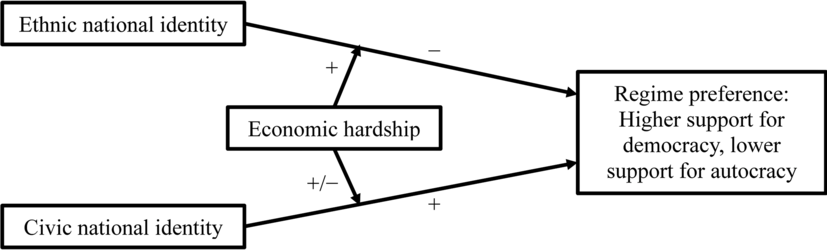
Figure 1 summarizes our core arguments.
The hypothesized relationships between ethnic and civic national identity, economic hardship as well as the support for democracy as opposed to authoritarian alternatives.

Method and data
In order to test the hypothesized relationships between an ethnic or civic national identity, economic hardship at the individual or societal level as well as the individual preference for democracy as opposed to autocratic alternatives, we employ cross-sectional survey data from the EVS 2017–18 (EVS, 2019), including over 27,000 respondents in 24 Western and Eastern European democracies:Footnote
7
Austria, Bulgaria, Croatia, the Czech Republic, Denmark, Estonia, Finland, France, Germany, Hungary, Iceland, Italy, Lithuania, the Netherlands, Norway, Poland, Romania, Serbia, the Slovak Republic, Slovenia, Spain, Sweden, Switzerland, and the United Kingdom. To account for the multilevel structure of our data and given that we are not interested in the direct effects of country-level variables, we run linearFootnote
8
regression models with country fixed-effects and country-clustered standard errors, which are more robust than multilevel modelsFootnote
9
because they control for all potential differences between the countries. In the first step of our analysis, we regress the preference for a democratic or autocratic regime
 $$Pre{f_i}$$
on the ethnic or civic conceptions of national identity
 $$Na{t_i}$$
as well as a set of control variables
 $$C{V_i}$$
. Our models always include both ethnic and civic conceptions of national identity simultaneously to account for the conceptual and empirical interrelatedness of the two concepts:
 $$Pre{f_i} = {\beta _1}Na{t_i} + {\beta _2}C{V_i} + {\alpha _j} + {\varepsilon _i}$$
For our dependent variable, we opt for a measure that distinguishes the support of respondents for a democratic regime vis-à-vis authoritarian alternatives. In this regard, the democracy–autocracy preferenceFootnote 10 (DAP) scale has been established and has found increasing use in literature as a measure of diffuse support for democracy (Inglehart and Welzel, Reference Inglehart and Welzel2005; Ariely and Davidov, Reference Ariely and Davidov2011; Magalhães, Reference Magalhães2014). The EVS question asks respondents whether they perceive certain types of political systems to be a good way of governing their country, including (a) a democratic political system, (b) a strong leader who does not have to bother with parliament and elections, and (c) having the army rule the country, with answers ranging from 1) very bad to 4) very good.Footnote 11 Even though a principal component factor analysis shows that the items load onto a single factor (factor loadings: democracy 0.65, strong leader −0.78, army −0.80), we opt for analyzing these three items separately in the first step to allow for a more fine-grained analysis and to test whether the results are in fact similar for all three items or driven by a specific item.
Our key independent variable is measured with five commonly used items for the ethnic or civic national identity (Kunovich, Reference Kunovich2009; Berg and Hjerm, Reference Berg and Hjerm2010; Reeskens and Hooghe, Reference Reeskens and Hooghe2010; Helbling et al., Reference Helbling, Reeskens and Wright2016). Respondents are asked how important they regard several aspects for being truly of the country’s nationality: (a) to have ancestry from the country, (b) to be born in the country, (c) to share the country’s culture, (d) to be able to speak the country’s language, and (e) to respect the political institutions and laws of the country, answers ranging from 1) not at all important to 4) very important. Ancestry and birth requirements have been indisputably connected to an ethnic and respecting the political institutions to a civic conception of nationhood. Language requirements also lean closer to the civic side of the spectrum, while sharing the culture positions somewhere in between the two ideal points (Reeskens and Hooghe, Reference Reeskens and Hooghe2010). As with our dependent variable, we decided on a more fine-grained analysis at first, adding all items individually to our model. This also allows to test the effect of the more disputed language and culture requirements (Brubaker, Reference Brubaker, Kriesi, Armingeon, Siegrist and Wimmer1999) separately. Further, such single-item models of the proposed relationships consider that Reeskens and Hooghe (Reference Reeskens and Hooghe2010) found that – while loading well onto single factors – not all indicators are equally applicable in cross-national research given differences in measurement invariance. Principal component factor analysis seems to confirm the classification in literature, resulting in a two-factor solution with ancestry (0.93) and born (0.90) loading strongly on the first factor, institutions (0.88) and language (0.73) on the second factor, while the culture criterion loads weakly on both factors (0.38 on the ethnic and 0.56 on the civic factor).
We control for a set of sociodemographic and political covariates that have been shown to affect both national identity (McLaren, Reference McLaren2017; Canan and Simon, Reference Canan and Simon2018; Hadler and Flesken, Reference Hadler and Flesken2018) and diffuse support of democracy (Magalhães, Reference Magalhães2014).Footnote 12 Age (in quadratic form), sex, and education are included because younger, older, male, and less-educated respondents may lean stronger toward ethnic conceptions of nationhood and also display a lower preference for democracy. Several economic variables are added, including household income, work status as well as experience with unemployment and welfare dependency during the last 5 years. Economically deprived respondents are expected to be both more inclined toward ethnic conceptions of nationhood as well as stronger preferences for authoritarian alternatives to democracy. We also control for marital status, children, and the frequency of attending religious services to control for the – on average – more conservative worldviews of married respondents, respondents with children, and religious respondents. Finally, respondents with a migration background may be less prone to ethnic conceptions of nationhood given that they would lead to their exclusion, but a socialization in nondemocratic countries may also lead them to be more favorable of autocratic alternatives to democracy. As to the political covariates, more rightist or extremist views on the left–right scale may both be negatively related to civic conceptions of nationhood as well as support of democracy. Furthermore, more politically interested respondents as well as respondents with a higher generalized trust may favor a civic conception of nationhood and also be stronger proponents of democracy. Finally, we also include a measure of specific support of democracy operationalized as the satisfaction with the functioning of the political system in order to block potential pathways between specific and diffuse support of democracy (Easton, Reference Easton1965, Reference Easton1975), as we are interested in the direct effects of ethnic and civic conceptions of nationhood on diffuse regime preference. An overview of all variables, their data sources as well as summary statistics can be found in Table A1 of the online appendix.
In the second step of our analysis, we strive to test how the direct effects of ethnic or civic conceptions of nationhood on regime preference are moderated by economic hardship. We thus adapt our models as follows:
 $$Pre{f_i} = {\beta _1}Na{t_i} + {\beta _2}Na{t_i}*EconHar{d_{ij}} + {\beta _3}C{V_i} + {\alpha _j} + {\varepsilon _i}$$
DAP is measured as above, but for simplicity, it is now combined to a single scale as the average of the three items (with leader rule and army rule reversed, so that higher values indicate a preference for more democratic systems). Similarly, ethnic and civic conceptions of national identity are recoded into two indices, with ethnic national identity as the mean score of the importance of ancestry and born requirements and civic national identity as a means of respect for institutions and language requirements.Footnote 13 All other control variables are included as before. In addition, the model now includes interaction terms between the two indices of national identity and one of several economic hardship variables, measured through both individual-level and country-levelFootnote 14 indicators. We decided to test our hypotheses with a diverse set of variables (see Table 1) to substantiate the reliability and validity of our measurement, seeing as economic hardship is a multifaceted concept affected by income levels, unemployment as well as social security. At the individual level, economic hardship can be produced by a low-household income or recent experiences of unemployment or welfare dependency. We take into account the country level as well because the perceived individual risk of economic hardship or the likelihood of overcoming economic hardship might crucially hinge on the economic situation of the country as a whole. At the country level, the risk of individual economic hardship can be increased by a low level of economic development, a high unemployment rate, and a low degree of social security (measured by the degree of income inequalityFootnote 15 as the Gini index).Footnote 16
Economic hardship variables

Empirical analysis
A first look at descriptive statistics of our key dependent and independent variablesFootnote 17 shows that, as suggested by previous work (e.g., Norris, Reference Norris2011), diffuse support for democracy is fairly high in European democracies. Only 5% of the respondents consider democracy as a bad way to run their country. Nevertheless, 10% still consider army rule, a potential authoritarian alternative, as a good way to run their country and support for the rule of strong leaders who do not have to bother with parliament and elections is substantial, with 28% of the respondents deeming it a good way to run their country. At the same time, we also observe some differences between the items measuring the respondents’ conception of nationhood. On the one hand, a large majority of roughly 95% of the respondents considers respecting the institutions and being able to speak the country’s language – the two civic membership criteria – as important for being a national, with sharing the country’s culture following closely. On the other hand, the quintessential ethnic membership criteria of having common ancestry and being born in the country are split more evenly between supporters and opponents, with 50% of the respondents regarding a common ancestry and 59% being born in the country as important criteria.Footnote 18
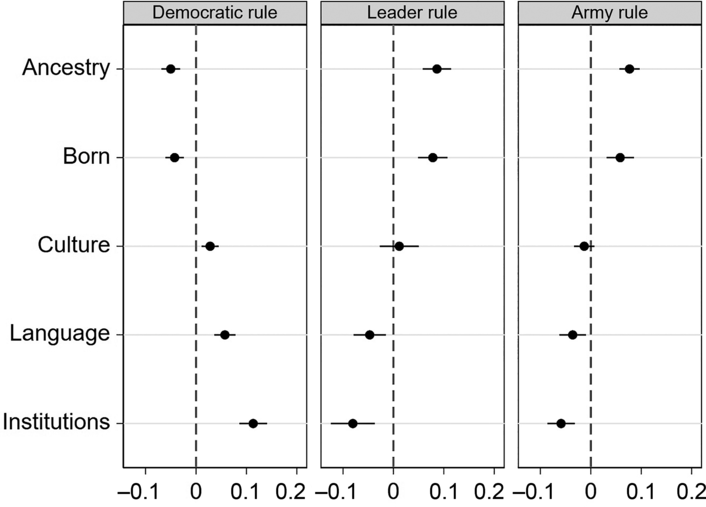
Figure 2 presents the results of the linear regression models testing the direct effect of an ethnic or civic national identity on the three items measuring support for democracy as opposed to authoritarian alternatives such as a strong leader or having the army rule the country. As discussed in the previous section, we do not combine our independent and dependent variables into indices but analyze the items separately in the first step. All models include a set of control variables, and the full regression results can be found in the online appendix in Table A3.
Regression coefficients of the relation between ethnic or civic national identity and support for democracy as opposed to authoritarian alternatives.
Note: Displayed are linear regression coefficients with 95% confidence intervals.

Overall, we find clear support for our hypothesized relationships: the more ethnic conceptions of nationhood (ancestry and born) are negatively related to support for democracy and positively related to support for leader and army rule, while the more civic conceptions of nationhood (institutions and language) are positively related to support for democracy and negatively related to support for leader and army rule. The order of the coefficients is also as expected, with ancestry as the most ethnic criterion displaying a slightly more negative relationship than the birth criterion and the respect of institutions criterion displaying a slightly more positive relationship compared to the language criterion (Reeskens and Hooghe, Reference Reeskens and Hooghe2010). The culture criterion is in between but leans somewhat closer to the civic items: it has a positive effect on support for democracy but is insignificant for support for leader or army rule.
The effect size is substantive and one of the strongest predictors of DAP.Footnote 19 A change in the ancestry criterion from the minimum to the maximum reduces support of democracy (on a scale from 1 to 4) by 0.15 and increases leader and army support by 0.26 and 0.23, respectively. At the same time, the same change in the respect for institutions criterion increases support of democracy by 0.34 and decreases leader and army support by 0.24 and 0.18. This also shows that a civic national identity has a stronger effect on support for a democratic regime, while an ethnic national identity has a slightly stronger effect on support of authoritarian alternatives. Jackknifing robustness checks show that the results are not contingent on individual countries.Footnote 20 The results also hold when using combined indices instead of the individual items. In addition, we performed several robustness checks, as alluded in the previous section. We replicated the models with a more narrow set of covariates including only sociodemographic control variables as well as a more broad set of covariates, including measures of whether respondents regard their political system as democratic, attitudes toward immigrants, particularized trust, and club membership as a measure of structural social capital. Next, we also selected alternative modeling strategies such as ordered logit regression with country dummies as well as multilevel models with several country-level control variables (GDP per capita, GDP growth, unemployment rate, Gini index, KOF globalization index, net migration rate, WGI government effectiveness, and FH democracy index). Finally, we also replicated our models with the EVS 2008 data set (EVS, 2008) using the same country set in order to ensure that our results are comparable across time. The results of these robustness checks can be found in Figure A1 in the online appendix. Overall, they do not have any substantive effects on our results and the results are very similar in the EVS (2008).
The effects of other covariates are largely as expected. Support for democracy as opposed to authoritarian alternatives increases with age, education, income, political interest as well as general trust and is higher among the part-time employed, self-employed, and students. In contrast, authoritarian alternatives are more popular among those with welfare dependency experiences, married or widowed respondents, respondents with children, religious and right-wing respondents as well as respondents with first-generation migration background.
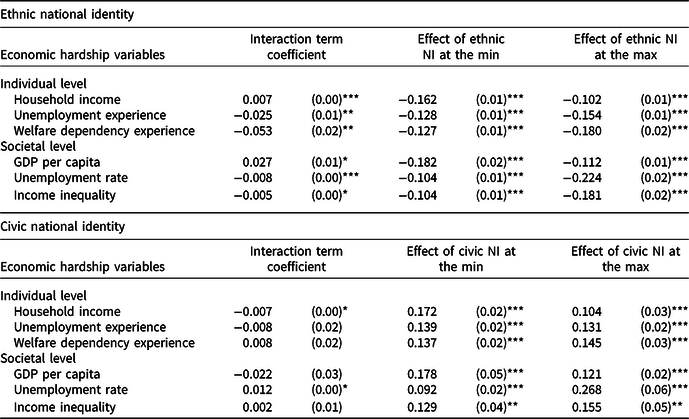
Moving on to the second part of our analysis, Table 2 displays the results of our interaction models. The first column shows the fixed-effects regression coefficient of the interaction term between the ethnic or civic national identity index and one of the economic hardship variables. In order to compare how much economic hardship moderates the effect of an ethnic or civic conception of nationhood, column two and three display the marginal effect of ethnic or civic national identity at the minimum or maximum of the respective economic hardship variable. The full results of our interaction models can be found in the online appendix in Table A5.
Regression coefficients of the moderating effect of economic hardship on the relation between ethnic or civic national identity and support for democracy as opposed to authoritarian alternatives

Column 1 displays fixed-effects regression coefficients with cluster-robust standard errors in parentheses, and columns 2 and 3 display the marginal effect of ethnic or civic national identity at the minimum or maximum of the respective economic hardship variable, + P < 0.10, * P < 0.05, ** P < 0.01, *** P < 0.001.
With regard to an ethnic conception of nationhood, all economic hardship variables support our Hypothesis 3. At the individual level, ethnic national identity is more negatively related to preferences for democracy for respondents with a lower income as well as unemployment and welfare dependency experiences. At the societal level, ethnic conceptions of nationhood are more strongly related to lower preferences for democracy in countries with a lower GDP per capita, a higher unemployment rate, and higher economic inequality. The effects are significant at the 5%, 1%, or 0.1% significance level and substantial, in particular, for economic hardship at the societal level. At the lowest level of unemployment (Iceland), an increase in the ethnic national identity index by 1 unit only decreases the preference for democracy as opposed to authoritarian alternatives by 0.10 on a scale from 1 to 4, whereas at the highest level (Spain), the DAP is decreased by 0.22.
The moderating effects are less coherent for civic conceptions of nationhood: only two of our economic hardship indicators have a significant moderating effect, both showing that economic hardship slightly reinforces the positive effect of civic national identity on preferences for democracy. Respondents with a lower income and respondents in countries with a higher unemployment rate have a more positive effect of a civic national identity on preferences for democracy as opposed to authoritarian alternatives. The effects are significant at the 5% level and, again, in particular substantial for economic hardship at the societal level: at the lowest level of unemployment, an increase in the civic national identity index by 1 unit only increases the preference for democracy by 0.09, while at the highest level, it is increased by 0.27. Overall, Hypothesis 4a clearly has to be refuted; however, there is at least some support for Hypothesis 4b, although only two of the six interaction terms turn out significant.
As in the first step, we again perform several robustness checks (see Figure A2 in the online appendix for detailed results). Jackknifing again shows that the results generally do not hinge on certain countries being included in the sample.Footnote 21 With the exception of the ordered logit models, the results are also robust to a different selection of control variables, different modeling approaches as well as civic national identity being measured with three instead of two items (i.e., including the culture criterion). As to our robustness check using the EVS (2008) (see Table A5 in the online appendix), the coefficients generally point into the expected direction, but only the interaction term for welfare dependency experience is significant for an ethnic national identity and only the unemployment rate for a civic national identity. However, the EVS (2008) may very well be a special case in this regard, as it was conducted at the height of the Great Recession 2007–09.
Conclusion
Is democracy still ‘the only game in town’ (Linz and Stepan, Reference Linz and Stepan1996, p. 5) in European societies? While there is widespread support for democracy, support for authoritarian alternatives such as army rule or a strong leader is far from negligible and may threaten democratic rule particularly in less-consolidated (Eastern) European countries but also in supposedly established democracies. In this paper, we set out to explain variation in regime support for democracy as opposed to authoritarian alternatives using cross-sectional survey data from 24 Western and Eastern European democracies included in the EVS 2017–18 (EVS, 2019). While existing research has primarily examined the economic determinants of diffuse (and specific) support for democracy (e.g., Kotzian, Reference Kotzian2011; Armingeon and Guthmann, Reference Armingeon and Guthmann2014; Teixeira et al., Reference Teixeira, Tsatsanis and Belchior2014), our analysis focuses on the content of national identity. Tying in with the discussion whether national identification and democracy are complementary or competing logics (Calhoun, Reference Calhoun2007; Helbling, Reference Helbling2009; Tamir, Reference Tamir2019b), we show that national identity is a double-edged sword for regime preference. On the one hand, a national identity that emphasizes civic conceptions of nationhood (i.e., respect for the country’s institutions and laws, being able to speak the language) is positively related to support for democracy and negatively related to army or leader rule; on the other hand, the reverse holds true for a national identity that highlights ethnic conceptions of nationhood (i.e., a common ancestry, being born in the country). Considering that ethnic conceptions of nationhood are held by roughly half of the respondents in our sample, this may be an important contribution in explaining why a substantial share of citizens in European democracies expresses support for authoritarian alternatives to democracy.
However, economic explanations are not to be neglected, either. Economic hardship entails existential insecurity and status anxiety and reinforces the cultural backlash of those who feel disoriented by the erosion of familiar values (Inglehart and Norris, Reference Inglehart and Norris2017). While economic hardship generally decreases support of democracy (e.g., Teixeira et al., Reference Teixeira, Tsatsanis and Belchior2014), it also further strengthens the negative effect of an ethnic conception of nationhood on support for democracy vis-à-vis authoritarian alternatives. This means that it is the economically deprived citizens with an ethnic conception of nationhood who are particularly vulnerable to authoritarian promises. On a more positive note, however, economic hardship also strengthens the positive effect of a civic conception of nationhood on support for democracy in some of our models. As ‘critical citizens’ (Norris, Reference Norris1999, Reference Norris2011), those with a civic national identity may thus continue to value democracy as the ideal form of government despite their dissatisfaction with the current economic performance of their democratic system.
This has important implications for understanding at least two crucial issues in contemporary European (if not global) societies. One is the relationship between the economy and identity/culture in driving diffuse system support. Economic crises and other performance-related crises of the political system are bound to occur every now and then in democracies. It is thus of vital importance for the survival of democracy that such crises or individual economic hardship do not substantially weaken diffuse support for democracy and reinvigorate support for authoritarian alternatives uniformly across all members of society. An individual’s social identity substantially shapes how she responds to economic hardship when evaluating her support for a democratic regime type. Therefore, our study shows that the often postulated primacy of economic concerns over values and culture is not as stable as it is frequently postulated. The second vital implication of our results is that democracies in which a large majority of citizens holds a civic conception of nationhood are decisively less in danger of ‘democratic backsliding’ (Bermeo, Reference Bermeo2016; Waldner and Lust, Reference Waldner and Lust2018) than those where an ethnic conception prevails. Thus, our results show two ways in which democracies can strengthen support for a democratic regime: first, by ensuring that they perform well economically and citizens are protected from economic hardship and insecurity, democracies can weaken the negative effects of an ethnic national identity and potentially even strengthen the positive effects of a civic national identity. Second, by promoting a permeation of a civic as opposed to an ethnic definition of national membership criteria through their citizenry, democracies can strengthen preferences for a democratic regime and also dampen the negative impact of economic crises. The latter point touches upon recent discussions on citizenship laws and immigration as well. In this regard, Tamir (Reference Tamir2019b) stresses the promotion of liberal nationalism with respect and empathy for foreigners in education and public discourse and the need to distribute social risks and opportunities in fair and transparent ways. Other authors also point to the role of education as well as the political discourse in shaping people’s position on the civic–ethnic continuum (Hjerm, Reference Hjerm2001; Hadler and Flesken, Reference Hadler and Flesken2018).
Naturally, we have to acknowledge certain limitations of our study. Unfortunately, our data set is restricted to exclusively European democracies. We thus cannot test whether our results can be generalized to a broader set of non-European democracies. In addition, our moderation analyses focus on objective measures of the economic situation, even though several studies emphasize that, in particular, a subjective evaluation of the country’s economic situation contributes to explaining support for democracy (Bratton and Mattes, Reference Bratton and Mattes2001; Armingeon and Guthmann, Reference Armingeon and Guthmann2014; Teixeira et al., Reference Teixeira, Tsatsanis and Belchior2014). Alas, our data set includes no measure for subjective evaluations of the economy. Finally, our research design is purely cross-sectional and thus not causal in nature. While we do believe that there are sound theoretical reasons for a causal influence of national identity on diffuse support for democracy, (quasi-)experimental evidence is needed to ascertain the causal nature the relationships found in our study.
Nevertheless, our conclusions allow for insights into determinants of diffuse system support in general and the role of identity therein that have been lacking in previous research. People with an ethnic national identity portray substantially lower support for a democratic regime than those holding a civic national identity, while the reverse is the case for authoritarian regime types. Additionally, we shed further light on the relationship between economic hardship and identity by showing that they profoundly interact with each other instead of looking at both separately. Economic hardship decisively strengthens the negative relationship between an ethnic national identity and support for democracy. For individuals with civic national identity, the results are less robust but they indicate a slight increase in this group’s support for democracy under economic hardship. These all in all consistent and robust findings yield crucial implications for both scholarly research as well as everyday politics and call for further endeavors in analyzing the relationship between other aspects of individual-level social identity and support for regime types.
Supplementary material
To view supplementary material for this article, please visit https://doi.org/10.1017/S1755773920000351.
Acknowledgments
An earlier version of this paper was presented at the SPSA Annual Conference 2020 in Lucerne and a research seminar at the University of Bern. We are grateful to Quynh Nguyen, Valon Hasanaj, and the other participants as well as Lars Bischoff, Keonhi Son, Maximilian Filsinger, and Jonas Schmid for their valuable feedback, which has helped improve this paper tremendously. We also thank the three anonymous referees and the editors for their very helpful comments and suggestions.