Introduction
The prevalence of adverse childhood events, such as childhood sexual abuse (CSA) or childhood physical abuse (CPA), in the general public is surprisingly high with estimates of up to a quarter of all children affected in high-income countries (Gilbert et al. Reference Gilbert, Widom, Browne, Fergusson, Webb and Janson2009; Radford et al. Reference Radford, Corral, Bradley and Fisher2013). CSA and CPA are often considered the most toxic forms of childhood adversity (CA); however, in recent years, death of a significant other, separation from a parent figure and placement in institutional care during early childhood have also been recognized as having detrimental consequences for mental health (Read et al. Reference Read, van Os, Morrison and Ross2005; Morgan et al. Reference Morgan, Kirkbride, Leff, Craig, Hutchinson, McKenzie, Morgan, Dazzan, Doody, Jones, Murray and Fearon2007; Read & Bentall, Reference Read and Bentall2012). Some have attempted to claim that, assuming causality, one-third of new cases of psychotic disorders may be attributable to CA (Dvir et al. Reference Dvir, Denietolis and Frazier2013).
Despite this intriguing research, pathogenic mechanisms that link CA to psychotic disorders are not well understood (Bentall et al. Reference Bentall, de Sousa, Varese, Wickham, Sitko, Haarmans and Read2014). This may be due to existing studies predominantly utilizing the traditional diagnostic categories of psychosis, the adequacy of which has increasingly been questioned (Costello, Reference Costello1992; van Os et al. Reference van Os, Gilvarry, Bale, Van Horn, Tattan, White and Murray1999; Cuthbert, Reference Cuthbert2014). Instead it has been postulated that the phenomenology of psychosis may be better conceptualized by symptom dimensions (Kay & Sevy, Reference Kay and Sevy1990; van Os et al. Reference van Os, Fahy, Jones, Harvey, Sham, Lewis, Bebbington, Toone, Williams and Murray1996, Reference van Os, Gilvarry, Bale, Van Horn, Tattan, White and Murray1999). The importance of symptom profiles (van Os et al. Reference van Os, Gilvarry, Bale, Van Horn, Tattan, White and Murray1999; Dikeos et al. Reference Dikeos, Wickham, McDonald, Walshe, Sigmundsson, Bramon, Grech, Toulopoulou, Murray and Sham2006) and their superiority over diagnostic categories at predicting clinical course and outcome of psychosis has been demonstrated (van Os et al. Reference van Os, Fahy, Jones, Harvey, Sham, Lewis, Bebbington, Toone, Williams and Murray1996; Demjaha et al. Reference Demjaha, Morgan, Morgan, Landau, Dean, Reichenberg, Sham, Fearon, Hutchinson, Jones, Murray and Dazzan2009). In terms of research into the associations between CA and psychosis, application of symptom dimensions may increase the statistical power to detect associations over categories especially where the categories may lack validity. However, research conducted in first-episode psychosis (FEP) cases where symptomatology is not affected by differences in clinical practice, hospitalization and treatment choices is still lacking (Emsley et al. Reference Emsley, Rabinowitz and Torreman2003; Demjaha et al. Reference Demjaha, Morgan, Morgan, Landau, Dean, Reichenberg, Sham, Fearon, Hutchinson, Jones, Murray and Dazzan2009). Existing research has most frequently identified multidimensional models with five factors (Bell et al. Reference Bell, Lysaker, Beam-Goulet, Milstein and Lindenmayer1994; Lindenmayer et al. Reference Lindenmayer, Bernstein-Hyman and Grochowski1994; White et al. Reference White, Harvey, Opler and Lindenmayer1997; Lançon et al. Reference Lançon, Aghababian, Llorca and Auquier1998; Emsley et al. Reference Emsley, Rabinowitz and Torreman2003). Based on previous work, Wallwork et al. (Reference Wallwork, Fortgang, Hashimoto, Weinberger and Dickinson2012) derived a consensus five-factor model of psychosis that comprised positive (e.g. delusions, hallucinatory behaviour), negative (e.g. blunted affect, emotional withdrawal), disorganized/concrete (e.g. conceptual disorganization, difficulty in abstract thinking), excited (e.g. excitement, hostility) and depressed (e.g. depression, guilt feelings) dimensions. This Wallwork/Fortgang five-factor model has been shown to be the most robust Positive and Negative Syndrome Scale (PANSS) factorial solution for exploring symptom profiles in FEP patients (Langeveld et al. Reference Langeveld, Andreassen, Auestad, Færden, Hauge, Joa, Johannessen, Melle, Rund, Røssberg, Simonsen, Vaglum and Larsen2013) and thus is the factorial model we chose to utilize in the current study.
In the present study we conducted confirmatory factor analyses (CFAs) of the Wallwork/Fortgang five-factor model (Wallwork et al. Reference Wallwork, Fortgang, Hashimoto, Weinberger and Dickinson2012) using data from a relatively large and well-characterized sample of patients presenting to psychiatric services for the first time with psychosis. We then aimed to examine independent associations between different types of CA (physical abuse, sexual abuse, parental separation, parental death, and being taken into care) and each of these specific psychotic symptom dimensions. Previously an association of childhood trauma with psychotic disorder has been demonstrated in this sample (Trotta et al. Reference Trotta, Di Forti, Iyegbe, Green, Dazzan, Mondelli, Morgan, Murray and Fisher2015). Given previous research that has explored associations between CA and individual symptoms of psychosis and schizotypy, we hypothesized that all forms of CA would be associated with the positive dimension (Read et al. Reference Read, Agar, Argyle and Aderhold2003; Janssen et al. Reference Janssen, Krabbendam, Bak, Hanssen, Vollebergh, de Graaf and van Os2004; Whitfield et al. Reference Whitfield, Dube, Felitti and Anda2005; Schürhoff et al. Reference Schürhoff, Laguerre, Fisher, Etain, Méary, Soussy, Szöke and Leboyer2009; Bentall et al. Reference Bentall, Wickham, Shevlin and Varese2012; Stilo et al. Reference Stilo, Di Forti, Mondelli, Falcone, Russo, O'Connor, Palmer, Paparelli, Kolliakou, Sirianni, Taylor, Handley, Dazzan, Pariante, Marques, Zoccali, David, Murray and Morgan2013; Velikonja et al. Reference Velikonja, Fisher, Mason and Johnson2015). As there is a consistent body of literature linking CSA with depression (e.g. Bifulco et al. Reference Bifulco, Brown and Adler1991; Kendler & Aggen, Reference Kendler and Aggen2014; Sitko et al. Reference Sitko, Bentall, Shevlin, O'Sullivan and Sellwood2014), we also hypothesized that this type of CA would be associated with the depressed symptom dimension.
Method
Sample
Participants were recruited as part of the Biomedical Research Centre Genetics and Psychosis (GAP) study, a large case–control study conducted in South London, UK. The study included patients aged 18–65 years who presented to psychiatric wards in the South London and Maudsley National Health Service (NHS) Foundation Mental Health Trust between January 2006 and October 2010 with a first episode of psychosis [International Classification of Diseases (ICD-10) codes F20–F29 and F30–F33] (World Health Organization, 1992). Exclusion criteria were: (1) evidence of psychotic symptoms precipitated by an organic cause; (2) transient psychotic symptoms resulting from acute intoxication as defined by ICD-10; (3) head injury causing clinically significant loss of consciousness; (4) under the age of 18 or over 65 years; and (5) learning disability (intelligence quotient < 70). The original GAP sample comprised 339 FEP patients; of these, symptom data were available for 236 patients (69.6% of the original GAP sample). Therefore, the data we present here are based on these 236 patients for whom we had complete symptom data.
Ethics
The GAP study was granted ethical approval by the South London and Maudsley and Institute of Psychiatry Local Research Ethics Committee (reference number: 05/Q0706/158). All cases gave informed written consent after reading a detailed information sheet. All procedures contributing to this work comply with the ethical standards of the relevant national and institutional committees on human experimentation and with the Helsinki Declaration of 1975, as revised in 2008.
Assessments
Sociodemographic characteristics
The Medical Research Council Socio-demographic Schedule modified version was utilized to collect data on sociodemographic characteristics (Mallett et al. Reference Mallett, Leff, Bhugra, Pang and Zhao2002). Ethnicity was self-ascribed using the 16 categories employed by the 2001 UK Census (http://www.ons.gov.uk/ons/guide-method/census/census-2001/index.html). Due to small numbers in some ethnic categories, we combined them into three broad ethnic groups: white (all white groups); black (all black groups); and other (encompassing Asian, mixed ethnicity and other ethnicities). Lifetime history of alcohol use prior to the onset of psychosis was collated using the Alcohol Use Disorders Identification Test (Babor et al. Reference Babor, de la Fuente, Saunders and Grant1992) and was split into ever used alcohol (1) v. never used alcohol (0). Lifetime use of cannabis and other illegal substances prior to the onset of psychosis was assessed with the Cannabis Experience Questionnaire modified version (Di Forti et al. Reference Di Forti, Morgan, Dazzan, Pariante, Mondelli, Marques, Handley, Luzi, Russo, Paparelli, Butt, Stilo, Wiffen, Powell and Murray2009). Patients were divided into those who reported ever having used cannabis (1) and those who reported never having used it (0). Similarly, use of any other illegal substances was coded as ever used (1) v. never used (0). The Family Interview for Genetic Studies (https://www.nimhgenetics.org/interviews/figs) and clinical records were used to obtain information about patients’ family history of mental health problems. A family history of psychosis variable was derived following consensus diagnoses based on the available information and referred to the presence (1) or absence (0) of a current or past psychotic disorder in at least one first-degree relative.
Clinical presentation
Duration of untreated psychosis (DUP) was determined from the assessment interview and mental health records and defined as the difference between the date of the appearance of the first positive psychotic symptom [hallucination, delusion or thought disorder rated as 4 or higher on the PANSS (Kay et al. Reference Kay, Fiszbein and Opler1987) as per Singh et al. Reference Singh, Cooper, Fisher, Tarrant, Lloyd, Banjo, Corfe and Jones2005] and date of first contact with mental health services for psychosis (Morgan et al. Reference Morgan, Abdul-Al, Lappin, Jones, Fearon, Leese, Croudace, Morgan, Dazzan, Craig, Leff and Murray2006). Diagnoses were made from interviews and mental health records utilizing the Operational Criteria Checklists (McGuffin et al. Reference McGuffin, Farmer and Harvey1991). In the present study, diagnoses were grouped using ICD-10 codes into schizophrenia-spectrum (F20–F29), affective psychoses (F30.2, F31.2, F31.5, F32.3 or F33.3) and other psychoses (F10, F53).
CA
CA was assessed using the Childhood Experience of Care and Abuse Questionnaire (CECA.Q; Bifulco et al. Reference Bifulco, Bernazzani, Moran and Jacobs2005), which was read out to participants during a face-to-face interview. The CECA.Q is a self-report instrument developed to retrospectively assess CA that occurred before 17 years of age. In this study, the focus was on five forms of CA that have been proposed to play an important role in the aetiology of psychosis: (i) physical abuse inflicted by either one or both parent figures; (ii) sexual abuse perpetrated by an individual at least 5 years older than the victim; (iii) separation from either or both parent figures for a period of at least 6 months; (iv) death of either or both parent figures; and (v) being taken into care by the authorities. Full details of this measure are provided elsewhere (Bifulco et al. Reference Bifulco, Bernazzani, Moran and Jacobs2005; Fisher et al. Reference Fisher, Jones, Fearon, Craig, Dazzan, Morgan, Hutchinson, Doody, McGuffin, Leff, Murray and Morgan2010). Briefly, the CPA and CSA sections begin with screening questions where the positive responses are followed up with more detailed questions. In order to establish the severity of CPA experienced, the four follow-up questions are designed to elicit more detailed information on the frequency of attacks, severity of the injuries sustained and whether the perpetrator was out of control. For CSA, the seven additional probes inquire about degree of sexual contact, relationship to perpetrator, and frequency of occurrence. The items for each type of abuse are summed separately to obtain a total CPA score and a total CSA score. Full scoring guidance and a copy of the measure are available (www.cecainterview.com). To ensure that the CECA.Q scores reflected a reasonable level of severity in the analysis, the total scores for the CPA and CSA subscales were dichotomized using the most conservative published cut-points (Bifulco et al. Reference Bifulco, Bernazzani, Moran and Jacobs2005). This measure has been shown to have good psychometric properties in patients with psychosis (Fisher et al. Reference Fisher, Craig, Fearon, Morgan, Dazzan, Lappin, Hutchinson, Doody, Jones, McGuffin, Murray, Leff and Morgan2011).
Psychotic symptoms
The PANSS (Kay et al. Reference Kay, Fiszbein and Opler1987) was completed in face-to-face interviews with the patients to assess psychotic symptoms over the week preceding the assessment. The 30 items are each rated on a seven-point scale (1 = absent, 7 = extreme) and grouped into three subscales: positive symptoms (seven items), negative symptoms (seven items) and general psychopathology (16 items).
Analysis
All analyses were conducted in STATA release 12 (STATACorp LP, USA). CFA was conducted to evaluate the statistical fit (Stefanovics et al. Reference Stefanovics, Elkis, Zhening, Zhang and Rosenheck2014) of the Wallwork/Fortgang five-factor model of psychosis (Wallwork et al. Reference Wallwork, Fortgang, Hashimoto, Weinberger and Dickinson2012) in this sample of patients with FEP. This model comprises positive (i.e. P1, P3, P5, G9), negative (i.e. N1, N2, N3, N4, N6 and G7), disorganized/concrete (i.e. P2, N5, G11), excited (i.e. P4, P7, G8 and G14) and depressed (i.e. G2, G3 and G6) factors. The factors identified by the Wallwork/Fortgang five-factor model were entered as latent variables in the CFA and the PANSS items were entered as observed variables. The goodness-of-fit index statistics were used to determine the adequacy of fit of the model. These included the comparative fit index (CFI; values greater than 0.90 indicate good model fit), the root mean square error of approximation (RMSEA; values less than 0.06 indicate good model fit) and the standardized root mean square residual (SRMR; values less than 0.08 indicate good model fit) (Stefanovics et al. Reference Stefanovics, Elkis, Zhening, Zhang and Rosenheck2014). To assess the improvement in the fit of the model, correlated measurement errors were introduced into the model based on significantly correlated residuals indicated by modification indices (Liemburg et al. Reference Liemburg, Castelein, Stewart, van der Gaag, Aleman and Knegtering2013).
Following CFA, factor scores for each of the five symptom dimensions were calculated for each patient using STATA's ‘predict’ post-estimation command. The distributions of the obtained symptom dimensions were examined and found to be normally distributed (see online Supplementary Figs S1–S5), thus meeting criteria for linear regression analysis. Linear regression was utilized to examine associations between each type of CA and the continuous symptom dimension scores. This set of analyses was controlled for age at first contact with mental health services for psychosis, gender, ethnicity, lifetime use of alcohol, cannabis or other illegal substances prior to psychosis onset, and family history of psychosis. To explore whether the relationships were independent of the effects of other forms of CA, the identified significant associations were re-examined additionally controlling for the other types of CA.
Results
Sample characteristics
Of the patients recruited to the GAP study (n = 339), the PANSS was completed for 236 patients (69.6%). This subsample with PANSS ratings did not differ significantly from the full GAP sample in terms of gender (χ2 = 0.41, p = 0.52), ethnicity (χ2 = 3.29, p = 0.19) and DUP (in days) (t = 0.37, p = 0.99); however, those patients without the PANSS tended to be older (t = 1.97, p = 0.05) (online Supplementary Table S1).
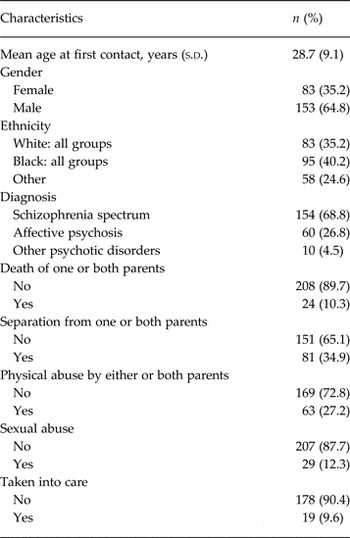
Data on demographic characteristics, clinical presentation and prevalence of CA for our sample are presented in Table 1. The mean age at first contact was 29 (SD = 9.1) years and the majority of the sample were men (64.8%). Around one-third (35.2%) was of white and 40.2% of black ethnicity. Just over two-thirds of the cases were diagnosed with schizophrenia-spectrum disorders (68.8%) and a quarter with affective psychoses (26.8%). The most common type of CA reported was separation from one or both parent figures (34.9%), followed by CPA (27.2%). Being placed into care by the authorities before 17 years of age was the least prevalent adversity (9.6%).
Demographic and clinical characteristics of the sample and distribution of type of childhood adversity

Data are given as number (percentage) unless otherwise indicated.
s.d., Standard deviation.
CFA
CFA was conducted in the current sample with the Wallwork/Fortgang five-factor model of PANSS items. The means and standard deviations of the actual PANSS scores are presented in online Supplementary Table S2. When the correlated residuals (i.e. measurement errors) were not introduced into the model the results of the CFA indicated a poor model fit: CFI = 0.767, RMSEA = 0.101 [95% confidence interval (CI) 0.092–0.111] and SRMR = 0.111. However, once significantly correlated residuals were incorporated into the model, the CFA produced an excellent fit of the model [CFI = 0.959, RMSEA = 0.052 (95% CI 0.037–0.067) and SRMR = 0.071]. Scores for all five symptom dimensions appeared to be normally distributed (online Supplementary Figs S1–S5).
Average symptom dimension scores by type of CA
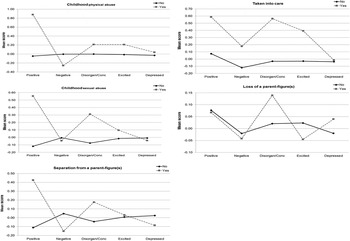
The mean symptom dimension scores for each of the five types of CA are illustrated in Fig. 1. Those patients who reported parental separation, relative to those who did not experience this type of CA, had a higher mean score for the positive dimension. Similarly, those patients who reported CSA and those who reported CPA had higher mean scores for the positive symptom dimension as well as lower mean scores for the negative symptom dimension compared with patients who did not report these forms of CA. Apart from the depressed dimension, the severity of the other four symptom dimensions was more pronounced among those who were placed in institutional care before the age of 17 years compared with those who were not. This was particularly the case for the positive and disorganized/concrete dimensions. Among those who had one or both parents die before they turned 17 years, the mean score for the disorganized/concrete dimension was slightly higher than for those patients who did not experience parental loss.
Mean psychosis symptom dimension scores for each type of childhood adversity among first-episode psychosis patients. The continuous symptom dimension scores were derived using the ‘predict’ post-estimation command in Stata following a confirmatory factor analysis of the Wallwork/Fortgang five-factor model (Wallwork et al. Reference Wallwork, Fortgang, Hashimoto, Weinberger and Dickinson2012) of the items from the Positive and Negative Syndrome Scale (Kay et al. Reference Kay, Fiszbein and Opler1987). The five dimensions capture positive, negative, disorganized/concrete (disorgan/conc), excited, and depressed symptom items at first presentation to psychiatric services. Childhood adversities reported by patients as occurring prior to 17 years of age have been dichotomized into ‘yes’ (present) v. ‘no’ (absent) according to published guidelines (Bifulco et al. Reference Bifulco, Bernazzani, Moran and Jacobs2005).

Associations between CA and symptom dimensions
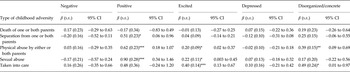
Unstandardized β's from regression analyses of the associations between each type of CA and symptom dimension scores are shown in Table 2. There was a significant association between CSA and the positive dimension, indicating that those individuals who experienced this form of CA scored on average 0.90 higher on the positive dimension than those who did not report CSA. Similarly, there was a significant but substantially weaker association of CSA with the excited dimension (β = 0.22). Although neither of the 95% CIs for these associations contained the point estimate of the other association, there was some overlap between the CIs indicating that CSA could not be said to be independently associated with both the positive and excited dimension. Reported exposure to CPA was associated with significant increases in average scores on the positive, disorganized/concrete and excited symptom dimensions compared with those who did not report this form of CA. However, the CIs for these associations overlapped and contained the point estimates, thus suggesting that CPA was not independently associated with these three symptoms dimensions. Those who were taken into care showed an average increase of 0.49 on the disorganized/concrete and 0.40 on the excited dimensions compared with those patients who did not report this form of CA. Again there was no evidence of independent associations with these two symptom dimensions. Additionally, experience of parental separation was associated with a significant increase of 0.51 in the average score on the positive dimension.
Associations between types of childhood adversity and the Wallwork/Fortgang continuous five-factor psychosis symptom dimension scoresa

β, Unstandardized linear regression coefficient; s.e., standard error; CI, confidence interval.
a The analyses are controlled for age at the time of first contact with mental health services for psychosis, gender, ethnicity, lifetime use of substances (alcohol, cannabis and other illegal substances) prior to onset of psychosis, and family history of psychosis.
* p < 0.05, ** p < 0.01, *** p < 0.001.
To explore whether these significant associations were truly independent of the effects of other forms of CA, each significant relationship was reanalysed additionally controlling for the remaining types of CA. The relationship between parental separation and the positive symptom dimension remained significant (β = 0.60, 95% CI 0.10–1.11). Although the magnitude of the relationship between CPA and the positive dimension weakened it remained significant (β = 0.48, 95% CI 0.03–0.93). The association of CSA with the positive dimension was also robust to adjustment for other types of CA and remained significant (β = 0.96, 95% CI 0.04–0.64). Finally, the association between being taken into care and the excited dimension retained significance (β = 0.36, 95% CI 0.08–0.65). All other associations were attenuated and failed to reach the conventional 0.05 level of statistical significance.
Discussion
In the present study of FEP patients we have identified independent and robust associations between three forms of CA (CSA, CPA and parental separation) and the positive psychosis symptom dimension from the Wallwork/Fortgang five-factor consensus model of psychosis. Additionally, placement in institutional care before the age of 17 years was significantly associated with the excited dimension, independent of the other forms of adversity. However, no significant associations were found between parental death and any of the symptom dimensions.
Methodological considerations
A major strength of the current study is that it is the first study to have examined the relationships between several specific forms of CA and symptom dimensions in a sample of FEP patients. The five-factor model of psychosis symptoms employed in the present study was selected for being a ‘consensus’ model derived from existing studies (Wallwork et al. Reference Wallwork, Fortgang, Hashimoto, Weinberger and Dickinson2012) that has been shown to be optimal for use in FEP samples (Langeveld et al. Reference Langeveld, Andreassen, Auestad, Færden, Hauge, Joa, Johannessen, Melle, Rund, Røssberg, Simonsen, Vaglum and Larsen2013). This will probably facilitate the comparability of our results with those obtained in future studies. The symptom dimensions were founded on the PANSS which has previously been shown to be resilient to the effects of age, severity of symptoms, chronicity of illness (White et al. Reference White, Harvey, Opler and Lindenmayer1997) and short-term medication withdrawal (Lindenmayer et al. Reference Lindenmayer, Bernstein-Hyman and Grochowski1994). Moreover, the sample utilized in the present study was a well-characterized sample of recent-onset patients presenting for the first time with psychosis and thus the findings are not confounded by chronicity of illness or prolonged medication use. Additionally, the regression analyses were controlled for important confounding factors, such as substance use and proxy genetic risk (Sideli et al. Reference Sideli, Mule, La Barbera and Murray2012) in addition to age at first contact with mental health services for psychosis, gender and ethnicity. Therefore, we can be more certain that the identified relationships are independent of the effects of these potentially confounding factors.
However, several methodological issues should be considered when interpreting the results of this study. Retrospective accounts of CA were utilized which could be biased due to forgetting over time and the reality distortions experienced by many patients with psychosis (Garety et al. Reference Garety, Kuipers, Fowler, Freeman and Bebbington2001; Lysaker et al. Reference Lysaker, France, Hunter and Davis2005; Bendall et al. Reference Bendall, Jackson, Hulbert and McGorry2008; Vassos et al. Reference Vassos, Sham, Cai, Deng, Liu, Sun, Zhao, Murray, Collier and Li2008). However, reports of CA obtained retrospectively from individuals with psychotic disorders have been shown to be stable over time and unaffected by severity of psychotic or affective symptoms (Fisher et al. Reference Fisher, Craig, Fearon, Morgan, Dazzan, Lappin, Hutchinson, Doody, Jones, McGuffin, Murray, Leff and Morgan2011). Second, as we did not have PANSS scores for the whole sample it is possible that this may have led to results being affected by selection bias. However, the comparison analyses between the full GAP sample and the subsample with PANSS ratings did not uncover any indication of potential biases. It is also noteworthy that the PANSS covered only 1 week of symptoms prior to the interview and thus may not be able to provide the best indicator of the overall clinical profile of these patients. Finally, the number of statistical tests carried out was significantly sentential; thus we cannot confidently rule out the possibility that some of the associations might have been due to type I errors.
CA and symptom dimensions
Previously, a 3-fold-increase in odds of psychosis in those who had reported a history of death of a parent during childhood has been reported (Stilo et al. Reference Stilo, Di Forti, Mondelli, Falcone, Russo, O'Connor, Palmer, Paparelli, Kolliakou, Sirianni, Taylor, Handley, Dazzan, Pariante, Marques, Zoccali, David, Murray and Morgan2013). In the present study, though, this type of CA was not associated with specific symptom dimensions. However, the association of CSA with the positive dimension was noticeably strong. Population-based studies have demonstrated that CSA is strongly related to delusions (Janssen et al. Reference Janssen, Krabbendam, Bak, Hanssen, Vollebergh, de Graaf and van Os2004) and hallucinations (Sitko et al. Reference Sitko, Bentall, Shevlin, O'Sullivan and Sellwood2014), though this finding is not consistent across all studies (Read et al. Reference Read, van Os, Morrison and Ross2005). Similarly, there was a robust significant association between parental separation and the positive symptom dimension. The pathogenic mechanism underlying these relationships could be explained in terms of attachment theory (Levy, Reference Levy2013). Accordingly, CSA and prolonged separation from parents may be considered as a profound failure to provide the security required for the development of a secure attachment, triggering intense fears and profound anxieties (Smith et al. Reference Smith, Gamble, Cort, Ward, Conwell and Talbot2012). These in turn have been linked to emotional over-reactivity to stressful external stimuli (Collip et al. Reference Collip, Myin-Germeys and van Os2008), leading to impaired rational cognition (Garety et al. Reference Garety, Kuipers, Fowler, Freeman and Bebbington2001) and increased paranoid thoughts (Sitko et al. Reference Sitko, Bentall, Shevlin, O'Sullivan and Sellwood2014; Wickham et al. Reference Wickham, Sitko and Bentall2015). Additionally, parental separation during the early years of childhood is also tied to other important adverse experiences, such as family conflict, financial burden and neglect (Rutter, Reference Rutter2006), which may be risk factors increasing vulnerability to positive symptoms of psychosis. Furthermore, a significant relationship between CPA and the positive dimension of psychosis may indicate that a constant anticipation of threat or violence may lead to the onset of delusions, unusual thought processes and hallucinations (Bentall et al. Reference Bentall, Rowse, Kinderman, Blackwood, Howard, Moore, Cummins and Corcoran2008).
In our study we found a significant association between being taken into care and the excited symptom dimension. This is consistent with previous research indicating associations between childhood maltreatment and the onset of symptoms related to this dimension (Gilman et al. Reference Gilman, Ni, Dunn, Breslau, McLaughlin, Smoller and Perlis2015) and bipolar disorder (Fisher & Hosang, Reference Fisher and Hosang2010). Although we did not find independent associations between other forms of adversity and the excited dimension in this study, it is possible that being taken into care represents the more severe end of the spectrum of physical and sexual abuse and/or is capturing extreme experiences of neglect. Indeed CSA and CPA were initially associated with the excited dimension but these relationships were attenuated when controlling for being taken into care (and the other adversities) indicating some overlap between them. Behavioural traits such as hostility, lack of impulse control and uncooperativeness, that comprised the excited dimension, may have developed due to these institutionalized children being brought up in a less structured environment. Indeed, around two-thirds of youths in one local British child welfare authority met criteria for conduct disorder (McCann et al. Reference McCann, James, Wilson and Dunn1996). These behavioural problems could also have been the outcome of an abusive or neglectful family environment (Jaffee et al. Reference Jaffee, Caspi, Moffitt and Taylor2004; Sarchiapone et al. Reference Sarchiapone, Carli, Cuomo, Marchetti and Roy2009). Either way, previous research has shown that maltreatment that comes to the attention of social services (which is likely to result in being taken into care) is associated with antisocial and impulsive behaviour (Cohen et al. Reference Cohen, Brown and Smaile2001), that may have been captured by the excited dimension in this study. It will be important to explore in other samples whether a similar association is evident in order to rule out the possibility that our finding was a statistical artefact.
Conclusion
It has been demonstrated that physical abuse, sexual abuse, parental separation and being taken into care before 17 years of age exhibited associations with particular symptom dimensions of psychosis in adulthood independent of important confounding factors and the other types of adversity investigated. These findings add further weight to the suggestion that there may be distinct pathways from specific forms of CA to particular types of psychotic symptoms (Bentall et al. Reference Bentall, de Sousa, Varese, Wickham, Sitko, Haarmans and Read2014) and these warrant further investigation. In terms of clinical implications, our findings reiterate the need for a history of CA to be taken during routine psychiatric assessments of individuals presenting with psychosis in order to facilitate meaningful and comprehensive treatment plans (Read & Bentall, Reference Read and Bentall2012). Eventually, these findings might also feed into interventions targeting high-risk children. However, it remains to be determined whether the present findings can be replicated in other FEP samples when controlling for all potential confounders.
Supplementary material
For supplementary material accompanying this paper visit http://dx.doi.org/10.1017/S0033291715001816
Acknowledgements
This study was funded by the UK National Institute of Health Research (NIHR) Biomedical Research Centre for Mental Health, South London and Maudsley NHS Foundation Trust; The Institute of Psychiatry, Psychology & Neuroscience at King's College London; The Psychiatry Research Trust; and the Maudsley Charitable research fund. H.L.F. is supported by a Fellows Award from the MQ: Transforming Mental Health charity (grant number: MQ14F40). The patients included in the present study were recruited in collaboration with the GAP and PUMP study teams and the South London and Maudsley NHS Foundation Trust. We would like to thank all of the patients who gave up their time to take part in this study and all of the staff and students who worked tirelessly to collect the data. This paper summarizes independent research funded by the NIHR under its IMPACT Programme (grant reference number RP-PG-0606-1049). The views expressed are those of the author(s) and not necessarily those of the NHS, the NIHR or the Department of Health.
Declaration of Interest
R.M.M. has received honoraria from Janssen, Astra-Zeneca, Lilly, BMS, and is an editor of this journal (Psychological Medicine). A.S.D. has received honoraria from Janssen and Roche Pharmaceuticals. F.G. has received honoraria for advisory work and lectures from Roche, BMS, Lundbeck, and Sunovion and has a family member with professional links to Lilly and GSK.