Introduction
Salvage laryngectomy is used to treat persistent disease or local recurrence in patients who have undergone primary radiotherapy for squamous cell carcinoma (SCC) of the larynx. Salvage surgery is associated with lower survival outcomes and higher complication rates than primary surgery,Reference Brenner, Marshak, Sulkes and Rakowsky1 but it offers the only chance of long-term survival in this group of patients. Treatment of the node-negative (N0) neck in this setting is controversial. Some authors would advocate neck dissection in this setting to reduce the risk of regional recurrence; however, others argue that neck dissection de-vascularises the neopharynx, leading to an increased risk of pharyngocutaneous fistula.Reference Basheeth, O'Leary and Sheahan2–Reference Sayles and Grant6
Occult disease may provide a mode of disease persistence if the neck is not treated at the time of salvage surgery. Previous studies have shown that the risk of occult nodal disease ranges from 3 to 28 per cent depending on laryngeal subsite, with lower rates seen in cases of recurrent glottic cancer.Reference Deganello, Meccariello, Bini, Paiar, Santoro and Mannelli7–Reference Koss, Russell, Leem, Schiff and Smith9
Our study aimed to investigate the effect of neck dissection of the clinically N0 neck, with respect to survival and complication rates.
Materials and methods
We conducted a retrospective case review of patients with laryngeal SCC undergoing total laryngectomy for recurrent or persistent disease following primary radiotherapy. The electronic records of all operations performed between July 2009 and December 2017 at a single head and neck centre in Adelaide, South Australia, were reviewed. Patients with clinically or radiologically N+ cervical nodal disease at the time of their salvage surgery were excluded from this study. Patients with disease in the larynx who had a history of head and neck cancer outside of these sites (e.g. oropharynx) were also excluded. Finally, biopsy-negative patients undergoing laryngectomy for post-treatment dysfunction, as opposed to malignancy, were not included in the study.
Clinical data were acquired through the electronic records of pathology results, radiology reports, oncological records, discharge summaries and mortality reports. All patients had been discussed at multidisciplinary head and neck cancer meetings, and the records from these meetings were used to cross-reference and complete details of patient treatment.
Primary outcome measures included disease-free survival and overall survival. A three-year follow-up period was selected, in line with existing literature and management paradigms.
Secondary outcome measures included the presence of a post-operative pharyngocutaneous fistula (confirmed by water-soluble contrast swallow or methylene blue dye testing), length of hospital stay and the requirement for further surgical intervention. The distribution of these complications across the two cohorts was compared using the Fisher's exact test or two-sample t-test.
This information was then tabulated into a spreadsheet and analysed using IBM SPSS™ statistical software, version 25.
Results
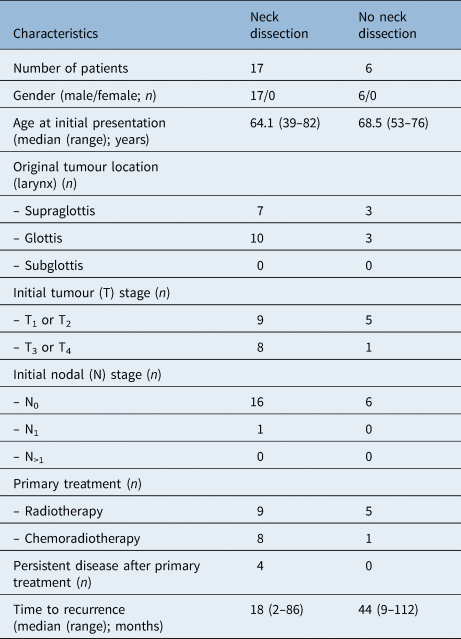
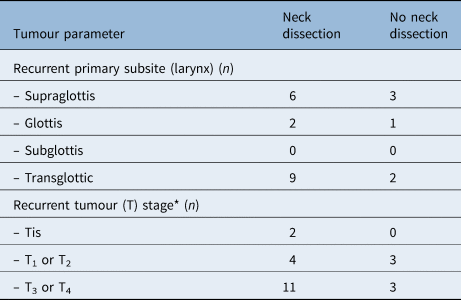
A total of 154 consecutive laryngectomy cases were initially identified within our hospital's operating theatre database. Upon review, a total of 23 cases were identified as salvage operations appropriate for inclusion in the study. Seventeen patients underwent neck dissection at the time of salvage surgery (all bilateral) and six did not. The characteristics of the patients prior to their original treatment are shown in Table 1, and details of the location and tumour stage of laryngeal recurrence are shown in Table 2.
Characteristics of patients prior to original treatment

Location and tumour stage of laryngeal recurrence

*Pathologically confirmed. Tis = tumour in situ
Post-salvage nodal staging and occult nodal disease rates
One of the 17 patients who underwent neck dissection (6 per cent) had evidence of occult pathological nodal disease after histopathological examination. None of the six patients who did not undergo neck dissection developed regional recurrence within the three-year follow-up period.
Survival
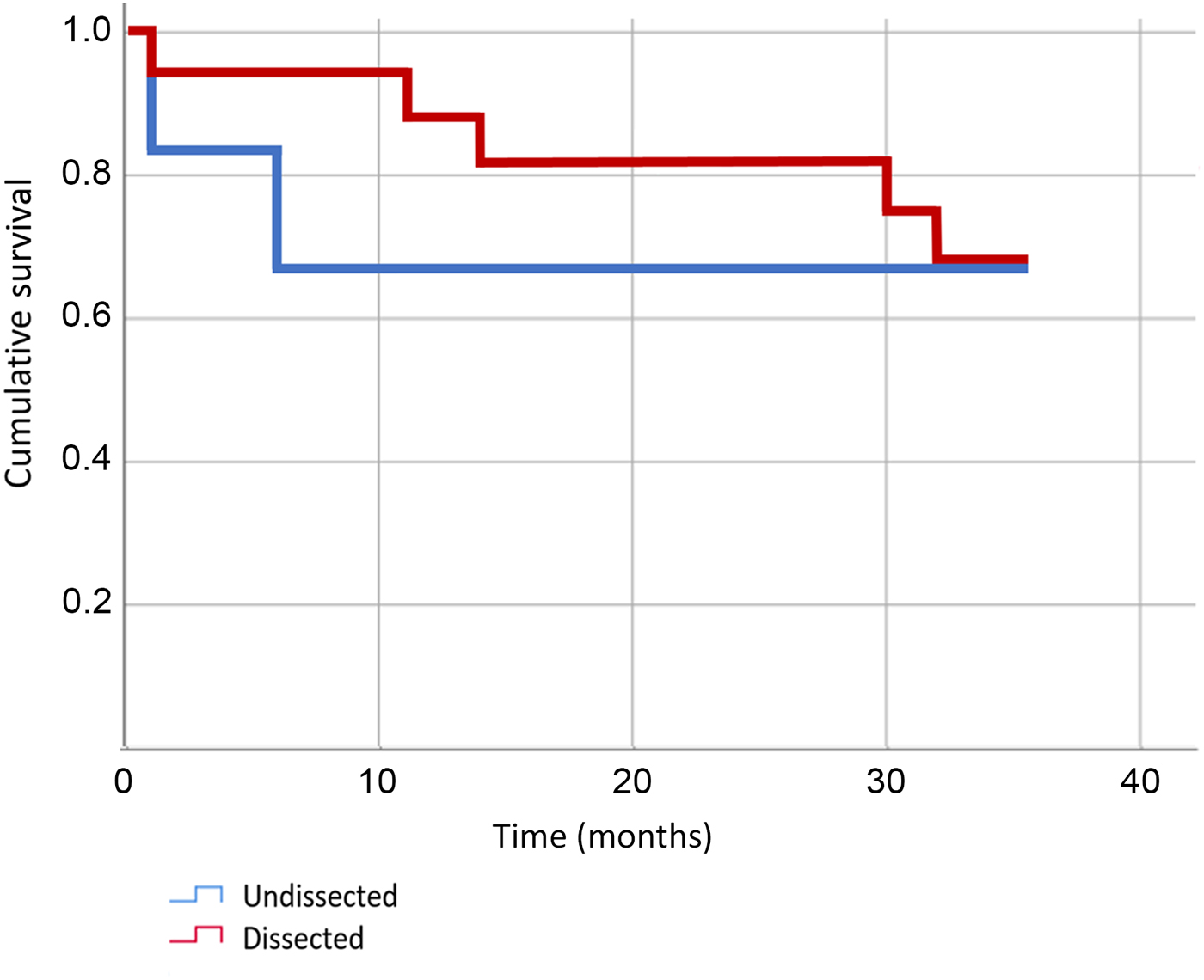
Over the three-year follow-up period, there were five deaths in the neck dissection cohort, compared with two deaths in the undissected cohort. Overall survival was 71 per cent for patients undergoing neck dissection and 67 per cent for those who did not have a neck dissection (p = 0.56). There were no associations between survival and: age at diagnosis (p = 0.97), time to recurrence (p = 0.82), recurrent tumour (T) stage (p = 0.34) or site of laryngeal recurrence (p = 0.33). The patient in whom occult regional disease was identified during salvage surgery died 11 months post-operatively because of a respiratory illness, with no evidence of recurrent carcinoma.
Over the same three-year period, disease-free survival was identical to that of overall survival, save for one local recurrence in a neck dissection patient six months post-salvage. This same patient died 14 months post-operatively (Figure 1).
Kaplan–Meier three-year overall survival plot for dissected and undissected neck cohorts.

Post-operative complications
A post-operative pharyngocutaneous fistula was identified in four cases. A fistula was identified in 3 out of 17 patients who had neck dissection (18 per cent) and in 1 out of 6 who did not (17 per cent) (p = 0.73). Two patients required a return to the operating theatre and repair with a pectoralis major flap. These repairs both occurred between three and four weeks after salvage surgery, in patients who had undergone a concurrent neck dissection. The remaining fistula in the neck dissection group was amenable to non-operative management, as was the only fistula in the undissected group.
There was no association between the use of vascularised tissue transfer and the risk of fistula (p = 0.34). In total, 10 patients underwent vascularised tissue transfer: 8 pectoralis myofascial flaps, 1 anterolateral thigh free flap and 1 radial forearm free flap. Pharyngocutaneous fistula occurred in 1 out of 10 patients who had a vascularised tissue transfer, compared with 3 out of 13 patients whose neopharynx was closed without any vascularised tissue transfer (23 per cent). Neither of the patients with free tissue transfers developed a fistula.
Hospitalisation length
The mean length of hospital stay for patients who underwent neck dissection at the time of salvage surgery was 24 days (range, 14–61 days), compared to 16 days (range, 15–19 days) for patients who did not have neck dissection (p = 0.10).
Discussion
Our study showed no significant association between neck dissection and disease-free or overall survival in patients with an N0 neck undergoing salvage laryngectomy for recurrent or persistent laryngeal SCC. This finding is consistently reflected elsewhere in the literature.Reference Basheeth, O'Leary and Sheahan2–Reference Yirmibesoglu, Fried, Shores, Rosenman, Weissler and Hackman5,Reference Farrag, Lin, Cummings, Koch, Flint and Califano8,Reference Birkeland, Rosko, Issa, Shuman, Prince and Wolf10–Reference Yao, Roebuck, Holsinger and Myers14 Whilst there was a trend towards better survival in dissected necks at 24 months (82 per cent vs 67 per cent), this was essentially nullified by 36 months. Despite this, however, one case of occult cervical nodal metastases was identified in this study. Regional relapse following salvage surgery is known to carry a very poor prognosis, and this finding indicates that there may still be some benefit of performing neck dissection in the N0 neck in selected cases.
Our finding of a 6 per cent rate of occult nodal disease is consistent with contemporaneous studies analysing the same head and neck subsites as the present investigation, the vast majority of which report a rate between 5 and 20 per cent.Reference Bohannon, Desmond, Clemons, Magnuson, Carroll and Rosenthal3,Reference Birkeland, Rosko, Issa, Shuman, Prince and Wolf10,Reference Freiser, Ojo, Lo, Saint-Victor, Bollig and Nayak11,Reference Wax and Touma13–Reference Hilly, Stern, Horowitz, Leshno and Feinmesser16 One study reported a higher rate of 28.3 per cent, but suggested that this may be a result of ‘differences in pathological assessment, or the presence of non-viable tumour cells’.Reference Koss, Russell, Leem, Schiff and Smith9
Known risk factors for nodal metastases in laryngeal cancer include supraglottic or subglottic primary site, advanced T stage, and the presence of lymphovascular invasion.Reference Birkeland, Rosko, Issa, Shuman, Prince and Wolf10,Reference Pezier, Nixon, Scotton, Joshi, Guerrero-Urbano and Oakley17 In our study, there was one patient who had occult nodal metastases. These were found following neck dissection performed in concert with salvage laryngectomy of a T4a transglottic recurrence. There was no nodal disease or radiological invasion evident during their original treatment 11 months earlier for a T3 glottic primary.
One recent studyReference Hilly, Stern, Horowitz, Leshno and Feinmesser16 has questioned the sensitivity of occult nodal disease rate as a decision-making tool, and suggested replacing it with risk of regional recurrence when designing decision algorithms for salvage surgery. This was based on lower rates of regional-only recurrence (0–8 per cent) compared with occult metastases (3–18 per cent) in the contemporaneous literature that they considered.Reference Bohannon, Desmond, Clemons, Magnuson, Carroll and Rosenthal3,Reference Farrag, Lin, Cummings, Koch, Flint and Califano8,Reference Wax and Touma13,Reference Yao, Roebuck, Holsinger and Myers14 If substituted as a key decision tool for salvage surgery, regional-only recurrence rates would lead to fewer neck dissections being performed. Whilst ostensibly a sensible suggestion, studies published since have shown extremely low rates of regional-only recurrence. This may underestimate the need for neck dissection in these patients. For example, our study showed a 0 per cent regional-only recurrence rate over three years, and this finding has been reflected in other contemporaneous literature utilising larger cohorts.Reference Freiser, Ojo, Lo, Saint-Victor, Bollig and Nayak11 Given these findings, it is our assertion that the risk of occult nodal disease should remain a significant factor in neck management during salvage surgery, to avoid under-treatment of the neck.
Our study found that neck dissection was not associated with an increased rate of fistula formation following salvage surgery (p = 0.73). This was mirrored by Freiser et al.,Reference Freiser, Ojo, Lo, Saint-Victor, Bollig and Nayak11 in a study that constitutes one of the largest analyses of neck complications for salvage patients to date. Their finding of 26 per cent and 33 per cent salivary leak rates for dissected and undissected necks, respectively (p = 0.42), were of comparable magnitude to our own. Previous studies have suggested that a selective dissection technique should be favoured in this setting, if oncologically appropriate, in order to minimise the risk of complications.Reference Pellini, Mercante, Marchese, Terenzi, Spoerduti and Manciocco18 As expected, there was also a trend towards a shorter hospital stay when the neck was not dissected.
With respect to closure techniques in the present study, defects closed primarily did not have a significantly higher fistula rate than those closed with vascularised tissue. Despite this, the return to operating theatre rate was higher in those patients who did not undergo vascularised tissue repair. This issue has been addressed specifically in the literature using meta-analysis, with free tissue transfer emerging as clearly superior in minimising the severity, and usually the quantity, of post-operative fistulae.Reference Paleri, Drinnan, van den Brekel, Hinni, Bradley and Wolf19
Limitations
The main limitations of our study were its retrospective nature and the limited number of cases available for analysis. The relative scarcity of salvage head and neck surgery cases is a common theme amongst the literature, with the number of study participants analysed in recent studies consistently falling below 100, despite these studies each spanning multiple decades.Reference Bohannon, Desmond, Clemons, Magnuson, Carroll and Rosenthal3,Reference Koss, Russell, Leem, Schiff and Smith9,Reference Wax and Touma13–Reference Hilly, Stern, Horowitz, Leshno and Feinmesser16 Meta-analysis of these results is made difficult by wide variations in study aims, scope and protocols.
• Salvage laryngectomy presents a final opportunity to treat persistent disease or local recurrence in patients who have undergone radiotherapy for laryngeal squamous cell carcinoma
• Neck dissection of a previously irradiated neck carries an increased risk of complications
• However, neck dissection may uncover occult disease in some clinically diagnosed node-negative patients, benefitting survival
• Our study revealed a 6 per cent risk of occult disease, smaller than in many previous studies
• Neck dissection patients did not have a higher fistula rate, but did have longer hospitalisations and a higher return to theatre rate
• The true three-year survival benefit of neck dissection remains unclear
Conclusion
The results from this study indicate no association between neck dissection and survival in patients with a N0 neck undergoing salvage laryngectomy. Despite this, occult lymph node metastases were detected in a single patient (6 per cent) undergoing neck dissection. The rate of fistula formation was similar for dissected and undissected necks.
These results suggest that neck dissection may result in a small number of patients with clinically and radiologically N0 necks being up-staged. The effect on survival, however, remains to be fully elucidated. In this small study, there was no evidence that neck dissection led to an increased rate of complications. As salvage surgery aims to be the final curative therapy, decisions should be made on an individual basis using a multidisciplinary approach that considers all clinical, histopathological and patient risk factors.
Competing interests
None declared