Introduction
Psychotic experiences (PEs) are hallucinations and delusions that do not reach the clinical threshold for a psychotic disorder (Linscott and van Os, Reference Linscott and van Os2013), which occur in 5.8–7.2% of the general population (Linscott and van Os, Reference Linscott and van Os2013; McGrath et al., Reference McGrath, Saha, Al-Hamzawi, Alonso, Bromet, Bruffaerts, Caldas-de-Almeida, Chiu, de Jonge, Fayyad, Florescu, Gureje, Haro, Hu, Kovess-Masfety, Lepine, Lim, Mora, Navarro-Mateu, Ochoa, Sampson, Scott, Viana and Kessler2015). For the vast majority of individuals, these phenomena, which fall on the least severe end of the psychosis continuum (Oh et al., Reference Oh, DeVylder and Chen2015), are transient and do not lead to full psychotic disorder (Hanssen et al., Reference Hanssen, Bak, Bijl, Vollebergh and van Os2005; Linscott and van Os, Reference Linscott and van Os2013). Despite this, there is growing evidence that PEs are linked to a number of adverse health outcomes including various physical health conditions. Data from countries across the world have shown that PEs are associated with physical illnesses such as arthritis, asthma, tuberculosis, and heart disease (Moreno et al., Reference Moreno, Nuevo, Chatterji, Verdes, Arango and Ayuso-Mateos2013; Oh and DeVylder, Reference Oh and DeVylder2015; Oh et al., Reference Oh, Waldman, Stickley, DeVylder and Koyanagi2019; Scott et al., Reference Scott, Saha, Lim, Aguilar-Gaxiola, Al-Hamzawi, Alonso, Benjet, Bromet, Bruffaerts, Caldas-de-Almeida, de Girolamo, de Jonge, Degenhardt, Florescu, Gureje, Haro, Hu, Karam, Kovess-Masfety, Lee, Lepine, Mneimneh, Navarro-Mateu, Piazza, Posada-Villa, Sampson, Stagnaro, Kessler and McGrath2018), as well as the co-occurrence of physical diseases (Stubbs et al., Reference Stubbs, Koyanagi, Veronese, Vancampfort, Solmi, Gaughran, Carvalho, Lally, Mitchell, Mugisha and Correll2016b). Although the mechanisms linking PEs and physical illnesses are uncertain, a recent study from the World Mental Health Survey (WMHS) found that this relationship may be bidirectional, as in some cases prior PEs were associated with the onset of medical conditions, whereas in others, PEs emerged following the earlier onset of physical illness (Scott et al., Reference Scott, Saha, Lim, Aguilar-Gaxiola, Al-Hamzawi, Alonso, Benjet, Bromet, Bruffaerts, Caldas-de-Almeida, de Girolamo, de Jonge, Degenhardt, Florescu, Gureje, Haro, Hu, Karam, Kovess-Masfety, Lee, Lepine, Mneimneh, Navarro-Mateu, Piazza, Posada-Villa, Sampson, Stagnaro, Kessler and McGrath2018).
Despite the rapid growth of this research field, information on the association between PEs and different health outcomes is still scarce in many settings. This is especially true for physical injuries (e.g. traffic injury). Given that accidents or injuries can result in outcomes such as psychological trauma and social isolation (Jeavons, Reference Jeavons2000; Gilboa, Reference Gilboa2001), which are factors that have been linked to the emergence of PEs (Spauwen et al., Reference Spauwen, Krabbendam, Lieb, Wittchen and van Os2006; Hoffman, Reference Hoffman2007; Scott et al., Reference Scott, Chant, Andrews, Martin and McGrath2007), while the mortality risk due to accidents among individuals with PE might also be elevated (Sharifi et al., Reference Sharifi, Eaton, Wu, Roth, Burchett and Mojtabai2015), this may be an important omission. The few studies on this topic to date have found that automobile and other life-threatening accidents are associated with the occurrence of PEs (Scott et al., Reference Scott, Chant, Andrews, Martin and McGrath2007; Saha et al., Reference Saha, Varghese, Slade, Degenhardt, Mills, McGrath and Scott2011; McGrath et al., Reference McGrath, Saha, Lim, Aguilar-Gaxiola, Alonso, Andrade, Bromet, Bruffaerts, Caldas de Almeida, Cardoso, de Girolamo, Fayyad, Florescu, Gureje, Haro, Kawakami, Koenen, Kovess-Masfety, Lee, Lepine, McLaughlin, Medina-Mora, Navarro-Mateu, Ojagbemi, Posada-Villa, Sampson, Scott, Tachimori, Ten Have, Kendler and Kessler2017), as are injuries following an assault (Geddes et al., Reference Geddes, Ehlers and Freeman2016) or a natural disaster (tsunami) (Keraite et al., Reference Keraite, Sumathipala, Siriwardhana, Morgan and Reininghaus2016). However, these studies have been primarily conducted in high-income countries (Scott et al., Reference Scott, Chant, Andrews, Martin and McGrath2007; Saha et al., Reference Saha, Varghese, Slade, Degenhardt, Mills, McGrath and Scott2011; Geddes et al., Reference Geddes, Ehlers and Freeman2016) or provided only pooled estimates mixing high-, low- and middle-income countries (LAMICs) (Moreno et al., Reference Moreno, Nuevo, Chatterji, Verdes, Arango and Ayuso-Mateos2013), while none of the multi-country studies provided individual country estimates (Moreno et al., Reference Moreno, Nuevo, Chatterji, Verdes, Arango and Ayuso-Mateos2013; McGrath et al., Reference McGrath, Saha, Lim, Aguilar-Gaxiola, Alonso, Andrade, Bromet, Bruffaerts, Caldas de Almeida, Cardoso, de Girolamo, Fayyad, Florescu, Gureje, Haro, Kawakami, Koenen, Kovess-Masfety, Lee, Lepine, McLaughlin, Medina-Mora, Navarro-Mateu, Ojagbemi, Posada-Villa, Sampson, Scott, Tachimori, Ten Have, Kendler and Kessler2017).
A focus on the association between injuries and PEs in LAMICs may be instructive for several reasons. Not only has the prevalence of PEs been reported to be comparatively high in LAMICs (Nuevo et al., Reference Nuevo, Chatterji, Verdes, Naidoo, Arango and Ayuso-Mateos2012), but other research has shown that approximately 90% of injury-related deaths occur in this setting (World Health Organization, 2014). Clarifying the nature of this association might therefore have important public health implications especially as there is also an indication that for some forms of injury (i.e. traffic-related injuries), trends may be diverging between countries at different levels of economic development with a downward trend observed in high-income countries but an upward trend in low-income countries (GBD 2016 DALYs and HALE Collaborators, 2017). In addition, it is also possible that there may be differences in the magnitude of this association between high-income countries and LAMICs as many LAMICs often lack resources to adequately care for mental health problems (Jacob et al., Reference Jacob, Sharan, Mirza, Garrido-Cumbrera, Seedat, Mari, Sreenivas and Saxena2007) and injuries (Reynolds et al., Reference Reynolds, Stewart, Drewett, Salerno, Sawe, Toroyan and Mock2017). Indeed, even within LAMICs, there may be between-country differences in the association due to the large heterogeneity seen in terms of economic development or sociocultural factors.
Thus, using data from 48 LAMICs, which participated in the World Health Survey (WHS), the aims of the current study were: (1) to examine whether traffic and other injuries are associated with PEs; (2) to determine if the association between injuries and PEs varies across countries with different levels of economic development; and (3) to assess the role of depression in this association given that it is highly comorbid with PEs (DeVylder et al., Reference DeVylder, Burnette and Yang2014) and is itself a risk factor for the occurrence of injury (Patten et al., Reference Patten, Williams, Lavorato and Eliasziw2010), but has not been examined in several of the previous studies on this topic (Scott et al., Reference Scott, Chant, Andrews, Martin and McGrath2007; Moreno et al., Reference Moreno, Nuevo, Chatterji, Verdes, Arango and Ayuso-Mateos2013; Keraite et al., Reference Keraite, Sumathipala, Siriwardhana, Morgan and Reininghaus2016).
Methods
The survey
The WHS was a cross-sectional, community-based study undertaken in 2002–2004 in 70 countries worldwide. Details of the survey are provided on the WHO website (http://www.who.int/healthinfo/survey/en/). Briefly, data were collected using stratified multi-stage random cluster sampling. Individuals aged 18 years and above with a valid home address were eligible to participate. Each member of a selected household had an equal probability of being chosen using Kish tables. A standardized questionnaire, translated accordingly was used in each country. The individual response rate across all countries was 98.5% (Nuevo et al., Reference Nuevo, Chatterji, Verdes, Naidoo, Arango and Ayuso-Mateos2012). Ethical approval to conduct the study was obtained from the ethical boards in each participating country. Informed consent was obtained from all participants. Sampling weights were generated to adjust for non-response and the population distribution as reported by the United Nations Statistical Division.
Data were publicly available for 69 countries. Of these, 10 countries were excluded due to a lack of sampling information. Furthermore, 10 high-income countries were excluded in order to focus on LAMICs. Turkey was also excluded as it lacked information on PEs. Thus, the final sample consisted of 48 LAMICs (N = 242 952). According to the World Bank classification at the time of the survey (2003), these countries corresponded to 21 low-income countries (LICs) (N = 105 286), 17 lower middle-income countries (LMICs) (N = 77 966), and 10 upper middle-income countries (UMICs) (N = 59 700). The data were nationally representative for all countries with the exception of China, Comoros, Ivory Coast, India, the Republic of Congo, and Russia. The included countries and their sample sizes are provided in online Table S1 of the Supplementary Material.
Psychotic experiences (PEs) (dependent variable)
Participants were asked questions on past 12-month positive psychotic symptoms (delusional mood, delusions of reference and persecution, delusions of control, hallucinations) which came from the WHO Composite International Diagnostic Interview (CIDI) 3.0 (Kessler and Ustun, Reference Kessler and Ustun2004) (specific questions can be found in online Table S2 of the Supplementary Material). This psychosis module has been reported to be highly consistent with clinician ratings (Cooper et al., Reference Cooper, Peters and Andrews1998). Individuals who endorsed at least one of the four psychotic symptoms were considered to have PEs. For some analyses, we grouped the four different types of PEs as delusions (i.e. delusional mood, delusions of reference and persecution, delusions of control) and hallucinations.
Injury (independent variable)
Road traffic accident-related injuries were assessed with the question ‘In the past 12 months, have you been involved in a road traffic accident where you suffered from bodily injury? This could have been an accident in which you were involved either as the occupant of a motor vehicle, or when you were riding a motorcycle or bicycle, or walking.’ Information on other (non-traffic) injuries was obtained with the question ‘In the past 12 months, have you suffered bodily injury that limited your everyday activities, due to a fall, burn, poisoning, submersion in water, or by a firearm, sharp weapon or an act of violence from another person?’ Both questions had ‘Yes’ and ‘No’ answer options. Any injury referred to having either type of injury.
Control variables
The control variables were selected based on past literature (Clausen et al., Reference Clausen, Martinez, Towers, Greenfield and Kowal2015; Koyanagi et al., Reference Koyanagi, Stickley and Haro2015) and included age, sex, wealth, highest level of education achieved (no formal, primary, secondary, tertiary), setting (rural or urban), alcohol consumption, and depression. Country-wise wealth quintiles were created using principal component analysis based on 15–20 assets depending on the country. Alcohol consumption was assessed by first asking the question ‘Have you ever consumed a drink that contains alcohol (such as beer, wine, etc.)?’ Respondents who replied ‘no’ were considered lifetime abstainers. If the respondent replied affirmatively, then he/she was asked how many standard drinks of any alcoholic beverage he/she had on each day of the past 7 days. The number of days in the past week on which four (female) or five (male) drinks were consumed was calculated (World Health Organization, 2002), and a total of 1–2 and ⩾3 days in the past 7 days were considered infrequent and frequent heavy drinking respectively. All other respondents, apart from lifetime abstainers, were considered non-heavy drinkers (Koyanagi and Stickley, Reference Koyanagi and Stickley2015b). The presence of depression in the previous 12 months was established with the use of the DSM-IV algorithm based on questions from the World Mental Health Survey version of the CIDI (Stubbs et al., Reference Stubbs, Koyanagi, Schuch, Firth, Rosenbaum, Veronese, Solmi, Mugisha and Vancampfort2016a).
Statistical analysis
Statistical analyses were performed with Stata 14.1 (Stata Corp LP, College station, Texas). All analyses excluded individuals with a self-reported lifetime diagnosis of psychosis (N = 2424) as PEs by definition do not include conditions that reach the clinical threshold for a diagnosis. The difference in sample characteristics by the presence of PEs was tested with χ2 tests and Student's t tests for categorical and continuous variables, respectively. Multivariable logistic regression analysis was conducted to assess the association between injury (traffic injury, other injury, any injury) (exposure) and PEs (outcome) using the overall sample. Four models were constructed to assess the influence of the inclusion of different variables in the models: Model 1 – adjusted for age, sex, and country; Model 2 – adjusted for the factors in Model 1, and wealth, education, and urban residence; Model 3 – adjusted for the factors in Model 2 and alcohol consumption; Model 4 – adjusted for the factors in Model 3 and depression. We also repeated this analysis with hallucinations and delusions as the outcomes, separately.
Next, in order to assess whether the association between any injury and PEs is consistent across countries, we conducted a country-wise analysis adjusting for sex and age. Between-country heterogeneity was assessed with Higgin's I 2 which represents the degree of heterogeneity that is not explained by sampling error with a value of <40% often considered as negligible and 40–60% as moderate heterogeneity (Higgins and Thompson, Reference Higgins and Thompson2002). A pooled estimate was obtained by combining the estimates for each country into a random effect meta-analysis (overall and by country income level).
All variables were included in the regression analysis as categorical variables with the exception of age (continuous variable). Taylor linearization methods were used in all analyses to account for the sample weighting and complex study design. Results from the logistic regression analyses are presented as odds ratios (ORs) with 95% confidence intervals (CIs). The level of statistical significance was set at p < 0.05.
Results
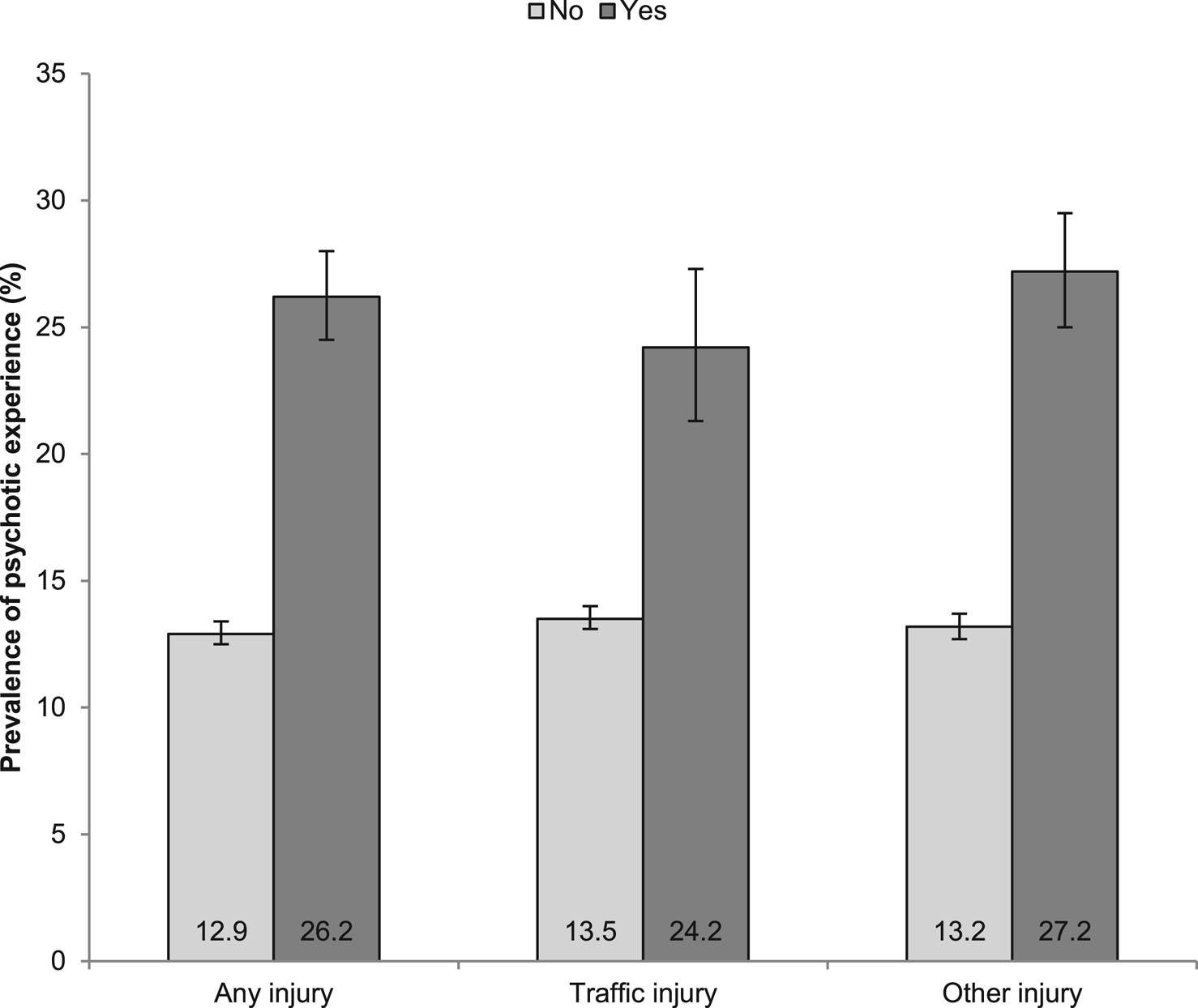
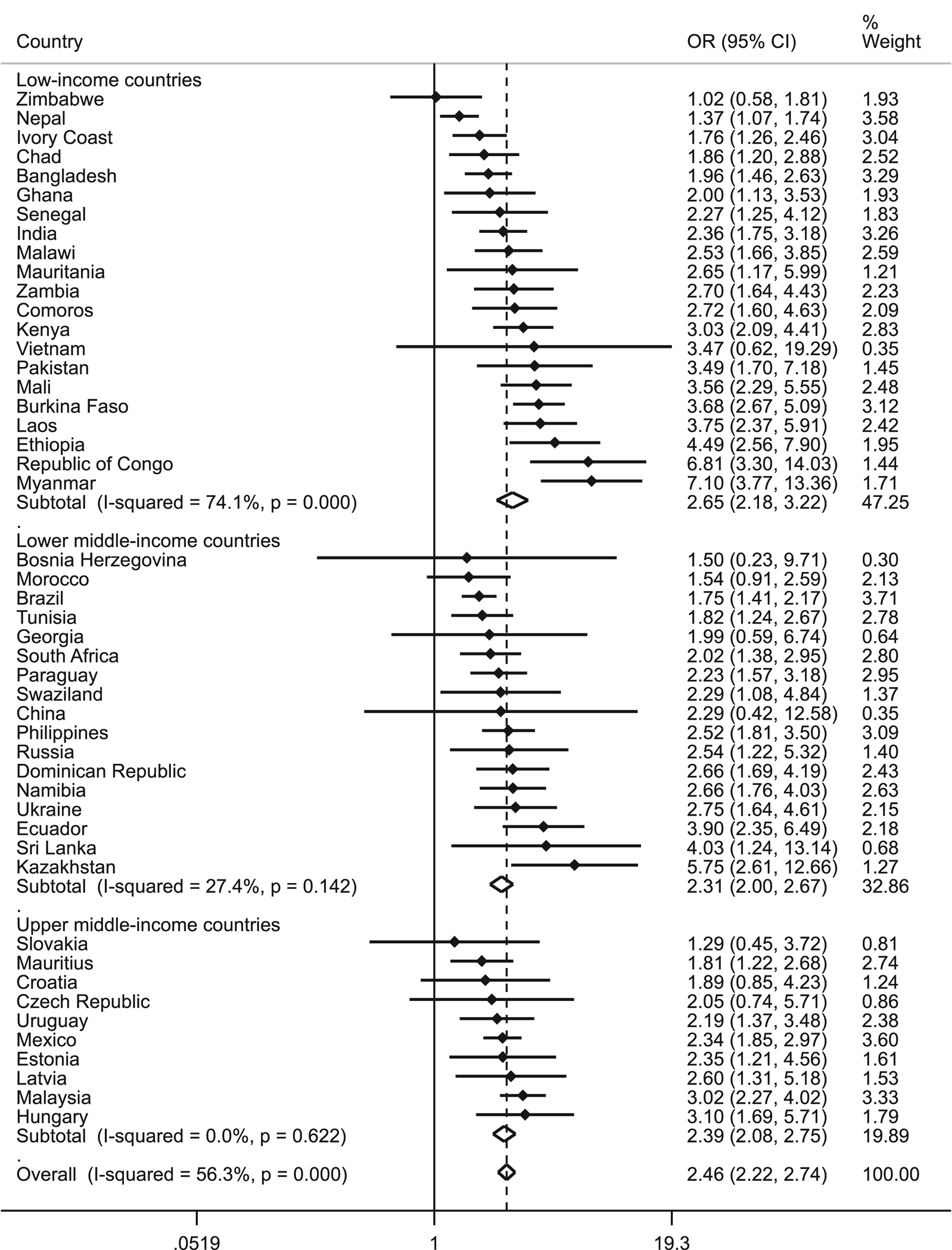
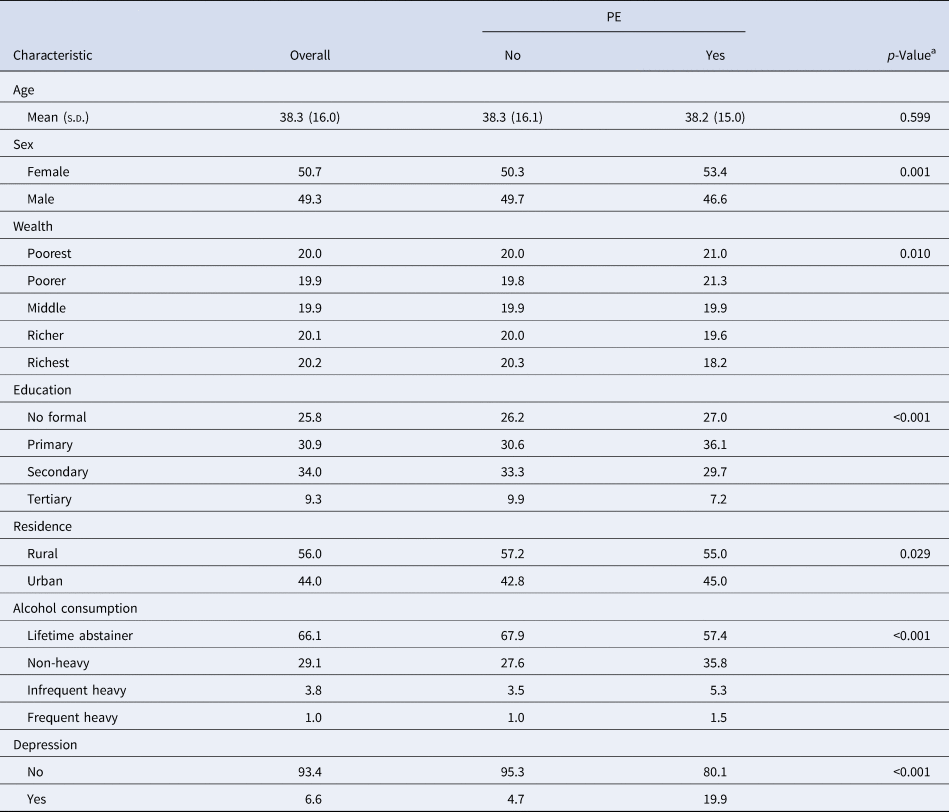
After the exclusion of individuals with a diagnosis of psychotic disorder, the final sample consisted of 224 862 individuals aged ⩾18 years [mean (s.d.) age 38.3 (16.0) years; 50.7% female] (Table 1). The overall prevalence (95% CI) of past 12-month traffic injury, other injury, any injury, and PE were 2.7% (2.5–2.9%), 4.7% (4.5–4.9%), 6.9% (6.6–7.2%), and 13.8% (13.3–14.3%), respectively. The prevalence of PE was much higher among those who experienced any injury, traffic injury, and other injury than those who did not experience these injuries (Fig. 1). For example, the prevalence of PE among those who had any injury was 26.2% compared to 12.9% among those without an injury. The prevalence of hallucinations among those who did and did not have any injury was 10.8% and 5.2%, respectively. The corresponding figures for delusions were 23.2% and 11.0%, respectively. The associations between any injury, traffic injury, other injury, and PE estimated by multivariable logistic regression are shown in Table 2. In the models adjusted only for age, sex, and country (Model 1), the ORs (95% CI) for any injury, traffic injury, and other injury were 2.21 (2.00–2.44), 1.99 (1.69–2.34), and 2.23 (1.95–2.56), respectively. The inclusion of other variables such as alcohol consumption and depression only slightly attenuated the ORs with the corresponding figures in the fully adjusted model (Model 4) being 2.07 (1.85–2.31), 1.84 (1.53–2.21), and 2.09 (1.84–2.37), respectively. The results were similar in the analysis where delusions and hallucinations were separate outcomes (online Supplementary Material Table S3). A country-wise analysis showed a positive association between any injury and PEs (OR > 1) in all 48 countries included in the study although statistical significance was not reached in nine countries (Fig. 2). The pooled OR estimate based on a meta-analysis was 2.46 (95% CI 2.22–2.74) with a moderate level of heterogeneity being observed (I 2 = 56.3%). The pooled estimates by country income level were similar.
Prevalence of PE by the absence or presence of any injury, traffic injury, and other injury. Estimates are based on weighted sample. Bars denote 95% CI.

Association between any injury (exposure) and PE (outcome) estimated by multivariable logistic regression adjusted for age and sex. OR, odds ratio; CI, confidence interval. Overall estimate was obtained by meta-analysis with random effects.

Sample characteristics (overall and by PE)

Estimates are based on weighted sample. Data are percentage unless otherwise stated.
a p-Value was calculated by Student's t test for age and by χ2 tests for other variables.
Association between any injury, traffic injury, other injury, and PE estimated by multivariable logistic regression

OR, odds ratio; CI, confidence interval.
Model 1: Adjusted for age, sex, and country. Model 2: Adjusted for the factors in Model 1, and wealth, education, and urban residence. Model 3: Adjusted for the factors in Model 2 and alcohol consumption. Model 4: Adjusted for the factors in Model 3 and depression.
Discussion
This study used data from over 200 000 adults in 48 LAMICs to examine the association between PEs and different forms of injury. The prevalence of PEs among those who experienced an injury was approximately double that of those without injuries. This finding of an association between injuries and PEs was further confirmed in a logistic regression analysis that adjusted for potential confounders including depression where the ORs for PEs ranged from 1.84 (traffic injuries) to 2.09 (other injuries). The results from a meta-analysis across all countries showed that there was a moderate level of between-country heterogeneity in the significant association between any injury and PEs (I 2 = 56.3%) but that the pooled estimates by the country income level were similar. To the best of our knowledge, this is the first study to examine the association between PEs and traffic and other injuries within numerous individual LAMICs, and by far the largest study on this topic in terms of the sample size and number of countries included.
Our results concur with those from studies which have found an association between the occurrence of PEs (hallucinations) following assault-related injury (Geddes et al., Reference Geddes, Ehlers and Freeman2016) and PEs (delusions) associated with life-threatening accidents (Scott et al., Reference Scott, Chant, Andrews, Martin and McGrath2007). They also accord with the results from a recent study that used WMHS data from 16 countries to show that automobile accidents and other life-threatening accidents were associated with a doubling of the odds for the first onset of PEs after controlling for a number of prior/intervening mental disorders (McGrath et al., Reference McGrath, Saha, Lim, Aguilar-Gaxiola, Alonso, Andrade, Bromet, Bruffaerts, Caldas de Almeida, Cardoso, de Girolamo, Fayyad, Florescu, Gureje, Haro, Kawakami, Koenen, Kovess-Masfety, Lee, Lepine, McLaughlin, Medina-Mora, Navarro-Mateu, Ojagbemi, Posada-Villa, Sampson, Scott, Tachimori, Ten Have, Kendler and Kessler2017), which was approximately the same strength of association as was observed between traffic injuries and PEs in the current study. There is also some indication that the strength of the association might be similar in LAMICs and high-income countries. Specifically, two earlier studies that used large community-based samples from Australia reported that experiencing a life-threatening accident, and being in an automobile accident were respectively associated with 1.95 and 1.46 times higher odds for reporting delusional experiences (Scott et al., Reference Scott, Chant, Andrews, Martin and McGrath2007; Saha et al., Reference Saha, Varghese, Slade, Degenhardt, Mills, McGrath and Scott2011). These results are close to the estimates we obtained for the association between any injury (OR 2.06) and traffic injury (OR 1.77) and delusions in fully adjusted analyses (Model 4, online Supplementary Table S3). It should be noted, however, that other research has indicated that the association between injuries and PEs may be more nuanced. For example, a recent study from Sri Lanka showed that although tsunami-related personal injury was linked to the presence of PEs, conflict-related injury was not (Keraite et al., Reference Keraite, Sumathipala, Siriwardhana, Morgan and Reininghaus2016). Even though that study did not adjust for the presence of comorbid mental disorders, it nevertheless highlights the possibility that the association between different types of injury and PEs may differ both across and within settings, and may depend on the nature of the trauma associated with the injury (e.g. multiple traumas, whether the trauma is life-threatening), underlining the need for research on different forms of injury and the short- and long-term consequences of injury.
Although it is uncertain what underlies the association between injuries and PEs, it is possible that various factors might be involved. For example, physical injuries may result in outcomes such as pain (Ciaramitaro et al., Reference Ciaramitaro, Mondelli, Logullo, Grimaldi, Battiston, Sard, Scarinzi, Migliaretti, Faccani and Cocito2010), which has been associated with PEs (Koyanagi and Stickley, Reference Koyanagi and Stickley2015a) and the onset of PEs (Scott et al., Reference Scott, Saha, Lim, Aguilar-Gaxiola, Al-Hamzawi, Alonso, Benjet, Bromet, Bruffaerts, Caldas-de-Almeida, de Girolamo, de Jonge, Degenhardt, Florescu, Gureje, Haro, Hu, Karam, Kovess-Masfety, Lee, Lepine, Mneimneh, Navarro-Mateu, Piazza, Posada-Villa, Sampson, Stagnaro, Kessler and McGrath2018). Social withdrawal/isolation might also be important in this context as not only is it one possible consequence of experiencing accidents and injury (Gilboa, Reference Gilboa2001), but it has been implicated in the development of PEs in vulnerable individuals as a result of the ‘social brain’ producing hallucinations and delusions of other persons/agents in the absence of social stimuli (which may accompany physical disability and isolation) (Hoffman, Reference Hoffman2007). In addition, as injuries such as burns can lead to stigma and rejection (Mock et al., Reference Mock, Peck, Krug and Haberal2009), it is also feasible that PEs might emerge in the context of social defeat i.e. being subordinated/excluded from the majority group (Selten and Cantor-Graae, Reference Selten and Cantor-Graae2005; Selten et al., Reference Selten, van der Ven, Rutten and Cantor-Graae2013), and associated possible detrimental biological effects such as dopamine dysregulation that may have a role in the development of psychosis (Selten et al., Reference Selten, Booij, Buwalda and Meyer-Lindenberg2017). Further, it has also been suggested that trauma-related cognitive processing styles such as peri-traumatic dissociation, negative trauma appraisal (e.g. self-blame) and dysfunctional cognitive control processes (e.g. rumination) might all be relevant in this respect (Geddes et al., Reference Geddes, Ehlers and Freeman2016).
Other psychological consequences of injury might also be important. For example, not only is posttraumatic stress disorder (PTSD) prevalent following traumatic injury (Herrera-Escobar et al., Reference Herrera-Escobar, Al Rafai, Seshadri, Weed, Apoj, Harlow, Brasel, Kasotakis, Kaafarani, Velmahos, Salim, Haider and Nehra2018), but several studies have reported that PTSD reliving/re-experiencing symptoms such as upsetting dreams and arousal symptoms such as sleep problems may link trauma and PEs (Gracie et al., Reference Gracie, Freeman, Green, Garety, Kuipers, Hardy, Ray, Dunn, Bebbington and Fowler2007; Alsawy et al., Reference Alsawy, Wood, Taylor and Morrison2015). Finally, it is also possible that the association might run in the opposite direction and those experiencing PEs might be at an increased risk for injury. For example, PEs have been associated with an increased risk for the use of illicit drugs such as cannabis (Degenhardt et al., Reference Degenhardt, Saha, Lim, Aguilar-Gaxiola, Al-Hamzawi, Alonso, Andrade, Bromet, Bruffaerts, Caldas-de-Almeida, de Girolamo, Florescu, Gureje, Haro, Karam, Karam, Kovess-Masfety, Lee, Lepine, Makanjuola, Medina-Mora, Mneimneh, Navarro-Mateu, Piazza, Posada-Villa, Sampson, Scott, Stagnaro, Ten Have, Kendler, Kessler and McGrath2018), which in turn, has been linked to motor vehicular injury (Blows et al., Reference Blows, Ivers, Connor, Ameratunga, Woodward and Norton2005). PEs have also been associated with cognitive impairment (Navarro-Mateu et al., Reference Navarro-Mateu, Alonso, Lim, Saha, Aguilar-Gaxiola, Al-Hamzawi, Andrade, Bromet, Bruffaerts, Chatterji, Degenhardt, de Girolamo, de Jonge, Fayyad, Florescu, Gureje, Haro, Hu, Karam, Kovess-Masfety, Lee, Medina-Mora, Ojagbemi, Pennell, Piazza, Posada-Villa, Scott, Stagnaro, Xavier, Kendler, Kessler and McGrath2017; Oh et al., Reference Oh, Koyanagi, Kelleher and DeVylder2018). This could be relevant as individuals experiencing difficulties with concentration, understanding, an inability to think clearly and memory deficits may be more likely to be involved in accidents and suffer vehicular injuries. A recent review and meta-analysis has further shown that those with PEs may be more prone to engage in self-injurious behavior (Honings et al., Reference Honings, Drukker, Groen and van Os2016).
We found that the pooled estimates for the association between any injury and PEs were similar across country income levels but there was a moderate level of between-country heterogeneity overall. This suggests that country level income is unlikely to be the source of between-country heterogeneity. While the reason for the between-country heterogeneity is unknown, it may be related to factors such as variations in the impact of injuries [as measured by differences in disability adjusted life years (DALYs)] across these countries (Nantulya and Reich, Reference Nantulya and Reich2003; GBD 2016 DALYs and HALE Collaborators, 2017).
In the current study, adjusting for depression had very little effect on the association between PEs and injury. This was somewhat surprising given that depression has been closely linked to both PEs and the occurrence of injuries (Patten et al., Reference Patten, Williams, Lavorato and Eliasziw2010; DeVylder et al., Reference DeVylder, Burnette and Yang2014). Having said this, previous studies on automobile and other life-threatening accidents and PEs which adjusted for depression have also produced similar results (Saha et al., Reference Saha, Varghese, Slade, Degenhardt, Mills, McGrath and Scott2011; McGrath et al., Reference McGrath, Saha, Lim, Aguilar-Gaxiola, Alonso, Andrade, Bromet, Bruffaerts, Caldas de Almeida, Cardoso, de Girolamo, Fayyad, Florescu, Gureje, Haro, Kawakami, Koenen, Kovess-Masfety, Lee, Lepine, McLaughlin, Medina-Mora, Navarro-Mateu, Ojagbemi, Posada-Villa, Sampson, Scott, Tachimori, Ten Have, Kendler and Kessler2017). This might mean that other psychiatric disorders are more important in this context. As mentioned above, PTSD symptoms have been suggested as possibly playing a role in the emergence of PEs following traumatic events such as serious motor vehicle accidents, while anxiety has also been reported to be important for psychotic symptoms (persecutory ideation) in relation to a history of trauma (including serious accidents and accident-related injuries) (Freeman and Fowler, Reference Freeman and Fowler2009). At the same time, it should also be noted that a recent multi-country study found that automobile and other life-threatening accidents were associated with first-onset PEs even after adjustment for mood and anxiety disorders (including PTSD) (McGrath et al., Reference McGrath, Saha, Lim, Aguilar-Gaxiola, Alonso, Andrade, Bromet, Bruffaerts, Caldas de Almeida, Cardoso, de Girolamo, Fayyad, Florescu, Gureje, Haro, Kawakami, Koenen, Kovess-Masfety, Lee, Lepine, McLaughlin, Medina-Mora, Navarro-Mateu, Ojagbemi, Posada-Villa, Sampson, Scott, Tachimori, Ten Have, Kendler and Kessler2017). This raises the possibility that the role of mental disorders in PEs might vary across different types of injury and/or locations. Future research should thus examine a wide range of mental health variables in the association between PEs and different types of injury in different settings to further elucidate the role of psychiatric disorders in the injury–PEs association.
Strengths and limitations
This study has strengths including the use of data from a large number of individuals collected from multiple countries using standard, validated measures. However, there are also some limitations that should be mentioned. First, given that PEs were self-reported we cannot exclude reporting bias, although there is some evidence that PEs can be self-reported in a stable, reliable, and valid manner in the general population (Konings et al., Reference Konings, Bak, Hanssen, van Os and Krabbendam2006). Second, information on the types of injury was limited while there was no information on the number, severity, or impact of the injuries, or whether they were self-inflicted. Given this, we were not able to examine if there was a dose–response gradient or differential effects across different types of injury. As some previous research has suggested that traumatic brain injury might be linked to the occurrence of both hallucinations and delusions (Sachdev et al., Reference Sachdev, Smith and Cathcart2001; Fujii and Ahmed, Reference Fujii and Ahmed2002) an important task for future research will be to examine the association between PEs and different types of injury using detailed information on these phenomena. Third, due to a lack of data, we were unable to investigate the confounding/mediating effect of factors such as drug use, PTSD, or a family history of psychotic disorder. Finally, as the data were cross-sectional, it was not possible to determine the temporality of the associations or establish causality. Future prospective research is now needed to determine how PEs and injuries are associated in different population samples.
Conclusion
This study showed that both traffic and other types of injuries are associated with PEs among adults living in LAMICs. The importance of this result is highlighted first, by the fact that the strength of the country-wise association we recorded between any injury and PEs (OR 2.46) slightly exceeded that between any injury and depression (OR 1.96) reported in a recent study conducted in 40 LAMICs (Stickley et al., Reference Stickley, Oh, Sumiyoshi, McKee and Koyanagi2019) and second, because earlier research has shown that PEs are prevalent in many LAMICs (Nuevo et al., Reference Nuevo, Chatterji, Verdes, Naidoo, Arango and Ayuso-Mateos2012). In light of this, enhancing the capacity of both mental health and trauma care systems in LAMICs (Wong et al., Reference Wong, Gupta, Deckelbaum, Razek and Kushner2015; Semrau et al., Reference Semrau, Alem, Abdulmalik, Docrat, Evans-Lacko, Gureje, Kigozi, Lempp, Lund, Petersen, Shidhaye, Thornicroft and Hanlon2018) may be important to address this comorbidity. If injury is confirmed to be a risk factor for PEs, providing adequate care for injuries including their mental health consequences may decrease the risk for PE onset, while strengthening national level strategies to reduce injuries may lead to better mental health at the population level.
Supplementary material
The supplementary material for this article can be found at https://doi.org/10.1017/S0033291719002897
Conflict of interest
None.
Ethical standards
The authors assert that all procedures contributing to this work comply with the ethical standards of the relevant national and institutional committees on human experimentation and with the Helsinki Declaration of 1975, as revised in 2008.