Introduction
Since 1945, the number of countries participating in international organisations (IOs) has steadily increased, leading to not only a greater number but also a greater diversity of actors who hold membership in IOs.Footnote 1 Countries in Europe, North America, and Oceania have gone from representing the majority of full members in IOs to now only representing the plurality of members, with African countries in particular becoming more visible in the international arena.
Though such trends are likely to continue, we still know relatively little about how these changes in participation affect IOs’ ability to address global governance issues. While more and greater diversity of participation may appeal to democratic norms of voice and representation, they also raise serious questions about the efficiency of the policy-making process. Indeed, new actors in the global governance arena are not only likely have different motivations but also different preferences and relationships with other actors compared to historically entrenched ones. Consequently, increasing the number and diversity of participating actors may increase the transaction costs of negotiations and make reaching agreement more difficult,Footnote 2 ultimately resulting in prolonged policy-making processes.Footnote 3 Conversely, however, research on social networks suggests that looking purely at the absolute number of actors may overlook how relationships among them can affect the policy-making process. To the extent that increased participation can encourage new coalition building, policy-making processes may become more efficient as actors are presented with greater opportunities to horse-trade. To date, while a rich literature has explored why membership and participation in IOs has increased, little is known about how it has affected the efficiency of international policy-making processes.Footnote 4
We root our investigation of the potential trade-offs between participation in and efficiency of policy-making processes on recent literature, which argues that participation and efficiency are important sources of an IO’s perceived legitimacy.Footnote 5 In particular, both participation and efficiency form an important part of an IO’s procedural legitimacy, that is, the idea that the legitimacy of an IO is determined by the processes or the procedures through which it functions, irrespective of the consequence of its policies. Building off of the framework developed by Dellmuth et al.Footnote 6: while participation forms an important pillar of an IO’s democratic procedures, insofar as it determines which actors are involved in the formulation, implementation, and review of IO decisions,Footnote 7 efficiency forms an imporstant pillar of an IO’s technocratic procedures, that is, the speed of an IO’s policy-making.Footnote 8
Though enormous progress has been made in identifying different sources of IO legitimacy, to date, few studies have examined the relationships between these different sources of legitimacy. We take a first step towards doing so by focusing on whether trade-offs might exist among different sources of legitimacy: specifically, does reinforcing an IO’s democratic procedures through increased participation affect its technocratic procedures? Though the policy-making process may slow because of the need to accommodate an increasing diversity of interests, it could conversely speed up because of the opportunity to build new coalitions. Furthermore, any such trade-offs may be conditioned by changes in an IO’s authority.Footnote 9 While an IO’s legitimacy is defined as the belief that an IO’s authority is appropriately exercised,Footnote 10 an IO’s authority is defined as the recognition that an IO has the right to be active in a certain policy area.Footnote 11 We argue that the relationship between participation and efficiency becomes more pronounced with increased IO authority. Though there are potentially many more interrelationships between different sources of legitimacy to explore (e.g., efficiency vs. effectiveness), in focusing narrowly on one set of relationships, we gain analytical clarity which future work on this topic may be able to build.
To empirically illustrate and test our argument, we provide a detailed analysis of the Codex Alimentarius (Codex), an international food safety standard-setting organisation established as a joint organisation of the World Health Organisation (WHO) and the Food and Agriculture Organisation of the United Nations (FAO) in 1963.Footnote 12 The Codex’s primary mandate is developing and publishing standards to protect the health of consumers and ensure fair practices in the international food trade. The importance of the Codex as a global food safety standard-setting organisation increased significantly in 1995 when the World Trade Organisation’s (WTO) Agreement on the Application of Sanitary and Phytosanitary Measures (SPS Agreement) entered into force. With the SPS Agreement, WTO members conferredFootnote 13 the regulatory authority of international food safety standard-setting to the Codex, upgrading it to the world’s de facto reference point for food safety standards.Footnote 14
Our analysis is based on an original dataset that includes information on the participation of 196 countries in the 880 meetings the Codex held between its establishment in 1963 and 2019. Overall, we find evidence that increasing the number of participating delegates is indeed associated with reduced policy-making speed. In other words, the more delegates participated in the Codex committee meetings, the longer it took these committees to adopt standards. We further find evidence that the greater the connectivity among participants across different Codex committees, the quicker it is for these committees to adopt standards. Meanwhile, we find some qualified evidence that, under some circumstances, the relationship between participation and connectivity on policy-making speed can become more pronounced after a rise in institutional authority.
The remainder of this article is organised as follows: In the next section we review the relevant literature and outline our principal argument. A brief introduction into our empirical case – the Codex Alimentarius – is provided in the following section. We then describe our dataset and empirical strategy before presenting and discussing our results. In the last section, we provide concluding remarks and point to several avenues for future research.
The role of participation and efficiency in IO legitimacy
With the rise of globalisation and increased industrialisation, countries around the world have increasingly been confronted with problems that spill far beyond their national borders. These include climate change, the spread of infectious diseases, and consumer safety of traded goods, to name a few. The resolution of such global problems increasingly rests on the ability to develop collective solutions.
In the last few decades, however, stakeholders who have historically been excluded from participating in IOs where such collective problems are addressed have expressed displeasure at their omission. These stakeholders argue that such global institutions and, correspondingly, the policies and decisions that they formulate, can hardly be considered legitimate without, at a minimum, allowing those targeted by these policies to represent their own unique perspectives and interests during the policy-making process.Footnote 15 The primary grievances lodged against the United Nations (UN), for instance, are directed towards the perceived lack of equal participation in, as well as shortcomings in the transparency and accountability of the decision-making process.Footnote 16
The rich literature on the sources of IO legitimacy can help us contextualise such grievances as being about the lack of democratic procedures in many global governance institutions.Footnote 17 IO procedures more generally refer to the method and process through which an IO formulates its policies.Footnote 18 Along with accountability, deliberation, and transparency of procedures, participation plays an important role in determining an IO’s democratic procedures and, correspondingly, the IO’s subsequent legitimacy. How and how many actors participate are not the only source of IO legitimacy, however. IOs may also derive their legitimacy from the efficiency of the policy-making process, which can be conceptualised as an IO’s technocratic procedures.Footnote 19 The efficiency of the policy-making process, in terms of either the speed of the process or the volume of policies that it produces, along with the expertise-base and legality of the policy-making process are important constituents of an IO’s technocratic procedures.Footnote 20
In exploring the relationship between democratic and technocratic procedures as our primary analytical focus, we take advantage of theoretical advances in conceptualising IO legitimacy by Dellmuth et al.Footnote 21 While Scharpf’sFootnote 22 seminal work articulated a dichotomous theory of IO legitimacy between what he termed input legitimacy, a policy’s process or procedures, on the one hand, and output legitimacy, the performance or consequences of a policy, on the other hand, Dellmuth et al.Footnote 23 argue for using a more systematic and nuanced typology. While still acknowledging the utility of differentiating between procedure (input) and performance (output) for understanding IO legitimacy, they argue that relying on these distinctions alone muddle other important ones like democracy and technocracy.Footnote 24 According to their framework, democracy and technocracy can be understood as orthogonal to procedure and performance insofar as both can be policy inputs (procedure) and policy outputs (performance).Footnote 25 Using this more refined model of IO legitimacy allows us additional analytical leverage to cleanly identify and explore how different aspects of IO legitimacy, in our case, democratic procedure and technocratic procedure, may relate to each other. Indeed, one of Dellmuth et al.Footnote 26 critiques of the utility of Scharpf’sFootnote 27 dichotomous conceptualisation is that its broadness makes it difficult to nail down what precisely about a given IO’s input or output legitimacy generates perceptions of legitimacy. Our analysis, at least, would have suffered from much greater analytical murkiness if relying only on a dichotomous conceptualisation of IO legitimacy, as both democratic and technocratic procedures map onto, and thus are not cleanly separable from, the concept of input legitimacy.
Meanwhile, despite these advances in conceptualising the potential sources of IO legitimacy, relatively little work has investigated whether there might exist trade-offs between them.Footnote 28 That is, do efforts to boost legitimacy along one dimension systematically affect legitimacy along other dimensions? And further, to what extent does a change in an organisation’s institutional authority affect this dynamic? Answering these questions is particularly important given that a wide variety of global governance institutions have made concerted efforts to increase their legitimacy along one clearly defined dimension, democratic procedures, by encouraging greater participation of previously excluded stakeholders, including both developing countries and transnational actors (TNAs).Footnote 29 Though much scholarship has been devoted to explaining why IOs have taken these steps to expand participation at allFootnote 30 or how non-state actors can create new spaces for private or self-regulation,Footnote 31 comparatively less work has explored whether efforts to increase democratic procedures have affected other potential sources of IO legitimacy.Footnote 32
One prominent exception is Stasavage,Footnote 33 whose early work explored whether there are trade-offs between transparency – the degree to which citizens are aware of how their interests are represented in the policy-making process – and accountability – the degree to which policy outcomes adhere to the public interest in international bargaining settings. While StasavageFootnote 34 notes that, a priori, one might assume greater transparency leads to greater accountability (democratic procedure), he finds incentives to posture or pander can counterintuitively mean that greater transparency can be associated with an increased risk of negotiation breakdown (technocratic procedure). His work suggests there may indeed be trade-offs between different sources of IO legitimacy and, in doing so, provides a promising signpost for our own exploration of the relationship between participation (democratic procedure) and efficiency (technocratic procedure).
In what follows, we develop a series of hypotheses to investigate the relationship between IOs’ democratic procedures, that is, participation and composition of participation, and technocratic procedures, that is, duration of the policy-making process. We further investigate how institutional authority may condition any trade-offs between those sources of IO legitimacy.
How increasing participation may affect the efficiency of the policy-making process
We begin by assuming that different actors have different motivations and preferences over any given policy.Footnote 35 At least one important reason why actors’ preferences may differ is that the same policy will entail different adjustment costs in the short run depending on an actor’s previous material resources, existing institutions, and political or physical environments, which may lead to different distributional consequences in the long run.Footnote 36 This dynamic becomes especially relevant for policies that are universally applied to all actors, as is the case with international standards. In this case, since different countries produce and trade different products, they may find it difficult to identify common interests for standardisation.Footnote 37 Moreover, since standard-setting usually involves the harmonisation of previously differing standards, creating universal or international standards can lead to conflicts of interest or diverse distributional consequences.Footnote 38 If compliance with international standards is voluntary, such policy-making activity may be unproblematic since actors have the flexibility to decide whether to harmonise based on the anticipated adjustment costs and distributional consequences. If, however, compliance with international standards is mandatory, as de facto became the case for Codex standards when adopted as the reference food safety standard-setting organisation in the 1995 WTO SPS Agreement, actors will think twice about agreeing to an international standard that generates additional (adjustment) costs for them.
Given these assumptions, we argue that an increase in the number of actors involved in the policy-making process, in our case the standard-setting process, increases the duration of the policy-making process.Footnote 39 More precisely, we expect that an increase in the number of participating actors leads to more pronounced preference heterogeneity, which, in turn, increases the transaction costs of the policy-making process.Footnote 40 Transaction costs for aggregating different policy preferences may increase for any number of reasons, including i) lower cost of defection: as the group size grows, individual costs of defection from a preferred policy outcome may diminish, making it more and more difficult for members to sanction each other, which negatively impacts policy efficiency; ii) higher information costs: the greater the group size, the greater the time and energy required to understand the preferences, influences, and strategies of other actors; and iii) smaller pool of common interests: when the group size grows, a policy that will satisfy all parties is less likely to exist, while the likelihood of multiple policy equilibrium grows. Compared to an environment in which a common policy is readily apparent, it takes a greater amount of time and energy to jockey over multiple policy equilibrium to reach a given policy solution.Footnote 41 Though it is beyond the scope of this article to investigate which of these transaction costs may be more important, we expect that a greater number and diversity of preferences overall leads to higher transaction costs in the global governance arena and that these higher transaction costs can be observed through a longer policy-making process.
Hypothesis 1a: The more participants there are in a global governance policy-making process, the greater the diversity of preferences there are for a given policy outcome, which increases the time it takes to develop collective policies.
How stronger networks between participants may affect the efficiency of the policy-making process
The normative rationale for increasing participation is to ensure that a greater diversity of voices is heard in the policy-making process. Note, however, that Hypothesis 1a implicitly assumes that there are relatively few fora for participants to discuss their diversity of preferences in and decide policy over – if policy-making decisions were only made through one forum, the bigger the group becomes, the more likely it is that the policy-making process takes longer and produces less results. However, it may be the case that there are multiple fora for participants to discuss and decide policy over. Indeed, KahlerFootnote 42 notes the possibility of ‘subdividing the large-group collective action problem into a series of small-group interactions’. While KahlerFootnote 43 refers specifically to mini-lateral solutions in his discussion, one can imagine that such small-group interactions can take place within the larger context of the same IO.
This is certainly the case in the Codex, where countries, intergovernmental organisations, and non-state actors negotiate international food safety standards in various committees that hold multi-day, sometimes simultaneous, meetings scattered all over the world. To generate sufficient support for their proposals and to improve their bargaining positions, countries likely build different coalitions depending on the given issue at stake, resulting in an overlapping, non-hierarchical patchwork of coalitions.Footnote 44 Countries that are well connected in the network of committees possess social power that is fungible with other forms of power,Footnote 45 are able to collaborate better,Footnote 46 and are better able to shape the outcomes of policy-making processes.Footnote 47
Such fora for interaction can be formal or informal. Here, we focus on the existence of formal fora that possess at least some power over the policy-making process. While participants surely do still interact in small groups informally, the ability for participants to negotiate their interests over different policies depends on the leverage that they may or may not enjoy in fora with at least some formal decision-making power in the policy-making process. Indeed, to draw an example from American politics, the literature on the US Congress suggests that committee structure can play an important role in coalition building and policy bargains, and that more generally collaboration within and across small groups can affect wider policy decisions in the larger group.Footnote 48 With this in mind, we formulate our next hypothesis as follows:
Hypothesis 2a: The stronger the ties between a given policy-making forum and another, the less time it takes to develop collective policies in that policy-making forum.
The conditioning role of increased authority on the efficiency of the policy-making process
We expect that our hypothesised relationship between participation and the policy-making process becomes more pronounced as the authority of the IO increases. An IO can be said to have authority when its policy targets (e.g., states) recognise its ability to make legally binding decisions.Footnote 49 As such, authority is theoretically prior to legitimacy insofar as legitimacy is ‘the belief that an IO’s authority is appropriately exercised’.Footnote 50
Increased IO authority to make decisions increases responsibility and pressure to act in a given policy-making area. This is in part because increased authority is offset by comparative losses in sovereignty by nation-states.Footnote 51 And indeed, since the post–World War II period, nation-states have increasingly ceded authority to international institutions in any number of arenas, from finance (e.g., the European Central Bank) to law (e.g., the International Criminal Court) and trade (e.g., the World Trade Organisation).Footnote 52 But this is also because relative to IOs with less authority, decisions taken by IOs with greater authority can lead to substantially higher material or reputational costs for participating countries, for which there is not just greater expectation for compliance, but also real consequences for non-compliance. This line of argumentation is consistent with previous work that argues that increased institutional authority leads to increased politicisation of such IOs, particularly when such IOs have a legitimacy gap.Footnote 53
We argue that because increased institutional authority increases the potential distributional costs of subsequent policies or decisions taken by a given IO, it increases the salience of a given policy area and the incentive that a country has in ensuring that the final policy output matches its own preferences as closely as possible. And because IO policy decisions have more bite with increased authority, we expect existing policy-making dynamics, including potential trade-offs between different types of legitimacy, to also become more pronounced. For instance, while we expect that having more voices in the policy-making arena generally will lead to a slower policy-making process, we expect the process to be even slower when an IO’s authority over that policy field increases because of the raised distributional stakes for everyone involved. Similarly, while we generally expect that stronger ties between different policy-making fora can grease the policy-making wheels, we further expect the wheels to turn even faster when an IO increases its institutional authority given the potential for more parties to extract distributional gains. Accordingly, we hypothesise the following relationship to hold:
Hypothesis 1b: The more participants there are in a global governance policy-making process, the greater the diversity of preferences there are for a given policy outcome, which increases the time it takes to develop collective policies. This relationship is more pronounced when an international organisation has greater institutional authority.
Hypothesis 2b: The stronger the ties between a given policy-making fora and another, the less time it takes to develop collective policies in that policy-making fora. This relationship is more pronounced when an international organisation has greater institutional authority.
The Codex Alimentarius
To empirically test our hypotheses, we analyse an original dataset of the Codex policy-making process. The Codex presents an interesting case study for several reasons. First, while the Codex plays an important role in the governance of international food safety and global food trade, the organisation has largely remained under the radar of IO scholars. While some scholars see the Codex as an hybrid intergovernmental–private administrationFootnote 54 or an intergovernmental organisation with informal characteristics,Footnote 55 others consider the Codex as a trans-governmental regulatory network,Footnote 56 a quasi-regulatory network,Footnote 57 or a transnational legal order.Footnote 58 In the context of its close relationship with the WTO, the Codex has even been described as a satellite organisation of the WTO legal systemFootnote 59 and as a quasi-legislator.Footnote 60 Indeed, another reason why the Codex presents an interesting case study is its unique link with the WTO. In the literature, this WTO–Codex nexus is frequently employed as an empirical example for concepts related to indirect governance including legalisation,Footnote 61 delegation,Footnote 62 hardening soft law,Footnote 63 and orchestration.Footnote 64 We exploit this unique constellation between the Codex and the WTO to explore the role of IO authority on the relationship between different sources of IO legitimacy.
The Codex was formally established in 1963 by the FAO and the WHO.Footnote 65 Its two (some observersFootnote 66 argue competing) objectives for the development of international food safety standards are to protect consumers’ health, and to ensure fair practices in global food trade. The Codex standards cover processed, semi-processed, and raw foods and include provisions related to issues on food hygiene, food additives, residues of pesticides and veterinary drugs, contaminants, labelling and presentation, methods of analysis and sampling, and import and export inspection and certification (see Annex A.1 for a brief summary of the Codex’s organisational features).Footnote 67
During the first thirty years of its existence, the Codex was one food safety standard-setting organisation among many.Footnote 68 The particular role and position of the Codex changed in 1995, however, when the WTO SPS Agreement came into force, an event that has been described as ‘the biggest single step in the history of the globalization of food standards’,Footnote 69 raising the Codex’s regulatory authorityFootnote 70 as the world’s de facto food safety standard-setting organisation.Footnote 71
Because the SPS Agreement strongly encourages countries to base their national food safety measures on the Codex international standards, it arguably hardened the soft law nature of the Codex standards.Footnote 72 By upgrading them to benchmarks or yardsticks for national requirementsFootnote 73 that enjoy the legal presumption of WTO compliance,Footnote 74 Codex standards further offer safe harbour in WTO disputes.Footnote 75 In doing so, it raised stakeholders’ economic and political stakes in the Codex standards and therefore their incentive to strategically influence the design of these standards towards their interests.Footnote 76 In short, the Codex’s explicit reference in the WTO SPS Agreement meant that it became the de facto reference standard for adjudicating whether trade disputes were based on sincere concerns about food safety or whether they served as proxies for non-tariff trade barriers. As the WTO SPS Agreement entered into force in 1995, and the Codex gained further regulatory authority, the total number of delegates increased and the composition of delegates changed significantly. While high income countries from Europe, North America, and Oceania continue to account for a considerable number of delegates in the standard-setting committees, their relative share has been declining over the past decades.
Evidence from case studies and interviews suggests that the WTO SPS Agreement has affected not only the number and composition of the Codex delegates but also interactions among them. After 1995, the Codex proceedings are argued to have become trade battlegrounds and fora for deregulationFootnote 77 prone to regulatory capture.Footnote 78 The fourteen-year-long negotiations to find mutually acceptable guidelines on labelling genetically modified foodFootnote 79 or the seventeen-year long development of a framework for risk analysisFootnote 80 offer evidence suggestive of a shift from technical–scientific collaboration to political–strategic behaviour,Footnote 81 and a move from the logic of appropriateness to the logic of consequences.Footnote 82
The contributions outlined above provide valuable insights into the standard-setting processes of the Codex and how these have been affected by the SPS Agreement. However, these in-depth case studies are based on selected Codex committees or selected Codex standards. As such, while we have accounts of what idiosyncratic factors may have affected the standard-setting processes for specific standards, we still lack systematic evidence for factors that may affect the standard-setting overall. Furthermore, the existing literature fails to theoretically recognise and to empirically explore the interaction of standard-setting democratic procedures (the number and connectedness of involved actors) and standard-setting technocratic procedures (the speed of the policy-making process) as well as the implications of the WTO’s conferral of regulatory authority for the Codex’s legitimacy.Footnote 83 This article fills this research gap. The next section outlines the data collected and methodology applied.
Research design and data
We base our analysis of the relationship between an IO’s democratic procedures and its technocratic procedures on an original dataset of the Codex’s organisational features.
Since its inception in 1963 and until 2019, the Codex has developed more than 500 standardsFootnote 84 in forty-four different committees. Over this period, almost 90,000 delegates from 196 countries participated in these standard-setting meetings.Footnote 85 From meeting notes, which are publicly available in PDF format on the Codex’s website, we extracted information on participating delegates as well as on proposed and adopted standards. In total, we analyse 524 proposed and adopted standards.Footnote 86
The benefit of testing our hypotheses within one IO is that we can assess whether increases in participation are associated with faster or slower policy-making across time. A drawback, however, is that while we believe that our hypotheses should also hold across different IOs (i.e., we expect that IOs with fewer delegates should be more efficient than IOs with more delegates), we cannot fully test this cross-sectional aspect of this hypothesis with the Codex example. We note, however, that the relatively large number of committees (44) within the Codex does allow us to control for cross-sectional differences across committees.
Dependent variable
Our dependent variable Time to Policy Adoption is operationalised as a binary variable taking on a value of 1 if a given proposed standard was ultimately adopted and 0 if it is still under consideration for adoption. Because the data is structured in a ‘proposed policy’–‘meeting’ format, each ‘proposed policy’ receives a row for each committee meeting that it is still under consideration (note: the unit of time is measured by committee meeting because meetings do not occur every year). The length of time used to move from proposal to adoption is captured across multiple rows in this panel. If a proposed standard is finally adopted, the dependent variable takes on a value of 1 for that year and the panel stops for that standard (the standard is not represented in subsequent meeting years in the dataset). If a standard was proposed but was ultimately not adopted, this is also included in our analysis, and in this case, the unadopted standard always takes on the value of 0 for that panel. As we detail more fully in the Appendix, we also operationalise the dependent variable as the total amount of time used to consider a given proposed standard for adoption as measured in years and use an event-based rather than panel-based data structure for those analyses. Ultimately, all analyses seek to model the efficiency of the policy-making process.
In interrogating what Time to Policy Adoption actually captures, one might reasonably argue that ‘easy’ standards are negotiated earlier on and the more ‘difficult’, scientifically more complex standards are left for last. In other words, a reasonable case could be made that rather than capturing the efficiency of the policy-making process, Time to Policy Adoption measures the relative ease of negotiating certain standards over others. It is, of course, true that food science advances – the Codex itself published a report on this topic in which it points that ‘[s]cience does not stop making progress’.Footnote 87 In the same report, however, the Codex also outlines that, just as science advances, the scientific advice provided to the Codex and its members also advances. More precisely, this scientific advice is provided by four expert bodies: the Joint FAO/WHO Expert Committee on Food Additives (JECFA), the Joint FAO/WHO Meetings on Pesticide Residues (JMPR), the Joint FAO/WHO Expert Meeting on Microbiological Risk Assessment (JEMRA), and the Joint FAO/WHO Expert Meetings on Nutrition (JEMNU). The experts working in these bodies are selected based on excellence, independence, and transparency and are only allowed to serve for up to five years.Footnote 88 We therefore believe that Codex members always have access to qualified experts to inform their negotiation position and decision-making in standard-setting processes and that this has not changed over time.
Moreover, contrary to the notion that some standards speed along the policy-making process because they are scientifically ‘easy, low-hanging fruit’, the Codex procedural manual demonstrates that the criteria for the establishment of work priorities depends on a whole host of considerations, including trade volume and patterns, regulatory divergence, market potential, ease of standardisation, existing coverage by general standards, the scope of related commodities, and relevant work by other international bodies.Footnote 89 More recent standards may also simply reflect recent market trends. In 2024, for example, avocado oil was included in the Standard for Named Vegetable Oils (Codex standard CXS 210–1999), with the Codex pointing out that ‘[w]hile it has been consumed in certain regions for millennia, recent growth in demand for healthier food products globally has seen a high value market develop for avocado oil’.Footnote 90 Arguably, avocado oil is just as scientifically complex as almond oil, coconut oil, or any of the other oils previously covered under this standard. All these factors suggest that the standard-making process is influenced by a potentially high diversity of interests rather than purely on technical, scientific complexity.
Main independent variables
To test our hypotheses, we rely on two independent variables – the participation of delegates in the standard-setting processes and the extent to which committees are connected. We operationalise participation in two ways: Delegates captures the total number of delegates that participated in the standard-setting committee meetings. Delegates (CAC) captures the total number of delegates that participated in the Codex CAC plenary meetings. In both cases, we consider only member state delegates, as unlike non-governmental and intergovernmental organisations, only member states have decision-making power to advance the standard-making process or not.
While the number of delegates is not a perfect measure of participation, as Hüller and MaierFootnote 91 argue, it is unlikely that delegates can exert any influence without participating. Indeed, countries’ active participation is arguably the most effective and efficient way to influence the design of international standards.Footnote 92 As evidence for the Codex’s own recognition of the importance of delegate participation, in 2005, Codex itself published a ninety-nine-page-long report on enhancing participation in Codex activities.Footnote 93 The Inter-American Institute for Cooperation on Agriculture (IICA) even published a 100-page Handbook of Good Practices for Participation in Codex Alimentarius Meetings for its members in 2009.Footnote 94 In addition, the Codex Trust Fund (CTF) was launched to support participation from developing and transition economy countries in Codex meetings. During the first round of the CTF between 2004 and 2015, 2,359 participants from 140 countries received support, around 7 per cent of the 32,099 participants that attended Codex meetings during this time period.Footnote 95
Our second independent variable, PageRank of Committee, captures the extent to which committees are connected. The PageRank algorithm was originally designed to measure the importance of different websites by measuring the number and quality of links to a given website.Footnote 96 The main assumption of this algorithm is that more important websites have more links to other websites. In our use of the PageRank algorithm, we measure the importance of different committees and assume that committees with more delegates in other committees have stronger ties than committees that do not. In short, the PageRank of a committee measures the strength of the ties of a particular committee (node) compared to all other committees (the network). The strength of these ties is calculated based on the relative proportion of state delegates different committees share.
Given that each committee has a different focus, one might reasonably assume collaboration across different vertical commodity committees or between vertical commodity and horizontal general subject committees to be difficult. A cursory examination of available anecdotal evidence suggests, however, that collaboration does take place, not least due to the overlapping participating delegations and delegates. The latest 2024 committee reports, for instance, illuminate the above point through the pattern of the United States Department of Agriculture’s (USDA) participation in Codex meetings. In 2024, the USDA sent forty-eight delegates to sixteen different commodity and general subject committee meetings,Footnote 97 and the responsible office within the USDA – the US Codex Office (USCO) – states on its website that it ‘manages the planning, policy development, support, and coordination for U.S. involvement in Codex, and develops strategies to accomplish U.S. objectives’.Footnote 98 It seems likely, then, that different USDA delegations do coordinate, collaborate, and work towards their overall strategic goals across committees. Moreover, some people do further participate in multiple committees and meetings. For example, one USDA International Standards Coordinator participated in multiple vertical commodity committees.Footnote 99 Another USDA International Issues Analyst participated in multiple horizontal general subject committees, vertical commodity committees, and in the Codex Alimentarius Commission meeting.Footnote 100 We explore more systematically whether and how different levels of committee connectivity matters for policy-making efficiency in our statistical models.
Control variables
Along with the dependent and independent variables outlined above, our analysis also includes a number of control variables to account for potential alternative explanatory variables or confounders. In terms of alternative explanatory variables, we consider the possibility that state power, and not dimensions of democratic procedures, such as delegate participation or delegate connectivity, may better explain the speed of the standard-setting process and the number of standards produced. We consider both internal and external factors when operationalising state power.Footnote 101 Internal factors refer to the means through which an actor may exert power within the framework of a given (international) organisation, for instance the experience or negotiation skills of a given delegation. External factors refer to a state’s sources of authority or influence, for instance a delegation’s economic size.Footnote 102 We include the following control variables:
1. Concentration of Delegates and Concentration of Delegates (CAC) (internal factors): These variables capture the extent to which the participation of delegates in meetings is concentrated in certain country delegations. We operationalise this by computing the Herfindahl index of delegates by country, which ranges from 0 to 1.0 represents a case where there is an equal number of delegates from all countries, while 1 represents the case where all delegates come from one country.
2. Log Weighted Trade Value (external factor): This variable captures delegates’ interest and power in the trade (exports and imports) of a given product that is subject to the negotiated standard (in log form). If the standard is for a particular product, say avocados, we weight delegations’ participation by their national trade in avocados. If the standard is general, say for food additives, we weight delegations’ participation by their national trade in food. The data on international trade is provided by the FAO.
3. Log Avg Distance to Meeting: This variable captures the distance (in log form) that national delegations are required to travel to a committee meeting location. As previously mentioned, committee meetings take place all over the world. We include this variable to control for the fact that some countries may not have the resources to send a large delegation to a meeting. This variable also helps us to control for the disproportionately large delegations that host countries tend to send to the meetings. The data on distances is provided by CEPII’s GeoDist database.
4. Number of Proposals: This variable captures the number of standards proposed in a committee overall. It allows us to control for how busy a committee is overall. There are potentially a number of theoretical relationships this variable can have with the standard-making process. For instance, a standard that is under consideration in a committee that has many other standards on the docket may take longer to deliberate over compared to a committee with relatively few standards on the docket. On the other hand, having more standards to consider may increase the potential for horse-trading among them, which may speed up the policy-making process.
5. Type of Committee Meeting: We include dummies for each committee (e.g., Codex Committee for Sugar, Codex Committee on Contaminants in food). The inclusion of these dummies controls for committee-specific norms and histories that may affect the policy-efficiency process.
6. WTO Dummy: This binary variable takes on a value of 1 if a meeting took place after the 1995 accession of the WTO and a value of 0 if it took place before. This measure operationalises the change in institutional authority the Codex experienced after its inclusion in the WTO’s 1995 SPS Agreement.
Empirical results
We test our hypotheses using discrete time hazard models in which the data is structured in a panel ‘proposed policy’–‘meeting’ format. The dependent variable is a binary measure of whether a policy was adopted and marks the time in which a proposed policy is under consideration for adoption. These models further include quartic (4) splines to account for time dependencies,Footnote 103 dummies for each committee meeting to control for committee fixed effects, and clustered standard errors based around the proposed policy.
In our baseline logit model, we assess whether increasing participation, as operationalised by the variables Delegates and Delegates (CAC), leads to a lower likelihood of policy adoption (Hypothesis 1a) (Table 1). The extent to which connectivity between committees affects the likelihood of policy adoption is tested in the PageRank of Committee variable (Hypothesis 2a).Footnote 104
Discrete time hazard models of the relationship between participation and committee connectivity on length of the policy-making process.

Quartic (4) splines and committee dummies included but not shown in the above.
Models use clustered standard errors grouped by proposed standard.
*** p < 0.001; **p < 0.01; *p < 0.05
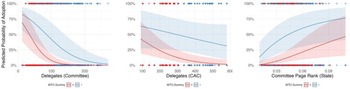
While Model 1 (Table 1) shows that the parameter estimates for our variables of interest are statistically significant, given well-known difficulties in substantively interpreting coefficient estimates for logistic regressions,Footnote 105 we focus our attention on the predicted probability plots presented in Figure 1. The first two subfigures in Figure 1 show that, in line with Hypothesis 1a, as delegation size increases in both committees and the CAC, the likelihood of adoption decreases substantially, from around 39 per cent to 19 per cent probability of adoption when increasing from the first to third quartile of committee delegates. Similarly, but slightly less starkly, the predicted probability changes from 32 per cent to 19 per cent when using the number of CAC delegates. Meanwhile, Hypothesis 2a also receives support as the predicted probability in policy adoption increases from 20 per cent to 29 per cent as committee connectivity increases. Finally, the dotted black points at the top and the bottom of Figure 1 show the distribution of the binary dependent variable (whether the policy was adopted or not) and indicate that the model results are not overly influenced by outliers – real data points were available across the range of values presented in each figure. Overall, these results suggest strong support for our baseline hypotheses.
Predicted probability of independent variables of interest on likelihood of policy adoption.

We test Hypothesis 1b and Hypothesis 2b, which argue that the effect between participation and connectivity respectively on the speed of the policy-making process grow more pronounced when institutional authority increases, by assessing how these relationships change with the Codex’s inclusion into the WTO’s SPS Agreement in 1995. In Model 2 (Table 1), we interact the WTO Dummy, which measures whether a given meeting takes place after 1995 or not, with our variables of interest: Delegates and Delegates (CAC), and PageRank of Committee. As Ai and NortonFootnote 106 note, because the magnitude of an interaction effect cannot be evaluated from ‘the sign, magnitude, or statistical significance of the coefficient on the interaction term’ alone for non-linear (logit) models, we again focus our attention on predicted probability plots to interpret the results (see Figure 2). Overall, the subfigures in Figure 2 show some qualified support for our hypotheses. That is, while all three plots show the same general relationship visualised in Figure 1 (increasing delegation size for both committees and the CAC are associated with a lower likelihood of policy adoption while increasing connectivity is associated with a higher likelihood of policy adoption), evidence for whether these relationships substantively differ before and after WTO accession are only found for certain ranges of these variables. For low levels of participation in both the committee and the CAC, there is no statistically significant difference on the effect of policy adoption before or after WTO accession. However, past approximately the 70th percentile of both committee delegate participation and of CAC delegate participation, increases in adoption levels are slightly higher after WTO accession compared to before WTO accession. Similarly, while there is no statistical difference between increasing committee connectivity on the likelihood of policy adoption for high levels of committee connectivity, for low levels of committee activity, below the 40th percentile, increases in connectivity during the period of WTO accession are associated with higher policy adoption compared to before WTO accession.
Predicted probability of independent variables of interest on likelihood of policy adoption before and after WTO accession.

To recap, these results suggest something more nuanced than our initial Hypothesis 2a and Hypothesis 2b: while there is evidence for a different relationship between participation and connectivity before and after changes in institutional authority, this relationship holds only for values past a certain threshold. There may be any number of reasons why we observe this pattern, not the least of which is measurement error. Theoretically, it is also possible that our hypotheses only ‘kick in’ after a certain threshold or tipping point is met. However, given that we did not theorise this finding before, we would only be able to provide speculation about it now and hope to probe more deeply into this matter in future research (and encourage others to do the same).
Moreover, because policy adoption appears to increase with increased authority across both parameters of interest (participation and connectivity), the results also suggest something qualitatively different than our initial hypotheses. Recall that our original hypotheses argued that an increase in institutional authority causes the relationships between participation and connectivity on policy adoption to be more pronounced – though what we observe in the relationship between WTO Dummy and PageRank of Committee accords with this hypothesis (notwithstanding that it only holds for extreme values), the relationship between WTO Dummy and Delegates and Delegates (CAC) does not. In the latter case, we would expect the curve for post-WTO accession (blue) to be below the curve for pre-WTO accession (red), because we hypothesised that an increase in participation would lead to a lower adoption rate with WTO accession compared to before WTO accession. One interpretation for our results is that while we found evidence for this more pronounced effect for connectivity, we found evidence to suggest another mechanism is at work for participation. A second potential interpretation is that these results suggest that an increase in institutional authority in general increases the efficiency of the policy-making process. A third potential interpretation is that policy-making productivity increased across IOs after 1995 more generally because of changes in the international order with the collapse of communism and the rise of liberalism. Evidence for the second and third interpretations is found when examining the relationship between WTO Dummy and likelihood of adoption in Figure 3. Further theoretical work and empirical research will be needed to validate whether these findings hold across other IOs.
Predicted probability of WTO accession on the likelihood of policy adoption.

Finally, we conducted an extensive series of robustness checks to assess the validity of our findings using a number of alternative model parameterisations and variable operationalisations. While we detail this work more fully in the Appendix, to briefly summarise, additional models we ran include Cox proportional hazard models, OLS, Poisson, Quasipoisson, and Negative Binomial models. As with the discrete time hazard models above, in these models, we first investigated the baseline relationship between participation and connectivity on the speed of the policy-making process. In a second step, we investigated how these relationships changed by interacting them with a WTO Dummy. While these models more directly analyse the length of time required for the policy-making process – making them conceptually important to consider for our research question, as detailed further in the Appendix – they are less methodologically rigorous than our main discrete time hazard models. Meanwhile, along with assessing model robustness with the addition and subtraction of control variables, with regard to our main independent variables of interest, we additionally operationalised participation as the average number of delegates (total number of delegates divided by total number of delegations) per committee or CAC. We also ran models that measured connectivity among not just member states but all meeting participants. Lastly, we checked the robustness of the models to the inclusion of additional control variables, such as the relative participation of US to EU participation (as a measure of the potential outsized influence both factions have in the standard-making process) as well as the number of delegates that were from NGOs (as a measure of the relative political salience of a given standard). Overall, we generally found evidence that supports what we report in our main analysis above: strong evidence to support Hypothesis 1a and Hypothesis 2a and weaker and more nuanced evidence to support Hypothesis 1b and Hypothesis 2b.
Conclusion
In this paper, we seek to evaluate the extent to which two important sources of legitimacy for international policy-making may affect each other. In particular, we have explored how changes in an IO’s democratic procedures, that is, the number of participants, may affect its technocratic procedures, that is, the efficiency of the policy-making process. When testing our hypotheses in the context of the Codex Alimentarius food safety standard-setting process, our analyses suggest strong evidence that an increase in participation increases the time it takes to adopt a standard. Conversely, we also find consistent evidence that the more networked a policy-making forum is, the faster the policy-making process. However, our findings for whether institutional authority makes these effects more pronounced is somewhat weaker insofar as we find these relationships change with increased institutional authority only for certain ranges of values and in a manner more nuanced than expected by our initial hypotheses. More research will be needed to explore how increases in institutional authority affect the policy-making process and whether these dynamics hold for other IOs.
Further work will also be necessary to see whether our results more generally hold for other international organisations and, if so, why increased participation does not necessarily lead to deadlock. However, if these results do generally hold, then there may be some hope that increasing participation need not gum the policy-making process, but indeed, to the extent it encourages the formation of new coalitions across multiple policy areas, it may in fact speed up the policy-making process. These findings have important implications for how international organisations might best bolster their legitimacy as they suggest that international organisations do not necessarily have to choose between bolstering their policy-making capabilitiesFootnote 107 with efforts to increase participation.Footnote 108
We note that our analysis has focused on analysing these dynamics in the context of nation-states. However, developing countries are not the only new entrants to the global stage. The active participation of TNAs, including non-governmental organisations, foundations, multinational companies, and scientific communities, has also become an increasingly prominent feature of global governanceFootnote 109 and transnational new governance.Footnote 110 We believe that with some adjustments for the particular characteristics of these actors, our analysis can be extended to analyse similar dynamics for these actors as well.Footnote 111
Lastly, we also note that the focus of our paper, democratic and technocratic procedures (to use Dellmuth’s et al.Footnote 112 terminology), represent only two of six of the main pillars of the emerging IO legitimacy literature.Footnote 113 Other pillars of legitimacy include democratic performance (i.e., democracy promotion in wider society), technocratic performance (i.e., an IO’s effectiveness in achieving policy ends), fair procedure (i.e., the extent to which the policy-making process treats those involved equitably), and fair performance (i.e., the extent to which the outcomes of policy-making are equitable). Conceivably, these different pillars may also interact with each other in ways that are not only substitutable, like we argue in this paper, but complementary. Some research along this vein includes Agné et al.,Footnote 114 who find that contrary to expectations, increases in democratic procedure do not seem to lead to perceptions of increased democratic performance among IOs. One future avenue of research that this paper could explore, for instance, is the relationship between democratic procedure (participation) and technocratic performance (effectiveness of policy solutions). We hope that this paper can spur others in exploring these dynamics among other types of legitimacy and across different institutional contexts.
Supplementary material
The supplementary material for this article can be found at https://doi.org/10.1017/S0260210526101764.
Acknowledgements
We are grateful to the editors and three anonymous referees for their constructive and insightful feedback, which greatly strengthened this article. Any remaining errors are our own. Both authors would like to thank the feedback they received from the Chair of International Relations at the Technical University of Munich (TUM), in particular Tim Büthe, Tobias Rommel, Abdel fattah Alshadafan, and Ernesto Cruz Ruiz. The authors would also like to acknowledge the helpful feedback they received from participants of the 2019 International Political Economy Society Conference. Sebastian Klotz would also like to further thank Tim Büthe for hosting him as a visiting researcher in 2018, and Manfred Elsig at the World Trade Institute (WTI) for facilitating this research visit, during which the collaborative work on this article started.
Statements and declarations
The authors declare no competing interests in the preparation of this manuscript.