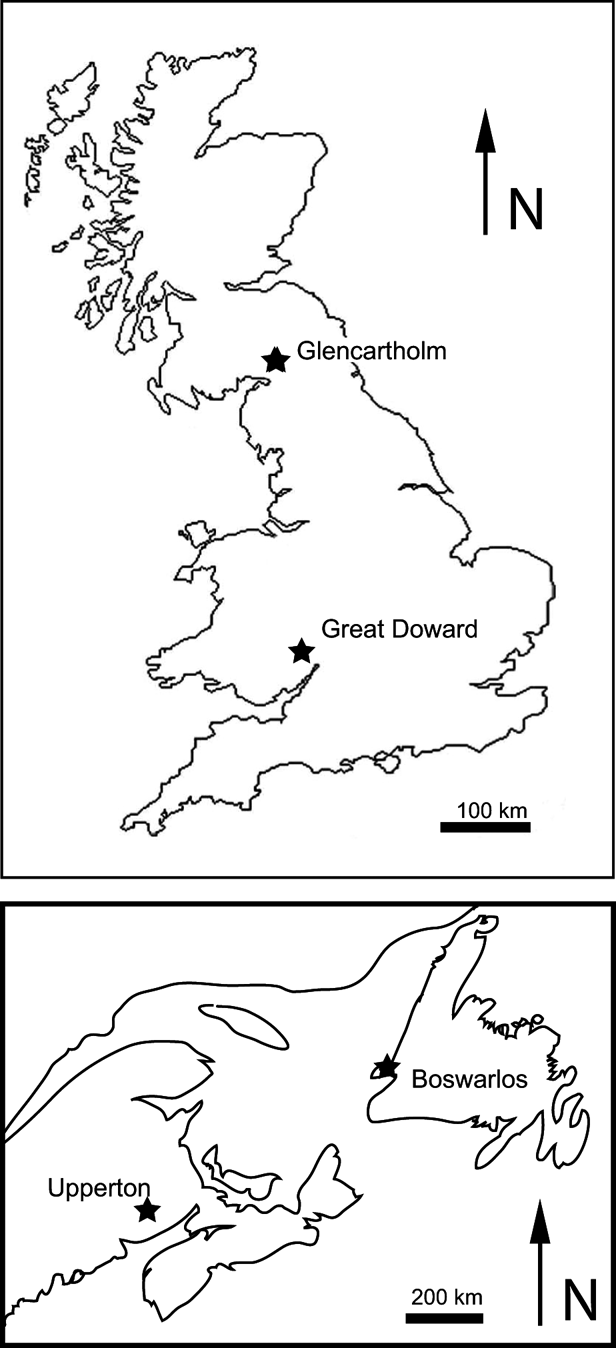
When Schramocaris was first found near Doward in the Forest of Dean (Fig. 1), it was thought that it was Pseudotealliocaris (Jenkins Reference Jenkins2007). Since the genus Pseudotealliocaris is considered a junior synonym of Tealliocaris, it was then assumed that this crustacean was a species of Tealliocaris (Clark Reference Clark2013; Clark et al. Reference Clark, Gillespie, Morris and Clayton2015). The broad, round carapace with rugose carinae was also reminiscent of another genus called Pseudogalathea, and the crustacean from the Forest of Dean was therefore compared with both Tealliocaris and Pseudogalathea. It was, however, found to be significantly different from both these genera, both morphometrically and anatomically (Clark et al. Reference Clark, Gillespie, Morris and Clayton2015).
Maps of the United Kingdom and NE Canada showing the localities where Schramocaris has been found.

Since at least the 1950s, the crustaceans from the cementstone at Glencartholm (Fig. 1), in the collections of the Natural History Museum, London and National Museums Scotland, were assumed to be a species of Tealliocaris, though had not been studied in any detail. A species of Tealliocaris from the overlying shales at Glencartholm, T. etheridgii, is still recognised as such (Clark Reference Clark2013). The specimens in National Museums Scotland are in the Robert Dunlop collection (see Dunlop et al. Reference Dunlop, Ross and Stewart2013 for more details).
The specimens collected by G. F. Matthew in the late 1800s from New Brunswick have similarly been in museum collections for some considerable time, but were originally described as ‘Prestwichia' and later as Tealliocaris woodwardi (Miller & Purdy Reference Miller and Purdy1998). Other specimens identified as Tealliocaris from Canada include a collection of carapaces described by Dewey & Fåhræus (Reference Dewey and Fåhræus1981) as Tealliocaris loudonensis which, until recently, were thought to have been lost. These have now been relocated thanks to the diligence of Michelle Coyne at the Geological Survey of Canada.
Here we describe two new species of Schramocaris from the Carboniferous of Scotland and Canada: the first species, S. clarksoni, from the Viséan of Glencartholm, Dumfries and Galloway, Scotland; and the second, S. matthewi, from the Viséan of New Foundland and New Brunswick, Canada.
Institutional abbreviations. GLAHM, The Hunterian, University of Glasgow, Glasgow, UK; GSC, Geological Survey of Canada, Ottawa, Canada; NBMG, New Brunswick Museum, Saint John, Canada; NHMUK, Natural History Museum, London, UK; NMS, National Museums Scotland, Edinburgh, UK.
1. Systematic palaeontology
Subclass Eumalacostraca Grobben Reference Grobben1892 sensu Martin & Davis, Reference Martin and Davis2001
Genus Schramocaris Clark, Gillespie, Morris & Clayton, Reference Clark, Gillespie, Morris and Clayton2015
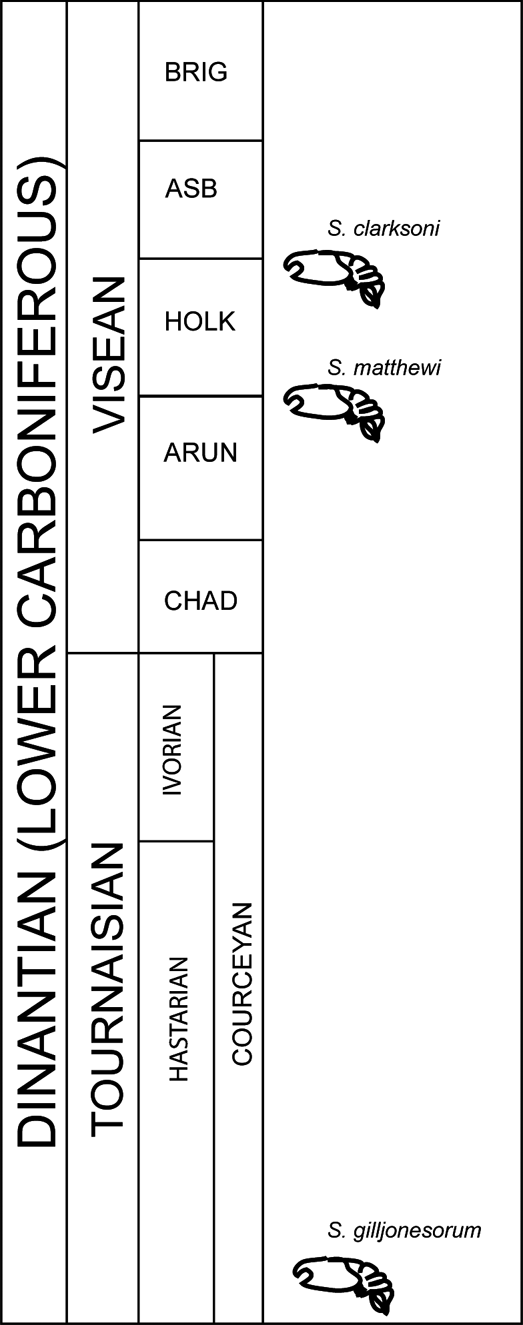
Type species. The type species of Schramocaris is S. gilljonesorum Clark et al., Reference Clark, Gillespie, Morris and Clayton2015 from the Courceyan Avon Group of Doward in the Forest of Dean, England (Fig. 2).
Temporal distribution of Schramocaris within the Lower Carboniferous. Abbreviations: ARUN = Arundian; ASB = Asbian; BRIG = Brigantian; CHAD = Chadian; HOLK = Holkerian.

Holotype. GLAHM 152432.
Emended diagnosis. As for Clark et al. (Reference Clark, Gillespie, Morris and Clayton2015), with the addition of the following: scaphocerite present; rectangular thoracomeres that taper anteriorly; lack of diaeresis on the uropods.
Schramocaris clarksoni sp. nov. (Figs 3, 4)
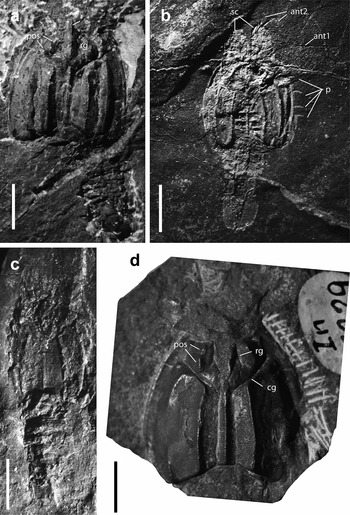
Schramocaris clarksoni from Glencartholm: (a) holotype showing single row of bosses along the carinae (best seen in the first lateral carinae) and paired postorbital carinae (pos), rostrum (r) and rostral groove (rg) (part, NMS G.1957.1.5015); (b) complete paratype specimen showing rarely preserved first and second antennae (ant1, ant2), scaphocerites (sc), pereiopods (p) and thoracic sternites (part, NMS G.1957.1.5016); (c) external mould of complete specimen with well-preserved pleon showing third tergite that is not enlarged as it is in Tealliocaris (paratype, NMS 1957.1.5018); (d) internal mould of a carapace missing the rostrum, showing paired post-orbital carinae with bosses (pos) and weak second lateral carinae in the post cervical region. The cervical (cg) and rostral (rg) grooves are well preserved in this specimen (NHMUK In.35329). Scale bars = 0.5 cm.

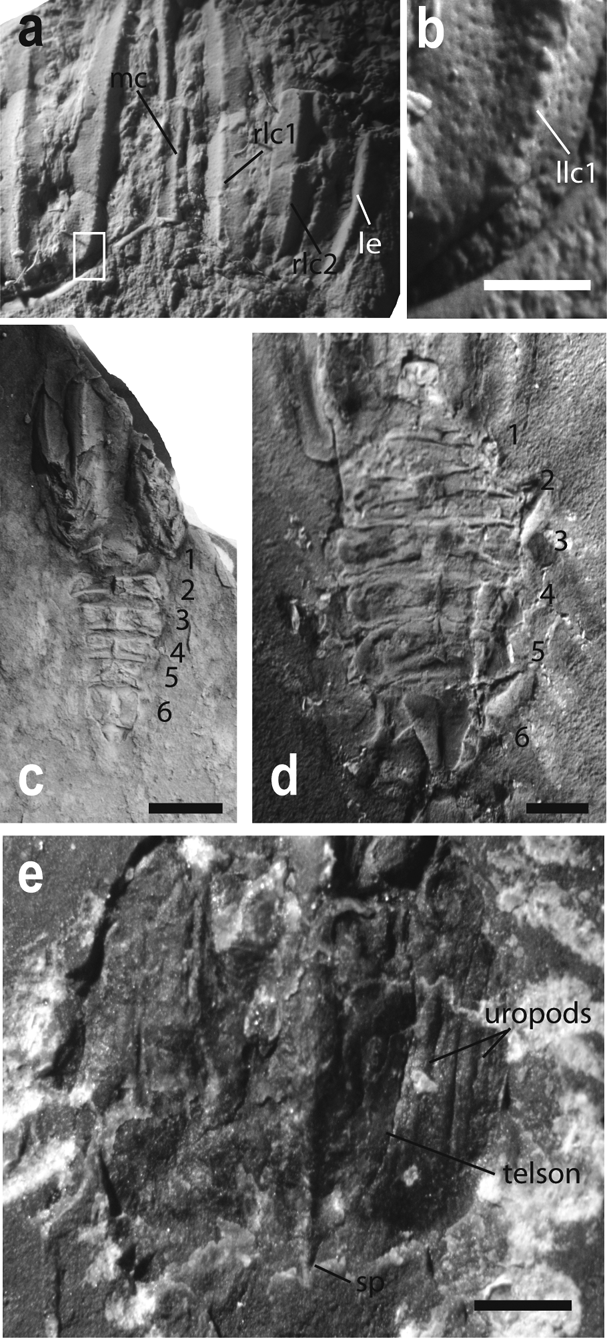
Paratypes of Schramocaris clarksoni: (a) latex peel coated in magnesium oxide of carapace, showing carinae (mc, right lateral carinae (rlc1, rlc2), le) with bosses (GLAHM 152454); (b) enlargement of (a), showing the posterior end of the left first lateral carina (llc1, GLAHM 152454), pitting on the carapace cuticle are tegumental ducts in the endocuticle (see Clark Reference Clark2013, fig. 3); (c, d) latex peels coated in magnesium oxide of part (c) and counterpart (d) of mostly complete specimen with well-preserved pleon ornamentation. (d) is an enlarged external mould to show only pleon (somites numbered 1–6, GLAHM 152460); (e) enlarged tail fan, showing telson with terminal short spine (sp) and uropods (GLAHM 152456). Scale bars = 0.5 cm (a); 0.1 cm (b, d, e); 0.25 cm (c).

Etymology. Named in honour of Professor Euan N. K. Clarkson, who has contributed significantly to our understanding of Carboniferous crustaceans in Scotland.
Material. Material from a cementstone at Glencartholm is in the collections of GLAHM, NMS and NHMUK. The specimens were found in a hard limestone within the Glencartholm Volcanic Member of the Tyne Limestone Formation (Frost & Holliday Reference Frost and Holliday1980) (Upper Border Group of Lumsden et al. Reference Lumsden, Tulloch, Howells and Davies1967). The Glencartholm Volcanic Member is thought to straddle the Holkerian–Asbian boundary within the Viséan (Cater et al. Reference Cater, Briggs and Clarkson1989; Purnell & Cossey Reference Purnell, Cossey, Cossey, Adams, Purnell, Whitley, Whyte and Wright2004; Fig. 2).
Diagnosis. This species has a generally smooth carapace with a single row of bosses along the central and both lateral carinae of the branchial region of the carapace. The second lateral carinae become less distinct in the mid-branchial area in some specimens.
Type material. The holotype for this species is NMS G.1957.1.5014/G.1957.1.5015 (part and counterpart) (Fig. 3a), as it has a well preserved and complete carapace preserved in relief. Paratypes: NMS G.1957.1.5016/G.1957.1.5017 (part and counterpart) (Fig. 3b); NMS G.1957.1.5018 (Fig. 3c); NHMUK In.35329 (Fig. 3d); GLAHM 152454 (Fig. 4a, b); GLAHM 152456 (Fig. 4c, d); GLAHM 152460/1-2 (Fig. 4e).
Description. The cementstone at Glencartholm has preserved many of the crustaceans in relief and the lack of compaction has made comparative analysis of the structures of S. gilljonesorum and S. clarksoni more reliable. The preservation is such that the thoracic limbs, including the cephalic limbs, that are absent in S. gilljonesorum, can be seen in this species. The presence of a scaphocerite is significant, as this was a character that was discussed as potentially important to differentiate Schramocaris from Tealliocaris (Clark et al. Reference Clark, Gillespie, Morris and Clayton2015). The scaphocerite is a simple oval structure with no obvious spines or ornamentation (Fig. 3b). The first antenna is long and flagellar, but the second antennae appear to be biramous and short. Only four simple walking limbs can be seen extending beyond the edge of the carapace (Fig. 3b); however, is likely that there is at least another shorter pair anterior to those observed. The thoracomeres are about the same length and are almost rectangular – although they appear to taper anterior towards the cervical groove (Fig. 3b, c). The carapace is broad, with the first lateral carinae being relatively close to the mid-carina when compared with Tealliocaris. The carinae have a single row of bosses along the crests, with only the occasional offset boss. Beyond the second lateral carinae is a flange-like edge to the carapace, which terminates in an ornamented lateral edge to the carapace with boss-like protuberances, similar to those of the lateral and median carinae. Anterior to the cervical groove is a rostral groove, lateral to which is a pair of post-orbital boss-ornamented carinae (Fig. 3d). The pleon is quite well preserved in a number of specimens and is similar in character to S. gilljonesorum. The first pleomere does not seem to preserve well, but can be seen in at least one specimen as having at least the median carina (Fig. 4c, d). Pleomeres 2–5 are similar in size, with similar pleurae that curve posteriorly. The tergites of these four pleomeres are similarly ornamented with a median carina, a robust anterior and posterior edge and a deep groove sloping from below the mid-point of the median carina (but not transecting it) postero-laterally towards the pleurae. The sixth pleomere is about 1.5 times longer than the others, supports the tail fan, but lacks the groove of the preceding pleomeres. No diaereses can be seen on the uropods and the telson appears to be a single unit. The telson is broad and rounded, although one specimen terminates in a short spine (Fig. 4e).
Schramocaris matthewi sp. nov. (Figs. 5, 6)
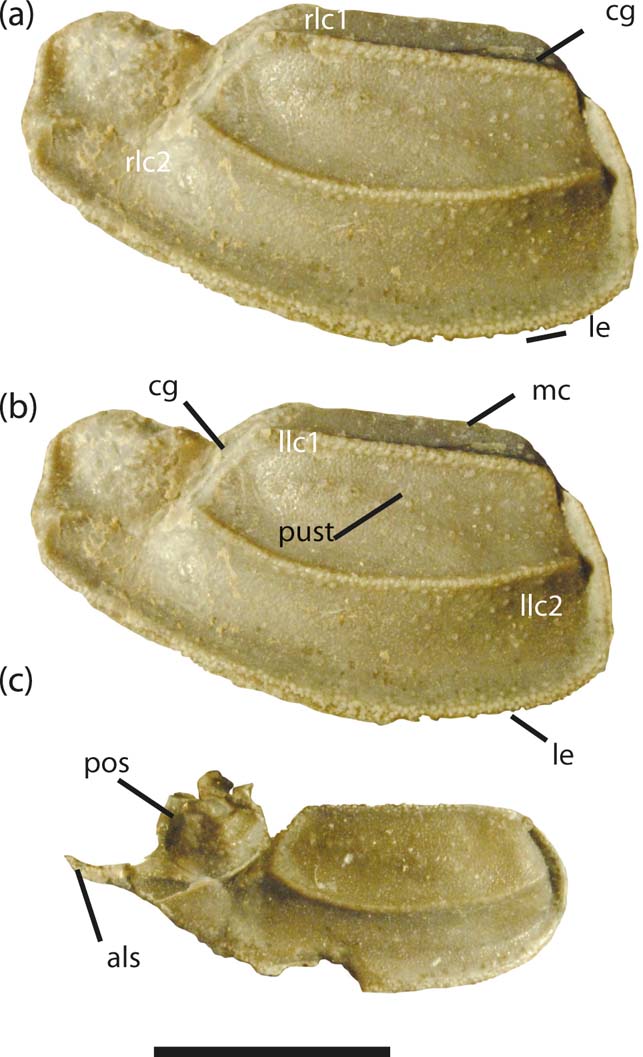
Specimens originally figured by Dewey & Fåhræus (Reference Dewey and Fåhræus1981) from the Ship Cove Formation, Newfoundland and redescribed here as the new species Schramocaris matthewi: (a) GSC 69151, lacking the anterior of the carapace, but showing the bosses on the carinae (rlc1, rlc2) and the multiple rows of bosses on the lateral edge (le). Lighter pustules can be seen between the carinae behind the cervical groove (cg); (b) holotype of Schramocaris matthewi (GSC 69152), showing the left side of the carapace with some preservation of the anterior end. Pustules (pust) are indicated on the branchial region of the carapace, as well as the carinae (llc1, llc2, mc, le); (c) a smaller specimen of Schramocaris matthewi (GSC 69153), showing bosses on the post orbital spines (pos) as well as an anterolateral spine (als) on the left side of the carapace. Scale bar = 0.5 cm.
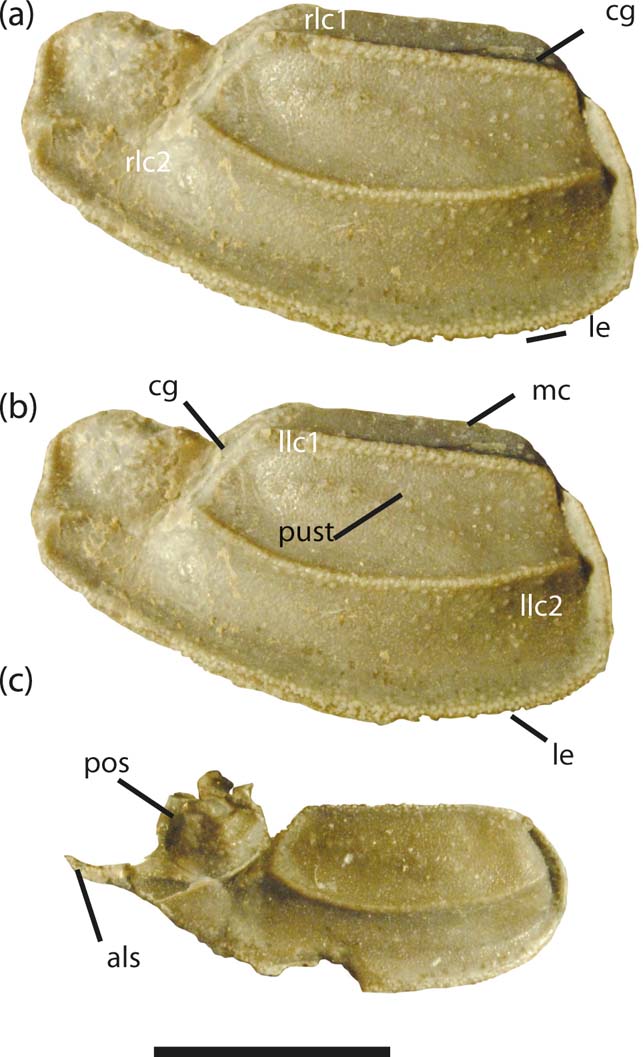
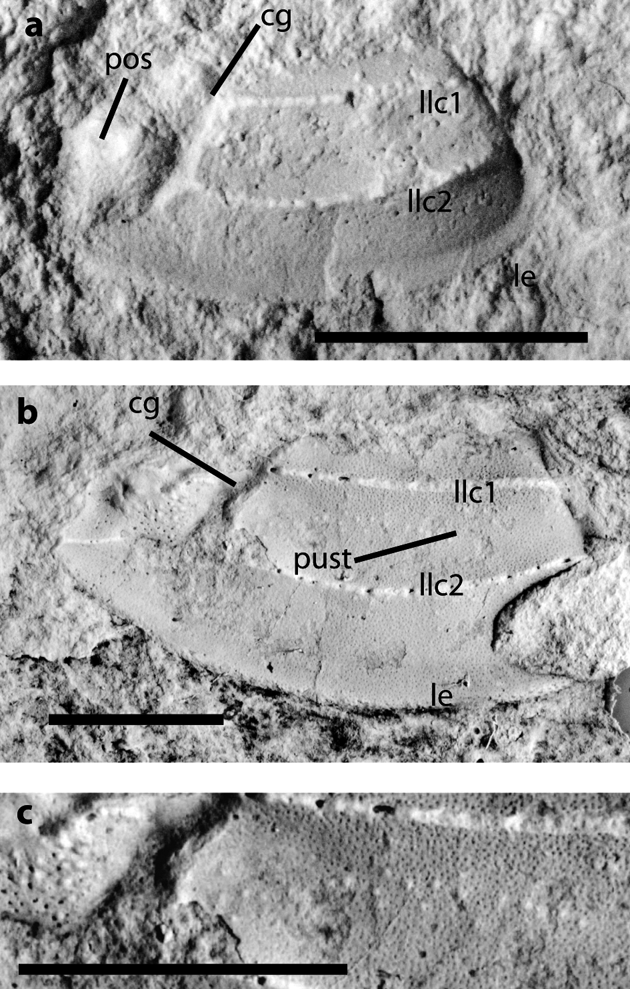
Partial carapaces of S. matthewi from the Macumber Formation of New Brunswick: (a) NBMG 19940, showing the post orbital spines (pos), cervical groove (cg) and lateral carinae (llc1, llc2), including the lateral edge (le); (b) NBMG 19937, showing the same structures as above, but also showing pustules (pust) on the branchial region of the carapace between the carinae; (c) enlargement of NBMG 19937, between the cervical groove and the lateral carinae. Bosses can also be seen on the post orbital spines in the far left of the image. Scale bars = 0.5 cm.

Etymology. Named in honour of G. F. Matthew, who first discovered the crustaceans in Canada in the late 1800s.
Material. Only isolated carapaces of this species have thus far been found. The specimens come from both the Ship Cove Formation, which has been shown to be the lowest unit of the Codroy Group in Newfoundland (Dewey & Fåhræus Reference Dewey and Fåhræus1981), and the Macumber Formation, which is its lateral equivalent as part of the Windsor Group in New Brunswick. This correlates approximately with the Arundian–Holkerian boundary and is slightly older than the deposits in southern Scotland from which S. clarksoni comes (Fig. 2).
Diagnosis. This species has a carapace with alternating rows of bosses along the central and both lateral carinae of the branchial region of the carapace. The second lateral carina remains distinct in the mid-branchial area of this species. There are a number of pustules on the branchial region of the carapace between the first lateral carina and the outer rim.
Type material. The holotype for this species is GSC 69152 (Fig. 5b) which was first figured as Tealliocaris aff. loudonensis by Dewey & Fåhræus (Reference Dewey and Fåhræus1981). Paratypes include the other previously figured material from both Dewey & Fåhræus (Reference Dewey and Fåhræus1981, plate 1, figs 1–4): GSC 69151 (Fig. 5a); GSC 69152 (Fig. 5b); GSC 69153 (Fig. 5c); and those figured by Miller & Purdy (Reference Miller and Purdy1998, fig. 4): NBMG 2131/2; and NBMG 10139; as well as those figured here: NBMG 19940 (Fig. 6a); and NBMG 19937 (Fig. 6b, c).
Description. This crustacean has been described in detail by Dewey & Fåhræus (Reference Dewey and Fåhræus1981) and Miller & Purdy (Reference Miller and Purdy1998), although it was not recognised as a new species due to the incomplete nature of the carapaces. The carapaces from Newfoundland described by Dewey & Fåhræus (Reference Dewey and Fåhræus1981) show an arcuate line of bosses between the first and second lateral carinae (Fig. 5a; GSC 69151), although in other specimens the bosses appear to be more randomly distributed (Fig. 5b, c; GSC 69152 and GSC 69153). There are also bosses beyond the second lateral carina. The lateral edge (Fig. 5a, b; le) has multiple bosses along its length, rather than the paired offset bosses seen in the two lateral carinae. The carapace appears to be pitted, but this is likely to be the tegumental ducts when the thin epicuticle is removed, as seen in Tealliocaris (Clark Reference Clark2013, fig. 3).
On the basis of the structures that can be readily observed on the carapace of the Canadian species, the robustness and ornamentation of the lateral carinae and the relative position of the carinae on the carapaces, these specimens belong to Schramocaris and are sufficiently different from S. gilljonesorum to warrant a different species. The occurrence of pustules in the branchial region of the carapace has not been observed in any other species of Schramocaris and appears to be diagnostic of this species (see Fig. 7).
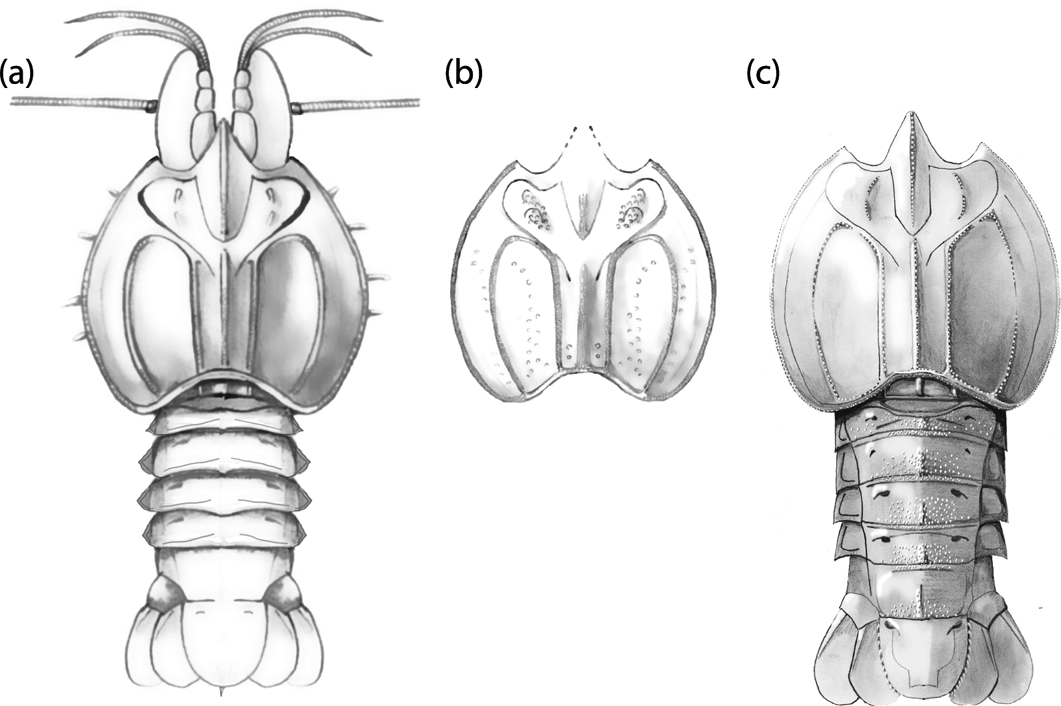
Reconstructions based on available information: (a) Schramiocaris clarksoni; (b) S. matthewi; (c) S. gilljonesorum. Not to scale.

2. Affinities
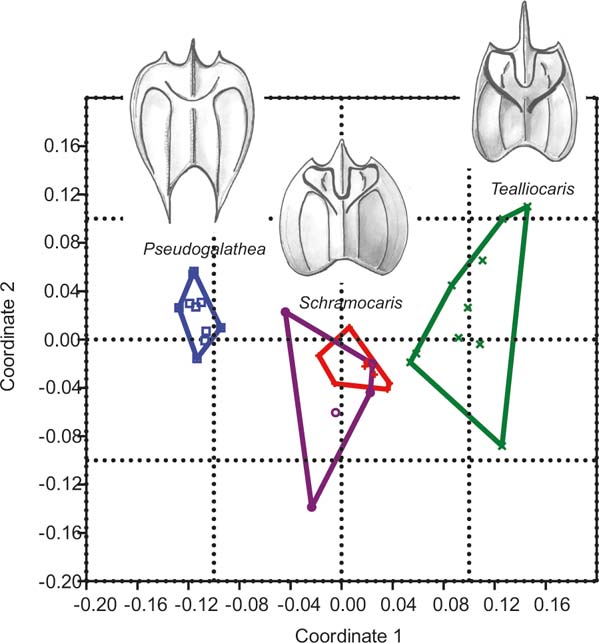
Although the three chosen genera of eumalcostracans have similar carapace morphology, a multivariate analysis using principal coordinates separates Pseudogalathea, Schramocaris and Tealliocaris into three distinct morphospaces (using PAST (Hammer et al. Reference Hammer, Harper and Ryan2001)). Two of the species of Schramocaris (S. gilljonesorum and S. clarksoni), however, overlapped substantially and could not be differentiated on this basis (Fig. 8). The incomplete nature of the carapaces of the third species, S. matthewi, could not be used in this analysis, as several of the landmarks, as defined by Clark (in Clark et al. Reference Clark, Gillespie, Morris and Clayton2015), are not preserved in the specimens available for study. The spread of the different species of Schramocaris within the morphospace, compared with that of the other two genera, is limited. Some of this may be due to more growth stages represented in the other genera, variation in the taphonomy due to moulting or preservation, greater temporal and geographical spread (in the case of Tealliocaris) or, perhaps, variation in morphologies as a result of adaptations to environmental pressures such as salinity. The shape of Schramocaris, based on the landmarks chosen for this study, appears to be conservative, both spatially and temporally.
Results of the principal coordinate analysis, showing that there is separation between the three Carboniferous genera Pseudogalathea (n = 10), Tealliocaris (n = 10) and Schramocaris (n = 14). S. gilljonesorum (n = 9) represented by the red shape and crosses; S. clarksoni (n = 5) by the purple shape and circles. A generalised carapace of each of the genera is also provided here for reference (based on Clark et al. Reference Clark, Gillespie, Morris and Clayton2015). The three species of Schramocaris show a general morphological similarity, based on the 12 landmarks of the carapace as defined by Clark et al. (Reference Clark, Gillespie, Morris and Clayton2015) using PAST (Hammer et al. Reference Hammer, Harper and Ryan2001).

3. Distribution of Schramocaris
Schramocaris is found in what has been interpreted as a mud-dominated shelf deposit within the Avon Group of the Forest of Dean during the marine transgression of the earliest Carboniferous (Waters & Davies Reference Waters, Davies, Brenchley and Rawson2006; Clark et al. Reference Clark, Gillespie, Morris and Clayton2015). In the Forest of Dean, Schramocaris is found in laminated magnesian calcite-rich shale, indicative of a nearshore marine environment with periodic evidence of evaporation (Clark et al. Reference Clark, Gillespie, Morris and Clayton2015).
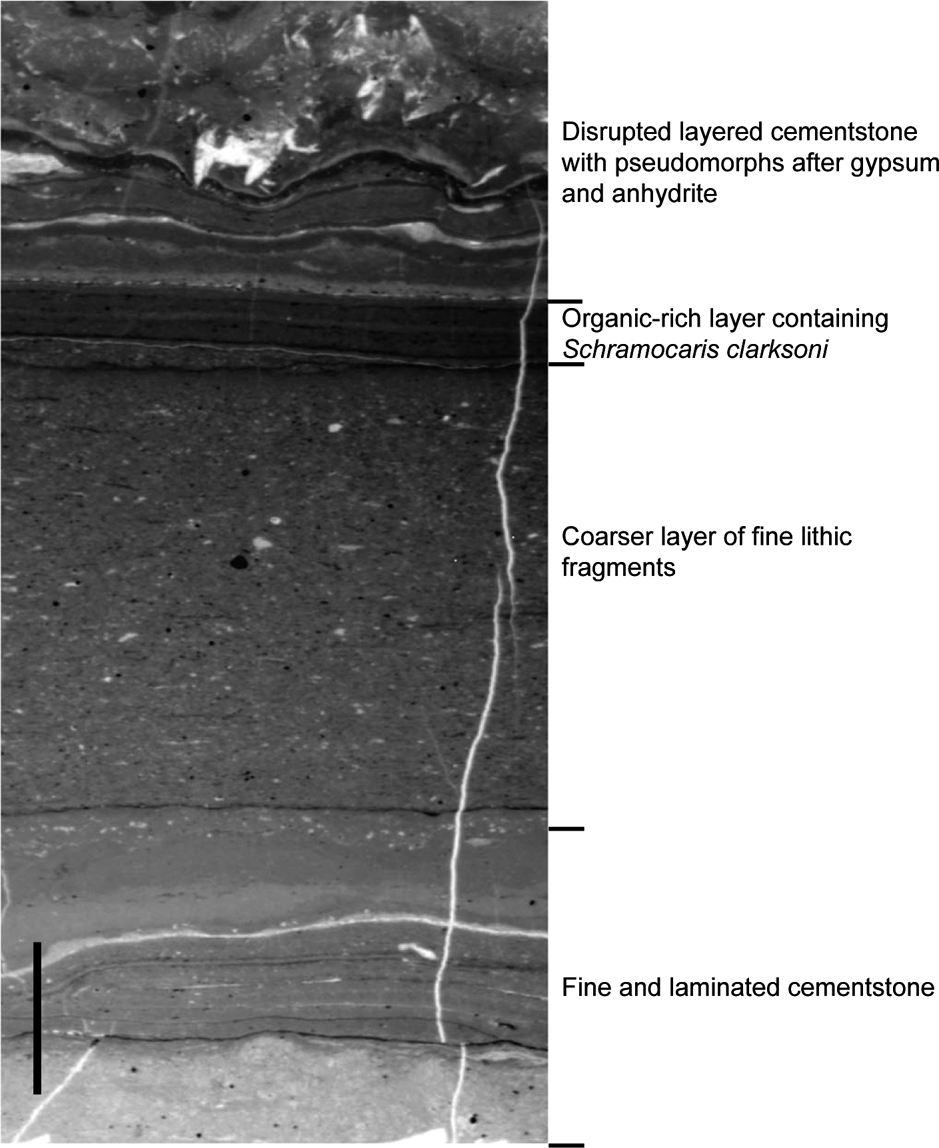
The sediments at Glencartholm in which S. clarksoni is found are shallow-water nearshore marine cementstones, with a high organic content and evidence of evaporation with pseudomorphs after gypsum and anhydrite (Cater et al. Reference Cater, Briggs and Clarkson1989) (Fig. 9).
Enlarged thin section of the cementstone at Glencartholm, showing the layer from which Schramocaris clarksoni was obtained and the overlying evaporitic pseudomorphs after gypsum and anhydrite. Scale bar = 0.1 cm.

In the Canadian Viséan, Schramocaris is found in potentially hypersaline pelmicrites of the Ship Cove Formation (Dewey & Fåhræus Reference Dewey and Fåhræus1981) and in shales of a shallow marine embayment in the Macumber Formation (Miller & Purdy Reference Miller and Purdy1998).
Other similar Carboniferous crustaceans, such as Pseudogalathea also appear to live in the more marine environments, whereas Tealliocaris seems to prefer lower salinities (Briggs & Clarkson Reference Briggs and Clarkson1989).
Although the species have changed, it appears that Schramocaris as a genus has retained its original environmental tolerance to survive in nearshore low-energy marine conditions. The variation in the ornamentation is the only means of distinguishing between these species, as it is in Tealliocaris (Clark Reference Clark2013), as the general morphology is indistinguishable based on a 12-point landmark analysis of the carapace (Clark et al. Reference Clark, Gillespie, Morris and Clayton2015) between S. gilljonesorum and S. clarksoni.
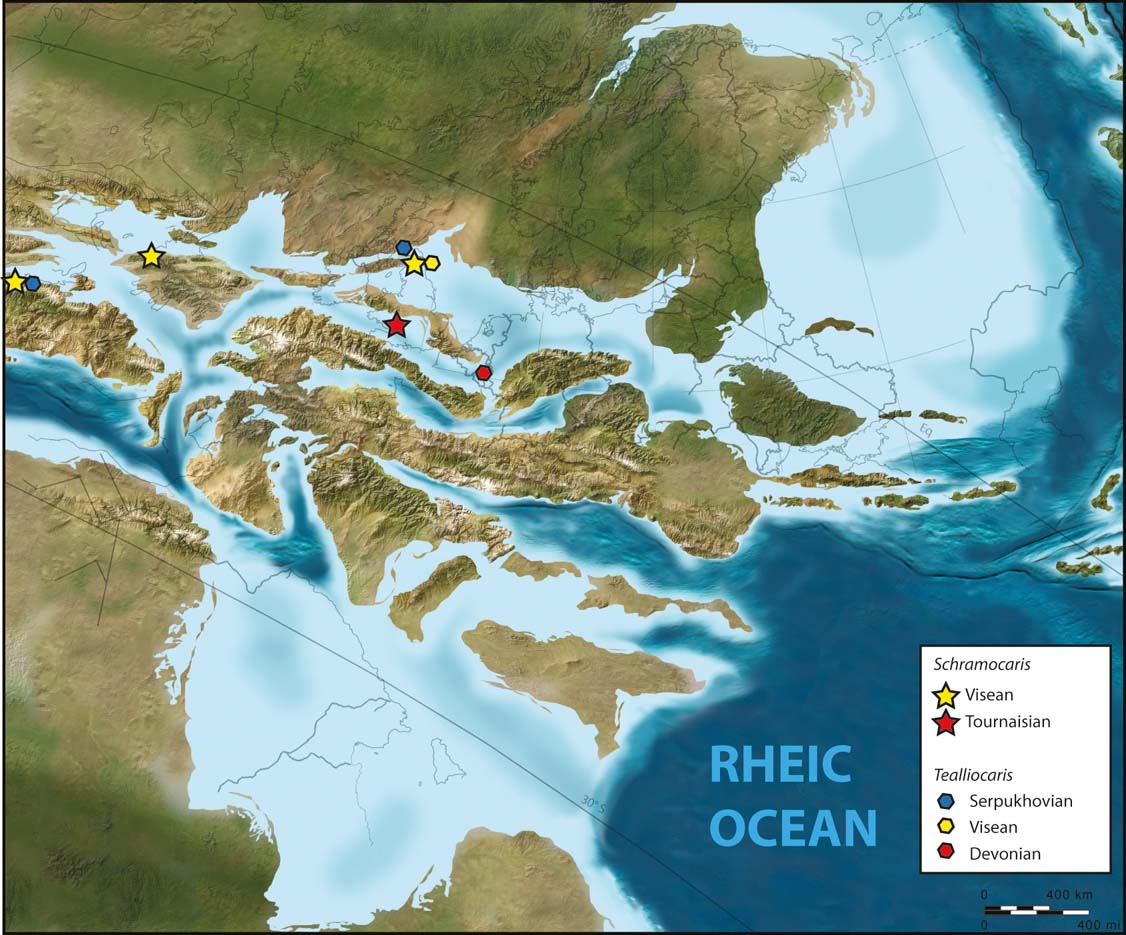
The distribution of Schramocaris appears to be very similar to that of Tealliocaris, except that Tealliocaris is restricted to non-marine environments ranging from the Devonian of Strud in Belgium (Gueriau et al. Reference Gueriau, Charbonnier and Clement2014) to the Serpukhovian of Bearsden in Scotland and Parrsboro in Canada (Copeland Reference Copeland1957; Clark et al. Reference Clark, Gillespie, Morris and Clayton2015). Both Tealliocaris and Schramocaris have only been found on the Euramerican coast of the Rheic Ocean (Fig. 10); Schramocaris appearing with the early marine transgressions of the Carboniferous, moving north and west with time. Tealliocaris also appears to have moved with the Early Carboniferous transgressions, appearing in freshwater floodplain deposits from the Devonian of Belgium (Gueriau et al. Reference Gueriau, Charbonnier and Clement2014) to the freshwater pools with occasional marine incursions of southern and central Scotland during the Viséan (Briggs & Clarkson Reference Briggs and Clarkson1985, Reference Briggs and Clarkson1989; Briggs et al. Reference Briggs, Clark and Clarkson1991; Clark Reference Clark2013), and the fresh water shales of the Serpukhovian of Bearsden and Parrsboro (Copeland Reference Copeland1957; Brooks Reference Brooks1962; Clark Reference Clark1989). In the case of Bearsden, the shales that contain Tealliocaris are topped by a marine incursion represented by a shale containing Posidonia, brachiopods, orthocones, conodonts and sharks, prior to the deposition of the more open marine Top Hosie Limestone (Clark Reference Clark1989, Reference Clark2013). It is difficult to be certain whether Tealliocaris represents a facultative inhabitant of freshwater lagoons and more saline environments; however, some of the environments in which it has been preserved certainly show signs of marine influence, particularly at localities such as Granton, Gullane and Glencartholm (Cater et al. Reference Cater, Briggs and Clarkson1989; Briggs & Clarkson Reference Briggs and Clarkson1985, Reference Briggs and Clarkson1989; Clark Reference Clark2013).
Palaeogeographic reconstruction of the western Rheic Ocean about 350 million years ago, showing the broad spatial and temporal distributions of Tealliocaris (hexagons) and Schramocaris (stars). The top line of latitude is the Equator; the lower line is 30° S. Base map courtesy of ©Colorado Plateau Geosystems, used with permission.

The new occurrences indicate that this crustacean lived in a marginal marine to fully marine environment in Scotland and Canada (Cater et al. Reference Cater, Briggs and Clarkson1989), which supports the concept that Schramocaris is a marine crustacean as suggested by the English material (Clark et al. Reference Clark, Gillespie, Morris and Clayton2015). This is a difficult niche to define for Carboniferous eumalacostracan crustaceans, due to a paucity of localities and poor preservation potential in anything other than the lowest energy environments (Briggs & Clarkson Reference Briggs, Clarkson, Taylor and Larwood1990). The preservation potential of Schramocaris seems to be reasonably good in these fine-grained near-shore marine sediments, allowing the potential for more discoveries of this genus and a more reliable measure of its distribution to be made.
4. Acknowledgements
Our thanks to Michelle Coyne of the Geological Survey of Canada, for locating the Dewey and Fåhræus specimens in Ottawa. Also to Amy Moe-Hoffman (Dunn-Seiler Museum, Mississippi State), Dr Elliot Burden (Memorial University of Newfoundland, St John's) and Doug Boyce (Department of Natural Resources, Newfoundland and Labrador), for helping in the search for these specimens. Thanks to Matt Stimson (New Brunswick Museum, Canada), who assisted in the field and helped to collect specimens NBMG 19937 and NBMG 19940. The authors would also like to thank the anonymous reviewer and Dr Alistair McGowan for their helpful comments on the first draft manuscript. This paper is a contribution to the Natural Environment Research Council (NERC) Consortium Grant ‘The Mid-Palaeozoic biotic crisis: setting the trajectory of tetrapod evolution', led by Professor Jenny Clack (University Museum of Zoology, Cambridge), including National Museums Scotland (NE/J020621/1).