The overuse and misuse of antimicrobials have resulted in the global public health threat of antibiotic resistance.1 Targeting improvements in antibiotic prescribing in the outpatient setting is critically important because ~80%–90% of antibiotics are prescribed in ambulatory care settings.2 Urinary tract infections (UTIs) are one of the most common infectious indications for antibiotic prescribing in the outpatient setting and therefore represent an important target for improving prescribing.Reference Durkin, Keller and Butler3
Antimicrobial stewardship programs (ASPs) have been created to combat resistance and guide appropriate prescribing.Reference Gupta, Hooton and Naber4 Both the Centers for Disease Control and Prevention (CDC) and The Joint Commission have developed standards to guide the implementation of antimicrobial stewardship initiatives and to promote patient safety in ambulatory healthcare settings.5,6 Direct-to-consumer telemedicine through virtual visits has emerged as an increasingly popular method for healthcare delivery and provides patients with convenient, on-demand, access to primary care providers for a wide variety of mild complaints such as uncomplicated UTIs.7 Virtual visits present an important ambulatory care target for ASPs outside traditional office visits; however, very little data currently exist regarding the appropriateness of antibiotic prescribing through virtual visits.Reference Penza, Murray and Pecina8,Reference Hickson, Talbert and Thornbury9 We compared the appropriateness of antimicrobial therapy between virtual visits and office visits for adult females diagnosed with uncomplicated UTIs within a primary care network.
Methods
This retrospective cohort study was conducted at Mercy Health Physician Partners (MHPP) primary care network in western Michigan. Adult females aged 18–65 years were eligible for study inclusion if they completed a virtual or office visit between January 1, 2018, and December 31, 2018. Included patients must have been diagnosed with an acute uncomplicated UTI through virtual visit or recorded ICD-10 diagnosis corresponding to UTI or acute cystitis without hematuria at an office visit (N39.0 or N30.00). Patients were selected for inclusion via a random number generator and were screened for inclusion until the target sample size of 350 patients was met. Random number generation was used to limit selection bias to ensure random sampling. Patients were excluded if they were ineligible for a virtual visit. Exclusion criteria included those who had UTI symptoms for ≥7 days at presentation, a UTI in the previous 4 weeks, >4 UTIs in the previous year, kidney stones in the previous 6 months, or history suggestive of complicated infection (eg, fever, chills, flank pain, vomiting, severe or moderate abdominal pain, male sex). Patients who had used an antibiotic in the previous month, had reported antibiotic failure during previous UTI treatment or were currently receiving prophylactic antibiotics for UTI were also excluded. Other exclusion criteria included abnormal vaginal discharge, concern for sexually transmitted infections, hospitalization in the previous 30 days, Foley catheter placement within the previous 30 days, and pregnancy or breastfeeding.
The MHPP network is composed of >500 physicians and advanced practice providers in 44 primary care offices in West Michigan, including the Grand Rapids metropolitan area. In September 2017, virtual visits became available to patients within the MHPP primary care network for certain infectious conditions, including uncomplicated UTIs. These visits are conducted by MHPP primary care providers through the Zipnosis platform (Zipnosis, Minneapolis, MN) and are text-based visits, accessible from a smart-phone or computer. Patients can complete a virtual visit at any time, 7 days per week, with provider response available within 1 hour during normal business hours (08:00 a.m. to 8:00 p.m.) or the following morning if completed after hours. Patients select from a list of chief complaints, one of which is female bladder infection. They then complete a corresponding questionnaire which assesses urinary symptoms, onset, previously tried over-the-counter treatments or home remedies, current medications, previous antibiotics taken for UTI, and medication allergies. Following the patient’s responses, the provider receives a virtual visit notification to their phone or computer with a visit summary. They then evaluate the answers to confirm the diagnosis of uncomplicated UTI and select a treatment plan from a drop-down menu of preset antibiotic and supportive care choices that are based on national guideline recommendations and include a fixed dose and duration corresponding to each antibiotic (Table 1). The virtual visit software and algorithms are developed by a third-party vendor; they are not based on local susceptibilities; and they do not include input from the local ASP. The virtual visit diagnosis and treatment algorithm does not include diagnostic testing orders for urinalysis or urine culture, which must be ordered outside of a visit. MHPP office visits are conducted using the athenahealth (athenahealth, Watertown, MA) outpatient electronic medical record system, which does not include any algorithms or outpatient order sets with UTI prescribing recommendations. Providers were able to order diagnostic tests, antibiotic therapy, and supportive care independently outside of a set algorithm.
Empiric Recommendationsa

Note. MHPP, Mercy Health Physician Partners; PO, per oral.
a MHPP empiric recommendations are listed in order of empiric preference. Zipnosis empiric recommendations are listed in the order that they appear on the medication drop down within the Zipnosis software platform.
b Unless CrCl <30 mL/min, documented allergy, or resistance.
c Alternative in order of preference based on documented allergy or resistance.
The outpatient antimicrobial stewardship program (ASP) at MHPP is co-led by 2 infectious diseases pharmacists and 2 infectious diseases physicians who also lead inpatient ASP efforts at the Mercy Health Saint Mary’s and Mercy Health Muskegon hospitals. The ASP leaders provide education annually with updated outpatient-specific antibiogram and empiric antimicrobial treatment guidelines based on local susceptibilities as well as national guideline recommendations. Annual ASP education is required for all outpatient providers and is provided via an electronic learning system while antibiogram and empiric therapy guidelines are available electronically via an intranet site accessible from any device connected to the MHPP network.
Data were collected from the athenahealth outpatient records system for both the MHPP office and virtual visit groups. Patients were stratified into their respective groups based on visit type (ie, virtual visit vs office visit). The following patient characteristics were retrieved: patient age, antibiotic allergies, UTI symptom onset and descriptions, as well as antibiotic therapy and supportive care received. The primary objective of this study was to compare guideline-concordant antibiotic selection for uncomplicated UTIs between virtual visits and office visits. Guideline-concordance was determined from local outpatient recommendations, which are based on current antibiogram data and the Infectious Diseases Society of America treatment guidelines for uncomplicated UTIs in females (Table 1). Nitrofurantoin was considered guideline-concordant therapy for all patients unless allergies, renal dysfunction, or history of nitrofurantoin-nonsusceptible organism or treatment failure was noted by the patient or provider. Second-line therapies were considered appropriate based on allergies or history of drug resistance. Secondary end points compared between groups included the rate of appropriate treatment duration and use of diagnostic testing resources (ie, urinalysis and cultures). Patient outcomes compared between groups included 48-hour, 7-day, and 30-day revisits, as well as Clostridioides difficile infection within 30 days of the initial visit. A revisit included office, urgent care, emergency department, or virtual visit.
Statistical analysis
Assuming a baseline office visit rate of guideline-concordant prescribing of 65%, a sample calculation estimated that at least 350 patients would be needed to detect a 10% difference in the primary end point with 80% power and a 2-sided α of 0.05. Nominal variables were assessed using the χ2 or the Fisher exact test, as appropriate, and continuous variables were assessed using the Student t test or the Mann-Whitney U test, as appropriate, based on the distribution of data. Multivariate logistic regression was conducted to assess independent risk factors for revisits. All statistical analyses were performed using SPSS version 22 software, (IBM, Armonk, New York).
Results
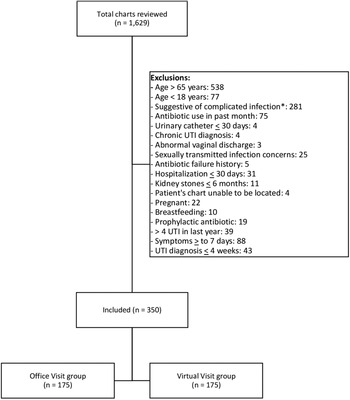
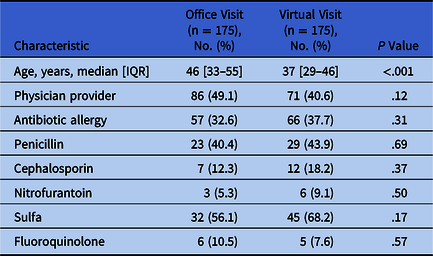
During the 12-month study period, 5,660 patients were diagnosed with an uncomplicated UTI by a MHPP primary care provider. In total, 1,629 patients were screened until the target sample size of 350 patients was met, with 175 patients per group (Fig. 1). Provider type and incidence of antibiotic allergies were similar between groups; however, the median age (interquartile range [IQR]) of patients treated in the virtual visit group was significantly younger than the office visit group (Table 2).
Patients excluded from the study. *Fever, chills, flank pain, vomiting, severe or moderate abdominal pain, pelvic pain.

Baseline Characteristics

Note. IQR, interquartile range.
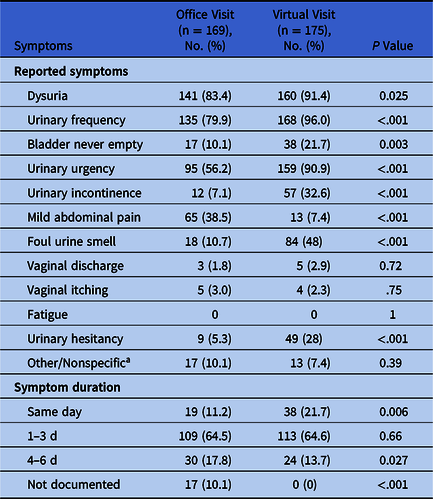
Patient-reported urinary symptoms were more common in the virtual visit group: 175 (100%) versus 169 (96.6%; P =.030). Documented patient-reported symptoms are listed in Table 3. The reported duration of symptoms at the time of the visit was shorter in the virtual visit group than in the office visit group. In addition, the use of over-the-counter treatments or home remedies prior to the visit were more common in the office visit group: virtual visits (13.7%) versus office visits (25.1%; P = .007).
Summary of Patient-Reported Symptoms

a Urinary spasm, nausea, diarrhea, loss of appetite, bladder pain, headache, straining, weak stream, night sweats.
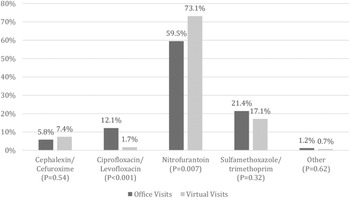
There was no difference in the rate of antibiotic prescribing between groups (virtual visits: 100% vs office visits: 98.9%; P = .50), however, antibiotic selection was significantly different between the 2 groups (P = .001) (Fig. 2). A guideline-concordant antibiotic was more commonly prescribed in the virtual visit group (74.9% vs 59.4%; P = .002). The most common antibiotic prescribed in both groups was nitrofurantoin: virtual visit (73.1%) versus office visit (59.5%; P = .62). Of the 106 patients who did not receive guideline-concordant antibiotic therapy, 93% were eligible for nitrofurantoin based on allergy history and renal function. Missed opportunities to utilize first-line nitrofurantoin were similar between groups: virtual visits (24.0%) versus office visits (36.6%; P = .27).
Antibiotics prescribed at office visits and virtual visits.

Guideline-concordant duration of antibiotic therapy was more common in the virtual visit group (100% vs 53.1%; P < .001). The median duration of antibiotic therapy prescribed was 5 days for virtual visits (range, 1–7 days) and 5 days for office visits (range, 3–10 days; P < .001). There was no difference in supportive care prescribed to patients between visit types: virtual visits (29.7%) versus office visits (26.3%; P = .48). In addition, patients treated through office visits were more likely to have a urinalysis (0% vs 97.1%; P < .001) or urine culture (0% vs 73.1%; P < .001) ordered. When a urine culture was collected, bacteria (>1,000 CFU) were isolated in 82.2% of samples. The most common bacterial species isolated were Escherichia coli and group B streptococci (22% and 2.3%, respectively). The bacteria isolated on culture were susceptible to the antibiotic prescribed in 87.6% of cases. The organism was susceptible to nitrofurantoin in 94.8.% of cases when it was prescribed, compared to 76.3% when an alternative antibiotic was used (P = .011).
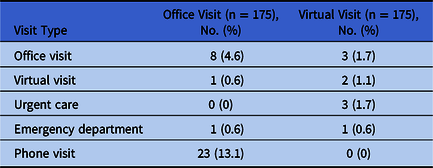
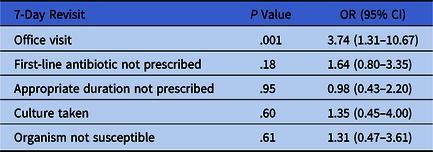
Interval unplanned revisits were similarly frequent in the 2 groups at both 48 hours (virtual visits: 10.3%; P = .73 vs office visits: 11.4%) and 30 days (virtual visits: 26.9% vs office visits: 24.0%; P = .54). Within 7 days, the patients who completed an office visit were more likely to have an unplanned revisit (5.1% vs 18.9%; P < .001) (Table 4). Of the patients with an unplanned revisit within 7 days, most were related to their original UTI complaint: virtual visits (55.6%) versus office visits (66.7%; P = .70). Patients with an unplanned revisit within 7 days were less likely to have been prescribed a first-line antibiotic (nonpreferred therapy: 17.4% vs first-line therapy: 9.4%; P = .03) or guideline-concordant duration of therapy (non–guideline-concordant: 19.5% vs guideline-concordant: 9.7%; P = .017). When an alternative antibiotic to nitrofurantoin was prescribed, there was an increased risk of an unplanned revisit within 7-days: alternative (17.1%) versus nitrofurantoin (9.5%; P = .041). No patients receiving nitrofurantoin met criteria for alternative therapy in either group. In multivariate logistic regression analysis (Table 5), the only factor independently associated with an unplanned revisit within 7 days was initial care through an office visit (odds ratio, 3.74; 95% CI, 1.31–10.67). No patient in either group was diagnosed with C. difficile within 30 days of the initial visit (P = 1.0).
Setting of Revisit Within 7 Days of Index Visit

Multivariate Logistic Regression Analysis Characteristics for Revisits Within 7 Days

Note. OR, odds ratio; CI, confidence interval.
Discussion
Our findings demonstrate that patients treated for uncomplicated UTI through a virtual visit were more likely to be prescribed a guideline-concordant antibiotic agent and duration of therapy than those who were treated at a primary care office visit. Furthermore, providers were less likely to order urinary lab testing for patients treated virtually. These results add further support to the growing evidence surrounding virtual visits as a tool to improve antibiotic prescribing in the outpatient setting. The virtual visit platform may have aided in increasing the rate of appropriate agents and durations prescribed due to a fixed drop-down menu of antibiotic choices. Additionally, each antibiotic selection contained a fixed, but guideline-appropriate, duration of therapy which could not be altered within the virtual visit platform.
Few published studies have evaluated antibiotic prescribing for UTIs treated through virtual visits. Murray et alReference Murray, Penza and Myers10 retrospectively compared antibiotic prescribing and follow-up outcomes of 450 female patients treated for UTI at an office visit or through a text-based virtual visit or nurse telephone protocol. The rate of antibiotic prescribing was similar between groups: virtual visit (81%) versus office visit (83%) versus phone nurse (81%; P = .90).Reference Murray, Penza and Myers10 Mehrotra et alReference Mehrotra, Paone and Martich11 similarly compared prescribing through electronic health visits (e-visits) and at primary care office visits for UTI. Of 2,954 patients evaluated, guideline-adherent antibiotic selection was similar between groups: e-visits (100%) versus office visits (92%; P = .07).Reference Mehrotra, Paone and Martich11 Finally, a retrospective evaluation by Rastogi et alReference Rastogi, Martinez and Gupta12 of 20,600 patients seeking care for UTI through direct-to-consumer telemedicine visits found that nitrofurantoin was the most commonly prescribed agent at 56%. This finding is important because nitrofurantoin remains the recommended first-line therapy for uncomplicated UTIs due to its consistently reliable activity against E. coli along with high rates of clinical cure.Reference Huttner, Verhaegh and Harbarth13 We observed a significantly higher proportion of isolated bacteria susceptible to the agent chosen when nitrofurantoin was prescribed and fewer unplanned 7-day revisits. Unfortunately, nearly all patients who received alternative antibiotic therapy were eligible for nitrofurantoin. Our primary care providers have access electronically to our local guidelines and ASP resources, which list recommended therapies in order of preference; however, these recommendations are not hard wired into the electronic medical record. The virtual visit platform’s drop-down menu with a limited selection of antibiotic therapies encourages the appropriate treatment choice; however, alterations to the order agents listed within this menu could further improve first-line antibiotic prescribing through virtual visits. With the continued growth of virtual visits, it is paramount for ASPs to routinely evaluate these platforms and their impact on antimicrobial use and resistance and to act on opportunities to improve prescribing. Future studies comparing virtual visits to office visits should include office visits optimizing discharge orders.
Our institution previously evaluated the same virtual visit platform’s impact on appropriate diagnosis and prescribing for sinusitis. We observed a significant improvement in the appropriate diagnosis of viral sinusitis and corresponding decrease in antibiotic prescribing in patients treated through virtual visits (94.3% vs 68.6%; P < .001), but there was no difference in guideline-concordant antibiotic prescribing between virtual visits and office visits (67.5% vs 64.8%; P = .64).Reference Johnson, Dumkow and Burns14 In addition, we observed no difference between virtual visits and office visits in the number of patients receiving guideline-concordant duration of therapy prescribed for sinusitis (40.8% vs 43.6%; P = .64).Reference Johnson, Dumkow and Burns14 These contrasting findings within the same platform type highlight the need for local stewardship programs to work closely with the virtual visit platform they utilize to optimize settings and guideline-concordant care.
Finally, in addition to opportunities for improved antibiotic prescribing, virtual visits may offer benefits for patients and healthcare systems through diagnostic and resource stewardship. Mehrotra et alReference Mehrotra, Paone and Martich11 found that the use of urine cultures was significantly lower in patients treated through a virtual visit compared to an in-office visit (7% vs 31%; P < .001) and that there was no difference in 3-week infection-related follow-up between these groups (7% vs 7%; P = .98). These findings were further corroborated by Murray et alReference Murray, Penza and Myers10 who observed that both urinalysis (0% vs 93%; P < .001) and urine culture (0% vs 21%; P < .001) were significantly reduced with virtual visits with no difference in 30-day follow-up (32% vs 26%; P = .25). They concluded that UTI treatment through telehealth offered quick and efficient access to primary care providers, likely at a decreased cost.Reference Murray, Penza and Myers10,Reference Mehrotra, Paone and Martich11 Similarly, we found that no urinalyses or cultures were ordered for patients treated through virtual visits, likely due to diagnostic tests not being included within the visit order menu. Current clinical practice guidelines support a limited role for diagnostic testing for uncomplicated UTIs.Reference Gupta, Hooton and Naber4 Patients with complicated UTI or pyelonephritis typically have a higher risk for antibiotic resistance and poor outcomes, so excluding them from text-based virtual visit eligibility is likely most appropriate. This practice ensures that these patients are evaluated by physical exam and have appropriate diagnostic testing to confirm susceptibility to the prescribed agent. In addition to significantly less diagnostic testing, we found that patients who received care within a virtual visit were less likely to have a UTI-related revisit within 7 days. These findings support the reduced use of diagnostic testing and follow-up resources with virtual visits.
Our study has several limitations. With all retrospective analyses, there is a risk for selection bias as well as reliance on the quality of documentation, including patients in the virtual visit group reliably answering the exclusion questionnaire. We did observe differences in documentation methods between groups. Virtual visit documentation is patient driven via a list of preset, close-ended, “yes or no” questions, whereas office visits are provider driven with no set list of questions or scripting. Despite the differences in documentation, groups were similar at baseline except that patients were more likely to be younger in the virtual visit group. Secondly, the Zipnosis platform offers a text-based delivery-of-care model; therefore, care through this platform may differ significantly from that provided by video software systems or those that interface with local electronic health record systems. Furthermore, this platform does not allow for modification to the preset antibiotic selection or associated durations of therapy and does not allow for diagnostic testing to be ordered within the virtual visit. We found that the preset agent selections and durations were appropriate and that the ordering of diagnostic tests did not negatively impact patient care or outcomes within our study, but this may not be consistently true across all platform types. Lastly, we only assessed patients diagnosed with uncomplicated UTI, which may limit the generalizability of our results to other diagnoses. Despite these limitations, our study adds further insights into the benefits and risks of virtual visits and their impact of antibiotic prescribing and patient outcomes.
In conclusion, in adult female patients presenting with an uncomplicated UTI, care through a virtual visit was associated with significantly more appropriate antimicrobial prescribing than at in-office primary care visits. Healthcare resources, including diagnostic testing and follow-up visits, were also used less often with virtual visits. As the use of telemedicine in healthcare continues to expand, virtual visits offer a convenient option for care that may be a valuable tool to improve prescribing.
Acknowledgments
Financial support
No financial support was provided relevant to this article.
Conflicts of interest
All authors report no conflicts of interest relevant to this article.