


1. INTRODUCTION
Liaison has been defined in many different ways, each definition being somewhat distinct from the others and each sharing a few core elements, such as the appearance of a consonant (Liaison Consonant or LC) between two words, of which the first (Word1 or W1) typically ends with a vowel sound in other, non-liaison contexts and the second (Word2 or W2) typically begins with a vowel sound in other, non-liaison contexts. One context in which liaison prescriptively occurs is when vowel-final W1 is a prenominal adjective and vowel-initial W2 is a noun, as seen in (1a). The final -t of petit (‘small’) in this masculine, singular adjective is normally not produced in other contexts, as seen in (1b). The LC is typically viewed as onset of the first syllable of W2 rather than coda of the final syllable of W1 (though whence the LC is generated is hotly debated). This association of an underlying (even orthographic) consonant of W1 with vowel-initial W2 is referred to in French as the process of enchaînement, in which the coda of one word is treated as onset to the following word, as seen in the feminine, adjective-noun sequence of (1c) (note that the second /t/ of petite is pronounced in other contexts as well, as illustrated in (1d)). While liaison without enchaînement is indeed possible, it is not common; therefore, the term ‘liaison’ as used here should be understood as liaison with enchaînement.
(1)


In most cases of liaison, the appearance or realization of the LC seems to be the primary feature that distinguishes a word such as petit ‘little’ in the non-liaison context of (1b) from petit in the liaison context of (1a). However, when the ultimate vowel of W1 is nasal, the LC [n] is often accompanied by a secondary distinguishing feature in W1: a change in vowel nasality.
When a prenominal adjective ending in an oronasal vowel is followed by a consonant-initial noun – non-liaison position – the nasal quality of the vowel is maintained and no LC [n] appears, as seen in (2a). However, when that same oronasal vowel-final, prenominal adjective is in position of liaison (as seen in (2b)), the quality of the vowel is typically described as being identical in pronunciation to its feminine counterpart (cf. (2c)): as Delattre (1947/Reference Delattre and Delattre1966: 150) indicated ‘Les adjectifs en nasales se dénasalisent dans la liaison avec le nom qui suit. La liaison est alors semblable à l’enchaînement du féminin correspondant’ (‘Nasal-final adjectives denasalize in liaison with the word that follows. Liaison is therefore similar to enchaînement with the corresponding feminine.’). More recently, Sampson (Reference Sampson2001: 242) describes masculine, singular W1 adjectives in liaison as ‘oral vowel + linking consonant’, which corroborates with the Delattre comparison to feminine forms (cf. (2c), below). While phonological descriptions (such as Sampson’s ‘oral vowel + linking consonant’) are certainly appropriate for what has largely been understood to be a phonological phenomenon, additional acoustic analyses of an oronasal vowel in sequences of liaison, such as the bon ami of (2b), may help to substantiate or to adjust the traditional view that the ultimate vowel of a masculine, oronasal vowel-final adjective in liaison, as in (2b), is both different from the vowel of (2a) and indistinguishable from the vowel of its feminine counterpart in enchaînement, as in (2c). While the transcription in (2b) indicates the identity of the vowel to be oral, this is merely to illustrate the conventional descriptions, as given above; the acoustic similarities between the vowels of the adjectives in (2) have yet to be established. Investigation into the acoustic profile of oronasal vowel-final adjectives in liaison may shed light on and give substance to the often-used (yet rarely-defined) term denasalization (e.g., change in duration, change in spectral qualities, etc.).
(2)

The relationship between the masculine form in liaison and the feminine form in enchaînement can also help us better understand the lexical nature of the LC itself. As the LC is absent from either W1 or W2 in other contexts (e.g., pre-pausal W1), the nature of its lexical status has been studied for nearly a century, resulting in a number of different theories that account for its appearance (cf. Côté (Reference Côté2011) for an excellent summary).
In more traditional theories, the LC is understood to be an underlying coda that is truncated in non-liaison contexts (Selkirk, Reference Selkirk1974), which can then be resyllabified as onset of the initial syllable of W2. In other theories the LC is seen as being generated directly as W2 onset (Morin, Reference Morin and Andersen1986) or as an epenthetic consonant that is neither strictly a part of W1 nor strictly a part of W2 (Klausenburger, 1974). Each of these theories would require a series of phonological processes to take place in order to generate the appropriate phonetic realization. For example, wherever the LC [n] is generated (e.g., as W1 coda, as W2 prefix, etc.) a chain of changes to the structure of W1 bon (e.g., vowel denasalization, resyllabification via enchaînement, etc.) would need to occur before articulation begins. However, this series of phonological processes isn’t required in all theories of the lexical nature of the LC. The theory of suppletion (Tranel, Reference Tranel1990; Steriade, Reference Steriade, Authier, Bullock and Reed1999; Côté, Reference Côté2005) considers the LC to be the ultimate phoneme of a second lexical form of the masculine adjective W1 used in liaison. This suggests the existence of two separate forms for bon (i.e., /bↄ̃/ and /bↄn/). In the theory of suppletion this liaison form can be shared with another form of the word existing in the speaker’s lexicon, such as a consonant-final, feminine form of W1; that is, the same phonological form stored in a speaker’s lexicon would be used for both the feminine bonne (i.e., [bↄn] in (2c)) and the masculine bon in liaison (i.e., [bↄn] in (2b)) (Steriade, Reference Steriade, Authier, Bullock and Reed1999). The theory of suppletion is of particular interest to the present study, as will be illustrated later.
The lack of acoustic description for certain oronasal vowel-final W1 in liaison and the theoretical implications concerning the lexical nature of LC that a phonetic comparison between masculine and feminine forms (as in the examples of (2)) would have, led me to pose the following research questions: 1) What are the acoustic differences between the oronasal vowel /ↄ̃/ in W1 adjectives in liaison and the same vowel in non-liaison adjectives? 2) Is the vowel of bon in liaison more like the vowel of non-liaison bon or the vowel in bonne in enchaînement with regards to features associated with nasal voice quality?
The treatment of prenominal, /ε̃/-final adjectives is a key part of this question of oronasal vowels in liaison that certainly merits investigation. However, as there are several /ε̃/-final adjectives that can be prenominal (e.g., prochain(e) ‘next’, moyen(ne) ‘middle’, ancien(ne) ‘old, former’, etc.), the introduction of the varying degrees of relative frequency for each /ε̃/-final adjective introduces a fascinating, though complex, new element to the mix that is beyond the scope of the present investigation. As bon is both the only /ↄ̃/-final adjective that can be prenominal and the most frequent prenominal adjective (>10.3M tokens vs. 2.5M for the most frequent /ε̃/-final adjective plein(e) in 10B-word French Web Corpus or frTenTen (Jakubíček, 2013)), it is the sole focus of the present study.
2. ON DETECTING NASALITY
Coupling of the nasal cavity by means of lowering the velum, can affect the speech signal in a variety of ways, typically in the lower 1300 Hz (Delvaux, Reference Delvaux2009; Maeda, Reference Maeda1993; Stevens, Reference Stevens1998). By introducing a secondary resonator, nasal coupling changes both the shape and length of the vocal tract, which can result in a strengthening and dampening in the speech signal at different frequencies by means of the introduction of nasal poles and zeros (Schwartz, Reference Schwartz1968; Maeda, Reference Maeda1993). Practically speaking, nasal coupling can lead to greater bandwidth of the first formant (Hattori et al., Reference Hattori, Yamamoto and Fujimura1958; Hawkins and Stevens, Reference Hawkins and Stevens1985; Stevens, Reference Stevens1998), dampening and loss of prominence in the first formant with regards to intensity (Maeda, Reference Maeda1993), and the appearance of newly-prominent harmonics (Maeda, Reference Maeda1993). These changes in the lower 1300 Hz can affect the overall distribution of energy across the spectrum of the vowel when compared to a similar oral vowel (say /ↄ̃/ vs. /ↄ/), resulting in a difference in spectral tilt (Gordon and Ladefoged, Reference Gordon and Ladefoged2001; Kiefte and Kluender, Reference Kiefte and Kluender2005). Capturing these changes to the speech signal will be discussed further below. While many of the changes on the speech signal in oronasal vowels are introduced by nasal coupling, there is evidence for other changes that are introduced by secondary oral articulations in the production of oronasal vowels, which suggests that a given oronasal vowel is more different from its conventionally-paired, oral counterpart (again, /ↄ̃/ vs. /ↄ/) in its articulation than what has been traditionally ascribed to nasal coupling only (Carignan, Reference Carignan2013, Reference Carignan2014; Carignan, Shosted, Fu, Liang and Sutton, Reference Carignan, Shosted, Fu, Liang and Sutton2015; Shosted, Carignan and Rong, Reference Shosted, Carignan and Rong2012; Styler, Reference Styler2015). While other articulatory differences beyond nasal coupling surely exist between the vowels of an oral-nasal pair, the fact that they are treated as a pair in the language (cf. the examples of (2)) permits direct comparison.
3. METHODOLOGY
Production of the vowel in bon (i.e., /ↄ̃/ or /ↄ/) in a variety of phonological contexts is investigated by taking multiple acoustic measures of the vowel as produced by 19 native speakers of Northern Metropolitan French (NMF) in a small series of reading tasks. Data are analysed in a series of regression models.
3.1. Participants
A group of 19 native speakers of NMF (10 females and nine males) living in the Austin, Texas area was recruited to participate in the present study. Qualification for status as speaker of NMF was determined by Coveney’s (2001: 3) definition of Standard French: ‘the well-educated middle classes from the northern two-thirds of France’. While this definition is broad, it is – to the best of my knowledge – suitable to the present study, as I am not aware of any major differences in vowel nasality outside of meridional French. Potential participants completed a questionnaire which identified their French city of origin, and those who identified as speakers of non-meridional French (roughly north of Lyon) were invited to participate. All had completed at least the baccalauréat or equivalent (two had moved to the United States before completing the bac, and therefore completed American high school instead). Participants range in age from 18 to 35 years old (mean = 22.79, s = 5.64) and all speak English well enough to work or study in the Austin area. Their length of residence in the United States at the time of the study ranged from 2 months to 15 years (mean = 23.4 months, s = 42.3 months), with 14 participants who had spent less than a year in the United States.
3.2. Vowel contexts
The measure of any single vowel is meaningless in isolation. Only in relative comparison against another measure – whether it be of the same vowel in another context or a different vowel altogether – does the value of any measure become meaningful. For this reason, in order to describe bon in liaison in a meaningful way, comparison must be made against both bon in other non-liaison contexts (i.e., bon + C) as well as bonne in enchaînement (i.e., bonne + V). Because these different contexts appear with varying degrees of frequency in natural speech (Durand and Lyche, Reference Durand and Lyche2008), reading tasks were prepared to elicit a greater number of viable tokens from each speaker.
3.3. Reading tasks
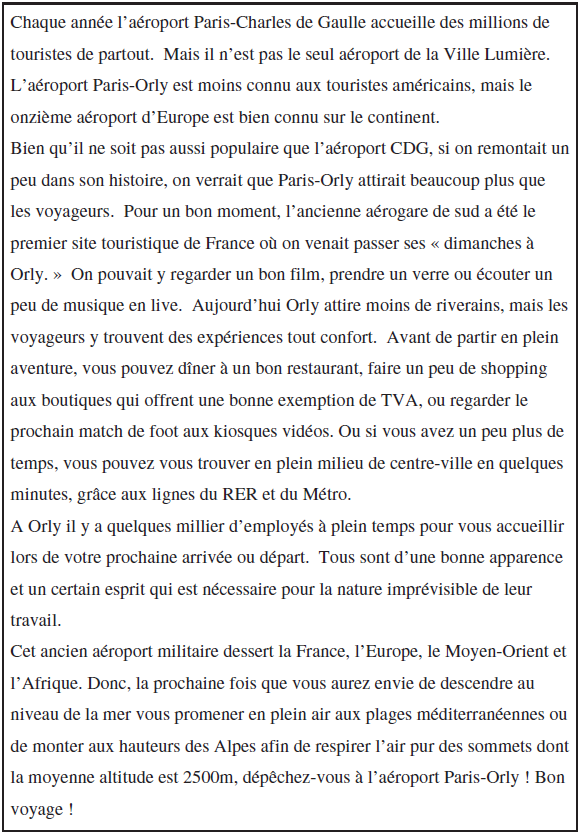
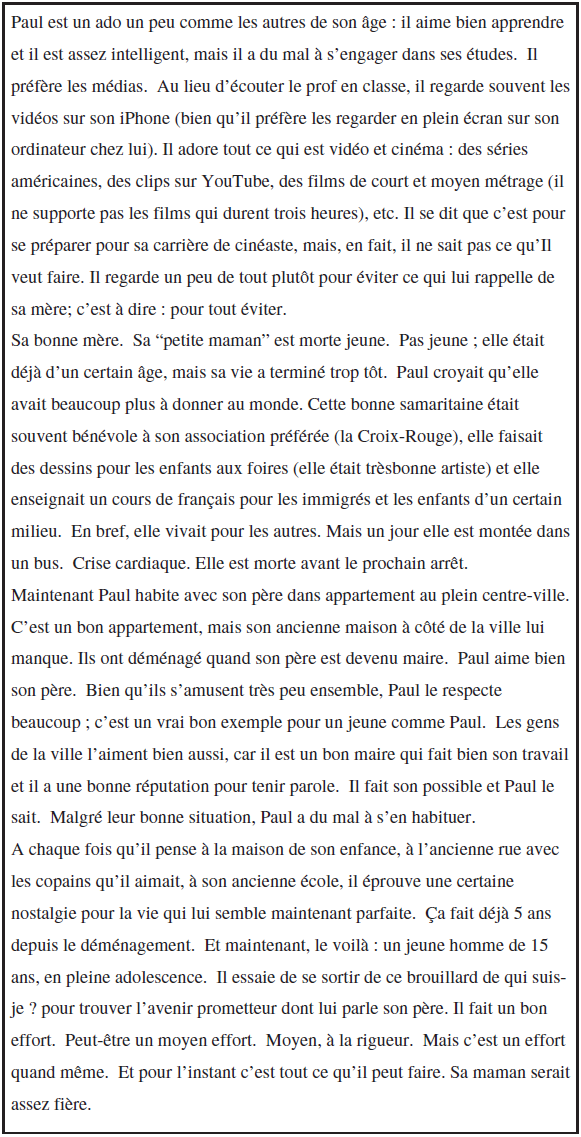
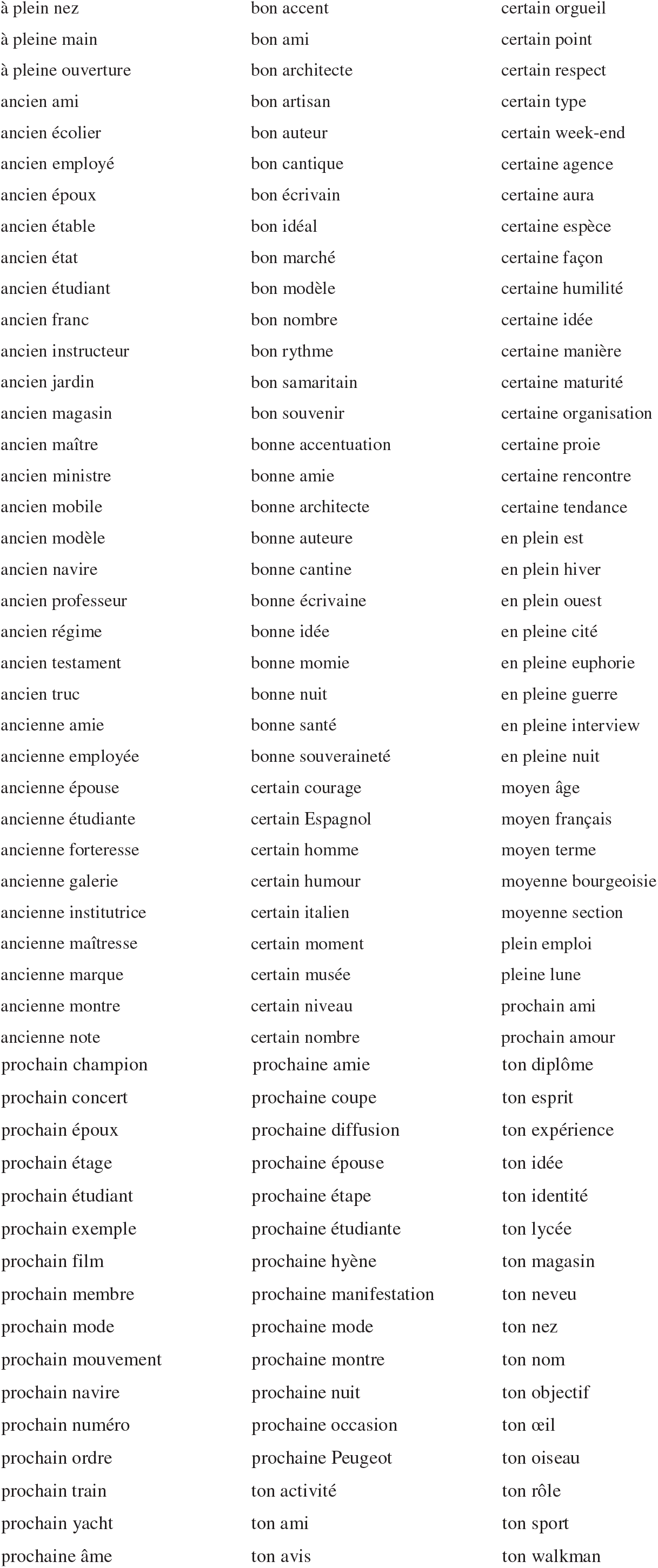
The reading tasks consisted of three sections: one text of 300 words (see Figure 5 in Appendix), one text of 468 words (see Figure 6 in Appendix), and a randomized word list of 150 two to three-word sequences (e.g., bonne idée ‘good idea’), which were read into the carrier phrase Je dis X encore une fois (‘I say X one more time’) one after the other (see Figure 7 in Appendix). The targeted collocations consisted of sequences of either [Adjective + Noun] or [Possessive Determiner + Noun], which were embedded in the texts among other collocations and word sequences that served as either targeted tokens for other, related studies or as distractors. Although distractors did exist in the texts, participants were informed that the study was about liaison generally. This candor was motivated by the fact that participants in earlier pilot studies began to hypercorrect with regards to liaison as soon as they encountered more than one of the more-common liaison sequences (e.g., bon ami ‘good friend’ or bon étudiant ‘good student’). In an effort to alleviate both performance anxiety and linguistic insecurity, participants were further informed that the study is not focused on whether or not participants make the liaisons prescribed in grammar books; rather, they were informed that the study focuses more on what normal speakers do with liaison. Though the methodological risks were high in informing participants of the general focus on liaison, more natural data seems to have been collected as many traditionally obligatoires liaisons were not made, and a few participants paused to comment that even though a particular liaison was prescriptively correcte, they didn’t make it because it didn’t feel natural.
While prenominal adjectives and possessive determiners are similar in many ways (e.g., both are prenominal elements, both are traditionally categorized as W1 in contexts of obligatory liaison, etc.), only one subgroup of the prenominal adjectives (i.e., bon(ne)) is analysed in the present study. Despite the shared oronasal vowel /ↄ̃/, analysis of the possessive determiners (e.g., ton and son) ought not be grouped with prenominal adjectives (e.g., bon) due to morphological and semantic differences that exist between the two; consequently, possessive determiner data generated in the corpus are not considered in the present study. Furthermore, tokens of other prenominal adjectives ending in /ε̃/ (e.g., prochain(e), ancien(ne), etc.), which were also generated in the corpus, are not included in the present study, due to the varying frequencies of these adjectives and of the W1+W2 collocations in which they occur in the language. These adjectives (i.e., /ε̃/-final adjectives) merit a separate, future study in which word and collocation frequency are taken into account in the analysis.
The resulting data for the analysis of bon(ne) consist of 40–41 tokens (some speakers occasionally neglected a token) for each speaker. These tokens were produced in a variety of contexts in order to provide opportunity to compare bon(ne) both in and out of liaison and enchaînement. Vowels in the following contexts were analysed:
(3)

Acoustic measurements of the vowels in any single one of these contexts must be compared against the vowel measurements in another context to give them relative meaning. For example, spectral measurements of the oronasal vowel /ↄ̃/ in the present study are only meaningful if they are distinct from those same spectral measurements in the oral vowel /ↄ/. In order to determine whether bon in liaison (3c) is more similar to the feminine bonne (3d) or the non-liaison bon (3b), comparison against both bonne (in as similar a phonological context as possible) and bon in other, non-liaison contexts must be made; both comparisons are necessary, for even if bon in liaison is not produced indistinguishably from bonne, it may also not be produced identically to bon in other contexts. Additionally, comparison is made of preconsonantal bon (3b) against non-nasal /ↄ/ (3a) (e.g., prof, populaire, votre, etc.) in order to verify the suitability of the selected acoustic measures to the data of each individual speaker. As even the most widely-used measures of nasality are not infallible in detecting nasality every time for every person (Styler, Reference Styler2015), it is prudent to verify that the selected measures can distinguish the maximally different (with regards to nasality) pre-consonantal bon from the oral /ↄ/ in contexts where no nasal segment is present; should the measures clearly predict the differences between these two vowels, they can be applied with a certain degree of confidence to other data (i.e., the other pairings). Analysed pairings are summarized in (4):
(4)

To summarize: comparison of the maximally-different vowels in (4a) is made to determine whether or not the selected acoustic measures can reliably detect the differences between oronasal and oral vowels; comparison of the word bon in non-liaison contexts against bon in liaison (4b) is made to determine whether or not the nasality of the vowel (with regards to the most common acoustic measures of nasality) is different in liaison from the vowel in other contexts; and comparison of bon in liaison is made against the feminine adjective bonne in prevocalic position (enchaînement) (4c) to determine whether or not the vowels of these two morphologically distinct forms are phonetically distinct.
3.4. Extraction of acoustic data
Using TextGrids in Praat (Boersma and Weenink, Reference Boersma and Weenink2017), vowel boundaries are identified manually for each of the targeted vowels in word sequences where liaison occurs; that is, where the LC is produced. Targeted sequences where liaison is not made are excluded, as my interest is primarily focused on what happens to the oronasal vowels when liaison actually occurs (see Sampson (Reference Sampson2001) for excellent work on the productivity of liaison for novel [Adjective + Noun] sequences). The boundaries are placed around the more stable part of the vowel, excluding formant transitions as much as possible. A Praat script extracts vowel duration (excluding formant transitions), F1, F2, F3 and F1 bandwidth at five equidistant points across the targeted vowel. A separate script by Lennes (Reference Lennes2002) that draws a FFT spectrum at a given point is applied at each of the five equidistant points. In each spectrum values of P0, A1 and A3 are manually identified, relying on the extracted F1 and F3 values from the previously mentioned script. The spectra are also used to identify Center of Gravity from the Praat object window. After these different values are determined at each of the five points, the five values of a given measure (e.g., F1 bandwidth) are averaged in order to generate a single value for the token to be analysed in the regression models (e.g., the five F2 values for a given bon token are averaged to yield a single F2 value for that specific token).
3.5. Acoustic measures
Nasality is a complex and difficult feature to measure acoustically due to the influence that the anti-formants and nasal formants have on the spectrum (Maeda, Reference Maeda1993; Schwartz, Reference Schwartz1968; Styler, Reference Styler2015). When a side branch is coupled to a resonator, sounds can get reflected from the side branch back onto the signal, which can cause certain frequencies to cancel each other out (Henning and Jongman, Reference Henning and Jongman2011; Maeda, Reference Maeda1993; Stevens, Reference Stevens1998; Styler, Reference Styler2015). Additionally, Stevens (Reference Stevens1998) indicates the configuration of the nasal and sinus cavities to vary greatly from person to person, which can result in various effects on the speech signal when nasal coupling does occur. Consequently, no single acoustic measure has proven completely foolproof for measuring nasality for all vowels or speakers (Glass and Zue, Reference Glass and Zue1985; Styler, Reference Styler2015). Instead of electing to use a single measure, I have selected six acoustic measures that have proven to be generally reliable in past studies (Carignan, Reference Carignan2014; Chen, Reference Chen1995; Styler, Reference Styler2015) and use them in concert to distinguish vowel nasality in the targeted tokens. All measures are made in Praat (Boersma and Weenink, Reference Boersma and Weenink2017).
A1−P0: Marilyn Chen (Reference Chen1995, Reference Chen1997) proposes to capture the difference between oronasal and oral segments by calculating the relative difference in A1 (the amplitude of the harmonic with greatest intensity near the expected F1) and P0 (the amplitude of the more intense of the first two harmonics). Because of the nasal formants and anti-formants introduced by nasal coupling, the lower harmonics are often amplified by 3db-6dB (Chen, Reference Chen1997) and harmonics in the range of F1 can be dampened ‘by about 5dB’ (Chen, Reference Chen1997: 2363). The relative change in A1−P0 can reflect some of the acoustic differences between oral and oronasal vowels. This measure is used frequently in acoustic analyses of nasality (cf. Pruthi and Espy-Wilson, Reference Pruthi and Espy-Wilson2007; Styler, Reference Styler2015).
A3−P0: Similar to (and based on) the measure that Chen (Reference Chen1995, Reference Chen1997) proposes, the relative difference in A3 (the amplitude of the harmonic with greatest intensity near the expected F3) and P0 (same P0 as described in previous measure) was proposed by Styler (Reference Styler2015) as a secondary measure that can capture the impact of nasal coupling on the lower ∼1500Hz of the spectrum, which is most affected by the lowering of the velum (Stevens, Reference Stevens1998). As harmonics near F3 typically occur outside of the spectral range most affected by nasal coupling, they should theoretically be relatively similar in amplitude from an oronasal vowel to its oral counterpart (for discussion on the indirect relationship between oronasal vowels and their oral counterparts, see Carignan (Reference Carignan2014)), and may serve as a relative point of reference between oral and oronasal vowels—unlike P0. Styler (Reference Styler2015) observed A3-P0 to be a relatively reliable indicator of the spectral tilt caused by nasal coupling.
Center of Gravity and F1 bandwidth: A general leveling and widening of the lower formants is often associated with nasal coupling (Delattre, Reference Delattre1968; Maeda, Reference Maeda1982; Macmillan, Kingston, Thorburn, Dickey, and Bartels, Reference Macmillan, Kingston, Thorburn, Dickey and Bartels1999), resulting in a lower Spectral Center of Gravity (CoG) and a greater F1 bandwidth (F1.bw) than are typically found in corresponding oral vowels. In his tests on the efficacy of various acoustic features in predicting nasality, Styler (Reference Styler2015) finds these two features to be good indicators.
F2: Carignan (Reference Carignan2014) observes that F2 regularly lowers when producing oronasal vowels in NMF, likely due both to nasal peaks introduced by nasal coupling, which can redistribute spectral energy in the frequencies of F2, as well as to differences that he observed in lingual articulation in the production of oronasal vowels, which may be used to differentiate further the oral-nasal contrast. This measure proved to be more effective for the other nasal-oral vowel pairs that he analysed, but it was still moderately effective for /ↄ̃/.
Duration: Previous studies in French nasality have indicated that increased vowel duration (V.Dur) can be a quality of oronasal vowels when compared against similar oral vowels. Stevens et al. (Reference Stevens, Andrede and Viana1987) found duration to be a salient feature in their perception tests. Delvaux et al. (Reference Delvaux, Huet, Piccaluga and Harmegnies2012) found the duration of oronasal vowels in NMF to be even longer than the oronasal vowels in Southern French; both were longer than their oral counterparts. Styler (Reference Styler2015) also found duration of oronasal vowels to be about 30ms longer than oral vowels. Styler continues to say that duration is likely a secondary feature of vowel nasality used to indicate further to the listener that the vowel is different from an oral vowel; this is similar to what Carignan (Reference Carignan2014) observes for lingual articulation (as described in previous section on F2). Consequently, duration of the vowels is also considered in the present study.
3.6. Regression models
In order to better capture how the six acoustic measures (i.e., A1−P0, A3−P0, CoG, F1.bw, F2, and V.Dur) work in concert, principal component scores – or eigenvalues – were generated by means of prcomp in the R “stats” package (R Core Team, 2016). Styler (Reference Styler2015) suggests that one measure may work better on one set of data (e.g., a particular speaker or a given vowel) than another and that it may be that more than one measure is required to capture the effects of nasal coupling on a given vowel. The first three principal component scores (e.g., PC1) were used as independent variables (as they accounted for 80–90% of the variation) in a linear model, with vowel context (e.g., the non-liaison /ↄ̃/ or the non-nasal oral vowel) as a binary dependent variable in R (R Core Team, 2016), as illustrated in (5).
(5)

In order to verify that the acoustic measures were appropriate for the given speaker’s data, a regression was first run between the vowels in the (4a) pairing (i.e., non-nasal oral vowels compared against non-liaison /ↄ̃/), which are maximally-different (with regards to nasality). If this model indicated significant differences between what we expect to be maximally different groups, the suitability of the measures for this speaker were understood to be appropriate, and the remaining data for the speaker would be analysed further in regression models following the pairs in (4b) and (4c).
4. RESULTS AND DISCUSSION FOR ACOUSTIC MEASURES
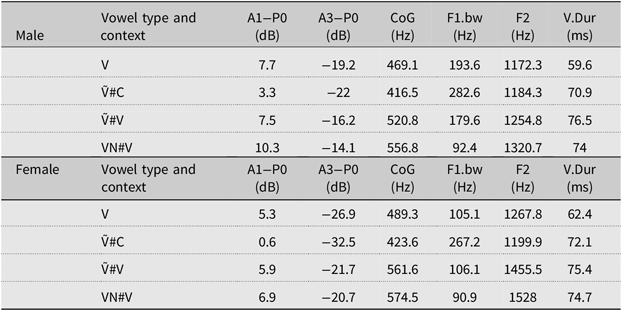
For each of the 19 participants, the first regression that compared V against Ṽ#C (i.e., oral vowels against non-liaison bon), which served as a suitability test for the selected acoustic measures on the data of each speaker, indicated there to be significant difference between these two maximally different – with regards to nasal quality – vowels. Average values for the six acoustic measures as produced by male and female speakers, respectively, are given for each of the four primary vowel contexts (i.e., V, Ṽ#C, Ṽ#V, and VN#V) in Table 1. As one of the primary objectives of the present study is to give acoustic descriptions of the differences and similarities that exist between the oronasal vowel /ↄ̃/ in W1 adjectives in liaison and the same vowel in non-liaison adjectives, these results provide an important, quantitative window into this particular aspect of vowel nasality. While significant differences may exist between some of these values, they are provided here with the intent of describing the vowels in the given contexts and may inform and facilitate future research into the topics of vowel nasality and liaison.
Average vowel measures for male and female speakers

Variation between the values for male and female speakers, respectively, is evident in Table 1: female speakers typically produce higher frequencies on CoG, lower values on F1 bandwidth and higher values on F2, which variation in measured values may very well be due to physiological differences between males and females. No noteworthy difference in vowel duration between male and female speakers was detected. While a greater difference for A1−P0 and A3−P0 values is evident among female speakers, the cause of this variation is not clear. As it is a measure of relative difference within an individual’s own speech and not a simple value like a F2 measurement, the difference is not as clearly attributable to physiological or other differences.
Overall, values for both male and female speakers differ between vowel-context pairs (e.g., Δ between Ṽ#C and Ṽ#V) in the same direction; for example, for both male and female speakers, the A1−P0 value is consistently higher for the W1 vowel in Ṽ#V than the W1 vowel in Ṽ#C. The only exception to this among all measures and vowel-context pairs is in the difference for F2 between the contexts V and Ṽ#C: for male speakers, the mean frequency of F2 in the oronasal vowel is 12 Hz higher than the mean frequency of F2 in the oral vowel, but for female speakers, the opposite is true.
More informative to the primary questions of inquiry than the differences between male and female speakers are the ways in which the oronasal vowel in liaison (Ṽ#V) differs from both the oronasal vowel in a non-liaison context (Ṽ#C) and the oral vowel /ↄ/ (V). For the oronasal vowel in liaison, both male and female speakers produced mean values for A1−P0, A3−P0, CoG and F1.bw that were more similar to values for those same measures in the oral vowel than in the non-liaison, nasal-vowel context. Often the value from the liaison context even surpasses the value from the oral context, resulting in something that appears at first glance to be more oral than the simple oral vowels. For example, non-liaison oronasal vowels had a lower mean frequency for CoG than their oral counterparts (i.e., for male speakers, CoG for Ṽ#C was 416.5 Hz compared to 469.1Hz for V, a difference of 51.5 Hz), but the mean frequency for CoG in the liaison context (Ṽ#V) was 520.8 Hz, which is 51.7 Hz greater than in context V and 104.3 Hz greater than in context Ṽ#C; with regards to F2, the mean value for Ṽ#V was greater than for both Ṽ#C and V contexts, though the difference in direction observed between genders alters the relationship between the Ṽ#V value and that of the other contexts. These similarities of the ultimate W1 vowel in context Ṽ#V when compared against the vowels of context V may appear surprising, though the data must be viewed with the understanding that the contexts in which V was measured were more phonemically diverse than were the vowels in either bon in liaison and pre-vocalic bonne. The latter two were very controlled, in that the targeted vowel only occured between the consonants /b/ and /n/, which are both articulated toward the front of the oral cavity. This frontedness likely accounts for higher CoG and F2 values than were observed for the vowels of context V, which occurred in a greater variety of words, syllables and sound sequences (e.g., prof ‘professor’, populaire ‘popular’, votre ‘your’, offrent ‘[they] offer’, Europe ‘Europe’, etc.). Thus, the vowels in liaison and enchaînement were not more oral than oral; rather, they were oral, but not necessarily identical to /ↄ/. Greater control (e.g., only using ultimate, open-syllable V contexts) could provide greater clarity into the differences and similarities that exist between the vowels in contexts V and Ṽ#V, but they will still ultimately be different phonemic sequences that yield different phonetic results.
While there were many similarities between the vowels of liaison bon and bonne in enchaînement, one major difference was observed in vowel duration (V.Dur) with the vowels of liaison bon and bonne in enchaînement being about 16ms longer than oral vowels in non-nasal sequences. This difference in duration may simply be due to regressive, coarticulatory effects by the nasal consonant [n].
Comparison between the mean values of contexts Ṽ#V and VN#V suggests the differences between the vowels in these two contexts to be much smaller than the differences that exist between most of the other categories analysed. While little can be concluded by simple comparison of the mean values, it appears that the vowels in contexts Ṽ#V and VN#V may be quite similar, indeed; as has been suggested in previous observations of the oronasal vowel in liaison (see section 1, above). To better understand the relationship between the vowels of these contexts, a more in-depth analysis is required.
5. RESULTS OF THE REGRESSION MODELS
Regression results for the pairing Ṽ#C and V, which serves as a test of suitability for the acoustic measures selected, indicated there to be significant differences between these vowels in the data for each of the 19 speakers. While not every measure proved significant for every speaker, the measures in concert indicated these vowels to be, indeed, distinct with regards to nasal quality for every speaker. Results from the regression models on the other vowel pairings differed in primarily four different ways for the 19 speakers. In this description and discussion, I hesitate to use the terms denasalized, rather than simply partially nasal, because our understanding of the nature of the LC can influence our view on where the preceding vowel in question comes from and what processes affect it; the nature of LC will be discussed in greater detail in the following section.
The regression model results from 11 of the 19 speakers demonstrated the pattern in Figure 1, in which the selected measures indicated there to be a significant difference (p < 0.05) between the vowels in contexts Ṽ#C and Ṽ#V, but not between the vowels in contexts Ṽ#V and VN#V. By far the most common result, this pattern suggests a partially nasal vowel that is found in liaison bon and pre-vocalic bonne (Ṽ#V and VN#V, respectively) and that is different from a normal oronasal vowel (Ṽ#C). I say partially nasal, and not oral, because it has previously been shown that modest regressive nasal assimilation can occur in French (Delvaux, Demolin, Harmegnies and Soquet, Reference Delvaux, Demolin, Harmegnies and Soquet2008). It may be that the vowel in some liaison sequences was more nasal and in others it was more oral, but the analyses do indicate a clear difference between the vowels in question for 11 of the 19 speakers.
Regression results for 11 speakers, in which significant differences were found between Ṽ#C and Ṽ#V, but not Ṽ#V and VN#V.

For four speakers, neither regression indicated significant difference between these vowel contexts, as illustrated in Figure 2. It should not be inferred that the vowel of non-liaison bon can in any way be equated with the vowel of pre-vocalic bonne, but it may indicate variety in the realization of bon in liaison. Just as Bybee (Reference Bybee2001, Reference Bybee2005) indicates that liaison is more commonly made in more frequent collocations, it may be that bon is realized closer to bonne in more frequent liaison word sequences. For example, in the French Web Corpus (Jakubíček, 2013) the sequence bon ami ‘good friend (m.)’ appears over 11,000 times, and the less common sequence bon idéal ‘good ideal’ appears only six times. The phonetic effects of frequency certainly merit future consideration. It should be noted that one of the speakers in this group had lived in the United States for just over five years, and another since elementary school, which might have an influence on their speech habits.
Regression results for four speakers, in which no significant difference was found between either Ṽ#C and Ṽ#V, or Ṽ#V and VN#V.

Results for the data of one speaker patterned in such a way that significant difference was detected between the vowels in pre-vocalic bonne and liaison bon, but no significant difference was detected between the vowels of bon in liaison and non-liaison bon, as illustrated in Figure 3. This is not to suggest that perceptually the bon vowels would be indistinguishable or even that the vowels are not distinct in other acoustic ways; but it may be that some of the individual Word1+Word2 sequences were more nasal than others – as suggested earlier with collocation frequency – or that, as a whole, the vowels in these sequences were simply more nasal than those in the data from other speakers. Impressionistically, many of this speaker’s bon liaison (Ṽ#V) tokens sound notably nasal, which may be a result of this speaker being the second to reside in the United States since elementary school.
Regression results for one speaker, in which significant difference was found between Ṽ#V and VN#V, but not between Ṽ#C and Ṽ#V.

The data for three speakers demonstrated the pattern shown in Figure 4, in which significant difference was detected between the vowels in both contexts. This pattern of results is difficult to account for. While it is possible that two distinct vowels (i.e., the W1 vowel of Ṽ#V and the W1 vowel of VN#V) exist on a spectrum of nasality between the vowels of V and Ṽ#C, future investigation (such as a perception test) into these data would yield a more likely explanation.
Regression results for three speakers, in which significant difference was found between both Ṽ#V and VN#V, and Ṽ#C and Ṽ#V.

6. DISCUSSION AND THEORETICAL IMPLICATIONS
Based on the above results, 15 of the 19 speakers (those demonstrating the patterns in Figures 1 and 2) seem to produce the vowel in bon in liaison indistinguishably from the vowel in bonne in the similar enchaînement position, with regards to the six acoustic measures associated with vowel nasality as has been suggested in the literature for decades (Delattre, 1947/Reference Delattre and Delattre1966; Fouché, Reference Fouché1959; Sampson, Reference Sampson2001; Côté, Reference Côté2005, Reference Côté2011). While these phonetic data shed light on the phonetic research questions posed in Section 1, they may also have theoretical implications with regards to certain phonological questions on liaison and nasality.
In previous sections, I described the vowel of liaison bon and the vowel of the feminine form bonne as partially nasal, rather than denasalized: the term denasalization for the oronasal vowel in bon (/bↄ̃/) implies that the underlying form of bon in liaison has an oronasal vowel to which the process of denasalization is applied, or perhaps a nasal feature that must be realized either as an oronasal vowel or as an overt nasal consonant. The term denasalization is often used, but rarely defined in clear phonetic terms. A general definition is given by Laver (1980: 88) as any process that ‘minimizes the occurrence of audible nasality’, but whether that means a partial or full reduction of nasality in a vowel remains unclear. For some speakers it may be that a partial reduction in nasal quality does occur, implying that denasalized vowels may exist on a continuum of nasality between oral and nasal. However, the present results suggest the vowel of bon in liaison to be largely indistinguishable from the vowel in bonne. The strong similarities that exist between the pronunciation for the masculine bon in liaison and the feminine bonne are important for the discussion of the nature of the LC (in this case [n]) for this and other prenominal adjectives. Given the fact that the bon liaison form and the bonne form are seemingly indistinguishable for many speakers, it seems more likely that the differences between non-liaison bon and liaison bon are more reflective of the speakers’ lexicon than of phonological processes.
My intention in this section is not to argue for one liaison theory over another, but to present how these data may be seen as evidence for two theories of liaison. The first theory is suppletion (Côté, Reference Côté2005; Morin, Reference Morin and Andersen1986; Steriade, Reference Steriade, Authier, Bullock and Reed1999; Tranel, Reference Tranel1990), which suggests that separate forms of a given word exist in the lexicon and that a speaker makes a lexical choice for a given context, rather than a series of transformational processes. For example, two forms for the word bon(ne) would exist in the lexicon: the form /bↄ̃/ would be used for masculine, non-liaison contexts, and another form /bↄn/ would be used for both feminine bonne generally, as well as masculine bon in liaison. The data in the present study suggest that a shared form /bↄn/ might exist in liaison for many speakers of NMF. It is, of course, possible that phonological transformations (including denasalization) could render bon in liaison indistinguishable from bonne, but there is evidence for suppletion in other prenominal adjectives elsewhere in the French language.
Other prenominal adjectives exhibit not only a different phonological form pre-vocalically, but also a distinct orthographic form. Tranel (Reference Tranel1990) highlights cases of clearly identifiable suppletion with prenominal adjectives that have two orthographically and phonologically distinct forms for masculine singular usages, as seen in (6) (modified from Tranel (Reference Tranel1990: 171):
(6)

The pre-vocalic forms of the adjectives in (6) (others include nouveau/nouvel, mou/mol, fou/fol, etc.) are phonemically identical to the feminine adjectival forms (e.g., belle [bεl] and vieille [vjεj]). Despite the lack of distinct orthographic forms, the prenominal adjective bon behaves in similar ways, in that it seems to have two separate singular lexical forms. In fact, both Steriade (Reference Steriade, Authier, Bullock and Reed1999) and Côté (Reference Côté2005) specifically offer the adjective bon as a case for suppletion, though they do so without the phonetic evidence for the clear distinction between non-liaison bon and liaison bon that is provided by the present study. Some may argue that the cases of bon and beau/bel are phonologically different enough (i.e., bon exhibiting denasalization and beau/bel exhibiting vocalization) that the cases cannot be considered analogous. While the phonological processes of denasalization and vocalization are indeed different, the apparent existence of a masculine form of the prenominal adjective that is phonemically and phonetically indistinguishable from the feminine form is strong evidence that it is a lexical process – and not a phonological process – that is at play in the case of these adjectives. However, as not all of the speakers here consistently pronounced bon in liaison distinctly from non-liaison bon, it is worth considering that, perhaps, bon may not be entirely suppletive for all speakers, nor that all speakers treat word sequences where liaison may be produced in the same way – neither must they.
A second liaison theory that may be supported by the present study concerns ideas proposed by Bybee (Reference Bybee1998, Reference Bybee2001, Reference Bybee2005) that ‘constructions are storage and processing units just as words and fixed phrases are’ (Reference Bybee2001: 22). In her work, Bybee shows that liaison occurs less in lower-frequency collocations than in higher-frequency collocations. While collocation frequency wasn’t included in the statistical models of the present study, it may be that a more frequent collocation, such as bon ami, may be stored as its own ‘precompiled chunk’ (Bybee, Reference Bybee1998: 433), which notion also aligns somewhat with the suppletion theory discussed above.
It is, of course, entirely possible that these theories co-exist in a speaker’s idiolect with the more traditional phonological processes, as they aren’t necessarily mutually exclusive. It may very well be that the more frequently occurring collocations are stored as suppletive forms in the lexicon, and that these forms may be a part of a complex lexical chunk, and that the less frequent collocations undergo processes such as denasalization. Future work in these areas will certainly be welcome.
7. CONCLUSION
In this study, I have sought to bring quantitative, acoustical data to verify conventional understandings of bon in liaison that have previously been based solely on impressions. While the narrowness of the study limits us from drawing conclusions about other oronasal vowels in liaison (i.e., /ε̃/), it has been shown that the majority of NMF speakers in this study seem to produce bon in liaison with a vowel that is distinct from the oronasal vowel /ↄ̃/, as well as similar to its oral counterpart in enchaînement. Study of the oronasal vowel /ε̃/ in liaison certainly merits future study, as its complexity and richness (both due to the greater number of available prenominal adjectives available with this vowel) would greatly expand our understanding of the behavior of oronasal vowels in liaison. As for other cases of prenominal, /ↄ̃/-final W1, study is already underway on the pronunciation of certain oronasal vowel-final, possessive determiners (e.g., son ‘his/her’) in liaison, which have traditionally been described as maintaining vowel nasality (Delattre, 1947/Reference Delattre and Delattre1966). Finally, I hope that the acoustic description (including the mean values for acoustic measures) will be helpful for others who engage in other studies of vowel nasality, as we strive to demystify this particular aspect of voice quality.
Appendix
Reading task of 300 words used to generate corpus.

Reading task of 468 words used to generate corpus.

Reading task of 150 word sequences embedded in the carrier phrase Je dis X encore une fois (‘I say X one more time’).