State courts play an important role in the development of US law and policy through the decisions they make. Because of their importance, scholars and policy makers have spent the better part of American history debating whether state court judges should be elected or appointed and how the method of selection influences judicial decision making. State judiciaries contend with a considerable share of criticism from various audiences, including scholars, lawyers, and nonacademics. Mostly, the debate centers on normative notions of judicial independence and competence. Judicial independence may be compromised by the need for accountability to the local electorate (Langer Reference Langer2002; Canes-Wrone, Clark, and Park Reference Canes-Wrone2012; Gibson Reference Gibson2012; Lim Reference Lim2013), while others question whether voters are discerning enough to choose qualified judges, whether judicial elections discourage the most competent folks from the bench (Posner Reference Posner2005; Lim Reference Lim2013; but see Bonneau and Hall Reference Bonneau2009, Reference Bonneau2016), and how elections may erode judicial independence (Canes-Wrone, Clark, and Kelly Reference Canes-Wrone2014; but see Hall [Reference Hall1987, Reference Hall1992] on the representative attributes of popular elections) and politicize the judiciary (but see Kritzer Reference Kritzer2015).
US Supreme Court justices have also waded into the public and scholarly debates regarding elected versus appointed judges in state judiciaries. Their attitudes on these issues are reflected in judicial outcomes, in which their professional preferences for appointed judiciaries is evidenced in the opinions they compose and statements they make. For instance, Associate Justice Sandra Day O’Connor commented in her concurring opinion in Republican Party of Minnesota v.White (536 U.S. 765, 792 [2002]) that “if the State has a problem with judicial impartiality, it is largely one the State brought upon itself by continuing the practice of popularly electing judges.” In a talk given at the University of Chicago’s Harris School of Public Policy in 2019, Associate Justice Ruth Bader Ginsburg remarked, “I think popular election is a very bad way to select judges. … I don’t know any other country in the world where judges are elected.”Footnote 1 Similarly, in a 1999 interview on the PBS show Frontline, Associate Justice Anthony Kennedy opined this about judicial elections: “Our system presumes that there are certain principles that are more important than the temper of the times. And you must have a judge who is detached, who is independent, who is fair, who is committed only to those principles, and not public pressures of other sorts. That’s the meaning of neutrality.”Footnote 2 Criticisms of this sort are not uncommon and suggest that elected judges are viewed, indeed by the justices themselves, as less independent and possibly less qualified than appointed judges. It is possible that these unfavorable perceptions and biases against judicial elections may influence how the justices view outputs that are produced by state court judges.
We suggest that one way to assess how the US Supreme Court is influenced by state courts is to examine the tendencies and conditions under which the Supreme Court justices incorporate language from state court opinions into their own opinions, paying particular attention to whether they borrow more language from appointed or elected state court judges.Footnote 3 In doing so, we develop a theory of bottom-up influence by lower court judges, whereby state court judges are recognized for the influential role they can play in developing American law at higher courts (Rachlinski Reference Rachlinski2006; Savchak and Bowie Reference Savchak2016). Notably, this work is one of the first studies to investigate how state court opinions influence the content of US Supreme Court opinions while also taking into account the connection between perceptions of judicial independence in the states. We use an original data set, including all Supreme Court cases reviewing state court decisions over a 20-year period, from 1995 to 2015, to analyze the extent to which the US Supreme Court justices incorporate words and phrasing from state court opinions. We offer several hypotheses about the conditions in which language borrowing occurs. Our research contributes in a novel way to the growing scholarly literature on opinion borrowing (Corley, Collins, and Calvin Reference Corley2011; Savchak and Bowie Reference Savchak2016; Bowie and Savchak Reference Bowie2019) and develops a richer understanding of state court judges as significant players in the course of American law.
The Bread and Butter of Judicial Work
Opinions are the bread and butter of judicial work and one of the most important duties of judging. Crafting opinions provides courts the opportunity to explain their reasoning through legalist terms and provide direction to relevant actors (Hettinger, Lindquist, and Martinek Reference Hettinger2006; Corley et al. Reference Corley2011; Owens and Wedeking Reference Owens2011; Bowie, Songer, and Szmer Reference Bowie2014; Black et al. Reference Black2016). For example, at the US Supreme Court, judicial opinions not only explain the rationalization for its decisions, but they also influence US policy while constraining federal and state political actors and implementers (Maltzman, Spriggs, and Wahlbeck Reference Maltzman2000). Through opinions, courts exert power and influence upon various governmental actors, policy makers, and judicial elites, and “the language used in written opinions has tremendous importance in shaping subsequent developments both inside and outside the legal system” (Zilis and Wedeking Reference Zilis2020, 212).Footnote 4
Over the last decade scholars such as Corley et al. (Reference Corley2011) have demonstrated that lower federal courts shape the content of US Supreme Court opinion language. Beyond this seminal work, a wave of studies establishes that a broad range of legal writings, including litigant briefs (Corley Reference Corley2008), amicus briefs (Collins, Corley, and Hamner Reference Collins2014, Reference Collins2015), and lower court dissents (Corley et al. Reference Corley2011), directly influence the content of US Supreme Court opinions. More recently, scholarship has extended this line of work to state courts, about which evidence demonstrates that state high court judges borrow language from intermediate appellate courts (Savchak and Bowie Reference Savchak2016; Bowie and Savchak Reference Bowie2019).
Why Borrow from Lower State Court Opinions?
It is obvious that US Supreme Court justices would borrow language from litigant briefs, amicus briefs, and lower federal court majority opinions and dissents, mostly because these are documents from within the federal hierarchy and are composed by professional attorneys and prudently selected judges who have been vetted and are familiar with federal law. But we argue that many of the reasons accounting for the justices’ adoption of language from these documents can also be applied to state court opinions. First, justices may wish to incorporate language from lower court opinions with which they agree. This agreement may indicate that the lower court opinion was persuasive and clear (Savchak and Bowie Reference Savchak2016). Second, justices may prefer to incorporate the lower court’s version of the case facts into their own opinions, which sets the stage in how the facts of a case are framed by the Supreme Court. Finally, it may not be obvious to justices how the case should be decided, and thus looking to the lower court opinion for guidance in constructing their own opinions can prove to be fruitful (Klein and Morrisroe Reference Klein1999).
This pragmatic approach in looking to lower court judicial opinions as influential documents should not come as a surprise; we know that judges have ultimate control over the judicial opinions they write but that they “do not start with a blank slate” (Corley et al. Reference Corley2011, 41). Rather, judicial opinions follow a presentational rubric, typically including a statement of facts, list of legal issues, procedural history of the case, and legal ruling and argumentation (van Geel Reference van Geel2008). When it comes to borrowing language from lower court opinions, evidence shows that judges use the lower court opinions’ version of case facts or borrow language when they agree with the outcome of the lower court (Corley et al. Reference Corley2011; Savchak and Bowie Reference Savchak2016). Additionally, lower court opinions provide a guide to the legal reasoning and argumentation used to reach its decision (Schoenherr and Black Reference Schoenherr2019). And individual-level characteristics matter too; higher court judges borrow more language from prestigious lower court opinion authors, and higher court judges’ career traits, such as being appointed or elected, being a former law professor, or serving as a lower court judge, have been shown to be pivotal in state court judges’ choices in borrowing language from lower court opinions (Savchak and Bowie Reference Savchak2016; Bowie and Savchak Reference Bowie2019).
In suggesting the possibility that lower court judges can influence higher court judges’ opinion writing, we depart from the more typical top-down approach to legal influence, emphasizing lower court compliance with US Supreme Court precedents (Songer, Segal, and Cameron Reference Songer1994; Fix, Kingsland, and Montgomery Reference Fix2017; but see Fix and Kassow Reference Fix2020) and its ability to achieve policy change through its opinions (Spriggs Reference Spriggs1997). Here, we suggest that judicial influence can flow from the bottom of the judiciary to its higher levels (Rachlinski Reference Rachlinski2006; Savchak and Bowie Reference Savchak2016; Bowie and Savchak Reference Bowie2019), in that lower court judges may influence and mold US Supreme Court policy through the written opinions they issue, in turn enabling them with a sort of judicial power. Corley et al. (Reference Corley2011, 33) note that, “when the Supreme Court’s majority opinion utilizes the same language as the lower court opinion, the lower court has affected the nature and substance of the opinion, indicating that the lower court judges have influenced the doctrinal development of law.” Our approach, along with prior work, recognizes lower court judges and their opinions as having an important potential power in developing law and precedent in higher courts.
We know from prior research that justices adopt language from various legal documents, but do justices actually incorporate language from state court opinions? We explore this question preliminarily by analyzing the borrowing tendencies of US Supreme Court justices over a 20-year period, from 1995 to 2015. We calculate the percentage of majority opinions per justice that include borrowed language in our data set. Figure 1 illustrates that US Supreme Court justices have ample opportunities to borrow, that they have a propensity to do so, and that there are clear differences among them in their tendency to borrow language (or not). To highlight, during this period, Associate Justices O’Connor, Ginsburg, and Sotomayor were more likely to incorporate language from lower state court opinions. For example, Justice O’Connor incorporated lower state court language in approximately 90% of the majority opinions that she wrote, and Justice Ginsburg was a close second by borrowing from state court opinions in just over 80% of her majority opinions. On the other end of the spectrum, Justice Breyer was the only justice who in a majority of his opinions did not borrow language from state court opinions. While Justice Thomas was more likely to borrow than not, we still see that approximately 45% of his opinions did not include language from state court opinions. Clearly, borrowing language from state court opinions is the norm, although there is a wide range of borrowing proclivities.
Percentage of majority opinions per justice that include borrowed language

Borrowing and Perceptions of State Courts
As we have argued, our particular attention is on state courts and the potential for their decisional reach to stretch beyond state boundaries. State courts not only influence policy for their states, but once a higher state court decision is appealed and reviewed by the US Supreme Court, they also have a stage upon which to influence policy nationwide. While there are several ways in which state courts might influence the work of the Supreme Court, one way to achieve these goals is to use the lower court opinion as a blueprint for the majority opinion of the Supreme Court. And, ultimately, justices will want to use state court opinions if those opinions will be useful for their goals.
But not all state court opinions have equal potential to be influential, and we focus here on the extent to which US Supreme Court justices’ professional preferences concerning judicial independence and high-quality legal writing affect their likelihood of borrowing language from the lower court opinion. Just as judicial scholars focus our professional inquiries on judicial selection methods in the states and the various consequences of those institutional choices (e.g., Hall Reference Hall2001; Bratton and Spill Reference Bratton2002; Bonneau and Hall Reference Bonneau2009, Reference Bonneau2016; Bonica and Sen Reference Bonica2017), as well as the skillfulness of judges’ writings (e.g., Goelzhauser and Cann Reference Goelzhauser2014; Black et al. Reference Black2016; Romano and Curry Reference Romano2020), we assert that Supreme Court justices also care about these issues of state court judicial independence and competence in their pursuit to preserve the legitimacy of the US judicial system, as well as their personal legal and policy goals.
US Supreme Court justices care about the institutional legitimacy of American courts, and they demonstrate their concerns in various ways, such as through their public comments during interviews and speeches (see Schmidt Reference Schmidt2013 and Hasen Reference Hasen2016), their own personal writings, statements in judicial opinions, and voluntary recusals from cases in which their impartiality may be questioned (see Fettig and Benesh Reference Fettig2016).Footnote 5 Justices extoll the value of consensus for its potential to increase the Court’s prestige and advise against writing separately for its cumulative “effect on the institution” (Rosen Reference Rosen2007). Tempered steps have been taken to increase institutional transparency: oral argument transcripts, opinions, and orders are now provided through its website (O’Brien Reference O’Brien2020). The Supreme Court also responds defensively to attacks from coordinate branches of government to ameliorate potential damage to their image of impartiality, such as when Chief Justice Roberts countered President Trump’s sorting of “Trump judges and Obama judges”: “We do not have Obama judges or Trump judges, Bush judges or Clinton judges. What we have is an extraordinary group of dedicated judges doing their level best to do equal right to those appearing before them” (Sherman Reference Sherman2018). In other words, the justices are aware of their precarious position in a system in which their existence and efficacy rely so heavily on public confidence in their work.
US Supreme Court justices’ care and concern about the reputation of the American judiciary may lead to cautious behavior regarding susceptibility to influence from the lower courts, especially with regard to borrowing language from state courts that elect rather than appoint their judges and from judges who lack superior skills for writing clearly. If a judicial opinion is a pivotal document that can pronounce new law, give direction to lower courts, and mandate policy change from administrative agencies, it may also act as a platform for the writer’s preferences on professional and nonideological issues, such as how to best choose judges and superior writing abilities. Leonard and Ross (Reference Leonard2016, 711) note, “An underlying assumption of the normative debate regarding judicial elections is that a more divisive or politicized environment is damaging to the output of courts and perhaps the coherence of the law itself.” In other words, US Supreme Court justices may view opinions from elected judges as too politicized and subpar and would prefer to distance themselves from their legal writings. Doing so may preserve the gravity of their own opinions rather than putting in jeopardy the significance of their work. Supreme Court justices may also find fault with the content of elected judges’ opinions because their decisions appear “corrupted.” The dismissal of content from elected judges’ opinions may be evidence of harbored prejudice against judges chosen through political means rather than the more widely respected and familiar model of judicial appointments practiced within our federal system, a minority of American states, and most judiciaries throughout the world.
Several justices have been particularly vocal about and professionally active in educating the public on the need for judicial independence. Indeed, justices have gone so far as to use the majority opinion as an opportunity for expressing disdain for the evils of state judicial candidates’ personal requests for electoral campaign contributions. For example, in Williams-Yulee v. Florida Bar (575 U.S. 433, 437–38 [2015]), Chief Justice John G. Roberts offered careful guidance in his majority opinion: “Judges are not politicians, even when they come to the bench by way of the ballot. … Politicians are expected to be appropriately responsive to the preferences of their supporters. A judge instead must ‘observe the utmost fairness,’ striving to be ‘perfectly and completely independent.’” Associate Justice Sonia Sotomayor recently expressed similar discontent in a dissent from denial of cert in Woodward v. Alabama (571 U.S. 1045, 1050 [2013]): “What could explain Alabama judges’ distinctive proclivity for imposing death sentences in cases where a jury has already rejected that penalty? The only answer that is supported by empirical evidence is one that, in my view, casts a cloud of illegitimacy over the criminal justice system: Alabama judges, who are elected in partisan proceedings, appear to have succumbed to electoral pressures.” Other justices have been blunt in their views of judicial elections in the states. When asked about the process of electing judges during a 2013 interview, Associate Justice Ruth Bader Ginsburg stated, “I will be frank to say that I think it is a dreadful way to choose people for judicial office. Judges are to be impartial. They are to judge without fear or favor. They are not to be beholden to any group. But it may be a little hard, if a group of lawyers has funded your campaign, for you to be impartial, or even if you are, to protect the appearance of being impartial” (Miller Reference Miller2013). And devotion to the overall judicial branch may continue even into retirement, as former Associate Justice Sandra Day O’Connor has shown in her work on civics literacy and speaking out against elected judiciaries and their susceptibility to outside interests.
While much of the criticism against judicial elections focuses on threats to judicial impartiality and trust in courts, another aspect of the judicial selection debate involves perceptions of competence—or a lack thereof (e.g., Goelzhauser and Cann Reference Goelzhauser2014; Leonard and Ross Reference Leonard2016)—and US Supreme Court justices have heeded these additional concerns. For instance, Associate Justice Sandra Day O’Connor’s criticism of judicial elections is exemplified in how her initiative, the O’Connor Judicial Selection Plan, devotes much language to recruiting competent judges who “have excellent analytical ability” and “demonstrate excellent substantive legal knowledge, or a willingness to learn at the earliest opportunity” and who “undertake the research necessary to gain command of the facts and issues presented.”Footnote 6 Other judges recognize these problems as well. Judge Richard Posner, of the US Court of Appeals for the Seventh Circuit, proposed that elected judiciaries lack “judicial talent” (2005, 1268). And state judges, themselves, view the work of appointed judiciaries as higher quality than judges in elected systems (Cann Reference Cann2007). The research suggests, coupled with the justices’ own declared preferences for exceptional competency and appearances of independence, that they may view appointed and elected judiciaries differently when deciding to borrow.
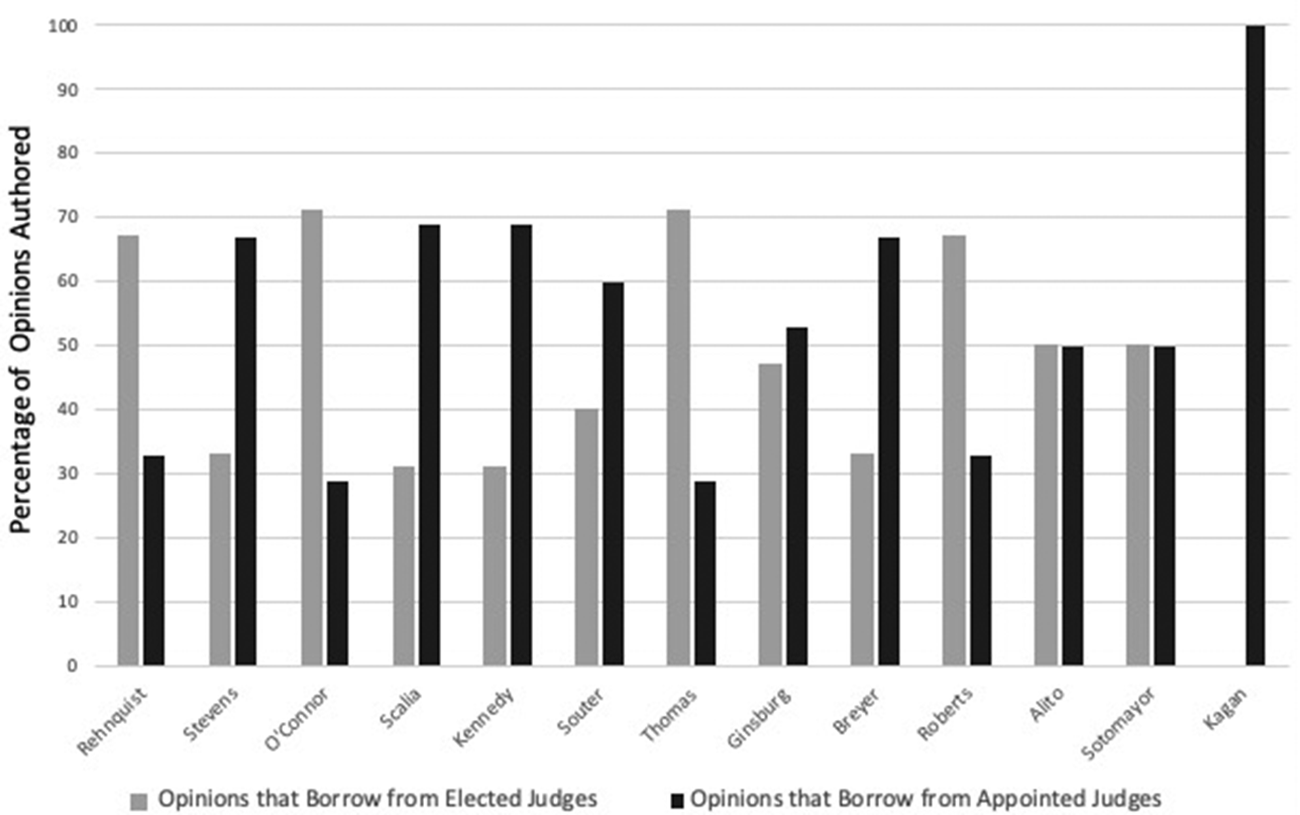
Preliminarily, we find differences among US Supreme Court justices in whether they borrow from elected versus appointed state judges. Figure 2 provides an overview of justice borrowing based on selection method of the state court judges. We calculate the percentage of majority opinions written per justice that borrow language from states with elected judges versus states with appointed judges. Of the majority opinions in which Supreme Court justices adopted lower court language, justices are more likely to do so from states that appoint judges than states that elect judges.Footnote 7 Put another way, 59% of the opinions that incorporate language from the lower courts borrow from appointed state court judges. As figure 2 shows, during our study period Associate Justices Stevens, Scalia, Kennedy, Souter, Ginsburg, Breyer, and Kagan all preferred to borrow from appointed judges rather than elected state court judges. Interestingly, Justice O’Connor, who is probably the most outspoken in her disdain for the process of electing judges, borrowed language from elected judges in 71% of her majority opinions during this period (29% for appointed judges), with Justices Rehnquist, Roberts, and Thomas following similar patterns.
Justice borrowing based on selection method of state court judges

Research confirms the concerns that US Supreme Court justices have in that elected judges play toward the wishes of the electorates to which they are accountable, even in the types of arguments they put forth, rather than being as independent minded as appointed judges (Huber and Gordon Reference Huber2004; Romano and Curry Reference Romano2020; but see Owens et al. Reference Owens2015). Meanwhile, scholars also suggest that appointed judges are more professional than elected judges, caring most about their reputations among legal counterparts, whereas elected judges are more concerned with dispensing justice quickly (Choi, Gulati, and Posner Reference Choi2010). Thus, we suggest that US Supreme Court justices will consider the selection method of the state court judge when deciding whether to borrow from the lower court opinion.
Hypothesis 1. Justices will borrow more language from appointed lower court opinion writers.
Judicial abilities may also be demonstrated on the job—most notably in judicial writing (Goelzhauser and Cann Reference Goelzhauser2014). A burgeoning body of work explores writing clarity by studying judicial opinions, and the bulk of this work establishes that clarity matters (Black et al. Reference Black2016; Nelson and Hinkle Reference Nelson2018; Fix and Fairbanks Reference Fix2020). The literature on opinion clarity has distinguished among three types: doctrinal, cognitive, and rhetorical (Owens and Wedeking Reference Owens2011; Black et al. Reference Black2016; Fix and Fairbanks Reference Fix2020). Because we believe the lower court opinion writing itself will influence the extent to which US Supreme Court justices borrow language, we are interested in the readability (or rhetorical clarity) of these lower court opinions (Owens and Wedeking Reference Owens2011; see also Fix and Fairbanks Reference Fix2020). As scholars have found, clearer opinions result in greater compliance by lower courts and other judicial audiences (Owens, Wedeking, and Wohlfarth Reference Owens2013; Black et al. Reference Black2016), particularly those bodies charged with implementing policy changes as a result of a judicial decision (Spriggs Reference Spriggs1997). In a similar vein, we suggest that justices will borrow more language from clear and well-written lower court opinions. Additionally, Justice Scalia, in his book with Bryan Garner on the art of persuading judges, notes that clarity should be valued “above all other elements of style” (Scalia and Garner Reference Scalia2008, 107). We expect Supreme Court justices, themselves, are also affected by the way a lower court opinion is written, so that clearer state court opinions will be viewed more favorably.
Hypothesis 2a. Justices will borrow more language from lower court judges who compose clearer opinions.
Likewise, US Supreme Court justices may avoid borrowing language from lower court opinions that are deemed unclear or poorly written. Plain English for Lawyers, one of the “go to” texts on legal writing, notes that the passive voice is not the preferred writing style because it can be ambiguous and “especially troublesome in legal writing” and may lead to poor argumentation (Wydick Reference Wydick1998, 32). Even the Federal Judicial Center’s Judicial Writing Manual (2020, 23) places a premium on using direct language and the active voice, resulting in a more comprehensible piece of writing. We expect that US Supreme Court justices will also disfavor opinions with larger amounts of passive-voice language in favor of those that are easier to understand.
Hypothesis 2b. Justices will borrow less language from lower court judges whose opinions use more passive language.
Policy and Personal Considerations in Language Borrowing
Legal and policy concerns are unavoidable and play a well-documented role in judges’ work. The influence of ideology has been a mainstay in the judicial behavior literature (e.g., Brace and Hall Reference Brace1997; Brace, Langer, and Hall Reference Brace2000; Segal and Spaeth Reference Segal2002; Cross Reference Cross2007), where scholars have studied its impact on agenda setting, opinion assignments, and judicial decisions (Caldeira and Wright Reference Caldeira1988; Perry Reference Perry1991; Maltzman et al. Reference Maltzman2000; Bowie and Songer Reference Bowie2009). We suggest that the extent to which the US Supreme Court justices agree with the lower court ruling should influence whether they will borrow content for their own opinions. When affirming a judgment below, a justice may look to the lower court opinion for shortcuts in useful language that may be helpful for explaining their own legal rationale.
Hypothesis 3. Justices will borrow more language when they affirm the lower court opinion.
Ideological compatibility between the lower court decision and the Supreme Court matters (Maltzman et al. Reference Maltzman2000; Segal and Spaeth Reference Segal2002; Scott Reference Scott2006). Similar to Corley et al. (Reference Corley2011), we also suggest that lower court decisions that are incongruent to the preferences of the majority opinion writer will have less influence. Then again, justices may for both ideological and workload considerations incorporate language from lower court opinions that are ideologically congruent to the majority opinion author.
Hypothesis 4. Justices will borrow more language from lower court opinions that are ideologically congruent.
The significance of a lower court opinion may also lead US Supreme Court justices to consider borrowing its language. A published opinion is a mandatory authority and holds precedential value; it is inherently more significant than others because it speaks to a broader audience than simply the litigants in the case (Carp and Rowland Reference Carp1983). Justices may hold a higher opinion of these opinions and, therefore, favor the deliberative work behind its contents.
Hypothesis 5. Justices will borrow more language from published lower court opinions.
At the same time, justices may place less value on opinions composed by state intermediate appellate court judges rather than state supreme court justices. While certainly not the norm, losing litigants at the state intermediate appellate court may appeal to the US Supreme Court if their state’s high court refuses review. Because these opinions are written by less esteemed judges who have not yet reached the pinnacle of their state’s judiciary, US Supreme Court justices may eschew these opinions as less significant and low caliber.
Hypothesis 6. Justices will borrow less language from opinions written by state intermediate appellate court judges.
Much of the US Supreme Court’s work is highly consensual, and thus opinions must be crafted to meet the needs of a growing number of concerns as more colleagues join the majority (Corley, Steigerwalt, and Ward Reference Corley2013). An opinion writer’s need to garner more votes may affect judicial outcomes; when more justices sign on to a majority opinion, the accommodation of their preferences can lead to less consequential and more diluted opinions (Rohde Reference Rohde1972; Maltzman et al. Reference Maltzman2000; Staudt, Friedman, and Epstein Reference Staudt2008). We suggest that these opinions allow writers less room to incorporate lower court opinion language as they write painstakingly to achieve a higher consensus that represents the views of their colleagues.
Hypothesis 7. Justices writing for larger majority coalitions will borrow less language from the lower court opinion.
Apart from legal and policy considerations, US Supreme Court justices may have other instrumental reasons to borrow opinion language from the lower court. One of these reasons, we argue, is acclimating to the work of a justice. We suggest the acclimation pressures for new justices may induce language borrowing for their own opinions, and these pressures should be highest during their initial period of adjustment to the bench. Otherwise known as the “freshman effect,” the literature has shown that being new to the Supreme Court has played a pivotal role in the substance of majority opinions (Bowen Reference Bowen1995; Wood et al. Reference Wood1998; but see Bowen and Scheb Reference Bowen1993). For instance, at today’s Supreme Court, freshman justices write more separate opinions than justices in the pre-1940 period (Bowen Reference Bowen1995), but this number is still significantly lower than in later stages of their careers (e.g., Brenner and Hagle Reference Brenner1996). New justices may compromise their time for writing opinions in exchange for becoming acquainted with their new colleagues and judicial duties, including managing law clerks and dealing with complex legal issues. Or newer justices may struggle with the immense charge of composing an opinion to equal that of their more experienced colleagues, and this task may require more time. Either way, the trade-off may result in opinions that borrow larger amounts of language from the lower court opinion.
Hypothesis 8. Freshman justices will borrow more language from the lower court opinion.
Data and Methods
Our goal is to understand whether US Supreme Court justices borrow language from state court opinions, and if so, under what conditions. We are especially interested in whether the justices’ biases against elected judiciaries discourage them from borrowing language from opinions written by elected state judges, as well as in understanding whether the Supreme Court opinion, itself, is a platform by which they can further their preferences for selecting judges in what they perceive as a more independent way. To do this, we collected and compiled data from multiple sources into an original data set. Our study begins by identifying all cases decided in the Supreme Court that originated within the state courts. These data were derived from the Spaeth et al. (Reference Spaeth2017) Supreme Court Judicial Database. For our analyses, we examine data from the 1995–2015 Supreme Court terms (a 20-year period), and our unit of analysis is the higher court–lower court opinion dyad (US Supreme Court–state court).Footnote 8 To make sure that each case sampled from the Spaeth et al. (Reference Spaeth2017) database originated in the states, we cross-checked each case in our sample using Westlaw. Overall, our data set includes 163 Supreme Court and state court opinion dyads. We excluded cases involving multiple lower court majority opinion authors, per curiam opinions (both Supreme Court and state court), and motions orders from the higher court.Footnote 9
Because we theorize that judicial influence may be a function of professional, policy, and personal factors, we used Westlaw to gather data specific to the states and courts from which lower court opinions were derived, as well as the specific opinion writer. In all, our data set includes decisions from 45 states, 59 courts, and 143 unique state judges. As seen in figure 3, the distribution of state cases accepted by the US Supreme Court for review varies quite widely. Within our data set of cases from 1995 to 2015, the largest portion of cases (15) were derived from California courts, including its supreme court and various district courts of appeal, while Illinois and Washington courts sourced nearly as many, 11 and 10, respectively. On the other end of the distribution, 12 states had only one case that was reviewed at the US Supreme Court. On average, there were 3.62 cases reviewed from each of the 45 states.
Distribution of state cases accepted by US Supreme Court for review

To create our dependent variable, we use the Westlaw direct history function to access the higher court and lower court opinion texts. The dependent variable is the percentage of phrasing borrowed within an opinion dyad. After locating both the Supreme Court and lower court opinions, we converted the opinions into a text format in order to compare the opinion dyads. We then used WCopyfind 4.1.1, an open-source plagiarism detection software program, to compare the text within each opinion dyad in order to ascertain the degree to which the lower court opinion words and phrasing were replicated, or “borrowed,” in the opinion of the US Supreme Court.Footnote 10
In constructing our dependent variable, we follow prior research and used identical WCopyfind 4.1.1 program settings before running the texts through the plagiarism detection analysis (Corley Reference Corley2008; Corley et al. Reference Corley2011; Savchak and Bowie Reference Savchak2016; Bowie and Savchak Reference Bowie2019).Footnote 11 After running the two documents in the plagiarism detection software, the program reported a comparative analysis of the two documents—the percentage of US Supreme Court opinion language that is taken directly from the lower state court opinion, and this percentage is our dependent variable. The values of our dependent variable range from 0 to 17. As figure 1 reflects (and as discussed earlier), there is a good deal of variation in the rate in which Supreme Court justices adopt language in their majority opinions.
Independent Variables
In order to understand and test factors that influence US Supreme Court justices’ decisions on whether to incorporate language from state court opinions, we include the following independent variables. We gathered two pieces of data that should reflect whether professional concerns and biases affect how lower courts might influence opinion writing at the Supreme Court. Appointed Lower Judge takes a value of 1 if a lower court opinion writer was chosen by appointment (through ordinary government appointments and merit selection systems) or a value of 0 if the opinion writer was elected to the court.Footnote 12 We expect a positive estimate here because appointed judges enjoy the reputation of objectivity and independence with US Supreme Court justices.
To capture the clarity of the lower state court opinion, we use measures for two dimensions of writing clarity to ascertain whether justices favor language from clearly written opinions. We recognize that there is a debate within the literature on which measure best captures writing clarity (Owens and Wedeking Reference Owens2011; Corley and Wedeking Reference Corley2014; Goelzhauser and Cann Reference Goelzhauser2014; Black et al. Reference Black2016; Nelson and Hinkle Reference Nelson2018; Fix and Fairbanks Reference Fix2020). We measure clarity by using two of Microsoft Word’s readability statistics (see Goelzhauser and Cann Reference Goelzhauser2014). Reading Ease accounts for the difficulty or ease of an opinion’s readability, and it is measured by the Flesch Reading Ease score, ranging from 0 to 100, with lower scores indicating higher degrees of reading difficulty and higher scores indicating easier reading.Footnote 13 We expect a positive estimate for this variable. While not limited to the field of law, there is a strong preference that clear writing should avoid the passive voice because it often creates ambiguity (Wydick Reference Wydick1998; Scalia and Garner Reference Scalia2008; Goelzhauser and Cann Reference Goelzhauser2014). As Wydick advises (Reference Wydick1998, 33), using the active voice “will make your writing clearer and more concise.” Therefore, we include the variable Passive Sentences, which accounts for the percentage of passive sentences in an opinion, and we expect a negative estimate here with regard to language borrowing.
A number of variables account for policy considerations, as well as personal considerations, on judicial influence. We use the Spaeth et al. (Reference Spaeth2017) case disposition variable to identify how the US Supreme Court treated the case from below. The dichotomous variable Affirm accounts for whether the Supreme Court affirms the lower state court ruling, coded as 1, and 0 when reversing, and we expect a positive estimate here, indicating that borrowing is more likely when there is agreement about the application of law.Footnote 14 We also account for ideological agreement between the Supreme Court majority opinion author and the ideological direction of the state court decision, where Ideological Congruence is coded as 1 for ideological congruence and 0 otherwise. We expect a positive estimate here, as we expect that justices are more willing to borrow language from lower court opinions they agree with ideologically. To measure whether a lower state court opinion was published, we looked for information within Westlaw to indicate the publication of a given opinion.Footnote 15 Our variable Published Opinion indicates that the lower court opinion was issued as published opinion, where 0 denotes otherwise, and we expect a positive estimate here with regard to language borrowing. IAC denotes whether the lower court opinion is from a state intermediate appellate court, coded as 1, or the state’s supreme court, coded as 0. A negative estimate is expected here, as justices consider these opinions as less significant than state supreme court opinions. Majority Size represents the number of justices within the Supreme Court majority coalition, and we expect a negative estimate, showing that opinion writers for larger coalitions are less likely to borrow lower court language given their need to accommodate the diverse policy wishes of numerous colleagues. Finally, SCOTUS Freshman equals 1 if the Supreme Court opinion writer is within the first 2 years of service on the Supreme Court, and we expect a positive estimate here, accounting for the initial period of adjustment to the Court’s work.Footnote 16
Controls
In order to account for factors that might affect how much language US Supreme Court justices borrow from the lower state court, we include two control variables. We incorporate a Word Count variable to recognize that opinions vary in length and number of words. Lengthier state court opinions provide more opportunities for justices to incorporate language (Corley et al. Reference Corley2011; Savchak and Bowie Reference Savchak2016). We measure Word Count as the natural log of the total number of words contained in the lower court opinion. This approach allows us to account for any variation and nonlinearity within the variable (see also Randazzo, Waterman, and Fine Reference Randazzo2006). We expect this variable to be positively signed. Our second control variable, Lower Judge Quality, is a dichotomous variable coded as 1 when the lower court opinion writer graduated from a top 14 law school and 0 otherwise (see Hinkle et al. Reference Hinkle2012).Footnote 17 To construct this variable, we identified the law school where each lower court opinion writer earned his or her law degree. We expect a positive estimate here, as elite-educated state judges are thought to be more able and part of a resourceful alumni network. Finally, we include justice-specific dummy variables for each Supreme Court majority opinion writer in our data set, and we exclude Associate Justice Breyer to serve as our reference category, given the consistency of his tenure during the period of our data set.
Results
Our data include borrowing tendencies from 13 US Supreme Court justices over a 20-year period.Footnote 18 During this time, we find that the justices incorporate state court language in approximately 66% of their majority opinions. Because of the continuous nature of our dependent variable, we estimate an ordinary least squares regression model to test how professional preferences, policy, and personal factors affect whether lower state court judges can exert judicial influence through opinion writing. Empirical results of our model are reported in table 1. The model’s R 2 value is .284, and the F-test is statistically significant at conventional levels, showing that the included variables contribute to our understanding of when Supreme Court justices borrow language from state court opinions.
OLS Model of State Court Opinion Influence on US Supreme Court Opinion Writing, 1995–2015

Note.—The unit of analysis is the US Supreme Court–lower state court opinion dyad. The dependent variable is the percentage of the lower court opinion that is borrowed by the US Supreme Court opinion. The model includes 12 SCOTUS justice-specific dummy variables; results are not reported. N = 163.
* p < .05 (one-tailed tests).
We suggested that three variables might shed light on whether US Supreme Court justices’ biases against state court systems and their judges shape their borrowing of opinion language from the lower state courts, and our statistical results provide some confirmation supporting our hypotheses. Supreme Court justices are, indeed, more willing to borrow language from the lower court opinion when it is crafted by an appointed judge as opposed to those chosen through elective methods, as indicated by the positive and statistically significant estimate for Appointed Lower Judge. In substantive terms, the justices cite approximately 1.5% more of the lower court opinion language from appointed judges than their elected counterparts among the states, demonstrating that appointed state court judges are more influential in shaping national law, while elected judges have less power to do so. It is important to understand the impact appointed systems may have on the increased propensity to borrow. For instance, given that the average state court opinion length is 6,852 words, this means that approximately 89 more words are borrowed from appointed judges than elected judges. Although this effect might seem small at first glance, we believe this is a substantively meaningful result, particularly given that appointed judges make up the minority of judges among the states and given the decreasing caseload of the Supreme Court. Our results show that appointed judges have more power to be influential at the Supreme Court.
Meanwhile, writing clarity bears some significance when it comes to lower court judges’ abilities to shape US Supreme Court opinion content. The estimate for Passive Sentences is negative and statistically significant, showing that justices are less interested in borrowing language from lower state court opinions written with passive-voice language. In other words, as the percentage of passive-voice content increases in a state court opinion, justices are less willing to incorporate its language. However, there is no connection between Reading Ease and a justice’s decision to borrow more language from the lower state court opinion. While this result is not what we predicted theoretically and may seem counterintuitive, the explanation may actually lie in the context of what we are studying: judicial opinions, especially those that are novel enough to warrant review by the Supreme Court, are inherently more complex and involve more challenging words and sentences that would naturally score lower by the Flesch Reading Ease equation. Indeed, the lower court opinions within our data set reported a mean Flesch Reading Ease score of 30.533, which is characterized as among the most difficult texts to read. As Goelzhauser and Cann (Reference Goelzhauser2014, 124) explain, “Written opinions are the primary means of communication between judges and stakeholders in the judicial process … and it is essential for judges to write in a way that can be easily understood.” Our results demonstrate that active-voice language can certainly be a means for judicial influence in higher courts, but the quality of being easy to read bears no influence on whether Supreme Court justices borrow language from the lower state court opinion.
We receive some confirmation of our hypotheses regarding policy and personal factors. The estimates for Affirm and Ideological Congruence are not statistically significant, indicating that justices are not inclined to favor language from opinions with agreeable outcomes or one with which they align ideologically. While we expected that US Supreme Court justices would more naturally borrow language from opinions with which they agree in outcome and find ideologically compatible, our findings here are in line with earlier work showing that outcome agreement and ideological congruence matter little for opinion content influence at the US Supreme Court (Corley et al. Reference Corley2011), as well as for state supreme court justices (Savchak and Bowie Reference Savchak2016). Justices do, however, consider opinion significance when considering whether to borrow language. The estimate for Published Opinion is positive and statistically significant, showing that a lower court judge’s decision to publish a decision plays a meaningful role in whether the US Supreme Court justices value its content. All else equal, justices borrow 3.8% more language from published lower court opinions than from unpublished opinions. And justices include fewer phrases from state intermediate appellate court opinions, as we see from the negative and statistically significant estimate for IAC. Their lack of significance as the final word from a state high court leaves their authors less influential on the national level.
From there, the estimates for Majority Size and SCOTUS Freshman are not statistically significant. Composing opinions for larger majorities is not a deterrent for language borrowing. And perhaps the result regarding freshman justices is reflective of broader changes in the judicial selection appointment politics of US Supreme Court justices to focus on nominees with prior judicial experience over the latter half of the 20th century, and certainly within the 1995–2015 period that we study here (Peretti Reference Peretti2007). Justices coming from lower appellate courts have plenty of experience working within a collegial judicial environment, managing law clerks, and writing their own opinions so that they can hold their own, so to speak, even upon their elevation to our nation’s highest court. Of the justices in our data who were freshman opinion authors, only one, Associate Justice Elena Kagan, did not come from the US Circuit Courts of Appeals.
Altogether, the results for these six variables confirm that when borrowing language, justices are more concerned with the nature of the lower court opinion and its significance rather than the context of decision making at the Supreme Court. Significance of the lower court opinions leads to more borrowing, but it makes no difference whether the justices are affirming a lower court outcome, agreeing with the ideological tenor of the opinion, writing for a larger majority coalition, or writing during their initial years as a justice.
With regard to our control variables, we find that as the lower court opinion length increases, the US Supreme Court justice borrows more of its language. Also, the estimate for Lower Judge Quality fails to meet traditional levels of statistical significance, showing that the justices do not differentiate between borrowing opinion language from judges who graduated from top law schools and those who did not. Given the vast state court systems, perhaps we may be asking too much of Supreme Court justices to know which law school a state court opinion author attended years, even decades, in the past, and it is possible that they do not care.
Conclusion
Courts at both the state and federal level play an important role in the development of law within the United States. One of the main ways courts promulgate their policies is through the opinions they write and craft. As scholars have noted, “Justices seek to influence the development of law and public policy through their written opinions on behalf of the court” (Smith et al. Reference Smith1994, 78). These precedents bind lower courts and other political actors within our system of government. While US Supreme Court opinions guide and constrain lower court judges at all levels of the judicial hierarchy, we show that lower court judges in the states play a unique role in shaping the content of US Supreme Court opinions as well.
The importance of understanding state court influence on US Supreme Court opinions should not be understated. State courts make decisions on a whole host of important policies, from same-sex marriage and public school funding, to the rights of the criminally accused. Predominately, scholarship that analyzes cross-court comparisons tends to focus on issues of lower court compliance with higher courts, which assumes that court influence flows from the top down. This present research departs from this typical view of court influence and suggests that lower courts (state courts, specifically) can influence higher courts (the US Supreme Court) with a “bottom up” approach of judicial power (Savchak and Bowie Reference Savchak2016; Bowie and Savchak Reference Bowie2019). One way we suggest state courts can influence policy at the Supreme Court is through higher courts adopting language from state court opinions in opinions reviewing these cases.
We also argue that the justices of the US Supreme Court will not view all state court opinions equally. In particular, we argued that there are reasons to believe that justices consider whether state court judges are appointed versus elected when deciding whether to incorporate lower court language into their final opinion. As we have highlighted, many justices, through various statements they have made, have been clear in their preference for appointed state selection methods rather than elected. And we suggested that the justices care about the quality of the lower court opinion, especially with regard to its clarity. To that end, we examined empirically whether state court opinions influence the content of Supreme Court opinions and how justices’ professional preferences about judicial selection methods and writing skills, as well as policy and personal factors, play a role in their decisions to borrow language.
We uncovered several interesting findings. First, we find that US Supreme Court justices are more likely to borrow language from judges who are appointed rather than elected, even when we account for judicial quality in terms of where a lower court opinion writer earned her law degree, as well as their writing abilities. This finding has important implications about which judges and states have the power to influence law on a national scope, especially considering that a handful of states use appointive methods for choosing state judges. But equally important, this finding is evidence that Supreme Court justices look more favorably on written content from judges they believe to be more independent, rather than those tainted, as evidenced by the justices’ own prejudicial comments, by the disrepute of electoral politics. The nuanced view of judicial preferences that we offer here is a bold extension of the well-established theoretical approach and empirical scholarship on the role of judicial preferences in court outcomes. Justices not only harbor and implement their own ideological preferences but institutional ones as well. Meanwhile, justices favor clear writing and are more inclined to be influenced by it, as manifested in the act of language borrowing. In other words, our results indicate that justices systematically incorporate language from state court opinions that are written clearly, and this is another piece of information adding to our understanding of the importance of opinion clarity.
In addition, the propensity that US Supreme Court justices borrow language from lower court opinions is not affected by majority opinion size, whether the justice is new to the bench, or if the Supreme Court affirms the lower state court decision or agrees with its ideological tenor. It is clear, though, that lower court decisions that are more significant have greater potential to influence the justices and their own opinion writing.
Finally, while this work has provided some interesting insights for understanding opinion content in the US courts, it does come with limitations. Our analysis only covers a period during which the US Supreme Court is majority conservative; therefore we cannot address whether there are meaningful differences between liberally leaning Courts. And as mentioned above, the limited number of freshman justice observations may have influenced our findings. At least for the freshman justice variable, more data would be useful in understanding this potential factor and whether our result is time bound. We also did not directly account for the impact of justice ideology and the decision to borrow. And we do not address here why specific Supreme Court justices look more favorably on opinion borrowing than others.
Nonetheless, this research is the first start to understanding how state courts can substantively shape and influence Supreme Court policy making, while at the same time highlighting the limitations of this influence due to institutional design and writing quality. And we draw important connections between two heretofore remote areas of judicial politics scholarship: how judges are selected in the American states and how Supreme Court justices’ professional preferences affect their work. Additionally, this research also rests on connections between what Supreme Court justices say and how they perform their work. Lately, Supreme Court justices have garnered scholarly attention by speaking off the bench more frequently (Hasen Reference Hasen2016), in a variety of settings (Schmidt Reference Schmidt2013; Hasen Reference Hasen2016), and on far-ranging topics, including autobiographical stories, reflections on Court life, interpersonnel matters, educational content, and matters of law and jurisprudence (Schmidt Reference Schmidt2013). We focus here on a topic that many justices have opined about over the last several decades—that judicial elections degrade the judiciary—and suggest that these sentiments are actually manifested in the justices’ work as they tend to depend less often on lower court opinions written by elected state judges. Overall, this research speaks specifically to judicial influence through opinion content, while also contributing to various other areas, such as judicial selection methods, judicial independence, and justices’ off-the-bench commentary.
Appendix
Descriptive Statistics

Note.— N = 163.